EP3409680B1 - Synthèse de bis (acyle) phosphines par l'activation de phosphures métalliques non réactives - Google Patents
Synthèse de bis (acyle) phosphines par l'activation de phosphures métalliques non réactives Download PDFInfo
- Publication number
- EP3409680B1 EP3409680B1 EP17173445.2A EP17173445A EP3409680B1 EP 3409680 B1 EP3409680 B1 EP 3409680B1 EP 17173445 A EP17173445 A EP 17173445A EP 3409680 B1 EP3409680 B1 EP 3409680B1
- Authority
- EP
- European Patent Office
- Prior art keywords
- linear
- alkyl
- branched
- acyl
- general formula
- Prior art date
- Legal status (The legal status is an assumption and is not a legal conclusion. Google has not performed a legal analysis and makes no representation as to the accuracy of the status listed.)
- Active
Links
- 0 Cc1c(*)c(*)c(C(**)=O)c(*)c1* Chemical compound Cc1c(*)c(*)c(C(**)=O)c(*)c1* 0.000 description 3
Classifications
-
- C—CHEMISTRY; METALLURGY
- C07—ORGANIC CHEMISTRY
- C07F—ACYCLIC, CARBOCYCLIC OR HETEROCYCLIC COMPOUNDS CONTAINING ELEMENTS OTHER THAN CARBON, HYDROGEN, HALOGEN, OXYGEN, NITROGEN, SULFUR, SELENIUM OR TELLURIUM
- C07F9/00—Compounds containing elements of Groups 5 or 15 of the Periodic Table
- C07F9/02—Phosphorus compounds
- C07F9/28—Phosphorus compounds with one or more P—C bonds
- C07F9/50—Organo-phosphines
- C07F9/5036—Phosphines containing the structure -C(=X)-P or NC-P
-
- C—CHEMISTRY; METALLURGY
- C07—ORGANIC CHEMISTRY
- C07F—ACYCLIC, CARBOCYCLIC OR HETEROCYCLIC COMPOUNDS CONTAINING ELEMENTS OTHER THAN CARBON, HYDROGEN, HALOGEN, OXYGEN, NITROGEN, SULFUR, SELENIUM OR TELLURIUM
- C07F9/00—Compounds containing elements of Groups 5 or 15 of the Periodic Table
- C07F9/02—Phosphorus compounds
- C07F9/28—Phosphorus compounds with one or more P—C bonds
- C07F9/50—Organo-phosphines
- C07F9/505—Preparation; Separation; Purification; Stabilisation
- C07F9/5063—Preparation; Separation; Purification; Stabilisation from compounds having the structure P-H or P-Heteroatom, in which one or more of such bonds are converted into P-C bonds
- C07F9/5077—Preparation; Separation; Purification; Stabilisation from compounds having the structure P-H or P-Heteroatom, in which one or more of such bonds are converted into P-C bonds from starting materials having the structure P-Metal, including R2P-M+
-
- C—CHEMISTRY; METALLURGY
- C07—ORGANIC CHEMISTRY
- C07F—ACYCLIC, CARBOCYCLIC OR HETEROCYCLIC COMPOUNDS CONTAINING ELEMENTS OTHER THAN CARBON, HYDROGEN, HALOGEN, OXYGEN, NITROGEN, SULFUR, SELENIUM OR TELLURIUM
- C07F9/00—Compounds containing elements of Groups 5 or 15 of the Periodic Table
- C07F9/02—Phosphorus compounds
- C07F9/28—Phosphorus compounds with one or more P—C bonds
- C07F9/50—Organo-phosphines
- C07F9/53—Organo-phosphine oxides; Organo-phosphine thioxides
- C07F9/5337—Phosphine oxides or thioxides containing the structure -C(=X)-P(=X) or NC-P(=X) (X = O, S, Se)
Definitions
- the present invention refers to a process for the preparation of a mono(acyl)phosphine of the general formula I and/or a bis(acyl)phosphine of the general formula II, wherein R 1 , R 2 , R 3 , R 4 and R 5 are the same or different and are independently selected from H, halogen, linear or branched C 1 -C 20 -alkyl, linear or branched C 2 -C 8 -alkenyl, C 1 -C 8 -alkoxy, C 2 -C 8 -alkenyloxy, C 3 -C 8 -cycloalkyl, C 6 -C 12 -aryl, C 3 -C 8 -cycloalkoxy, C 7 -C 12 -arylalkoxy, C 9 -C 15 -alkenylarylalkoxy, nitro-, C 6 -C 12 -arylsulfonyl, 4-alkylarylsulfonyl, C 1 -C 20
- Mono and bis(acyl)phosphines are known in the state of the art as intermediates which are obtained when preparing mono and bis(acyl)phosphine oxide or mono and bis(acyl)phosphine sulfide compounds. These oxides and sulfides find diverse applications as reactive initiators in the light-induced polymerisation of ethylenically unsaturated compounds. For example, such compounds are known inter alia from U.S. Pat. Nos.
- a process for the preparation of a mono(acyl)phosphine of the general formula I and/or a bis(acyl)phosphine of the general formula II is provided, wherein R 1 , R 2 , R 3 , R 4 and R 5 are the same or different and are independently selected from H, halogen, linear or branched C 1 -C 20 -alkyl, linear or branched C 2 -C 8 -alkenyl, C 1 -Cs-alkoxy, C 2 -C 8 -alkenyloxy, C 3 -C 8 -cycloalkyl, C 6 -C 12 -aryl, C 3 -C 8 -cycloalkoxy, C 7 -C 12 -arylalkoxy, C 9 -C 15 -alkenylarylalkoxy, nitro-, C 6 -C 12 -arylsulfonyl, 4-alkylarylsulfonyl, C
- the process is suitable for the preparation of mono and/or bis(acyl)phosphines and avoids elaborate processing steps for obtaining the desired mono and/or bis(acyl)phosphines. Furthermore, the process is competitive and reliable. Furthermore, the process allows the preparation of the mono and/or bis(acyl)phosphines without the use of metallic sodium or lithium in combination with undesirable phosphorus compounds such as white phosphorus, red phosphorus, phosphorus trichloride, alkyl or aryl phosphine, or dialkyl or diaryl phosphine. In addition thereto, the process allows the preparation of mono and/or bis(acyl)phosphines which are not accessible by the processes of the prior art.
- R 1 , R 3 and R 5 and/or R 7 , R 9 and R 11 are the same.
- R 1 , R 3 and R 5 and/or R 7 , R 9 and R 11 are the same and are selected from linear or branched C 1 -C 20 -alkyl, preferably linear or branched C 1 -C 18 -alkyl, more preferably linear or branched C 1 -C 12 -alkyl and most preferably linear C 1 -C 8 -alkyl.
- R 2 and R 4 and/or R 8 and R 10 are the same, preferably R 2 and R 4 and/or R 8 and R 10 are different from R 1 , R 3 and R 5 and/or R 7 , R 9 and R 11 .
- R 2 and R 4 and/or R 8 and R 10 are the same and are H.
- Z is a halogen, preferably selected from fluoro, chloro, bromo and iodo, more preferably chloro.
- the metal phosphide is selected from the group comprising Ca 3 P 2 , Zn 3 P 2 , AIP, Fe 3 P, and mixtures thereof, preferably from the group comprising Ca 3 P 2 , Zn 3 P 2 , AIP and mixtures thereof.
- the chelating agent has the capability of complexing cations such as Ca 2+ , Zn 2+ , Al + , Fe 3+ and mixtures thereof.
- the chelating agent is selected from the group comprising 1,2-dimethoxyethane (DME), 1,2-diethoxyethane (DEE), 1,2-dihydroxypropane, 1,3-dihydroxypropane, 1,2-dimethoxypropane, 1,3-dimethoxypropane, glycerol, 1,3-dioxane, 1,4-dioxane, tris(2-aminoethyl)amine, tris[2-(dimethylamino)ethyl]amine, diethylene glycol dim ethyl ether (Diglyme), triethylene glycol dimethyl ether (Triglyme), N,N,N',N'-tetramethylethylendiamine (TMEDA), ethylenediaminetetraacetic acid (EDTA) and mixtures thereof.
- DME 1,2-dimethoxyethane
- DEE 1,2-diethoxyethane
- 1,2-dihydroxypropane 1,3-d
- an alcohol is further added into step a), preferably an alcohol selected from the group comprising methanol, ethanol, n-propanol, iso-propanol, n-butanol, iso-butanol, tert-butanol, n-amyl alcohol, sec-amyl alcohol, tert-amyl alcohol, 3-methyl-3-pentanol, ethylenglycol, 1,2,3-propantriol, ethanolamine, diethanolamine, triethanolamine and mixtures thereof, more preferably the alcohol is selected from the group comprising tert-butanol, sec-amyl alcohol, tert-amyl alcohol, 3-methyl-3-pentanol and mixtures thereof.
- an additive selected from the group comprising potassium tert-butoxide, trisodium ⁇ -DL-alanine diacetate, trimethylamine, triethylamine and mixtures thereof, is further added into step a) and/or b).
- step a) is carried out at a temperature in the range from 10 to 50 °C, preferably in the range from 12 to 40 °C, more preferably in the range from 15 to 30 °C, and most preferably in the range from 15 to 28 °C and/or step b) is carried out at a temperature in the range from -5 to 50 °C, preferably in the range from 0 to 40 °C, more preferably in the range from 0 to 30 °C, and most preferably in the range from 0 to 28 °C.
- the process comprises a further step d) of alkylating, alkoxylating, alkenylating, alkenoxylating, arylating, acylating, carboxylating, cycloalkylating, cycloalkoxylating, arylalkoxylating, alkenylarylalkoxylating or hydroxylating and subsequently oxidizing the bis(acyl)phosphine of the general formula II obtained in step c) for obtaining a bis(acyl)phosphine of the general formula IV wherein R 1 , R 2 , R 3 , R 4 , R 5 , R 7 , R 8 , R 9 , R 10 and R 11 are as defined above, and R 12 is selected from the group comprising OH, linear or branched C 1 -C 20 -alkyl, linear or branched C 2 -C 8 -alkenyl, C 1 -C 8 -alkoxy, C 2 -C 8 -al
- the oxidizing is carried out by using hydrogen peroxide.
- the process comprises a further step d) of alkylating, alkoxylating, alkenylating, alkenoxylating, arylating, acylating, carboxylating, cycloalkylating, cycloalkoxylating, arylalkoxylating, alkenylarylalkoxylating or hydroxylating the mono(acyl)phosphine of the general formula I obtained in step c) for obtaining the mono(acyl)phosphine of the general formula V wherein R 1 , R 2 , R 3 , R 4 and R 5 are as defined above, and R 13 is selected from the group comprising OH, linear or branched C 1 -C 20 -alkyl, linear or branched C 2 -C 8 -alkenyl, C 1 -Cs-alkoxy, C 2 -C 8 -alkenyloxy, C 3 -C 8 -cycloalkyl, C 6 -C 12 -aryl
- a process for the preparation of a mono(acyl)phosphine and/or a bis(acyl)phosphine is provided as defined by the appended claims. It is appreciated that a mono(acyl)phosphine of the general formula I and/or a bis(acyl)phosphine of the general formula II is prepared,
- R 1 , R 2 , R 3 , R 4 and R 5 in the general formula I and/or II can be the same or different.
- R 1 , R 2 , R 3 , R 4 and R 5 are the same or different and are independently selected from H, halogen, linear or branched C 1 -C 20 -alkyl, linear or branched C 2 -C 8 -alkenyl, C 1 -C 8 -alkoxy, C 2 -C 8 -alkenyloxy, C 3 -C 8 -cycloalkyl, C 6 -C 12 -aryl, C 3 -C 8 -cycloalkoxy, C 7 -C 12 -arylalkoxy, C 9 -C 15 -alkenylarylalkoxy, nitro-, C 6 -C 12 -arylsulfonyl, 4-alkylarylsulfonyl, C 1 -C 20 -alkyl
- linear or branched C 1 -C 20 -alkyl in the meaning of the present invention refers to a linear or branched chain alkyl group having 1 to 20 carbon atoms, and includes, for example, methyl, ethyl, propyl, isopropyl, n-butyl, isobutyl, sec. butyl, tert.
- linear or branched C 2 -C 8 -alkenyl in the meaning of the present invention refers to a linear or branched chain alkenyl group having 2 to 8 carbon atoms, and includes, for example, ethenyl, propenyl, butenyl, triisobutenyl, pentenyl, hexenyl, heptenyl and octenyl, preferably ethenyl or propenyl.
- alkenyl in the meaning of the present invention includes the cis and trans isomers.
- C 1 -C 8 -alkoxy in the meaning of the present invention means that the alkoxy moiety has a linear or branched chain alkyl having 1 to 8 carbon atoms, and includes, for example, methoxy, ethoxy, propoxy, isopropoxy, butoxy, isobutoxy, tertiary butoxy, pentyloxy, hexyloxy, heptyloxy and octyloxy.
- C 2 -C 8 -alkenyloxy in the meaning of the present invention means that the alkenyloxy moiety has a linear or branched chain alkenyl having 2 to 8 carbon atoms, and includes, for example, ethenyloxy, propenyloxy, butenyloxy, triisobutenyloxy, pentenyloxy, hexenyloxy, heptenyloxy and octenyloxy.
- C 3 -C 3 -cycloalkyl in the meaning of the present invention refers to a cyclic alkyl having 3 to 8 carbon atoms, and includes, for example, cyclopropyl, cyclobutyl, cyclopentyl, cyclohexyl, and cycloheptyl, preferably cyclopentyl and cyclohexyl.
- C 6 -C 12 -aryl in the meaning of the present invention refers to a group containing one or more 6-membered unsaturated hydrocarbon ring(s), wherein the unsaturation is represented formally by conjugated double bonds and which may optionally be substituted at one or more carbon atoms of such ring(s) by independently selected alkyl groups, and includes, for example, phenyl, naphthyl, methylphenyl, dimethoxyphenyl, 5-isopropyl-2-methylphenyl, methylphenyl and t-butylphenyl, preferably naphthyl.
- C 3 -C 8 -cycloalkoxy in the meaning of the present invention means that the cycloalkoxy moiety has a cyclic alkyl having 3 to 8 carbon atoms, and includes, for example, cyclopropyloxy, cyclobutyloxy, cyclopentyloxy, cyclohexyloxy, and cycloheptyloxy, preferably cyclopentyloxy and cyclohexyloxy.
- C 7 -C 12 -arylalkoxy in the meaning of the present invention means that the alkoxy moiety has a linear or branched chain alkyl having 1 to 8 carbon atoms, preferably 1 or 2 carbon atoms, which is connected to C 6 -C 12 -aryl.
- C 9 -C 15 -alkenylarylalkoxy in the meaning of the present invention means that the alkoxy moiety has a linear or branched chain alkyl having 1 to 8 carbon atoms, preferably 1 or 2 carbon atoms, which is connected to C 6 -C 12 -aryl, preferably C 6 -aryl, which is further connected to linear or branched C 2 -C 8 -alkenyl, preferably C 2 - alkenyl.
- the alkoxy and alkenyl moieties are connected in para-position of the aryl moiety.
- C 6 -C 12 -arylsulfonyl in the meaning of the present invention refers to a sulfonyl moiety having a C 6 -C 12 -aryl.
- 4-alkylarylsulfonyl in the meaning of the present invention refers to a sulfonyl moiety having a C 6 -C 12 -aryl, which is connected to a linear or branched C 1 -C 20 -alkyl.
- the alkyl moiety is connected in para-position of the aryl moiety.
- halogen in the meaning of the present invention refers to fluoro, chloro, bromo or iodo.
- R 1 , R 2 , R 3 , R 4 and R 5 are the same or different and are independently selected from H, halogen, linear or branched C 1 -C 20 -alkyl, linear or branched C 2 -C 8 -alkenyl, C 1 -C 8 -alkoxy, C 2 -C 8 -alkenyloxy, C 3 -C 8 -cycloalkyl, C 6 -C 12 -aryl, C 3 -C 8 -cycloalkoxy, C 7 -C 12 -arylalkoxy, C 9 -C 15 -alkenylarylalkoxy, nitro-, C 6 -C 12 -arylsulfonyl, 4-alkylarylsulfonyl, C 1 -C 20 -alkylcarboxy, C 1 -C 8 -alkoxycarbonyl and an O-, S- or N-containing 5- or 6-membered heterocyclic ring.
- R 1 , R 2 , R 3 , R 4 and R 5 in the general formula I and/or II are the same or different and are independently selected from H, halogen, linear or branched C 1 -C 20 -alkyl, linear or branched C 2 -C 8 -alkenyl, C 1 -C 8 -alkoxy, C 2 -C 8 -alkenyloxy, C 3 -C 8 -cycloalkyl and C 6 -C 12 -aryl.
- R 1 , R 2 , R 3 , R 4 and R 5 are the same or different and are independently selected from H, halogen and, linear or branched C 1 -C 20 -alkyl.
- R 1 , R 2 , R 3 , R 4 and R 5 are the same or different and are independently selected from H and, linear or branched C 1 -C 20 -alkyl.
- R 1 , R 2 , R 3 , R 4 and R 5 is/are H.
- R 1 , R 2 , R 3 , R 4 and R 5 is/are linear or branched C 1 -C 20 -alkyl, preferably linear or branched C 1 -C 18 -alkyl, more preferably linear or branched C 1 -C 12 -alkyl and most preferably linear C 1 -C 8 -alkyl, e.g. linear C 1 -C 8 -alkyl.
- R 1 , R 2 , R 3 , R 4 and R 5 is/are linear or branched C 1 -C 6 -alkyl, e.g.
- linear C 1 -C 6 -alkyl preferably linear or branched C 1 -C 4 -alkyl, e.g. linear C 1 -C 4 -alkyl,and most preferably linear or branched C 1 -C 3 -alkyl, e.g. linear C 1 -C 3 -alkyl. It is especially preferred that one or more of R 1 , R 2 , R 3 , R 4 and R 5 is/are C 1 - or C 2 -alkyl, e.g. C 1 -alkyl.
- R 1 , R 3 and R 5 are the same.
- R 1 , R 3 and R 5 are preferably selected from H, halogen, linear or branched C 1 -C 8 -alkyl, linear or branched C 2 -C 8 -alkenyl, C 1 -C 8 -alkoxy, C 2 -C 8 -alkenyloxy, C 3 -C 8 -cycloalkyl, C 6 -C 12 -aryl, C 3 -C 8 -cycloalkoxy, C 7 -C 12 -arylalkoxy, C 9 -C 15 -alkenylarylalkoxy, SR 14 , NHR 14 or NR 14 R 15 with R 14 and R 15 being independently selected from H, linear or branched C 1 -C 20 -alkyl, linear or branched C 2 -C 8 -alkenyl and C 3 -C 8 -cycloalkyl, and an O-, S- or
- R 1 , R 3 and R 5 are the same and are selected from linear or branched C 1 -C 8 -alkyl, linear or branched C 2 -C 8 -alkenyl, C 1 -C 8 -alkoxy, C 2 -C 3 -alkenyloxy, C 3 -C 8 -cycloalkyl and an O-, S- or N-containing 5- or 6-membered heterocyclic ring.
- R 1 , R 3 and R 5 are the same and are linear or branched C 1 -C 20 -alkyl, preferably linear or branched C 1 -C 18 -alkyl, more preferably linear or branched C 1 -C 12 -alkyl and most preferably linear C 1 -C 8 -alkyl, e.g. linear C 1 -C 8 -alkyl.
- R 1 , R 3 and R 5 are the same and are linear or branched C 1 -C 6 -alkyl, e.g. linear C 1 -C 6 -alkyl, preferably linear or branched C 1 -C 4 -alkyl,e.g.
- linear C 1 -C 4 -alkyl and most preferably linear or branched C 1 -C 3 -alkyl, e.g. linear C 1 -C 3 -alkyl. It is especially preferred that R 1 , R 3 and R 5 are the same and are C 1 - or C 2 -alkyl, e.g. C 1 -alkyl.
- R 1 , R 3 and R 5 are the same and are SR 14 , NHR 14 or NR 14 R 15 with R 14 and R 15 being independently selected from H, linear or branched C 1 -C 20 -alkyl, linear or branched C 2 -C 8 -alkenyl and C 3 -C 8 -cycloalkyl.
- R 2 and R 4 are the same.
- R 2 and R 4 are preferably selected from H, halogen, linear or branched C 1 -C 20 -alkyl, linear or branched C 2 -C 8 -alkenyl, C 1 -C 8 -alkoxy, C 2 -C 8 -alkenyloxy, C 3 -C 8 -cycloalkyl, C 6 -C 12 -aryl, C 3 -C 8 -cycloalkoxy, C 7 -C 12 -arylalkoxy, C 9 -C 15 -alkenylarylalkoxy, SR 14 , NHR 14 or NR 14 R 15 with R 14 and R 15 being independently selected from H, linear or branched C 1 -C 20 -alkyl, linear or branched C 2 -C 8 -alkenyl and C 3 -C 8 -cycloalkyl, and an O-, S- or N-containing 5- or 6-membere
- R 2 and R 4 are selected from H, halogen, linear or branched C 1 -C 20 -alkyl, linear or branched C 2 -C 8 -alkenyl, C 1 -C 8 -alkoxy, C 2 -C 8 -alkenyloxy, C 3 -C 8 -cycloalkyl, C 6 -C 12 -aryl, C 3 -C 8 -cycloalkoxy, C 7 -C 12 -arylalkoxy, C 9 -C 15 -alkenylarylalkoxy and an O-, S- or N-containing 5- or 6-membered heterocyclic ring.
- R 2 and R 4 are the same and are selected from H, linear or branched C 1 -C 20 -alkyl, linear or branched C 2 -C 8 -alkenyl, C 1 -C 8 -alkoxy, C 2 -C 8 -alkenyloxy, C 3 -C 8 -cycloalkyl and an O-, S- or N-containing 5- or 6-membered heterocyclic ring.
- R 2 and R 4 are the same and are H.
- R 2 and R 4 are preferably different from R 1 , R 3 and R 5 .
- R 2 and R 4 are preferably the same and are H and R 1 , R 3 and R 5 are the same and are linear or branched C 1 -C 20 -alkyl, preferably linear or branched C 1 -C 18 -alkyl, more preferably linear or branched C 1 -C 12 -alkyl and most preferably linear C 1 -C 8 -alkyl, e.g. linear C 1 -C 8 -alkyl.
- R 2 and R 4 are the same and are H and R 1 , R 3 and R 5 are the same and are linear or branched C 1 -C 6 -alkyl, e.g. linear C 1 -C 6 -alkyl, preferably linear or branched C 1 -C 4 -alkyl, e.g. linear C 1 -C 4 -alkyl, and most preferably linear or branched C 1 -C 3 -alkyl, e.g. linear C 1 -C 3 -alkyl. It is especially preferred that R 2 and R 4 are the same and are H and R 1 , R 3 and R 5 are the same and are C 1 - or C 2 -alkyl, e.g. C 1 -alkyl.
- R 2 and R 4 are the same and are H and R 1 , R 3 and R 5 are the same and are SR 14 , NHR 14 or NR 14 R 15 with R 14 and R 15 being independently selected from H, linear or branched C 1 -C 20 -alkyl, linear or branched C 2 -C 8 -alkenyl and C 3 -C 8 -cycloalkyl.
- R 7 , R 8 , R 9 , R 10 and R 11 in the general formula II can be the same or different.
- R 7 , R 8 , R 9 , R 10 and R 11 are the same or different and are independently selected from H, halogen, linear or branched C 1 -C 20 -alkyl, linear or branched C 2 -C 8 -alkenyl, C 1 -C 8 -alkoxy, C 2 -C 8 -alkenyloxy, C 3 -C 8 -cycloalkyl, C 6 -C 12 -aryl, C 3 -C 8 -cycloalkoxy, C 7 -C 12 -arylalkoxy, C 9 -C 15 -alkenylarylalkoxy, SR 14 , NHR 14 or NR 14 R 15 with R 14 and R 15 being independently selected from H, linear or branched C 1 -C 20 -alkyl, linear or branched
- R 7 , R 8 , R 9 , R 10 and R 11 are the same or different and are independently selected from H, halogen, linear or branched C 1 -C 20 -alkyl, linear or branched C 2 -C 8 -alkenyl, C 1 -C 8 -alkoxy, C 2 -C 8 -alkenyloxy, C 3 -C 8 -cycloalkyl, C 6 -C 12 -aryl, C 3 -C 8 -cycloalkoxy, C 7 -C 12 -arylalkoxy, C 9 -C 15 -alkenylarylalkoxy and an O-, S- or N-containing 5- or 6-membered heterocyclic ring.
- R 7 , R 8 , R 9 , R 10 and R 11 in the general formula II are the same or different and are independently selected from H, halogen, linear or branched C 1 -C 20 -alkyl, linear or branched C 2 -C 8 -alkenyl, C 1 -C 8 -alkoxy, C 2 -C 8 -alkenyloxy, C 3 -C 8 -cycloalkyl and C 6 -C 12 -aryl.
- R 7 , R 8 , R 9 , R 10 and R 11 are the same or different and are independently selected from H, halogen and, linear or branched C 1 -C 20 -alkyl.
- R 7 , R 8 , R 9 , R 10 and R 11 are the same or different and are independently selected from H and, linear or branched C 1 -C 20 -alkyl.
- R 7 , R 8 , R 9 , R 10 and R 11 is/are H.
- R 7 , R 8 , R 9 , R 10 and R 11 is/are linear or branched C 1 -C 20 -alkyl, preferably linear or branched C 1 -C 18 -alkyl, more preferably linear or branched C 1 -C 12 -alkyl and most preferably linear C 1 -C 8 -alkyl, e.g. linear C 1 -C 8 -alkyl.
- one or more of R 7 , R 8 , R 9 , R 10 and R 11 is/are linear or branched C 1 -C 6 -alkyl, e.g.
- linear C 1 -C 6 -alkyl preferably linear or branched C 1 -C 4 -alkyl, e.g. linear C 1 -C 4 -alkyl, and most preferably linear or branched C 1 -C 3 -alkyl, e.g. linear C 1 -C 3 -alkyl. It is especially preferred that one or more of R 7 , R 8 , R 9 , R 10 and R 11 is/are C 1 - or C 2 -alkyl, e.g. C 1 -alkyl.
- R 7 , Rg and R 11 are the same.
- R 7 , R 9 and R 11 are preferably selected from H, halogen, linear or branched C 1 -C 20 -alkyl, linear or branched C 2 -C 8 -alkenyl, C 1 -C 8 -alkoxy, C 2 -C 8 -alkenyloxy, C 3 -C 8 -cycloalkyl, C 6 -C 12 -aryl, C 3 -C 8 -cycloalkoxy, C 7 -C 12 -arylalkoxy, C 9 -C 15 -alkenylarylalkoxy, SR 14 , NHR 14 or NR 14 R 15 with R 14 and R 15 being independently selected from H, linear or branched C 1 -C 20 -alkyl, linear or branched C 2 -C 8 -alkenyl and C 3 -C 8 -cycloalkyl, and an O-, S- or
- R 7 , R 9 and R 11 are selected from H, halogen, linear or branched C 1 -C 20 -alkyl, linear or branched C 2 -C 8 -alkenyl, C 1 -C 8 -alkoxy, C 2 -C 8 -alkenyloxy, C 3 -C 8 -cycloalkyl, C 6 -C 12 -aryl, C 3 -C 8 -cycloalkoxy, C 7 -C 12 -arylalkoxy, C 9 -C 15 -alkenylarylalkoxy and an O-, S- or N-containing 5- or 6-membered heterocyclic ring.
- R 7 , R 9 and R 11 are the same and are selected from linear or branched C 1 -C 20 -alkyl, linear or branched C 2 -C 8 -alkenyl, C 1 -C 8 -alkoxy, C 2 -C 8 -alkenyloxy, C 3 -C 8 -cycloalkyl and an O-, S- or N-containing 5- or 6-membered heterocyclic ring.
- R 7 , R 9 and R 11 are the same and are linear or branched C 1 -C 20 -alkyl, preferably linear or branched C 1 -C 18 -alkyl, more preferably linear or branched C 1 -C 12 -alkyl and most preferably linear C 1 -C 8 -alkyl, e.g. linear C 1 -C 8 -alkyl.
- R 7 , Rg and R 11 are the same and are linear or branched C 1 -C 6 -alkyl, e.g. linear C 1 -C 6 -alkyl, preferably linear or branched C 1 -C 4 -alkyl, e.g.
- linear C 1 -C 4 -alkyl and most preferably linear or branched C 1 -C 3 -alkyl, e.g. linear C 1 -C 3 -alkyl. It is especially preferred that R 7 , Rg and R 11 are the same and are C 1 - or C 2 -alkyl, e.g. C 1 -alkyl.
- R 7 , Rg and R 11 are the same and are SR 14 , NHR 14 or NR 14 R 15 with R 14 and R 15 being independently selected from H, linear or branched C 1 -C 20 -alkyl, linear or branched C 2 -C 8 -alkenyl and C 3 -C 8 -cycloalkyl.
- R 8 and R 10 are the same.
- R 8 and R 10 are preferably selected from H, halogen, linear or branched C 1 -C 20 -alkyl, linear or branched C 2 -C 8 -alkenyl, C 1 -C 8 -alkoxy, C 2 -C 8 -alkenyloxy, C 3 -C 8 -cycloalkyl, C 6 -C 12 -aryl, C 3 -C 8 -cycloalkoxy, C 7 -C 12 -arylalkoxy, C 9 -C 15 -alkenylarylalkoxy, SR 14 , NHR 14 or NR 14 R 15 with R 14 and R 15 being independently selected from H, linear or branched C 1 -C 20 -alkyl, linear or branched C 2 -C 8 -alkenyl and C 3 -C 8 -cycloalkyl, and an O-, S- or N-containing 5- or 6-membere
- R 8 and R 10 are selected from H, halogen, linear or branched C 1 -C 20 -alkyl, linear or branched C 2 -C 8 -alkenyl, C 1 -C 8 -alkoxy, C 2 -C 8 -alkenyloxy, C 3 -C 8 -cycloalkyl, C 6 -C 12 -aryl, C 3 -C 8 -cycloalkoxy, C 7 -C 12 -arylalkoxy, C 9 -C 15 -alkenylarylalkoxy and an O-, S- or N-containing 5- or 6-membered heterocyclic ring.
- R 8 and R 10 are the same and are selected from H, linear or branched C 1 -C 20 -alkyl, linear or branched C 2 -C 8 -alkenyl, C 1 -C 8 -alkoxy, C 2 -C 8 -alkenyloxy, C 3 -C 8 -cycloalkyl and an O-, S- or N-containing 5- or 6-membered heterocyclic ring.
- R 8 and R 10 are the same and are H.
- R 8 and R 10 are preferably different from R 7 , Rg and R 11 .
- R 8 and R 10 are preferably the same and are H and R 7
- R 9 and R 11 are the same and are linear or branched C 1 -C 20 -alkyl, preferably linear or branched C 1 -C 18 -alkyl, more preferably linear or branched C 1 -C 12 -alkyl and most preferably linear C 1 -C 8 -alkyl, e.g. linear C 1 -C 8 -alkyl.
- R 8 and R 10 are the same and are H and R 7
- R 9 and R 11 are the same and are linear or branched C 1 -C 6 -alkyl, e.g. linear C 1 -C 6 -alkyl, preferably linear or branched C 1 -C 4 -alkyl,e.g. linear C 1 -C 4 -alkyl, and most preferably linear or branched C 1 -C 3 -alkyl, e.g. linear C 1 -C 3 -alkyl.
- R 8 and R 10 are the same and are H and R 7
- Rg and R 11 are the same and are C 1 - or C 2 -alkyl, e.g. C 1 -alkyl.
- R 8 and R 10 are the same and are H and R 7 , R 9 and R 11 are the same and are SR 14 , NHR 14 or NR 14 R 15 with R 14 and R 15 being independently selected from H, linear or branched C 1 -C 20 -alkyl, linear or branched C 2 -C 8 -alkenyl and C 3 -C 8 -cycloalkyl.
- R 1 , R 2 , R 3 , R 4 , R 5 , R 7 , R 8 , R 9 , R 10 and R 11 in general formula II, it is to be noted that they can be the same or different.
- R 1 , R 2 , R 3 , R 4 , R 5 , R 7 , R 8 , Rg, R 10 and R 11 are the same or different and are independently selected from H, halogen, linear or branched C 1 -C 20 -alkyl, linear or branched C 2 -C 8 -alkenyl, C 1 -C 8 -alkoxy, C 2 -C 8 -alkenyloxy, C 3 -C 8 -cycloalkyl, C 6 -C 12 -aryl, C 3 -C 8 -cycloalkoxy, C 7 -C 12 -arylalkoxy, C 9 -C 15 -alkenylarylalkoxy, SR 14 , NHR 14 or
- R 1 , R 2 , R 3 , R 4 , R 5 , R 7 , R 8 , R 9 , R 10 and R 11 in the general formula II are the same or different and are independently selected from H, halogen, linear or branched C 1 -C 20 -alkyl, linear or branched C 2 -C 8 -alkenyl, C 1 -C 8 -alkoxy, C 2 -C 8 -alkenyloxy, C 3 -C 8 -cycloalkyl and C 6 -C 12 -aryl.
- R 1 , R 2 , R 3 , R 4 , R 5 , R 7 , R 8 , R 9 , R 10 and R 11 are the same or different and are independently selected from H, halogen and, linear or branched C 1 -C 20 -alkyl.
- R 1 , R 2 , R 3 , R 4 , R 5 , R 7 , R 8 , R 9 , R 10 and R 11 are the same or different and are independently selected from H and, linear or branched C 1 -C 20 -alkyl.
- R 1 , R 2 , R 3 , R 4 , R 5 , R 7 , R 8 , R 9 , R 10 and R 11 in general formula II are the same.
- R 1 , R 2 , R 3 , R 4 , R 5 , R 7 , R 8 , R 9 , R 10 and R 11 are preferably H.
- R 1 , R 2 , R 3 , R 4 , R 5 , R 7 , R 8 , R 9 , R 10 and R 11 in general formula II are different.
- R 1 , R 2 , R 3 , R 4 , R 5 , R 7 , R 8 , R 9 , R 10 and R 11 in general formula II is/are H.
- R 1 , R 2 , R 3 , R 4 , R 5 , R 7 , R 8 , R 9 , R 10 and R 11 in general formula II is/are linear or branched C 1 -C 20 -alkyl, preferably linear or branched C 1 -C 18 -alkyl, more preferably linear or branched C 1 -C 12 -alkyl and most preferably linear C 1 -C 8 -alkyl, e.g. linear C 1 -C 8 -alkyl.
- R 1 , R 2 , R 3 , R 4 , R 5 , R 7 , R 8 , R 9 , R 10 and R 11 is/are linear or branched C 1 -C 6 -alkyl, e.g. linear C 1 -C 6 -alkyl, preferably linear or branched C 1 -C 4 -alkyl,e.g. linear C 1 -C 4 -alkyl,and most preferably linear or branched C 1 -C 3 -alkyl, e.g. linear C 1 -C 3 -alkyl.
- R 1 , R 2 , R 3 , R 4 , R 5 , R 7 , R 8 , R 9 , R 10 and R 11 in general formula II is/are C 1 - or C 2 -alkyl, e.g. C 1 -alkyl.
- R 1 , R 3 , R 5 , R 7 , R 9 and R 11 in general formula II are the same.
- R 1 , R 3 , R 5 , R 7 , R 9 and R 11 are selected from H, halogen, linear or branched C 1 -C 20 -alkyl, linear or branched C 2 -C 8 -alkenyl, C 1 -C 8 -alkoxy, C 2 -C 8 -alkenyloxy, C 3 -C 8 -cycloalkyl, C 6 -C 12 -aryl, C 3 -C 8 -cycloalkoxy, C 7 -C 12 -arylalkoxy, C 9 -C 15 -alkenylarylalkoxy, SR 14 , NHR 14 or NR 14 R 15 with R 14 and R 15 being independently selected from H, linear or branched C 1 -C 20 -alkyl, linear or branched C 2 -C 8 -alkyl, linear or
- R 1 , R 3 , R 5 , R 7 , R 9 and R 11 are the same and are selected from H, halogen, linear or branched C 1 -C 20 -alkyl, linear or branched C 2 -C 8 -alkenyl, C 1 -C 8 -alkoxy, C 2 -C 8 -alkenyloxy, C 3 -C 8 -cycloalkyl, C 6 -C 12 -aryl, C 3 -C 8 -cycloalkoxy, C 7 -C 12 -arylalkoxy, C 9 -C 15 -alkenylarylalkoxy, and an O-, S- or N-containing 5- or 6-membered heterocyclic ring.
- R 1 , R 3 , R 5 , R 7 , R 9 and R 11 are the same and are selected from linear or branched C 1 -C 20 -alkyl, linear or branched C 2 -C 8 -alkenyl, C 1 -C 8 -alkoxy, C 2 -C 8 -alkenyloxy, C 3 -C 8 -cycloalkyl and an O-, S- or N-containing 5- or 6-membered heterocyclic ring.
- R 1 , R 3 , R 5 , R 7 , R 9 and R 11 in general formula II are the same and are linear or branched C 1 -C 20 -alkyl, preferably linear or branched C 1 -C 18 -alkyl, more preferably linear or branched C 1 -C 12 -alkyl and most preferably linear C 1 -C 8 -alkyl, e.g. linear C 1 -C 8 -alkyl.
- R 1 , R 3 , R 5 , R 7 , R 9 and R 11 are the same and are linear or branched C 1 -C 6 -alkyl, e.g.
- linear C 1 -C 6 -alkyl preferably linear or branched C 1 -C 4 -alkyl, e.g. linear C 1 -C 4 -alkyl, and most preferably linear or branched C 1 -C 3 -alkyl, e.g. linear C 1 -C 3 -alkyl. It is especially preferred that R 1 , R 3 , R 5 , R 7 , R 9 and R 11 are the same and are C 1 - or C 2 -alkyl, e.g. C 1 -alkyl.
- R 2 , R 4 , R 8 and R 10 in general formula II are the same.
- R 2 , R 4 , R 8 and R 10 are selected from H, halogen, linear or branched C 1 -C 20 -alkyl, linear or branched C 2 -C 8 -alkenyl, C 1 -C 8 -alkoxy, C 2 -C 8 -alkenyloxy, C 3 -C 8 -cycloalkyl, C 6 -C 12 -aryl, C 3 -C 8 -cycloalkoxy, C 7 -C 12 -arylalkoxy, C 9 -C 15 -alkenylarylalkoxy and an O-, S- or N-containing 5- or 6-membered heterocyclic ring.
- R 2 , R 4 , R 8 and R 10 are the same and are selected from H, linear or branched C 1 -C 20 -alkyl, linear or branched C 2 -C 8 -alkenyl, C 1 -C 8 -alkoxy, C 2 -C 8 -alkenyloxy, C 3 -C 8 -cycloalkyl and an O-, S- or N-containing 5- or 6-membered heterocyclic ring.
- R 2 , R 4 , R 8 and R 10 are the same and are H.
- R 2 , R 4 , R 8 and R 10 are preferably different from R 1 , R 3 , R 5 , R 7 , R 9 and R 11 .
- R 2 , R 4 , R 8 and R 10 are preferably the same and are H and R 1 , R 3 , R 5 , R 7 , R 9 and R 11 are the same and are linear or branched C 1 -C 20 -alkyl, preferably linear or branched C 1 -C 18 -alkyl, more preferably linear or branched C 1 -C 12 -alkyl and most preferably linear C 1 -C 8 -alkyl, e.g.
- linear C 1 -C 8 -alkyl For example, R 2 , R 4 , R 8 and R 10 are the same and are H and R 1 , R 3 , R 5 , R 7 , R 9 and R 11 are the same and are linear or branched C 1 -C 6 -alkyl, e.g. linear C 1 -C 6 -alkyl, preferably linear or branched C 1 -C 4 -alkyl, e.g. linear C 1 -C 4 -alkyl, and most preferably linear or branched C 1 -C 3 -alkyl, e.g. linear C 1 -C 3 -alkyl.
- R 2 , R 4 , R 8 and R 10 are the same and are H and R 1 , R 3 , R 5 , R 7 , R 9 and R 11 are the same and are C 1 - or C 2 -alkyl, e.g. C 1 -alkyl.
- R 6 in general formula I, it is to be noted that R 6 is H. Alternatively, R 6 is replaced by an alkaline earth metal cation or a mixed alkali metal/alkaline earth metal cation, preferably an alkaline earth metal cation.
- R 6 in general formula I is H.
- alkaline earth metal cation in the meaning of the present invention preferably refers to magnesium, calcium or strontium cations, more preferably magnesium or calcium cations and most preferably calcium cations.
- mixed alkali metal/alkaline earth metal cation in the meaning of the present invention if not specifically defined, as for step a), preferably refers to sodium magnesium, lithium magnesium, potassium magnesium, sodium calcium, lithium calcium, potassium calcium, sodium strontium lithium strontium or potassium strontium cations, more preferably lithium magnesium or lithium calcium cations and most preferably lithium calcium cations.
- the bis(acyl)phosphine of the general formula II is a bis(acyl)phosphine, in which R 1 , R 3 , R 5 , R 7 , R 9 and R 11 in general formula II are the same and R 2 , R 4 , R 8 and R 10 are the same.
- R 1 , R 3 , R 5 , R 7 , R 9 and R 11 in general formula II are the same and are C 1 -alkyl and R 2 , R 4 , R 8 and R 10 are the same and are H.
- the bis(acyl)phosphine of the general formula II is a bis(acyl)phosphine, in which R 1 , R 3 and R 5 in general formula II are the same, R 7 , R 9 and R 11 are the same, R 2 and R 4 are the same and R 8 and R 10 are the same.
- R 1 , R 3 and R 5 in general formula II are different from R 7 , R 9 and R 11 and R 2 and R 4 are different from R 8 and R 10 . It is thus appreciated that a mixed bis(acyl)phosphine can be prepared by the process of the present invention.
- the bis(acyl)phosphine of the general formula II is a bis(acyl)phosphine, in which R 1 and R 5 in general formula II are the same, R 7 and R 11 are the same, R 2 , R 3 and R 4 are the same and R 8 , R 3 and R 10 are the same.
- R 1 and R 5 in general formula II are different from R 7 and R 11 and R 2 , R 3 , R 4 , R 8 , R 9 and R 10 are the same or different, preferably the same.
- the bis(acyl)phosphine of the general formula II is a bis(acyl)phosphine, in which R 1 and R 5 in general formula II are the same and are chloro, R 7 and R 11 are the same and are methoxy, R 2 , R 3 and R 4 are the same and are H and R 8 , R 9 and R 10 are the same and are H.
- the process of the present invention results in the preparation of the mono(acyl)phosphine of the general formula I or the bis(acyl)phosphine of the general formula II. More preferably, a mixture of the mono(acyl)phosphine of the general formula I and the bis(acyl)phosphine of the general formula II is obtained.
- the mono(acyl)phosphine of the general formula I and/or the bis(acyl)phosphine of the general formula II is prepared by a specific process, namely a process avoiding the use of metallic sodium or lithium in combination with undesirable phosphorus compounds such as white phosphorus, red phosphorus, phosphorus trichloride, alkyl or aryl phosphine, or dialkyl or diaryl phosphine.
- the process is characterized in that it comprises the steps of
- a metal phosphide is contacted with a chelating agent. It is believed that the metal cations of the metal phosphide are complexated by the chelating agent and thus this step advantageously provides a sufficient amount of phosphide anions in the following process step b).
- a suitable metal phosphide is selected from the group comprising Ca 3 P 2 , Zn 3 P 2 , AIP, Fe 3 P, Ni 3 P 2 , Sr 3 P 2 , Ba 3 P 2 , Co 3 P 2 , ScP, Ti 3 P 4 , Sn 3 P 4 , WP 2 , LaP, Pb 3 P 2 , BiP, and mixtures thereof or a mixed metal phosphide comprising two or more metal cations.
- the metal phosphide is selected from the group comprising Ca 3 P 2 , Zn 3 P 2 , AIP, Fe 3 P, and mixtures thereof.
- the metal phosphide is selected from the group comprising Ca 3 P 2 , Zn 3 P 2 , AIP and mixtures thereof. Even more preferably, the metal phosphide is selected from the group comprising Ca 3 P 2 , Zn 3 P 2 , AIP and mixtures thereof. Most preferably, the metal phosphide is selected from the group comprising Ca 3 P 2 , Zn 3 P 2 and mixtures thereof.
- the mixed metal phosphide in step a) is selected from iron cobalt phosphides such as Fe 0.5 Co 0.5 P, Fe 0.25 Co 0.75 P or Fe 0.75 Co 0.25 P and zirconium niobium phosphides such as Zr 6.45 Nb 4.55 P 4 .
- the metal phosphide is thus Ca 3 P 2 .
- the metal phosphide is thus Zn 3 P 2 .
- the metal phosphide is contacted with a chelating agent in order to provide a sufficient amount of the phosphide anions for the following reaction.
- the chelating agent is not restricted to a specific chelating agent. However, it is preferred that the chelating agent has the capability of complexing Ca 2+ , Zn 2+ , Al + , Fe 3+ , Ni 3+ , Sr 2+ , Ba 2+ , Co 2+ , Sc + , Ti 4+ , Sn 4+ , W 2+ , La + , Pb 3+ , Bi + , and mixtures thereof.
- the chelating agent has the capability of complexing Ca 2+ , Zn 2+ , Al + , Fe 3+ and mixtures thereof, preferably Ca 2+ , Zn 2+ , Al 3+ and mixtures thereof, and most preferably Ca 2+ , Zn 2+ , Al 3+ and mixtures thereof.
- the chelating agent has the capability of complexing Ca 2+ .
- the chelating agent has the capability of complexing Zn 2+ .
- the chelating agent is selected from the group comprising 1,2-dimethoxyethane (DME), 1,2-diethoxyethane (DEE), 1,2-dihydroxypropane, 1,3-dihydroxypropane, 1,2-dimethoxypropane, 1,3-dimethoxypropane, glycerol, 1,3-dioxane, 1,4-dioxane, tris(2-aminoethyl)amine, tris[2-(dimethylamino)ethyl]amine diethylene glycol dimethyl ether (Diglyme), triethylene glycol dimethyl ether (Triglyme), N,N,N',N'-tetramethylethylendiamine (TMEDA), ethylenediaminetetraacetic acid (EDTA) and mixtures thereof.
- DME 1,2-dimethoxyethane
- DEE 1,2-diethoxyethane
- 1,2-dihydroxypropane 1,3-dihydroxypropane
- the chelating agent is selected from the group comprising 1,2-dimethoxyethane (DME), 1,2-diethoxyethane (DEE), glycerol, diethylene glycol dimethyl ether (Diglyme), triethylene glycol dimethyl ether (Triglyme), N,N,N',N'-tetramethylethylendiamine (TMEDA), ethylenediaminetetraacetic acid (EDTA) and mixtures thereof.
- DME 1,2-dimethoxyethane
- DEE 1,2-diethoxyethane
- glycerol diethylene glycol dimethyl ether
- Triglyme triethylene glycol dimethyl ether
- Triglyme N,N,N',N'-tetramethylethylendiamine
- EDTA ethylenediaminetetraacetic acid
- the chelating agent is selected from the group comprising 1,2-dimethoxyethane (DME), 1,2-diethoxyethane (DEE), diethylene glycol dimethyl ether (Diglyme), triethylene glycol dimethyl ether (Triglyme) and mixtures thereof. More preferably, the chelating agent is selected from 1,2-dimethoxyethane (DME), 1,2-diethoxyethane (DEE), diethylene glycol dimethyl ether (Diglyme) and mixtures thereof. Most preferably, the chelating agent is 1,2-dimethoxyethane (DME) and/or 1,2-diethoxyethane (DEE), e.g. 1,2-dimethoxyethane (DME) or 1,2-diethoxyethane (DEE). In one embodiment, the chelating agent is 1,2-dimethoxyethane (DME).
- DME 1,2-dimethoxyethane
- DEE 1,2-diethoxyethane
- DME 1,2-diethoxy
- the weight ratio of chelating agent to metal phosphide is from 50:1 to 2:1, more preferably from 30:1 to 3:1, even more preferably from 20:1 to 3:1 and most preferably from 10:1 to 3:1.
- Step a) of the process of the present invention can be carried out over a wide temperature range. It is appreciated that a lower temperature in step a) results in a slower complexating of the metal cations by the chelating agent but improves the overall provision of phosphide anions. Thus, in order to obtain a sufficient amount of phosphide anions for the following reaction in step b) it is preferred that the process is carried out at a temperature in the range from 10 to 50 °C, preferably in the range from 12 to 40 °C, more preferably in the range from 15 to 30 °C, and most preferably in the range from 15 to 28 °C. For example, step a) is carried out at about room temperature, i.e. a temperature of about 21 °C ⁇ 2 °C.
- process step a) is carried out in the absence of further additives. This is preferably the case if the chelating agent is liquid as such, e.g. 1,2-dimethoxyethane (DME).
- process step a) is carried out in the presence of one or more additives.
- an additive selected from the group comprising potassium tert-butoxide, trisodium ⁇ -DL-alanine diacetate, trimethylamine, trimethylamine and mixtures thereof, can be added into step a).
- an alcohol can be further added into step a).
- the addition of an alcohol is advantageous in order to control the protonation of the metal phosphide and thus renders the metal phosphide more accessible (i.e. reactive) for the following reaction in process step b).
- the alcohol is preferably selected from the group comprising methanol, ethanol, n-propanol, iso-propanol, n-butanol, iso-butanol, tert-butanol, n-amyl alcohol, sec-amyl alcohol, tert-amyl alcohol, 3-methyl-3-pentanol, ethylenglycol, 1,2,3-propantriol, ethanolamine, diethanolamine, triethanolamine and mixtures thereof.
- the overall yield is further improved if a sterically hindered alcohol is added.
- the alcohol is especially selected from the group comprising tert-butanol, sec-amyl alcohol, tert-amyl alcohol, 3-methyl-3-pentanol and mixtures thereof.
- the alcohol is tert-butanol, tert-amyl alcohol, 3-methyl-3-pentanol and mixtures thereof.
- the alcohol is tert-amyl alcohol or 3-methyl-3-pentanol.
- step a If an alcohol is added into step a), the alcohol is preferably added at the end of step a).
- Process step a) is preferably carried out under mixing the components, i.e. the metal phosphide, chelating agent and optional additives and alcohol.
- the skilled person will adapt the mixing conditions (such as the configuration of mixing tools and mixing speed) according to his process equipment.
- step b) is carried out in that the mixture obtained in step a) is contacted with a compound of the general formula IIIa and/or IIIb, wherein R 1 , R 2 , R 3 , R 4 and R 5 and/or R 7 , R 8 , R 9 , R 10 and R 11 are as defined above; Z is selected from halogen, C 1 -C 20 -alkylcarboxy, C 6 -C 12 -arylcarboxy, C 1 -C 8 -alkoxy and C 6 -C 12 -aryloxy.
- R 1 , R 2 , R 3 , R 4 , R 5 , R 7 , R 8 , R 9 , R 10 and R 11 in general formula IIIa and/or IIIb and preferred embodiments thereof reference is made to the statements provided above when discussing the technical details of the mono(acyl)phosphine of the general formula I and/or the bis(acyl)phosphine of the general formula II obtained by the process of the present invention.
- Z is selected from halogen, C 1 -C 20 -alkylcarboxy, C 6 -C 12 -arylcarboxy, C 1 -C 8 -alkoxy and C 6 -C 12 -aryloxy.
- Z is a halogen. More preferably, Z is selected from fluoro, chloro, bromo and iodo, even more preferably chloro, bromo and iodo, still more preferably chloro and bromo. Most preferably, Z is chloro.
- C 1 -C 20 -alkylcarboxy in the meaning of the present invention means that the carboxy moiety has a linear or branched chain alkyl having 1 to 20 carbon atoms, and includes, for example, methylcarboxy, ethylcarboxy, propylcarboxy, isopropylcarboxy, n-butylcarboxy, isobutylcarboxy, sec. butylcarboxy, tert.
- C 6 -C 12 -arylcarboxy in the meaning of the present invention means that the carboxy moiety has a C 6 -C 12 -aryl, and includes, for example, phenylcarboxy, naphthylcarboxy, methylphenylcarboxy, dimethoxyphenylcarboxy, 5-isopropyl-2-methylphenylcarboxy, methylphenylcarboxy and t-butylphenylcarboxy, preferably naphthylcarboxy. Accordingly, Z forms together with the carbonyl group of the compound of the general formula IIIa and/or IIIb an anhydride group.
- C 1 -C 8 -alkoxy in the meaning of the present invention means that the alkoxy moiety has a linear or branched chain alkyl having 1 to 8 carbon atoms, and includes, for example, methoxy, ethoxy, propoxy, isopropoxy, butoxy, isobutoxy, tertiary butoxy, pentyloxy, hexyloxy, heptyloxy and octyloxy. Accordingly, Z forms together with the carbonyl group of the compound of the general formula IIIa and/or IIIb an ester group.
- C 6 -C 12 -aryloxy in the meaning of the present invention means that the aryloxy moiety has a C 6 -C 12 -aryl. Accordingly, Z forms together with the carbonyl group of the compound of the general formula IIIa and/or IIIb an ester group.
- the compound of the general formula IIIa is a compound wherein R 1 , R 2 , R 3 , R 4 and R 5 are the same or different and are independently selected from H, halogen, linear or branched C 1 -C 20 -alkyl, linear or branched C 2 -C 8 -alkenyl, C 1 -Cs-alkoxy, C 2 -C 8 -alkenyloxy, C 3 -C 8 -cycloalkyl and C 6 -C 12 -aryl and Z is chloro.
- R 1 , R 2 , R 3 , R 4 and R 5 are the same or different and are independently selected from H, halogen and, linear or branched C 1 -C 20 -alkyl and Z is chloro.
- R 1 , R 2 , R 3 , R 4 and R 5 are the same or different and are independently selected from H and linear or branched C 1 -C 20 -alkyl and Z is chloro.
- R 1 , R 2 , R 3 , R 4 and R 5 is/are H and Z is chloro.
- R 1 , R 2 , R 3 , R 4 and R 5 is/are linear or branched C 1 -C 20 -alkyl, preferably linear or branched C 1 -C 18 -alkyl, more preferably linear or branched C 1 -C 12 -alkyl and most preferably linear C 1 -C 8 -alkyl, e.g. linear C 1 -C 8 -alkyl and Z is chloro.
- one or more of R 1 , R 2 , R 3 , R 4 and R 5 is/are linear or branched C 1 -C 6 -alkyl, e.g.
- linear C 1 -C 6 -alkyl preferably linear or branched C 1 -C 4 -alkyl, e.g. linear C 1 -C 4 -alkyl, and most preferably linear or branched C 1 -C 3 -alkyl, e.g. linear C 1 -C 3 -alkyl, and Z is chloro. It is especially preferred that one or more of R 1 , R 2 , R 3 , R 4 and R 5 is/are C 1 - or C 2 -alkyl, e.g. C 1 -alkyl, and Z is chloro.
- R 1 , R 3 and R 5 are the same and Z is chloro.
- R 1 , R 3 and R 5 are preferably selected from H, halogen, linear or branched C 1 -C 20 -alkyl, linear or branched C 2 -C 8 -alkenyl, C 1 -C 8 -alkoxy, C 2 -C 8 -alkenyloxy, C 3 -C 8 -cycloalkyl, C 6 -C 12 -aryl, C 3 -C 8 -cycloalkoxy, C 7 -C 12 -arylalkoxy, C 9 -C 15 -alkenylarylalkoxy, SR 14 , NHR 14 or NR 14 R 15 with R 14 and R 15 being independently selected from H, linear or branched C 1 -C 20 -alkyl, linear or branched C 2 -C 8 -alkenyl and C 3 -C 8 -cycloalkyl, and an O
- R 1 , R 3 and R 5 are selected from H, halogen, linear or branched C 1 -C 20 -alkyl, linear or branched C 2 -C 8 -alkenyl, C 1 -Cs-alkoxy, C 2 -C 8 -alkenyloxy, C 3 -C 8 -cycloalkyl, C 6 -C 12 -aryl, C 3 -C 8 -cycloalkoxy, C 7 -C 12 -arylalkoxy, C 9 -C 15 -alkenylarylalkoxy and an O-, S- or N-containing 5- or 6-membered heterocyclic ring, and Z is chloro.
- R 1 , R 3 and R 5 are the same and are selected from linear or branched C 1 -C 20 -alkyl, linear or branched C 2 -C 8 -alkenyl, C 1 -C 8 -alkoxy, C 2 -C 8 -alkenyloxy, C 3 -C 8 -cycloalkyl and an O-, S- or N-containing 5- or 6-membered heterocyclic ring, and Z is chloro.
- R 1 , R 3 and R 5 are the same and are linear or branched C 1 -C 20 -alkyl, preferably linear or branched C 1 -C 18 -alkyl, more preferably linear or branched C 1 -C 12 -alkyl and most preferably linear C 1 -C 8 -alkyl, e.g. linear C 1 -C 8 -alkyl, and Z is chloro.
- R 1 , R 3 and R 5 are the same and are linear or branched C 1 -C 6 -alkyl, e.g. linear C 1 -C 6 -alkyl, preferably linear or branched C 1 -C 4 -alkyl, e.g.
- linear C 1 -C 4 -alkyl and most preferably linear or branched C 1 -C 3 -alkyl, e.g. linear C 1 -C 3 -alkyl, and Z is chloro. It is especially preferred that R 1 , R 3 and R 5 are the same and are C 1 - or C 2 -alkyl, e.g. C 1 -alkyl, and Z is chloro.
- R 2 and R 4 are the same and Z is chloro.
- R 2 and R 4 are preferably selected from H, halogen, linear or branched C 1 -C 20 -alkyl, linear or branched C 2 -C 8 -alkenyl, C 1 -C 8 -alkoxy, C 2 -C 8 -alkenyloxy, C 3 -C 8 -cycloalkyl, C 6 -C 12 -aryl, C 3 -C 8 -cycloalkoxy, C 7 -C 12 -arylalkoxy, C 9 -C 15 -alkenylarylalkoxy, SR 14 , NHR 14 or NR 14 R 15 with R 14 and R 15 being independently selected from H, linear or branched C 1 -C 20 -alkyl, linear or branched C 2 -C 8 -alkenyl and C 3 -C 8 -cycloalkyl, and an O-, S- or N-containing
- R 2 and R 4 are selected from H, halogen, linear or branched C 1 -C 20 -alkyl, linear or branched C 2 -C 8 -alkenyl, C 1 -C 8 -alkoxy, C 2 -C 8 -alkenyloxy, C 3 -C 8 -cycloalkyl, C 6 -C 12 -aryl, C 3 -C 8 -cycloalkoxy, C 7 -C 12 -arylalkoxy, C 9 -C 15 -alkenylarylalkoxy and an O-, S- or N-containing 5- or 6-membered heterocyclic ring, and Z is chloro.
- R 2 and R 4 are the same and are selected from H, linear or branched C 1 -C 20 -alkyl, linear or branched C 2 -Cs-alkenyl, C 1 -C 8 -alkoxy, C 2 -C 8 -alkenyloxy, C 3 -C 8 -cycloalkyl and an O-, S- or N-containing 5- or 6-membered heterocyclic ring, and Z is chloro.
- R 2 and R 4 are the same and are H, and Z is chloro.
- R 2 and R 4 are preferably different from R 1 , R 3 and R 5 .
- R 2 and R 4 are preferably the same and are H and R 1 , R 3 and R 5 are the same and are linear or branched C 1 -C 20 -alkyl, preferably linear or branched C 1 -C 18 -alkyl, more preferably linear or branched C 1 -C 12 -alkyl and most preferably linear C 1 -C 8 -alkyl, e.g. linear C 1 -C 8 -alkyl, and Z is chloro.
- R 2 and R 4 are the same and are H and R 1 , R 3 and R 5 are the same and are linear or branched C 1 -C 6 -alkyl, e.g. linear C 1 -C 6 -alkyl, preferably linear or branched C 1 -C 4 -alkyl, e.g. linear C 1 -C 4 -alkyl, and most preferably linear or branched C 1 -C 3 -alkyl, e.g. linear C 1 -C 3 -alkyl, and Z is chloro. It is especially preferred that R 2 and R 4 are the same and are H and R 1 , R 3 and R 5 are the same and are C 1 - or C 2 -alkyl, e.g. C 1 -alkyl, and Z is chloro.
- R 7 , R 8 , R 9 , R 10 and R 11 in the general formula IIIb can be the same or different.
- R 7 , R 8 , R 9 , R 10 and R 11 are the same or different and are independently selected from H, halogen, linear or branched C 1 -C 20 -alkyl, linear or branched C 2 -C 8 -alkenyl, C 1 -C 8 -alkoxy, C 2 -C 8 -alkenyloxy, C 3 -C 8 -cycloalkyl, C 6 -C 12 -aryl, C 3 -C 8 -cycloalkoxy, C 7 -C 12 -arylalkoxy, C 9 -C 15 -alkenylarylalkoxy and an O-, S- or N-containing 5- or 6-membered heterocyclic ring, and Z is chloro.
- R 7 , R 8 , R 9 , R 10 and R 11 in the general formula IIIb are the same or different and are independently selected from H, halogen, linear or branched C 1 -C 20 -alkyl, linear or branched C 2 -C 8 -alkenyl, C 1 -C 8 -alkoxy, C 2 -C 8 -alkenyloxy, C 3 -C 8 -cycloalkyl and C 6 -C 12 -aryl, and Z is chloro.
- R 7 , R 8 , R 9 , R 10 and R 11 are the same or different and are independently selected from H, halogen and, linear or branched C 1 -C 20 -alkyl, and Z is chloro.
- R 7 , R 8 , R 9 , R 10 and R 11 are the same or different and are independently selected from H and, linear or branched C 1 -C 20 -alkyl, and Z is chloro.
- R 7 , R 8 , R 9 , R 10 and R 11 is/are H and Z is chloro.
- R 7 , R 8 , R 9 , R 10 and R 11 is/are linear or branched C 1 -C 20 -alkyl, preferably linear or branched C 1 -C 18 -alkyl, more preferably linear or branched C 1 -C 12 -alkyl and most preferably linear C 1 -C 8 -alkyl, e.g. linear C 1 -C 8 -alkyl, and Z is chloro.
- one or more of R 7 , R 8 , R 9 , R 10 and R 11 is/are linear or branched C 1 -C 6 -alkyl, e.g.
- linear C 1 -C 6 -alkyl preferably linear or branched C 1 -C 4 -alkyl, e.g. linear C 1 -C 4 -alkyl, and most preferably linear or branched C 1 -C 3 -alkyl, e.g. linear C 1 -C 3 -alkyl, and Z is chloro. It is especially preferred that one or more of R 7 , R 8 , R 9 , R 10 and R 11 is/are C 1 - or C 2 -alkyl, e.g. C 1 -alkyl, and Z is chloro.
- R 7 , R 9 and R 11 are the same and Z is chloro.
- R 7 , R 9 and R 11 are preferably selected from H, halogen, linear or branched C 1 -C 20 -alkyl, linear or branched C 2 -C 8 -alkenyl, C 1 -C 8 -alkoxy, C 2 -C 8 -alkenyloxy, C 3 -C 8 -cycloalkyl, C 6 -C 12 -aryl, C 3 -C 8 -cycloalkoxy, C 7 -C 12 -arylalkoxy, C 9 -C 15 -alkenylarylalkoxy, SR 14 , NHR 14 or NR 14 R 15 with R 14 and R 15 being independently selected from H, linear or branched C 1 -C 20 -alkyl, linear or branched C 2 -C 8 -alkenyl and C 3 -C 8 -cycloalkyl, and an O
- R 7 , R 9 and R 11 are selected from H, halogen, linear or branched C 1 -C 20 -alkyl, linear or branched C 2 -C 8 -alkenyl, C 1 -C 8 -alkoxy, C 2 -C 8 -alkenyloxy, C 3 -C 8 -cycloalkyl, C 6 -C 12 -aryl, C 3 -C 8 -cycloalkoxy, C 7 -C 12 -arylalkoxy, C 9 -C 15 -alkenylarylalkoxy and an O-, S- or N-containing 5- or 6-membered heterocyclic ring, and Z is chloro.
- R 7 , R 9 and R 11 are the same and are selected from linear or branched C 1 -C 20 -alkyl, linear or branched C 2 -C 8 -alkenyl, C 1 -C 8 -alkoxy, C 2 -C 8 -alkenyloxy, C 3 -C 8 -cycloalkyl and an O-, S- or N-containing 5- or 6-membered heterocyclic ring, and Z is chloro.
- R 7 , R 9 and R 11 are the same and are linear or branched C 1 -C 20 -alkyl, preferably linear or branched C 1 -C 18 -alkyl, more preferably linear or branched C 1 -C 12 -alkyl and most preferably linear C 1 -C 8 -alkyl, e.g. linear C 1 -C 8 -alkyl, and Z is chloro.
- R 7 , R 9 and R 11 are the same and are linear or branched C 1 -C 6 -alkyl, e.g. linear C 1 -C 6 -alkyl, preferably linear or branched C 1 -C 4 -alkyl, e.g.
- linear C 1 -C 4 -alkyl and most preferably linear or branched C 1 -C 3 -alkyl, e.g. linear C 1 -C 3 -alkyl, and Z is chloro. It is especially preferred that R 7 , R 9 and R 11 are the same and are C 1 - or C 2 -alkyl, e.g. C 1 -alkyl, and Z is chloro.
- R 8 and R 10 are the same and Z is chloro.
- R 8 and R 10 are preferably selected from H, halogen, linear or branched C 1 -C 20 -alkyl, linear or branched C 2 -C 8 -alkenyl, C 1 -C 8 -alkoxy, C 2 -C 8 -alkenyloxy, C 3 -C 8 -cycloalkyl, C 6 -C 12 -aryl, C 3 -C 8 -cycloalkoxy, C 7 -C 12 -arylalkoxy, C 9 -C 15 -alkenylarylalkoxy, SR 14 , NHR 14 or NR 14 R 15 with R 14 and R 15 being independently selected from H, linear or branched C 1 -C 20 -alkyl, linear or branched C 2 -C 8 -alkenyl and C 3 -C 8 -cycloalkyl, and an O-, S- or N-containing
- R 8 and R 10 are selected from H, halogen, linear or branched C 1 -C 20 -alkyl, linear or branched C 2 -C 8 -alkenyl, C 1 -C 8 -alkoxy, C 2 -C 8 -alkenyloxy, C 3 -C 8 -cycloalkyl, C 6 -C 12 -aryl, C 3 -C 8 -cycloalkoxy, C 7 -C 12 -arylalkoxy, C 9 -C 15 -alkenylarylalkoxy and an O-, S- or N-containing 5- or 6-membered heterocyclic ring, and Z is chloro.
- R 8 and R 10 are the same and are selected from H, linear or branched C 1 -C 20 -alkyl, linear or branched C 2 -C 8 -alkenyl, C 1 -C 8 -alkoxy, C 2 -C 8 -alkenyloxy, C 3 -C 8 -cycloalkyl and an O-, S- or N-containing 5- or 6-membered heterocyclic ring, and Z is chloro.
- R 8 and R 10 are the same and are H and Z is chloro.
- R 8 and R 10 are preferably different from R 7 , R 9 and R 11 .
- R 8 and R 10 are preferably the same and are H and R 7
- R 9 and R 11 are the same and are linear or branched C 1 -C 20 -alkyl, preferably linear or branched C 1 -C 18 -alkyl, more preferably linear or branched C 1 -C 12 -alkyl and most preferably linear C 1 -C 8 -alkyl, e.g. linear C 1 -C 8 -alkyl, and Z is chloro.
- R 8 and R 10 are the same and are H and R 7
- Rg and R 11 are the same and are linear or branched C 1 -C 6 -alkyl, e.g. linear C 1 -C 6 -alkyl, preferably linear or branched C 1 -C 4 -alkyl, e.g. linear C 1 -C 4 -alkyl, and most preferably linear or branched C 1 -C 3 -alkyl, e.g. linear C 1 -C 3 -alkyl, and Z is chloro.
- R 8 and R 10 are the same and are H and R 7
- R 9 and R 11 are the same and are C 1 - or C 2 -alkyl, e.g. C 1 -alkyl, and Z is chloro.
- the mixture obtained in step a) is contacted with a compound of the general formula IIIa, wherein R 1 , R 3 and R 5 are the same and R 2 and R 4 are the same and Z is chloro.
- R 1 , R 3 and R 5 in general formula IIIa are the same and are C 1 -alkyl and R 2 and R 4 are the same and are H and Z is chloro.
- this embodiment specifically results in a mono(acyl)phosphine of the general formula I and/or the corresponding symmetric bis(acyl)phosphine of the general formula II, i.e. R 1 , R 3 , R 5 , R 7 , R 9 and R 11 are the same and R 2 , R 4 , R 8 and R 10 are the same.
- the mixture obtained in step a) is contacted with a compound of the general formula IIIa and IIIB, in which R 1 , R 3 and R 5 in general formula IIIa are the same, R 7 , R 9 and R 11 in general formula IIIb are the same, R 2 and R 4 in general formula IIIa are the same and R 8 and R 10 in general formula IIIb are the same and Z is chloro.
- R 1 , R 3 and R 5 in general formula IIIa are different from R 7 , R 9 and R 11 in general formula IIIb and R 2 and R 4 in general formula IIIa are different from R 8 and R 10 in general formula IIIb and Z is chloro. It is thus appreciated that a mixed bis(acyl)phosphine is obtained if compounds of the general formula IIIa and IIIB are added in step b) of the present process.
- the equivalent weight ratio of the compound of the general formula IIIa and/or IIIB to the metal phosphide added in step a) [IIIa and/or IIIb:metal phosphide] is from 15:1 to 1:1, more preferably from 12:1 to 2:1, even more preferably from 10:1 to 2:1 and most preferably from 8:1 to 2:1.
- Step b) of the process of the present invention can be carried out over a wide temperature range.
- process step b) is preferably carried out at a temperature in the range from -5 to 50 °C, preferably in the range from 0 to 40 °C, more preferably in the range from 0 to 30 °C, and most preferably in the range from 0 to 28 °C.
- step b) is carried out at about room temperature, i.e. a temperature of about 21 °C ⁇ 2 °C.
- process steps a) and b) are carried out at about room temperature, i.e. a temperature of about 21 °C ⁇ 2 °C.
- process step b) is carried out at a temperature below the temperature used in process step a).
- process step b) is carried out without the addition of further additives.
- one or more additives can be added to process step b).
- an additive selected from the group comprising potassium tert-butoxide, trisodium ⁇ -DL-alanine diacetate, trimethylamine, triethylamine and mixtures thereof, can be added into step b).
- an alcohol can be added into step b).
- the alcohol is preferably selected from the group comprising methanol, ethanol, n-propanol, iso-propanol, n-butanol, iso-butanol, tert-butanol, n-amyl alcohol, sec-amyl alcohol, tert-amyl alcohol, 3-methyl-3-pentanol, ethylenglycol, 1,2,3-propantriol, ethanolamine, diethanolamine, triethanolamine and mixtures thereof.
- the overall yield is further improved if a sterically hindered alcohol is added.
- the alcohol is especially selected from the group comprising tert-butanol, sec-amyl alcohol, tert-amyl alcohol, 3-methyl-3-pentanol and mixtures thereof.
- the alcohol is tert-butanol, tert-amyl alcohol, 3-methyl-3-pentanol and mixtures thereof.
- the alcohol is tert-amyl alcohol or 3-methyl-3-pentanol.
- the alcohol is preferably added to the mixture of step a) before the compound of the general formula IIIa and/or IIIB is added.
- Process step b) is preferably carried out under mixing the components, i.e. the mixture obtained in step a), the compound of the general formula IIIa and/or IIIB and optional additives and alcohol.
- the skilled person will adapt the mixing conditions (such as the configuration of mixing tools and mixing speed) according to his process equipment.
- the mixture obtained in step b) is acidified in step c).
- step c) is carried out by adding an acid. It is preferred that the acid has a pKa value of below 6, more preferably in the range from 0 to 5, and most preferably in the range from 2 to 5.
- the acid is preferably selected from the group comprising hydrochloric acid, acetic acid, propionic acid, butanoic acid, oxalic acid, fumaric acid, benzoic acid, phosphoric acid, sulfuric acid, citric acid and mixtures thereof.
- the acid is not restricted to a specific acid, but it is preferred to add a weak acid in order to avoid the unwanted formation of by-products.
- the acid is preferably selected from acetic acid, propionic acid, butanoic acid, oxalic acid, fumaric acid, benzoic acid and citric acid, more preferably is acetic acid.
- the equivalent weight ratio of the compound of the general formula IIIa and/or IIIB to the acid added in step c) [IIIa and/or IIIb:acid] is from 15:1 to 1:1, more preferably from 12:1 to 2:1, even more preferably from 10:1 to 2:1 and most preferably from 8:1 to 2:1.
- Step c) of the process of the present invention can be carried out over a wide temperature range.
- process step b) is preferably carried out at a temperature in the range from -5 to 50 °C, preferably in the range from 0 to 40 °C, more preferably in the range from 0 to 30 °C, and most preferably in the range from 0 to 28 °C.
- step c) is carried out at about room temperature, i.e. a temperature of about 21 °C ⁇ 2 °C.
- the process may comprise further steps for isolating and/or purifying the obtained mono(acyl)phosphine of the general formula I and/or the bis(acyl)phosphine of the general formula II.
- the process may further comprise a step of
- the process further comprises the steps of
- the process may further comprise a step of drying the obtained mono(acyl)phosphine of the general formula I and/or the bis(acyl)phosphine of the general formula II.
- the process comprises a further step d) of alkylating, alkoxylating, alkenylating, alkenoxylating, arylating, acylating, carboxylating, cycloalkylating, cycloalkoxylating, arylalkoxylating, alkenylarylalkoxylating or hydroxylating and oxidizing the bis(acyl)phosphine of the general formula II obtained in step c) for obtaining the bis(acyl)phosphine of the general formula IV wherein R 1 , R 2 , R 3 , R 4 , R 5 , R 7 , R 8 , R 9 , R 10 and R 11 are as defined above, and R 12 is selected from the group comprising OH, linear or branched C 1 -C 20 -alkyl, linear or branched C 2 -C 8 -alkenyl, C 1 -C 8 -alkoxy, C 2 -C 8 -alkenyloxy,
- R 1 , R 2 , R 3 , R 4 , R 5 , R 7 , R 8 , R 9 , R 10 and R 11 in general formula IV and preferred embodiments thereof reference is made to the statements provided above when discussing the technical details of the mono(acyl)phosphine of the general formula I and/or the bis(acyl)phosphine of the general formula II obtained by the process of the present invention.
- R 12 in general formula IV it is selected from the group comprising OH, linear or branched C 1 -C 20 -alkyl, linear or branched C 2 -C 8 -alkenyl, C 1 -C 8 -alkoxy, C 2 -C 8 -alkenyloxy, C 3 -C 8 -cycloalkyl, C 6 -C 12 -aryl, C 1 -C 8 -acyl, C 3 -C 8 -cycloalkoxy, C 7 -C 12 -arylalkoxy, C 9 -C 15 -alkenylarylalkoxy and an O-, S- or N-containing 5- or 6-membered heterocyclic ring.
- R 12 is selected from the group comprising OH, linear or branched C 1 -C 20 -alkyl, C 3 -C 8 -cycloalkyl, C 6 -C 12 -aryl, C 1 -C 8 -acyl,and an O-, S- or N-containing 5- or 6-membered heterocyclic ring. More preferably, R 12 is selected from the group comprising OH, linear or branched C 1 -C 20 -alkyl and C 6 -C 12 -aryl. Most preferably, R 12 is OH or linear or branched C 1 -C 20 -alkyl. For example, R 12 is OH.
- the oxidizing is preferably carried out by using hydrogen peroxide.
- the process can comprise a further step d) of alkylating, alkoxylating, alkenylating, alkenoxylating, arylating, acylating, carboxylating, cycloalkylating, cycloalkoxylating, arylalkoxylating, alkenylarylalkoxylating or hydroxylating the mono(acyl)phosphine of the general formula I obtained in step c) for obtaining the mono(acyl)phosphine of the general formula V wherein R 1 , R 2 , R 3 , R 4 and R 5 are as defined above, and R 13 is selected from the group comprising OH, linear or branched C 1 -C 20 -alkyl, linear or branched C 2 -C 8 -alkenyl, C 1 -C 8 -alkoxy, C 2 -C 8 -alkenyloxy, C 3 -C 8 -cycloalkyl, C 6 -C 12 -aryl
- R 13 in general formula V it is selected from the group comprising OH, linear or branched C 1 -C 20 -alkyl, linear or branched C 2 -C 8 -alkenyl, C 1 -C 8 -alkoxy, C 2 -C 8 -alkenyloxy, C 3 -C 8 -cycloalkyl, C 6 -C 12 -aryl, C 1 -C 8 -acyl, C 3 -C 8 -cycloalkoxy, C 7 -C 12 -arylalkoxy, C 9 -C 15 -alkenylarylalkoxy and an O-,S- or N-containing 5- or 6-membered heterocyclic ring.
- R 13 is selected from the group comprising OH, linear or branched C 1 -C 20 -alkyl, C 3 -C 8 -cycloalkyl, C 6 -C 12 -aryl, C 1 -C 8 -acyl, and an O-,S- or N-containing 5- or 6-membered heterocyclic ring. More preferably, R 13 is selected from the group comprising OH, linear or branched C 1 -C 20 -alkyl and C 6 -C 12 -aryl.
Landscapes
- Chemical & Material Sciences (AREA)
- Organic Chemistry (AREA)
- Crystallography & Structural Chemistry (AREA)
- Health & Medical Sciences (AREA)
- Life Sciences & Earth Sciences (AREA)
- Biochemistry (AREA)
- General Health & Medical Sciences (AREA)
- Molecular Biology (AREA)
- Organic Low-Molecular-Weight Compounds And Preparation Thereof (AREA)
Claims (15)
- Procédé pour la préparation d'une mono(acyl)phosphine de formule générale I et/ou d'une bis(acyl)phosphine de formule générale II,
 dans laquelle R1, R2, R3, R4 et R5 sont identiques ou différents et sont indépendamment choisis parmi H, un halogène, alkyle en C1 à C20 linéaire ou ramifié, alcényle en C2 à C8 linéaire ou ramifié, alcoxy en C1 à C8, alcényloxy en C2 à C8, cycloalkyle en C3 à C8, aryle en C6 à C12, cycloalcoxy en C3 à C8, arylalcoxy en C7 à C12, alcénylarylalcoxy en C9 à C15, nitro-, arylsulfonyle en C6 à C12, 4-alkylarylsulfonyle, alkylcarboxy en C1 à C20, alcoxycarbonyle en C1 à C8, SR14, NHR14 ou NR14R15 où R14 et R15 sont indépendamment choisis parmi H, alkyle en C1 à C20 linéaire ou ramifié, alcényle en C2 à C9 linéaire ou ramifié et cycloalkyle en C3 à C8, et un cycle hétérocyclique à 5 ou 6 chaînons contenant 0, S ou N ;R6 est H ou R6 est remplacé par un cation de métal alcalino-terreux ou un cation mixte de métal alcalin/métal alcalino-terreux ;
le procédé comprenant les étapes dea) mise en contact d'un phosphure métallique choisi dans le groupe constitué par Ca3P2, Zn3P2, AlP, Fe3P, Ni3P2, Sr3P2, Ba3P2, Co3P2, ScP, Ti3P4, Sn3P4, WP2, LaP, Pb3P2, BiP, et leurs mélanges, ou d'un phosphure métallique mixte qui est un phosphure de fer et de cobalt ou un phosphure de zirconium et de niobium, avec un agent chélatant,b) mise en contact du mélange obtenu dans l'étape a) avec un composé de formules générales IIIa et/ou IIIb,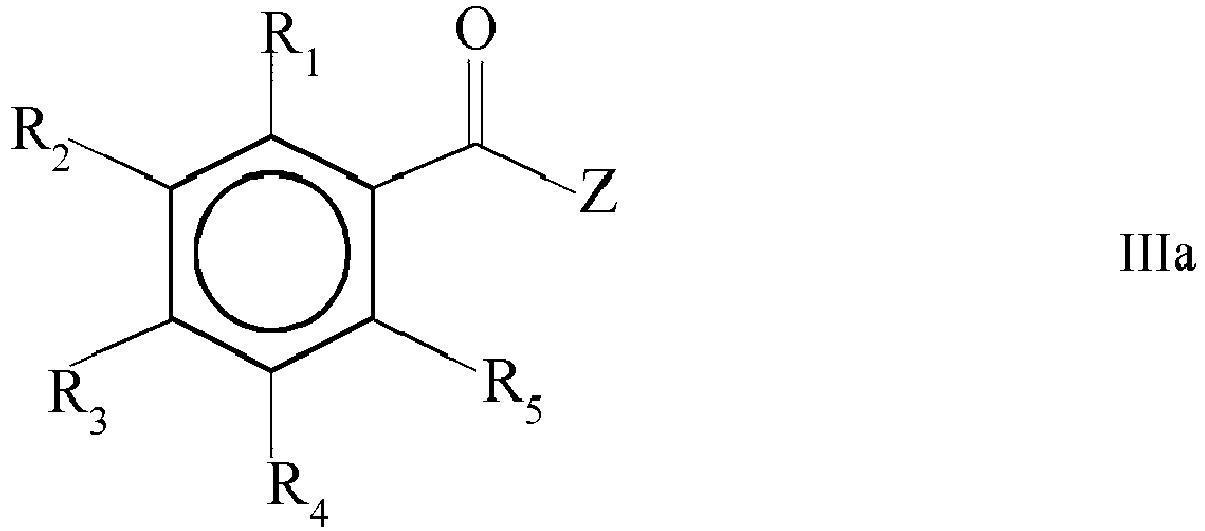
 c) acidification du mélange obtenu dans l'étape b).
 - Procédé selon la revendication 1, caractérisé en ce que R1, R3 et R5 et/ou R7, R9 et R11 sont identiques.
- Procédé selon la revendication 2, caractérisé en ce que R1, R3 et R5 et/ou R7, R9 et R11 sont identiques et sont choisis parmi alkyle en C1 à C20 linéaire ou ramifié, de préférence alkyle en C1 à C18 linéaire ou ramifié, plus préférablement alkyle en C1 à C12 linéaire ou ramifié, et le plus préférablement alkyle en C1 à C8 linéaire.
- Procédé selon l'une quelconque des revendications 1 à 3, caractérisé en ce que R2 et R4 et/ou R9 et R10 sont identiques, de préférence R2 et R4 et/ou R9 et R10 sont différents de R1, R3 et R5 et/ou R7, R9 et R11.
- Procédé selon la revendication 1, caractérisé en ce que R2 et R4 et/ou R9 et R10 dont identiques et sont H.
- Procédé selon l'une quelconque des revendications 1 à 5, caractérisé en ce que Z est un halogène, de préférence choisi parmi fluoro, chloro, bromo et iodo, de préférence chloro.
- Procédé selon l'une quelconque des revendications 1 à 6, caractérisé en ce que le phosphure métallique est choisi dans le groupe constitué par Ca3P2, Zn3P2, AlP, Fe3P, et leurs mélanges, de préférence dans le groupe constitué par Ca3P2, Zn3P2, AlP et leurs mélanges.
- Procédé selon l'une quelconque des revendications 1 à 7, caractérisé en ce que l'agent chélatant a la capacité de complexer des cations tels que Ca2+, Zn2+, Al+, Fe3+ et leurs mélanges.
- Procédé selon l'une quelconque des revendications 1 à 8, caractérisé en ce que l'agent chélatant est choisi dans le groupe comprenant le 1,2-diméthoxyéthane (DME), le 1,2-diéthoxyéthane (DEE), le 1,2-dihydroxypropane, le 1,3-dihydroxypropane, le 1,2-diméthoxypropane, le 1,3-diméthoxypropane, le glycérol, le 1,3-dioxane, le 1,4-dioxane, la tris(2-aminoéthyl)amine, la tris[2-(diméthylamino)éthyl]amine, l'éther diméthylique de diéthylèneglycol (diglyme), l'éther diméthylique de triéthylèneglycol (triglyme), la N,N,N',N'-tétraméthyléthylènediamine (TMEDA), l'acide éthylènediaminetétraacétique (EDTA), et leurs mélanges.
- Procédé selon l'une quelconque des revendications 1 à 9, caractérisé en ce qu'un alcool est en outre ajouté dans l'étape a), de préférence un alcool choisi dans le groupe comprenant le méthanol, l'éthanol, le n-propanol, l'isopropanol, le n-butanol, l'isobutanol, le tert-butanol, l'alcool n-amylique, l'alcool sec-amylique, l'alcool tert-amylique, le 3-méthyl-3-pentanol, l'éthylèneglycol, le 1,2,3-propanetriol, l'éthanolamine, la diéthanolamine, la triéthanolamine et leurs mélanges, plus préférablement l'alcool est choisi dans le groupe comprenant le tert-butanol, l'alcool sec-amylique, l'alcool tert-amylique, le 3-méthyl-3-pentanol et leurs mélanges.
- Procédé selon l'une quelconque des revendications 1 à 10, caractérisé en ce qu'un additif choisi dans le groupe comprenant le tert-butylate de potassium, le diacétate d'α-DL-alanine trisodique, la triméthylamine, la triéthylamine et leurs mélanges, est en outre ajouté dans les étapes a) et/ou b).
- Procédé selon l'une quelconque des revendications 1 à 11, caractérisé en ce que l'étape a) est mise en œuvre à une température dans la plage de 10 à 50°C, de préférence dans la plage de 12 à 40°C, plus préférablement dans la plage de 15 à 30°C, et le plus préférablement dans la plage de 15 à 28°C, et/ou l'étape b) est mise en œuvre à une température dans la plage de -5 à 50°C, de préférence dans la plage de 0 à 40°C, plus préférablement dans la plage de 0 à 30°C, et le plus préférablement dans la plage de 0 à 28°C.
- Procédé selon l'une quelconque des revendications 1 à 12, caractérisé en ce que le procédé comprend une autre étape d) d'alkylation, alcoxylation, alcénylation, alcénoxylation, arylation, acylation, carboxylation, cycloalkylation, cycloalcoxylation, arylalcoxylation, alcénylarylalcoxylation ou hydroxylation et ensuite d'oxydation de la bis(acyl)phosphine de formule générale II obtenue dans l'étape c) pour que soit obtenue la bis(acyl)phosphine de formule générale IV

- Procédé selon la revendication 13, caractérisé en ce que l'oxydation est mise en œuvre par utilisation de peroxyde d'hydrogène.
- Procédé selon l'une quelconque des revendications 1 à 12, caractérisé en ce que le procédé comprend une autre étape d) d'alkylation, alcoxylation, alcénylation, alcénoxylation, arylation, acylation, carboxylation, cycloalkylation, cycloalcoxylation, arylalcoxylation, alcénylarylalcoxylation ou hydroxylation de la mono(acyl)phosphine de formule générale I obtenue dans l'étape c) pour que soit obtenue la mono(acyl)phosphine de formule générale V

Priority Applications (7)
| Application Number | Priority Date | Filing Date | Title |
|---|---|---|---|
| EP17173445.2A EP3409680B1 (fr) | 2017-05-30 | 2017-05-30 | Synthèse de bis (acyle) phosphines par l'activation de phosphures métalliques non réactives |
| BR112019023226-5A BR112019023226A2 (pt) | 2017-05-30 | 2018-05-30 | Processo para preparação de uma mono(acil)fosfina da fórmula geral i e/ou uma bis(acil)fosfina da fórmula geral ii, mono(acil)fosfina da fórmula geral i e/ou uma bis(acil)fosfina da fórmula geral ii, bis(acil)fosfina da fórmula geral iv, e, mono(acil)fosfina da fórmula geral v |
| CN201880031743.1A CN110621682A (zh) | 2017-05-30 | 2018-05-30 | 通过无反应活性金属磷化物活化合成双(酰基)膦 |
| TW107118406A TWI675040B (zh) | 2017-05-30 | 2018-05-30 | 藉由不具反應性金屬磷化物的活化來合成雙(醯基)膦 |
| PCT/EP2018/064156 WO2018219994A1 (fr) | 2017-05-30 | 2018-05-30 | Synthèse de bis(acyl)phosphines par activation de phosphures métalliques non réactifs |
| JP2019556885A JP2020521722A (ja) | 2017-05-30 | 2018-05-30 | 非反応性金属リン化物の活性化によるビス(アシル)ホスフィンの合成 |
| US16/613,394 US20200115402A1 (en) | 2017-05-30 | 2018-05-30 | Synthesis of bis(acyl)phosphines by activation of unreactive metal phosphides |
Applications Claiming Priority (1)
| Application Number | Priority Date | Filing Date | Title |
|---|---|---|---|
| EP17173445.2A EP3409680B1 (fr) | 2017-05-30 | 2017-05-30 | Synthèse de bis (acyle) phosphines par l'activation de phosphures métalliques non réactives |
Publications (2)
| Publication Number | Publication Date |
|---|---|
| EP3409680A1 EP3409680A1 (fr) | 2018-12-05 |
| EP3409680B1 true EP3409680B1 (fr) | 2021-01-06 |
Family
ID=58873672
Family Applications (1)
| Application Number | Title | Priority Date | Filing Date |
|---|---|---|---|
| EP17173445.2A Active EP3409680B1 (fr) | 2017-05-30 | 2017-05-30 | Synthèse de bis (acyle) phosphines par l'activation de phosphures métalliques non réactives |
Country Status (7)
| Country | Link |
|---|---|
| US (1) | US20200115402A1 (fr) |
| EP (1) | EP3409680B1 (fr) |
| JP (1) | JP2020521722A (fr) |
| CN (1) | CN110621682A (fr) |
| BR (1) | BR112019023226A2 (fr) |
| TW (1) | TWI675040B (fr) |
| WO (1) | WO2018219994A1 (fr) |
Families Citing this family (1)
| Publication number | Priority date | Publication date | Assignee | Title |
|---|---|---|---|---|
| CN111285339B (zh) * | 2020-03-15 | 2022-10-04 | 湖北中科墨磷科技有限公司 | 一种Sn3P4诱导二维黑磷晶体的制备方法 |
Family Cites Families (17)
| Publication number | Priority date | Publication date | Assignee | Title |
|---|---|---|---|---|
| DE2909994A1 (de) | 1979-03-14 | 1980-10-02 | Basf Ag | Acylphosphinoxidverbindungen, ihre herstellung und verwendung |
| DE3443221A1 (de) | 1984-11-27 | 1986-06-05 | ESPE Fabrik pharmazeutischer Präparate GmbH, 8031 Seefeld | Bisacylphosphinoxide, ihre herstellung und verwendung |
| US5218009A (en) | 1989-08-04 | 1993-06-08 | Ciba-Geigy Corporation | Mono- and di-acylphosphine oxides |
| RU2091385C1 (ru) | 1991-09-23 | 1997-09-27 | Циба-Гейги АГ | Бисацилфосфиноксиды, состав и способ нанесения покрытий |
| ZA941879B (en) | 1993-03-18 | 1994-09-19 | Ciba Geigy | Curing compositions containing bisacylphosphine oxide photoinitiators |
| SK286152B6 (sk) | 1998-11-30 | 2008-04-07 | Ciba Specialty Chemicals Holding Inc. | Spôsob prípravy acylfosfínov, acylfosfínoxidov a acylfosfínsulfidov |
| GB2360283B (en) * | 2000-02-08 | 2002-08-21 | Ciba Sc Holding Ag | Monoacylarylphosphines and acylphosphine oxides and sulphides |
| GB2365430B (en) * | 2000-06-08 | 2002-08-28 | Ciba Sc Holding Ag | Acylphosphine photoinitiators and intermediates |
| JP2005509685A (ja) * | 2001-11-20 | 2005-04-14 | チバ スペシャルティ ケミカルズ ホールディング インコーポレーテッド | アシルホスフィン及びその誘導体のマルチマー形態 |
| CA2531318A1 (fr) * | 2003-07-18 | 2005-02-17 | Ciba Specialty Chemicals Holding Inc. | Procede de preparation d'acylphosphanes et de derives d'acylphosphanes |
| CN101065388B (zh) * | 2004-11-23 | 2011-12-21 | 西巴特殊化学品控股有限公司 | 制备酰基磷烷及其衍生物的方法 |
| WO2010121387A1 (fr) * | 2009-04-20 | 2010-10-28 | ETH Zürich | Nanoparticules polymères |
| EP2451847B1 (fr) * | 2009-07-06 | 2021-11-24 | IGM Group B.V. | Oxydes de bisacylphosphine à liaison de polymère |
| ES2881686T3 (es) * | 2012-10-01 | 2021-11-30 | Eth Zuerich | Un procedimiento para la preparación de acilofosfanos |
| WO2014095724A1 (fr) * | 2012-12-19 | 2014-06-26 | Basf Se | Dérivés d'acide bisacylphosphinique, leur préparation et leur utilisation en tant que photo-initiateurs |
| CN106554430B (zh) * | 2016-06-20 | 2019-04-02 | 长沙新宇高分子科技有限公司 | 一种酰基膦光引发剂 |
| EP3296301A1 (fr) * | 2016-09-19 | 2018-03-21 | ETH Zürich | Procédé versatile pour la préparation d'acylphosphines |
-
2017
- 2017-05-30 EP EP17173445.2A patent/EP3409680B1/fr active Active
-
2018
- 2018-05-30 US US16/613,394 patent/US20200115402A1/en not_active Abandoned
- 2018-05-30 JP JP2019556885A patent/JP2020521722A/ja active Pending
- 2018-05-30 CN CN201880031743.1A patent/CN110621682A/zh active Pending
- 2018-05-30 WO PCT/EP2018/064156 patent/WO2018219994A1/fr not_active Ceased
- 2018-05-30 TW TW107118406A patent/TWI675040B/zh active
- 2018-05-30 BR BR112019023226-5A patent/BR112019023226A2/pt active Search and Examination
Non-Patent Citations (1)
| Title |
|---|
| None * |
Also Published As
| Publication number | Publication date |
|---|---|
| BR112019023226A2 (pt) | 2020-05-26 |
| TW201900662A (zh) | 2019-01-01 |
| US20200115402A1 (en) | 2020-04-16 |
| JP2020521722A (ja) | 2020-07-27 |
| CN110621682A (zh) | 2019-12-27 |
| EP3409680A1 (fr) | 2018-12-05 |
| TWI675040B (zh) | 2019-10-21 |
| WO2018219994A1 (fr) | 2018-12-06 |
Similar Documents
| Publication | Publication Date | Title |
|---|---|---|
| EP0386105B1 (fr) | Procede de preparation de ligands bidentes | |
| US3517067A (en) | Syntheses of quaternary phosphonium salts | |
| JP5154940B2 (ja) | 高精製ジアルキルホスフィン酸の製造方法 | |
| CN100567310C (zh) | 高纯度二烷基次膦酸的制备方法 | |
| US20200115402A1 (en) | Synthesis of bis(acyl)phosphines by activation of unreactive metal phosphides | |
| EP0807637A1 (fr) | Procédé de préparation de phosphanes tertiaires contenant des groupes phosphinates ou phosphonates et nouveaux phosphanes contenant des groupes phosphinates | |
| CN102603793B (zh) | 用于制备烷基磷酸酯的方法 | |
| US3347932A (en) | Synthesis of quaternary phosphonium salts | |
| Yavari et al. | A simple synthesis of stable phosphoranes derived from imides or acetanilide derivatives | |
| Savignac et al. | α-Cuprophosphonates. V. The Reaction of 3 and 4-Oxoalkane Phosphonates and Their Use in Aminoalkanephosphonic Acids Synthesis | |
| KR100889897B1 (ko) | 포스포로디아미디트의 제조방법 | |
| EP0938490A1 (fr) | Nouveaux palladaphosphacyclobutanes et leur procede de preparation | |
| JPH09221491A (ja) | 6−アルコキシ−(6H)−ジベンゾ[c,e][1,2]− オキサホスホリンの製造方法 | |
| Arbuzova et al. | Nucleophilic addition of secondary phosphine chalcogenides to, α, β-acetylenic γ-hydroxy acid nitriles and a rearrangement of the adducts | |
| US10865219B2 (en) | Process for the preparation of bis(acyl)phospinic acid sylyl esters | |
| Baharfar et al. | The novel one-pot synthesis of functionalized vinyl sulfides using triphenylphosphine catalyzed nucleophilic addition of thiols to acetylenes | |
| CN112321638B (zh) | 单烷基亚膦酸二烷基酯、二烷基膦酸酯及其金属盐的制备方法 | |
| EP0491240A1 (fr) | Procédé de préparation de diphosphanes sulphonés solubles dans l'eau | |
| JP4183974B2 (ja) | パラ−ジアリールホスフィノベンゼンスルホン酸塩の製造方法 | |
| JPH0359908B2 (fr) | ||
| SU1074878A1 (ru) | Метиленбис ( @ -оксиалкил) фосфиновые кислоты | |
| DE4318013A1 (de) | Fünfwertige Phosphorverbindungen und Verfahren zu ihrer Herstellung | |
| JPH02503084A (ja) | アルキルジアリールホスファイト類およびジアリールハロホスフェート類の製造方法 | |
| CN112745348A (zh) | 一种二烃基二硫代次膦酸的制备方法 | |
| JP2777985B2 (ja) | セレノアルケニルホスホン酸エステルおよびその製造方法 |
Legal Events
| Date | Code | Title | Description |
|---|---|---|---|
| PUAI | Public reference made under article 153(3) epc to a published international application that has entered the european phase |
Free format text: ORIGINAL CODE: 0009012 |
|
| STAA | Information on the status of an ep patent application or granted ep patent |
Free format text: STATUS: THE APPLICATION HAS BEEN PUBLISHED |
|
| AK | Designated contracting states |
Kind code of ref document: A1 Designated state(s): AL AT BE BG CH CY CZ DE DK EE ES FI FR GB GR HR HU IE IS IT LI LT LU LV MC MK MT NL NO PL PT RO RS SE SI SK SM TR |
|
| AX | Request for extension of the european patent |
Extension state: BA ME |
|
| STAA | Information on the status of an ep patent application or granted ep patent |
Free format text: STATUS: REQUEST FOR EXAMINATION WAS MADE |
|
| 17P | Request for examination filed |
Effective date: 20190528 |
|
| RBV | Designated contracting states (corrected) |
Designated state(s): AL AT BE BG CH CY CZ DE DK EE ES FI FR GB GR HR HU IE IS IT LI LT LU LV MC MK MT NL NO PL PT RO RS SE SI SK SM TR |
|
| STAA | Information on the status of an ep patent application or granted ep patent |
Free format text: STATUS: EXAMINATION IS IN PROGRESS |
|
| 17Q | First examination report despatched |
Effective date: 20191029 |
|
| GRAP | Despatch of communication of intention to grant a patent |
Free format text: ORIGINAL CODE: EPIDOSNIGR1 |
|
| STAA | Information on the status of an ep patent application or granted ep patent |
Free format text: STATUS: GRANT OF PATENT IS INTENDED |
|
| INTG | Intention to grant announced |
Effective date: 20201006 |
|
| GRAS | Grant fee paid |
Free format text: ORIGINAL CODE: EPIDOSNIGR3 |
|
| GRAA | (expected) grant |
Free format text: ORIGINAL CODE: 0009210 |
|
| STAA | Information on the status of an ep patent application or granted ep patent |
Free format text: STATUS: THE PATENT HAS BEEN GRANTED |
|
| AK | Designated contracting states |
Kind code of ref document: B1 Designated state(s): AL AT BE BG CH CY CZ DE DK EE ES FI FR GB GR HR HU IE IS IT LI LT LU LV MC MK MT NL NO PL PT RO RS SE SI SK SM TR |
|
| REG | Reference to a national code |
Ref country code: GB Ref legal event code: FG4D |
|
| REG | Reference to a national code |
Ref country code: AT Ref legal event code: REF Ref document number: 1352260 Country of ref document: AT Kind code of ref document: T Effective date: 20210115 Ref country code: CH Ref legal event code: EP |
|
| REG | Reference to a national code |
Ref country code: DE Ref legal event code: R096 Ref document number: 602017030783 Country of ref document: DE |
|
| REG | Reference to a national code |
Ref country code: IE Ref legal event code: FG4D |
|
| REG | Reference to a national code |
Ref country code: NL Ref legal event code: MP Effective date: 20210106 |
|
| REG | Reference to a national code |
Ref country code: AT Ref legal event code: MK05 Ref document number: 1352260 Country of ref document: AT Kind code of ref document: T Effective date: 20210106 |
|
| REG | Reference to a national code |
Ref country code: LT Ref legal event code: MG9D |
|
| PG25 | Lapsed in a contracting state [announced via postgrant information from national office to epo] |
Ref country code: PT Free format text: LAPSE BECAUSE OF FAILURE TO SUBMIT A TRANSLATION OF THE DESCRIPTION OR TO PAY THE FEE WITHIN THE PRESCRIBED TIME-LIMIT Effective date: 20210506 Ref country code: NO Free format text: LAPSE BECAUSE OF FAILURE TO SUBMIT A TRANSLATION OF THE DESCRIPTION OR TO PAY THE FEE WITHIN THE PRESCRIBED TIME-LIMIT Effective date: 20210406 Ref country code: HR Free format text: LAPSE BECAUSE OF FAILURE TO SUBMIT A TRANSLATION OF THE DESCRIPTION OR TO PAY THE FEE WITHIN THE PRESCRIBED TIME-LIMIT Effective date: 20210106 Ref country code: FI Free format text: LAPSE BECAUSE OF FAILURE TO SUBMIT A TRANSLATION OF THE DESCRIPTION OR TO PAY THE FEE WITHIN THE PRESCRIBED TIME-LIMIT Effective date: 20210106 Ref country code: GR Free format text: LAPSE BECAUSE OF FAILURE TO SUBMIT A TRANSLATION OF THE DESCRIPTION OR TO PAY THE FEE WITHIN THE PRESCRIBED TIME-LIMIT Effective date: 20210407 Ref country code: LT Free format text: LAPSE BECAUSE OF FAILURE TO SUBMIT A TRANSLATION OF THE DESCRIPTION OR TO PAY THE FEE WITHIN THE PRESCRIBED TIME-LIMIT Effective date: 20210106 Ref country code: BG Free format text: LAPSE BECAUSE OF FAILURE TO SUBMIT A TRANSLATION OF THE DESCRIPTION OR TO PAY THE FEE WITHIN THE PRESCRIBED TIME-LIMIT Effective date: 20210406 |
|
| PG25 | Lapsed in a contracting state [announced via postgrant information from national office to epo] |
Ref country code: PL Free format text: LAPSE BECAUSE OF FAILURE TO SUBMIT A TRANSLATION OF THE DESCRIPTION OR TO PAY THE FEE WITHIN THE PRESCRIBED TIME-LIMIT Effective date: 20210106 Ref country code: RS Free format text: LAPSE BECAUSE OF FAILURE TO SUBMIT A TRANSLATION OF THE DESCRIPTION OR TO PAY THE FEE WITHIN THE PRESCRIBED TIME-LIMIT Effective date: 20210106 Ref country code: LV Free format text: LAPSE BECAUSE OF FAILURE TO SUBMIT A TRANSLATION OF THE DESCRIPTION OR TO PAY THE FEE WITHIN THE PRESCRIBED TIME-LIMIT Effective date: 20210106 Ref country code: AT Free format text: LAPSE BECAUSE OF FAILURE TO SUBMIT A TRANSLATION OF THE DESCRIPTION OR TO PAY THE FEE WITHIN THE PRESCRIBED TIME-LIMIT Effective date: 20210106 Ref country code: SE Free format text: LAPSE BECAUSE OF FAILURE TO SUBMIT A TRANSLATION OF THE DESCRIPTION OR TO PAY THE FEE WITHIN THE PRESCRIBED TIME-LIMIT Effective date: 20210106 |
|
| PG25 | Lapsed in a contracting state [announced via postgrant information from national office to epo] |
Ref country code: IS Free format text: LAPSE BECAUSE OF FAILURE TO SUBMIT A TRANSLATION OF THE DESCRIPTION OR TO PAY THE FEE WITHIN THE PRESCRIBED TIME-LIMIT Effective date: 20210506 |
|
| REG | Reference to a national code |
Ref country code: DE Ref legal event code: R097 Ref document number: 602017030783 Country of ref document: DE |
|
| PG25 | Lapsed in a contracting state [announced via postgrant information from national office to epo] |
Ref country code: SM Free format text: LAPSE BECAUSE OF FAILURE TO SUBMIT A TRANSLATION OF THE DESCRIPTION OR TO PAY THE FEE WITHIN THE PRESCRIBED TIME-LIMIT Effective date: 20210106 Ref country code: CZ Free format text: LAPSE BECAUSE OF FAILURE TO SUBMIT A TRANSLATION OF THE DESCRIPTION OR TO PAY THE FEE WITHIN THE PRESCRIBED TIME-LIMIT Effective date: 20210106 Ref country code: EE Free format text: LAPSE BECAUSE OF FAILURE TO SUBMIT A TRANSLATION OF THE DESCRIPTION OR TO PAY THE FEE WITHIN THE PRESCRIBED TIME-LIMIT Effective date: 20210106 |
|
| PLBE | No opposition filed within time limit |
Free format text: ORIGINAL CODE: 0009261 |
|
| STAA | Information on the status of an ep patent application or granted ep patent |
Free format text: STATUS: NO OPPOSITION FILED WITHIN TIME LIMIT |
|
| PG25 | Lapsed in a contracting state [announced via postgrant information from national office to epo] |
Ref country code: SK Free format text: LAPSE BECAUSE OF FAILURE TO SUBMIT A TRANSLATION OF THE DESCRIPTION OR TO PAY THE FEE WITHIN THE PRESCRIBED TIME-LIMIT Effective date: 20210106 Ref country code: RO Free format text: LAPSE BECAUSE OF FAILURE TO SUBMIT A TRANSLATION OF THE DESCRIPTION OR TO PAY THE FEE WITHIN THE PRESCRIBED TIME-LIMIT Effective date: 20210106 Ref country code: DK Free format text: LAPSE BECAUSE OF FAILURE TO SUBMIT A TRANSLATION OF THE DESCRIPTION OR TO PAY THE FEE WITHIN THE PRESCRIBED TIME-LIMIT Effective date: 20210106 |
|
| 26N | No opposition filed |
Effective date: 20211007 |
|
| REG | Reference to a national code |
Ref country code: CH Ref legal event code: PL |
|
| PG25 | Lapsed in a contracting state [announced via postgrant information from national office to epo] |
Ref country code: ES Free format text: LAPSE BECAUSE OF FAILURE TO SUBMIT A TRANSLATION OF THE DESCRIPTION OR TO PAY THE FEE WITHIN THE PRESCRIBED TIME-LIMIT Effective date: 20210106 Ref country code: CH Free format text: LAPSE BECAUSE OF NON-PAYMENT OF DUE FEES Effective date: 20210531 Ref country code: AL Free format text: LAPSE BECAUSE OF FAILURE TO SUBMIT A TRANSLATION OF THE DESCRIPTION OR TO PAY THE FEE WITHIN THE PRESCRIBED TIME-LIMIT Effective date: 20210106 Ref country code: LU Free format text: LAPSE BECAUSE OF NON-PAYMENT OF DUE FEES Effective date: 20210530 Ref country code: LI Free format text: LAPSE BECAUSE OF NON-PAYMENT OF DUE FEES Effective date: 20210531 Ref country code: MC Free format text: LAPSE BECAUSE OF FAILURE TO SUBMIT A TRANSLATION OF THE DESCRIPTION OR TO PAY THE FEE WITHIN THE PRESCRIBED TIME-LIMIT Effective date: 20210106 |
|
| REG | Reference to a national code |
Ref country code: BE Ref legal event code: MM Effective date: 20210531 |
|
| PG25 | Lapsed in a contracting state [announced via postgrant information from national office to epo] |
Ref country code: SI Free format text: LAPSE BECAUSE OF FAILURE TO SUBMIT A TRANSLATION OF THE DESCRIPTION OR TO PAY THE FEE WITHIN THE PRESCRIBED TIME-LIMIT Effective date: 20210106 |
|
| PG25 | Lapsed in a contracting state [announced via postgrant information from national office to epo] |
Ref country code: IE Free format text: LAPSE BECAUSE OF NON-PAYMENT OF DUE FEES Effective date: 20210530 |
|
| PG25 | Lapsed in a contracting state [announced via postgrant information from national office to epo] |
Ref country code: IS Free format text: LAPSE BECAUSE OF FAILURE TO SUBMIT A TRANSLATION OF THE DESCRIPTION OR TO PAY THE FEE WITHIN THE PRESCRIBED TIME-LIMIT Effective date: 20210506 Ref country code: FR Free format text: LAPSE BECAUSE OF NON-PAYMENT OF DUE FEES Effective date: 20210531 |
|
| PG25 | Lapsed in a contracting state [announced via postgrant information from national office to epo] |
Ref country code: BE Free format text: LAPSE BECAUSE OF NON-PAYMENT OF DUE FEES Effective date: 20210531 |
|
| P01 | Opt-out of the competence of the unified patent court (upc) registered |
Effective date: 20230508 |
|
| PG25 | Lapsed in a contracting state [announced via postgrant information from national office to epo] |
Ref country code: NL Free format text: LAPSE BECAUSE OF NON-PAYMENT OF DUE FEES Effective date: 20210206 Ref country code: CY Free format text: LAPSE BECAUSE OF FAILURE TO SUBMIT A TRANSLATION OF THE DESCRIPTION OR TO PAY THE FEE WITHIN THE PRESCRIBED TIME-LIMIT Effective date: 20210106 |
|
| PG25 | Lapsed in a contracting state [announced via postgrant information from national office to epo] |
Ref country code: HU Free format text: LAPSE BECAUSE OF FAILURE TO SUBMIT A TRANSLATION OF THE DESCRIPTION OR TO PAY THE FEE WITHIN THE PRESCRIBED TIME-LIMIT; INVALID AB INITIO Effective date: 20170530 |
|
| PG25 | Lapsed in a contracting state [announced via postgrant information from national office to epo] |
Ref country code: MK Free format text: LAPSE BECAUSE OF FAILURE TO SUBMIT A TRANSLATION OF THE DESCRIPTION OR TO PAY THE FEE WITHIN THE PRESCRIBED TIME-LIMIT Effective date: 20210106 |
|
| PG25 | Lapsed in a contracting state [announced via postgrant information from national office to epo] |
Ref country code: TR Free format text: LAPSE BECAUSE OF FAILURE TO SUBMIT A TRANSLATION OF THE DESCRIPTION OR TO PAY THE FEE WITHIN THE PRESCRIBED TIME-LIMIT Effective date: 20210106 |
|
| PG25 | Lapsed in a contracting state [announced via postgrant information from national office to epo] |
Ref country code: MT Free format text: LAPSE BECAUSE OF FAILURE TO SUBMIT A TRANSLATION OF THE DESCRIPTION OR TO PAY THE FEE WITHIN THE PRESCRIBED TIME-LIMIT Effective date: 20210106 |
|
| PGFP | Annual fee paid to national office [announced via postgrant information from national office to epo] |
Ref country code: DE Payment date: 20250528 Year of fee payment: 9 |
|
| PGFP | Annual fee paid to national office [announced via postgrant information from national office to epo] |
Ref country code: GB Payment date: 20250522 Year of fee payment: 9 |
|
| PGFP | Annual fee paid to national office [announced via postgrant information from national office to epo] |
Ref country code: IT Payment date: 20250530 Year of fee payment: 9 |