EP3409681B1 - N,n-bis(2-dialkylphosphinoethyl)amin-boran-komplex und herstellungsverfahren dafür sowie verfahren zur herstellung eines rutheniumkomplexes mit n,n-bis(2-dialkylphosphinoethyl)amin als ligand - Google Patents
N,n-bis(2-dialkylphosphinoethyl)amin-boran-komplex und herstellungsverfahren dafür sowie verfahren zur herstellung eines rutheniumkomplexes mit n,n-bis(2-dialkylphosphinoethyl)amin als ligand Download PDFInfo
- Publication number
- EP3409681B1 EP3409681B1 EP17744455.1A EP17744455A EP3409681B1 EP 3409681 B1 EP3409681 B1 EP 3409681B1 EP 17744455 A EP17744455 A EP 17744455A EP 3409681 B1 EP3409681 B1 EP 3409681B1
- Authority
- EP
- European Patent Office
- Prior art keywords
- group
- optionally substituted
- atom
- bis
- independently represent
- Prior art date
- Legal status (The legal status is an assumption and is not a legal conclusion. Google has not performed a legal analysis and makes no representation as to the accuracy of the status listed.)
- Active
Links
- 0 **(B(N)N)(*)N Chemical compound **(B(N)N)(*)N 0.000 description 2
Images


Classifications
-
- C—CHEMISTRY; METALLURGY
- C07—ORGANIC CHEMISTRY
- C07F—ACYCLIC, CARBOCYCLIC OR HETEROCYCLIC COMPOUNDS CONTAINING ELEMENTS OTHER THAN CARBON, HYDROGEN, HALOGEN, OXYGEN, NITROGEN, SULFUR, SELENIUM OR TELLURIUM
- C07F9/00—Compounds containing elements of Groups 5 or 15 of the Periodic Table
- C07F9/02—Phosphorus compounds
- C07F9/28—Phosphorus compounds with one or more P—C bonds
- C07F9/50—Organo-phosphines
- C07F9/505—Preparation; Separation; Purification; Stabilisation
- C07F9/5063—Preparation; Separation; Purification; Stabilisation from compounds having the structure P-H or P-Heteroatom, in which one or more of such bonds are converted into P-C bonds
- C07F9/5077—Preparation; Separation; Purification; Stabilisation from compounds having the structure P-H or P-Heteroatom, in which one or more of such bonds are converted into P-C bonds from starting materials having the structure P-Metal, including R2P-M+
-
- C—CHEMISTRY; METALLURGY
- C07—ORGANIC CHEMISTRY
- C07F—ACYCLIC, CARBOCYCLIC OR HETEROCYCLIC COMPOUNDS CONTAINING ELEMENTS OTHER THAN CARBON, HYDROGEN, HALOGEN, OXYGEN, NITROGEN, SULFUR, SELENIUM OR TELLURIUM
- C07F15/00—Compounds containing elements of Groups 8, 9, 10 or 18 of the Periodic Table
- C07F15/0006—Compounds containing elements of Groups 8, 9, 10 or 18 of the Periodic Table compounds of the platinum group
- C07F15/0046—Ruthenium compounds
-
- C—CHEMISTRY; METALLURGY
- C07—ORGANIC CHEMISTRY
- C07F—ACYCLIC, CARBOCYCLIC OR HETEROCYCLIC COMPOUNDS CONTAINING ELEMENTS OTHER THAN CARBON, HYDROGEN, HALOGEN, OXYGEN, NITROGEN, SULFUR, SELENIUM OR TELLURIUM
- C07F5/00—Compounds containing elements of Groups 3 or 13 of the Periodic Table
- C07F5/02—Boron compounds
- C07F5/022—Boron compounds without C-boron linkages
-
- C—CHEMISTRY; METALLURGY
- C07—ORGANIC CHEMISTRY
- C07F—ACYCLIC, CARBOCYCLIC OR HETEROCYCLIC COMPOUNDS CONTAINING ELEMENTS OTHER THAN CARBON, HYDROGEN, HALOGEN, OXYGEN, NITROGEN, SULFUR, SELENIUM OR TELLURIUM
- C07F9/00—Compounds containing elements of Groups 5 or 15 of the Periodic Table
- C07F9/02—Phosphorus compounds
- C07F9/28—Phosphorus compounds with one or more P—C bonds
-
- C—CHEMISTRY; METALLURGY
- C07—ORGANIC CHEMISTRY
- C07F—ACYCLIC, CARBOCYCLIC OR HETEROCYCLIC COMPOUNDS CONTAINING ELEMENTS OTHER THAN CARBON, HYDROGEN, HALOGEN, OXYGEN, NITROGEN, SULFUR, SELENIUM OR TELLURIUM
- C07F9/00—Compounds containing elements of Groups 5 or 15 of the Periodic Table
- C07F9/02—Phosphorus compounds
- C07F9/28—Phosphorus compounds with one or more P—C bonds
- C07F9/50—Organo-phosphines
- C07F9/5027—Polyphosphines
Definitions
- the present invention relates to an N,N-bis(2-dialkylphosphinoethyl)amine-borane complex, and a production method therefor, and a method for producing a ruthenium complex containing N,N-bis(2-dialkylphosphinoethyl)amines as a ligand.
- metal complexes comprising metal species and ligands are widely used as catalysts for organic synthesis reactions.
- the metal species which is an organic compound having a group (coordination group) having lone pair electrons capable of coordinating to the metal species plays an extremely important role, is known as a factor for the expression of the performance and activity of such a catalyst.
- metal complexes with tridentate ligand having an imino group as a coordination group in the molecule are known to exhibit high catalytic activities in, for example, hydrogenation reactions of carbonyl compounds, dehydrogenation reactions of alcohols, and the like, and also the hydrogen atom on the imino group is known to exert great influences on the expression of activities in these catalytic organic synthesis reactions.
- Known examples of such a tridentate ligand include N,N-bis(2-phosphinoethyl)amine, and it is reported that ruthenium complexes with the tridentate ligand function as excellent catalysts in hydrogenation reactions of esters (Patent Documents 1 to 4 and Non-Patent Documents 1 to 3).
- N,N-bis(2-diarylphosphinoethyl)amines used as a ligand can be synthesized easily by introducing phosphino groups as the coordination groups to N,N-bis(2-chloroethyl)amine as a substrate.
- Patent Document 5 discloses a process for the production of hydrogen comprising: (a) contacting a solution comprising at least one ligand-stabilized metal catalyst with at least one compound of the formula (I), R 1 R 2 HNBHR 3 R 4 (I), in a solvent under conditions for the solvolysis of the compound of formula (I), wherein R 1 , R 2 , R 3 and R 4 are each simultaneously or independently selected from H, branched or unbranched fluoro-substituted-C 1-20 alkyl, branched or unbranched C 1-20 alkyl and C 6-14 aryl or any two of R 1 , R 2 , R 3 and R 4 are linked to form a branched or unbranched C 2- 10 alkylene, which together with the nitrogen and/or boron atoms to which they are attached, forms a ring; and (b) optionally collecting hydrogen produced in the solvolysis of the compounds of formula (I).
- An object of the present invention is to provide a production method in which a ruthenium metal complex containing, as a ligand, N,N-bis(2-dialkylphosphinoethyl)amines having excellent performance such as catalytic activity in a hydrogenation reaction of a carbonyl compound, a dehydrogenation reaction of alcohols, etc. can be produced in a simple manner and high yield. Further, it is an object of the present invention to provide an N,N-bis(2-dialkylphosphinoethyl)amine-borane complex which is useful as a ligand raw material and a novel method for safely and practically producing the same.
- the present inventors have conducted intensive study to solve the above-described problems, and consequently have found that carbon dioxide is reacted with N,N-bis(2-chloroethyl)amine to be derived to 3-(2-chloroethyl)-2-oxazolidinone, and thus to react a dialkylphosphine-borane compound with the reaction product in the presence of bases, whereby a novel N,N-bis(2-dialkylphosphinoethyl)amine-borane complex can be synthesized with good yield by simple operation.
- this novel compound is stable to air and can be easily purified by, for example, column chromatography or recrystallization, and by reacting this compound with a ruthenium precursor in the presence of amines, a ruthenium metal complex containing, as a ligand, N,N-bis(2-dialkylphosphinoethyl)amines having excellent performance such as catalytic activity in a hydrogenation reaction of a carbonyl compound, a dehydrogenation reaction of alcohols, etc. can be safely produced in high yield by a short process, and the present invention has been completed.
- the present invention provides an N,N-bis(2-dialkylphosphinoethyl)amine-borane complex, and a production method therefor, and a method for producing a ruthenium complex containing N,N-bis(2-dialkylphosphinoethyl)amines as a ligand.
- the present invention includes the following [1] to [11].
- the present invention provides a method for simply and practically producing a novel N,N-bis(2-dialkylphosphinoethyl)amine-borane complex.
- the N,N-bis(2-dialkylphosphinoethyl)amine-borane complex according to the present invention is stable to air and can be easily purified by, for example, column chromatography or recrystallization, and by reacting this complex with a ruthenium precursor in the presence of amines, a ruthenium metal complex containing, as a ligand, N,N-bis(2-dialkylphosphinoethyl)amines having excellent performance such as catalytic activity in a hydrogenation reaction of a carbonyl compound, a dehydrogenation reaction of alcohols, etc. can be safely produced in high yield by a short process.
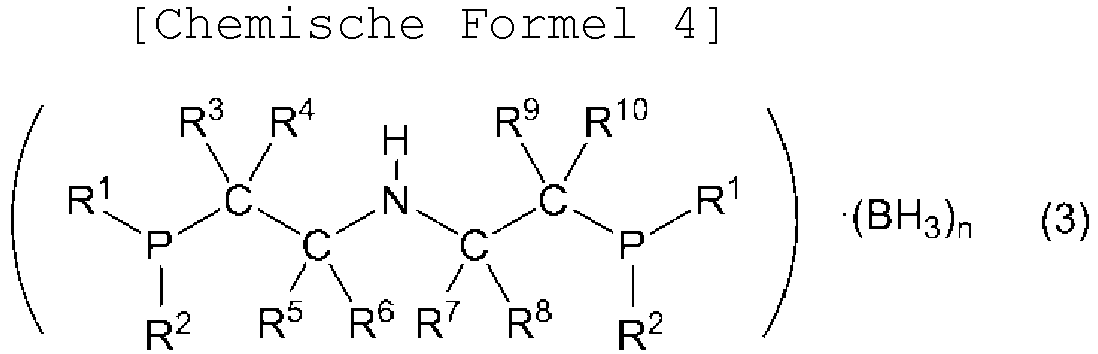
- a method for producing an N,N-bis(2-dialkylphosphinoethyl)amine-borane complex having the formula (3) according to the present invention can be expressed by the following reaction formula (6).
- the leaving group represented by LG may be any group that enables a nucleophilic substitution reaction, specific examples thereof include halogen atoms such as a fluorine atom, a chlorine atom, a bromine atom, and an iodine atom, a methanesulfonyloxy group (OMs), a p-toluenesulfonyloxy group (OTs), a benzenesulfonyloxy group (OSO 2 C 6 H 5 ), and a trifluoromethanesulfonyloxy group (OTf), of which a halogen atom is preferable and a chlorine atom is more preferable.
- halogen atoms such as a fluorine atom, a chlorine atom, a bromine atom, and an iodine atom
- OMs methanesulfonyloxy group
- OTs p-toluenesulfonyloxy group
- R 3 , R 4 , R 5 , R 6 , R 7 , R 8 , R 9 and R 10 each independently represent a hydrogen atom or a group selected from the group consisting of an alkyl group optionally having substituent(s), a cycloalkyl group optionally having substituent(s), an alkenyl group optionally having substituent(s), an aryl group optionally having substituent(s), and an aralkyl group optionally having substituent(s), and preferably each represent a hydrogen atom.
- the alkyl group in R 3 to R 10 may be linear or branched, examples thereof include an alkyl group having 1 to 30 carbon atoms, preferably 1 to 20 carbon atoms, and more preferably 1 to 10 carbon atoms, and specific examples thereof include a methyl group, an ethyl group, an n-propyl group, an isopropyl group, an n-butyl group, a 2-butyl group, an isobutyl group, a tert-butyl group, a cyclobutyl group, an n-pentyl group, a 2-pentyl group, a 3-pentyl group, a tert-pentyl group, a 2-methylbutyl group, a 3-methylbutyl group, a 2-methylbutan-3-yl group, a 2,2-dimethylpropyl group, an n-hexyl group, a 2-hexyl group, a 3-hexyl group, a ter
- Examples of the cycloalkyl group include a saturated or unsaturated monocyclic or polycyclic cycloalkyl group having 3 to 8 carbon atoms, preferably 5 to 7 carbon atoms.
- Examples of such a cycloalkyl group include a cyclopropyl group, a cyclopentyl group, a cyclohexyl group, a 1-adamantyl group, and a 2-adamantyl group, of which a cyclopentyl group and a cyclohexyl group are preferable.
- alkenyl group examples include an alkenyl group having 2 to 20 carbon atoms, which may be linear, branched or cyclic, of which an alkenyl group having 2 to 14 carbon atoms is preferable and an alkenyl group having 2 to 8 carbon atoms is more preferable.
- Specific examples thereof include a vinyl group, a 1-propenyl group, a 2-propenyl group, an allyl group, a 1-cyclohexenyl group, a 1-styryl group, and a 2-styryl group.
- aryl group examples include an aryl group having 6 to 18 carbon atoms, of which an aryl group having 6 to 14 carbon atoms is preferable and an aryl group having 6 to 10 carbon atoms is more preferable.
- Specific examples thereof include a phenyl group, a 1-naphthyl group, and a 2-naphthyl group, and preferred specific examples thereof include a phenyl group.
- aralkyl group examples include an aralkyl group having the above-described alkyl group in which at least one hydrogen atom of the alkyl group is substituted with the above-described aryl group and a polycyclic aralkyl group formed by condensing the above-described cyclic alkyl group with the above-described aryl group, and specific examples thereof include a benzyl group, a 1-phenylethyl group, a 2-phenylethyl group, a 1-phenylpropyl group, a 2-phenylpropyl group, a 3-phenylpropyl group, a 1-phenyl-2-propyl group, a 2-phenyl-2-propyl group, a 1-indanyl group, a 2-indanyl group, and a 9-fluorenyl group.
- Substituents which may be present on the alkyl groups, the cycloalkyl groups, the alkenyl groups, the aryl groups, and the aralkyl group serving as R 3 to R 10 , the ring formed when two of the R 3 to R 6 are bonded to each other, the ring formed when two of the R 7 to R 10 are bonded to each other, and the ring formed when two of the R 3 to R 10 are bonded to each other include alkyl groups, halogen atoms, alkenyl groups, aryl groups, heteroaryl groups, aralkyl groups, halogenoalkyl groups, and alkoxy groups, and the alkyl groups, the halogen atoms, the alkenyl groups, the aryl groups, the aralkyl groups, and substituent groups thereon are the same as those described in detail above.
- the heteroaryl groups include heteroaryl groups derived from 5- or 6-membered aromatic heterocycles containing 1 to 4 heteroatoms selected from the group consisting of a nitrogen atom, an oxygen atom, and a sulfur atom, and heteroaryl groups derived from polycyclic aromatic heterocycles which are formed by condensing the above-described aromatic heterocycles with the above-described aryl groups.
- Specific examples thereof include a 2-furyl group, a 3-furyl group, a 2-thienyl group, a 3-thienyl group, a 2-benzofuryl group, a 3-benzofuryl group, a 2-benzothienyl group, and a 3-benzothienyl group.
- alkoxy groups examples include alkoxy groups having 1 to 10 carbon atoms, of which alkoxy groups having 1 to 4 carbon atoms are preferable. Specific examples thereof include a methoxy group, an ethoxy group, a 1-propoxy group, a 2-propoxy group, a 1-butoxy group, a 2-butoxy group, and a tert-butoxy group.
- halogenoalkyl groups include groups which are the same as the above-described alkyl groups, except that at least one hydrogen atom is replaced with a halogen atom, and specific examples thereof include a trifluoromethyl group, and an n-nonafluorobutyl group.
- R 1 and R 2 each independently represent an alkyl group optionally having substituent(s) or a cycloalkyl group optionally having substituent(s).
- the alkyl group in R 1 and R 2 may be linear or branched, examples thereof include an alkyl group having 1 to 30 carbon atoms, preferably 1 to 20 carbon atoms, and more preferably 1 to 10 carbon atoms, and specific examples thereof include a methyl group, an ethyl group, an n-propyl group, an isopropyl group, an n-butyl group, a 2-butyl group, an isobutyl group, a tert-butyl group, a cyclobutyl group, an n-pentyl group, a 2-pentyl group, a 3-pentyl group, a tert-pentyl group, a 2-methylbutyl group, a 3-methylbutyl group, a 2-methylbutan-3-yl group, a 2,2-dimethylpropyl group, an n-hexyl group, a 2- hexyl group, a 3-hexyl group, a
- Examples of the cycloalkyl group in R 1 and R 2 include a saturated or unsaturated monocyclic or polycyclic cycloalkyl group having 3 to 8 carbon atoms, preferably 5 to 7 carbon atoms.
- Examples of such a cycloalkyl group include a cyclopropyl group, a cyclopentyl group, a cyclohexyl group, a 1-adamantyl group, and a 2-adamantyl group, of which a cyclopentyl group and a cyclohexyl group are preferable.
- R 1 and R 2 may be bonded to each other to form an optionally substituted ring.
- a ring include a phosphetane ring and a phospholane ring.
- Substituents which may be present on the alkyl groups and the cycloalkyl groups serving as R 1 and R 2 and the ring formed when R 1 and R 2 are bonded to each other include alkyl groups, halogen atoms, alkenyl groups, aryl groups, heteroaryl groups, aralkyl groups, halogenoalkyl groups, and alkoxy groups, and the alkyl groups, the halogen atoms, the alkenyl groups, the aryl groups, the aralkyl groups, and these substituents are the same as those described in detail in the above formula (1).
- examples of an optionally substituted alkyl group represented by R 1 or R 2 , an optionally substituted cycloalkyl group represented by R 1 or R 2 , and an optionally substituted ring formed by bonding adjacent R 1 and R 2 to each other include the same groups as in the formula (2).
- R 3 , R 4 , R 5 , R 6 , R 7 , R 8 , R 9 and R 10 each independently represent a hydrogen atom or a group selected from the group consisting of an alkyl group optionally having substituent(s), a cycloalkyl group optionally having substituent(s), an alkenyl group optionally having substituent(s), an aryl group optionally having substituent(s), and an aralkyl group optionally having substituent(s), and preferably each represent a hydrogen atom.
- Examples of the alkyl group, the optionally substituted alkenyl group, the optionally substituted aryl group, and the optionally substituted aralkyl group in R 3 to R 10 include the same groups as in the above formula (1).
- borane represents boron trihydride expressed by BH 3 .
- borane is coordinated to a nitrogen atom or phosphorus atom, and n is 2 or 3, or a mixture of 2 and 3.
- the oxazolidinone having the formula (1) can be synthesized by a method similar to the known method in, for example, JP 2003-292798 A .
- 3-(2-chloroethyl)-2-oxazolidinone can be synthesized by reacting carbon dioxide with N,N-bis(2-chloroethyl)amine hydrochloride.
- the phosphine-borane complex having the formula (2) can be synthesized by a method similar to the known method in, for example, Lydia McKinstry, Tom, Livinghouse, Tetrahedron, 1995, 51, 7655 .
- this complex can be produced by reacting secondary phosphines with a borane-dimethyl sulfide complex (BH 3 -SMe 2 ), a borane-tetrahydrofuran complex (BH 3 -THF), or the like.
- the reaction of the oxazolidinone having the formula (1) and the phosphine-borane complex having the formula (2) produced as described above is carried out in the presence of bases, whereby the N,N-bis(2-dialkylphosphinoethyl)amine-borane complex having the formula (3) can be produced.
- the amount of the phosphine-borane complex having the formula (2) which is used is not particularly limited, and is selected, as appropriate, from the range of generally 0.6 to 20 equivalents, preferably 1 to 10 equivalents, and more preferably 2 to 5 equivalents to the oxazolidinone having the formula (1).
- the phosphine-borane complex having the formula (2) may be used after purification by, for example, column chromatography or recrystallization in the production process, and after extraction with a solvent, the solution washed with water may be used.
- bases include alkali metal hydroxides such as lithium hydroxide, sodium hydroxide, and potassium hydroxide, alkaline earth metal hydroxides such as calcium hydroxide, strontium hydroxide, and barium hydroxide, metal hydrides such as lithium hydride, sodium hydride, potassium hydride, calcium hydride, sodium borohydride, and lithium aluminum hydride, alkali metal alkoxides such as lithium methoxide, sodium methoxide, potassium methoxide, sodium ethoxide, potassium ethoxide, sodium tert-butoxide, and potassium tert-butoxide, organolithium compounds such as methyllithium, n-butyllithium, sec-butyllithium, tert-butyllithium, and phenyllithium, alkali metal amides such as lithiumamide, sodium amide, lithium diisopropyl amide, and lithium hexamethyldisilazide, and Grignard reagents
- the amount of the base used is not particularly limited, and is selected, as appropriate, from the range of generally 0.3 to 10 equivalents, preferably 0.5 to 5 equivalents, and more preferably 0.8 to 3 equivalents to the compound having the formula (2).
- a method for adding the base is not particularly limited, and each of the compound having the formula (2) and the base may be added separately.
- a mixture of the compound having the formula (2) and the base (and a solvent) may be added, or the phosphide-borane complex obtainable by reacting the compound having the formula (2) with the base (in a solvent) may be added.
- This reaction is preferably carried out in the presence of solvent(s).
- the solvent include an aliphatic hydrocarbon such as n-pentane, n-hexane, n-heptane, n-octane, n-decane, cyclohexane, or decalin, an aromatic hydrocarbon such as benzene, toluene, xylene, mesitylene, p-cymene, or 1,4-diisopropylbenzene, a monoalcohol such as methanol, ethanol, 2-propanol, n-butanol, tert-butanol, 2-methyl-2-butanol, or 2-ethoxyethanol, a polyol such as ethylene glycol, propylene glycol, 1,2-propanediol, or glycerin, an ether such as diethyl ether, diisopropyl ether, tert-butyl methyl ether,
- the amount of the solvent used is not particularly limited, and is selected, as appropriate, from the range of generally 1 to 200 volumes, preferably 2 to 100 volumes, and more preferably 5 to 50 volumes to 1 volume of the compound having the formula (1).
- This reaction is preferably carried out in an inert gas atmosphere.
- the inert gas include argon gas and nitrogen gas.
- the reaction temperature is selected, as appropriate, from the range of generally -78 to 150°C, preferably -40 to 100°C, and more preferably -20 to 80°C.
- the reaction time naturally varies depending on the base, the solvent, the reaction temperature, and other conditions, and is selected, as appropriate, from the range of generally 1 minute to 48 hours, preferably 5 minutes to 24 hours, and more preferably 10 minutes to 15 hours.
- N,N-bis(2-dialkylphosphinoethyl)amine-borane complex having the formula (3) may be subjected to post treatments, isolation, and purification.
- methods for the post treatments include concentration, solvent exchange, washing, extraction, back-extraction, filtration, and crystallization by adding a poor solvent. These methods can be performed alone or in combination.
- methods for the isolation or purification include decolorization with an adsorbent, column chromatography, distillation, recrystallization, and crystallization of a salt obtained by washing of crystals with a poor solvent. These methods can be performed alone or in combination.
- the ruthenium complex can be produced by stirring the ruthenium carbonyl complex having the formula (4) and the N,N-bis(2-dialkylphosphinoethyl)amine-borane complex having the above formula (3) in the presence of amines, in a solvent as appropriate.
- the amount of the N,N-bis(2-dialkylphosphinoethyl)amine-borane complex having the formula (3) which is used is not particularly limited, and is selected, as appropriate, from the range of generally 0.5 to 20 equivalents, preferably 0.7 to 10 equivalents, and more preferably 0.8 to 3 equivalents to the ruthenium carbonyl complex having the formula (4).
- examples of the anionic group represented by X include a hydride ion (H - ); a halogen ion such as a chlorine ion (Cl - ), a bromine ion (Br - ), or an iodine ion (I - ); as well as complex anions such as BH 4 , BF 4 , BPh 4 , PF 6 , an acetoxy group, and a trifluoromethanesulfonyloxy group.
- a halogen ion is preferable, and a chlorine ion (Cl - ) is more preferable.
- Examples of neutral monodentate ligands represented by L1, L2, and L3 include alcohols, ethers, sulfides, sulfoxides, amines, amides, nitriles, isonitriles, heteroarenes, secondary phosphines, secondary phosphine oxides, tertiary phosphines, phosphites, phosphoramidites, tertiary arsines, carbenes, hydrogen molecule, and carbon monoxide, of which tertiary phosphines, phosphites, carbon monoxide, and the like are more preferable. Tertiary phosphines and the like are still more preferable.
- the tertiary phosphines are compounds having the following formula (9): wherein P represents a phosphorus atom; R 11 , R 12 , and R 13 each independently represent a group selected from the group consisting of an alkyl group, an alkenyl group optionally having substituent(s), an aryl group optionally having substituent(s), a heteroaryl group optionally having substituent(s), and an aralkyl group optionally having substituent(s); and any two of R 11 to R 13 may be bonded to each other to form a ring optionally having substituent(s).
- R 11 , R 12 , and R 13 each independently represent a group selected from the group consisting of an optionally substituted alkyl group, an optionally substituted cycloalkyl group, an optionally substituted alkenyl group, an optionally substituted aryl group, an optionally substituted heteroaryl group, and an optionally substituted aralkyl group, and preferably represent a group selected from the group consisting of an alkyl group, an optionally substituted aryl group, and an optionally substituted heteroaryl group.
- the alkyl groups may be linear or branched, and examples thereof include alkyl groups having 1 to 30 carbon atoms, of which alkyl groups having 1 to 20 carbon atoms are preferable and alkyl groups having 1 to 10 carbon atoms are more preferable.
- Specific examples thereof include a methyl group, an ethyl group, an n-propyl group, an isopropyl group, an n-butyl group, a 2-butyl group, an isobutyl group, a tert-butyl group, an n-pentyl group, a 2-pentyl group, a 3-pentyl group, a tert-pentyl group, a 2-methylbutyl group, a 3-methylbutyl group, a 2-methylbutan-3-yl group, a 2,2-dimethylpropyl group, an n-hexyl group, a 2-hexyl group, a 3-hexyl group, a tert-hexyl group, a 2-methylpentyl group, a 3-methylpentyl group, a 4-methylpentyl group, a 2-methylpentan-3-yl group, a 2-methylpentan-4-yl group, a 3-methylp
- Examples of the cycloalkyl group include a saturated or unsaturated monocyclic or polycyclic cycloalkyl group having 3 to 8 carbon atoms, preferably 5 to 7 carbon atoms.
- Examples of such a cycloalkyl group include a cyclopropyl group, a cyclobutyl group, a cyclopentyl group, a cyclohexyl group, a 1-adamantyl group, and a 2-adamantyl group, of which a cyclopentyl group and a cyclohexyl group are preferable.
- alkenyl group examples include an alkenyl group having 2 to 20 carbon atoms, which may be linear, branched or cyclic, of which an alkenyl group having 2 to 14 carbon atoms is preferable and an alkenyl group having 2 to 8 carbon atoms is more preferable.
- Specific examples thereof include a vinyl group, a 1-propenyl group, a 2-propenyl group, an allyl group, a 1-cyclohexenyl group, a 1-styryl group, and a 2-styryl group.
- aryl group examples include an aryl group having 6 to 18 carbon atoms, of which an aryl group having 6 to 14 carbon atoms is preferable and an aryl group having 6 to 10 carbon atoms is more preferable.
- Specific examples thereof include a phenyl group, a 1-naphthyl group, and a 2-naphthyl group, and preferred specific examples thereof include a phenyl group.
- the heteroaryl groups include heteroaryl groups derived from 5- or 6-membered aromatic heterocycles containing 1 to 4 heteroatoms selected from the group consisting of a nitrogen atom, an oxygen atom, and a sulfur atom, and heteroaryl groups derived from polycyclic aromatic heterocycles which are formed by condensing the above-described aromatic heterocycles with the above-described aryl groups.
- Specific examples thereof include a 2-furyl group, a 3-furyl group, a 2-thienyl group, a 3-thienyl group, a 2-benzofuryl group, a 3-benzofuryl group, a 2-benzothienyl group, and a 3-benzothienyl group, and preferred specific examples thereof include a 2-furyl group.
- aralkyl group examples include an aralkyl group having the above-described alkyl group in which at least one hydrogen atom of the alkyl group is substituted with the above-described aryl group and a polycyclic aralkyl group formed by condensing the above-described cyclic alkyl group with the above-described aryl group, and specific examples thereof include a benzyl group, a 1-phenylethyl group, a 2-phenylethyl group, a 1-phenylpropyl group, a 2-phenylpropyl group, a 3-phenylpropyl group, a 1-phenyl-2-propyl group, a 2-phenyl-2-propyl group, a 1-indanyl group, a 2-indanyl group, and a 9-fluorenyl group.
- R 11 to R 13 may be bonded to each other to form a ring optionally having substituent(s).
- the ring include a phospholane ring, a phosphole ring, a phosphinane ring, and a phosphinine ring.
- substituents which may be present on the alkenyl groups, the aryl groups, the heteroaryl groups, and the aralkyl groups serving as R 11 to R 13 and on the ring formed when any two of R 11 to R 13 are bonded to each other include alkyl groups, halogenoalkyl groups, alkenyl groups, aryl groups, heteroaryl groups, aralkyl groups, hydroxy groups, alkoxy groups, alkoxycarbonyl groups, carboxyl groups, amino groups, sulfo groups, and halogeno groups.
- the alkyl groups, alkenyl groups, aryl groups, heteroaryl groups, and aralkyl groups are the same as the groups in the detailed description of R 11 to R 13 .
- halogenoalkyl groups include groups which are the same as the above-described alkyl groups, except that at least one hydrogen atom is replaced with a halogen atom.
- Specific examples thereof include a trifluoromethyl group and an n-nonafluorobutyl group, and preferred specific examples thereof include a trifluoromethyl group.
- alkoxy groups examples include alkoxy groups having 1 to 10 carbon atoms, of which alkoxy groups having 1 to 4 carbon atoms is preferable. Specific examples thereof include a methoxy group, an ethoxy group, a 1-propoxy group, a 2-propoxy group, a 1-butoxy group, a 2-butoxy group, and a tert-butoxy group, and preferred specific examples thereof include a methoxy group.
- alkoxycarbonyl groups include a methoxycarbonyl group.
- amino groups include a dimethylamino group and a 4-morpholinyl group.
- halogeno groups include a fluoro group, a chloro group, a bromo group, and an iodo group, of which a fluoro group and a chloro group are preferable.
- Preferred specific examples of the tertiary phosphines having the formula (9) include trimethylphosphine, triethylphosphine, tricyclohexylphosphine, triphenylphosphine, tris(4-trifluoromethylphenyl)phosphine, tris(4-methoxyphenyl)phosphine, and tris(2-furyl)phosphine. Triphenylphosphine is more preferable.
- borane of the N,N-bis(2-dialkylphosphinoethyl)amine-borane complex having the formula (3) is required to be dissociated.
- borane may be used for complexation reaction while being dissociated in the reaction system.
- the complexation reaction is carried out while dissociating borane in the reaction system.
- amines include diethylamine, triethylamine, tri-n-butylamine, diisopropylethylamine, N,N-dimethylaniline, 4-dimethylaminopyridine, pyrrolidine, piperidine, N-methylmorpholine, 1,5-diazabicyclo[4.3.0]non-5-ene (DBN), and 1,8-diazabicyclo[5.4.0]undec-7-ene (DBU), N,N,N',N'-tetramethylethylenediamine (TMEDA), and 1,4-diazabicyclo[2.2.2]octane (DABCO), of which diethylamine, N,N,N',N'-tetramethylethylenediamine (TMEDA), and 1,4-diazabicyclo[2.2.2]octane (DABCO) are preferable and 1,4-diazabicyclo[2.2.2]octane (DABCO) is
- the amount of the amines used is not particularly limited, and is selected, as appropriate, from the range of generally 0.5 to 30 equivalents, preferably 0.7 to 20 equivalents, and more preferably 0.8 to 10 equivalents to the compound having the formula (4).
- a method for adding the amines is not particularly limited, and each of the compound having the formula (3) and the base may be added separately, or a mixture of the compound having the formula (3) and the base (and a solvent) may be added.
- This reaction is preferably carried out in the presence of solvent(s).
- the solvent include an aliphatic hydrocarbon such as n-pentane, n-hexane, n-heptane, n-octane, n-decane, cyclohexane, or decalin, an aromatic hydrocarbon such as benzene, toluene, xylene, mesitylene, p-cymene, or 1,4-diisopropylbenzene, a halogenated aromatic hydrocarbon such as chlorobenzene or o-dichlorobenzene, an alcohol such as methanol, ethanol, 2-propanol, n-butanol, tert-butanol, 2-methyl-2-butanol, or 2-ethoxyethanol, a polyol such as ethylene glycol, propylene glycol, 1,2-propanediol, or glycerin, an ether such as diethyl
- the amount of the solvent used is not particularly limited, and is selected, as appropriate, from the range of generally 0.5 to 100 volumes, preferably 1 to 50 volumes, and more preferably 2 to 40 volumes to 1 volume of the compound having the formula (4).
- This reaction is preferably carried out in an inert gas atmosphere.
- the inert gas include argon gas and nitrogen gas.
- the reaction temperature is selected, as appropriate, from the range of generally 0 to 250°C, preferably 10 to 200°C, and more preferably 20 to 180°C.
- the reaction time naturally varies depending on the amines, the solvent, the reaction temperature, and other conditions, and is selected, as appropriate, from the range of generally 1 minute to 48 hours, preferably 5 minutes to 24 hours, and more preferably 10 minutes to 15 hours.
- the thus obtained ruthenium complex having the formula (5) may be subjected to post treatments, isolation, and purification.
- post treatments include concentration, solvent exchange, washing, extraction, back-extraction, filtration, and crystallization by adding a poor solvent. These methods can be performed alone or in combination.
- n-hexane solution of n-butyllithium (n-BuLi) (concentration: 1.60 mol/L, 108 mL, 173 mmol, 0.95 equivalents) was placed in a dropping funnel, and added dropwise to the solution at such a rate that the internal temperature was maintained at not more than 10°C over 30 minutes. The ice-water bath was removed, and the temperature was returned to 20°C.
- 3-(2-chloroethyl)-2-oxazolidinone (12.2 g, 81.7 mmol, 0.45 equivalents) and dehydrated tetrahydrofuran (36.0 mL) were placed in a dropping funnel, and added dropwise at such a rate that the internal temperature was maintained at not more than 25°C over 30 minutes, followed by stirring at room temperature for 2 hours.
- BH 3 -THF solution concentration: 0.9 mol/L, 24.8 mL, 22.3 mmol, 1.1 equivalents
- n-hexane solution of n-butyllithium (n-BuLi) (concentration: 1.64 mol/L, 7.06 mL, 11.57 mmol, 0.95 equivalents) was placed in a dropping funnel, and added dropwise to the solution at such a rate that the internal temperature was maintained at not more than 10°C over 30 minutes. The ice-water bath was removed, and the temperature was returned to 20°C.
- 3-(2-chloroethyl)-2-oxazolidinone (0.82 g, 5.48 mmol, 0.45 equivalents) and dehydrated tetrahydrofuran (2.5 mL) were placed in a dropping funnel, and added dropwise at such a rate that the internal temperature was maintained at not more than 25°C over 30 minutes, followed by stirring at room temperature for 2 hours.
- a magnetic stirrer bar, a thermometer, and a three-way cock were attached to a 300 mL four-necked round-bottom flask, and the flask was purged with nitrogen. Then, bisisopropylphosphine chloride (5.0 g, 32.8 mmol, 1.0 equivalent) and diethyl ether (25 mL) were introduced, and cooled to 5°C in an ice-water bath. Subsequently, an ether solution of LiAlH 4 (concentration: 1.0 mol/L, 32.8 mL, 32.8 mmol, 1.0 equivalent) was added dropwise over 30 minutes so that the internal temperature was maintained at not more than 10°C.
- LiAlH 4 concentration: 1.0 mol/L, 32.8 mL, 32.8 mmol, 1.0 equivalent
- a magnetic stirrer bar, a thermometer, and a three-way cock were attached to a 300 mL four-necked round-bottom flask, and the flask was purged with nitrogen. Then, a borane-tetrahydrofuran solution (BH 3 -THF solution, concentration: 0.9 mol/L, 100 mL, 90 mmol, 3.5 equivalents) was introduced, and cooled to 5°C in an ice-water bath. Subsequently, bisisopropylphosphine (3.0 g, 25.4 mmol, 1.0 equivalent) was added dropwise via a syringe over 30 minutes so that the internal temperature was maintained at not more than 10°C.
- BH 3 -THF solution concentration: 0.9 mol/L, 100 mL, 90 mmol, 3.5 equivalents
- n-hexane solution of n-butyllithium (n-BuLi) (concentration: 1.64 mol/L, 5.27 mL, 8.64 mmol, 0.95 equivalents) was placed in a dropping funnel, and added dropwise to the solution at such a rate that the internal temperature was maintained at not more than 10°C over 30 minutes. The ice-water bath was removed, and the temperature was returned to 20°C.
- 3-(2-chloroethyl)-2-oxazolidinone (0.61 g, 4.09 mmol, 0.45 equivalents) and dehydrated tetrahydrofuran (2.5 mL) were placed in a dropping funnel, and added dropwise at such a rate that the internal temperature was maintained at not more than 25°C over 30 minutes, followed by stirring at room temperature for 2 hours.
- the present invention provides a production method in which a ruthenium metal complex containing, as a ligand, N,N-bis(2-dialkylphosphinoethyl)amines having excellent performance such as catalytic activity in a hydrogenation reaction of a carbonyl compound, a dehydrogenation reaction of alcohols, etc. can be produced in a simple manner and high yield.
- the present invention further provides an N,N-bis(2-dialkylphosphinoethyl)amine-borane complex which is useful as a ligand raw material and a novel method for safely and practically producing the same.
- the N,N-bis(2-dialkylphosphinoethyl)amine-borane complex is stable to air and can be easily purified by, for example, column chromatography or recrystallization, and by reacting this complex with a ruthenium precursor in the presence of amines, a ruthenium metal complex can be easily and safely produced in high yield by a short process; therefore, it is suitable for industrial application.
- the N,N-bis(2-dialkylphosphinoethyl)amine-borane complex of the present invention is useful in the field of organic industrial chemistry.
Landscapes
- Chemical & Material Sciences (AREA)
- Organic Chemistry (AREA)
- Health & Medical Sciences (AREA)
- Life Sciences & Earth Sciences (AREA)
- Biochemistry (AREA)
- General Health & Medical Sciences (AREA)
- Molecular Biology (AREA)
- Crystallography & Structural Chemistry (AREA)
- Organic Low-Molecular-Weight Compounds And Preparation Thereof (AREA)
- Catalysts (AREA)
- Low-Molecular Organic Synthesis Reactions Using Catalysts (AREA)
Claims (11)
- Verfahren zur Herstellung einer Verbindung mit der folgenden Formel (3):


- Verfahren nach Anspruch 1, wobei R3, R4, R5, R6, R7, R8, R9 und R10 Wasserstoffatome sind.
- Verfahren nach Anspruch 1 oder 2, wobei R1 und R2 Gruppen sind, die jeweils unabhängig ausgewählt sind aus der Gruppe, bestehend aus einer Isopropylgruppe, einer Cyclohexylgruppe und einer tert-Butylgruppe.
- Verfahren nach einem der Ansprüche 1 bis 3, wobei gilt: LG ist ein Halogenatom oder eine Gruppe, ausgewählt aus der Gruppe, bestehend aus einer Methansulfonyloxygruppe (OMs), einer p-Toluolsulfonyloxygruppe (OTs), einer Benzolsulfonyloxygruppe (OSO2C6H5) und einer Trifluormethansulfonyloxygruppe (OTf).
- Verfahren nach einem der Ansprüche 1 bis 4, wobei die Base Alkyllithium ist.
- Verfahren zur Herstellung eines Rutheniumkomplexes mit der folgenden Formel (5):


- Verfahren nach Anspruch 6, wobei R3, R4, R5, R6, R7, R8, R9 und R10 Wasserstoffatome sind.
- Verfahren nach Anspruch 6 oder 7, wobei R1 und R2 Gruppen sind, die jeweils unabhängig ausgewählt sind aus der Gruppe, bestehend aus einer Isopropylgruppe, einer Cyclohexylgruppe und einer tert-Butylgruppe.
- Verfahren nach einem der Ansprüche 6 bis 8, wobei L1, L2 und L3 tertiäre Phosphine sind.
- Verfahren nach einem der Ansprüche 6 bis 9, wobei X ein Halogenatom ist.
- Verbindung der folgenden Formel (3):

Applications Claiming Priority (2)
| Application Number | Priority Date | Filing Date | Title |
|---|---|---|---|
| JP2016016455 | 2016-01-29 | ||
| PCT/JP2017/003116 WO2017131226A1 (ja) | 2016-01-29 | 2017-01-30 | N,n-ビス(2-ジアルキルホスフィノエチル)アミン-ボラン錯体及びその製造法、並びにn,n-ビス(2-ジアルキルホスフィノエチル)アミンを配位子とするルテニウム錯体の製造方法 |
Publications (3)
| Publication Number | Publication Date |
|---|---|
| EP3409681A1 EP3409681A1 (de) | 2018-12-05 |
| EP3409681A4 EP3409681A4 (de) | 2019-07-17 |
| EP3409681B1 true EP3409681B1 (de) | 2020-09-16 |
Family
ID=59398289
Family Applications (1)
| Application Number | Title | Priority Date | Filing Date |
|---|---|---|---|
| EP17744455.1A Active EP3409681B1 (de) | 2016-01-29 | 2017-01-30 | N,n-bis(2-dialkylphosphinoethyl)amin-boran-komplex und herstellungsverfahren dafür sowie verfahren zur herstellung eines rutheniumkomplexes mit n,n-bis(2-dialkylphosphinoethyl)amin als ligand |
Country Status (6)
| Country | Link |
|---|---|
| US (1) | US10407448B2 (de) |
| EP (1) | EP3409681B1 (de) |
| JP (1) | JP6913635B2 (de) |
| CN (1) | CN108290910B (de) |
| CA (1) | CA3012962C (de) |
| WO (1) | WO2017131226A1 (de) |
Families Citing this family (1)
| Publication number | Priority date | Publication date | Assignee | Title |
|---|---|---|---|---|
| WO2021045206A1 (ja) * | 2019-09-05 | 2021-03-11 | 国立大学法人東京大学 | アンモニアの製造方法及び製造装置 |
Family Cites Families (10)
| Publication number | Priority date | Publication date | Assignee | Title |
|---|---|---|---|---|
| JP3916493B2 (ja) | 2002-04-03 | 2007-05-16 | 三井化学株式会社 | 有機重合体の親水性化方法、該親水性化法により得られる親水性有機重合体及び該親水性有機重合体からなる成形体とその用途 |
| KR101555070B1 (ko) * | 2007-05-18 | 2015-09-22 | 카나타 케미컬 테크놀로지스 인코포레이티드 | 암모니아 보란으로부터 수소를 제조하는 방법 |
| US8471048B2 (en) | 2009-10-23 | 2013-06-25 | Takasago International Corporation | Ruthenium carbonyl complex having tridentate ligand, its production method and use |
| JP5628613B2 (ja) | 2010-09-21 | 2014-11-19 | 高砂香料工業株式会社 | アミド化合物からアルコール及び/又はアミンを製造する方法 |
| US9000212B2 (en) | 2011-04-22 | 2015-04-07 | Takasago International Corporation | Method for producing compound with carbonyl group by using ruthenium carbonyl complex having tridentate ligand as dehydrogenation oxidation catalyst |
| JP2014114257A (ja) * | 2012-12-12 | 2014-06-26 | Takasago Internatl Corp | ルテニウムカルボニル錯体を用いたハロゲン置換安息香酸エステルの還元方法 |
| JP6358660B2 (ja) * | 2013-03-04 | 2018-07-18 | 高砂香料工業株式会社 | アミン類のアルキル化方法 |
| FR3013046B1 (fr) * | 2013-11-08 | 2015-11-06 | Pivert | Procede de synthese d'esters et catalyseur de ladite synthese |
| GB201401230D0 (en) * | 2014-01-24 | 2014-03-12 | Givaudan Sa | Improvements in or relating to organic compounds |
| JPWO2016136374A1 (ja) * | 2015-02-26 | 2017-12-28 | 国立研究開発法人科学技術振興機構 | 光触媒構造体および光電池 |
-
2017
- 2017-01-30 US US16/073,660 patent/US10407448B2/en active Active
- 2017-01-30 EP EP17744455.1A patent/EP3409681B1/de active Active
- 2017-01-30 CN CN201780003545.XA patent/CN108290910B/zh active Active
- 2017-01-30 JP JP2017563888A patent/JP6913635B2/ja active Active
- 2017-01-30 WO PCT/JP2017/003116 patent/WO2017131226A1/ja not_active Ceased
- 2017-01-30 CA CA3012962A patent/CA3012962C/en active Active
Non-Patent Citations (1)
| Title |
|---|
| None * |
Also Published As
| Publication number | Publication date |
|---|---|
| US20190040090A1 (en) | 2019-02-07 |
| JP6913635B2 (ja) | 2021-08-04 |
| CA3012962C (en) | 2025-05-27 |
| CA3012962A1 (en) | 2017-08-03 |
| US10407448B2 (en) | 2019-09-10 |
| CN108290910A (zh) | 2018-07-17 |
| EP3409681A1 (de) | 2018-12-05 |
| EP3409681A4 (de) | 2019-07-17 |
| WO2017131226A1 (ja) | 2017-08-03 |
| CN108290910B (zh) | 2020-06-23 |
| JPWO2017131226A1 (ja) | 2018-11-22 |
Similar Documents
| Publication | Publication Date | Title |
|---|---|---|
| JP6456364B2 (ja) | ルテニウム錯体及びその製造方法並びにその用途 | |
| JP6904509B2 (ja) | アルコールへのエステルの選択的還元 | |
| CA2108160C (en) | Chiral tridentate bis(phospholane) ligands | |
| Lindner et al. | Preparation, properties, and reactions of metal-containing heterocycles. 65. The behavior of tetracarbonyl (. eta. 2-ethene) ruthenium toward activated alkenes and alkynes | |
| EP3409681B1 (de) | N,n-bis(2-dialkylphosphinoethyl)amin-boran-komplex und herstellungsverfahren dafür sowie verfahren zur herstellung eines rutheniumkomplexes mit n,n-bis(2-dialkylphosphinoethyl)amin als ligand | |
| Wang et al. | Axially chiral BINIM and Ni (II)-catalyzed asymmetric chlorination of 3-substituted oxindoles | |
| CN104437642B (zh) | 一种用于烯烃复分解反应的催化剂及其制备方法 | |
| JP2015063511A (ja) | リン化合物及びその遷移金属錯体 | |
| EP3604319B1 (de) | Kationischer rutheniumkomplex und herstellungsverfahren dafür und verwendung davon | |
| Muñoz et al. | Pd-catalysed methoxycarbonylation of vinylarenes using chiral monodentate phosphetanes and phospholane as ligands. Effect of substrate substituents on enantioselectivity | |
| EP2183259B1 (de) | Liganden auf paracyclophanbasis, ihre herstellung und ihre verwendung in der katalyse | |
| EP2937355B1 (de) | Phosphorverbindung und übergangsmetallkomplex dafür | |
| Falshaw et al. | Ruthenium complexes that incorporate a chiro-inositol derived diphosphinite ligand as catalysts for asymmetric hydrogenation reactions | |
| EP4692101A1 (de) | Diphosphin-diboran-komplex und herstellungsverfahren dafür | |
| CN114096547B (zh) | 光学活性双膦基甲烷、其制造方法以及过渡金属络合物和不对称催化剂 | |
| JP4625741B2 (ja) | 第二級ホスフィン−ボラン錯体の製造方法 | |
| Han et al. | Synthesis of novel chiral bisoxazoline ligands with a spiro [4, 4]-1, 6-nonadiene skeleton | |
| Brancatelli et al. | Rhodium complexes with a new chiral amino-phosphinite ligand and their behavior as pre-catalysts in the hydroformylation of styrene | |
| Wang | Highly Stereoselective Cyclopropanation of Alkenes with Unsymmetrical Diazomalonates via Co (II)-Based Metalloradical Catalysis | |
| JP6765378B2 (ja) | ルテニウム錯体の製造方法 | |
| CA2946705C (en) | Ruthenium complex, method for producing same, and use of same | |
| WO2025164594A1 (ja) | ルテニウム-ジホスフィン-カルボキシラート錯体及びその製造方法 | |
| Yuan et al. | Palladacycle mediated synthesis of cyano-functionalized chiral 1, 2-diphosphine and subsequent functional group transformations | |
| Alnasleh | Development of Methods for the Heteroatom Functionalization of Cyclopropenes | |
| Yuan | Asymmetric synthesis of functionalized chiral diphosphines via organopalladium promoted hydrophosphination and diels-alder reactions |
Legal Events
| Date | Code | Title | Description |
|---|---|---|---|
| STAA | Information on the status of an ep patent application or granted ep patent |
Free format text: STATUS: THE INTERNATIONAL PUBLICATION HAS BEEN MADE |
|
| PUAI | Public reference made under article 153(3) epc to a published international application that has entered the european phase |
Free format text: ORIGINAL CODE: 0009012 |
|
| STAA | Information on the status of an ep patent application or granted ep patent |
Free format text: STATUS: REQUEST FOR EXAMINATION WAS MADE |
|
| 17P | Request for examination filed |
Effective date: 20180806 |
|
| AK | Designated contracting states |
Kind code of ref document: A1 Designated state(s): AL AT BE BG CH CY CZ DE DK EE ES FI FR GB GR HR HU IE IS IT LI LT LU LV MC MK MT NL NO PL PT RO RS SE SI SK SM TR |
|
| AX | Request for extension of the european patent |
Extension state: BA ME |
|
| DAV | Request for validation of the european patent (deleted) | ||
| DAX | Request for extension of the european patent (deleted) | ||
| A4 | Supplementary search report drawn up and despatched |
Effective date: 20190619 |
|
| RIC1 | Information provided on ipc code assigned before grant |
Ipc: C07F 9/50 20060101AFI20190613BHEP Ipc: C07F 15/00 20060101ALI20190613BHEP |
|
| STAA | Information on the status of an ep patent application or granted ep patent |
Free format text: STATUS: EXAMINATION IS IN PROGRESS |
|
| 17Q | First examination report despatched |
Effective date: 20191119 |
|
| GRAP | Despatch of communication of intention to grant a patent |
Free format text: ORIGINAL CODE: EPIDOSNIGR1 |
|
| STAA | Information on the status of an ep patent application or granted ep patent |
Free format text: STATUS: GRANT OF PATENT IS INTENDED |
|
| INTG | Intention to grant announced |
Effective date: 20200515 |
|
| GRAS | Grant fee paid |
Free format text: ORIGINAL CODE: EPIDOSNIGR3 |
|
| GRAA | (expected) grant |
Free format text: ORIGINAL CODE: 0009210 |
|
| STAA | Information on the status of an ep patent application or granted ep patent |
Free format text: STATUS: THE PATENT HAS BEEN GRANTED |
|
| AK | Designated contracting states |
Kind code of ref document: B1 Designated state(s): AL AT BE BG CH CY CZ DE DK EE ES FI FR GB GR HR HU IE IS IT LI LT LU LV MC MK MT NL NO PL PT RO RS SE SI SK SM TR |
|
| REG | Reference to a national code |
Ref country code: GB Ref legal event code: FG4D |
|
| REG | Reference to a national code |
Ref country code: CH Ref legal event code: NV Representative=s name: VALIPAT S.A. C/O BOVARD SA NEUCHATEL, CH Ref country code: CH Ref legal event code: EP |
|
| REG | Reference to a national code |
Ref country code: DE Ref legal event code: R096 Ref document number: 602017023777 Country of ref document: DE |
|
| REG | Reference to a national code |
Ref country code: IE Ref legal event code: FG4D |
|
| REG | Reference to a national code |
Ref country code: AT Ref legal event code: REF Ref document number: 1314093 Country of ref document: AT Kind code of ref document: T Effective date: 20201015 |
|
| REG | Reference to a national code |
Ref country code: NL Ref legal event code: FP |
|
| PG25 | Lapsed in a contracting state [announced via postgrant information from national office to epo] |
Ref country code: SE Free format text: LAPSE BECAUSE OF FAILURE TO SUBMIT A TRANSLATION OF THE DESCRIPTION OR TO PAY THE FEE WITHIN THE PRESCRIBED TIME-LIMIT Effective date: 20200916 Ref country code: HR Free format text: LAPSE BECAUSE OF FAILURE TO SUBMIT A TRANSLATION OF THE DESCRIPTION OR TO PAY THE FEE WITHIN THE PRESCRIBED TIME-LIMIT Effective date: 20200916 Ref country code: GR Free format text: LAPSE BECAUSE OF FAILURE TO SUBMIT A TRANSLATION OF THE DESCRIPTION OR TO PAY THE FEE WITHIN THE PRESCRIBED TIME-LIMIT Effective date: 20201217 Ref country code: NO Free format text: LAPSE BECAUSE OF FAILURE TO SUBMIT A TRANSLATION OF THE DESCRIPTION OR TO PAY THE FEE WITHIN THE PRESCRIBED TIME-LIMIT Effective date: 20201216 Ref country code: BG Free format text: LAPSE BECAUSE OF FAILURE TO SUBMIT A TRANSLATION OF THE DESCRIPTION OR TO PAY THE FEE WITHIN THE PRESCRIBED TIME-LIMIT Effective date: 20201216 Ref country code: FI Free format text: LAPSE BECAUSE OF FAILURE TO SUBMIT A TRANSLATION OF THE DESCRIPTION OR TO PAY THE FEE WITHIN THE PRESCRIBED TIME-LIMIT Effective date: 20200916 |
|
| REG | Reference to a national code |
Ref country code: AT Ref legal event code: MK05 Ref document number: 1314093 Country of ref document: AT Kind code of ref document: T Effective date: 20200916 |
|
| PG25 | Lapsed in a contracting state [announced via postgrant information from national office to epo] |
Ref country code: RS Free format text: LAPSE BECAUSE OF FAILURE TO SUBMIT A TRANSLATION OF THE DESCRIPTION OR TO PAY THE FEE WITHIN THE PRESCRIBED TIME-LIMIT Effective date: 20200916 Ref country code: LV Free format text: LAPSE BECAUSE OF FAILURE TO SUBMIT A TRANSLATION OF THE DESCRIPTION OR TO PAY THE FEE WITHIN THE PRESCRIBED TIME-LIMIT Effective date: 20200916 |
|
| REG | Reference to a national code |
Ref country code: LT Ref legal event code: MG4D |
|
| PG25 | Lapsed in a contracting state [announced via postgrant information from national office to epo] |
Ref country code: LT Free format text: LAPSE BECAUSE OF FAILURE TO SUBMIT A TRANSLATION OF THE DESCRIPTION OR TO PAY THE FEE WITHIN THE PRESCRIBED TIME-LIMIT Effective date: 20200916 Ref country code: RO Free format text: LAPSE BECAUSE OF FAILURE TO SUBMIT A TRANSLATION OF THE DESCRIPTION OR TO PAY THE FEE WITHIN THE PRESCRIBED TIME-LIMIT Effective date: 20200916 Ref country code: PT Free format text: LAPSE BECAUSE OF FAILURE TO SUBMIT A TRANSLATION OF THE DESCRIPTION OR TO PAY THE FEE WITHIN THE PRESCRIBED TIME-LIMIT Effective date: 20210118 Ref country code: CZ Free format text: LAPSE BECAUSE OF FAILURE TO SUBMIT A TRANSLATION OF THE DESCRIPTION OR TO PAY THE FEE WITHIN THE PRESCRIBED TIME-LIMIT Effective date: 20200916 Ref country code: EE Free format text: LAPSE BECAUSE OF FAILURE TO SUBMIT A TRANSLATION OF THE DESCRIPTION OR TO PAY THE FEE WITHIN THE PRESCRIBED TIME-LIMIT Effective date: 20200916 Ref country code: SM Free format text: LAPSE BECAUSE OF FAILURE TO SUBMIT A TRANSLATION OF THE DESCRIPTION OR TO PAY THE FEE WITHIN THE PRESCRIBED TIME-LIMIT Effective date: 20200916 |
|
| PG25 | Lapsed in a contracting state [announced via postgrant information from national office to epo] |
Ref country code: ES Free format text: LAPSE BECAUSE OF FAILURE TO SUBMIT A TRANSLATION OF THE DESCRIPTION OR TO PAY THE FEE WITHIN THE PRESCRIBED TIME-LIMIT Effective date: 20200916 Ref country code: AT Free format text: LAPSE BECAUSE OF FAILURE TO SUBMIT A TRANSLATION OF THE DESCRIPTION OR TO PAY THE FEE WITHIN THE PRESCRIBED TIME-LIMIT Effective date: 20200916 Ref country code: AL Free format text: LAPSE BECAUSE OF FAILURE TO SUBMIT A TRANSLATION OF THE DESCRIPTION OR TO PAY THE FEE WITHIN THE PRESCRIBED TIME-LIMIT Effective date: 20200916 Ref country code: PL Free format text: LAPSE BECAUSE OF FAILURE TO SUBMIT A TRANSLATION OF THE DESCRIPTION OR TO PAY THE FEE WITHIN THE PRESCRIBED TIME-LIMIT Effective date: 20200916 Ref country code: IS Free format text: LAPSE BECAUSE OF FAILURE TO SUBMIT A TRANSLATION OF THE DESCRIPTION OR TO PAY THE FEE WITHIN THE PRESCRIBED TIME-LIMIT Effective date: 20210116 |
|
| REG | Reference to a national code |
Ref country code: DE Ref legal event code: R097 Ref document number: 602017023777 Country of ref document: DE |
|
| PG25 | Lapsed in a contracting state [announced via postgrant information from national office to epo] |
Ref country code: SK Free format text: LAPSE BECAUSE OF FAILURE TO SUBMIT A TRANSLATION OF THE DESCRIPTION OR TO PAY THE FEE WITHIN THE PRESCRIBED TIME-LIMIT Effective date: 20200916 |
|
| PLBE | No opposition filed within time limit |
Free format text: ORIGINAL CODE: 0009261 |
|
| STAA | Information on the status of an ep patent application or granted ep patent |
Free format text: STATUS: NO OPPOSITION FILED WITHIN TIME LIMIT |
|
| 26N | No opposition filed |
Effective date: 20210617 |
|
| PG25 | Lapsed in a contracting state [announced via postgrant information from national office to epo] |
Ref country code: DK Free format text: LAPSE BECAUSE OF FAILURE TO SUBMIT A TRANSLATION OF THE DESCRIPTION OR TO PAY THE FEE WITHIN THE PRESCRIBED TIME-LIMIT Effective date: 20200916 Ref country code: SI Free format text: LAPSE BECAUSE OF FAILURE TO SUBMIT A TRANSLATION OF THE DESCRIPTION OR TO PAY THE FEE WITHIN THE PRESCRIBED TIME-LIMIT Effective date: 20200916 Ref country code: MC Free format text: LAPSE BECAUSE OF FAILURE TO SUBMIT A TRANSLATION OF THE DESCRIPTION OR TO PAY THE FEE WITHIN THE PRESCRIBED TIME-LIMIT Effective date: 20200916 |
|
| PG25 | Lapsed in a contracting state [announced via postgrant information from national office to epo] |
Ref country code: LU Free format text: LAPSE BECAUSE OF NON-PAYMENT OF DUE FEES Effective date: 20210130 |
|
| REG | Reference to a national code |
Ref country code: BE Ref legal event code: MM Effective date: 20210131 |
|
| PG25 | Lapsed in a contracting state [announced via postgrant information from national office to epo] |
Ref country code: IT Free format text: LAPSE BECAUSE OF FAILURE TO SUBMIT A TRANSLATION OF THE DESCRIPTION OR TO PAY THE FEE WITHIN THE PRESCRIBED TIME-LIMIT Effective date: 20200916 |
|
| PG25 | Lapsed in a contracting state [announced via postgrant information from national office to epo] |
Ref country code: IE Free format text: LAPSE BECAUSE OF NON-PAYMENT OF DUE FEES Effective date: 20210130 |
|
| PG25 | Lapsed in a contracting state [announced via postgrant information from national office to epo] |
Ref country code: BE Free format text: LAPSE BECAUSE OF NON-PAYMENT OF DUE FEES Effective date: 20210131 |
|
| PG25 | Lapsed in a contracting state [announced via postgrant information from national office to epo] |
Ref country code: CY Free format text: LAPSE BECAUSE OF FAILURE TO SUBMIT A TRANSLATION OF THE DESCRIPTION OR TO PAY THE FEE WITHIN THE PRESCRIBED TIME-LIMIT Effective date: 20200916 |
|
| PG25 | Lapsed in a contracting state [announced via postgrant information from national office to epo] |
Ref country code: HU Free format text: LAPSE BECAUSE OF FAILURE TO SUBMIT A TRANSLATION OF THE DESCRIPTION OR TO PAY THE FEE WITHIN THE PRESCRIBED TIME-LIMIT; INVALID AB INITIO Effective date: 20170130 |
|
| PG25 | Lapsed in a contracting state [announced via postgrant information from national office to epo] |
Ref country code: MK Free format text: LAPSE BECAUSE OF FAILURE TO SUBMIT A TRANSLATION OF THE DESCRIPTION OR TO PAY THE FEE WITHIN THE PRESCRIBED TIME-LIMIT Effective date: 20200916 |
|
| PG25 | Lapsed in a contracting state [announced via postgrant information from national office to epo] |
Ref country code: MT Free format text: LAPSE BECAUSE OF FAILURE TO SUBMIT A TRANSLATION OF THE DESCRIPTION OR TO PAY THE FEE WITHIN THE PRESCRIBED TIME-LIMIT Effective date: 20200916 |
|
| PG25 | Lapsed in a contracting state [announced via postgrant information from national office to epo] |
Ref country code: TR Free format text: LAPSE BECAUSE OF FAILURE TO SUBMIT A TRANSLATION OF THE DESCRIPTION OR TO PAY THE FEE WITHIN THE PRESCRIBED TIME-LIMIT Effective date: 20200916 |
|
| PGFP | Annual fee paid to national office [announced via postgrant information from national office to epo] |
Ref country code: GB Payment date: 20251220 Year of fee payment: 10 |
|
| PGFP | Annual fee paid to national office [announced via postgrant information from national office to epo] |
Ref country code: NL Payment date: 20251217 Year of fee payment: 10 Ref country code: FR Payment date: 20251217 Year of fee payment: 10 |
|
| REG | Reference to a national code |
Ref country code: CH Ref legal event code: U11 Free format text: ST27 STATUS EVENT CODE: U-0-0-U10-U11 (AS PROVIDED BY THE NATIONAL OFFICE) Effective date: 20260201 |
|
| PGFP | Annual fee paid to national office [announced via postgrant information from national office to epo] |
Ref country code: DE Payment date: 20251217 Year of fee payment: 10 |
|
| PGFP | Annual fee paid to national office [announced via postgrant information from national office to epo] |
Ref country code: CH Payment date: 20260201 Year of fee payment: 10 |