EP3410328B1 - Procédé et système de distinction entre un être humain et un robot en tant qu'utilisateur d'un dispositif intelligent mobile - Google Patents
Procédé et système de distinction entre un être humain et un robot en tant qu'utilisateur d'un dispositif intelligent mobile Download PDFInfo
- Publication number
- EP3410328B1 EP3410328B1 EP17173666.3A EP17173666A EP3410328B1 EP 3410328 B1 EP3410328 B1 EP 3410328B1 EP 17173666 A EP17173666 A EP 17173666A EP 3410328 B1 EP3410328 B1 EP 3410328B1
- Authority
- EP
- European Patent Office
- Prior art keywords
- data
- smart device
- user behavior
- mobile smart
- behavior vector
- Prior art date
- Legal status (The legal status is an assumption and is not a legal conclusion. Google has not performed a legal analysis and makes no representation as to the accuracy of the status listed.)
- Active
Links
Images
Classifications
-
- G—PHYSICS
- G06—COMPUTING OR CALCULATING; COUNTING
- G06F—ELECTRIC DIGITAL DATA PROCESSING
- G06F21/00—Security arrangements for protecting computers, components thereof, programs or data against unauthorised activity
- G06F21/30—Authentication, i.e. establishing the identity or authorisation of security principals
- G06F21/31—User authentication
- G06F21/316—User authentication by observing the pattern of computer usage, e.g. typical user behaviour
-
- G—PHYSICS
- G06—COMPUTING OR CALCULATING; COUNTING
- G06F—ELECTRIC DIGITAL DATA PROCESSING
- G06F2221/00—Indexing scheme relating to security arrangements for protecting computers, components thereof, programs or data against unauthorised activity
- G06F2221/21—Indexing scheme relating to G06F21/00 and subgroups addressing additional information or applications relating to security arrangements for protecting computers, components thereof, programs or data against unauthorised activity
- G06F2221/2133—Verifying human interaction, e.g., Captcha
Definitions
- the invention relates to the field of telecommunication.
- the invention relates to a system and method for a Completely Automated Public Turing test to Tell Computer and Human Apart (CAPTCHA).
- Robots are computer programs which try to pose themselves as humans.
- a well-known example of a robot is a program which creates a free email account for commercial or malicious activities such as SPAM-email. Such a robot may create hundreds or thousands of email accounts within a very short time, e.g. one hour.
- Robots While the misuse of a fake email account may be annoying to the email service provider and the recipient of the SPAM-email, this robot activity is one of the smaller threats. Robots may also disturb online polling processes, or block online shops, or perform so-called denial of service attacks on government or military servers.
- CAPTCHAs have been developed to tell humans and robots apart.
- CAPTCHA technology provides a computer program that protects against robots by generating and grading tests that humans can pass but current computer programs cannot, see literature 4.
- One example for a CAPTCHA task is a distorted text that humans are able to read; however, computers are currently unable to decipher.
- CAPTCHAs are known to the skilled person: text based CAPTCHA, graphic based CAPTCHA, audio based CAPTCHA, game based CAPTCHA, video based CAPTCHA, advertise based CAPTCHA. Reference is made to literature 1 to 5 providing for the examples of CAPTCHA tests.
- EP 2 458 524 A1 relates to a method for identifying a user of a mobile device having an acceleration sensing unit, comprises: predefining a pattern of a movement of the mobile device wherein pattern signals comprising pattern acceleration signals sensed by the acceleration sensing unit are recorded during regular physical activities of the user of the mobile device together with the mobile device; obtaining data based on ongoing signals comprising ongoing acceleration signals sensed by the acceleration sensing unit; comparing the obtained data with the predefined pattern; and initiating a security function if the obtained data does not correspond to the predefined pattern.
- the method allows for increasing security of data and of service access on mobile devices based on analysis of movement data captured by the mobile device.
- the method allows for on-line, implicit and continues protection of data and service access without burden of involving active attention of the user.
- analysis physical movement data captured by the mobile device can indicate unexpected events which can lead to having the phone being lost, stolen or the like.
- analysis of physical movement data during the user's regular physical activities such as walking or the like can additionally allow for authenticating/identifying the user.
- the method can be an implicit authentication technique, i.e. it does not involve active attention of the user, and it is performed continuously as the user is regularly using or carrying the mobile device.
- Physical movement data is captured by the acceleration sensing unit such as accelerometer sensors commonly embedded in modem mobile devices, see also literature 9.
- US 2016/103996 A1 relates to a computing device processor configured with processor-executable instructions to implement methods of using behavioral analysis and machine learning techniques to identify, prevent, correct, or otherwise respond to malicious or performance-degrading behaviors of the computing device.
- the method is not suitable for a CAPTCHA since the recorded data is a security risk, especially if transmitted to a third party for passing a CAPTCHA test.
- US 2016/103996 A1 relates to methods of using behavioral analysis and machine learning techniques to identify, prevent, correct, or otherwise respond to malicious or performance-degrading behaviors of the computing device.
- US 2010/115610 A1 relates to a method and a system for evaluating identification of a user based on behavioral patterns and time patterns, including an analysis component for analyzing data; an authentication component for authenticating the analyzed data; and a behavioral biometric device for collecting behavioral biometric data related to the user.
- WO 2014/205148 A1 relates to a system and a method for establishing user identities through continuously monitoring input device usage.
- WO 2010/105249 A1 relates to a system and method for distinguishing human input events from malware- generated events based on obtaining a first set of input events from a user utilizing the input device.
- the first input events are used to obtain or derive a feature indicative of the user, such as a multi-dimensional feature vector as provided by a support vector machine.
- Second input events are then obtained, and the second input events are classified against the feature to determine if either the user or malware initiated the second input events.
- the invention focuses on a CAPTCHA based on an analysis of a user behavior rather than presenting a test.
- the inventive concept is to record user behavior data and building a behavioral vector relating to the use data, which enables application behavior request processor unit to distinguish between a robot and a human.
- the use data may comprise sensor data, such as accelerometer data or, Gyro data, GPS data, and/or magnetometer data.
- the use data may also comprise application related data such as frequently opened applications, frequently used grammar in text messages or email, and/or any pattern of use from a browser or other computer program.
- a use pattern may comprise the number of interactions per predetermined time, the number of input, and/or other data relating to the use behavior of a computer program.
- the behavioral data may also comprise information about the outgoing or incoming connections, in particular the data connections of the mobile device.
- a characteristic user behavioral vector is generated.
- the CAPTCHA-system can distinguish between a human and a robot.
- the CAPTCHA-system may also be able to detect whether the mobile device is operated by the owner or it is used by some other user and may be stolen.
- the vector merely contains statistical data on the user behavior and does not allow reconstructing any specific and/or critical user related data.
- Mobile devices in general and smart phones and tablets in particular are equipped with many different sensors and advanced operation systems, e.g. Android, iOS and Windows.
- many types of use data is recorded in order to build up a history based on user's behavior.
- the CAPTCHA-system is based on pattern recognition in the use data.
- a data analyzer unit searches for any patterns in the use data that relates to a user dependent behavior.
- the data analyzer unit extracts features from the use data to recognize characteristic patterns and merges the patterns to build up a user behavioral vector. This vector allows for distinguishing between human and robot and for preventing the access of a robot to a service. It may also prevent unauthorized users from access.
- pattern recognition is performed on data relating to body movements of the user. Recorded data from an accelerometer and a GPS could be used, since the data itself comprises characteristic patterns, if the device is being used by a human and not merely operated by a software or a robot.
- the system may compare the most recent data from a predetermined time period, e. g. last behavior of the past 15 minutes, with at least one other period from the history.
- a predetermined time period e. g. last behavior of the past 15 minutes
- Known methods of anomaly detection may be used to recognize any unusual activity the recent data to identify, whether or not the device is hacked by a robot or malware.
- a pattern recognition is performed on data relating to the application use data. Every user has a specific behavior in terms of a number of times and a type of applications the user opens on the device as well as the time the user spends using a specific application per day or in specific period of time. This data is recorded by the data collector unit according to the invention. The data analyzer unit analyses this data with a pattern recognition algorithm to find the normal user behavior.
- the use data of a navigation app may be used.
- the data regarding touch inputs, GPS tracking, and/or typical navigation destinations may be used to distinguish between a human and a robot.
- the use data of a social-network app may be used.
- the data regarding frequently visited profiles and/or number, content and frequency of posts may be used to distinguish between a human and a robot.
- the behavior request processor receives the most recent data from a predetermined period, e.g. of the last 15 minutes, from a database in the device and compares it with the normal user's behavior patterns to find out whether there is an anomaly or not.
- pattern recognition is performed on data relating to written SMS and messages.
- the data analyzer unit searches for a pattern among the written messages.
- the algorithm in the system finds the grammar rules and/or vocabulary domain which are frequently employed by a user in order to write a message and builds up a pattern upon this data.
- Suitable and preferred algorithms for the statistical analysis of the use data of step a) are based on a Decision Tree, fast Fourier transform, a neural network, support vector machines, and/or a multi-layer perceptron
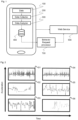
- Figure 1 shows one embodiment of the invention.
- data 100 is, preferably continuously, recorded by a plurality of sensors.
- the data is collected by a data collection unit 200 of the system.
- the data is then analyzed in a data analyzer unit 300.
- the data analyzer unit 300 searches for patterns in the collected data. Pattern recognition algorithms may be used by the data analyzer unit 300. Characteristic patterns are identified and merged to build a user behavioral vector.
- the analyzed data i.e. the behavioral vector
- the device 500 requests an information from a third party, in particular a web service 600
- the web service may request information whether or not the user of the device 500 is a human or a robot, i.e. requesting a CAPTCHA. Therefore the web service 600 contacts the behavior request processor 700 of the system to receive a CAPTCHA response message.
- the behavior request processor 700 retrieves the behavioral vector from the database.
- the behavior vector from a predetermined time may be requested.
- the predetermined time is preferably between 1 to 5 minutes. Based on a comparison with either a model and/or with at least one further behavioral vector from the database 400, the behavior request processor 700 distinguishes between a human or a robot and sends the corresponding CAPTCHA response message to the web service 600.
- the behavior request processor 700 may be formed in the device.
- the behavior request processor may be formed in a protected portion of the operating a system.
- the behavior request processor 700 may be formed in a cloud service. Since the data stored in the database 400 does not allow for identification of a specific human being, i.e. a user, the data is not security sensitive and may even be transmitted by or unsecured connections. However, it is preferred to transmit data is in the system by or secure connections.
- Fig. 2 shows data patterns of use data according to the invention.
- the shown patterns S1 to S6 correspond to accelerometer readings over a certain time for 6 different activities. Even without the use a sophisticated algorithm a profile difference between different activities is obvious.
- the data analyzer unit searches for characteristic patterns which are typical for use by a human, regardless of the actual profile of a specific activity.
- the data in S1 relates to running; the data in S2 relates to resting during typing for 1 minute; the data in S3 relates to holding a mobile phone in a hand while looking at the display; the data in S4 relates to walking; the data in S5 relates to typing on a keyboard; and S6 relates to calling with a mobile phone holding it near to an ear.
- the system searches for a pattern in each one of the above signals. For instance, the signal relating to running S1 has more peaks than the signal of typing on the keyboard S5. Amplitude and the time between the peaks in S1 are the factors to understand the speed and the amount of pressure on the feet when the user is running. These together indicates that the user runs and also teaches specifics about the way of the user's running.
- the system analyzes the above signals for a period of time and deducts that the user is typing, running, relaxing or sitting and based on the recognized patterns determines whether or not the way of, e.g., running is the running style of a human user. Through this process, a human user would be approved and a fake and/or other user would be reject.
- the CAPTCHA-system provides a high security.
- CAPTCHAs like image recognition, game or puzzle or moving image CAPTCHAs can eventually be hacked by current advanced artificial intelligence algorithms.
- the CAPTCHA-system is fast and user friendly than other methods, because the CAPTCHA doesn't present a user with a task to solve. In other words, there is no effort required from the users to pass the CAPTCHA. Instead the CAPTCHA uses the saved history of use data, looks for an anomaly, takes the most recent data and decides whether or not to send approval message in case of normal activity or a reject message in case of a hacked device or a robot.
- the CAPTCHA allows for a plausibility check of last recent user behavior with their own history is the best method to recognize whether the phone is hacked by software or a robot.
Landscapes
- Engineering & Computer Science (AREA)
- Computer Security & Cryptography (AREA)
- Computer Hardware Design (AREA)
- General Engineering & Computer Science (AREA)
- Theoretical Computer Science (AREA)
- General Health & Medical Sciences (AREA)
- Social Psychology (AREA)
- Health & Medical Sciences (AREA)
- Software Systems (AREA)
- Physics & Mathematics (AREA)
- General Physics & Mathematics (AREA)
- Telephonic Communication Services (AREA)
- Management, Administration, Business Operations System, And Electronic Commerce (AREA)
Claims (8)
- Procédé de distinction entre un humain et un robot en tant qu'un utilisateur d'un dispositif intelligent mobile, comprenant les étapes suivantes :a) la collecte continue et le stockage temporaire des données d'utilisation provenant d'au moins un capteur du dispositif intelligent mobile et/ou d'au moins une application en cours d'exécution sur le dispositif intelligent mobile ;b) l'élaboration d'un vecteur de comportement d'utilisateur actuel sur la base d'une analyse statistique des données d'utilisation dans une trame de temps prédéterminée, et le stockage du vecteur de comportement d'utilisateur actuel dans une base de données (400) sur le dispositif intelligent mobile ; etc) la réception, sur une unité formant processeur de demande de comportement (700) formée dans un service en nuage, d'une demande CAPTCHA provenant d'un service Web (600) en réponse à une demande d'informations provenant du dispositif intelligent mobile ;d) sur le processeur de demande de comportement (700), l'extraction du vecteur de comportement d'utilisateur actuel de la base de données (400) ;e) sur le processeur de demande de comportement (700), la distinction d'un humain et d'un robot en tant qu'un utilisateur en comparant le vecteur de comportement d'utilisateur actuel à au moins un modèle et/ou à au moins un autre vecteur de comportement d'utilisateur provenant de la base de données (400) ; etsur le processeur de demande de comportement (700), l'envoi d'une réponse CAPTCHA depuis le processeur de demande de comportement (700) au service Web (600) sur la base des résultats de l'étape de comparaison.
- Procédé selon la revendication 1, dans lequel au moins un autre vecteur de comportement d'utilisateur est collecté et stocké dans ladite base de données (400) pendant une trame de temps prédéterminée antérieure.
- Procédé selon la revendication 1 ou la revendication 2, dans lequel l'au moins un capteur est un capteur de mouvement, et les données d'utilisation comprennent des données obtenues à partir dudit capteur de mouvement, et le vecteur de comportement d'utilisateur est élaboré sur la base d'au moins une des données suivantes : une durée de mouvement, un type de mouvement, un schéma de mouvement, et une intensité de mouvement.
- Procédé selon l'une quelconque des revendications 1 à 3, dans lequel les données d'utilisation comprennent des données provenant d'une application en cours d'exécution sur le dispositif intelligent mobile, et le vecteur de comportement d'utilisateur est élaboré sur la base d'au moins une des informations d'application suivantes : nombre de lancements d'application, nombre d'entrées dans l'application, types d'entrée dans l'application, contenu d'entrée dans l'application, et durée d'utilisation d'une application.
- Procédé selon l'une quelconque des revendications 1 à 4, dans lequel les données d'utilisation comprennent des données provenant d'une unité de télécommunication du dispositif intelligent mobile et le vecteur de comportement d'utilisateur est élaboré sur la base d'au moins un des éléments suivants : nombre d'appels effectués, durée d'appels, nombres de messages textuels, longueur de messages textuels, contenu de messages textuels, quantité de données envoyées, taille de paquet de données envoyées, contacts utilisés en dernier et source et destination de données envoyées.
- Procédé selon l'une quelconque des revendications 1 à 5, dans lequel les données d'utilisation comprennent des données provenant d'un microphone du dispositif intelligent mobile et le vecteur de comportement d'utilisateur est élaboré sur la base d'au moins une des données suivantes : un spectre de fréquence des données, un spectre d'intensité des données, et au moins un schéma trouvé dans les données.
- Système pour distinguer entre un humain et un robot en tant qu'un utilisateur d'un dispositif intelligent mobile, le système comprenant :une unité de collecte de données configurée pour collecter en continu et stocker temporairement des données d'utilisation provenant d'au moins un capteur du dispositif intelligent mobile et/ou d'au moins une application en cours d'exécution sur le dispositif intelligent mobile ;une unité d'analyse de données configurée pour élaborer un vecteur de comportement d'utilisateur actuel sur la base d'une analyse statistique des données d'utilisation collectées par l'unité de collecte de données dans une trame de temps prédéterminée, et stockant le vecteur de comportement d'utilisateur actuel dans une base de données (400) du dispositif intelligent mobile ; etune unité formant processeur de demande de comportement (700) formée dans un service en nuage, configurée pour recevoir une demande CAPTCHA d'un service Web (600) en réponse à une demande d'informations provenant du dispositif intelligent mobiledans lequel l'unité formant processeur de demande de comportement (700) est configurée pour extraire le vecteur de comportement d'utilisateur actuel de la base de données (400) ; etdans lequel l'unité formant processeur de demande de comportement (700) est configurée pour distinguer un humain et un robot en tant qu'un utilisateur en comparant le vecteur de comportement d'utilisateur actuel à au moins un modèle et/ou à au moins un autre vecteur de comportement d'utilisateur provenant de la base de données (400) ; etdans lequel l'unité formant processeur de demande de comportement (700) est configurée pour envoyer une réponse CAPTCHA au service Web (600) sur la base des résultats de l'étape de comparaison.
- Système selon la revendication 7, dans lequel l'au moins un autre vecteur de comportement d'utilisateur est collecté et est stocké dans ladite base de données (400) pendant une trame de temps prédéterminée antérieure.
Priority Applications (1)
| Application Number | Priority Date | Filing Date | Title |
|---|---|---|---|
| EP17173666.3A EP3410328B1 (fr) | 2017-05-31 | 2017-05-31 | Procédé et système de distinction entre un être humain et un robot en tant qu'utilisateur d'un dispositif intelligent mobile |
Applications Claiming Priority (1)
| Application Number | Priority Date | Filing Date | Title |
|---|---|---|---|
| EP17173666.3A EP3410328B1 (fr) | 2017-05-31 | 2017-05-31 | Procédé et système de distinction entre un être humain et un robot en tant qu'utilisateur d'un dispositif intelligent mobile |
Publications (2)
| Publication Number | Publication Date |
|---|---|
| EP3410328A1 EP3410328A1 (fr) | 2018-12-05 |
| EP3410328B1 true EP3410328B1 (fr) | 2025-01-15 |
Family
ID=59009541
Family Applications (1)
| Application Number | Title | Priority Date | Filing Date |
|---|---|---|---|
| EP17173666.3A Active EP3410328B1 (fr) | 2017-05-31 | 2017-05-31 | Procédé et système de distinction entre un être humain et un robot en tant qu'utilisateur d'un dispositif intelligent mobile |
Country Status (1)
| Country | Link |
|---|---|
| EP (1) | EP3410328B1 (fr) |
Families Citing this family (3)
| Publication number | Priority date | Publication date | Assignee | Title |
|---|---|---|---|---|
| KR102636409B1 (ko) | 2018-12-28 | 2024-02-15 | 삼성전자주식회사 | 전자 장치 및 그 제어 방법 |
| CN110266727A (zh) * | 2019-07-09 | 2019-09-20 | 中国工商银行股份有限公司 | 模拟浏览器行为的识别方法、服务器及客户端 |
| CN113742665B (zh) * | 2020-06-05 | 2024-03-26 | 国家计算机网络与信息安全管理中心 | 用户身份识别模型构建、用户身份验证方法及装置 |
Family Cites Families (10)
| Publication number | Priority date | Publication date | Assignee | Title |
|---|---|---|---|---|
| US7929805B2 (en) | 2006-01-31 | 2011-04-19 | The Penn State Research Foundation | Image-based CAPTCHA generation system |
| US9400879B2 (en) * | 2008-11-05 | 2016-07-26 | Xerox Corporation | Method and system for providing authentication through aggregate analysis of behavioral and time patterns |
| EP2406717A4 (fr) * | 2009-03-13 | 2012-12-26 | Univ Rutgers | Systèmes et procédés pour détecter un logiciel malveillant |
| US8483518B2 (en) | 2010-02-19 | 2013-07-09 | Microsoft Corporation | Image-based CAPTCHA exploiting context in object recognition |
| US20120023549A1 (en) | 2010-07-23 | 2012-01-26 | Academia Sinica | CAPTCHA AND reCAPTCHA WITH SINOGRAPHS |
| EP2458524B1 (fr) | 2010-11-25 | 2018-08-15 | Deutsche Telekom AG | Identification d'un utilisateur de dispositif électronique mobile |
| TW201248530A (en) | 2011-10-07 | 2012-12-01 | Wei-Chih Lin | Advertising CAPTCHA system and method |
| DE202013100910U1 (de) | 2013-03-01 | 2013-04-09 | Alicius Schröder | CAPTCHA zur Unterscheidung von Computern und Menschen bei der Interaktion von Computern |
| WO2014205148A1 (fr) * | 2013-06-19 | 2014-12-24 | Arizona Board Of Regents For The University Of Arizona | Outil d'authentification permanente |
| US9703962B2 (en) * | 2014-10-09 | 2017-07-11 | Qualcomm Incorporated | Methods and systems for behavioral analysis of mobile device behaviors based on user persona information |
-
2017
- 2017-05-31 EP EP17173666.3A patent/EP3410328B1/fr active Active
Non-Patent Citations (1)
| Title |
|---|
| JONATHAN ANDERSON ET AL: "Stayin Alive: Aliveness as an Alternative to Authentication", 12 April 2012, SECURITY PROTOCOLS XX, SPRINGER BERLIN HEIDELBERG, BERLIN, HEIDELBERG, PAGE(S) 242 - 250, ISBN: 978-3-642-35693-3, XP047007918 * |
Also Published As
| Publication number | Publication date |
|---|---|
| EP3410328A1 (fr) | 2018-12-05 |
Similar Documents
| Publication | Publication Date | Title |
|---|---|---|
| Zhu et al. | RiskCog: Unobtrusive real-time user authentication on mobile devices in the wild | |
| Meng et al. | Surveying the development of biometric user authentication on mobile phones | |
| Feizollah et al. | A study of machine learning classifiers for anomaly-based mobile botnet detection | |
| US20170227995A1 (en) | Method and system for implicit authentication | |
| EP3482331B1 (fr) | Obscurcissement de données lors de la collecte de données comportementales | |
| Khan et al. | A comparative evaluation of implicit authentication schemes | |
| US11810014B2 (en) | Systems, methods and apparatus for evaluating status of computing device user | |
| Benzekki et al. | A context-aware authentication system for mobile cloud computing | |
| CN111641588A (zh) | 网页模拟输入检测方法、装置、计算机设备及存储介质 | |
| EP4097632B1 (fr) | Procédé pour générer des données d'apprentissage pour un module de détection de robot, module de détection de robot entraîné à partir de données d'apprentissage générées par le procédé et système de détection de robot | |
| Sharma et al. | Behavioral biometrics: Past, present | |
| Hupperich et al. | Leveraging sensor fingerprinting for mobile device authentication | |
| EP3410328B1 (fr) | Procédé et système de distinction entre un être humain et un robot en tant qu'utilisateur d'un dispositif intelligent mobile | |
| Shila et al. | CASTRA: Seamless and unobtrusive authentication of users to diverse mobile services | |
| Pramila et al. | A survey on adaptive authentication using machine learning techniques | |
| Cariello et al. | SMARTCOPE: Smartphone change of possession evaluation for continuous authentication | |
| CN118797593A (zh) | 身份验证方法、装置、设备、可读存储介质及产品 | |
| Fenu et al. | Leveraging continuous multi-modal authentication for access control in mobile cloud environments | |
| Rahman et al. | Movement pattern based authentication for smart mobile devices | |
| Akhtar et al. | Multitrait Selfie: Low-Cost Multimodal Smartphone User Authentication | |
| CN107808082A (zh) | 电子装置、数据访问验证方法和计算机可读存储介质 | |
| Chandre et al. | Beyond Passwords: Enhancing Security with Continuous Behavioral Biometrics and Passive Authentication | |
| Neal et al. | Mobile biometrics, replay attacks, and behavior profiling: An empirical analysis of impostor detection | |
| Ejaz et al. | Behaviour Biometrics Using AI for Continuous Authentication Systems | |
| Chandre et al. | Adaptive Behavioral Authentication for Fraud Detection: Leveraging Real-Time User Behavior to Enhance Financial Security |
Legal Events
| Date | Code | Title | Description |
|---|---|---|---|
| PUAI | Public reference made under article 153(3) epc to a published international application that has entered the european phase |
Free format text: ORIGINAL CODE: 0009012 |
|
| STAA | Information on the status of an ep patent application or granted ep patent |
Free format text: STATUS: THE APPLICATION HAS BEEN PUBLISHED |
|
| AK | Designated contracting states |
Kind code of ref document: A1 Designated state(s): AL AT BE BG CH CY CZ DE DK EE ES FI FR GB GR HR HU IE IS IT LI LT LU LV MC MK MT NL NO PL PT RO RS SE SI SK SM TR |
|
| AX | Request for extension of the european patent |
Extension state: BA ME |
|
| STAA | Information on the status of an ep patent application or granted ep patent |
Free format text: STATUS: REQUEST FOR EXAMINATION WAS MADE |
|
| 17P | Request for examination filed |
Effective date: 20190130 |
|
| RBV | Designated contracting states (corrected) |
Designated state(s): AL AT BE BG CH CY CZ DE DK EE ES FI FR GB GR HR HU IE IS IT LI LT LU LV MC MK MT NL NO PL PT RO RS SE SI SK SM TR |
|
| STAA | Information on the status of an ep patent application or granted ep patent |
Free format text: STATUS: EXAMINATION IS IN PROGRESS |
|
| 17Q | First examination report despatched |
Effective date: 20200928 |
|
| GRAP | Despatch of communication of intention to grant a patent |
Free format text: ORIGINAL CODE: EPIDOSNIGR1 |
|
| STAA | Information on the status of an ep patent application or granted ep patent |
Free format text: STATUS: GRANT OF PATENT IS INTENDED |
|
| INTG | Intention to grant announced |
Effective date: 20240715 |
|
| GRAJ | Information related to disapproval of communication of intention to grant by the applicant or resumption of examination proceedings by the epo deleted |
Free format text: ORIGINAL CODE: EPIDOSDIGR1 |
|
| STAA | Information on the status of an ep patent application or granted ep patent |
Free format text: STATUS: EXAMINATION IS IN PROGRESS |
|
| GRAS | Grant fee paid |
Free format text: ORIGINAL CODE: EPIDOSNIGR3 |
|
| STAA | Information on the status of an ep patent application or granted ep patent |
Free format text: STATUS: GRANT OF PATENT IS INTENDED |
|
| GRAP | Despatch of communication of intention to grant a patent |
Free format text: ORIGINAL CODE: EPIDOSNIGR1 |
|
| INTC | Intention to grant announced (deleted) | ||
| INTG | Intention to grant announced |
Effective date: 20241107 |
|
| GRAA | (expected) grant |
Free format text: ORIGINAL CODE: 0009210 |
|
| STAA | Information on the status of an ep patent application or granted ep patent |
Free format text: STATUS: THE PATENT HAS BEEN GRANTED |
|
| AK | Designated contracting states |
Kind code of ref document: B1 Designated state(s): AL AT BE BG CH CY CZ DE DK EE ES FI FR GB GR HR HU IE IS IT LI LT LU LV MC MK MT NL NO PL PT RO RS SE SI SK SM TR |
|
| REG | Reference to a national code |
Ref country code: CH Ref legal event code: EP Ref country code: GB Ref legal event code: FG4D |
|
| REG | Reference to a national code |
Ref country code: DE Ref legal event code: R096 Ref document number: 602017087318 Country of ref document: DE |
|
| REG | Reference to a national code |
Ref country code: IE Ref legal event code: FG4D |
|
| REG | Reference to a national code |
Ref country code: NL Ref legal event code: MP Effective date: 20250115 |
|
| PG25 | Lapsed in a contracting state [announced via postgrant information from national office to epo] |
Ref country code: NL Free format text: LAPSE BECAUSE OF FAILURE TO SUBMIT A TRANSLATION OF THE DESCRIPTION OR TO PAY THE FEE WITHIN THE PRESCRIBED TIME-LIMIT Effective date: 20250115 |
|
| PG25 | Lapsed in a contracting state [announced via postgrant information from national office to epo] |
Ref country code: RS Free format text: LAPSE BECAUSE OF FAILURE TO SUBMIT A TRANSLATION OF THE DESCRIPTION OR TO PAY THE FEE WITHIN THE PRESCRIBED TIME-LIMIT Effective date: 20250415 |
|
| PG25 | Lapsed in a contracting state [announced via postgrant information from national office to epo] |
Ref country code: FI Free format text: LAPSE BECAUSE OF FAILURE TO SUBMIT A TRANSLATION OF THE DESCRIPTION OR TO PAY THE FEE WITHIN THE PRESCRIBED TIME-LIMIT Effective date: 20250115 |
|
| PG25 | Lapsed in a contracting state [announced via postgrant information from national office to epo] |
Ref country code: PL Free format text: LAPSE BECAUSE OF FAILURE TO SUBMIT A TRANSLATION OF THE DESCRIPTION OR TO PAY THE FEE WITHIN THE PRESCRIBED TIME-LIMIT Effective date: 20250115 |
|
| PGFP | Annual fee paid to national office [announced via postgrant information from national office to epo] |
Ref country code: DE Payment date: 20250519 Year of fee payment: 9 |
|
| PG25 | Lapsed in a contracting state [announced via postgrant information from national office to epo] |
Ref country code: ES Free format text: LAPSE BECAUSE OF FAILURE TO SUBMIT A TRANSLATION OF THE DESCRIPTION OR TO PAY THE FEE WITHIN THE PRESCRIBED TIME-LIMIT Effective date: 20250115 |
|
| PGFP | Annual fee paid to national office [announced via postgrant information from national office to epo] |
Ref country code: GB Payment date: 20250522 Year of fee payment: 9 |
|
| REG | Reference to a national code |
Ref country code: LT Ref legal event code: MG9D |
|
| PG25 | Lapsed in a contracting state [announced via postgrant information from national office to epo] |
Ref country code: NO Free format text: LAPSE BECAUSE OF FAILURE TO SUBMIT A TRANSLATION OF THE DESCRIPTION OR TO PAY THE FEE WITHIN THE PRESCRIBED TIME-LIMIT Effective date: 20250415 Ref country code: IS Free format text: LAPSE BECAUSE OF FAILURE TO SUBMIT A TRANSLATION OF THE DESCRIPTION OR TO PAY THE FEE WITHIN THE PRESCRIBED TIME-LIMIT Effective date: 20250515 |
|
| REG | Reference to a national code |
Ref country code: AT Ref legal event code: MK05 Ref document number: 1760285 Country of ref document: AT Kind code of ref document: T Effective date: 20250115 |
|
| PG25 | Lapsed in a contracting state [announced via postgrant information from national office to epo] |
Ref country code: HR Free format text: LAPSE BECAUSE OF FAILURE TO SUBMIT A TRANSLATION OF THE DESCRIPTION OR TO PAY THE FEE WITHIN THE PRESCRIBED TIME-LIMIT Effective date: 20250115 |
|
| PG25 | Lapsed in a contracting state [announced via postgrant information from national office to epo] |
Ref country code: LV Free format text: LAPSE BECAUSE OF FAILURE TO SUBMIT A TRANSLATION OF THE DESCRIPTION OR TO PAY THE FEE WITHIN THE PRESCRIBED TIME-LIMIT Effective date: 20250115 Ref country code: PT Free format text: LAPSE BECAUSE OF FAILURE TO SUBMIT A TRANSLATION OF THE DESCRIPTION OR TO PAY THE FEE WITHIN THE PRESCRIBED TIME-LIMIT Effective date: 20250515 |
|
| PGFP | Annual fee paid to national office [announced via postgrant information from national office to epo] |
Ref country code: FR Payment date: 20250521 Year of fee payment: 9 |
|
| PG25 | Lapsed in a contracting state [announced via postgrant information from national office to epo] |
Ref country code: BG Free format text: LAPSE BECAUSE OF FAILURE TO SUBMIT A TRANSLATION OF THE DESCRIPTION OR TO PAY THE FEE WITHIN THE PRESCRIBED TIME-LIMIT Effective date: 20250115 Ref country code: GR Free format text: LAPSE BECAUSE OF FAILURE TO SUBMIT A TRANSLATION OF THE DESCRIPTION OR TO PAY THE FEE WITHIN THE PRESCRIBED TIME-LIMIT Effective date: 20250416 |
|
| PG25 | Lapsed in a contracting state [announced via postgrant information from national office to epo] |
Ref country code: AT Free format text: LAPSE BECAUSE OF FAILURE TO SUBMIT A TRANSLATION OF THE DESCRIPTION OR TO PAY THE FEE WITHIN THE PRESCRIBED TIME-LIMIT Effective date: 20250115 |
|
| PG25 | Lapsed in a contracting state [announced via postgrant information from national office to epo] |
Ref country code: SE Free format text: LAPSE BECAUSE OF FAILURE TO SUBMIT A TRANSLATION OF THE DESCRIPTION OR TO PAY THE FEE WITHIN THE PRESCRIBED TIME-LIMIT Effective date: 20250115 |
|
| PG25 | Lapsed in a contracting state [announced via postgrant information from national office to epo] |
Ref country code: SM Free format text: LAPSE BECAUSE OF FAILURE TO SUBMIT A TRANSLATION OF THE DESCRIPTION OR TO PAY THE FEE WITHIN THE PRESCRIBED TIME-LIMIT Effective date: 20250115 |
|
| PG25 | Lapsed in a contracting state [announced via postgrant information from national office to epo] |
Ref country code: DK Free format text: LAPSE BECAUSE OF FAILURE TO SUBMIT A TRANSLATION OF THE DESCRIPTION OR TO PAY THE FEE WITHIN THE PRESCRIBED TIME-LIMIT Effective date: 20250115 |
|
| PG25 | Lapsed in a contracting state [announced via postgrant information from national office to epo] |
Ref country code: IT Free format text: LAPSE BECAUSE OF FAILURE TO SUBMIT A TRANSLATION OF THE DESCRIPTION OR TO PAY THE FEE WITHIN THE PRESCRIBED TIME-LIMIT Effective date: 20250115 |
|
| REG | Reference to a national code |
Ref country code: DE Ref legal event code: R097 Ref document number: 602017087318 Country of ref document: DE |
|
| PG25 | Lapsed in a contracting state [announced via postgrant information from national office to epo] |
Ref country code: EE Free format text: LAPSE BECAUSE OF FAILURE TO SUBMIT A TRANSLATION OF THE DESCRIPTION OR TO PAY THE FEE WITHIN THE PRESCRIBED TIME-LIMIT Effective date: 20250115 Ref country code: CZ Free format text: LAPSE BECAUSE OF FAILURE TO SUBMIT A TRANSLATION OF THE DESCRIPTION OR TO PAY THE FEE WITHIN THE PRESCRIBED TIME-LIMIT Effective date: 20250115 |
|
| PG25 | Lapsed in a contracting state [announced via postgrant information from national office to epo] |
Ref country code: RO Free format text: LAPSE BECAUSE OF FAILURE TO SUBMIT A TRANSLATION OF THE DESCRIPTION OR TO PAY THE FEE WITHIN THE PRESCRIBED TIME-LIMIT Effective date: 20250115 |
|
| PG25 | Lapsed in a contracting state [announced via postgrant information from national office to epo] |
Ref country code: SK Free format text: LAPSE BECAUSE OF FAILURE TO SUBMIT A TRANSLATION OF THE DESCRIPTION OR TO PAY THE FEE WITHIN THE PRESCRIBED TIME-LIMIT Effective date: 20250115 |
|
| PLBE | No opposition filed within time limit |
Free format text: ORIGINAL CODE: 0009261 |
|
| STAA | Information on the status of an ep patent application or granted ep patent |
Free format text: STATUS: NO OPPOSITION FILED WITHIN TIME LIMIT |
|
| REG | Reference to a national code |
Ref country code: CH Ref legal event code: L10 Free format text: ST27 STATUS EVENT CODE: U-0-0-L10-L00 (AS PROVIDED BY THE NATIONAL OFFICE) Effective date: 20251126 |
|
| REG | Reference to a national code |
Ref country code: CH Ref legal event code: H13 Free format text: ST27 STATUS EVENT CODE: U-0-0-H10-H13 (AS PROVIDED BY THE NATIONAL OFFICE) Effective date: 20251223 |
|
| 26N | No opposition filed |
Effective date: 20251016 |
|
| PG25 | Lapsed in a contracting state [announced via postgrant information from national office to epo] |
Ref country code: LU Free format text: LAPSE BECAUSE OF NON-PAYMENT OF DUE FEES Effective date: 20250531 |
|
| PG25 | Lapsed in a contracting state [announced via postgrant information from national office to epo] |
Ref country code: CH Free format text: LAPSE BECAUSE OF NON-PAYMENT OF DUE FEES Effective date: 20250531 |
|
| REG | Reference to a national code |
Ref country code: BE Ref legal event code: MM Effective date: 20250531 |
|
| PG25 | Lapsed in a contracting state [announced via postgrant information from national office to epo] |
Ref country code: MC Free format text: LAPSE BECAUSE OF FAILURE TO SUBMIT A TRANSLATION OF THE DESCRIPTION OR TO PAY THE FEE WITHIN THE PRESCRIBED TIME-LIMIT Effective date: 20250115 |
|
| PG25 | Lapsed in a contracting state [announced via postgrant information from national office to epo] |
Ref country code: IE Free format text: LAPSE BECAUSE OF NON-PAYMENT OF DUE FEES Effective date: 20250531 |
|
| PG25 | Lapsed in a contracting state [announced via postgrant information from national office to epo] |
Ref country code: BE Free format text: LAPSE BECAUSE OF NON-PAYMENT OF DUE FEES Effective date: 20250531 |