EP3412596A1 - Obturateur-barrière d'embouchure et récipient avec obturateur-barrière d'embouchure - Google Patents
Obturateur-barrière d'embouchure et récipient avec obturateur-barrière d'embouchure Download PDFInfo
- Publication number
- EP3412596A1 EP3412596A1 EP17747601.7A EP17747601A EP3412596A1 EP 3412596 A1 EP3412596 A1 EP 3412596A1 EP 17747601 A EP17747601 A EP 17747601A EP 3412596 A1 EP3412596 A1 EP 3412596A1
- Authority
- EP
- European Patent Office
- Prior art keywords
- resin
- layer
- barrier
- molded article
- cylindrical molded
- Prior art date
- Legal status (The legal status is an assumption and is not a legal conclusion. Google has not performed a legal analysis and makes no representation as to the accuracy of the status listed.)
- Withdrawn
Links
Images

Classifications
-
- B—PERFORMING OPERATIONS; TRANSPORTING
- B32—LAYERED PRODUCTS
- B32B—LAYERED PRODUCTS, i.e. PRODUCTS BUILT-UP OF STRATA OF FLAT OR NON-FLAT, e.g. CELLULAR OR HONEYCOMB, FORM
- B32B1/00—Layered products having a non-planar shape
-
- B—PERFORMING OPERATIONS; TRANSPORTING
- B65—CONVEYING; PACKING; STORING; HANDLING THIN OR FILAMENTARY MATERIAL
- B65D—CONTAINERS FOR STORAGE OR TRANSPORT OF ARTICLES OR MATERIALS, e.g. BAGS, BARRELS, BOTTLES, BOXES, CANS, CARTONS, CRATES, DRUMS, JARS, TANKS, HOPPERS, FORWARDING CONTAINERS; ACCESSORIES, CLOSURES, OR FITTINGS THEREFOR; PACKAGING ELEMENTS; PACKAGES
- B65D75/00—Packages comprising articles or materials partially or wholly enclosed in strips, sheets, blanks, tubes or webs of flexible sheet material, e.g. in folded wrappers
- B65D75/52—Details
- B65D75/58—Opening or contents-removing devices added or incorporated during package manufacture
- B65D75/5861—Spouts
- B65D75/5872—Non-integral spouts
- B65D75/5883—Non-integral spouts connected to the package at the sealed junction of two package walls
-
- B—PERFORMING OPERATIONS; TRANSPORTING
- B32—LAYERED PRODUCTS
- B32B—LAYERED PRODUCTS, i.e. PRODUCTS BUILT-UP OF STRATA OF FLAT OR NON-FLAT, e.g. CELLULAR OR HONEYCOMB, FORM
- B32B27/00—Layered products comprising a layer of synthetic resin
- B32B27/06—Layered products comprising a layer of synthetic resin as the main or only constituent of a layer, which is next to another layer of the same or of a different material
- B32B27/08—Layered products comprising a layer of synthetic resin as the main or only constituent of a layer, which is next to another layer of the same or of a different material of synthetic resin
-
- B—PERFORMING OPERATIONS; TRANSPORTING
- B32—LAYERED PRODUCTS
- B32B—LAYERED PRODUCTS, i.e. PRODUCTS BUILT-UP OF STRATA OF FLAT OR NON-FLAT, e.g. CELLULAR OR HONEYCOMB, FORM
- B32B27/00—Layered products comprising a layer of synthetic resin
- B32B27/30—Layered products comprising a layer of synthetic resin comprising vinyl (co)polymers; comprising acrylic (co)polymers
-
- B—PERFORMING OPERATIONS; TRANSPORTING
- B32—LAYERED PRODUCTS
- B32B—LAYERED PRODUCTS, i.e. PRODUCTS BUILT-UP OF STRATA OF FLAT OR NON-FLAT, e.g. CELLULAR OR HONEYCOMB, FORM
- B32B27/00—Layered products comprising a layer of synthetic resin
- B32B27/32—Layered products comprising a layer of synthetic resin comprising polyolefins
-
- B—PERFORMING OPERATIONS; TRANSPORTING
- B32—LAYERED PRODUCTS
- B32B—LAYERED PRODUCTS, i.e. PRODUCTS BUILT-UP OF STRATA OF FLAT OR NON-FLAT, e.g. CELLULAR OR HONEYCOMB, FORM
- B32B7/00—Layered products characterised by the relation between layers; Layered products characterised by the relative orientation of features between layers, or by the relative values of a measurable parameter between layers, i.e. products comprising layers having different physical, chemical or physicochemical properties; Layered products characterised by the interconnection of layers
- B32B7/02—Physical, chemical or physicochemical properties
-
- B—PERFORMING OPERATIONS; TRANSPORTING
- B32—LAYERED PRODUCTS
- B32B—LAYERED PRODUCTS, i.e. PRODUCTS BUILT-UP OF STRATA OF FLAT OR NON-FLAT, e.g. CELLULAR OR HONEYCOMB, FORM
- B32B7/00—Layered products characterised by the relation between layers; Layered products characterised by the relative orientation of features between layers, or by the relative values of a measurable parameter between layers, i.e. products comprising layers having different physical, chemical or physicochemical properties; Layered products characterised by the interconnection of layers
- B32B7/04—Interconnection of layers
- B32B7/12—Interconnection of layers using interposed adhesives or interposed materials with bonding properties
-
- B—PERFORMING OPERATIONS; TRANSPORTING
- B65—CONVEYING; PACKING; STORING; HANDLING THIN OR FILAMENTARY MATERIAL
- B65D—CONTAINERS FOR STORAGE OR TRANSPORT OF ARTICLES OR MATERIALS, e.g. BAGS, BARRELS, BOTTLES, BOXES, CANS, CARTONS, CRATES, DRUMS, JARS, TANKS, HOPPERS, FORWARDING CONTAINERS; ACCESSORIES, CLOSURES, OR FITTINGS THEREFOR; PACKAGING ELEMENTS; PACKAGES
- B65D65/00—Wrappers or flexible covers; Packaging materials of special type or form
- B65D65/38—Packaging materials of special type or form
- B65D65/40—Applications of laminates for particular packaging purposes
-
- B—PERFORMING OPERATIONS; TRANSPORTING
- B65—CONVEYING; PACKING; STORING; HANDLING THIN OR FILAMENTARY MATERIAL
- B65D—CONTAINERS FOR STORAGE OR TRANSPORT OF ARTICLES OR MATERIALS, e.g. BAGS, BARRELS, BOTTLES, BOXES, CANS, CARTONS, CRATES, DRUMS, JARS, TANKS, HOPPERS, FORWARDING CONTAINERS; ACCESSORIES, CLOSURES, OR FITTINGS THEREFOR; PACKAGING ELEMENTS; PACKAGES
- B65D75/00—Packages comprising articles or materials partially or wholly enclosed in strips, sheets, blanks, tubes or webs of flexible sheet material, e.g. in folded wrappers
- B65D75/52—Details
- B65D75/58—Opening or contents-removing devices added or incorporated during package manufacture
-
- B—PERFORMING OPERATIONS; TRANSPORTING
- B32—LAYERED PRODUCTS
- B32B—LAYERED PRODUCTS, i.e. PRODUCTS BUILT-UP OF STRATA OF FLAT OR NON-FLAT, e.g. CELLULAR OR HONEYCOMB, FORM
- B32B2262/00—Composition or structural features of fibres which form a fibrous or filamentary layer or are present as additives
- B32B2262/02—Synthetic macromolecular fibres
- B32B2262/0253—Polyolefin fibres
-
- B—PERFORMING OPERATIONS; TRANSPORTING
- B32—LAYERED PRODUCTS
- B32B—LAYERED PRODUCTS, i.e. PRODUCTS BUILT-UP OF STRATA OF FLAT OR NON-FLAT, e.g. CELLULAR OR HONEYCOMB, FORM
- B32B2307/00—Properties of the layers or laminate
- B32B2307/30—Properties of the layers or laminate having particular thermal properties
- B32B2307/31—Heat sealable
-
- B—PERFORMING OPERATIONS; TRANSPORTING
- B32—LAYERED PRODUCTS
- B32B—LAYERED PRODUCTS, i.e. PRODUCTS BUILT-UP OF STRATA OF FLAT OR NON-FLAT, e.g. CELLULAR OR HONEYCOMB, FORM
- B32B2307/00—Properties of the layers or laminate
- B32B2307/70—Other properties
- B32B2307/732—Dimensional properties
Definitions
- the present invention relates to a barrier plug and a container with a barrier plug.
- plastic soft packaging bags in various forms are developed, and packaging products, in which various foods and drinks, for example, baby foods, liquid foods, infusion bags, juices, jelly-like drinks, nutritional drinks, drinking water, teas, coffee drinks, milk, seasonings, oils, cosmetics, and others, are filled and packaged, are sold.
- various foods and drinks for example, baby foods, liquid foods, infusion bags, juices, jelly-like drinks, nutritional drinks, drinking water, teas, coffee drinks, milk, seasonings, oils, cosmetics, and others
- packaging products obtained by attaching a plug to an opening at one side of the bag body, and the like have also been proposed because of their convenience.
- These packaging products are referred to as pouches with spouts, or the like, are easy to handle, also have resealability and the like, and are in increasing demand.
- some containers containing drugs or the like such as infusion bags, are also provided with plugs.
- bags and containers using packaging materials (films) provided with these barrier layers in this manner the entire barrier properties can be improved, but in the plug provided in these bags and containers, measures for gas barrier property improvement are not taken, and therefore for most gas transmission to the contents, the influence of these plugs is strong, which is not negligible in the suppression of the deterioration of the contents.
- many measures for suppressing deterioration due to gas transmission and enhancing the storage properties are proposed (for example, see Patent Literatures 1 to 3).
- problems of conventional cylindrical molded articles such as plugs are that the oxygen barrier properties decrease in the case of storage under high humidity, and the water vapor barrier properties, and the oxygen barrier properties when hot water treatment such as boiling or retorting is performed decrease.
- the present invention has been made in view of the above problems, and it is an object of the present invention to provide a barrier plug excellent in room temperature storage properties and high temperature and high humidity storage properties and excellent in smell retention properties for smelling substances, and a container with a barrier plug comprising the barrier plug.
- Room temperature storage properties little deterioration of the contents, for example, in the case of storage at 23°C and 50% RH for 3 days.
- High temperature and high humidity storage properties little deterioration of the contents, for example, in the case of storage at 40°C and 90% RH for 3 days.
- the present inventors have studied diligently in order to solve the above problems, and as a result found that the above problems can be solved by using a cylindrical barrier material having a balance of both the oxygen transmission rate and the water vapor transmission rate, leading to the completion of the present invention.
- the present invention is as follows.
- a barrier plug excellent in water vapor barrier properties and oxygen barrier properties and excellent in smell retention properties for smelling substances it is possible to provide a barrier plug excellent in water vapor barrier properties and oxygen barrier properties and excellent in smell retention properties for smelling substances, and a container with a barrier plug comprising the barrier plug.
- the present embodiment An embodiment of the present invention (hereinafter referred to as “the present embodiment”) will be described in detail below, but the present invention is not limited to this, and various modifications can be made without departing from the spirit thereof.
- the barrier plug in the present embodiment comprises a spout body to be attached to a container, and a cylindrical molded article inserted into the spout body, wherein the cylindrical molded article comprises a resin layer comprising a barrier resin, the oxygen transmission rate of the above resin layer is 10000 mL ⁇ m/m 2 ⁇ 24 hrs ⁇ MPa (23°C and 65% RH) or less, the water vapor transmission rate of the above resin layer is 1000 g ⁇ m/m 2 ⁇ 24 hrs (38°C and 90% RH) or less, and the above cylindrical molded article forms a discharge flow path for discharging the contents in the above container to the outside.
- the oxygen transmission rate of the above resin layer is 10000 mL ⁇ m/m 2 ⁇ 24 hrs ⁇ MPa (23°C and 65% RH) or less
- the water vapor transmission rate of the above resin layer is 1000 g ⁇ m/m 2 ⁇ 24 hrs (38°C and 90% RH) or less
- the above cylindrical molded article forms
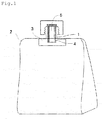
- FIG. 1 A schematic view showing a specific example of the barrier plug and a container with a barrier plug comprising the barrier plug in the present embodiment is shown in Figure 1 .
- the barrier plug in the present embodiment can be used for a container containing a food or the like, and can be used as a plug for a container of which water vapor barrier properties and oxygen barrier properties are required, also for a product other than a food or the like.
- the "container containing a food or the like” is not particularly limited, and examples thereof include containers with plugs such as pouches with spouts including Cheer Pack (R), bags with plugs such as bag-in-box bag bodies or infusion bags, and bottles with plugs in which drinks, jellies, seasonings such as soy sauce, or the like are enclosed.
- Plugs such as pouches with spouts including Cheer Pack (R)
- bags with plugs such as bag-in-box bag bodies or infusion bags
- problems of conventional plugs are that they have poor oxygen barrier properties and/or water vapor barrier properties, and therefore even if containers themselves containing foods or the like have oxygen barrier properties and water vapor barrier properties, oxygen and water vapor passing through the plugs deteriorate the contents of the packaging, and conversely, the components in the contents of the packaging are released to the outside through the plugs.
- a food to be packaged is enclosed in a container in a heated state, or a container in which a food is enclosed is heated.
- a problem is that when the plug is exposed to water vapor produced from the food or the like in the food packaging step, the barrier properties decrease further.
- the barrier plug in the present embodiment can prevent the deterioration of a food, a drink, a drug, or the like in a packaging that dislikes the intrusion of gases such as oxygen and water vapor, and can allow long-term storage while keeping hygiene and safety.
- the barrier plug in the present embodiment can maintain barrier properties even if hot water treatment such as boiling or retort treatment is performed.
- the resin constituting the spout body is not particularly limited, and examples thereof include a polyethylene-based resin (hereinafter also referred to as "PE") such as low density polyethylene, medium density polyethylene, high density polyethylene, or ethylene- ⁇ -olefin; a polypropylene-based resin (hereinafter also referred to as "PP") such as a homopolymer or a copolymer such as a random copolymer or a block copolymer; an ethylene-vinyl acetate copolymer (hereinafter abbreviated as EVA); a polyamide-based resin (hereinafter also referred to as "PA”); and an adhesive resin.
- PE polyethylene-based resin
- PP polypropylene-based resin
- EVA ethylene-vinyl acetate copolymer
- PA polyamide-based resin
- polyolefin-based resins such as a polyethylene-based resin, a polypropylene-based resin, and an ethylene-vinyl acetate copolymer are preferred.
- a polyolefin-based resin By using a polyolefin-based resin, the moldability tends to improve more.
- One resin constituting the spout body may be used alone, or two or more resins constituting the spout body may be used in combination.
- the cylindrical molded article is to be inserted into the spout body, and the inserted cylindrical molded article forms a discharge flow path for discharging the contents in a container to the outside.
- the cylindrical molded article has a resin layer comprising a barrier resin, the oxygen transmission rate of the resin layer is 10000 mL ⁇ m/m 2 ⁇ 24 hrs ⁇ MPa (23°C and 65% RH) or less, and the water vapor transmission rate of the resin layer is 1000 g ⁇ m/m 2 ⁇ 24 hrs (38°C and 90% RH) or less.
- “RH” means relative humidity.
- the "cylindrical molded article” is not particularly limited as long as it comprises a cylindrically molded resin layer comprising a barrier resin.
- the oxygen transmission rate of the resin layer at 23°C and 65% RH is preferably 10000 mL ⁇ m/m 2 ⁇ 24 hrs ⁇ MPa or less, more preferably 800 mL ⁇ m/m 2 ⁇ 24 hrs ⁇ MPa or less, further preferably 500 mL ⁇ m/m 2 ⁇ 24 hrs ⁇ MPa or less, still further preferably 450 mL ⁇ m/m 2 ⁇ 24 hrs ⁇ MPa or less, still more preferably 350 mL ⁇ m/m 2 ⁇ 24 hrs ⁇ MPa or less, particularly preferably 300 mL ⁇ m/m 2 ⁇ 24 hrs ⁇ MPa or less, and most preferably 250 mL ⁇ m/m 2 ⁇ 24 hrs ⁇ MPa or less.
- the lower limit of the oxygen transmission rate of the resin layer at 23°C and 65% RH is not particularly limited and is 0 mL ⁇ m/m 2 ⁇ 24 hrs ⁇ MPa.
- "RH" means relative humidity.
- the oxygen transmission rate of the resin layer at 23°C and 65% RH is 10000 mL ⁇ m/m 2 ⁇ 24 hrs ⁇ MPa or less, the suppression of the deterioration of contents, and the property of keeping the freshness of contents tend to improve more.
- the oxygen transmission rate of the resin layer at 23°C and 65% RH can be decreased by selecting a resin layer having better barrier properties, and specifically, by using a vinylidene chloride copolymer, the oxygen transmission rate can be significantly decreased, but this is not limiting.
- the oxygen transmission rate of the resin layer at 23°C and 65% RH can be measured by a method described in Examples.
- the "resin having barrier properties" is not particularly limited, and examples thereof include ethylene-vinyl alcohol copolymers, polyamide-based resins, polychlorotrifluoroethylene-based resins, and polyacrylonitrile-based resins.
- the water vapor transmission rate of the resin layer at 38°C and 90% RH is preferably 1000 g ⁇ m/m 2 ⁇ 24 hrs or less, more preferably 500 g ⁇ m/m 2 ⁇ 24 hrs or less, further preferably 300 g ⁇ m/m 2 ⁇ 24 hrs or less, still further preferably 200 g ⁇ m/m 2 ⁇ 24 hrs or less, still more preferably 100 g ⁇ m/m 2 ⁇ 24 hrs or less, particularly preferably 50 g ⁇ m/m 2 ⁇ 24 hrs or less, and most preferably 25 g ⁇ m/m 2 ⁇ 24 hrs or less.
- the lower limit of the water vapor transmission rate of the resin layer at 38°C and 90% RH is not particularly limited and is 0 g ⁇ m/m 2 ⁇ 24 hrs.
- the water vapor transmission rate of the resin layer at 38°C and 90% RH is 1000 g ⁇ m/m 2 ⁇ 24 hrs or less, the suppression of the deterioration of contents, and the property of keeping the freshness of contents tend to improve more.
- the water vapor transmission rate of the resin layer at 38°C and 90% RH can be decreased by selecting a resin layer having better barrier properties, and specifically, by using a vinylidene chloride copolymer, the water vapor transmission rate can be significantly decreased, but this is not limiting.
- the water vapor transmission rate of the resin layer at 38°C and 90% RH can be measured by a method described in Examples.
- the rate of decrease in the oxygen transmission rate is preferably 80 to 100%, more preferably 90 to 100%, and further preferably 95 to 100%.
- the rate of decrease in the oxygen transmission rate is within the above range, a decrease in barrier properties such as the oxygen transmission rate tends to be able to be more suppressed also in such a case.
- the rate of decrease in the oxygen transmission rate can be controlled by the selection of a resin, and specifically, by using a vinylidene chloride copolymer, the oxygen transmission rate can be significantly decreased.
- the thickness of the resin layer is preferably 5 to 1500 ⁇ m, more preferably 10 to 1000 ⁇ m, further preferably 25 to 700 ⁇ m, and particularly preferably 50 to 500 ⁇ m. When the thickness of the resin layer is within the above range, the cylindrical molded article can be used for more applications.
- the thickness of the cylindrical molded article is preferably 5 to 1500 ⁇ m, more preferably 50 to 1000 ⁇ m, further preferably 75 to 700 ⁇ m, and particularly preferably 100 to 600 ⁇ m. When the thickness of the cylindrical molded article is within the above range, the cylindrical molded article can be used for more applications.
- the inner diameter of the cylindrical molded article can be appropriately adjusted according to its application, is not particularly limited, and may be a diameter of 1 to 100 mm, or a diameter of 100 mm or more depending on the large container.
- a barrier plug characterized by being equipped with a barrier plug and sealed
- those in which the inner diameter of the cylindrical molded article is 5 mm to 15 mm, and the thickness of the cylindrical molded article is 0.3 mm to 2 mm are preferred.
- the barrier plug can be manufactured by subjecting the cylindrical molded article to insert injection molding or the like with respect to a body.
- the resin layer comprises a barrier resin, and the resin layer is preferably composed of a barrier resin.
- the barrier resin is not particularly limited, and examples thereof include vinylidene chloride copolymers, vinylidene chloride homopolymers, ethylene-vinyl alcohol copolymers, polyamide-based resins, polychlorotrifluoroethylene-based resins, and polyacrylonitrile-based resins.
- the resin layer preferably comprises a vinylidene chloride copolymer as the barrier resin, and the barrier resin is preferably composed of a vinylidene chloride copolymer.
- the cylindrical molded article in the present embodiment may have a first resin layer comprising a barrier resin, and a second resin layer comprising a barrier resin having a composition different from that of the first resin layer.
- One barrier resin may be used alone, or two or more barrier resins may be used in combination.
- the melting point of the barrier resin is preferably higher than the melting point of the resin constituting the spout body.
- a vinylidene chloride copolymer is a copolymer of a vinylidene chloride monomer and a monomer copolymerizable with the vinylidene chloride monomer.
- the monomer copolymerizable with the vinylidene chloride monomer is not particularly limited, and examples thereof include vinyl chloride; acrylates such as methyl acrylate and butyl acrylate; acrylic acid; methacrylates such as methyl methacrylate and butyl methacrylate; methacrylic acid; methylacrylonitrile; and vinyl acetate.
- methyl acrylate and methylacrylonitrile are preferred from the viewpoint of the balance between water vapor non-transmission properties and oxygen non-transmission properties and extrusion processability.
- One of these copolymerizable monomers may be used alone, or two or more of these copolymerizable monomers may be used in combination.
- the comonomer content of a vinylidene chloride-acrylate copolymer, a vinylidene chloride-methacrylate copolymer, and a vinylidene chloride-methylacrylonitrile copolymer is preferably 1 to 35% by mass, more preferably 1 to 25% by mass, further preferably 2 to 15.5% by mass, still further preferably 2 to 10% by mass, still more preferably 4 to 10% by mass, and particularly preferably 5 to 8% by mass.
- the comonomer content of the vinylidene chloride copolymer is 1% by mass or more, the melting properties during extrusion tend to improve more.
- the comonomer content of the vinylidene chloride copolymer is 35% by mass or less, the water vapor non-transmission properties and the oxygen non-transmission properties tend to improve more.
- the comonomer (vinyl chloride) content of a vinylidene chloride-vinyl chloride copolymer is preferably 1 to 40% by mass, more preferably 1 to 30% by mass, further preferably 1 to 21% by mass, still further preferably 3.5 to 18.5% by mass, still more preferably 6 to 16% by mass, and particularly preferably 8.5 to 13.5% by mass.
- the comonomer content of the vinylidene chloride copolymer is 1% by mass or more, the melting properties during extrusion tend to improve more.
- the comonomer content of the vinylidene chloride copolymer is 40% by mass or less, the water vapor non-transmission properties and the oxygen non-transmission properties tend to improve more.
- the weight average molecular weight (Mw) of the vinylidene chloride copolymer is preferably 50,000 to 150,000, more preferably 60,000 to 130,000, and further preferably 70,000 to 100,000.
- Mw weight average molecular weight
- the melt tension required for molding tends to improve more.
- the weight average molecular weight (Mw) is 150,000 or less, melt extrusion in which thermal stability is maintained tends to be possible.
- the weight average molecular weight (Mw) can be obtained by a gel permeation chromatography method (GPC method) using a standard polystyrene calibration curve.
- the polyolefin-based resin is not particularly limited, and examples thereof include polyethylene, polypropylene, ethylene- ⁇ -olefin copolymers, and ethylene-vinyl acetate copolymers.
- the polyethylene is not particularly limited, and examples thereof include low density polyethylene having a density of 0.910 to 0.930 g/cm 3 and high density polyethylene having a density of 0.942 g/cm 3 or more.
- the polypropylene is not particularly limited, and examples thereof include homopolypropylene and random polypropylene.
- the comonomer (vinyl alcohol) content of an ethylene-vinyl alcohol copolymer is preferably 35 to 60 mol %, more preferably 38 to 58 mol %, further preferably 38 to 54 mol %, still further preferably 39 to 49 mol %, and particularly preferably 41.5 to 46.5 mol %.
- the degree of saponification of the ethylene-vinyl alcohol copolymer is preferably 98 to 100 mol %, more preferably 99 to 100 mol %. When the degree of saponification is within the above range, the oxygen non-transmission properties tend to improve more.
- the content of vinyl acetate in the ethylene-vinyl acetate copolymer is preferably 1 to 35% by mass, more preferably 5 to 30% by mass, further preferably 10 to 25% by mass, and particularly preferably 15 to 20% by mass based on 100% by mass of the ethylene-vinyl acetate copolymer.
- the interlayer adhesive strength tends to improve more in the case of a multilayer configuration.
- the content of vinyl alcohol in the ethylene-vinyl alcohol copolymer is preferably 25 to 60% by mass, more preferably 30 to 55% by mass, further preferably 35 to 50% by mass, and particularly preferably 40 to 45% by mass based on 100% by mass of the ethylene-vinyl alcohol copolymer.
- the rate of decrease in the oxygen transmission rate tends to decrease more.
- the polyamide-based resin is not particularly limited, and examples thereof include polycaproamide (nylon 6), polydodecanamide (nylon 12), polytetramethylene adipamide (nylon 46), polyhexamethylene adipamide (nylon 66), polyundecamethylene adipamide (nylon 116), polymetaxylylene adipamide (nylon MXD6), polyparaxylylene adipamide (nylon PXD6), polytetramethylene sebacamide (nylon 410), polyhexamethylene sebacamide (nylon 610), polydecamethylene adipamide (nylon 106), polydecamethylene sebacamide (nylon 1010), polyhexamethylene dodecamide (nylon 612), polydecamethylene dodecamide (nylon 1012), polyhexamethylene isophthalamide (nylon 61), polytetramethylene terephthalamide (nylon 4T), polypentamethylene terephthalamide (nylon 5T), poly-2-methylp
- the resin layer may comprise other additives such as a known plasticizer, heat stabilizer, colorant, organic lubricant, inorganic lubricant, surfactant, and processing aid as required.
- the plasticizer is not particularly limited, and examples thereof include acetyl tributyl citrate, acetylated monoglycerides, and dibutyl sebacate.
- the heat stabilizer is not particularly limited, and examples thereof include epoxidized vegetable oils such as epoxidized soybean oil and epoxidized linseed oil, epoxy-based resins, magnesium oxide, and hydrotalcite.
- the cylindrical molded article may have a single-layer structure of a resin layer comprising a barrier resin, or may have a two-layer structure having an inside layer and an outside layer, or a three- or more-layer structure having an inside layer, one or more intermediate layers, and an outside layer, according to the application.
- the inside layer comprises a polyolefin-based resin
- the outside layer is the above resin layer.
- the inside layer comprise a polyolefin-based resin
- the outside layer and/or the above intermediate layer be the above resin layers.
- the resin constituting the layer other than the resin layer comprising the barrier resin is not particularly limited, and examples thereof include a polyethylene-based resin (hereinafter also referred to as "PE") such as low density polyethylene, medium density polyethylene, high density polyethylene, or ethylene- ⁇ -olefin; a polypropylene-based resin (hereinafter also referred to as "PP") such as a homo or a copolymer such as a random copolymer or a block copolymer, or other copolymers; an ethylene-vinyl acetate copolymer (hereinafter also referred to as "EVA”); a polyamide-based resin (hereinafter also referred to as "PA”); and an adhesive resin.
- the layer other than the resin layer comprising the barrier resin may comprise other components such as an adhesive.
- the layer configuration of a cylindrical molded article having a two- or more-layer structure is not particularly limited, and examples thereof include PE/PVDC/PE, PE/PVDC, PVDC/PE, PP/PVDC/PP, PP/PVDC, PVDC/PP, PE/EVA/PVDC/EVA/PVDC, PVDC/EVA/PVDC, PVDC/EVA/PE, PE/EVA/PVDC, PVDC/EVA/PE, PP/adhesive resin/PVDC/adhesive resin/PP, PP/adhesive resin/PVDC, PVDC/adhesive resin/PP, PE/EVA/PVDC/EVA/PE, PE/adhesive resin/PVDC, and PE/adhesive resin/PVDC/adhesive resin/PE.
- PE/PVDC indicates that a PE layer and a PVDC layer are laminated from the inside of the cylindrical molded article toward the outside.
- the barrier plug may have a lid portion covering a mouth of the plug.
- the portion of the lid portion covering the mouth of the plug preferably comprises a barrier resin, and other portions of the lid portion may comprise a barrier resin or the same resin as illustrated for the spout body.
- the cylindrical molded article in the present embodiment can be manufactured by a molding method such as extrusion processing, injection molding processing, or blow molding processing.
- extrusion processing in which a resin is melted and extruded, or injection molding processing in which a molten resin is injected into a mold and molded is preferred.
- a cylindrical molded article obtained by cylindrically multilayer-extruding a single layer or two or more layers by extrusion processing is preferred in that the ease of attachment such as joining or sealing, and the dimensional precision are good for processing by injection molding, bag making processing, part attachment processing, or the like using a cylindrical molded article.
- the cylindrical molded article extruded in this manner is cut to a predetermined length and used.
- a barrier plug is molded by insert injection molding or the like using the cylindrical molded article in the present embodiment, and the barrier plug is attached to a bag and a container.
- the cylindrical molded article at this time is used with a length reaching the interiors of the bag and the container.
- an insert-injection-molded barrier plug or a tubular cylindrical molded article is attached by performing heat sealing or the like in a state in which it is sandwiched between the inner surfaces of a bag at an end or corner portion of the bag.
- a barrier plug 1 in the present embodiment has a spout body 3 to be attached to a container 2 with a barrier plug, and the above cylindrical molded article 4 inserted into the spout body, and the cylindrical molded article forms a discharge flow path 5 for discharging the contents in the above container to the outside.
- a barrier plug 1 can be manufactured, for example, by injection-molding the resin constituting the spout body 3 around the cylindrical molded article 4, though not particularly limited.
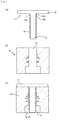
- Figure 2(a) shows a mold core 11 used for injection molding, and a cylindrical molded article attachment portion 13 having a columnar shape is formed on the base 12 of the mold core 11.
- the cylindrical molded article attachment portion 13 comprises a large diameter portion 13a located on the base end side on the base 12 side of the cylindrical molded article attachment portion 13, a small diameter portion 13b located on the tip side of the cylindrical molded article attachment portion 13, and a covering layer portion 13c formed between the large diameter portion 13a and the small diameter portion 13b.
- the covering layer portion 13c is stepped toward the tip side of the cylindrical molded article attachment portion 13.
- the difference between the radii of the large diameter portion 13a and the small diameter portion 13b is approximately equal to the wall thickness of the cylindrical molded article 4, the outer diameter of the large diameter portion 13a is approximately equal to the outer diameter of the cylindrical molded article 4, and the outer diameter of the small diameter portion 13b is formed so as to be slightly smaller than the inner diameter of the cylindrical molded article 4, specifically 0.01 to 0.2 mm smaller.
- the axial length of the small diameter portion 13b of the cylindrical molded article attachment portion 13 is formed longer than the axial length of the cylindrical molded article 4.
- Figure 2(b) shows a molding mold 14, and the molding mold 14 is formed of a left molding mold and a right molding mold so that it can be divided right and left.
- a cavity 15 is formed inside the molding mold 14, and the shape of the inner peripheral surface of the molding mold 14 is formed in the same shape as the outer peripheral shape of the spout body.
- a gate communicating with the injection port of an injection molding machine not shown is provided toward the cavity 15.
- the above-described mold core 11 is configured to be moveable forward and backward so that the cylindrical molded article attachment portion 13 can be vertically brought into and out of the cavity 15 of the molding mold 14.
- the barrier plug 1 is molded by an injection molding apparatus having an injection molding machine and a molding mold.
- the cylindrical molded article 4 is attached to the cylindrical molded article attachment portion 13 of the mold core 11, and inserted until one end side of the cylindrical molded article 4 abuts the bottom of the covering layer portion 13c. Therefore, the covering layer portion 13c plays a role as the positioning of the cylindrical molded article 4.
- the cylindrical molded article attachment portion 13 is inserted into the cavity 15 of the molding mold 14 in a state in which the cylindrical molded article 4 is inserted into the cylindrical molded article attachment portion 13, and the left molding mold and the right molding mold are closed.
- a resin stirred and melted in the injection molding machine is injected into the cavity 15 from the gate.
- the cylindrical molded article 4 is subjected to the flow pressure of the molten resin, and a load under which the cylindrical molded article 4 tries to move to the large diameter portion 13a side on the base end side of the cylindrical molded article attachment portion 13 is applied, but movement is restricted by the covering layer portion 13c of the cylindrical molded article attachment portion 13.
- the covering layer portion 13c restricts the position of the cylindrical molded article 4, and therefore the covering layer portion 13c is formed in the cylindrical molded article attachment portion 13 so that the cylindrical molded article 4 is disposed at a normal position in the spout body.
- the space between the molding mold 14 and the cylindrical molded article attachment portion 13 of the mold core 11 is filled with the molten resin by the injection molding machine, and thus the spout body is formed.
- a stepped clearance is formed between one end side of the cylindrical molded article 4 and the covering layer portion 13c formed in the cylindrical molded article attachment portion 13, the clearance is filled with the molten resin, and thus the covering layer 6 of the spout body is formed (see Figure 3 ).
- the covering layer 6 is formed so that the portion abutting the end surface of the cylindrical molded article 4 on one end side is a restriction surface, and the surface where the covering layer 6 abuts the covering layer portion 13c of the cylindrical molded article attachment portion 13 is a covering layer.
- the cylindrical molded article 4 On the other end side of the cylindrical molded article 4, its end surface is covered with the molten resin, and a retention surface is formed. Thus, the end surfaces of the cylindrical molded article 4 on one end side and the other end side are covered with the spout body.
- the spout body comes into contact with the cylindrical molded article 4 in a molten state during molding, and thus the close adhesiveness and adhesiveness between the spout body and the cylindrical molded article 4 are enhanced.
- the molten resin 16 is cooled and solidified, and thus the spout body 3 is molded, and the barrier plug 1 is obtained. Even if there is a slight gap between the cylindrical molded article 4 and the small diameter portion 13b of the cylindrical molded article attachment portion 13, the molten resin can be prevented from entering the gap by resin viscosity adjustment or the like.
- the container 2 and the cylindrical molded article 4 preferably lap in the longitudinal direction of the cylindrical molded article 4.
- the length h of the lap in the longitudinal direction is preferably 0.1 mm to 10 mm, more preferably 2 mm to 7 mm.
- the length h is 0.1 mm or more, the water vapor barrier properties, the oxygen barrier properties, and the smell retention properties tend to improve more.
- the length h is 10 mm or less, the amount of the relatively expensive cylindrical molded article 4 used can be decreased, and therefore the cost of the barrier plug can be reduced.
- the wall thickness D of the spout body is preferably 0.2 mm to 2 mm, more preferably 0.4 mm to 1.5 mm.
- the wall thickness D refers to the thickness of the thinnest portion.
- the container with the barrier plug in the present embodiment has a container and the above barrier plug attached to the container, and the container comprises at least one or more selected from the group consisting of a laminated film having a resin layer composed of a barrier resin having an oxygen transmission rate of 10000 mL ⁇ m/m 2 ⁇ 24 hrs ⁇ MPa (23°C and 65% RH) or less and a water vapor transmission rate of 1000 g ⁇ m/m 2 ⁇ 24 hrs (38°C and 90% RH) or less, a laminated film having an aluminum foil layer, and a metal vapor-deposited film.
- Examples of the constituent member of the container include at least one or more selected from the group consisting of a laminated film having a resin layer composed of a barrier resin, a laminated film having an aluminum foil layer, and a metal vapor-deposited film.
- the resin layer composed of the barrier resin can have the same configuration as described for the above barrier plug except that it has an oxygen transmission rate of 10000 mL ⁇ m/m 2 ⁇ 24 hrs ⁇ MPa (23°C and 65% RH) or less and a water vapor transmission rate of 1000 g ⁇ m/m 2 ⁇ 24 hrs (38°C and 90% RH) or less and constitutes the container.
- These substitute measurement films were obtained by forming films using a direct inflation apparatus and using a single-layer die for single-layer films and a coextrusion multilayer die for laminated films, so as to provide predetermined configuration ratios.
- a direct inflation apparatus By multiplying the measured values of the oxygen transmission rate, water vapor transmission rate, and rate of decrease in the oxygen transmission rate of a substitute measurement film by the thickness value of the resin layer comprising the barrier resin to provide transmission rates per ⁇ m, barrier properties when a cylindrical molded article is formed can be estimated.
- the oxygen transmission rate (OTR) was measured in accordance with ASTM D-3985. Specifically, a substitute measurement sample having a predetermined thickness was measured under the conditions of 23°C and 65% RH using Mocon OX-TRAN 2/20. The obtained measured value was multiplied by the thickness of the resin layer comprising the barrier resin to obtain the oxygen transmission rate per thickness of 1 ⁇ m (rounded to the nearest whole number).
- the water vapor transmission rate (WVTR) was measured in accordance with ASTM F-372. Specifically, a substitute measurement sample having a predetermined thickness was measured under the conditions of 38°C and 90% RH using Mocon PERMATRAN-W398. The obtained measured value was multiplied by the thickness of the resin layer comprising the barrier resin to obtain the water vapor transmission rate per thickness of 1 ⁇ m (rounded to the nearest whole number).
- the rate of decrease in the oxygen transmission rate was measured in accordance with ASTM D-3985. Specifically, a substitute measurement sample having a predetermined thickness was measured under the conditions of 23°C and 90% RH using Mocon OX-TRAN 2/20. The obtained measured value was multiplied by the thickness of the resin layer comprising the barrier resin to provide the oxygen transmission rate per thickness of 1 ⁇ m (rounded to the nearest whole number) under the condition of 90% RH. The rate of decrease in the oxygen transmission rate was obtained by dividing the oxygen transmission rate under the condition of 65% RH by the oxygen transmission rate under the condition of 90% RH (rounding the quotient to the nearest whole number) and multiplying the quotient by 100%.
- Each of the cylindrical molded articles obtained in the Examples and the Comparative Examples was inserted into a spout body composed of polyethylene, and a lid portion was attached to obtain a barrier plug.
- Each of the resin compositions obtained in the Examples and the Comparative Examples was continuously extruded into a sheet shape using melt extrusion equipment. Then, the extruded resin composition was adjusted to the same thickness as the tube in a cold water tank. The obtained sheet was cut, and the sheet was disposed on a lid portion body composed of polyethylene so as to be the portion of a lid portion covering a mouth of a plug, thereby obtaining the lid portion.
- the obtained barrier plug to which the lid portion was attached was attached to a pouch composed of a laminated film having an aluminum foil layer to obtain a container with a barrier plug.
- a case where ⁇ E was 0 or more and 7 or less could be evaluated as the soy sauce being in a relatively good state with little discoloration of the soy sauce.
- a case where ⁇ E was more than 7 and 12 or less could be evaluated as the soy sauce being in a good state.
- a case where ⁇ E was more than 12 and 14 or less could be evaluated as the soy sauce being in a usable state though discoloration being visually recognizable.
- a case where ⁇ E was more than 14 could be evaluated as the soy sauce being in an unusable state with extreme discoloration.
- a case where ⁇ E was 0 or more and 7 or less could be evaluated as the soy sauce being in a relatively good state with little discoloration of the soy sauce.
- a case where ⁇ E was more than 7 and 12 or less could be evaluated as the soy sauce being in a good state.
- a case where ⁇ E was more than 12 and 14 or less could be evaluated as the soy sauce being in a usable state though discoloration being visually recognizable.
- a case where ⁇ E was more than 14 could be evaluated as the soy sauce being in an unusable state with extreme discoloration.
- a resin composition obtained by mixing 1 wt % of epoxidized soybean oil as a heat stabilizer with a PVDC-A resin with vinylidene chloride (VDC)/methyl acrylate (MA) 95/5 (% by mass) having a weight average molecular weight of 80,000 (manufactured by Asahi Kasei Chemicals Corporation) was continuously extruded cylindrically using melt extrusion equipment equipped with a cylindrical die. Then, the extruded resin composition was adjusted to an outer diameter of 10 mm in a cold water tank with an outer diameter sizing apparatus to obtain a single-layer tube having a thickness of 300 ⁇ m.
- the same resin composition was adjusted to a thickness of 30 ⁇ m, which was 1/10 of the tube thickness, using a direct inflation apparatus, to obtain a single-layer film (substitute measurement film).
- the oxygen transmission rate and water vapor transmission rate of this substitute measurement film were measured.
- VDC vinylidene chloride
- MA methyl acrylate
- VDC vinylidene chloride
- VC vinylidene chloride
- a single-layer tube having an outer diameter of 10 mm and a thickness of 100 ⁇ m was obtained as in Example 1 except that the thickness was 100 ⁇ m.
- a single-layer tube having an outer diameter of 10 mm and a thickness of 500 ⁇ m was obtained as in Example 1 except that the thickness was 500 ⁇ m.
- Low density polyethylene PE-A (manufactured by Asahi Kasei Chemicals Corporation, product name F1920)
- a resin composition obtained by mixing 1 wt % of epoxidized soybean oil as a heat stabilizer with the PVDC-A resin were continuously extruded cylindrically using the low density polyethylene (PE-A) for an inside layer and an outside layer and the resin composition for an intermediate layer and using melt extrusion equipment equipped with a coextrusion multilayer cylindrical die. Then, the extruded material was adjusted to an outer diameter of 10 mm in a cold water tank with an outer diameter sizing apparatus to obtain a three-layer tube having a thickness of 600 ⁇ m.
- a two-layer tube having an outer diameter of 10 mm and a thickness of 400 ⁇ m was obtained as in Example 6 except that the outside layer composed of the low density polyethylene (PE-A) was not provided.
- PE-A low density polyethylene
- a three-layer tube having an outer diameter of 10 mm and a thickness of 500 ⁇ m was obtained as in Example 6 except that the PVDC-B resin was used instead of the PVDC-A resin.
- a two-layer tube having an outer diameter of 10 mm and a thickness of 400 ⁇ m was obtained as in Example 7 except that the PVDC-B resin was used instead of the PVDC-A resin.
- a three-layer tube having an outer diameter of 10 mm and a thickness of 500 ⁇ m was obtained as in Example 6 except that the high density polyethylene (PE-B (manufactured by Asahi Kasei Chemicals Corporation, product name F371)) was used instead of the low density polyethylene (PE-A).
- PE-B high density polyethylene
- PE-A low density polyethylene
- a two-layer tube having an outer diameter of 10 mm and a thickness of 400 ⁇ m was obtained as in Example 7 except that the high density polyethylene (PE-B) was used instead of the low density polyethylene (PE-A).
- PE-B high density polyethylene
- PE-A low density polyethylene
- the low density polyethylene (PE-A), the ethylene-vinyl acetate copolymer (EVA-A), and a resin composition obtained by mixing 1 wt % of epoxidized soybean oil as a heat stabilizer with the PVDC-A resin were continuously extruded cylindrically using the low density polyethylene (PE-A) for an inside layer, the ethylene-vinyl acetate copolymer (EVA-A) for an intermediate layer, and the resin composition for an outside layer and using melt extrusion equipment equipped with a coextrusion multilayer cylindrical die.
- the extruded material was adjusted to an outer diameter of 10 mm in a cold water tank with an outer diameter sizing apparatus to obtain a three-layer tube having a thickness of 400 ⁇ m.
- adjustment to a total thickness of 40 ⁇ m, which was 1/10 of the tube thickness was made in the same manner by coextrusion multilayer film molding equipment with the same thickness configuration ratio for the layers to obtain a three-layer film (substitute measurement film). The oxygen transmission rate and water vapor transmission rate of this substitute measurement film were measured.
- a five-layer tube having an outer diameter of 10 mm and a thickness of 600 ⁇ m was obtained as in Example 12 except that an ethylene-vinyl acetate copolymer (EVA-B (manufactured by Nippon Unicar Company Limited, product name NUC-3758)) was used instead of the ethylene-vinyl acetate copolymer (EVA-A).
- EVA-B ethylene-vinyl acetate copolymer
- NUC-3758 ethylene-vinyl acetate copolymer
- a three-layer tube having an outer diameter of 10 mm and a thickness of 400 ⁇ m was obtained as in Example 13 except that the ethylene-vinyl acetate copolymer (EVA-B) was used instead of the ethylene-vinyl acetate copolymer (EVA-A).
- EVA-B ethylene-vinyl acetate copolymer
- EVA-A ethylene-vinyl acetate copolymer
- a three-layer tube having an outer diameter of 10 mm and a thickness of 500 ⁇ m was obtained as in Example 6 except that homopolypropylene (PP-A (manufactured by SunAllomer Ltd., product name PL500A)) was used instead of the low density polyethylene (PE-A).
- PP-A homopolypropylene
- PE-A low density polyethylene
- Adjustment to an outer diameter of 10 mm was made to obtain a two-layer tube having a thickness of 400 ⁇ m, as in Example 16 except that the outside layer composed of the homopolypropylene (PP-A) was not provided.
- PP-A homopolypropylene
- the homopolypropylene (PP-A), an adhesive resin, a resin composition obtained by mixing 1 wt % of epoxidized soybean oil as a heat stabilizer with the PVDC-A resin, an adhesive resin, and the homopolypropylene (PP-A) were continuously extruded cylindrically in this order from the inside using melt extrusion equipment equipped with a coextrusion multilayer cylindrical die. Then, the extruded material was adjusted to an outer diameter of 10 mm in a cold water tank with an outer diameter sizing apparatus to obtain a five-layer tube having a thickness of 600 ⁇ m.
- a five-layer tube having an outer diameter of 10 mm and a thickness of 600 ⁇ m was obtained as in Example 18 except that random polypropylene (PP-B (manufactured by SunAllomer Ltd., product name PB222A)) was used instead of the homopolypropylene (PP-A).
- PP-B random polypropylene
- PB222A homopolypropylene
- the homopolypropylene (PP-A), an adhesive resin, and a resin composition obtained by mixing 1 wt % of epoxidized soybean oil as a heat stabilizer with the PVDC-A resin were continuously extruded cylindrically using the homopolypropylene (PP-A) for an inside layer, the adhesive resin for an intermediate layer, and the resin composition for an outside layer and using melt extrusion equipment equipped with a coextrusion multilayer cylindrical die. Then, the extruded material was adjusted to an outer diameter of 10 mm in a cold water tank with an outer diameter sizing apparatus to obtain a three-layer tube having a thickness of 450 ⁇ m.
- a five-layer tube having an outer diameter of 10 mm and a thickness of 500 ⁇ m was obtained as in Example 12 except that an outside layer composed of an ethylene vinyl alcohol copolymer (EVOH) was provided instead of the outside layer composed of the low density polyethylene (PE-A), and an adhesive resin was used instead of the ethylene-vinyl acetate copolymer (EVA-A) of the inside layer.
- EVOH ethylene vinyl alcohol copolymer
- PE-A low density polyethylene
- a single-layer tube having an outer diameter of 10 mm and a thickness of 150 ⁇ m was obtained as in Example 1 except that an ethylene vinyl alcohol copolymer was used instead of the PVDC-A resin, and the thickness was 150 ⁇ m.
- adjustment to a thickness of 15 ⁇ m, which was 1/10 of the tube thickness was made in the same manner using a melt extrusion machine, to obtain a single-layer film (substitute measurement film). The oxygen transmission rate and water vapor transmission rate of this substitute measurement film were measured.
- a single-layer tube having an outer diameter of 10 mm and a thickness of 150 ⁇ m was obtained as in Example 1 except that an MXD6 polyamide resin (PA (manufactured by MITSUBISHI GAS CHEMICAL COMPANY, INC., product name S6007)) was used instead of the PVDC-A resin, and the thickness was 150 ⁇ m.
- PA manufactured by MITSUBISHI GAS CHEMICAL COMPANY, INC., product name S6007
- adjustment to a thickness of 15 ⁇ m, which was 1/10 of the tube thickness was made in the same manner using a melt extrusion machine, to obtain a single-layer film (substitute measurement film). The oxygen transmission rate and water vapor transmission rate of this substitute measurement film were measured.
- the low density polyethylene (PE-A), an adhesive resin, an ethylene vinyl alcohol copolymer (EVOH), an adhesive resin, and the low density polyethylene (PE-A) were continuously extruded cylindrically in this order from the inside using melt extrusion equipment equipped with a coextrusion multilayer cylindrical die. Then, the extruded material was adjusted to an outer diameter of 10 mm in a cold water tank with an outer diameter sizing apparatus to obtain a five-layer tube having a thickness of 450 ⁇ m. In addition, adjustment to a total thickness of 45 ⁇ m, which was 1/10 of the tube thickness, was made in the same manner by coextrusion multilayer film molding equipment with the same thickness configuration ratio for layers to obtain a five-layer film (substitute measurement film). The oxygen transmission rate and water vapor transmission rate of this substitute measurement film were measured.
- Adjustment to an outer diameter of 10 mm was made to obtain a five-layer tube having a thickness of 500 ⁇ m, as in Comparative Example 3 except that 150 ⁇ m of an intermediate layer composed of the MXD6 polyamide resin (PA) was used instead of 100 ⁇ m of the intermediate layer composed of the ethylene vinyl alcohol copolymer (EVOH).
- PA MXD6 polyamide resin
- EVOH ethylene vinyl alcohol copolymer
- the barrier plug of the present invention has industrial applicability as a plug used for various packagings.
Landscapes
- Engineering & Computer Science (AREA)
- Mechanical Engineering (AREA)
- Packages (AREA)
- Laminated Bodies (AREA)
- Bag Frames (AREA)
- Wrappers (AREA)
- Closures For Containers (AREA)
- Containers Having Bodies Formed In One Piece (AREA)
- Chemical Vapour Deposition (AREA)
- Packging For Living Organisms, Food Or Medicinal Products That Are Sensitive To Environmental Conditiond (AREA)
- Details Of Rigid Or Semi-Rigid Containers (AREA)
Applications Claiming Priority (2)
| Application Number | Priority Date | Filing Date | Title |
|---|---|---|---|
| JP2016021242 | 2016-02-05 | ||
| PCT/JP2017/004101 WO2017135450A1 (fr) | 2016-02-05 | 2017-02-03 | Obturateur-barrière d'embouchure et récipient avec obturateur-barrière d'embouchure |
Publications (2)
| Publication Number | Publication Date |
|---|---|
| EP3412596A1 true EP3412596A1 (fr) | 2018-12-12 |
| EP3412596A4 EP3412596A4 (fr) | 2019-12-25 |
Family
ID=59499727
Family Applications (1)
| Application Number | Title | Priority Date | Filing Date |
|---|---|---|---|
| EP17747601.7A Withdrawn EP3412596A4 (fr) | 2016-02-05 | 2017-02-03 | Obturateur-barrière d'embouchure et récipient avec obturateur-barrière d'embouchure |
Country Status (13)
| Country | Link |
|---|---|
| US (1) | US10894649B2 (fr) |
| EP (1) | EP3412596A4 (fr) |
| JP (1) | JP2017141061A (fr) |
| KR (1) | KR20180109916A (fr) |
| CN (1) | CN108883865B (fr) |
| AU (1) | AU2017215878B2 (fr) |
| BR (1) | BR112018015374A2 (fr) |
| CL (1) | CL2018002082A1 (fr) |
| MX (1) | MX2018009509A (fr) |
| MY (1) | MY193060A (fr) |
| PH (1) | PH12018501614A1 (fr) |
| RU (1) | RU2744527C2 (fr) |
| WO (1) | WO2017135450A1 (fr) |
Families Citing this family (4)
| Publication number | Priority date | Publication date | Assignee | Title |
|---|---|---|---|---|
| US11059633B2 (en) | 2019-10-31 | 2021-07-13 | Cheer Pack North America | Flip-top closure for container |
| JP7530712B2 (ja) | 2019-12-06 | 2024-08-08 | 株式会社細川洋行 | 塞ぎ部材付き排出用部材および収容容器 |
| JP2023100359A (ja) * | 2022-01-06 | 2023-07-19 | 株式会社細川洋行 | 包装袋用積層体、包装袋、スパウト付き包装袋及び内容物入りスパウト付き包装袋 |
| JP2023100362A (ja) * | 2022-01-06 | 2023-07-19 | 株式会社細川洋行 | 包装袋用積層体、包装袋、スパウト付き包装袋及び内容物入りスパウト付き包装袋 |
Family Cites Families (17)
| Publication number | Priority date | Publication date | Assignee | Title |
|---|---|---|---|---|
| JPS6363738A (ja) * | 1986-09-05 | 1988-03-22 | Toyo Seikan Kaisha Ltd | 熱成形性塩化ビニリデン樹脂組成物 |
| JP4641078B2 (ja) | 2000-02-01 | 2011-03-02 | 大日本印刷株式会社 | 注出具及び注出具付き包装袋 |
| JP2003095288A (ja) * | 2001-09-20 | 2003-04-03 | Toppan Printing Co Ltd | 酸素バリア性を有する口栓付パウチ |
| SE0103507L (sv) | 2001-10-22 | 2003-04-23 | Tetra Laval Holdings & Finance | Förpackningslaminat för en autoklaverbar förpackningsbehållare |
| JP2006001623A (ja) | 2004-06-21 | 2006-01-05 | Toppan Printing Co Ltd | バリア口栓およびバリア口栓付袋状容器 |
| JP4563132B2 (ja) * | 2004-10-05 | 2010-10-13 | 旭化成ケミカルズ株式会社 | 収縮包装体 |
| CN100500522C (zh) * | 2005-03-03 | 2009-06-17 | 徐跃 | 阻隔性双层塑料瓶及其制造方法 |
| JP4848800B2 (ja) * | 2006-03-06 | 2011-12-28 | 東洋製罐株式会社 | 複合スパウト及び複合スパウトを形成する射出成形装置 |
| KR101321328B1 (ko) * | 2006-03-06 | 2013-10-23 | 니혼 클로져 가부시키가이샤 | 복합 스파우트 및 복합 스파우트를 형성하는 사출 성형 장치 |
| CN100460202C (zh) * | 2006-05-15 | 2009-02-11 | 高学文 | Pvdc-聚烯烃共挤出热成型高阻隔复合包装材料 |
| JP5306587B2 (ja) | 2006-09-29 | 2013-10-02 | 東洋製罐株式会社 | ガス遮断性を有するスパウト及びその製造方法並びに該スパウトを装着したスパウト付き容器 |
| JP5239522B2 (ja) | 2008-06-04 | 2013-07-17 | 大日本印刷株式会社 | バリア性を有するスパウト |
| JP5955506B2 (ja) | 2011-02-03 | 2016-07-20 | 株式会社型システム | スパウトの製造方法 |
| JP2015036215A (ja) | 2013-08-13 | 2015-02-23 | ユニチカ株式会社 | ガスバリア層およびガスバリア性フィルム |
| US11046505B2 (en) | 2014-02-24 | 2021-06-29 | Guala Pack S.P.A. | Oxygen impermeable spout for a flexible pouch |
| JP6468799B2 (ja) | 2014-10-28 | 2019-02-13 | 三笠産業株式会社 | スパウト付パウチ |
| JP6679626B2 (ja) * | 2016-02-05 | 2020-04-15 | 旭化成株式会社 | 筒状成型体、バリア口栓、及びバリア口栓付容器 |
-
2017
- 2017-02-03 AU AU2017215878A patent/AU2017215878B2/en not_active Expired - Fee Related
- 2017-02-03 BR BR112018015374-5A patent/BR112018015374A2/pt not_active Application Discontinuation
- 2017-02-03 WO PCT/JP2017/004101 patent/WO2017135450A1/fr not_active Ceased
- 2017-02-03 MX MX2018009509A patent/MX2018009509A/es unknown
- 2017-02-03 JP JP2017018997A patent/JP2017141061A/ja active Pending
- 2017-02-03 CN CN201780009963.XA patent/CN108883865B/zh not_active Expired - Fee Related
- 2017-02-03 MY MYPI2018702707A patent/MY193060A/en unknown
- 2017-02-03 EP EP17747601.7A patent/EP3412596A4/fr not_active Withdrawn
- 2017-02-03 KR KR1020187022472A patent/KR20180109916A/ko not_active Withdrawn
- 2017-02-03 US US16/075,237 patent/US10894649B2/en not_active Expired - Fee Related
- 2017-02-03 RU RU2018131576A patent/RU2744527C2/ru active
-
2018
- 2018-07-31 PH PH12018501614A patent/PH12018501614A1/en unknown
- 2018-08-02 CL CL2018002082A patent/CL2018002082A1/es unknown
Also Published As
| Publication number | Publication date |
|---|---|
| MX2018009509A (es) | 2019-03-28 |
| RU2018131576A3 (fr) | 2020-05-20 |
| US20190039800A1 (en) | 2019-02-07 |
| AU2017215878A1 (en) | 2018-09-06 |
| RU2018131576A (ru) | 2020-03-06 |
| JP2017141061A (ja) | 2017-08-17 |
| WO2017135450A1 (fr) | 2017-08-10 |
| CN108883865A (zh) | 2018-11-23 |
| BR112018015374A2 (pt) | 2018-12-18 |
| MY193060A (en) | 2022-09-26 |
| AU2017215878B2 (en) | 2022-07-07 |
| HK1259016A1 (zh) | 2019-11-22 |
| CL2018002082A1 (es) | 2019-02-15 |
| CN108883865B (zh) | 2021-02-19 |
| EP3412596A4 (fr) | 2019-12-25 |
| US10894649B2 (en) | 2021-01-19 |
| RU2744527C2 (ru) | 2021-03-11 |
| KR20180109916A (ko) | 2018-10-08 |
| PH12018501614A1 (en) | 2019-04-08 |
Similar Documents
| Publication | Publication Date | Title |
|---|---|---|
| JP7050049B2 (ja) | 酸素バリヤプラスチック材料 | |
| EP3526037B1 (fr) | Tube stratifié à barrière polymère pour récipient | |
| AU2010312385B2 (en) | Plastic film having oxygen absorbing function and infusion bag | |
| EP3412596A1 (fr) | Obturateur-barrière d'embouchure et récipient avec obturateur-barrière d'embouchure | |
| US12049348B2 (en) | Multilayer film for container and container comprising same | |
| EP3412593A1 (fr) | Corps moulé cylindrique, élément d'arrêt formant barrière, et contenant avec élément d'arrêt formant barrière | |
| JP6805599B2 (ja) | 多層シート、トレイ及び包装体 | |
| US20140076928A1 (en) | Material composition, laminate tube and method for manufacture thereof | |
| CN109383929A (zh) | 吸嘴 | |
| US20190047316A1 (en) | Cylindrical molded article and barrier plug, barrier plug-attached container, and tube for storing ink | |
| JP2010013638A (ja) | 酸素吸収樹脂組成物 | |
| EP3372640B1 (fr) | Composition de résine contenant un copolymère d'éthylène/alcool vinylique, stratifié, et article moulé | |
| US20190047317A1 (en) | Cylindrical molded article | |
| HK1259016B (zh) | 阻隔口栓及带阻隔口栓的容器 | |
| JP2019031328A (ja) | スパウト | |
| US5932305A (en) | Composite sheet and sealed container | |
| JP2001150605A (ja) | 多層構造体 | |
| US20070166493A1 (en) | Barrier container structure and method of production |
Legal Events
| Date | Code | Title | Description |
|---|---|---|---|
| STAA | Information on the status of an ep patent application or granted ep patent |
Free format text: STATUS: THE INTERNATIONAL PUBLICATION HAS BEEN MADE |
|
| PUAI | Public reference made under article 153(3) epc to a published international application that has entered the european phase |
Free format text: ORIGINAL CODE: 0009012 |
|
| STAA | Information on the status of an ep patent application or granted ep patent |
Free format text: STATUS: REQUEST FOR EXAMINATION WAS MADE |
|
| 17P | Request for examination filed |
Effective date: 20180829 |
|
| AK | Designated contracting states |
Kind code of ref document: A1 Designated state(s): AL AT BE BG CH CY CZ DE DK EE ES FI FR GB GR HR HU IE IS IT LI LT LU LV MC MK MT NL NO PL PT RO RS SE SI SK SM TR |
|
| AX | Request for extension of the european patent |
Extension state: BA ME |
|
| DAV | Request for validation of the european patent (deleted) | ||
| DAX | Request for extension of the european patent (deleted) | ||
| A4 | Supplementary search report drawn up and despatched |
Effective date: 20191125 |
|
| RIC1 | Information provided on ipc code assigned before grant |
Ipc: B65D 75/58 20060101AFI20191119BHEP Ipc: B32B 27/32 20060101ALI20191119BHEP Ipc: B65D 65/40 20060101ALI20191119BHEP Ipc: B32B 7/02 20190101ALI20191119BHEP Ipc: B32B 27/08 20060101ALI20191119BHEP Ipc: B32B 1/04 20060101ALI20191119BHEP Ipc: B65D 33/38 20060101ALI20191119BHEP Ipc: B32B 27/30 20060101ALI20191119BHEP |
|
| STAA | Information on the status of an ep patent application or granted ep patent |
Free format text: STATUS: EXAMINATION IS IN PROGRESS |
|
| 17Q | First examination report despatched |
Effective date: 20200820 |
|
| STAA | Information on the status of an ep patent application or granted ep patent |
Free format text: STATUS: THE APPLICATION IS DEEMED TO BE WITHDRAWN |
|
| 18D | Application deemed to be withdrawn |
Effective date: 20220924 |