EP3415470A1 - Bordotiertes natriumionen-kathodenmaterial, verfahren zur herstellung und davon und dessen verwendung - Google Patents
Bordotiertes natriumionen-kathodenmaterial, verfahren zur herstellung und davon und dessen verwendung Download PDFInfo
- Publication number
- EP3415470A1 EP3415470A1 EP17401062.9A EP17401062A EP3415470A1 EP 3415470 A1 EP3415470 A1 EP 3415470A1 EP 17401062 A EP17401062 A EP 17401062A EP 3415470 A1 EP3415470 A1 EP 3415470A1
- Authority
- EP
- European Patent Office
- Prior art keywords
- cathode material
- sodium
- cathode
- boron
- elements
- Prior art date
- Legal status (The legal status is an assumption and is not a legal conclusion. Google has not performed a legal analysis and makes no representation as to the accuracy of the status listed.)
- Withdrawn
Links
Images


Classifications
-
- C—CHEMISTRY; METALLURGY
- C01—INORGANIC CHEMISTRY
- C01G—COMPOUNDS CONTAINING METALS NOT COVERED BY SUBCLASSES C01D OR C01F
- C01G45/00—Compounds of manganese
- C01G45/12—Complex oxides containing manganese and at least one other metal element
- C01G45/1221—Manganates or manganites with trivalent manganese, tetravalent manganese or mixtures thereof
- C01G45/1228—Manganates or manganites with trivalent manganese, tetravalent manganese or mixtures thereof of the type (MnO2)-, e.g. LiMnO2 or Li(MxMn1-x)O2
-
- C—CHEMISTRY; METALLURGY
- C01—INORGANIC CHEMISTRY
- C01P—INDEXING SCHEME RELATING TO STRUCTURAL AND PHYSICAL ASPECTS OF SOLID INORGANIC COMPOUNDS
- C01P2002/00—Crystal-structural characteristics
- C01P2002/70—Crystal-structural characteristics defined by measured X-ray, neutron or electron diffraction data
- C01P2002/72—Crystal-structural characteristics defined by measured X-ray, neutron or electron diffraction data by d-values or two theta-values, e.g. as X-ray diagram
-
- C—CHEMISTRY; METALLURGY
- C01—INORGANIC CHEMISTRY
- C01P—INDEXING SCHEME RELATING TO STRUCTURAL AND PHYSICAL ASPECTS OF SOLID INORGANIC COMPOUNDS
- C01P2002/00—Crystal-structural characteristics
- C01P2002/70—Crystal-structural characteristics defined by measured X-ray, neutron or electron diffraction data
- C01P2002/76—Crystal-structural characteristics defined by measured X-ray, neutron or electron diffraction data by a space-group or by other symmetry indications
Definitions
- the invention is related to a cathode material for sodium based electrochemical energy storage devices, a method for preparing it and its use as well as a battery containing a cathode material according to the invention.
- the state of the art concerning battery active materials predominantly consists of lithium-based compounds, which share the same working principle.
- lithium-ion batteries appear to be the most promising technology for electrochemical energy storage and for promoting the implementation of renewable energies.
- all lithium-based systems have one drawback, which is the limited and geographically unevenly distributed availability of lithium resources.
- a strong increase of demand for lithium e.g. if lithium-ion batteries will be used for large-scale applications like electric vehicles, a shortage of lithium is likely to occur, leading to a strong price increase.
- Sodium-ion batteries might be an interesting technology, especially in case of a shortage of lithium, since sodium resources are cheap, highly abundant and available in almost every country in the world (in forms of rock, sea salt, brine).
- the redox potential of sodium is higher than that of lithium (about 0.3 V vs. the Standard Hydrogen Electrode) and that sodium is heavier (23 g mol -1 vs. 7 g mol -1 for lithium), which leads to a decreased specific energy density.
- this lower specific energy is partially balanced by the use of aluminium as anode current collector in sodium-ion batteries, since sodium does not alloy with it at low potentials.
- the heavier and more expensive copper current collector which is necessarily used in lithium-ion batteries, can be replaced. This is consequently not only leading to reduced weight but also cost.
- lithium-ion cathode materials are dependent on the use of nickel and/or cobalt as part of the active material, making them costly, toxic, environmentally unfriendly and limited in raw-materials supply.
- the sodium-ion battery is regarded as a promising candidate for efficient energy storage and especially low-cost applications, e.g. stationary energy storage.
- a strong increase in scientific publications on sodium-ion batteries is registered since about 2010.
- EP 2879215 A1 discusses a boron-doped lithium-rich nickel cobalt manganese oxide. The boron doping results in a higher capacity retention upon cycle life.
- boron is used to increase the mobility of charge carriers in a polyanionic compound, which is a different material class than layered compounds.
- US6497854 B2 US6998069 B1 and US2016181605 A1 boron doping results in a higher capacity retention upon cycle life.
- the key point for a desired sodium-ion cathode material is the combination of high capacities, also at elevated charge and discharge current rates, a sufficiently high average working potential, high density, high cycling stability/reversibility/ efficiency, a facile synthesis and the use of low-cost materials.
- the aim of this invention is to provide a secondary sodium-based cathode material fulfilling all requirements to be a proper substitute for lithium-based cathode materials.
- Boron doping is known to be used in lithium-ion compounds, resulting in a better capacity retention upon cycle numbers (cycle life), but does not show any significant capacity increase.
- the invention provides a cathode material which allows sodium ions to reversibly intercalate between the transition metal layers and which reveals a good electrochemical performance.
- the cathode material reveals an excellent electrochemical performance in a stable potential window of standard nonaqueous electrolytes. In one embodiment, the cathode material also depicts little or no toxic metals like nickel, making it more or very environmentally friendly.
- sodium-ion cathode materials are able to show comparable electrochemical performances but comprise considerable amounts of toxic metals like cobalt or nickel and/or need a much wider potential window, which stresses the material and the electrolyte and/or show a much more reduced cycle life.
- a secondary cathode material comprising at least one layered sodium transition metal oxide having the formula Na x Me1 y Me2 z B b O n Formula I wherein 0.5 ⁇ x, and Me1 is Mn or a mixture of Mn and at least one metal taken amongst the elements Fe, Ni, Co and 0.7 ⁇ y ⁇ 0.97, and Me2 is at least one metal taken amongst the elements Li, Mg, Al, K, Ca, Ti, Cr, Cu, Zn, Zr, Sn and 0 ⁇ z ⁇ 0.3, and 0.03 ⁇ b ⁇ 0.25, and (b+z) ⁇ 0.3 and 1.9 ⁇ n ⁇ 2.1.
- the metal layers comprising Me1, Me2 and/or B in the layered metal oxide are denoted as transition metal layers, as the main metals Me1 are transition metals.
- B as well as Me2 can be non-transition metals and act preferably as dopants in the structure.
- variable x defines the amount of sodium which is embodied in the cathode material by synthesis.
- the cathode contains the sodium reservoir which can be cycled within a battery and a high Na/(Me1+Me2+B) ratio is desired to keep the required amount of cathode material as low as possible.
- the amount x of sodium is greater than 0.63 (x>0.63).
- the variable b defines the amount of boron (B).
- Me1 defines either Mn or a mixture of Mn with at least one metal taken amongst the elements Fe, Ni or Co, or a mixture of Mn with at least two of the metals taken amongst the elements Fe, Ni or Co.
- the variable y defines the amount of Me1 in the layered sodium-ion compound and is set to 0.70 ⁇ y ⁇ 0.97.
- Me1 Mn.
- Manganese is preferred because of its high valence, low cost and low toxicity. Using Mn only as Me1 results in a very environmentally friendly battery as the use of toxic components is reduced to a minimum.
- Manganese-based compounds are often found with nickel and/or cobalt as alternative elements, due to the similar ionic radii and the often stated effect of improving the current rate capability and average working potential by nickel and cobalt.
- manganese in combination with Fe is known to form P2-Na 2/3 Fe 0.5 Mn 0.5 O 2 and O3-Na 1.0 Fe 0.5 Mn 0.5 O 2 with reported capacities above 175 mAh g -1 and enables potential cost reductions by the use of lower-cost raw material for the iron content.
- Me2 defines other elements, also referred to as dopants, in the layered sodium-ion compound, z defines the amount of Me2.
- Me2 is in one embodiment redox active and in another embodiment not redox active.
- the additional dopants are taken amongst the elements Li, Mg, Al, K, Ca, Ti, Cr, Cu, Zn, Zr, Sn. More preferably, they are taken amongst the elements Mg, Al, Ca, Ti, Cr, Cu, Zn.
- the cathode material can include either none, one or a mixture of more than one dopant from the list. Additional doping with elements mentioned as Me2 potentially reduces the preferred minimum content of boron. Therefore, when adding dopants Me2, lower boron values are preferred.
- the combined ratio of Me2 and boron in the cathode material (b+z) should be less than 0.30 as the ratio of Me1, the redox-active cation, is reduced when using higher (b+z) contents, thus reducing the reversible capacity.
- the oxygen stoichiometry n includes values of 1.9-2.1.
- the novelty of this invention is the surprisingly high specific capacity up to charge and discharge rates of 500 mA g -1 .
- the high current-rate capability is especially surprising in the range of 4.0-2.0 V vs. Na/Na + , which is a very stable potential range for the standard organic electrolyte, used in this type of batteries. This effect is achieved by the use of boron in the layered sodium transition metal oxide cathode material.
- the cathode material of this invention comprises several crystal phases instead of a single phase system.
- the proposed cathode material is a sodium transition metal oxide with at least two distinguished coexisting phases by synthesis. It is known that multi-phase compounds can be synthesized with different variants of phases and combinations thereof by different synthesis conditions. It is further known, that these multi-phase compounds can have superior properties than simple mixtures of phase pure species.
- the synthesis consists of a facile and relatively simple solid-state heating of the corresponding educts, which are low-cost commodities. Additionally, the conducted synthesis method is not dependent on complicated steps like quenching of the high-temperature calcined material in liquid nitrogen.
- the cathode material can be obtained, e.g., via co-precipitation, sol-gel or solid-state procedures. Co-precipitation leads to an optimal mixture of the material.
- the solid-state route is preferred.
- the educts should be mixed at first and then heated for a certain time in the range between 600-1100 °C. All additional steps are intended to improve the homogeneity of the sample.
- the educts should be repeatedly mixed via, e.g., ball milling and calcined at a sufficiently high temperature, in one embodiment the temperature is more than 350 °C to decompose the educts like acetates, nitrates and others, preferably 375 °C.
- the material should then be mixed again via ball milling to mix the intermediate oxides and finally annealed to obtain a sufficiently high crystallinity and homogeneity of the product.
- the final high-temperature annealing is usually conducted between 600-1100°C. After annealing, the material has to be further treated mechanically to obtain the requested form of the product, for example adjusting the particle size by grinding. It has to be mentioned that additional steps like quenching in liquid nitrogen are not necessary. Cooling down the product is sufficient. In one preferred embodiment, cooling the samples down slowly within several hours in the furnace is sufficient.
- a method for preparing the proposed cathode material comprises at least one step of grinding of stoichiometric amounts of the metals to yield a ground material and afterwards heating at temperatures between 600-1100°C.
- the educts are ground in, e.g., a ball mill to ensure a sufficient mixing of the educts and afterwards calcined at 300-700 °C to yield the desired mixture of intermediate oxides.
- the mixture is then converted to pellets and then annealed at a temperature between 600 and 1100 °C.
- the proposed cathode material is to be used in a rechargeable sodium-ion battery.
- the sodium-ion cathode materials are applied to an electrode and assembled with an anode and an electrolyte into a cell.
- an organic solvent which comprises one or more components of ethylene carbonate (EC), propylene carbonate (PC), dimethyl carbonate (DMC), dimethoxyethane (DME) among others.
- FEC fluoroethylene carbonate
- FEC fluoroethylene carbonate
- a cathode electrode typically consists of an aluminium foil coated with the cathode material and a binder as well as a conductive additive.
- the electrodes are prepared by mixing 5 wt% binder, preferably polyvinylidene difluoride (PVdF), 10 wt% conductive carbon black as additive to increase the electrode's electric conductivity and N-methyl-2-pyrrolidone (NMP) as solvent with 85 wt% of the cathode material.
- PVdF polyvinylidene difluoride
- NMP N-methyl-2-pyrrolidone
- Aluminium foil can be used as anode electrode current collector since sodium, in contrast to lithium, does not alloy with aluminium at low potentials.
- the proposed rechargeable sodium-ion battery comprises at least one anode and at least one cathode, wherein at least one cathode comprises the proposed cathode material.
- Fig. 1 depicts the complete diffractogram of Na 0.64 B 0.11 Mn 0.89 O 2 , which is shown in Fig. 2 as an excerpt.
- Fig. 2 depicts the multi-phase character of Na 0.64 B 0.11 Mn 0.89 O 2 .
- the space groups of the reference compounds are as follows: Na 1.00 Mn 0.9 B 0.10 O 2 ( C 2/ m , monoclinic, PDF 01-075-3247), Na 0.70 MnO 2 ( Cmcm , orthorhombic, PDF 00-027-0752), Na 0.70 MnO 2 ( P 6 3 / mmc , hexagonal, PDF 00-027-0751) and Na 2/3 MnO 2 [ C 2/ c , monoclinic as main phase, Solid State Ionics (1999), 126(1), 3-24 ].
- Fig. 3 depicts the cyclic voltammogram (CV) of Na 0.64 B 0.11 Mn 0.89 O 2 .
- the good reversibility is depicted by the overlapping loops.
- Fig. 4 underlines the reversibility of the cycling of Na 0.64 B 0.11 Mn 0.89 O 2 , the multiphase reaction by the multistep potential profile and allows to evaluate the average working potential of the compounds.
- Fig. 5 depicts generally the same as Fig. 4 but at an increased current rate and shows higher cycle numbers.
- Fig. 6 proves the excellent current-rate capability with a high capacity retention and cycling stability at currents up to 500 mA g -1 .
- the stability is demonstrated by the almost unchanged potential profile at 40 mA g -1 , even after cycling at extreme currents such as 1,500 mA g -1 .
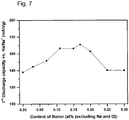
- Fig. 7 indicates the maximum of beneficial boron doping in sodium manganese oxide with sodium equivalents of 2/3.
- the most beneficial boron content is identified to be Na 2/3 Mn 1-x B x O 2 with 0.250 ⁇ x ⁇ 0.100.
- boron doped layered sodium-based transition metal oxides were prepared and used as cathode material.
- Layered sodium transition metal oxides were obtained via a modified co-precipitation method.
- a stoichiometric amount of sodium carbonate monohydrate (Sigma-Aldrich, ⁇ 99.5%) was dissolved in water and an aqueous solution with stoichiometric ratios of salts [e.g. manganese (II) acetate tetrahydrate (Sigma- Aldrich, ⁇ 99%), boric acid (Alfa Aesar, 99%), aluminium 2-ethylhexanoate (Strem, ⁇ 96%), the selected elements depend on the aimed individual compound] was added dropwise under stirring.
- salts e.g. manganese (II) acetate tetrahydrate (Sigma- Aldrich, ⁇ 99%)
- boric acid Alfa Aesar, 99%
- aluminium 2-ethylhexanoate (Strem, ⁇ 96%), the selected elements depend on the aimed individual compound
- the water was removed by rotary evaporation and the residue calcined in a box furnace in air at 375 °C in order to decompose the precursor mixture to oxides.
- the obtained product was ground with mortar and pestle and annealed in a final step in a box furnace in air at 900 °C for 6 hours and furnace cooled.
- the powder was then ground with mortar and pestle, screened over a 45 ⁇ m sieve and used without further treatment.
- Layered sodium transition metal oxides were obtained via consecutive grinding, ball milling, pressing into a pellet and calcination/annealing of the educts.
- stoichiometric ratios of salts e.g. sodium carbonate monohydrate (Sigma-Aldrich, ⁇ 99.5%), manganese (II) acetate tetrahydrate (Sigma-Aldrich, ⁇ 99%), boric acid (Alfa Aesar, 99+%), aluminium 2-ethylhexanoate (Strem, ⁇ 96%), the selected elements depend on the aimed individual compound] were processed in the following order: Grinding with mortar and pestle, ball milling, annealing at 500 °C for 4 h (heating rate 5 °C min -1 ), furnace cooling, grinding with mortar and pestle, ball milling, grinding with mortar and pestle, pressing into a pellet, annealing at 900 °C for 6 h (heating rate 5 °C min -1 ),
- XRD X-ray diffraction
- SEM scanning electron microscopy
- Electrodes were processed by mixing the active material with a polyvinylidene difluoride binder [PVdF, Solef 6020, Arkema, 10 wt.% solution in N -Methyl-2-pyrrolidone (NMP), Sigma-Aldrich, anhydrous, 99.5%] and conductive carbon black (CB) (Super C65, IMERYS) in NMP via ball milling.
- PVdF polyvinylidene difluoride binder
- NMP N -Methyl-2-pyrrolidone
- CB conductive carbon black
- the slurries were casted on aluminium foil (20 ⁇ m).
- the coated foils were predried at 60 °C in air for 24 h.
- the slurry composition was 85 wt.% active material, 10 wt.% carbon black and 5 wt.% binder.
- the average active material mass loading for sodium metal half-cell tests for the cathode was about 2.5 mg cm -2 .
- Galvanostatic cycling tests were carried out on a Maccor battery tester 4300 and cyclic voltammetry on a VMP3 Potentiostat (Biologic). All electrochemical tests were carried out in climatic chambers at a temperature of 20 ⁇ 1 °C.
- Three-electrode Swagelok® cells were assembled using the appropriate working electrode and sodium metal (99.8%, Acros Organics) as the counter and reference electrodes. Three-electrode cells were used instead of two-electrode cells to avoid the possible influence of the polarization of the sodium metal electrode upon cycling. Thus, all potential values refer to the Na/Na + reference couple. Whatman® GF/D glass fiber separators were used and drenched with 300 ⁇ L of electrolyte.
Landscapes
- Chemical & Material Sciences (AREA)
- Organic Chemistry (AREA)
- Inorganic Chemistry (AREA)
- Battery Electrode And Active Subsutance (AREA)
- Secondary Cells (AREA)
Priority Applications (1)
| Application Number | Priority Date | Filing Date | Title |
|---|---|---|---|
| EP17401062.9A EP3415470A1 (de) | 2017-06-14 | 2017-06-14 | Bordotiertes natriumionen-kathodenmaterial, verfahren zur herstellung und davon und dessen verwendung |
Applications Claiming Priority (1)
| Application Number | Priority Date | Filing Date | Title |
|---|---|---|---|
| EP17401062.9A EP3415470A1 (de) | 2017-06-14 | 2017-06-14 | Bordotiertes natriumionen-kathodenmaterial, verfahren zur herstellung und davon und dessen verwendung |
Publications (1)
| Publication Number | Publication Date |
|---|---|
| EP3415470A1 true EP3415470A1 (de) | 2018-12-19 |
Family
ID=59363073
Family Applications (1)
| Application Number | Title | Priority Date | Filing Date |
|---|---|---|---|
| EP17401062.9A Withdrawn EP3415470A1 (de) | 2017-06-14 | 2017-06-14 | Bordotiertes natriumionen-kathodenmaterial, verfahren zur herstellung und davon und dessen verwendung |
Country Status (1)
| Country | Link |
|---|---|
| EP (1) | EP3415470A1 (de) |
Cited By (9)
| Publication number | Priority date | Publication date | Assignee | Title |
|---|---|---|---|---|
| CN111435741A (zh) * | 2019-01-11 | 2020-07-21 | 宁德时代新能源科技股份有限公司 | 正极活性材料、正极极片及钠离子电池 |
| CN112234200A (zh) * | 2020-09-18 | 2021-01-15 | 中南大学 | 一种o3型层状钠离子电池正极材料及其制备方法 |
| CN114843471A (zh) * | 2022-05-16 | 2022-08-02 | 电子科技大学长三角研究院(湖州) | 一种层状正极材料及其制备方法和应用 |
| CN115084484A (zh) * | 2022-07-29 | 2022-09-20 | 湖北万润新能源科技股份有限公司 | 一种钠离子电池正极材料及其制备方法和应用 |
| CN115863559A (zh) * | 2022-11-07 | 2023-03-28 | 常熟理工学院 | 一种高价态金属元素修饰改性的p2型钠离子电池正极材料及制备方法与应用 |
| CN116477670A (zh) * | 2023-03-16 | 2023-07-25 | 荆门市格林美新材料有限公司 | 一种钠离子前驱体材料及其制备方法和应用 |
| WO2023137859A1 (zh) * | 2022-01-24 | 2023-07-27 | 江苏翔鹰新能源科技有限公司 | 一种钠离子电池正极活性物质及其制备方法、应用 |
| CN118431441A (zh) * | 2024-05-08 | 2024-08-02 | 南昌大学 | 一种层状钠离子高熵氧化物正极材料及其制备方法与应用 |
| WO2026044703A1 (zh) * | 2024-08-30 | 2026-03-05 | 宁德新能源科技有限公司 | 电化学装置及电子设备 |
Citations (5)
| Publication number | Priority date | Publication date | Assignee | Title |
|---|---|---|---|---|
| US6497854B2 (en) | 2000-11-30 | 2002-12-24 | Nikko Materials Company, Limited | Cathode material for a lithium secondary battery and method for manufacturing same |
| US6998069B1 (en) | 1999-12-03 | 2006-02-14 | Ferro Gmbh | Electrode material for positive electrodes of rechargeable lithium batteries |
| US7529014B2 (en) | 2002-12-05 | 2009-05-05 | Commissariat A L'energie Atomique | Boron-substituted lithium compounds, active electrode materials, batteries and electrochrome devices |
| WO2014132174A1 (en) | 2013-02-27 | 2014-09-04 | Umicore | Doped sodium manganese oxide cathode material for sodium ion batteries |
| EP2879215A1 (de) | 2013-08-08 | 2015-06-03 | Peking University | Bordotiertes lithiumreiches positivelektrodenmaterial für eine lithiumionenbatterie und herstellungsverfahren dafür |
-
2017
- 2017-06-14 EP EP17401062.9A patent/EP3415470A1/de not_active Withdrawn
Patent Citations (6)
| Publication number | Priority date | Publication date | Assignee | Title |
|---|---|---|---|---|
| US6998069B1 (en) | 1999-12-03 | 2006-02-14 | Ferro Gmbh | Electrode material for positive electrodes of rechargeable lithium batteries |
| US6497854B2 (en) | 2000-11-30 | 2002-12-24 | Nikko Materials Company, Limited | Cathode material for a lithium secondary battery and method for manufacturing same |
| US7529014B2 (en) | 2002-12-05 | 2009-05-05 | Commissariat A L'energie Atomique | Boron-substituted lithium compounds, active electrode materials, batteries and electrochrome devices |
| WO2014132174A1 (en) | 2013-02-27 | 2014-09-04 | Umicore | Doped sodium manganese oxide cathode material for sodium ion batteries |
| EP2879215A1 (de) | 2013-08-08 | 2015-06-03 | Peking University | Bordotiertes lithiumreiches positivelektrodenmaterial für eine lithiumionenbatterie und herstellungsverfahren dafür |
| US20160181605A1 (en) | 2013-08-08 | 2016-06-23 | Peking University | Boron-doped lithium-rich manganese based materials and preparation methods for li-ion battery cathode |
Non-Patent Citations (7)
| Title |
|---|
| BUCHHOLZ, JOURNAL OF POWER SOURCES, vol. 282, 2015, pages 581 - 585 |
| CLEMENT ET AL., ENERGY & ENVIRONMENTAL SCIENCE, vol. 9, no. 10, 2016, pages 3240 - 3251 |
| HU ET AL., ADVANCED SCIENCE, vol. 3, no. 12, 2016 |
| KUMAKURA, ANGEWANDTE CHEMIE INTERNATIONAL EDITION, vol. 55, no. 41, 2016, pages 12760 - 12763 |
| SOLID STATE IONICS, vol. 126, no. 1, 1999, pages 3 - 24 |
| VELIKOKHATNYI ET AL., MATERIALS SCIENCE AND ENGINEERING: B, vol. 128, no. 1, 2006, pages 115 - 124 |
| VELIKOKHATNYI O I ET AL: "Effect of boron on the stability of monoclinic NaMnO"2: Theoretical and experimental studies", MATERIALS SCIENCE AND ENGINEERING: B, ELSEVIER, AMSTERDAM, NL, vol. 128, no. 1-3, 15 March 2006 (2006-03-15), pages 115 - 124, XP027953829, ISSN: 0921-5107, [retrieved on 20060315] * |
Cited By (17)
| Publication number | Priority date | Publication date | Assignee | Title |
|---|---|---|---|---|
| CN111435741A (zh) * | 2019-01-11 | 2020-07-21 | 宁德时代新能源科技股份有限公司 | 正极活性材料、正极极片及钠离子电池 |
| CN112234200A (zh) * | 2020-09-18 | 2021-01-15 | 中南大学 | 一种o3型层状钠离子电池正极材料及其制备方法 |
| CN112234200B (zh) * | 2020-09-18 | 2022-07-26 | 中南大学 | 一种o3型层状钠离子电池正极材料及其制备方法 |
| CN116525810B (zh) * | 2022-01-24 | 2025-09-02 | 江苏翔鹰新能源科技有限公司 | 一种钠离子电池正极活性物质及其制备方法、应用 |
| JP2024507080A (ja) * | 2022-01-24 | 2024-02-16 | 江蘇翔鷹新能源科技有限公司 | ナトリウムイオン電池正極活物質及びその製造方法と使用 |
| WO2023137859A1 (zh) * | 2022-01-24 | 2023-07-27 | 江苏翔鹰新能源科技有限公司 | 一种钠离子电池正极活性物质及其制备方法、应用 |
| CN116525810A (zh) * | 2022-01-24 | 2023-08-01 | 江苏翔鹰新能源科技有限公司 | 一种钠离子电池正极活性物质及其制备方法、应用 |
| KR20230128339A (ko) * | 2022-01-24 | 2023-09-04 | 장쑤 샹잉 뉴 에너지 테크놀로지 컴퍼니, 리미티드 | 나트륨 이온 배터리용 양극 활물질 및 이의 제조 방법,응용 |
| CN114843471B (zh) * | 2022-05-16 | 2023-09-22 | 电子科技大学长三角研究院(湖州) | 一种层状正极材料及其制备方法和应用 |
| CN114843471A (zh) * | 2022-05-16 | 2022-08-02 | 电子科技大学长三角研究院(湖州) | 一种层状正极材料及其制备方法和应用 |
| CN115084484A (zh) * | 2022-07-29 | 2022-09-20 | 湖北万润新能源科技股份有限公司 | 一种钠离子电池正极材料及其制备方法和应用 |
| JP2024536426A (ja) * | 2022-07-29 | 2024-10-04 | 湖北万潤新能源科技股▲フン▼有限公司 | ナトリウムイオン電池用正極材料及びその製造方法、並びに応用 |
| CN115863559A (zh) * | 2022-11-07 | 2023-03-28 | 常熟理工学院 | 一种高价态金属元素修饰改性的p2型钠离子电池正极材料及制备方法与应用 |
| CN116477670A (zh) * | 2023-03-16 | 2023-07-25 | 荆门市格林美新材料有限公司 | 一种钠离子前驱体材料及其制备方法和应用 |
| CN116477670B (zh) * | 2023-03-16 | 2025-04-25 | 荆门市格林美新材料有限公司 | 一种钠离子前驱体材料及其制备方法和应用 |
| CN118431441A (zh) * | 2024-05-08 | 2024-08-02 | 南昌大学 | 一种层状钠离子高熵氧化物正极材料及其制备方法与应用 |
| WO2026044703A1 (zh) * | 2024-08-30 | 2026-03-05 | 宁德新能源科技有限公司 | 电化学装置及电子设备 |
Similar Documents
| Publication | Publication Date | Title |
|---|---|---|
| EP3415470A1 (de) | Bordotiertes natriumionen-kathodenmaterial, verfahren zur herstellung und davon und dessen verwendung | |
| KR102010690B1 (ko) | 나트륨 이온 배터리용 캐소드 물질로서의 나트륨 망간 산화물을 위한 2가 금속 도핑 | |
| Chen et al. | Emerging polyanionic and organic compounds for high energy density, non-aqueous potassium-ion batteries | |
| Buchholz et al. | Mg-doping for improved long-term cyclability of layered Na-ion cathode materials–The example of P2-type NaxMg0. 11Mn0. 89O2 | |
| Patoux et al. | Direct synthesis of LiNi1/3Co1/3Mn1/3O2 from nitrate precursors | |
| Matsui et al. | Ca-substituted P3-type NaxNi1/3Mn1/3Co1/3O2 as a potential high voltage cathode active material for sodium-ion batteries | |
| Xie et al. | Physical and electrochemical properties of mix-doped lithium iron phosphate as cathode material for lithium ion battery | |
| JP2023510984A (ja) | ナトリウムイオン電池のカソード材料として用いるNa過剰P3型層状酸化物NaxMyOz(x≧0.66、0.8≦y≦1.0、z≦2) | |
| Boddu et al. | Layered NaxCoO2-based cathodes for advanced Na-ion batteries: review on challenges and advancements | |
| Boddu et al. | Hysteresis abated P2-type NaCoO 2 cathode reveals highly reversible multiple phase transitions for high-rate sodium-ion batteries | |
| Aravindan et al. | Effect of LiBOB additive on the electrochemical performance of LiCoPO4 | |
| KR102401390B1 (ko) | 리튬, 니켈, 망간 혼합 옥사이드 화합물 및 상기 화합물을 포함하는 전극 | |
| US20230365428A1 (en) | Compound | |
| KR102401394B1 (ko) | 화합물 | |
| JP6528192B2 (ja) | リチウムナトリウム複合酸化物の製造方法 | |
| US20250019258A1 (en) | Layered Sodium Metal Oxides For Na-ion Batteries | |
| Pahari et al. | The evolution of structure–property relationship of P2-type Na0. 67Ni0. 33Mn0. 67O2 by vanadium substitution and organic electrolyte combinations for sodium-ion batteries | |
| Nakayama et al. | Electrochemical reactions of layered niobate material as novel anode for sodium ion batteries | |
| KR20170039707A (ko) | 리튬 이온 배터리용 캐소드 조성물 | |
| Yang et al. | Realizing the performance of LiCoPO4 cathodes by Fe substitution with off-stoichiometry | |
| KR20250043589A (ko) | Lmo 캐소드 조성물 | |
| KR20250046334A (ko) | Lmo 캐소드 조성물 | |
| Periasamy et al. | Electrochemical performance behavior of combustion-synthesized LiNi0. 5Mn0. 5O2 lithium-intercalation cathodes | |
| Pahari et al. | Effect of Vanadium Substitution on the Ni-Site in P2-Type Na0. 67Ni0. 33Mn0. 67O2 in Optimized Carbonate Ester Electrolytes as Cathode for Sodium-Ion Batteries | |
| Hameed et al. | From lithium to sodium and potassium batteries |
Legal Events
| Date | Code | Title | Description |
|---|---|---|---|
| PUAI | Public reference made under article 153(3) epc to a published international application that has entered the european phase |
Free format text: ORIGINAL CODE: 0009012 |
|
| STAA | Information on the status of an ep patent application or granted ep patent |
Free format text: STATUS: THE APPLICATION HAS BEEN PUBLISHED |
|
| AK | Designated contracting states |
Kind code of ref document: A1 Designated state(s): AL AT BE BG CH CY CZ DE DK EE ES FI FR GB GR HR HU IE IS IT LI LT LU LV MC MK MT NL NO PL PT RO RS SE SI SK SM TR |
|
| AX | Request for extension of the european patent |
Extension state: BA ME |
|
| STAA | Information on the status of an ep patent application or granted ep patent |
Free format text: STATUS: REQUEST FOR EXAMINATION WAS MADE |
|
| 17P | Request for examination filed |
Effective date: 20190617 |
|
| RBV | Designated contracting states (corrected) |
Designated state(s): AL AT BE BG CH CY CZ DE DK EE ES FI FR GB GR HR HU IE IS IT LI LT LU LV MC MK MT NL NO PL PT RO RS SE SI SK SM TR |
|
| STAA | Information on the status of an ep patent application or granted ep patent |
Free format text: STATUS: EXAMINATION IS IN PROGRESS |
|
| 17Q | First examination report despatched |
Effective date: 20200527 |
|
| STAA | Information on the status of an ep patent application or granted ep patent |
Free format text: STATUS: THE APPLICATION IS DEEMED TO BE WITHDRAWN |
|
| 18D | Application deemed to be withdrawn |
Effective date: 20201208 |