EP3415547A1 - Verfahren zur herstellung sic-verknüpfter polyethersiloxane - Google Patents
Verfahren zur herstellung sic-verknüpfter polyethersiloxane Download PDFInfo
- Publication number
- EP3415547A1 EP3415547A1 EP17175693.5A EP17175693A EP3415547A1 EP 3415547 A1 EP3415547 A1 EP 3415547A1 EP 17175693 A EP17175693 A EP 17175693A EP 3415547 A1 EP3415547 A1 EP 3415547A1
- Authority
- EP
- European Patent Office
- Prior art keywords
- radical
- sih
- olefinically unsaturated
- polyether
- atoms
- Prior art date
- Legal status (The legal status is an assumption and is not a legal conclusion. Google has not performed a legal analysis and makes no representation as to the accuracy of the status listed.)
- Granted
Links
Images

Classifications
-
- C—CHEMISTRY; METALLURGY
- C08—ORGANIC MACROMOLECULAR COMPOUNDS; THEIR PREPARATION OR CHEMICAL WORKING-UP; COMPOSITIONS BASED THEREON
- C08G—MACROMOLECULAR COMPOUNDS OBTAINED OTHERWISE THAN BY REACTIONS ONLY INVOLVING UNSATURATED CARBON-TO-CARBON BONDS
- C08G77/00—Macromolecular compounds obtained by reactions forming a linkage containing silicon with or without sulfur, nitrogen, oxygen or carbon in the main chain of the macromolecule
- C08G77/42—Block-or graft-polymers containing polysiloxane sequences
- C08G77/46—Block-or graft-polymers containing polysiloxane sequences containing polyether sequences
-
- C—CHEMISTRY; METALLURGY
- C08—ORGANIC MACROMOLECULAR COMPOUNDS; THEIR PREPARATION OR CHEMICAL WORKING-UP; COMPOSITIONS BASED THEREON
- C08G—MACROMOLECULAR COMPOUNDS OBTAINED OTHERWISE THAN BY REACTIONS ONLY INVOLVING UNSATURATED CARBON-TO-CARBON BONDS
- C08G77/00—Macromolecular compounds obtained by reactions forming a linkage containing silicon with or without sulfur, nitrogen, oxygen or carbon in the main chain of the macromolecule
- C08G77/04—Polysiloxanes
- C08G77/06—Preparatory processes
-
- C—CHEMISTRY; METALLURGY
- C08—ORGANIC MACROMOLECULAR COMPOUNDS; THEIR PREPARATION OR CHEMICAL WORKING-UP; COMPOSITIONS BASED THEREON
- C08G—MACROMOLECULAR COMPOUNDS OBTAINED OTHERWISE THAN BY REACTIONS ONLY INVOLVING UNSATURATED CARBON-TO-CARBON BONDS
- C08G77/00—Macromolecular compounds obtained by reactions forming a linkage containing silicon with or without sulfur, nitrogen, oxygen or carbon in the main chain of the macromolecule
- C08G77/04—Polysiloxanes
- C08G77/38—Polysiloxanes modified by chemical after-treatment
-
- C—CHEMISTRY; METALLURGY
- C08—ORGANIC MACROMOLECULAR COMPOUNDS; THEIR PREPARATION OR CHEMICAL WORKING-UP; COMPOSITIONS BASED THEREON
- C08L—COMPOSITIONS OF MACROMOLECULAR COMPOUNDS
- C08L71/00—Compositions of polyethers obtained by reactions forming an ether link in the main chain; Compositions of derivatives of such polymers
-
- C—CHEMISTRY; METALLURGY
- C08—ORGANIC MACROMOLECULAR COMPOUNDS; THEIR PREPARATION OR CHEMICAL WORKING-UP; COMPOSITIONS BASED THEREON
- C08G—MACROMOLECULAR COMPOUNDS OBTAINED OTHERWISE THAN BY REACTIONS ONLY INVOLVING UNSATURATED CARBON-TO-CARBON BONDS
- C08G77/00—Macromolecular compounds obtained by reactions forming a linkage containing silicon with or without sulfur, nitrogen, oxygen or carbon in the main chain of the macromolecule
- C08G77/04—Polysiloxanes
- C08G77/12—Polysiloxanes containing silicon bound to hydrogen
-
- C—CHEMISTRY; METALLURGY
- C08—ORGANIC MACROMOLECULAR COMPOUNDS; THEIR PREPARATION OR CHEMICAL WORKING-UP; COMPOSITIONS BASED THEREON
- C08G—MACROMOLECULAR COMPOUNDS OBTAINED OTHERWISE THAN BY REACTIONS ONLY INVOLVING UNSATURATED CARBON-TO-CARBON BONDS
- C08G77/00—Macromolecular compounds obtained by reactions forming a linkage containing silicon with or without sulfur, nitrogen, oxygen or carbon in the main chain of the macromolecule
- C08G77/70—Siloxanes defined by use of the MDTQ nomenclature
Definitions
- the invention is in the field of organopolysiloxanes and relates to a process for preparing SiC-linked polyethersiloxanes.
- the invention relates to a process for preparing SiC-linked polyethersiloxanes by a hydrosilylation reaction between a SiH-containing siloxane and an olefinically unsaturated polyether.
- SiC-linked, organomodified siloxanes, especially polyethersiloxanes, with their widely adjustable surfactant behavior represent an industrially very important class of substances.
- the established way of producing these substances is the platinum-metal-catalyzed addition of SiH-group-bearing siloxanes and silanes to olefinically functionalized compounds, such as eg on allyl polyether.
- the solvent-free hydrosilylation reactions start from a two-phase nature. This applies in particular to the preparation of SiC-linked polyethersiloxanes. Without the introduction of considerable shear energy, the reaction mixtures without a solvent typically tend to separate their reactant phases.
- reactant phase compatibilizing solvents such as the use of the suitable for the hydrosilylation reaction aromatic solvents benzene, toluene or the isomeric xylenes also the disadvantage of sometimes considerably reduced space-time yield, since a part of the reactor volume claimed by the auxiliary solvent.
- the organic auxiliary phase is always an annoying foreign phase, which is to separate consuming, more or less expensive to clean and later returned to the overall process.
- the guarantee of cross-contaminated material flows is of particular importance.
- the US2004 / 198905 is concerned with this general problem of a two-phase starting hydrosilylation reaction and claims a solvent-free process for preparing organically modified organopolysiloxanes comprising a hydrosilylation reaction which comprises a liquid organopolysiloxane (A) containing at least one hydrogen atom bonded to a silicon atom in each molecule with a non-silicon-containing liquid organic compound (B) containing in each molecule at least one olefinic carbon-carbon double bond in the presence of a catalyst (C) for the hydrosilylation reaction by reacting the hydrosilylation reaction in one Dispersion in which the component (B) in the component (A) or the component (A) in the component (B) in each case in a microparticulate form having an average particle size ⁇ 100 microns, caused by the entry by high Shear energy stirring of components (A) and (B).
- a hydrosilylation reaction which comprises a liquid organopolysiloxane (A) containing
- Colloid mills, homomixers and inline mixers are mentioned as preferred apparatuses for producing the high-energy shear and the desired dispersing effect.
- an ULTRA-TURRAX and a rotating disk mixer are used.
- the SiH group-containing siloxane to be used and the olefinically unsaturated polyether are preferably liquid at room temperature (20 ° C).
- the illustration Fig. 1 shows the turnover-time behavior of the SiC coupling reaction.
- the gas volumetric SiH conversion in percent and on the abscissa the reaction time is plotted in minutes.
- the characteristic curve of the process according to the invention shows the process improvement associated with the process according to the invention.
- the curves of the inventive non-inventive examples 1 and 2 have in the exothermic initial phase to a much lower slope, in contrast, the inventive example after a short time a much higher SiH conversion.
- the added amount of polyethersiloxane is preferably in the range of 2 to 10 wt .-% based on the total mass of the reactants, preferably in the range of 2 to 6 wt .-%. In general, some preliminary preliminary experiments show the person skilled in the art what amount is most suitable.
- polyethersiloxanes In principle, a large number of polyethersiloxanes can be used to achieve the reaction acceleration. However, preference is given to using polyethersiloxanes whose chemical structure is similar or similar to that of the polyethersiloxane desired via the hydrosilylation reaction from the point of view of system compatibility and later use.
- the polyethersiloxane which structurally corresponds to that polyethersiloxane which results from the SiC-linking addition of the olefinically unsaturated polyether to the siloxane containing SiH groups is particularly preferably selected for dispersing the siloxane containing SiH groups.
- inventive method is based on the teaching of US2004 / 198905 from which one can not borrow, which dispersion of the reactant components ((B) dispersed in (A) or (A) dispersed in (B)) allows a preferred reaction regime.
- the comparative experiment emphasizes the ineffectiveness of a procedure in which the non-silicone-containing, liquid organic compound (polyether) is mixed together with a polyether siloxane with stirring and then in a second step, this premix under stirring with a SiH-group-containing siloxane and charged with a noble metal catalyst.
- the observed turnover-time behavior is significantly delayed and is substantially similar to the turnover-time behavior of running in non-inventive Example 1 one-pot system, wherein the SiH-containing siloxane and polyether together with stirring Be heated reaction temperature and then charged with noble metal catalyst.
- the siloxanes having SiH groups used in the process according to the invention are preferably those which correspond to one of the formulas (I) to (V): with R 1 , identical or different: alkyl and / or aralkyl and / or aromatic radical, each comprising 1 to 10 C atoms, and with 1 ⁇ n ⁇ 250, with R 1 , identical or different: alkyl and / or aralkyl and / or aromatic radical, each comprising 1 to 10 carbon atoms and with a, the same or different: 1 ⁇ a ⁇ 60 and with 0 ⁇ b ⁇ 10, with R 1 , identical or different: alkyl and / or aralkyl and / or aromatic radical, each comprising 1 to 10 carbon atoms with 0 ⁇ x ⁇ 250 and with 1 ⁇ y ⁇ 50, with R 1 , identical or different: alkyl and / or aralkyl and / or aromatic radical, each comprising 1 to 10 C atoms, with 0
- index numbers reproduced here and the value ranges of the specified indices can be used as averages (weight average) of the possible statistical distribution of the actual existing ones Structures and / or their mixtures are understood. This also applies to such as in itself exactly reproduced structural formulas, such as for formula (VI).
- the units denoted by m, n and o can optionally be mixed randomly or else in blocks in the chain.
- Statistical distributions can be constructed block by block with an arbitrary number of blocks and an arbitrary sequence or a randomized distribution, they can also be of alternating construction or also form a gradient over the chain, in particular they can also form all mixed forms in which optionally groups of different Distributions can follow one another. Special designs may cause statistical distributions to be constrained by execution. For all areas that are not affected by the restriction, the statistical distribution does not change.
- radical A is understood as meaning radicals of substances which form the beginning of the olefinically unsaturated polyether or olefinically unsaturated alkoxylation product to be produced, which is obtained by the addition of alkylene oxides.
- the starting compound is preferably selected from the group of olefinically unsaturated alcohols and polyetherols.
- the starting compound containing the group A is preferably a monovalent olefinically unsaturated polyether alcohol and / or a monohydric olefinically unsaturated alcohol, or any desired mixtures thereof.
- the index a may also be subject to a statistical distribution.
- Z can also be the remainder of a starting compound Z-OH.
- the monomers used in the alkoxylation reaction are preferably ethylene oxide, propylene oxide, butylene oxide and / or styrene oxide, as well as any desired mixtures of these epoxides.
- the different monomers can be used in pure form or mixed.
- the metered addition of another epoxide to an epoxide already present in the reaction mixture can be continuous over time so that an increasing concentration gradient of the continuously added epoxide is produced.
- the resulting polyethers are thus subject to a statistical distribution in the final product, where restrictions can be determined by the dosage.
- a structure gradient can then be expected over the chain length.
- the relationships between dosage and product structure are known in the art.
- polyethers of the formula (VI) which have a weight-average molar mass of from 76 to 10,000 g / mol, preferably from 100 to 8,000 g / mol and more preferably from 200 to 6,000 g / mol.
- radicals A are preferably those which have arisen from compounds of the formula (II): A [-OH] a (II) where a is 1.
- starting compound for the alkoxylation reaction it is possible with preference to use all compounds of the formula (II) A [-OH] a (II) be used.
- the olefinically unsaturated organic radical has at least two carbon atoms, preferably at least three carbon atoms.
- starting compounds are understood as meaning substances which form the beginning (start) of the polyether or alkoxylation product to be produced, which is obtained by the addition of alkylene oxides.
- the starting compound is preferably selected from the group of olefinically unsaturated alcohols or polyetherols.
- the starting compound containing the group A used is preferably a monovalent olefinically unsaturated polyether alcohol and / or a monohydric olefinically unsaturated alcohol, or any desired mixtures thereof.
- radicals derived from allyl alcohol, 1-hexenol, methallyl alcohol, vinyl alcohol and vinyloxybutanol are particularly preferred.
- polyether encompasses a broad amount of compounds, both polyethers, polyetherols, polyether alcohols, polyether esters and polyether carbonates, which are optionally used synonymously with one another. It is not necessary for the term "poly” to be associated with a variety of ether functionalities or alcohol functionalities in the molecule or polymer. Rather, this only indicates that at least repeating units of individual monomer units or compositions are present which have a higher molecular weight and also also a certain polydispersity.
- poly in the context of this invention comprises not only exclusively compounds having at least 3 repeating units of one or more monomers in the molecule, but in particular those compositions of compounds which have a molecular weight distribution and thereby have an average molecular weight of at least 200 g / mol ,
- This definition takes into account the fact that it is common practice in the field of technology considered to refer to such compounds as polymers even if they do not seem to satisfy a polymer definition analogous to OECD or REACH directives.
- the unsaturated polyethers to be used are preferably ethylene oxide and propylene oxide derivatives of said unsaturated alcohols and, in addition to the homopolymer structures derived only from ethylene oxide (EO) or only from propylene oxide (PO), also comprise all accessible EO - / PO mixed derivatives.
- EO ethylene oxide
- PO propylene oxide
- low molecular weight polyetherols having 1 hydroxyl group and weight average molecular weights of 100 to 5000 g / mol are used as starting compounds.
- Particularly suitable are polypropylene glycols, polyethylene glycols, poly (ethylene) -co- (propylene) glycols, polybutylene glycols, poly (propylene) -co- (butylene) glycols, poly (butylene) -co- (ethylene) glycols which are an OH group to have.
- these polyalkylene glycols especially those compounds are advantageous which are derived from allyl alcohol, 1-hexenol, methallyl alcohol, vinyl alcohol and vinyloxybutanol.
- the hydrosilylation is carried out in the presence of a noble metal catalyst.
- catalysts can be used such as platinum, rhodium, osmium, ruthenium, palladium, iridium complexes or similar compounds or the corresponding pure elements or their immobilized on silica, alumina or activated carbon or similar support materials derivatives.
- the hydrosilylation is preferably carried out with the aid of platinum complexes such as cis- (NH 3 ) 2 PtCl 2 - (cis-platinum), di- [chloro-chloro (cyclohexene) -platinum (II)] or preferably with zerovalent platinum complexes such as for example [tris (divinyltetramethyldisiloxane) bis-platinum (0)] (Karstedt catalyst) and particularly preferably with solutions of olefin-activated platinum (0) complex catalysts (so-called WK catalysts) according to the teaching of US Pat EP1520870 carried out.
- the amount of catalyst is in this case calculated so that the total concentration of platinum 1 to 100 wppm (ppm by weight), preferably 2 to 10 wppm based on the total reaction mixture.
- the minimum platinum concentration is preferably chosen to allow a safe and rapid SiC coupling reaction without compromising the economics of the process by excessive use of noble metal or, moreover, causing deleterious product discoloration.
- the hydrosilylation can be carried out at temperatures between 0 and 200.degree. C., preferably between 50 and 140.degree.
- the catalysts can be used over a wide temperature range.
- the temperature range is preferably selected to be so low that it represents an acceptable compromise between the desired product purity and production output.
- the inventively preferred, olefin-activated systems catalyze under mild exothermicity satisfactorily already from 50 ° C. To achieve higher throughput rates, the reaction temperature can also be significantly increased without causing deactivation and shutdown phenomena.
- high-energy dispersing machines in particular colloid mills, homomixers, inline mixers or rotating disk-equipped rotary disk mixers, are dispensed with.
- inventive method is carried out in the absence of organic solvents, ie in particular in the absence of such solvents as alcohols, such as ethyl alcohol and isopropyl alcohol and aromatic solvents such as benzene, toluene and xylene.
- “Absence of organic solvents” in the sense of the present invention means that less than 5 wt .-%, based on the total mass of the reactants, preferably less than 2 wt .-%, more preferably less than 1 wt .-%, especially none at all organic solvents are used.
- the entry of organic solvents is not required for the process according to the invention, but can result, for example, in the introduction of the catalyst, for example when using solutions of olefin-activated platinum (0) complex catalysts.
- the addition of the olefinically unsaturated polyether with a noble metal catalyst and optionally further additives if desired in the individual system, the addition of the olefinically unsaturated polyether with a noble metal catalyst and optionally further additives.
- additives can serve, for example, when using olefinically unsaturated polyethers which carry a terminal hydroxyl group, to prevent unintentional molar mass in the hydrosilylation by dehydrocondensation or acetal formation and are inter alia in the US 4,847,398 (Alkali metal carboxylates) or for example in the EP 0 550 064 (sterically hindered amines and phosphines) described.
- the process claimed according to the invention is suitable for the preparation of SiC-linked polyethersiloxanes which can be used as stabilizers for PU foams, defoamers, coating additives, emulsifiers, in particular cosmetic emulsifiers, cosmetic conditioners, deaerators, demulsifiers, textile finishing agents, building protection additives, plastic additives, in particular anti-foaming agents. Scratch additives, antifouling additives and anti-icing agents.
- SiC-linked polyether siloxanes resulting from the process according to the invention and their aforementioned use are further objects of the present invention.
- the SiH conversion achieved at a particular point in time of the reaction is determined gasvolumetrically by the sodium butylate-induced decomposition of a weighed sample taken from a reaction matrix on a gas burette. The volume of hydrogen released thereby characterizes the reaction progress achieved.
- gasvolumetric SiH determination method see C. Harzdorf, Z. Anal. Chem. 276, 279-283 (1975 ).
Landscapes
- Chemical & Material Sciences (AREA)
- Health & Medical Sciences (AREA)
- Chemical Kinetics & Catalysis (AREA)
- Medicinal Chemistry (AREA)
- Polymers & Plastics (AREA)
- Organic Chemistry (AREA)
- General Chemical & Material Sciences (AREA)
- Silicon Polymers (AREA)
- Polyethers (AREA)
Abstract
Description
- Die Erfindung liegt auf dem Gebiet der Organopolysiloxane und betrifft ein Verfahren zur Herstellung SiC-verknüpfter Polyethersiloxane. Insbesondere betrifft die Erfindung ein Verfahren zur Herstellung SiC-verknüpfter Polyethersiloxane durch eine Hydrosilylierungsreaktion zwischen einem SiH-Gruppen aufweisenden Siloxan und einem olefinisch ungesättigten Polyether.
- Die Herstellung organisch modifizierter Organopolysiloxane durch eine Hydrosilylierungsreaktion von einem flüssigem Organopolysiloxan, das mindestens eine Siliciumwasserstoffgruppe pro Molekül besitzt mit einer nicht Silicon enthaltenden, flüssigen organischen Verbindung, die mindestens eine olefinische Kohlenstoff-Kohlenstoff-Doppelbindung in jedem Molekül enthält, ist bekannt.
- SiC-verknüpfte, organomodifizierte Siloxane, speziell Polyethersiloxane, stellen mit ihrem weit einstellbaren Tensidverhalten eine industriell sehr wichtige Stoffklasse dar. Der etablierte Weg zur Herstellung dieser Substanzen liegt in der Platinmetall-katalysierten Anlagerung SiH-Gruppen tragender Siloxane und Silane an olefinisch funktionalisierte Verbindungen, wie z.B. an Allylpolyether.
- Die Verwendung von Platinkatalysatoren für die Anlagerung von Silanen oder Siloxanen mit SiH-Gruppen an Verbindungen mit einer oder mehreren olefinischen Doppelbindungen ist bekannt (Hydrosilylierung) und z.B. in dem von Michael. A. Brook verfassten Buch "Silicon in Organic, Organometallic, and Polymer Chemistry", Verlag John Wiley & Sons, Inc., New York 2000, Seite 403 ff. , und in der Patentliteratur, z.B. in der
DE-A-26 46 726 , derEP-A-0 075 703 und derUS-A-3 775 452 , beschrieben. In der heutigen betrieblichen Praxis haben sich überwiegend Hexachloroplatinsäure und cis-Diamminoplatin(II)chlorid durchgesetzt. - Obwohl sich dieses Reaktionsprinzip in der Theorie scheinbar einfach beschreiben lässt, ist die reproduzierbare Durchführung im industriellen Maßstab sehr diffizil.
- Der Phaseninkompatibilität der Reaktanden (SiH-Gruppen tragendes Organopolysiloxan und eine olefinische Kohlenstoff-Kohlenstoff-Doppelbindung in jedem Molekül enthaltende organische Verbindung) geschuldet, starten die lösungsmittelfrei geführten Hydrosilylierungsreaktionen aus einer Zweiphasigkeit. Das gilt insbesondere für die Herstellung SiC-verknüpfter Polyethersiloxane. Ohne Eintrag erheblicher Scherenergie neigen die Reaktionsansätze ohne Lösungsmittel typischer Weise zur Separation ihrer Reaktandphasen.
- Als Konsequenz der beobachteten Inkompatibilität der Reaktandphasen laufen die lösungsmittelfrei geführten Hydrosilylierungsreaktionen oft sehr langsam, manchmal sogar unvollständig ab, beeinträchtigen dadurch die in der Produktion erzielbare Raum-Zeit-Ausbeute und mindern in einigen Fällen auch die erreichbare Produktqualität.
- Die Phaseninkompatibilität zwischen den Reaktanden ist umso ausgeprägter, je hydrophiler der anzulagernde ungesättigte Polyether ist. Dieser Befund gilt daher insbesondere für Polyether, die einen hohen Anteil von Ethylenoxid in ihrer molekularen Struktur aufweisen.
- Die anwendungstechnische Brauchbarkeit von Produkten, die aus der Platinmetall-katalysierten Anlagerungsreaktion von SiH-Gruppen tragenden Siloxanen an olefinische Doppelbindungen aufweisende Verbindungen hervorgehen, ist insbesondere direkt verknüpft mit dem erzielten Umsatz in der Hydrosilylierung, das heißt, der Minimierung von restlichen SiH-Funktionen. Rest-SiH führt insbesondere in Gegenwart ubiquitärer Wasserspuren (z.B. Luftfeuchtigkeit) zu unkontrollierbaren Hydrolyse- und Vernetzungsprozessen, die speziell im Falle von Anlagerungsverbindungen hohen Molekulargewichts zwingend zur Vergelung führen und die Produkte unbrauchbar machen.
- Andererseits erkauft man sich bei der Verwendung von Reaktandphasenkompatibilisierung erzeugenden Lösungsmitteln, wie zum Beispiel beim Einsatz der für die Hydrosilylierungsreaktion geeigneten aromatischen Lösungsmittel Benzol, Toluol oder der isomeren Xylole auch den Nachteil einer zum Teil erheblich verringerten Raum-Zeit-Ausbeute, da ein Teil des Reaktorvolumens vom Hilfslösemittel beansprucht wird. Zudem entsteht die Notwendigkeit, das Lösungsmittel nach beendeter Reaktion destillativ und vollständig zu entfernen.
- Im Umfeld eines speziell organomodifizierte Siloxane herstellenden Produktionsbetriebes ist die organische Hilfsphase stets eine lästige Fremdphase, die es gilt, aufwendig abzutrennen, mehr oder minder aufwendig zu reinigen und später wieder in den Gesamtprozess zurückzuführen. Der Gewährleistung nicht querkontaminierter Stoffströme kommt neben Aspekten der sicheren Lagerung, Handhabung und Entsorgung dabei eine besondere Bedeutung zu.
- Demzufolge besteht eine grundsätzliche technische Herausforderungen darin, einen Herstellprozess zu finden, der auf den Einsatz systemfremder Lösemittel verzichten kann.
- Die
US2004/198905 beschäftigt sich mit diesem allgemeinen Problem einer aus der Zweiphasigkeit startenden Hydrosilylierungsreaktion und beansprucht ein lösungsmittelfreies Verfahren zur Herstellung von organisch modifizierten Organopolysiloxanen, umfassend eine Hydrosilylierungsreaktion, bei der man ein flüssiges Organopolysiloxan (A), das mindestens ein an ein Siliciumatom gebundenes Wasserstoffatom in jedem Molekül enthält, mit einer nicht Silizium enthaltenden, flüssigen organischen Verbindung (B), die in jedem Molekül mindestens eine olefinische Kohlenstoff-Kohlenstoff-Doppelbindung enthält, in Gegenwart von einem Katalysator (C) für die Hydrosilylierungsreaktion zur Umsetzung bringt, in dem man die Hydrosilylierungsreaktion in einer Dispersion durchführt, bei der die Komponente (B) in der Komponente (A) oder die Komponente (A) in der Komponente (B) jeweils in einer mikroverteilten Form mit einer mittleren Teilchengröße ≤ 100 µm vorliegen, herbeigeführt durch das durch Eintrag hoher Scherenergie erfolgende Rühren der Komponenten (A) und (B). - Die Lehre der
US2004/198905 verlangt, dass die Komponenten (A) und (B) einer hochenergetischen Scherung ausgesetzt werden, um zu gewährleisten, dass die jeweiligen Dispersionen der Reaktandkomponenten ((B) dispergiert in (A) oder aber (A) dispergiert in (B)) nur von feinverteilten Tröpfchen durchsetzt sind, deren mittlere Teilchengrößen ≤ 100 µm betragen. GemäßUS2004/198905 h ängt die Durchführung der Hydrosilylierungsreaktionen direkt von dem Erzielen dieser Tröpfchengeometrie ab. - Als bevorzugte Apparate zur Erzeugung der hochenergetischen Scherung und des angestrebten Dispergiereffektes sind dort Kolloidmühlen, Homomischer und Inline-Mischer genannt. In den Ausführungsbeispielen kommen ein ULTRA-TURRAX sowie ein rotierender Scheibenmischer zum Einsatz.
- Gerade dieser apparative Aufwand gereicht dem Hydrosilylierungsverfahren der
US2004/198905 zum Nachteil. Die angesprochenen hochenergetischen Dispergiermaschinen sind teuer in ihrer Anschaffung sowie im Betrieb und aufgrund ihres Verschleißes auch kostspielig im Unterhalt. Darüber hinaus kann man sie nicht ohne weiteres in existierende Betriebsanlagen, die zumeist mit Standardrührern ausgestattet sind, integrieren. - In explosionsgefährdeten Produktionsbereichen, wie zum Beispiel in Betrieben zur Herstellung organomodifizierter Organopolysiloxane, ist bei der Installation von hochenergetischen Dispergiermaschinen ein erheblicher Sicherheitsaufwand zu treiben. Im Gegensatz zu Standardrührern geht von diesen mit hoher Geschwindigkeit arbeitenden Apparaten stets die Gefahr des an ihren metallischen Teilen (Rotor/ Stator) durch Friktion erzeugten Funkenschlags aus.
- Ein weiteres Handicap der in der
US2004/198905 offenbarten Lehre liegt in der Verwendung unrealistisch hoher Einsatzmengen teuren Platinkatalysators. Alle dort aufgeführten Beispiele ressortieren auf Platinmengen von 80 Gewichts-ppm (wppm) bezogen auf den Gesamtansatz. Praxisrelevanz besitzen allerdings solche überbordenden Katalysen weder im Hinblick auf die Kosten noch im Hinblick auf die Qualitätsdefizite, die ein derartig hergestelltes organomodifiziertes Polyorganosiloxan hinsichtlich Verfärbung, Geruch und Viskosität erfährt. Über diese wichtigen Produkteigenschaften schweigt die Schrift jedoch. - In Sicht der
US2004/198905 gilt es, ein effizientes Verfahren zur Herstellung organisch modifizierter Organopolysiloxane durch eine Hydrosilylierungsreaktion zu finden, das auf den Einsatz hochenergetischer Dispergiermaschinen und unverhältnismäßig hoher Platinmengen verzichten kann und dennoch eine zügige SiC-Verknüpfungsreaktion gewährleistet und ebenfalls ein lösungsmittelfreies Arbeiten ermöglicht. - Im Rahmen der vorliegenden Erfindung wurde nun überraschenderweise ein sehr effizientes lösungsmittelfreies Verfahren zur Herstellung organisch modifizierter Organopolysiloxane durch eine Hydrosilylierungsreaktion zwischen einem Organopolysiloxan, das mindestens eine Siliciumwasserstoffgruppe pro Molekül besitzt und einem olefinisch ungesättigten Polyether, gefunden.
- Gegenstand der Erfindung ist ein Verfahren zur Herstellung SiC-verknüpfter Polyethersiloxane durch Edelmetall-katalysierte Anlagerung von olefinisch ungesättigten Polyethern an SiH-Gruppen aufweisende Siloxane, dadurch gekennzeichnet, dass
- (i) man vor Reaktionsbeginn das SiH-Gruppen aufweisende Siloxan zusammen mit einem Polyethersiloxan vermischt, vorzugsweise unter Rühren, und dann
- (ii) in einem zweiten Schritt diese Vormischung mit einem olefinisch ungesättigten Polyether sowie mit einem Edelmetallkatalysator und gegebenenfalls weiteren Additiven beaufschlagt, vorzugsweise unter weiterem Rühren,
- Das einzusetzende SiH-Gruppen aufweisende Siloxan und der olefinisch ungesättigte Polyether sind vorzugsweise bei Raumtemperatur (20°C) flüssig.
- Die Abbildung
Fig. 1 zeigt das Umsatz-Zeitverhalten der SiC-Verknüpfungsreaktion. Auf der Ordinate ist der gasvolumetrisch bestimmte SiH-Umsatz in Prozent und auf der Abszisse die Reaktionszeit in Minuten aufgetragen. Der das erfindungsgemäße Verfahren kennzeichnende Kurvenverlauf (Beispiel 3) zeigt die mit dem erfindungsgemäßen Verfahren einhergehende Prozessverbesserung. Die Kurvenverläufe der nichterfindungsgemäßen Beispiele 1 und 2 weisen in der exothermen Anfangsphase eine viel geringere Steigung auf, demgegenüber weist das erfindungsgemäße Beispiel bereits nach kurzer Zeit einen deutlich höheren SiH-Umsatz auf. - Im Rahmen des erfindungsgemäßen Verfahrens wurde gefunden, dass bereits das Vermischen einer kleinen Menge eines Polyethersiloxans mit dem SiH-Gruppen aufweisenden Siloxan vor der Reaktion ausreichend ist, um eine sehr effektive Reaktionsbeschleunigung der angestrebten SiC-Verknüpfungsreaktion zu bewirken.
- Die hinzugefügte Menge an Polyethersiloxan liegt vorzugsweise im Bereich von 2 bis 10 Gew.-% bezogen auf die Gesamtmasse der Reaktanden, bevorzugt im Bereich von 2 bis 6 Gew.-%. In der Regel zeigen einige orientierende Vorversuche dem Fachmann, welche Einsatzmenge am zweckmäßigsten ist.
- Zur Erzielung der Reaktionsbeschleunigung kann prinzipiell eine Vielzahl von Polyethersiloxanen eingesetzt werden. Bevorzugt werden jedoch unter den Gesichtspunkten der Systemverträglichkeit und der späteren Anwendung hierbei Polyethersiloxane eingesetzt, deren chemische Struktur derjenigen des über die Hydrosilylierungsreaktion angestrebten Polyethersiloxans ähnelt oder nahe kommt.
- Somit wählt man zur Dispergierung des SiH-Gruppen aufweisenden Siloxans erfindungsgemäß besonders bevorzugt das Polyethersiloxan aus, das strukturell demjenigen Polyethersiloxan entspricht, das aus der SiC-verknüpfenden Anlagerung des olefinisch ungesättigten Polyethers an das SiH-Gruppen aufweisende Siloxan hervorgeht.
- Auch hier setzt sich das erfindungsgemäße Verfahren von der Lehre der
US2004/198905 - In diesem Zusammenhang unterstreicht das Vergleichsexperiment (Beispiel 2) die Unwirksamkeit eines Vorgehens, bei dem man in einem ersten Schritt die nicht Silicon enthaltende, flüssige organische Verbindung (Polyether) zusammen mit einem Polyethersiloxan unter Rühren vermischt und dann in einem zweiten Schritt diese Vormischung unter Rühren mit einem SiH-Gruppen aufweisenden Siloxan und mit einem Edelmetallkatalysator beaufschlagt. Verglichen mit dem im selben Stoffsystem durchgeführten erfindungsgemäßen Verfahren ist das beobachtete Umsatz-Zeit-Verhalten deutlich verzögert und ähnelt im Wesentlichen dem Umsatz-Zeit-Verhalten des im nichterfindungsgemäßen Beispiel 1 ausgeführten Eintopfsystems, bei dem SiH-Gruppen aufweisendes Siloxan und Polyether gemeinsam unter Rühren auf Reaktionstemperatur erhitzt und dann mit Edelmetallkatalysator beaufschlagt werden.
- Wie effektiv das erfindungsgemäß beanspruchte Verfahren selbst bei Hydrosilylierungen verläuft, deren Einsatzmenge an Platin aus betriebswirtschaftlichen Gründen schon in die Nähe einer gerade noch wirksamen unteren Grenzkonzentration optimiert wurde, belegt Beispiel 3.
- Die nach dem erfindungsgemäßen Verfahren eingesetzten SiH-Gruppen aufweisenden Siloxane, sind vorzugsweise solche, die einer der Formeln (I) bis (V) entsprechen:

und mit 1 ≤ n ≤ 250,
und mit a, gleich oder verschieden: 1 ≤ a ≤ 60 und
mit 0 < b ≤ 10,
mit 0 ≤ x ≤ 250 und
mit 1 ≤ y ≤ 50,
mit 0 ≤ x ≤ 250 und
1 ≤ y ≤ 50,
und mit 4 ≤ (k+l) ≤ 5 und
| ≥ 1. - Vorzugsweise steht der in den Formeln (I) bis (V) angegebene Rest R1 für eine Methylgruppe.
Bevorzugte olefinisch ungesättigte Polyether zur Durchführung des erfindungsgemäßen Verfahrens sind diejenigen, die der Formel (VI) entsprechen:
A[-O-(CH2-CHR-O-)m-(CH2-CH2-O-)n-(CH2-CH(CH3)-O-)o-Z]a (VI),
hierin ist - A ein olefinisch ungesättigter, mindestens zwei Kohlenstoffatome, bevorzugt mindestens drei Kohlenstoffatome aufweisender organischer Rest einer organischen Startverbindung zur Bereitung des Polyethers,
- R unabhängig voneinander eine gesättigte Alkylgruppe mit 2-18 C-Atomen oder ein aromatischer Rest, respektive bevorzugt eine Ethylgruppe oder ein Phenylrest,
- Z entweder Wasserstoff, ein linearer oder verzweigter, gesättigter oder ungesättigter Kohlenwasserstoffrest mit 1-18 C-Atomen bevorzugt eine Methyl-, Ethyl-, Propyl-, Butyl-, Vinyl-, Allyl-, Methallylgruppe oder
der Rest einer organischen Säure der Formel -C(=O)-ZE, wobei ZE ein organischer Rest, bevorzugt ein linearer oder verzweigter, gesättigter oder ungesättigter Kohlenwasserstoffrest mit 1 bis 17 C-Atomen, bevorzugt eine Methylgruppe ist, oder ein aromatischer Kohlenwasserstoffrest mit 6 bis 20 C-Atomen, bevorzugt ein Phenylrest ist, oder
der Rest der Formel -C(=O)-O-Zc ist, wobei Zc ein organischer Rest, bevorzugt ein linearer oder verzweigter, gesättigter oder ungesättigter Kohlenwasserstoffrest mit 1 bis 18 C-Atomen, bevorzugt eine Methyl-, Ethylgruppe ist, oder ein aromatischer Kohlenwasserstoffrest mit 6 bis 20 C-Atomen, bevorzugt ein Phenylrest, -
- m
- gleich 0 bis zu 50, bevorzugt 0 bis zu 30, besonders bevorzugt 0 bis zu 20 ist
- n
- gleich 0 bis zu 250, bevorzugt 3 bis zu 220, besonders bevorzugt 5 bis zu 200 ist
- o
- gleich 0 bis zu 250, bevorzugt 3 bis zu 220, besonders bevorzugt 5 bis zu 200 ist
- a
- gleich 1 bis zu 8, bevorzugt größer 1 bis zu 6, besonders bevorzugt 1, 2, 3 oder 4.
- Die hier wiedergegebenen Indexzahlen und die Wertbereiche der angegebenen Indizes können als Mittelwerte (Gewichtsmittel) der möglichen statistischen Verteilung der tatsächlichen vorhandenen Strukturen und/oder deren Mischungen verstanden werden. Dies gilt auch für als solche an sich exakt wiedergegebene Strukturformeln, wie beispielsweise für Formel (VI).
- Die mit m, n und o bezeichneten Einheiten können wahlweise statistisch gemischt oder auch blockweise in der Kette enthalten sein. Statistische Verteilungen können blockweise aufgebaut sein mit einer beliebigen Anzahl an Blöcken und einer beliebigen Sequenz oder einer randomisierten Verteilung unterliegen, sie können auch alternierend aufgebaut sein oder auch über die Kette einen Gradienten bilden, insbesondere können sie auch alle Mischformen bilden, bei denen gegebenenfalls Gruppen unterschiedlicher Verteilungen aufeinander folgen können. Spezielle Ausführungen können dazu führen, dass die statistischen Verteilungen durch die Ausführung Beschränkungen erfahren. Für alle Bereiche, die nicht von der Beschränkung betroffen sind, ändert sich die statistische Verteilung nicht.
- Unter dem Rest A werden im Rahmen der vorliegenden Erfindung Reste von Substanzen verstanden, die den Anfang des herzustellenden olefinisch ungesättigten Polyethers oder olefinisch ungesättigten Alkoxylierungsproduktes bilden, das durch die Anlagerung von Alkylenoxiden erhalten wird. Die Startverbindung ist vorzugsweise ausgewählt aus der Gruppe der olefinisch ungesättigten Alkohole und Polyetherole. Bevorzugt wird als Startverbindung enthaltend die Gruppe A ein einwertiger olefinisch ungesättigter Polyetheralkohol und/oder ein einwertiger olefinisch ungesättigter Alkohol, oder deren beliebige Mischungen verwendet. Für den Fall, dass mehrere Startverbindungen A als Gemisch verwendet wurden, kann der Index a auch einer statistischen Verteilung unterliegen. Z kann darüber hinaus auch der Rest einer Startverbindung Z-OH sein.
- Als Monomere in der Alkoxylierungsreaktion werden bevorzugt Ethylenoxid, Propylenoxid, Butylenoxid und/oder Styroloxid eingesetzt sowie beliebige Mischungen dieser Epoxide. Die unterschiedlichen Monomere können in reiner Form oder gemischt eingesetzt werden. Auch kann die Dosierung eines weiteren Epoxides zu einem bereits in der Reaktionsmischung vorliegenden Epoxides kontinuierlich über die Zeit erfolgen, so dass ein zunehmender Konzentrationsgradient des kontinuierlich zugegebenen Epoxides entsteht. Die entstehenden Polyether unterliegen damit einer statistischen Verteilung im Endprodukt, wobei Beschränkungen durch die Dosierung bestimmt werden können. Im hier genannten Fall der kontinuierlichen Zugabe eines weiteren Epoxides zu einem bereits in der Reaktionsmischung vorliegenden Epoxides ist dann über die Kettenlänge ein Strukturgradient zu erwarten. Die Zusammenhänge zwischen Dosierung und Produktstruktur sind dem Fachmann bekannt.
- Besonders bevorzugt sind die Polyether der Formel (VI) die eine gewichtsmittlere Molmasse von 76 bis 10.000 g/mol, bevorzugt von 100 bis 8.000 g/mol und besonders bevorzugt von 200 bis 6.000 g/mol aufweisen.
- Bevorzugt sind jedoch die Reste A solche, die aus Verbindungen der Formel (II) hervorgegangen sind:
A[-OH]a (II)
wobei a gleich 1 ist. - Als Startverbindung für die Alkoxylierungsreaktion können vorzugsweise alle Verbindungen der Formel (II)
A[-OH]a (II)
verwendet werden. Die Verbindungen der Formel (II) weisen mindestens eine Hydroxylgruppe und A = olefinisch ungesättigter, organischen Rest auf (wie oben definiert). Der olefinisch ungesättige, organische Rest weist mindestens zwei Kohlenstoffatome, bevorzugt mindestens drei Kohlenstoffatome auf. Unter Startverbindungen werden im Rahmen der vorliegenden Erfindung Substanzen verstanden, die den Anfang (Start) des herzustellenden Polyethers oder Alkoxylierungsproduktes bilden, das durch die Anlagerung von Alkylenoxiden erhalten wird. Die Startverbindung ist vorzugsweise ausgewählt aus der Gruppe der olefininisch ungesättigten Alkohole oder Polyetherole. Bevorzugt wird als Startverbindung enthaltend die Gruppe A ein einwertiger olefinisch ungesättiger Polyetheralkohol und/oder ein einwertiger olefinisch ungesättiger Alkohol, oder deren beliebige Mischungen verwendet. - Besonders bevorzugt sind die Reste, die sich von Allylalkohol, 1-Hexenol, Methallylalkohol, Vinylalkohol und Vinyloxybutanol, ableiten.
- Im Rahmen dieser Erfindung umfasst der Begriff Polyether eine breite Menge an Verbindungen, sowohl Polyether, Polyetherole, Polyetheralkohole, Polyetherester als auch Polyethercarbonate, die gegebenenfalls synonym zueinander verwendet werden. Dabei ist nicht erforderlich, dass der Ausdruck "Poly" damit einhergehen muss, dass es sich um eine Vielzahl von Etherfunktionalitäten oder Alkoholfunktionalitäten im Molekül oder Polymer handelt. Vielmehr wird dadurch nur angedeutet, dass zumindest Wiederholungseinheiten einzelner Monomerbausteine oder aber Zusammensetzungen vorliegen, die eine höhere Molmasse und zudem auch noch eine gewisse Polydispersität aufweisen. Das Wortfragment "Poly" umfasst im Zusammenhang mit dieser Erfindung nicht nur ausschließlich Verbindungen mit zumindest 3 Wiederholungseinheiten eines oder mehrerer Monomere im Molekül, sondern insbesondere auch solche Zusammensetzungen von Verbindungen, die eine Molekulargewichtsverteilung aufweisen und dabei ein mittleres Molekulargewicht von mindestens 200 g/mol besitzen. Bei dieser Definition ist dem Umstand Rechnung getragen, dass es auf dem betrachteten Gebiet der Technik üblich ist, solche Verbindungen bereits als Polymere zu bezeichnen, auch wenn sie nicht einer Polymerdefinition analog OECD- oder REACH-Richtlinien zu genügen scheinen.
- Im Rahmen der erfindungsgemäßen Lehre sind die zu verwendenden ungesättigten Polyether vorzugsweise Ethylenoxid- und Propylenoxid-Derivate der genannten ungesättigten Alkohole und umfassen neben den nur von Ethylenoxid (EO)- bzw. nur von Propylenoxid (PO)-abgeleiteten Homopolymer-Strukturen auch alle zugänglichen EO-/PO-Mischderivate.
- Vorzugsweise werden niedermolekulare Polyetherole mit 1 Hydroxylgruppe und gewichtsmittleren Molmassen von 100 bis 5000 g/mol als Startverbindungen verwendet. Besonders geeignet sind Polypropylenglykole, Polyethylenglykole, Poly(ethylen)-co-(propylen)glykole, Polybutylenglykole, Poly(propylen)-co-(butylen)glykole, Poly(butylen)-co-(ethylen)glykole, die eine OH-Gruppe haben. Unter diesen Polyalkylenglykolen sind insbesondere solche Verbindungen vorteilhaft, die sich von Allylalkohol, 1-Hexenol, Methallylalkohol, Vinylalkohol und Vinyloxybutanol ableiten.
- Die Inhalte des Buches "Chemie und Technologie der Silicone", Verlag Chemie, 1960, der
DE-B-26 46 726 , derEP-A-0 075 703 , derWO 98/00463 US-A-3 516 946 , derUS-A-3 814 730 , derUS-A-3 775 452 , derUS-A-4 288 345 , derEP-A-1 520 870 werden hiermit als Referenz eingeführt und gelten als Teil des Offenbarungsgehaltes der vorliegenden Erfindung. - Erfindungsgemäß wird die Hydrosilylierung in Gegenwart eines Edelmetallkatalysators durchgeführt. Dabei können beispielsweise Katalysatoren eingesetzt werden wie Platin-, Rhodium-, Osmium-, Ruthenium-, Palladium-, Iridium-Komplexe oder ähnliche Verbindungen bzw. die entsprechenden reinen Elemente oder deren auf Silica, Aluminiumoxid oder Aktivkohle oder ähnlichen Trägermaterialien immobilisierten Derivate. Bevorzugt wird die Hydrosilylierung mit Hilfe von Platinkomplexen wie cis-(NH3)2PtCl2-(Cis-Platin), Di-□-[chloro-bis chloro(cyclohexen)platin(II)] oder vorzugsweise mit Komplexen des nullwertigen Platins wie zum Beispiel [Tris(divinyltetramethyldisiloxan)bis-platin(0)] (Karstedt-Katalysator) und besonders bevorzugt mit Lösungen Olefin-aktivierter Platin(0)-Komplexkatalysatoren (sog. WK-Katalysatoren) gemäß der Lehre der
EP1520870 durchgeführt. Die Katalysatormenge wird hierbei so bemessen, dass die Gesamtkonzentration an Platin 1 bis 100 wppm (Gewichts-ppm), vorzugsweise 2 bis 10 wppm bezogen auf das gesamte Reaktionsgemisch beträgt. - Für den Fachmann ersichtlich, wird die minimale Platinkonzentration vorzugsweise so gewählt, dass sie eine sicher-zügige SiC-Verknüpfungsreaktion gestattet, ohne die Wirtschaftlichkeit des Verfahrens durch zu hohen Edelmetalleinsatz zu beinträchtigen oder darüber hinaus auch noch nachteilige Produktverfärbungen hervorzurufen.
- Die Hydrosilylierung kann bei Temperaturen zwischen 0 und 200 °C, bevorzugt zwischen 50 und 140 °C, durchgeführt werden.
- Die Katalysatoren können über einen weiten Temperaturbereich eingesetzt werden. Zur Vermeidung von Nebenreaktionen wird vorzugsweise der Temperaturbereich so niedrig gewählt, dass er einen akzeptablen Kompromiss zwischen angestrebter Produktreinheit und Produktionsleistung darstellt. Die erfindungsgemäß bevorzugten, Olefin-aktivierten Systeme katalysieren unter schwacher Exothermie zufriedenstellend bereits ab 50° C. Zur Erzielung höherer Durchsatzraten kann die Umsetzungstemperatur auch erheblich erhöht werden, ohne dass es zu Desaktivier- und Abschaltphänomenen kommt.
- Geeignete Verfahren zur Hydrosilylierung werden zum Beispiel im Buch "Chemie und Technologie der Silicone", Verlag Chemie, 1960, Seite 43, sowie in
US-A-3 775 452 undEP-A-1 520 870 beschrieben, auf welche ausdrücklich verwiesen wird. - Insbesondere wird in dem erfindungsgemäßen Verfahren darauf verzichtet, hochenergetische Dispergiermaschinen, wie insbesondere Kolloidmühlen, Homomischer, Inline-Mischer oder rotierende Scheiben-ausgerüstete Rotationsscheibenmischer, einzusetzen. Insbesondere wird das erfindungsgemäße Verfahren in Abwesenheit organischer Lösungsmittel durchgeführt, also insbesondere in Abwesenheit solcher Lösungsmittel wie Alkohole, wie z.B. Ethylalkohol und Isopropylalkohol sowie aromatischer Lösungsmittel wie z.B. Benzol, Toluol und Xylol. "Abwesenheit organischer Lösungsmittel" bedeutet im Sinne der vorliegenden Erfindung, dass weniger als 5 Gew.-%, bezogen auf die Gesamtmasse der Reaktanden, bevorzugt weniger als 2 Gew.-%, weiter bevorzugt weniger als 1 Gew.-%, insbesondere gar keine organische Lösungsmittel eingesetzt werden. Der Eintrag organischer Lösungsmittel ist für das erfindungsgemäße Verfahren nicht erforderlich, kann sich aber beispielsweise bei der Einbringung des Katalysators ergeben, z.B. bei Einsatz von Lösungen Olefin-aktivierter Platin(0)-Komplexkatalysatoren. Erfindungsgemäß kann, falls im individuellen System gewünscht, die Zugabe des olefinisch ungesättigten Polyethers mit einem Edelmetallkatalysator und gegebenenfalls weiteren Additiven erfolgen. Diese Additive können zum Beispiel bei Einsatz olefinisch ungesättigter Polyether, die eine terminale Hydroxylgruppe tragen, dazu dienen, unbeabsichtigten Molmassenaufbau in der Hydrosilylierung durch Dehydrokondensation respektive Acetalbildung zu verhindern und sind unter anderem in der
US 4 847 398 (Alkalimetallcarboxylate) oder beispielweise in derEP 0 550 064 (sterisch gehinderte Amine und Phosphine) beschrieben. - Das erfindungsgemäß beanspruchte Verfahren eignet sich zur Herstellung SiC-verknüpfter Polyethersiloxane, die verwendet werden können als Stabilisatoren für PUR-Schäume, Entschäumer, Lackadditive, Emulgatoren, insbesondere kosmetische Emulgatoren, kosmetische Conditioner, Entlüfter, Dismulgatoren, Textilausrüstungsmittel, Bautenschutzadditive, Kunststoffadditive, insbesondere Anti-Scratch-Additive, Antifouling-Additive bzw. -Beschichtungen und Anti-Icing-Mittel.
- Die aus dem erfindungsgemäßen Verfahren resultierenden SiC-verknüpften Polyethersiloxane sowie deren vorgenannte Verwendung sind weitere Gegenstände der vorliegenden Erfindung.
- Ohne die erfindungsgemäße Lehre zu beschränken, dienen nachfolgende Beispiele dem Fachmann zur Erläuterung des beanspruchten Verfahrens.
- Der zu einem bestimmten Zeitpunkt der Reaktion erzielte SiH-Umsatz wird gasvolumetrisch durch die Natriumbutylat induzierte Zersetzung einer der Reaktionsmatrix entnommenen, eingewogenen Probe an einer Gasbürette bestimmt. Das Volumen des dabei freigesetzten Wasserstoffs kennzeichnet den erzielten Reaktionsfortschritt. Zur detaillierten Beschreibung der Methodik der gasvolumetrischen SiH-Bestimmung sei auf C. Harzdorf, Z. Anal. Chem. 276, 279-283 (1975) verwiesen.
- In einem 250 ml Dreihalskolben, versehen mit Kontaktthermometer, KPG-Rührer und Rückflusskühler werden 30,8 g (75 mmol) eines Poly(methylhydrogen)polydimethylsiloxans mit einem gasvolumetrisch bestimmten SiH-Wert von 2,44 val/kg zusammen mit 87,4 g (101,5 mmol) eines Allylalkohol-gestarteten, Ethylenoxid-Propylenoxid basierten Polyethers (26 Gew.-% Propylenoxidanteil) mit einer Iodzahl von 30,5 g/100 g vorgelegt und mittels einer Pilzheizhaube innerhalb von 7 Minuten unter Rühren (400 upm) auf 70°C erhitzt. Durch Zugabe von 5 wppm Platin in Form eines in Dekamethylcyclopentasiloxan gelösten, Ethylen-aktivierten Karstedt-Katalysators gemäß
EP 1 520 870 B1 wird die Reaktion gestartet. Zur Umsatzkontrolle der exotherm einsetzenden Reaktion werden in den ersten 30 Minuten alle 3 Minuten Proben entnommen und in einem Zersetzungskölbchen eingewogen. Der jeweilige SiH-Umsatz wird dann volumetrisch durch Natriumbutylat induzierte Zersetzung der eingewogenen Proben an der Gasbürette bestimmt. Das Exothermiemaximum ist bereits nach 9 Minuten bei 90°C erreicht. Nach einer Stunde belegt die gasvolumetrische Bestimmung einen SiH-Umsatz von 80,6 % und nach 2,5 Stunden einen SiH-Umsatz von 99,6%. - In einem 250 ml Dreihalskolben, versehen mit Kontaktthermometer, KPG-Rührer und Rückflusskühler werden 6,2 g (5 w% bezogen auf Gesamtansatz) des im Beispiel 1 hergestellten Polyethersiloxans zusammen mit 87,4 g (101,5 mmol) eines Allylalkohol-gestarteten, Ethylenoxid-Propylenoxid basierten Polyethers (26 Gew.-% Propylenoxidanteil) mit einer Iodzahl von 30,5 g/100 g vorgelegt und mittels einer Pilzheizhaube innerhalb von 7 Minuten unter Rühren (400 upm) auf 70°C erhitzt. Durch die unmittelbare Zugabe von 30,8 g (75 mmol) eines Poly(methylhydrogen)-polydimethylsiloxans mit einem gasvolumetrisch bestimmten SiH-Wert von 2,44 val/kg zusammen mit 5 wppm Platin in Form eines in Dekamethylcyclopentasiloxan gelösten, Ethylen-aktivierten Karstedt-Katalysators gemäß
EP 1 520 870 B1 wird die Reaktion gestartet. Zur Umsatzkontrolle der exotherm einsetzenden Reaktion werden in den ersten 30 Minuten alle 3 Minuten Proben entnommen und in einem Zersetzungskölbchen eingewogen. Der jeweilige SiH-Umsatz wird dann volumetrisch durch Natriumbutylat induzierte Zersetzung der eingewogenen Proben an der Gasbürette bestimmt. Zur Umsatzkontrolle wird in den ersten 30 Minuten alle 3 Minuten eine Probe genommen und der SiH-Umsatz gasvolumetrisch bestimmt. Mit 90°C ist das Exothermiemaximum nach 9 Minuten erreicht. Nach 1 Stunde belegt die gasvolumetrische Bestimmung einen SiH-Umsatz von 83,1 % und nach 2 Stunden einen SiH-Umsatz von 97,9%. - In einem 250 ml Dreihalskolben, versehen mit Kontaktthermometer, KPG-Rührer und Rückflusskühler werden 6,2 g (5 w% bezogen auf Gesamtansatz) des im Beispiel 1 hergestellten Polyethersiloxans zusammen mit 30,8 g (75 mmol) eines Poly(methylhydrogen)polydimethylsiloxans mit einem gasvolumetrisch bestimmten SiH-Wert von 2,44 val/kg Wasserstoffsiloxans vorgelegt und mittels einer Pilzheizhaube innerhalb von 7 Minuten unter Rühren (400 upm) auf 70°C erhitzt. Durch die unmittelbare Zugabe von 87,4 g (101,5 mmol) eines Allylalkohol-gestarteten, Ethylenoxid-Propylenoxid basierten Polyethers (26 Gew.-% Propylenoxidanteil) mit einer mittleren Molmasse von 843 g/mol zusammen mit 5 wppm Platin in Form eines in Dekamethylcyclopentasiloxan gelösten, Ethylen-aktivierten Karstedt-Katalysators gemäß
EP 1 520 870 B1 wird die Reaktion gestartet. Zur Umsatzkontrolle der exotherm einsetzenden Reaktion werden in den ersten 30 Minuten alle 3 Minuten Proben entnommen und in einem Zersetzungskölbchen eingewogen. Der jeweilige SiH-Umsatz wird dann volumetrisch durch Natriumbutylat induzierte Zersetzung der eingewogenen Proben an der Gasbürette bestimmt. Zur Umsatzkontrolle wird in den ersten 30 Minuten alle 3 Minuten eine Probe genommen und der SiH-Umsatz gasvolumetrisch bestimmt. Das Exothermiemaximum liegt nach 9 Minuten Reaktionszeit bei 97°C. Nach 1 Stunde belegt die gasvolumetrische Bestimmung einen SiH-Umsatz von 97,1 % und bereits nach 1,5 Stunden ist der Umsatz quantitativ. - Durch reaktionsbegleitende Probenahme wurde für die 3 Beispiele ein Umsatz-Zeitverhalten bestimmt, das in
FIG. 1 dargestellt ist. Auf der Ordinate ist der gasvolumetrisch bestimmte SiH-Umsatz in Prozent und auf der Abszisse die Reaktionszeit in Minuten aufgetragen. Der das erfindungsgemäße Verfahren kennzeichnende Kurvenverlauf (Beispiel 3) belegt eindrucksvoll die mit dem Verfahren einhergehende Prozessverbesserung. Die im Rahmen der Messtoleranz nahezu identischen Kurvenverläufe der nichterfindungsgemäßen Beispiele 1 und 2 weisen in der exothermen Anfangsphase eine deutlich geringere Steigung auf als die Kurve des erfindungsgemäßen Verfahrens. So erreichen beispielsweise die nichterfindungsgemäßen Reaktionsansätze (Beispiele 1 und 2) nach einer Reaktionszeit von t = 20 Minuten etwa 50% des theoretischen SiH-Umsatzes, während der erfindungsgemäß durchgeführte Reaktionsansatz (Beispiel 3) bereits 78% des theoretischen SiH-Umsatzes aufweist. - Außerdem erreicht die das erfindungsgemäße Verfahren kennzeichnende Kurve früher den Endumsatz und belegt somit den erzielten Produktivitätsgewinn.
Claims (12)
- Verfahren zur Herstellung SiC-verknüpfter Polyethersiloxane durch Edelmetall-katalysierte Anlagerung von olefinisch ungesättigten Polyethern an SiH-Gruppen aufweisende Siloxane, dadurch gekennzeichnet, dass(i) man vor Reaktionsbeginn das SiH-Gruppen aufweisende Siloxan zusammen mit einem Polyethersiloxan vermischt, vorzugsweise unter Rühren, und dann(ii) in einem zweiten Schritt diese Vormischung mit einem olefinisch ungesättigten Polyether sowie mit einem Edelmetallkatalysator und gegebenenfalls weiteren Additiven beaufschlagt, vorzugsweise unter weiterem Rühren,und die SiC-Verknüpfungsreaktion bis zu einem gasvolumetrisch bestimmten SiH-Umsatz von mindestens 97% durchführt.
- Verfahren nach Anspruch 1, dadurch gekennzeichnet, dass das mit dem SiH-Gruppen aufweisenden Siloxan zu vermischende Polyethersiloxan strukturell demjenigen Polyethersiloxan entspricht, das aus der SiC-verknüpfenden Anlagerung des olefinisch ungesättigten Polyethers an das SiH-Gruppen aufweisende Siloxan hervorgeht.
- Verfahren nach Anspruch 1 oder 2, dadurch gekennzeichnet, dass man das mit dem SiH-Gruppen aufweisenden Siloxan zu vermischende Polyethersiloxan in Mengen von 5 bis 100 Massenprozent bezogen auf die Masse des SiH-Gruppen aufweisenden Siloxans plus der Masse des olefinisch ungesättigten Polyethers hinzugibt.
- Verfahren nach einem der Ansprüche 1 bis 3, dadurch gekennzeichnet, dass das zur SiC-Verknüpfung eingesetzte, mindestens eine SiH-Gruppe tragende Siloxan einer der Formeln (I) bis (V) entspricht:

und mit 1 ≤ n ≤ 250,
und mit a, gleich oder verschieden: 1 ≤ a ≤ 60 und
mit 0 < b ≤ 10,
mit 0 ≤ x ≤ 250 und
mit 1 ≤ y ≤ 50,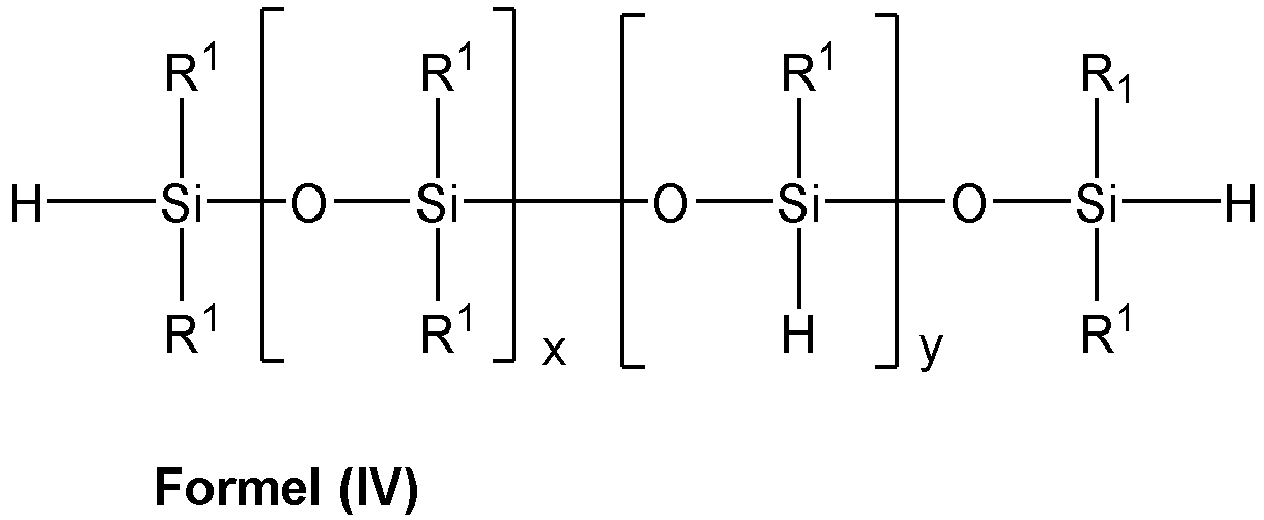
mit 0 ≤ x ≤ 250 und
1 ≤ y ≤ 50,
und mit 4 ≤ (k+ l) 5 und
l ≥ 1. - Verfahren nach Anspruch 4, dadurch gekennzeichnet, dass der Rest R1 für eine Methylgruppe steht.
- Verfahren nach einem der Ansprüche 1 bis 5 , dadurch gekennzeichnet, dass der olefinisch ungesättigte Polyether der Formel (VI) entspricht:
A[-O-(CH2-CHR-O-)m-(CH2-CH2-O-)-O-(CH2-CH(CH3)-O-)o-Z]a (VI)
mit A einem olefinisch ungesättigten, mindestens zwei Kohlenstoffatome, bevorzugt mindestens drei Kohlenstoffatome aufweisenden organischen Rest einer organischen Startverbindung zur Bereitung des Polyethers undR unabhängig voneinander eine gesättigte Alkylgruppe mit 2-18 C-Atomen ist oder ein aromatischer Rest, bevorzugt eine Ethylgruppe oder ein Phenylrest,
undZ entweder Wasserstoff,
ein linearer oder verzweigter, gesättigter oder ungesättigter Kohlenwasserstoffrest mit 1-18 C-Atomen, bevorzugt eine Methyl-, Ethyl-, Propyl-, Butyl-, Vinyl-, Allyl oder Methallylgruppe ist, oder der Rest einer organischen Säure der Formel -C(=O)-ZE, wobei ZE ein organischer Rest, bevorzugt ein linearer oder verzweigter, gesättigter oder ungesättigter Kohlenwasserstoffrest mit 1 bis 17 C-Atomen, bevorzugt eine Methylgruppe ist, oder ein aromatischer Kohlenwasserstoffrest mit 6 bis 20 C-Atomen, bevorzugt ein Phenylrest ist, oder
der Rest der Formel -C(=O)-O-ZC ist, wobei Zc ein organischer Rest, bevorzugt ein linearer oder verzweigter, gesättigter oder ungesättigter Kohlenwasserstoffrest mit 1 bis 18 C-Atomen, bevorzugt eine Methyl-, Ethylgruppe ist, oder ein aromatischer Kohlenwasserstoffrest mit 6 bis 20 C-Atomen, bevorzugt ein Phenylrest,m gleich 0 bis zu 50, bevorzugt 0 bis zu 30, besonders bevorzugt 0 bis zu 20 ist,n gleich 0 bis zu 250, bevorzugt 3 bis zu 220, besonders bevorzugt 5 bis zu 200 ist,o gleich 0 bis zu 250, bevorzugt 3 bis zu 220, besonders bevorzugt 5 bis zu 200 ist,a gleich 1 bis zu 8, bevorzugt größer 1 bis zu 6, besonders bevorzugt 1, 2, 3 oder 4,mit der Maßgabe, dass die Summe aus m, n und o gleich oder größer als 1 ist. - Verfahren nach einem der Ansprüche 1 bis 6, dadurch gekennzeichnet, dass es in Gegenwart eines Edelmetall-Katalysators, ausgewählt aus Platin-, Rhodium-, Osmium-, Ruthenium-, Palladium-, Iridium-Komplexen oder deren auf Trägermaterialien wie Silica, Aluminiumoxid oder Aktivkohle immobilisierten Derivaten sowie deren Lösungen und/ oder deren Zubereitungen durchgeführt wird.
- Verfahren nach einem der Ansprüche 1 bis 7, dadurch gekennzeichnet, dass es in Gegenwart eines Edelmetall-Katalysators, ausgewählt aus Komplexen des nullwertigen Platins und/ oder deren Lösungen und/ oder deren Zubereitungen durchgeführt wird.
- Verfahren nach einem der Ansprüche 1 bis 8, dadurch gekennzeichnet, dass die Menge des eingesetzten Edelmetall-Katalysators 1 bis 100 Gewichts-ppm, bevorzugt 2 bis 10 Gewichts-ppm bezogen auf die Masse des SiH-Gruppen aufweisenden Siloxans plus der Masse des olefinisch ungesättigten Polyethers beträgt.
- Verfahren nach einem der Ansprüche 1 bis 9, dadurch gekennzeichnet, dass die Edelmetall-katalysierte Anlagerung der olefinisch ungesättigten Polyether an SiH-Gruppen aufweisende Siloxane bei Temperaturen zwischen 0°C und 200°C, bevorzugt zwischen 50°C und 140°C vorgenommen wird.
- SiC-verknüpfte Polyethersiloxane, hergestellt durch ein Verfahren nach einem der Ansprüche 1 bis 10.
- Verwendung der Polyethersiloxane gemäß Anspruch 11 als Stabilisatoren für PUR-Schäume, Entschäumer, Lackadditive, Emulgatoren, insbesondere kosmetische Emulgatoren, kosmetische Conditioner, Entlüfter, Dismulgatoren, Textilausrüstungsmittel, Bautenschutzadditive, Kunststoffadditive, insbesondere Anti-Scratch-Additive, Antifouling-Additive bzw. -Beschichtungen und Anti-Icing-Mittel.
Priority Applications (4)
| Application Number | Priority Date | Filing Date | Title |
|---|---|---|---|
| EP17175693.5A EP3415547B1 (de) | 2017-06-13 | 2017-06-13 | Verfahren zur herstellung sic-verknüpfter polyethersiloxane |
| US15/978,828 US10519280B2 (en) | 2017-06-13 | 2018-05-14 | Process for preparing SiC-Bonded polyethersiloxanes |
| CA3007808A CA3007808A1 (en) | 2017-06-13 | 2018-06-12 | Process for preparing sic-bonded polyethersiloxanes |
| CN201810606112.XA CN109081922B (zh) | 2017-06-13 | 2018-06-13 | 制备SiC-键合的聚醚硅氧烷的方法 |
Applications Claiming Priority (1)
| Application Number | Priority Date | Filing Date | Title |
|---|---|---|---|
| EP17175693.5A EP3415547B1 (de) | 2017-06-13 | 2017-06-13 | Verfahren zur herstellung sic-verknüpfter polyethersiloxane |
Publications (2)
| Publication Number | Publication Date |
|---|---|
| EP3415547A1 true EP3415547A1 (de) | 2018-12-19 |
| EP3415547B1 EP3415547B1 (de) | 2020-03-25 |
Family
ID=59093384
Family Applications (1)
| Application Number | Title | Priority Date | Filing Date |
|---|---|---|---|
| EP17175693.5A Active EP3415547B1 (de) | 2017-06-13 | 2017-06-13 | Verfahren zur herstellung sic-verknüpfter polyethersiloxane |
Country Status (4)
| Country | Link |
|---|---|
| US (1) | US10519280B2 (de) |
| EP (1) | EP3415547B1 (de) |
| CN (1) | CN109081922B (de) |
| CA (1) | CA3007808A1 (de) |
Cited By (2)
| Publication number | Priority date | Publication date | Assignee | Title |
|---|---|---|---|---|
| US11021575B2 (en) | 2018-08-15 | 2021-06-01 | Evonik Operations Gmbh | Process for producing acetoxy-bearing siloxanes |
| US11498996B2 (en) | 2019-05-28 | 2022-11-15 | Evonik Operations Gmbh | Process for producing polyoxyalkylene polysiloxane block polymers |
Families Citing this family (27)
| Publication number | Priority date | Publication date | Assignee | Title |
|---|---|---|---|---|
| EP3272331B1 (de) | 2016-07-22 | 2018-07-04 | Evonik Degussa GmbH | Verfahren zur herstellung von siloxanen enthaltend glycerinsubstituenten |
| EP3321304B1 (de) | 2016-11-15 | 2019-06-19 | Evonik Degussa GmbH | Mischungen zyklischer-verzweigter siloxane vom d/t-typ und deren folgeprodukte |
| EP3415548B1 (de) * | 2017-06-13 | 2020-03-25 | Evonik Operations GmbH | Verfahren zur herstellung sic-verknüpfter polyethersiloxane |
| DE112018004605A5 (de) | 2017-10-17 | 2020-05-28 | Evonik Operations Gmbh | Zinkketoiminatkomplexe als Katalysatoren zur Herstellung von Polyurethanen |
| EP3492513B1 (de) | 2017-11-29 | 2021-11-03 | Evonik Operations GmbH | Verfahren zur herstellung von im siloxanteil verzweigten sioc-verknüpften polyethersiloxanen |
| US11345783B2 (en) | 2018-05-17 | 2022-05-31 | Evonik Operations Gmbh | Linear polydimethylsiloxane-polyoxyalkylene block copolymers of the structure type ABA |
| EP3794060A1 (de) | 2018-05-17 | 2021-03-24 | Evonik Operations GmbH | Lineare polydimethylsiloxan-polyoxyalkylen-blockcopolymere des strukturtyps aba |
| EP3611214A1 (de) | 2018-08-15 | 2020-02-19 | Evonik Operations GmbH | Sioc-verknüpfte, lineare polydimethylsiloxan-polyoxyalkylen-blockcopolymere |
| ES2970332T3 (es) | 2018-12-04 | 2024-05-28 | Evonik Operations Gmbh | Siloxanos reactivos |
| ES2992917T3 (en) | 2019-05-28 | 2024-12-19 | Evonik Operations Gmbh | Method for producing siloxanes bearing acetoxy groups |
| ES2990990T3 (es) | 2019-05-28 | 2024-12-02 | Evonik Operations Gmbh | Polietersiloxanos basados en SiOC personalizados |
| PL3744756T3 (pl) | 2019-05-28 | 2024-10-28 | Evonik Operations Gmbh | Układy acetoksylowe |
| EP3744760A1 (de) | 2019-05-28 | 2020-12-02 | Evonik Operations GmbH | Verfahren zur herstellung von im siloxanteil verzweigten sioc-verknüpften polyethersiloxanen |
| EP3744745A1 (de) | 2019-05-28 | 2020-12-02 | Evonik Operations GmbH | Herstellung von pu-schaumstoffen |
| ES2913783T3 (es) | 2019-05-28 | 2022-06-06 | Evonik Operations Gmbh | Procedimiento para la purificación de acetoxisiloxanos |
| EP3744755B1 (de) | 2019-05-28 | 2024-10-09 | Evonik Operations GmbH | Verfahren zur herstellung acetoxygruppen-tragender siloxane |
| ES2986717T3 (es) | 2019-05-28 | 2024-11-12 | Evonik Operations Gmbh | Procedimiento para la producción de polietersiloxanos enlazados a SiOC ramificados en la parte de siloxano |
| EP3744774B1 (de) | 2019-05-28 | 2021-09-01 | Evonik Operations GmbH | Verfahren zum recycling von silikonen |
| CN110903483A (zh) * | 2019-12-13 | 2020-03-24 | 山东大易化工有限公司 | 一种有效提高聚醚改性硅油生产稳定性和纯度的制备工艺 |
| CN111072972A (zh) * | 2019-12-14 | 2020-04-28 | 烟台开发区金宏化工有限公司 | 一种端环氧硅油的制备方法及其在氨基硅油中的应用 |
| ES3036635T3 (en) | 2020-02-14 | 2025-09-23 | Evonik Operations Gmbh | Sioc-linked, linear polydimethylsiloxane polyoxyalkylene block copolymers |
| ES2977903T3 (es) | 2020-03-27 | 2024-09-02 | Evonik Operations Gmbh | Reciclaje de materiales de estructuras planas siliconizadas |
| US11732092B2 (en) | 2020-10-19 | 2023-08-22 | Evonik Operations Gmbh | Upcycling process for processing silicone wastes |
| EP4011992A1 (de) | 2020-12-09 | 2022-06-15 | Evonik Operations GmbH | Härtbare kondensationsverbindungen auf basis von alkoxyfunktionellen polysiloxanen |
| US12060460B2 (en) | 2021-04-29 | 2024-08-13 | Evonik Operations Gmbh | Process for producing endcapped, liquid siloxanes from silicone wastes |
| CN115999203B (zh) * | 2022-12-19 | 2025-10-03 | 中海油(天津)油田化工有限公司 | 一种海上油田油气分离用低含硅原油消泡剂及其制备方法 |
| CN118480342B (zh) * | 2024-07-15 | 2024-10-22 | 克拉玛依市紫光技术有限公司 | 一种粘土稳定剂及其制备方法 |
Citations (14)
| Publication number | Priority date | Publication date | Assignee | Title |
|---|---|---|---|---|
| US3516946A (en) | 1967-09-29 | 1970-06-23 | Gen Electric | Platinum catalyst composition for hydrosilation reactions |
| US3775452A (en) | 1971-04-28 | 1973-11-27 | Gen Electric | Platinum complexes of unsaturated siloxanes and platinum containing organopolysiloxanes |
| US3814730A (en) | 1970-08-06 | 1974-06-04 | Gen Electric | Platinum complexes of unsaturated siloxanes and platinum containing organopolysiloxanes |
| DE2646726A1 (de) | 1976-10-15 | 1978-04-20 | Wacker Chemie Gmbh | Verfahren zum regeln der geschwindigkeit der durch platinkatalysator gefoerderten anlagerung von si-gebundenem wasserstoff an aliphatische mehrfachbindungen enthaltendes organopolysiloxan |
| US4288345A (en) | 1980-02-06 | 1981-09-08 | General Electric Company | Platinum complex |
| EP0075703A1 (de) | 1981-08-27 | 1983-04-06 | Th. Goldschmidt AG | Verfahren zur Addition von organischen Siliciumverbindungen mit SiH-Gruppen an Verbindungen mit olefinischen Doppelbindungen |
| EP0314903A2 (de) * | 1987-09-09 | 1989-05-10 | OSi Specialties, Inc. | Verfahren zur Herstellung von Polysiloxanoxyalkylen-Copolymeren |
| EP0550064A2 (de) | 1991-12-30 | 1993-07-07 | OSi Specialties, Inc. | Verfahren und Zusammensetzung zur Förderung von Hydrosilylierungsreaktionen unter Verwendung sterisch gehinderter Stickstoff- und phosphorhaltiger Verbindungen |
| US5668212A (en) * | 1992-10-06 | 1997-09-16 | Shizu Naito | Aqueous organosiloxane liquid composition and its use |
| WO1998000463A1 (fr) | 1996-06-28 | 1998-01-08 | Rhodia Chimie | Utilisation de complexes du platine notamment a titre de catalyseurs d'hydrosilylation homogenes et thermoactivables |
| EP0885932A2 (de) * | 1997-06-18 | 1998-12-23 | OSi Specialties, Inc. | Hydrophile Polysiloxanzusammensetzungen |
| US20040198905A1 (en) | 2001-07-23 | 2004-10-07 | Hideyuki Mori | Method for preparing organically modified organopolysiloxanes |
| EP1520870A1 (de) | 2003-10-04 | 2005-04-06 | Goldschmidt GmbH | Verfahren zur Herstellung von organischen Siliciumverbindungen |
| WO2008132236A2 (en) * | 2007-05-01 | 2008-11-06 | Dow Corning Corporation | Polymer and polymer compositions |
Family Cites Families (112)
| Publication number | Priority date | Publication date | Assignee | Title |
|---|---|---|---|---|
| US4857583A (en) * | 1987-07-02 | 1989-08-15 | Union Carbide Corporation | Process for the preparation of organopolysiloxane surfactants |
| DE4027976C3 (de) | 1990-09-04 | 1997-09-18 | Goldschmidt Ag Th | Verfahren zur Herstellung aktiver Magnesiumhydrid-Magnesium-Wasserstoff-Speichersysteme und Vorrichtung zur Durchführung des Verfahrens |
| DE4039278A1 (de) | 1990-12-08 | 1992-06-11 | Goldschmidt Ag Th | Verfahren zur herstellung aktiver, reversibel h(pfeil abwaerts)2(pfeil abwaerts) aufnehmender magnesiumhydrid-magnesium-wasserstoff-speichersysteme |
| US5153293A (en) * | 1991-03-18 | 1992-10-06 | Dow Corning Corporation | Process for the preparation of organopolysiloxane copolymers |
| DE4116382C1 (de) | 1991-05-18 | 1992-06-11 | Th. Goldschmidt Ag, 4300 Essen, De | |
| DE4116987C1 (de) | 1991-05-24 | 1992-07-30 | Th. Goldschmidt Ag, 4300 Essen, De | |
| US5831103A (en) | 1992-10-20 | 1998-11-03 | Th. Goldschmidt Ag | Halogen-magnesium-aluminum hydridohalides, methods for their synthesis and their use as reducing agents |
| JP2738904B2 (ja) * | 1992-10-22 | 1998-04-08 | 有限会社ナトー研究所 | 水含有オルガノシロキサン液状組成物とその用途 |
| DE4239246C1 (de) | 1992-11-21 | 1993-12-16 | Goldschmidt Ag Th | Verfahren zur Herstellung von SiH-Gruppen aufweisenden Organopolysiloxanen |
| DE4313130C1 (de) | 1993-04-22 | 1994-05-26 | Goldschmidt Ag Th | Verfahren zur Herstellung von Silanen bzw. Organosiliciumhydriden durch Reduktion der entsprechenden Siliciumhalogenide bzw. Organosiliciumhalogenide |
| DE4320920C1 (de) | 1993-06-24 | 1994-06-16 | Goldschmidt Ag Th | Silane mit hydrophilen Gruppen, deren Herstellung und Verwendung als Tenside in wäßrigen Medien |
| DE4330059C1 (de) | 1993-09-06 | 1994-10-20 | Goldschmidt Ag Th | Silane mit hydrophilen Gruppen, deren Herstellung und Verwendung als Tenside in wäßrigen Medien |
| DE4336602A1 (de) | 1993-10-27 | 1995-05-04 | Goldschmidt Ag Th | Verfahren zur Herstellung von Aluminiumwasserstoff (AlH¶3¶) durch Umsetzung von Magnesiumhydrid mit Aluminiumhalogenid |
| US5430097A (en) * | 1993-12-23 | 1995-07-04 | Dow Corning Corporation | Production of organopolysiloxane copolymers with a phenyl ether solvent |
| DE4415556C1 (de) | 1994-04-27 | 1995-06-01 | Goldschmidt Ag Th | Organosilyl- bzw. Organosiloxanyl-Derivate von Glycerinethern und deren Verwendung |
| DE4419456A1 (de) | 1994-06-03 | 1995-12-07 | Goldschmidt Ag Th | Verfahren zur Herstellung von Magnesiumhydrid |
| DE4446516C1 (de) | 1994-12-24 | 1996-03-28 | Goldschmidt Ag Th | Verfahren zur Herstellung von ether- und halogenidfreiem Aluminiumwasserstoff |
| EP0744234B1 (de) | 1995-05-26 | 1999-10-27 | Th. Goldschmidt AG | Verfahren zur Herstellung röntgenamorpher und nanokristalliner Metallpulver |
| US5648444A (en) * | 1995-11-15 | 1997-07-15 | Witco Corporation | Hydrosilation in esters without hydroxyl moieties |
| DE19613366A1 (de) | 1996-04-03 | 1997-10-09 | Goldschmidt Ag Th | Vorrichtung zur Behandlung von Suspensionen |
| US6071977A (en) * | 1996-10-31 | 2000-06-06 | Ck Witco Corporation | Hydrosilation in high boiling natural vegetable oils |
| DE19648637A1 (de) | 1996-11-25 | 1998-06-04 | Goldschmidt Ag Th | Verfahren zur Herstellung von alpha,omega-Alkenolen |
| US5856548A (en) | 1997-05-17 | 1999-01-05 | Th. Goldschmidt Ag | Process for preparing dimethylmonochlorosilane |
| DE59807606D1 (de) | 1997-06-10 | 2003-04-30 | Goldschmidt Ag Th | Schäumbarer Metallkörper |
| US6372874B1 (en) * | 1998-12-04 | 2002-04-16 | Crompton Corporation | Process for the preparation of siloxane-oxyalkylene copolymers |
| DE19859759C1 (de) * | 1998-12-23 | 2000-06-29 | Goldschmidt Ag Th | Verfahren und Vorrichtung zur Durchführung kontinuierlicher Hydrosilylierungsreaktionen |
| DE19907855C1 (de) | 1999-02-24 | 2000-09-21 | Goldschmidt Ag Th | Herstellung von Metallschäumen |
| EP1031634A1 (de) | 1999-02-24 | 2000-08-30 | Goldschmidt AG | Verfahren zur Separation von Metallschmelzen unter Zugabe von Metallhydrid, insbesondere MgH2 |
| EP1031635B1 (de) | 1999-02-24 | 2003-10-15 | Goldschmidt AG | Aktiviertes Magnesiummetall |
| CA2298240C (en) | 1999-02-24 | 2007-08-21 | Goldschmidt Ag | Synergistic catalyst system and process for carrying out hydrosilylation reactions |
| DE10024776C1 (de) | 2000-05-19 | 2001-09-06 | Goldschmidt Ag Th | Verwendung von Metallhydrid-behandeltem Zink in der metallorganischen Synthese |
| US6915834B2 (en) | 2001-02-01 | 2005-07-12 | Goldschmidt Ag | Process for producing metal foam and metal body produced using this process |
| DE10104338A1 (de) | 2001-02-01 | 2002-08-08 | Goldschmidt Ag Th | Herstellung flächiger, metallischer Integralschäume |
| DE10104339A1 (de) | 2001-02-01 | 2002-08-08 | Goldschmidt Ag Th | Verfahren zur Herstellung von Metallschaum und danach hergestellter Metallkörper |
| WO2002068506A1 (de) | 2001-02-27 | 2002-09-06 | Goldschmidt Ag | Verfahren zur aufbereitung von polyethersiloxanen |
| DE10123899A1 (de) | 2001-05-16 | 2002-11-21 | Goldschmidt Ag Th | Verfahren zur Herstellung von Metallformteilen |
| ATE357304T1 (de) | 2001-05-19 | 2007-04-15 | Goldschmidt Gmbh | Herstellung von metallschäumen |
| DE10127716A1 (de) | 2001-06-07 | 2002-12-12 | Goldschmidt Ag Th | Verfahren zur Herstellung von Metall/Metallschaum-Verbundbauteilen |
| EP1350804B1 (de) | 2002-03-26 | 2004-04-07 | Goldschmidt AG | Verwendung organofunktionell modifizierter Polysiloxane zur Herstellung von Polyurethanweichschäumen |
| DE10232115A1 (de) | 2002-07-16 | 2004-02-05 | Goldschmidt Ag | Organopolysiloxane zur Entschäumung wässriger Systeme |
| DE10232908A1 (de) | 2002-07-19 | 2004-01-29 | Goldschmidt Ag | Verwendung organfunktionell modifizierter, Phenylderivate enthaltender Polysiloxane als Dispergier- und Netzmittel für Füllstoffe und Pigmente in wässrigen Pigmentpasten und Farb- oder Lackformulierungen |
| DE50206131D1 (de) | 2002-12-21 | 2006-05-11 | Goldschmidt Gmbh | Verfahren zur Aufbereitung von Polyethersiloxanen |
| DE10301355A1 (de) | 2003-01-16 | 2004-07-29 | Goldschmidt Ag | Äquilibrierung von Siloxanen |
| US7125185B2 (en) | 2003-03-20 | 2006-10-24 | Silverbrook Research Pty Ltd | Display device having pagewidth printer |
| DE102005001039B4 (de) | 2005-01-07 | 2017-11-09 | Evonik Degussa Gmbh | Verfahren zur Herstellung von Äquilibrierungsprodukten von Organosiloxanen und die so erhältlichen Organopolysiloxane |
| DE102005039398A1 (de) | 2005-08-20 | 2007-02-22 | Goldschmidt Gmbh | Verfahren zur Herstellung von Anlagerungsprodukten aus SiH-Gruppen enthaltenden Verbindungen an Olefingruppen aufweisende Reaktionspartner in wässrigen Medien |
| DE102005039931A1 (de) | 2005-08-24 | 2007-03-01 | Goldschmidt Gmbh | Verfahren zur Herstellung von SiOC-verknüpften, linearen Polydimethylsiloxan-Polyoxyalkylen-Blockcopolymeren |
| DE102005057857A1 (de) | 2005-12-03 | 2010-02-25 | Evonik Goldschmidt Gmbh | Polyethermodifizierte Polysiloxane mit Blockcharakter und deren Verwendung zur Herstellung von kosmetischen Formulierungen |
| DE102006061353A1 (de) | 2006-12-22 | 2008-06-26 | Evonik Goldschmidt Gmbh | Verfahren zur Umsetzung von Polyorganosiloxanen und deren Verwendung |
| DE102006061351A1 (de) | 2006-12-22 | 2008-06-26 | Evonik Goldschmidt Gmbh | Verfahren zur Herstellung von SiOC-verknüpften, linearen Polydimethylsiloxan-Polyoxyalkylen-Blockcopolymeren und ihre Verwendung |
| DE102006061350A1 (de) | 2006-12-22 | 2008-06-26 | Evonik Goldschmidt Gmbh | Verfahren zur Herstellung von SiOC-verknüpften, linearen Polydimethylsiloxan-Polyoxyalkylen-Blockcopolymeren und ihre Verwendung |
| DE102007035646A1 (de) | 2007-07-27 | 2009-01-29 | Evonik Goldschmidt Gmbh | Über SIC- und über Carbonsäureestergruppen verknüpfte lineare Polydimethylsiloxan-Polyoxyalkylen-Blockcopolymere, ein Verfahren zur ihrer Herstellung und ihre Verwendung |
| DE102007055484A1 (de) | 2007-11-21 | 2009-05-28 | Evonik Goldschmidt Gmbh | Verfahren zur Herstellung von Polydimethylsiloxanen an sulfonsauren Kationenaustauscherharzen |
| DE102007055485A1 (de) | 2007-11-21 | 2009-06-04 | Evonik Goldschmidt Gmbh | Verfahren zur Herstellung verzweigter SiH-funktioneller Polysiloxane und deren Verwendung zur Herstellung SiC- und SiOC-verknüpfter, verzweigter organomodifizierter Polysiloxane |
| DE102007057146A1 (de) | 2007-11-28 | 2009-06-04 | Evonik Goldschmidt Gmbh | Verfahren zur Herstellung von Polyetheralkoholen mit DMC-Katalysatoren unter Verwendung von speziellen Additiven mit aromatischer Hydroxy-Funktionalisierung |
| DE102007057145A1 (de) | 2007-11-28 | 2009-06-04 | Evonik Goldschmidt Gmbh | Verfahren zur Herstellung von Polyetheralkoholen mit DMC-Katalysatoren unter Verwendung von SiH-Gruppen tragenden Verbindungen als Additive |
| DE102008000266A1 (de) | 2008-02-11 | 2009-08-13 | Evonik Goldschmidt Gmbh | Die Erfindung betrifft die Verwendung von Schaumstabilisatoren, die auf Basis nachwachsender Rohstoffe hergestellt werden, zur Herstellung von Polyurethanschäumen |
| DE102008000360A1 (de) | 2008-02-21 | 2009-08-27 | Evonik Goldschmidt Gmbh | Neue Alkoxysilylgruppen tragende Polyetheralkohole durch Alkoxylierung epoxidfunktioneller Alkoxysilane an Doppelmetallcyanid (DMC)-Katalysatoren, sowie Verfahren zu deren Herstellung |
| DE102008000903A1 (de) | 2008-04-01 | 2009-10-08 | Evonik Goldschmidt Gmbh | Neue Organosiloxangruppen tragende Polyetheralkohole durch Alkoxylierung epoxidfunktioneller (Poly)Organosiloxane an Doppelmetallcyanid (DMC)-Katalysatoren, sowie Verfahren zu deren Herstellung |
| DE102008002713A1 (de) | 2008-06-27 | 2009-12-31 | Evonik Goldschmidt Gmbh | Neue Polyethersiloxane enthaltende Alkoxylierungsprodukte durch direkte Alkoxylierung organomodifizierter alpha, omega-Dihydroxysiloxane an Doppelmetallcyanid (DMC)-Katalysatoren, sowie Verfahren zu deren Herstellung |
| DE102008041601A1 (de) | 2008-08-27 | 2010-03-04 | Evonik Goldschmidt Gmbh | Verfahren zur Herstellung verzweigter SiH-funtioneller Polysiloxane und deren Verwendung zur Herstellung flüssiger, SiC- oder SiOC-verknüpfter, verzweigter organomodifizierter Polysiloxane |
| DE102008042181B4 (de) | 2008-09-18 | 2020-07-23 | Evonik Operations Gmbh | Äquilibrierung von Siloxanen an wasserhaltigen sulfonsauren Kationenaustauscherharzen |
| DE102008043218A1 (de) | 2008-09-24 | 2010-04-01 | Evonik Goldschmidt Gmbh | Polymere Werkstoffe sowie daraus bestehende Kleber- und Beschichtungsmittel auf Basis multialkoxysilylfunktioneller Präpolymerer |
| DE102008043245A1 (de) | 2008-10-29 | 2010-05-06 | Evonik Goldschmidt Gmbh | Siliconpolyether-Copolymersysteme sowie Verfahren zu deren Herstellung durch Alkoxylierungsreaktion |
| DE102008043343A1 (de) | 2008-10-31 | 2010-05-06 | Evonik Goldschmidt Gmbh | Silikonpolyetherblock-Copolymere mit definierter Polydispersität im Polyoxyalkylenteil und deren Verwendung als Stabilisatoren zur Herstellung von Polyurethanschäumen |
| PL2352779T3 (pl) | 2008-12-05 | 2018-04-30 | Evonik Degussa Gmbh | Polieterosiloksany zawierające grupy alkoksysililowe i sposób ich wytwarzania |
| DE102009022628A1 (de) | 2008-12-05 | 2010-06-10 | Evonik Goldschmidt Gmbh | Verfahren zur Modifizierung von Oberflächen |
| DE102009002417A1 (de) | 2009-04-16 | 2010-10-21 | Evonik Goldschmidt Gmbh | Verwendung organomodifizierter, im Siliconteil verzweigter Siloxane zur Herstellung kosmetischer oder pharmazeutischer Zusammensetzungen |
| DE102009003274A1 (de) | 2009-05-20 | 2010-11-25 | Evonik Goldschmidt Gmbh | Zusammensetzungen enthaltend Polyether-Polysiloxan-Copolymere |
| DE102009022627A1 (de) | 2009-05-25 | 2010-12-02 | Evonik Goldschmidt Gmbh | Reaktive Silylgruppen tragende Hydroxylverbindungen als Keramikbindemittel |
| DE102009022631A1 (de) | 2009-05-25 | 2010-12-16 | Evonik Goldschmidt Gmbh | Härtbare Silylgruppen enthaltende Zusammensetzungen und deren Verwendung |
| DE102009022630A1 (de) | 2009-05-25 | 2010-12-02 | Evonik Goldschmidt Gmbh | Emulsionen auf Basis Silylgruppen tragender Hydroxylverbindungen |
| DE102009034607A1 (de) | 2009-07-24 | 2011-01-27 | Evonik Goldschmidt Gmbh | Neuartige Siliconpolyethercopolymere und Verfahren zu deren Herstellung |
| DE102009028640A1 (de) | 2009-08-19 | 2011-02-24 | Evonik Goldschmidt Gmbh | Härtbare Masse enthaltend Urethangruppen aufweisende silylierte Polymere und deren Verwendung in Dicht- und Klebstoffen, Binde- und/oder Oberflächenmodifizierungsmitteln |
| DE102009028636A1 (de) | 2009-08-19 | 2011-02-24 | Evonik Goldschmidt Gmbh | Neuartige Urethangruppen enthaltende silylierte Präpolymere und Verfahren zu deren Herstellung |
| DE102010001350A1 (de) | 2010-01-29 | 2011-08-04 | Evonik Goldschmidt GmbH, 45127 | Neuartige lineare Polydimethylsiloxan-Polyether-Copolymere mit Amino- und/oder quaternären Ammoniumgruppen und deren Verwendung |
| DE102010001528A1 (de) | 2010-02-03 | 2011-08-04 | Evonik Goldschmidt GmbH, 45127 | Neue Partikel und Kompositpartikel, deren Verwendungen und ein neues Verfahren zu deren Herstellung aus Alkoxysilylgruppen tragenden Alkoxylierungsprodukten |
| DE102010001531A1 (de) | 2010-02-03 | 2011-08-04 | Evonik Goldschmidt GmbH, 45127 | Neuartige organomodifizierte Siloxane mit primären Aminofunktionen, neuartige organomodifizierte Siloxane mit quaternären Ammoniumfunktionen und das Verfahren zu deren Herstellung |
| DE102010002180A1 (de) | 2010-02-22 | 2011-08-25 | Evonik Goldschmidt GmbH, 45127 | Stickstoffhaltige silizium-organische Pfropfmischpolymere |
| DE102010002178A1 (de) | 2010-02-22 | 2011-08-25 | Evonik Goldschmidt GmbH, 45127 | Verfahren zur Herstellung von Amin-Amid-funktionellen Siloxanen |
| DE102010029723A1 (de) | 2010-06-07 | 2011-12-08 | Evonik Goldschmidt Gmbh | Verfahren zur Herstellung von organischen Siliciumverbindungen |
| DE102010031087A1 (de) | 2010-07-08 | 2012-01-12 | Evonik Goldschmidt Gmbh | Neuartige polyestermodifizierte Organopolysiloxane |
| DE102010062156A1 (de) | 2010-10-25 | 2012-04-26 | Evonik Goldschmidt Gmbh | Polysiloxane mit stickstoffhaltigen Gruppen |
| DE102011076019A1 (de) | 2011-05-18 | 2012-11-22 | Evonik Goldschmidt Gmbh | Alkoxylierungsprodukte und Verfahren zu ihrer Herstellung mittels DMC-Katalysatoren |
| DE102011079465A1 (de) | 2011-07-20 | 2013-01-24 | Evonik Goldschmidt Gmbh | Verfahren zur Reduktion von Carbonsäureestern oder -lactonen zu den entsprechenden Ethern |
| DE102011109545A1 (de) * | 2011-08-03 | 2013-02-07 | Evonik Goldschmidt Gmbh | Verfahren zur Herstellung von Polyethersiloxanen enthaltend Polyethercarbonatgrundstrukturen |
| DE102011109540A1 (de) | 2011-08-03 | 2013-02-07 | Evonik Goldschmidt Gmbh | Alkylcarbonat endverschlossene Polyethersilioxane und Verfahren zu deren Herstellung |
| DE102011085492A1 (de) | 2011-10-31 | 2013-05-02 | Evonik Goldschmidt Gmbh | Neue aminogruppenhaltige Siloxane, Verfahren zu deren Herstellung und Anwendung |
| DE102011088787A1 (de) | 2011-12-16 | 2013-06-20 | Evonik Industries Ag | Siloxannitrone und deren Anwendung |
| DE102012202521A1 (de) | 2012-02-20 | 2013-08-22 | Evonik Goldschmidt Gmbh | Verzweigte Polysiloxane und deren Verwendung |
| DE102012202527A1 (de) | 2012-02-20 | 2013-08-22 | Evonik Goldschmidt Gmbh | Zusammensetzungen enthaltend Polymere und Metallatome oder -ionen und deren Verwendung |
| DE102012203737A1 (de) | 2012-03-09 | 2013-09-12 | Evonik Goldschmidt Gmbh | Modifizierte Alkoxylierungsprodukte, die zumindest eine nicht-terminale Alkoxysilylgruppe aufweisen und mehrere Urethangruppen enthalten und deren Verwendung |
| DE102012210553A1 (de) | 2012-06-22 | 2013-12-24 | Evonik Industries Ag | Siliconpolyether und Verfahren zu deren Herstellung aus Methylidengruppen tragenden Polyethern |
| DE102013208328A1 (de) | 2013-05-07 | 2014-11-13 | Evonik Industries Ag | Polyoxyalkylene mit seitenständigen langkettigen Acyloxyresten und Verfahren zu ihrer Herstellung mittels DMC-Katalysatoren |
| DE102013106906A1 (de) | 2013-07-01 | 2015-01-08 | Evonik Industries Ag | Siloxan-Polymere mit zentralem Polysiloxan-Polymerblock mit terminalen organofunktionellen Resten umfassend Harnstoff- und/oder Carbamat-Gruppen sowie Aminosäure-Reste |
| DE102013106905A1 (de) | 2013-07-01 | 2015-01-08 | Evonik Industries Ag | Siloxan-Polymere mit zentralem Polysiloxan-Polymerblock mit organofunktionellen Resten mit jeweils mindestens zwei bivalenten Gruppen ausgewählt aus Harnstoff- und/oder Carbamat-Gruppen und mindestens einem UV/Vis-Chromophor als Rest |
| DE102013213655A1 (de) | 2013-07-12 | 2015-01-15 | Evonik Industries Ag | Härtbare Silylgruppen enthaltende Zusammensetzungen mit verbesserter Lagerstabilität |
| DE102013214081A1 (de) | 2013-07-18 | 2015-01-22 | Evonik Industries Ag | Neue aminosäuremodifizierte Siloxane, Verfahren zu ihrer Herstellung und Anwendung |
| DE102013216751A1 (de) | 2013-08-23 | 2015-02-26 | Evonik Industries Ag | Modifizierte Alkoxylierungsprodukte, die Alkoxysilylgruppen aufweisen und Urethangruppen enthalten und deren Verwendung |
| DE102013216787A1 (de) | 2013-08-23 | 2015-02-26 | Evonik Degussa Gmbh | Guanidingruppen aufweisende semi-organische Siliciumgruppen enthaltende Verbindungen |
| DE102014209408A1 (de) | 2014-05-19 | 2015-11-19 | Evonik Degussa Gmbh | Ethoxylatherstellung unter Verwendung hoch aktiver Doppelmetallcyanid-Katalysatoren |
| DE102014209407A1 (de) | 2014-05-19 | 2015-11-19 | Evonik Degussa Gmbh | Hoch aktive Doppelmetallcyanid-Katalysatoren und Verfahren zu deren Herstellung |
| DE102014213507A1 (de) | 2014-07-11 | 2016-01-14 | Evonik Degussa Gmbh | Platin enthaltende Zusammensetzung |
| EP3020749B1 (de) | 2014-11-12 | 2020-09-30 | Evonik Operations GmbH | Verfahren zur herstellung von platin enthaltenden zusammensetzungen |
| EP3050910B1 (de) | 2015-01-28 | 2016-12-07 | Evonik Degussa GmbH | Modifizierte alkoxylierungsprodukte, die zumindest eine nicht-terminale alkoxysilylgruppe aufweisen, mit erhöhter lagerstabilität und verbesserter dehnung und der unter deren verwendung hergestellten polymere |
| EP3168273B1 (de) | 2015-11-11 | 2018-05-23 | Evonik Degussa GmbH | Härtbare polymere |
| PL3168274T3 (pl) | 2015-11-11 | 2018-10-31 | Evonik Degussa Gmbh | Polimery utwardzalne |
| CN108291020A (zh) | 2015-11-26 | 2018-07-17 | 赢创德固赛有限公司 | 包含环氧化合物和带有烷氧基甲硅烷基的预聚物的粘合剂体系及其应用 |
| EP3202816B1 (de) | 2016-02-04 | 2018-09-19 | Evonik Degussa GmbH | Alkoxysilylhaltige klebdichtstoffe mit verbessertem weiterreisswiderstand |
| EP3228649B1 (de) | 2016-04-04 | 2020-07-15 | Evonik Operations GmbH | Aufbereitung alkalisch katalysierter alkoxylierungsprodukte |
| EP3272331B1 (de) | 2016-07-22 | 2018-07-04 | Evonik Degussa GmbH | Verfahren zur herstellung von siloxanen enthaltend glycerinsubstituenten |
| EP3415548B1 (de) * | 2017-06-13 | 2020-03-25 | Evonik Operations GmbH | Verfahren zur herstellung sic-verknüpfter polyethersiloxane |
-
2017
- 2017-06-13 EP EP17175693.5A patent/EP3415547B1/de active Active
-
2018
- 2018-05-14 US US15/978,828 patent/US10519280B2/en active Active
- 2018-06-12 CA CA3007808A patent/CA3007808A1/en active Pending
- 2018-06-13 CN CN201810606112.XA patent/CN109081922B/zh active Active
Patent Citations (16)
| Publication number | Priority date | Publication date | Assignee | Title |
|---|---|---|---|---|
| US3516946A (en) | 1967-09-29 | 1970-06-23 | Gen Electric | Platinum catalyst composition for hydrosilation reactions |
| US3814730A (en) | 1970-08-06 | 1974-06-04 | Gen Electric | Platinum complexes of unsaturated siloxanes and platinum containing organopolysiloxanes |
| US3775452A (en) | 1971-04-28 | 1973-11-27 | Gen Electric | Platinum complexes of unsaturated siloxanes and platinum containing organopolysiloxanes |
| DE2646726A1 (de) | 1976-10-15 | 1978-04-20 | Wacker Chemie Gmbh | Verfahren zum regeln der geschwindigkeit der durch platinkatalysator gefoerderten anlagerung von si-gebundenem wasserstoff an aliphatische mehrfachbindungen enthaltendes organopolysiloxan |
| US4288345A (en) | 1980-02-06 | 1981-09-08 | General Electric Company | Platinum complex |
| EP0075703A1 (de) | 1981-08-27 | 1983-04-06 | Th. Goldschmidt AG | Verfahren zur Addition von organischen Siliciumverbindungen mit SiH-Gruppen an Verbindungen mit olefinischen Doppelbindungen |
| EP0314903A2 (de) * | 1987-09-09 | 1989-05-10 | OSi Specialties, Inc. | Verfahren zur Herstellung von Polysiloxanoxyalkylen-Copolymeren |
| US4847398A (en) | 1987-09-09 | 1989-07-11 | Union Carbide Corporation | Process for the preparation of siloxane-oxyalkylene copolymers |
| EP0550064A2 (de) | 1991-12-30 | 1993-07-07 | OSi Specialties, Inc. | Verfahren und Zusammensetzung zur Förderung von Hydrosilylierungsreaktionen unter Verwendung sterisch gehinderter Stickstoff- und phosphorhaltiger Verbindungen |
| US5668212A (en) * | 1992-10-06 | 1997-09-16 | Shizu Naito | Aqueous organosiloxane liquid composition and its use |
| WO1998000463A1 (fr) | 1996-06-28 | 1998-01-08 | Rhodia Chimie | Utilisation de complexes du platine notamment a titre de catalyseurs d'hydrosilylation homogenes et thermoactivables |
| EP0885932A2 (de) * | 1997-06-18 | 1998-12-23 | OSi Specialties, Inc. | Hydrophile Polysiloxanzusammensetzungen |
| US20040198905A1 (en) | 2001-07-23 | 2004-10-07 | Hideyuki Mori | Method for preparing organically modified organopolysiloxanes |
| EP1520870A1 (de) | 2003-10-04 | 2005-04-06 | Goldschmidt GmbH | Verfahren zur Herstellung von organischen Siliciumverbindungen |
| EP1520870B1 (de) | 2003-10-04 | 2006-01-25 | Goldschmidt GmbH | Verfahren zur Herstellung von organischen Siliciumverbindungen |
| WO2008132236A2 (en) * | 2007-05-01 | 2008-11-06 | Dow Corning Corporation | Polymer and polymer compositions |
Non-Patent Citations (3)
| Title |
|---|
| "Chemie und Technologie der Silicone", 1960, VERLAG CHEMIE, pages: 43 |
| C. HARZDORF, Z. ANAL. CHEM., vol. 276, 1975, pages 279 - 283 |
| MICHAEL. A. BROOK: "Silicon in Organic, Organometallic, and Polymer Chemistry", 2000, JOHN WILEY & SONS, INC., pages: 403 ff |
Cited By (2)
| Publication number | Priority date | Publication date | Assignee | Title |
|---|---|---|---|---|
| US11021575B2 (en) | 2018-08-15 | 2021-06-01 | Evonik Operations Gmbh | Process for producing acetoxy-bearing siloxanes |
| US11498996B2 (en) | 2019-05-28 | 2022-11-15 | Evonik Operations Gmbh | Process for producing polyoxyalkylene polysiloxane block polymers |
Also Published As
| Publication number | Publication date |
|---|---|
| CN109081922A (zh) | 2018-12-25 |
| US20180355114A1 (en) | 2018-12-13 |
| CN109081922B (zh) | 2022-09-06 |
| CA3007808A1 (en) | 2018-12-13 |
| EP3415547B1 (de) | 2020-03-25 |
| US10519280B2 (en) | 2019-12-31 |
Similar Documents
| Publication | Publication Date | Title |
|---|---|---|
| EP3415548B1 (de) | Verfahren zur herstellung sic-verknüpfter polyethersiloxane | |
| EP3415547B1 (de) | Verfahren zur herstellung sic-verknüpfter polyethersiloxane | |
| EP2107077B1 (de) | Organosiloxangruppen tragende Polyetheralkohole durch Alkoxylierung epoxidfunktioneller (Poly)Organosiloxane an Doppelmetallcyanid (DMC)-Katalysatoren, sowie Verfahren zu deren Herstellung | |
| EP2352779B1 (de) | Alkoxysilylgruppen tragende polyethersiloxane sowie verfahren zu deren herstellung | |
| EP2138526B1 (de) | Neue Polyethersiloxane enthaltende Alkoxylierungsprodukte durch direkte Alkoxylierung organomodifizierter alpha, omega-Dihydroxysiloxane an Doppelmetallcyanid (DMC)-Katalysatoren, sowie Verfahren zu deren Herstellung | |
| EP1679335B1 (de) | Siloxanblockcopolymere | |
| EP2392608B1 (de) | Verfahren zur Herstellung von organischen Siliciumverbindungen | |
| EP3020749B1 (de) | Verfahren zur herstellung von platin enthaltenden zusammensetzungen | |
| EP3029088B1 (de) | Verfahren zur herstellung von polyethersiloxanen | |
| EP1627892B1 (de) | Verfahren zur Herstellung von organisch modifizierten Polyorganosiloxanen durch katalytische dehydrogenative Kondensation von Polyorganosiloxanen mit Alkoholen | |
| WO2019219452A1 (de) | Lineare polydimethylsiloxan-polyoxyalkylen-blockcopolymere des strukturtyps aba | |
| EP3794059A1 (de) | Lineare polydimethylsiloxan-polyoxyalkylen-blockcopolymere des strukturtyps aba | |
| EP1460098B1 (de) | Verfahren zur Herstellung von organisch modifizierten Polyorganosiloxanen | |
| EP3744762A1 (de) | Verfahren zur herstellung von polyoxyalkylen polysiloxan blockpolymerisaten | |
| EP0927734B1 (de) | Kontinuierliches Verfahren zur Herstellung von Polyorganosiloxanen | |
| DE102008043245A1 (de) | Siliconpolyether-Copolymersysteme sowie Verfahren zu deren Herstellung durch Alkoxylierungsreaktion | |
| EP2676986A1 (de) | Siliconpolyether und Verfahren zu deren Herstellung aus Methylidengruppen tragenden Polyethern | |
| DE102005051939A1 (de) | Verfahren zur Herstellung von organisch modifizierten Polyorganosiloxanen | |
| EP2365021A1 (de) | Verfahren zur Herstellung von Amin-Amid-funktionellen Siloxanen | |
| DE19620572A1 (de) | Harze geringen Molekulargewichtes und mit einem hohen Vinylgehalt zum Spritzgießen | |
| DE102011109545A1 (de) | Verfahren zur Herstellung von Polyethersiloxanen enthaltend Polyethercarbonatgrundstrukturen | |
| EP0797612B1 (de) | Verfahren zur herstellung von im wesentlichen cyclenfreien polyorgano-siloxanen und organofunktionellen siloxanen | |
| EP1370601B1 (de) | Verfahren zur herstellung von hydroxyalkylpolysiloxanen | |
| DE102010062244A1 (de) | Verfahren zur Umsetzung von Hydroxy-Verbindungen mit linearen, verzweigten oder cyclischen Polyalkysiloxanen | |
| EP4520777A1 (de) | Verfahren zur herstellung hochwertiger hydrosilylierungsprodukte |
Legal Events
| Date | Code | Title | Description |
|---|---|---|---|
| PUAI | Public reference made under article 153(3) epc to a published international application that has entered the european phase |
Free format text: ORIGINAL CODE: 0009012 |
|
| STAA | Information on the status of an ep patent application or granted ep patent |
Free format text: STATUS: THE APPLICATION HAS BEEN PUBLISHED |
|
| AK | Designated contracting states |
Kind code of ref document: A1 Designated state(s): AL AT BE BG CH CY CZ DE DK EE ES FI FR GB GR HR HU IE IS IT LI LT LU LV MC MK MT NL NO PL PT RO RS SE SI SK SM TR |
|
| AX | Request for extension of the european patent |
Extension state: BA ME |
|
| STAA | Information on the status of an ep patent application or granted ep patent |
Free format text: STATUS: REQUEST FOR EXAMINATION WAS MADE |
|
| STAA | Information on the status of an ep patent application or granted ep patent |
Free format text: STATUS: EXAMINATION IS IN PROGRESS |
|
| 17P | Request for examination filed |
Effective date: 20190613 |
|
| RBV | Designated contracting states (corrected) |
Designated state(s): AL AT BE BG CH CY CZ DE DK EE ES FI FR GB GR HR HU IE IS IT LI LT LU LV MC MK MT NL NO PL PT RO RS SE SI SK SM TR |
|
| 17Q | First examination report despatched |
Effective date: 20190722 |
|
| RAP1 | Party data changed (applicant data changed or rights of an application transferred) |
Owner name: EVONIK OPERATIONS GMBH |
|
| GRAP | Despatch of communication of intention to grant a patent |
Free format text: ORIGINAL CODE: EPIDOSNIGR1 |
|
| STAA | Information on the status of an ep patent application or granted ep patent |
Free format text: STATUS: GRANT OF PATENT IS INTENDED |
|
| INTG | Intention to grant announced |
Effective date: 20200103 |
|
| RIN1 | Information on inventor provided before grant (corrected) |
Inventor name: KNOTT, WILFRIED Inventor name: WINDBIEL, DAGMAR |
|
| GRAS | Grant fee paid |
Free format text: ORIGINAL CODE: EPIDOSNIGR3 |
|
| GRAA | (expected) grant |
Free format text: ORIGINAL CODE: 0009210 |
|
| STAA | Information on the status of an ep patent application or granted ep patent |
Free format text: STATUS: THE PATENT HAS BEEN GRANTED |
|
| AK | Designated contracting states |
Kind code of ref document: B1 Designated state(s): AL AT BE BG CH CY CZ DE DK EE ES FI FR GB GR HR HU IE IS IT LI LT LU LV MC MK MT NL NO PL PT RO RS SE SI SK SM TR |
|
| REG | Reference to a national code |
Ref country code: GB Ref legal event code: FG4D Free format text: NOT ENGLISH |
|
| REG | Reference to a national code |
Ref country code: AT Ref legal event code: REF Ref document number: 1248474 Country of ref document: AT Kind code of ref document: T Effective date: 20200415 Ref country code: IE Ref legal event code: FG4D Free format text: LANGUAGE OF EP DOCUMENT: GERMAN |
|
| REG | Reference to a national code |
Ref country code: DE Ref legal event code: R096 Ref document number: 502017004348 Country of ref document: DE |
|
| REG | Reference to a national code |
Ref country code: NL Ref legal event code: FP |
|
| PG25 | Lapsed in a contracting state [announced via postgrant information from national office to epo] |
Ref country code: RS Free format text: LAPSE BECAUSE OF FAILURE TO SUBMIT A TRANSLATION OF THE DESCRIPTION OR TO PAY THE FEE WITHIN THE PRESCRIBED TIME-LIMIT Effective date: 20200325 Ref country code: FI Free format text: LAPSE BECAUSE OF FAILURE TO SUBMIT A TRANSLATION OF THE DESCRIPTION OR TO PAY THE FEE WITHIN THE PRESCRIBED TIME-LIMIT Effective date: 20200325 Ref country code: NO Free format text: LAPSE BECAUSE OF FAILURE TO SUBMIT A TRANSLATION OF THE DESCRIPTION OR TO PAY THE FEE WITHIN THE PRESCRIBED TIME-LIMIT Effective date: 20200625 |
|
| PG25 | Lapsed in a contracting state [announced via postgrant information from national office to epo] |
Ref country code: SE Free format text: LAPSE BECAUSE OF FAILURE TO SUBMIT A TRANSLATION OF THE DESCRIPTION OR TO PAY THE FEE WITHIN THE PRESCRIBED TIME-LIMIT Effective date: 20200325 Ref country code: LV Free format text: LAPSE BECAUSE OF FAILURE TO SUBMIT A TRANSLATION OF THE DESCRIPTION OR TO PAY THE FEE WITHIN THE PRESCRIBED TIME-LIMIT Effective date: 20200325 Ref country code: HR Free format text: LAPSE BECAUSE OF FAILURE TO SUBMIT A TRANSLATION OF THE DESCRIPTION OR TO PAY THE FEE WITHIN THE PRESCRIBED TIME-LIMIT Effective date: 20200325 Ref country code: BG Free format text: LAPSE BECAUSE OF FAILURE TO SUBMIT A TRANSLATION OF THE DESCRIPTION OR TO PAY THE FEE WITHIN THE PRESCRIBED TIME-LIMIT Effective date: 20200625 Ref country code: GR Free format text: LAPSE BECAUSE OF FAILURE TO SUBMIT A TRANSLATION OF THE DESCRIPTION OR TO PAY THE FEE WITHIN THE PRESCRIBED TIME-LIMIT Effective date: 20200626 |
|
| REG | Reference to a national code |
Ref country code: LT Ref legal event code: MG4D |
|
| PG25 | Lapsed in a contracting state [announced via postgrant information from national office to epo] |
Ref country code: RO Free format text: LAPSE BECAUSE OF FAILURE TO SUBMIT A TRANSLATION OF THE DESCRIPTION OR TO PAY THE FEE WITHIN THE PRESCRIBED TIME-LIMIT Effective date: 20200325 Ref country code: IS Free format text: LAPSE BECAUSE OF FAILURE TO SUBMIT A TRANSLATION OF THE DESCRIPTION OR TO PAY THE FEE WITHIN THE PRESCRIBED TIME-LIMIT Effective date: 20200725 Ref country code: SK Free format text: LAPSE BECAUSE OF FAILURE TO SUBMIT A TRANSLATION OF THE DESCRIPTION OR TO PAY THE FEE WITHIN THE PRESCRIBED TIME-LIMIT Effective date: 20200325 Ref country code: CZ Free format text: LAPSE BECAUSE OF FAILURE TO SUBMIT A TRANSLATION OF THE DESCRIPTION OR TO PAY THE FEE WITHIN THE PRESCRIBED TIME-LIMIT Effective date: 20200325 Ref country code: SM Free format text: LAPSE BECAUSE OF FAILURE TO SUBMIT A TRANSLATION OF THE DESCRIPTION OR TO PAY THE FEE WITHIN THE PRESCRIBED TIME-LIMIT Effective date: 20200325 Ref country code: EE Free format text: LAPSE BECAUSE OF FAILURE TO SUBMIT A TRANSLATION OF THE DESCRIPTION OR TO PAY THE FEE WITHIN THE PRESCRIBED TIME-LIMIT Effective date: 20200325 Ref country code: PT Free format text: LAPSE BECAUSE OF FAILURE TO SUBMIT A TRANSLATION OF THE DESCRIPTION OR TO PAY THE FEE WITHIN THE PRESCRIBED TIME-LIMIT Effective date: 20200818 Ref country code: LT Free format text: LAPSE BECAUSE OF FAILURE TO SUBMIT A TRANSLATION OF THE DESCRIPTION OR TO PAY THE FEE WITHIN THE PRESCRIBED TIME-LIMIT Effective date: 20200325 |
|
| REG | Reference to a national code |
Ref country code: DE Ref legal event code: R097 Ref document number: 502017004348 Country of ref document: DE |
|
| PG25 | Lapsed in a contracting state [announced via postgrant information from national office to epo] |
Ref country code: ES Free format text: LAPSE BECAUSE OF FAILURE TO SUBMIT A TRANSLATION OF THE DESCRIPTION OR TO PAY THE FEE WITHIN THE PRESCRIBED TIME-LIMIT Effective date: 20200325 Ref country code: DK Free format text: LAPSE BECAUSE OF FAILURE TO SUBMIT A TRANSLATION OF THE DESCRIPTION OR TO PAY THE FEE WITHIN THE PRESCRIBED TIME-LIMIT Effective date: 20200325 Ref country code: IT Free format text: LAPSE BECAUSE OF FAILURE TO SUBMIT A TRANSLATION OF THE DESCRIPTION OR TO PAY THE FEE WITHIN THE PRESCRIBED TIME-LIMIT Effective date: 20200325 Ref country code: MC Free format text: LAPSE BECAUSE OF FAILURE TO SUBMIT A TRANSLATION OF THE DESCRIPTION OR TO PAY THE FEE WITHIN THE PRESCRIBED TIME-LIMIT Effective date: 20200325 |
|
| REG | Reference to a national code |
Ref country code: CH Ref legal event code: PL |
|
| PLBE | No opposition filed within time limit |
Free format text: ORIGINAL CODE: 0009261 |
|
| STAA | Information on the status of an ep patent application or granted ep patent |
Free format text: STATUS: NO OPPOSITION FILED WITHIN TIME LIMIT |
|
| PG25 | Lapsed in a contracting state [announced via postgrant information from national office to epo] |
Ref country code: PL Free format text: LAPSE BECAUSE OF FAILURE TO SUBMIT A TRANSLATION OF THE DESCRIPTION OR TO PAY THE FEE WITHIN THE PRESCRIBED TIME-LIMIT Effective date: 20200325 |
|
| 26N | No opposition filed |
Effective date: 20210112 |
|
| PG25 | Lapsed in a contracting state [announced via postgrant information from national office to epo] |
Ref country code: LU Free format text: LAPSE BECAUSE OF NON-PAYMENT OF DUE FEES Effective date: 20200613 |
|
| PG25 | Lapsed in a contracting state [announced via postgrant information from national office to epo] |
Ref country code: IE Free format text: LAPSE BECAUSE OF NON-PAYMENT OF DUE FEES Effective date: 20200613 Ref country code: LI Free format text: LAPSE BECAUSE OF NON-PAYMENT OF DUE FEES Effective date: 20200630 Ref country code: CH Free format text: LAPSE BECAUSE OF NON-PAYMENT OF DUE FEES Effective date: 20200630 |
|
| PG25 | Lapsed in a contracting state [announced via postgrant information from national office to epo] |
Ref country code: SI Free format text: LAPSE BECAUSE OF FAILURE TO SUBMIT A TRANSLATION OF THE DESCRIPTION OR TO PAY THE FEE WITHIN THE PRESCRIBED TIME-LIMIT Effective date: 20200325 |
|
| PG25 | Lapsed in a contracting state [announced via postgrant information from national office to epo] |
Ref country code: TR Free format text: LAPSE BECAUSE OF FAILURE TO SUBMIT A TRANSLATION OF THE DESCRIPTION OR TO PAY THE FEE WITHIN THE PRESCRIBED TIME-LIMIT Effective date: 20200325 Ref country code: MT Free format text: LAPSE BECAUSE OF FAILURE TO SUBMIT A TRANSLATION OF THE DESCRIPTION OR TO PAY THE FEE WITHIN THE PRESCRIBED TIME-LIMIT Effective date: 20200325 Ref country code: CY Free format text: LAPSE BECAUSE OF FAILURE TO SUBMIT A TRANSLATION OF THE DESCRIPTION OR TO PAY THE FEE WITHIN THE PRESCRIBED TIME-LIMIT Effective date: 20200325 |
|
| PG25 | Lapsed in a contracting state [announced via postgrant information from national office to epo] |
Ref country code: MK Free format text: LAPSE BECAUSE OF FAILURE TO SUBMIT A TRANSLATION OF THE DESCRIPTION OR TO PAY THE FEE WITHIN THE PRESCRIBED TIME-LIMIT Effective date: 20200325 Ref country code: AL Free format text: LAPSE BECAUSE OF FAILURE TO SUBMIT A TRANSLATION OF THE DESCRIPTION OR TO PAY THE FEE WITHIN THE PRESCRIBED TIME-LIMIT Effective date: 20200325 |
|
| PGFP | Annual fee paid to national office [announced via postgrant information from national office to epo] |
Ref country code: NL Payment date: 20230620 Year of fee payment: 7 |
|
| PGFP | Annual fee paid to national office [announced via postgrant information from national office to epo] |
Ref country code: AT Payment date: 20230621 Year of fee payment: 7 |
|
| P01 | Opt-out of the competence of the unified patent court (upc) registered |
Free format text: CASE NUMBER: UPC_APP_326158/2023 Effective date: 20230524 |
|
| REG | Reference to a national code |
Ref country code: NL Ref legal event code: MM Effective date: 20240701 |
|
| REG | Reference to a national code |
Ref country code: AT Ref legal event code: MM01 Ref document number: 1248474 Country of ref document: AT Kind code of ref document: T Effective date: 20240613 |
|
| PG25 | Lapsed in a contracting state [announced via postgrant information from national office to epo] |
Ref country code: NL Free format text: LAPSE BECAUSE OF NON-PAYMENT OF DUE FEES Effective date: 20240701 |
|
| PG25 | Lapsed in a contracting state [announced via postgrant information from national office to epo] |
Ref country code: NL Free format text: LAPSE BECAUSE OF NON-PAYMENT OF DUE FEES Effective date: 20240701 |
|
| PG25 | Lapsed in a contracting state [announced via postgrant information from national office to epo] |
Ref country code: AT Free format text: LAPSE BECAUSE OF NON-PAYMENT OF DUE FEES Effective date: 20240613 |
|
| PGFP | Annual fee paid to national office [announced via postgrant information from national office to epo] |
Ref country code: DE Payment date: 20250618 Year of fee payment: 9 |
|
| PGFP | Annual fee paid to national office [announced via postgrant information from national office to epo] |
Ref country code: GB Payment date: 20250618 Year of fee payment: 9 |
|
| PGFP | Annual fee paid to national office [announced via postgrant information from national office to epo] |
Ref country code: BE Payment date: 20250618 Year of fee payment: 9 |
|
| PGFP | Annual fee paid to national office [announced via postgrant information from national office to epo] |
Ref country code: FR Payment date: 20250625 Year of fee payment: 9 |