EP3416086A1 - Verfahren zur verwaltung einer instanz einer klasse - Google Patents
Verfahren zur verwaltung einer instanz einer klasse Download PDFInfo
- Publication number
- EP3416086A1 EP3416086A1 EP17305731.6A EP17305731A EP3416086A1 EP 3416086 A1 EP3416086 A1 EP 3416086A1 EP 17305731 A EP17305731 A EP 17305731A EP 3416086 A1 EP3416086 A1 EP 3416086A1
- Authority
- EP
- European Patent Office
- Prior art keywords
- component
- instance
- package
- secure element
- security
- Prior art date
- Legal status (The legal status is an assumption and is not a legal conclusion. Google has not performed a legal analysis and makes no representation as to the accuracy of the status listed.)
- Withdrawn
Links
Images




Classifications
-
- G—PHYSICS
- G06—COMPUTING OR CALCULATING; COUNTING
- G06F—ELECTRIC DIGITAL DATA PROCESSING
- G06F21/00—Security arrangements for protecting computers, components thereof, programs or data against unauthorised activity
- G06F21/70—Protecting specific internal or peripheral components, in which the protection of a component leads to protection of the entire computer
- G06F21/71—Protecting specific internal or peripheral components, in which the protection of a component leads to protection of the entire computer to assure secure computing or processing of information
-
- G—PHYSICS
- G06—COMPUTING OR CALCULATING; COUNTING
- G06F—ELECTRIC DIGITAL DATA PROCESSING
- G06F21/00—Security arrangements for protecting computers, components thereof, programs or data against unauthorised activity
- G06F21/70—Protecting specific internal or peripheral components, in which the protection of a component leads to protection of the entire computer
- G06F21/71—Protecting specific internal or peripheral components, in which the protection of a component leads to protection of the entire computer to assure secure computing or processing of information
- G06F21/77—Protecting specific internal or peripheral components, in which the protection of a component leads to protection of the entire computer to assure secure computing or processing of information in smart cards
-
- G—PHYSICS
- G06—COMPUTING OR CALCULATING; COUNTING
- G06F—ELECTRIC DIGITAL DATA PROCESSING
- G06F21/00—Security arrangements for protecting computers, components thereof, programs or data against unauthorised activity
- G06F21/10—Protecting distributed programs or content, e.g. vending or licensing of copyrighted material ; Digital rights management [DRM]
- G06F21/12—Protecting executable software
-
- G—PHYSICS
- G06—COMPUTING OR CALCULATING; COUNTING
- G06F—ELECTRIC DIGITAL DATA PROCESSING
- G06F21/00—Security arrangements for protecting computers, components thereof, programs or data against unauthorised activity
- G06F21/10—Protecting distributed programs or content, e.g. vending or licensing of copyrighted material ; Digital rights management [DRM]
- G06F21/109—Protecting distributed programs or content, e.g. vending or licensing of copyrighted material ; Digital rights management [DRM] by using specially-adapted hardware at the client
Definitions
- the present invention relates to methods of managing an instance of a class. It relates particularly to methods of managing instance of a class defined by a package in a secure element.
- Secure elements can be small devices comprising a memory, a microprocessor and an operating system for computing treatments. Such secure elements may comprise a plurality of memories of different types, like non-volatile memory and volatile memory. They are called “secure” because they are able to control the access to the data they contain and to authorize or not the use of data by other machines or entities. Secure elements may also provide computation services based on cryptographic components. In general, secure elements have limited computing resources and limited memory resources and they are intended to be connected to a host machine which provides them with electric power. Secure elements may be removable or fixed to a host machine. For example, smart cards, embedded secure element (eSE) and integrated secure element (iSE) are a kind of secure elements.
- eSE embedded secure element
- iSE integrated secure element
- An application intended to be installed on a secure element may be developed as a class or a set of classes which is stored into the secure element.
- a Java Card tm applet can be handled through several classes defined in one or several packages.
- Such applet is installed by creating an instance of each of its associated classes.
- Such applet may need to be personalized with diversified data specific to the context of operation and/or to the end-user.
- the executable code relating to such personalization phase is part of the applet executable code. This increase the overall size of the applet executable code which must remain stored in the secure element during all the applet life.
- commands which need to be executed for running the executable code relating to such personalization operation is typically bound to the I/O interface on which these commands are transported. (e.g. to APDU defined by ISO-7816 standards in the case of smart cards). This makes uneasy or impossible to issue such commands if any of the I/O interface protocols changes.
- WO2008/068576 A1 describes a way to use custom components of a CAP file for conveying static personalization data of a Java Card tm application.
- the document WO2015/078614 A1 describes a way to use custom components of a CAP file for loading patch written in native code.
- An object of the invention is to solve the one of the above mentioned technical problem.
- An aspect of the present invention is a method for managing an instance of a class in a secure element embedded in a hosting machine.
- the secure element includes a Central Processing Unit, a storage area and a virtual machine.
- the method comprises a step of receiving by the secure element a load file containing a binary representation of a package of the class and a step of instantiating the instance from the package and storing the instance in the storage area.
- the load file includes a specific component which is a custom component within the meaning of Java CardTM specifications.
- the specific component contains executable data and the instance requests the execution of a subset of said executable data by directly invoking the subset of executable data through an Application Programming Interface (API).
- API Application Programming Interface
- the execution of said subset of executable data may personalize the instance.
- the specific component may contain Heap data and said Heap data may be written in a heap of the virtual machine to personalize the instance.
- the load file may include a Setup component containing an installation parameter which triggers an automatic installation of the instance, the Setup component being a custom component within the meaning of Java CardTM specifications.
- the installation parameter may trigger at least one of the following actions: an automatic installation of the instance, an automatic association of the instance to a security domain and an automatic creation of a security domain.
- the load file may include a Security Domain component containing Security Domain parameters which are required to securely initialize a Security Domain to which the package is associated, said Security Domain component being a custom component within the meaning of Java CardTM specifications.
- the load file may include a Group component containing a group parameter which defines a group of packages sharing at least one security attribute, said package belonging to said group of packages and said Group component being a custom component within the meaning of Java CardTM specifications.
- said at least one security attribute may be a Firewall Context ID.
- the load file may include a Security component containing a security parameter which is required to verify the genuineness of the package or to decipher part of the load file, said Security component being a custom component within the meaning of Java CardTM specifications.
- Another aspect of the invention is a method for generating a load file to be loaded on a secure element comprising a virtual machine, a CPU and a storage area.
- the load file contains a binary representation of a package of a class. The method comprises the following steps:
- Another aspect of the invention is a secure element embedded in a hosting machine and including an Operating System, a CPU, a storage area, a virtual machine, a loader and a linker.
- the secure element is able to receive a load file containing a binary representation of a package of a class and to create an instance of the class from said package.
- the loader is adapted to retrieve from the load file and to handle a specific component which is a custom component within the meaning of Java CardTM specifications and which comprises executable data to be directly invoked through an Application Programming Interface (API) by the instance of the class.
- API Application Programming Interface
- the linker is adapted to perform a linking phase of the executable data contained in the specific component.
- the loader may be configured to personalize said instance by automatically running a subset of executable data.
- the load file may include a Setup component containing an installation parameter which triggers an automatic installation of said instance by the loader, said Setup component being a custom component within the meaning of Java CardTM specifications.
- the load file may include a Security Domain component containing Security Domain parameters which are used by the loader to securely initialize a Security Domain to which the package is associated, said Security Domain component being a custom component within the meaning of Java CardTM specifications.
- the load file may include a Security component containing a security parameter which is used by the loader to verify the genuineness of the package or to decipher part of the load file, said Security component being a custom component within the meaning of Java CardTM specifications.
- the invention may apply to any type of application intended to be installed on a secure element through package mechanism.
- the invention is well suited for secure elements comprising a virtual machine like a Javacard ® virtual machine for example.
- Such secure elements may be coupled to a host machine like a smartphone, a tablet, a personal computer, a smart watch, a vehicle, a meter, a slot machine, a TV or a computer for example.
- a host machine like a smartphone, a tablet, a personal computer, a smart watch, a vehicle, a meter, a slot machine, a TV or a computer for example.
- the word package means a set of individual files, data or resources which are packed together as a software collection that provides certain features or services.
- a package may contain executable code and static parameters.
- the invention applies to packages as defined in object-oriented programming languages (like Java® for instance).
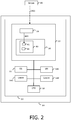
- Figure 2 shows schematically the architecture of a system including a secure element and a server according to an example of the invention.
- the secure element 10 is a eUICC (embedded Universal Integrated Circuit Card) embedded in a hosting machine 20.
- the hosting machine 20 can be a mobile phone for example.
- a server 90 is supposed to send a load file 30 to the secure element 10.
- the load file can be conveyed through OTA (Over-The-air) using Telecom communication protocols (i.e. remote connection) or via a local connection.
- the secure element 10 includes a central processing unit (CPU) 12, an operating system (OS) 11, a Java Card virtual machine (VM) 141, a loader 142, a linker 143 and a storage area 13.
- the storage area 13 can comprise a volatile part and a non-volatile part.
- the load file 30 is stored into the storage area 13.
- the load file 30 comprises a binary representation of a package of a class.
- the load file 30 is a CAP file.
- a Java Card CAP file is composed of a number of standardized Components.
- the Java Card Specifications also allows the CAP file to host so-called custom components whose contents and semantic are not defined by and remain out of scope of the Java Card Specifications.
- the load file 30 includes a specific component 40 which is a custom component.
- the specific component 40 comprises executable data 41.
- the specific component 40 also comprises heap data 42. (Optional)
- Figure 1 shows an example of flow diagram of instance management according to an aspect of the invention.
- the secure element 10 receives a load file 30 which contains a binary representation of a package of a class.
- the load file can be a CAP file as defined by Java CardTM specifications V2.1. or upper.
- the CAP file 30 includes a specific component 40 which is a custom component within the meaning of Java CardTM specifications V2.1.
- the specific component 40 contains executable data 41.
- the executable data 41 are bytecode runnable by a Java Virtual machine embedded in the secure element 10.
- an instance 15 of the class is created from the package. This operation is called instantiation of the class.
- step S14 the created instance 15 is stored in a storage area 13 of the secure element 10.
- the instance 15 requests the execution of a subset of the executable data 41 by directly invoking the subset of executable data 41 through an Application Programming Interface (API).
- API Application Programming Interface
- the instance 15 is designed to call the relevant API to trigger execution of executable data 41.
- execution of the executable data 41 can allow to update cardholder specific data, to generate random values, secret keys or cryptograms to be sent after personalization phase.
- executable data 41 contain a software component which is designed to personalize the instance 15 itself.
- the instance can initiate its own personalization operation by calling the executable data 41 (or a subset) on its own.
- the specific component 40 i.e. custom component
- PEC Perso component
- the custom component 41 can also contain Heap data which are intended to be written in the heap of the virtual machine of the secure element 10 to personalize the instance 15.
- the Perso Component contains executable code suitable for personalizing one or more Applet instances.
- Such executable code comes in addition to, is provided in the same format (i.e. Java Card bytecodes), and needs to be linked in the same way as the executable code present in the standard Method component which constitutes the main executable code of the package.
- the format of executable code contained by the PEC is interoperable and may be interpreted by any secure element implementation compliant with the Java Card Specifications.
- the PEC may contain executable code in an alternative proprietary format, or proprietary instructions or macros allowing to perform various personalization operations.
- the executable data 41 is intended for the personalization of one or several instances of the same Applet module.
- the PEC can contain the identifier (AID) of the Applet module for which such executable data 41 applies.
- AID identifier
- Several Applet modules may be defined in a package.
- the PEC may contain several sub-components, each one containing executable code for the personalization of a specific Applet module defined in the package. In the following, such a sub-component will be referred to as a sub-component of type A.
- the executable data 41 is intended for the personalization of a single Applet instance.
- the PEC contains the identifier (AID) of the Applet instance for which the executable data 41 applies.
- the PEC may contain several sub-components, each one containing executable code for the personalization of a specific Applet instance. In the following, such a sub-component will be referred to as a sub-component of type B.
- a sub-component of type B may also contain information (e.g. module AID, instance AID, install parameters, etc.) relating to the automatic installation of an Applet instance.
- information e.g. module AID, instance AID, install parameters, etc.
- an Applet instance shall be installed immediately upon successful linking of the package and the executable code contained by that sub-component may be executed immediately on behalf and in the context of the newly created Applet instance.
- a sub-component of type C is introduced which is a variant of sub-component type B also intended for the personalization of a single Applet instance.
- This sub-component contains the identifier (AID) of the Applet instance to which it applies and references the executable code of a sub-component of type A that shall be executed on behalf and in the context of the specified Applet instance.
- the sub-component may also specify input data / parameters which may be accessed during the execution of the referenced executable code.
- a sub-component of type C may also contain information (e.g. module AID, instance AID, install parameters, etc.) relating to the automatic installation of an Applet instance.
- information e.g. module AID, instance AID, install parameters, etc.
- an Applet instance shall be installed immediately upon successful linking of the package and the executable code referenced by that sub-component may be executed immediately on behalf and in the context of the newly created Applet instance.
- an Applet instance running the main executable code of its Method component can invoke a specific Application Programming Interface (API) to run the executable code of the PEC. More precisely the applet instance can invoke the API to run the executable code found in a sub-component of type A corresponding to the Applet module from which this Applet instance was created, or a sub-component of type B or C corresponding to this Applet instance (as specified by its AID).
- the Applet instance may also provide some parameters, e.g. a byte array with input data, which may be accessed during the execution of the referenced executable code.
- a sub-component of type B or C may be automatically discarded/deleted once its contents have been used (i.e. once its executable code has been executed). Other conditions may be defined to automatically trigger such an operation.
- a sub-component of type A may be automatically discarded if all sub-components of type C have been processed.
- the entire PEC may be automatically discarded once the secure element has processed / gone through all of its sub-components.
- an Applet instance may invoke a specific API to discard/remove a sub-component of type A, B or C.
- Java Card objects created by an Applet instance are stored on the secure element 10 in a so-called HEAP, which is a memory area where Java Card objects are stored in a final and proprietary (implementation specific) format. Therefore, instead of executable code, the PEC may alternatively contain data directly corresponding to the HEAP data that would have resulted from the execution of executable code by the Applet instance. Such data may be provided in final proprietary format if the entity preparing the PEC has a total knowledge of the current internal state of the secure element 10, or in "pre-linked" proprietary format so as to be easily integrated / relocated in the HEAP and associated to the specified Applet instance.
- a sub-component of type D is introduced which is similar to a sub-component of type B except that, instead of executable code, it contains "pre-linked" HEAP data provided in a proprietary format.
- Such data correspond to the HEAP data that would have resulted from the execution of executable code by an Applet instance.
- the AID of the Applet instance to which such data applies is also specified.
- such data cannot be copied to the HEAP directly and must be first linked / adapted by the secure element 10, e.g. so as to compute their correct final location in the HEAP and correctly associate them with the specified Applet instance. Once they have been linked / adapted, the data can be copied to the HEAP at the computed location.
- a sub-component of type D may also contain information (e.g. module AID, instance AID, install parameters, etc.) relating to the automatic installation of an Applet instance.
- information e.g. module AID, instance AID, install parameters, etc.
- an Applet instance may be installed immediately upon successful linking of the package and the data contained by this sub-component may be linked / adapted and copied to the HEAP.
- a sub-component of type D may be automatically discarded / deleted once its contents have been used (i.e. data linked/adapted/copied to the HEAP). Other conditions may be defined to automatically trigger such an operation.
- an Applet instance may invoke a specific API to discard/remove a sub-component of type D.
- a sub-component of type E is introduced which is similar to a sub-component of type D except that, instead of "pre-linked" data, it contains data in a proprietary format directly corresponding to the HEAP data that would have resulted from the execution of executable code by one or several Applet instances.
- these data are not necessarily bound to a specific Applet instance but correspond to raw HEAP data that may correspond to multiple Applet instances. Hence, such data may be directly copied to the HEAP.
- a sub-component of this type should be automatically discarded / deleted once its contents have been used (i.e. data copied to the HEAP).
- the PEC may combine and contain several occurrences of sub-components of the different types described above.
- Figure 7 shows an example of flow diagram of processing a package including a PEC with type B sub-components.
- Figure 8 shows an example of flow diagram of processing a package including a PEC with type A and C sub-components.
- the entire PEC may be deleted at the end of the processing, or alternatively sub-components of type A may be kept so as to be later invoked (using an API) by additional Applet instances created independently.
- an Applet instance could request executing and/or getting rid of a sub-component's executable code any time during its lifetime.
- Some sub-components may become useful/useless depending on the configuration achieved during earlier phases.
- a sub-component could be dedicated to executable code implementing symmetric cryptography whereas another would be dedicated to asymmetric cryptography: one of them would become useless depending on the cryptographic keys personalized earlier.
- an Application Provider can easily define suitable configuration(s) for its Application(s) and embed such information directly in the Java Card CAP file. Hence, only a single operation (i.e. loading the package) is needed to achieve the full installation and personalization of one or several Applet instances, avoiding additional management step or further authorization.
- An aspect of the invention allows separating personalization-related executable code from the rest of the executable code (i.e. focused on the operational phase) which can then be smaller.
- the personalization-related executable code may be deleted so as to reclaim memory space (immediately or later).
- An aspect of the invention allows deploying suitable configuration(s) easily whatever the communication channel and messaging used for transport (e.g. APDU, SPI, I2C, HCI, OTA), with no need to rework the messaging to deploy the contents.
- suitable configuration(s) easily whatever the communication channel and messaging used for transport (e.g. APDU, SPI, I2C, HCI, OTA), with no need to rework the messaging to deploy the contents.
- the invention is well-suited for the broadcast or scaled deployment of contents to a very large number of IOT/wearable-hosted Java Card based Secure Elements.
- An Application Provider can build/maintain a package including a PEC and still load it to any secure element. The invention remains compatible with already deployed secure elements.
- the invention does not need to upgrade the virtual machine (i.e. no design impact on the Java Card VM).
- Figure 3 shows schematically the configuration of a storage area 13 of a secure element according to an example of the invention.
- the storage area 13 stores a load file 30 which includes a Setup component 50 also named SUC.
- the Setup component 50 contains an installation parameter 51 which triggers an automatic installation of the instance 15 (by reference to Fig. 1 & 2 ).
- the Setup component 50 is a custom component within the meaning of Java CardTM specifications V2.1.
- the storage area 13 stores a security domain 16 (named SD1) as defined by GlobalPlatform specifications V2.1 or upper.
- the installation parameter 51 can trigger one or several of the following actions: the automatic installation of the instance 15, the automatic association of the instance 15 to the security domain 16 and the automatic creation of a security domain 17. (shown in dashed line with the name SD2 at Fig 3 .)
- the Setup component describes additional setup actions that shall be performed upon successful loading/linking of the executable code contained by the package.
- This component may include information related to:
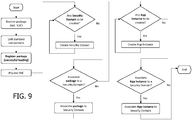
- Flag A specifies that in case of failure the package shall be deleted, proceed with the deletion of the package. Otherwise, record the successful loading of the package
- Figure 9 shows an example of flow diagram of processing a package including a Setup component SUC.
- An aspect of the invention allows the Application Provider to easily define and deploy a configuration composed of one or several Applet instances and to embed such information directly in the Java Card CAP file.
- Figure 4 shows schematically the configuration of a storage area 13 of a secure element according to an example of the invention.
- the storage area 13 stores a load file 30 which includes a Security Domain component 60 also named SDC.
- the SDC 60 contains Security Domain parameters 61 which are required to securely initialize a Security Domain 18 to which the package is associated.
- the Security Domain component 60 is a custom component within the meaning of Java CardTM specifications.
- the storage area 13 stores a security domain 18 (named SD) as defined by Global Platform specifications.
- the security scheme makes use of asymmetric cryptography and key pairs composed of a public key (PK) and its associated private key (SK).
- PK public key
- SK private key
- a public key can sometimes be provided under the form of a public key certificate (CERT) delivered by some certificate authority: in this case, the public key needs to be extracted from the certificate, and this should be done only after verification of the certificate.
- CERT public key certificate
- an Application Provider may load its Java Card package to a secure element and doing so, automatically install a new Security Domain (SD) to which the package will be associated, generate cryptographic keys for this Security Domain and retrieve such cryptographic keys off-secure element.
- SD Security Domain
- the secure element is supposed to have been prepared as follows:
- the Security Domain component contains:
- the AP Upon reception of the response, the AP shall:
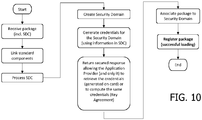
- Figure 10 shows an example of flow diagram of processing a package including a Security Domain component SDC.
- An aspect of the invention allows an Application Provider to easily and securely set up a Security Domain, load a Java Card package and associate this package to its Security Domain.
- Figure 5 shows schematically the configuration of a storage area 13 of a secure element according to an example of the invention.
- the storage area 13 stores a load file 30 associated to a first package and a load file 130 associated to a second package.
- the load file 30 includes a Group component (GRC) 70 containing a group parameter 71 which defines a group of packages sharing at least one security attribute.
- the load file 130 includes a Group component (GRC) 170 containing a group parameter 171 which defines a group of packages sharing at least one security attribute.
- the Group components are custom components within the meaning of Java CardTM specifications. Both first and second packages belong to said group of packages.
- An Application Provider (AP) loading a Java Card package to a secure element may at the same time create a new Package Group for this package or associate this package to an existing Package Group on the secure element. Belonging to a Package Group implies that the sharing of a number of functional or security attributes. The AP may therefore load several packages, associate them to the same Package Group and have them sharing a number of attributes.
- the list of attributes that are shared is either implicitly known or specified as a multiple choice among a list of attributes supported by the secure element implementation (NB: well-known attributes or proprietary attributes).
- a primary example of attribute that may be shared by packages associated to the same Package Group is the Firewall Context ID which, if shared by multiple packages, allows Applet instances created from such packages to communicate and access each other as freely as if they were belonging to the same package.
- the AP may only need to use an AP Public Key for Signature Verification (PK.AP.AUT) and corresponding AP Private Key for Signature Generation, or it may in addition need to obtain from the Card Issuer or from a Controlling Authority (CA) an AP Public Key Certificate (CERT.AP.AUT) certifying its PK.AP.AUT.
- CA Controlling Authority
- CERT.AP.AUT AP Public Key Certificate
- more than one CA may be able to deliver such a certificate.
- CA Card Issuer
- the need to involve a CA in the deployment of the described mechanism essentially depends on the security conditions under which packages will be loaded to the secure element, e.g. whether secure element administrators can be trusted or not, whether secure messaging will be used, whether the package contains its own security, etc.
- the secure element on which the packages are loaded may need to be prepared in the following way:
- a Package Group shall be identified using a Group ID.
- a suitable Group ID would be the AID of the package being loaded when the new Package Group is created.
- the Group component shall contain information related to:
- Packages associated with the same Group ID may now benefit from sharing the same attributes.
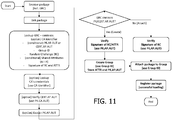
- Figure 11 shows an example of flow diagram of processing a package including a Group component GRC.
- the above-presented aspect of the invention allows an Application Provider to develop applications easier to maintain (i.e. better design) and showing better performances, with lower code size and lower resource consumption.
- Figure 6 shows schematically the configuration of a storage area 13 of a secure element according to an example of the invention.
- the storage area 13 stores a load file 30 including a Security component 80 (SEC) containing at least a security parameter 81 which is required to verify the genuineness of the package or to decipher part of the load file 30.
- SEC Security component 80
- the Security component 80 is a custom component within the meaning of Java CardTM specifications.
- an Application Provider may secure its Java Card package, or have it secured by some trusted third party, so as to deploy it to a "group of secure elements" (i.e. to any secure element of such a group).
- CA Card Issuer
- a CA would deploy the same set of credentials on all the secure elements of a fleet of secure elements. Then the AP may request the CA to protect its package (using CA's credentials) so that it may be deployed to this entire fleet of secure elements.
- the Security component shall be the last component of the package.
- the secure element when the secure element receives the load file (i.e. CAP file) and a Security component is present, the secure element shall assume that the contents (values) of each CAP file component, except the contents of the Security component, are encrypted with a symmetric encryption/decryption key KS.CAP.ENC:
- only a selection of the CAP file components may be encrypted.
- the list of non-encrypted components may either be known implicitly, or a list may be provided in the Security component.
- encrypting the CAP file components is fully optional. Indeed, encrypting the CAP file may sometimes not be needed depending on the business or deployment context.
- a CAP file containing a Security component but for which CAP file components wouldn't be encrypted could be loaded on any secure element, including secure elements that do not support this security scheme.
- the Java Card Specifications specify that a Custom component shall simply be ignored/skipped if not supported by the secure element implementation.
- the Security component shall contain (at least):
- the signature is not computed directly over above mentioned data but over a hash (i.e. cryptographic digest) of these data.
- the CA i.e. Card Issuer or Controlling Authority
- the CA is responsible for protecting the CAP file upon request from the Application Provider.
- the CA would provide the AP with a certificate CERT.AP.AUT certifying an AP Public Key for Signature Verification (PK.AP.AUT) (i.e. a key generated and owned by the AP).
- PK.AP.AUT AP Public Key for Signature Verification
- the AP would be able to and directly responsible for protecting the CAP file, without further help from the CA (i.e. the CA delivers CERT.AP.AUT once for all):
- PK.CA.ENC is either publicly available (under the form of a certificate CERT.CA.ENC from which PK.CA.ENC may be extracted) or somehow provided by the CA to the AP. Then the AP is able to compute the suitable KS.CAP.ENC using PK.CA.ENC, and the AP is able to encrypt the CAP file components as needed.
- Figure 12 shows an example of flow diagram of processing a package including a Security component SEC.
- the above-presented aspect of the invention allows an Application Provider to secure the deployment of a Java Card package, with precomputed signature and encryption. Such protection does not depend on the establishment of a one-to-one secured connection with the secure element.
- the above-presented aspect of the invention allows several Controlling Authorities and delegation of the package protection operation to the Application Provider (through deliverance of CERT.AP.AUT).
- Another aspect of the invention is a method for generating a load file 30 containing a binary representation of a package of a class to be loaded on a secure element.
- the method comprises the steps of:
- the method may also comprise a step of generating any one of the Setup component, Security Domain component, Group component and Security component as described above and to include it in the load file.
- the secure element comprises a virtual machine, a loader and a linker.
- the secure element is able to receive a load file containing a binary representation of a package of a class and to create an instance of the class from this package.
- the loader is adapted to retrieve from the load file and to handle a specific component which is a custom component within the meaning of Java CardTM specifications and which comprises executable data to be directly invoked through an Application Programming Interface (API) by the instance of the class.
- API Application Programming Interface
- the linker is adapted to perform a linking phase of the executable data contained in the specific component.
- the loader may be configured to personalize the instance by automatically running a subset of executable data.
- the loader may be configured to automatically detect the presence of Setup component in the load file and to automatically install the instance according to one or several installation parameters included in the Setup component.
- the loader may also be configured to automatically run a subset of executable data present in the Perso component to personalize the instance that has been installed.
- the loader may be configured to automatically detect the presence of Security Domain component in the load file and to securely initialize a Security Domain to which the package is associated thanks to Security Domain parameters included in the Security Domain component.
- the loader may be configured to automatically detect the presence of Security component in the load file and to verify the genuineness (i.e. origin/integrity) of the package according to one or several security parameters included in the Security component and/or to decipher part of the load file using one or several security parameters included in the Security component.
- the loader can be configured to send back, to the Application provider server, data generated during the personalization phase.
- the secure element may comprises a plurality of packages for which several instances of class are installed.
- the above described specific component, Setup component, Security Domain component, Group component and Security component may be merged in any combination of custom components.
- a load file may include several copies of each of these custom components.
Landscapes
- Engineering & Computer Science (AREA)
- Theoretical Computer Science (AREA)
- Physics & Mathematics (AREA)
- Computer Hardware Design (AREA)
- Software Systems (AREA)
- Computer Security & Cryptography (AREA)
- General Engineering & Computer Science (AREA)
- General Physics & Mathematics (AREA)
- Mathematical Physics (AREA)
- Multimedia (AREA)
- Technology Law (AREA)
- Stored Programmes (AREA)
Priority Applications (5)
| Application Number | Priority Date | Filing Date | Title |
|---|---|---|---|
| EP17305731.6A EP3416086A1 (de) | 2017-06-15 | 2017-06-15 | Verfahren zur verwaltung einer instanz einer klasse |
| US16/621,781 US11556673B2 (en) | 2017-06-15 | 2018-05-14 | Method for managing an instance of a class |
| EP18722601.4A EP3639186B8 (de) | 2017-06-15 | 2018-05-14 | Verfahren zur verwaltung einer instanz einer klasse |
| PCT/EP2018/062414 WO2018228763A1 (en) | 2017-06-15 | 2018-05-14 | Method for managing an instance of a class |
| CN201880039592.4A CN110914825B (zh) | 2017-06-15 | 2018-05-14 | 用于管理类的实例的方法 |
Applications Claiming Priority (1)
| Application Number | Priority Date | Filing Date | Title |
|---|---|---|---|
| EP17305731.6A EP3416086A1 (de) | 2017-06-15 | 2017-06-15 | Verfahren zur verwaltung einer instanz einer klasse |
Publications (1)
| Publication Number | Publication Date |
|---|---|
| EP3416086A1 true EP3416086A1 (de) | 2018-12-19 |
Family
ID=59579552
Family Applications (2)
| Application Number | Title | Priority Date | Filing Date |
|---|---|---|---|
| EP17305731.6A Withdrawn EP3416086A1 (de) | 2017-06-15 | 2017-06-15 | Verfahren zur verwaltung einer instanz einer klasse |
| EP18722601.4A Active EP3639186B8 (de) | 2017-06-15 | 2018-05-14 | Verfahren zur verwaltung einer instanz einer klasse |
Family Applications After (1)
| Application Number | Title | Priority Date | Filing Date |
|---|---|---|---|
| EP18722601.4A Active EP3639186B8 (de) | 2017-06-15 | 2018-05-14 | Verfahren zur verwaltung einer instanz einer klasse |
Country Status (4)
| Country | Link |
|---|---|
| US (1) | US11556673B2 (de) |
| EP (2) | EP3416086A1 (de) |
| CN (1) | CN110914825B (de) |
| WO (1) | WO2018228763A1 (de) |
Families Citing this family (4)
| Publication number | Priority date | Publication date | Assignee | Title |
|---|---|---|---|---|
| US12277198B2 (en) * | 2020-03-31 | 2025-04-15 | Felica Networks, Inc. | Information processing device, information processing method, and information processing system |
| CN111880800B (zh) * | 2020-06-19 | 2023-10-31 | 无锡融卡科技有限公司 | 应用下载方法与应用下载系统 |
| CN112698912B (zh) * | 2020-12-29 | 2024-04-26 | 成都融微软件服务有限公司 | 一种Java Card虚拟机运行环境及内存管理方法 |
| DE102023102191A1 (de) * | 2023-01-30 | 2024-08-01 | Giesecke+Devrient Mobile Security Germany Gmbh | Installieren eines Betriebssystems in einer Prozessoreinrichtung, insbesondere einem Sicherheitsmodul |
Citations (4)
| Publication number | Priority date | Publication date | Assignee | Title |
|---|---|---|---|---|
| WO2008068576A1 (en) | 2006-12-01 | 2008-06-12 | Cassis International Pte Ltd | Cap file for personalisation of a java application |
| EP2469486A1 (de) * | 2010-12-23 | 2012-06-27 | Gemalto KK | Bearbeitungsverfahren zur Personalisierung einer Bewerbung |
| WO2015078614A1 (en) | 2013-11-29 | 2015-06-04 | Gemalto Sa | Method for loading a native code on a secure element |
| WO2015102944A1 (en) * | 2014-01-06 | 2015-07-09 | Apple Inc. | Applet migration in a secure element |
Family Cites Families (15)
| Publication number | Priority date | Publication date | Assignee | Title |
|---|---|---|---|---|
| US20120130838A1 (en) * | 2006-09-24 | 2012-05-24 | Rfcyber Corp. | Method and apparatus for personalizing secure elements in mobile devices |
| DE102008033976A1 (de) * | 2008-07-21 | 2010-01-28 | Giesecke & Devrient Gmbh | Laden und Aktualisieren einer personalisierungsbedürftigen Applikation |
| ES2702470T3 (es) * | 2009-11-05 | 2019-03-01 | Gemalto Sa | Objeto portátil seguro |
| DE102009059939A1 (de) * | 2009-12-22 | 2011-06-30 | Giesecke & Devrient GmbH, 81677 | Verfahren zum Komprimieren von Bezeichnern |
| EP2461613A1 (de) * | 2010-12-06 | 2012-06-06 | Gemalto SA | Verfahren und System zur Handhabung von UICC-Daten |
| MX342702B (es) * | 2012-02-14 | 2016-10-10 | Apple Inc | Metodos y aparato para distribucion a gran escala de clientes de acceso electronico. |
| RU2648941C2 (ru) * | 2012-10-12 | 2018-03-28 | Конинклейке Филипс Н.В. | Безопасная обработка данных виртуальной машиной |
| US9384485B1 (en) * | 2013-11-26 | 2016-07-05 | American Express Travel Related Services Company, Inc. | Systems and methods for rapidly provisioning functionality to one or more mobile communication devices |
| FR3029658B1 (fr) * | 2014-12-09 | 2018-01-05 | Bull Sas | Systeme et methode de gestion de code octal java |
| EP3208717A1 (de) * | 2016-02-17 | 2017-08-23 | Gemalto Sa | Verfahren zur verwaltung von objekten in einem sicheren element |
| US20170270517A1 (en) * | 2016-03-18 | 2017-09-21 | Madhu Vasu | Partially activated tokens with limited functionality |
| US9990194B2 (en) * | 2016-08-25 | 2018-06-05 | Oracle International Corporation | Preservation of backward compatibility for java card cap files |
| CN106126981B (zh) * | 2016-08-30 | 2019-04-02 | 电子科技大学 | 基于虚拟函数表替换的软件安全防护方法 |
| US10885520B2 (en) * | 2016-09-22 | 2021-01-05 | Apple Inc. | Script deployment through service provider servers |
| US20180203853A1 (en) * | 2017-01-13 | 2018-07-19 | International Business Machines Corporation | Extensible variable array definition |
-
2017
- 2017-06-15 EP EP17305731.6A patent/EP3416086A1/de not_active Withdrawn
-
2018
- 2018-05-14 EP EP18722601.4A patent/EP3639186B8/de active Active
- 2018-05-14 CN CN201880039592.4A patent/CN110914825B/zh active Active
- 2018-05-14 US US16/621,781 patent/US11556673B2/en active Active
- 2018-05-14 WO PCT/EP2018/062414 patent/WO2018228763A1/en not_active Ceased
Patent Citations (5)
| Publication number | Priority date | Publication date | Assignee | Title |
|---|---|---|---|---|
| WO2008068576A1 (en) | 2006-12-01 | 2008-06-12 | Cassis International Pte Ltd | Cap file for personalisation of a java application |
| EP1936574A1 (de) * | 2006-12-01 | 2008-06-25 | Cassis International PTE Ltd. | CAP-Datei zur Personalisierung von Java-Anwendungen |
| EP2469486A1 (de) * | 2010-12-23 | 2012-06-27 | Gemalto KK | Bearbeitungsverfahren zur Personalisierung einer Bewerbung |
| WO2015078614A1 (en) | 2013-11-29 | 2015-06-04 | Gemalto Sa | Method for loading a native code on a secure element |
| WO2015102944A1 (en) * | 2014-01-06 | 2015-07-09 | Apple Inc. | Applet migration in a secure element |
Also Published As
| Publication number | Publication date |
|---|---|
| EP3639186A1 (de) | 2020-04-22 |
| WO2018228763A1 (en) | 2018-12-20 |
| EP3639186B1 (de) | 2021-11-10 |
| CN110914825A (zh) | 2020-03-24 |
| CN110914825B (zh) | 2023-11-07 |
| EP3639186B8 (de) | 2022-02-16 |
| US20200151365A1 (en) | 2020-05-14 |
| US11556673B2 (en) | 2023-01-17 |
Similar Documents
| Publication | Publication Date | Title |
|---|---|---|
| US11544391B2 (en) | Secure processing systems and methods | |
| JP6888011B2 (ja) | 信頼できる実行環境を有するモバイル装置 | |
| TWI598814B (zh) | 用於管理及診斷配備有統一可延伸韌體介面(uefi)相容韌體的計算裝置之系統與方法 | |
| KR101795457B1 (ko) | 보안 기능이 강화된 디바이스의 초기화 방법 및 디바이스의 펌웨어 업데이트 방법 | |
| US8381307B2 (en) | Method for protecting a converted applet (CAP) file including encrypting the CAP file | |
| JP4251667B2 (ja) | アプリケーション履歴リストを有する集積回路カード | |
| US8392724B2 (en) | Information terminal, security device, data protection method, and data protection program | |
| EP3639186B1 (de) | Verfahren zur verwaltung einer instanz einer klasse | |
| US10248795B2 (en) | Implementing method for JavaCard application function expansion | |
| CN103975338A (zh) | 用于根据包括待保护应用程序和初始配置文件的初始包文件生成保护该应用程序的包文件的方法以及相关的计算机程序产品和计算装置 | |
| CN103282913B (zh) | 用于加载至少一个软件模块的代码的方法 | |
| US10409588B2 (en) | Method for managing objects in a secure element | |
| US12192182B2 (en) | Container with encrypted software packages | |
| CN113692576A (zh) | Native与JavaCard动态切换的方法及设备 | |
| CN105187410A (zh) | 一种应用的自升级方法及其系统 | |
| EP2689367B1 (de) | Datensicherheit mittels verteiltem sicherheitsschlüssel | |
| US20260099319A1 (en) | Hardware security module firmware update | |
| CN117795511A (zh) | 更新代理和更新代理中的数据预播种 | |
| GB2561374A (en) | Storing data on target data processing devices | |
| JP6741236B2 (ja) | 情報処理装置 | |
| KR102387685B1 (ko) | 보안 부트 검증 방법 및 이를 위한 보안 칩 | |
| CN109409137B (zh) | 一种在tee环境中加载外部资源的方法和系统 | |
| CN121858359A (zh) | 安全元件的数据管理方法和系统 | |
| CN119921949A (zh) | 秘钥管理方法、相关装置及存储介质 | |
| CN116166277A (zh) | 一种应用程序的管理装置和嵌入式设备 |
Legal Events
| Date | Code | Title | Description |
|---|---|---|---|
| PUAI | Public reference made under article 153(3) epc to a published international application that has entered the european phase |
Free format text: ORIGINAL CODE: 0009012 |
|
| AK | Designated contracting states |
Kind code of ref document: A1 Designated state(s): AL AT BE BG CH CY CZ DE DK EE ES FI FR GB GR HR HU IE IS IT LI LT LU LV MC MK MT NL NO PL PT RO RS SE SI SK SM TR |
|
| AX | Request for extension of the european patent |
Extension state: BA ME |
|
| STAA | Information on the status of an ep patent application or granted ep patent |
Free format text: STATUS: THE APPLICATION IS DEEMED TO BE WITHDRAWN |
|
| 18D | Application deemed to be withdrawn |
Effective date: 20190620 |