EP3416948B1 - Indazen aufweisende sulfonylharnstoffe als entzündungshemmstoffe - Google Patents
Indazen aufweisende sulfonylharnstoffe als entzündungshemmstoffe Download PDFInfo
- Publication number
- EP3416948B1 EP3416948B1 EP17705416.0A EP17705416A EP3416948B1 EP 3416948 B1 EP3416948 B1 EP 3416948B1 EP 17705416 A EP17705416 A EP 17705416A EP 3416948 B1 EP3416948 B1 EP 3416948B1
- Authority
- EP
- European Patent Office
- Prior art keywords
- group
- disease
- alkyl
- optionally substituted
- compound
- Prior art date
- Legal status (The legal status is an assumption and is not a legal conclusion. Google has not performed a legal analysis and makes no representation as to the accuracy of the status listed.)
- Active
Links
Images

Classifications
-
- C—CHEMISTRY; METALLURGY
- C07—ORGANIC CHEMISTRY
- C07D—HETEROCYCLIC COMPOUNDS
- C07D413/00—Heterocyclic compounds containing two or more hetero rings, at least one ring having nitrogen and oxygen atoms as the only ring hetero atoms
- C07D413/02—Heterocyclic compounds containing two or more hetero rings, at least one ring having nitrogen and oxygen atoms as the only ring hetero atoms containing two hetero rings
- C07D413/12—Heterocyclic compounds containing two or more hetero rings, at least one ring having nitrogen and oxygen atoms as the only ring hetero atoms containing two hetero rings linked by a chain containing hetero atoms as chain links
-
- A—HUMAN NECESSITIES
- A61—MEDICAL OR VETERINARY SCIENCE; HYGIENE
- A61K—PREPARATIONS FOR MEDICAL, DENTAL OR TOILETRY PURPOSES
- A61K31/00—Medicinal preparations containing organic active ingredients
- A61K31/33—Heterocyclic compounds
- A61K31/395—Heterocyclic compounds having nitrogen as a ring hetero atom, e.g. guanethidine or rifamycins
- A61K31/40—Heterocyclic compounds having nitrogen as a ring hetero atom, e.g. guanethidine or rifamycins having five-membered rings with one nitrogen as the only ring hetero atom, e.g. sulpiride, succinimide, tolmetin, buflomedil
- A61K31/403—Heterocyclic compounds having nitrogen as a ring hetero atom, e.g. guanethidine or rifamycins having five-membered rings with one nitrogen as the only ring hetero atom, e.g. sulpiride, succinimide, tolmetin, buflomedil condensed with carbocyclic rings, e.g. carbazole
- A61K31/404—Indoles, e.g. pindolol
- A61K31/4045—Indole-alkylamines; Amides thereof, e.g. serotonin, melatonin
-
- A—HUMAN NECESSITIES
- A61—MEDICAL OR VETERINARY SCIENCE; HYGIENE
- A61K—PREPARATIONS FOR MEDICAL, DENTAL OR TOILETRY PURPOSES
- A61K31/00—Medicinal preparations containing organic active ingredients
- A61K31/33—Heterocyclic compounds
- A61K31/395—Heterocyclic compounds having nitrogen as a ring hetero atom, e.g. guanethidine or rifamycins
- A61K31/41—Heterocyclic compounds having nitrogen as a ring hetero atom, e.g. guanethidine or rifamycins having five-membered rings with two or more ring hetero atoms, at least one of which being nitrogen, e.g. tetrazole
- A61K31/415—1,2-Diazoles
-
- A—HUMAN NECESSITIES
- A61—MEDICAL OR VETERINARY SCIENCE; HYGIENE
- A61K—PREPARATIONS FOR MEDICAL, DENTAL OR TOILETRY PURPOSES
- A61K31/00—Medicinal preparations containing organic active ingredients
- A61K31/33—Heterocyclic compounds
- A61K31/395—Heterocyclic compounds having nitrogen as a ring hetero atom, e.g. guanethidine or rifamycins
- A61K31/41—Heterocyclic compounds having nitrogen as a ring hetero atom, e.g. guanethidine or rifamycins having five-membered rings with two or more ring hetero atoms, at least one of which being nitrogen, e.g. tetrazole
- A61K31/42—Oxazoles
-
- A—HUMAN NECESSITIES
- A61—MEDICAL OR VETERINARY SCIENCE; HYGIENE
- A61K—PREPARATIONS FOR MEDICAL, DENTAL OR TOILETRY PURPOSES
- A61K31/00—Medicinal preparations containing organic active ingredients
- A61K31/33—Heterocyclic compounds
- A61K31/395—Heterocyclic compounds having nitrogen as a ring hetero atom, e.g. guanethidine or rifamycins
- A61K31/41—Heterocyclic compounds having nitrogen as a ring hetero atom, e.g. guanethidine or rifamycins having five-membered rings with two or more ring hetero atoms, at least one of which being nitrogen, e.g. tetrazole
- A61K31/42—Oxazoles
- A61K31/423—Oxazoles condensed with carbocyclic rings
-
- A—HUMAN NECESSITIES
- A61—MEDICAL OR VETERINARY SCIENCE; HYGIENE
- A61K—PREPARATIONS FOR MEDICAL, DENTAL OR TOILETRY PURPOSES
- A61K31/00—Medicinal preparations containing organic active ingredients
- A61K31/33—Heterocyclic compounds
- A61K31/395—Heterocyclic compounds having nitrogen as a ring hetero atom, e.g. guanethidine or rifamycins
- A61K31/535—Heterocyclic compounds having nitrogen as a ring hetero atom, e.g. guanethidine or rifamycins having six-membered rings with at least one nitrogen and one oxygen as the ring hetero atoms, e.g. 1,2-oxazines
- A61K31/5375—1,4-Oxazines, e.g. morpholine
-
- A—HUMAN NECESSITIES
- A61—MEDICAL OR VETERINARY SCIENCE; HYGIENE
- A61K—PREPARATIONS FOR MEDICAL, DENTAL OR TOILETRY PURPOSES
- A61K49/00—Preparations for testing in vivo
- A61K49/0004—Screening or testing of compounds for diagnosis of disorders, assessment of conditions, e.g. renal clearance, gastric emptying, testing for diabetes, allergy, rheuma, pancreas functions
-
- A—HUMAN NECESSITIES
- A61—MEDICAL OR VETERINARY SCIENCE; HYGIENE
- A61P—SPECIFIC THERAPEUTIC ACTIVITY OF CHEMICAL COMPOUNDS OR MEDICINAL PREPARATIONS
- A61P1/00—Drugs for disorders of the alimentary tract or the digestive system
-
- A—HUMAN NECESSITIES
- A61—MEDICAL OR VETERINARY SCIENCE; HYGIENE
- A61P—SPECIFIC THERAPEUTIC ACTIVITY OF CHEMICAL COMPOUNDS OR MEDICINAL PREPARATIONS
- A61P1/00—Drugs for disorders of the alimentary tract or the digestive system
- A61P1/04—Drugs for disorders of the alimentary tract or the digestive system for ulcers, gastritis or reflux esophagitis, e.g. antacids, inhibitors of acid secretion, mucosal protectants
-
- A—HUMAN NECESSITIES
- A61—MEDICAL OR VETERINARY SCIENCE; HYGIENE
- A61P—SPECIFIC THERAPEUTIC ACTIVITY OF CHEMICAL COMPOUNDS OR MEDICINAL PREPARATIONS
- A61P1/00—Drugs for disorders of the alimentary tract or the digestive system
- A61P1/16—Drugs for disorders of the alimentary tract or the digestive system for liver or gallbladder disorders, e.g. hepatoprotective agents, cholagogues, litholytics
-
- A—HUMAN NECESSITIES
- A61—MEDICAL OR VETERINARY SCIENCE; HYGIENE
- A61P—SPECIFIC THERAPEUTIC ACTIVITY OF CHEMICAL COMPOUNDS OR MEDICINAL PREPARATIONS
- A61P11/00—Drugs for disorders of the respiratory system
-
- A—HUMAN NECESSITIES
- A61—MEDICAL OR VETERINARY SCIENCE; HYGIENE
- A61P—SPECIFIC THERAPEUTIC ACTIVITY OF CHEMICAL COMPOUNDS OR MEDICINAL PREPARATIONS
- A61P11/00—Drugs for disorders of the respiratory system
- A61P11/06—Antiasthmatics
-
- A—HUMAN NECESSITIES
- A61—MEDICAL OR VETERINARY SCIENCE; HYGIENE
- A61P—SPECIFIC THERAPEUTIC ACTIVITY OF CHEMICAL COMPOUNDS OR MEDICINAL PREPARATIONS
- A61P11/00—Drugs for disorders of the respiratory system
- A61P11/14—Antitussive agents
-
- A—HUMAN NECESSITIES
- A61—MEDICAL OR VETERINARY SCIENCE; HYGIENE
- A61P—SPECIFIC THERAPEUTIC ACTIVITY OF CHEMICAL COMPOUNDS OR MEDICINAL PREPARATIONS
- A61P13/00—Drugs for disorders of the urinary system
- A61P13/12—Drugs for disorders of the urinary system of the kidneys
-
- A—HUMAN NECESSITIES
- A61—MEDICAL OR VETERINARY SCIENCE; HYGIENE
- A61P—SPECIFIC THERAPEUTIC ACTIVITY OF CHEMICAL COMPOUNDS OR MEDICINAL PREPARATIONS
- A61P17/00—Drugs for dermatological disorders
-
- A—HUMAN NECESSITIES
- A61—MEDICAL OR VETERINARY SCIENCE; HYGIENE
- A61P—SPECIFIC THERAPEUTIC ACTIVITY OF CHEMICAL COMPOUNDS OR MEDICINAL PREPARATIONS
- A61P17/00—Drugs for dermatological disorders
- A61P17/02—Drugs for dermatological disorders for treating wounds, ulcers, burns, scars, keloids, or the like
-
- A—HUMAN NECESSITIES
- A61—MEDICAL OR VETERINARY SCIENCE; HYGIENE
- A61P—SPECIFIC THERAPEUTIC ACTIVITY OF CHEMICAL COMPOUNDS OR MEDICINAL PREPARATIONS
- A61P17/00—Drugs for dermatological disorders
- A61P17/06—Antipsoriatics
-
- A—HUMAN NECESSITIES
- A61—MEDICAL OR VETERINARY SCIENCE; HYGIENE
- A61P—SPECIFIC THERAPEUTIC ACTIVITY OF CHEMICAL COMPOUNDS OR MEDICINAL PREPARATIONS
- A61P17/00—Drugs for dermatological disorders
- A61P17/10—Anti-acne agents
-
- A—HUMAN NECESSITIES
- A61—MEDICAL OR VETERINARY SCIENCE; HYGIENE
- A61P—SPECIFIC THERAPEUTIC ACTIVITY OF CHEMICAL COMPOUNDS OR MEDICINAL PREPARATIONS
- A61P19/00—Drugs for skeletal disorders
- A61P19/02—Drugs for skeletal disorders for joint disorders, e.g. arthritis, arthrosis
-
- A—HUMAN NECESSITIES
- A61—MEDICAL OR VETERINARY SCIENCE; HYGIENE
- A61P—SPECIFIC THERAPEUTIC ACTIVITY OF CHEMICAL COMPOUNDS OR MEDICINAL PREPARATIONS
- A61P19/00—Drugs for skeletal disorders
- A61P19/04—Drugs for skeletal disorders for non-specific disorders of the connective tissue
-
- A—HUMAN NECESSITIES
- A61—MEDICAL OR VETERINARY SCIENCE; HYGIENE
- A61P—SPECIFIC THERAPEUTIC ACTIVITY OF CHEMICAL COMPOUNDS OR MEDICINAL PREPARATIONS
- A61P19/00—Drugs for skeletal disorders
- A61P19/06—Antigout agents, e.g. antihyperuricemic or uricosuric agents
-
- A—HUMAN NECESSITIES
- A61—MEDICAL OR VETERINARY SCIENCE; HYGIENE
- A61P—SPECIFIC THERAPEUTIC ACTIVITY OF CHEMICAL COMPOUNDS OR MEDICINAL PREPARATIONS
- A61P21/00—Drugs for disorders of the muscular or neuromuscular system
-
- A—HUMAN NECESSITIES
- A61—MEDICAL OR VETERINARY SCIENCE; HYGIENE
- A61P—SPECIFIC THERAPEUTIC ACTIVITY OF CHEMICAL COMPOUNDS OR MEDICINAL PREPARATIONS
- A61P25/00—Drugs for disorders of the nervous system
-
- A—HUMAN NECESSITIES
- A61—MEDICAL OR VETERINARY SCIENCE; HYGIENE
- A61P—SPECIFIC THERAPEUTIC ACTIVITY OF CHEMICAL COMPOUNDS OR MEDICINAL PREPARATIONS
- A61P25/00—Drugs for disorders of the nervous system
- A61P25/02—Drugs for disorders of the nervous system for peripheral neuropathies
-
- A—HUMAN NECESSITIES
- A61—MEDICAL OR VETERINARY SCIENCE; HYGIENE
- A61P—SPECIFIC THERAPEUTIC ACTIVITY OF CHEMICAL COMPOUNDS OR MEDICINAL PREPARATIONS
- A61P25/00—Drugs for disorders of the nervous system
- A61P25/14—Drugs for disorders of the nervous system for treating abnormal movements, e.g. chorea, dyskinesia
- A61P25/16—Anti-Parkinson drugs
-
- A—HUMAN NECESSITIES
- A61—MEDICAL OR VETERINARY SCIENCE; HYGIENE
- A61P—SPECIFIC THERAPEUTIC ACTIVITY OF CHEMICAL COMPOUNDS OR MEDICINAL PREPARATIONS
- A61P25/00—Drugs for disorders of the nervous system
- A61P25/22—Anxiolytics
-
- A—HUMAN NECESSITIES
- A61—MEDICAL OR VETERINARY SCIENCE; HYGIENE
- A61P—SPECIFIC THERAPEUTIC ACTIVITY OF CHEMICAL COMPOUNDS OR MEDICINAL PREPARATIONS
- A61P25/00—Drugs for disorders of the nervous system
- A61P25/24—Antidepressants
-
- A—HUMAN NECESSITIES
- A61—MEDICAL OR VETERINARY SCIENCE; HYGIENE
- A61P—SPECIFIC THERAPEUTIC ACTIVITY OF CHEMICAL COMPOUNDS OR MEDICINAL PREPARATIONS
- A61P25/00—Drugs for disorders of the nervous system
- A61P25/28—Drugs for disorders of the nervous system for treating neurodegenerative disorders of the central nervous system, e.g. nootropic agents, cognition enhancers, drugs for treating Alzheimer's disease or other forms of dementia
-
- A—HUMAN NECESSITIES
- A61—MEDICAL OR VETERINARY SCIENCE; HYGIENE
- A61P—SPECIFIC THERAPEUTIC ACTIVITY OF CHEMICAL COMPOUNDS OR MEDICINAL PREPARATIONS
- A61P27/00—Drugs for disorders of the senses
- A61P27/02—Ophthalmic agents
-
- A—HUMAN NECESSITIES
- A61—MEDICAL OR VETERINARY SCIENCE; HYGIENE
- A61P—SPECIFIC THERAPEUTIC ACTIVITY OF CHEMICAL COMPOUNDS OR MEDICINAL PREPARATIONS
- A61P29/00—Non-central analgesic, antipyretic or antiinflammatory agents, e.g. antirheumatic agents; Non-steroidal antiinflammatory drugs [NSAID]
-
- A—HUMAN NECESSITIES
- A61—MEDICAL OR VETERINARY SCIENCE; HYGIENE
- A61P—SPECIFIC THERAPEUTIC ACTIVITY OF CHEMICAL COMPOUNDS OR MEDICINAL PREPARATIONS
- A61P29/00—Non-central analgesic, antipyretic or antiinflammatory agents, e.g. antirheumatic agents; Non-steroidal antiinflammatory drugs [NSAID]
- A61P29/02—Non-central analgesic, antipyretic or antiinflammatory agents, e.g. antirheumatic agents; Non-steroidal antiinflammatory drugs [NSAID] without antiinflammatory effect
-
- A—HUMAN NECESSITIES
- A61—MEDICAL OR VETERINARY SCIENCE; HYGIENE
- A61P—SPECIFIC THERAPEUTIC ACTIVITY OF CHEMICAL COMPOUNDS OR MEDICINAL PREPARATIONS
- A61P3/00—Drugs for disorders of the metabolism
-
- A—HUMAN NECESSITIES
- A61—MEDICAL OR VETERINARY SCIENCE; HYGIENE
- A61P—SPECIFIC THERAPEUTIC ACTIVITY OF CHEMICAL COMPOUNDS OR MEDICINAL PREPARATIONS
- A61P3/00—Drugs for disorders of the metabolism
- A61P3/04—Anorexiants; Antiobesity agents
-
- A—HUMAN NECESSITIES
- A61—MEDICAL OR VETERINARY SCIENCE; HYGIENE
- A61P—SPECIFIC THERAPEUTIC ACTIVITY OF CHEMICAL COMPOUNDS OR MEDICINAL PREPARATIONS
- A61P3/00—Drugs for disorders of the metabolism
- A61P3/08—Drugs for disorders of the metabolism for glucose homeostasis
- A61P3/10—Drugs for disorders of the metabolism for glucose homeostasis for hyperglycaemia, e.g. antidiabetics
-
- A—HUMAN NECESSITIES
- A61—MEDICAL OR VETERINARY SCIENCE; HYGIENE
- A61P—SPECIFIC THERAPEUTIC ACTIVITY OF CHEMICAL COMPOUNDS OR MEDICINAL PREPARATIONS
- A61P31/00—Antiinfectives, i.e. antibiotics, antiseptics, chemotherapeutics
- A61P31/04—Antibacterial agents
-
- A—HUMAN NECESSITIES
- A61—MEDICAL OR VETERINARY SCIENCE; HYGIENE
- A61P—SPECIFIC THERAPEUTIC ACTIVITY OF CHEMICAL COMPOUNDS OR MEDICINAL PREPARATIONS
- A61P31/00—Antiinfectives, i.e. antibiotics, antiseptics, chemotherapeutics
- A61P31/12—Antivirals
-
- A—HUMAN NECESSITIES
- A61—MEDICAL OR VETERINARY SCIENCE; HYGIENE
- A61P—SPECIFIC THERAPEUTIC ACTIVITY OF CHEMICAL COMPOUNDS OR MEDICINAL PREPARATIONS
- A61P31/00—Antiinfectives, i.e. antibiotics, antiseptics, chemotherapeutics
- A61P31/12—Antivirals
- A61P31/14—Antivirals for RNA viruses
-
- A—HUMAN NECESSITIES
- A61—MEDICAL OR VETERINARY SCIENCE; HYGIENE
- A61P—SPECIFIC THERAPEUTIC ACTIVITY OF CHEMICAL COMPOUNDS OR MEDICINAL PREPARATIONS
- A61P31/00—Antiinfectives, i.e. antibiotics, antiseptics, chemotherapeutics
- A61P31/12—Antivirals
- A61P31/14—Antivirals for RNA viruses
- A61P31/16—Antivirals for RNA viruses for influenza or rhinoviruses
-
- A—HUMAN NECESSITIES
- A61—MEDICAL OR VETERINARY SCIENCE; HYGIENE
- A61P—SPECIFIC THERAPEUTIC ACTIVITY OF CHEMICAL COMPOUNDS OR MEDICINAL PREPARATIONS
- A61P31/00—Antiinfectives, i.e. antibiotics, antiseptics, chemotherapeutics
- A61P31/12—Antivirals
- A61P31/14—Antivirals for RNA viruses
- A61P31/18—Antivirals for RNA viruses for HIV
-
- A—HUMAN NECESSITIES
- A61—MEDICAL OR VETERINARY SCIENCE; HYGIENE
- A61P—SPECIFIC THERAPEUTIC ACTIVITY OF CHEMICAL COMPOUNDS OR MEDICINAL PREPARATIONS
- A61P33/00—Antiparasitic agents
-
- A—HUMAN NECESSITIES
- A61—MEDICAL OR VETERINARY SCIENCE; HYGIENE
- A61P—SPECIFIC THERAPEUTIC ACTIVITY OF CHEMICAL COMPOUNDS OR MEDICINAL PREPARATIONS
- A61P35/00—Antineoplastic agents
-
- A—HUMAN NECESSITIES
- A61—MEDICAL OR VETERINARY SCIENCE; HYGIENE
- A61P—SPECIFIC THERAPEUTIC ACTIVITY OF CHEMICAL COMPOUNDS OR MEDICINAL PREPARATIONS
- A61P35/00—Antineoplastic agents
- A61P35/02—Antineoplastic agents specific for leukemia
-
- A—HUMAN NECESSITIES
- A61—MEDICAL OR VETERINARY SCIENCE; HYGIENE
- A61P—SPECIFIC THERAPEUTIC ACTIVITY OF CHEMICAL COMPOUNDS OR MEDICINAL PREPARATIONS
- A61P35/00—Antineoplastic agents
- A61P35/04—Antineoplastic agents specific for metastasis
-
- A—HUMAN NECESSITIES
- A61—MEDICAL OR VETERINARY SCIENCE; HYGIENE
- A61P—SPECIFIC THERAPEUTIC ACTIVITY OF CHEMICAL COMPOUNDS OR MEDICINAL PREPARATIONS
- A61P37/00—Drugs for immunological or allergic disorders
-
- A—HUMAN NECESSITIES
- A61—MEDICAL OR VETERINARY SCIENCE; HYGIENE
- A61P—SPECIFIC THERAPEUTIC ACTIVITY OF CHEMICAL COMPOUNDS OR MEDICINAL PREPARATIONS
- A61P37/00—Drugs for immunological or allergic disorders
- A61P37/02—Immunomodulators
-
- A—HUMAN NECESSITIES
- A61—MEDICAL OR VETERINARY SCIENCE; HYGIENE
- A61P—SPECIFIC THERAPEUTIC ACTIVITY OF CHEMICAL COMPOUNDS OR MEDICINAL PREPARATIONS
- A61P37/00—Drugs for immunological or allergic disorders
- A61P37/02—Immunomodulators
- A61P37/06—Immunosuppressants, e.g. drugs for graft rejection
-
- A—HUMAN NECESSITIES
- A61—MEDICAL OR VETERINARY SCIENCE; HYGIENE
- A61P—SPECIFIC THERAPEUTIC ACTIVITY OF CHEMICAL COMPOUNDS OR MEDICINAL PREPARATIONS
- A61P39/00—General protective or antinoxious agents
- A61P39/02—Antidotes
-
- A—HUMAN NECESSITIES
- A61—MEDICAL OR VETERINARY SCIENCE; HYGIENE
- A61P—SPECIFIC THERAPEUTIC ACTIVITY OF CHEMICAL COMPOUNDS OR MEDICINAL PREPARATIONS
- A61P43/00—Drugs for specific purposes, not provided for in groups A61P1/00-A61P41/00
-
- A—HUMAN NECESSITIES
- A61—MEDICAL OR VETERINARY SCIENCE; HYGIENE
- A61P—SPECIFIC THERAPEUTIC ACTIVITY OF CHEMICAL COMPOUNDS OR MEDICINAL PREPARATIONS
- A61P5/00—Drugs for disorders of the endocrine system
-
- A—HUMAN NECESSITIES
- A61—MEDICAL OR VETERINARY SCIENCE; HYGIENE
- A61P—SPECIFIC THERAPEUTIC ACTIVITY OF CHEMICAL COMPOUNDS OR MEDICINAL PREPARATIONS
- A61P7/00—Drugs for disorders of the blood or the extracellular fluid
-
- A—HUMAN NECESSITIES
- A61—MEDICAL OR VETERINARY SCIENCE; HYGIENE
- A61P—SPECIFIC THERAPEUTIC ACTIVITY OF CHEMICAL COMPOUNDS OR MEDICINAL PREPARATIONS
- A61P7/00—Drugs for disorders of the blood or the extracellular fluid
- A61P7/02—Antithrombotic agents; Anticoagulants; Platelet aggregation inhibitors
-
- A—HUMAN NECESSITIES
- A61—MEDICAL OR VETERINARY SCIENCE; HYGIENE
- A61P—SPECIFIC THERAPEUTIC ACTIVITY OF CHEMICAL COMPOUNDS OR MEDICINAL PREPARATIONS
- A61P7/00—Drugs for disorders of the blood or the extracellular fluid
- A61P7/06—Antianaemics
-
- A—HUMAN NECESSITIES
- A61—MEDICAL OR VETERINARY SCIENCE; HYGIENE
- A61P—SPECIFIC THERAPEUTIC ACTIVITY OF CHEMICAL COMPOUNDS OR MEDICINAL PREPARATIONS
- A61P9/00—Drugs for disorders of the cardiovascular system
-
- A—HUMAN NECESSITIES
- A61—MEDICAL OR VETERINARY SCIENCE; HYGIENE
- A61P—SPECIFIC THERAPEUTIC ACTIVITY OF CHEMICAL COMPOUNDS OR MEDICINAL PREPARATIONS
- A61P9/00—Drugs for disorders of the cardiovascular system
- A61P9/04—Inotropic agents, i.e. stimulants of cardiac contraction; Drugs for heart failure
-
- A—HUMAN NECESSITIES
- A61—MEDICAL OR VETERINARY SCIENCE; HYGIENE
- A61P—SPECIFIC THERAPEUTIC ACTIVITY OF CHEMICAL COMPOUNDS OR MEDICINAL PREPARATIONS
- A61P9/00—Drugs for disorders of the cardiovascular system
- A61P9/08—Vasodilators for multiple indications
-
- A—HUMAN NECESSITIES
- A61—MEDICAL OR VETERINARY SCIENCE; HYGIENE
- A61P—SPECIFIC THERAPEUTIC ACTIVITY OF CHEMICAL COMPOUNDS OR MEDICINAL PREPARATIONS
- A61P9/00—Drugs for disorders of the cardiovascular system
- A61P9/10—Drugs for disorders of the cardiovascular system for treating ischaemic or atherosclerotic diseases, e.g. antianginal drugs, coronary vasodilators, drugs for myocardial infarction, retinopathy, cerebrovascula insufficiency, renal arteriosclerosis
-
- A—HUMAN NECESSITIES
- A61—MEDICAL OR VETERINARY SCIENCE; HYGIENE
- A61P—SPECIFIC THERAPEUTIC ACTIVITY OF CHEMICAL COMPOUNDS OR MEDICINAL PREPARATIONS
- A61P9/00—Drugs for disorders of the cardiovascular system
- A61P9/12—Antihypertensives
-
- C—CHEMISTRY; METALLURGY
- C07—ORGANIC CHEMISTRY
- C07C—ACYCLIC OR CARBOCYCLIC COMPOUNDS
- C07C307/00—Amides of sulfuric acids, i.e. compounds having singly-bound oxygen atoms of sulfate groups replaced by nitrogen atoms, not being part of nitro or nitroso groups
- C07C307/04—Diamides of sulfuric acids
- C07C307/06—Diamides of sulfuric acids having nitrogen atoms of the sulfamide groups bound to acyclic carbon atoms
-
- C—CHEMISTRY; METALLURGY
- C07—ORGANIC CHEMISTRY
- C07C—ACYCLIC OR CARBOCYCLIC COMPOUNDS
- C07C307/00—Amides of sulfuric acids, i.e. compounds having singly-bound oxygen atoms of sulfate groups replaced by nitrogen atoms, not being part of nitro or nitroso groups
- C07C307/04—Diamides of sulfuric acids
- C07C307/10—Diamides of sulfuric acids having nitrogen atoms of the sulfamide groups bound to carbon atoms of six-membered aromatic rings
-
- C—CHEMISTRY; METALLURGY
- C07—ORGANIC CHEMISTRY
- C07C—ACYCLIC OR CARBOCYCLIC COMPOUNDS
- C07C311/00—Amides of sulfonic acids, i.e. compounds having singly-bound oxygen atoms of sulfo groups replaced by nitrogen atoms, not being part of nitro or nitroso groups
- C07C311/30—Sulfonamides, the carbon skeleton of the acid part being further substituted by singly-bound nitrogen atoms, not being part of nitro or nitroso groups
- C07C311/45—Sulfonamides, the carbon skeleton of the acid part being further substituted by singly-bound nitrogen atoms, not being part of nitro or nitroso groups at least one of the singly-bound nitrogen atoms being part of any of the groups, X being a hetero atom, Y being any atom, e.g. N-acylaminosulfonamides
- C07C311/47—Y being a hetero atom
-
- C—CHEMISTRY; METALLURGY
- C07—ORGANIC CHEMISTRY
- C07D—HETEROCYCLIC COMPOUNDS
- C07D209/00—Heterocyclic compounds containing five-membered rings, condensed with other rings, with one nitrogen atom as the only ring hetero atom
- C07D209/02—Heterocyclic compounds containing five-membered rings, condensed with other rings, with one nitrogen atom as the only ring hetero atom condensed with one carbocyclic ring
- C07D209/04—Indoles; Hydrogenated indoles
- C07D209/08—Indoles; Hydrogenated indoles with only hydrogen atoms or radicals containing only hydrogen and carbon atoms, directly attached to carbon atoms of the hetero ring
-
- C—CHEMISTRY; METALLURGY
- C07—ORGANIC CHEMISTRY
- C07D—HETEROCYCLIC COMPOUNDS
- C07D209/00—Heterocyclic compounds containing five-membered rings, condensed with other rings, with one nitrogen atom as the only ring hetero atom
- C07D209/02—Heterocyclic compounds containing five-membered rings, condensed with other rings, with one nitrogen atom as the only ring hetero atom condensed with one carbocyclic ring
- C07D209/04—Indoles; Hydrogenated indoles
- C07D209/10—Indoles; Hydrogenated indoles with substituted hydrocarbon radicals attached to carbon atoms of the hetero ring
- C07D209/14—Radicals substituted by nitrogen atoms, not forming part of a nitro radical
-
- C—CHEMISTRY; METALLURGY
- C07—ORGANIC CHEMISTRY
- C07D—HETEROCYCLIC COMPOUNDS
- C07D209/00—Heterocyclic compounds containing five-membered rings, condensed with other rings, with one nitrogen atom as the only ring hetero atom
- C07D209/02—Heterocyclic compounds containing five-membered rings, condensed with other rings, with one nitrogen atom as the only ring hetero atom condensed with one carbocyclic ring
- C07D209/04—Indoles; Hydrogenated indoles
- C07D209/30—Indoles; Hydrogenated indoles with hetero atoms or with carbon atoms having three bonds to hetero atoms with at the most one bond to halogen, directly attached to carbon atoms of the hetero ring
- C07D209/40—Nitrogen atoms, not forming part of a nitro radical, e.g. isatin semicarbazone
-
- C—CHEMISTRY; METALLURGY
- C07—ORGANIC CHEMISTRY
- C07D—HETEROCYCLIC COMPOUNDS
- C07D211/00—Heterocyclic compounds containing hydrogenated pyridine rings, not condensed with other rings
- C07D211/92—Heterocyclic compounds containing hydrogenated pyridine rings, not condensed with other rings with a hetero atom directly attached to the ring nitrogen atom
- C07D211/96—Sulfur atom
-
- C—CHEMISTRY; METALLURGY
- C07—ORGANIC CHEMISTRY
- C07D—HETEROCYCLIC COMPOUNDS
- C07D213/00—Heterocyclic compounds containing six-membered rings, not condensed with other rings, with one nitrogen atom as the only ring hetero atom and three or more double bonds between ring members or between ring members and non-ring members
- C07D213/02—Heterocyclic compounds containing six-membered rings, not condensed with other rings, with one nitrogen atom as the only ring hetero atom and three or more double bonds between ring members or between ring members and non-ring members having three double bonds between ring members or between ring members and non-ring members
- C07D213/04—Heterocyclic compounds containing six-membered rings, not condensed with other rings, with one nitrogen atom as the only ring hetero atom and three or more double bonds between ring members or between ring members and non-ring members having three double bonds between ring members or between ring members and non-ring members having no bond between the ring nitrogen atom and a non-ring member or having only hydrogen or carbon atoms directly attached to the ring nitrogen atom
- C07D213/24—Heterocyclic compounds containing six-membered rings, not condensed with other rings, with one nitrogen atom as the only ring hetero atom and three or more double bonds between ring members or between ring members and non-ring members having three double bonds between ring members or between ring members and non-ring members having no bond between the ring nitrogen atom and a non-ring member or having only hydrogen or carbon atoms directly attached to the ring nitrogen atom with substituted hydrocarbon radicals attached to ring carbon atoms
- C07D213/36—Radicals substituted by singly-bound nitrogen atoms
- C07D213/42—Radicals substituted by singly-bound nitrogen atoms having hetero atoms attached to the substituent nitrogen atom
-
- C—CHEMISTRY; METALLURGY
- C07—ORGANIC CHEMISTRY
- C07D—HETEROCYCLIC COMPOUNDS
- C07D231/00—Heterocyclic compounds containing 1,2-diazole or hydrogenated 1,2-diazole rings
- C07D231/02—Heterocyclic compounds containing 1,2-diazole or hydrogenated 1,2-diazole rings not condensed with other rings
- C07D231/10—Heterocyclic compounds containing 1,2-diazole or hydrogenated 1,2-diazole rings not condensed with other rings having two or three double bonds between ring members or between ring members and non-ring members
- C07D231/14—Heterocyclic compounds containing 1,2-diazole or hydrogenated 1,2-diazole rings not condensed with other rings having two or three double bonds between ring members or between ring members and non-ring members with hetero atoms or with carbon atoms having three bonds to hetero atoms with at the most one bond to halogen, e.g. ester or nitrile radicals, directly attached to ring carbon atoms
- C07D231/18—One oxygen or sulfur atom
-
- C—CHEMISTRY; METALLURGY
- C07—ORGANIC CHEMISTRY
- C07D—HETEROCYCLIC COMPOUNDS
- C07D233/00—Heterocyclic compounds containing 1,3-diazole or hydrogenated 1,3-diazole rings, not condensed with other rings
- C07D233/54—Heterocyclic compounds containing 1,3-diazole or hydrogenated 1,3-diazole rings, not condensed with other rings having two double bonds between ring members or between ring members and non-ring members
- C07D233/64—Heterocyclic compounds containing 1,3-diazole or hydrogenated 1,3-diazole rings, not condensed with other rings having two double bonds between ring members or between ring members and non-ring members with substituted hydrocarbon radicals attached to ring carbon atoms, e.g. histidine
-
- C—CHEMISTRY; METALLURGY
- C07—ORGANIC CHEMISTRY
- C07D—HETEROCYCLIC COMPOUNDS
- C07D235/00—Heterocyclic compounds containing 1,3-diazole or hydrogenated 1,3-diazole rings, condensed with other rings
- C07D235/02—Heterocyclic compounds containing 1,3-diazole or hydrogenated 1,3-diazole rings, condensed with other rings condensed with carbocyclic rings or ring systems
- C07D235/04—Benzimidazoles; Hydrogenated benzimidazoles
- C07D235/24—Benzimidazoles; Hydrogenated benzimidazoles with hetero atoms or with carbon atoms having three bonds to hetero atoms with at the most one bond to halogen, e.g. ester or nitrile radicals, directly attached in position 2
- C07D235/26—Oxygen atoms
-
- C—CHEMISTRY; METALLURGY
- C07—ORGANIC CHEMISTRY
- C07D—HETEROCYCLIC COMPOUNDS
- C07D235/00—Heterocyclic compounds containing 1,3-diazole or hydrogenated 1,3-diazole rings, condensed with other rings
- C07D235/02—Heterocyclic compounds containing 1,3-diazole or hydrogenated 1,3-diazole rings, condensed with other rings condensed with carbocyclic rings or ring systems
- C07D235/04—Benzimidazoles; Hydrogenated benzimidazoles
- C07D235/24—Benzimidazoles; Hydrogenated benzimidazoles with hetero atoms or with carbon atoms having three bonds to hetero atoms with at the most one bond to halogen, e.g. ester or nitrile radicals, directly attached in position 2
- C07D235/30—Nitrogen atoms not forming part of a nitro radical
-
- C—CHEMISTRY; METALLURGY
- C07—ORGANIC CHEMISTRY
- C07D—HETEROCYCLIC COMPOUNDS
- C07D237/00—Heterocyclic compounds containing 1,2-diazine or hydrogenated 1,2-diazine rings
- C07D237/02—Heterocyclic compounds containing 1,2-diazine or hydrogenated 1,2-diazine rings not condensed with other rings
- C07D237/06—Heterocyclic compounds containing 1,2-diazine or hydrogenated 1,2-diazine rings not condensed with other rings having three double bonds between ring members or between ring members and non-ring members
- C07D237/10—Heterocyclic compounds containing 1,2-diazine or hydrogenated 1,2-diazine rings not condensed with other rings having three double bonds between ring members or between ring members and non-ring members with hetero atoms or with carbon atoms having three bonds to hetero atoms with at the most one bond to halogen, e.g. ester or nitrile radicals, directly attached to ring carbon atoms
- C07D237/22—Nitrogen and oxygen atoms
-
- C—CHEMISTRY; METALLURGY
- C07—ORGANIC CHEMISTRY
- C07D—HETEROCYCLIC COMPOUNDS
- C07D239/00—Heterocyclic compounds containing 1,3-diazine or hydrogenated 1,3-diazine rings
- C07D239/02—Heterocyclic compounds containing 1,3-diazine or hydrogenated 1,3-diazine rings not condensed with other rings
- C07D239/24—Heterocyclic compounds containing 1,3-diazine or hydrogenated 1,3-diazine rings not condensed with other rings having three or more double bonds between ring members or between ring members and non-ring members
- C07D239/28—Heterocyclic compounds containing 1,3-diazine or hydrogenated 1,3-diazine rings not condensed with other rings having three or more double bonds between ring members or between ring members and non-ring members with hetero atoms or with carbon atoms having three bonds to hetero atoms with at the most one bond to halogen, directly attached to ring carbon atoms
- C07D239/32—One oxygen, sulfur or nitrogen atom
-
- C—CHEMISTRY; METALLURGY
- C07—ORGANIC CHEMISTRY
- C07D—HETEROCYCLIC COMPOUNDS
- C07D241/00—Heterocyclic compounds containing 1,4-diazine or hydrogenated 1,4-diazine rings
- C07D241/02—Heterocyclic compounds containing 1,4-diazine or hydrogenated 1,4-diazine rings not condensed with other rings
- C07D241/04—Heterocyclic compounds containing 1,4-diazine or hydrogenated 1,4-diazine rings not condensed with other rings having no double bonds between ring members or between ring members and non-ring members
-
- C—CHEMISTRY; METALLURGY
- C07—ORGANIC CHEMISTRY
- C07D—HETEROCYCLIC COMPOUNDS
- C07D249/00—Heterocyclic compounds containing five-membered rings having three nitrogen atoms as the only ring hetero atoms
- C07D249/16—Heterocyclic compounds containing five-membered rings having three nitrogen atoms as the only ring hetero atoms condensed with carbocyclic rings or ring systems
- C07D249/18—Benzotriazoles
-
- C—CHEMISTRY; METALLURGY
- C07—ORGANIC CHEMISTRY
- C07D—HETEROCYCLIC COMPOUNDS
- C07D261/00—Heterocyclic compounds containing 1,2-oxazole or hydrogenated 1,2-oxazole rings
- C07D261/20—Heterocyclic compounds containing 1,2-oxazole or hydrogenated 1,2-oxazole rings condensed with carbocyclic rings or ring systems
-
- C—CHEMISTRY; METALLURGY
- C07—ORGANIC CHEMISTRY
- C07D—HETEROCYCLIC COMPOUNDS
- C07D263/00—Heterocyclic compounds containing 1,3-oxazole or hydrogenated 1,3-oxazole rings
- C07D263/52—Heterocyclic compounds containing 1,3-oxazole or hydrogenated 1,3-oxazole rings condensed with carbocyclic rings or ring systems
- C07D263/54—Benzoxazoles; Hydrogenated benzoxazoles
- C07D263/58—Benzoxazoles; Hydrogenated benzoxazoles with hetero atoms or with carbon atoms having three bonds to hetero atoms with at the most one bond to halogen, e.g. ester or nitrile radicals, directly attached in position 2
-
- C—CHEMISTRY; METALLURGY
- C07—ORGANIC CHEMISTRY
- C07D—HETEROCYCLIC COMPOUNDS
- C07D271/00—Heterocyclic compounds containing five-membered rings having two nitrogen atoms and one oxygen atom as the only ring hetero atoms
- C07D271/02—Heterocyclic compounds containing five-membered rings having two nitrogen atoms and one oxygen atom as the only ring hetero atoms not condensed with other rings
- C07D271/06—1,2,4-Oxadiazoles; Hydrogenated 1,2,4-oxadiazoles
-
- C—CHEMISTRY; METALLURGY
- C07—ORGANIC CHEMISTRY
- C07D—HETEROCYCLIC COMPOUNDS
- C07D271/00—Heterocyclic compounds containing five-membered rings having two nitrogen atoms and one oxygen atom as the only ring hetero atoms
- C07D271/12—Heterocyclic compounds containing five-membered rings having two nitrogen atoms and one oxygen atom as the only ring hetero atoms condensed with carbocyclic rings or ring systems
-
- C—CHEMISTRY; METALLURGY
- C07—ORGANIC CHEMISTRY
- C07D—HETEROCYCLIC COMPOUNDS
- C07D277/00—Heterocyclic compounds containing 1,3-thiazole or hydrogenated 1,3-thiazole rings
- C07D277/02—Heterocyclic compounds containing 1,3-thiazole or hydrogenated 1,3-thiazole rings not condensed with other rings
- C07D277/20—Heterocyclic compounds containing 1,3-thiazole or hydrogenated 1,3-thiazole rings not condensed with other rings having two or three double bonds between ring members or between ring members and non-ring members
- C07D277/22—Heterocyclic compounds containing 1,3-thiazole or hydrogenated 1,3-thiazole rings not condensed with other rings having two or three double bonds between ring members or between ring members and non-ring members with only hydrogen atoms, hydrocarbon or substituted hydrocarbon radicals, directly attached to ring carbon atoms
- C07D277/28—Radicals substituted by nitrogen atoms
-
- C—CHEMISTRY; METALLURGY
- C07—ORGANIC CHEMISTRY
- C07D—HETEROCYCLIC COMPOUNDS
- C07D295/00—Heterocyclic compounds containing polymethylene-imine rings with at least five ring members, 3-azabicyclo [3.2.2] nonane, piperazine, morpholine or thiomorpholine rings, having only hydrogen atoms directly attached to the ring carbon atoms
- C07D295/22—Heterocyclic compounds containing polymethylene-imine rings with at least five ring members, 3-azabicyclo [3.2.2] nonane, piperazine, morpholine or thiomorpholine rings, having only hydrogen atoms directly attached to the ring carbon atoms with hetero atoms directly attached to ring nitrogen atoms
- C07D295/26—Sulfur atoms
-
- C—CHEMISTRY; METALLURGY
- C07—ORGANIC CHEMISTRY
- C07D—HETEROCYCLIC COMPOUNDS
- C07D307/00—Heterocyclic compounds containing five-membered rings having one oxygen atom as the only ring hetero atom
- C07D307/02—Heterocyclic compounds containing five-membered rings having one oxygen atom as the only ring hetero atom not condensed with other rings
- C07D307/34—Heterocyclic compounds containing five-membered rings having one oxygen atom as the only ring hetero atom not condensed with other rings having two or three double bonds between ring members or between ring members and non-ring members
- C07D307/38—Heterocyclic compounds containing five-membered rings having one oxygen atom as the only ring hetero atom not condensed with other rings having two or three double bonds between ring members or between ring members and non-ring members with substituted hydrocarbon radicals attached to ring carbon atoms
- C07D307/52—Radicals substituted by nitrogen atoms not forming part of a nitro radical
-
- C—CHEMISTRY; METALLURGY
- C07—ORGANIC CHEMISTRY
- C07D—HETEROCYCLIC COMPOUNDS
- C07D311/00—Heterocyclic compounds containing six-membered rings having one oxygen atom as the only hetero atom, condensed with other rings
- C07D311/02—Heterocyclic compounds containing six-membered rings having one oxygen atom as the only hetero atom, condensed with other rings ortho- or peri-condensed with carbocyclic rings or ring systems
- C07D311/04—Benzo[b]pyrans, not hydrogenated in the carbocyclic ring
- C07D311/06—Benzo[b]pyrans, not hydrogenated in the carbocyclic ring with oxygen or sulfur atoms directly attached in position 2
- C07D311/20—Benzo[b]pyrans, not hydrogenated in the carbocyclic ring with oxygen or sulfur atoms directly attached in position 2 hydrogenated in the hetero ring
-
- C—CHEMISTRY; METALLURGY
- C07—ORGANIC CHEMISTRY
- C07D—HETEROCYCLIC COMPOUNDS
- C07D317/00—Heterocyclic compounds containing five-membered rings having two oxygen atoms as the only ring hetero atoms
- C07D317/08—Heterocyclic compounds containing five-membered rings having two oxygen atoms as the only ring hetero atoms having the hetero atoms in positions 1 and 3
- C07D317/44—Heterocyclic compounds containing five-membered rings having two oxygen atoms as the only ring hetero atoms having the hetero atoms in positions 1 and 3 ortho- or peri-condensed with carbocyclic rings or ring systems
- C07D317/46—Heterocyclic compounds containing five-membered rings having two oxygen atoms as the only ring hetero atoms having the hetero atoms in positions 1 and 3 ortho- or peri-condensed with carbocyclic rings or ring systems condensed with one six-membered ring
- C07D317/48—Methylenedioxybenzenes or hydrogenated methylenedioxybenzenes, unsubstituted on the hetero ring
- C07D317/62—Methylenedioxybenzenes or hydrogenated methylenedioxybenzenes, unsubstituted on the hetero ring with hetero atoms or with carbon atoms having three bonds to hetero atoms with at the most one bond to halogen, e.g. ester or nitrile radicals, directly attached to atoms of the carbocyclic ring
- C07D317/66—Nitrogen atoms not forming part of a nitro radical
-
- C—CHEMISTRY; METALLURGY
- C07—ORGANIC CHEMISTRY
- C07D—HETEROCYCLIC COMPOUNDS
- C07D403/00—Heterocyclic compounds containing two or more hetero rings, having nitrogen atoms as the only ring hetero atoms, not provided for by group C07D401/00
- C07D403/02—Heterocyclic compounds containing two or more hetero rings, having nitrogen atoms as the only ring hetero atoms, not provided for by group C07D401/00 containing two hetero rings
- C07D403/12—Heterocyclic compounds containing two or more hetero rings, having nitrogen atoms as the only ring hetero atoms, not provided for by group C07D401/00 containing two hetero rings linked by a chain containing hetero atoms as chain links
-
- C—CHEMISTRY; METALLURGY
- C07—ORGANIC CHEMISTRY
- C07D—HETEROCYCLIC COMPOUNDS
- C07D413/00—Heterocyclic compounds containing two or more hetero rings, at least one ring having nitrogen and oxygen atoms as the only ring hetero atoms
- C07D413/02—Heterocyclic compounds containing two or more hetero rings, at least one ring having nitrogen and oxygen atoms as the only ring hetero atoms containing two hetero rings
- C07D413/04—Heterocyclic compounds containing two or more hetero rings, at least one ring having nitrogen and oxygen atoms as the only ring hetero atoms containing two hetero rings directly linked by a ring-member-to-ring-member bond
-
- C—CHEMISTRY; METALLURGY
- C07—ORGANIC CHEMISTRY
- C07C—ACYCLIC OR CARBOCYCLIC COMPOUNDS
- C07C2601/00—Systems containing only non-condensed rings
- C07C2601/12—Systems containing only non-condensed rings with a six-membered ring
- C07C2601/14—The ring being saturated
-
- C—CHEMISTRY; METALLURGY
- C07—ORGANIC CHEMISTRY
- C07C—ACYCLIC OR CARBOCYCLIC COMPOUNDS
- C07C2602/00—Systems containing two condensed rings
- C07C2602/02—Systems containing two condensed rings the rings having only two atoms in common
- C07C2602/04—One of the condensed rings being a six-membered aromatic ring
- C07C2602/08—One of the condensed rings being a six-membered aromatic ring the other ring being five-membered, e.g. indane
-
- C—CHEMISTRY; METALLURGY
- C07—ORGANIC CHEMISTRY
- C07C—ACYCLIC OR CARBOCYCLIC COMPOUNDS
- C07C2603/00—Systems containing at least three condensed rings
- C07C2603/02—Ortho- or ortho- and peri-condensed systems
- C07C2603/04—Ortho- or ortho- and peri-condensed systems containing three rings
- C07C2603/06—Ortho- or ortho- and peri-condensed systems containing three rings containing at least one ring with less than six ring members
- C07C2603/10—Ortho- or ortho- and peri-condensed systems containing three rings containing at least one ring with less than six ring members containing five-membered rings
Definitions
- the invention relates to the field of medical treatment and diagnosis of disease. More particularly, this invention relates to novel sulfonylureas and related compounds and their use in treating, or identifying a disease or condition responsive to inhibition of NLRP3 or inhibition of the activation of NLRP3 or related components of the inflammatory process.
- NLR NOD-like receptor
- NLRP3 pyrin domain-containing protein 3
- NLRP3 is an intracellular signalling molecule that senses many pathogen-derived, environmental and host-derived factors. Upon activation, NLRP3 binds to apoptosis-associated speck-like protein containing a caspase activation and recruitment domain (ASC). ASC then polymerises to form a large aggregate known as an ASC speck. Polymerised ASC in turn interacts with the cysteine protease caspase-1 to form a complex termed the inflammasome. This results in the activation of caspase-1, which cleaves the proinflammatory cytokines IL-1 ⁇ and IL-18 to their active forms and mediates a type of inflammatory cell death known as pyroptosis. The ASC speck can also recruit and activate caspase-8, which can process pro-IL-1 ⁇ and pro-IL-18 and trigger apoptotic cell death.
- ASC caspase activation and recruitment domain
- Caspase-1 cleaves pro-IL- 1 ⁇ and pro-IL-18 to their active forms, which are secreted from the cell. Active caspase-1 also cleaves gasdermin-D to trigger pyroptosis. Through its control of the pyroptotic cell death pathway, caspase-1 also mediates the release of alarmin molecules such as IL-33 and high mobility group box 1 protein (HMGB1). Caspase-1 also cleaves intracellular IL-1R2 resulting in its degradation and allowing the release of IL-1 ⁇ . In human cells caspase-1 may also control the processing and secretion of IL-37. A number of other caspase-1 substrates such as components of the cytoskeleton and glycolysis pathway may contribute to caspase-1-dependent inflammation.
- NLRP3-dependent ASC specks are released into the extracellular environment where they can activate caspase-1 , induce processing of caspase-1 substrates and propagate inflammation.
- cytokines derived from NLRP3 inflammasome activation are important drivers of inflammation and interact with other cytokine pathways to shape the immune response to infection and injury.
- IL-1 ⁇ signalling induces the secretion of the pro-inflammatory cytokines IL-6 and TNF.
- IL-1 ⁇ and IL-18 synergise with IL-23 to induce IL-17 production by memory CD4 Th17 cells and by ⁇ T cells in the absence of T cell receptor engagement.
- IL-18 and IL-12 also synergise to induce IFN- ⁇ production from memory T cells and NK cells driving a Th1 response.
- NLRP3 The inherited CAPS diseases Muckle-Wells syndrome (MWS), familial cold autoinflammatory syndrome and neonatal-onset multisystem inflammatory disease are caused by gain-of-function mutations in NLRP3, thus defining NLRP3 as a critical component of the inflammatory process.
- NLRP3 has also been implicated in the pathogenesis of a number of complex diseases, notably including metabolic disorders such as type 2 diabetes, atherosclerosis, obesity and gout.
- NLRP3 A role for NLRP3 in diseases of the central nervous system is emerging, and lung diseases have also been shown to be influenced by NLRP3. Furthermore, NLRP3 has a role in the development of liver disease, kidney disease and aging. Many of these associations were defined using Nlrp3 - / - mice, but there have also been insights into the specific activation of NLRP3 in these diseases. In type 2 diabetes, the deposition of islet amyloid polypeptide in the pancreas activates NLRP3 and IL-1 ⁇ signaling, resulting in cell death and inflammation.
- NLRP3 inflammasome Several small molecules have been shown to inhibit the NLRP3 inflammasome. Glyburide inhibits IL-1 ⁇ production at micromolar concentrations in response to the activation of NLRP3 but not NLRC4 or NLRP1.
- Other previously characterised NLRP3 inhibitors include parthenolide, 3,4-methylenedioxy- ⁇ -nitrostyrene and dimethyl sulfoxide (DMSO), although these agents have limited potency and are nonspecific.
- NLRP3-related diseases include biologic agents that target IL-1. These are the recombinant IL-1 receptor antagonist anakinra, the neutralizing IL-1 ⁇ antibody canakinumab and the soluble decoy IL-1 receptor rilonacept. These approaches have proven successful in the treatment of CAPS, and these biologic agents have been used in clinical trials for other IL-1 ⁇ -associated diseases.
- cytokine release inhibitory drugs CRIDs
- CRIDs are a class of diarylsulfonylurea containing compounds that inhibit the post-translational processing of IL-1 ⁇ . Post-translational processing of IL-1 ⁇ is accompanied by activation of caspase-1 and cell death. CRIDs arrest activated monocytes so that caspase-1 remains inactive and plasma membrane latency is preserved.
- sulfonylurea-containing compounds are also disclosed as inhibitors of NLRP3 (Bank et al., J. Med. Chem., 59(5), 1691-1710, 2016 ; Coll et al., Nature Medicine, 2015, 21(3), 248-255 ).
- WO98/32733 discloses sulfonylurea-containing IL-1 inhibitors.
- a pharmaceutical composition comprising a compound of the first aspect, or a pharmaceutically acceptable salt or solvate thereof, and a pharmaceutically acceptable carrier, diluent and/or excipient.
- a third aspect of the invention provides for a compound of the first aspect, or a pharmaceutically acceptable salt or solvate thereof, or the pharmaceutical composition of the second aspect for use in the treatment or prevention of a disease, disorder or condition.
- the references to methods of treatment in the subsequent paragraphs of this description are to be interpreted as references to the compounds, pharmaceutical compositions and medicaments of the present invention for use in a method for treatment of the human (or animal) body by therapy (or for diagnosis).
- a fourth aspect of the invention provides for use of a compound of the first aspect, or a pharmaceutically acceptable salt or solvate thereof, in the manufacture of a medicament for the treatment or prevention of a disease, disorder or condition.
- the disease, disorder or condition is responsive to inhibition of activation of the NLRP3 inflammasome.
- the disease, disorder or condition is a disease, disorder or condition of the immune system, the cardiovascular system, the endocrine system, the gastrointestinal tract, the renal system, the respiratory system, the central nervous system, is a cancer or other malignancy and/or is caused by or associated with a pathogen.
- a compound of the first aspect or a pharmaceutically acceptable salt or solvate thereof for use in diagnosing a disease, disorder or condition in a mammal including the step of administering a labelled compound of the first aspect, or a pharmaceutically acceptable salt or solvate thereof, to the mammal or to a biological sample obtained from the mammal to facilitate diagnosis of the disease, disorder or condition in the mammal.
- a sixth aspect of the invention resides in an ex-vivo or in-vitro method of modulating the activity of a biological target comprising the step of exposing the biological target to a compound of the first aspect, or a pharmaceutically acceptable salt or solvate thereof.
- FIG 1 is a series of isothermal titration calorimetry (ITC) showing a) control experiments: Ca 2+ binding to EDTA (top left) and Cu 2+ binding to EDTA (bottom left), together with b) data showing no binding of MCC950 (sodium salt) to Ca 2+ (top right), but significant binding to Cu 2+ (bottom right).
- ITC isothermal titration calorimetry
- NLRP3 inhibition will be a superior treatment over IL-1 biologics, as inhibition of all NLRP3-dependent processes will be more effective than inhibition of a single NLRP3-dependent process, such as IL-1 signalling.
- NLRP3 inhibition may block all processes downstream of NLRP3, including ASC speck formation and caspase-8 and caspase-1 activation. Consequently, NLRP3 inhibition will block all caspase-1 dependent processes such as IL-1 ⁇ , IL-18 and IL-37 processing and secretion, gasdermin D cleavage, pyroptosis, and release of IL-1 ⁇ , IL-33 and HMGB. Furthermore, NLRP3-dependent extracellular release of the ASC speck will be blocked, and caspase-8-dependent pro-IL-1 ⁇ and pro-IL-18 cleavage and apoptotic cell death will be prevented. Thus, specific inhibition of NLRP3 by compounds of the first aspect will prevent multiple downstream inflammatory signals and should therefore prove more effective as an anti-inflammatory therapy than IL-1 blockade alone.
- Anti-IL-1 biologics block IL-1 derived from NLRP3-independent sources, such as IL-1 produced by other inflammasomes (e.g. NLRC4, NLRP1, NLRP6, AIM2), and IL-1 generated by the latter pathways may be important for host defence against pathogens.
- IL-1 produced by other inflammasomes
- IL-1 generated by the latter pathways may be important for host defence against pathogens.
- patients receiving IL-1/IL-1R antagonists exhibit increased incidence of upper airway infections. Specific inhibition of NLRP3 by the present compounds may thus exert less generalised immunosuppression compared to anti-IL-1 biologics.
- IL-1 ⁇ and IL-18 generated by the NLRP3/caspase-1 axis, play critical roles in driving IL-17 production by CD4 Th17 cells and ⁇ T cells.
- IL-1 ⁇ and IL-18 synergise with IL-23 to induce IL-17 production by memory CD4 Th17 cells and by ⁇ T cells in the absence of TCR engagement.
- IL-1-driven IL-17 has also been implicated in psoriasis, type I diabetes, rheumatoid arthritis, type 2 diabetes mellitus, atherosclerosis, obesity, gout, and recently, asthma.
- each of these diseases has been shown to involve the activation of tissue macrophages, dendritic cells, or brain microglia, driven by the frustrated phagocytosis of metabolites that accumulate extracellularly.
- NLRP3 senses this phagocytic event, leading to IL-1 release, triggering inflammation to clear the offensive material. Disease will result if this process becomes chronic or over-activated, which explains why so many diseases have been shown to involve NLRP3.
- Inhibitors that act to prevent NLRP3 activation hence can have utility in IL-17 driven, as well as IL-1 driven diseases.
- the terms 'comprises', 'comprising', 'includes', 'including', or similar terms are intended to mean a non-exclusive inclusion, such that a method or composition that comprises a list of elements does not include those elements solely, but may well include other elements not listed.
- alkyl refers to a straight-chain or branched alkyl substituent containing from, for example, 1 to about 12 carbon atoms, preferably 1 to about 9 carbon atoms, more preferably 1 to about 6 carbon atoms, even more preferably from 1 to about 4 carbon atoms, still yet more preferably from 1 to 2 carbon atoms.
- the number of carbons referred to relates to the carbon backbone and carbon branching, but does not include carbon atoms belonging to any substituents, for example the carbon atoms of an alkoxy substituent branching off the main carbon chain.
- Substituted alkyl includes alkyl substituted with one or more moieties selected from the group consisting of halo (e.g., CI, F, Br, and I); halogenated alkyl (e.g., CF 3 , 2-Br-ethyl, CH 2 F, CH 2 Cl, CH 2 CF 3 , or CF 2 CF 3 ); hydroxyl; amino; carboxylate; carboxamido; alkylamino; arylamino; alkoxy; aryloxy; nitro; azido; cyano; thio; sulfonic acid; sulfate; phosphonic acid; phosphate; and phosphonate as well as those described under the definition of "optionally substituted".
- alkenyl refers to unsaturated linear or branched hydrocarbon groups, having 2 to 12 carbon atoms, preferably 2 to 9 carbon atoms, more preferably 2 to 6 carbon atoms, and having at least one carbon-carbon double bond.
- the alkenyl group may have a specified number of carbon atoms, for example, C 2 -C 6 alkenyl which includes alkenyl groups having 2, 3, 4, 5 or 6 carbon atoms in linear or branched arrangements.
- the number of carbons referred to relates to the carbon backbone and carbon branching, but does not include carbon atoms belonging to any substituents.
- alkenyl groups may be selected from the group consisting of ethenyl, propenyl, isopropenyl, butenyl, s- and t-butenyl, pentenyl, hexenyl, hepta-1,3-dienyl, hexa-1,3-dienyl, nona-1,3,5-trienyl and the like.
- Substituted alkenyl includes alkenyl substituted with one or more moieties selected from the group consisting of halo (e.g., CI, F, Br, and I); halogenated alkyl ( e .
- alkynyl refers to unsaturated linear or branched hydrocarbon groups, having 2 to 12 carbon atoms, preferably 2 to 9 carbon atoms, more preferably 2 to 6 carbon atoms, and having at least one carbon-carbon triple bond.
- the alkynyl group may have a specified number of carbon atoms, for example, C 2 -C 6 alkynyl which includes alkynyl groups having 2, 3, 4, 5 or 6 carbon atoms in linear or branched arrangements.
- the number of carbons referred to relates to the carbon backbone and carbon branching, but does not include carbon atoms belonging to any substituents.
- alkynylene is similarly defined as a divalent alkynyl group.
- alkoxy as used herein means straight or branched chain alkyl groups linked by an oxygen atom (i.e., -O-alkyl), wherein alkyl is as described above.
- alkoxy refers to oxygen-linked groups comprising 1 to 10 carbon atoms ("C 1-10 alkoxy”).
- alkoxy refers to oxygen-linked groups comprising 1 to 8 carbon atoms (“C 1-8 alkoxy”), 1 to 6 carbon atoms (“C 1-6 alkoxy”), 1 to 4 carbon atoms (“C 1-4 alkoxy”) or 1 to 3 carbon atoms ("C 1-3 alkoxy").
- cycloalkyl and cycloalkenyl refer to saturated and unsaturated mono-cyclic, bicyclic or tricyclic carbon groups. Where appropriate, the cycloalkyl or cycloalkenyl group may have a specified number of carbon atoms, for example, C 3 -C 6 cycloalkyl or cycloalkenyl includes within its scope a carbocyclic group having 3, 4, 5 or 6 carbon atoms.
- cycloalkyl and cycloalkenyl groups may be selected from the group consisting of cyclopropyl, cyclobutyl, cyclopentyl, cyclopentenyl, cyclohexyl, cyclohexenyl, cyclohexadienyl and the like.
- Substituted cycloalkyl or cycloalkenyl includes substitutions with one or more moieties selected from the group consisting of halo (e.g., CI, F, Br, and I); halogenated alkyl ( e .
- CF 3 2-Br-ethyl, CH 2 F, CH 2 Cl, CH 2 CF 3 , or CF 2 CF 3 ); hydroxyl; amino; carboxylate; carboxamido; alkylamino; arylamino; alkoxy; aryloxy; nitro; azido; cyano; thio; sulfonic acid; sulfate; phosphonic acid; phosphate; and phosphonate as well as those described under the definition of "optionally substituted".
- amino as used herein means a moiety represented by the structure NR 23 , and includes primary amines, and secondary and tertiary amines substituted by alkyl ( i . e ., alkylamino).
- R 23 may represent, for example, two hydrogen atoms, two alkyl moieties, or one hydrogen atom and one alkyl moiety.
- aryl refers to a monocyclic, bicyclic, tricyclic or other polycyclic carbon ring of up to 8 members in each ring, wherein at least one ring is aromatic as defined by the Hückel 4n+2 rule.
- the term includes polycyclic systems comprising saturated carbon rings or heteroaryl or heterocyclic groups so long as at least one ring is aryl, as described.
- An "arylene” group is similarly defined as a divalent aryl group.
- aralkyl and "arylalkyl” as used herein mean an aryl group as defined above linked to the molecule through an alkylene group as defined above.
- heteroaryl refers to an aryl group containing from one or more (particularly one to four) non-carbon ring atom(s) (particularly N, O or S) or a combination thereof.
- a heteroaryl group may be optionally substituted at one or more carbon or nitrogen atom(s).
- Heteroaryl rings may also be fused with one or more cyclic hydrocarbon, heterocyclic, aryl, or heteroaryl rings.
- Heterocyclyl refers to a non-aromatic ring having 3 to 8 atoms in the ring, preferably 5 to 8 atoms in the ring, and of those atoms 1 to 4 are heteroatoms (particularly N, O or S). Heterocyclic rings may also be fused with one or more cyclic hydrocarbon, heterocyclic, aryl, or heteroaryl rings. Heterocyclic includes partially and fully saturated heterocyclic groups. Heterocyclic systems may be attached to another moiety via any number of carbon atoms or heteroatoms of the radical and may be both saturated and unsaturated.
- heterocyclic groups include C 4 -C 6 selenocycles, pyrrolidinyl, pyrrolinyl, pyranyl, piperidinyl, piperazinyl, morpholinyl, tetrahydrofuranyl, tetrahydrothiophenyl, pyrazolinyl, dithiolyl, oxathiolyl, dioxanyl, dioxinyl, oxazinyl, azepinyl, diazepinyl, thiazepinyl, oxepinyl and thiapinyl, imidazolinyl, thiomorpholinyl, and the like.
- halo refers to fluoro, chloro, bromo and iodo groups.
- halogen refers to fluorine, chlorine, bromine and iodine.
- Optionally substituted in reference to a substituent group refers to substituent groups optionally substituted with one or more moieties, for example, those selected from the group consisting of optionally substituted C 1-10 alkyl (e.g., optionally substituted C 1-6 alkyl); optionally substituted C 3-6 cycloalkyl (e.g., optionally substituted cyclopropyl), optionally substituted hydroxylalkyl; optionally substituted C 1-10 alkoxy (e.g., optionally substituted C 1-6 alkoxy); optionally substituted C 2-10 alkenyl; optionally substituted C 2-10 alkynyl; optionally substituted C 6-12 aryl; aryloxy; optionally substituted heteroaryl; optionally substituted heterocyclyl; halo (e.g., CI, F, Br, and I); hydroxyl; halogenated alkyl (e.g., CF 3 , 2-Br-ethyl, CH 2 F, CH 2 CF
- a range of the number of atoms in a structure is indicated (e.g., a C 1 -C 12 , C 1 -C 10 , C 1 -C 9 , C 1 -C 6 , C 1 -C 4 , or C 2 -C 20 , C 2 -C 12 , C 2 -C 10 , C 2 -C 9 , C 2 -C 8 , C 2 -C 6 , C 2 -C 4 alkyl, alkenyl, etc.), it is specifically contemplated that any sub-range or individual number of carbon atoms falling within the indicated range also can be used.
- R 1 is independently C 1 -C 10 alkyl which may be optionally substituted.
- R 1 is independently C 1 -C 8 alkyl which may be optionally substituted.
- R 1 is independently C 1 -C 6 alkyl which may be optionally substituted.
- R 1 is independently C 1 -C 6 alkenyl which may be optionally substituted.
- R 1 is independently C 1 -C 8 alkynyl which may be optionally substituted.
- R 1 is independently C 1 -C 6 alkynyl which may be optionally substituted.
- one or more hydrogens of the alkyl, alkenyl or alkynyl groups is deuterated.
- R 1 is independently C 3 -C 8 cycloalkyl or cycloalkenyl which may each be optionally substituted.
- R 1 is independently C 4 -C 7 cycloalkyl or cycloalkenyl which may each be optionally substituted.
- R 1 is independently selected from C 5 or C 6 cycloalkyl or cycloalkenyl, each of which may be optionally substituted.
- R 1 is independently C 6 -C 8 aryl which may be optionally substituted.
- R 1 is independently C 6 -C 7 aryl which may be optionally substituted.
- W 2 and R 2 form an indacene group, including substituted, for example halogenated, and hydrogenated variants thereof.
- W 2 and R 2 may form a hexahydro-indacene group, preferably a hexahydro-s-indacene group.
- R 1 is independently C 5 -C 8 heteroaryl which may be optionally substituted.
- R 1 is independently C 5 -C 7 heteroaryl which may be optionally substituted.
- R 1 is independently selected from C 5 or C 6 heteroaryl, each of which may be optionally substituted.
- R 1 is independently C 3 -C 8 heterocyclyl which may be optionally substituted.
- R 1 is independently C 4 -C 7 heterocyclyl which may be optionally substituted.
- R 1 is independently selected from C 5 or C 6 heterocyclyl, each of which may be optionally substituted.
- Examples of compounds of the first aspect include the compounds of Examples 1-3 and 5-43 below and the compounds:
- (R 1 ) 2 N- in formula (II) or A in formula (III) comprises a heteroaryl group, wherein R 1 and A may be optionally substituted.
- (R 1 ) 2 N- in formula (II) is R 1 NH- or (R 1 ) 2 N-wherein at least one R 1 comprises a heteroaryl group, or A in formula (III) is a heteroaryl group or a cyclic group which is substituted with a heteroaryl group, wherein R 1 and A may be optionally substituted.
- (R 1 ) 2 N- in formula (II) is Het-L-NH- or Het-L-NR 1 -, wherein Het is an optionally substituted heteroaryl group, -L- is a bond or an optionally substituted alkylene, alkenylene, alkynylene or arylene group, which may optionally include one or more heteroatoms N, O or S in its carbon skeleton, and R 1 is as previously defined.
- -L- is a bond or a C 1 -C 2 alkylene group.
- Het is an optionally substituted monocyclic or bicyclic heteroaryl group.
- such a group is unsubstituted or substituted with one or more halo, alkyl, alkoxy, aryl, alkylaryl, alkoxyaryl, heteroaryl or halogenated alkyl groups.
- Het is selected from an optionally substituted furanyl, thiophenyl, pyrrolyl, oxazolyl, thiazolyl, imidazolyl, pyrazolyl, isoxazolyl, isothiazolyl, oxadiazolyl, triazolyl, thiadiazolyl, pyridinyl, pyridazinyl, pyrimidinyl, pyrazinyl, triazinyl, indolizinyl, indolyl, isoindolyl, benzofuranyl, benzothiophenyl, indazolyl, benzimidazolyl, benzthiazolyl, purinyl, quinolinyl, isoquinolinyl, cinnolinyl, phthalazinyl, quinazolinyl, quinoxalinyl, naphthyridinyl or pteridinyl group.
- such a group is unsubstituted or substituted with one or more halo, alkyl, alkoxy, acyl, aryl, alkylaryl, alkoxyaryl, heteroaryl, arylalkyl, heteroarylalkyl, or halogenated alkyl groups.
- Examples of compounds of the first aspect comprising a heteroaryl group include the compounds of Examples 8, 13, 14, 15, 17-23, 27, 29, 30, 35, 39, 42 and 43 below and the compounds:
- (R 1 ) 2 N- in formula (II) or A in formula (III) comprises a heterocyclic group containing a nitrogen atom and at least one further heteroatom in the heterocyclic ring, wherein R 1 and A may be optionally substituted.
- (R 1 ) 2 N- in formula (II) or A in formula (III) may comprise a heterocyclic group containing at least two nitrogen atoms in the heterocyclic ring, wherein R 1 and A may be optionally substituted.
- a in formula (III) is an optionally substituted heterocyclic group containing at least one further heteroatom N, O or S in the heterocyclic ring.
- A is an optionally substituted heterocyclic group containing at least one further nitrogen atom in the heterocyclic ring.
- the heterocyclic group is monocyclic or bicyclic.
- a in formula (III) is an optionally substituted piperazinyl, morpholinyl or thiomorpholinyl group. Typically such a group is unsubstituted or substituted with one or more halo, alkyl, alkoxy, acyl, aryl, alkylaryl, alkoxyaryl, heteroaryl, arylalkyl, heteroarylalkyl, or halogenated alkyl groups.
- Examples of compounds of the first aspect comprising a heterocyclic group containing a nitrogen atom and at least one further heteroatom in the heterocyclic ring include the compounds of Examples 1, 2, 13, 16, 17 and 41 below and the compounds:
- (R 1 ) 2 N- in formula (II) is R 1 NH- or (R 1 ) 2 N-wherein at least one R 1 comprises a fused bicyclic group, or A in formula (III) is a fused bicyclic group, wherein R 1 and A may be optionally substituted.
- the fused bicyclic group may be optionally substituted and may be carbocyclic or heterocyclic. Both rings of the bicyclic group may be aromatic, or one ring may be aromatic and the other non-aromatic, or both rings may be non-aromatic.
- (R 1 ) 2 N- in formula (II) is Bic-L-NH- or Bic-L-NR 1 -, wherein Bic is an optionally substituted fused bicyclic group, -L- is a bond or an optionally substituted alkylene, alkenylene, alkynylene or arylene group, which may optionally include one or more heteroatoms N, O or S in its carbon skeleton, and R 1 is as previously defined. Typically, -L- is a bond or a C 1 -C 2 alkylene group.
- Bic comprises a 5-membered ring fused to a six-membered ring.
- the six-membered ring is aromatic.
- groups include optionally substituted indolyl, isoindolyl, indolinyl, indazolyl, indenyl, indanyl and 1,3-benzodioxolyl groups.
- Examples of compounds of the first aspect comprising a fused bicyclic group include the compounds of Examples 8, 28, 34, 36, 37, 38, 40, 42 and 43 below and the compounds:
- (R 1 ) 2 N-in formula (II)or A in formula (III) is halo-substituted.
- R 1 or A is substituted with one or more fluoro and/or chloro groups.
- (R 1 ) 2 N- in formula (II) is Har-L-NH- or Har-L-NR 1 -, wherein Har is an aryl or a heteroaryl group substituted with one or more halo, halogenated alkyl or halogenated alkoxy groups, wherein Har may optionally be further substituted, -L- is a bond or an optionally substituted alkylene, alkenylene, alkynylene or arylene group, which may optionally include one or more heteroatoms N, O or S in its carbon skeleton, and R 1 is as previously defined.
- -L- is a bond, a -O-(C 1 -C 2 alkylene)-group or a C 1 -C 2 alkylene group.
- Har is a phenyl or toluyl group substituted with one or more chloro, fluoro, trifluoromethyl and/or trifluoromethoxy groups.
- halo-substituted compounds of the first aspect include the compounds of Examples 5, 6, 9-11 and 32 below and the compounds:
- (R 1 ) 2 N- in formula (II) is Het-X-(CH 2 ) m -NH-, Ar-X-(CH 2 ) m -NH-, Het-X-(CH 2 ) m -NR 1 - or Ar-X-(CH 2 ) m -NR 1 -; wherein Het is as defined above; Ar is an optionally substituted aryl group; -X- is a bond, -NH-, -S-or -O-; and m is 2-6. Typically m is 2-4. More typically m is 2. Examples of such compounds of the first aspect include the compounds of Examples 5, 15, 21 and 24-26 below.
- (R 1 ) 2 N- in formula (II) or A in formula (III) is substituted with an alkylsulphonyl or a cyano group.
- (R 1 ) 2 N- may be R 1 NH- or (R 1 ) 2 N- wherein at least one R 1 is a cyano- or alkylsulphonyl-substituted aryl or arylalkyl group, which may optionally be substituted with further substituents.
- Examples of compounds of the first aspect substituted with an alkylsulphonyl or a cyano group include the compounds of Examples 7 and 33 below.
- (R 1 ) 2 N- in formula (II) is R 1 N(Me)-, wherein R 1 is an optionally substituted aryl or heteroaryl group.
- R 1 is an optionally substituted aryl or heteroaryl group.
- (R 1 ) 2 N- in formula (II) is Am-M-NH- or Am-M-NR 1 -, wherein Am is a primary, secondary or tertiary amino group, -M- is a branched alkylene, a cycloalkylene or a cycloalkyl-substituted alkylene group, and R 1 is as previously defined.
- Am is a dialkylamino group and -M- is a cycloalkyl-substituted alkylene group.
- An example of such a compound of the first aspect is the compound of Example 12 below.
- (R 1 ) 2 N- in formula (II) or A in formula (III) comprises a heterocyclic group, wherein the heterocyclic group is substituted with one or more hydroxyl, halo, alkyl, alkoxy, halogenated alkyl or halogenated alkoxy groups.
- the substituted heterocyclic group contains a single heteroatom in the heterocyclic ring, such as nitrogen.
- the substituted heterocyclic group may contain two or more heteroatoms in the heterocyclic ring, such as nitrogen and one or more further heteroatoms selected from O, N or S.
- the substituted heterocyclic group is substituted with one or more hydroxyl or C 1 -C 4 alkyl groups.
- Specific examples of such compounds of the first aspect include the compounds of Examples 2 and 41 below and:
- -W 2 R 2 is halo substituted.
- (R 1 ) 2 N- in formula (II) or A in formula (III) comprises a heterocyclic group, wherein the heterocyclic group contains a single heteroatom in the heterocyclic ring, such as a nitrogen atom, wherein R 1 and A may be optionally substituted.
- (R 1 ) 2 N- in formula (II) or A in formula (III) comprises a heterocyclic group containing a nitrogen atom and at least one further heteroatom in the heterocyclic ring, wherein R 1 and A may be optionally substituted.
- (R 1 ) 2 N- in formula (II) or A in formula (III) is selected from the group consisting of:
- each ring shown in the above structures with an R 3 group extending therefrom indicates that an R 3 group may extend from one or more or all of the available positions on said ring for substitution.
- R 1 or A may be selected from the group consisting of pyrazole, imidazole, triazole, tetrazole, pyrrole, morpholine, piperazine, 4-methyl piperazine, and fused bicyclics or tricyclics comprising a benzene ring fused with at least one 5-membered heterocycle, in one embodiment an indole, each of which may be substituted or unsubstituted.
- R 1 or A may be pyrazole or triazole optionally substituted at a ring atom with a group selected from halo, isopropyl, morpholinyl, piperidinyl, and piperazinyl, each of which groups may themselves be optionally substituted with C 1 -C 6 alkyl.
- A is C 3 -C 8 heteroaryl or heterocyclyl, each of which may be optionally substituted.
- A is C 4 -C 7 heteroaryl or heterocyclyl, each of which may be optionally substituted.
- A is selected from C 5 or C 6 heteroaryl or heterocyclyl, each of which may be optionally substituted.
- A may be selected from pyrazole, imidazole, triazole, tetrazole, pyrrole, morpholine, piperazine, 4-methyl piperazine, and fused bicyclics or tricyclics comprising a benzene ring fused with at least one 5-membered heterocycle, such as indole, all of which groups may be optionally substituted at a ring atom with a group selected from halo, isopropyl, morpholinyl, piperidinyl, and piperazinyl, each of which groups may themselves be optionally substituted with C 1 -C 6 alkyl.
- the compound of the first aspect is selected from the group consisting of:
- W 2 and R 2 form an indacene, or substituted or hydrogenated variant thereof.
- the indacene may be a hexahydroindacene.
- (R 1 ) 2 N- in formula (II) is selected from alkylamine, dialkylamine, arylamine or diarylamine, or A in formula (III) is selected from piperidine, morpholine, thiomorpholine, pyridine, pyrazole, azepine, hydroazepine, imidazole, pyrrolidine, isoquinoline or thienopyridine.
- the compound of formula (II) or (III) may not be a compound selected from the group consisting of:
- the compound of the first aspect has a molecular weight of from 200 to 2000 Da.
- the compound of the first aspect has a molecular weight of from 300 to 1000 Da. More preferably, the compound of the first aspect has a molecular weight of from 350 to 500 Da.
- the compounds of the present invention may provide one or more benefits over prior art sulfonyl ureas selected from: improved microsomal stability; improved permeability; reduced Pgp liability; reduced plasma protein binding; increased half-life; improved oral bioavailability; improved AUC; improved Cmax; reduced Cyp inhibition; and improved solubility.
- the compounds of the first aspect offer improved pharmacokinetic characteristics.
- CRID3 a known sulfonylurea, has a half-life of 3.2 hours (mouse) which may lead to substantial trough levels from QD or BD dosing when the t1/2 is extrapolated to man.
- the compounds of the first aspect may differ in, for example, their protein binding, metabolism and oral availability.
- the compounds of the first aspect have a tPSA of less than 90 ⁇ 2 .
- the compounds of the first aspect have a tPSA of less than 90 ⁇ 2 and a molecular weight of less than 405.
- the compounds of the first aspect may exhibit improved properties compared to known anti-diabetes drugs. Such compounds of the first aspect may be viewed as very potent versions of current sulfonylurea anti-diabetes drugs.
- Known diabetes drugs do not target NLRP3 to any therapeutically significant extent and so it would be necessary to use very high doses to have any significant effect on the NLRP3 inflammasome.
- the compounds of the first aspect show advantageously improved properties in a significant decrease in IC50 versus the NLRP3 inflammasome and additionally have the benefits, not realised by existing diabetes drugs, associated with NLRP3 inhibition such as improved wound healing and other advantages described herein.
- one or more of the compounds of the first aspect may be useful as photoswitchable compounds which may be applied in a range of uses including but not limited to insulin release.
- one or more compounds of the first aspect may be appropriate for use as probes, such as photoaffinity probes, or as reactive intermediates which can be modified either directly or by means of a linking moiety to give biotinylated, fluorescent or photoaffinity probes.
- probes such as photoaffinity probes
- reactive intermediates which can be modified either directly or by means of a linking moiety to give biotinylated, fluorescent or photoaffinity probes.
- the compounds of the first aspect may be modified or derivatised by means well understood in the art to allow linkage to a molecule such as biotin, or a fluorescent group or photoaffinity label.
- compounds with one or more chiral centers are provided. While racemic mixtures of compounds of the invention may be active, selective, and bioavailable, isolated isomers may be of interest as well.
- the compounds disclosed herein as active agents may contain chiral centers, which may be either of the (R) or (S) configuration, or which may comprise a mixture thereof. Accordingly, the present invention also includes stereoisomers of the compounds described herein, where applicable, either individually or admixed in any proportions.
- Stereoisomers may include, but are not limited to, enantiomers, diastereomers, racemic mixtures, and combinations thereof. Such stereoisomers can be prepared and separated using conventional techniques, either by reacting enantiomeric starting materials, or by separating isomers of compounds of the present invention.
- Isomers may include geometric isomers. Examples of geometric isomers include, but are not limited to, cis isomers or trans isomers across a double bond. Other isomers are contemplated among the compounds of the present invention. The isomers may be used either in pure form or in admixture with other isomers of the compounds described herein.
- optical isomers of the compounds according to the present invention include the following:
- the compound optionally may be provided in a composition that is enantiomerically enriched, such as a mixture of enantiomers in which one enantiomer is present in excess, in particular, to the extent of 95% or more, 96% or more, 97% or more, 98% or more, or 99% or more, including 100%.
- a composition that is enantiomerically enriched such as a mixture of enantiomers in which one enantiomer is present in excess, in particular, to the extent of 95% or more, 96% or more, 97% or more, 98% or more, or 99% or more, including 100%.
- compositions contain a greater proportion of the named isomer of the compound in relation to other isomers.
- these terms indicate that the composition contains at least 90% by weight of the named isomer and 10% by weight or less of the one or more other isomers; or more preferably about 95% by weight of the named isomer and 5% or less of the one or more other isomers.
- the composition may contain at least 99% by weight of the named isomer and 1 % or less by weight of the one or more other isomers, or may contain 100% by weight of the named isomer and 0% by weight of the one of more other isomers. These percentages are based on the total amount of the compound of the present invention present in the composition.
- the compounds of the present invention may be utilized per se or in the form of a pharmaceutically acceptable ester, amide, salt, solvate or isomer.
- the compound may be provided as a pharmaceutically acceptable salt.
- a salt of the drug compound should be both pharmacologically and pharmaceutically acceptable, but non-pharmaceutically acceptable salts may conveniently be used to prepare the free active compound or pharmaceutically acceptable salts thereof and are not excluded from the scope of this invention.
- Such pharmacologically and pharmaceutically acceptable salts can be prepared by reaction of the drug with an organic or inorganic acid, using standard methods detailed in the literature.
- Examples of pharmaceutically acceptable salts of the compounds useful according to the invention include acid addition salts. Salts of non-pharmaceutically acceptable acids, however, may be useful, for example, in the preparation and purification of the compounds.
- Suitable acid addition salts according to the present invention include organic and inorganic acids. Preferred salts include those formed from hydrochloric, hydrobromic, sulfuric, phosphoric, citric, tartaric, lactic, pyruvic, acetic, succinic, fumaric, maleic, oxaloacetic, methanesulfonic, ethanesulfonic, p-toluenesulfonic, benzenesulfonic, and isethionic acids.
- compositions include those formed with propionic acid, glycolic acid, oxalic acid, malic acid, malonic acid, benzoic acid, cinnamic acid, mandelic acid, salicylic acid, and the like.
- pharmaceutically acceptable salts include, but are not limited to, sulfates, pyrosulfates, bisulfates, sulfites, bisulfites, phosphates, monohydrogenphosphates, dihydrogenphosphates, metaphosphates, pyrophosphates, chlorides, bromides, iodides, acetates, propionates, decanoates, caprylates, acrylates, formates, isobutyrates, caproates, heptanoates, propiolates, oxalates, malonates, succinates, suberates, sebacates, fumarates, maleates, butyne-1,4-dioates, hexyne-1,6-dio
- An acid addition salt may be reconverted to the free base by treatment with a suitable base.
- Preparation of basic salts of acid moieties which may be present on a compound useful according to the present invention may be prepared in a similar manner using a pharmaceutically acceptable base, such as sodium hydroxide, potassium hydroxide, ammonium hydroxide, calcium hydroxide, triethylamine, or the like.
- Esters of the active agent compounds according to the present invention may be prepared through functionalization of hydroxyl and/or carboxyl groups that may be present within the molecular structure of the compound.
- Amides may also be prepared using techniques known to those skilled in the art.
- amides may be prepared from esters, using suitable amine reactants, or they may be prepared from an anhydride or an acid chloride by reaction with ammonia or a lower alkyl amine.
- esters and amides of compounds of the invention can be made by reaction with a carbonylating agent ( e .
- ethyl formate acetic anhydride, methoxyacetyl chloride, benzoyl chloride, methyl isocyanate, ethyl chloroformate, methanesulfonyl chloride) and a suitable base (e . g ., 4-dimethylaminopyridine, pyridine, triethylamine, potassium carbonate) in a suitable organic solvent (e . g ., tetrahydrofuran, acetone, methanol, pyridine, N,N-dimethylformamide) at a temperature of 0 °C to 60 °C.
- suitable organic solvent e . g ., tetrahydrofuran, acetone, methanol, pyridine, N,N-dimethylformamide
- pharmaceutically acceptable solvates include, but are not limited to, compounds according to the invention in combination with water, isopropanol, ethanol, methanol, DMSO, ethyl
- the compounds used in the methods of the invention may exist in different forms.
- the compounds may exist in stable and metastable crystalline forms and isotropic and amorphous forms, all of which are intended to be within the scope of the present invention.
- the desired salt may be prepared by any suitable method known to the art, including treatment of the free base with an inorganic acid, such as hydrochloric acid, hydrobromic acid, sulfuric acid, nitric acid, phosphoric acid and the like, or with an organic acid, such as acetic acid, maleic acid, succinic acid, mandelic acid, fumaric acid, malonic acid, pyruvic acid, oxalic acid, glycolic acid, salicylic acid, pyranosidyl acids such as glucuronic acid and galacturonic acid, alpha-hydroxy acids such as citric acid and tartaric acid, amino acids such as aspartic acid and glutamic acid, aromatic acids such as benzoic acid and cinnamic acid, sulfonic acids such a p-toluenesulfonic acid or ethanesulfonic acid, or the like.
- an inorganic acid such as hydrochloric acid, hydrobromic acid, sulfuric acid, nitric acid,
- the desired salt may be prepared by any suitable method known to the art, including treatment of the free acid with an inorganic or organic base, such as an amine (primary, secondary or tertiary), an alkali metal or alkaline earth metal hydroxide or the like.
- an inorganic or organic base such as an amine (primary, secondary or tertiary), an alkali metal or alkaline earth metal hydroxide or the like.
- suitable salts include organic salts derived from amino acids such as glycine and arginine, ammonia, primary, secondary and tertiary amines, and cyclic amines such as piperidine, morpholine and piperazine, and inorganic salts derived from sodium, calcium, potassium, magnesium, manganese, iron, copper, zinc, aluminium and lithium.
- a pharmaceutical composition comprising a compound of the first aspect disclosed herein, or a pharmaceutically acceptable salt or solvate thereof, and a pharmaceutically acceptable carrier, diluent and/or excipient.
- the pharmaceutically acceptable carrier, diluent and/or excipient may be or include one or more of diluents, solvents, pH buffers, binders, fillers, emulsifiers, disintegrants, polymers, lubricants, oils, fats, waxes, coatings, viscosity-modifying agents, glidants and the like.
- the salt forms of the compounds of the invention are especially useful due to their improved solubility.
- the pharmaceutical composition includes a cyclodextrin.
- the cyclodextrin may be selected from alpha, beta or gamma cyclodextrins.
- the cyclodextrin is selected from a methyl cyclodextrin, a hydroxypropyl cyclodextrin and a sulfobutylether cyclodextrin.
- cyclodextrins provide significant advantages in formulation and delivery of the compounds of the invention.
- Cyclodextrin formulations such as for example, one or more compounds of the invention with hydroxypropyl beta cyclodextrin or methyl beta cyclodextrin, may have uses in cholesterol sequestration/cholesterol lowering or via NLRP3 inhibition for Non-alcoholic steatohepatitis (NASH) and also in Alzheimer's Disease (AD).
- NASH Non-alcoholic steatohepatitis
- AD Alzheimer's Disease
- Diluents may include one or more of microcrystalline cellulose, lactose, mannitol, calcium phosphate, calcium sulfate, kaolin, dry starch, powdered sugar, and the like.
- Binders may include one or more of povidone, starch, stearic acid, gums, hydroxypropylmethyl cellulose and the like.
- Disintegrants may include one or more of starch, croscarmellose sodium, crospovidone, sodium starch glycolate and the like.
- Solvents may include one or more of ethanol, methanol, isopropanol, chloroform, acetone, methylethyl ketone, methylene chloride, water and the like.
- Lubricants may include one or more of magnesium stearate, zinc stearate, calcium stearate, stearic acid, sodium stearyl fumarate, hydrogenated vegetable oil, glyceryl behenate and the like.
- a glidant may be one or more of colloidal silicon dioxide, talc or corn starch and the like.
- Buffers may include phosphate buffers, borate buffers and carbonate buffers, although without limitation thereto.
- Fillers may include one or more gels inclusive of gelatin, starch and synthetic polymer gels, although without limitation thereto.
- Coatings may comprise one or more of film formers, solvents, plasticizers and the like.
- Suitable film formers may be one or more of hydroxypropyl methyl cellulose, methyl hydroxyethyl cellulose, ethyl cellulose, hydroxypropyl cellulose, povidone, sodium carboxymethyl cellulose, polyethylene glycol, acrylates and the like.
- Suitable solvents may be one or more of water, ethanol, methanol, isopropanol, chloroform, acetone, methylethyl ketone, methylene chloride and the like.
- Plasticizers may be one or more of propylene glycol, castor oil, glycerin, polyethylene glycol, polysorbates, and the like.
- the choice of pharmaceutically acceptable carriers, diluents and/or excipients will, at least in part, be dependent upon the mode of administration of the formulation.
- the composition may be in the form of a tablet, capsule, caplet, powder, an inhalable liquid (e.g. solution, suspension), an injectable liquid, a suppository, a slow release formulation, an osmotic pump formulation or any other form that is effective and safe for administration.
- the pharmaceutical composition is for the treatment or prevention of a disease, disorder or condition in a mammal.
- a third aspect of the invention provides for a compound of the first aspect, or a pharmaceutically acceptable salt or solvate thereof, or the pharmaceutical composition of the second aspect, for use in the treatment or prevention of a disease, disorder or condition.
- a fourth aspect of the invention provides for use of a compound of the first aspect, or a pharmaceutically acceptable salt or solvate thereof, in the manufacture of a medicament for the treatment or prevention of a disease, disorder or condition.
- administering or “administration”, and the like, describe the introduction of the compound or composition to a mammal such as by a particular route or vehicle.
- Routes of administration may include topical, parenteral and enteral which include oral, buccal, sub-lingual, nasal, anal, gastrointestinal, subcutaneous, intramuscular and intradermal routes of administration, although without limitation thereto.
- treat means administration of the compound or composition to a subject to at least ameliorate, reduce or suppress existing signs or symptoms of the disease, disorder or condition experienced by the subject.
- prevent prophylactically administering the formulation to a subject such as a mammal who does not exhibit signs or symptoms of a disease, disorder or condition, but who is expected or anticipated to likely exhibit such signs or symptoms in the absence of prevention.
- Preventative treatment may at least lessen or partly ameliorate expected symptoms or signs.
- effective amount refers to the administration of an amount of the relevant active agent sufficient to prevent the occurrence of symptoms of the condition being treated, or to bring about a halt in the worsening of symptoms or to treat and alleviate or at least reduce the severity of the symptoms.
- the effective amount will vary in a manner which would be understood by a person of skill in the art with patient age, sex, weight, etc. An appropriate dosage or dosage regime can be ascertained through routine trial.
- the terms "subject” or “individual” or “patient” may refer to any mammalian subject. Mammals may include, but are not restricted to, primates, livestock animals (e.g. sheep, cows, horses, donkeys, pigs), laboratory test animals (e.g. rabbits, mice, rats, guinea pigs, hamsters), companion animals (e.g. cats, dogs) and captive wild animals (e.g. foxes, deer, dingoes).
- a preferred subject is a human in need of treatment for a disease, disorder or condition as described herein. However, it will be understood that the aforementioned terms do not imply that symptoms are necessarily present.
- the disease, disorder or condition is one which is responsive to inhibition of activation of the NLRP3 inflammasome.
- the compound of the first aspect, or pharmaceutically acceptable salt or solvate thereof is a specific inhibitor of NLRP3.
- the disease, disorder or condition is responsive to modulation of one or more of IL-1 ⁇ , IL-17, IL-18, IL-1 ⁇ , IL-37, IL-33 and Th17 cells.
- the modulation is inhibition of one or more of IL-1 ⁇ , IL-17, IL-18, IL-1 ⁇ , IL-37, and IL-33.
- the modulation of Th17 cells is by inhibition of production and/or secretion of IL-17.
- the disease, disorder or condition is a disease, disorder or condition of the immune system, the cardiovascular system, the endocrine system, the gastrointestinal tract, the renal system, the respiratory system, the central nervous system, is a cancer or other malignancy and/or is caused by or associated with a pathogen.
- any particular disease, disorder or condition may be categorized according to more than one of the above general embodiments.
- a non-limiting example is Type I diabetes which is an autoimmune disease and a disease of the endocrine system.
- the disease, disorder or condition is of the immune system.
- the disease, disorder or condition is an inflammatory disease, disorder or condition or an autoimmune disease, disorder or condition.
- the disease, disorder or condition is of the skin.
- the disease, disorder or condition is of the cardiovascular system.
- the disease, disorder or condition is a cancer, tumour or other malignancy.
- cancers, tumours and malignancies refer to diseases disorders or conditions, or to cells or tissues associated with the diseases, disorders or conditions, characterized by aberrant or abnormal cell proliferation, differentiation and/or migration often accompanied by an aberrant or abnormal molecular phenotype that includes one or more genetic mutations or other genetic changes associated with oncogenesis, expression of tumour markers, loss of tumour suppressor expression or activity and/or aberrant or abnormal cell surface marker expression.
- cancers, tumours and malignancies may include sarcomas, lymphomas, leukemias, solid tumours, blastomas, gliomas, carcinomas, melanomas and metastatic cancers, although without limitation thereto.
- sarcomas lymphomas, leukemias, solid tumours, blastomas, gliomas, carcinomas, melanomas and metastatic cancers, although without limitation thereto.
- a more comprehensive listing of cancers, tumours and malignancies may be found at the National Cancer Institute's website http://www.cancer.gov/cancertopics/types/alphalist.
- the disease, disorder or condition is of the renal system.
- the disease, disorder or condition is of the gastro-intestinal tract.
- the disease, disorder or condition is of the respiratory system.
- the disease, disorder or condition is of the endocrine system.
- the disease, disorder or condition is of the central nervous system (CNS).
- CNS central nervous system
- the disease, disorder or condition is caused by, or is associated with, a pathogen.
- the pathogen may be a virus, a bacterium, a protist, a worm or a fungus or any other organism capable of infecting a mammal, although without limitation thereto.
- viruses include influenza virus, cytomegalovirus, Epstein Barr Virus, human immunodeficiency virus (HIV), alphavirus such as Chikungunya and Ross River virus, flaviviruses such as Dengue virus, Zika virus and papillomavirus, although without limitation thereto.
- HIV human immunodeficiency virus
- alphavirus such as Chikungunya and Ross River virus
- flaviviruses such as Dengue virus, Zika virus and papillomavirus, although without limitation thereto.
- Non-limiting examples of pathogenic bacteria include Staphylococcus aureus, Helicobacter pylori, Bacillus anthracis, Bordatella pertussis, Corynebacterium diptheriae, Clostridium tetani, Clostridium botulinum, Streptococcus pneumoniae, Streptococcus pyogenes, Listeria monocytogenes, Hemophilus influenzae, Pasteurella multicida, Shigella dysenteriae, Mycobacterium tuberculosis, Mycobacterium leprae, Mycoplasma pneumoniae, Mycoplasma hominis, Neisseria meningitidis, Neisseria gonorrhoeae, Rickettsia rickettsii, Legionella pneumophila, Klebsiella pneumoniae, Pseudomonas aeruginosa, Propionibacterium acnes, Treponema pallidum, Chlamydia tra
- protists include Plasmodium, Babesia, Giardia, Entamoeba, Leishmania and Trypanosomes, although without limitation thereto.
- Non-limiting examples of worms include helminths inclusive of schistisimes, roundworms, tapeworms and flukes, although without limitation thereto.
- Non-limiting examples of fungi include Candida and Aspergillus species, although without limitation thereto.
- the disease, disorder or condition is selected from the group consisting of constitutive inflammation including the cryopyrin-associated periodic syndromes (CAPS): Muckle-Wells syndrome (MWS), familial cold autoinflammatory syndrome (FCAS) and neonatal-onset multisystem inflammatory disease (NOMID); including autoinflammatory diseases: familial Mediterranean fever(FMF), TNF receptor associated periodic syndrome (TRAPS), mevalonate kinase deficiency (MKD), hyperimmunoglobulinemia D and periodic fever syndrome (HIDS), deficiency of interleukin 1 receptor (DIRA) antagonist, Majeed syndrome, pyogenic arthritis, pyoderma gangrenosum and acne syndrome (PAPA), haploinsufficiency of A20 (HA20), pediatric granulomatous arthritis (PGA), PLCG2-associated antibody deficiency and immune dysregulation (PLAID), PLCG2-associated autoinflammation, antibody deficiency and immune dysregulation (APLAID) and sideroblastic anemia with B-cell immunode
- CAPS
- the disease, disorder or condition is an autoinflammatory disease such as cryopyrin-associated periodic syndromes (CAPS), Muckle-Wells syndrome (MWS), familial cold autoinflammatory syndrome (FCAS), familial Mediterranean fever (FMF), Neonatal onset multisystem inflammatory disease (NOMID), Tumor Necrosis Factor (TNF) Receptor-Associated Periodic Syndrome (TRAPS), hyperimmunoglobulinemia D and periodic fever syndrome (HIDS), deficiency of interleukin 1 receptor antagonist (DIRA), Majeed syndrome, or pyogenic arthritis, pyoderma gangrenosum and acne syndrome (PAPA).
- CAPS cryopyrin-associated periodic syndromes
- MFS Muckle-Wells syndrome
- FCAS familial cold autoinflammatory syndrome
- FMF familial Mediterranean fever
- NOMID Neonatal onset multisystem inflammatory disease
- TNF Tumor Necrosis Factor
- TRAPS Tumor Necrosis Factor
- HIDS hyperimmunoglobulinemia D and periodic fever syndrome
- the disease, disorder or condition is Parkinson's disease or Huntington's disease.
- the disease, disorder or condition is gout or juvenile idiopathic arthritis.
- the disease, disorder or condition is non-alcoholic steatohepatitis (NASH).
- NASH non-alcoholic steatohepatitis
- the disease, disorder or condition is oxalate nephropathy or nephrocalcinosis.
- the disease, disorder or condition is hidradenitis suppurativa (HS).
- the disease, disorder or condition is myelodisplastic syndrome, macrophage activation syndrome, Schnitzler syndrome, adult-onset Still's disease, or Behçet's Disease.
- the disease, disorder or condition being treated is NASH.
- NLRP3 inflammasome activation is central to inflammatory recruitment in NASH, and inhibition of NLRP3 may both prevent and reverse liver fibrosis.
- Compounds of the present invention by interrupting the function of NLRP3 inflammasomes in liver tissue, can cause histological reductions in liver inflammation, decreased recruitment of macrophages and neutrophils, and suppression of NF- ⁇ B activation. Inhibition of the NLRP3 can reduce hepatic expression of pro-IL-1 ⁇ and normalized hepatic and circulating IL-1 ⁇ , IL-6 and MCP-1 levels thereby assisting in treatment of the disease.
- the disease, disorder or condition being treated is severe steroid resistant (SSR) asthma.
- SSR severe steroid resistant
- Respiratory infections induce an NLRP3 inflammasome/caspase-1/IL-1 ⁇ signaling axis in the lungs that promotes SSR asthma.
- the NLRP3 inflammasome recruits, and activates, pro-caspase-1 to induce IL-1 ⁇ responses.
- NLRP3 inflammasome- induced IL-1 ⁇ responses are therefore important in the control of infections, however, excessive activation results in aberrant inflammation and has been associated with the pathogenesis of SSR asthma and COPD.
- the administration of compounds of the first aspect that target specific disease processes are more therapeutically attractive than non-specifically inhibiting inflammatory responses with steroids or IL-1 ⁇ .
- Targeting the NLRP3 inflammasome/caspase-1/IL-1 ⁇ signaling axis with the compounds of the first aspect may therefore be useful in the treatment of SSR asthma and other steroid-resistant inflammatory conditions.
- the disease, disorder or condition being treated is Parkinson's disease.
- Parkinson's is the most common neurodegenerative movement disorder and is characterized by a selective loss of dopaminergic neurons, accompanied by the accumulation of mis-folded ⁇ -synuclein (Syn) into Lewy bodies that are pathological hallmarks of the disease.
- Syn mis-folded ⁇ -synuclein
- Chronic microglial neuroinflammation is evident early in the disease, and has been proposed to drive pathology.
- a central role for microglial NLRP3 is postulated in Parkinson's progression.
- the NLRP3 inflammasome is activated by fibrillar Syn via a Syk kinase dependent mechanism, and also occurs in the absence of Syn pathology at the early stages of dopaminergic degeneration, and drives neuronal loss.
- the compounds of the first aspect may block NLRP3 inflammasome activation by fibrillar Syn or mitochondrial dysfunction and thereby confer effective neuroprotection of the nigrostriatal dopaminergic system and assist with treatment of Parkinson's.
- a compound of the first aspect or a pharmaceutically acceptable salt or solvate thereof for use in diagnosing a disease, disorder or condition in a mammal including the step of administering a labelled compound of the first aspect, or a pharmaceutically acceptable salt or solvate thereof, to the mammal or to a biological sample obtained from the mammal to facilitate diagnosis of the disease, disorder or condition in the mammal.
- Inflammasome activation in particular that of the NLRP3 inflammasome, is known to drive initiation, progression and chronic development of a vast number of inflammatory diseases.
- the sulfonylureas and related compounds of the first aspect are potent and specific direct inhibitors of NLRP3. Accordingly, a chemical probe specific for NLRP3, which is present in immune cells during inflammation has potential utility in diagnosing inflammatory and other related diseases.
- An NRLP3 activation probe comprising a compound of the first aspect could act as an effective surrogate biomarker of inflammatory disease for ex vivo (blood) or in vivo (MRI, PET etc.) diagnostics.
- a compound of the first aspect (or a pharmaceutically effective salt or solvate thereof) could also be used in other ex-vivo and/or in in-vitro diagnostic methods.
- the use of the compounds of the first aspect in diagnosing inflammatory and other related diseases may be achieved by near infrared fluorescent imaging and ex vivo characterisation of immune cells by degree of inhibition of IL-1beta, pro-caspase 1 cleavage and IL-18 levels.
- peripheral blood monocytes PMBCs
- macrophages macrophages
- dendritic cells CD4 + T cells
- Th17 cells Th1 cells and Th2 cells are relevant.
- In vivo diagnostics may use magnetic resonance imaging (MRI), employing 2 H (deuterium), 13 C, 19 F and/or 15 N labelled variants of compounds of the present invention given to a patient IV, IM, SC, PO, topical, IT, etc.
- PET positron emission tomography
- isotopes include 11 C, 13 N, 15 O, 18 F, 64 Cu, 62 Cu, 124 I, 76 Br, 82 Rb and 68 Ga, with 18 F being the most clinically utilized.
- diagnostic probe for radioimaging, PET and the like whereby the intensity, location and temporal accretion of the diagnostic probe is able to identify the degree and/or the location of immune cells with activated NLRP3 as a surrogate biomarker of the patients inflammatory state, and site of inflammation within the body. They will also be useful for application to biological samples removed from the body i.e. in vitro diagnosis.
- FIG 1 evidences complex formation between the sodium form of MCC950 (CRID3), a sulfonylurea, and copper chloride by using isothermal titration calorimetry (ITC).
- ITC isothermal titration calorimetry
- the results show that copper (II) ions form a strong complex with MCC950, comparable to the complex with EDTAx2Na and much stronger than with EDTA free acid.
- Formation of MCC950:Cu(ll) complex was endothermic with enthalpy being positive which suggests that the process was entropy driven with the presence of strong hydrophobic interactions. This is a strong indication that compounds of the first aspect, bearing the same core functional sulfonyl and urea moieties, will achieve the same degree of complexation thereby proving for their use in diagnostics, as described above.
- a sixth aspect of the invention resides in an ex-vivo or in vitro method of modulating the activity of a biological target comprising the step of exposing the biological target to a compound of the first aspect, or a pharmaceutically acceptable salt or solvate thereof.
- the biological target may be selected from the group consisting of NLRP3 inflammasome, IL-1 ⁇ , IL-17, IL-18, IL-1 ⁇ , IL-37, IL-33 and Th17 cells.
- the target is NLRP3 inflammasome.
- the modulation may be as described previously for the third or fourth aspects.
- a biological sample may include cells, tissues, fluids, molecules or other biological materials obtained, or obtainable, from a mammal.
- Non-limiting examples include urine, blood and fractions thereof such as serum, plasma, lymphocytes and erythrocytes, cerebrospinal cyclodextrins.
- the cyclodextrin is selected from a methyl cyclodextrin, a hydroxypropyl cyclodextrin and a sulfobutylether cyclodextrin.
- cyclodextrins provide significant advantages in formulation and delivery of the compounds of the invention.
- Cyclodextrin formulations such as for example, one or more compounds of the invention with hydroxypropyl beta cyclodextrin or methyl beta cyclodextrin, may have uses in cholesterol sequestration/cholesterol lowering or via NLRP3 inhibition for Non-alcoholic steatohepatitis (NASH) and also in Alzheimer's Disease (AD).
- NASH Non-alcoholic steatohepatitis
- AD Alzheimer's Disease
- Diluents may include one or more of microcrystalline cellulose, lactose, mannitol, calcium phosphate, calcium sulfate, kaolin, dry starch, powdered sugar, and the like.
- Binders may include one or more of povidone, starch, stearic acid, gums, hydroxypropylmethyl cellulose and the like.
- Disintegrants may include one or more of starch, croscarmellose sodium, crospovidone, sodium starch glycolate and the like.
- Solvents may include one or more of ethanol, methanol, isopropanol, chloroform, acetone, methylethyl ketone, methylene chloride, water and the like.
- Lubricants may include one or more of magnesium stearate, zinc stearate, calcium stearate, stearic acid, sodium stearyl fumarate, hydrogenated vegetable oil, glyceryl behenate and the like.
- a glidant may be one or more of colloidal silicon dioxide, talc or corn starch and the like.
- Buffers may include phosphate buffers, borate buffers and carbonate buffers, although without limitation thereto.
- Fillers may include one or more gels inclusive of gelatin, starch and synthetic polymer gels, although without limitation thereto.
- Coatings may comprise one or more of film formers, solvents, plasticizers and the like.
- Suitable film formers may be one or more of hydroxypropyl methyl cellulose, methyl hydroxyethyl cellulose, ethyl cellulose, hydroxypropyl cellulose, povidone, sodium carboxymethyl cellulose, polyethylene glycol, acrylates and the like.
- Suitable solvents may be one or more of water, ethanol, methanol, isopropanol, chloroform, acetone, methylethyl ketone, methylene chloride and the like.
- Plasticizers may be one or more of propylene glycol, castor oil, glycerin, polyethylene glycol, polysorbates, and the like.
- the choice of pharmaceutically acceptable carriers, diluents and/or excipients will, at least in part, be dependent upon the mode of administration of the formulation.
- the composition may be in the form of a tablet, capsule, caplet, powder, an inhalable liquid (e.g. solution, suspension), an injectable liquid, a suppository, a slow release formulation, an osmotic pump formulation or any other form that is effective and safe for administration.
- a third aspect of the invention resides in a method of treatment or prevention of a disease, disorder or condition including the step of administering an effective amount of a compound of the first aspect, or a pharmaceutically effective salt, solvate or prodrug thereof, or the pharmaceutical composition of the second aspect, to thereby treat or prevent the disease, disorder or condition.
- a fourth aspect of the invention provides for a compound of the first aspect, or a pharmaceutically effective salt, solvate or prodrug thereof, or the pharmaceutical composition of the second aspect, for use in the treatment or prevention of a disease, disorder or condition.
- a fifth aspect of the invention provides for use of a compound of the first aspect, or a pharmaceutically effective salt, solvate or prodrug thereof, in the manufacture of a medicament for the treatment or prevention of a disease, disorder or condition.
- administering or “administration”, and the like, describe the introduction of the compound or composition to a mammal such as by a particular route or vehicle.
- Routes of administration may include topical, parenteral and enteral which include oral, buccal, sub-lingual, nasal, anal, gastrointestinal, subcutaneous, intramuscular and intradermal routes of administration, although without limitation thereto.
- treat means administration of the compound or composition to a subject to at least ameliorate, reduce or suppress existing signs or symptoms of the disease, disorder or condition experienced by the subject.
- prevent prophylactically administering the formulation to a subject such as a mammal who does not exhibit signs or symptoms of a disease, disorder or condition, but who is expected or anticipated to likely exhibit such signs or symptoms in the absence of prevention.
- Preventative treatment may at least lessen or partly ameliorate expected symptoms or signs.
- effective amount refers to the administration of an amount of the relevant active agent sufficient to prevent the occurrence of symptoms of the condition being treated, or to bring about a halt in the worsening of symptoms or to treat and alleviate or at least reduce the severity of the symptoms.
- the effective amount will vary in a manner which would be understood by a person of skill in the art with patient age, sex, weight, etc. An appropriate dosage or dosage regime can be ascertained through routine trial.
- the terms "subject” or “individual” or “patient” may refer to any mammalian subject. Mammals may include, but are not restricted to, primates, livestock animals (e.g. sheep, cows, horses, donkeys, pigs), laboratory test animals (e.g. rabbits, mice, rats, guinea pigs, hamsters), companion animals (e.g. cats, dogs) and captive wild animals (e.g. foxes, deer, dingoes).
- a preferred subject is a human in need of treatment for a disease, disorder or condition as described herein. However, it will be understood that the aforementioned terms do not imply that symptoms are necessarily present.
- the disease, disorder or condition is one which is responsive to inhibition of activation of the NLRP3 inflammasome.
- the compound of the first aspect, or pharmaceutically effective salt, solvate or prodrug thereof is a specific inhibitor of NLRP3.
- the disease, disorder or condition is responsive to modulation of one or more of IL-1 ⁇ , IL-17, IL-18, IL-1 ⁇ , IL-37, IL-33 and Th17 cells.
- the modulation is inhibition of one or more of IL-1 ⁇ , IL-17, IL-18, IL-1 ⁇ , IL-37, and IL-33.
- the modulation of Th17 cells is by inhibition of production and/or secretion of IL-17.
- the disease, disorder or condition is a disease, disorder or condition of the immune system, the cardiovascular system, the endocrine system, the gastrointestinal tract, the renal system, the respiratory system, the central nervous system, is a cancer or other malignancy and/or is caused by or associated with a pathogen.
- any particular disease, disorder or condition may be categorized according to more than one of the above general embodiments.
- a non-limiting example is Type I diabetes which is an autoimmune disease and a disease of the endocrine system.
- the disease, disorder or condition is of the immune system.
- the disease, disorder or condition is an inflammatory disease, disorder or condition or an autoimmune disease, disorder or condition.
- the disease, disorder or condition is of the skin.
- the disease, disorder or condition is of the cardiovascular system.
- the disease, disorder or condition is a cancer, tumour or other malignancy.
- cancers tumours and malignancies refer to diseases disorders or conditions, or to cells or tissues associated with the diseases, disorders or conditions, characterized by aberrant or abnormal cell proliferation, differentiation and/or migration often accompanied by an aberrant or abnormal molecular phenotype that includes one or more genetic mutations or other genetic changes associated with oncogenesis, expression of tumour markers, loss of tumour suppressor expression or activity and/or aberrant or abnormal cell surface marker expression.
- cancers, tumours and malignancies may include sarcomas, lymphomas, leukemias, solid tumours, blastomas, gliomas, carcinomas, melanomas and metastatic cancers, although without limitation thereto.
- sarcomas lymphomas, leukemias, solid tumours, blastomas, gliomas, carcinomas, melanomas and metastatic cancers, although without limitation thereto.
- a more comprehensive listing of cancers tumours and malignancies may be found at the National Cancer Institute's website http://www.cancer.gov/cancertopics/types/alphalist.
- the disease, disorder or condition is of the renal system.
- the disease, disorder or condition is of the gastro-intestinal tract.
- the disease, disorder or condition is of the respiratory system.
- the disease, disorder or condition is of the endocrine system.
- the disease, disorder or condition is of the central nervous system (CNS).
- CNS central nervous system
- the disease, disorder or condition is caused by, or is associated with, a pathogen.
- the pathogen may be a virus, a bacterium, a protist, a worm or a fungus or any other organism capable of infecting a mammal, although without limitation thereto.
- viruses include influenza virus, cytomegalovirus, Epstein Barr Virus, human immunodeficiency virus (HIV), alphavirus such as Chikungunya and Ross River virus, flaviviruses such as Dengue virus, Zika virus and papillomavirus, although without limitation thereto.
- HIV human immunodeficiency virus
- alphavirus such as Chikungunya and Ross River virus
- flaviviruses such as Dengue virus, Zika virus and papillomavirus, although without limitation thereto.
- Non-limiting examples of pathogenic bacteria include Staphylococcus aureus, Helicobacter pylori, Bacillus anthracis, Bordatella pertussis, Corynebacterium diptheriae , Clostridium tetani, Clostridium botulinum, Streptococcus pneumoniae, Streptococcus pyogenes, Listeria monocytogenes, Hemophilus influenzae, Pasteurella multicida, Shigella dysenteriae, Mycobacterium tuberculosis, Mycobacterium leprae, Mycoplasma pneumoniae, Mycoplasma hominis, Neisseria meningitidis, Neisseria gonorrhoeae, Rickettsia rickettsii, Legionella pneumophila, Klebsiella pneumoniae, Pseudomonas aeruginosa, Propionibacterium acnes, Treponema pallidum, Chlamydia
- protists include Plasmodium, Babesia, Giardia, Entamoeba, Leishmania and Trypanosomes, although without limitation thereto.
- Non-limiting examples of worms include helminths inclusive of schistisimes, roundworms, tapeworms and flukes, although without limitation thereto.
- Non-limiting examples of fungi include Candida and Aspergillus species, although without limitation thereto.
- the disease, disorder or condition is selected from the group consisting of constitutive inflammation including the cryopyrin-associated periodic syndromes (CAPS): Muckle-Wells syndrome (MWS), familial cold autoinflammatory syndrome (FCAS) and neonatal-onset multisystem inflammatory disease (NOMID); including autoinflammatory diseases: familial Mediterranean fever (FMF), TNF receptor associated periodic syndrome (TRAPS), mevalonate kinase deficiency (MKD), hyperimmunoglobulinemia D and periodic fever syndrome (HIDS), deficiency of interleukin 1 receptor (DIRA) antagonist, Majeed syndrome, pyogenic arthritis, pyoderma gangrenosum and acne syndrome (PAPA), haploinsufficiency of A20 (HA20), pediatric granulomatous arthritis (PGA), PLCG2-associated antibody deficiency and immune dysregulation (PLAID), PLCG2-associated autoinflammation, antibody deficiency and immune dysregulation (APLAID) and sideroblastic anemia with B-cell immunode
- CAPS
- the disease, disorder or condition is an autoinflammatory disease such as cryopyrin-associated periodic syndromes (CAPS), Muckle-Wells syndrome (MWS), familial cold autoinflammatory syndrome (FCAS), familial Mediterranean fever (FMF), Neonatal onset multisystem inflammatory disease (NOMID), Tumor Necrosis Factor (TNF) Receptor-Associated Periodic Syndrome (TRAPS), hyperimmunoglobulinemia D and periodic fever syndrome (HIDS), deficiency of interleukin 1 receptor antagonist (DIRA), Majeed syndrome, or pyogenic arthritis, pyoderma gangrenosum and acne syndrome (PAPA).
- CAPS cryopyrin-associated periodic syndromes
- MFS Muckle-Wells syndrome
- FCAS familial cold autoinflammatory syndrome
- FMF familial Mediterranean fever
- NOMID Neonatal onset multisystem inflammatory disease
- TNF Tumor Necrosis Factor
- TRAPS Tumor Necrosis Factor
- HIDS hyperimmunoglobulinemia D and periodic fever syndrome
- the disease, disorder or condition is Parkinson's disease or Huntington's disease.
- the disease, disorder or condition is gout or juvenile idiopathic arthritis.
- the disease, disorder or condition is non-alcoholic steatohepatitis (NASH).
- NASH non-alcoholic steatohepatitis
- the disease, disorder or condition is oxalate nephropathy or nephrocalcinosis.
- the disease, disorder or condition is uveitis.
- the disease, disorder or condition is hidradenitis suppurativa (HS).
- the disease, disorder or condition is myelodisplastic syndrome, macrophage activation syndrome, Schnitzler syndrome, adult-onset Still's disease, or Beh et's Disease.
- the disease, disorder or condition being treated is NASH.
- NLRP3 inflammasome activation is central to inflammatory recruitment in NASH, and inhibition of NLRP3 may both prevent and reverse liver fibrosis.
- Compounds of the present invention by interrupting the function of NLRP3 inflammasomes in liver tissue, can cause histological reductions in liver inflammation, decreased recruitment of macrophages and neutrophils, and suppression of NF- ⁇ B activation. Inhibition of the NLRP3 can reduce hepatic expression of pro-IL-1 ⁇ and normalized hepatic and circulating IL-1 ⁇ , IL-6 and MCP-1 levels thereby assisting in treatment of the disease.
- the disease, disorder or condition being treated is severe steroid resistant (SSR) asthma.
- SSR severe steroid resistant
- Respiratory infections induce an NLRP3 inflammasome/caspase-1/IL-1 ⁇ signaling axis in the lungs that promotes SSR asthma.
- the NLRP3 inflammasome recruits, and activates, pro-caspase-1 to induce IL-1 ⁇ responses.
- NLRP3 inflammasome-induced IL-1 ⁇ responses are therefore important in the control of infections, however, excessive activation results in aberrant inflammation and has been associated with the pathogenesis of SSR asthma and COPD.
- the administration of compounds of the first aspect that target specific disease processes are more therapeutically attractive than non-specifically inhibiting inflammatory responses with steroids or IL-1 ⁇ .
- Targeting the NLRP3 inflammasome/caspase-1/IL-1 ⁇ signaling axis with the compounds of the first aspect may therefore be useful in the treatment of SSR asthma and other steroid-resistant inflammatory conditions.
- the disease, disorder or condition being treated is Parkinson's disease.
- Parkinson's is the most common neurodegenerative movement disorder and is characterized by a selective loss of dopaminergic neurons, accompanied by the accumulation of mis-folded ⁇ -synuclein (Syn) into Lewy bodies that are pathological hallmarks of the disease.
- Syn mis-folded ⁇ -synuclein
- Chronic microglial neuroinflammation is evident early in the disease, and has been proposed to drive pathology.
- a central role for microglial NLRP3 is postulated in Parkinson's progression.
- the NLRP3 inflammasome is activated by fibrillar Syn via a Syk kinase dependent mechanism, and also occurs in the absence of Syn pathology at the early stages of dopaminergic degeneration, and drives neuronal loss.
- the compounds of the first aspect may block NLRP3 inflammasome activation by fibrillar Syn or mitochondrial dysfunction and thereby confer effective neuroprotection of the nigrostriatal dopaminergic system and assist with treatment of Parkinson's.
- a method of diagnosing a disease, disorder or condition in a mammal including the step of administering a labelled compound of the first aspect, or a pharmaceutically effective salt, solvate or prodrug thereof, to the mammal or to a biological sample obtained from the mammal to facilitate diagnosis of the disease, disorder or condition in the mammal.
- Inflammasome activation in particular that of the NLRP3 inflammasome, is known to drive initiation, progression and chronic development of a vast number of inflammatory diseases.
- the sulfonylureas and related compounds of the first aspect are potent and specific direct inhibitors of NLRP3. Accordingly, a chemical probe specific for NLRP3, which is present in immune cells during inflammation has potential utility in diagnosing inflammatory and other related diseases.
- An NRLP3 activation probe comprising a compound of the first aspect could act as an effective surrogate biomarker of inflammatory disease for ex vivo (blood) or in vivo (MRI, PET etc.) diagnostics.
- a compound of the first aspect (or a pharmaceutically effective salt, solvate or prodrug thereof) could also be used in other ex-vivo and/or in in-vitro diagnostic methods.
- the use of the compounds of formula (I) in diagnosing inflammatory and other related diseases may be achieved by near infrared fluorescent imaging and ex vivo characterisation of immune cells by degree of inhibition of IL-1beta, pro-caspase 1 cleavage and IL-18 levels.
- peripheral blood monocytes (PMBCs) peripheral blood monocytes (PMBCs), macrophages, dendritic cells, CD4 + T cells, Th17 cells, Th1 cells and Th2 cells are relevant.
- In vivo diagnostics may use magnetic resonance imaging (MRI), employing 2 H (deuterium), 13 C, 19 F and/or 15 N labelled variants of compounds of the present invention given to a patient IV, IM, SC, PO, topical, IT, etc.
- MRI magnetic resonance imaging
- PET positron emission tomography
- isotopes include 11 C, 13 N, 15 O, 18 F, 64 Cu, 62 Cu, 124 I, 76 Br, 82 Rb and 68 Ga, with 18 F being the most clinically utilized.
- diagnostic probe for radioimaging, PET and the like whereby the intensity, location and temporal accretion of the diagnostic probe is able to identify the degree and/or the location of immune cells with activated NLRP3 as a surrogate biomarker of the patients inflammatory state, and site of inflammation within the body. They will also be useful for application to biological samples removed from the body i.e. in vitro diagnosis.
- FIG 1 evidences complex formation between the sodium form of MCC950 (CRID3), a sulfonylurea, and copper chloride by using isothermal titration calorimetry (ITC).
- ITC isothermal titration calorimetry
- the results show that copper (II) ions form a strong complex with MCC950, comparable to the complex with EDTAx2Na and much stronger than with EDTA free acid.
- Formation of MCC950:Cu(II) complex was endothermic with enthalpy being positive which suggests that the process was entropy driven with the presence of strong hydrophobic interactions. This is a strong indication that compounds of formula (I), bearing the same core functional sulfonyl and urea moieties, will achieve the same degree of complexation thereby proving for their use in diagnostics, as described above.
- a seventh aspect of the invention resides in a method of modulating the activity of a biological target comprising the step of exposing the biological target to a compound of the first aspect, or a pharmaceutically effective salt, solvate or prodrug thereof.
- the method may be an ex-vivo or an in-vitro method.
- the biological target may be selected from the group consisting of NLRP3 inflammasome, IL-1 ⁇ , IL-17, IL-18, IL-1 ⁇ , IL-37, IL-33 and Th17 cells.
- the target is NLRP3 inflammasome.
- the modulation may be as described previously for the third to fifth aspects.
- a biological sample may include cells, tissues, fluids, molecules or other biological materials obtained, or obtainable, from a mammal.
- Non-limiting examples include urine, blood and fractions thereof such as serum, plasma, lymphocytes and erythrocytes, cerebrospinal fluid, PAP smears, nasal and ocular secretions, amniotic fluid, faeces, semen, tissue and/or organ biopsies and nucleic acid (e.g. DNA, RNA) or protein samples, although without limitation thereto.
- A1 To a solution of R 2 amine intermediate (1 eq.) with or without base such as, but not exclusively, triethylamine (1.2 eq.) in an anhydrous aprotic solvent such as, but not exclusively, tetrahydrofuran or dichloromethane was added triphosgene (0.4 to 1.1 eq.). The reaction was stirred at ambient temperature or, where necessary, heated at reflux until completion, typically from 2 to 18 h.
- base such as, but not exclusively, triethylamine (1.2 eq.)
- an anhydrous aprotic solvent such as, but not exclusively, tetrahydrofuran or dichloromethane
- the R 2 acid chloride intermediate was dissolved in acetone and added drop-wise to a solution of sodium azide (1.5 eq) in a water:acetone (50:50) solution at 0 °C. Iced water was added to precipitate the resulting R 2 acylazide intermediate which was dissolved in toluene and dried (MgSO4) prior to adding the solution in a drop-wise fashion to anhydrous toluene at reflux while maintaining a constant flow of inert gas. The reaction was heated until completion, typically 2 h, to give the R 2 isocyanate.
- R 1 sulfonamide intermediate (1 eq.) was dissolved in anhydrous THF and treated with NaH (1 eq.) under reduced pressure. The mixture was heated to reflux for 2 h then cooled to room temperature and R 2 isocyanate intermediate in THF added under nitrogen atmosphere. The reaction mixture was stirred at reflux until completion.
- R 1 sulfonamide intermediate (1 eq.) was dissolved in anhydrous THF or anhydrous methanol and treated with NaH (1 eq.) under reduced pressure. Once effervescence ceased the R 2 isocyanate intermediate was added and the reaction mixture was stirred at ambient temperature overnight.
- R 1 sulfonamide (1.0 eq.) was dissolved in anhydrous THF under a nitrogen atmosphere. Solid sodium methoxide (1.0 eq mmol) was added in one portion. This mixture was stirred at ambient temperature for 3 h. A solution of the R 2 isocyanate (1.17 eq) in THF was added drop wise. The reaction mixture was stirred at room temperature overnight.
- Morpholine-4-sulfonyl chloride (0.5 g, 4.3 mmol) in acetone (0.5 mL) was added to aq NH 3 (1.5 mL, NH 4 OH in H 2 O, 28% NH 3 basis) at 0 °C and stirred at same temperature for 2 h.
- the solvent was removed in vacuo and the residue azeotroped twice with toluene.
- the residue was purified by column chromatography on silica gel using 2% MeOH-DCM eluent to give morpholine-4-sulfonamide as white solid (270 mg, 60%).
- R 1 sulphonamide intermediates are commercially available and/or may be prepared by routine synthetic methods.
- WO 2016/131098 for example discloses the synthesis of the following R 1 sulphonamide intermediates which may be used in the synthesis of compounds of the present invention:
- 9H-carbazole (2.0 g, 12 mmol) was dissolved in acetonitrile (80 mL) and acetic acid (20 mL) then cooled to 0 °C and c.HCl:water (4:2, 6 mL) added. The solution was treated with a solution of sodium nitrite (1 g, 14.4 mmol) in water (4 mL) drop-wise over 10 mins. The reaction was stirred at 0-10 °C for 3 hours or until completion then diluted with water and extracted using ethyl acetate. The organics were washed with water, brine then dried (Na 2 SO 4 ) and concentrated in vacuo to give 9-nitro-9H-carbazole as a yellow solid used directly in the next reaction step.
- R 1 and R 2 amine intermediates are commercially available and/or may be prepared by routine synthetic methods.
- WO 2016/131098 for example discloses the synthesis of the following R 1 and R 2 amine intermediates which may be used in the synthesis of compounds of the present invention:
- R 2 acid intermediates are commercially available and/or may be prepared by routine synthetic methods.
- WO 2016/131098 for example discloses the synthesis of the following R 2 acid intermediates which may be used in the synthesis of compounds of the present invention: 2,3,6,7-tetrahydrobenzo[1,2-b:4,5-b']difuran-4-carboxylic acid Benzo[ d ][1,3]dioxole-4-carboxylic acid
- MCC950 (also known as CRID3) is a sulphonylurea having the formula:
- An autolTC 200 (GE life sciences) was used to measure the change in heat induced by Cu 2+ -MCC950 interactions and data analysed using the MicroCal Origin version 7.0 software package adapted for auto-ITC data analysis.
- Copper chloride (5 or 2.5mM of CuCl2) dissolved in water (miliQ water; Elga) was titrated into a cell containing 0.4 mM MCC950Na also dissolved in water. The titration consisted of 19 ⁇ 2 ⁇ L injections at 25°C. As a control EDTA was used, in free acid form or as a sodium di-salt, at a concentration of 0.4 mM.
- MCC950:Cu(II) complex was endothermic with enthalpy being positive thereby suggesting that the process was entropy driven with the presence of strong hydrophobic interactions.
- thermodynamics are displayed in the table below and results are also shown in FIG 1 :
- the following assays can be used to determine inhibitory activity of test compounds on the NLRP3 inflammasome using common stimuli such as adenosine triphosphate, nigericin, LeuLeu-OMe or monosodium urate crystals (MSU).
- common stimuli such as adenosine triphosphate, nigericin, LeuLeu-OMe or monosodium urate crystals (MSU).
- HMDM Human Monocyte Derived Macrophages
- human monocytes are isolated from buffy coat blood using Ficoll-Plaque Plus (GE Healthcare) and density centrifugation.
- CD14 + cell selection is performed using MACS magnetic beads (Miltenyl Biotec).
- Isolated CD14 + monocytes are differentiated in culture for 7 days with 10 ng/ml human CSF-1 (Miltenyl Biotec) in Iscove's modified Dulbecco's medium (IMDM) containing L-glutamine supplemented with 10% FBS and 1% penicillin/streptomycin (Life Technologies) as described by Croker et al 2013 Immunol Cell Biol 91:625 .
- IMDM Iscove's modified Dulbecco's medium
- Stably transfected ASC-cerulean macrophages as described by Hett et al. are cultured in DMEM supplemented with 10% FCS and 1% P/S.
- HMDM HMDM are seeded at 1 ⁇ 10 5 /ml. The following day the overnight medium is replaced and cells are stimulated with Escherichia coli serotype 0111:B4 (Sigma Aldrich) for 3 h. Medium is removed and replaced with serum free medium (SFM) containing test compound 30 min prior to NLRP3 stimulation. Cells are then stimulated with: adenosine 5'-triphosphate disodium salt hydrate (5 mM 1 h), nigericin (10 ⁇ M 1 h), LeuLeu-OMe (1 mM 2 h) or MSU (200 ⁇ g/ml 15 h). ATP can be sourced from Sigma Aldrich, nigericin and MSU from Invivogen and LeuLeu-Ome from Chem-Impex International.
- SFM serum free medium
- ELISA and cell death assays cells are seeded in 96 well plates. Supernatants are removed and analysed using ELISA kits according to the manufacturer's instructions (DuoSet ® R&D Systems, ReadySetGo! ® eBioscience, BD OptElA TM , or Perkin Elmer AlphaLISA ® ). Cell death is assessed by measurement of LDH release relative to a 100% cell lysis control using the CytoTox96 ® non-radioactive cytotoxicity assay (Promega).
- Carbutamide was purchased from Sigma Aldrich (Catalogue No. 381578). Acetonitrile was Chromasolv ® HPLC grade (Sigma Aldrich, Sydney, Australia), the formic acid was AR grade 99%-100% Normapur (VWR International Pty Ltd, Brisbane, Australia), DMSO was ReagentPlus ® grade (D5879, Sigma Aldrich, Sydney, Australia) and the H 2 O Milli-Q was filtered.
- Preparation of precipitation solution 100 mL ACN and 5 ⁇ L of 10 mM carbutamide in DMSO (ACN with 135 ng/mL carbutamide MS internal standard).
- Preparation of standard curve in plasma A 1 mg/mL of test compound in 10 mM NH 4 HCO 3 was prepared and diluted 10-fold to give a 100,000 ng/mL stock solution. A series of 10-fold dilutions of the 100,000 ng/mL stock solution with 10 mM NH 4 HCO 3 gave concentrations of 10,000, 1,000, 100 and 10 ng/mL. The 100,000 ng/mL stock solution was diluted to 3: 7 with 10 mM NH 4 HCO 3 to give a concentration of 30,000 ng/mL and a series of 10-fold dilutions gave concentrations of 3,000, 300, 30 and 3 ng/mL.
- test compound-containing solution 20 ⁇ L of test compound-containing solution and 160 ⁇ L precipitation solution were added to 20 ⁇ L of mouse plasma in a low binding Eppendorf tube.
- the samples were vortexed, allowed to stand at 4 °C for 10 mins and centrifuged at 14,000 ⁇ g for 8 min.
- 150 ⁇ L of the supernatant was transferred to an HPLC vial insert. The samples were stored at 4 °C until analysis.
- Preparation of standard curve in brain homogenate The sample solutions prepared for the plasma standard curve were used for the brain homogenate standard curve.
- mice brain homogenate from the saline control was thawed and vortexed for 3 min or until homogenous, sonicated for 1 min.
- 50 ⁇ L of mouse brain homogenate was transferred into an Eppendorf tube, followed by 50 ⁇ L of test compound in 10 mM NH 4 HCO 3 , 150 ⁇ L of H 2 O and 500 ⁇ L of ice cold precipitation solution with vortexing after every addition.
- the standards were allowed to stand at 4 °C for 10 mins and then centrifuged at 14,000 ⁇ g for 8 min. 200 ⁇ L of the supernatant was transferred to HPLC vial insert ensuring that no air bubbles were present and the samples stored at 4 °C until analysis.
- Table 1 Topological Polar Surface Area (tPSA) and molecular weight of select compounds.
- tPSA Topological Polar Surface Area
- Table 1 Topological Polar Surface Area (tPSA) and molecular weight of select compounds.
- tPS A M.W. 1 N-((1,2,3,5,6,7-hexahydro-s-indacen-4-yl)carbamoyl) morpholine-4-sulfonamide
- 88 365 2 N-((1,2,3,5,6,7-hexahydro-s-indacen-4-yl)carbamoyl)-4-methylpiperazine-1-sulfonamide 90 378 3 N-[1,2,3,5,6,7-hexahydro-s-indacen-4-yl]-N'-[(dimethylamino)sulfonyl]urea 79 323 4 N-((9H-carbazol-9-yl)carbamoyl)-1-isopropyl
- Nuclear magnetic resonance (NMR) spectra were recorded at 400 MHZ; the chemical shifts are reported in parts per million. Spectra were recorded using a Bruker Avance III spectrometer at 400 MHz fitted with a BBO 5mm liquid probe.
- Mass spectra were recorded with a Waters Acquity UPLC system equipped with Acquity UPLC BEH.
- Mobile phases typically consisted of acetonitrile mixed with water containing 10mM ammonium bicarbonate.
- Preparative HPLC was carried out using a Waters Xbridge BEH C18, 5 ⁇ m, 19x50 mm column using a gradient MeCN in aqueous 10 mM ammonium bicarbonate. Fractions were collected following detection by mass with positive and negative ion electrospray detector on a Waters FractionLynx LCMS.
- THP-1 cells (ATCC # TIB-202) were grown in RPMI containing L-glutamine (Gibco #11835) supplemented with 1 mM sodium pyruvate (Sigma # S8636) and penicillin (100units/ml)/streptomycin (0.1 mg/ml) (Sigma # P4333) in 10% Fetal Bovine Serum (FBS) (Sigma # F0804). The cells were routinely passaged and grown to confluency ( ⁇ 10 6 cells/ml). On the day of the experiment, THP-1 cells were harvested and resuspended into RPMI medium (without FBS). The cells were then counted and viability (>90%) checked by Trypan blue (Sigma # T8154).
Landscapes
- Health & Medical Sciences (AREA)
- Chemical & Material Sciences (AREA)
- Organic Chemistry (AREA)
- Life Sciences & Earth Sciences (AREA)
- Veterinary Medicine (AREA)
- Animal Behavior & Ethology (AREA)
- Public Health (AREA)
- General Health & Medical Sciences (AREA)
- Medicinal Chemistry (AREA)
- Pharmacology & Pharmacy (AREA)
- Nuclear Medicine, Radiotherapy & Molecular Imaging (AREA)
- General Chemical & Material Sciences (AREA)
- Chemical Kinetics & Catalysis (AREA)
- Engineering & Computer Science (AREA)
- Bioinformatics & Cheminformatics (AREA)
- Biomedical Technology (AREA)
- Diabetes (AREA)
- Neurology (AREA)
- Virology (AREA)
- Neurosurgery (AREA)
- Immunology (AREA)
- Oncology (AREA)
- Hematology (AREA)
- Epidemiology (AREA)
- Rheumatology (AREA)
- Cardiology (AREA)
- Communicable Diseases (AREA)
- Pulmonology (AREA)
- Heart & Thoracic Surgery (AREA)
- Pain & Pain Management (AREA)
- Physical Education & Sports Medicine (AREA)
- Dermatology (AREA)
- Endocrinology (AREA)
- Urology & Nephrology (AREA)
- Obesity (AREA)
- Molecular Biology (AREA)
- Gastroenterology & Hepatology (AREA)
- Toxicology (AREA)
- Tropical Medicine & Parasitology (AREA)
- Psychiatry (AREA)
Claims (14)
- Verbindung der Formel (II) oder (III) oder pharmazeutisch annehmbares Salz oder Solvat davon:

 R1 unabhängig ausgewählt ist aus der Gruppe bestehend aus Wasserstoff, C1-C12-Alkyl, C2-C12-Alkenyl, C2-C12-Alkinyl, Aryl, Heterocyclyl, Heteroaryl, Cycloalkyl, Cycloalkenyl, Arylalkyl und einer fusionierten bicyclischen Gruppe, die alle jeweils optional substituiert sein können;A Heteroaryl oder Heterocyclyl ist, das jeweils optional substituiert und über einen Ringstickstoff mit dem Sulfonyl-Schwefel verknüpft ist; undW2 und R2 eine Indazengruppe oder eine substituierte oder hydrierte Variante davon bilden;wobei jeder optionale Substituent unabhängig aus der Gruppe ausgewählt ist bestehend aus C1-10-Alkyl; C3-6-Cycloalkyl; Hydroxyalkyl; C1-10-Alkoxy; C2-10-Alkenyl; C2-10-Alkinyl; C6-12-Aryl; Aryloxy; Heteroaryl; Heterocyclyl; Halogen; Hydroxyl; halogeniertem Alkyl; Amino; Alkylamino; Arylamino; Acyl; Amido; CN; NO2; N3; CH2OH; CONH2; CONR24R25; CO2R24; CH2OR24; NHCOR24; NHCO2R24; C1-3-Alkylthio; Sulfat; Sulfonsäure; Sulfonatestern; Phosphonsäure; Phosphat; Phosphonat; Mono-, Di- oder Triphosphatestern; Trityl; Monomethoxytritryl; R24SO; R24SO2; CF3S; CF3SO2; und Trialkylsilyl; wobei R24 und R25 jeweils unabhängig ausgewählt sind aus H oder C1-10-Alkyl;vorausgesetzt, dass die Verbindung nicht Folgendes ist:

- Verbindung nach Anspruch 1, wobei die Verbindung Formel (II) ist und ein R1 Wasserstoff ist.
- Verbindung der Formel (II) oder (III) oder ein pharmazeutisch annehmbares Salz oder Solvat davon:

 W2 und R2 eine Indazengruppe oder eine substituierte oder hydrierte Variante davon bilden; und(R1)2N- in Formel (II) oder A in Formel (III) aus der Gruppe ausgewählt ist bestehend aus:




 jede gestrichelte Linie unabhängig eine Bindung sein kann;T O oder S ist;A, B, D, E, W, X, Y und Z, wenn vorhanden, jeweils unabhängig ausgewählt sind aus O, C(R3), C(R3)2, N, N(R3) und S;jedes Auftreten von R3 unabhängig ausgewählt ist aus der Gruppe bestehend aus Wasserstoff, Halid, Cyano, C1-C6-Alkyl, C1-C6-Trifluoralkyl, C1-C6-Alkoxy, C=O, SO2, Acyl, Amino, Hydroxyl, C5-C6-Heteroaryl, C5-C6-Heterocyclyl und C3-C6-Cycloalkyl, die jeweils optional substituiert sein können; undn 0, 1, 2, oder 3 ist;wobei jeder optionale Substituent unabhängig aus der Gruppe ausgewählt ist bestehend aus C1-10-Alkyl; C3-6-Cycloalkyl; Hydroxyalkyl; C1-10-Alkoxy; C2-10-Alkenyl; C2-10-Alkinyl; C6-12-Aryl; Aryloxy; Heteroaryl; Heterocyclyl; Halogen; Hydroxyl; halogeniertem Alkyl; Amino; Alkylamino; Arylamino; Acyl; Amido; CN; NO2; N3; CH2OH; CONH2; CONR24R25; CO2R24; CH2OR24; NHCOR24; NHCO2R24; C1-3-Alkylthio; Sulfat; Sulfonsäure; Sulfonatestern; Phosphonsäure; Phosphat; Phosphonat; Mono-, Di- oder Triphosphatestern; Trityl; Monomethoxytritryl; R24SO; R24SO2; CF3S; CF3SO2; und Trialkylsilyl; wobei R24 und R25 jeweils unabhängig ausgewählt sind aus H oder C1-10-Alkyl;vorausgesetzt, dass die Verbindung nicht Folgendes ist:

- Verbindung der Formel (II) oder ein pharmazeutisch annehmbares Salz oder Solvat davon:
 W2 und R2 eine Indazengruppe oder eine substituierte oder hydrierte Variante davon bilden; und(R1)2N- Folgendes ist:(i) Het-L-NH- oder Het-L-NR1-; wobei Het eine optional substituierte Heteroarylgruppe ist; -L- eine Bindung oder eine C1-C2-Alkylengruppe ist; und R1 unabhängig ausgewählt ist aus der Gruppe bestehend aus Wasserstoff, C1-C12-Alkyl, C2-C12-Alkenyl, C2-C12-Alkinyl, Aryl, Heterocyclyl, Heteroaryl, Cycloalkyl, Cycloalkenyl, Arylalkyl und einer fusionierten bicyclischen Gruppe, die alle jeweils optional substituiert sein können; oder(ii) Bic-L-NH- oder Bic-L-NR1-; wobei Bic eine optional substituierte fusionierte bicyclische Gruppe ist; -L- eine Bindung oder eine C1-C2-Alkylengruppe ist; und R1 unabhängig ausgewählt ist aus der Gruppe bestehend aus Wasserstoff, C1-C12-Alkyl, C2-C12-Alkenyl, C2-C12-Alkinyl, Aryl, Heterocyclyl, Heteroaryl, Cycloalkyl, Cycloalkenyl, Arylalkyl und einer fusionierten bicyclischen Gruppe, die alle jeweils optional substituiert sein können; oder(iii) Har-L-NH- oder Har-L-NR1; wobei Har ein Aryl oder eine Heteroarylgruppe, das/die mit einem oder mehreren Halogenen substituiert ist, eine halogenierte Alkyl- oder eine halogenierte Alkoxygruppe ist, wobei Har optional weiter substituiert sein kann; -L- eine Bindung, eine -O-(C1-C2-Alkylen)-Gruppe oder eine C1-C2-Alkylengruppe ist; und R1 unabhängig ausgewählt ist aus der Gruppe bestehend aus Wasserstoff, C1-C12-Alkyl, C2-C12-Alkenyl, C2-C12-Alkinyl, Aryl, Heterocyclyl, Heteroaryl, Cycloalkyl, Cycloalkenyl, Arylalkyl und einer fusionierten bicyclischen Gruppe, die alle jeweils optional substituiert sein können; oder(iv) Het-X-(CH2)m-NH-, Ar-X-(CH2)m-NH-, Het-X-(CH2)m-NR1- oder Ar-X-(CH2)m-NR1-; wobei Het eine optional substituierte Heteroarylgruppe ist; Ar eine optional substituierte Arylgruppe ist; -X- eine Bindung, -NH-; -S- oder -O- ist; m 2-6 beträgt; und R1 unabhängig ausgewählt ist aus der Gruppe bestehend aus Wasserstoff, C1-C12-Alkyl, C2-C12-Alkenyl, C2-C12-Alkinyl, Aryl, Heterocyclyl, Heteroaryl, Cycloalkyl, Cycloalkenyl, Arylalkyl und einer fusionierten bicyclischen Gruppe, die alle jeweils optional substituiert sein können; oder(v) Am-M-NH- oder Am-M-NR1-; wobei Am eine primäre, sekundäre oder tertiäre Aminogruppe ist; -M- ein verzweigtes Alkylen, ein Cycloalkylen oder eine Cycloalkyl-substituierte Alkylengruppe ist; R1 unabhängig ausgewählt ist aus der Gruppe bestehend aus Wasserstoff, C1-C12-Alkyl, C2-C12-Alkenyl, C2-C12-Alkinyl, Aryl, Heterocyclyl, Heteroaryl, Cycloalkyl, Cycloalkenyl, Arylalkyl und einer fusionierten bicyclischen Gruppe, die alle jeweils optional substituiert sein können; oder(vi) (R1)2N-, wobei R1 unabhängig ausgewählt ist aus Pyrazol, Imidazol, Triazol, Tetrazol, Pyrrol, Morpholin, Piperazin, 4-Methylpiperazin und fusionierten Bicyclen oder Tricyclen, die einen Benzenring umfassen, der mit mindestens einem 5-gliedrigen Heterocyclus fusioniert ist, wie etwa Indol, wobei jede der Gruppen optional an einem Ringatom mit einer Gruppe ausgewählt aus Halogen, Isopropyl, Morpholinyl, Piperidinyl und Piperazinyl substituiert sein kann, wobei jede dieser Gruppen selbst optional mit C1-C6-Alkyl substituiert sein kann; oder(vii) (R1)2N-, wobei R1 unabhängig ausgewählt ist aus Pyrazol oder Triazol, optional substituiert an einem Ringatom mit einer Gruppe ausgewählt aus Halogen, Isopropyl, Morpholinyl, Piperidinyl und Piperazinyl, wobei jede dieser Gruppen selbst optional mit C1-C6-Alkyl substituiert sein kann;wobei jeder optionale Substituent unabhängig aus der Gruppe ausgewählt ist bestehend aus C1-10-Alkyl; C3-6-Cycloalkyl; Hydroxyalkyl; C1-10-Alkoxy; C2-10-Alkenyl; C2-10-Alkinyl; C6-12-Aryl; Aryloxy; Heteroaryl; Heterocyclyl; Halogen; Hydroxyl; halogeniertem Alkyl; Amino; Alkylamino; Arylamino; Acyl; Amido; CN; NO2; N3; CH2OH; CONH2; CONR24R25; CO2R24; CH2OR24; NHCOR24; NHCO2R24; C1-3-Alkylthio; Sulfat; Sulfonsäure; Sulfonatestern; Phosphonsäure; Phosphat; Phosphonat; Mono-, Di- oder Triphosphatestern; Trityl; Monomethoxytritryl; R24SO; R24SO2; CF3S; CF3SO2; und Trialkylsilyl; wobei R24 und R25 jeweils unabhängig ausgewählt sind aus H oder C1-10-Alkyl.
 - Verbindung der Formel (III) oder pharmazeutisch annehmbares Salz oder Solvat davon:
 W2 und R2 eine Indazengruppe oder eine substituierte oder hydrierte Variante davon bilden; undA Heteroaryl oder Heterocyclyl ist, das jeweils optional substituiert und über einen Ringstickstoff mit dem Sulfonyl-Schwefel verknüpft ist, wobei A Folgendes ist:(i) ausgewählt aus Pyrazol, Imidazol, Triazol, Tetrazol, Pyrrol, Morpholin, Piperazin, 4-Methylpiperazin und fusionierten Bicyclen oder Tricyclen, die einen Benzenring umfassen, der mit mindestens einem 5-gliedrigen Heterocyclus fusioniert ist, wie etwa Indol, wobei jede der Gruppen optional an einem Ringatom mit einer Gruppe ausgewählt aus Halogen, Isopropyl, Morpholinyl, Piperidinyl und Piperazinyl substituiert sein kann, wobei jede dieser Gruppen selbst optional mit C1-C6-Alkyl substituiert sein kann; oder(ii) ausgewählt aus Pyrazol oder Triazol, optional substituiert an einem Ringatom mit einer Gruppe ausgewählt aus Halogen, Isopropyl, Morpholinyl, Piperidinyl und Piperazinyl, wobei jede dieser Gruppen selbst optional mit C1-C6-Alkyl substituiert sein kann; oder(iii) eine heterocyclische Gruppe, wobei die heterocyclische Gruppe mit einem oder mehreren von Hydroxyl, Halogen, Alkyl, Alkoxy, halogeniertem Alkyl oder halogeniertem Alkoxygruppen substituiert ist;wobei jeder optionale Substituent unabhängig aus der Gruppe ausgewählt ist bestehend aus C1-10-Alkyl; C3-6-Cycloalkyl; Hydroxyalkyl; C1-10-Alkoxy; C2-10-Alkenyl; C2-10-Alkinyl; C6-12-Aryl; Aryloxy; Heteroaryl; Heterocyclyl; Halogen; Hydroxyl; halogeniertem Alkyl; Amino; Alkylamino; Arylamino; Acyl; Amido; CN; NO2; N3; CH2OH; CONH2; CONR24R25; CO2R24; CH2OR24; NHCOR24; NHCO2R24; C1-3-Alkylthio; Sulfat; Sulfonsäure; Sulfonatestern; Phosphonsäure; Phosphat; Phosphonat; Mono-, Di- oder Triphosphatestern; Trityl; Monomethoxytritryl; R24SO; R24SO2; CF3S; CF3SO2; und Trialkylsilyl; wobei R24 und R25 jeweils unabhängig ausgewählt sind aus H oder C1-10-Alkyl;vorausgesetzt, dass die Verbindung nicht Folgendes ist:
- Verbindung nach einem der vorhergehenden Ansprüche, wobei W2 und R2 eine Hexahydro-Indazengruppe, wie etwa eine Hexahydro-s-Indazengruppe, bilden.
- Verbindung, ausgewählt aus:


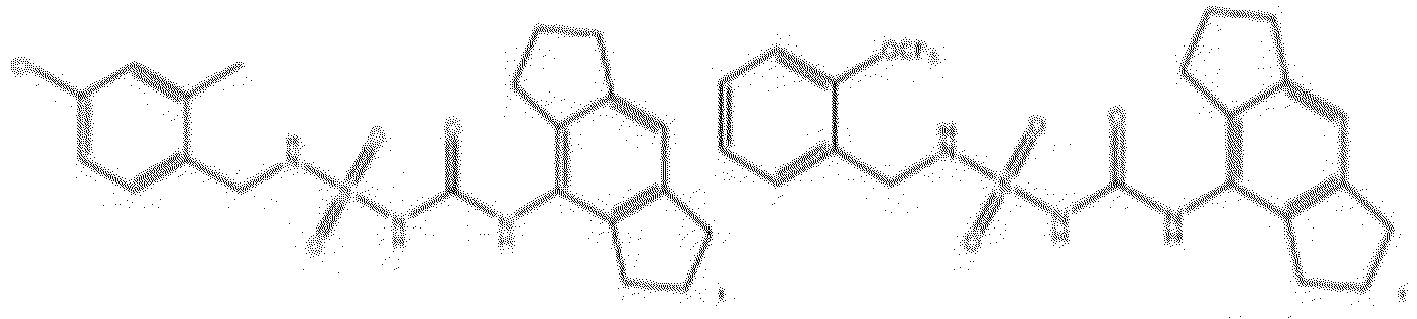


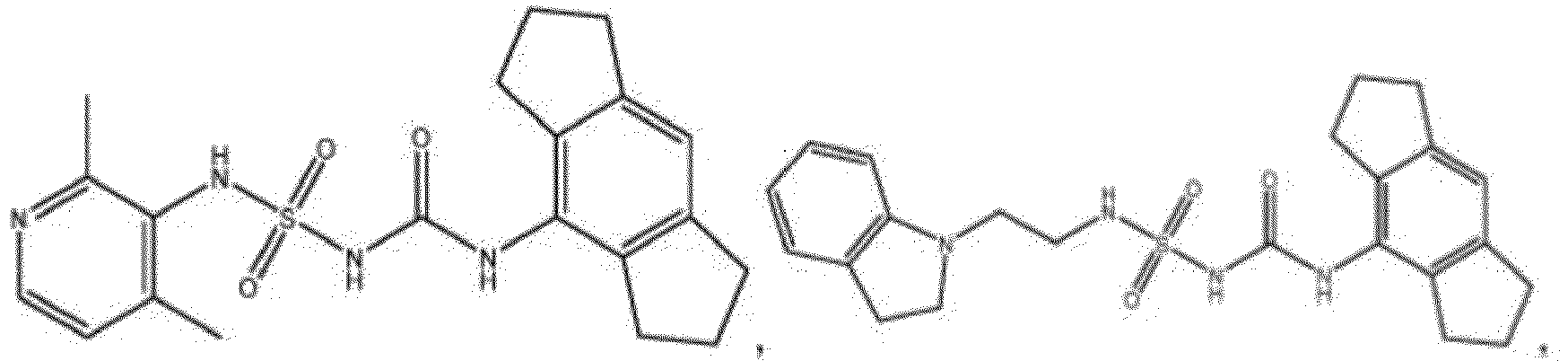

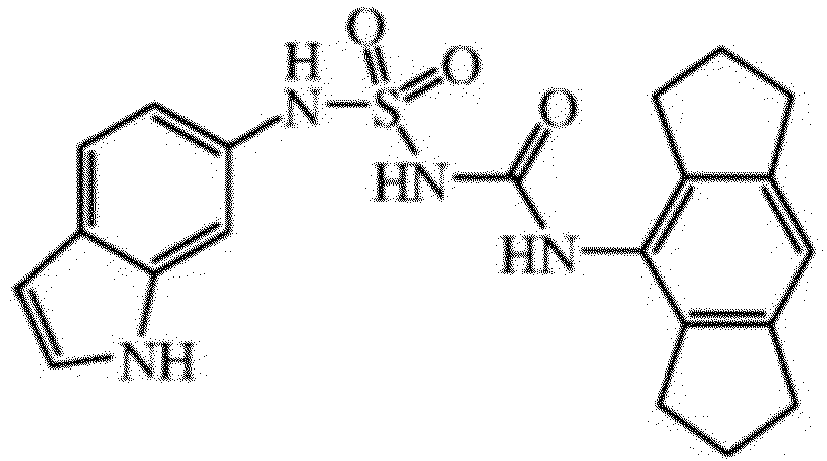 N-((1,2,3,5,6,7-Hexahydro-s-indazen-4-yl)carbamoyl)(1H-indol-6-amin)sulfonamid,
 N-((2,6-Diisopropylphenyl)carbamoyl)(1H-indol-6-amin)sulfonamid,
 N-((4-Chlor-2,6-diisopropylphenyl)carbamoyl)(1H-indol-6-amin)sulfonamid,
 N-((4-Fluor-2,6-diisopropylphenyl)carbamoyl)(1H-indol-6-amin)sulfonamid,
 N-((1,2,3,5,6,7-Hexahydro-s-indacen-4-yl)carbamoyl) (1-methyl-1H-indol-6-amin)sulfonamid,
 N-((2,6-Diisopropylphenyl)carbamoyl)(1-methyl-1H-indol-6-amin)sulfonamid,
 N-((4-Chlor-2,6-diisopropylphenyl)carbamoyl)(1-methyl-1H-indol-6-amin)sulfonamid,
 N-((4-Fluor-2,6-diisopropylphenyl)carbamoyl)(1-methyl-1H-indol-6-amin)sulfonamid,
 N-((2,6-Diisopropylphenyl)carbamoyl)(1H-indol-5-amin)sulfonamid,
 N-((4-Chlor-2,6-diisopropylphenyl)carbamoyl)(1H-indol-5-amin)sulfonamid,
 N-((4-Fluor-2,6-diisopropylphenyl)carbamoyl)(1H-indol-5-amin)sulfonamid,
 N-((1,2,3,5,6,7-Hexahydro-s-indazen-4-yl)carbamoyl) (1-mehtyl-1H-indol-5-amin)sulfonamid,
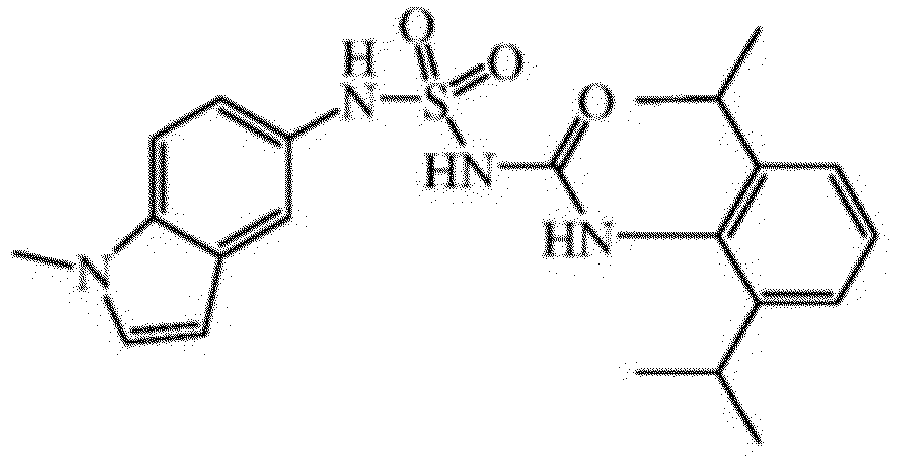 N-((2,6-Diisopropylphenyl)carbamoyl)(1-methy-1H-indol-5-amin)sulfonamid,
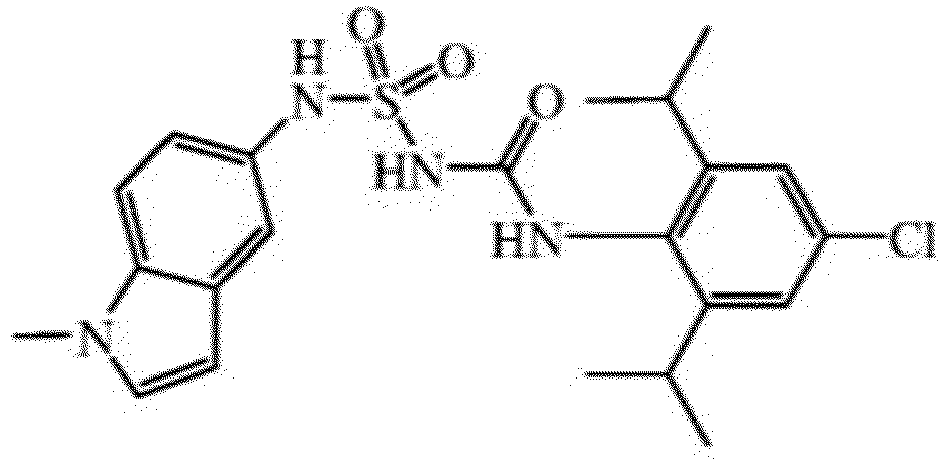 N-((4-Chlor-2,6-diisopropylphenyl)carbamoyl)(1-methy-1H-indol-5-amin)sulfonamid,
 N-((4-Fluor-2,6-diisopropylphenyl)carbamoyl)(1-methy-1H-indol-5-amin)sulfonamid,
 N-((2,6-Diisopropylphenyl)carbamoyl)(N-benzyl-1-(thiazol-2-yl)methanamin)sulfonamid,
 N-((4-Chlor-2,6-diisopropylphenyl)carbamoyl)(N-benzyl-1-(thiazol-2-yl)methanamin)sulfonamid,
 N-((4-Fluor-2,6-diisopropylphenyl)carbamoyl)(N-benzyl-1-(thiazol-2-yl)methanamin)sulfonamid,
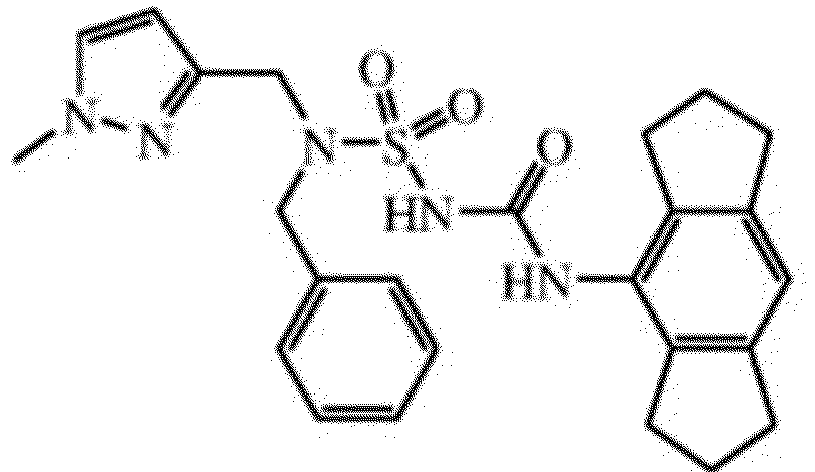 N-((1,2,3,5,6,7-Hexahydro-s-indazen-4-yl)-carbamoyl) (N-benzyl-1-(1-methyl-1H-pyrazol-3-yl)methanamin)sulfonamid,
 N-((2,6-Diisopropylphenyl)carbamoyl)(N-benzyl-1-(1-methyl-1H-pyrazol-3-yl)-methanamin)sulfonamid,
 N-((4-Chlor-2,6-diisopropylphenyl)carbamoyl) (N-benzyl-1-(1-methyl-1H-pyrazol-3-yl)-methanamin)sulfonamid,
 N-((4-Fluor-2,6-diisopropylphenyl)carbamoyl) (N-benzyl-1-(1-methyl-1H-pyrazol-3-yl)-methanamin)sulfonamid,
 N-((1,2,3,5,6,7-Hexahydro-s-indazen-4-yl)-carbamoyl) (N-benzyl-1-(1-isopropyl-1H-pyrazol-3-yl)methanamin) sulfonamid,
 N-((2,6-Diisopropylphenyl)carbamoyl)(N-benzyl-1-(1-isopropyl-1H-pyrazol-3-yl)-methamin)sulfonamid,
 N-((4-Chlor-2,6-diisopropylphenyl)carbamoyl) (N-benzyl-1-(1-isopropyl-1H-pyrazol-3-yl)-methamin)sulfonamid,
 N-((4-Fluor-2,6-diisopropylphenyl)carbamoyl) (N-benzyl-1-(1-isopropyl-1H-pyrazol-3-yl)-methamin)sulfonamid,
 N-((1,2,3,5,6,7-Hexahydro-s-indazen-4-yl)-carbamoyl) (N-benzyl-1-(1-(2,2,2-trifluorethyl)-1H-pyrazol-3-yl)methanamin)sulfonamid,
 N-((2,6,-Diisopropylphenyl)carbamoyl) (N-benzyl-1-(1-(2,2,2-trifluorethyl)-1H-pyrazol-3-yl)methanamin)sulfonamid,
 N-((4-Chlor-2,6-diisopropylphenyl)carbamoly) (N-benzyl-1-(1-(2,2,2-trifluorethyl)-1H-pyrazol-3-yl)-methamin)sulfonamid,
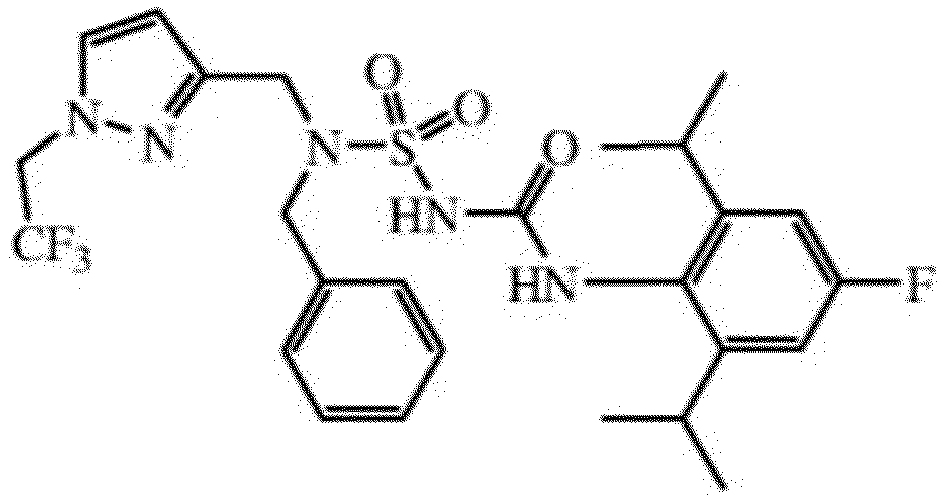 N-((4-Fluor-2,6-diisopropylphenyl)carbamoly) (N-benzyl-1-(1-(2,2,2-trifluorethyl)-1H-pyrazol-3-yl)-methamin)sulfonamid,
 N-((1,2,3,5,6,7-Hexahydro-s-indazen-4-yl)carbamoyl)(3-methylbenzo[d]isoxazol-6-amin)sulfonamid,
 N-((2,6-Diisopropylphenyl)carbamoyl)(3-methylbenzo[d]isoxazol-6-amin)sulfonamid,
 N-((4-Chlor-2,6-diisopropylphenyl)carbamoyl) (3-methylbenzo[d]isoxazol-6-amin)sulfonamid,
 N-((4-Fluor-2,6-diisopropylphenyl)carbamoyl) (3-methylbenzo[d]isoxazol-6-amin)sulfonamid,
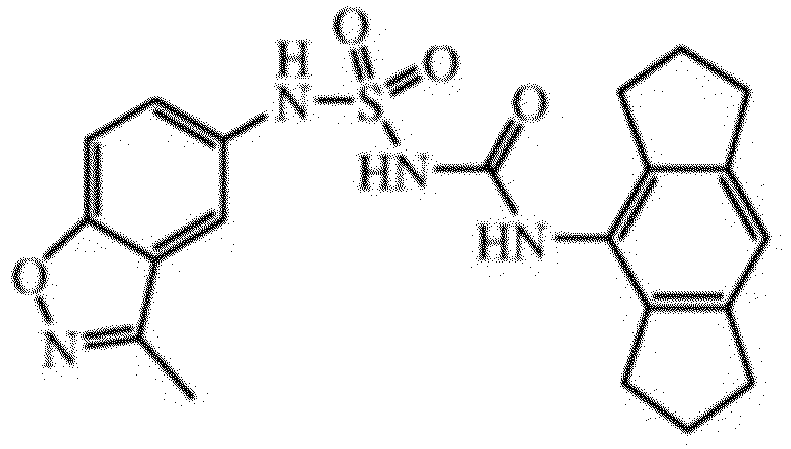 N-((1,2,3,5,6,7-Hexahydro-s-indazen-4-yl)carbamoyl)(3-methylbenzo[d]isoxazol-5-amin)sulfonamid,
 N-((2,6-Diisopropylphenyl)carbamoyl)(3-methylbenzo[d]isoxazol-5-amin)sulfonamid,
 N-((4-Chlor-2,6-diisopropylphenyl)carbamoyl) (3-methylbenzo[d]isoxazol-5-amin)sulfonamid,
 N-((4-Fluor-2,6-diisopropylphenyl)carbamoyl) (3-methylbenzo[d]isoxazol-5-amin)sulfonamid,
 N-((1,2,3,5,6,7-Hexahydro-s-indazen-4-yl)carbamoyl(2-methylbenzo[d]oxazol-6-amin)sulfonamid,
 N-((2,6-Diisopropylphenyl)carbamoyl(2-methylbenzo[d]oxazol-6-amin)sulfonamid,
 N-((4-Chlor-2,6-diisopropylphenyl)carbamoyl(2-methylbenzo[d]oxazol-6-amin)sulfonamid,
 N-((4-Fluor-2,6-diisopropylphenyl)carbamoyl(2-methylbenzo[d]oxazol-6-amin)sulfonamid,
 N-((1,2,3,5,6,7-Hexahydro-s-indazen-4-yl)carbamoyl) (2-methylbenzo[d]oxazol-5-amin)sulfonamid,
 N-((2,6-Diisopropylphenyl)carbamoyl)(2-methylbenzo[d]oxazol-5-amin)sulfonamid,
 N-((4-Chlor-2,6-diisopropylphenyl)carbamoyl) (2-methylbenzo[d]oxazol-5-amin)sulfonamid,
 N-((4-Fluor-2,6-diisopropylphenyl)carbamoyl) (2-methylbenzo[d]oxazol-5-amin)sulfonamid,
 N-((1,2,3,5,6,7-Hexahydro-s-indazen-4-yl)carbamoyl) (2-methyl-1H-benzo[d]imidazol-6-amin)sulfonamid,
 N-((2,6-Diisopropylphenyl)carbamoyl)(2-methyl-1H-benzo[d]imidazol-6-amin)sulfonamid,
 N-((4-Chlor-2,6-diisopropylphenyl)carbamoyl) (2-methyl-1H-benzo[d]imidazol-6-amin)sulfonamid,
 N-((4-Fluor-2,6-diisopropylphenyl)carbamoyl)(2-methyl-1H-benzo[d]imidazol-6-amin)sulfonamid,
 N-((1,2,3,5,6,7-Hexahydro-s-indazen-4-yl)carbamoyl)(1,2-dimethyl-1H-benzo[d]imidazol-6-amin)sulfonamid,
 N-((2,6-Diisopropylphenyl)carbamoyl) (1,2-dimethyl-1H-benzo[d]imidazol-6-amin)sulfonamid,
 N-((4-Chlor-2,6-diisopropylphenyl)carbamoyl) (1,2-dimethyl-1H-benzo[d]imidazol-6-amin)sulfonamid,
 N-((4-Fluor-2,6-diisopropylphenyl)carbamoyl) (1,2-dimethyl-1H-benzo[d]imidazol-6-amin)sulfonamid,
 N-((1,2,3,5,6,7-Hexahydro-s-indazen-4-yl)carbamoyl)(benzo[d][1,2,3]oxadiazol-6-amin)sulfonamid,
 N-((2,6-Diisopropylphenyl)carbamoyl)(benzo[d][1,2,3]oxadiazol-6-amin)sulfonamid,
 N-((4-Chlor-2,6-diisopropylphenyl)carbamoyl)(benzo[d][1,2,3]oxadiazol-6-amin)sulfonamid,
 N-((4-Fluor-2,6-diisopropylphenyl)carbamoyl)(benzo[d][1,2,3]oxadiazol-6-amin)sulfonamid,
 N-((1,2,3,5,6,7-Hexahydro-s-indazen-4-yl)carbamoyl)(1-methyl-1H-benzo[d][1,2,3]triazol-5-amin)sulfonamid,
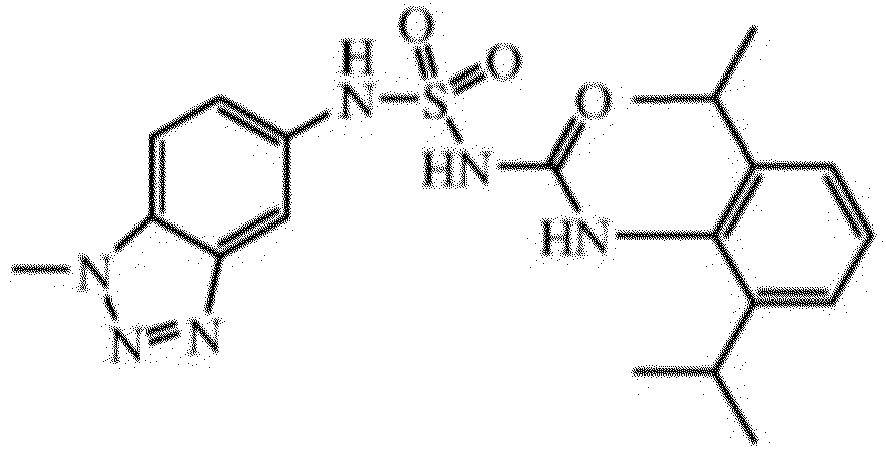 N-((2,6-Diisopropylphenyl)carbamoyl)(1-methyl-1H-benzo[d][1,2,3]triazol-5-amin)sulfonamid,
 N-((4-Chlor-2,6-diisopropylphenyl)carbamoyl)(1-methyl-1H-benzo[d][1,2,3]triazol-5-amin)sulfonamid,
 N-((4-Fluor-2,6-diisopropylphenyl)carbamoyl)(1-methyl-1H-benzo[d][1,2,3]triazol-5-amin)sulfonamid,
 N-((1,2,3,5,6,7-Hexahydro-s-indazen-4-yl)carbamoyl)(1-methyl-1H-benzo[d][1,2,3]triazol-6-amin)sulfonamid,
 N-((2,6-Diisopropylphenyl)carbamoyl)(1-methyl-1H-benzo[d][1,2,3]triazol-6-amin)sulfonamid,
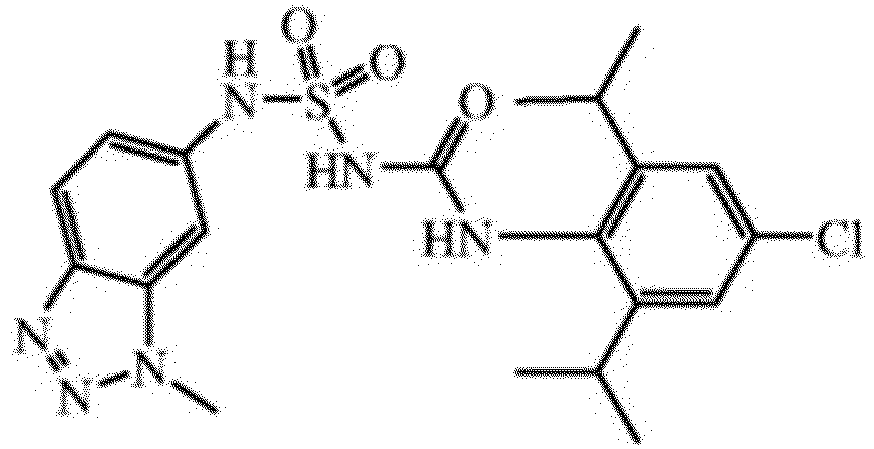 N-((4-Chlor-2,6-diisopropylphenyl)carbamoyl)(1-methyl-1H-benzo[d][1,2,3]triazol-6-amin)sulfonamid,
 N-((4-Fluor-2,6-diisopropylphenyl)carbamoyl)(1-methyl-1H-benzo[d][1,2,3]triazol-6-amin)sulfonamid,
 N-((2,6-Diisopropylphenyl)carbamoyl)(1-methyl-1H-indazol-6-amin)sulfonamid,
 N-((4-Chlor-2,6-diisopropylphenyl)carbamoyl) (1-methyl-1H-indazol-6-amin)sulfonamid,
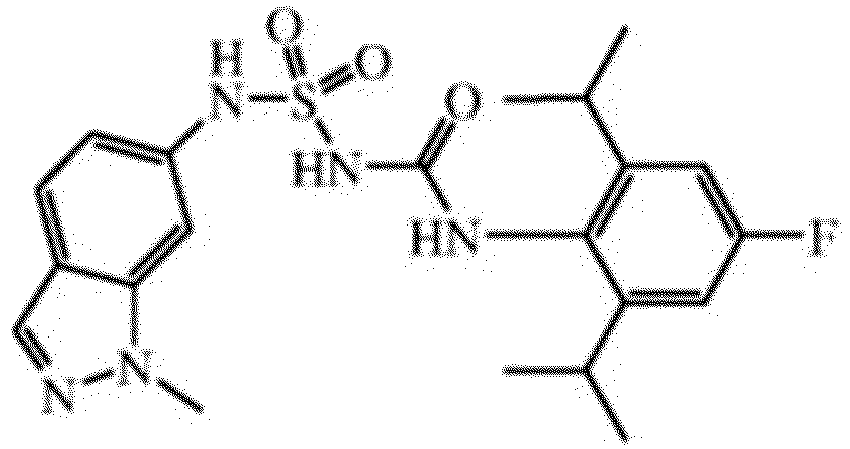 N-((4-Fluor-2,6-diisopropylphenyl)carbamoyl) (1-methyl-1H-indazol-6-amin)sulfonamid,
 N-((1,2,3,5,6,7-Hexahydro-s-indazen-4-yl)-carbamoyl)(1H-indazol-6-amin)sulfonamid,
 N-((2,6-Diisopropylphenyl)carbamoyl)1H-indazol-6-amin)sulfonamid,
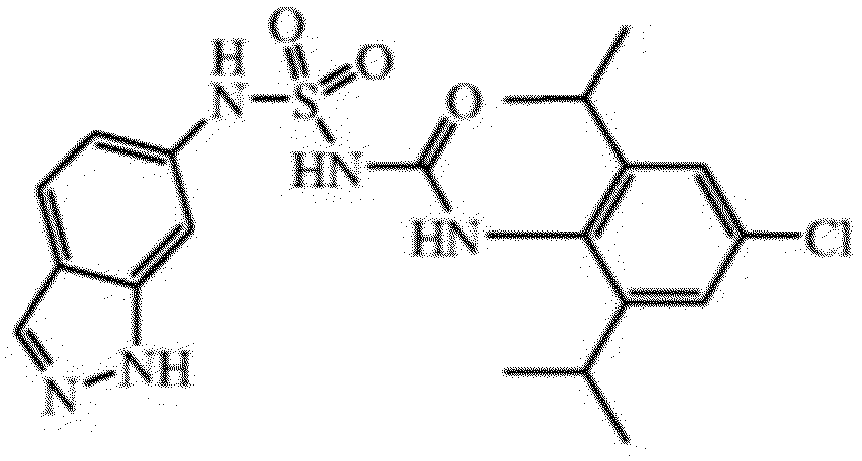 N-((4-Chlor-2,6-diisopropylphenyl)carbamoyl)(1H-indazol-6-amin)sulfonamid,
 N-((4-Fluor-2,6-diisopropylphenyl)carbamoyl)(1H-indazol-6-amin)sulfonamid,
 N-((1,2,3,5,6,7-Hexahydro-s-indazen-4-yl)-carbamoyl)(1H-indazol-5-amin)sulfonamid,
 N-((2,6-Diisopropylphenyl)carbamoyl)(1H-indazol-5-amin)sulfonamid,
 N-((4-Chlor-2,6-diisopropylphenyl)carbamoyl)(1H-indazol-5-amin)sulfonamid,
 N-((4-Flour-2,6-diisopropylphenyl)carbamoyl)(1H-indazol-5-amin)sulfonamid,
 N-((1,2,3,5,6,7-Hexahydro-s-indazen-4-yl)-carbamoyl) (1-methyl-1H-indazol-5-amin)sulfonamid,
 N-((2,6-Diisopropylphenyl)carbamoyl)(1-methyl-1H-indazol-5-amin)sulfonamid,
 N-((4-Chlor-2,6-diisopropylphenyl)carbamoyl) (1-methyl-1H-indazol-5-amin)sulfonamid,
 N-((4-Fluor-2,6-diisopropylphenyl)carbamoyl) (1-methyl-1H-indazol-5-amin)sulfonamid,
 N-((2,6-Diisopropylphenyl)carbamoyl) (6-methoxy-4-methylpyridin-3-amino)sulfonamid,
 N-((4-Chlor-2,6-diisopropylphenyl)carbamoyl) (6-methoxy-4-methylpyridin-3-amino)sulfonamid,
 N-((4-Fluor-2,6-diisopropylphenyl)carbamoyl) (6-methoxy-4-methylpyridin-3-amino)sulfonamid,
 N-((1,2,3,5,6,7-Hexahydro-s-indazen-4-yl)carbamoyl)(6-methoxypyridin-3-amino)sulfonamid,
 N-((2,6-Diisopropylphenyl)carbamoyl)(6-methoxypyridin-3-amino)sulfonamid,
 N-((4-Chlor-2,6-diisopropylphenyl)carbamoyl) (6-methoxypyridin-3-amino)sulfonamid,
 N-((4-Fluor-2,6-diisopropylphenyl)carbamoyl) (6-methoxypyridin-3-amino)sulfonamid,
 N-((1,2,3,5,6,7-Hexahydro-s-indazen-4-yl)carbamoyl)(2-methoxypyrimidin-5-amino)sulfonamid,
 N-((2,6-Diisopropyphenyl)carbamoyl)(2-methoxypyrimidin-5-amino)sulfonamid,
 N-((4-Chlor-2,6-diisopropyphenyl)carbamoyl)(2-methoxypyrimidin-5-amino)sulfonamid,
 N-((4-Fluor-2,6-diisopropyphenyl)carbamoyl)(2-methoxypyrimidin-5-amino)sulfonamid,
 N-((1,2,3,5,6,7-Hexahydro-s-indazen-4-yl)carbamoyl)(6-methoxypyridazin-3-amino)sulfonamid,
 N-((2,6-Diisopropylphenyl)carbamoyl)(6-methoxypyridazin-3-amino)sulfonamid,
 N-((4-Chlor-2,6-diisopropylphenyl)carbamoyl) (6-methoxypyridazin-3-amino)sulfonamid,
 N-((4-Fluor-2,6-diisopropylphenyl)carbamoyl) (6-methoxypyridazin-3-amino)sulfonamid,
 N-((1,2,3,5,6,7-Hexahydro-s-indazen-4-yl)carbamoyl)(5-methoxypyrazin-2-amino)sulfonamid,
 N-((2,6-Diisopropylphenyl)carbamoyl)(5-methoxypyrazin-2-amino)sulfonamid,
 N-((4-Chlor-2,6-diisopropylphenyl)carbamoyl)(5-methoxypyrazin-2-amino)sulfonamid,
 N-((4-Fluor-2,6-diisopropylphenyl)carbamoyl)(5-methoxypyrazin-2-amino)sulfonamid,
 N-((1,2,3,5,6,7-Hexahydro-s-indazen-4-yl)carbamoyl)piperazin-1-sulfonamid,
 N-((2,6-Diisopropylphenyl)carbamoyl)-piperazin-1-sulfonamid,
 N-((4-Chlor-2,6-diisopropylphenyl)carbamoyl)-piperazin-1-sulfonamid,
 N-((4-Fluor-2,6-diisopropylphenyl)carbamoyl)-piperazin-1-sulfonamid,
 N-((1,2,3,5,6,7-Hexahydro-s-indazen-4-yl)carbamoyl)-4-(2,2,2-trifluorethyl)piperazin-1-sulfonamid,
 N-((2,6-Diisopropylphenyl)carbamoyl)-4-(2,2,2-trifluorethyl)piperazin-1-sulfonamid,
 N-((4-Chlor-2,6-diisopropylphenyl)carbamoyl)-4-(2,2,2-trifluorethyl)piperazin-1-sulfonamid,
 N-((4-Fluor-2,6-diisopropylphenyl)carbamoyl)-4-(2,2,2-trifluorethyl)piperazin-1-sulfonamid,
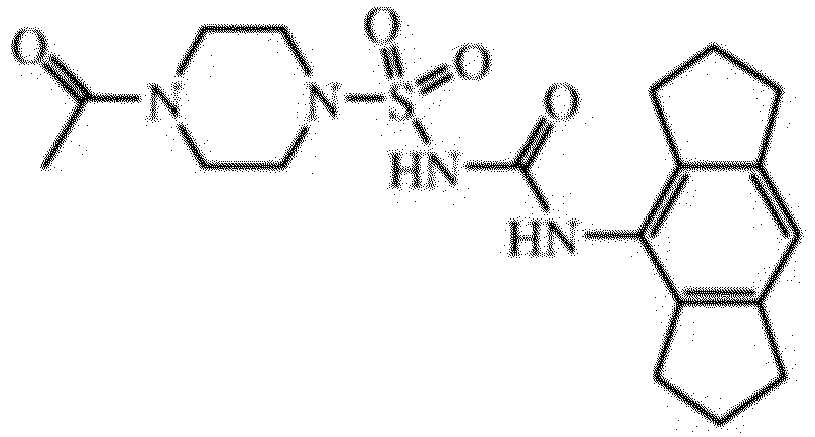 4-Acetyl-N-((1,2,3,5,6,7-hexahydro-s-indazen-4-yl)carbamoyl)piperazin-1-sulfonamid,
 4-Acetyl-N-((2,6-diisopropylphenyl)carbamoyl)-piperazin-1-sulfonamid,
 4-Acetyl-N-((4-chlor-2,6-diisopropylphenyl)carbamoyl)-piperazin-1-sulfonamid,
 4-Acetyl-N-((4-fluor-2,6-diisopropylphenyl)carbamoyl)-piperazin-1-sulfonamid,
 4-Benzyl-N-((1,2,3,5,6,7-hexahydro-s-indazen-4-yl)carbamoyl)piperazin-1-sulfonamid,
 4-Benzyl-N-((2,6-diisopropylphenyl)carbamoyl)-piperazin-1-sulfonamid,
 4-Benzyl-N-((4-chlor-2,6-diisopropylphenyl)carbamoyl)-piperazin-1-sulfonamid,
 4-Benzyl-N-((4-fluor-2,6-diisopropylphenyl)carbamoyl)-piperazin-1-sulfonamid,
 N-((1,2,3,5,6,7-Hexahydro-s-indazen-4-yl)carbamoyl)-2,4,6-trimethylpiperazin-1-sulfonamid,
 N-((2,6-Diisopropylphenyl)carbamoyl)-2,4,6-trimethylpiperazin-1-sulfonamid,
 N-((4-Chlor-2,6-diisopropylphenyl)carbamoyl)-2,4,6-trimethylpiperazin-1-sulfonamid,
 N-((4-Fluor-2,6-diisopropylphenyl)carbamoyl)-2,4,6-trimethylpiperazin-1-sulfonamid,
 N-((1,2,3,5,6,7-Hexahydro-s-indazen-4-yl)carbamoyl)-3,4,5-trimethylpiperazin-1-sulfonamid,
 N-((2,6-Diisopropylphenyl)carbamoyl)-3,4,5-trimethylpiperazin-1-sulfonamid,
 N-((4-Chlor-2,6-diisopropylphenyl)carbamoyl)-3,4,5-trimethylpiperazin-1-sulfonamid,
 N-((4-Fluor-2,6-diisopropylphenyl)carbamoyl)-3,4,5-trimethylpiperazin-1-sulfonamid,
 N-((1,2,3,5,6,7-Hexahydro-s-indazen-4-yl)carbamoyl)octahydro-2H-pyrido[1,2-a]pyrazin-2-sulfonamid,
 N-((2,6-Diisopropylphenyl)carbamoyl)-octahydro-2H-pyrido[1,2-a]pyrazin-2-sulfonamid,
 N-((4-Chlor-2,6-diisopropylphenyl)carbamoyl)-octahydro-2H-pyrido[1,2-a]pyrazin-2-sulfonamid,
 N-((4-Fluor-2,6-diisopropylphenyl)-carbamoyl)octahydro-2H-pyrido[1,2-a]pyrazin-2-sulfonamid,
 N-((2,6-Diisopropylphenyl)carbamoyl)-morpholin-4-sulfonamid,
 N-((4-Chlor-2,6-diisopropylphenyl)carbamoyl)-morpholin-4-sulfonamid,
 N-((4-Fluor-2,6-diisopropylphenyl)carbamoyl)morpholin-4-sulfonamid,
 N-((1,2,3,5,6,7-Hexahydro-s-indazen-4-yl)carbamoyl)-3,5-dimethylmorpholin-4-sulfonamid,
 N-((2,6-Diisopropylphenyl)carbamoyl)-3,5-dimethylmorpholin-4-sulfonamid,
 N-((4-Chlor-2,6-diisopropylphenyl)carbamoyl)-3,5-dimethylmorpholin-4-sulfonamid,
 N-((4-Fluor-2,6-diisopropylphenyl)carbamoyl)-3,5-dimethylmorpholin-4-sulfonamid,
 N-((1,2,3,5,6,7-Hexahydro-s-indazen-4-yl)carbamoyl)-2,6-dimethylmorpholin-4-sulfonamid,
 N-((2,6-Diisopropylphenyl)carbamoyl)-2,6-dimethylmorpholin-4-sulfonamid,
 N-((4-Chlor-2,6-diisopropylphenyl)carbamoyl)-2,6-dimethylmorpholin-4-sulfonamid,
 N-((4-Fluor-2,6-diisopropylphenyl)carbamoyl)-2,6-dimethylmorpholin-4-sulfonamid,
 N-((1,2,3,5,6,7-Hexahydro-s-indazen-4-yl)carbamoyl)-4-methylpiperidin-1-sulfonamid,
 N-((2,6-Diisopropylphenyl)carbamoyl)-4-methylpiperidin-1-sulfonamid,
 N-((4-Chlor-2,6-diisopropylphenyl)carbamoyl)-4-methylpiperidin-1-sulfonamid,
 N-((4-Fluor-2,6-diisopropylphenyl)carbamoyl)-4-methylpiperidin-1-sulfonamid,
 N-((1,2,3,5,6,7-Hexahydro-s-indazen-4-yl)carbamoyl)-2,4,6-trimethylpiperidin-1-sulfonamid,
 N-((2,6-Diisopropylphenyl)carbamoyl)-2,4,6-trimethylpiperidin-1-sulfonamid,
 N-((4-Chlor-2,6-Diisopropylphenyl)carbamoyl)-2,4,6-trimethylpiperidin-1-sulfonamid,
 N-((4-Fluor-2,6-Diisopropylphenyl)carbamoyl)-2,4,6-trimethylpiperidin-1-sulfonamid,
 N-((1,2,3,5,6,7-Hexahydro-s-indazen-4-yl)carbamoyl)-3,4,5-trimethylpiperidin-1-sulfonamid,
 N-((2,6-Diisopropylphenyl)carbamoyl)-3,4,5-trimethylpiperidin-1-sulfonamid,
 N-((4-Chlor-2,6-diisopropylphenyl)carbamoyl)-3,4,5-trimethylpiperidin-1-sulfonamid,
 N-((4-Fluor-2,6-diisopropylphenyl)carbamoyl)-3,4,5-trimethylpiperidin-1-sulfonamid,
 N-((1,2,3,5,6,7-Hexahydro-s-indazen-4-yl)carbamoyl)-4-hydroxypiperidin-1-sulfonamid,
 N-((2,6-Diisopropylphenyl)carbamoyl)-4-hydroxypiperidin-1-sulfonamid,
 N-((4-Chlor-2,6-diisopropylphenyl)carbamoyl)-4-hydroxypiperidin-1-sulfonamid,
 N-((4-Fluor-2,6-diisopropylphenyl)carbamoyl)-4-hydroxypiperidin-1-sulfonamid,
 N-((1,2,3,5,6,7-Hexahydro-s-indazen-4-yl)carbamoyl)piperidin-1-sulfonamid,
 N-((4-Chlor-2,6-diisopropylphenyl)carbamoyl)-piperidin-1-sulfonamid,
 N-((4-Fluor-2,6-diisopropylphenyl)carbamoyl)piperidin-1-sulfonamid,

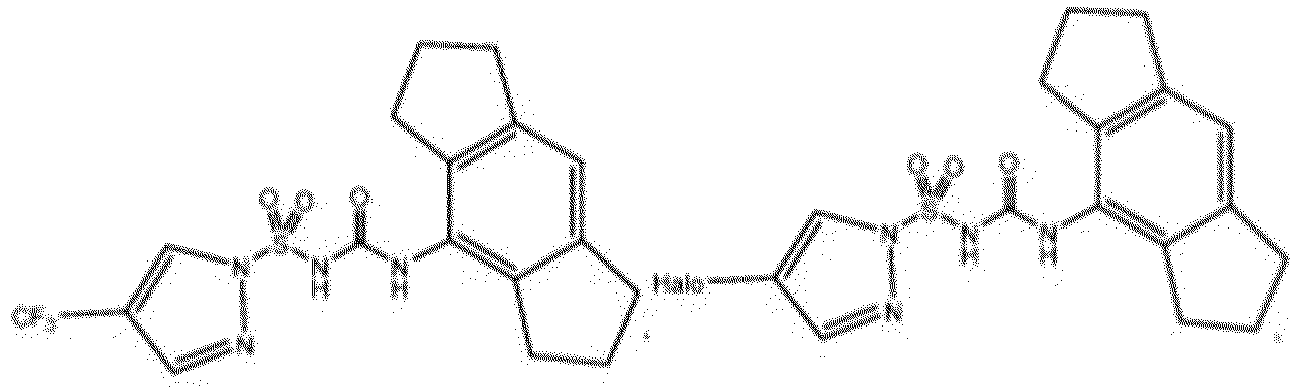


- Pharmazeutische Zusammensetzung, umfassend eine Verbindung nach einem von Anspruch 1 bis Anspruch 7 oder ein pharmazeutisch annehmbares Salz oder Solvat davon und einen pharmazeutisch annehmbaren Träger, ein pharmazeutisch annehmbares Verdünnungsmittel und/oder einen pharmazeutisch annehmbaren Hilfsstoff.
- Verbindung oder pharmazeutisch annehmbares Salz oder Solvat nach einem von Anspruch 1 bis Anspruch 7, wobei die Verbindung oder das pharmazeutisch annehmbare Salz oder Solvat davon der Verwendung für Folgendes dient:(i) Medizin; und/oder(ii) der Behandlung oder Prävention einer Krankheit, einer Störung oder eines Zustands.
- Verbindung oder pharmazeutisch annehmbares Salz oder Solvat nach Anspruch 9(ii), wobei die Krankheit, die Störung oder der Zustand Folgendes ist:(i) eine Krankheit, eine Störung oder ein Zustand des Immunsystems; und/oder(ii) eine entzündliche Krankheit, eine entzündliche Störung oder ein entzündlicher Zustand oder eine Autoimmunkrankheit, eine Autoimmunstörung oder ein Autoimmunzustand; und/oder(iii) eine Krankheit, eine Störung oder ein Zustand der Haut; und/oder(iv) eine Krankheit, eine Störung oder ein Zustand des Herzkreislaufsystems; und/oder(v) ein Krebs, ein Tumor oder eine andere Malignität; und/oder(vi) eine Krankheit, eine Störung oder ein Zustand des Nierensystems; und/oder(vii) eine Krankheit, eine Störung oder ein Zustand des Magen-Darm-Trakts; und/oder(viii) eine Krankheit, eine Störung oder ein Zustand des Atmungssystems; und/oder(ix) eine Krankheit, eine Störung oder ein Zustand des endokrinen Systems; und/oder(x) eine Krankheit, eine Störung oder ein Zustand des zentralen Nervensystems (ZNS).
- Verbindung oder pharmazeutisch annehmbares Salz oder Solvat nach Anspruch 9(ii), wobei die Krankheit, die Störung oder der Zustand ausgewählt ist aus der Gruppe bestehend aus konstitutiver Entzündung, einschließlich Cryopyrin-assoziierten periodischen Syndromen (CAPS), des Muckle-Wells-Syndroms (MWS), familiären kälteinduzierten autoentzündlichen Syndroms (FCAS) und neonatal einsetzender multisystemischer autoentzündlicher Krankheit (NOMID), autoentzündlichen Krankheiten, familiären Mittelmeerfiebers (FMF), TNF-Rezeptor-assoziierten periodischen Syndroms (TRAPS), Mevalonatkinase-Defizienz (MKD), Hyperimmunglobulinämie D und periodischen Fiebersyndroms (HIDS), Defizienz des Interleukin-1-Rezeptor-Antagonisten (DIRA), Majeed-Syndroms, pyogener Arthritis, Pyoderma gangraenosum-Akne-Syndroms (PAPA-Syndrom), A20-Haploinsuffizienz (HA20), pädiatrischer granulomatöser Arthritis, PLCG2-assoziierter Antikörperdefizienz und Immundysregulation (PLAID), PLCG2-assoziierter Autoentzündung, Antikörperdefizienz und Immundysregulation (APLAID) und sideroblastischer Anämie mit B-Zellen-Immundefizienz, periodischer Fieber und Entwicklungsverzögerung (SIFD); Autoimmunkrankheiten, einschließlich Multipler Sklerose (MS), Diabetes Typ 1, Psoriasis, rheumatischer Arthritis, Behcet-Krankheit, des Sjogran-Syndroms und Schnitzler-Syndroms; Makrophagenaktivierungssyndrom; Blau-Syndrom; Atemwegskrankheiten, einschließlich chronischer obstruktiver Lungenstörung (COPD), Asthma wie etwa allergisches Asthma und steroidresistentes Asthma, Asbestose, Silikose und zystischer Fibrose; Dermatitis, einschließlich Kontaktdermatitis; Krankheiten des zentralen Nervensystems, einschließlich Parkinson-Krankheit, Alzheimer-Krankheit, Motoneuron-Krankheit, Huntington-Krankheit, zerebraler Malaria und Gehirnverletzung durch Pneumokokken-Meningitis; Stoffwechselkrankheiten, einschließlich Diabetes Typ 2, Atherosklerose, Adipositas, Gicht, Pseudogicht; Augenkrankheiten, einschließlich jener des Augenepithels, altersabhängiger Makuladegeneration (AMD), Uveitis, Hornhautentzündung und trockenes Auge; Nierenkrankheiten, einschließlich chronischer Nierenkrankheit, Oxalat-Nephropathie, Nephrokalzinose und diabetischer Nephropathie; Leberkrankheiten, einschließlich nichtalkoholischer Steatohepatitis (NASH) und alkoholischer Leberkrankheit; Entzündungsreaktionen in der Haut, einschließlich Kontaktsensibilisierung und Sonnenbrand; Entzündungsreaktionen in den Gelenken, einschließlich Osteoarthritis, systemischer juveniler idiopathischer Arthritis, im Erwachsenalter einsetzender Still-Krankheit, rezidivierender Polychondritis; Virusinfektionen, einschließlich Alphavirus (Chikungunya, Ross River) und Flavivirus (Dengue, Zika), Grippe, HIV; Hidradenitis suppurativa (HS) und anderen zystenverursachenden Hautkrankheiten; Krebsen, einschließlich Lungenkrebsmetastasen, Bauchspeicheldrüsenkrebsen, Magenkrebsen, des myelodysplastischen Syndroms, Leukämie; Polymyositis; Schlaganfall, einschließlich des ischämischen Schlaganfalls; Herzinfarkt, einschließlich des wiederkehrenden Herzinfarkts; kongestives Herzversagen; Embolie; Herzkreislaufkrankheit; Transplant-gegen-Wirt-Krankheit; Bluthochdruck; Colitis; Wurminfektion; Bakterieninfektion; Bauchaortenaneurysma; Wundheilung; Depression, psychologischer Stress; Ischämie-Reperfusionsverletzung und Krankheiten, bei denen bestimmt wurde, dass eine Person Träger einer Keimbahn- oder somatischen nicht stillen Mutation in NLRP3 ist.
- Verbindung oder pharmazeutisch annehmbares Salz oder Solvat nach einem von Anspruch 1 bis Anspruch 7, wobei die Verbindung oder das pharmazeutisch annehmbare Salz oder Solvat davon der Verwendung bei der Diagnose einer Krankheit, einer Störung oder eines Zustands bei einem Säugetier dient, einschließlich des Schritts des Verabreichens einer markierten Verbindung nach einem von Anspruch 1 bis Anspruch 7 oder eines pharmazeutisch annehmbaren Salzes oder Solvats oder eines Metallion-Chelat-Komplexes davon an das Säugetier oder an eine biologische Probe, die von dem Säugetier erlangt wurde, um die Diagnose der Krankheit, der Störung oder des Zustands bei dem Säugetier zu ermöglichen.
- Ex-vivo- oder In-vitro-Verfahren zum Modulieren der Aktivität eines biologischen Ziels, umfassend den Schritt des Aussetzens des biologischen Ziels gegenüber einer Verbindung nach einem von Anspruch 1 oder Anspruch 7 oder einem pharmazeutisch annehmbaren Salz oder Solvat davon.
- Verfahren nach Anspruch 13, wobei das biologische Ziel ausgewählt ist aus der Gruppe bestehend aus dem NLRP3-Inflammasom, IL-1β-, IL-17-, IL-18-, IL-1α-, IL-37-, IL-33- und Th17-Zellen.
Applications Claiming Priority (2)
| Application Number | Priority Date | Filing Date | Title |
|---|---|---|---|
| AU2016900535A AU2016900535A0 (en) | 2016-02-16 | Sulfonylureas and related compounds and use of same | |
| PCT/EP2017/053498 WO2017140778A1 (en) | 2016-02-16 | 2017-02-16 | Sulfonylureas and related compounds and use of same |
Publications (3)
| Publication Number | Publication Date |
|---|---|
| EP3416948A1 EP3416948A1 (de) | 2018-12-26 |
| EP3416948B1 true EP3416948B1 (de) | 2024-07-24 |
| EP3416948C0 EP3416948C0 (de) | 2024-07-24 |
Family
ID=58046688
Family Applications (1)
| Application Number | Title | Priority Date | Filing Date |
|---|---|---|---|
| EP17705416.0A Active EP3416948B1 (de) | 2016-02-16 | 2017-02-16 | Indazen aufweisende sulfonylharnstoffe als entzündungshemmstoffe |
Country Status (16)
| Country | Link |
|---|---|
| US (1) | US11858922B2 (de) |
| EP (1) | EP3416948B1 (de) |
| JP (1) | JP2019512009A (de) |
| KR (1) | KR20180133244A (de) |
| CN (1) | CN109071454B (de) |
| AR (1) | AR109348A1 (de) |
| AU (1) | AU2017219204A1 (de) |
| BR (1) | BR112018016671A2 (de) |
| CA (1) | CA3014487A1 (de) |
| HK (1) | HK1257569A1 (de) |
| IL (1) | IL261035A (de) |
| MA (1) | MA44225A (de) |
| MX (1) | MX2018009840A (de) |
| SG (1) | SG11201806745RA (de) |
| UY (1) | UY37362A (de) |
| WO (1) | WO2017140778A1 (de) |
Families Citing this family (75)
| Publication number | Priority date | Publication date | Assignee | Title |
|---|---|---|---|---|
| HUE055755T2 (hu) | 2015-02-16 | 2021-12-28 | Univ Queensland | Szulfonolkarmabidok és rokon vegyületeik valamint felhasználásuk |
| HK1257569A1 (zh) | 2016-02-16 | 2019-10-25 | The University Of Queensland | 磺醯脲和相关化合物及其用途 |
| CN120574152A (zh) | 2016-09-06 | 2025-09-02 | 爱尔兰贾兹制药有限公司 | (r)-2-氨基-3-苯丙基氨基甲酸酯盐酸盐的溶剂化物形式的晶体、其制备方法、组合物及用途 |
| CA3047336A1 (en) | 2017-01-23 | 2018-07-26 | Jecure Therapeutics, Inc. | Chemical compounds as inhibitors of interleukin-1 activity |
| US11840543B2 (en) | 2017-05-24 | 2023-12-12 | The University Of Queensland | Compounds and uses |
| KR102669722B1 (ko) | 2017-07-07 | 2024-05-29 | 인플라좀 리미티드 | 신규한 설폰아마이드 카복스아마이드 화합물 |
| EP3649112A1 (de) | 2017-07-07 | 2020-05-13 | Inflazome Limited | Sulfonylharnstoffe und sulfonylthioharnstoffe als nlrp3-inhibitoren |
| EP3668840A1 (de) * | 2017-08-15 | 2020-06-24 | Inflazome Limited | Neuartige sulfonamid-carboxamid-verbindungen |
| US11773058B2 (en) | 2017-08-15 | 2023-10-03 | Inflazome Limited | Sulfonamide carboxamide compounds |
| EP3668843A1 (de) | 2017-08-15 | 2020-06-24 | Inflazome Limited | Sulfonylharnstoffe und sulfonylthioharnstoffe als nlrp3-inhibitoren |
| TW201910316A (zh) * | 2017-08-15 | 2019-03-16 | 愛爾蘭商英弗雷佐姆有限公司 | 新穎化合物 |
| TW201910317A (zh) | 2017-08-15 | 2019-03-16 | 愛爾蘭商英弗雷佐姆有限公司 | 新穎化合物 |
| JP6984818B2 (ja) * | 2017-09-01 | 2021-12-22 | 学校法人近畿大学 | ゼルンボン誘導化合物と癌細胞増殖抑制剤およびそれらの製造方法 |
| US11623922B2 (en) | 2017-10-03 | 2023-04-11 | Inflazome Limited | Compounds |
| EP3707137A1 (de) | 2017-11-09 | 2020-09-16 | Inflazome Limited | Neuartige sulfonamid-carboxamid-verbindungen |
| PE20210050A1 (es) | 2017-11-09 | 2021-01-08 | Inflazome Ltd | Nuevos compuestos de sulfonamida carboxamida |
| GB201721185D0 (en) | 2017-12-18 | 2018-01-31 | Nodthera Ltd | Sulphonyl urea derivatives |
| TWI805699B (zh) * | 2018-03-01 | 2023-06-21 | 日商日本煙草產業股份有限公司 | 甲基內醯胺環化合物及其用途 |
| GB201803393D0 (en) | 2018-03-02 | 2018-04-18 | Inflazome Ltd | Novel compounds |
| US11884645B2 (en) | 2018-03-02 | 2024-01-30 | Inflazome Limited | Sulfonyl acetamides as NLRP3 inhibitors |
| US12030879B2 (en) | 2018-03-02 | 2024-07-09 | Inflazome Limited | Sulfonyl acetamides as NLRP3 inhibitors |
| WO2019166619A1 (en) * | 2018-03-02 | 2019-09-06 | Inflazome Limited | Novel compounds |
| GB201803394D0 (en) | 2018-03-02 | 2018-04-18 | Inflazome Ltd | Novel compounds |
| US11530200B2 (en) | 2018-03-02 | 2022-12-20 | Inflazome Limited | Compounds |
| WO2019166627A1 (en) | 2018-03-02 | 2019-09-06 | Inflazome Limited | Novel compounds |
| EP3759073A1 (de) | 2018-03-02 | 2021-01-06 | Inflazome Limited | Sulfonamidderivate als nlrp3-inhibitoren |
| GB201806578D0 (en) | 2018-04-23 | 2018-06-06 | Inflazome Ltd | Novel compound |
| MA52489A (fr) * | 2018-05-04 | 2021-03-10 | Inflazome Ltd | Nouveaux composés |
| CN108404117B (zh) * | 2018-05-29 | 2020-06-30 | 广东龙帆生物科技有限公司 | 核苷酸结合寡聚化结构域样受体蛋白在治疗寨卡病毒感染药物中的应用 |
| CA3104199A1 (en) * | 2018-07-20 | 2020-01-23 | F. Hoffmann-La Roche Ag | Sulfonylurea compounds as inhibitors of interleukin-1 activity |
| BR112021001044A2 (pt) | 2018-07-20 | 2021-04-13 | F. Hoffmann-La Roche Ag | Compostos de sulfonimidamida como inibidores da atividade de interleucina-1 |
| CN112672995A (zh) * | 2018-08-15 | 2021-04-16 | 英夫拉索姆有限公司 | 新型磺酰胺脲化合物 |
| GB201902327D0 (en) | 2019-02-20 | 2019-04-03 | Inflazome Ltd | Novel compounds |
| GB201819083D0 (en) | 2018-11-23 | 2019-01-09 | Inflazome Ltd | Novel compounds |
| FI3911631T3 (fi) | 2019-01-14 | 2025-02-03 | Zydus Lifesciences Ltd | Uusia substituoituja sulfonyyliureajohdannaisia |
| WO2020152361A1 (en) * | 2019-01-25 | 2020-07-30 | NodThera Limited | Carbamate derivatives and uses thereof |
| GB201905265D0 (en) | 2019-04-12 | 2019-05-29 | Inflazome Ltd | Inflammasome inhibition |
| US20220267300A1 (en) * | 2019-06-12 | 2022-08-25 | NodThera Limited | Sulfonamide derivatives and uses thereof |
| ES3056339T3 (en) * | 2019-06-12 | 2026-02-19 | Nodthera Ltd | Sulfonylurea derivatives and uses thereof |
| SI3983387T1 (sl) * | 2019-06-12 | 2024-09-30 | NodThera Limited | Derivati sulfoniluree in njihove uporabe |
| EP3986879B1 (de) | 2019-06-21 | 2024-10-02 | AC Immune SA | Kondensierte 1,2-thiazole und 1,2-thiazine, die als nlrp3-modulatoren wirken |
| WO2021002887A1 (en) | 2019-07-02 | 2021-01-07 | Novartis Inflammasome Research, Inc. | Gut-targeted nlrp3 antagonists and their use in therapy |
| CN110183433B (zh) * | 2019-07-11 | 2021-06-04 | 华东理工大学 | 吡唑类化合物及其制备方法与用途 |
| AU2020314186B2 (en) | 2019-07-17 | 2026-04-23 | Zomagen Biosciences Ltd | NLRP3 modulators |
| JP7723652B2 (ja) | 2019-07-17 | 2025-08-14 | ズーマゲン バイオサイエンシーズ エルティーディー | 多発性硬化症(MS)の治療のためのNLPR3モジュレーターとしてのN-((1,2,3,5,6,7-ヘキサヒドロ-s-インダセン-4-イル)カルバモイル)-4,5,6,7-テトラヒドロベンゾフラン-2-スルホンアミド誘導体および関連化合物 |
| EP4013761A1 (de) | 2019-08-16 | 2022-06-22 | Inflazome Limited | Makrocyclische sulfonylharnstoffderivate, verwendbar als nlrp3-inhibitoren |
| JP2022547882A (ja) | 2019-09-06 | 2022-11-16 | インフレイゾーム リミテッド | Nlrp3阻害剤 |
| JPWO2021132577A1 (de) * | 2019-12-27 | 2021-07-01 | ||
| JP7072260B2 (ja) * | 2019-12-27 | 2022-05-20 | 国立大学法人愛媛大学 | マックル・ウェルズ症候群の治療用医薬組成物 |
| JP7843705B2 (ja) | 2020-01-22 | 2026-04-10 | エフ・ホフマン-ラ・ロシュ・アクチェンゲゼルシャフト | Nlrp3モジュレーターとしてのスルホンイミドアミド化合物 |
| US11618751B1 (en) | 2022-03-25 | 2023-04-04 | Ventus Therapeutics U.S., Inc. | Pyrido-[3,4-d]pyridazine amine derivatives useful as NLRP3 derivatives |
| US20230121952A1 (en) | 2020-02-18 | 2023-04-20 | Inflazome Limited | Compounds |
| US12599616B2 (en) | 2020-02-28 | 2026-04-14 | Zydus Lifesciences Limited | Subtituted sulfonylurea and sulfoximineurea derivatives |
| EP4121059A4 (de) | 2020-03-16 | 2023-12-13 | Zomagen Biosciences Ltd | Nlrp3-modulatoren |
| IL299084A (en) | 2020-06-19 | 2023-02-01 | Ac Immune Sa | History of dihydrooxazole and thiourea or urea modulating the NLRP3 inflammasome pathway |
| WO2022005881A1 (en) * | 2020-06-29 | 2022-01-06 | Bacainn Biotherapeutics, Inc. | Probenecid compounds for the treatment of inflammasome-mediated lung disease |
| WO2022023907A1 (en) | 2020-07-31 | 2022-02-03 | Novartis Ag | Methods of selecting and treating patients at elevated risk of major adverse cardiac events |
| WO2022160015A1 (en) * | 2021-01-29 | 2022-08-04 | Griffith University | Antiviral agents and uses thereof |
| EP4293018A4 (de) * | 2021-02-10 | 2025-04-30 | Hangzhou Innogate Pharma Co., Ltd. | Verbindung als nlrp3-hemmer |
| US11319319B1 (en) | 2021-04-07 | 2022-05-03 | Ventus Therapeutics U.S., Inc. | Compounds for inhibiting NLRP3 and uses thereof |
| US20250109126A1 (en) | 2021-12-22 | 2025-04-03 | Ac Immune Sa | Dihydro-oxazol derivative compounds |
| CN114469940B (zh) * | 2022-03-15 | 2023-03-31 | 温州医科大学附属第一医院 | 小分子化合物aq-390在制备抵抗细胞焦亡药物及抑制剂的应用 |
| EP4554945A1 (de) | 2022-07-14 | 2025-05-21 | AC Immune SA | Pyrrolotriazin- und imidazotriazinderivate als modulatoren des nlrp3-inflammasom-signalwegs |
| CA3261365A1 (en) | 2022-07-28 | 2024-02-01 | Ac Immune Sa | NEW COMPOUNDS |
| US12331048B2 (en) | 2022-10-31 | 2025-06-17 | Ventus Therapeutics U.S., Inc. | Pyrido-[3,4-d]pyridazine amine derivatives useful as NLRP3 inhibitors |
| AR132221A1 (es) * | 2023-03-30 | 2025-06-04 | Adama Agan Ltd | Proceso para la preparación de derivados de sulfamida |
| EP4719599A1 (de) | 2023-06-02 | 2026-04-08 | Merck Sharp & Dohme LLC | 5,6 ungesättigte bicyclische heterocyclen als inhibitoren des nod-ähnlichen rezeptorproteins 3 |
| WO2025113692A1 (zh) * | 2023-12-01 | 2025-06-05 | 拜西欧斯(北京)生物技术有限公司 | 磺酰脲衍生物及其应用 |
| WO2025133307A1 (en) | 2023-12-22 | 2025-06-26 | Ac Immune Sa | Heterocyclic modulators of the nlrp3 inflammasome pathway |
| WO2025153532A1 (en) | 2024-01-16 | 2025-07-24 | NodThera Limited | Nlrp3 inhibitors and glp-1 agonists combination therapies |
| WO2025153625A1 (en) | 2024-01-17 | 2025-07-24 | Ac Immune Sa | Imidazo[1,2-d][1,2,4]triazine derivatives for use as inhibitors of the nlrp3 inflammasome pathway |
| WO2025153624A1 (en) | 2024-01-17 | 2025-07-24 | Ac Immune Sa | Imidazo[1,2-d][1,2,4]triazine derivatives for use as inhibitors of the nlrp3 inflammasome pathway |
| CN117942334B (zh) * | 2024-01-24 | 2024-08-02 | 大连医科大学附属第二医院 | 一种nlrp3炎症小体活化抑制剂及其制备方法和应用 |
| WO2025163069A1 (en) | 2024-01-31 | 2025-08-07 | Ac Immune Sa | Novel compounds |
| WO2026057747A1 (en) | 2024-09-11 | 2026-03-19 | Ac Immune Sa | Therapeutic use of nlrp3 inflammasome pathway inhibitor compounds |
Citations (1)
| Publication number | Priority date | Publication date | Assignee | Title |
|---|---|---|---|---|
| WO1998032733A1 (en) * | 1997-01-29 | 1998-07-30 | Pfizer Inc. | Sulfonyl urea derivatives and their use in the control of interleukin-1 activity |
Family Cites Families (46)
| Publication number | Priority date | Publication date | Assignee | Title |
|---|---|---|---|---|
| DE1064284B (de) | 1958-01-11 | 1959-08-27 | Bayer Ag | Fungizide Mittel |
| US3242174A (en) | 1962-02-06 | 1966-03-22 | Pfizer & Co C | 1-(tertiary aminosulfonyl)-3-(hydrocarbon) ureas |
| DE1165012B (de) * | 1962-04-05 | 1964-03-12 | Hoechst Ag | Verfahren zur Herstellung von Benzolsulfonylsemicarbaziden |
| DE1168415B (de) * | 1962-04-06 | 1964-04-23 | Boehringer & Soehne Gmbh | Verfahren zur Herstellung neuer Benzolsulfonyl-semicarbazide |
| DE1670121A1 (de) * | 1966-08-02 | 1970-10-29 | Boehringer Mannheim Gmbh | Verfahren zur Herstellung neuer antidiabetisch wirksamer Benzolsulfonyl-semicarbazide |
| NL131473C (de) | 1966-10-28 | |||
| US3856786A (en) | 1972-07-25 | 1974-12-24 | Pennwalt Corp | Sulfonyldiisocyanate adducts |
| US4401816A (en) * | 1980-04-29 | 1983-08-30 | E. I. Du Pont De Nemours And Company | Sulfamoyl chlorides |
| GB2110689A (en) | 1981-12-03 | 1983-06-22 | Sandoz Ltd | Herbicidal heterocyclic aminosulfonyl ureas and isoureas |
| CH649081A5 (de) * | 1982-01-12 | 1985-04-30 | Ciba Geigy Ag | Triaza-verbindungen. |
| CA2019260C (en) | 1989-06-22 | 1999-06-29 | Hirokazu Ochiai | Penam derivatives and salts thereof, processes for producing the same and antibacterial agent comprising the same |
| US5214206A (en) * | 1990-11-07 | 1993-05-25 | Warner-Lambert Company | Aminosulfonyl urea acat inhibitors |
| DE4039733A1 (de) | 1990-12-13 | 1992-06-17 | Basf Ag | Substituierte 5-aminopyrazole |
| JP2000302783A (ja) | 1999-04-22 | 2000-10-31 | Fuji Photo Film Co Ltd | ピロロピリミジンオン化合物及びそれを用いた感熱記録材料 |
| JP4112127B2 (ja) | 1999-08-31 | 2008-07-02 | 株式会社リコー | 感熱記録材料 |
| EP1214087A1 (de) | 1999-09-14 | 2002-06-19 | Pfizer Products Inc. | Behandlung mit kombinationen aus il1-ra und diarylsulfonylureaverbindungen |
| CA2411495A1 (en) * | 2000-06-14 | 2001-12-20 | Warner-Lambert Company | 1,2,4-trisubstituted benzenes as inhibitors of 15-lipoxygenase |
| DE60132920T2 (de) | 2000-12-26 | 2009-02-12 | Pola Pharma Inc. | Biphenylderivate |
| CA2369967A1 (en) | 2001-02-12 | 2002-08-12 | Joseph Anthony Cornicelli | Methods of treating nuclear factor-kappa b mediated diseases and disorders |
| US20020127263A1 (en) * | 2001-02-27 | 2002-09-12 | Wenda Carlyle | Peroxisome proliferator-acitvated receptor gamma ligand eluting medical device |
| EP1281399A3 (de) | 2001-08-01 | 2004-02-11 | Warner-Lambert Company | Hemmer mit doppelter Wirkung auf Wachsester- und Cholesterylestersynthese zur Hemmung der Sebumproduktion |
| KR20090121832A (ko) * | 2008-05-23 | 2009-11-26 | 인제대학교 산학협력단 | 2-(2-히드록시벤조일)히드라진카르복시아미드 유도체 또는이의 약학적으로 허용가능한 염, 이의 제조방법, 및 이를유효 성분으로 함유하는 선택적 면역 억제용 약학적 조성물 |
| CN103159651B (zh) | 2011-12-14 | 2015-06-17 | 安徽贝克联合制药有限公司 | 磺酰脲胍及其制备方法和用途 |
| HUE055755T2 (hu) | 2015-02-16 | 2021-12-28 | Univ Queensland | Szulfonolkarmabidok és rokon vegyületeik valamint felhasználásuk |
| DE102015104306B4 (de) | 2015-03-23 | 2018-05-03 | Papierfabrik August Koehler Se | Wärmeempfindliches Aufzeichnungsmaterial |
| FR3046933B1 (fr) | 2016-01-25 | 2018-03-02 | Galderma Research & Development | Inhibiteurs nlrp3 pour le traitement des pathologies cutanees inflammatoires |
| HK1257569A1 (zh) | 2016-02-16 | 2019-10-25 | The University Of Queensland | 磺醯脲和相关化合物及其用途 |
| WO2017189663A1 (en) | 2016-04-26 | 2017-11-02 | Enanta Pharmaceuticals, Inc. | Isoxazole derivatives as fxr agonists and methods of use thereof |
| US10080742B2 (en) | 2016-04-26 | 2018-09-25 | Enanta Pharmaceuticals, Inc. | Isoxazole derivatives as FXR agonists and methods of use thereof |
| WO2017189652A1 (en) | 2016-04-26 | 2017-11-02 | Enanta Pharmaceuticals, Inc. | Isoxazole derivatives as fxr agonists and methods of use thereof |
| WO2017201152A1 (en) | 2016-05-18 | 2017-11-23 | Enanta Pharmaceuticals, Inc. | Isoxazole derivatives as fxr agonists and methods of use thereof |
| US10144729B2 (en) | 2016-05-18 | 2018-12-04 | Enanta Pharmaceuticals, Inc. | Isoxazole analogs as FXR agonists and methods of use thereof |
| EP3272739A1 (de) | 2016-07-20 | 2018-01-24 | NodThera Limited | Sulfonylharnstoff-derivate und ihre verwendung in der kontrole der interleukin-1-aktivität |
| US11840543B2 (en) | 2017-05-24 | 2023-12-12 | The University Of Queensland | Compounds and uses |
| US20210122739A1 (en) | 2017-08-15 | 2021-04-29 | Inflazome Limited | Novel sulfonamide carboxamide compounds |
| EP3668843A1 (de) | 2017-08-15 | 2020-06-24 | Inflazome Limited | Sulfonylharnstoffe und sulfonylthioharnstoffe als nlrp3-inhibitoren |
| SG11202001164SA (en) | 2017-08-15 | 2020-03-30 | Inflazome Ltd | Novel sulfonamide carboxamide compounds |
| TW201910316A (zh) | 2017-08-15 | 2019-03-16 | 愛爾蘭商英弗雷佐姆有限公司 | 新穎化合物 |
| TW201910317A (zh) | 2017-08-15 | 2019-03-16 | 愛爾蘭商英弗雷佐姆有限公司 | 新穎化合物 |
| WO2019092172A1 (en) | 2017-11-09 | 2019-05-16 | Inflazome Limited | Novel sulfonamide carboxamide compounds |
| EP3707137A1 (de) | 2017-11-09 | 2020-09-16 | Inflazome Limited | Neuartige sulfonamid-carboxamid-verbindungen |
| US12030879B2 (en) | 2018-03-02 | 2024-07-09 | Inflazome Limited | Sulfonyl acetamides as NLRP3 inhibitors |
| WO2019166619A1 (en) | 2018-03-02 | 2019-09-06 | Inflazome Limited | Novel compounds |
| EP3759073A1 (de) | 2018-03-02 | 2021-01-06 | Inflazome Limited | Sulfonamidderivate als nlrp3-inhibitoren |
| CN112672995A (zh) * | 2018-08-15 | 2021-04-16 | 英夫拉索姆有限公司 | 新型磺酰胺脲化合物 |
| GB201902327D0 (en) | 2019-02-20 | 2019-04-03 | Inflazome Ltd | Novel compounds |
-
2017
- 2017-02-16 HK HK18116654.3A patent/HK1257569A1/zh unknown
- 2017-02-16 SG SG11201806745RA patent/SG11201806745RA/en unknown
- 2017-02-16 MA MA044225A patent/MA44225A/fr unknown
- 2017-02-16 US US15/999,424 patent/US11858922B2/en active Active
- 2017-02-16 EP EP17705416.0A patent/EP3416948B1/de active Active
- 2017-02-16 WO PCT/EP2017/053498 patent/WO2017140778A1/en not_active Ceased
- 2017-02-16 MX MX2018009840A patent/MX2018009840A/es unknown
- 2017-02-16 JP JP2018543108A patent/JP2019512009A/ja active Pending
- 2017-02-16 BR BR112018016671A patent/BR112018016671A2/pt not_active Application Discontinuation
- 2017-02-16 AU AU2017219204A patent/AU2017219204A1/en not_active Abandoned
- 2017-02-16 CN CN201780022601.4A patent/CN109071454B/zh not_active Expired - Fee Related
- 2017-02-16 KR KR1020187026790A patent/KR20180133244A/ko not_active Withdrawn
- 2017-02-16 CA CA3014487A patent/CA3014487A1/en not_active Abandoned
- 2017-08-15 AR ARP170102277A patent/AR109348A1/es unknown
- 2017-08-15 UY UY0001037362A patent/UY37362A/es not_active Application Discontinuation
-
2018
- 2018-08-07 IL IL261035A patent/IL261035A/en unknown
Patent Citations (1)
| Publication number | Priority date | Publication date | Assignee | Title |
|---|---|---|---|---|
| WO1998032733A1 (en) * | 1997-01-29 | 1998-07-30 | Pfizer Inc. | Sulfonyl urea derivatives and their use in the control of interleukin-1 activity |
Non-Patent Citations (2)
| Title |
|---|
| COLL, R.C. ET AL.: "A small-molecule inhibitor of the NLRP3 inflammasome for the treatment of inflammatory diseases", NATURE MEDICINE, vol. 21, no. 3, 2015, pages 248 - 255 * |
| RÄKEL, R. ET AL.: "Beneficial effects of gliclazide modified release compared with glibenclamide on endothelial activation and low-grade inflammation in patients with type 2 diabetes", DIABETES, OBESITY AND METABOLISM, vol. 9, no. 1, 2007, pages 127 - 129 * |
Also Published As
| Publication number | Publication date |
|---|---|
| AU2017219204A1 (en) | 2018-08-23 |
| AR109348A1 (es) | 2018-11-21 |
| CN109071454A (zh) | 2018-12-21 |
| HK1257569A1 (zh) | 2019-10-25 |
| MA44225A (fr) | 2018-12-26 |
| UY37362A (es) | 2018-09-28 |
| WO2017140778A1 (en) | 2017-08-24 |
| US20200299284A1 (en) | 2020-09-24 |
| CA3014487A1 (en) | 2017-08-24 |
| SG11201806745RA (en) | 2018-09-27 |
| IL261035A (en) | 2018-10-31 |
| US11858922B2 (en) | 2024-01-02 |
| JP2019512009A (ja) | 2019-05-09 |
| CN109071454B (zh) | 2023-02-17 |
| EP3416948A1 (de) | 2018-12-26 |
| BR112018016671A2 (pt) | 2018-12-26 |
| MX2018009840A (es) | 2019-01-21 |
| EP3416948C0 (de) | 2024-07-24 |
| KR20180133244A (ko) | 2018-12-13 |
Similar Documents
| Publication | Publication Date | Title |
|---|---|---|
| US11858922B2 (en) | Sulfonylureas and related compounds and use of same | |
| EP3259253B1 (de) | Sulfonylharnstoffe und verwandte verbindungen und verwendung davon | |
| JP6820282B2 (ja) | スルホンアミド誘導体及びそれを含有する医薬組成物 | |
| JPWO2017033946A1 (ja) | 複素環化合物 | |
| JP2018527295A (ja) | 複素環化合物 | |
| RS56479B1 (sr) | Derivati karbamata/uree | |
| CN112313233A (zh) | Jak家族激酶的小分子抑制剂 | |
| WO2014181813A1 (ja) | 複素環化合物 | |
| TW200924774A (en) | Fused pyrrolidine 1,2,4-triazole derivatives as modulators of mGluR5 | |
| JP2024528073A (ja) | 有機ピリジン-ピラゾール化合物及びその使用 | |
| TW201245197A (en) | Substituted [(5h-pyrrolo[2,1-c][1,4]benzodiazepin-11-yl)piperazin-1-yl]-2,2-dimethylpropanoic acid compounds as dual activity H1 inverse agonists/5-HT2A antagonists | |
| WO2015146928A1 (ja) | 複素環化合物 | |
| CN103228656B (zh) | 3-取代基-6-(吡啶基甲氧基)-吡咯并吡啶化合物 | |
| HK40009886A (en) | Sulfonylureas and related compounds and use of same | |
| HK40009886B (en) | Sulfonylureas and related compounds and use of same | |
| RU2795512C2 (ru) | Сульфонилмочевины и родственные соединения и их применение | |
| HK1249501B (en) | Sulfonylureas and related compounds and use of same | |
| WO2016018773A1 (en) | Ccr9 antagonist compounds | |
| BR112017017610B1 (pt) | Composto de fórmula (ii) ou um sal ou solvato farmaceuticamente a c e i t á v e i s d o m e s m o , u s o d o c o m p o s t o o u d o s a l o u s o l v a t o farmaceuticamente aceitáveis e composição farmacêutica | |
| BR112018015855B1 (pt) | Derivado de sulfonamida |
Legal Events
| Date | Code | Title | Description |
|---|---|---|---|
| STAA | Information on the status of an ep patent application or granted ep patent |
Free format text: STATUS: UNKNOWN |
|
| STAA | Information on the status of an ep patent application or granted ep patent |
Free format text: STATUS: THE INTERNATIONAL PUBLICATION HAS BEEN MADE |
|
| PUAI | Public reference made under article 153(3) epc to a published international application that has entered the european phase |
Free format text: ORIGINAL CODE: 0009012 |
|
| STAA | Information on the status of an ep patent application or granted ep patent |
Free format text: STATUS: REQUEST FOR EXAMINATION WAS MADE |
|
| 17P | Request for examination filed |
Effective date: 20180912 |
|
| AK | Designated contracting states |
Kind code of ref document: A1 Designated state(s): AL AT BE BG CH CY CZ DE DK EE ES FI FR GB GR HR HU IE IS IT LI LT LU LV MC MK MT NL NO PL PT RO RS SE SI SK SM TR |
|
| AX | Request for extension of the european patent |
Extension state: BA ME |
|
| STAA | Information on the status of an ep patent application or granted ep patent |
Free format text: STATUS: EXAMINATION IS IN PROGRESS |
|
| REG | Reference to a national code |
Ref country code: HK Ref legal event code: DE Ref document number: 1257569 Country of ref document: HK |
|
| 17Q | First examination report despatched |
Effective date: 20191028 |
|
| GRAP | Despatch of communication of intention to grant a patent |
Free format text: ORIGINAL CODE: EPIDOSNIGR1 |
|
| STAA | Information on the status of an ep patent application or granted ep patent |
Free format text: STATUS: GRANT OF PATENT IS INTENDED |
|
| INTG | Intention to grant announced |
Effective date: 20230906 |
|
| GRAJ | Information related to disapproval of communication of intention to grant by the applicant or resumption of examination proceedings by the epo deleted |
Free format text: ORIGINAL CODE: EPIDOSDIGR1 |
|
| STAA | Information on the status of an ep patent application or granted ep patent |
Free format text: STATUS: EXAMINATION IS IN PROGRESS |
|
| GRAP | Despatch of communication of intention to grant a patent |
Free format text: ORIGINAL CODE: EPIDOSNIGR1 |
|
| STAA | Information on the status of an ep patent application or granted ep patent |
Free format text: STATUS: GRANT OF PATENT IS INTENDED |
|
| INTC | Intention to grant announced (deleted) | ||
| INTG | Intention to grant announced |
Effective date: 20240212 |
|
| GRAS | Grant fee paid |
Free format text: ORIGINAL CODE: EPIDOSNIGR3 |
|
| GRAA | (expected) grant |
Free format text: ORIGINAL CODE: 0009210 |
|
| STAA | Information on the status of an ep patent application or granted ep patent |
Free format text: STATUS: THE PATENT HAS BEEN GRANTED |
|
| AK | Designated contracting states |
Kind code of ref document: B1 Designated state(s): AL AT BE BG CH CY CZ DE DK EE ES FI FR GB GR HR HU IE IS IT LI LT LU LV MC MK MT NL NO PL PT RO RS SE SI SK SM TR |
|
| REG | Reference to a national code |
Ref country code: GB Ref legal event code: FG4D |
|
| REG | Reference to a national code |
Ref country code: CH Ref legal event code: EP |
|
| REG | Reference to a national code |
Ref country code: DE Ref legal event code: R096 Ref document number: 602017083489 Country of ref document: DE |
|
| REG | Reference to a national code |
Ref country code: IE Ref legal event code: FG4D |
|
| REG | Reference to a national code |
Ref country code: CH Ref legal event code: PK Free format text: BERICHTIGUNGEN |
|
| U01 | Request for unitary effect filed |
Effective date: 20240809 |
|
| U07 | Unitary effect registered |
Designated state(s): AT BE BG DE DK EE FI FR IT LT LU LV MT NL PT SE SI Effective date: 20240826 |
|
| PG25 | Lapsed in a contracting state [announced via postgrant information from national office to epo] |
Ref country code: NO Free format text: LAPSE BECAUSE OF FAILURE TO SUBMIT A TRANSLATION OF THE DESCRIPTION OR TO PAY THE FEE WITHIN THE PRESCRIBED TIME-LIMIT Effective date: 20241024 |
|
| PG25 | Lapsed in a contracting state [announced via postgrant information from national office to epo] |
Ref country code: GR Free format text: LAPSE BECAUSE OF FAILURE TO SUBMIT A TRANSLATION OF THE DESCRIPTION OR TO PAY THE FEE WITHIN THE PRESCRIBED TIME-LIMIT Effective date: 20241025 Ref country code: PL Free format text: LAPSE BECAUSE OF FAILURE TO SUBMIT A TRANSLATION OF THE DESCRIPTION OR TO PAY THE FEE WITHIN THE PRESCRIBED TIME-LIMIT Effective date: 20240724 |
|
| PG25 | Lapsed in a contracting state [announced via postgrant information from national office to epo] |
Ref country code: IS Free format text: LAPSE BECAUSE OF FAILURE TO SUBMIT A TRANSLATION OF THE DESCRIPTION OR TO PAY THE FEE WITHIN THE PRESCRIBED TIME-LIMIT Effective date: 20241124 |
|
| PG25 | Lapsed in a contracting state [announced via postgrant information from national office to epo] |
Ref country code: HR Free format text: LAPSE BECAUSE OF FAILURE TO SUBMIT A TRANSLATION OF THE DESCRIPTION OR TO PAY THE FEE WITHIN THE PRESCRIBED TIME-LIMIT Effective date: 20240724 |
|
| PG25 | Lapsed in a contracting state [announced via postgrant information from national office to epo] |
Ref country code: ES Free format text: LAPSE BECAUSE OF FAILURE TO SUBMIT A TRANSLATION OF THE DESCRIPTION OR TO PAY THE FEE WITHIN THE PRESCRIBED TIME-LIMIT Effective date: 20240724 Ref country code: RS Free format text: LAPSE BECAUSE OF FAILURE TO SUBMIT A TRANSLATION OF THE DESCRIPTION OR TO PAY THE FEE WITHIN THE PRESCRIBED TIME-LIMIT Effective date: 20241024 |
|
| PG25 | Lapsed in a contracting state [announced via postgrant information from national office to epo] |
Ref country code: RS Free format text: LAPSE BECAUSE OF FAILURE TO SUBMIT A TRANSLATION OF THE DESCRIPTION OR TO PAY THE FEE WITHIN THE PRESCRIBED TIME-LIMIT Effective date: 20241024 Ref country code: PL Free format text: LAPSE BECAUSE OF FAILURE TO SUBMIT A TRANSLATION OF THE DESCRIPTION OR TO PAY THE FEE WITHIN THE PRESCRIBED TIME-LIMIT Effective date: 20240724 Ref country code: NO Free format text: LAPSE BECAUSE OF FAILURE TO SUBMIT A TRANSLATION OF THE DESCRIPTION OR TO PAY THE FEE WITHIN THE PRESCRIBED TIME-LIMIT Effective date: 20241024 Ref country code: IS Free format text: LAPSE BECAUSE OF FAILURE TO SUBMIT A TRANSLATION OF THE DESCRIPTION OR TO PAY THE FEE WITHIN THE PRESCRIBED TIME-LIMIT Effective date: 20241124 Ref country code: HR Free format text: LAPSE BECAUSE OF FAILURE TO SUBMIT A TRANSLATION OF THE DESCRIPTION OR TO PAY THE FEE WITHIN THE PRESCRIBED TIME-LIMIT Effective date: 20240724 Ref country code: GR Free format text: LAPSE BECAUSE OF FAILURE TO SUBMIT A TRANSLATION OF THE DESCRIPTION OR TO PAY THE FEE WITHIN THE PRESCRIBED TIME-LIMIT Effective date: 20241025 Ref country code: ES Free format text: LAPSE BECAUSE OF FAILURE TO SUBMIT A TRANSLATION OF THE DESCRIPTION OR TO PAY THE FEE WITHIN THE PRESCRIBED TIME-LIMIT Effective date: 20240724 |
|
| U20 | Renewal fee for the european patent with unitary effect paid |
Year of fee payment: 9 Effective date: 20250121 |
|
| PG25 | Lapsed in a contracting state [announced via postgrant information from national office to epo] |
Ref country code: RO Free format text: LAPSE BECAUSE OF FAILURE TO SUBMIT A TRANSLATION OF THE DESCRIPTION OR TO PAY THE FEE WITHIN THE PRESCRIBED TIME-LIMIT Effective date: 20240724 Ref country code: SM Free format text: LAPSE BECAUSE OF FAILURE TO SUBMIT A TRANSLATION OF THE DESCRIPTION OR TO PAY THE FEE WITHIN THE PRESCRIBED TIME-LIMIT Effective date: 20240724 |
|
| PGFP | Annual fee paid to national office [announced via postgrant information from national office to epo] |
Ref country code: CH Payment date: 20250301 Year of fee payment: 9 |
|
| PG25 | Lapsed in a contracting state [announced via postgrant information from national office to epo] |
Ref country code: CZ Free format text: LAPSE BECAUSE OF FAILURE TO SUBMIT A TRANSLATION OF THE DESCRIPTION OR TO PAY THE FEE WITHIN THE PRESCRIBED TIME-LIMIT Effective date: 20240724 |
|
| PG25 | Lapsed in a contracting state [announced via postgrant information from national office to epo] |
Ref country code: SK Free format text: LAPSE BECAUSE OF FAILURE TO SUBMIT A TRANSLATION OF THE DESCRIPTION OR TO PAY THE FEE WITHIN THE PRESCRIBED TIME-LIMIT Effective date: 20240724 |
|
| PGFP | Annual fee paid to national office [announced via postgrant information from national office to epo] |
Ref country code: GB Payment date: 20250123 Year of fee payment: 9 |
|
| PLBE | No opposition filed within time limit |
Free format text: ORIGINAL CODE: 0009261 |
|
| STAA | Information on the status of an ep patent application or granted ep patent |
Free format text: STATUS: NO OPPOSITION FILED WITHIN TIME LIMIT |
|
| VS25 | Lapsed in a validation state [announced via postgrant information from nat. office to epo] |
Ref country code: MD Free format text: LAPSE BECAUSE OF FAILURE TO SUBMIT A TRANSLATION OF THE DESCRIPTION OR TO PAY THE FEE WITHIN THE PRESCRIBED TIME-LIMIT Effective date: 20240724 |
|
| 26N | No opposition filed |
Effective date: 20250425 |
|
| REG | Reference to a national code |
Ref country code: HK Ref legal event code: WD Ref document number: 1257569 Country of ref document: HK |
|
| PG25 | Lapsed in a contracting state [announced via postgrant information from national office to epo] |
Ref country code: MC Free format text: LAPSE BECAUSE OF FAILURE TO SUBMIT A TRANSLATION OF THE DESCRIPTION OR TO PAY THE FEE WITHIN THE PRESCRIBED TIME-LIMIT Effective date: 20240724 |
|
| PG25 | Lapsed in a contracting state [announced via postgrant information from national office to epo] |
Ref country code: IE Free format text: LAPSE BECAUSE OF NON-PAYMENT OF DUE FEES Effective date: 20250216 |
|
| VS25 | Lapsed in a validation state [announced via postgrant information from nat. office to epo] |
Ref country code: MA Free format text: FAILURE TO ELECT DOMICILE IN THE NATIONAL COUNTRY Effective date: 20241025 |
|
| VS25 | Lapsed in a validation state [announced via postgrant information from nat. office to epo] |
Ref country code: MA Free format text: LAPSE BECAUSE OF FAILURE TO SUBMIT A TRANSLATION OF THE DESCRIPTION OR TO PAY THE FEE WITHIN THE PRESCRIBED TIME-LIMIT Effective date: 20240724 |