EP3418329B1 - Harzzusammensetzung auf polyolefin-basis und harzfilm auf polyolefin-basis - Google Patents
Harzzusammensetzung auf polyolefin-basis und harzfilm auf polyolefin-basis Download PDFInfo
- Publication number
- EP3418329B1 EP3418329B1 EP17753143.1A EP17753143A EP3418329B1 EP 3418329 B1 EP3418329 B1 EP 3418329B1 EP 17753143 A EP17753143 A EP 17753143A EP 3418329 B1 EP3418329 B1 EP 3418329B1
- Authority
- EP
- European Patent Office
- Prior art keywords
- polyolefin
- based resin
- resin composition
- mass
- film
- Prior art date
- Legal status (The legal status is an assumption and is not a legal conclusion. Google has not performed a legal analysis and makes no representation as to the accuracy of the status listed.)
- Active
Links
Images
Classifications
-
- C—CHEMISTRY; METALLURGY
- C08—ORGANIC MACROMOLECULAR COMPOUNDS; THEIR PREPARATION OR CHEMICAL WORKING-UP; COMPOSITIONS BASED THEREON
- C08L—COMPOSITIONS OF MACROMOLECULAR COMPOUNDS
- C08L23/00—Compositions of homopolymers or copolymers of unsaturated aliphatic hydrocarbons having only one carbon-to-carbon double bond; Compositions of derivatives of such polymers
- C08L23/02—Compositions of homopolymers or copolymers of unsaturated aliphatic hydrocarbons having only one carbon-to-carbon double bond; Compositions of derivatives of such polymers not modified by chemical after-treatment
- C08L23/04—Homopolymers or copolymers of ethene
- C08L23/06—Polyethylene
-
- B—PERFORMING OPERATIONS; TRANSPORTING
- B29—WORKING OF PLASTICS; WORKING OF SUBSTANCES IN A PLASTIC STATE IN GENERAL
- B29C—SHAPING OR JOINING OF PLASTICS; SHAPING OF MATERIAL IN A PLASTIC STATE, NOT OTHERWISE PROVIDED FOR; AFTER-TREATMENT OF THE SHAPED PRODUCTS, e.g. REPAIRING
- B29C55/00—Shaping by stretching, e.g. drawing through a die; Apparatus therefor
- B29C55/005—Shaping by stretching, e.g. drawing through a die; Apparatus therefor characterised by the choice of materials
-
- B—PERFORMING OPERATIONS; TRANSPORTING
- B29—WORKING OF PLASTICS; WORKING OF SUBSTANCES IN A PLASTIC STATE IN GENERAL
- B29C—SHAPING OR JOINING OF PLASTICS; SHAPING OF MATERIAL IN A PLASTIC STATE, NOT OTHERWISE PROVIDED FOR; AFTER-TREATMENT OF THE SHAPED PRODUCTS, e.g. REPAIRING
- B29C55/00—Shaping by stretching, e.g. drawing through a die; Apparatus therefor
- B29C55/02—Shaping by stretching, e.g. drawing through a die; Apparatus therefor of plates or sheets
- B29C55/04—Shaping by stretching, e.g. drawing through a die; Apparatus therefor of plates or sheets uniaxial, e.g. oblique
-
- C—CHEMISTRY; METALLURGY
- C08—ORGANIC MACROMOLECULAR COMPOUNDS; THEIR PREPARATION OR CHEMICAL WORKING-UP; COMPOSITIONS BASED THEREON
- C08J—WORKING-UP; GENERAL PROCESSES OF COMPOUNDING; AFTER-TREATMENT NOT COVERED BY SUBCLASSES C08B, C08C, C08F, C08G or C08H
- C08J5/00—Manufacture of articles or shaped materials containing macromolecular substances
- C08J5/18—Manufacture of films or sheets
-
- C—CHEMISTRY; METALLURGY
- C08—ORGANIC MACROMOLECULAR COMPOUNDS; THEIR PREPARATION OR CHEMICAL WORKING-UP; COMPOSITIONS BASED THEREON
- C08K—Use of inorganic or non-macromolecular organic substances as compounding ingredients
- C08K3/00—Use of inorganic substances as compounding ingredients
-
- C—CHEMISTRY; METALLURGY
- C08—ORGANIC MACROMOLECULAR COMPOUNDS; THEIR PREPARATION OR CHEMICAL WORKING-UP; COMPOSITIONS BASED THEREON
- C08K—Use of inorganic or non-macromolecular organic substances as compounding ingredients
- C08K3/00—Use of inorganic substances as compounding ingredients
- C08K3/16—Halogen-containing compounds
-
- C—CHEMISTRY; METALLURGY
- C08—ORGANIC MACROMOLECULAR COMPOUNDS; THEIR PREPARATION OR CHEMICAL WORKING-UP; COMPOSITIONS BASED THEREON
- C08K—Use of inorganic or non-macromolecular organic substances as compounding ingredients
- C08K5/00—Use of organic ingredients
- C08K5/56—Organo-metallic compounds, i.e. organic compounds containing a metal-to-carbon bond
-
- C—CHEMISTRY; METALLURGY
- C08—ORGANIC MACROMOLECULAR COMPOUNDS; THEIR PREPARATION OR CHEMICAL WORKING-UP; COMPOSITIONS BASED THEREON
- C08L—COMPOSITIONS OF MACROMOLECULAR COMPOUNDS
- C08L23/00—Compositions of homopolymers or copolymers of unsaturated aliphatic hydrocarbons having only one carbon-to-carbon double bond; Compositions of derivatives of such polymers
-
- C—CHEMISTRY; METALLURGY
- C08—ORGANIC MACROMOLECULAR COMPOUNDS; THEIR PREPARATION OR CHEMICAL WORKING-UP; COMPOSITIONS BASED THEREON
- C08L—COMPOSITIONS OF MACROMOLECULAR COMPOUNDS
- C08L69/00—Compositions of polycarbonates; Compositions of derivatives of polycarbonates
-
- B—PERFORMING OPERATIONS; TRANSPORTING
- B29—WORKING OF PLASTICS; WORKING OF SUBSTANCES IN A PLASTIC STATE IN GENERAL
- B29C—SHAPING OR JOINING OF PLASTICS; SHAPING OF MATERIAL IN A PLASTIC STATE, NOT OTHERWISE PROVIDED FOR; AFTER-TREATMENT OF THE SHAPED PRODUCTS, e.g. REPAIRING
- B29C55/00—Shaping by stretching, e.g. drawing through a die; Apparatus therefor
- B29C55/02—Shaping by stretching, e.g. drawing through a die; Apparatus therefor of plates or sheets
- B29C55/04—Shaping by stretching, e.g. drawing through a die; Apparatus therefor of plates or sheets uniaxial, e.g. oblique
- B29C55/06—Shaping by stretching, e.g. drawing through a die; Apparatus therefor of plates or sheets uniaxial, e.g. oblique parallel with the direction of feed
-
- B—PERFORMING OPERATIONS; TRANSPORTING
- B29—WORKING OF PLASTICS; WORKING OF SUBSTANCES IN A PLASTIC STATE IN GENERAL
- B29C—SHAPING OR JOINING OF PLASTICS; SHAPING OF MATERIAL IN A PLASTIC STATE, NOT OTHERWISE PROVIDED FOR; AFTER-TREATMENT OF THE SHAPED PRODUCTS, e.g. REPAIRING
- B29C55/00—Shaping by stretching, e.g. drawing through a die; Apparatus therefor
- B29C55/02—Shaping by stretching, e.g. drawing through a die; Apparatus therefor of plates or sheets
- B29C55/04—Shaping by stretching, e.g. drawing through a die; Apparatus therefor of plates or sheets uniaxial, e.g. oblique
- B29C55/08—Shaping by stretching, e.g. drawing through a die; Apparatus therefor of plates or sheets uniaxial, e.g. oblique transverse to the direction of feed
-
- B—PERFORMING OPERATIONS; TRANSPORTING
- B29—WORKING OF PLASTICS; WORKING OF SUBSTANCES IN A PLASTIC STATE IN GENERAL
- B29K—INDEXING SCHEME ASSOCIATED WITH SUBCLASSES B29B, B29C OR B29D, RELATING TO MOULDING MATERIALS OR TO MATERIALS FOR MOULDS, REINFORCEMENTS, FILLERS OR PREFORMED PARTS, e.g. INSERTS
- B29K2023/00—Use of polyalkenes or derivatives thereof as moulding material
-
- B—PERFORMING OPERATIONS; TRANSPORTING
- B29—WORKING OF PLASTICS; WORKING OF SUBSTANCES IN A PLASTIC STATE IN GENERAL
- B29K—INDEXING SCHEME ASSOCIATED WITH SUBCLASSES B29B, B29C OR B29D, RELATING TO MOULDING MATERIALS OR TO MATERIALS FOR MOULDS, REINFORCEMENTS, FILLERS OR PREFORMED PARTS, e.g. INSERTS
- B29K2069/00—Use of PC, i.e. polycarbonates or derivatives thereof, as moulding material
-
- B—PERFORMING OPERATIONS; TRANSPORTING
- B29—WORKING OF PLASTICS; WORKING OF SUBSTANCES IN A PLASTIC STATE IN GENERAL
- B29K—INDEXING SCHEME ASSOCIATED WITH SUBCLASSES B29B, B29C OR B29D, RELATING TO MOULDING MATERIALS OR TO MATERIALS FOR MOULDS, REINFORCEMENTS, FILLERS OR PREFORMED PARTS, e.g. INSERTS
- B29K2105/00—Condition, form or state of moulded material or of the material to be shaped
- B29K2105/0005—Condition, form or state of moulded material or of the material to be shaped containing compounding ingredients
- B29K2105/002—Agents changing electric characteristics
-
- B—PERFORMING OPERATIONS; TRANSPORTING
- B29—WORKING OF PLASTICS; WORKING OF SUBSTANCES IN A PLASTIC STATE IN GENERAL
- B29K—INDEXING SCHEME ASSOCIATED WITH SUBCLASSES B29B, B29C OR B29D, RELATING TO MOULDING MATERIALS OR TO MATERIALS FOR MOULDS, REINFORCEMENTS, FILLERS OR PREFORMED PARTS, e.g. INSERTS
- B29K2105/00—Condition, form or state of moulded material or of the material to be shaped
- B29K2105/0088—Blends of polymers
-
- C—CHEMISTRY; METALLURGY
- C08—ORGANIC MACROMOLECULAR COMPOUNDS; THEIR PREPARATION OR CHEMICAL WORKING-UP; COMPOSITIONS BASED THEREON
- C08L—COMPOSITIONS OF MACROMOLECULAR COMPOUNDS
- C08L2203/00—Applications
- C08L2203/16—Applications used for films
Definitions
- the present invention relates to a polyolefin-based resin composition, and a polyolefin-based resin film obtained by using the polyolefin-based resin composition.
- Polyolefin-based resins are inexpensive, have a good balance of physical properties, and are used for various purposes.
- polyolefin-based resin films which have excellent specific strength and chemical stability, have been widely used as packaging materials.
- polyolefin-based resins have very high surface-specific resistance values, and are easily electrically charged by friction etc. Therefore, after being formed into a film or the like, polyolefin-based resins have a problem of adherence of dust etc.
- dust adherence must be avoided.
- Patent Literature (PTL) 1 discloses that a polyolefin-based resin composition with excellent antistatic performance is produced by incorporating surface-modified carbon nanotubes with a polypropylene resin.
- PTL 2 discloses that a polyolefin-based resin composition with excellent antistatic performance is produced by incorporating a polystyrene-based resin and an ionomer resin into polyolefin.
- WO2013/007760 A1 discloses blends of poly(alkylene)carbonate with polyolefins for oxygen barrier.
- EP2473542 A0 discloses biodegradable polymer/thermoplastic starch compositions.
- CN101443404 B discloses antistatic resin compositions.
- Polyolefin-based resins which are nonpolar resins, are very poorly miscible with polar conductive substances.
- To impart antistatic properties to polyolefin-based resins it is necessary to incorporate a large amount of a conductive substance into the polyolefin-based resins. This may reduce the mechanical strength of the polyolefin-based resins, or cause coloring derived from the conductive substance.
- the present inventors found that when a resin composition prepared by incorporating a polyalkylene carbonate resin and an ionic liquid into a polyolefin-based resin is stretched at least uniaxially, the surface resistance value is significantly reduced as compared with that of the original polyolefin-based resin.
- the ionic liquid which is a highly viscous liquid, requires a device for injecting the highly viscous liquid when kneaded, and is difficult to quantify due to its high viscosity. Therefore, there is a need to implement better workability.
- An object of the present invention is to provide a polyolefin-based resin composition with excellent antistatic performance and excellent workability during the production, which is achieved by adding a conductive substance to a polyolefin-based resin.
- Another object of the present invention is to provide a polyolefin-based resin film formed using the composition.
- the present inventors found that when a resin composition comprising a polyolefin-based resin, a polyalkylene carbonate resin, and a metal salt having a melting point higher than 100°C is stretched at least uniaxially, the surface resistance value is significantly lowered as compared with that of the original polyolefin-based resin.
- the present inventors conducted further studies based on this finding, and have accomplished the present invention.
- the polyolefin-based resin composition according to the present invention is such that the mechanical properties of the polyolefin-based resin used to obtain the composition are maintained and a film formed by stretching the polyolefin-based resin composition at least uniaxially has a significantly reduced surface resistivity, and thus has enhanced antistatic performance. Therefore, problems at the time of use, such as dust adherence, can also be reduced.
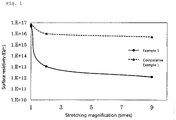
- Fig. 1 is a graph showing the relationship between the stretching magnification and the surface resistivity of the films obtained in Example 1 and Comparative Example 1.
- the polyolefin-based resin composition contains a polyolefin-based resin, a polyalkylene carbonate resin, and a metal salt having a melting point higher than 100°C.
- the polyolefin-based resin refers to a polymer comprising olefin-derived monomer units.
- examples include polyethylene-based resins, polypropylene-based resins, ethylene-carboxylic acid alkenyl ester copolymer resins, ethylene-unsaturated carboxylic acid alkyl ester copolymer resins, polybutene-based resins, poly(4-methyl-1-pentene)-based resins, and the like.
- Examples of preferable polyethylene-based resins include polyethylene.
- the polyethylene is not particularly limited.
- Examples of usable polyethylene include low-density polyethylene, linear low-density polyethylene, medium-density polyethylene, high-density polyethylene, ultrahigh-molecular-weight polyethylene, and the like.
- Examples of preferable polypropylene-based resins include polypropylene, and copolymers of propylene with one or more other olefins.
- Examples of preferable "one or more other olefins” as used herein include ethylene, butene, pentene, hexene, octane, and the like.
- the "one or more other olefins” for use may refer to a single olefin, or a combination of two or more olefins.
- the copolymer may be a block copolymer, a random copolymer, or an alternating copolymer.
- polypropylene-based resin polypropylene, a propylene-ethylene copolymer, a propylene-ethylene-butene copolymer, a propylene-butene copolymer, a propylene-hexene copolymer, a propylene-octene copolymer, and the like are preferable.
- Polypropylene is more preferable.
- Polypropylene is not particularly limited. For example, isotactic polypropylene, syndiotactic polypropylene, and the like can be used.
- Examples of “carboxylic acid alkenyl esters” of ethylene-carboxylic acid alkenyl ester copolymer resins include vinyl acetate, vinyl propionate, vinyl butyrate, isopropenyl acetate, allyl acetate, and the like. Of these, vinyl acetate is preferable. Specifically, as an ethylene-carboxylic acid alkenyl ester copolymer resin, an ethylene-vinyl acetate copolymer is particularly preferable.
- Examples of "unsaturated carboxylic acid alkyl esters" of ethylene-unsaturated carboxylic acid alkyl ester copolymer resins include methyl acrylate, ethyl acrylate, propyl acrylate, methyl methacrylate, ethyl methacrylate, propyl methacrylate, and the like. Of these, methyl acrylate and methyl methacrylate are preferable. Specifically, as an ethylene-unsaturated carboxylic acid alkyl ester copolymer resin, an ethylene-methyl acrylate copolymer and an ethylene-methyl methacrylate copolymer are particularly preferable.
- Polyolefin-based resins can be used singly, or in a combination of two or more.
- polyolefin-based resins polyethylene-based resins or polypropylene-based resins are preferably used from the viewpoint of excellent compatibility with polyalkylene carbonate resins.
- At least one resin selected from the group consisting of polyethylene, polypropylene, and copolymers of propylene with one or more other olefins is more preferable.
- Polyethylene and polypropylene are particularly preferable.
- the method for producing a polyolefin-based resin is not particularly limited. Any known methods may be used. Examples of usable methods include methods comprising radical polymerization of an olefin using an initiator, such as a peroxide; methods comprising polymerization of an olefin using the gas-phase method, the solution method, etc. in the presence of a polymerization catalyst; and the like. Examples of usable polymerization catalysts include Ziegler-Natta catalysts, Phillips catalysts, metallocene catalysts, and the like.
- the molecular weight of the polyolefin-based resin is not particularly limited.
- the mass average molecular weight of the polyolefin-based resin is such that the lower limit is preferably 20,000, and the upper limit is preferably 6,000,000; the lower limit is more preferably 50,000, and the upper limit is more preferably 3,000,000; the lower limit is even more preferably 100,000, and the upper limit is even more preferably 1,000,000.
- the polyolefin-based resin having a mass average molecular weight of 20,000 or more can more preferably enhance the mechanical strength of the resulting polyolefin-based resin composition, and thus ensures practical use.
- the polyolefin-based resin having a mass average molecular weight of 6,000,000 or less makes the process of forming the resulting polyolefin-based resin composition easier.
- the mass average molecular weight is a value calculated by preparing a 0.5% solution of a polyolefin-based resin in 1,2-dichlorobenzene, conducting a measurement by high-performance liquid chromatography, and comparing the measurement result with that of polystyrene with known mass average molecular weight measured under the same conditions.
- the measurement conditions are as follows.
- the resin fluidity may be shown, for example, in terms of the melt flow rate (MFR, unit: g/10 minutes) measured by the method described in JIS K 7210: 1999.
- MFR melt flow rate
- the lower limit of MFR measured at a temperature of 230°C with a load of 2.16 kg by the above method is preferably 0.5, and the upper limit is preferably 100.
- the lower limit of MFR is more preferably 1, and the upper limit of MFR is more preferably 50 (g/10 minutes).
- the obtained polyolefin-based resin composition has a fluidity that is not excessively low, and can be preferably formed into a shape by an extrusion or blowing forming process.
- the obtained polyolefin-based resin composition can be preferably formed into a shape by an injection forming process or the like.
- the amount of the polyolefin-based resin contained in the polyolefin-based resin composition is not particularly limited, and can be suitably selected as long as the effect of the present invention is not impaired.
- the amount of the polyolefin-based resin may be, for example, 50 mass% or more, 60 mass% or more, 70 mass% or more, 80 mass% or more, 90 mass% or more, 95 mass% or more, 99 mass% or more, or 99.9 mass% or more.
- the polyalkylene carbonate resin is not particularly limited. Examples include a polymer obtained by polymerization reaction of alkylene oxide and carbon dioxide (i.e., a copolymer of alkylene oxide and carbon dioxide), and a polymer obtained by ring-opening polymerization of cyclic carbonate. Of these, a polyalkylene carbonate resin obtained by copolymerization of alkylene oxide and carbon dioxide is preferably used.
- the polymerization reaction of alkylene oxide and carbon dioxide can be preferably performed in the presence of a metal catalyst.
- alkylene oxides include ethylene oxide, propylene oxide, 1-butene oxide, 2-butene oxide, isobutylene oxide, 1-pentene oxide, 2-pentene oxide, 1-hexene oxide, 1-octene oxide, 1-decene oxide, cyclopentene oxide, cyclohexene oxide, styrene oxide, vinylcyclohexene oxide, 3-phenylpropylene oxide, 3,3,3-trifluoropropylene oxide, 3-naphthylpropylene oxide, 3-phenoxy propylene oxide, 3-naphthoxy propylene oxide, butadiene monoxide, 3-vinyloxy propylene oxide, 3-trimethylsilyloxy propylene oxide, and the like.
- alkylene oxides from the viewpoint of high polymerization reactivity with carbon dioxide, ethylene oxide and propylene oxide are preferable, and propylene oxide is more preferable.
- Such alkylene oxides may be used singly, or in a combination of two or more.
- metal catalysts examples include aluminum catalysts and zinc catalysts. Of these, from the viewpoint of high polymerization activity in a polymerization reaction of alkylene oxide and carbon dioxide, zinc catalysts are preferably used.
- Examples of zinc catalysts include organozinc catalysts such as zinc acetate, diethylzinc, and dibutylzinc; organozinc catalysts obtained by reacting a zinc compound with a compound such as a primary amine, a divalent phenol, a divalent aromatic carboxylic acid, an aromatic hydroxylic acid, an aliphatic dicarboxylic acid, or an aliphatic monocarboxylic acid; and the like.
- organozinc catalysts those obtained by reacting a zinc compound with an aliphatic dicarboxylic acid and an aliphatic monocarboxylic acid are preferable because of their higher polymerization activity.
- Specific examples of preferable organozinc catalysts include dimethyl zinc, diethyl zinc, and diphenyl zinc.
- the amount of the metal catalyst to be used for the polymerization reaction is such that the lower limit is preferably 0.001 parts by mass, and the upper limit is preferably 20 parts by mass; and the lower limit is more preferably 0.01 parts by mass, and the upper limit is more preferably 10 parts by mass, per 100 parts by mass of alkylene oxide.
- the amount of the metal catalyst is 0.001 parts by mass or more, the polymerization reaction can proceed quickly.
- the amount of the metal catalyst is 20 parts by mass or less, effects that are commensurate with the amount of catalyst used can be obtained.
- the method for the polymerization reaction of alkylene oxide and carbon dioxide in the presence of a metal catalyst is not particularly limited.
- the following method can be used: after alkylene oxide, a metal catalyst, and optionally a reaction solvent are placed in an autoclave and mixed, carbon dioxide is compressed thereinto to allow a reaction to proceed.
- the reaction solvent optionally used in the polymerization reaction is not particularly limited.
- organic solvents can be used. Specific examples include aliphatic hydrocarbon-based solvents, such as pentane, hexane, octane, decane, and cyclohexane; aromatic hydrocarbon-based solvents, such as benzene, toluene, and xylene; halogenated hydrocarbon-based solvents, such as dichloromethane, chloroform, carbon tetrachloride, 1,1-dichloroethane, 1,2-dichloroethane, ethyl chloride, trichloroethane, 1-chloropropane, 2-chloropropane, 1-chlorobutane, 2-chlorobutane, 1-chloro-2-methylpropane, chlorobenzene, and bromobenzene; ether-based solvents such as tetrahydrofuran, 1,3-dioxolan,
- the amount of the reaction solvent is preferably 100 to 10,000 parts by mass per 100 parts by mass of alkylene oxide, from the viewpoint of achieving a smooth reaction.
- the pressure of carbon dioxide used in the polymerization reaction is not particularly limited.
- the lower limit is preferably 0.1 MPa, and the upper limit is preferably 20 MPa; the lower limit is more preferably 0.2 MPa, and the upper limit is more preferably 10 MPa; and the lower limit is even more preferably 0.5 MPa, and the upper limit is even more preferably 5 MPa.
- the polymerization reaction temperature in the polymerization reaction is not particularly limited. However, the polymerization reaction temperature is preferably such that the lower limit is preferably 30°C, and the upper limit is preferably 100°C; and the lower limit is more preferably 40°C, and the upper limit is more preferably 80°C. A polymerization reaction temperature of 30°C or more allows the polymerization reaction to proceed more quickly. A polymerization reaction temperature of 100°C or less can decrease the likelihood of side reactions, and further increase the yield of the polymer.
- the polymerization reaction time cannot be generalized, because it depends on the polymerization reaction temperature, the amount of catalyst, and type of alkylene oxide; however, it is usually preferable that polymerization reaction time is 2 to 40 hours.
- reaction product After completion of the polymerization reaction, the reaction product is separated by filtration or the like, optionally washed with a solvent or the like, and dried to obtain a polyalkylene carbonate resin.
- the polyalkylene carbonate resin used to form the polyolefin-based resin composition may be a single polyalkylene carbonate resin, or a combination of two or more.
- the mass average molecular weight of the polyalkylene carbonate resin is such that the lower limit is preferably 10,000, and the upper limit is preferably 2,000,000; the lower limit is more preferably 30,000, and the upper limit is more preferably 1,000,000; the lower limit is even more preferably 50,000, and the upper limit is even more preferably 750,000.
- the mass average molecular weight is a value calculated by preparing a 0.5% solution of a polyalkylene carbonate resin in N,N-dimethylformamide, conducting a measurement by high-performance liquid chromatography, and comparing the measurement result with that of polystyrene with known mass average molecular weight measured under the same conditions.
- the measurement conditions are as follows.
- the obtained polyolefin-based resin composition can have preferably enhanced mechanical strength.
- the polyalkylene carbonate resin has a mass average molecular weight of 2,000,000 or less, enhanced dispersibility in the polyolefin-based resin can be achieved.
- the polyalkylene carbonate resin content of the polyolefin-based resin composition is such that the lower limit is preferably 0.05 parts by mass and the upper limit is preferably 20 parts by mass; the lower limit is more preferably 0.5 parts by mass and the upper limit is more preferably 17.5 parts by mass; the lower limit is even more preferably 1 part by mass, and the upper limit is even more preferably 15 parts by mass, per 100 parts by mass of the polyolefin-based resin.
- the polyalkylene carbonate resin content is more than 20 parts by mass, the mechanical strength and/or the breaking strain of the polyolefin-based resin composition may slightly decrease.
- the polyalkylene carbonate resin content is less than 0.05 parts by mass, high modification effects of the polyolefin-based resin composition may not be obtained.
- the metal salt having a melting point higher than 100°C is formed from a metal cation and an anion.
- the cation of the metal salt is lithium ion, sodium ion, or potassium ion; and more preferably, for example, lithium ion.
- anion of the metal salt examples include halogen ion,
- carboxylate ion and the like.
- preferable anions include chloride, bromide, iodide, tetrafluoroborate, halophosphate, bis(perfluoroalkyl sulfonyl)amide, and the like.
- the metal salt of the polyolefin-based resin composition is an alkali metal salt as stated in claim 1.
- the combination of the cation and anion of the metal salt is a combination of a cation selected from the group consisting of lithium ion, sodium ion, and potassium ion, and an anion selected from the group consisting of halogen, carboxylate, hexafluorophosphate, tetrafluoroborate, and bis(perfluoroalkyl sulfonyl)amide.
- bis(perfluoroalkyl sulfonyl)amides bis(trifluoromethanesulfonyl)amide is particularly preferable.
- a combination of lithium ion, sodium ion, or potassium ion as a cation, and bis(trifluoromethane sulfonyl)amide or halogen ion (in particular, fluoride ion, chloride ion, bromide ion, or iodide ion) as an anion is particularly preferable.
- the metal salt include lithium bis(trifluoromethane sulfonyl)amide, lithium bromide, potassium iodide, and the like.
- the metal salt content of the polyolefin-based resin composition is such that the lower limit is preferably 0.01 parts by mass, and the upper limit is preferably 10 parts by mass; the lower limit is more preferably 0.1 parts by mass, and the upper limit is more preferably 7.5 parts by mass; and the lower limit is even more preferably 0.5 parts by mass, and the upper limit is even more preferably 5 parts by mass, per 100 parts by mass of polyolefin-based resin.
- the metal salt content is within the above range, the antistatic performance can be enhanced without greatly decreasing other properties of the polyolefin-based resin composition.
- the method for producing the polyolefin-based resin composition is not particularly limited. Examples include a method comprising mixing, in no particular order, a polyolefin-based resin, a polyalkylene carbonate resin, and a metal salt using a Henschel mixer, a ribbon blender, a blender, or the like, and melt-kneading the resulting mixture; a method comprising melt-kneading a polyalkylene carbonate resin and a metal salt beforehand, then mixing the resulting mixture with a polyolefin-based resin, and melt-kneading; and a method comprising dissolving and mixing a polyolefin-based resin, a polyalkylene carbonate resin, and a metal salt in a solvent or the like, and then removing the solvent.
- the method comprising melt-kneading a polyolefin-based resin, a polyalkylene carbonate resin, and a metal salt is preferable from the viewpoint of simplicity of producing the composition as well as capability of producing a homogeneous composition.
- a method comprising preparing a mixture by dissolving a polyalkylene carbonate resin and a metal salt in a solvent, then removing the solvent therefrom, further adding a polyolefin-based resin to the mixture, and melt-kneading is preferably used.
- the solvent used herein can be appropriately selected from suitable organic solvents, and is preferably, for example, acetone.
- the method for melt-kneading a polyolefin-based resin, a polyalkylene carbonate resin, and a metal salt is not particularly limited. Examples include melt-kneading methods using a uniaxial extruder, a biaxial extruder, a Banbury mixer, a kneader, a roll kneader, or the like.
- the shape of the polyolefin-based resin composition is not restricted.
- the polyolefin-based resin composition can be formed into any shape, such as a strand, a sheet, a flat plate, or a pellet. In particular, a pellet is preferable in terms of ease of supplying to a forming machine.
- the polyolefin-based resin composition is preferably a solid composition.
- the polyolefin-based resin composition may comprise other additives as long as the effect of the present invention is not impaired.
- additives include antioxidants; stabilizers such as ultraviolet absorbers and light stabilizers; flame retardants; antistatic agents; antimicrobial agents; nucleating agents; lubricants; anti-blocking agents; colorants; fillers; and the like.
- antioxidants examples include 2,6-di-t-butyl-p-cresol (BHT), 2,2'-methylenebis(4-methyl-6-t-butylphenol), tetrakis[methylene-(3,5-di-t-butyl-4-hydroxyhydrocinnamate)]methane, dilauryl-3,3'-thiodipropionate (DLTDP), distearyl-3,3'-thiodipropionate (DSTDP), triphenyl phosphite (TPP), triisodecyl phosphite (TDP), octylated diphenylamine, N-n-butyl-p-aminophenol, N,N-diisopropyl-p-phenylenediamine, and the like.
- BHT 2,6-di-t-butyl-p-cresol
- DLTDP distearyl-3,3'-thiodipropionate
- TPP tri
- UV absorbers examples include 2-hydroxybenzophenone, 2,4-dihydroxybenzophenone, phenylsalicylate, 2,4-di-t-butylphenyl-3,5-di-t-butyl-4-hydroxybenzoate), 2'-hydroxyphenyl benzotriazole, (2'-hydroxy-5'-methylphenyl)benzotriazole, ethyl-2-cyano-3,3-diphenylacrylate, methyl-2-carbomethoxy-3-(paramethoxybenzyl)acrylate, and the like.
- light stabilizers examples include 2,2,6,6-tetramethyl-4-piperidyl stearate, bis(2,2,6,6-tetramethyl-4-piperidyl)sebacate, tetrakis(2,2,6,6-tetramethyl-4-piperidyl)-1,2,3,4-butane tetracarboxylate, bis(2,2,6,6-tetramethyl-4-piperidyl)-di(tridecyl)-1,2,3,4-butane tetracarboxylate, bis(1,2,2,4,4-pentamethyl-4-piperidyl)-2-butyl-2-(3,5-di-t-butyl-4-hydroxybenzyl)malonate, 1-(2-hydroxyethyl)-2,2,6,6-tetramethyl-4-piperidinol-diethyl succinate polycondensation product, 1,5,8,12-tetrakis[2,4-bis(N-butyl-N-(2,2,6,6
- flame retardants include tricresyl phosphate, tris(2,3-dibromopropyl)phosphate, decabromo biphenylether, tetrabromo bisphenol A, antimony trioxide, magnesium hydroxide, zinc borate, barium metaborate, aluminum hydroxide, red phosphorus, ammonium polyphosphate, HET acid, and the like.
- antistatic agents examples include polyethylene oxide, polypropylene oxide, polyethylene glycol, polyester amide, polyether ester amide, and the like.
- antimicrobial agents examples include 2-bromo-2-nitro-1,3-propanediol, 2,2-dibromo-2-nitroethanol, methylenebis thiocyanate, 1,4-bisbromoacetoxy-2-butene, hexabromodimethyl sulfone, 5-chloro-2,4,6-trifluoroisophthalonitrile, tetrachloroisophthalonitrile, dimethyldithiocarbamate, 4,5-dichloro-1,2-diol-3-one, 3,3,4,4-tetrachlorotetrahydrothiophene-1,1-dioxide, triiodoallyl alcohol, bromonitrostyrene, glutaraldehyde, phthalaldehyde, isophthalaldehyde, terephthalaldehyde, dichloroglyoxime, ⁇ -chlorobenzaldoxime, ⁇ -chlorobenzaldoxime acetate, 1,
- nucleating agents examples include 1,3:2,4-dibenzylidene sorbitol, sodium-2,2'-methylene-bis(4,6-di-t-butylphenyl)phosphate, bis(2,4,8,10-tetra-t-butyl-hydroxy-12H-dibenzo[d,g][1,3,2]dioxaphosphocin-6-oxide), aluminum benzoate, sodium adipate, sodium thiophenecarboxylate, sodium pyrrolecarboxylate, and the like.
- lubricants include liquid paraffin, natural paraffin, micro wax, polyethylene wax, stearic acid, stearamide, palmitic acid amide, methylenebis stearyl amide, butyl stearate, hydrogenated castor oil, ethylene glycol monostearate, and the like.
- anti-blocking agents examples include talc, silica, calcium carbonate, synthetic zeolite, starch, stearic acid bisamide, and the like.
- colorants include inorganic pigments such as titanium oxide, lithopone, white lead, zinc oxide, aureolin, cobalt green, cerulean blue, cobalt blue, cobalt violet, iron oxide, iron blue, chromium oxide, lead chromate, barium chromate, cadmium sulfide, cadmium yellow, and ultramarine; azo pigments such as azo lake-based pigments, monoazo-based pigments, disazo-based pigments, or chelate azo-based pigments; organic pigments such as benzimidazolone-based pigments, phthalocyanine-based pigments, quinacridone-based pigments, dioxazine-based pigments, isoindolinone-based pigments, thioindigo-based pigments, perylene-based pigments, quinophthalone-based pigments, and anthraquinone-based polycyclic pigments; azo-based dyes, anthraquinone-based dyes, indig
- fillers include inorganic fillers such as calcium carbonate, talc, clay, silicic acid, silicate, asbestos, mica, glass fiber, glass balloon, carbon fiber, metal fiber, ceramic whisker, and titanium whisker; and organic fillers such as urea, calcium stearate, organic cross-linked particles (for example, epoxy-based or urethane-based cross-linked particles), cellulose fiber, and wood flour.
- inorganic fillers such as calcium carbonate, talc, clay, silicic acid, silicate, asbestos, mica, glass fiber, glass balloon, carbon fiber, metal fiber, ceramic whisker, and titanium whisker
- organic fillers such as urea, calcium stearate, organic cross-linked particles (for example, epoxy-based or urethane-based cross-linked particles), cellulose fiber, and wood flour.
- Such other additives can be used singly, or in a combination of two or more.
- the amount is such that the lower limit is preferably 0.01 parts by mass, and the upper limit is preferably 100 parts by mass; the lower limit is more preferably 0.5 parts by mass, and the upper limit is more preferably 50 parts by mass; and the lower limit is even more preferably 0.1 parts by mass, and the upper limit is even more preferably 10 parts by mass, per 100 parts by mass of the polyolefin-based resin composition.
- the polyolefin-based resin film is obtained by forming the polyolefin-based resin composition described above into a film shape; in particular, it is a film formed by being stretched at least uniaxially.
- the polyolefin-based resin film is formed by stretching the polyolefin-based composition at least uniaxially, the mechanical properties are maintained and the surface resistivity is significantly reduced, thereby enhancing antistatic performance. This can also reduce problems at the time of use, such as dust adherence.
- the method for producing the polyolefin-based resin film is not particularly limited.
- the polyolefin-based resin film can be obtained, for example, by, after the polyolefin-based resin composition is produced, forming the polyolefin-based resin composition into a film shape by a T-die forming process, an inflation forming process, calendaring, solvent casting, a hot press method, or like methods, and stretching the film at least uniaxially.
- the method for stretching the polyolefin-based resin film at least uniaxially is also not particularly limited.
- a method of mono- or biaxially stretching the polyolefin-based resin film by roll stretching, tenter stretching, tubular stretching, or like methods can be used.
- the polyolefin-based resin film may be stretched while being heated. By heating the film, the film can be evenly stretched at a high stretching magnification.
- the lower limit of the heating temperature is preferably equal to or higher than the glass transition temperature of the polyolefin-based resin, and more preferably at least 30°C higher than the glass transition temperature, even more preferably at least 50°C higher than the glass transition temperature.
- the upper limit of the heating temperature is preferably equal to or lower than the melting point of the polyolefin-based resin, more preferably at least 5°C lower than the melting point, and even more preferably at least 10°C lower than the melting point.
- the direction in which the polyolefin-based resin film is stretched is not particularly limited, and the film may be stretched in any direction.
- the resin film may be stretched in at least either the resin flow direction at the time of forming (MD direction), or the direction perpendicular thereto (TD direction).
- the stretching magnification of the polyolefin-based resin film is not particularly limited.
- the stretching magnification of the polyolefin-based resin film may be in the range of 1.01 to 20
- the polyolefin-based resin composition can be easily formed into a film having no defects, and the polyolefin-based resin film obtained by stretching the composition has excellent antistatic performance.
- the lower limit of the stretching magnification can be suitably set as long as the effect of the present invention is not impaired.
- the lower limit of the stretching magnification may be 1.1, 1.2, 1.3, 1.4, 1.5, 1.6, 1.7, 1.8, 1.9, or 2.
- the upper limit of the stretching magnification can be suitably set insofar as the effect of the present invention is not impaired.
- the upper limit of the stretching magnification may be 10, 9, 8, 7, 6, or 5.
- the lower limit of the stretching magnification is more preferably 1.5 times, particularly preferably 2 times.
- the upper limit of the stretching magnification is more preferably 10 times, and particularly preferably 5 times.
- the stretching magnification in the stretching in at least one of the MD direction and the TD direction is preferably in the range of 1.01 to 20 times from the viewpoint of forming a defect-free film and exhibiting sufficient antistatic performance.
- the lower limit of the stretching magnification in at least one of the MD direction and the TD direction is more preferably 1.5 times, and particularly preferably 2 times.
- the upper limit of the uniaxial stretching magnification in at least one of the MD direction and the TD direction is more preferably 10 times, and particularly preferably 5 times.
- the thickness of the polyolefin-based resin film is not particularly limited.
- the thickness can be 0.01 to 10 mm. If the thickness is within this range, desirable formability can be maintained, and a polyolefin-based resin film with excellent antistatic performance can be more easily obtained.
- the thickness is more preferably 0.05 to 1 mm.
- the polyolefin-based resin film thus stretched has a surface resistivity lower than that of unstretched polyolefin-based resin film.
- the surface resistivity value varies depending on the type of resin, the surface resistivity after stretching is preferably reduced to 1/10 to 1/10000, relative to the surface resistivity before stretching. More specifically, it is preferable that, for example, when the stretching magnification is 2 times, the surface resistivity after stretching is preferably reduced to 1/10 to 1/1000, relative to the surface resistivity before stretching. When the stretching magnification is 9 times, the surface resistivity after stretching is preferably reduced to 1/100 to 1/10000, relative to the surface resistivity before stretching. In such cases, the stretched polyolefin-based resin film has sufficient antistatic performance.
- the domain of the metal salt-containing polyalkylene carbonate resin is linearly deformed by stretching and a conductive path is thereby formed. More specifically, in the polyolefin-based resin composition, the polyalkylene carbonate resin is dispersed in a polyolefin-based resin matrix.
- This dispersion state is confirmed to have a "sea-island structure." Because the polyolefin-based resin composition is in such a dispersion state, when the polyolefin-based resin film is formed without being stretched, a conductive path is difficult to form; accordingly, the surface resistance of the obtained polyolefin-based resin film hardly decreases. In contrast, when the polyolefin-based resin film is stretched, the configuration of the domain of the polyalkylene carbonate resin is stretched to allow easy contact with each other, thereby forming a conductive path mediated by a metal salt in the polyolefin-based resin film. As a result, the surface resistance of the polyolefin-based resin film decreases as compared with that before stretching, whereby the resulting film can exhibit better antistatic performance.
- the polyolefin-based resin film may be used for various purposes, such as wrapping materials, masking materials, packaging materials for electronic components, tape materials, plastic bags, packaging materials for pharmaceuticals or sundries, plastic wraps for foods, transportation packaging materials, and the like.
- the polyolefin-based resin film may also be used as a lamination film obtained by bonding the film to paper, non-woven fabric, cellophane, or the like. Further, the polyolefin-based resin film may also be used as a label to be attached to other plastic resin shaped articles.
- the temperature was then raised to 110°C, and the mixture was stirred at the same temperature for 2 hours and subjected to azeotropic dehydration to remove water.
- the reaction mixture was then cooled to room temperature to obtain a slurry containing an organozinc catalyst.
- the reaction mixture was filtered and then dried under reduced pressure to obtain 40 g of polypropylene carbonate.
- the mass average molecular weight is a value calculated by preparing a 0.5% solution of polypropylene carbonate in N,N-dimethylformamide, conducting a measurement by high-performance liquid chromatography, and comparing the measurement result with that of polystyrene with known mass average molecular weight measured under the same conditions.
- the measurement conditions are as follows.
- Li-TSFA lithium bis(trifluoromethane sulfonyl)amide
- the obtained polyolefin-based resin composition was processed using a desktop hot press (manufactured by Techno Supply Co., Ltd.) at a press temperature of 210°C and a press pressure of 20 MPa to obtain a sheet-shaped article with a thickness of 0.2 mm.
- the resulting sheet-shaped article was stretched in the MD direction using a "MODEL 4466" Instron tensile testing machine at 25°C and 120 mm/min to obtain three types of sheets having stretching magnifications of 1.5, 2, and 5 times.
- three polyolefin-based resin films having thicknesses of 0.18 mm (1.5 times), 0.15 mm (2 times), and 0.04 mm (5 times) were obtained.
- a polyolefin-based resin composition was obtained in the same manner as in Example 1, except that the amount of the metal salt-containing polypropylene carbonate was changed to 0.75 g and the amount of the high-density polyethylene was changed to 4.25 g.
- LiBr lithium bromide
- the obtained polyolefin-based resin composition was processed using a desktop hot press (manufactured by Techno Supply Co., Ltd.) at a press temperature of 210°C and a press pressure of 20 MPa to obtain a sheet-shaped article with a thickness of 0.2 mm.
- the resulting sheet-shaped article was stretched in the MD direction using a "MODEL 4466" Instron tensile testing machine at 25°C and 120 mm/min to obtain three types of sheets having stretching magnifications of 1.5, 2, and 8 times.
- three polyolefin-based resin films having thicknesses of 0.18 mm (1.5 times), 0.15 mm (2 times), and 0.03 mm (8 times) were obtained.
- a polyolefin-based resin composition was obtained in the same manner as in Example 1, except that the type of metal salt was changed to potassium iodide (hereinafter referred to as KI, melting point: 681°C).
- KI potassium iodide
- a polyolefin-based resin composition and a polyolefin-based resin film were obtained by kneading polyethylene alone under the same conditions as in Example 1.
- a polyolefin-based resin composition and a polyolefin-based resin film were obtained by kneading under the same conditions as in Example 1, except that no metal salt was used.
- the surface resistivity was measured according to JIS K 6911: 1995 using the following measuring device.
- Table 1 shows the measurement results of surface resistivity of the polyolefin-based resin films having stretching magnifications of 1.5, 2, and 9 times, obtained in Examples 1 to 4 and Comparative Examples 1 and 2.
- Table 4 also shows the measurement results of the surface resistivity of an unstretched polyolefin-based resin film (magnification: x 1).
- Fig. 1 shows the relationship between the stretching magnification and surface resistivity of the films obtained in Example 1 and Comparative Example 1.
- the polyolefin-based resin film of the present invention has excellent antistatic performance. Therefore, in addition to conventional uses of polyolefin-based resin films, the polyolefin-based resin film of the present invention can also be used, for example, as wrapping materials for electronic materials etc., in which polyolefin-based resin films had only limited use because of the necessary avoidance of electrostatic discharge or dust adherence.
Landscapes
- Chemical & Material Sciences (AREA)
- Health & Medical Sciences (AREA)
- Chemical Kinetics & Catalysis (AREA)
- Medicinal Chemistry (AREA)
- Polymers & Plastics (AREA)
- Organic Chemistry (AREA)
- Engineering & Computer Science (AREA)
- Mechanical Engineering (AREA)
- Manufacturing & Machinery (AREA)
- Materials Engineering (AREA)
- Compositions Of Macromolecular Compounds (AREA)
- Manufacture Of Macromolecular Shaped Articles (AREA)
Claims (6)
- Eine Harzzusammensetzung auf Polyolefinbasis, umfassend ein Harz auf Polyolefinbasis, ein Polyalkylencarbonatharz und ein Metallsalz mit einem Schmelzpunkt von höher als 100°C, wobei das Metallsalz mit einem Schmelzpunkt von höher als 100°C aus einem Metallkation und einem Anion gebildet ist und das Kation ausgewählt ist aus der Gruppe bestehend aus Lithiumion, Natriumion und Kaliumion, und das Anion ausgewählt ist aus der Gruppe bestehend aus Halogen, Carboxylat, Hexafluorphosphat, Tetrafluorborat und Bis(perfluoralkylsulfonyl)amid.
- Die Harzzusammensetzung auf Polyolefinbasis gemäß Anspruch 1, wobei das Polyalkylencarbonatharz in einer Menge von 0,05 bis 20 Massenteilen vorliegt und das Metallsalz mit einem Schmelzpunkt von höher als 100°C in einer Menge von 0,01 bis 5 Massenteilen vorliegt, bezogen auf 100 Massenteile des Harzes auf Polyolefinbasis.
- Die Harzzusammensetzung auf Polyolefinbasis gemäß Anspruch 1 oder 2, wobei das Polyalkylencarbonatharz ein Polypropylencarbonat ist.
- Die Harzzusammensetzung auf Polyolefinbasis gemäß einem der Ansprüche 1 bis 3, wobei das Harz auf Polyolefinbasis Polyethylen ist.
- Ein Harzfilm auf Polyolefinbasis, gebildet unter Verwendung der Harzzusammensetzung auf Polyolefinbasis gemäß einem der Ansprüche 1 bis 4, wobei der Film mindestens uniaxial gestreckt ist.
- Der Harzfilm auf Polyolefinbasis gemäß Anspruch 5, wobei die uniaxiale Streckvergrößerung im Bereich von 1,01 bis 20 liegt.
Applications Claiming Priority (2)
| Application Number | Priority Date | Filing Date | Title |
|---|---|---|---|
| JP2016027120 | 2016-02-16 | ||
| PCT/JP2017/005227 WO2017141886A1 (ja) | 2016-02-16 | 2017-02-14 | ポリオレフィン系樹脂組成物及びポリオレフィン系樹脂フィルム |
Publications (3)
| Publication Number | Publication Date |
|---|---|
| EP3418329A1 EP3418329A1 (de) | 2018-12-26 |
| EP3418329A4 EP3418329A4 (de) | 2019-09-25 |
| EP3418329B1 true EP3418329B1 (de) | 2022-08-17 |
Family
ID=59625096
Family Applications (1)
| Application Number | Title | Priority Date | Filing Date |
|---|---|---|---|
| EP17753143.1A Active EP3418329B1 (de) | 2016-02-16 | 2017-02-14 | Harzzusammensetzung auf polyolefin-basis und harzfilm auf polyolefin-basis |
Country Status (7)
| Country | Link |
|---|---|
| US (1) | US20200263007A1 (de) |
| EP (1) | EP3418329B1 (de) |
| JP (1) | JP6944157B2 (de) |
| KR (1) | KR20180107132A (de) |
| CN (1) | CN108699299B (de) |
| TW (1) | TWI739801B (de) |
| WO (1) | WO2017141886A1 (de) |
Families Citing this family (2)
| Publication number | Priority date | Publication date | Assignee | Title |
|---|---|---|---|---|
| WO2020158476A1 (ja) * | 2019-01-29 | 2020-08-06 | 三井・ダウ ポリケミカル株式会社 | 樹脂組成物及び成形体 |
| CN110105667A (zh) * | 2019-05-27 | 2019-08-09 | 王飞 | 用于汽车内饰件的玻璃纤维增强聚丙烯塑料及其生产工艺 |
Family Cites Families (12)
| Publication number | Priority date | Publication date | Assignee | Title |
|---|---|---|---|---|
| CN101443404B (zh) * | 2006-03-16 | 2012-07-18 | 大科能树脂有限公司 | 抗静电树脂组合物和模制品 |
| JP2010138326A (ja) * | 2008-12-12 | 2010-06-24 | Toudai Tlo Ltd | ポリアルキレンカーボネート樹脂組成物及び当該組成物から成形された成形体 |
| WO2011026171A1 (en) * | 2009-09-03 | 2011-03-10 | Tristano Pty Ltd | Polymer/thermoplastic starch compositions |
| SI2627713T1 (sl) * | 2010-10-11 | 2019-11-29 | Novomer Inc | Polimerne mešanice |
| CN101987897A (zh) * | 2010-10-15 | 2011-03-23 | 金发科技股份有限公司 | 一种永久性抗静电模塑组合物及其制备方法 |
| GB201111929D0 (en) * | 2011-07-12 | 2011-08-24 | Norner As | Polycarbonat blends |
| US20140005624A1 (en) * | 2012-06-27 | 2014-01-02 | Kimberly-Clark Worldwide, Inc. | Film Containing a Polyalkylene Carbonate |
| JP2014058610A (ja) * | 2012-09-14 | 2014-04-03 | Tsubakuro Kagaku Kogyo Kk | 樹脂成形体 |
| CN103242635A (zh) * | 2013-04-27 | 2013-08-14 | 上虞市佳华高分子材料有限公司 | 一种永久抗静电透明聚碳酸酯组合物及其制备方法 |
| US20170253733A1 (en) * | 2014-08-29 | 2017-09-07 | National University Corporation Kanazawa University | Polyolefin resin composition, molding, and polyolefin resin film |
| BR102015027108B1 (pt) * | 2014-10-27 | 2021-01-12 | China Petroleum & Chemical Corporation | composição de polietileno, e, película |
| WO2017119330A1 (ja) * | 2016-01-04 | 2017-07-13 | 住友精化株式会社 | 樹脂表面粗化用組成物 |
-
2017
- 2017-02-14 KR KR1020187022550A patent/KR20180107132A/ko not_active Ceased
- 2017-02-14 EP EP17753143.1A patent/EP3418329B1/de active Active
- 2017-02-14 US US15/998,647 patent/US20200263007A1/en not_active Abandoned
- 2017-02-14 WO PCT/JP2017/005227 patent/WO2017141886A1/ja not_active Ceased
- 2017-02-14 JP JP2018500111A patent/JP6944157B2/ja not_active Expired - Fee Related
- 2017-02-14 CN CN201780011475.2A patent/CN108699299B/zh not_active Expired - Fee Related
- 2017-02-15 TW TW106104864A patent/TWI739801B/zh not_active IP Right Cessation
Non-Patent Citations (1)
| Title |
|---|
| JOSEPH R WEBSTER: "The Perception of Metallic Stearates as Acid Acceptors", 3 October 2006 (2006-10-03), XP055683818, Retrieved from the Internet <URL:http://www.stabilization-technologies.com/attachments/File/The_Perception_Of_Metallic_Stearates_As_Acid_Acceptors_Revised.pdf> [retrieved on 20200407] * |
Also Published As
| Publication number | Publication date |
|---|---|
| TW201734119A (zh) | 2017-10-01 |
| EP3418329A1 (de) | 2018-12-26 |
| JPWO2017141886A1 (ja) | 2018-12-06 |
| CN108699299A (zh) | 2018-10-23 |
| EP3418329A4 (de) | 2019-09-25 |
| CN108699299B (zh) | 2021-03-12 |
| TWI739801B (zh) | 2021-09-21 |
| KR20180107132A (ko) | 2018-10-01 |
| WO2017141886A1 (ja) | 2017-08-24 |
| JP6944157B2 (ja) | 2021-10-06 |
| US20200263007A1 (en) | 2020-08-20 |
Similar Documents
| Publication | Publication Date | Title |
|---|---|---|
| EP0502420B1 (de) | Thermoplastische Kunstharzzusammensetzung | |
| EP3527617B1 (de) | Polyolefinharzzusammensetzung und formartikel damit | |
| EP3204451B1 (de) | Vernetzbare zusammensetzung mit polyethylen und verwendung davon zum rotationsformen | |
| TWI818113B (zh) | 聚烯烴系樹脂用核劑、含有其之聚烯烴系樹脂用核劑組成物、聚烯烴系樹脂用母料、聚烯烴系樹脂組成物、其成形品、其薄膜、多孔質薄膜之製造方法及包裝體 | |
| US20200095410A1 (en) | Polyolefin resin composition, molding, and polyolefin resin film | |
| KR20210067265A (ko) | 수축필름용 폴리프로필렌 수지 조성물 및 이를 이용하여 제조된 수축필름 | |
| JP2019163379A (ja) | 変性ビニルアルコール系樹脂 | |
| EP3418329A1 (de) | Auf polyolefin basierende harzzusammensetzung, form und auf polyolefin basierender harzfilm | |
| JP2017114927A (ja) | 帯電防止性樹脂組成物 | |
| EP2990439B1 (de) | Polyolefin basierte harzzusammensetzung | |
| JP6652842B2 (ja) | 帯電防止性熱可塑性樹脂組成物およびそれを成形してなる成形体 | |
| JP5190349B2 (ja) | 押出し成形用ポリエチレン系樹脂、その製造方法、及び得られる押出し成形品 | |
| CN111073123A (zh) | 一种聚乙烯母料及制备方法、聚乙烯组合物 | |
| CN112693203A (zh) | 一种缠绕膜及其制备方法 | |
| KR102155352B1 (ko) | 폴리올레핀계 수지 조성물 | |
| JP5346823B2 (ja) | ポリプロピレン系改質樹脂組成物の製造方法、ポリプロピレン系改質樹脂組成物 | |
| CN119213080A (zh) | 树脂组合物、树脂添加剂组合物、树脂结构体、耐候性提高方法、树脂组合物的制造方法和受阻胺系光稳定剂 | |
| EP4692227A1 (de) | Ethylen-vinylalkohol-copolymerzusammensetzung und herstellungsverfahren dafür, pellet, mehrschichtige struktur und herstellungsverfahren dafür | |
| JPS63135444A (ja) | 結晶化ポリエステル成形品及びその製造方法 | |
| CN108912468A (zh) | 一种抗老化气泡膜及其成型工艺 |
Legal Events
| Date | Code | Title | Description |
|---|---|---|---|
| STAA | Information on the status of an ep patent application or granted ep patent |
Free format text: STATUS: THE INTERNATIONAL PUBLICATION HAS BEEN MADE |
|
| PUAI | Public reference made under article 153(3) epc to a published international application that has entered the european phase |
Free format text: ORIGINAL CODE: 0009012 |
|
| STAA | Information on the status of an ep patent application or granted ep patent |
Free format text: STATUS: REQUEST FOR EXAMINATION WAS MADE |
|
| 17P | Request for examination filed |
Effective date: 20180917 |
|
| AK | Designated contracting states |
Kind code of ref document: A1 Designated state(s): AL AT BE BG CH CY CZ DE DK EE ES FI FR GB GR HR HU IE IS IT LI LT LU LV MC MK MT NL NO PL PT RO RS SE SI SK SM TR |
|
| AX | Request for extension of the european patent |
Extension state: BA ME |
|
| DAV | Request for validation of the european patent (deleted) | ||
| DAX | Request for extension of the european patent (deleted) | ||
| REG | Reference to a national code |
Ref country code: DE Ref legal event code: R079 Ref document number: 602017060759 Country of ref document: DE Free format text: PREVIOUS MAIN CLASS: C08L0023000000 Ipc: B29C0055000000 |
|
| A4 | Supplementary search report drawn up and despatched |
Effective date: 20190822 |
|
| RIC1 | Information provided on ipc code assigned before grant |
Ipc: B65D 85/86 20060101ALI20190816BHEP Ipc: C08K 5/56 20060101ALI20190816BHEP Ipc: C08L 23/00 20060101ALI20190816BHEP Ipc: B29C 55/04 20060101ALI20190816BHEP Ipc: B29C 55/00 20060101AFI20190816BHEP Ipc: C08K 3/00 20180101ALI20190816BHEP Ipc: C08L 69/00 20060101ALI20190816BHEP |
|
| STAA | Information on the status of an ep patent application or granted ep patent |
Free format text: STATUS: EXAMINATION IS IN PROGRESS |
|
| 17Q | First examination report despatched |
Effective date: 20200603 |
|
| GRAP | Despatch of communication of intention to grant a patent |
Free format text: ORIGINAL CODE: EPIDOSNIGR1 |
|
| STAA | Information on the status of an ep patent application or granted ep patent |
Free format text: STATUS: GRANT OF PATENT IS INTENDED |
|
| INTG | Intention to grant announced |
Effective date: 20220307 |
|
| GRAS | Grant fee paid |
Free format text: ORIGINAL CODE: EPIDOSNIGR3 |
|
| GRAA | (expected) grant |
Free format text: ORIGINAL CODE: 0009210 |
|
| STAA | Information on the status of an ep patent application or granted ep patent |
Free format text: STATUS: THE PATENT HAS BEEN GRANTED |
|
| AK | Designated contracting states |
Kind code of ref document: B1 Designated state(s): AL AT BE BG CH CY CZ DE DK EE ES FI FR GB GR HR HU IE IS IT LI LT LU LV MC MK MT NL NO PL PT RO RS SE SI SK SM TR |
|
| REG | Reference to a national code |
Ref country code: CH Ref legal event code: EP |
|
| REG | Reference to a national code |
Ref country code: DE Ref legal event code: R096 Ref document number: 602017060759 Country of ref document: DE |
|
| REG | Reference to a national code |
Ref country code: IE Ref legal event code: FG4D |
|
| REG | Reference to a national code |
Ref country code: AT Ref legal event code: REF Ref document number: 1511906 Country of ref document: AT Kind code of ref document: T Effective date: 20220915 |
|
| REG | Reference to a national code |
Ref country code: NL Ref legal event code: MP Effective date: 20220817 |
|
| REG | Reference to a national code |
Ref country code: LT Ref legal event code: MG9D |
|
| PG25 | Lapsed in a contracting state [announced via postgrant information from national office to epo] |
Ref country code: SE Free format text: LAPSE BECAUSE OF FAILURE TO SUBMIT A TRANSLATION OF THE DESCRIPTION OR TO PAY THE FEE WITHIN THE PRESCRIBED TIME-LIMIT Effective date: 20220817 Ref country code: RS Free format text: LAPSE BECAUSE OF FAILURE TO SUBMIT A TRANSLATION OF THE DESCRIPTION OR TO PAY THE FEE WITHIN THE PRESCRIBED TIME-LIMIT Effective date: 20220817 Ref country code: PT Free format text: LAPSE BECAUSE OF FAILURE TO SUBMIT A TRANSLATION OF THE DESCRIPTION OR TO PAY THE FEE WITHIN THE PRESCRIBED TIME-LIMIT Effective date: 20221219 Ref country code: NO Free format text: LAPSE BECAUSE OF FAILURE TO SUBMIT A TRANSLATION OF THE DESCRIPTION OR TO PAY THE FEE WITHIN THE PRESCRIBED TIME-LIMIT Effective date: 20221117 Ref country code: NL Free format text: LAPSE BECAUSE OF FAILURE TO SUBMIT A TRANSLATION OF THE DESCRIPTION OR TO PAY THE FEE WITHIN THE PRESCRIBED TIME-LIMIT Effective date: 20220817 Ref country code: LV Free format text: LAPSE BECAUSE OF FAILURE TO SUBMIT A TRANSLATION OF THE DESCRIPTION OR TO PAY THE FEE WITHIN THE PRESCRIBED TIME-LIMIT Effective date: 20220817 Ref country code: LT Free format text: LAPSE BECAUSE OF FAILURE TO SUBMIT A TRANSLATION OF THE DESCRIPTION OR TO PAY THE FEE WITHIN THE PRESCRIBED TIME-LIMIT Effective date: 20220817 Ref country code: FI Free format text: LAPSE BECAUSE OF FAILURE TO SUBMIT A TRANSLATION OF THE DESCRIPTION OR TO PAY THE FEE WITHIN THE PRESCRIBED TIME-LIMIT Effective date: 20220817 |
|
| REG | Reference to a national code |
Ref country code: AT Ref legal event code: MK05 Ref document number: 1511906 Country of ref document: AT Kind code of ref document: T Effective date: 20220817 |
|
| PG25 | Lapsed in a contracting state [announced via postgrant information from national office to epo] |
Ref country code: PL Free format text: LAPSE BECAUSE OF FAILURE TO SUBMIT A TRANSLATION OF THE DESCRIPTION OR TO PAY THE FEE WITHIN THE PRESCRIBED TIME-LIMIT Effective date: 20220817 Ref country code: IS Free format text: LAPSE BECAUSE OF FAILURE TO SUBMIT A TRANSLATION OF THE DESCRIPTION OR TO PAY THE FEE WITHIN THE PRESCRIBED TIME-LIMIT Effective date: 20221217 Ref country code: HR Free format text: LAPSE BECAUSE OF FAILURE TO SUBMIT A TRANSLATION OF THE DESCRIPTION OR TO PAY THE FEE WITHIN THE PRESCRIBED TIME-LIMIT Effective date: 20220817 Ref country code: GR Free format text: LAPSE BECAUSE OF FAILURE TO SUBMIT A TRANSLATION OF THE DESCRIPTION OR TO PAY THE FEE WITHIN THE PRESCRIBED TIME-LIMIT Effective date: 20221118 |
|
| PG25 | Lapsed in a contracting state [announced via postgrant information from national office to epo] |
Ref country code: SM Free format text: LAPSE BECAUSE OF FAILURE TO SUBMIT A TRANSLATION OF THE DESCRIPTION OR TO PAY THE FEE WITHIN THE PRESCRIBED TIME-LIMIT Effective date: 20220817 Ref country code: RO Free format text: LAPSE BECAUSE OF FAILURE TO SUBMIT A TRANSLATION OF THE DESCRIPTION OR TO PAY THE FEE WITHIN THE PRESCRIBED TIME-LIMIT Effective date: 20220817 Ref country code: ES Free format text: LAPSE BECAUSE OF FAILURE TO SUBMIT A TRANSLATION OF THE DESCRIPTION OR TO PAY THE FEE WITHIN THE PRESCRIBED TIME-LIMIT Effective date: 20220817 Ref country code: DK Free format text: LAPSE BECAUSE OF FAILURE TO SUBMIT A TRANSLATION OF THE DESCRIPTION OR TO PAY THE FEE WITHIN THE PRESCRIBED TIME-LIMIT Effective date: 20220817 Ref country code: CZ Free format text: LAPSE BECAUSE OF FAILURE TO SUBMIT A TRANSLATION OF THE DESCRIPTION OR TO PAY THE FEE WITHIN THE PRESCRIBED TIME-LIMIT Effective date: 20220817 Ref country code: AT Free format text: LAPSE BECAUSE OF FAILURE TO SUBMIT A TRANSLATION OF THE DESCRIPTION OR TO PAY THE FEE WITHIN THE PRESCRIBED TIME-LIMIT Effective date: 20220817 |
|
| REG | Reference to a national code |
Ref country code: DE Ref legal event code: R097 Ref document number: 602017060759 Country of ref document: DE |
|
| PG25 | Lapsed in a contracting state [announced via postgrant information from national office to epo] |
Ref country code: SK Free format text: LAPSE BECAUSE OF FAILURE TO SUBMIT A TRANSLATION OF THE DESCRIPTION OR TO PAY THE FEE WITHIN THE PRESCRIBED TIME-LIMIT Effective date: 20220817 Ref country code: EE Free format text: LAPSE BECAUSE OF FAILURE TO SUBMIT A TRANSLATION OF THE DESCRIPTION OR TO PAY THE FEE WITHIN THE PRESCRIBED TIME-LIMIT Effective date: 20220817 |
|
| PGFP | Annual fee paid to national office [announced via postgrant information from national office to epo] |
Ref country code: DE Payment date: 20221230 Year of fee payment: 7 |
|
| PLBE | No opposition filed within time limit |
Free format text: ORIGINAL CODE: 0009261 |
|
| STAA | Information on the status of an ep patent application or granted ep patent |
Free format text: STATUS: NO OPPOSITION FILED WITHIN TIME LIMIT |
|
| PG25 | Lapsed in a contracting state [announced via postgrant information from national office to epo] |
Ref country code: AL Free format text: LAPSE BECAUSE OF FAILURE TO SUBMIT A TRANSLATION OF THE DESCRIPTION OR TO PAY THE FEE WITHIN THE PRESCRIBED TIME-LIMIT Effective date: 20220817 |
|
| 26N | No opposition filed |
Effective date: 20230519 |
|
| PG25 | Lapsed in a contracting state [announced via postgrant information from national office to epo] |
Ref country code: SI Free format text: LAPSE BECAUSE OF FAILURE TO SUBMIT A TRANSLATION OF THE DESCRIPTION OR TO PAY THE FEE WITHIN THE PRESCRIBED TIME-LIMIT Effective date: 20220817 |
|
| PG25 | Lapsed in a contracting state [announced via postgrant information from national office to epo] |
Ref country code: MC Free format text: LAPSE BECAUSE OF FAILURE TO SUBMIT A TRANSLATION OF THE DESCRIPTION OR TO PAY THE FEE WITHIN THE PRESCRIBED TIME-LIMIT Effective date: 20220817 |
|
| REG | Reference to a national code |
Ref country code: CH Ref legal event code: PL |
|
| REG | Reference to a national code |
Ref country code: BE Ref legal event code: MM Effective date: 20230228 |
|
| GBPC | Gb: european patent ceased through non-payment of renewal fee |
Effective date: 20230214 |
|
| PG25 | Lapsed in a contracting state [announced via postgrant information from national office to epo] |
Ref country code: LU Free format text: LAPSE BECAUSE OF NON-PAYMENT OF DUE FEES Effective date: 20230214 Ref country code: LI Free format text: LAPSE BECAUSE OF NON-PAYMENT OF DUE FEES Effective date: 20230228 Ref country code: CH Free format text: LAPSE BECAUSE OF NON-PAYMENT OF DUE FEES Effective date: 20230228 |
|
| REG | Reference to a national code |
Ref country code: IE Ref legal event code: MM4A |
|
| PG25 | Lapsed in a contracting state [announced via postgrant information from national office to epo] |
Ref country code: GB Free format text: LAPSE BECAUSE OF NON-PAYMENT OF DUE FEES Effective date: 20230214 |
|
| PG25 | Lapsed in a contracting state [announced via postgrant information from national office to epo] |
Ref country code: IE Free format text: LAPSE BECAUSE OF NON-PAYMENT OF DUE FEES Effective date: 20230214 Ref country code: GB Free format text: LAPSE BECAUSE OF NON-PAYMENT OF DUE FEES Effective date: 20230214 Ref country code: FR Free format text: LAPSE BECAUSE OF NON-PAYMENT OF DUE FEES Effective date: 20230228 |
|
| PG25 | Lapsed in a contracting state [announced via postgrant information from national office to epo] |
Ref country code: BE Free format text: LAPSE BECAUSE OF NON-PAYMENT OF DUE FEES Effective date: 20230228 |
|
| PG25 | Lapsed in a contracting state [announced via postgrant information from national office to epo] |
Ref country code: IT Free format text: LAPSE BECAUSE OF FAILURE TO SUBMIT A TRANSLATION OF THE DESCRIPTION OR TO PAY THE FEE WITHIN THE PRESCRIBED TIME-LIMIT Effective date: 20220817 |
|
| REG | Reference to a national code |
Ref country code: DE Ref legal event code: R119 Ref document number: 602017060759 Country of ref document: DE |
|
| PG25 | Lapsed in a contracting state [announced via postgrant information from national office to epo] |
Ref country code: BG Free format text: LAPSE BECAUSE OF FAILURE TO SUBMIT A TRANSLATION OF THE DESCRIPTION OR TO PAY THE FEE WITHIN THE PRESCRIBED TIME-LIMIT Effective date: 20220817 |
|
| PG25 | Lapsed in a contracting state [announced via postgrant information from national office to epo] |
Ref country code: BG Free format text: LAPSE BECAUSE OF FAILURE TO SUBMIT A TRANSLATION OF THE DESCRIPTION OR TO PAY THE FEE WITHIN THE PRESCRIBED TIME-LIMIT Effective date: 20220817 |
|
| PG25 | Lapsed in a contracting state [announced via postgrant information from national office to epo] |
Ref country code: DE Free format text: LAPSE BECAUSE OF NON-PAYMENT OF DUE FEES Effective date: 20240903 |
|
| PG25 | Lapsed in a contracting state [announced via postgrant information from national office to epo] |
Ref country code: DE Free format text: LAPSE BECAUSE OF NON-PAYMENT OF DUE FEES Effective date: 20240903 |
|
| PG25 | Lapsed in a contracting state [announced via postgrant information from national office to epo] |
Ref country code: CY Free format text: LAPSE BECAUSE OF FAILURE TO SUBMIT A TRANSLATION OF THE DESCRIPTION OR TO PAY THE FEE WITHIN THE PRESCRIBED TIME-LIMIT; INVALID AB INITIO Effective date: 20170214 |
|
| PG25 | Lapsed in a contracting state [announced via postgrant information from national office to epo] |
Ref country code: HU Free format text: LAPSE BECAUSE OF FAILURE TO SUBMIT A TRANSLATION OF THE DESCRIPTION OR TO PAY THE FEE WITHIN THE PRESCRIBED TIME-LIMIT; INVALID AB INITIO Effective date: 20170214 |
|
| PG25 | Lapsed in a contracting state [announced via postgrant information from national office to epo] |
Ref country code: TR Free format text: LAPSE BECAUSE OF FAILURE TO SUBMIT A TRANSLATION OF THE DESCRIPTION OR TO PAY THE FEE WITHIN THE PRESCRIBED TIME-LIMIT Effective date: 20220817 |