EP3418990A1 - Système et procédé pour améliorer l'intimité des maisons et d'autres bâtiments ayant un système de sécurité/commande de maison connectée et soumis à des intrusions de véhicules aériens sans pilote - Google Patents
Système et procédé pour améliorer l'intimité des maisons et d'autres bâtiments ayant un système de sécurité/commande de maison connectée et soumis à des intrusions de véhicules aériens sans pilote Download PDFInfo
- Publication number
- EP3418990A1 EP3418990A1 EP18175581.0A EP18175581A EP3418990A1 EP 3418990 A1 EP3418990 A1 EP 3418990A1 EP 18175581 A EP18175581 A EP 18175581A EP 3418990 A1 EP3418990 A1 EP 3418990A1
- Authority
- EP
- European Patent Office
- Prior art keywords
- drone
- privacy
- condition
- detector
- processor
- Prior art date
- Legal status (The legal status is an assumption and is not a legal conclusion. Google has not performed a legal analysis and makes no representation as to the accuracy of the status listed.)
- Granted
Links
Images


Classifications
-
- G—PHYSICS
- G08—SIGNALLING
- G08B—SIGNALLING SYSTEMS, e.g. PERSONAL CALLING SYSTEMS; ORDER TELEGRAPHS; ALARM SYSTEMS
- G08B13/00—Burglar, theft or intruder alarms
- G08B13/18—Actuation by interference with heat, light, or radiation of shorter wavelength; Actuation by intruding sources of heat, light, or radiation of shorter wavelength
- G08B13/189—Actuation by interference with heat, light, or radiation of shorter wavelength; Actuation by intruding sources of heat, light, or radiation of shorter wavelength using passive radiation detection systems
- G08B13/194—Actuation by interference with heat, light, or radiation of shorter wavelength; Actuation by intruding sources of heat, light, or radiation of shorter wavelength using passive radiation detection systems using image scanning and comparing systems
- G08B13/196—Actuation by interference with heat, light, or radiation of shorter wavelength; Actuation by intruding sources of heat, light, or radiation of shorter wavelength using passive radiation detection systems using image scanning and comparing systems using television cameras
- G08B13/19654—Details concerning communication with a camera
-
- G—PHYSICS
- G05—CONTROLLING; REGULATING
- G05B—CONTROL OR REGULATING SYSTEMS IN GENERAL; FUNCTIONAL ELEMENTS OF SUCH SYSTEMS; MONITORING OR TESTING ARRANGEMENTS FOR SUCH SYSTEMS OR ELEMENTS
- G05B19/00—Program-control systems
- G05B19/02—Program-control systems electric
- G05B19/04—Program control other than numerical control, i.e. in sequence controllers or logic controllers
- G05B19/042—Program control other than numerical control, i.e. in sequence controllers or logic controllers using digital processors
-
- G—PHYSICS
- G08—SIGNALLING
- G08B—SIGNALLING SYSTEMS, e.g. PERSONAL CALLING SYSTEMS; ORDER TELEGRAPHS; ALARM SYSTEMS
- G08B13/00—Burglar, theft or intruder alarms
- G08B13/18—Actuation by interference with heat, light, or radiation of shorter wavelength; Actuation by intruding sources of heat, light, or radiation of shorter wavelength
- G08B13/189—Actuation by interference with heat, light, or radiation of shorter wavelength; Actuation by intruding sources of heat, light, or radiation of shorter wavelength using passive radiation detection systems
- G08B13/194—Actuation by interference with heat, light, or radiation of shorter wavelength; Actuation by intruding sources of heat, light, or radiation of shorter wavelength using passive radiation detection systems using image scanning and comparing systems
- G08B13/196—Actuation by interference with heat, light, or radiation of shorter wavelength; Actuation by intruding sources of heat, light, or radiation of shorter wavelength using passive radiation detection systems using image scanning and comparing systems using television cameras
- G08B13/19639—Details of the system layout
-
- G—PHYSICS
- G05—CONTROLLING; REGULATING
- G05B—CONTROL OR REGULATING SYSTEMS IN GENERAL; FUNCTIONAL ELEMENTS OF SUCH SYSTEMS; MONITORING OR TESTING ARRANGEMENTS FOR SUCH SYSTEMS OR ELEMENTS
- G05B15/00—Systems controlled by a computer
- G05B15/02—Systems controlled by a computer electric
-
- G—PHYSICS
- G05—CONTROLLING; REGULATING
- G05B—CONTROL OR REGULATING SYSTEMS IN GENERAL; FUNCTIONAL ELEMENTS OF SUCH SYSTEMS; MONITORING OR TESTING ARRANGEMENTS FOR SUCH SYSTEMS OR ELEMENTS
- G05B19/00—Program-control systems
- G05B19/02—Program-control systems electric
- G05B19/418—Total factory control, i.e. centrally controlling a plurality of machines, e.g. direct or distributed numerical control [DNC], flexible manufacturing systems [FMS], integrated manufacturing systems [IMS] or computer integrated manufacturing [CIM]
- G05B19/4185—Total factory control, i.e. centrally controlling a plurality of machines, e.g. direct or distributed numerical control [DNC], flexible manufacturing systems [FMS], integrated manufacturing systems [IMS] or computer integrated manufacturing [CIM] characterised by the network communication
- G05B19/4186—Total factory control, i.e. centrally controlling a plurality of machines, e.g. direct or distributed numerical control [DNC], flexible manufacturing systems [FMS], integrated manufacturing systems [IMS] or computer integrated manufacturing [CIM] characterised by the network communication by protocol, e.g. MAP, TOP
-
- G—PHYSICS
- G08—SIGNALLING
- G08B—SIGNALLING SYSTEMS, e.g. PERSONAL CALLING SYSTEMS; ORDER TELEGRAPHS; ALARM SYSTEMS
- G08B13/00—Burglar, theft or intruder alarms
- G08B13/16—Actuation by interference with mechanical vibrations in air or other fluid
- G08B13/1654—Actuation by interference with mechanical vibrations in air or other fluid using passive vibration detection systems
- G08B13/1672—Actuation by interference with mechanical vibrations in air or other fluid using passive vibration detection systems using sonic detecting means, e.g. a microphone operating in the audio frequency range
-
- G—PHYSICS
- G08—SIGNALLING
- G08B—SIGNALLING SYSTEMS, e.g. PERSONAL CALLING SYSTEMS; ORDER TELEGRAPHS; ALARM SYSTEMS
- G08B13/00—Burglar, theft or intruder alarms
- G08B13/18—Actuation by interference with heat, light, or radiation of shorter wavelength; Actuation by intruding sources of heat, light, or radiation of shorter wavelength
- G08B13/181—Actuation by interference with heat, light, or radiation of shorter wavelength; Actuation by intruding sources of heat, light, or radiation of shorter wavelength using active radiation detection systems
-
- G—PHYSICS
- G08—SIGNALLING
- G08B—SIGNALLING SYSTEMS, e.g. PERSONAL CALLING SYSTEMS; ORDER TELEGRAPHS; ALARM SYSTEMS
- G08B13/00—Burglar, theft or intruder alarms
- G08B13/18—Actuation by interference with heat, light, or radiation of shorter wavelength; Actuation by intruding sources of heat, light, or radiation of shorter wavelength
- G08B13/189—Actuation by interference with heat, light, or radiation of shorter wavelength; Actuation by intruding sources of heat, light, or radiation of shorter wavelength using passive radiation detection systems
- G08B13/194—Actuation by interference with heat, light, or radiation of shorter wavelength; Actuation by intruding sources of heat, light, or radiation of shorter wavelength using passive radiation detection systems using image scanning and comparing systems
- G08B13/196—Actuation by interference with heat, light, or radiation of shorter wavelength; Actuation by intruding sources of heat, light, or radiation of shorter wavelength using passive radiation detection systems using image scanning and comparing systems using television cameras
- G08B13/19654—Details concerning communication with a camera
- G08B13/1966—Wireless systems, other than telephone systems, used to communicate with a camera
-
- G—PHYSICS
- G08—SIGNALLING
- G08B—SIGNALLING SYSTEMS, e.g. PERSONAL CALLING SYSTEMS; ORDER TELEGRAPHS; ALARM SYSTEMS
- G08B13/00—Burglar, theft or intruder alarms
- G08B13/22—Electrical actuation
- G08B13/24—Electrical actuation by interference with electromagnetic field distribution
- G08B13/2491—Intrusion detection systems, i.e. where the body of an intruder causes the interference with the electromagnetic field
-
- G—PHYSICS
- G08—SIGNALLING
- G08B—SIGNALLING SYSTEMS, e.g. PERSONAL CALLING SYSTEMS; ORDER TELEGRAPHS; ALARM SYSTEMS
- G08B15/00—Identifying, scaring or incapacitating burglars, thieves or intruders, e.g. by explosives
- G08B15/02—Identifying, scaring or incapacitating burglars, thieves or intruders, e.g. by explosives with smoke, gas, or coloured or odorous powder or liquid
-
- G—PHYSICS
- G08—SIGNALLING
- G08B—SIGNALLING SYSTEMS, e.g. PERSONAL CALLING SYSTEMS; ORDER TELEGRAPHS; ALARM SYSTEMS
- G08B25/00—Alarm systems in which the location of the alarm condition is signalled to a central station, e.g. fire or police telegraphic systems
- G08B25/008—Alarm setting and unsetting, i.e. arming or disarming of the security system
-
- G—PHYSICS
- G08—SIGNALLING
- G08C—TRANSMISSION SYSTEMS FOR MEASURED VALUES, CONTROL OR SIMILAR SIGNALS
- G08C17/00—Arrangements for transmitting signals characterised by the use of a wireless electrical link
- G08C17/02—Arrangements for transmitting signals characterised by the use of a wireless electrical link using a radio link
-
- H—ELECTRICITY
- H04—ELECTRIC COMMUNICATION TECHNIQUE
- H04K—SECRET COMMUNICATION; JAMMING OF COMMUNICATION
- H04K3/00—Jamming of communication; Counter-measures
- H04K3/40—Jamming having variable characteristics
- H04K3/45—Jamming having variable characteristics characterized by including monitoring of the target or target signal, e.g. in reactive jammers or follower jammers for example by means of an alternation of jamming phases and monitoring phases, called "look-through mode"
-
- H—ELECTRICITY
- H04—ELECTRIC COMMUNICATION TECHNIQUE
- H04K—SECRET COMMUNICATION; JAMMING OF COMMUNICATION
- H04K3/00—Jamming of communication; Counter-measures
- H04K3/80—Jamming or countermeasure characterized by its function
- H04K3/82—Jamming or countermeasure characterized by its function related to preventing surveillance, interception or detection
- H04K3/825—Jamming or countermeasure characterized by its function related to preventing surveillance, interception or detection by jamming
-
- H—ELECTRICITY
- H04—ELECTRIC COMMUNICATION TECHNIQUE
- H04K—SECRET COMMUNICATION; JAMMING OF COMMUNICATION
- H04K3/00—Jamming of communication; Counter-measures
- H04K3/80—Jamming or countermeasure characterized by its function
- H04K3/90—Jamming or countermeasure characterized by its function related to allowing or preventing navigation or positioning, e.g. GPS
-
- H—ELECTRICITY
- H04—ELECTRIC COMMUNICATION TECHNIQUE
- H04K—SECRET COMMUNICATION; JAMMING OF COMMUNICATION
- H04K3/00—Jamming of communication; Counter-measures
- H04K3/80—Jamming or countermeasure characterized by its function
- H04K3/92—Jamming or countermeasure characterized by its function related to allowing or preventing remote control
-
- G—PHYSICS
- G05—CONTROLLING; REGULATING
- G05B—CONTROL OR REGULATING SYSTEMS IN GENERAL; FUNCTIONAL ELEMENTS OF SUCH SYSTEMS; MONITORING OR TESTING ARRANGEMENTS FOR SUCH SYSTEMS OR ELEMENTS
- G05B2219/00—Program-control systems
- G05B2219/20—Pc systems
- G05B2219/25—Pc structure of the system
- G05B2219/25011—Domotique, I-O bus, home automation, building automation
-
- G—PHYSICS
- G05—CONTROLLING; REGULATING
- G05B—CONTROL OR REGULATING SYSTEMS IN GENERAL; FUNCTIONAL ELEMENTS OF SUCH SYSTEMS; MONITORING OR TESTING ARRANGEMENTS FOR SUCH SYSTEMS OR ELEMENTS
- G05B2219/00—Program-control systems
- G05B2219/20—Pc systems
- G05B2219/26—Pc applications
- G05B2219/2642—Domotique, domestic, home control, automation, smart house
-
- H—ELECTRICITY
- H04—ELECTRIC COMMUNICATION TECHNIQUE
- H04K—SECRET COMMUNICATION; JAMMING OF COMMUNICATION
- H04K2203/00—Jamming of communication; Countermeasures
- H04K2203/10—Jamming or countermeasure used for a particular application
- H04K2203/22—Jamming or countermeasure used for a particular application for communication related to vehicles
Definitions
- This disclosure relates to connected security/controls systems for use in homes, offices, apartments, businesses, and other residential and work-related areas to monitor and/or control wireless electronic devices, such as smoke or gas sensors/detectors, thermostats, heating/venting/air-conditioning (HVAC) systems, lights, video cameras, sound systems, window and door sensors, door locks, and, in particular, automated window shades, blinds, and curtains, automated windows, automated doors, user alert devices such as an audio or visual alarm, and other electronic devices that can serve to protect the privacy of an area protected by the connected security/control system.
- HVAC heating/venting/air-conditioning
- drones Unmanned aerial vehicles
- sensors including, for example, cameras, GPS circuitry, wireless transceivers, gyroscopes, compasses, three axis accelerometers, and even more exotic componentry such as radar, sonar and jammers.
- sensors including, for example, cameras, GPS circuitry, wireless transceivers, gyroscopes, compasses, three axis accelerometers, and even more exotic componentry such as radar, sonar and jammers.
- sensors including, for example, cameras, GPS circuitry, wireless transceivers, gyroscopes, compasses, three axis accelerometers, and even more exotic componentry such as radar, sonar and jammers.
- a privacy protection system for a building, home, apartment, or other area protected by a connected security system.
- the privacy protection system includes a detector drone and a connected security system.
- the drone includes a wireless transmitter, at least one drone detecting sensor, and a processor operably connected to the wireless transmitter and the at least one drone detecting sensor.
- the processor is configured to automatically initiate a wireless signal from the wireless transmitter in response to a signal from the at least one drone detecting sensor indicating that the at least one drone detecting sensor has detected a foreign drone.
- the connected security system protects a first area and includes a central processor and at least one electronic device operably connected to the central processor to be controlled by the central processor.
- the at least one electronic device has a privacy condition wherein the device protects the first area against a privacy intrusions by a drone located outside of the first area and a non-privacy condition wherein the device does not protect the first area from the privacy intrusion.
- the central processor is configured to automatically command the at least one electronic device to change from the non-privacy condition to the privacy condition in response to the wireless signal from the detector drone.
- the at least one electronic device includes at least one of an automated window blind, an automated window curtain, an automated window shade, an automated window shutter, an automated window, an automated door, and a user alert device.
- the at least one drone detecting sensor includes at least one of an acoustical sensor, an optical sensor, a camera, wireless signal finder, a thermal sensor, a sonar, and a radar.
- the detector drone further includes a countermeasure device controlled by the processor, the countermeasure device being activated by a command signal from the processor.
- the countermeasure device includes a deployable screen have a stowed condition wherein the screen is stowed for deployment and a deployed condition wherein the screen is deployed to block the foreign drone from invading the privacy of the first area, the deployable screen changing from the stowed condition to the deployed condition in response to the command signal from the processor.
- the screen hangs from the detector drone in the deployed condition.
- the screen is separated from the detector drone and directed toward the foreign drone in the deployed condition.
- the countermeasure device includes a smoke dispenser that dispenses a smoke screen in the deployed condition.
- the smoke dispenser is separated from the detector drone and directed toward the foreign drone in the deployed condition.
- the countermeasure device includes a paint dispenser that dispenses paint at the foreign drone in the deployed condition.
- the countermeasure device includes a signal jammer that attempts to jam any wireless signals from the foreign drone in the deployed condition.
- the connected security system further includes at least one additional electronic device operably connected to the central processor to be controlled by the central processor, the central processor configured to automatically command the at least one additional electronic device to change from a first condition to a second condition in response to the wireless receiver receiving the wireless signal from the detector drone.
- the at least one additional electronic device comprises at least one of a television, light, music system, door sensor, window sensor, gas sensor, heat sensor, smoke sensor, motion sensor, thermostat, and HVAC system.
- the central processor is located in the first area
- the connected security system further includes a wireless receiver operably connected to the central processor
- the central processor is configured to automatically command the at least one electronic device to change from the non-privacy condition to the privacy condition in response to the wireless receiver receiving the wireless signal from the detector drone.
- the central processor is located remote from the first area.
- the processor of the detector drone is configured to navigate the drone between a plurality of stay locations, with the drone remaining stationary at each stay location for a period of time while the at least one drone detecting sensor remains operable to detect a foreign drone.
- the processor of the detector drone is configured to navigate the detector drone from the stay location toward a foreign drone in response to the signal from the at least one drone detecting sensor indicating that the at least one drone detecting sensor has detected a foreign drone.
- a computer processor implemented method is provided utilizing a detector drone to protect the privacy of a building, home, apartment, or other area protected by a connected security system.
- the detector drone includes a wireless transmitter, and at least one drone detecting sensor.
- the connected security system protects a first area and includes a wireless receiver and at least one electronic device having a privacy condition wherein the device protects the first area against a privacy intrusions by a drone located outside of the first area and a non-privacy condition wherein the device does not protect the first area from the privacy intrusion.
- the method includes the steps of: (a) initiating a wireless signal from the wireless transmitter in response to a signal from the at least one drone detecting sensor indicating that the at least one drone detecting sensor has detected a foreign drone; and (b) automatically commanding the at least one electronic device to change from the non-privacy condition to the privacy condition in response to the wireless receiver receiving the wireless signal from the detector drone.
- the at least one electronic device includes at least one of an automated window blind, an automated window curtain, an automated window shade, an automated window shutter, an automated window, an automated door, and a user alert device.
- the at least one drone detecting sensor includes at least one of an acoustical sensor, an optical sensor, a camera, wireless signal finder, a thermal sensor, a sonar, and a radar.
- the detector drone further includes a countermeasure device and the method further comprises automatically activating the countermeasure device in response to the signal from the at least one drone detecting sensor.
- the connected security system further includes at least one additional electronic device having a first condition and a second condition
- the method further comprises the step of automatically commanding the at least one additional electronic device to change from the first condition to the second condition in response to the wireless receiver receiving the wireless signal from the detector drone.
- a privacy protection system for a building, home, apartment, or other area protected by a connected security system.
- the privacy protection system includes at least one computer processor configured to implement the above-described method.
- At least one non-transitory computer readable storage medium includes instructions for implementing the above-described method in at least one computer processor executing the instructions.
- a privacy protection system 10 is provided for a building, home, apartment, or other area 12 protected by a connected security/ control system 14 that monitors and/or controls a plurality of connected electronic devices 15 via signals that can be transmitted either wirelessly or via hard lines depending upon the configuration of each of the electronic devices 15.
- the system 10 includes the connected security system 14 and a detector drone 16 that is configured to detect an intruder/foreign drone 17 that may be seeking to invade/intrude on the privacy of the protected area 12 and to automatically alert the security system 14 so that the security system 14 can automatically control of one or more of the electronic devices 15 so as to protect the privacy of the protected area 12 against such an invasion/intrusion of privacy.
- the detector drone 16 is a portable, multisensor unit, and includes a propulsion system 18 in the form of four electric motor driven propellers (best seen in Fig. 2 ), a wireless transmitter 19 as part of a wireless transceiver/communication unit 20, a foreign drone detection unit 22 including a plurality of drone detecting sensors 24, and a control processor 26 operably connected to the propulsion system 18, the transmitter 19, the wireless transceiver/ communication unit 20 and the sensors 24 to receive signals therefrom and send control signals thereto.
- a propulsion system 18 in the form of four electric motor driven propellers (best seen in Fig. 2 )
- a wireless transmitter 19 as part of a wireless transceiver/communication unit
- a foreign drone detection unit 22 including a plurality of drone detecting sensors 24
- a control processor 26 operably connected to the propulsion system 18, the transmitter 19, the wireless transceiver/ communication unit 20 and the sensors 24 to receive signals therefrom and send control signals thereto.
- the sensors 24 in the drone detection unit 22 can include one or more acoustical sensors 24A, one or more optical sensors 24B, one or more cameras 24C which can be in the form of an infrared, thermal imaging, or regular camera, a wireless signal finder 24D to detect any wireless signals/communications transmitting from a foreign drone 17, a radar 24E, a sonar 24F, and other detection sensors 24G, such as, for example, a thermal or infrared sensor.
- the propulsion system 18, transmitter 19, wireless transceiver/ communication unit 20, and sensors 24A-24G can be of any suitable form or construction, many of which are known.
- the processor 26 is configured to automatically initiate a wireless signal 30 from the wireless transmitter 19 in response to a signal 32 from one or more of the sensors 24 indicating that one or more of the sensors 24 have detected a foreign drone 17.
- the processor 26 may executed a plurality of instructions that have been stored in an electronic memory device 33 operably connected to the processor 26.
- the wireless signal 30 is used to alert the security system 14 of the foreign drone 17 so that the security system 14 can take steps to protect the privacy of the protected area 12 against privacy invasions/intrusions by the foreign drone 17.
- the detector drone 16 can further include a counteraction/ countermeasure action unit 34, with the countermeasure action unit 34 including one or more countermeasure devices 36.
- the countermeasure devices 36 has an inactive or stowed condition and an active or deployed condition that is controlled by the processor 26.
- the countermeasure devices 36 include a wireless signal jammer 36A to jam wireless signals to/from a foreign drone 17, a fog/smoke/gas/paint dispenser unit 36B that remains fixed to the drone 16 while dispensing a smoke screen in the deployed condition to block or inhibit viewing of the protected area 12 by a foreign drone 17, a fog/smoke/gas/paint dispenser bomb unit 36C that can be separated from the drone 16 and directed towards a foreign drone 17 to dispense a smoke/paint screen in the deployed condition to block or inhibit viewing of the protected area 12 by a foreign drone 17, and/or a physical item dispensing unit 36D having a deployable screen 38 having a stowed condition wherein the screen is stowed for deployment and a deployed condition wherein the screen is deployed to block a foreign drone 17 from invading the privacy of the first area.
- a wireless signal jammer 36A to jam wireless signals to/from a foreign drone 17
- the deployable screen 38 remains attached to the drone 16 while the drone 16 maneuvers to position the screen 38 between a foreign drone 17 and the protected area 12 to block or inhibit viewing of the protected area 12 by a foreign drone 17.
- the deployable screen 38 can be separated from the drone 16 and directed toward a foreign drone 17 in an attempt to cloak any surveillance devices on the foreign drone 17 and/or disable the foreign drone 17.
- the screen 38 can be made of any suitable material, including any suitable cloth or paper, mesh, or fabric material.
- the processor 26 is configured to automatically activate any one or more of the countermeasure devices 36 in response to the signal 32 while maneuvering the drone 16 to utilize the countermeasure devices 36 to their best advantage.
- the connected security system 14 of the illustrated embodiment includes a central processor 40 and the plurality of electronic devices, shown at 15, that are operably connected to the central processor 40 to be monitored and/or controlled by the central processor 40.
- the electronic devices 15 includes a plurality of electronic devices 46, each device 46 having a privacy condition wherein the device 46 protects the area 12 against a privacy intrusion by a foreign drone 17 and a non-privacy condition where the device 46 does not protect the area 12 from the privacy intrusion.
- the electronic devices 46 can be provided in any suitable form and in the illustrated embodiment include an automated window blinds, shades, curtains, or shutters 46A, automated windows 46B, and automated doors 46C, each of which would have a closed position for the privacy condition and an open position for the non-privacy condition.
- a device 46 can also be provided in the form of a user alert/alarm device 46D, such as an audio or a visual alarm, wherein the alarm 46D is inactive in the non-privacy condition and active in the privacy condition so as to alert occupants within the area 14 of the presence of an intruder of a foreign drone 17.
- the alarm can be one or more stationary units 46D mounted within the protected area 12, or can be provided in the form of a portable communications device 46E, such as a cell phone or smart phone, having an application that will alert a user of the protected area 12 to the presence of a foreign drone 17 in the vicinity of the protected area 12.
- a portable communications device 46E such as a cell phone or smart phone
- the connected home security system 14 can also include other electronic devices 48 that are monitored and/or controlled by the central processor 40 including, for example, TV's 48A, music systems 48B, lighting 48C, HVAC units 48D, cameras 48F, door/window sensors 48G, smoke/heat/gas sensors and detectors 48H, motion sensors 481 and other connected home sensors, automatic devices, and security devices 48J.
- Some or all of the devices 48 may also have a privacy condition wherein the device 48 protects the area 12 against an intrusion and a non-privacy condition wherein the device does not protect the area 12 from intrusion.
- the lighting 48C can be turned on in the non-privacy condition and turned off in the privacy condition so as to darken the area 12.
- a TV 48A can also be on in a non-privacy condition and turned off in a privacy condition so as to again darken the area 12 and to prevent a foreign drone 17 from observing anything that may have been playing on the TV.
- the music system 48A can be on in a non-privacy condition and turned off in a privacy condition to prevent a foreign drone 17 from listening or recording what is played on the music system.
- the cameras 48F, motion sensors 481, and window/door sensors 48G can be activated in the privacy condition so as to protect the area 12 against a physical intrusion that may be instigated by the foreign drone 17 determining that the area 12 is unoccupied.
- the devices 46 and 48 can either be connected to the central processor 40 via hard lines or via a wireless signal, and can be of any suitable configuration and form, many of which are known for connected home/business security and control systems.
- the security system 14 can include a wireless receiver 50 to directly receive the wireless signal 30 from the wireless transmitter 19 of the protector drone 16, or can receive a signal 52 via a gateway or panel or the cloud/internet, as shown at 54, alerting the processor 40 to the wireless signal 30 from the protector drone 20.
- the central processor 40 and the wireless receiver 50 will be part of an integrated control panel unit, as is commonly employed in connected home/business security and control systems.
- the portable alert device 46 can receive notification of the foreign drone 17 directly from the gateway/panel/cloud rather than from a transmission directly from the security system 14 or the drone 16. While the central processor 40 is shown as being located within the protected area 12, in some applications it may be desirable for the central processor 40 to be located remote from the protected area 12.
- the central processor 40 is configured to automatically command one or more of the devices 46 and 48 to change from a first condition to a second condition, such as from the non-privacy condition to the privacy condition, in response to the wireless signal 30 from the detector drone 16.
- the processor 26 of the drone 16 can be configured so that in one mode of operation (“patrol mode”) the processor 26 navigates the drone 16 so that drone 16 continuously patrols the vicinity surrounding the protected area 12.
- the processor 26 can also be further configured for another mode of operation (“stop location mode”) best seen in Fig. 3 , so that the processor 26 navigates the drone 16 to move between a plurality of predefined locations 56 ("stay locations") in the vicinity of the protected area 12 according to a predetermined schedule, with the drone 16 remaining stationary at each stay location 56 with its propulsion system 18 turned off (propeller shutdown) while the sensors 24 continue to monitor for a foreign drone 17.
- stay locations predefined locations
- the processor 26 of the drone 16 is programmed so that the drone 16 will move clockwise around the vicinity/perimeter of the protected area 12 (shown in the form of a private home or building), with the drone 16 moving in numerical order from the stay location 54 indicated with the number 1 through the numerical sequence of stay locations 54, with one "circuit" being completed when the drone reaches the stay location 54 numbered 5.
- the drone 16 pauses/rests at each of the stay locations 54 for a predetermined period of time that can be customized for each of the stay locations 54.
- the "stay location" mode of operation allows for the power consumption of the drone 16 to be minimized while it is performing its detection function.
- the ability of at least some the sensors 24 to detect a foreign drone 17 may be improved when the drone 16 is at a stay location 54 with the propulsion system 18 turned off so as to not cause interference with the sensors 24.
- the ability of the acoustical sensors 24A may be improved without the noise generated by the propulsion system 18 when it is operating.
- the processor 26 is configured to initiate the propulsion system 18 of the drone 16 and to fly the drone 16 toward the foreign drone 17 in an effort to further detect and confirm the presence of the foreign drone 17 and/or to enable the successful deployment of the countermeasure devices 34, as shown at 58 in Fig. 3 .
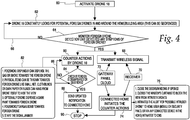
- the system 10 initiates the operation of the detector drone 16, as shown at 60, and the processor 26 operates the sensors 24 to continuously look for a potential foreign drone 17 in the vicinity of the protected area 12, as shown at 62.
- the detector drone 16 can either continuously patrol around the protected area 12, or can move from one stay location 54 to another based upon a predetermined time schedule, with the protector drone 16 pausing for a time period at each of the stay locations 54 so as to minimize its power usage.
- the processor 26 continuously receives the signals 32 from the sensors 24 and queries as to whether or not any of the signals 32 indicates the detection of a foreign drone 17, as shown at 64. If there is no indication of a foreign drone 17, the sensors 24 continue to search for a foreign drone 17, as shown at 66.
- the processor 26 determines that a foreign drone 17 has been detected, the processor 26 operates the transmitter 19 to initiate the wireless signal 30 indicating that a foreign drone 17 has been detected, as shown at 68.
- This signal 30 is either transmitted directly to receiver 50 of the security system 14 as shown at 70, or indirectly via the gateway/panel/cloud 54, as shown at 72.
- the central processor 40 initiates counteractions to protect the privacy of the protected area 12 by operating one or more of the devices 46 and 48 to change from the non-privacy condition to the privacy condition, as shown at 74.
- the processor 40 could command the electronic devices 46A-46C to close doors and windows and to close window curtains/shades/blinds/shutters to block the view of the foreign drone 17 into the protected area 12, and/or can initiate the alert devices 46D and 46E in order to warn occupants/users of the protected area 12 of the presence of a foreign drone 17, as shown at 76.
- the processor 26 of the drone 16 can initiate one or more of the countermeasure devices 34 if a foreign drone 17 is detected. The processor 26 will continue to receive and process the signals 32 from the sensors 24 to determine if the foreign drone 17 has exited the vicinity of the area 12 or if the foreign drone 17 has been disabled, as shown at 84.
- the detector drone 16 will continue to initiate one or more of the countermeasures as shown at 86. If the processor 26 determines that the foreign drone 17 has exited the vicinity or been disabled, it will initiate an additional wireless signal from the transmitter 19 to alert the security system 14 that the foreign drone 17 is no longer a threat, as shown at 88, and the privacy protection actions can be stopped as shown at 90.
- the disclosed system and method 10 provide a simple and automatic way to detect intruder/foreign drones and automatically take action in response to such detection so as to protect the privacy of any area protected by a connected security/control system. It should further be appreciated that because the detector drone 16 provides mobility to the detecting sensors 24, the disclosed system and method 10 provide the ability to detect intruder/foreign drones without requiring that multiple drone detecting sensors be located throughout an area protected by a connected security/control system.
- processor is intended to include any logic circuitry that responds to and processes the basic instructions/algorithms and logic operations to monitor and control other electronic devices and can be of any suitable design and configuration, many of which are known, including, for example, microprocessors.
- memory can include any device, or combination of devices, capable of storing data/information and being automatically accessed by a computer processor that is in communication therewith.
Landscapes
- Engineering & Computer Science (AREA)
- Physics & Mathematics (AREA)
- General Physics & Mathematics (AREA)
- Computer Networks & Wireless Communication (AREA)
- Signal Processing (AREA)
- Automation & Control Theory (AREA)
- Multimedia (AREA)
- Emergency Management (AREA)
- Business, Economics & Management (AREA)
- Radar, Positioning & Navigation (AREA)
- Remote Sensing (AREA)
- General Engineering & Computer Science (AREA)
- Computer Security & Cryptography (AREA)
- Electromagnetism (AREA)
- Manufacturing & Machinery (AREA)
- Quality & Reliability (AREA)
- Alarm Systems (AREA)
Applications Claiming Priority (1)
| Application Number | Priority Date | Filing Date | Title |
|---|---|---|---|
| US15/628,146 US10551810B2 (en) | 2017-06-20 | 2017-06-20 | System and method to improve the privacy of homes and other buildings having a connected home security/control system and subject to intrusions by unmanned aerial vehicles |
Publications (2)
| Publication Number | Publication Date |
|---|---|
| EP3418990A1 true EP3418990A1 (fr) | 2018-12-26 |
| EP3418990B1 EP3418990B1 (fr) | 2021-08-04 |
Family
ID=62495719
Family Applications (1)
| Application Number | Title | Priority Date | Filing Date |
|---|---|---|---|
| EP18175581.0A Active EP3418990B1 (fr) | 2017-06-20 | 2018-06-01 | Système et procédé pour améliorer l'intimité des maisons et d'autres bâtiments ayant un système de sécurité/commande de maison connectée et soumis à des intrusions de véhicules aériens sans pilote |
Country Status (4)
| Country | Link |
|---|---|
| US (1) | US10551810B2 (fr) |
| EP (1) | EP3418990B1 (fr) |
| CN (1) | CN109102668A (fr) |
| CA (1) | CA3007072A1 (fr) |
Cited By (1)
| Publication number | Priority date | Publication date | Assignee | Title |
|---|---|---|---|---|
| EP4303626A1 (fr) | 2022-07-05 | 2024-01-10 | AGC Glass Europe | Dispositif de détection de drone |
Families Citing this family (8)
| Publication number | Priority date | Publication date | Assignee | Title |
|---|---|---|---|---|
| US10939074B2 (en) * | 2017-11-15 | 2021-03-02 | Dean Drako | Aerial imaging privacy enhancement system |
| US10690457B2 (en) * | 2018-04-26 | 2020-06-23 | AI Incorporated | Method and apparatus for overexposing images captured by drones |
| WO2024006540A1 (fr) | 2022-07-01 | 2024-01-04 | Therma-Tru Corporation | Système de porte électronique |
| US11521445B2 (en) * | 2018-08-03 | 2022-12-06 | Therma-Tru Corporation | Integrated electronic entry door systems |
| WO2020110400A1 (fr) * | 2018-11-28 | 2020-06-04 | パナソニックIpマネジメント株式会社 | Véhicule aérien sans pilote, procédé de commande et programme |
| US11534919B2 (en) * | 2019-03-06 | 2022-12-27 | Ademco Inc. | Security sentinel robot |
| WO2022056500A1 (fr) * | 2020-09-14 | 2022-03-17 | Eloyan Armen | Système de sécurité assurant une protection contre les drones |
| US20250219757A1 (en) * | 2023-12-28 | 2025-07-03 | Rebecca Lynn Walker | Perimeter security system |
Citations (1)
| Publication number | Priority date | Publication date | Assignee | Title |
|---|---|---|---|---|
| US20170092138A1 (en) * | 2015-09-30 | 2017-03-30 | Alarm.Com Incorporated | Drone detection systems |
Family Cites Families (9)
| Publication number | Priority date | Publication date | Assignee | Title |
|---|---|---|---|---|
| US9175934B1 (en) | 2012-11-19 | 2015-11-03 | Lockheed Martin Corporation | Auto-injector countermeasure for unmanned aerial vehicles |
| US9085362B1 (en) | 2012-11-21 | 2015-07-21 | Lockheed Martin Corporation | Counter-unmanned aerial vehicle system and method |
| IL234372B (en) | 2013-08-31 | 2020-02-27 | Izidor Gabbay Ronen | A robotic system and method for complex internal warfare |
| US20150317924A1 (en) * | 2014-05-02 | 2015-11-05 | John Chowhan Park | Unmanned Aerial System for Creating Aerial Message |
| US9633547B2 (en) * | 2014-05-20 | 2017-04-25 | Ooma, Inc. | Security monitoring and control |
| US9997079B2 (en) | 2014-12-12 | 2018-06-12 | Amazon Technologies, Inc. | Commercial and general aircraft avoidance using multi-spectral wave detection |
| US9862489B1 (en) * | 2016-02-07 | 2018-01-09 | Lee Weinstein | Method and apparatus for drone detection and disablement |
| US10023311B2 (en) * | 2016-03-10 | 2018-07-17 | International Business Machines Corporation | Automatic painting system with drone, user interface and computer vision |
| US10926875B2 (en) * | 2016-12-14 | 2021-02-23 | Sanmina Corporation | Devices and methods for facilitating capture of unmanned aerial vehicles |
-
2017
- 2017-06-20 US US15/628,146 patent/US10551810B2/en active Active
-
2018
- 2018-06-01 EP EP18175581.0A patent/EP3418990B1/fr active Active
- 2018-06-01 CA CA3007072A patent/CA3007072A1/fr not_active Abandoned
- 2018-06-20 CN CN201810635038.4A patent/CN109102668A/zh active Pending
Patent Citations (1)
| Publication number | Priority date | Publication date | Assignee | Title |
|---|---|---|---|---|
| US20170092138A1 (en) * | 2015-09-30 | 2017-03-30 | Alarm.Com Incorporated | Drone detection systems |
Cited By (1)
| Publication number | Priority date | Publication date | Assignee | Title |
|---|---|---|---|---|
| EP4303626A1 (fr) | 2022-07-05 | 2024-01-10 | AGC Glass Europe | Dispositif de détection de drone |
Also Published As
| Publication number | Publication date |
|---|---|
| US10551810B2 (en) | 2020-02-04 |
| CN109102668A (zh) | 2018-12-28 |
| CA3007072A1 (fr) | 2018-12-20 |
| US20180364662A1 (en) | 2018-12-20 |
| EP3418990B1 (fr) | 2021-08-04 |
Similar Documents
| Publication | Publication Date | Title |
|---|---|---|
| EP3418990B1 (fr) | Système et procédé pour améliorer l'intimité des maisons et d'autres bâtiments ayant un système de sécurité/commande de maison connectée et soumis à des intrusions de véhicules aériens sans pilote | |
| US7916018B2 (en) | Wireless door contact sensor with motion sensor disable | |
| EP3118826B1 (fr) | Système de surveillance, de sécurité de maison, de bureau par micro-drones mobiles et caméras ip | |
| EP2911125B1 (fr) | Dispositif de surveillance de sécurité et procédé utilisant un champ de vision commun | |
| KR101543542B1 (ko) | 지능형 감시 시스템 및 이를 이용한 지능형 감시 방법 | |
| KR100932117B1 (ko) | 마이크로폰 어레이를 이용한 감시 장치 | |
| US10713127B2 (en) | System and method for establishing an alternate communication path between a central monitoring station and a connected security/control system | |
| KR20110086254A (ko) | 웹카메라를 이용한 침입감지정보 실시간 전송 시스템 | |
| CN105069951A (zh) | 一种室内防盗监控系统 | |
| US20190080576A1 (en) | Security marking system | |
| EP3514773B1 (fr) | Systèmes et procédés de protection d'une zone contournée dans un système de sécurité ou un système domestique connecté | |
| KR200188880Y1 (ko) | 영상 전송용 보안 시스템 | |
| EP2856446B1 (fr) | Dispositif, système et procédé de surveillance d'un espace prédéterminé | |
| EP2698773A1 (fr) | Système d'alarme anti-intrusion et procédé d'armement d'un système d'alarme anti-intrusion | |
| JP3210413U (ja) | 小型無人航空機による警備監視システム | |
| EP3408842B1 (fr) | Système de sécurité et son procédé d'utilisation | |
| KR20150085338A (ko) | 임펄스 레이더를 이용한 주차장 자동 제어 시스템 | |
| KR101042368B1 (ko) | 경비 시스템 및 그 제어 방법 | |
| KR101529909B1 (ko) | 지능형 cctv 및 제어기술을 이용한 불법 무단 침입자 물리적 방지 방법 | |
| KR101131659B1 (ko) | 방범장치가 일체화된 현관등 | |
| CN109903492A (zh) | 一种主动遮阳安防系统 | |
| EP4576033A1 (fr) | Capteur d'alarme pour une fenêtre ou une porte et procédé de fonctionnement d'un capteur d'alarme | |
| US12106642B2 (en) | Methods and systems for monitoring and reporting security breach of a property | |
| KR20230075111A (ko) | 활동 센서와 적외선 어레이 센서를 이용하여 댁내 경보 상황을 지능형으로 판단하는 시스템 | |
| WO2025133329A1 (fr) | Capteur d'alarme pour une fenêtre ou une porte et procédé de fonctionnement d'un capteur d'alarme |
Legal Events
| Date | Code | Title | Description |
|---|---|---|---|
| PUAI | Public reference made under article 153(3) epc to a published international application that has entered the european phase |
Free format text: ORIGINAL CODE: 0009012 |
|
| STAA | Information on the status of an ep patent application or granted ep patent |
Free format text: STATUS: REQUEST FOR EXAMINATION WAS MADE |
|
| 17P | Request for examination filed |
Effective date: 20180601 |
|
| AK | Designated contracting states |
Kind code of ref document: A1 Designated state(s): AL AT BE BG CH CY CZ DE DK EE ES FI FR GB GR HR HU IE IS IT LI LT LU LV MC MK MT NL NO PL PT RO RS SE SI SK SM TR |
|
| AX | Request for extension of the european patent |
Extension state: BA ME |
|
| STAA | Information on the status of an ep patent application or granted ep patent |
Free format text: STATUS: EXAMINATION IS IN PROGRESS |
|
| 17Q | First examination report despatched |
Effective date: 20200409 |
|
| GRAP | Despatch of communication of intention to grant a patent |
Free format text: ORIGINAL CODE: EPIDOSNIGR1 |
|
| STAA | Information on the status of an ep patent application or granted ep patent |
Free format text: STATUS: GRANT OF PATENT IS INTENDED |
|
| INTG | Intention to grant announced |
Effective date: 20201112 |
|
| RIN1 | Information on inventor provided before grant (corrected) |
Inventor name: MEGANATHAN, DEEPAK SUNDAR Inventor name: RAGHAVAN, SREEVAS |
|
| GRAJ | Information related to disapproval of communication of intention to grant by the applicant or resumption of examination proceedings by the epo deleted |
Free format text: ORIGINAL CODE: EPIDOSDIGR1 |
|
| STAA | Information on the status of an ep patent application or granted ep patent |
Free format text: STATUS: EXAMINATION IS IN PROGRESS |
|
| GRAP | Despatch of communication of intention to grant a patent |
Free format text: ORIGINAL CODE: EPIDOSNIGR1 |
|
| STAA | Information on the status of an ep patent application or granted ep patent |
Free format text: STATUS: GRANT OF PATENT IS INTENDED |
|
| INTC | Intention to grant announced (deleted) | ||
| INTG | Intention to grant announced |
Effective date: 20210406 |
|
| GRAS | Grant fee paid |
Free format text: ORIGINAL CODE: EPIDOSNIGR3 |
|
| RAP1 | Party data changed (applicant data changed or rights of an application transferred) |
Owner name: ADEMCO INC. |
|
| GRAA | (expected) grant |
Free format text: ORIGINAL CODE: 0009210 |
|
| STAA | Information on the status of an ep patent application or granted ep patent |
Free format text: STATUS: THE PATENT HAS BEEN GRANTED |
|
| AK | Designated contracting states |
Kind code of ref document: B1 Designated state(s): AL AT BE BG CH CY CZ DE DK EE ES FI FR GB GR HR HU IE IS IT LI LT LU LV MC MK MT NL NO PL PT RO RS SE SI SK SM TR |
|
| REG | Reference to a national code |
Ref country code: GB Ref legal event code: FG4D |
|
| REG | Reference to a national code |
Ref country code: AT Ref legal event code: REF Ref document number: 1417790 Country of ref document: AT Kind code of ref document: T Effective date: 20210815 |
|
| REG | Reference to a national code |
Ref country code: CH Ref legal event code: EP |
|
| REG | Reference to a national code |
Ref country code: DE Ref legal event code: R096 Ref document number: 602018021052 Country of ref document: DE |
|
| REG | Reference to a national code |
Ref country code: IE Ref legal event code: FG4D |
|
| REG | Reference to a national code |
Ref country code: LT Ref legal event code: MG9D |
|
| REG | Reference to a national code |
Ref country code: NL Ref legal event code: MP Effective date: 20210804 |
|
| REG | Reference to a national code |
Ref country code: AT Ref legal event code: MK05 Ref document number: 1417790 Country of ref document: AT Kind code of ref document: T Effective date: 20210804 |
|
| PG25 | Lapsed in a contracting state [announced via postgrant information from national office to epo] |
Ref country code: SE Free format text: LAPSE BECAUSE OF FAILURE TO SUBMIT A TRANSLATION OF THE DESCRIPTION OR TO PAY THE FEE WITHIN THE PRESCRIBED TIME-LIMIT Effective date: 20210804 Ref country code: RS Free format text: LAPSE BECAUSE OF FAILURE TO SUBMIT A TRANSLATION OF THE DESCRIPTION OR TO PAY THE FEE WITHIN THE PRESCRIBED TIME-LIMIT Effective date: 20210804 Ref country code: HR Free format text: LAPSE BECAUSE OF FAILURE TO SUBMIT A TRANSLATION OF THE DESCRIPTION OR TO PAY THE FEE WITHIN THE PRESCRIBED TIME-LIMIT Effective date: 20210804 Ref country code: FI Free format text: LAPSE BECAUSE OF FAILURE TO SUBMIT A TRANSLATION OF THE DESCRIPTION OR TO PAY THE FEE WITHIN THE PRESCRIBED TIME-LIMIT Effective date: 20210804 Ref country code: ES Free format text: LAPSE BECAUSE OF FAILURE TO SUBMIT A TRANSLATION OF THE DESCRIPTION OR TO PAY THE FEE WITHIN THE PRESCRIBED TIME-LIMIT Effective date: 20210804 Ref country code: NO Free format text: LAPSE BECAUSE OF FAILURE TO SUBMIT A TRANSLATION OF THE DESCRIPTION OR TO PAY THE FEE WITHIN THE PRESCRIBED TIME-LIMIT Effective date: 20211104 Ref country code: PT Free format text: LAPSE BECAUSE OF FAILURE TO SUBMIT A TRANSLATION OF THE DESCRIPTION OR TO PAY THE FEE WITHIN THE PRESCRIBED TIME-LIMIT Effective date: 20211206 Ref country code: LT Free format text: LAPSE BECAUSE OF FAILURE TO SUBMIT A TRANSLATION OF THE DESCRIPTION OR TO PAY THE FEE WITHIN THE PRESCRIBED TIME-LIMIT Effective date: 20210804 Ref country code: AT Free format text: LAPSE BECAUSE OF FAILURE TO SUBMIT A TRANSLATION OF THE DESCRIPTION OR TO PAY THE FEE WITHIN THE PRESCRIBED TIME-LIMIT Effective date: 20210804 Ref country code: BG Free format text: LAPSE BECAUSE OF FAILURE TO SUBMIT A TRANSLATION OF THE DESCRIPTION OR TO PAY THE FEE WITHIN THE PRESCRIBED TIME-LIMIT Effective date: 20211104 |
|
| PG25 | Lapsed in a contracting state [announced via postgrant information from national office to epo] |
Ref country code: PL Free format text: LAPSE BECAUSE OF FAILURE TO SUBMIT A TRANSLATION OF THE DESCRIPTION OR TO PAY THE FEE WITHIN THE PRESCRIBED TIME-LIMIT Effective date: 20210804 Ref country code: LV Free format text: LAPSE BECAUSE OF FAILURE TO SUBMIT A TRANSLATION OF THE DESCRIPTION OR TO PAY THE FEE WITHIN THE PRESCRIBED TIME-LIMIT Effective date: 20210804 Ref country code: GR Free format text: LAPSE BECAUSE OF FAILURE TO SUBMIT A TRANSLATION OF THE DESCRIPTION OR TO PAY THE FEE WITHIN THE PRESCRIBED TIME-LIMIT Effective date: 20211105 |
|
| PG25 | Lapsed in a contracting state [announced via postgrant information from national office to epo] |
Ref country code: NL Free format text: LAPSE BECAUSE OF FAILURE TO SUBMIT A TRANSLATION OF THE DESCRIPTION OR TO PAY THE FEE WITHIN THE PRESCRIBED TIME-LIMIT Effective date: 20210804 |
|
| PG25 | Lapsed in a contracting state [announced via postgrant information from national office to epo] |
Ref country code: DK Free format text: LAPSE BECAUSE OF FAILURE TO SUBMIT A TRANSLATION OF THE DESCRIPTION OR TO PAY THE FEE WITHIN THE PRESCRIBED TIME-LIMIT Effective date: 20210804 |
|
| REG | Reference to a national code |
Ref country code: DE Ref legal event code: R097 Ref document number: 602018021052 Country of ref document: DE |
|
| PG25 | Lapsed in a contracting state [announced via postgrant information from national office to epo] |
Ref country code: SM Free format text: LAPSE BECAUSE OF FAILURE TO SUBMIT A TRANSLATION OF THE DESCRIPTION OR TO PAY THE FEE WITHIN THE PRESCRIBED TIME-LIMIT Effective date: 20210804 Ref country code: SK Free format text: LAPSE BECAUSE OF FAILURE TO SUBMIT A TRANSLATION OF THE DESCRIPTION OR TO PAY THE FEE WITHIN THE PRESCRIBED TIME-LIMIT Effective date: 20210804 Ref country code: RO Free format text: LAPSE BECAUSE OF FAILURE TO SUBMIT A TRANSLATION OF THE DESCRIPTION OR TO PAY THE FEE WITHIN THE PRESCRIBED TIME-LIMIT Effective date: 20210804 Ref country code: EE Free format text: LAPSE BECAUSE OF FAILURE TO SUBMIT A TRANSLATION OF THE DESCRIPTION OR TO PAY THE FEE WITHIN THE PRESCRIBED TIME-LIMIT Effective date: 20210804 Ref country code: CZ Free format text: LAPSE BECAUSE OF FAILURE TO SUBMIT A TRANSLATION OF THE DESCRIPTION OR TO PAY THE FEE WITHIN THE PRESCRIBED TIME-LIMIT Effective date: 20210804 Ref country code: AL Free format text: LAPSE BECAUSE OF FAILURE TO SUBMIT A TRANSLATION OF THE DESCRIPTION OR TO PAY THE FEE WITHIN THE PRESCRIBED TIME-LIMIT Effective date: 20210804 |
|
| PLBE | No opposition filed within time limit |
Free format text: ORIGINAL CODE: 0009261 |
|
| STAA | Information on the status of an ep patent application or granted ep patent |
Free format text: STATUS: NO OPPOSITION FILED WITHIN TIME LIMIT |
|
| 26N | No opposition filed |
Effective date: 20220506 |
|
| PG25 | Lapsed in a contracting state [announced via postgrant information from national office to epo] |
Ref country code: IT Free format text: LAPSE BECAUSE OF FAILURE TO SUBMIT A TRANSLATION OF THE DESCRIPTION OR TO PAY THE FEE WITHIN THE PRESCRIBED TIME-LIMIT Effective date: 20210804 |
|
| PG25 | Lapsed in a contracting state [announced via postgrant information from national office to epo] |
Ref country code: SI Free format text: LAPSE BECAUSE OF FAILURE TO SUBMIT A TRANSLATION OF THE DESCRIPTION OR TO PAY THE FEE WITHIN THE PRESCRIBED TIME-LIMIT Effective date: 20210804 |
|
| REG | Reference to a national code |
Ref country code: DE Ref legal event code: R119 Ref document number: 602018021052 Country of ref document: DE |
|
| PG25 | Lapsed in a contracting state [announced via postgrant information from national office to epo] |
Ref country code: MC Free format text: LAPSE BECAUSE OF FAILURE TO SUBMIT A TRANSLATION OF THE DESCRIPTION OR TO PAY THE FEE WITHIN THE PRESCRIBED TIME-LIMIT Effective date: 20210804 |
|
| REG | Reference to a national code |
Ref country code: CH Ref legal event code: PL |
|
| REG | Reference to a national code |
Ref country code: BE Ref legal event code: MM Effective date: 20220630 |
|
| PG25 | Lapsed in a contracting state [announced via postgrant information from national office to epo] |
Ref country code: LU Free format text: LAPSE BECAUSE OF NON-PAYMENT OF DUE FEES Effective date: 20220601 Ref country code: LI Free format text: LAPSE BECAUSE OF NON-PAYMENT OF DUE FEES Effective date: 20220630 Ref country code: IE Free format text: LAPSE BECAUSE OF NON-PAYMENT OF DUE FEES Effective date: 20220601 Ref country code: FR Free format text: LAPSE BECAUSE OF NON-PAYMENT OF DUE FEES Effective date: 20220630 Ref country code: CH Free format text: LAPSE BECAUSE OF NON-PAYMENT OF DUE FEES Effective date: 20220630 |
|
| PG25 | Lapsed in a contracting state [announced via postgrant information from national office to epo] |
Ref country code: DE Free format text: LAPSE BECAUSE OF NON-PAYMENT OF DUE FEES Effective date: 20230103 Ref country code: BE Free format text: LAPSE BECAUSE OF NON-PAYMENT OF DUE FEES Effective date: 20220630 |
|
| P01 | Opt-out of the competence of the unified patent court (upc) registered |
Effective date: 20230601 |
|
| PG25 | Lapsed in a contracting state [announced via postgrant information from national office to epo] |
Ref country code: HU Free format text: LAPSE BECAUSE OF FAILURE TO SUBMIT A TRANSLATION OF THE DESCRIPTION OR TO PAY THE FEE WITHIN THE PRESCRIBED TIME-LIMIT; INVALID AB INITIO Effective date: 20180601 |
|
| PG25 | Lapsed in a contracting state [announced via postgrant information from national office to epo] |
Ref country code: MK Free format text: LAPSE BECAUSE OF FAILURE TO SUBMIT A TRANSLATION OF THE DESCRIPTION OR TO PAY THE FEE WITHIN THE PRESCRIBED TIME-LIMIT Effective date: 20210804 Ref country code: CY Free format text: LAPSE BECAUSE OF FAILURE TO SUBMIT A TRANSLATION OF THE DESCRIPTION OR TO PAY THE FEE WITHIN THE PRESCRIBED TIME-LIMIT Effective date: 20210804 |
|
| PG25 | Lapsed in a contracting state [announced via postgrant information from national office to epo] |
Ref country code: TR Free format text: LAPSE BECAUSE OF FAILURE TO SUBMIT A TRANSLATION OF THE DESCRIPTION OR TO PAY THE FEE WITHIN THE PRESCRIBED TIME-LIMIT Effective date: 20210804 |
|
| PG25 | Lapsed in a contracting state [announced via postgrant information from national office to epo] |
Ref country code: MT Free format text: LAPSE BECAUSE OF FAILURE TO SUBMIT A TRANSLATION OF THE DESCRIPTION OR TO PAY THE FEE WITHIN THE PRESCRIBED TIME-LIMIT Effective date: 20210804 |
|
| PGFP | Annual fee paid to national office [announced via postgrant information from national office to epo] |
Ref country code: GB Payment date: 20250617 Year of fee payment: 8 |