EP3419193A1 - Procédé de transmission d'informations, dispositif et système de communication appropriés pour un accès multiple non orthogonal - Google Patents
Procédé de transmission d'informations, dispositif et système de communication appropriés pour un accès multiple non orthogonal Download PDFInfo
- Publication number
- EP3419193A1 EP3419193A1 EP16890150.2A EP16890150A EP3419193A1 EP 3419193 A1 EP3419193 A1 EP 3419193A1 EP 16890150 A EP16890150 A EP 16890150A EP 3419193 A1 EP3419193 A1 EP 3419193A1
- Authority
- EP
- European Patent Office
- Prior art keywords
- symbols
- cos
- sin
- information transmission
- predetermined angle
- Prior art date
- Legal status (The legal status is an assumption and is not a legal conclusion. Google has not performed a legal analysis and makes no representation as to the accuracy of the status listed.)
- Withdrawn
Links
Images






Classifications
-
- H—ELECTRICITY
- H04—ELECTRIC COMMUNICATION TECHNIQUE
- H04J—MULTIPLEX COMMUNICATION
- H04J13/00—Code division multiplex systems
-
- H—ELECTRICITY
- H04—ELECTRIC COMMUNICATION TECHNIQUE
- H04B—TRANSMISSION
- H04B7/00—Radio transmission systems, i.e. using radiation field
- H04B7/24—Radio transmission systems, i.e. using radiation field for communication between two or more posts
- H04B7/26—Radio transmission systems, i.e. using radiation field for communication between two or more posts at least one of which is mobile
-
- H—ELECTRICITY
- H04—ELECTRIC COMMUNICATION TECHNIQUE
- H04J—MULTIPLEX COMMUNICATION
- H04J11/00—Orthogonal multiplex systems, e.g. using WALSH codes
- H04J11/0023—Interference mitigation or co-ordination
- H04J11/0026—Interference mitigation or co-ordination of multi-user interference
- H04J11/0036—Interference mitigation or co-ordination of multi-user interference at the receiver
-
- H—ELECTRICITY
- H04—ELECTRIC COMMUNICATION TECHNIQUE
- H04L—TRANSMISSION OF DIGITAL INFORMATION, e.g. TELEGRAPHIC COMMUNICATION
- H04L1/00—Arrangements for detecting or preventing errors in the information received
- H04L1/004—Arrangements for detecting or preventing errors in the information received by using forward error control
- H04L1/0056—Systems characterized by the type of code used
- H04L1/0071—Use of interleaving
-
- H—ELECTRICITY
- H04—ELECTRIC COMMUNICATION TECHNIQUE
- H04L—TRANSMISSION OF DIGITAL INFORMATION, e.g. TELEGRAPHIC COMMUNICATION
- H04L27/00—Modulated-carrier systems
- H04L27/32—Carrier systems characterised by combinations of two or more of the types covered by groups H04L27/02, H04L27/10, H04L27/18 or H04L27/26
- H04L27/34—Amplitude- and phase-modulated carrier systems, e.g. quadrature-amplitude modulated carrier systems
- H04L27/3405—Modifications of the signal space to increase the efficiency of transmission, e.g. reduction of the bit error rate, bandwidth, or average power
- H04L27/3411—Modifications of the signal space to increase the efficiency of transmission, e.g. reduction of the bit error rate, bandwidth, or average power reducing the peak to average power ratio or the mean power of the constellation; Arrangements for increasing the shape gain of a signal set
-
- H—ELECTRICITY
- H04—ELECTRIC COMMUNICATION TECHNIQUE
- H04L—TRANSMISSION OF DIGITAL INFORMATION, e.g. TELEGRAPHIC COMMUNICATION
- H04L27/00—Modulated-carrier systems
- H04L27/32—Carrier systems characterised by combinations of two or more of the types covered by groups H04L27/02, H04L27/10, H04L27/18 or H04L27/26
- H04L27/34—Amplitude- and phase-modulated carrier systems, e.g. quadrature-amplitude modulated carrier systems
- H04L27/3405—Modifications of the signal space to increase the efficiency of transmission, e.g. reduction of the bit error rate, bandwidth, or average power
- H04L27/3444—Modifications of the signal space to increase the efficiency of transmission, e.g. reduction of the bit error rate, bandwidth, or average power by applying a certain rotation to regular constellations
-
- H—ELECTRICITY
- H04—ELECTRIC COMMUNICATION TECHNIQUE
- H04L—TRANSMISSION OF DIGITAL INFORMATION, e.g. TELEGRAPHIC COMMUNICATION
- H04L27/00—Modulated-carrier systems
- H04L27/32—Carrier systems characterised by combinations of two or more of the types covered by groups H04L27/02, H04L27/10, H04L27/18 or H04L27/26
- H04L27/34—Amplitude- and phase-modulated carrier systems, e.g. quadrature-amplitude modulated carrier systems
- H04L27/36—Modulator circuits; Transmitter circuits
- H04L27/362—Modulation using more than one carrier, e.g. with quadrature carriers, separately amplitude modulated
- H04L27/364—Arrangements for overcoming imperfections in the modulator, e.g. quadrature error or unbalanced I and Q levels
Definitions
- This disclosure relates to the field of communication technologies, and in particular to an information transmission method, apparatus and a communication system suitable for nonorthogonal multiple access.
- Machine type communication is an outstanding feature of a 5th generation (5G) mobile communication system.
- 5G 5th generation
- UE user equipment
- UE user equipment
- 4G 4G
- a new multiple access technique is more important in a 5G system.
- Sparse code multiple access is a new multiple access technique. "Sparsity" refers to signals transmitted by a UE do not occupy all allocated resource, but more UEs are permitted to be accessed into the system by permitting multiple UEs to use the same resource. And the SCMA is substantially a nonorthogonal multiple access mode.
- Embodiments of this disclosure provide an information transmission apparatus, method and a communication system suitable for nonorthogonal multiple access, in which higher diversity gains can be obtained by performing secondary rotation on symbols, system performance can further be improved, and more UEs can be multiplexed.
- an information transmission method suitable for nonorthogonal multiple access including:
- an information transmission apparatus suitable for nonorthogonal multiple access, the information transmission apparatus including:
- a communication system including:
- An advantage of the embodiments of this disclosure exists in that by performing rotation for a first time on multiple constellation symbols and performing real part and imaginary part interleaving on different symbols, and then performing rotation for a second time and performing real part and imaginary part interleaving on different symbols, higher diversity gains can be obtained, system performance can further be improved, and more UEs can be multiplexed.
- a base station may be referred to as an access point, a broadcast transmitter, a node B, or an evolution node B (eNB), etc., and may include some or all functions of them.
- a term “base station” shall be used in the text, and each base station provides communication coverage for a specific geographical region.
- a term “cell” may refer to a base station and/or a coverage region thereof, depending on the context using the term.
- a mobile station or equipment may be referred to as a user equipment (UE).
- the UE may be fixed or mobile, and may also be referred to as a mobile station, a terminal, an access terminal, a user unit, or a station, etc.
- the UE may be a cellular phone, a personal digital assistant (PDA), a wireless modem, a wireless communication device, a handhold device, a lap-top computer, and a cordless telephone, etc.
- PDA personal digital assistant
- a codeword in the SCMA is constituted by using two-dimensional constellation points. For example, signals are rotated first to respectively generate signal copies at real parts and imaginary parts, and then the copies are transmitted on multiple resource elements. In this way, association may be established between symbols within the codeword, so as to resist interference produced when signals of multiple UEs are superimposed.
- FIG. 1 is a schematic diagram of performing multiplexing by multiple UEs in the SCMA, in which each square denotes a time-frequency resource element, such as a resource element (RE) in an orthogonal frequency division multiplexing (OFDM) system.
- a time-frequency resource element such as a resource element (RE) in an orthogonal frequency division multiplexing (OFDM) system.
- a blank represents a zero position, denoting that the UE does not transmit a signal on the resource element, or referred to as transmitting a zero symbol; and a shadow represents a non-zero position, denoting that the UE transmits a signal on the resource element, and non-zero symbols being transmitted.
- four resource elements carry signals of total six UEs, and each UE transmits two non-zero symbols.
- phase rotation is first performed on the original symbols. Assuming that a rotation angle is ⁇ , the symbols after rotation are as follows:
- each UE For multiple UEs, each UE generates signals according to the above process, and the signals are mapped onto non-zero positions for transmission. For different UEs, as shown in FIG. 1 , the non-zero positions onto which the signals are mapped are different.
- the four resource elements shown in FIG. 1 constitute a codeword, including zero symbols and non-zero symbols.
- expressions of s i and s i +1 are general formulae for transmitting non-zero symbols.
- multiple codewords may be transmitted according a size of resource allocation.
- FIG. 2 is a schematic diagram of transmitting two codewords in the SCMA, in which an example of continuously transmitting four non-zero symbols is shown. As shown in FIG. 2 , the same signal component (such as u i , or v i , etc.) is dispersed onto two different resource elements for transmission.
- the same signal component such as u i , or v i , etc.
- SCMA is illustrated above. It should be noted that the embodiments of this disclosure are not limited to transmission of SCMA, and are suitable for or applicable to any scenarios of nonorthogonal multiple access.
- FIG. 3 is a flowchart of the information transmission method of the embodiment of this disclosure. As shown in FIG. 3 , the information transmission method includes:
- multiple transmitting devices may perform the nonorthogonal multiple access (such as nonorthogonal multiple access based on sparsity).
- the transmitting device may be, for example, MTC UE, the MTC UE and other UE performing, for example, nonorthogonal transmission based on sparsity, with a receiving device; however, this disclosure is not limited thereto. Following description shall be given by only taking MTC UE and nonorthogonal multiple access based on sparsity as examples.
- the receiving device may be a macro base station (such as an eNB), and macro cells generated by the macro base station may serve for the UE; or the receiving device may also be a pico base station, and pico cells generated by the pico base station may serve for the UE; or the receiving device may also be another network device.
- a macro base station such as an eNB
- pico base station such as a pico base station
- pico cells generated by the pico base station may serve for the UE
- the receiving device may also be another network device.
- this disclosure is not limited thereto, and a particular scenario may be determined according to an actual situation.
- c i u i + j v i
- c i + 1 u i + 1 + j v i + 1
- c i + 2 u i + 2 + j v i + 2
- c i + 3 u i + 3 + j v i + 3 .
- c i ⁇ c i +3 may be symbols from any constellations, such as binary phase shift keying (BPSK), quadrature phase shift keying (QPSK), 16 quadrature amplitude modulation (QAM), or 64QAM; however, this disclosure is not limited thereto. Furthermore, reference may be made to any related methods for how to modulate the constellation symbols, etc.
- BPSK binary phase shift keying
- QPSK quadrature phase shift keying
- QAM 16 quadrature amplitude modulation
- 64QAM 64QAM
- constellation rotation also referred to as constellation rotation or phase rotation
- real part and imaginary part interleaving may be performed on two first symbols having different signal components, so as to obtain multiple second symbols.
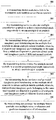
- s i u i cos ⁇ ⁇ v i sin ⁇ + j u i + 1 cos ⁇ ⁇ v i + 1 sin ⁇
- s i + 1 u i sin ⁇ + v i cos ⁇ + j u i + 1 sin ⁇ + v i + 1 cos ⁇
- s i + 2 u i + 2 cos ⁇ ⁇ v i + 2 sin ⁇ + j u i + 3 cos ⁇ ⁇ v i + 3 sin ⁇
- s i + 3 u i + 2 sin ⁇ + v i + 2 cos ⁇ + j u i + 3 sin ⁇ + v i + 3 cos ⁇ .
- a real part of and an imaginary part of may be exchanged, a real part of and an imaginary part of may be exchanged; or an imaginary part of and a real part of may be exchanged, and an imaginary part of and a real part of may be exchanged, etc.
- particular manner of imaginary part and real part interleaving may be determined according to an actual situation.
- real part and imaginary part interleaving may be performed on two third symbols having different signal components, so as to obtain multiple fourth symbols.
- the multiple fourth symbols may be respectively mapped onto the multiple resource elements.
- N fourth symbols may be mapped onto N resource elements in M time-frequency resource elements, and other resource elements transmit zero symbols; where, M and N are positive integers, and M is greater than N.
- this disclosure is not limited thereto; for example, "a non-SCMA" manner may also be used for mapping.
- FIG. 4 is a schematic diagram of user resource mapping of the embodiment of this disclosure. As shown in FIG. 4 , w i to w i +3 are mapped onto four non-zero resource positions for transmission; wherein, the same signal component (such as u i ) is dispersed onto four different resource elements for transmission. In comparison with the SCMA method shown in FIG. 2 where u i is dispersed onto two different resource elements for transmission, the method shown in FIG. 4 (which may be referred to as a dual rotation method) is able to obtain a higher diversity gain, thereby improving demodulation performance of the UE, and making it possible to multiplex more UEs.
- the method shown in FIG. 4 (which may be referred to as a dual rotation method) is able to obtain a higher diversity gain, thereby improving demodulation performance of the UE, and making it possible to multiplex more UEs.
- each UE executes blocks 301-305; and in block 305, positions of non-zero resources onto which symbols are mapped by different UEs are different, hence, nonorthogonal multiple access may be performed.
- FIG. 5 is another flowchart of the information transmission method of the embodiment of this disclosure, in which a case where the data to be transmitted are modulated into multiple codewords is shown. As shown in FIG. 5 , the information transmission method includes:
- FIG. 5 only schematically explains the embodiment of this disclosure; however, this disclosure is not limited thereto.
- an order of execution of the blocks or steps may be appropriately adjusted, and furthermore, some other blocks or steps may be added, or some of these blocks or steps may be reduced. And appropriate modifications may be made by those skilled in the art according to what is described above, without being limited to those contained in the above figure.
- Embodiment 1 shall be described on the basis of Embodiment 1.
- an effect of this disclosure and how to determine a rotation angle shall be described by taking that MTC UE uses BPSK symbols as an example.
- FIG. 6 is a schematic diagram of user resource mapping of orthogonal multiple access.
- the MTC UE in an orthogonal multiple access mode, the MTC UE usually uses QPSK symbols to perform transmission, four resource elements are able to multiplex four UEs, and each UE uses one resource element.
- FIG. 7 is a schematic diagram of user resource mapping of the SCMA. As shown in FIG. 7 , in the SCMA mode, each MTC UE uses two resource elements, a transmitted signal is formed by rotating and interleaving two BPSK symbols, and four resource elements are able to multiplex six UEs.
- a single UE is still taken as an example, and a UE ID is omitted. And it is assumed that the UE is intended to transmit original four BPSK symbols, a 1 , a 2 , a 3 and a 4 ; where, a 1 ⁇ a 4 are from a BPSK constellation.
- first-stage constellation rotation may be performed. Assuming that a rotation angle is ⁇ , symbols after the rotation are denoted as:
- second-stage constellation rotation may be performed. Assuming that a rotation angle is ⁇ , symbols after the rotation are denoted as:
- a manner of interleaving may be, for example, exchanging the imaginary part of and a real part of and exchanging an imaginary part of and the real part of
- w 1 a 1 cos ⁇ cos ⁇ ⁇ a 2 sin ⁇ cos ⁇ + j a 3 cos ⁇ cos ⁇ ⁇ a 4 sin ⁇ cos ⁇
- w 2 a 1 cos ⁇ sin ⁇ ⁇ a 2 sin ⁇ sin ⁇ + j a 3 cos ⁇ sin ⁇ ⁇ a 4 sin ⁇ sin ⁇
- w 3 a 1 sin ⁇ cos ⁇ + a 2 cos ⁇ cos ⁇ + j a 3 sin ⁇ cos ⁇ + a 4 cos ⁇ cos ⁇
- w 4 a 1 sin ⁇ sin ⁇ + a 2 cos ⁇ sin ⁇ + j a 3 sin ⁇ sin ⁇ cos ⁇
- w 4 a 1 sin ⁇ sin ⁇ + a 2 cos
- w 1 ⁇ w 4 may be mapped onto the four non-zero resource positions and transmitted.
- Multiple UEs may respectively perform the above operations, and non-zero resource positions of different UEs are different.
- the nonorthogonal multiple access (such as nonorthogonal multiple access based on sparsity) may be performed.
- FIG. 8 is a schematic diagram of comparison of the SCMA method and the dual-rotation method, in which a case taking a single UE as an example is shown. As shown in FIG. 8 , taking a 1 as an example, it is transmitted on two resource elements in the SCMA method, and is transmitted on four resource elements in the dual-rotation method in the embodiment of this disclosure. Hence, in comparison with the SCMA method, the dual-rotation method in the embodiment of this disclosure has a higher diversity effect theoretically.
- FIG. 9 is another schematic diagram of comparison of the SCMA method and the dual-rotation method, in which bit error rate (BER) performance curves of the SCMA method and the dual-rotation method of the embodiment of this disclosure under a condition of a single UE are shown; it is assumed that channels are subject to independent-identically-distributed Rayleigh distribution.
- BER bit error rate
- FIG. 10 is a further schematic diagram of comparison of the SCMA method and the dual-rotation method, in which bit error rate performance curves of the SCMA method and the dual-rotation method of the embodiment of this disclosure under a condition of multiple UEs (the number of UEs is 6) are shown; it is assumed that channels are subject to independent-identically-distributed Rayleigh distribution.
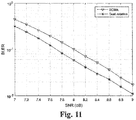
- FIG. 11 is still another schematic diagram of comparison of the SCMA method and the dual-rotation method, in which block error rate (BLER) performance curves of the SCMA method and the dual-rotation method of the embodiment of this disclosure under a condition of multiple UEs (the number of UEs is 6) are shown; it is assumed that channels are subject to independent-identically-distributed Rayleigh distribution, and Turbo channel coding meeting the LTE standard is used, with a code rate being 0.795.
- BLER block error rate
- Simulation results shown in FIGs. 9-11 verify effectiveness of the dual-rotation method of the embodiment of this disclosure.
- demodulation performance of the UE is improved, thereby making it possible to multiplex more UEs.
- the first predetermined angle and the second predetermined angle may be determined based on a symbol error rate. For example, in a case where the constellation symbols are BPSK symbols and a signal to noise ratio is greater than a predetermined value, the first predetermined angle is 45°, and the second predetermined angle is 60°.
- the vector a 1&2 may have four possible values, which makes that x has four possible values, that is, x ⁇ ⁇ x ( l )
- l 1,2,3,4 ⁇ .
- x ( i ) is misjudged as x ( k )
- an error may occur in the demodulation of a 1 and a 2 .
- An error probability shall be calculated below.
- SNR signal to noise ratio
- first predetermined angle and the second predetermined angle are illustrated above. However, this disclosure is not limited thereto, and other methods for determining angles may also be used. And furthermore, the rotation angles are not limited to 45° and 60°, other angles may also be used, and particular values may be determined according to an actual situation.
- fourth symbols containing the same signal components may be dispersedly mapped onto unneighboring resource elements experiencing independent or uncorrelated channel fading.
- the resource mapping method is also suitable for or applicable to the conventional SCMA method.
- mapping symbols (which may be s i , etc., in the SCMA, or may be w i , etc., in the embodiments of this disclosure) onto non-zero resources for transmission
- symbol interleaving may be performed, so that symbols containing the same signal components are mapped onto resource elements experiencing independent or uncorrelated channel fading as possible, that is, the same codeword is dispersed onto unneighboring resource elements experiencing independent or uncorrelated channel fading for transmission.
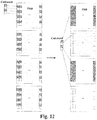
- FIG. 12 is a schematic diagram of performing codeword interleaving of the embodiment of this disclosure, in which a case taking the SCMA as an example is shown. As shown by the left side in FIG. 12 , symbols (including zero symbols and non-zero symbols) belonging to the same codeword in the conventional SCMA method (a method in which no codeword interleaving is performed) are mapped onto consecutive resource elements, and so on, and multiple codewords will fill in all resource block pairs allocated for the UE.
- symbols including zero symbols and non-zero symbols belonging to the same codeword will be mapped into different resource block pairs, hence, the symbols experience unrelated channel fading as possible, thereby further utilizing diversity.
- FIG. 13 is another schematic diagram of performing codeword interleaving of the embodiment of this disclosure, in which a case taking the dual-rotation method of the embodiment of this disclosure as an example is shown. As shown by the left side in FIG. 13 , in the method where no codeword interleaving is performed, symbols (including zero symbols and non-zero symbols) belonging to the same codeword will be mapped into consecutive resource elements, and so on, and multiple codewords will fill in all resource block pairs allocated for the UE.
- symbols containing the same signal components may be dispersed onto four non-zero resource elements for transmission, hence, eight symbols (including zero symbols and non-zero symbols) may be deemed as an equivalent codeword, and then the equivalent codeword is interleaved. After being interleaved, eight symbols belonging to the same codeword will be dispersed onto different resource block pairs for transmission.
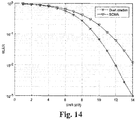
- FIG. 14 is yet another schematic diagram of comparison of the SCMA method and the dual-rotation method of the embodiment of this disclosure, in which a performance simulation result after codeword interleaving is used. It is assumed that an ETU 120 km/h channel is used, and LTE Turbo channel coding is used, with a code rate being 0.795.
- the dual-rotation method after codeword interleaving has a better performance than the conventional SCMA method; and in comparison with FIG. 11 , the method after codeword interleaving has a better performance than the method where no codeword interleaving is performed (for example, the block error rate is lower), thereby further obtaining diversity gains.
- the embodiment of this disclosure provides an information transmission apparatus suitable for nonorthogonal multiple access.
- This embodiment corresponds to the information transmission method suitable for nonorthogonal multiple access in embodiments 1-3, with identical contents being not going to be described herein any further.
- FIG. 15 is a schematic diagram of the information transmission apparatus suitable for nonorthogonal multiple access of the embodiment of this disclosure. As shown in FIG. 15 , the information transmission apparatus 1500 includes:
- the data to be transmitted may be modulated into multiple codewords, each codeword including N non-zero constellation symbols, N being a positive integer.
- each N fourth symbols may be mapped onto N resource elements in M time-frequency resource elements for transmission; where, M is a positive integer, and M is greater than N. however, this embodiment is not limited thereto.
- the information transmission apparatus 1500 may further include: an angle determining unit 1507 configured to determine the first predetermined angle and the second predetermined angle based on a symbol error rate.
- the resource mapping unit 506 may further be configured to: dispersedly map fourth symbols containing the same signal components onto unneighboring resource elements experiencing independent or uncorrelated channel fading.
- Resource elements contained in the same codeword are from different physical resource block (PRB) pairs and are located at unneighboring time-frequency positions away from each other.
- PRB physical resource block
- This embodiment further provides a transmitting device, configured with the above-described information transmission apparatus 1500.
- the transmitting device may be, for example, a UE, such as MTC UE, and a receiving device may be a base station.
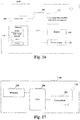
- FIG. 16 is a schematic diagram of the UE of the embodiment of this disclosure.
- the UE 1600 may include a central processing unit 100 and a memory 140, the memory 140 being coupled to the central processing unit 100.
- this figure is illustrative only, and other types of structures may also be used, so as to supplement or replace this structure and achieve a telecommunications function or other functions.
- the functions of the information transmission apparatus 1500 may be integrated into the central processing unit 100.
- the central processing unit 100 may be configured to carry out the information transmission method suitable for nonorthogonal multiple access described in embodiments 1-3.
- the central processing unit 100 may be configured to perform the following control: modulating data to be transmitted into multiple constellation symbols; rotating the multiple constellation symbols by a first predetermined angle respectively to obtain multiple first symbols; performing real part and imaginary part interleaving on the multiple first symbols to obtain multiple second symbols; wherein, real parts and imaginary parts belonging to the same first symbol are dispersed to positions of real parts and imaginary parts of different second symbols; rotating the multiple second symbols by a second predetermined angle respectively to obtain multiple third symbols; performing real part and imaginary part interleaving on the multiple third symbols to obtain multiple fourth symbols; wherein, real parts and imaginary parts belonging to the same third symbol are dispersed to positions of real parts and imaginary parts of different fourth symbols; and mapping the multiple fourth symbols onto multiple resource elements and performing transmission of information.
- the information transmission apparatus 1500 and the central processing unit 100 may be configured separately.
- the information transmission apparatus 1500 may be configured as a chip connected to the central processing unit 100, with its functions being realized under control of the central processing unit 100.
- the UE 1600 may further include a communication module 110, an input unit 120, a memory 140, a display 160 and a power supply 170. Functions of the above components are similar to those in the relevant art, and shall not be described herein any further. It should be noted that the UE 1600 does not necessarily include all the parts shown in FIG. 16 , and furthermore, the UE 1600 may include parts not shown in FIG. 16 , and the relevant art may be referred to.
- the transmitting device may also be, for example, a base station, and the receiving device may be a UE, such as MTC UE.
- the transmitting device and the receiving device may also be other network devices.
- FIG. 17 is a schematic diagram of a structure of the base station of the embodiment of this disclosure.
- the base station 1700 may include a central processing unit (CPU) 200 and a memory 210, the memory 210 being coupled to the central processing unit 200.
- the memory 210 may store various data, and furthermore, it may store a program for information processing, and execute the program under control of the central processing unit 200.
- the information transmission apparatus 1500 may carry out the information transmission method applicable to nonorthogonal multiple access described in Embodiment 1.
- the central processing unit 200 may be configured to carry out the functions of the information transmission apparatus 1500.
- the base station 1700 may include a transceiver 220, and an antenna 230, etc. Functions of the above components are similar to those in the relevant art, and shall not be described herein any further. It should be noted that the base station 1700 does not necessarily include all the parts shown in FIG. 17 , and furthermore, the base station 1700 may include parts not shown in FIG. 17 , and the relevant art may be referred to.
- the embodiment of this disclosure further provides a communication system, with contents identical to those in embodiments 1-4 being not going to be described herein any further.
- the communication system may include:
- multiple transmitting devices may respectively map fourth symbols onto multiple resource elements for performing nonorthogonal multiple access.
- the transmitting device may be, for example, a UE, such as MTC UE, and the receiving device may be a base station; however, this disclosure is not limited thereto.
- the transmitting device is a UE and the receiving device is a base station as an example.
- FIG. 18 is a schematic diagram of the communication system of the embodiment of this disclosure. As shown in FIG. 18 , the communication system 1800 may include a base station 1801 and a UE 1802.
- the UE 1802 may modulate data to be transmitted into multiple constellation symbols; rotate the multiple constellation symbols by a first predetermined angle respectively to obtain multiple first symbols; perform real part and imaginary part interleaving on the multiple first symbols to obtain multiple second symbols; wherein, real parts and imaginary parts belonging to the same first symbol are dispersed to positions of real parts and imaginary parts of different second symbols; rotate the multiple second symbols by a second predetermined angle respectively to obtain multiple third symbols; perform real part and imaginary part interleaving on the multiple third symbols to obtain multiple fourth symbols; wherein, real parts and imaginary parts belonging to the same third symbol are dispersed to positions of real parts and imaginary parts of different fourth symbols; and map the multiple fourth symbols onto multiple resource elements and perform transmission of information.
- the base station 1801 receives information transmitted by the UE 1802, and correspondingly demodulates the received information.
- An embodiment of the present disclosure provides a computer readable program, which, when executed in a transmitting device, will cause a computer unit to carry out the information transmission method suitable for nonorthogonal multiple access described in Embodiment 1 in the transmitting device.
- An embodiment of the present disclosure provides a computer storage medium, including a computer readable program, which will cause a computer unit to carry out the information transmission method suitable for nonorthogonal multiple access described in Embodiment 1 in a transmitting device.
- the above apparatuses of the present disclosure may be implemented by hardware, or by hardware in combination with software.
- the present disclosure relates to such a computer-readable program that when the program is executed by a logic device, the logic device is enabled to carry out the apparatus or components as described above, or to carry out the methods or steps as described above.
- the present disclosure also relates to a storage medium for storing the above program, such as a hard disk, a floppy disk, a CD, a DVD, and a flash memory, etc.
- the method for random access and data transmission carried out in the apparatus for random access and data transmission described with reference to the embodiments of this disclosure may be directly embodied as hardware, software modules executed by a processor, or a combination thereof.
- one or more functional block diagrams and/or one or more combinations of the functional block diagrams shown in FIG. 15 may either correspond to software modules of procedures of a computer program, or correspond to hardware modules.
- Such software modules may respectively correspond to the steps shown in FIG. 3 .
- the hardware module for example, may be carried out by firming the soft modules by using a field programmable gate array (FPGA).
- FPGA field programmable gate array
- the soft modules may be located in an RAM, a flash memory, an ROM, an EPROM, and EEPROM, a register, a hard disc, a floppy disc, a CD-ROM, or any memory medium in other forms known in the art.
- a memory medium may be coupled to a processor, so that the processor may be able to read information from the memory medium, and write information into the memory medium; or the memory medium may be a component of the processor.
- the processor and the memory medium may be located in an ASIC.
- the soft modules may be stored in a memory of a mobile terminal, and may also be stored in a memory card of a pluggable mobile terminal.
- the soft modules may be stored in the MEGA-SIM card or the flash memory device of a large capacity.
- One or more functional blocks and/or one or more combinations of the functional blocks in figures may be realized as a universal processor, a digital signal processor (DSP), an application-specific integrated circuit (ASIC), a field programmable gate array (FPGA) or other programmable logic devices, discrete gate or transistor logic devices, discrete hardware component or any appropriate combinations thereof carrying out the functions described in this application.
- DSP digital signal processor
- ASIC application-specific integrated circuit
- FPGA field programmable gate array
- the one or more functional block diagrams and/or one or more combinations of the functional block diagrams in figures may also be realized as a combination of computing equipment, such as a combination of a DSP and a microprocessor, multiple processors, one or more microprocessors in communication combination with a DSP, or any other such configuration.
Landscapes
- Engineering & Computer Science (AREA)
- Computer Networks & Wireless Communication (AREA)
- Signal Processing (AREA)
- Radio Transmission System (AREA)
- Digital Transmission Methods That Use Modulated Carrier Waves (AREA)
Applications Claiming Priority (1)
| Application Number | Priority Date | Filing Date | Title |
|---|---|---|---|
| PCT/CN2016/073796 WO2017139915A1 (fr) | 2016-02-15 | 2016-02-15 | Procédé de transmission d'informations, dispositif et système de communication appropriés pour un accès multiple non orthogonal |
Publications (1)
| Publication Number | Publication Date |
|---|---|
| EP3419193A1 true EP3419193A1 (fr) | 2018-12-26 |
Family
ID=59624783
Family Applications (1)
| Application Number | Title | Priority Date | Filing Date |
|---|---|---|---|
| EP16890150.2A Withdrawn EP3419193A1 (fr) | 2016-02-15 | 2016-02-15 | Procédé de transmission d'informations, dispositif et système de communication appropriés pour un accès multiple non orthogonal |
Country Status (5)
| Country | Link |
|---|---|
| US (1) | US20180343160A1 (fr) |
| EP (1) | EP3419193A1 (fr) |
| JP (1) | JP2019510402A (fr) |
| CN (1) | CN108463957A (fr) |
| WO (1) | WO2017139915A1 (fr) |
Families Citing this family (1)
| Publication number | Priority date | Publication date | Assignee | Title |
|---|---|---|---|---|
| US20190132165A1 (en) * | 2017-11-01 | 2019-05-02 | Industrial Technology Research Institute | Method of receiving or transmitting data by ue or base station under noma scheme, ue using the same and base station using the same |
Family Cites Families (11)
| Publication number | Priority date | Publication date | Assignee | Title |
|---|---|---|---|---|
| KR20060097721A (ko) * | 2003-09-30 | 2006-09-14 | 마쓰시다 일렉트릭 인더스트리얼 컴패니 리미티드 | 무선 송신 장치, 무선 수신 장치 및 무선 송신 방법 |
| US7570698B2 (en) * | 2004-11-16 | 2009-08-04 | Intel Corporation | Multiple output multicarrier transmitter and methods for spatial interleaving a plurality of spatial streams |
| JP2007074618A (ja) * | 2005-09-09 | 2007-03-22 | Sony Corp | 無線通信装置及び無線通信方法、並びにコンピュータ・プログラム |
| CN101621490B (zh) * | 2009-08-13 | 2013-03-20 | 北京邮电大学 | 一种用于ofdm系统的联合编码调制分集的方法 |
| CN102075487B (zh) * | 2009-11-25 | 2013-02-27 | 清华大学 | 基于多维星座映射的编码调制方法、解调解码方法及系统 |
| CN102170325B (zh) * | 2011-03-11 | 2013-07-10 | 北京邮电大学 | 一种基于多输入多输出无线通信系统的调制方法 |
| CN102904665A (zh) * | 2011-07-25 | 2013-01-30 | 华为技术有限公司 | 一种控制信道的传输方法、装置和系统 |
| CN103178890A (zh) * | 2011-12-26 | 2013-06-26 | 中兴通讯股份有限公司 | 信号收发方法及系统、信号发送、接收方法及相关装置 |
| EP2618532A1 (fr) * | 2012-01-19 | 2013-07-24 | Panasonic Corporation | Entrelacement de composant amélioré pour constellations rotatives |
| US9509379B2 (en) * | 2013-06-17 | 2016-11-29 | Huawei Technologies Co., Ltd. | System and method for designing and using multidimensional constellations |
| CN105306175B (zh) * | 2015-11-09 | 2018-10-02 | 哈尔滨工业大学 | 基于v-blast编码方式的mimo-scma系统上行链路构架方法 |
-
2016
- 2016-02-15 WO PCT/CN2016/073796 patent/WO2017139915A1/fr not_active Ceased
- 2016-02-15 JP JP2018541147A patent/JP2019510402A/ja active Pending
- 2016-02-15 CN CN201680078855.3A patent/CN108463957A/zh active Pending
- 2016-02-15 EP EP16890150.2A patent/EP3419193A1/fr not_active Withdrawn
-
2018
- 2018-08-01 US US16/051,674 patent/US20180343160A1/en not_active Abandoned
Also Published As
| Publication number | Publication date |
|---|---|
| CN108463957A (zh) | 2018-08-28 |
| WO2017139915A1 (fr) | 2017-08-24 |
| US20180343160A1 (en) | 2018-11-29 |
| JP2019510402A (ja) | 2019-04-11 |
Similar Documents
| Publication | Publication Date | Title |
|---|---|---|
| US10547486B2 (en) | Data transmission method and apparatus | |
| US11855765B2 (en) | Data transmission method and communication apparatus | |
| US20180192424A1 (en) | Information Transmission Apparatus and Method and Communications System | |
| US20190379511A1 (en) | Data Transmission Method and Apparatus | |
| US11611967B2 (en) | Scrambling-based data transmission method | |
| US12063113B2 (en) | Coding and modulation method, demodulation and decoding method, apparatus, and device | |
| CN104272641A (zh) | 在基于多用户mimo的通信系统中解调信号的方法及装置 | |
| WO2019242738A1 (fr) | Méthode d'envoi de symboles de modulation, méthode de réception de symboles de modulation et équipement de communication | |
| CN105703877B (zh) | 叠加编码、解码方法、装置、发射机及接收机 | |
| US10979263B2 (en) | Data processing method and device | |
| EP3829125A1 (fr) | Procédé et dispositif de modulation de données, et support d'informations informatique | |
| EP3618325B1 (fr) | Procédé et dispositif de régulation de puissance | |
| US12088444B2 (en) | Communication method and communication apparatus | |
| US20250132964A1 (en) | Data processing method and data processing apparatus | |
| US20180343160A1 (en) | Information Transmission Method, Apparatus and Communication System suitable for Nonorthogonal Multiple Access | |
| US10819463B2 (en) | Wireless communication with modulation and demodulation set based on channel information | |
| US20190068351A1 (en) | Resource mapping method and apparatus and communication system | |
| US20260129433A1 (en) | Communication method and apparatus | |
| US10958497B2 (en) | Method and apparatus for processing modulation symbol | |
| CN121286037A (zh) | 通信方法及装置 | |
| WO2025262545A1 (fr) | Appareil, procédé et programme informatique | |
| WO2025262546A1 (fr) | Appareil, procédé et programme informatique | |
| CN120034953A (zh) | 信号比特数的确定方法、装置、设备以及可读存储介质 |
Legal Events
| Date | Code | Title | Description |
|---|---|---|---|
| STAA | Information on the status of an ep patent application or granted ep patent |
Free format text: STATUS: THE INTERNATIONAL PUBLICATION HAS BEEN MADE |
|
| PUAI | Public reference made under article 153(3) epc to a published international application that has entered the european phase |
Free format text: ORIGINAL CODE: 0009012 |
|
| STAA | Information on the status of an ep patent application or granted ep patent |
Free format text: STATUS: REQUEST FOR EXAMINATION WAS MADE |
|
| 17P | Request for examination filed |
Effective date: 20180725 |
|
| AK | Designated contracting states |
Kind code of ref document: A1 Designated state(s): AL AT BE BG CH CY CZ DE DK EE ES FI FR GB GR HR HU IE IS IT LI LT LU LV MC MK MT NL NO PL PT RO RS SE SI SK SM TR |
|
| AX | Request for extension of the european patent |
Extension state: BA ME |
|
| STAA | Information on the status of an ep patent application or granted ep patent |
Free format text: STATUS: THE APPLICATION HAS BEEN WITHDRAWN |
|
| 18W | Application withdrawn |
Effective date: 20190405 |