EP3422045A1 - Système amélioré de poursuite d'objets - Google Patents
Système amélioré de poursuite d'objets Download PDFInfo
- Publication number
- EP3422045A1 EP3422045A1 EP17178908.4A EP17178908A EP3422045A1 EP 3422045 A1 EP3422045 A1 EP 3422045A1 EP 17178908 A EP17178908 A EP 17178908A EP 3422045 A1 EP3422045 A1 EP 3422045A1
- Authority
- EP
- European Patent Office
- Prior art keywords
- statistical distribution
- radar
- inno
- vector
- detections
- Prior art date
- Legal status (The legal status is an assumption and is not a legal conclusion. Google has not performed a legal analysis and makes no representation as to the accuracy of the status listed.)
- Granted
Links
Images



Classifications
-
- G—PHYSICS
- G01—MEASURING; TESTING
- G01S—RADIO DIRECTION-FINDING; RADIO NAVIGATION; DETERMINING DISTANCE OR VELOCITY BY USE OF RADIO WAVES; LOCATING OR PRESENCE-DETECTING BY USE OF THE REFLECTION OR RERADIATION OF RADIO WAVES; ANALOGOUS ARRANGEMENTS USING OTHER WAVES
- G01S13/00—Systems using the reflection or reradiation of radio waves, e.g. radar systems; Analogous systems using reflection or reradiation of waves whose nature or wavelength is irrelevant or unspecified
- G01S13/66—Radar-tracking systems; Analogous systems
- G01S13/72—Radar-tracking systems; Analogous systems for two-dimensional [2D] tracking, e.g. combination of angle and range tracking, track-while-scan radar
-
- G—PHYSICS
- G01—MEASURING; TESTING
- G01S—RADIO DIRECTION-FINDING; RADIO NAVIGATION; DETERMINING DISTANCE OR VELOCITY BY USE OF RADIO WAVES; LOCATING OR PRESENCE-DETECTING BY USE OF THE REFLECTION OR RERADIATION OF RADIO WAVES; ANALOGOUS ARRANGEMENTS USING OTHER WAVES
- G01S13/00—Systems using the reflection or reradiation of radio waves, e.g. radar systems; Analogous systems using reflection or reradiation of waves whose nature or wavelength is irrelevant or unspecified
- G01S13/88—Radar or analogous systems specially adapted for specific applications
- G01S13/93—Radar or analogous systems specially adapted for specific applications for anti-collision purposes
- G01S13/931—Radar or analogous systems specially adapted for specific applications for anti-collision purposes of land vehicles
-
- G—PHYSICS
- G06—COMPUTING OR CALCULATING; COUNTING
- G06F—ELECTRIC DIGITAL DATA PROCESSING
- G06F17/00—Digital computing or data processing equipment or methods, specially adapted for specific functions
- G06F17/10—Complex mathematical operations
- G06F17/18—Complex mathematical operations for evaluating statistical data, e.g. average values, frequency distributions, probability functions, regression analysis
-
- G—PHYSICS
- G01—MEASURING; TESTING
- G01S—RADIO DIRECTION-FINDING; RADIO NAVIGATION; DETERMINING DISTANCE OR VELOCITY BY USE OF RADIO WAVES; LOCATING OR PRESENCE-DETECTING BY USE OF THE REFLECTION OR RERADIATION OF RADIO WAVES; ANALOGOUS ARRANGEMENTS USING OTHER WAVES
- G01S13/00—Systems using the reflection or reradiation of radio waves, e.g. radar systems; Analogous systems using reflection or reradiation of waves whose nature or wavelength is irrelevant or unspecified
- G01S13/88—Radar or analogous systems specially adapted for specific applications
- G01S13/93—Radar or analogous systems specially adapted for specific applications for anti-collision purposes
- G01S13/931—Radar or analogous systems specially adapted for specific applications for anti-collision purposes of land vehicles
- G01S2013/9327—Sensor installation details
- G01S2013/93272—Sensor installation details in the back of the vehicles
Definitions
- the present disclosure relates to a vehicle radar system comprising a control unit arrangement and at least one radar sensor arrangement that is arranged to transmit signals and receive reflected signals.
- the vehicle radar system is arranged to acquire a plurality of measured radar detections at different times and to engage a tracking algorithm.
- Many vehicles comprise radar systems which are arranged for object detection, being able to provide a warning to a driver about an object in the path of a vehicle, as well as providing input to vehicle systems such as Adaptive Cruise Control (ACC) and Rear Cross Traffic Avoidance (RCTA) systems, which can provide both warnings and activate Autonomous Emergency Braking (AEB) to avoid a collision with an object behind a host vehicle.
- ACC Adaptive Cruise Control
- RCTA Rear Cross Traffic Avoidance
- AEB Autonomous Emergency Braking
- Such radar systems comprise one or more forward-looking radar transceivers and one or more rearward-looking radar transceivers in an ego vehicle. It can be difficult to accurately estimate the heading of a remote vehicle or object, especially if the remote vehicle or object is moving in a predominantly lateral or tangential direction relative to the ego vehicle. This is for example the case when an ego vehicle is backing out from a parking slot, entering a road with an oncoming remote vehicle that is driving towards a position behind the host vehicle, and in this case an RCTA system is used.
- the RCTA system needs the velocity, distance and azimuth angle of the remote vehicle in order to determine if any warning or emergency braking is needed.
- the RCTA system comprises a control unit that is arranged to run a tracking algorithm that in turn is arranged to predict the movement of the remote vehicle, for example by means of a Kalman filter.
- the radar sensors will obtain a plurality of detections from the remote vehicle, and each radar scan will return different points. This in turn leads to tangential velocity uncertainty as well as angular noise, which is detrimental for a tracking algorithm that needs a certain amount of consistent radar detections in order to be able predict the movement of the remote vehicle to a sufficient degree.
- RCTA systems are described in US 2016/291149 and US 2008/306666 , where camera data is used together with radar data.
- a tracking algorithm produces a sufficient prediction of the movement of a remote vehicle or other target object as quick as possible, regardless of if the tracking algorithm is used in an RCTA system or for any other relevant purposes such as for example general collision avoidance or automatic and/or assisted driving.
- the object of the present disclosure is to provide a radar system that comprises a tracking algorithm that is arranged to predict the movement of a remote vehicle or other target object to a sufficient degree in a quicker and more reliable manner than before without having to add further components.
- a vehicle radar system comprising a control unit arrangement and at least one radar sensor arrangement that is arranged to transmit signals and receive reflected signals.
- the vehicle radar system is arranged to acquire a plurality of measured radar detections at different times.
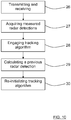
- the control unit arrangement is arranged to engage a tracking algorithm using the present measured radar detections as input such that at least one track is initialized. For each track, the control unit arrangement is arranged to calculate a calculated previous radar detection that precedes the present measured radar detections, and to re-initialize the tracking algorithm using the present measured radar detections (in combination with the calculated previous radar detection.
- This object is also obtained by means of a method for a vehicle radar system, where the method comprises transmitting signals and receiving reflected signals, and acquiring a plurality of measured radar detections at different times.
- the method further comprises engaging a tracking algorithm using the present measured radar detections as input such that at least one track is initialized. For each track, the method comprises calculating a calculated previous radar detection that precedes the present measured radar detections, and re-initializing the tracking algorithm using the present measured radar detections in combination with the calculated previous radar detection.
- the control unit arrangement for each track, for each one of a plurality of measured radar detections, is arranged to calculate a corresponding predicted detection and a corresponding corrected predicted detection.
- the control unit arrangement is furthermore arranged to calculate a corresponding distance vector, an innovation vector, that runs between a present measured radar detection and a corresponding present predicted detection.
- Each innovation vector is constituted by a vector part of a first vector type and of a vector part of a second vector type.
- the control unit arrangement is arranged to calculate a statistical distribution of a plurality of at least one of said vector types, and to determine how the calculated statistical distribution is related to another statistical distribution, and/or to determine symmetrical characteristics of the calculated statistical distribution.
- the control unit arrangement is then arranged to either maintain or re-initialize the tracking algorithm in dependence of the determined result that provides data for quality measures of said track.
- said another statistical distribution is constituted by a predetermined statistical distribution where the control unit arrangement is arranged to determine to which extent the calculated statistical distribution deviates from the predetermined statistical distribution. If said deviation is determined to exceed a predefined threshold, the control unit arrangement is arranged to re-initialize the tracking algorithm.
- said another statistical distribution is constituted by a statistical distribution of parts of the corresponding measured radar detections, where the control unit arrangement is arranged to determine a ratio between the calculated statistical distribution and said another statistical distribution. If said ratio is determined to deviate beyond a predefined threshold, the control unit arrangement is arranged to re-initialize the tracking algorithm.
- a tracking algorithm is provided that produces a sufficient prediction of the movement of a remote vehicle as quick as possible.
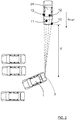
- Figure 1 schematically shows a top view of an ego vehicle 1 arranged to run on a road 2 in a forward direction F, where the ego vehicle 1 comprises a vehicle radar system 3.
- the vehicle radar system 3 comprises a rear radar sensor arrangement 4 that is arranged to distinguish and/or resolve single targets 5 from the surroundings by transmitting signals 6 and receiving reflected signals 7 and using a Doppler effect in a previously well-known manner.
- the transmitted signals 6 are according to some aspects constituted by sweep signals in the form of FMCW (Frequency Modulated Continuous Wave) chirp signals 6 of a previously known kind.
- FMCW Frequency Modulated Continuous Wave
- the vehicle radar system 3 further comprises a control unit arrangement 8 that is connected to the rear radar sensor arrangement 4 and is arranged to provide azimuth angles of possible target objects 5 by simultaneously sampling and analyzing phase and amplitude of the received signals in a previously well-known manner.
- a control unit arrangement 8 that is connected to the rear radar sensor arrangement 4 and is arranged to provide azimuth angles of possible target objects 5 by simultaneously sampling and analyzing phase and amplitude of the received signals in a previously well-known manner.
- a control unit arrangement 8 that is connected to the rear radar sensor arrangement 4 and is arranged to provide azimuth angles of possible target objects 5 by simultaneously sampling and analyzing phase and amplitude of the received signals in a previously well-known manner.
- a radar detection 9 is shown, having a certain detected azimuth angle ⁇ relative a radar reference line 22 - suitably a radar sensor arrangement boresight direction, distance r and radial velocity v.
- an approaching target vehicle 31 is moving towards the ego vehicle with a velocity V target , and is detected by means of the rear radar sensor arrangement 4.
- each measured radar detection 10, 11, 12, 13 has a certain corresponding measured azimuth angle ⁇ 0 , ⁇ -1 , ⁇ -2 , ⁇ -3 , distance r 0 , r -1, r -2 , r -3, and radial velocity v 0 , v -1 , v -2 , v -3 . All azimuth angles ⁇ 0 , ⁇ -1 , ⁇ -2, ⁇ -3 are defined relative the radar reference line 22.
- the control unit arrangement 8 is arranged to engage a tracking algorithm using a Kalman filter at the initial time to using the present four measured radar detections 10, 11, 12, 13 as input.
- the central part of a tracking algorithm is the filtering of the tracks.
- the used filter algorithm can be chosen freely.
- a Kalman filter is common, but there is a huge variety of filters, e.g. ⁇ - ⁇ -filters or - ⁇ - ⁇ - ⁇ -filters.
- a track is in this context defined by at least a filter state that consists of the position and its derivatives; at least velocity, but can contain also acceleration and higher derivatives. It is desired to have a reliable track engaged as early as possible, when a distance d between the vehicles 1, 31 is as large as possible.
- control unit arrangement 8 is arranged to use the tracking algorithm to calculate a calculated previous radar detection 14 that precedes the present four measured radar detections 10, 11, 12, 13 at a corresponding previous time t -4 , where the calculated previous radar detection 14 has a certain corresponding calculated azimuth angle ⁇ -4 , distance r -4 , and radial velocity v -4 .
- the control unit arrangement 8 is arranged to re-start the tracking algorithm using the present four radar detections 10, 11, 12, 13 and the calculated previous radar detection 14, and then calculate a next calculated radar detection 15 at a corresponding next time t +1 .
- the rear radar sensor arrangement 4 has also detected a next measured radar detection 16 that corresponds to the next calculated radar detection 15.
- the rear radar sensor arrangement 4 has detected a following measured radar detection 17.
- no azimuth angle, distance, and radial velocity is indicated for the last detection 15, 16, 17 for reasons of clarity.
- the calculated radar detection above are predicted radar detections before correction in the tracking algorithm.
- general measured radar detections, predicted radar detections and corrected radar detection for a running tracking algorithm will be discussed.
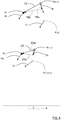
- and a first measured radar detection z t at a time t are shown.
- is corrected such that a first corrected radar detection x t
- the procedure continues in a well-known manner such that a second measured radar detection z t+1 , a second predicted radar detection x t+1
- the first measured radar detection z t has a measured velocity vector m 1
- has a predicted velocity vector p 1
- has a first corrected velocity vector c 1 .
- the first innovation vector 18 is constituted by two parts, a first main part 18a that runs along the predicted velocity vector p 1 and a first perpendicular part 18b that is perpendicular to the first main part 18a.
- the second measured radar detection z t+1 has a measured velocity vector m 2
- has a predicted velocity vector p 2
- has a second corrected velocity vector c 2 .
- the second innovation vector 23 is constituted by two parts, a second main part 23a that runs along the predicted velocity vector p 2 and a second perpendicular part 23b that is perpendicular to the second main part 23a.
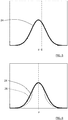
- the control unit arrangement 8 is arranged to determine a plurality of perpendicular parts 18b, 23b for a corresponding plurality of radar cycles, and to calculate a statistical distribution 24 for said perpendicular parts 18b, 23b.
- the control unit arrangement 8 is then arranged to determine to which extent the calculated statistical distribution deviates from a predetermined statistical distribution 25, according to some aspects a normal, or Gaussian, distribution, and/or its symmetrical characteristics such as symmetry around a zero point. If the deviation exceeds a predefined threshold, the tracking algorithm is re-started.
- said plurality of perpendicular parts 18b, 23b is constituted by about 10 - 30 perpendicular parts.
- the main parts 18a, 23a are dependent on the predicted velocity vector p 1 , p 2 .
- the control unit arrangement 8 is arranged to determine a plurality of main parts for a corresponding plurality of radar cycles, and to calculate a statistical distribution for said main parts. The control unit arrangement 8 is then arranged to determine to which extent the calculated statistical distribution is related to the direction of the track. If the calculated statistical distribution is pointing to the rear of the track, the track is too fast, and if the calculated statistical distribution is pointing to the front of the track, the track is too slow.
- the calculated statistical distribution 24 deviates from a predetermined statistical distribution 25, according to some aspects a normal, or Gaussian, distribution, and/or its symmetrical characteristics such as symmetry around a zero point. If the deviation exceeds a predefined threshold, the tracking algorithm is re-started in this case as well.
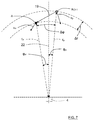
- has a certain calculated azimuth angle ⁇ p , distance r p , and radial velocity v p
- the first measured radar detection z t has a certain measured azimuth angle ⁇ m , distance r m , and radial velocity v m
- the azimuth angles ⁇ p , ⁇ m are measured from the radar reference line 22. Between the azimuth angles ⁇ p , ⁇ m there is a difference angle ⁇ , and between the distances r p , r m there is a difference distance ⁇ r.
- the innovation vector 19 is constituted by two parts, an angular part, the difference angle ⁇ , and a radial part, the difference distance ⁇ r.
- has a corresponding corrected radar detection, and of course a plurality of measured radar detections, predicted radar detections and predicted radar detections is obtained during a plurality of radar cycles.
- the control unit arrangement 8 is arranged to determine a plurality of angular parts ⁇ , and a plurality of measured azimuth angles ⁇ m , for a corresponding plurality of radar cycles, and to calculate a first angular statistical distribution ⁇ inno, ⁇ for the angular parts ⁇ and a second angular statistical distribution ⁇ meas, ⁇ for the measured azimuth angles ⁇ m .
- the control unit arrangement 8 is then arranged to determine an angular noise ratio by dividing the first angular statistical distribution ⁇ inno, ⁇ with the second angular statistical distribution ⁇ meas, ⁇
- the control unit arrangement 8 is arranged to determine a plurality of radial parts ⁇ r, and a plurality of measured distances r m , for a corresponding plurality of radar cycles, and to calculate a first distance statistical distribution ⁇ inno,r for the radial parts ⁇ r and a second distance statistical distribution ⁇ meas,r for the measured distances r m .
- the control unit arrangement 8 is then arranged to determine a range noise ration by dividing the first distance statistical distribution ⁇ inno,r with the second distance statistical distribution ⁇ meas,r .
- the statistical distributions ⁇ inno, ⁇ , ⁇ inno,r , ⁇ meae, ⁇ , ⁇ meas,r are constituted by normal, or Gaussian, distributions.
- a radar cycle is one observation phase during which the vehicle radar system 2 is arranged to acquire data, process said data on several signal processing levels and to send out available results. This can be a fixed time interval, or it can be a dynamic time interval depending on environment conditions and processing load.
- the tracking algorithm can be re-started or re-initialized.
- the quality measures define how well a certain track fits corresponding measurement.
- a core of the present disclosure lies not that the statistical distribution of innovation vector parts 18a, 18b; ⁇ , ⁇ r are determined and investigated. The investigation result provides data for said quality measures.
- a tracking procedure follows the following steps:
- the ego vehicle 1 comprises a safety control unit 20 and safety means 21, for example an emergency braking system and/or an alarm signal device.
- the safety control unit 20 is arranged to control the safety means 21 in dependence of input from the radar system 3. Such input may be input via the control unit arrangement 8.
- the present disclosure also relates to a method for a vehicle radar system 3, where the method comprises:
- the radar system may be implemented in any type of vehicle such as cars, trucks and buses as well as boats and aircraft.
- the statistical distributions 24, 25; ⁇ inno, ⁇ , ⁇ meas, ⁇ ; ⁇ inno,r, ⁇ meas,r, shown are only examples of statistical distributions that are used for explaining the present disclosure.
- the statistical distributions 24, 25; ⁇ inno, ⁇ , ⁇ meas, ⁇ ; ⁇ inno,r, ⁇ meas,r can have any forms possible and/or suitable within the scope of the present disclosure.
- control unit arrangement 8 may be comprised by one or more separate or integrated control units.
- the safety control unit 20 is according to some aspects comprised in the control unit arrangement 8.
- tracked target vehicle generally there can be any type of tracked target object such as for example a bicycle or a pedestrian.
- FMCW signals and FMCW signal configurations are also conceivable, as well as other types of Doppler radar signals.
- Other types of radar systems are also conceivable; not only FMCW radar systems are conceivable.
- Pulse radar, FSK (frequency-shift keying) or CW (continuous wave) waveform are also conceivable like all other kinds of suitable modulation techniques.
- a rear vehicle radar system is shown in Figure 1 and Figure 2 , but the examples above are of course applicable for any type of vehicle radar system at any position in a vehicle.
- the present disclosure relates to a vehicle radar system 3 comprising a control unit arrangement 8 and at least one radar sensor arrangement 4 that is arranged to transmit signals 6 and receive reflected signals 7, where the vehicle radar system 3 is arranged to acquire a plurality of measured radar detections 10, 11, 12, 13 at different times; where the control unit arrangement 8 is arranged to engage a tracking algorithm using the present measured radar detections 10, 11, 12, 13 as input such that at least one track is initialized. For each track, the control unit arrangement 8 is arranged to:
- said plurality of measured radar detections 10, 11, 12, 13 constitutes at least four measured radar detections 10, 11, 12, 13.
- the tracking algorithm comprises a Kalman filter.
- the control unit arrangement 8 is arranged to calculate a corresponding predicted detection x t
- said another statistical distribution is constituted by a predetermined statistical distribution 25, where the control unit arrangement 8 is arranged to determine to which extent the calculated statistical distribution deviates from the predetermined statistical distribution 25, and if said deviation is determined to exceed a predefined threshold, to re-initialize the tracking algorithm.
- said another statistical distribution is constituted by a statistical distribution ⁇ meas, ⁇ , ⁇ meas,r of parts of the corresponding measured radar detections z t , z t+1 , where the control unit arrangement 8 is arranged to determine a ratio between the calculated statistical distribution ⁇ inno, ⁇ , ⁇ inno,r and said another statistical distribution ⁇ meas, ⁇ , ⁇ meas,r , and if said ratio is determined to deviate beyond a predefined threshold, to re-initialize the tracking algorithm.
- the present disclosure also relates to a method for a vehicle radar system 3, where the method comprises:
- said plurality of measured radar detections 10, 11, 12, 13 constitutes at least four measured radar detections 10, 11, 12, 13.
- the tracking algorithm uses a Kalman filter.
- the method comprises calculating a corresponding predicted detection x t
- said another statistical distribution is constituted by a predetermined statistical distribution 25, where the control unit arrangement 8 is arranged to determine to which extent the calculated statistical distribution deviates from the predetermined statistical distribution 25, and if said deviation is determined to exceed a predefined threshold, to re-initialize the tracking algorithm.
- said another statistical distribution is constituted by a statistical distribution ⁇ meas, ⁇ , ⁇ meas,r of parts of the corresponding measured radar detections z t , z t+1 , where the control unit arrangement 8 is arranged to determine a ratio between the calculated statistical distribution ⁇ inno, ⁇ , ⁇ inno,r and said another statistical distribution ⁇ meas, ⁇ , ⁇ meas,r , and if said ratio is determined to deviate beyond a predefined threshold, to re-initialize the tracking algorithm.
Landscapes
- Engineering & Computer Science (AREA)
- Radar, Positioning & Navigation (AREA)
- Remote Sensing (AREA)
- Physics & Mathematics (AREA)
- General Physics & Mathematics (AREA)
- Computer Networks & Wireless Communication (AREA)
- Data Mining & Analysis (AREA)
- Pure & Applied Mathematics (AREA)
- Mathematical Physics (AREA)
- Mathematical Optimization (AREA)
- Computational Mathematics (AREA)
- Theoretical Computer Science (AREA)
- Mathematical Analysis (AREA)
- Electromagnetism (AREA)
- Evolutionary Biology (AREA)
- Operations Research (AREA)
- Probability & Statistics with Applications (AREA)
- Bioinformatics & Computational Biology (AREA)
- Algebra (AREA)
- Bioinformatics & Cheminformatics (AREA)
- Databases & Information Systems (AREA)
- Software Systems (AREA)
- General Engineering & Computer Science (AREA)
- Life Sciences & Earth Sciences (AREA)
- Radar Systems Or Details Thereof (AREA)
Priority Applications (4)
| Application Number | Priority Date | Filing Date | Title |
|---|---|---|---|
| EP17178908.4A EP3422045B1 (fr) | 2017-06-30 | 2017-06-30 | Système amélioré de poursuite d'objets |
| CN201880036066.2A CN110691985B (zh) | 2017-06-30 | 2018-06-15 | 用于增强的对象追踪的系统 |
| US16/626,925 US11650305B2 (en) | 2017-06-30 | 2018-06-15 | System for enhanced object tracking |
| PCT/EP2018/065990 WO2019001991A1 (fr) | 2017-06-30 | 2018-06-15 | Système pour l'amélioration du pistage d'un objet |
Applications Claiming Priority (1)
| Application Number | Priority Date | Filing Date | Title |
|---|---|---|---|
| EP17178908.4A EP3422045B1 (fr) | 2017-06-30 | 2017-06-30 | Système amélioré de poursuite d'objets |
Publications (2)
| Publication Number | Publication Date |
|---|---|
| EP3422045A1 true EP3422045A1 (fr) | 2019-01-02 |
| EP3422045B1 EP3422045B1 (fr) | 2022-04-20 |
Family
ID=59258148
Family Applications (1)
| Application Number | Title | Priority Date | Filing Date |
|---|---|---|---|
| EP17178908.4A Active EP3422045B1 (fr) | 2017-06-30 | 2017-06-30 | Système amélioré de poursuite d'objets |
Country Status (4)
| Country | Link |
|---|---|
| US (1) | US11650305B2 (fr) |
| EP (1) | EP3422045B1 (fr) |
| CN (1) | CN110691985B (fr) |
| WO (1) | WO2019001991A1 (fr) |
Families Citing this family (2)
| Publication number | Priority date | Publication date | Assignee | Title |
|---|---|---|---|---|
| JP7181010B2 (ja) * | 2018-06-11 | 2022-11-30 | 株式会社デンソーテン | レーダ装置および物標検出方法 |
| EP4187276A1 (fr) * | 2021-11-30 | 2023-05-31 | Aptiv Technologies Limited | Procédé et système d'estimation de matrice d'étalonnage de radar |
Citations (4)
| Publication number | Priority date | Publication date | Assignee | Title |
|---|---|---|---|---|
| US20080306666A1 (en) | 2007-06-05 | 2008-12-11 | Gm Global Technology Operations, Inc. | Method and apparatus for rear cross traffic collision avoidance |
| US20100191391A1 (en) * | 2009-01-26 | 2010-07-29 | Gm Global Technology Operations, Inc. | multiobject fusion module for collision preparation system |
| US20100198513A1 (en) * | 2009-02-03 | 2010-08-05 | Gm Global Technology Operations, Inc. | Combined Vehicle-to-Vehicle Communication and Object Detection Sensing |
| US20160291149A1 (en) | 2015-04-06 | 2016-10-06 | GM Global Technology Operations LLC | Fusion method for cross traffic application using radars and camera |
Family Cites Families (7)
| Publication number | Priority date | Publication date | Assignee | Title |
|---|---|---|---|---|
| US7626535B2 (en) * | 2006-11-09 | 2009-12-01 | Raytheon Company | Track quality based multi-target tracker |
| GB0701869D0 (en) * | 2007-01-31 | 2007-03-14 | Cambridge Consultants | Adaptive radar |
| US8793046B2 (en) * | 2012-06-01 | 2014-07-29 | Google Inc. | Inferring state of traffic signal and other aspects of a vehicle's environment based on surrogate data |
| TWI470257B (zh) * | 2013-10-07 | 2015-01-21 | Univ Nat Chiao Tung | 角度估計檢測方法及電子裝置 |
| BR102014006109B1 (pt) * | 2014-03-14 | 2021-10-19 | Embraer S.A. | Radar de alta precisão para acompanhamento de alvos aéreos |
| US10718864B2 (en) * | 2016-06-17 | 2020-07-21 | Fujitsu Ten Limited | Radar device and information transfer method |
| JP6597517B2 (ja) * | 2016-08-10 | 2019-10-30 | 株式会社デンソー | 物標検出装置 |
-
2017
- 2017-06-30 EP EP17178908.4A patent/EP3422045B1/fr active Active
-
2018
- 2018-06-15 US US16/626,925 patent/US11650305B2/en active Active
- 2018-06-15 WO PCT/EP2018/065990 patent/WO2019001991A1/fr not_active Ceased
- 2018-06-15 CN CN201880036066.2A patent/CN110691985B/zh active Active
Patent Citations (4)
| Publication number | Priority date | Publication date | Assignee | Title |
|---|---|---|---|---|
| US20080306666A1 (en) | 2007-06-05 | 2008-12-11 | Gm Global Technology Operations, Inc. | Method and apparatus for rear cross traffic collision avoidance |
| US20100191391A1 (en) * | 2009-01-26 | 2010-07-29 | Gm Global Technology Operations, Inc. | multiobject fusion module for collision preparation system |
| US20100198513A1 (en) * | 2009-02-03 | 2010-08-05 | Gm Global Technology Operations, Inc. | Combined Vehicle-to-Vehicle Communication and Object Detection Sensing |
| US20160291149A1 (en) | 2015-04-06 | 2016-10-06 | GM Global Technology Operations LLC | Fusion method for cross traffic application using radars and camera |
Also Published As
| Publication number | Publication date |
|---|---|
| WO2019001991A1 (fr) | 2019-01-03 |
| US20200132827A1 (en) | 2020-04-30 |
| EP3422045B1 (fr) | 2022-04-20 |
| CN110691985B (zh) | 2023-04-21 |
| US11650305B2 (en) | 2023-05-16 |
| CN110691985A (zh) | 2020-01-14 |
Similar Documents
| Publication | Publication Date | Title |
|---|---|---|
| US10473760B2 (en) | Radar device and vertical axis-misalignment detecting method | |
| US11307300B2 (en) | Vehicle radar system | |
| EP3539837B1 (fr) | Système de radar de véhicule permettant de détecter des véhicules précédents | |
| US9812008B2 (en) | Vehicle detection and tracking based on wheels using radar and vision | |
| CN105445734A (zh) | 具有基于相位的多目标检测的雷达系统 | |
| US11300660B2 (en) | Determining relative velocity in a vehicle radar system | |
| KR20190125453A (ko) | 하나 이상의 표적의 반경방향 상대 가속도를 결정하기 위한 방법 및 레이더 장치 | |
| Macaveiu et al. | Automotive radar target tracking by Kalman filtering | |
| KR20200108464A (ko) | 임계적인 횡방향 이동을 검출하는 방법 및 장치 | |
| US11391833B2 (en) | System for enhanced object tracking | |
| US11650305B2 (en) | System for enhanced object tracking | |
| US12024175B2 (en) | Vehicle system for detection of oncoming vehicles | |
| EP3413083B1 (fr) | Système de véhicule pour la détection de véhicules en approche | |
| EP3480624A1 (fr) | Détection d'orientation de rangée de stationnement | |
| JP2007232747A (ja) | 車載用レーダ装置 | |
| US20250012920A1 (en) | Method, device and system for operating a rail vehicle for warning about a possible collision | |
| KR102175492B1 (ko) | 도플러 주파수를 이용한 각도 분해장치 | |
| CN114402224A (zh) | 用于物体跟踪的方法 | |
| KR20160112672A (ko) | 레이더 신호 처리장치 및 방법 |
Legal Events
| Date | Code | Title | Description |
|---|---|---|---|
| PUAI | Public reference made under article 153(3) epc to a published international application that has entered the european phase |
Free format text: ORIGINAL CODE: 0009012 |
|
| STAA | Information on the status of an ep patent application or granted ep patent |
Free format text: STATUS: THE APPLICATION HAS BEEN PUBLISHED |
|
| AK | Designated contracting states |
Kind code of ref document: A1 Designated state(s): AL AT BE BG CH CY CZ DE DK EE ES FI FR GB GR HR HU IE IS IT LI LT LU LV MC MK MT NL NO PL PT RO RS SE SI SK SM TR |
|
| AX | Request for extension of the european patent |
Extension state: BA ME |
|
| STAA | Information on the status of an ep patent application or granted ep patent |
Free format text: STATUS: REQUEST FOR EXAMINATION WAS MADE |
|
| 17P | Request for examination filed |
Effective date: 20190701 |
|
| RBV | Designated contracting states (corrected) |
Designated state(s): AL AT BE BG CH CY CZ DE DK EE ES FI FR GB GR HR HU IE IS IT LI LT LU LV MC MK MT NL NO PL PT RO RS SE SI SK SM TR |
|
| STAA | Information on the status of an ep patent application or granted ep patent |
Free format text: STATUS: EXAMINATION IS IN PROGRESS |
|
| 17Q | First examination report despatched |
Effective date: 20200217 |
|
| REG | Reference to a national code |
Ref country code: DE Ref legal event code: R079 Ref document number: 602017056156 Country of ref document: DE Free format text: PREVIOUS MAIN CLASS: G01S0013720000 Ipc: G01S0013931000 |
|
| GRAP | Despatch of communication of intention to grant a patent |
Free format text: ORIGINAL CODE: EPIDOSNIGR1 |
|
| STAA | Information on the status of an ep patent application or granted ep patent |
Free format text: STATUS: GRANT OF PATENT IS INTENDED |
|
| RIC1 | Information provided on ipc code assigned before grant |
Ipc: G01S 13/72 20060101ALI20211028BHEP Ipc: G01S 13/931 20200101AFI20211028BHEP |
|
| INTG | Intention to grant announced |
Effective date: 20211119 |
|
| GRAS | Grant fee paid |
Free format text: ORIGINAL CODE: EPIDOSNIGR3 |
|
| GRAA | (expected) grant |
Free format text: ORIGINAL CODE: 0009210 |
|
| STAA | Information on the status of an ep patent application or granted ep patent |
Free format text: STATUS: THE PATENT HAS BEEN GRANTED |
|
| AK | Designated contracting states |
Kind code of ref document: B1 Designated state(s): AL AT BE BG CH CY CZ DE DK EE ES FI FR GB GR HR HU IE IS IT LI LT LU LV MC MK MT NL NO PL PT RO RS SE SI SK SM TR |
|
| REG | Reference to a national code |
Ref country code: GB Ref legal event code: FG4D |
|
| REG | Reference to a national code |
Ref country code: CH Ref legal event code: EP |
|
| REG | Reference to a national code |
Ref country code: IE Ref legal event code: FG4D |
|
| REG | Reference to a national code |
Ref country code: DE Ref legal event code: R096 Ref document number: 602017056156 Country of ref document: DE |
|
| REG | Reference to a national code |
Ref country code: AT Ref legal event code: REF Ref document number: 1485578 Country of ref document: AT Kind code of ref document: T Effective date: 20220515 |
|
| REG | Reference to a national code |
Ref country code: SE Ref legal event code: TRGR |
|
| REG | Reference to a national code |
Ref country code: LT Ref legal event code: MG9D |
|
| REG | Reference to a national code |
Ref country code: NL Ref legal event code: MP Effective date: 20220420 |
|
| REG | Reference to a national code |
Ref country code: AT Ref legal event code: MK05 Ref document number: 1485578 Country of ref document: AT Kind code of ref document: T Effective date: 20220420 |
|
| PG25 | Lapsed in a contracting state [announced via postgrant information from national office to epo] |
Ref country code: NL Free format text: LAPSE BECAUSE OF FAILURE TO SUBMIT A TRANSLATION OF THE DESCRIPTION OR TO PAY THE FEE WITHIN THE PRESCRIBED TIME-LIMIT Effective date: 20220420 |
|
| PG25 | Lapsed in a contracting state [announced via postgrant information from national office to epo] |
Ref country code: PT Free format text: LAPSE BECAUSE OF FAILURE TO SUBMIT A TRANSLATION OF THE DESCRIPTION OR TO PAY THE FEE WITHIN THE PRESCRIBED TIME-LIMIT Effective date: 20220822 Ref country code: NO Free format text: LAPSE BECAUSE OF FAILURE TO SUBMIT A TRANSLATION OF THE DESCRIPTION OR TO PAY THE FEE WITHIN THE PRESCRIBED TIME-LIMIT Effective date: 20220720 Ref country code: LT Free format text: LAPSE BECAUSE OF FAILURE TO SUBMIT A TRANSLATION OF THE DESCRIPTION OR TO PAY THE FEE WITHIN THE PRESCRIBED TIME-LIMIT Effective date: 20220420 Ref country code: HR Free format text: LAPSE BECAUSE OF FAILURE TO SUBMIT A TRANSLATION OF THE DESCRIPTION OR TO PAY THE FEE WITHIN THE PRESCRIBED TIME-LIMIT Effective date: 20220420 Ref country code: GR Free format text: LAPSE BECAUSE OF FAILURE TO SUBMIT A TRANSLATION OF THE DESCRIPTION OR TO PAY THE FEE WITHIN THE PRESCRIBED TIME-LIMIT Effective date: 20220721 Ref country code: FI Free format text: LAPSE BECAUSE OF FAILURE TO SUBMIT A TRANSLATION OF THE DESCRIPTION OR TO PAY THE FEE WITHIN THE PRESCRIBED TIME-LIMIT Effective date: 20220420 Ref country code: ES Free format text: LAPSE BECAUSE OF FAILURE TO SUBMIT A TRANSLATION OF THE DESCRIPTION OR TO PAY THE FEE WITHIN THE PRESCRIBED TIME-LIMIT Effective date: 20220420 Ref country code: BG Free format text: LAPSE BECAUSE OF FAILURE TO SUBMIT A TRANSLATION OF THE DESCRIPTION OR TO PAY THE FEE WITHIN THE PRESCRIBED TIME-LIMIT Effective date: 20220720 Ref country code: AT Free format text: LAPSE BECAUSE OF FAILURE TO SUBMIT A TRANSLATION OF THE DESCRIPTION OR TO PAY THE FEE WITHIN THE PRESCRIBED TIME-LIMIT Effective date: 20220420 |
|
| PG25 | Lapsed in a contracting state [announced via postgrant information from national office to epo] |
Ref country code: RS Free format text: LAPSE BECAUSE OF FAILURE TO SUBMIT A TRANSLATION OF THE DESCRIPTION OR TO PAY THE FEE WITHIN THE PRESCRIBED TIME-LIMIT Effective date: 20220420 Ref country code: PL Free format text: LAPSE BECAUSE OF FAILURE TO SUBMIT A TRANSLATION OF THE DESCRIPTION OR TO PAY THE FEE WITHIN THE PRESCRIBED TIME-LIMIT Effective date: 20220420 Ref country code: LV Free format text: LAPSE BECAUSE OF FAILURE TO SUBMIT A TRANSLATION OF THE DESCRIPTION OR TO PAY THE FEE WITHIN THE PRESCRIBED TIME-LIMIT Effective date: 20220420 Ref country code: IS Free format text: LAPSE BECAUSE OF FAILURE TO SUBMIT A TRANSLATION OF THE DESCRIPTION OR TO PAY THE FEE WITHIN THE PRESCRIBED TIME-LIMIT Effective date: 20220820 |
|
| REG | Reference to a national code |
Ref country code: DE Ref legal event code: R097 Ref document number: 602017056156 Country of ref document: DE |
|
| PG25 | Lapsed in a contracting state [announced via postgrant information from national office to epo] |
Ref country code: SM Free format text: LAPSE BECAUSE OF FAILURE TO SUBMIT A TRANSLATION OF THE DESCRIPTION OR TO PAY THE FEE WITHIN THE PRESCRIBED TIME-LIMIT Effective date: 20220420 Ref country code: SK Free format text: LAPSE BECAUSE OF FAILURE TO SUBMIT A TRANSLATION OF THE DESCRIPTION OR TO PAY THE FEE WITHIN THE PRESCRIBED TIME-LIMIT Effective date: 20220420 Ref country code: RO Free format text: LAPSE BECAUSE OF FAILURE TO SUBMIT A TRANSLATION OF THE DESCRIPTION OR TO PAY THE FEE WITHIN THE PRESCRIBED TIME-LIMIT Effective date: 20220420 Ref country code: MC Free format text: LAPSE BECAUSE OF FAILURE TO SUBMIT A TRANSLATION OF THE DESCRIPTION OR TO PAY THE FEE WITHIN THE PRESCRIBED TIME-LIMIT Effective date: 20220420 Ref country code: EE Free format text: LAPSE BECAUSE OF FAILURE TO SUBMIT A TRANSLATION OF THE DESCRIPTION OR TO PAY THE FEE WITHIN THE PRESCRIBED TIME-LIMIT Effective date: 20220420 Ref country code: DK Free format text: LAPSE BECAUSE OF FAILURE TO SUBMIT A TRANSLATION OF THE DESCRIPTION OR TO PAY THE FEE WITHIN THE PRESCRIBED TIME-LIMIT Effective date: 20220420 Ref country code: CZ Free format text: LAPSE BECAUSE OF FAILURE TO SUBMIT A TRANSLATION OF THE DESCRIPTION OR TO PAY THE FEE WITHIN THE PRESCRIBED TIME-LIMIT Effective date: 20220420 |
|
| REG | Reference to a national code |
Ref country code: CH Ref legal event code: PL |
|
| REG | Reference to a national code |
Ref country code: BE Ref legal event code: MM Effective date: 20220630 |
|
| PLBE | No opposition filed within time limit |
Free format text: ORIGINAL CODE: 0009261 |
|
| STAA | Information on the status of an ep patent application or granted ep patent |
Free format text: STATUS: NO OPPOSITION FILED WITHIN TIME LIMIT |
|
| 26N | No opposition filed |
Effective date: 20230123 |
|
| GBPC | Gb: european patent ceased through non-payment of renewal fee |
Effective date: 20220720 |
|
| PG25 | Lapsed in a contracting state [announced via postgrant information from national office to epo] |
Ref country code: AL Free format text: LAPSE BECAUSE OF FAILURE TO SUBMIT A TRANSLATION OF THE DESCRIPTION OR TO PAY THE FEE WITHIN THE PRESCRIBED TIME-LIMIT Effective date: 20220420 |
|
| PG25 | Lapsed in a contracting state [announced via postgrant information from national office to epo] |
Ref country code: LU Free format text: LAPSE BECAUSE OF NON-PAYMENT OF DUE FEES Effective date: 20220630 Ref country code: LI Free format text: LAPSE BECAUSE OF NON-PAYMENT OF DUE FEES Effective date: 20220630 Ref country code: IE Free format text: LAPSE BECAUSE OF NON-PAYMENT OF DUE FEES Effective date: 20220630 Ref country code: CH Free format text: LAPSE BECAUSE OF NON-PAYMENT OF DUE FEES Effective date: 20220630 |
|
| PG25 | Lapsed in a contracting state [announced via postgrant information from national office to epo] |
Ref country code: SI Free format text: LAPSE BECAUSE OF FAILURE TO SUBMIT A TRANSLATION OF THE DESCRIPTION OR TO PAY THE FEE WITHIN THE PRESCRIBED TIME-LIMIT Effective date: 20220420 Ref country code: GB Free format text: LAPSE BECAUSE OF NON-PAYMENT OF DUE FEES Effective date: 20220720 Ref country code: BE Free format text: LAPSE BECAUSE OF NON-PAYMENT OF DUE FEES Effective date: 20220630 |
|
| PG25 | Lapsed in a contracting state [announced via postgrant information from national office to epo] |
Ref country code: IT Free format text: LAPSE BECAUSE OF FAILURE TO SUBMIT A TRANSLATION OF THE DESCRIPTION OR TO PAY THE FEE WITHIN THE PRESCRIBED TIME-LIMIT Effective date: 20220420 |
|
| PG25 | Lapsed in a contracting state [announced via postgrant information from national office to epo] |
Ref country code: HU Free format text: LAPSE BECAUSE OF FAILURE TO SUBMIT A TRANSLATION OF THE DESCRIPTION OR TO PAY THE FEE WITHIN THE PRESCRIBED TIME-LIMIT; INVALID AB INITIO Effective date: 20170630 |
|
| REG | Reference to a national code |
Ref country code: DE Ref legal event code: R081 Ref document number: 602017056156 Country of ref document: DE Owner name: MAGNA ELECTRONICS SWEDEN AB, SE Free format text: FORMER OWNER: VEONEER SWEDEN AB, VARGARDA, SE |
|
| PG25 | Lapsed in a contracting state [announced via postgrant information from national office to epo] |
Ref country code: MK Free format text: LAPSE BECAUSE OF FAILURE TO SUBMIT A TRANSLATION OF THE DESCRIPTION OR TO PAY THE FEE WITHIN THE PRESCRIBED TIME-LIMIT Effective date: 20220420 Ref country code: CY Free format text: LAPSE BECAUSE OF FAILURE TO SUBMIT A TRANSLATION OF THE DESCRIPTION OR TO PAY THE FEE WITHIN THE PRESCRIBED TIME-LIMIT Effective date: 20220420 |
|
| PG25 | Lapsed in a contracting state [announced via postgrant information from national office to epo] |
Ref country code: TR Free format text: LAPSE BECAUSE OF FAILURE TO SUBMIT A TRANSLATION OF THE DESCRIPTION OR TO PAY THE FEE WITHIN THE PRESCRIBED TIME-LIMIT Effective date: 20220420 |
|
| PG25 | Lapsed in a contracting state [announced via postgrant information from national office to epo] |
Ref country code: MT Free format text: LAPSE BECAUSE OF FAILURE TO SUBMIT A TRANSLATION OF THE DESCRIPTION OR TO PAY THE FEE WITHIN THE PRESCRIBED TIME-LIMIT Effective date: 20220420 |
|
| PG25 | Lapsed in a contracting state [announced via postgrant information from national office to epo] |
Ref country code: BG Free format text: LAPSE BECAUSE OF FAILURE TO SUBMIT A TRANSLATION OF THE DESCRIPTION OR TO PAY THE FEE WITHIN THE PRESCRIBED TIME-LIMIT Effective date: 20220420 |
|
| PG25 | Lapsed in a contracting state [announced via postgrant information from national office to epo] |
Ref country code: BG Free format text: LAPSE BECAUSE OF FAILURE TO SUBMIT A TRANSLATION OF THE DESCRIPTION OR TO PAY THE FEE WITHIN THE PRESCRIBED TIME-LIMIT Effective date: 20220420 |
|
| PGFP | Annual fee paid to national office [announced via postgrant information from national office to epo] |
Ref country code: DE Payment date: 20250618 Year of fee payment: 9 |
|
| PGFP | Annual fee paid to national office [announced via postgrant information from national office to epo] |
Ref country code: FR Payment date: 20250623 Year of fee payment: 9 |
|
| PGFP | Annual fee paid to national office [announced via postgrant information from national office to epo] |
Ref country code: SE Payment date: 20250618 Year of fee payment: 9 |