EP3423120B1 - Échafaudage de polymère poreux et son procédé de préparation - Google Patents
Échafaudage de polymère poreux et son procédé de préparation Download PDFInfo
- Publication number
- EP3423120B1 EP3423120B1 EP17760613.4A EP17760613A EP3423120B1 EP 3423120 B1 EP3423120 B1 EP 3423120B1 EP 17760613 A EP17760613 A EP 17760613A EP 3423120 B1 EP3423120 B1 EP 3423120B1
- Authority
- EP
- European Patent Office
- Prior art keywords
- scaffold
- mpa
- porous
- bone
- polymer
- Prior art date
- Legal status (The legal status is an assumption and is not a legal conclusion. Google has not performed a legal analysis and makes no representation as to the accuracy of the status listed.)
- Active
Links
Images



Classifications
-
- A—HUMAN NECESSITIES
- A61—MEDICAL OR VETERINARY SCIENCE; HYGIENE
- A61L—METHODS OR APPARATUS FOR STERILISING MATERIALS OR OBJECTS IN GENERAL; DISINFECTION, STERILISATION OR DEODORISATION OF AIR; CHEMICAL ASPECTS OF BANDAGES, DRESSINGS, ABSORBENT PADS OR SURGICAL ARTICLES; MATERIALS FOR BANDAGES, DRESSINGS, ABSORBENT PADS OR SURGICAL ARTICLES
- A61L27/00—Materials for grafts or prostheses or for coating grafts or prostheses
- A61L27/40—Composite materials, i.e. containing one material dispersed in a matrix of the same or different material
- A61L27/44—Composite materials, i.e. containing one material dispersed in a matrix of the same or different material having a macromolecular matrix
- A61L27/46—Composite materials, i.e. containing one material dispersed in a matrix of the same or different material having a macromolecular matrix with phosphorus-containing inorganic fillers
-
- A—HUMAN NECESSITIES
- A61—MEDICAL OR VETERINARY SCIENCE; HYGIENE
- A61L—METHODS OR APPARATUS FOR STERILISING MATERIALS OR OBJECTS IN GENERAL; DISINFECTION, STERILISATION OR DEODORISATION OF AIR; CHEMICAL ASPECTS OF BANDAGES, DRESSINGS, ABSORBENT PADS OR SURGICAL ARTICLES; MATERIALS FOR BANDAGES, DRESSINGS, ABSORBENT PADS OR SURGICAL ARTICLES
- A61L27/00—Materials for grafts or prostheses or for coating grafts or prostheses
- A61L27/14—Macromolecular materials
- A61L27/18—Macromolecular materials obtained otherwise than by reactions only involving carbon-to-carbon unsaturated bonds
-
- A—HUMAN NECESSITIES
- A61—MEDICAL OR VETERINARY SCIENCE; HYGIENE
- A61L—METHODS OR APPARATUS FOR STERILISING MATERIALS OR OBJECTS IN GENERAL; DISINFECTION, STERILISATION OR DEODORISATION OF AIR; CHEMICAL ASPECTS OF BANDAGES, DRESSINGS, ABSORBENT PADS OR SURGICAL ARTICLES; MATERIALS FOR BANDAGES, DRESSINGS, ABSORBENT PADS OR SURGICAL ARTICLES
- A61L27/00—Materials for grafts or prostheses or for coating grafts or prostheses
- A61L27/40—Composite materials, i.e. containing one material dispersed in a matrix of the same or different material
- A61L27/44—Composite materials, i.e. containing one material dispersed in a matrix of the same or different material having a macromolecular matrix
- A61L27/446—Composite materials, i.e. containing one material dispersed in a matrix of the same or different material having a macromolecular matrix with other specific inorganic fillers other than those covered by A61L27/443 or A61L27/46
-
- A—HUMAN NECESSITIES
- A61—MEDICAL OR VETERINARY SCIENCE; HYGIENE
- A61L—METHODS OR APPARATUS FOR STERILISING MATERIALS OR OBJECTS IN GENERAL; DISINFECTION, STERILISATION OR DEODORISATION OF AIR; CHEMICAL ASPECTS OF BANDAGES, DRESSINGS, ABSORBENT PADS OR SURGICAL ARTICLES; MATERIALS FOR BANDAGES, DRESSINGS, ABSORBENT PADS OR SURGICAL ARTICLES
- A61L27/00—Materials for grafts or prostheses or for coating grafts or prostheses
- A61L27/50—Materials characterised by their function or physical properties, e.g. injectable or lubricating compositions, shape-memory materials, surface modified materials
-
- A—HUMAN NECESSITIES
- A61—MEDICAL OR VETERINARY SCIENCE; HYGIENE
- A61L—METHODS OR APPARATUS FOR STERILISING MATERIALS OR OBJECTS IN GENERAL; DISINFECTION, STERILISATION OR DEODORISATION OF AIR; CHEMICAL ASPECTS OF BANDAGES, DRESSINGS, ABSORBENT PADS OR SURGICAL ARTICLES; MATERIALS FOR BANDAGES, DRESSINGS, ABSORBENT PADS OR SURGICAL ARTICLES
- A61L27/00—Materials for grafts or prostheses or for coating grafts or prostheses
- A61L27/50—Materials characterised by their function or physical properties, e.g. injectable or lubricating compositions, shape-memory materials, surface modified materials
- A61L27/54—Biologically active materials, e.g. therapeutic substances
-
- A—HUMAN NECESSITIES
- A61—MEDICAL OR VETERINARY SCIENCE; HYGIENE
- A61L—METHODS OR APPARATUS FOR STERILISING MATERIALS OR OBJECTS IN GENERAL; DISINFECTION, STERILISATION OR DEODORISATION OF AIR; CHEMICAL ASPECTS OF BANDAGES, DRESSINGS, ABSORBENT PADS OR SURGICAL ARTICLES; MATERIALS FOR BANDAGES, DRESSINGS, ABSORBENT PADS OR SURGICAL ARTICLES
- A61L27/00—Materials for grafts or prostheses or for coating grafts or prostheses
- A61L27/50—Materials characterised by their function or physical properties, e.g. injectable or lubricating compositions, shape-memory materials, surface modified materials
- A61L27/56—Porous materials, e.g. foams or sponges
-
- A—HUMAN NECESSITIES
- A61—MEDICAL OR VETERINARY SCIENCE; HYGIENE
- A61L—METHODS OR APPARATUS FOR STERILISING MATERIALS OR OBJECTS IN GENERAL; DISINFECTION, STERILISATION OR DEODORISATION OF AIR; CHEMICAL ASPECTS OF BANDAGES, DRESSINGS, ABSORBENT PADS OR SURGICAL ARTICLES; MATERIALS FOR BANDAGES, DRESSINGS, ABSORBENT PADS OR SURGICAL ARTICLES
- A61L2300/00—Biologically active materials used in bandages, wound dressings, absorbent pads or medical devices
- A61L2300/40—Biologically active materials used in bandages, wound dressings, absorbent pads or medical devices characterised by a specific therapeutic activity or mode of action
- A61L2300/404—Biocides, antimicrobial agents, antiseptic agents
- A61L2300/406—Antibiotics
-
- A—HUMAN NECESSITIES
- A61—MEDICAL OR VETERINARY SCIENCE; HYGIENE
- A61L—METHODS OR APPARATUS FOR STERILISING MATERIALS OR OBJECTS IN GENERAL; DISINFECTION, STERILISATION OR DEODORISATION OF AIR; CHEMICAL ASPECTS OF BANDAGES, DRESSINGS, ABSORBENT PADS OR SURGICAL ARTICLES; MATERIALS FOR BANDAGES, DRESSINGS, ABSORBENT PADS OR SURGICAL ARTICLES
- A61L2300/00—Biologically active materials used in bandages, wound dressings, absorbent pads or medical devices
- A61L2300/60—Biologically active materials used in bandages, wound dressings, absorbent pads or medical devices characterised by a special physical form
- A61L2300/602—Type of release, e.g. controlled, sustained, slow
- A61L2300/604—Biodegradation
-
- A—HUMAN NECESSITIES
- A61—MEDICAL OR VETERINARY SCIENCE; HYGIENE
- A61L—METHODS OR APPARATUS FOR STERILISING MATERIALS OR OBJECTS IN GENERAL; DISINFECTION, STERILISATION OR DEODORISATION OF AIR; CHEMICAL ASPECTS OF BANDAGES, DRESSINGS, ABSORBENT PADS OR SURGICAL ARTICLES; MATERIALS FOR BANDAGES, DRESSINGS, ABSORBENT PADS OR SURGICAL ARTICLES
- A61L2300/00—Biologically active materials used in bandages, wound dressings, absorbent pads or medical devices
- A61L2300/60—Biologically active materials used in bandages, wound dressings, absorbent pads or medical devices characterised by a special physical form
- A61L2300/64—Animal cells
-
- A—HUMAN NECESSITIES
- A61—MEDICAL OR VETERINARY SCIENCE; HYGIENE
- A61L—METHODS OR APPARATUS FOR STERILISING MATERIALS OR OBJECTS IN GENERAL; DISINFECTION, STERILISATION OR DEODORISATION OF AIR; CHEMICAL ASPECTS OF BANDAGES, DRESSINGS, ABSORBENT PADS OR SURGICAL ARTICLES; MATERIALS FOR BANDAGES, DRESSINGS, ABSORBENT PADS OR SURGICAL ARTICLES
- A61L2430/00—Materials or treatment for tissue regeneration
- A61L2430/02—Materials or treatment for tissue regeneration for reconstruction of bones; weight-bearing implants
-
- C—CHEMISTRY; METALLURGY
- C08—ORGANIC MACROMOLECULAR COMPOUNDS; THEIR PREPARATION OR CHEMICAL WORKING-UP; COMPOSITIONS BASED THEREON
- C08L—COMPOSITIONS OF MACROMOLECULAR COMPOUNDS
- C08L67/00—Compositions of polyesters obtained by reactions forming a carboxylic ester link in the main chain; Compositions of derivatives of such polymers
- C08L67/04—Polyesters derived from hydroxycarboxylic acids, e.g. lactones
Definitions
- the present invention relates to a porous polymer material (or scaffold), and more particularly to a polymer-ceramic composite having interconnected pores and a porosity of about 50% to 90% as defined in the claims.
- the scaffold is bioresorbable and exhibits advantageous mechanical properties that mimic those found in natural bone.
- Methods of preparing the scaffolds and using them in skeletal tissue engineering applications e.g., as bone grafts to repair bone, osteochondral, and ligament defects.
- Artificial polymer-based bone graft material made to closely resemble natural bone would be a useful replacement for natural bone in various clinical applications (e.g., bone repair and reconstruction).
- Acceptable synthetic bone can avoid problems of supply availability and the risks and complications associated with allograft bone, such as risks of infection, disease, and viral transmission.
- a method of preparing a porous scaffold comprising a biodegradable polymer and a ceramic material, the porous scaffold having a desired shape and comprising interconnected pores and an average porosity of about 50% to about 90%, the method involving heating at 100°C a mixture comprising the biodegradable polymer, the ceramic material, and a porogen and compressing the heated mixture at a pressure of 23 MPa.
- the disclosure relates to a porous polymer scaffold comprising a polymer (e.g., polycaprolactone) and an inorganic additive (e.g., tricalcium phosphate), the scaffold having interconnected pores and a porosity range of about 50% to about 90%.
- the porous scaffold has a pore size ranging from about 500-800 ⁇ M.
- the porous scaffold is a bioresorbable scaffold, optionally comprising a bioreactive agent (e.g., mesenchymal stem cells).
- a bioreactive agent e.g., mesenchymal stem cells
- the scaffold provides a suitable platform for stem cell differentiation.
- the present invention provides, a method of preparing a porous scaffold comprising a biodegradable polymer and a ceramic material, the porous scaffold having a desired shape and comprising interconnected pores and an average porosity of 50% to 90%, the method comprising the steps of:heating a mixture comprising the biodegradable polymer, the ceramic material, and a porogen;compressing the heated mixture at a pressure of 35 MPa to 110 MPa;cooling the compression to form a bulk substrate; selectively removing a material from the bulk substrate to afford a shaped substrate; and removing the porogen from the shaped substrate to afford the porous scaffold having a desired shape.
- the invention also provides a porous scaffold obtainable by the above mentioned method.
- This porous polymer scaffold is also claimed for use in a method of treating a bone defect site in a patient in need thereof, the method comprising applying to the bone defect site a bone graft composition comprising the porous scaffold.
- the present disclosure also provides a method of treating a bone defect site in a patient, for example, by applying to the defect site a bone graft composition comprising the porous scaffold of the invention.
- the bone graft may be implanted surgically to the site and may contain differentiated stem cells (e.g., mesenchymal stem cells and/or adipose derived stem cells, hADSC) harvested from the patient or another donor.
- differentiated stem cells e.g., mesenchymal stem cells and/or adipose derived stem cells, hADSC
- the present invention provides an artificial polymer-based bone scaffold that, when implanted in the body, acts as a template that that allows the body's own cells to grow and form new tissues while the scaffold is gradually absorbed.
- the scaffold is a highly porous and biocompatible material, comprising a polymer (e.g., polycaprolactone) and an inorganic additive (e.g., tricalcium phosphate) and has interconnected pores throughout the structure.
- the scaffold has numerous advantageous properties, including but not limited to: a) being highly porous with an interconnected pore network that facilitates cell growth and nutrient delivery throughout the structure; b) promoting cell attachment and differentiation; c) having mechanical properties that mimic those of natural bone and that permit machining the scaffold into a suitable shape; and d) being biocompatible and bioresorbable.
- the scaffold is not limited to any particular form and may be in the form of any rigid object or in the form of an anatomical shape.
- the scaffold is a de-cellularized object or material.
- the scaffold is cellularized.
- the term "scaffold" includes, but is not limited to, a biological or artificial tissue engineering carrier matrix for tissue-regenerating cells.
- a scaffold may be a biocompatible scaffold, a bioactive scaffold or a degradable scaffold.
- the scaffold of the invention contains a polymer material, for example a bioresorbable polymer.
- a polymer material for example a bioresorbable polymer.
- bioresorbable polymer or degradable polymer
- degradable polymer includes any polymer material that can be safely absorbed in the body such that the material from which a scaffold is made disappears over time.
- Bioresorbable polymers are well known in the art and include, but are not limited to, polylactides, polyglycolides, polycaprolactones, polyanhydrides, polyamides, polyurethanes, polyesteramides, polyorthoesters, polydioxanones, polyacetals, polyketals, polycarbonates, polyorthocarbonates, polyphosphazenes, polyhydroxybutyrates, polyhydroxyvalerates, polyalkylene oxalates, polyalkylene succinates, poly(malic acid), poly(amino acids), polyvinylpyrrolidone, polyethylene glycol, polyhydroxycellulose, chitin, chitosan, poly(L-lactic acid), poly(lactide-co-glycolide), poly(hydroxybutyrate-co-valerate), and copolymers, terpolymers, or combinations or mixtures of the above materials.
- the bioresorbable polymer comprises silk, poly(ethylene glycol) diacrylate (PEGDA), or poly(ethylene glycol) (PEG).
- PEGDA poly(ethylene glycol) diacrylate
- PEG poly(ethylene glycol)
- Suitable bioresorbable polymers can be chosen by the person skilled in the art using standard techniques and based on the mechanical and degradation properties of the polymer such that the polymer is chosen for its compatibility with, for example, bone remodeling.
- the bioresorbable polymer or polymer composite comprises polycaprolactone (PCL, e.g., at 40-80 kDa) or a PCL-ceramic composite mesh.
- PCL polycaprolactone
- the bioresorbable polymer or polymer composite comprises polycaprolactone (PCL, e.g., at 40-80 kDa) or a PCL-ceramic composite mesh.
- the bioresorbable polymer or polymer composite comprises poly(lactic-co-glycolic acid) (PLGA).
- the bioresorbable polymer or polymer composite comprises poly(lactic acid) (PLLA).
- the bioresorbable polymer or polymer composite comprises polyhydroxybutyrate (PHB).
- the bioresorbable polymer or polymer composite comprises poly(lactide-co-caprolactone) (PLCL).
- the bioresorbable polymer comprises poly(3-hydroxybutyrate-co-3-hydroxyvalerate) (PHBV) or a PHB-PHV copolymer.
- the mechanical properties and degradation time of the scaffold can be tailored by adjusting, for example, the molecular weight, hydrophilicity, and/or crystallinity of the bioresorbable polymer. This can be achieved, for example, by varying the percentage of polymer (e.g., polycaprolactone) with respect to certain additives.
- the bioresorbable polymer is combined with a ceramic material to produce a polymer-ceramic composite. Suitable ceramics include, for example, inorganic additives such as tricalcium phosphate (TCP) or hydroxyapatite (HA).
- TCP tricalcium phosphate
- HA hydroxyapatite
- Tricalcium phosphate is a calcium salt of phosphoric acid with the chemical formula Ca 3 (PO 4 ) 2 .
- Calcium phosphate is one of the main combustion products of bone.
- Hydroxyapatite is a naturally occurring mineral form of calcium apatite with the formula Ca 5 (PO4) 3 (OH). Up to 50% by volume and 70% by weight of human bone is a modified form of hydroxyapatite.
- Other ceramics include, for example, biphasic calcium phosphate (BCP) and bioglass.
- BCP biphasic calcium phosphate
- suitable additives include, but are not limited to, bone powder, and/or calcium phosphate.
- the scaffold is sufficiently porous to allow, for example, seeding and growth of cells.
- the size of the pores can be adjusted to optimize cell survival and proliferation.
- the pores are at least about 50 ⁇ m to at least about 850 ⁇ m in diameter.
- the pore size is about 60 ⁇ m, 70 ⁇ m, 80 ⁇ m, 90 ⁇ m, 100 ⁇ m, 120 ⁇ m, 140 ⁇ m, 160 ⁇ m, 180 ⁇ m, 200 ⁇ m, 220 ⁇ m, 240 ⁇ m, 260 ⁇ m, 280 ⁇ m, 300 ⁇ m 320 ⁇ m, 340 ⁇ m, 360 ⁇ m, 380 ⁇ m, 400 ⁇ m, 420 ⁇ m, 440 ⁇ m, 460 ⁇ m, 480 ⁇ m, 500 ⁇ m, 520 ⁇ m, 540 ⁇ m, 560 ⁇ m, 580 ⁇ m, 600 ⁇ m, 620 ⁇ m, 640 ⁇ m, 660 ⁇ m, 680 ⁇ m, 700 ⁇ m, 750 ⁇ m, 800 ⁇ m, or about 850 ⁇ m.
- the average pore size is from about 500 ⁇ m to about 800 ⁇ m.
- the average pore size from about 450 ⁇ m to about 600 ⁇ m.
- the porosity (or void fraction or "empty space") of the scaffold can also be varied to allow seeding and cell growth.
- the porosity of the scaffold is at least 50% to at least 90%.
- the porosity is 50%, 55%, 60%, 65%, 70%, 75%, 80%, 85%, or 90%.
- the porosity is 50% to about 60% or 50% to about 70%, or about 70% to about 80% or about 80% to 90%.
- the porosity is from about 60% to about 80%.
- the porosity is 50%.
- the pores are sufficiently interconnected so that cells can migrate throughout the scaffold.
- the interconnected pores can promote uniform cell seeding and nutrient delivery throughout the scaffold.
- the scaffold material is substantially uniform throughout the structure.
- the scaffold may be characterized as having very narrow pore size distributions (or variation) throughout the structure.
- the average pore size at the surface of the scaffold is substantially similar to the average size of pores at other portions of the structure. In some embodiments the average pore size is uniform throughout the scaffold structure.
- the average pore size distribution is less than about 200 ⁇ m, 190 ⁇ m, 180 ⁇ m, 170 ⁇ m, 160 ⁇ m, 150 ⁇ m, 140 ⁇ m, 130 ⁇ m, 120 ⁇ m, 110 ⁇ m, 100 ⁇ m, 75 ⁇ m, 50 ⁇ m, 40 ⁇ m, 30 ⁇ m, 20 ⁇ m, 10 ⁇ m, 9 ⁇ m, 8 ⁇ m, 7 ⁇ m, 6 ⁇ m, 5 ⁇ m, 4 ⁇ m, 3 ⁇ m, 2 ⁇ m, or about 1 ⁇ m.
- the average pore size distribution is less than about 10 ⁇ m.
- the average pore size distribution throughout the scaffold is less than about 5 ⁇ m. In some embodiments, the variation in average pore size throughout the structure is less than about 20%, 15%, 10%, 5%, 4%, 3%, 2%, or about 1%.
- the porosity (or void fraction or "empty space") of the scaffold is substantially uniform throughout the structure.
- the variation in porosity is less than about 20%, 15%, 10%, 5%, 4%, 3%, 2%, or about 1%.
- the porosity at the surface of the scaffold is substantially similar to the porosity at other portions of the structure. In some embodiments the porosity is uniform throughout the scaffold structure.
- the scaffolds contain a highly porous region, having e.g., 80, 85, 90, or 95% porosity.
- the scaffolds contain a separate region having 60%, 65%, 70% or 75% porosity.
- the scaffold material is manufactured by melt compressing polymer and/or polymer/ceramic (e.g., calcium phosphate powders) with porogens (or salt crystals such as NaCl), processing (or machining) the resulting bulk compression to a particular shape, and then leaching the embedded salt crystals to form a porous polymer/calcium phosphate adduct.
- polymer and/or polymer/ceramic e.g., calcium phosphate powders
- porogens or salt crystals such as NaCl
- processing or machining
- leaching the embedded salt crystals to form a porous polymer/calcium phosphate adduct.
- a porous scaffold of polycaprolactone and tricalcium phosphate can prepared.
- polycaprolactone/tricalcium phosphate powders can be heated in the presence of salt crystals.
- the heated mixture is compressed (for example using a 39 MPa compression force), forcing a liquid polycaprolactone/tricalcium phosphate solution between the salt crystals.
- the compression is then cooled and resulting compression is machined to a desired shape, and the salt crystals are leached with a solvent (such as water), to afford the porous scaffold comprising polycaprolactone and tricalcium phosphate.
- the final material is biocompatible and osteo-conductive.
- the salt crystals can comprise any salt (e.g., sodium chloride), or other porogen material, suitable for generating a porous construct for tissue engineering.
- Suitable porogens include, for example, sodium chloride or poly (methyl methacrylate) (PMMA).
- the porogen is glucose or poly(vinyl alcohol).
- the salt crystal particle size is chosen by a person skilled in the art using standard techniques to provide a desired pore size and interconnectivity to the resulting scaffold. In some embodiments, the particle size is at least about 50 ⁇ m to at least about 850 ⁇ m in diameter.
- the particle size of the salt crystal porogen is about 60 ⁇ m, 70 ⁇ m, 80 ⁇ m, 90 ⁇ m, 100 ⁇ m, 120 ⁇ m, 140 ⁇ m, 160 ⁇ m, 180 ⁇ m, 200 ⁇ m, 220 ⁇ m, 240 ⁇ m, 260 ⁇ m, 280 ⁇ m, 300 ⁇ m 320 ⁇ m, 340 ⁇ m, 360 ⁇ m, 380 ⁇ m, 400 ⁇ m, 420 ⁇ m, 440 ⁇ m, 460 ⁇ m, 480 ⁇ m, 500 ⁇ m, 520 ⁇ m, 540 ⁇ m, 560 ⁇ m, 580 ⁇ m, 600 ⁇ m, 620 ⁇ m, 640 ⁇ m, 660 ⁇ m, 680 ⁇ m, 700 ⁇ m, 720 ⁇ m, 740 ⁇ m, 760 ⁇ m, 780 ⁇ m, 800 ⁇ m, 820 ⁇ m, 840 ⁇ m, 860 ⁇ m,
- the polymer mixture is heated before the compression step.
- the polymer mixture may be heated to a temperature of about 50 °C, or about 55 °C, 60 °C, 65 °C, 70 °C, 75 °C, 80 °C, 95 °C, 90 °C, 95 °C, 100 °C, 110 °C, 120 °C, 130 °C, 140 °C, 150 °C, 160 °C, 170 °C, 180 °C, 190 °C, 200 °C, 210 °C, 220 °C, 230 °C, 240 °C, 250 °C, 260 °C, 270 °C, 280 °C or about 300 °C.
- the polymer mixture is heated to 220 °C, e.g., for mixtures comprising PLLA.
- the polymer mixture is heated to a temperature of about 185 °C before the compression step.
- the high compression force used in the inventive process which is applied before cooling, forces the salt crystals to come into contact with one another and displace gas, causing the pores to become advantageously interconnected throughout the scaffold.
- the polymer and tricalcium phosphate components are squeezed packed at a high pressure, then cooled until solidified. Pressures of 35 MPa to 110 MPa, or 35 MPa, 40 MPa, 45 MPa, 50 MPa, 55 MPa, 60 MPa, 65 MPa, 70 MPa, 75 MPa, 80 MPa, 85 MPa, 90 MPa, 95 MPa, 100 MPa are applied during the compression step. In one embodiment, a pressure of about 39 MPa is used.
- the compressed bulk material may be processed or machined (e.g., lathed, subjected to computer numerical control (“CNC") automation, drilled or milled) before the salt leaching step, into any suitable shape.
- CNC computer numerical control
- a suitable shape is any shape compatible for the particular application of interest, for example as a bone graft.
- the shape of the scaffold may be a planar form or a three-dimensional form. Complicated three-dimensional shapes may also be prepared, for example in the form of a biological organ or tissue such as a body part or bone, or the like.
- the scaffold is shaped in the form of a biological tissue.
- the scaffold is shaped in the form a bone structure, for example a bone graft.
- the scaffold is shaped to conform to a bone structure being remodeled, e.g., an anatomical bone graft substitute (such as flat bones (cranium, maxilla, and rib), long bones (femur, tibia, ulna), and articulating surfaces (knee, hip, and temporomandibular joint), including a plate, pin, rod, screw, anchor, tack, arrow, stable, button, or any other regular or irregular shape, or a combination thereof.
- an anatomical bone graft substitute such as flat bones (cranium, maxilla, and rib), long bones (femur, tibia, ulna), and articulating surfaces (knee, hip, and temporomandibular joint)
- a plate pin, rod, screw, anchor, tack, arrow, stable, button, or any other regular or irregular shape, or a combination thereof.
- the porosity and pore interconnectivity of the scaffolds can be preserved by carrying out the processing/machining step (or selectively removing material from the compressed bulk by way of milling, lathing, drilling, or cutting) prior to porogen leaching.
- soft polymers e.g., PCL
- ceramics/porogens e.g., TPC and salt, respectively
- the scaffolds of the invention have an advantageous capacity to permit cells to infiltrate and remodel the construct during regeneration.
- scaffolds with no or limited porosity are often encapsulated by a fibrous scar and fail to remodel properly.
- the scaffold of the invention also exhibits certain advantageous mechanical properties which are useful, for example, in bone engineering applications.
- the mechanical properties of the scaffold match those found in natural bone.
- the scaffold has a Young's modulus (or elastic modulus) between about 0.1 and about 2 GPa or about 15 to about 20 GPa, or about 0.2 GPa, 0.4 GPa, 0.6 GPa, 0.8 GPa, 1.0 GPa, 1.2 GPa, 1.4 GPa, 1.6 GPa, 1.8 GPa, or about 2.0 GPa, or about 15 GPa, 16 GPa, 17 GPa, 18 GPa, 19 GPa, or about 20 GPa.
- the scaffold has a compressive strength of at least about 2.0 MPa to at least about 200 MPa, or more, or about 2.0 MPa, 5.0 MPa, 10 MPa, 15 MPa, 20 MPa, 25 MPa, 30 MP, 35 MPa, 40 MP, 45 MPa, 50 MPa, 55 MPa, 60 MPa, 65 MPa, 70 MPa, 75 MPa, 80 MPa, 85 MPa, 90 MPa, 95 MPa, 100 MPa, 150 MPa or about 200 MPa, or more.
- the scaffold has a compressive modulus value of at least about 50 MPa, 60 MPa, 70 MPa, 80 MPa, 90 MPa, 100 MPa, 120 MPa, 140 MPa, 160 MPa, 180 MPA, 200 MPa to at least about 500 MPa, or more, or about 250 MPa, 300 MPa, 350 MPa, 400 MPa, or about 450 MPa, or more.
- the modulus is about 100 MPa for PHB-PHV scaffolds.
- the scaffold has a torsional strength of at least about 20 Nm, 30 nM, 40 Nm, to at least about 360 Nm, or more, or about 40 Nm, 60 Nm, 80 Nm, 100 Nm, 120 Nm, 140 Nm, 160 Nm, 180 Nm, 200 Nm, 240 Nm, 280 Nm, 320 Nm, 340 Nm, 360 Nm, 380 Nm, 400 Nm, 420 Nm, 440 Nm, 460 Nm, 480 Nm, or about 500 Nm or more.
- the scaffold has a bending strength of at least about 50 Nm to at least about 600 Nm, or more. In some embodiments, the scaffold has a bending strength of at least about 50 Nm, 100 Nm, 150 Nm, 200 Nm, 250 Nm, 300 Nm, 350 Nm, 400 Nm, 450 Nm, 500 Nm, 550 Nm, or about 600 Nm, or more.
- the mechanical properties of the scaffold can vary, based on certain properties, for example the density and pore geometry of the scaffold.
- Certain scaffolds for example, those comprising poly-caprolactone polymer, can exhibit compressive modulus values ranging from about 0.1 MPa to about 2.0 MPa, or about 0.05 MPa, 0.06 MPa, 0.07 MPa, 0.08 MPa, 0.9 MPa, or about 0.2 MPa, 0.3 MPa, 0.4 MPa, 0.5 MPa, 0.6 MPa, 0.7 MPa, 0.8 MPa, 0.9 MPa, 1.0 MPa, 1.1 MPa, 1.2 MPa, 1.3 MPa, 1.4 MPa, 1.5 MPa, 1.6 MPa, 1.7 MPa, 1.8 MPa, or about 1.9 MPa.
- Suitable mechanical strength parameters are also disclosed in Li et al., Biomaterials, 25, 2004, 5473-5480 (PHBV polymer composites).
- the scaffolds of the invention are particularly useful for bone regeneration applications to replace or repair a bone defect, e.g., by surgical implantation of the scaffold.
- the scaffolds described here are also useful for long bone tissue engineering, for example, to augment the length of a bone in the upper and lower extremities of the human body.
- the scaffolds are also useful in bone engineering applications relevant to trauma (e.g., from an accident), congenital defects (e.g., people born without certain bones), and cancer such as ewings sarcoma. Other applications include using the scaffolds to mimic cartilage, ligament, & tendon interface with bone.
- the scaffold is implanted into a patient in need of bone regeneration or long bone tissue engineering.
- the scaffold can be implanted with or without additional bioactive and/or inert agents or can be cultured in vitro with cells isolated from a donor, such as a patient, before implanting the scaffold into a patient. Pre-culturing of the scaffold promotes cellular proliferation and integration of the scaffold when implanted into the patient.
- the scaffolds may be filled, packed, infused, adsorbed with, and/or absorbed with, suitable agents.
- agents can include, e.g., a bioactive agent, or an inert agent, and combinations thereof.
- Inert agents can be any suitable agent, e.g., carrier, excipient, sterilizing solution, labeling solution, and the like.
- Bioactive agents are also known in the art.
- stem cells e.g., mesenchymal stem cells
- bone marrow plasma
- growth factors, proteins, antibiotics, and immunosuppressive agents and combinations thereof.
- Scaffolds may also be surface treated (e.g., with plasma, or treatment with acid/base) to change chemical properties such as hydrophilicity.
- chemical conjugation eg NHS-EDC conjugation
- Polycaprolactone and tricalcium phosphate powders (2:1 ratio) were combined in the presence of sodium chloride salt crystals (average particle size of 850 ⁇ m).
- the mixture was heated to a temperature of 100 °C and then compressed at a force of 39 MPa using a hydraulic press.
- the compressed mixture was cooled to room temperature and sodium chloride salt crystals were leached from the solid by immersing the solid in a water solution with vigorous shaking.
- a porous polycaprolactone/tricalcium phosphate adduct was isolated, having an average porosity of 50-90% and an average pore size of about 600-800 ⁇ m.
- Sodium chloride particles (450-600 ⁇ m) were mixed with PHB-PHV2% copolymer powder and compressed to 185 °C with 70 MPa pressure. The flat ends of the compress were lathed to remove film surface. Salt was removed by serial water washes.
- salt 25-600 ⁇ m was mixed with PHB powder and compressed to 190 °C with 70 MPa pressure. Cores were drilled out of the compressed block and porogen was removed using water washes ( Figure 5A ).
- PMMA beads (425-500 ⁇ m) were mixed with PHB powder and compressed to 190 °C with 70 MPa pressure. Cores were drilled out of the compressed block and porogen was removed using acetone washes ( Figure 5B ).
- a bulk block of PHB-PHV2% polymer was prepared ( Figure 6A ).
- the bulk was then machined with CNC to an anatomical shape ( Figure 6B ), followed by a salt leaching step to create a porous scaffold having a desired shape ( Figure 6C ).
- a microCT scan shows the porosity of the scaffold in Figure 6D .
- PHB-PHV2% copolymer material was combined with 60% or 80% salt (450-600 ⁇ m) and heated to 185°C as in Example 2. Compression forces were applied as set forth in Table 1 until the scaffolds could be both machined on lathe and leached without losing mechanical integrity. Table 1. Compression Pressure Applied to PHB-PHV2% copolymer. Pressure (MPa) 60% Porogen 80% Porogen 4.4 Crumbled in lathe Crumbled in lathe 8.8 Successfully lathed and washed Fell apart during wash 17.6 - Successfully lathed and washed 105 - Successfully lathed and washed
- Human mesenchymal stem cells were harvested from human adipose tissue and cultured in cell culture medium supplemented with osteogenic inducing factors. Medium was changed 2 times per week and cultured for 3 passages until confluence (14 days).
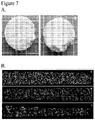
- Adipose-derived human mesenchymal stem cells were cultured on porous PHB-PHV2% scaffolds for 7 days. Live/dead imaging (4x) reveals a confluent covering of live cells on this material ( Figure 8 ).
- hADSC Human adipose derived stem cells
- a porous polymer scaffold is provided.
- hADSCs cells adhere, divide and differentiate on the scaffold over the course of 3 weeks.
- the cellularized scaffold is tested as follows: 1) H+E histology to confirm cell attachment and proliferation, 2) DNA quantization to confirm the final amount of cells in the scaffold, 3) expression of osteogenic markers (genetic or protein) to confirm differentiation of the stem cells to the osteogenic lineage, and 4) mineral quantization to confirm the deposition of minerals by the differentiated hADSCs.
- the scaffolds can be milled in to anatomically correct shapes. After cellularization, the scaffolds can be implanted using conventional methods to replace bone lost due to trauma, congenital defects or cancer.
Landscapes
- Health & Medical Sciences (AREA)
- Chemical & Material Sciences (AREA)
- Medicinal Chemistry (AREA)
- Life Sciences & Earth Sciences (AREA)
- Public Health (AREA)
- Transplantation (AREA)
- Epidemiology (AREA)
- Oral & Maxillofacial Surgery (AREA)
- Animal Behavior & Ethology (AREA)
- General Health & Medical Sciences (AREA)
- Dermatology (AREA)
- Veterinary Medicine (AREA)
- Engineering & Computer Science (AREA)
- Inorganic Chemistry (AREA)
- Composite Materials (AREA)
- Materials Engineering (AREA)
- Chemical Kinetics & Catalysis (AREA)
- Dispersion Chemistry (AREA)
- Biomedical Technology (AREA)
- Molecular Biology (AREA)
- Materials For Medical Uses (AREA)
- Polymers & Plastics (AREA)
- Organic Chemistry (AREA)
Claims (14)
- Procédé de préparation d'un échafaudage poreux comprenant un polymère biodégradable et un matériau céramique, l'échafaudage poreux présentant une forme souhaitée et comprenant des pores interconnectés et une porosité moyenne comprise entre 50 % et 90 %, le procédé comprenant les étapes consistant :à chauffer un mélange comprenant le polymère biodégradable, le matériau céramique et un porogène ;à compresser le mélange chauffé à une pression comprise entre 35 MPa et 110 MPa;à refroidir la compression pour former un substrat en vrac ;à supprimer de manière sélective un matériau du substrat en vrac pour fournir un substrat formé ; et à supprimer le porogène du substrat formé pour fournir l'échafaudage poreux présentant une forme souhaitée.
- Procédé selon la revendication 1, dans lequel(i) le polymère biodégradable est sélectionné dans le groupe constitué par : la polycaprolactone, l'acide poly(lactique-co-glycolique), l'acide poly(lactique), le polyhydroxybutyrate, la poly(lactide-co-caprolactone) et le poly(3-hydroxybutyrate-co-3-hydroxyvalérate) ; ou(ii) le matériau céramique est sélectionné dans le groupe constitué par: le phosphate tricalcique, l'hydroxyapatite, le phosphate de calcium biphasique et le bioverre.
- Procédé selon la revendication 1, dans lequel l'étape de suppression sélective d'un matériau du substrat en vrac comprend l'excision d'au moins une partie du substrat en vrac par broyage, lattage, perçage ou découpe du substrat en vrac pour fournir une forme souhaitée.
- Procédé selon la revendication 1, dans lequel(i) la porosité moyenne se situe dans la plage allant de 60 % à 80 % ; ou(ii) les pores de l'échafaudage présentent une taille de pore moyenne comprise entre 450 µm et 600 µm ; ou(iii) une modification de la taille de pore moyenne partout dans l'échafaudage est inférieure à 10 % ; ou(iv) le porogène comprend du chlorure de sodium ou du polyméthacrylate de méthyle.
- Procédé selon la revendication 1, dans lequel(i) le chauffage est effectué à une température comprise entre 185 °C et 190 °C ; ou(ii) la compression est effectuée à une pression de 70 MPa.
- Procédé selon la revendication 1, dans lequel la forme souhaitée est(i) une forme anatomique ; ou(ii) sous la forme d'un tissu biologique ; ou(iii) sous la forme d'un greffon osseux.
- Procédé selon la revendication 1, dans lequel l'échafaudage comprend un agent bioactif, qui(i) est facultativement sélectionné dans le groupe constitué par : des cellules souches, la moelle osseuse, le plasma, les facteurs de croissance, les antibiotiques et les agents immunodépresseurs ou des combinaisons de ceux-ci ; ou(ii) facultativement comprend des cellules souches.
- Procédé selon la revendication 7, dans lequel l'échafaudage est une plate-forme appropriée pour une différenciation des cellules souches, dans lequel lesdites cellules souches sont facultativement des cellules souches mésenchymateuses.
- Échafaudage poreux pouvant être obtenu par le procédé selon l'une quelconque des revendications précédentes.
- Échafaudage polymère poreux selon la revendication 9, destiné à être utilisé dans un procédé de traitement d'un site de défaut osseux chez un patient qui en a besoin, le procédé comprenant l'application au site de défaut osseux d'une composition de greffon osseux comprenant l'échafaudage poreux.
- Échafaudage polymère poreux destiné à être utilisé selon la revendication 10, dans lequel le greffon osseux est implanté chirurgicalement dans le site.
- Échafaudage polymère poreux destiné à être utilisé selon la revendication 10, dans lequel la composition de greffon osseux comprend des cellules souches mésenchymateuses différenciées prélevées chez le patient ou un donneur.
- Échafaudage polymère poreux destiné à être utilisé selon la revendication 10, dans lequel la solution cellulaire comprend des cellules souches qui se différencient sur le greffon.
- Procédé selon la revendication 1, dans lequel l'échafaudage polymère poreux présente une porosité moyenne comprise entre 80 % et 90 %, de préférence de 90 %.
Applications Claiming Priority (2)
| Application Number | Priority Date | Filing Date | Title |
|---|---|---|---|
| US201662301280P | 2016-02-29 | 2016-02-29 | |
| PCT/US2017/019956 WO2017151619A1 (fr) | 2016-02-29 | 2017-02-28 | Échafaudage de polymère poreux et son procédé de préparation |
Publications (3)
| Publication Number | Publication Date |
|---|---|
| EP3423120A1 EP3423120A1 (fr) | 2019-01-09 |
| EP3423120A4 EP3423120A4 (fr) | 2019-09-18 |
| EP3423120B1 true EP3423120B1 (fr) | 2020-11-18 |
Family
ID=59744396
Family Applications (1)
| Application Number | Title | Priority Date | Filing Date |
|---|---|---|---|
| EP17760613.4A Active EP3423120B1 (fr) | 2016-02-29 | 2017-02-28 | Échafaudage de polymère poreux et son procédé de préparation |
Country Status (5)
| Country | Link |
|---|---|
| US (2) | US11517647B2 (fr) |
| EP (1) | EP3423120B1 (fr) |
| ES (1) | ES2837750T3 (fr) |
| PT (1) | PT3423120T (fr) |
| WO (1) | WO2017151619A1 (fr) |
Families Citing this family (7)
| Publication number | Priority date | Publication date | Assignee | Title |
|---|---|---|---|---|
| US12421369B2 (en) * | 2016-06-14 | 2025-09-23 | The Regents Of The University Of California | Porous polymer scaffolds, and methods of making and using the same |
| CN108324987B (zh) * | 2018-02-09 | 2020-11-24 | 华南理工大学 | 一种中空多孔球形颗粒人工骨及其制备方法和应用 |
| KR20210035776A (ko) | 2018-03-06 | 2021-04-01 | 에피본, 인크. | 주사가능한 기성품 연골, 힘줄 및 인대 복구 조성물 및 사용 방법 |
| RU2708589C1 (ru) * | 2019-10-07 | 2019-12-09 | Федеральное государственное автономное образовательное учреждение высшего образования "Национальный исследовательский технологический университет "МИСиС" | Способ получения трехмерных изделий сложной формы со структурой нативной трабекулярной кости на основе высоковязкого полимера |
| US12246111B2 (en) * | 2020-01-30 | 2025-03-11 | SDIP Innovations Pty Ltd | Bioresorbable implant with inside-out resorption for enhanced bone ingrowth and tissue integration and method of manufacturing thereof |
| CN114712567A (zh) * | 2022-03-11 | 2022-07-08 | 中国人民解放军联勤保障部队第九二七医院 | 一种可降解的引导骨再生生物膜及其制备方法和应用 |
| WO2025073518A1 (fr) * | 2023-10-04 | 2025-04-10 | Evonik Operations Gmbh | Polycaprolactone ayant des propriétés de frittage par impression 3d sls améliorées |
Family Cites Families (17)
| Publication number | Priority date | Publication date | Assignee | Title |
|---|---|---|---|---|
| CA2535169A1 (fr) | 2003-12-31 | 2005-07-21 | Osteotech, Inc. | Compositions de matrice osseuse ameliorees et methodes associees |
| US7767221B2 (en) | 2004-03-05 | 2010-08-03 | The Trustees Of Columbia University In The City Of New York | Multi-phased, biodegradable and osteointegrative composite scaffold for biological fixation of musculoskeletal soft tissue to bone |
| WO2006099332A2 (fr) * | 2005-03-11 | 2006-09-21 | Wake Forest University Health Sciences | Production par genie tissulaire de doigts, d'orteils et de membres |
| US8029575B2 (en) * | 2005-10-25 | 2011-10-04 | Globus Medical, Inc. | Porous and nonporous materials for tissue grafting and repair |
| WO2009021209A2 (fr) | 2007-08-09 | 2009-02-12 | The Board Of Regents Of The University Of Texas System | Charpente de type osseux à deux couches |
| DK2274023T3 (da) | 2008-04-10 | 2020-03-16 | Bonus Therapeutics Ltd | Knoglelignende proteseimplantater |
| KR20110086045A (ko) | 2008-10-24 | 2011-07-27 | 오스테오테크, 인코포레이티드 | 뼈 형성 촉진용 조성물 및 뼈 형성 촉진방법 |
| US8865199B2 (en) | 2008-11-17 | 2014-10-21 | Ingeneron, Inc. | Biomatrix composition and methods of biomatrix seeding |
| US8906362B2 (en) | 2009-03-23 | 2014-12-09 | Wake Forest University Health Sciences | Tissue engineered meniscus scaffolds and methods of use |
| US9163212B2 (en) | 2010-01-25 | 2015-10-20 | Warsaw Orthopedic, Inc. | Osteogenic cell delivery matrix |
| WO2011123110A1 (fr) * | 2010-03-30 | 2011-10-06 | Daniel Sunho Oh | Procédé de préparation d'échafaudages composites céramique/polymère comportant des molécules bioactives pour la régénération de tissu dur |
| US9597359B2 (en) | 2010-10-01 | 2017-03-21 | The Trustees Of Columbia University In The City Of New York | Production of dentin, cementum and enamel by cells |
| WO2012064606A2 (fr) | 2010-11-10 | 2012-05-18 | Wake Forest University Health Sciences | Matrice extracellulaire spécifique d'un tissu avec ou sans composants protéiques tissulaires pour la culture cellulaire |
| CA2863967C (fr) | 2012-02-07 | 2021-02-09 | Lifenet Health | Liquefaction de matrice osseuse |
| WO2016073989A2 (fr) | 2014-11-07 | 2016-05-12 | The Trustees Of Columbia University In The City Of New York | Cellules souches ostéochondroréticulaires pour la régénération des os et du cartilage |
| CA2967306A1 (fr) | 2014-11-10 | 2016-05-19 | University Of Pittsburgh-Of The Commonwealth System Of Higher Education | Technologies a base de cellules souches pour l'ingenierie et la regeneration de tissu squelettique aviaire |
| EP3349814B1 (fr) | 2015-09-18 | 2021-03-17 | University of Pittsburgh- Of the Commonwealth System of Higher Education | Matrice extracellulaire soluble non gélifiante présentant une activité biologique |
-
2017
- 2017-02-28 EP EP17760613.4A patent/EP3423120B1/fr active Active
- 2017-02-28 WO PCT/US2017/019956 patent/WO2017151619A1/fr not_active Ceased
- 2017-02-28 ES ES17760613T patent/ES2837750T3/es active Active
- 2017-02-28 PT PT177606134T patent/PT3423120T/pt unknown
- 2017-02-28 US US16/080,880 patent/US11517647B2/en active Active
-
2022
- 2022-02-24 US US17/679,796 patent/US20220176019A1/en not_active Abandoned
Non-Patent Citations (1)
| Title |
|---|
| None * |
Also Published As
| Publication number | Publication date |
|---|---|
| EP3423120A1 (fr) | 2019-01-09 |
| PT3423120T (pt) | 2020-12-21 |
| WO2017151619A1 (fr) | 2017-09-08 |
| US20220176019A1 (en) | 2022-06-09 |
| EP3423120A4 (fr) | 2019-09-18 |
| US20190083681A1 (en) | 2019-03-21 |
| US11517647B2 (en) | 2022-12-06 |
| ES2837750T3 (es) | 2021-07-01 |
Similar Documents
| Publication | Publication Date | Title |
|---|---|---|
| US20220176019A1 (en) | Porous polymer scaffold and methods thereof | |
| CN1230207C (zh) | 骨代用品材料 | |
| Dorozhkin | Medical application of calcium orthophosphate bioceramics | |
| US10080661B2 (en) | Injectable and moldable bone substitute materials | |
| Dorozhkin | Calcium orthophosphate (CaPO4) scaffolds for bone tissue engineering applications | |
| JP2004505677A (ja) | 多孔質人工骨移植片およびその製造方法 | |
| R Naqshbandi et al. | Development of porous calcium phosphate bioceramics for bone implant applications: A review | |
| US20050107286A1 (en) | Composite biomaterial comprising phospholine | |
| Dorozhkin | Calcium orthophosphate-based bioceramics and its clinical applications | |
| CN111526896B (zh) | 制备骨引导性聚合物制品的方法和由此制备的骨引导性聚合物制品 | |
| Dorozhkin | Calcium-orthophosphate-based bioactive ceramics | |
| Ma et al. | Intervertebral spinal fusion using a RP-based PLGA/TCP/bBMP biomimetic grafting material | |
| Yoo et al. | Preparation of a hemiporous hydroxyapatite scaffold and evaluation as a cell-mediated bone substitute | |
| Cruz et al. | Direct manufacture of hydroxyapatite based bone implants by selective laser sintering | |
| US20230075772A1 (en) | Implantable bone scaffolds including at least one integration aid, methods of making and using the same | |
| Koo et al. | Treatment of bone defects in rabbit tibiae using CaO-SiO2-P2O5-B2O3 bioactive ceramics: radiological, biomechanical, and histological evaluation | |
| Dorozhkin | Calcium Orthophosphate (CaPO4)-Based Bioceramics: Preparation, Properties, and Applications. Coatings 2022, 12, 1380 | |
| Chepeleva et al. | CYTOCOMPATIBILITY OF PRESSURELESS SINTERED POROUS B4C-CERAMICS ASSESSED IN VITRO | |
| US20250058023A1 (en) | Shaped amalgamated cartilage grafts and methods for making and using same | |
| Świeczko-Żurek | Antimicrobal and ostheointegration activity of bone cement contains nanometals | |
| Thian et al. | Materials viewpoints in bone regenerative medicine: progress and prospects | |
| Dorozhkin | JOURNAL OF BIOTECHNOLOGY AND BIOMEDICAL SCIENCE | |
| Chakraborty et al. | Potential of stem cell to tailor the bone-ceramic interface for better fixation of orthopedic implants | |
| Al-Munajjed | Development of novel collagen-calcium phosphate scaffolds suitable for bone tissue-engineering and bone repair | |
| Fu | Freeze casting of bioactive glass and ceramic scaffolds for bone tissue engineering |
Legal Events
| Date | Code | Title | Description |
|---|---|---|---|
| STAA | Information on the status of an ep patent application or granted ep patent |
Free format text: STATUS: THE INTERNATIONAL PUBLICATION HAS BEEN MADE |
|
| PUAI | Public reference made under article 153(3) epc to a published international application that has entered the european phase |
Free format text: ORIGINAL CODE: 0009012 |
|
| STAA | Information on the status of an ep patent application or granted ep patent |
Free format text: STATUS: REQUEST FOR EXAMINATION WAS MADE |
|
| 17P | Request for examination filed |
Effective date: 20180920 |
|
| AK | Designated contracting states |
Kind code of ref document: A1 Designated state(s): AL AT BE BG CH CY CZ DE DK EE ES FI FR GB GR HR HU IE IS IT LI LT LU LV MC MK MT NL NO PL PT RO RS SE SI SK SM TR |
|
| AX | Request for extension of the european patent |
Extension state: BA ME |
|
| DAV | Request for validation of the european patent (deleted) | ||
| DAX | Request for extension of the european patent (deleted) | ||
| A4 | Supplementary search report drawn up and despatched |
Effective date: 20190816 |
|
| RIC1 | Information provided on ipc code assigned before grant |
Ipc: A61L 27/44 20060101ALI20190809BHEP Ipc: C08L 67/04 20060101ALI20190809BHEP Ipc: A61L 27/56 20060101ALI20190809BHEP Ipc: A61L 27/46 20060101AFI20190809BHEP Ipc: A61L 27/54 20060101ALI20190809BHEP |
|
| REG | Reference to a national code |
Ref country code: DE Ref legal event code: R079 Ref document number: 602017027844 Country of ref document: DE Free format text: PREVIOUS MAIN CLASS: A61L0027500000 Ipc: A61L0027460000 |
|
| GRAP | Despatch of communication of intention to grant a patent |
Free format text: ORIGINAL CODE: EPIDOSNIGR1 |
|
| STAA | Information on the status of an ep patent application or granted ep patent |
Free format text: STATUS: GRANT OF PATENT IS INTENDED |
|
| RIC1 | Information provided on ipc code assigned before grant |
Ipc: A61L 27/54 20060101ALI20200519BHEP Ipc: C08L 67/04 20060101ALI20200519BHEP Ipc: A61L 27/56 20060101ALI20200519BHEP Ipc: A61L 27/46 20060101AFI20200519BHEP Ipc: A61L 27/44 20060101ALI20200519BHEP |
|
| INTG | Intention to grant announced |
Effective date: 20200610 |
|
| GRAS | Grant fee paid |
Free format text: ORIGINAL CODE: EPIDOSNIGR3 |
|
| GRAA | (expected) grant |
Free format text: ORIGINAL CODE: 0009210 |
|
| STAA | Information on the status of an ep patent application or granted ep patent |
Free format text: STATUS: THE PATENT HAS BEEN GRANTED |
|
| AK | Designated contracting states |
Kind code of ref document: B1 Designated state(s): AL AT BE BG CH CY CZ DE DK EE ES FI FR GB GR HR HU IE IS IT LI LT LU LV MC MK MT NL NO PL PT RO RS SE SI SK SM TR |
|
| REG | Reference to a national code |
Ref country code: GB Ref legal event code: FG4D |
|
| REG | Reference to a national code |
Ref country code: CH Ref legal event code: NV Representative=s name: VALIPAT S.A. C/O BOVARD SA NEUCHATEL, CH Ref country code: CH Ref legal event code: EP |
|
| REG | Reference to a national code |
Ref country code: IE Ref legal event code: FG4D |
|
| REG | Reference to a national code |
Ref country code: DE Ref legal event code: R096 Ref document number: 602017027844 Country of ref document: DE |
|
| REG | Reference to a national code |
Ref country code: AT Ref legal event code: REF Ref document number: 1335042 Country of ref document: AT Kind code of ref document: T Effective date: 20201215 |
|
| REG | Reference to a national code |
Ref country code: PT Ref legal event code: SC4A Ref document number: 3423120 Country of ref document: PT Date of ref document: 20201221 Kind code of ref document: T Free format text: AVAILABILITY OF NATIONAL TRANSLATION Effective date: 20201214 |
|
| REG | Reference to a national code |
Ref country code: NL Ref legal event code: FP |
|
| PG25 | Lapsed in a contracting state [announced via postgrant information from national office to epo] |
Ref country code: NO Free format text: LAPSE BECAUSE OF FAILURE TO SUBMIT A TRANSLATION OF THE DESCRIPTION OR TO PAY THE FEE WITHIN THE PRESCRIBED TIME-LIMIT Effective date: 20210218 Ref country code: RS Free format text: LAPSE BECAUSE OF FAILURE TO SUBMIT A TRANSLATION OF THE DESCRIPTION OR TO PAY THE FEE WITHIN THE PRESCRIBED TIME-LIMIT Effective date: 20201118 Ref country code: FI Free format text: LAPSE BECAUSE OF FAILURE TO SUBMIT A TRANSLATION OF THE DESCRIPTION OR TO PAY THE FEE WITHIN THE PRESCRIBED TIME-LIMIT Effective date: 20201118 Ref country code: GR Free format text: LAPSE BECAUSE OF FAILURE TO SUBMIT A TRANSLATION OF THE DESCRIPTION OR TO PAY THE FEE WITHIN THE PRESCRIBED TIME-LIMIT Effective date: 20210219 |
|
| PG25 | Lapsed in a contracting state [announced via postgrant information from national office to epo] |
Ref country code: BG Free format text: LAPSE BECAUSE OF FAILURE TO SUBMIT A TRANSLATION OF THE DESCRIPTION OR TO PAY THE FEE WITHIN THE PRESCRIBED TIME-LIMIT Effective date: 20210218 Ref country code: SE Free format text: LAPSE BECAUSE OF FAILURE TO SUBMIT A TRANSLATION OF THE DESCRIPTION OR TO PAY THE FEE WITHIN THE PRESCRIBED TIME-LIMIT Effective date: 20201118 Ref country code: IS Free format text: LAPSE BECAUSE OF FAILURE TO SUBMIT A TRANSLATION OF THE DESCRIPTION OR TO PAY THE FEE WITHIN THE PRESCRIBED TIME-LIMIT Effective date: 20210318 Ref country code: LV Free format text: LAPSE BECAUSE OF FAILURE TO SUBMIT A TRANSLATION OF THE DESCRIPTION OR TO PAY THE FEE WITHIN THE PRESCRIBED TIME-LIMIT Effective date: 20201118 Ref country code: PL Free format text: LAPSE BECAUSE OF FAILURE TO SUBMIT A TRANSLATION OF THE DESCRIPTION OR TO PAY THE FEE WITHIN THE PRESCRIBED TIME-LIMIT Effective date: 20201118 |
|
| REG | Reference to a national code |
Ref country code: LT Ref legal event code: MG9D |
|
| PG25 | Lapsed in a contracting state [announced via postgrant information from national office to epo] |
Ref country code: HR Free format text: LAPSE BECAUSE OF FAILURE TO SUBMIT A TRANSLATION OF THE DESCRIPTION OR TO PAY THE FEE WITHIN THE PRESCRIBED TIME-LIMIT Effective date: 20201118 |
|
| PG25 | Lapsed in a contracting state [announced via postgrant information from national office to epo] |
Ref country code: SM Free format text: LAPSE BECAUSE OF FAILURE TO SUBMIT A TRANSLATION OF THE DESCRIPTION OR TO PAY THE FEE WITHIN THE PRESCRIBED TIME-LIMIT Effective date: 20201118 Ref country code: EE Free format text: LAPSE BECAUSE OF FAILURE TO SUBMIT A TRANSLATION OF THE DESCRIPTION OR TO PAY THE FEE WITHIN THE PRESCRIBED TIME-LIMIT Effective date: 20201118 Ref country code: CZ Free format text: LAPSE BECAUSE OF FAILURE TO SUBMIT A TRANSLATION OF THE DESCRIPTION OR TO PAY THE FEE WITHIN THE PRESCRIBED TIME-LIMIT Effective date: 20201118 Ref country code: LT Free format text: LAPSE BECAUSE OF FAILURE TO SUBMIT A TRANSLATION OF THE DESCRIPTION OR TO PAY THE FEE WITHIN THE PRESCRIBED TIME-LIMIT Effective date: 20201118 Ref country code: RO Free format text: LAPSE BECAUSE OF FAILURE TO SUBMIT A TRANSLATION OF THE DESCRIPTION OR TO PAY THE FEE WITHIN THE PRESCRIBED TIME-LIMIT Effective date: 20201118 Ref country code: SK Free format text: LAPSE BECAUSE OF FAILURE TO SUBMIT A TRANSLATION OF THE DESCRIPTION OR TO PAY THE FEE WITHIN THE PRESCRIBED TIME-LIMIT Effective date: 20201118 |
|
| REG | Reference to a national code |
Ref country code: DE Ref legal event code: R097 Ref document number: 602017027844 Country of ref document: DE |
|
| PG25 | Lapsed in a contracting state [announced via postgrant information from national office to epo] |
Ref country code: DK Free format text: LAPSE BECAUSE OF FAILURE TO SUBMIT A TRANSLATION OF THE DESCRIPTION OR TO PAY THE FEE WITHIN THE PRESCRIBED TIME-LIMIT Effective date: 20201118 |
|
| PLBE | No opposition filed within time limit |
Free format text: ORIGINAL CODE: 0009261 |
|
| STAA | Information on the status of an ep patent application or granted ep patent |
Free format text: STATUS: NO OPPOSITION FILED WITHIN TIME LIMIT |
|
| PG25 | Lapsed in a contracting state [announced via postgrant information from national office to epo] |
Ref country code: MC Free format text: LAPSE BECAUSE OF FAILURE TO SUBMIT A TRANSLATION OF THE DESCRIPTION OR TO PAY THE FEE WITHIN THE PRESCRIBED TIME-LIMIT Effective date: 20201118 |
|
| 26N | No opposition filed |
Effective date: 20210819 |
|
| REG | Reference to a national code |
Ref country code: BE Ref legal event code: MM Effective date: 20210228 |
|
| PG25 | Lapsed in a contracting state [announced via postgrant information from national office to epo] |
Ref country code: AL Free format text: LAPSE BECAUSE OF FAILURE TO SUBMIT A TRANSLATION OF THE DESCRIPTION OR TO PAY THE FEE WITHIN THE PRESCRIBED TIME-LIMIT Effective date: 20201118 Ref country code: LU Free format text: LAPSE BECAUSE OF NON-PAYMENT OF DUE FEES Effective date: 20210228 |
|
| PG25 | Lapsed in a contracting state [announced via postgrant information from national office to epo] |
Ref country code: SI Free format text: LAPSE BECAUSE OF FAILURE TO SUBMIT A TRANSLATION OF THE DESCRIPTION OR TO PAY THE FEE WITHIN THE PRESCRIBED TIME-LIMIT Effective date: 20201118 |
|
| PG25 | Lapsed in a contracting state [announced via postgrant information from national office to epo] |
Ref country code: IE Free format text: LAPSE BECAUSE OF NON-PAYMENT OF DUE FEES Effective date: 20210228 |
|
| PG25 | Lapsed in a contracting state [announced via postgrant information from national office to epo] |
Ref country code: IS Free format text: LAPSE BECAUSE OF FAILURE TO SUBMIT A TRANSLATION OF THE DESCRIPTION OR TO PAY THE FEE WITHIN THE PRESCRIBED TIME-LIMIT Effective date: 20210318 |
|
| PG25 | Lapsed in a contracting state [announced via postgrant information from national office to epo] |
Ref country code: BE Free format text: LAPSE BECAUSE OF NON-PAYMENT OF DUE FEES Effective date: 20210228 |
|
| REG | Reference to a national code |
Ref country code: AT Ref legal event code: UEP Ref document number: 1335042 Country of ref document: AT Kind code of ref document: T Effective date: 20201118 |
|
| PGFP | Annual fee paid to national office [announced via postgrant information from national office to epo] |
Ref country code: CH Payment date: 20230329 Year of fee payment: 7 Ref country code: AT Payment date: 20230309 Year of fee payment: 7 |
|
| PGFP | Annual fee paid to national office [announced via postgrant information from national office to epo] |
Ref country code: PT Payment date: 20230301 Year of fee payment: 7 Ref country code: IT Payment date: 20230314 Year of fee payment: 7 |
|
| P01 | Opt-out of the competence of the unified patent court (upc) registered |
Effective date: 20230512 |
|
| PG25 | Lapsed in a contracting state [announced via postgrant information from national office to epo] |
Ref country code: CY Free format text: LAPSE BECAUSE OF FAILURE TO SUBMIT A TRANSLATION OF THE DESCRIPTION OR TO PAY THE FEE WITHIN THE PRESCRIBED TIME-LIMIT Effective date: 20201118 |
|
| PGFP | Annual fee paid to national office [announced via postgrant information from national office to epo] |
Ref country code: NL Payment date: 20230301 Year of fee payment: 7 |
|
| PG25 | Lapsed in a contracting state [announced via postgrant information from national office to epo] |
Ref country code: HU Free format text: LAPSE BECAUSE OF FAILURE TO SUBMIT A TRANSLATION OF THE DESCRIPTION OR TO PAY THE FEE WITHIN THE PRESCRIBED TIME-LIMIT; INVALID AB INITIO Effective date: 20170228 |
|
| PGFP | Annual fee paid to national office [announced via postgrant information from national office to epo] |
Ref country code: ES Payment date: 20230330 Year of fee payment: 7 |
|
| PG25 | Lapsed in a contracting state [announced via postgrant information from national office to epo] |
Ref country code: MK Free format text: LAPSE BECAUSE OF FAILURE TO SUBMIT A TRANSLATION OF THE DESCRIPTION OR TO PAY THE FEE WITHIN THE PRESCRIBED TIME-LIMIT Effective date: 20201118 |
|
| PG25 | Lapsed in a contracting state [announced via postgrant information from national office to epo] |
Ref country code: MT Free format text: LAPSE BECAUSE OF FAILURE TO SUBMIT A TRANSLATION OF THE DESCRIPTION OR TO PAY THE FEE WITHIN THE PRESCRIBED TIME-LIMIT Effective date: 20201118 |
|
| REG | Reference to a national code |
Ref country code: CH Ref legal event code: PL |
|
| REG | Reference to a national code |
Ref country code: NL Ref legal event code: MM Effective date: 20240301 |
|
| PGFP | Annual fee paid to national office [announced via postgrant information from national office to epo] |
Ref country code: DE Payment date: 20240828 Year of fee payment: 8 |
|
| PG25 | Lapsed in a contracting state [announced via postgrant information from national office to epo] |
Ref country code: PT Free format text: LAPSE BECAUSE OF NON-PAYMENT OF DUE FEES Effective date: 20240902 |
|
| PGFP | Annual fee paid to national office [announced via postgrant information from national office to epo] |
Ref country code: GB Payment date: 20240827 Year of fee payment: 8 |
|
| REG | Reference to a national code |
Ref country code: AT Ref legal event code: MM01 Ref document number: 1335042 Country of ref document: AT Kind code of ref document: T Effective date: 20240228 |
|
| PGFP | Annual fee paid to national office [announced via postgrant information from national office to epo] |
Ref country code: FR Payment date: 20240827 Year of fee payment: 8 |
|
| PG25 | Lapsed in a contracting state [announced via postgrant information from national office to epo] |
Ref country code: CH Free format text: LAPSE BECAUSE OF NON-PAYMENT OF DUE FEES Effective date: 20240229 |
|
| PG25 | Lapsed in a contracting state [announced via postgrant information from national office to epo] |
Ref country code: AT Free format text: LAPSE BECAUSE OF NON-PAYMENT OF DUE FEES Effective date: 20240228 |
|
| PG25 | Lapsed in a contracting state [announced via postgrant information from national office to epo] |
Ref country code: PT Free format text: LAPSE BECAUSE OF NON-PAYMENT OF DUE FEES Effective date: 20240902 Ref country code: CH Free format text: LAPSE BECAUSE OF NON-PAYMENT OF DUE FEES Effective date: 20240229 Ref country code: AT Free format text: LAPSE BECAUSE OF NON-PAYMENT OF DUE FEES Effective date: 20240228 |
|
| PG25 | Lapsed in a contracting state [announced via postgrant information from national office to epo] |
Ref country code: NL Free format text: LAPSE BECAUSE OF NON-PAYMENT OF DUE FEES Effective date: 20240301 |
|
| PG25 | Lapsed in a contracting state [announced via postgrant information from national office to epo] |
Ref country code: NL Free format text: LAPSE BECAUSE OF NON-PAYMENT OF DUE FEES Effective date: 20240301 |
|
| PG25 | Lapsed in a contracting state [announced via postgrant information from national office to epo] |
Ref country code: IT Free format text: LAPSE BECAUSE OF NON-PAYMENT OF DUE FEES Effective date: 20240228 |
|
| REG | Reference to a national code |
Ref country code: ES Ref legal event code: FD2A Effective date: 20250402 |
|
| PG25 | Lapsed in a contracting state [announced via postgrant information from national office to epo] |
Ref country code: ES Free format text: LAPSE BECAUSE OF NON-PAYMENT OF DUE FEES Effective date: 20240301 |
|
| REG | Reference to a national code |
Ref country code: DE Ref legal event code: R119 Ref document number: 602017027844 Country of ref document: DE |
|
| GBPC | Gb: european patent ceased through non-payment of renewal fee |
Effective date: 20250228 |
|
| PG25 | Lapsed in a contracting state [announced via postgrant information from national office to epo] |
Ref country code: TR Free format text: LAPSE BECAUSE OF FAILURE TO SUBMIT A TRANSLATION OF THE DESCRIPTION OR TO PAY THE FEE WITHIN THE PRESCRIBED TIME-LIMIT Effective date: 20201118 |
|
| PG25 | Lapsed in a contracting state [announced via postgrant information from national office to epo] |
Ref country code: DE Free format text: LAPSE BECAUSE OF NON-PAYMENT OF DUE FEES Effective date: 20250902 |
|
| PG25 | Lapsed in a contracting state [announced via postgrant information from national office to epo] |
Ref country code: GB Free format text: LAPSE BECAUSE OF NON-PAYMENT OF DUE FEES Effective date: 20250228 |
|
| PG25 | Lapsed in a contracting state [announced via postgrant information from national office to epo] |
Ref country code: FR Free format text: LAPSE BECAUSE OF NON-PAYMENT OF DUE FEES Effective date: 20250228 |