EP3423675B1 - Détection de mouvement et correction de données de résonance magnétique - Google Patents
Détection de mouvement et correction de données de résonance magnétique Download PDFInfo
- Publication number
- EP3423675B1 EP3423675B1 EP17760781.9A EP17760781A EP3423675B1 EP 3423675 B1 EP3423675 B1 EP 3423675B1 EP 17760781 A EP17760781 A EP 17760781A EP 3423675 B1 EP3423675 B1 EP 3423675B1
- Authority
- EP
- European Patent Office
- Prior art keywords
- wait
- porosity
- long
- short
- time
- Prior art date
- Legal status (The legal status is an assumption and is not a legal conclusion. Google has not performed a legal analysis and makes no representation as to the accuracy of the status listed.)
- Active
Links
Images



Classifications
-
- G—PHYSICS
- G01—MEASURING; TESTING
- G01V—GEOPHYSICS; GRAVITATIONAL MEASUREMENTS; DETECTING MASSES OR OBJECTS; TAGS
- G01V3/00—Electric or magnetic prospecting or detecting; Measuring magnetic field characteristics of the earth, e.g. declination, deviation
- G01V3/18—Electric or magnetic prospecting or detecting; Measuring magnetic field characteristics of the earth, e.g. declination, deviation specially adapted for well-logging
- G01V3/32—Electric or magnetic prospecting or detecting; Measuring magnetic field characteristics of the earth, e.g. declination, deviation specially adapted for well-logging operating with electron or nuclear magnetic resonance
-
- E—FIXED CONSTRUCTIONS
- E21—EARTH OR ROCK DRILLING; MINING
- E21B—EARTH OR ROCK DRILLING; OBTAINING OIL, GAS, WATER, SOLUBLE OR MELTABLE MATERIALS OR A SLURRY OF MINERALS FROM WELLS
- E21B47/00—Survey of boreholes or wells
- E21B47/12—Means for transmitting measuring-signals or control signals from the well to the surface, or from the surface to the well, e.g. for logging while drilling
-
- E—FIXED CONSTRUCTIONS
- E21—EARTH OR ROCK DRILLING; MINING
- E21B—EARTH OR ROCK DRILLING; OBTAINING OIL, GAS, WATER, SOLUBLE OR MELTABLE MATERIALS OR A SLURRY OF MINERALS FROM WELLS
- E21B49/00—Testing the nature of borehole walls; Formation testing; Methods or apparatus for obtaining samples of soil or well fluids, specially adapted to earth drilling or wells
-
- E—FIXED CONSTRUCTIONS
- E21—EARTH OR ROCK DRILLING; MINING
- E21B—EARTH OR ROCK DRILLING; OBTAINING OIL, GAS, WATER, SOLUBLE OR MELTABLE MATERIALS OR A SLURRY OF MINERALS FROM WELLS
- E21B49/00—Testing the nature of borehole walls; Formation testing; Methods or apparatus for obtaining samples of soil or well fluids, specially adapted to earth drilling or wells
- E21B49/08—Obtaining fluid samples or testing fluids, in boreholes or wells
-
- G—PHYSICS
- G01—MEASURING; TESTING
- G01N—INVESTIGATING OR ANALYSING MATERIALS BY DETERMINING THEIR CHEMICAL OR PHYSICAL PROPERTIES
- G01N24/00—Investigating or analyzing materials by the use of nuclear magnetic resonance, electron paramagnetic resonance or other spin effects
- G01N24/08—Investigating or analyzing materials by the use of nuclear magnetic resonance, electron paramagnetic resonance or other spin effects by using nuclear magnetic resonance
- G01N24/081—Making measurements of geologic samples, e.g. measurements of moisture, pH, porosity, permeability, tortuosity or viscosity
-
- G—PHYSICS
- G01—MEASURING; TESTING
- G01R—MEASURING ELECTRIC VARIABLES; MEASURING MAGNETIC VARIABLES
- G01R33/00—Arrangements or instruments for measuring magnetic variables
- G01R33/20—Arrangements or instruments for measuring magnetic variables involving magnetic resonance
- G01R33/44—Arrangements or instruments for measuring magnetic variables involving magnetic resonance using nuclear magnetic resonance [NMR]
- G01R33/448—Relaxometry, i.e. quantification of relaxation times or spin density
-
- G—PHYSICS
- G01—MEASURING; TESTING
- G01R—MEASURING ELECTRIC VARIABLES; MEASURING MAGNETIC VARIABLES
- G01R33/00—Arrangements or instruments for measuring magnetic variables
- G01R33/20—Arrangements or instruments for measuring magnetic variables involving magnetic resonance
- G01R33/28—Details of apparatus provided for in groups G01R33/44 - G01R33/64
- G01R33/32—Excitation or detection systems, e.g. using radio frequency signals
- G01R33/36—Electrical details, e.g. matching or coupling of the coil to the receiver
-
- G—PHYSICS
- G01—MEASURING; TESTING
- G01R—MEASURING ELECTRIC VARIABLES; MEASURING MAGNETIC VARIABLES
- G01R33/00—Arrangements or instruments for measuring magnetic variables
- G01R33/20—Arrangements or instruments for measuring magnetic variables involving magnetic resonance
- G01R33/28—Details of apparatus provided for in groups G01R33/44 - G01R33/64
- G01R33/38—Systems for generation, homogenisation or stabilisation of the main or gradient magnetic field
- G01R33/383—Systems for generation, homogenisation or stabilisation of the main or gradient magnetic field using permanent magnets
-
- G—PHYSICS
- G01—MEASURING; TESTING
- G01R—MEASURING ELECTRIC VARIABLES; MEASURING MAGNETIC VARIABLES
- G01R33/00—Arrangements or instruments for measuring magnetic variables
- G01R33/20—Arrangements or instruments for measuring magnetic variables involving magnetic resonance
- G01R33/44—Arrangements or instruments for measuring magnetic variables involving magnetic resonance using nuclear magnetic resonance [NMR]
-
- G—PHYSICS
- G01—MEASURING; TESTING
- G01V—GEOPHYSICS; GRAVITATIONAL MEASUREMENTS; DETECTING MASSES OR OBJECTS; TAGS
- G01V2200/00—Details of seismic or acoustic prospecting or detecting in general
- G01V2200/10—Miscellaneous details
- G01V2200/14—Quality control
Definitions
- NMR nuclear magnetic resonance
- Porosity and other properties derived from NMR measurements can be affected by various motions of an NMR tool. Accounting for such motions is important for acquisition of accurate estimations of formation characteristics based on NMR measurements.
- GB 2 359 632 A discloses detecting motion effects on a borehole NMR measurement.
- FENG DENG ET AL "Effects and Corrections for Mobile NMR Measurement"
- the present invention relates to a nuclear magnetic resonance (NMR) apparatus for estimating properties of an earth formation according to claim 1 and a method of performing a nuclear magnetic resonance (NMR) measurement according to claim 6.
- NMR nuclear magnetic resonance
- Advantageous embodiments of the invention are described in the dependent claims.
- Embodiments of nuclear magnetic resonance (NMR) apparatuses, systems and methods utilize dual-wait-time (DTW) pulse sequences to estimate and/or correct for motion.
- motion refers to any condition that can cause instability of a magnetic field or otherwise affect the magnetic field in such a way as to affect NMR measurements. This instability can be caused by mechanical motion or by another condition, such as sub-optimal performance of an NMR tool.
- Embodiments described herein are useful for correction of NMR measurement errors due to various types of motions of an NMR tool or other downhole component, such as axial motion and lateral motion (including lateral vibrations), and for errors due to an imperfect or sub-optimal (e.g., not axisymmetric) B 0 field or B 1 field stability.
- An embodiment of an NMR apparatus or system is configured to perform an NMR measurement by emitting DTW pulse sequences that include a first pulse sequence having a first wait time and a second pulse sequence having a second wait time into a formation volume of interest.
- "Wait time” is defined, in one embodiment, as the time during which the NMR-active material (earth formation) is polarized, i.e. magnetized.
- a receiving assembly is configured to detect a long-wait-time echo train based on the first pulse sequence and a short-wait-time echo train based on the second pulse sequence.
- the NMR apparatus or system includes a processor that is configured to estimate formation properties including volumes of fluid within a formation volume of interest.
- the processor is also configured to estimate and/or correct for motion by detecting shifts in detected volumes of partial porosities in the formation volume of interest. For example, the processor detects motion by determining a shift of a portion of the porosity in a T 2 distribution from a long-T 2 porosity to a short-T 2 porosity. This shift is also referred to as a "motion artefact”. It is noted that the terms “first” and “second” are not intended to imply a temporal order.
- FIG. 1 illustrates an exemplary embodiment of a downhole measurement, data acquisition, and/or analysis system 10 that includes devices or systems for in-situ measurement of characteristics of an earth formation 12.
- the system 10 includes a magnetic resonance apparatus such as an NMR tool 14.
- An example of the magnetic resonance apparatus is a logging-while-drilling (LWD) magnetic resonance tool.
- the tool 14 is configured to generate magnetic resonance data for use in estimating characteristics of a formation, such as porosity, irreducible water saturation, permeability, hydrocarbon content, and fluid viscosity.
- An exemplary tool 14 includes a static magnetic field source 16, such as a permanent magnet assembly, that magnetizes formation materials and a transmitter and/or receiver assembly 18 (e.g., an antenna or antenna assembly) that transmits radio frequency (RF) energy or pulsed energy that provides an oscillating magnetic field in the formation, and detects NMR signals as voltages induced in the receiver.
- the transmitter assembly 18 may serve the receive function, or distinct receiving antennas may be used for that purpose.
- the tool 14 may include a variety of components and configurations as known in the art of nuclear magnetic resonance or magnetic resonance imaging.
- the tool 14 may be configured as a component of various subterranean systems, such as wireline well logging and LWD systems.
- the tool 14 can be incorporated within a drill string 20 including a drill bit 22 or other suitable carrier and deployed downhole, e.g., from a drilling rig 24 into a borehole 26 during a drilling operation.
- the tool 14 is not limited to the embodiments described herein, and may be deployed in a carrier with alternative conveyance methods.
- a "carrier” as described herein means any device, device component, combination of devices, media and/or member that may be used to convey, house, support or otherwise facilitate the use of another device, device component, combination of devices, media, and/or member.
- Exemplary non-limiting carriers include drill strings of the coiled tube type, of the jointed pipe type, and any combination or portion thereof.
- Other carrier examples include casing pipes, wired pipes, wirelines, wireline sondes, slickline sondes, drop shots, downhole subs, bottom-hole assemblies, and drill strings.
- the tool 14 and/or other downhole components are equipped with transmission equipment to communicate ultimately to a surface processing unit 28.
- Such transmission equipment may take any desired form, and different transmission media and methods may be used, such as wired, fiber optic, mud pulse telemetry and/or other wireless transmission methods.
- Additional processing units may be deployed with the carrier.
- a downhole electronics unit 30 includes various electronic components to facilitate receiving signals and collect data, transmitting data and commands, and/or processing data downhole.
- the surface processing unit 28, electronics 30, the tool 14, and/or other components of the system 10 include devices as necessary to provide for storing and/or processing data collected from the tool 14 and other components of the system 10. Exemplary devices include, without limitation, at least one processor, storage, memory, input devices, output devices, and the like.
- Magnetic resonance measurements are performed by the NMR tool 14, which generates a static magnetic field (B 0 ) in a volume within the formation (a "volume of interest") using one or more magnets (e.g., the magnetic field source 16).
- An oscillating (e.g., RF) magnetic field (B 1 ) is generated, which is at least substantially perpendicular to the static magnetic field in the volume of interest.
- the volume of interest may be circular or toroidal around the borehole, and/or focused or directed toward a specific angular region (i.e., side-looking).
- the surface processing unit 28, electronics 30 and/or other suitable processing device includes a processor configured to generate electrical pulses and transmit the pulses to the transmitter assembly, which in turn generates pulses of electromagnetic energy that induce the oscillating field B 1 in the volume of interest.
- a processing device may be referred generally as a pulse generator, which includes a microcontroller or other processor that is capable of transmitting a pulse sequence or series of pulse sequences. Each pulse sequence can be programmed or set based on parameters such as pulse duration, time intervals between pulses and time between successive pulse sequences (wait time).
- the spin axes of hydrogen nuclei in the formation precess around the direction of the B 0 field with the Larmor frequency, which is proportional to the strength of the magnetic field B 0 .
- the direction of orientation of the field B 0 in the formation volume of interest is referred to as the longitudinal direction or z-direction.
- T 1 a longitudinal relaxation or spin lattice relaxation time.
- T 2 is a time constant of the transversal relaxation, which describes the loss of magnetization in the plane orthogonal to the B 0 field.
- the magnetization When the B 1 field is turned on, the magnetization will be rotated around the B 1 field by an angle proportional to the length of the pulse and to the strength of the B 1 field.
- the B 1 field is oriented perpendicular to the B 0 field in the volume of interest, e.g., in the x-y plane orthogonal to the longitudinal or z-axis, where the z-axis points along B 0 in the volume of interest.
- the B 1 field is typically applied as a sequence of short-duration pulses, referred to as a "pulse sequence” or “data gathering sequence”.
- the said pulses may be rectangular or other shaped.
- a pulse sequence is used to measure T 2 relaxation, and is also indirectly used for the measurement of the T 1 relaxation.
- the first pulse is a "tipping pulse", which acts to align the nuclear magnetization in the formation in a direction perpendicular to the static field B 0 , e.g., rotate the magnetization from the z-direction into the x-y plane.
- the nuclear magnetization disperses in the x-y plane due to a spread of precession frequencies caused by B 0 field inhomogeneity and gradually returns or "relaxes" to its alignment with the static field.
- one or more "refocusing pulses” are applied, which have a duration and amplitude selected to at least partly reverse the magnetizations of microscopic volume elements.
- the coherent macroscopic magnetization that was lost after the tipping pulse rephases after each refocus pulse, resulting in so-called spin echoes that induce a measurable voltage in the receiving antenna.
- the refocus pulses restore only the transversal magnetization that gets lost due to the inhomogeneity of the B 0 field.
- the loss of magnetization due to relaxation processes cannot be restored and will happen with a time T 2 .
- Pulse sequence parameters include wait time (TW), echo spacing or inter-echo time (TE), the number of echoes (N E ) produced by a sequence, and the number of successive repeated pulse sequences.
- the wait time is the period of time between a saturation sequence (which is performed for deleting magnetization in the formation) and the onset of the first pulse of an NMR echo detection sequence or the period of time between successive NMR echo detection sequences.
- Nuclear magnetization of the volume of interest recovers during the wait time. After a pulse sequence, the nuclear magnetization is more or less zero and another wait time is used to re-establish the magnetization prior to application of the next sequence.
- TW can be selected to measure different formation types and regions expected to have different T 1 ranges. For example, longer TWs, usually in connection with a larger number of echoes, are useful for movable or non-wetting fluids.
- CPMG Carr-Purcell-Meiboom-Gill
- the inter-pulse time interval is the same as the inter-echo time interval, TE, where TE is measured between centers of echoes or centers of refocus pulses.
- Systems and/or processors described herein are configured to perform various functions including performing NMR measurements and/or estimating formation properties, as well as detecting and/or correcting for motion.
- a processor is configured to perform NMR methods and account for effects of motion on NMR measurements, such as enhanced decay of the recorded amplitude of the echoes. For example, in the presence of a free fluid with long T 2 values (e.g., low viscosity or light oil), motion of the NMR tool 14 or other carrier leads to a partial shift of detected porosity from a long-T 2 fluid volumetric to a short-T 2 fluid volumetric. The value of the additional porosity resulting from this shift is proportional to a polarized measured long-T 2 porosity.
- T 2 values e.g., low viscosity or light oil
- axial motion (along the axis of a borehole) with slowly varying velocity, which is the logging speed in wireline applications or rate of penetration (ROP) in while-drilling applications.
- ROP rate of penetration
- Another type of motion includes fast small-range movements, which typically represent a small deflection (e.g., on the order of millimeters.
- type of motion includes axial motions (e.g., axial vibrations) and lateral motions (e.g., lateral vibrations).
- corrections of NMR measurements are performed to compensate for vibrations or other small-range motions, which can be axial, lateral or have both axial and lateral components.
- the effect of these motions on the NMR signals is generally caused by magnetic fields that move with respect to a fixed location in the formation from where the NMR signals originate. For this reason, the rotation of an axisymmetric NMR tool with a non-perfect axi-symmetric magnet field can also affect NMR signals. Thus, even an instability of a magnetic field or instability of a magnetic field amplitude may be considered motion, regardless whether that instability is caused by mechanical motion or electronic instability of a magnetic field generator.
- the effect of a non-axisymmetric B 0 field on NMR data is similar to the effect of lateral motion.
- the processor uses a dual-wait-time (DTW) measurement and estimates the above mentioned shift of detected porosity to estimate motion by detecting and/or measuring motion artefacts, and may also use the estimated motion to correct properties derived from NMR measurements, such as porosity.
- a transmitting assembly is configured to emit pulse sequences that include at least a first pulse sequence having a first wait time and a second pulse sequence having a second wait time into a formation volume of interest.
- a receiving assembly detects echo trains (referred to herein as "long-wait-time echo trains”) based on the first pulse sequence, and also detects echo trains (referred to herein as "short-wait-time echo trains”) based on the second pulse sequence.
- FIG. 2 illustrates a method 40 for performing an NMR measurement operation that includes estimation of motion and/or correction of NMR data based on estimations of motion.
- the method 40 may be performed in conjunction with the system 10, but is not limited thereto.
- the method 40 includes one or more of stages 41-45 described herein, at least portions of which may be performed by a processor (e.g., the surface processing unit 28).
- the method 40 includes the execution of all of stages 41-45 in the order described. However, certain stages 41-45 may be omitted, stages may be added, or the order of the stages changed.
- an NMR or other magnetic resonance measurement tool is deployed into a borehole.
- the tool e.g., the tool 14
- the tool is deployed as part of a wireline operation, or during drilling as part of an LWD operation.
- the speed at which the NMR device is advanced is referred to as logging speed.
- Measurements are performed by generating a static magnetic field B 0 in a volume of interest in the formation, and transmitting a pulsed signal from at least one transmitting antenna according to at least two different pulse sequences, which in turn generate an oscillating magnetic field B 1 in the volume of interest.
- At least one receiving antenna detects NMR signals from the volume in response to the interaction between the nuclear spins of interest and the static and oscillating magnetic fields, and generates raw NMR data.
- the raw NMR data include spin echo trains that may be measured at a plurality of depths.
- the pulse sequences are CPMG pulse sequences.
- Output from each measurement is detected as time domain amplitude measurements generated by each pulse sequence.
- the time domain amplitude values for a pulse sequence are referred to as an echo train, in which the echo amplitude decreases with the time constant T 2 .
- the decrease may be exponential (e.g., in the case of a unimodal decay with no motion), multi exponential (i.e. a sum of exponentials), or non-exponential (e.g., in the presence of axial or lateral motion).
- the measurements are performed by emitting a plurality of pulse sequences that include at least two sequences, each having a different wait time (“TW”).
- the at least two sequences in this embodiment are referred to as dual-wait-time (“DTW") sequences.
- the DTW sequences include a first sequence having a relatively long wait time and a second sequence having a relatively short wait time.
- the first sequence is referred to as a "long-TW sequence” having a long wait time (TW L )
- the second sequence is referred to as a "short-TW sequence” (having a short wait time (TW S ) relative to the first sequence.
- the wait times may be selected based on the T 1 time for a given volumetric component (or simply volumetric) of the volume of interest, i.e., the time needed to polarize a fluid or formation material.
- volumetrics include heavy oil, light hydrocarbons (e.g., gas and/or light oil), free fluid, moveable water, bound fluids, clay bound water and capillary bound water.
- the wait time is the time from the end of a saturation sequence to the first pulse (tipping pulse) of the following CPMG sequence.
- TW L > 3 ⁇ T 1,LHC , where T 1,LHC is the log-mean (or geometric mean) T 1 for a light hydrocarbon (e.g., gas and/or light oil) volumetric.
- TW S > 3 ⁇ T 1,MW , where T 1,MW is the log-mean T 1 for a movable water volumetric.
- Various rules may be used for selection of the relative wait times for the TW L sequence and the TW S sequence. Any suitable criteria may be used to select the relative wait times, such as the desired resolution (e.g., vertical resolution) and motion characteristics (e.g., motion frequency).
- At least one sequence is configured as a phase-alternate pair (PAP) sequence pattern.
- a PAP sequence pattern includes two consecutively recorded sequences, where the phase of the tipping pulse of the second sequence in the pair being reversed relative to the phase of the tipping pulse of the first sequence in the pair. The echoes of the two consecutive sequences are subtracted to eliminate ringing and offset.
- the TW L sequence includes two phase alternating paired (PAPed) sequences
- the TW S sequence includes also two PAPed sequences.
- the DTW measurement may also include a clay bound water (CBW) measurement which includes one or more CBW sequences.
- CBW sequence is a sequence having a wait time corresponding to the T 1 value for clay bound water.
- a long measurement is performed by detecting echo trains from a TW L sequence
- a short measurement is performed by detecting echo trains from a TW S sequence.
- an additional measurement is performed using a CBW sequence having a wait time that is shorter than both the long and short wait times.
- the TW L sequence may include one PAP or multiple PAPs
- the TW S sequence and the CBW sequence may include multiple PAPs.
- measured data including raw echo trains are processed to, e.g., remove noise and improve analysis.
- processing includes an optional despiking (spike noise removal) of the measured data.
- processing includes calibration to correlate data values with fluid and/or formation property values.
- the measured data spin echo trains
- Other processing techniques include, for example, filtering to remove incomplete measurements, and phase rotating the data into a "signal channel".
- an optional outflow correction may be applied to the processed NMR data.
- an "outflow correction” corresponds to the "motion correction A" described in U.S. Patent No. 7,358,725 .
- the outflow correction might be due to axial and/or radial movement of the tool.
- the outflow correction can be applied on phase rotated PAPed echo trains. Alternatively the order of this stage and of the next stage (“stack and average echo trains”) might be interchanged and the outflow correction would be applied on the stacked or averaged echo trains.
- the first pulse sequence includes a first plurality of successive echo trains detected from a plurality of successive pulse sequences having the first wait time
- the second pulse sequence includes a second plurality of successive pulse sequences having the second wait time.
- the processor is configured to stack or average the first plurality of successive echo trains to generate the long-wait-time echo train, and stack or average the second plurality of successive echo trains to generate the short-wait-time echo train.
- FIG. 3 shows an example of two simulated combined or stacked echo trains 52, 54. Echo train 52 is for a TW of 12 seconds and train 54 is for a TW of 2 seconds.
- the echo trains are analyzed to detect potential motion artefacts that are related to magnetic field variation.
- Motion artefacts are caused, as discussed above, by movement or vibration of the NMR tool, changes or errors in a magnetic field source, or other conditions that result in magnetic field variations.
- motion artefacts are detected in conjunction with a differential echo train by estimating a difference between the long-wait-time echo train and the short-wait-time echo train to generate a differential echo-train. For example, amplitude values of individual echoes from the short-wait-time echo train are subtracted from corresponding amplitude values of the long-wait-time echo train.
- the differential echo train is then inverted to transform the data from the time domain (echo train data) into the T 2 domain (T 2 distribution).
- the inversion results in a differential T 2 distribution.
- the differential T 2 distribution is divided into two or more volume fractions, or fractions of the pore space volume. Each volume fraction is associated with a T 2 value range.
- the differential T 2 distribution is divided into two volumetrics: a fraction of the pore space fluid volume or volume fraction associated with short-T 2 values (referred to as a "short-T 2 " fluid or a “short-T 2 porosity fraction"), and a fraction of the pore space fluid volume or volume fraction associated with long-T 2 values (referred to as a "long-T 2 " fluid or a "long-T 2 porosity fraction").
- Short-T 2 fluids are fluids or combinations of fluids corresponding to T 2 values or a portion of a T 2 distribution below a selected threshold or cutoff
- long-T 2 fluids are fluids corresponding to T 2 values or a portion of a T 2 distribution at or above the cutoff.
- the short-T 2 porosity fraction is compared to a threshold value.
- a motion artefact is detected if the short-T 2 porosity fraction is equal to or greater than a threshold value. For example, If the short-T 2 porosity fraction of the differential T2 distribution is larger than a threshold (e.g., 1 porosity unit or alternatively 3% of total porosity), then a motion artefact is detected.
- a threshold e.g., 1 porosity unit or alternatively 3% of total porosity
- This embodiment of detecting motion artefacts using the differential T 2 distribution is advantageous, in that detection can be performed using only a single T 2 distribution and one porosity fraction (the differential short-T 2 porosity).
- the echo train data are inverted to transform the data from the time domain (echo train data) into the T 2 domain (T 2 distribution) and generate at least two T 2 distributions.
- the two T 2 distributions may include a first T 2 distribution for the TW L sequence (a "TW L distribution") a second T 2 distribution for the TW S sequence (a "TW S distribution) and/or the differential T 2 distribution.
- One or more cutoffs i.e., time values
- the two T 2 distributions are selected as the TW L distribution and the TW S distribution.
- the two T 2 distributions are selected as the TW L distribution and the differential distribution.
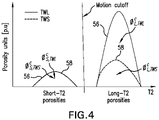
- T 2 distributions calculated based on the TW L sequence and the TW S sequence is shown in FIG. 4 (for NMR acquisition that is not affected by motion) and in FIG. 5 (for NMR acquisition that is affected by motion).
- the T 2 distribution for TW L is represented by a curve 56
- the T 2 distribution for TW S is represented by a curve 58.
- the area under each curve may be associated with all or part of the total porosity of the volume of interest, which can be divided by cutoffs to define partial porosities of different volumetrics.
- FIG. 4 shows examples of a cutoff used to define partial porosities for different volumetrics.
- a cutoff splits the T 2 porosity distribution into two volumetrics: a short-T 2 porosity fraction associated with short-T 2 fluid, and a long-T 2 porosity fraction associated with long-T 2 fluid.
- Short-T 2 fluids are fluids or combinations of fluids corresponding to T 2 values or a portion of a T 2 distribution below a selected threshold or cutoff
- long-T 2 fluids are fluids corresponding to T 2 values or a portion of a T 2 distribution at or above the cutoff.
- long-T 2 fluids include free fluids (e.g., gas and/or light oil) and short-T 2 fluids include bound fluids (e.g., bound water).
- the short-T 2 porosity fluid volumetric corresponds to the Bulk Volume Irreducible (BVI) volumetric
- the long-T 2 porosity fluid volumetric corresponds to the Bulk Volume Moveable (BVM) volumetric.
- the motion cutoff may be the same or similar to the BVI cutoff, but is not so limited.
- the cutoff between short and long-T 2 fluids is determined in the laboratory with NMR measurements on core samples. In the absence of laboratory data, default values based on lithology or other information may be used.
- FIGS. 4 and 5 illustrate the effect of lateral motion (or other types of motion) or B 0 field instability on the measured partial porosity of the long-T 2 and short-T 2 porosity fractions.
- a portion of the partial porosity of the long-T 2 porosity fraction for the long wait time and for the short wait time is shifted to the partial porosity of the short-T 2 porosity fraction. This is shown as a decrease in the volume under the curve 56 and the curve 58 in the long-T 2 porosity (above the motion cutoff), and a corresponding increase in the volume under the curve 56 and the curve 58 in the short-T 2 porosity (below the motion cutoff).
- NMR simulations have shown that lateral motion typically leads to a shift of partial porosity from the long-T 2 porosity into the short-T 2 porosity.
- the shifted amount of porosity is proportional to the polarized long-T 2 porosity.
- FIGS. 4 and 5 Examples of the detection of motion artefacts and motion correction are described below in conjunction with the examples shown in FIGS. 4 and 5 . It is noted that the shape, values and shift in partial porosities of FIGS. 4 and 5 are provided for illustration purposes and are not intended to be limiting. Furthermore, the examples can be performed with any suitable pair of T 2 distributions, such as a TW L distribution and a differential T 2 distribution.
- FIG. 4 shows the partial porosities for NMR measurements that are not affected by motion or that have been corrected for motion as described herein.
- FIG. 5 shows the partial porosities from NMR measurements that were affected by motion but have not been corrected ("uncorrected partial porosities").
- the shift can be associated with a factor of proportionality ⁇ between the shifted porosity and the long-T 2 porosity that is unaffected by motion.
- the porosity that is missed in the long-T 2 porosity can be equated to the porosity added into the short- T 2 porosity as follows: where ⁇ S , TWL and ⁇ S, TWS are measured uncorrected short-T 2 porosities from the long and short sequence, respectively, and ⁇ c S,TWL and ⁇ c S,TWS are the short-T 2 porosities corrected for motion.
- ⁇ c L, TWL and ⁇ c L, TWS are the long-T 2 porosities corrected for motion.
- the long-T 2 porosities ⁇ L, TWL and ⁇ L, TWS that are measured are the parts of the long-T 2 porosities that were not shifted. These porosities can be calculated as:
- the polarized short-T 2 porosity ⁇ c S corrected for motion can be represented as: and the long-T 2 porosity corrected for motion becomes:
- the short-T 2 porosity is assumed to be fully polarized (i.e., P S,TWL ⁇ 1 and P S,TWS ⁇ 1). If TW S is not sufficiently long to polarize the short-T 2 porosity, the polarization of the short-T 2 porosity can be estimated by using the T 2 distribution and an assumed T 1 /T 2 ratio. In principle the same applies also if TW L is not long enough to fully polarize the short-T 2 porosity, but is unlikely in practice.
- the shift calculated according to the above methods can be used to estimate the movement (e.g., lateral movement or shift) of an NMR tool or other carrier.
- the calculated shift can be correlated with motion by any suitable method.
- experimental and/or empirical data such as lab data, measured data from other operations and models can be used to calibrate the processor and provide estimations of movement based on the calculated shifts.
- motion correction is applied to compensate for shifts in NMR data that result from motion. For example, by applying the above formulas, a partial porosity is shifted to compensate for shifts due to lateral motion or other types of motion, and/or for instabilities in the B 0 or B 1 fields.
- the apparatuses, systems and methods described herein provide numerous advantages.
- the embodiments described herein provide an effective technique for correcting errors or shifts in NMR measurements due to lateral motion, such as vibration, as well as imperfections in magnet setup.
- motion estimation and/or correction can be achieved using only the NMR measurements without requiring additional measurements or processing capabilities.
- various analyses and/or analytical components may be used, including digital and/or analog subsystems.
- the system may have components such as a processor, storage media, memory, input, output, communications link (wired, wireless, pulsed mud, optical or other), user interfaces, software programs, signal processors and other such components (such as resistors, capacitors, inductors, etc.) to provide for operation and analyses of the apparatus and methods disclosed herein in any of several manners well-appreciated in the art.
- teachings may be, but need not be, implemented in conjunction with a set of computer executable instructions stored on a computer readable medium, including memory (ROMs, RAMs), optical (CD-ROMs), or magnetic (disks, hard drives), or any other type that when executed causes a computer to implement the method of the present invention.
- ROMs, RAMs random access memory
- CD-ROMs compact disc-read only memory
- magnetic (disks, hard drives) any other type that when executed causes a computer to implement the method of the present invention.
- These instructions may provide for equipment operation, control, data collection and analysis and other functions deemed relevant by a system designer, owner, user, or other such personnel, in addition to the functions described in this disclosure.
Landscapes
- Physics & Mathematics (AREA)
- Life Sciences & Earth Sciences (AREA)
- Engineering & Computer Science (AREA)
- Geology (AREA)
- Mining & Mineral Resources (AREA)
- General Life Sciences & Earth Sciences (AREA)
- Environmental & Geological Engineering (AREA)
- High Energy & Nuclear Physics (AREA)
- Geochemistry & Mineralogy (AREA)
- General Physics & Mathematics (AREA)
- Fluid Mechanics (AREA)
- Geophysics (AREA)
- Remote Sensing (AREA)
- Analytical Chemistry (AREA)
- Immunology (AREA)
- Pathology (AREA)
- Condensed Matter Physics & Semiconductors (AREA)
- General Health & Medical Sciences (AREA)
- Biochemistry (AREA)
- Chemical & Material Sciences (AREA)
- Health & Medical Sciences (AREA)
- Magnetic Resonance Imaging Apparatus (AREA)
- Geophysics And Detection Of Objects (AREA)
Claims (10)
- Appareil de résonance magnétique nucléaire (RMN) pour estimer des propriétés d'une formation terrestre (12), l'appareil comprenant :un support configuré pour être déployé dans un trou de forage (26) dans la formation terrestre (12) ;un dispositif de mesure (14) à résonance magnétique nucléaire (RMN) incluant un ensemble de transmission configuré pour émettre une ou plusieurs séquences d'impulsions à double temps d'attente, et un ensemble de réception (18) configuré pour détecter un train d'échos à long temps d'attente (52) (54) et un train d'échos à court temps d'attente (52) (54) sur la base de la ou des séquences d'impulsions à double temps d'attente ; etun processeur configuré pour analyser le train d'échos à long temps d'attente (52) (54) et le train d'échos à court temps d'attente (52) (54) pour détecter un artefact de mouvement potentiel se rapportant à une variation de champ magnétique dans le volume d'intérêt, le processeur caractérisé en ce qu'il est configuré pour mettre en œuvre au moins un parmi :l'estimation d'une différence entre le train d'échos à long temps d'attente (52) (54) et le train d'échos à court temps d'attente (52) (54) pour générer un train d'échos différentiel, l'inversion du train d'échos différentiel (52) (54) en une distribution T2 différentielle, et la détection de l'artefact de mouvement en réponse à la détermination que le train d'échos différentiel (52) (54) inclut une fraction de porosité à courte T2 qui est supérieure à une valeur seuil ; etl'inversion des deux trains d'échos (52) (54) en deux distributions T2, les deux trains d'échos (52) (54) sélectionnés parmi le train d'échos à long temps d'attente (52) (54), le train d'échos à court temps d'attente (52) (54) et le train d'échos différentiel (52) (54), le calcul d'au moins deux fractions de porosité pour chacune des deux distributions T2, l'estimation d'un décalage d'une quantité de porosité entre les au moins deux fractions de porosité de chacune des deux distributions T2, et la détection de l'artefact de mouvement sur la base du décalage.
- Appareil selon la revendication 1, dans lequel les au moins deux fractions de porosité incluent une fraction de porosité à courte T2 et une fraction de porosité à longue T2.
- Appareil selon la revendication 1, dans lequel le processeur est configuré pour mettre en outre en œuvre une correction des données de mesure de RMN sur la base du décalage, dans lequel les données de mesure de RMN incluent le train d'échos à long temps d'attente (52) (54) et le train d'échos à court temps d'attente (52) (54).
- Appareil selon la revendication 2, dans lequel l'estimation du décalage de la quantité de porosité inclut une parmi :l'estimation d'une différence entre une première fraction de porosité à courte T2 provenant d'une des deux distributions T2 et une deuxième fraction de porosité à courte T2 provenant d'une autre des deux distributions T2 ; etl'estimation d'une différence entre la première fraction de porosité à courte T2 et la deuxième fraction de porosité à courte T2, dans lequel au moins une des première et deuxième fractions de porosité à courte T2 est multipliée par un facteur.
- Appareil selon la revendication 2, dans lequel l'estimation du décalage de la quantité de porosité inclut une parmil'estimation d'une différence entre une première fraction de porosité à longue T2 provenant d'une des deux distributions T2 et une deuxième fraction de porosité à longue T2 provenant d'une autre des deux distributions T2 ;l'estimation d'un rapport entre la première fraction de porosité à longue T2 et la deuxième fraction de porosité à longue T2 ; etl'estimation d'une différence entre la première fraction de porosité à longue T2 et la deuxième fraction de porosité à longue T2, dans lequel au moins une des première et deuxième fractions de porosité à longue T2 est multipliée par un facteur.
- Procédé (40) de mise en œuvre d'une mesure de résonance magnétique nucléaire (RMN), le procédé (40) comprenant :la réception de données de mesure de RMN incluant un train d'échos à long temps d'attente (52) (54) et un train d'échos à court temps d'attente (52) (54), les données de mesure générées par un dispositif de mesure (14) à résonance magnétique nucléaire (RMN) disposé dans un support dans une formation terrestre (12), le dispositif de mesure RMN incluant un ensemble de transmission (18) configuré pour émettre une ou plusieurs séquences d'impulsions à double temps d'attente dans un volume d'intérêt de formation ; etl'analyse du train d'échos à long temps d'attente (52) (54) et du train d'échos à court temps d'attente (52) (54) par un processeur pour détecter un artefact de mouvement potentiel se rapportant à une variation de champ magnétique dans le volume d'intérêt, dans lequel l'analyse est caractérisée en ce qu'elle inclut au moins une parmi :l'estimation d'une différence entre le train d'échos à long temps d'attente (52) (54) et le train d'échos à court temps d'attente (52) (54) pour générer un train d'échos différentiel, l'inversion du train d'échos différentiel (52) (54) en une distribution T2 différentielle, et la détection de l'artefact de mouvement en réponse à la détermination que le train d'échos différentiel (52) (54) inclut une fraction de porosité à courte T2 qui est supérieure à une valeur seuil ; etl'inversion des deux trains d'échos (52) (54) en deux distributions T2, les deux trains d'échos (52) (54) sélectionnés parmi le train d'échos à long temps d'attente (52) (54), le train d'échos à court temps d'attente et le train d'échos différentiel (52) (54), le calcul d'au moins deux fractions de porosité pour chacune des deux distributions T2, l'estimation d'un décalage d'une quantité de porosité entre les au moins deux fractions de porosité de chacune des deux distributions T2, et la détection de l'artefact de mouvement sur la base du décalage.
- Procédé (40) selon la revendication 6, dans lequel les au moins deux fractions de porosité incluent une fraction de porosité à courte T2 et une fraction de porosité à longue T2.
- Procédé (40) selon la revendication 7, dans lequel les deux distributions T2 incluent une distribution T2 à long temps d'attente estimée en inversant le train d'échos à long temps d'attente (52) (54), et une distribution T2 à court temps d'attente estimée en inversant le train d'échos à court temps d'attente (52) (54).
- Procédé (40) selon la revendication 7, dans lequel les deux distributions T2 incluent une distribution T2 à long temps d'attente estimée en inversant le train d'échos à long temps d'attente (52) (54), et la distribution T2 différentielle.
- Procédé (40) selon la revendication 6, comprenant en outre la correction des données de mesure de RMN sur la base du décalage.
Applications Claiming Priority (2)
| Application Number | Priority Date | Filing Date | Title |
|---|---|---|---|
| US15/061,636 US10126457B2 (en) | 2016-03-04 | 2016-03-04 | Motion detection and correction of magnetic resonance data |
| PCT/US2017/020375 WO2017151870A1 (fr) | 2016-03-04 | 2017-03-02 | Détection de mouvement et correction de données de résonance magnétique |
Publications (3)
| Publication Number | Publication Date |
|---|---|
| EP3423675A1 EP3423675A1 (fr) | 2019-01-09 |
| EP3423675A4 EP3423675A4 (fr) | 2019-11-27 |
| EP3423675B1 true EP3423675B1 (fr) | 2022-08-31 |
Family
ID=59722744
Family Applications (1)
| Application Number | Title | Priority Date | Filing Date |
|---|---|---|---|
| EP17760781.9A Active EP3423675B1 (fr) | 2016-03-04 | 2017-03-02 | Détection de mouvement et correction de données de résonance magnétique |
Country Status (6)
| Country | Link |
|---|---|
| US (1) | US10126457B2 (fr) |
| EP (1) | EP3423675B1 (fr) |
| CN (1) | CN109072693B (fr) |
| BR (1) | BR112018067448B1 (fr) |
| SA (1) | SA518392317B1 (fr) |
| WO (1) | WO2017151870A1 (fr) |
Families Citing this family (13)
| Publication number | Priority date | Publication date | Assignee | Title |
|---|---|---|---|---|
| US8970217B1 (en) | 2010-04-14 | 2015-03-03 | Hypres, Inc. | System and method for noise reduction in magnetic resonance imaging |
| US10739489B2 (en) * | 2016-01-15 | 2020-08-11 | Baker Hughes, A Ge Company, Llc | Low gradient magnetic resonance logging for measurement of light hydrocarbon reservoirs |
| DE112016005494T5 (de) * | 2016-03-04 | 2018-08-09 | Halliburton Energy Services, Inc. | Kernspinresonanzmessung mit mehreren Untersuchungstiefen zum Ermitteln der Porosität und des Porentyps von unterirdischen Formationen |
| WO2018164688A1 (fr) * | 2017-03-09 | 2018-09-13 | Halliburton Energy Services, Inc. | Outil de résonance magnétique nucléaire de fond de trou à compensation active pour des effets de mouvement |
| CN108363053B (zh) * | 2017-12-28 | 2022-07-05 | 生迪智慧科技有限公司 | 对象移动的监测方法和装置 |
| US11415534B2 (en) * | 2018-01-10 | 2022-08-16 | Halliburton Energy Services, Inc. | Interspersing different wait times in trainlet and partial recovery sequences |
| NO20211062A1 (en) | 2019-04-05 | 2021-09-03 | Halliburton Energy Services Inc | Reverse circular polarization based antenna orientation |
| NO20211061A1 (en) | 2019-04-05 | 2021-09-03 | Halliburton Energy Services Inc | Circular polarization correction in nuclear magnetic resonsance (NMR) logging |
| US11435496B2 (en) | 2019-10-07 | 2022-09-06 | Halliburton Energy Services, Inc. | Reducing data bandwidth requirements in downhole nuclear magnetic resonance processing |
| CN116057372A (zh) * | 2020-07-10 | 2023-05-02 | 斯伦贝谢技术有限公司 | 随钻运动检测 |
| US20220356800A1 (en) * | 2021-04-29 | 2022-11-10 | Halliburton Energy Services, Inc. | Drilling Quasi-Stationary Data Extraction And Processing |
| US11422283B1 (en) * | 2021-07-14 | 2022-08-23 | Halliburton Energy Services, Inc. | Reducing motion effects on nuclear magnetic resonance relaxation data |
| US12242015B2 (en) | 2023-01-13 | 2025-03-04 | Halliburton Energy Services, Inc. | Split inversion for nuclear magnetic resonance data |
Family Cites Families (22)
| Publication number | Priority date | Publication date | Assignee | Title |
|---|---|---|---|---|
| JP3369243B2 (ja) * | 1993-04-05 | 2003-01-20 | 株式会社東芝 | 磁気共鳴イメージング装置 |
| DE19647537A1 (de) | 1996-11-16 | 1998-05-20 | Philips Patentverwaltung | MR-Verfahren zur Reduzierung von Bewegungsartefakten und Anordnung zur Durchführung des Verfahrens |
| WO1999036801A1 (fr) | 1998-01-16 | 1999-07-22 | Numar Corporation | Procede et appareil de mesure de fond pendant le forage par resonance magnetique nucleaire |
| US6291995B1 (en) | 1998-03-03 | 2001-09-18 | Schlumberger Technology Corporation | Apparatus and method for generating a pulse sequence |
| US6566874B1 (en) | 1998-07-30 | 2003-05-20 | Schlumberger Technology Corporation | Detecting tool motion effects on nuclear magnetic resonance measurements |
| US6297632B1 (en) * | 1999-07-19 | 2001-10-02 | Schlumberger Technology Corporation | Detecting tool motion effects on spin echoes obtained with nuclear magnetic resonance measurements |
| US6331775B1 (en) | 1999-09-15 | 2001-12-18 | Baker Hughes Incorporated | Gas zone evaluation by combining dual wait time NMR data with density data |
| US6847209B2 (en) * | 2001-01-26 | 2005-01-25 | Fonar Corporation | Driven equilibrium and fast-spin echo scanning |
| US6650114B2 (en) | 2001-06-28 | 2003-11-18 | Baker Hughes Incorporated | NMR data acquisition with multiple interecho spacing |
| WO2005008259A2 (fr) * | 2003-07-08 | 2005-01-27 | New York University | Procede, systeme et agencement logiciel permettant de mesurer la correlation entre champs magnetiques |
| WO2005026748A2 (fr) * | 2003-09-08 | 2005-03-24 | The Regents Of The University Of California | Imagerie par resonance magnetique a temps d'echo ultra-courts |
| US7268547B2 (en) | 2003-10-07 | 2007-09-11 | Baker Hughes Incorporated | Correction of motion influences in NMR signals |
| WO2005067569A2 (fr) | 2004-01-04 | 2005-07-28 | Halliburton Energy Services, Inc. | Procede et appareil de detection d'hydrocarbures avec des diagraphies rmn dans des puits fores avec des boues a base d'huile |
| US7180287B2 (en) | 2004-05-05 | 2007-02-20 | Baker Hughes Incorporated | Reduction of motion artifacts in NMR |
| US7196516B2 (en) * | 2004-08-16 | 2007-03-27 | Baker Hughes Incorporated | Correction of NMR artifacts due to constant-velocity axial motion and spin-lattice relaxation |
| US8604787B2 (en) * | 2006-04-27 | 2013-12-10 | Stefan Posse | Magnetic resonance spectroscopy with real-time correction of motion and frequency drift, and real-time shimming |
| US9625547B2 (en) * | 2013-03-28 | 2017-04-18 | Universitatsspital Basel | Magnetic resonance imaging method for the quantification of the T1 and/or T2 relaxation times in a sample |
| BR112015015959A2 (pt) | 2013-03-28 | 2017-07-11 | Halliburton Energy Services Inc | método, dispositivo de armazenamento legível por máquina e sistema |
| JP2016539672A (ja) * | 2013-10-09 | 2016-12-22 | エムシー10 インコーポレイテッドMc10,Inc. | コンフォーマルセンサを含むユーティリティギア |
| US9671483B2 (en) * | 2014-02-26 | 2017-06-06 | Baker Hughes Incorporated | T2 inversions with reduced motion artifacts |
| US10539705B2 (en) | 2014-10-23 | 2020-01-21 | Baker Hughes, A Ge Company, Llc | Formation evaluation utilizing dual wait time nuclear magnetic resonance |
| US10739489B2 (en) * | 2016-01-15 | 2020-08-11 | Baker Hughes, A Ge Company, Llc | Low gradient magnetic resonance logging for measurement of light hydrocarbon reservoirs |
-
2016
- 2016-03-04 US US15/061,636 patent/US10126457B2/en active Active
-
2017
- 2017-03-02 BR BR112018067448-6A patent/BR112018067448B1/pt active IP Right Grant
- 2017-03-02 EP EP17760781.9A patent/EP3423675B1/fr active Active
- 2017-03-02 CN CN201780014858.5A patent/CN109072693B/zh active Active
- 2017-03-02 WO PCT/US2017/020375 patent/WO2017151870A1/fr not_active Ceased
-
2018
- 2018-09-01 SA SA518392317A patent/SA518392317B1/ar unknown
Also Published As
| Publication number | Publication date |
|---|---|
| CN109072693A (zh) | 2018-12-21 |
| WO2017151870A1 (fr) | 2017-09-08 |
| US20170254919A1 (en) | 2017-09-07 |
| BR112018067448A2 (pt) | 2019-01-02 |
| CN109072693B (zh) | 2022-06-17 |
| SA518392317B1 (ar) | 2023-02-12 |
| BR112018067448B1 (pt) | 2023-02-14 |
| EP3423675A1 (fr) | 2019-01-09 |
| EP3423675A4 (fr) | 2019-11-27 |
| US10126457B2 (en) | 2018-11-13 |
Similar Documents
| Publication | Publication Date | Title |
|---|---|---|
| US10126457B2 (en) | Motion detection and correction of magnetic resonance data | |
| EP3403078B1 (fr) | Enregistrement par résonance magnétique nucléaire à faible gradient pour mesurer des gisements d'hydrocarbures légers | |
| EP3397838B1 (fr) | Diagraphie à rmn dans une formation avec micro-porosité en utilisant des premiers échos à partir de multiples mesures | |
| CA2576991C (fr) | Correction d'artefacts rmn dus a un mouvement axial a vitesse constante et a une relaxation spin-milieu | |
| NO336430B1 (no) | Bestemmelse av T1 relaksasjonstid fra multippel ventetid NMR logger frembragt i den samme eller forskjellige passeringer | |
| AU2013262770B2 (en) | Hybrid saturation recovery-inversion recovery pulse sequence for improved NMR logging of boreholes | |
| CA2563698C (fr) | Utilisation de mesures realisees dans un train d'echos pour la correction d'echos multiples dans un deuxieme train d'echos, permettant d'eviter l'utilisation de paire a alternancede phase dans le deuxieme train | |
| US10551521B2 (en) | Magnetic resonance pulse sequences and processing | |
| US10061053B2 (en) | NMR T2 distribution from simultaneous T1 and T2 inversions for geologic applications | |
| NO20240803A1 (en) | Data inversion to reduce motion effects on nuclear magnetic resonance relaxation data | |
| WO2017176548A1 (fr) | Inversions t2 avec artéfacts de mouvement réduits | |
| Coman et al. | Improved NMR Logging Approach to Simultaneously Determine Porosity, T 2 and T 1 | |
| US9223048B2 (en) | System and method to detect a fluid flow without a tipping pulse | |
| US10267946B2 (en) | Magnetic resonance pulse sequences having wait times based on carrier speed | |
| WO2021158929A1 (fr) | Annulation d'oscillations amorties lors de mesures par rmn | |
| US12392922B2 (en) | Systems and methods for calibrating a nuclear magnetic resonance tool |
Legal Events
| Date | Code | Title | Description |
|---|---|---|---|
| STAA | Information on the status of an ep patent application or granted ep patent |
Free format text: STATUS: THE INTERNATIONAL PUBLICATION HAS BEEN MADE |
|
| PUAI | Public reference made under article 153(3) epc to a published international application that has entered the european phase |
Free format text: ORIGINAL CODE: 0009012 |
|
| STAA | Information on the status of an ep patent application or granted ep patent |
Free format text: STATUS: REQUEST FOR EXAMINATION WAS MADE |
|
| 17P | Request for examination filed |
Effective date: 20180928 |
|
| AK | Designated contracting states |
Kind code of ref document: A1 Designated state(s): AL AT BE BG CH CY CZ DE DK EE ES FI FR GB GR HR HU IE IS IT LI LT LU LV MC MK MT NL NO PL PT RO RS SE SI SK SM TR |
|
| AX | Request for extension of the european patent |
Extension state: BA ME |
|
| DAV | Request for validation of the european patent (deleted) | ||
| DAX | Request for extension of the european patent (deleted) | ||
| REG | Reference to a national code |
Ref country code: DE Ref legal event code: R079 Ref document number: 602017061266 Country of ref document: DE Free format text: PREVIOUS MAIN CLASS: E21B0047000000 Ipc: G01V0003320000 |
|
| A4 | Supplementary search report drawn up and despatched |
Effective date: 20191025 |
|
| RIC1 | Information provided on ipc code assigned before grant |
Ipc: G01V 3/32 20060101AFI20191021BHEP Ipc: G01R 33/44 20060101ALI20191021BHEP Ipc: G01N 24/08 20060101ALI20191021BHEP |
|
| INTG | Intention to grant announced |
Effective date: 20220506 |
|
| GRAS | Grant fee paid |
Free format text: ORIGINAL CODE: EPIDOSNIGR3 |
|
| STAA | Information on the status of an ep patent application or granted ep patent |
Free format text: STATUS: GRANT OF PATENT IS INTENDED |
|
| GRAA | (expected) grant |
Free format text: ORIGINAL CODE: 0009210 |
|
| STAA | Information on the status of an ep patent application or granted ep patent |
Free format text: STATUS: THE PATENT HAS BEEN GRANTED |
|
| AK | Designated contracting states |
Kind code of ref document: B1 Designated state(s): AL AT BE BG CH CY CZ DE DK EE ES FI FR GB GR HR HU IE IS IT LI LT LU LV MC MK MT NL NO PL PT RO RS SE SI SK SM TR |
|
| RAP3 | Party data changed (applicant data changed or rights of an application transferred) |
Owner name: BAKER HUGHES HOLDINGS LLC |
|
| REG | Reference to a national code |
Ref country code: CH Ref legal event code: EP Ref country code: GB Ref legal event code: FG4D |
|
| REG | Reference to a national code |
Ref country code: AT Ref legal event code: REF Ref document number: 1515697 Country of ref document: AT Kind code of ref document: T Effective date: 20220915 Ref country code: DE Ref legal event code: R096 Ref document number: 602017061266 Country of ref document: DE |
|
| REG | Reference to a national code |
Ref country code: IE Ref legal event code: FG4D |
|
| REG | Reference to a national code |
Ref country code: NO Ref legal event code: T2 Effective date: 20220831 |
|
| REG | Reference to a national code |
Ref country code: LT Ref legal event code: MG9D |
|
| REG | Reference to a national code |
Ref country code: NL Ref legal event code: MP Effective date: 20220831 |
|
| PG25 | Lapsed in a contracting state [announced via postgrant information from national office to epo] |
Ref country code: SE Free format text: LAPSE BECAUSE OF FAILURE TO SUBMIT A TRANSLATION OF THE DESCRIPTION OR TO PAY THE FEE WITHIN THE PRESCRIBED TIME-LIMIT Effective date: 20220831 Ref country code: RS Free format text: LAPSE BECAUSE OF FAILURE TO SUBMIT A TRANSLATION OF THE DESCRIPTION OR TO PAY THE FEE WITHIN THE PRESCRIBED TIME-LIMIT Effective date: 20220831 Ref country code: LV Free format text: LAPSE BECAUSE OF FAILURE TO SUBMIT A TRANSLATION OF THE DESCRIPTION OR TO PAY THE FEE WITHIN THE PRESCRIBED TIME-LIMIT Effective date: 20220831 Ref country code: LT Free format text: LAPSE BECAUSE OF FAILURE TO SUBMIT A TRANSLATION OF THE DESCRIPTION OR TO PAY THE FEE WITHIN THE PRESCRIBED TIME-LIMIT Effective date: 20220831 Ref country code: FI Free format text: LAPSE BECAUSE OF FAILURE TO SUBMIT A TRANSLATION OF THE DESCRIPTION OR TO PAY THE FEE WITHIN THE PRESCRIBED TIME-LIMIT Effective date: 20220831 |
|
| REG | Reference to a national code |
Ref country code: AT Ref legal event code: MK05 Ref document number: 1515697 Country of ref document: AT Kind code of ref document: T Effective date: 20220831 |
|
| PG25 | Lapsed in a contracting state [announced via postgrant information from national office to epo] |
Ref country code: PL Free format text: LAPSE BECAUSE OF FAILURE TO SUBMIT A TRANSLATION OF THE DESCRIPTION OR TO PAY THE FEE WITHIN THE PRESCRIBED TIME-LIMIT Effective date: 20220831 Ref country code: IS Free format text: LAPSE BECAUSE OF FAILURE TO SUBMIT A TRANSLATION OF THE DESCRIPTION OR TO PAY THE FEE WITHIN THE PRESCRIBED TIME-LIMIT Effective date: 20221231 Ref country code: HR Free format text: LAPSE BECAUSE OF FAILURE TO SUBMIT A TRANSLATION OF THE DESCRIPTION OR TO PAY THE FEE WITHIN THE PRESCRIBED TIME-LIMIT Effective date: 20220831 Ref country code: GR Free format text: LAPSE BECAUSE OF FAILURE TO SUBMIT A TRANSLATION OF THE DESCRIPTION OR TO PAY THE FEE WITHIN THE PRESCRIBED TIME-LIMIT Effective date: 20221201 |
|
| PG25 | Lapsed in a contracting state [announced via postgrant information from national office to epo] |
Ref country code: SM Free format text: LAPSE BECAUSE OF FAILURE TO SUBMIT A TRANSLATION OF THE DESCRIPTION OR TO PAY THE FEE WITHIN THE PRESCRIBED TIME-LIMIT Effective date: 20220831 Ref country code: RO Free format text: LAPSE BECAUSE OF FAILURE TO SUBMIT A TRANSLATION OF THE DESCRIPTION OR TO PAY THE FEE WITHIN THE PRESCRIBED TIME-LIMIT Effective date: 20220831 Ref country code: PT Free format text: LAPSE BECAUSE OF FAILURE TO SUBMIT A TRANSLATION OF THE DESCRIPTION OR TO PAY THE FEE WITHIN THE PRESCRIBED TIME-LIMIT Effective date: 20230102 Ref country code: ES Free format text: LAPSE BECAUSE OF FAILURE TO SUBMIT A TRANSLATION OF THE DESCRIPTION OR TO PAY THE FEE WITHIN THE PRESCRIBED TIME-LIMIT Effective date: 20220831 Ref country code: DK Free format text: LAPSE BECAUSE OF FAILURE TO SUBMIT A TRANSLATION OF THE DESCRIPTION OR TO PAY THE FEE WITHIN THE PRESCRIBED TIME-LIMIT Effective date: 20220831 Ref country code: CZ Free format text: LAPSE BECAUSE OF FAILURE TO SUBMIT A TRANSLATION OF THE DESCRIPTION OR TO PAY THE FEE WITHIN THE PRESCRIBED TIME-LIMIT Effective date: 20220831 Ref country code: AT Free format text: LAPSE BECAUSE OF FAILURE TO SUBMIT A TRANSLATION OF THE DESCRIPTION OR TO PAY THE FEE WITHIN THE PRESCRIBED TIME-LIMIT Effective date: 20220831 |
|
| PG25 | Lapsed in a contracting state [announced via postgrant information from national office to epo] |
Ref country code: SK Free format text: LAPSE BECAUSE OF FAILURE TO SUBMIT A TRANSLATION OF THE DESCRIPTION OR TO PAY THE FEE WITHIN THE PRESCRIBED TIME-LIMIT Effective date: 20220831 Ref country code: EE Free format text: LAPSE BECAUSE OF FAILURE TO SUBMIT A TRANSLATION OF THE DESCRIPTION OR TO PAY THE FEE WITHIN THE PRESCRIBED TIME-LIMIT Effective date: 20220831 |
|
| REG | Reference to a national code |
Ref country code: DE Ref legal event code: R097 Ref document number: 602017061266 Country of ref document: DE |
|
| PG25 | Lapsed in a contracting state [announced via postgrant information from national office to epo] |
Ref country code: NL Free format text: LAPSE BECAUSE OF FAILURE TO SUBMIT A TRANSLATION OF THE DESCRIPTION OR TO PAY THE FEE WITHIN THE PRESCRIBED TIME-LIMIT Effective date: 20220831 Ref country code: AL Free format text: LAPSE BECAUSE OF FAILURE TO SUBMIT A TRANSLATION OF THE DESCRIPTION OR TO PAY THE FEE WITHIN THE PRESCRIBED TIME-LIMIT Effective date: 20220831 |
|
| P01 | Opt-out of the competence of the unified patent court (upc) registered |
Effective date: 20230526 |
|
| PLBE | No opposition filed within time limit |
Free format text: ORIGINAL CODE: 0009261 |
|
| STAA | Information on the status of an ep patent application or granted ep patent |
Free format text: STATUS: NO OPPOSITION FILED WITHIN TIME LIMIT |
|
| 26N | No opposition filed |
Effective date: 20230601 |
|
| PG25 | Lapsed in a contracting state [announced via postgrant information from national office to epo] |
Ref country code: SI Free format text: LAPSE BECAUSE OF FAILURE TO SUBMIT A TRANSLATION OF THE DESCRIPTION OR TO PAY THE FEE WITHIN THE PRESCRIBED TIME-LIMIT Effective date: 20220831 |
|
| REG | Reference to a national code |
Ref country code: DE Ref legal event code: R119 Ref document number: 602017061266 Country of ref document: DE |
|
| PG25 | Lapsed in a contracting state [announced via postgrant information from national office to epo] |
Ref country code: MC Free format text: LAPSE BECAUSE OF FAILURE TO SUBMIT A TRANSLATION OF THE DESCRIPTION OR TO PAY THE FEE WITHIN THE PRESCRIBED TIME-LIMIT Effective date: 20220831 |
|
| REG | Reference to a national code |
Ref country code: CH Ref legal event code: PL |
|
| REG | Reference to a national code |
Ref country code: BE Ref legal event code: MM Effective date: 20230331 |
|
| PG25 | Lapsed in a contracting state [announced via postgrant information from national office to epo] |
Ref country code: LU Free format text: LAPSE BECAUSE OF NON-PAYMENT OF DUE FEES Effective date: 20230302 |
|
| REG | Reference to a national code |
Ref country code: IE Ref legal event code: MM4A |
|
| PG25 | Lapsed in a contracting state [announced via postgrant information from national office to epo] |
Ref country code: LI Free format text: LAPSE BECAUSE OF NON-PAYMENT OF DUE FEES Effective date: 20230331 Ref country code: IE Free format text: LAPSE BECAUSE OF NON-PAYMENT OF DUE FEES Effective date: 20230302 Ref country code: FR Free format text: LAPSE BECAUSE OF NON-PAYMENT OF DUE FEES Effective date: 20230331 Ref country code: DE Free format text: LAPSE BECAUSE OF NON-PAYMENT OF DUE FEES Effective date: 20231003 Ref country code: CH Free format text: LAPSE BECAUSE OF NON-PAYMENT OF DUE FEES Effective date: 20230331 |
|
| PG25 | Lapsed in a contracting state [announced via postgrant information from national office to epo] |
Ref country code: BE Free format text: LAPSE BECAUSE OF NON-PAYMENT OF DUE FEES Effective date: 20230331 |
|
| PG25 | Lapsed in a contracting state [announced via postgrant information from national office to epo] |
Ref country code: IT Free format text: LAPSE BECAUSE OF FAILURE TO SUBMIT A TRANSLATION OF THE DESCRIPTION OR TO PAY THE FEE WITHIN THE PRESCRIBED TIME-LIMIT Effective date: 20220831 |
|
| PG25 | Lapsed in a contracting state [announced via postgrant information from national office to epo] |
Ref country code: BG Free format text: LAPSE BECAUSE OF FAILURE TO SUBMIT A TRANSLATION OF THE DESCRIPTION OR TO PAY THE FEE WITHIN THE PRESCRIBED TIME-LIMIT Effective date: 20220831 |
|
| PG25 | Lapsed in a contracting state [announced via postgrant information from national office to epo] |
Ref country code: BG Free format text: LAPSE BECAUSE OF FAILURE TO SUBMIT A TRANSLATION OF THE DESCRIPTION OR TO PAY THE FEE WITHIN THE PRESCRIBED TIME-LIMIT Effective date: 20220831 |
|
| PG25 | Lapsed in a contracting state [announced via postgrant information from national office to epo] |
Ref country code: CY Free format text: LAPSE BECAUSE OF FAILURE TO SUBMIT A TRANSLATION OF THE DESCRIPTION OR TO PAY THE FEE WITHIN THE PRESCRIBED TIME-LIMIT; INVALID AB INITIO Effective date: 20170302 |
|
| PG25 | Lapsed in a contracting state [announced via postgrant information from national office to epo] |
Ref country code: HU Free format text: LAPSE BECAUSE OF FAILURE TO SUBMIT A TRANSLATION OF THE DESCRIPTION OR TO PAY THE FEE WITHIN THE PRESCRIBED TIME-LIMIT; INVALID AB INITIO Effective date: 20170302 |
|
| PG25 | Lapsed in a contracting state [announced via postgrant information from national office to epo] |
Ref country code: TR Free format text: LAPSE BECAUSE OF FAILURE TO SUBMIT A TRANSLATION OF THE DESCRIPTION OR TO PAY THE FEE WITHIN THE PRESCRIBED TIME-LIMIT Effective date: 20220831 |
|
| PGFP | Annual fee paid to national office [announced via postgrant information from national office to epo] |
Ref country code: GB Payment date: 20260220 Year of fee payment: 10 |
|
| PGFP | Annual fee paid to national office [announced via postgrant information from national office to epo] |
Ref country code: NO Payment date: 20260223 Year of fee payment: 10 |