EP3424740B1 - Verfahren zum drucken von mikrooptischen 3d-bildern auf verpackungssystemen - Google Patents
Verfahren zum drucken von mikrooptischen 3d-bildern auf verpackungssystemen Download PDFInfo
- Publication number
- EP3424740B1 EP3424740B1 EP17179770.7A EP17179770A EP3424740B1 EP 3424740 B1 EP3424740 B1 EP 3424740B1 EP 17179770 A EP17179770 A EP 17179770A EP 3424740 B1 EP3424740 B1 EP 3424740B1
- Authority
- EP
- European Patent Office
- Prior art keywords
- substrate
- plate
- images
- flexographic
- printing
- Prior art date
- Legal status (The legal status is an assumption and is not a legal conclusion. Google has not performed a legal analysis and makes no representation as to the accuracy of the status listed.)
- Active
Links
Images








Classifications
-
- B—PERFORMING OPERATIONS; TRANSPORTING
- B29—WORKING OF PLASTICS; WORKING OF SUBSTANCES IN A PLASTIC STATE IN GENERAL
- B29D—PRODUCING PARTICULAR ARTICLES FROM PLASTICS OR FROM SUBSTANCES IN A PLASTIC STATE
- B29D11/00—Producing optical elements, e.g. lenses or prisms
- B29D11/00009—Production of simple or compound lenses
- B29D11/00365—Production of microlenses
-
- B—PERFORMING OPERATIONS; TRANSPORTING
- B29—WORKING OF PLASTICS; WORKING OF SUBSTANCES IN A PLASTIC STATE IN GENERAL
- B29C—SHAPING OR JOINING OF PLASTICS; SHAPING OF MATERIAL IN A PLASTIC STATE, NOT OTHERWISE PROVIDED FOR; AFTER-TREATMENT OF THE SHAPED PRODUCTS, e.g. REPAIRING
- B29C33/00—Moulds or cores; Details thereof or accessories therefor
- B29C33/38—Moulds or cores; Details thereof or accessories therefor characterised by the material or the manufacturing process
- B29C33/3842—Manufacturing moulds, e.g. shaping the mould surface by machining
-
- B—PERFORMING OPERATIONS; TRANSPORTING
- B29—WORKING OF PLASTICS; WORKING OF SUBSTANCES IN A PLASTIC STATE IN GENERAL
- B29D—PRODUCING PARTICULAR ARTICLES FROM PLASTICS OR FROM SUBSTANCES IN A PLASTIC STATE
- B29D11/00—Producing optical elements, e.g. lenses or prisms
-
- B—PERFORMING OPERATIONS; TRANSPORTING
- B41—PRINTING; LINING MACHINES; TYPEWRITERS; STAMPS
- B41M—PRINTING, DUPLICATING, MARKING, OR COPYING PROCESSES; COLOUR PRINTING
- B41M1/00—Inking and printing with a printer's forme
- B41M1/02—Letterpress printing, e.g. book printing
- B41M1/04—Flexographic printing
-
- B—PERFORMING OPERATIONS; TRANSPORTING
- B41—PRINTING; LINING MACHINES; TYPEWRITERS; STAMPS
- B41M—PRINTING, DUPLICATING, MARKING, OR COPYING PROCESSES; COLOUR PRINTING
- B41M1/00—Inking and printing with a printer's forme
- B41M1/26—Printing on other surfaces than ordinary paper
- B41M1/30—Printing on other surfaces than ordinary paper on organic plastics, horn or similar materials
-
- B—PERFORMING OPERATIONS; TRANSPORTING
- B41—PRINTING; LINING MACHINES; TYPEWRITERS; STAMPS
- B41M—PRINTING, DUPLICATING, MARKING, OR COPYING PROCESSES; COLOUR PRINTING
- B41M3/00—Printing processes to produce particular kinds of printed work, e.g. patterns
- B41M3/06—Veined printings; Fluorescent printings; Stereoscopic images; Imitated patterns, e.g. tissues, textiles
-
- B—PERFORMING OPERATIONS; TRANSPORTING
- B41—PRINTING; LINING MACHINES; TYPEWRITERS; STAMPS
- B41M—PRINTING, DUPLICATING, MARKING, OR COPYING PROCESSES; COLOUR PRINTING
- B41M7/00—After-treatment of prints, e.g. heating, irradiating, setting of the ink, protection of the printed stock
-
- B—PERFORMING OPERATIONS; TRANSPORTING
- B41—PRINTING; LINING MACHINES; TYPEWRITERS; STAMPS
- B41M—PRINTING, DUPLICATING, MARKING, OR COPYING PROCESSES; COLOUR PRINTING
- B41M7/00—After-treatment of prints, e.g. heating, irradiating, setting of the ink, protection of the printed stock
- B41M7/0036—After-treatment of prints, e.g. heating, irradiating, setting of the ink, protection of the printed stock using protective coatings or layers dried without curing
-
- B—PERFORMING OPERATIONS; TRANSPORTING
- B41—PRINTING; LINING MACHINES; TYPEWRITERS; STAMPS
- B41M—PRINTING, DUPLICATING, MARKING, OR COPYING PROCESSES; COLOUR PRINTING
- B41M7/00—After-treatment of prints, e.g. heating, irradiating, setting of the ink, protection of the printed stock
- B41M7/0045—After-treatment of prints, e.g. heating, irradiating, setting of the ink, protection of the printed stock using protective coatings or film forming compositions cured by mechanical wave energy, e.g. ultrasonics, cured by electromagnetic radiation or waves, e.g. ultraviolet radiation, electron beams, or cured by magnetic or electric fields, e.g. electric discharge, plasma
-
- G—PHYSICS
- G02—OPTICS
- G02B—OPTICAL ELEMENTS, SYSTEMS OR APPARATUS
- G02B3/00—Simple or compound lenses
-
- G—PHYSICS
- G02—OPTICS
- G02B—OPTICAL ELEMENTS, SYSTEMS OR APPARATUS
- G02B3/00—Simple or compound lenses
- G02B3/0006—Arrays
- G02B3/0012—Arrays characterised by the manufacturing method
-
- B—PERFORMING OPERATIONS; TRANSPORTING
- B42—BOOKBINDING; ALBUMS; FILES; SPECIAL PRINTED MATTER
- B42D—BOOKS; BOOK COVERS; LOOSE LEAVES; PRINTED MATTER CHARACTERISED BY IDENTIFICATION OR SECURITY FEATURES; PRINTED MATTER OF SPECIAL FORMAT OR STYLE NOT OTHERWISE PROVIDED FOR; DEVICES FOR USE THEREWITH AND NOT OTHERWISE PROVIDED FOR; MOVABLE-STRIP WRITING OR READING APPARATUS
- B42D25/00—Information-bearing cards or sheet-like structures characterised by identification or security features; Manufacture thereof
- B42D25/30—Identification or security features, e.g. for preventing forgery
- B42D25/324—Reliefs
-
- B—PERFORMING OPERATIONS; TRANSPORTING
- B42—BOOKBINDING; ALBUMS; FILES; SPECIAL PRINTED MATTER
- B42D—BOOKS; BOOK COVERS; LOOSE LEAVES; PRINTED MATTER CHARACTERISED BY IDENTIFICATION OR SECURITY FEATURES; PRINTED MATTER OF SPECIAL FORMAT OR STYLE NOT OTHERWISE PROVIDED FOR; DEVICES FOR USE THEREWITH AND NOT OTHERWISE PROVIDED FOR; MOVABLE-STRIP WRITING OR READING APPARATUS
- B42D25/00—Information-bearing cards or sheet-like structures characterised by identification or security features; Manufacture thereof
- B42D25/40—Manufacture
- B42D25/405—Marking
- B42D25/425—Marking by deformation, e.g. embossing
Definitions
- the present invention relates to a method for printing 3D-microoptic images on packaging systems, and 3D-microoptic image packaging systems.
- Films used in products and packages can benefit from micro-sized patterns.
- Such patterns can provide various effects, such as optical effects (e.g. lensing, holographics), tactile effects (e.g. perceived softness), and/or functional effects (e.g. surface characteristics).
- Imparting 3D-effects can be realized by taking advantage of the moire-magnifier principle, wherein a substrate comprises images and micro-sized patterns with a specific relative arrangement.
- 3D-microoptic decoration techniques are of great interest, since they provide a high impact on the first impression of a product and serve as an eye-catcher with high holding power for consumers to stop at a product.
- WO 2004/092085 A2 refers to a method of creating a selectively formed lenticular image.
- DE 102006003311 A1 is about a method for producing image effect subject to viewing angle has the image printed onto a substrate and coated with lacquer and subjected to a raster type spatial pattern with forms mini lenses.
- US 2013/0057608 A1 sets out a printer and printing method that forms a lenticular lens or a transparent structure based on pseudo-embossment printing or the like on paper having penetrability, and an inkjet printer performs.
- 3D-microoptic films are for example provided by Nanoventions, Inc., Visual Physics, /LLC, Rolling Optics, AB, and Grapac Japan Co., Inc.
- Commercially available films may either have images printed on one side and micro-sized lenses printed on the other side, or the images are printed on one side with continuous relief features in the shape of grooves on the same side.
- Lenticular designs with lenses having an expansion of 1 mm or more and continuous relief feature designs on flexible films or labels, often provide undesired properties like decreasing their flexibility.
- the known lenticular designs with lenses having an expansion of 1 mm or more are often unappealing for consumers due to rough surfaces which provide an unpleasant feeling when handling a packaging system with such lenticular designs on the outer surface.
- a process for making 3D-microoptic packaging systems comprises providing a substrate, printing a plurality of images on at least part of the first major surface of the substrate, applying a transparent varnish layer on the printed first major surface of the substrate, and forming a plurality of relief features on the outer surface of the varnish layer, wherein the relief features are micro-lenses, characterized in that the relief features on the varnish layer are formed by a filmless casting process using a flexographic casting plate.
- Microlens designs can be easily incorporated into flexible films and labels of packaging systems as they are typically thin and small. Microlens designs can be incorporated into packaging systems without significantly changing their characteristics with regard to their suitability as packaging systems, e.g., their flexibility, thickness, weight, feel. Microlens designs are therefore suitable for a variety of packaging systems. They can provide a smooth surface and thereby appeal to consumers. They can be thin and lightweight and thereby retain flexibility of flexible films and labels.
- the present invention relates to a method for printing 3D-microoptic images on packaging systems.
- the method comprises providing a substrate having a first and a second major surface; printing a plurality of images on at least part of the first major surface of the substrate to provide a substrate with a printed first major surface; applying a transparent varnish layer on the printed first major surface of the substrate, wherein the varnish layer has an inner surface being in contact with the printed first major surface of the substrate and an outer surface facing away from the substrate; and forming a plurality of relief features on the outer surface of the varnish layer, wherein the relief features are micro-lenses.
- the present invention further relates to 3D-microoptic image packaging systems comprising a substrate having a first and a second major surface, a plurality of images on at least part of the first major surface, a transparent varnish layer on the first major surface of the substrate superimposing the printed images, wherein the varnish layer has an inner surface being in contact with the printed first major surface of the substrate and an outer surface facing away from the substrate, wherein the varnish layer has a plurality of relief features on the outer surface of the varnish layer, and wherein the relief features are micro-lenses.
- a "3D-microoptic image packaging system” is a packaging system having images printed on its surface that exhibit 3D-optical effects for a viewer.
- substrates are all materials which are suitable for printing and which have a first and a second major surface.
- substrates Preferably, substrates have a sheet-like shape.
- Rigid substrates are substrates which are resistant to deformation in response to an applied force and which are therefore not suitable for use in in-line printing processes.
- a "relief feature” according to the present invention is a feature protruding from the minimum expansion of the varnish in perpendicular direction from the substrate surface.
- the "image size" defines the maximum expansion of an image.
- micro means an expansion of less than 1 mm, preferably 1 ⁇ m to less than 1 mm.
- Micro-images are images with an image size of less than 1 mm.
- Micro-lenses are lenses with a maximum height and width of less than 1 mm.
- the distance between images characterizes the minimum distance between images. Accordingly, the “distance between relief features” characterizes the minimum distance between relief features.
- Height is defined as the expansion in perpendicular direction from a surface.
- the height of the varnish layer is the expansion in perpendicular direction from the substrate surface.
- the height of the relief features is the difference between the maximum expansion of the varnish in perpendicular direction from the substrate surface and the minimum expansion of the varnish in perpendicular direction from the substrate surface.
- the height may also be called “thickness", where the thickness of a structured layer is described as the minimum expansion of the layer in perpendicular direction from a surface.
- a “plurality” according to the present invention is more than one.
- transparent means that a material has a transparency (I/I 0 ) of at least 0.5 in a wavelength range of from 400 to 780 nm and a material layer thickness of 10 mm.
- Porous defines materials with a pore size of at least 1 nm. Materials having lower pore sizes, i.e., in the sub-nanometer range, or no pores are “non-porous" materials.
- the pore size can be determined by ASTM D4404.
- a "photopolymer” according to the application under examination is a polymeric material that can be cured by electromagnetic irradiation, e.g., light.
- the present invention relates to a method for printing 3D-microoptic images on packaging systems comprising
- the method comprises the provision of a substrate having a first and a second major surface.
- the substrate may be flexible or rigid.
- the substrate is rigid.
- the substrate may be of any shape.
- the substrate may be sheet-like, e.g., be a foil or film, have the shape of a packaging system, or have the shape of a part of a packaging system.
- the substrate may have any thickness.
- the substrate has a thickness of from 1 ⁇ m to 10 cm, or from 2 ⁇ m to 5 cm, or from 5 ⁇ m to 1 cm, or from 10 ⁇ m to 5 mm, or from 20 ⁇ m to 1 mm.
- the substrate may comprise polymeric materials, glass, wood, stone, ceramics, metals, woven or non-woven fabrics, paper, or combinations thereof.
- the substrate comprises a polymeric material. More preferably, the polymeric material is selected from the group consisting of high density polyethylene, low density polyethylene, linear low density polyethylene, polypropylene, polyethylene terephthalate, and combinations of two or more thereof.
- Rigid substrates may comprise polymeric materials, glass, wood, stone, ceramics, enamels metals, or combinations thereof.
- substrates comprise a polymeric material. More preferably, the polymeric material is selected from the group consisting of high density polyethylene, low density polyethylene, linear low density polyethylene, polypropylene, polyethylene terephthalate, and combinations of two or more thereof.
- the substrate may also be flexible.
- a flexible substrate may comprise polymeric materials, metal materials, woven or non-woven fabrics, paper, or combinations thereof, preferably a polymeric material.
- a flexible substrate is preferably a plastic foil or a plastic film.
- the polymeric material is preferably selected from the group consisting of high density polyethylene, low density polyethylene, linear low density polyethylene, polypropylene, polyethylene terephthalate, and combinations of two or more thereof.
- the substrate may be porous or non-porous.
- Porous substrates may for example be microporous substrates with a pore size of less than 1 ⁇ m, for example of less than 500 nm or in a range of from 1 to 500 nm or from 2 to 200 nm.
- Preferred substrates according to the present invention are non-porous.
- the method comprises printing a plurality of images on at least part of the first major surface of the substrate to provide a substrate with a printed first major surface.
- the images may be printed by any method known in the art which is suitable for printing images on a major surface of a substrate.
- the images may be printed by a process selected from inkjet printing, in-mold labeling, transfer printing, rotogravure, silk screen printing, letterpress printing, offset lithography, and flexographic printing. These printing procedures are well known in the art.
- Inkjet printing generally includes a high-pressure pump directing liquid ink from a reservoir through a gun body and a microscopic nozzle creating ink droplets.
- the ink droplets are subjected to an electrostatic field as they form, so that each droplet can be individually charged. They are then directed by electrostatic deflection plates to print on the substrate. This process is described in further detail below with regard to Fig. 1
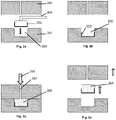
- In-mold labeling is a plastic molding process which is used for shaping a plastic material while simultaneously decorating its surface.
- a carrier foil carrying the decoration to be transferred to the plastic part is placed inside the mold of an opened molding device. By using vacuum or static charging, the foil is fixated in the mold.
- the plastic material e.g. polypropylene, is introduced into the mold in molten or softened state.
- the molding device is closed. By applying heat and/or pressure the plastic material is formed into the desired shape.
- the carrier foil and the plastic material are fused forming a printed substrate with the print being an integral part of the substrate. This process is described in further detail below with regard to Figs. 2a-2d .
- Transfer printing generally includes using a transfer device to transfer liquid-based inks from an ink pad onto a substrate.
- Suitable transfer devices are for example engraved metal plates like copper or steel plates, or structured polymeric stamps like rubber stamps. This process is described in further detail below with regard to Figs. 3a-3c .
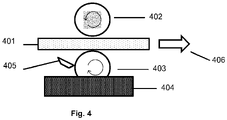
- Rotogravure is a printing process using a rotary printing press that involves engraving an image onto an image carrier, namely a cylinder which is part of the rotary printing press.
- the ink is applied directly to the cylinder and transferred from the cylinder to the substrate. This process is described in further detail below with regard to Fig. 4 .
- Silk screen printing is a printing technique where a design is imposed on a mesh screen which is used to transfer ink onto a substrate.
- the mesh screen can be made of any mesh material, preferably of polyethylene terephthalate.
- the open mesh apertures are filled with ink.
- the ink-filled mesh is contacted with the substrate which causes the ink to wet the substrate and be pulled out of the mesh apertures. This process is described in further detail below with regard to Fig. 5 .
- Letterpress printing is a technique of relief printing using a printing press. Thereby, many copies can be produced by repeated direct impression of an inked raised surface against sheets or rolls of a substrate.
- the process comprises several steps: composition, i.e., assembling movable pieces to form the desired image; imposition, i.e., arranging various assemblies from the composition step to a form ready to use on the press; lock up, i.e., fixating the assemblies to avoid printing errors; and printing by inking the reliefs of the assemblies and pressing them onto the substrate surface. This process is described in further detail below with regard to Fig. 6 .
- Offset lithography is a printing process where an inked image is transferred indirectly from an image carrier plate to a substrate surface.
- the lithographic process is based on the repulsion of oil and water. It uses a flat image carrier plate, i.e., a plate having a flat, non-engraved surface, on which the image to be printed obtains ink from ink rollers.
- the non-printing areas of the image carrier plate attract a water-based film, so that these areas remain ink-free.
- the image carrier plate transfers the image to a transfer blanket which then prints it on the substrate surface.
- this process is carried out continuously using a rotary printing press, wherein the image carrier plate and the transfer blanket are rotating cylinders, i.e., the plate cylinder and the offset cylinder, and the substrate pass between the offset cylinder and an impression cylinder.
- This process is described in further detail below with regard to Fig. 7 .
- a positive mirrored master of an image is created in a flexographic printing plate.
- Such plates can be made by analog or digital platemaking processes which are described in further detail below.
- the image areas are raised above the non-image areas on the plate.
- Ink is transferred to the plate in a uniform thickness.
- the substrate is then pressed to the inked flexographic printing plate, e.g., by sandwiching it between the plate and an impression cylinder, to transfer the image.
- different methods are available, like feeding the substrate through a dryer or curing the ink by irradiating the substrate with UV light.
- an image comprises multiple colors, preferably for each color a different flexographic printing plate is used.
- the plates are made, and put on a cylinder which is placed in the printing press.
- the image from each flexographic printing plate is transferred to the substrate.
- Flexographic printing is preferred for printing flexible substrates. This process is described in further detail below with regard to Fig. 8 .
- the images printed on the substrate are not limited in their size, shape and color.
- the images may be the same or different. Preferably, at least some images are the same. For example, all images are the same.
- the printed surface may comprise two or more, for example two or three or four or five or more than five, arrays of images, wherein the images within an array are the same.
- the images may be arranged in a regular pattern.
- the substrate comprises arrays of images
- the images within an array are preferably arranged in a regular pattern.
- the pattern in different arrays may be the same or different.
- the images are micro-images.
- the image size may be at least 20 ⁇ m, preferably in the range of from 20 ⁇ m to 300 ⁇ m, for example in the range of from 50 to 100 ⁇ m.
- the images may have the same or different image sizes.
- the substrate comprises arrays of images
- the images within an array preferably have the same image size.
- the image size in different arrays may be different.
- the distance between the images may be in the range of from 1 ⁇ m to 1 mm, preferably in the range of from 5 ⁇ m to 100 ⁇ m, more preferably in the range of from 10 to 50 ⁇ m. It may be preferred that the distance between the images is the order of the image size, for example differing by no more than 50 % or by no more than 30 % or by no more than 10 %.
- the ratio of image size to image distance may be in the range of from 10:1 to 1:100, preferably in the range of from 5:1 to 1:50 or from 2:1 to 1:10.
- the substrate comprises arrays of images
- the images within an array preferably have the same image distance. The image distance in different arrays may be different.
- the method comprises applying a transparent varnish layer in the printed first major surface of the substrate.
- the varnish layer has an inner surface which is in contact with the printed first major surface of the substrate, and an outer surface facing away from the substrate.
- the varnish layer may be formed by applying a varnish composition to the printed first major surface of the printed substrate and subsequent hardening to form the varnish layer.
- the varnish composition may be applied by spraying, dripping, rolling, flooding, spin coating or dip coating processes.
- the varnish composition may be any varnish known in the art which is compatible with the respective substrate material, which is suitable for coating a flexible substrate and which is suitable for use in an in-line process.
- the varnish is heat curable, light curable or both, preferably UV curable.
- the varnish may for example comprise polyolefins like polyethylene, preferably LLDPE, LDPE, MDPE, HDPE, or polypropylene, polyesters like polyethylene terephthalate, polyamides like nylon, halogenated vinyl resins like polyvinyl chloride, poly(meth)acrylates, biodegradable plastics, polyurethanes, alkyd resins, epoxy phenolic resins, or combinations of two or more thereof.
- polyolefins like polyethylene, preferably LLDPE, LDPE, MDPE, HDPE, or polypropylene
- polyesters like polyethylene terephthalate
- polyamides like nylon
- halogenated vinyl resins like polyvinyl chloride
- poly(meth)acrylates poly(meth)acrylates
- biodegradable plastics polyurethanes
- alkyd resins epoxy phenolic resins, or combinations of two or more thereof.
- Biodegradable plastics are plastics that are decomposed by the action of living organisms like bacteria, in particular bioplastics. They may for example be selected from aliphatic polyesters, polyanhydrides, polyvinyl alcohol, starch derivatives, cellulose esters like cellulose acetate and nitrocellulose, and polyethylene terephthalate. Bioplastics are plastics derived from renewable biomass sources like vegetable fats and oils, corn starch or microbiota, preferably composed of starches, cellulose or biopolymers.
- They may for example be selected from starch-based plastics, cellulose-based plastics, protein-based plastics, polyhydroxyalkanoates like poly-3-hydroxybutyrate, polyhydroxyvalerate, polyhydroxyhexanoate, polylactic acid, and polyhydroxyurethanes.
- the varnish is an acrylic varnish.
- An acrylic varnish according to the invention may be a varnish comprising poly(meth)acrylate, i.e., polyacrylic acid, polymethacrylic acid, polyacrylic acid derivatives like carboxylates, esters, amides or salts thereof, polymethacrylic acid derivatives like carboxylates, esters, amines or salts thereof, copolymers thereof, or combinations of two or more thereof.
- the salts are alkaline metal salts, preferably sodium salts, in particular sodium polyacrylate.
- the acrylic varnish comprises a structural element of formula (I) or (II) wherein X and Y may be selected from N and O, preferably O; and R 1 and R 2 may be selected from H, C 1 -C 18 alkyl, C 1 -C 18 alkenyl, C 6 -C 14 aryl, preferably from H, methyl and ethyl.
- the method comprises forming a plurality of relief features on the outer surface of the varnish layer.
- the relief features on the varnish layer may be formed by a process similar to the above described printing processes, wherein relief features are printed instead of images.
- the relief features are formed by a process being flexographic casting.
- the relief features are formed by a filmless casting process using a flexographic casting plate.
- a mirrored master of the relief features is created in a flexographic casting plate. Methods of making such plates are described in further detail below.
- the relief feature areas are raised above the non-relief feature areas on the plate. Varnish is transferred to the plate.
- the printed substrate is then pressed to the flexographic casting plate, e.g., by sandwiching it between the plate and an impression cylinder, to transfer the varnish and thereby form the relief features.
- the varnish For curing the varnish, different methods are available, like heat curing or UV curing. Preferably the varnish is cured by UV curing.
- micro-lenses are discontinuous relief features, i.e., which are not continuous in one direction of the substrate, with the ratio of the smallest expansion to the largest expansion of one relief feature being in the range of from 1:1000 to 1:1, preferably 1:100 to 1:1, more preferably 1:10 to 1:1.
- micro-lenses may be round or angular, for example circular, elliptical, angular with 3 or 4 or 5 or 6 or 8 or more than 8 corners.
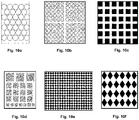
- angular micro-lenses are selected from the group consisting of triangles, squares, rectangles, rhombi, and regular polygons like pentagons, hexagons, or octagons. Examples of shapes of discontinuous relief features are shown in Figs. 10a-10f .
- the relief features may for example have the shape of triangles, trapezoids, squares, rectangles, or partial circles. Preferred side-view shapes of the relief features are shown in Figs. 11a-11g .
- the relief features are in the shape of partial spheres, partial ellipsoids, cylinders, cones, tetrahedrons, pyramids, hexagonal pyramids, octagonal pyramids, cubes, cuboids, pentagonal prisms, hexagonal prisms.
- the relief features are preferably in the shape of partial spheres.
- the relief features may be arranged in a regular pattern.
- the substrate comprises arrays of relief features
- the relief features within an array are preferably arranged in a regular pattern.
- the pattern in different arrays may be the same or different.
- the relief features have a height in the range of from 50 nm to 150 ⁇ m, preferably from 10 to 30 ⁇ m.
- the size of the relief features is at least 20 ⁇ m, preferably in the range of from 20 ⁇ m to 300 ⁇ m, for example in the range of from 50 to 100 ⁇ m.
- the relief features may have the same or different sizes.
- the substrate comprises arrays of relief features
- the relief features within an array preferably have the same size.
- the size of the relief features in different arrays may be different.
- the pattern of the relief features and the images may be the same or different. It is preferred that the relief features and the images have an identical pattern. It may also be preferred that each image is superimposed with a relief feature.
- the ratio of the maximum diameter of the relief features to the maximum diameter of the images may be at least 1, for example the ratio is in the range of from 50:1 to 1:10, or 10:1 to 1:2, or 5:1 to 1:1.2, or 2:1 to 1:1, more preferably from 1.3:1 to 1:1.
- the above diameter ratio preferably relates to at least one array, more preferably all arrays.
- the relief features and the images have an identical pattern, wherein each image is superimposed with a relief feature which has at least the same maximum diameter as the image and which is centrally arranged on top of the image.
- a flexographic printing plate is used.
- the relief features are formed by a filmless casting process, preferably a flexographic casting plate is used.
- the flexographic printing plate, the flexographic casting plate or both may be made of a plastic material, for example polypropylene, high density polyethylene, low density polyethylene, linear low density polyethylene, polyethylene terephthalate, and combinations of two or more thereof, preferably polypropylene.
- the flexographic printing plate, the flexographic casting plate or both may be flexible or rigid, preferably flexible.
- the flexographic printing plate, the flexographic casting plate or both may be made by a process comprising injection molding, blow molding, embossing, printing, engraving, or combinations thereof.
- the flexographic printing plate, the flexographic casting plate or both are made by a process comprising the following steps:
- a patterned substrate can be pressed into an uncured soft photopolymer plate to form a patterned flexographic printing or casting plate, which can be used to impart micro-sized patterns into curable coatings on films.
- This analog impression process does not require precise equipment control or the use of a wash-out step as known from prior applications.
- the resulting flexographic printing or casting plate can be used with commercially available coatings, on conventional flexographic equipment, and can last for many thousands of cycles, so the plate is also easy and inexpensive to use. This process is described in further detail with regard to Figs. 16 and 17a-j .
- the patterned substrates may be flexible or rigid.
- Flexible patterned substrates suitable for the invention may be commercially purchased in the form of a flexible patterned film, such as a CAST AND CURE holographic film available from Breit Technologies of Overland Park, Kansas, United States.
- a flexible patterned substrate can be any suitable material that is flexible (e.g. a thin, pliable, sheet-like material), has suitable pattern of relief features, and can be processed as described with regard to Fig. 16 .
- Examples of flexible patterned substrates include textured paper, fabric, micro-embossed film, optical lens film.
- Rigid patterned substrates may also be suitable for the invention, such as for example metal sheets, molded plastic sheets, or silicon wafers.
- the patterned substrate is flexible.
- the uncured soft photopolymer plate can have various overall thicknesses, for example of from 0.1 mm to 10.0 mm, or from 0.5 to 5 mm or from 0.8 to 3 mm, preferably from 1.0 to 2 mm.
- An uncured soft photopolymer plate may for example have a thickness of 1.14 mm or of 1.70 mm.
- the uncured soft photopolymer plate may however also be provided without a protective mask.
- Uncured soft photopolymers are commercially available in the form of a flexographic plate (with and without a mask layer), such as: CYREL FAST (e.g.
- Uncured soft photopolymer plates may be made from one or more suitable materials (such as mixtures of monomers, oligomers, and/or photoinitiators; common forms include acrylates and silicones) that are curable into a hardened state by exposure to visible and/or UV light, as known in the art.
- suitable materials such as mixtures of monomers, oligomers, and/or photoinitiators; common forms include acrylates and silicones
- the flexographic printing plate, the flexographic casting plate or both are made by a process comprising the following steps:
- the rigid patterned substrate may be made of a material selected from polymeric materials, metal materials, glass, ceramics, minerals, combinations of two or more thereof, and composite materials of one or more of the aforementioned materials.
- the rigid patterned substrate is a patterned steel plate.
- the pattern in the rigid substrate can be formed by any suitable method for patterning rigid substrates, for example injection molding, blow molding, embossing, printing, engraving, or combinations thereof.
- the pattern of the rigid patterned substrate is made by laser pulse engraving.
- the polymeric material may be a thermoplastic resin, for example selected from polypropylene, high density polyethylene, low density polyethylene, linear low density polyethylene, polyethylene terephthalate, and combinations of two or more thereof.
- the polymeric material is polypropylene.
- the polymeric material may be applied in an injection molding process on the rigid patterned substrate.
- injection molding is commonly known in the art. For example, the following procedure may be followed: The polymeric material is heated to a molten or malleable state. The material is then forced through a nozzle onto the rigid patterned substrate which serves as a mold cavity. The plastic material is then cooled on the mold, for example by the mold as such remaining cold, by external cooling, or both. This process is described in further detail with regard to Figs. 18 and 19a-b .
- the invention further relates to 3D-microoptic image packaging systems comprising
- the varnish layer has an inner surface being in contact with the printed first major surface of the substrate and an outer surface facing away from the substrate. Further, the varnish layer has a plurality of relief features on the outer surface of the varnish layer.
- the relief features are micro-lenses, characterized in that the relief features on the varnish layer are formed by a filmless casting process using a flexographic casting plate.
- the preferred embodiments of the flexible substrate, the images, the varnish layer and the relief features described above with regard to the method according to the invention also apply to the flexible substrate, the images, the varnish layer and the relief features of the 3D-microoptic image packaging systems.
- One exemplary 3D-microoptic image packaging system is shown in Fig. 20 .
- the 3D-microoptic image packaging systems are suitable for food and non-food packaging systems, for example for packaging personal care and pharma products, household and gardening products, entertainment and media products, electronic devices, toys, sports products.
- Fig. 1 shows an inkjet printing process.
- a high pressure pump 103 directs liquid ink 102 through a gun body and a nozzle 105.
- a piezoelectric crystal 104 creates an acoustic wave, thereby breaking the stream of ink 102 into droplets 106.
- the ink droplets are subjected to an electrostatic field by a charging electrode 107.
- the droplets are directed by electrostatic deflection plates 108 to print on the substrate 101 or are allowed to continue undeflected to a collection gutter 110 for re-use.
- the result is a substrate 101 with ink droplets 111 disposed thereon forming images.
- Fig. 2 shows an in-mold labeling process.
- the molding device used for in-mold labeling comprises two parts: a lower part 201 comprising the mold 205, and an upper part 202 for closing the mold and filling the plastic material into the mold 205.
- a printed label 203 is introduced into the mold 205 using a handling device 204.
- the handling device 204 is removed.
- the printed label 203 is fixated in the mold 205 so that no air pockets or creases adversely affect the product.
- the molding device is closed. Through an opening 207, the plastic material 206 is introduced into the mold 205. After heat and pressure treatment and subsequent cooling, the molding device is opened and a molded plastic material with a printed surface 208 is obtained.
- Fig. 3a-3c shows a transfer printing process.
- the transfer device 302 includes a plurality of posts 303.
- the posts 302 can pick up liquid-based ink 304 from an ink pad 301.
- the picked-up ink 304 can then be transferred from the posts 303 of the transfer device 302 onto the surface of the substrate 305.
- printed images 306 are disposed on the surface of the substrate 305.
- Fig. 4 shows a rotogravure printing process.
- the substrate 401 is printed continuously by passing through a rotary printing press in direction 406.
- the rotary printing press comprises a gravure cylinder 403 and an impression cylinder 402.
- An image is engraved onto the gravure cylinder 403.
- the gravure cylinder 403 is in contact with an ink reservoir 404. Excess ink is removed from the gravure cylinder 403 by a doctor blade 405 before coming into contact with the major surface of the substrate 401 which is to be printed.
- the impression cylinder 402 applies a pressure from the other side, i.e., on the second major surface of the substrate 401. A substrate with a printed surface is thereby obtained.
- Fig. 5 shows a silk screen printing process.
- a mesh 1901 preferably made of polyethylene terephthalate, with mesh apertures 1902 is provided.
- the mesh 1901 is contacted with an ink 1903, so that the ink fills the mesh apertures 1902.
- the ink-filled mesh is then contacted with a substrate 1904.
- a squeezer 1906 the ink is squeezed out of the mesh apertures 1902 and onto the substrate 1904.
- the mesh 1901 is removed 1905 to provide the printed substrate 1907.
- Fig. 6 shows a letterpress printing process.
- a bed 2001 is provided.
- movable pieces 2002 are assembled to form an image.
- the movable pieces 2002 are inked so that the top surfaces of the movable pieces 2002 are coated with the ink 2003.
- the substrate 2004 is then pressed onto the movable pieces 2002 so that the inked surface 2003 contacts the substrate 2004 and thereby transfers the ink to the substrate 2004 to provide the printed substrate 2005.
- Fig. 7 shows an offset lithography process.
- a substrate 501 is printed continuously by passing through a rotary printing press in direction 502.
- the rotary printing press comprises an impression cylinder 503, an offset cylinder 504, and a plate cylinder 505.
- the plate cylinder 505 is further in contact with a dampening unit comprising a water fountain and a dampening cylinder 507, and an inking unit comprising an ink fountain and an inking cylinder 506.
- the inking and dampening units deliver ink and water onto the plate cylinder 505.
- the plate cylinder 505 transfers the ink onto the blanket covering the offset cylinder 504.
- the substrate 501 is pressed against the offset cylinder 504 by the impression cylinder 503, transferring the ink onto the substrate to form a printed image.
- Fig. 8 is a schematic view of a flexographic printing process.
- the flexible substrate 601 passes through the flexographic printing press in the indicated direction 602.
- an ink layer 603 comprising a plurality of images 605 is printed on the substrate 601 via ink stations 604, wherein each of the ink stations 604 contributes part of the images 605.
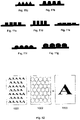
- Figs. 9a-9c show schematic views of printed substrates with different regular patterns of different images.
- Figs. 10a-10f top views of varnish layers with different top view shapes of micro-lenses are shown.
- Figs. 10a and 10b show a circular shape of the relief features.
- Figs. 10d-10e show a square shape of the relief features.
- Fig. 10f shows a rhombic shape of the relief features.
- Figs. 11a-11g side views of varnish layers with preferred side view shapes of the relief features are shown.
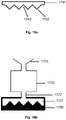
- Fig. 11a shows a triangular shape of the relief features.
- Fig. 11b shows a trapezoid shape of the relief features.
- Fig. 11c shows a square shape of the relief features.
- Figs. 11d and 11e show a rectangular shape of the relief features.
- Fig. 11f shows relief features in the shape of partial spheres.
- Fig. 11g shows relief features in the shape of partial ellipsoids.
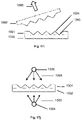
- Fig. 12 shows a schematic view of the moire magnifier principle of the provision of a 3D micro-optic image from a viewer's perspective: a printed substrate with a regular pattern of micro-images 1001 is superimposed with a varnish layer with circular micro-lenses 1002. The resulting 3D micro-optic image 1003 is caused by a moire magnification effect.
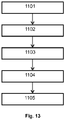
- Fig. 13 is a flowchart that illustrates the steps of printing 3D-microoptic images on packaging systems.
- Step 1101 includes providing a substrate.
- Step 1102 includes printing a plurality of images on the first major surface of the substrate.
- Step 1103 includes applying a varnish layer on the printed first major surface of the substrate.
- Step 1104 includes forming a plurality of relief features on the outer surface of the varnish layer.
- Result 1105 is a 3D-microoptic image packaging system resulting from the steps 1101-1104. The 3D-microoptic effect is caused by the overlaying of images and relief features resulting in a moire magnification effect.
- Fig. 14 shows a process according to the invention.
- a substrate 1201 is provided. Images are printed on the substrate 1201 via ink stations 1202 in a flexographic printing process, providing a printed substrate with an ink layer 1203 with micro-images 1204 on one surface of the substrate 1201.
- a flexographic casting plate 1205 is then used for applying a varnish layer 1206 and casting varnish micro-lenses 1207 which superimpose the micro-images.
- Fig. 15 is a schematic view of a flexographic printing press suitable for printing 3D-microoptic images on packaging systems.
- the substrate 1301 passes the flexographic printing press in the indicated direction 1305.
- an ink layer 1302 comprising a plurality of images 1303 is printed on the substrate 1301 via ink stations 1306, wherein each of the ink stations 1306 contributes part of the images 1303.
- a varnish layer comprising a plurality of relief features 1034 is casted via a varnish station 1307.
- Fig. 16 is a flowchart that illustrates the steps of making a patterned flexographic printing or casting plate according to the invention.
- Step 1401 includes providing a patterned substrate, preferably a flexible patterned substrate, which is described in further detail in connection with Fig. 17a .
- Step 1402 includes providing an uncured soft photopolymer plate, as described in connection with Fig. 17b .
- Step 1403 includes optional pretreatment steps of the plate, as described in connection with Figs. 17c-17e .
- Step 1404 includes impressing the substrate into the plate, as described in connection with Figs. 17f and 17g .
- Step 1405 includes curing the plate, as described in connection with Figs. 17h-17j .
- Result 1406 is the flexographic printing or casting plate resulting from the steps 1401-1405.
- Fig. 17a illustrates an end view of a flexible patterned substrate.
- At least part of the one major surface of the substrate 1510 includes relief features.
- the relief features are characterized by protrusions 1511 and recesses 1512. They may for example have a height (measured perpendicular to the substrate from the deepest recess to the tallest protrusion) of 50 nm to 150 ⁇ m.
- the protrusions 1511 and the recesses 1512 together form an exemplary pattern, which serves as the master pattern for the flexographic printing or casting plate made in the method of Fig. 16 .
- the pattern on the substrate can have relief features that include any number of protrusions and/or recesses of any kind, of any shape, of any aspect ratio, having any distribution known in the art, with any of these configurations variable in any way, preferably so long as the pattern has a height from 50 nm to 150 ⁇ m, such as 50 nm to 75 ⁇ m, 50 nm to 37 ⁇ m, 50 nm to 15 ⁇ m, or 50 nm to 7 ⁇ m.
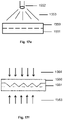
- Fig. 17b illustrates an end view of an uncured soft photopolymer plate comprising a protective mask 1520 and photopolymer material 1521.
- the presence of a protective mask 1520 in the uncured soft photopolymer plate is optional.
- Fig. 17c illustrates an end view of a step of curing a side of the plate which is the same as the plate of Fig. 17b .
- a curing source 1534 such as a UV light or an electron-beam emitter, emits curing energy 1533 (e.g. heat and/or light), which at least partially cures an outer portion of the photopolymer material, such that the photopolymer material has a cured portion 1532 and an uncured portion 1531.
- a curing source (for use with any curing step disclosed herein) may be a DeGraf Concept 400 ECLF plate curing system (available from GLUNZ & JENSEN of Ringsted, Denmark).
- Fig. 17d illustrates an end view of a step of removing the mask 1540 from the plate.
- the removal process 1543 (such as laser ablation) comprises removing the mask 1540 in direction 1544, and exposing an unmasked area 1542 on a surface of the uncured portion 1541 of the photopolymer material.
- all of the mask may be removed, such that all of the first side 1542 becomes an unmasked area.
- the unmasked area may be continuous or discontinuous.
- a mask may be ablated using a CDI Spark 4835 Inline UV Digital Flexo image setter (available from ESKO of Ghent, Belgium).
- Fig. 17e illustrates an end view of a step of pretreating the plate.
- a treating source 1552 such as a spray nozzle, a doctor blade, or a draw down rod provides a treatment 1553, which partially treats at least part of an outer portion of the uncured portion 1550 of the plate, e.g., to improve its ability to release a surface after contact.
- An example of said treating is spraying a thin silicone coating.
- the uncured portion 1551 may be partially or fully treated.
- Fig. 17f illustrates an end view of a step of impressing the flexible patterned substrate 1560 into an exposed surface of the uncured portion 1561 of the soft photopolymer plate.
- Opposing inward forces 1563 and 1564 provide pressure that presses the substrate 1560 and the plate against each other, such that the pattern of the substrate 1560 is imparted to the plate and the protrusions and recesses of the pattern shape at least an outer portion of the uncured portion 1561 into a pattern that is an inverse of the pattern of the substrate 1560.
- the protrusions and recesses of relief features of the substrate 1560 become recesses and protrusions of relief features on the plate.
- the opposed inward forces can be provided by various kinds of mechanical apparatus known in the art, including, for example, the pressure rollers as shown in Fig. 17g .
- the impressing step may also include applying heat (e.g. by a heater that provides conduction, convection, and/or radiation) to further soften the soft photopolymer plate before and/or during impressing.
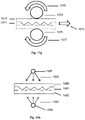
- Fig. 17g illustrates a side view of a portion of a mechanical apparatus that can be used in the step of impressing the flexible patterned substrate 1570 into an exposed surface of the uncured portion 1571 of the soft photopolymer plate.
- a first roller 1574 rotates 1576 counterclockwise and a second roller 1575 rotates 1577 clockwise.
- the rollers 1574 and 1575 together provide distributions of opposing inward forces that press the substrate 1570 and the plate against each other, such that the pattern of the substrate 1570 is imparted to the plate, as the substrate 1570 and the plate passes through 1573 between the rollers 1574 and 1575.
- the pair of rollers 1574 and 1575 can be provided by a (heated or unheated) roll laminating machine, as known in the art, including, for example, LUX Laminator Model 62 Pro S available from MacDermid, Inc. of Morristown, Tennessee, United States. Substrate and plate may be passed through one or more pairs of such rollers, one or more times, with or without a carrier sheet on either or both sides. Other kinds of laminating machines or presses (with or without rollers) as known in the art may alternatively be used.
- Fig. 17h illustrates an end view of a step of partially curing a side of the plate.
- the substrate 1580 has material properties, e.g. translucence, that allow for transmission of the curing energy.
- a first curing source 1586 is located outside of the substrate 1580 and emits curing energy 1585 that travels through the substrate 1580. It partially cures at least a portion of the uncured portion 1581 of the photopolymer material.
- a second curing source 1584 is located outside of the cured portion of the plate 1582 and emits curing energy 1583 that travels through the plate.
- the plate has material properties, e.g.
- the substrate 1580 can be more easily removed from the plate without distorting or damaging the pattern formed on the plate.
- one or more curing sources are used on only one side.
- curing energy falls within the UV spectrum, such as UV-A (315 to 400 nm wavelengths), UV-B (280 to 315 nm wavelengths), and UV-C (100 to 280 nm wavelengths), and can be provided by various sources, such as mercury bulbs or LED fixtures configured to provide such wavelengths.
- the step of partial curing is replaced by a step of full curing, so that the partially cured portion 1581 is fully cured.
- the step of partial curing is omitted, so that the partially cured portion 1581 is uncured.
- Fig. 17i illustrates an end view of a side of the plate.
- the flexible patterned substrate 1590 is removed 1595 from the plate, e.g., by pulling or peeling away.
- the photopolymer material of the plate has a cured portion 1592 and a portion 1591, which depending on previous steps may be uncured, partially cured or fully cured. At least part of the portion 1591 includes protrusions 1594 and recesses 1593, which together form an exemplary pattern, which is the imparted pattern on the flexographic printing plate.
- Fig. 17j illustrates an end view of a step of fully curing the photopolymer material of the plate.
- a first curing source 1506 located outside of the portion 1501 of the plate emits curing energy 1505 that travels to the portion 1501 and contributes to fully curing portion 1501.
- a second curing source 1504 located outside of the cured portion 1502 of the plate emits curing energy 1503 that travels through the cured portion 1502 which has material properties (e.g. translucence) that allow for transmission of the curing energy.
- Said curing energy 1503 contributes to fully curing portion 1501, such that the portion 1501 becomes fully cured. Thereby, the pattern formed on the plate is finally cured, and the plate is further prepared for end use.
- 1506 is a first treating source emitting detackifying energy 1505 that travels to the portion 1501 and contributes to fully curing portion 1501 by further polymerization of the photopolymer material.
- 1504 is a second treating source emitting detackifying energy 1503 that travels through the cured portion 1502 that contributes to further polymerization of the photopolymer material.
- a cured photopolymer plate may be detackified in any other way known in the art, for example by immersing the plate in one or more chemical solutions (such as a halogen solution).
- the step of detackifying the plate is optional. Typically, detackifying energy falls within the UV-C spectrum (100 to 280 nm wavelengths).
- Fig. 18 is a flowchart that illustrates the steps of making a patterned flexographic printing or casting plate according to the invention.
- Step 1601 includes providing a rigid patterned substrate, preferably a patterned steel plate, which is described in further detail in connection with Fig. 19a .
- Step 1602 includes providing a polymeric material, preferably polypropylene.
- Step 1603 includes heating the polymeric material in order to bring it in a molten or malleable state.
- Step 1604 includes forcing the molten or malleable polymeric material onto the substrate, e.g., as described in connection with Fig. 19b .
- Step 1605 includes cooling the polymeric material.
- Result 1606 is the flexographic printing or casting plate resulting from the steps 1601-1605.
- Fig. 19a illustrates an end view of a rigid patterned substrate.
- At least part of the one major surface of the substrate 1701 includes relief features.
- the relief features are characterized by protrusions 1702 and recesses 1703. They may for example have a height (measured perpendicular to the substrate from the deepest recess to the tallest protrusion) of 50 nm to 150 ⁇ m.
- the protrusions 1702 and the recesses 1703 together form an exemplary pattern, which serves as the master pattern for the flexographic printing or casting plate made in the method of Fig. 18 .
- the pattern on the substrate can have relief features that include any number of protrusions and/or recesses of any kind, of any shape, of any aspect ratio, having any distribution known in the art, with any of these configurations variable in any way, preferably so long as the pattern has a height from 50 nm to 150 ⁇ m, such as 50 nm to 75 ⁇ m, 50 nm to 37 ⁇ m, 50 nm to 15 ⁇ m, or 50 nm to 7 ⁇ m.
- Fig. 19b illustrates an injection molding device.
- a solid polymeric material is loaded in a vessel 1723 via a hopper 1724.
- the vessel 1723 is heatable, so that the polymeric material can be molten or made malleable in the vessel 1723.
- a polymeric material can be loaded into the vessel 1723 in an already molten or malleable state.
- the molten or malleable polymeric material is forced through a nozzle 1722 into a cavity 1721 that is defined by a mold 1720.
- the mold 1720 comprises a rigid patterned substrate as shown in Fig. 19a .
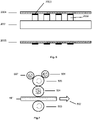
- Fig. 20 shows an example of a microoptic image packaging system 1800 from a side view.
- the system comprises a substrate 1810, an ink layer 1820 comprising micro-images 1830, and a varnish layer 1840.
- the varnish layer 1840 is superimposed on the ink layer 1820.
- the inner surface of the varnish layer 1840 is in contact with the ink layer.
- the outer surface of the varnish layer 1840 faces away from the ink layer 1820 and the substrate 1810.
- a plurality of relief features 1850 is disposed on the outer surface of the varnish layer 1840.
- Each of the images 1830 are superimposed with one relief feature 1850 which has at least the same maximum diameter as the image 1830 and which is centrally arranged on top of the image 1830.
Landscapes
- Engineering & Computer Science (AREA)
- Mechanical Engineering (AREA)
- Manufacturing & Machinery (AREA)
- Health & Medical Sciences (AREA)
- Physics & Mathematics (AREA)
- Ophthalmology & Optometry (AREA)
- General Physics & Mathematics (AREA)
- Plasma & Fusion (AREA)
- Electromagnetism (AREA)
- Optics & Photonics (AREA)
- General Health & Medical Sciences (AREA)
- Textile Engineering (AREA)
- Vascular Medicine (AREA)
- Printing Methods (AREA)
- Ink Jet (AREA)
- Application Of Or Painting With Fluid Materials (AREA)
Claims (14)
- Verfahren zum Drucken von mikrooptischen 3D-Bildern auf Verpackungssystemen, umfassenda. Bereitstellen eines Substrats, das eine erste und eine zweite Hauptoberfläche aufweist;b. Drucken einer Vielzahl von Bildern auf wenigstens einem Teil der ersten Hauptoberfläche des Substrats, um ein Substrat mit einer gedruckten ersten Hauptoberfläche bereitzustellen;c. Aufbringen einer transparenten Lackschicht auf der gedruckten ersten Hauptoberfläche des Substrats, wobei die Lackschicht eine Innenoberfläche, die mit der gedruckten ersten Hauptoberfläche des Substrats in Kontakt steht, und eine Außenoberfläche aufweist, die von dem Substrat abgewandt ist; undd. Bilden einer Vielzahl von Reliefmerkmalen auf der Außenoberfläche der Lackschicht, wobei die Reliefmerkmale Mikrolinsen sind, dadurch gekennzeichnet, dass die Reliefmerkmale auf der Lackschicht durch ein filmloses Gießverfahren unter Verwendung einer Flexographie-Gießplatte gebildet werden.
- Verfahren nach Anspruch 1, wobei das Substrat ein steifes, nicht poröses Polymermaterial ist, ausgewählt aus der Gruppe bestehend aus Polyethylen hoher Dichte, Polyethylen niedriger Dichte, linearem Polyethylen niedriger Dichte, Polypropylen und Polyethylenterephthalat.
- Verfahren nach einem der vorstehenden Ansprüche, wobei die Bilder durch ein Verfahren gedruckt werden, das aus Tintenstrahldruck, In-Mould-Etikettierung, Transferdruck, Rotationstiefdruck, Siebdruck, Buchdruck, Offsetlithographie und Flexographiedruck ausgewählt wird.
- Verfahren nach einem der vorstehenden Ansprüche, wobei die Bilder Mikrobilder sind.
- Verfahren nach einem der vorstehenden Ansprüche, wobei die Bilder in einem regelmäßigen Muster angeordnet sind.
- Verfahren nach einem der vorstehenden Ansprüche, wobei die Bildgröße wenigstens 20 µm beträgt, vorzugsweise im Bereich von 20 bis 300 µm, und wobei der Abstand zwischen den Bildern im Bereich von 1 µm bis 1 mm, vorzugsweise von 5 µm bis 100 µm, mehr bevorzugt von 10 bis 50 µm liegt.
- Verfahren nach einem der vorstehenden Ansprüche, wobei der Lack wärmehärtbar, lichthärtbar oder beides, vorzugsweise UV-härtbar ist, wobei der Lack vorzugsweise ein Acryllack ist.
- Verfahren nach einem der vorstehenden Ansprüche, wobei die Reliefmerkmale eine Höhe im Bereich von 50 nm bis 150 µm, vorzugsweise von 10 bis 30 µm, einen Durchmesser von wenigstens 20 µm, vorzugsweise im Bereich von 20 bis 300 µm und die Form von Teilkugeln aufweisen.
- Verfahren nach einem der vorstehenden Ansprüche, wobei die Reliefmerkmale und die Bilder ein identisches Muster aufweisen, wobei vorzugsweise jedes Bild mit einem Reliefmerkmal überlagert ist, das wenigstens den gleichen maximalen Durchmesser wie das Bild aufweist und das zentral auf dem Bild angeordnet ist.
- Verfahren nach einem der vorstehenden Ansprüche, wobei die Bilder durch Flexographiedruck unter Verwendung einer Flexographie-Druckplatte gedruckt werden oder wobei die Reliefmerkmale durch ein filmloses Gießverfahren unter Verwendung einer Flexographie-Gießplatte gebildet werden oder beides und wobei die Flexographie-Druckplatte, die Flexographie-Gießplatte oder beide durch ein Verfahren hergestellt werden, das Spritzgießen, Blasformen, Prägen, Drucken, Gravieren oder Kombinationen davon umfasst.
- Verfahren nach Anspruch 10, wobei die Flexographie-Druckplatte, die Flexographie-Gießplatte oder beide elastisch sind und aus einem Kunststoffmaterial, vorzugsweise Polypropylen, hergestellt sind.
- Verfahren nach einem der Ansprüche 10 oder 11, wobei die Flexographie-Druckplatte, die Flexographie-Gießplatte oder beide durch ein Verfahren hergestellt werden, das die folgenden Schritte umfasst:i. Bereitstellen eines elastischen gemusterten Substrats;ii. Drücken der gemusterten Oberfläche des gemusterten Substrats auf eine ungehärtete weiche Photopolymerplatte, um eine gemusterte, ungehärtete Photopolymerplatte bereitzustellen; undiii. Härten der gemusterten ungehärteten Photopolymerplatte, um die gemusterte Flexographieplatte bereitzustellen.
- Verfahren nach einem der Ansprüche 10 oder 11, wobei die Flexographie-Gießplatte durch ein Verfahren hergestellt wird, das die folgenden Schritte umfasst(i) Bereitstellen eines steifen gemusterten Substrats, vorzugsweise einer gemusterten Stahlplatte, die durch Laserimpulsgravierung hergestellt ist; und(ii) Aufbringen eines Polymermaterials, vorzugsweise Polypropylen, in einem Spritzgießverfahren auf dem steifen gemusterten Substrat, um die Flexographie-Gießplatte bereitzustellen.
- Mikrooptisches 3D-Bildverpackungssystem, umfassendA. ein Substrat mit einer ersten und einer zweiten Hauptoberfläche;B. eine Vielzahl von Bildern auf wenigstens einem Teil der ersten Hauptoberfläche;C. eine transparente Lackschicht auf der ersten Hauptoberfläche des Substrats, welche die gedruckten Bilder überlagert, wobei die Lackschicht eine Innenoberfläche, die mit der gedruckten ersten Hauptoberfläche des Substrats in Kontakt steht, und eine Außenoberfläche aufweist, die von dem Substrat abgewandt ist; und wobei die Lackschicht eine Vielzahl von Reliefmerkmalen auf der Außenoberfläche der Lackschicht aufweist, wobei die Reliefmerkmale Mikrolinsen sind, dadurch gekennzeichnet, dass die Reliefmerkmale auf der Lackschicht durch ein filmloses Gießverfahren unter Verwendung einer Flexographie-Gießplatte gebildet werden.
Priority Applications (8)
| Application Number | Priority Date | Filing Date | Title |
|---|---|---|---|
| EP17179770.7A EP3424740B1 (de) | 2017-07-05 | 2017-07-05 | Verfahren zum drucken von mikrooptischen 3d-bildern auf verpackungssystemen |
| MX2019015686A MX2019015686A (es) | 2017-07-05 | 2018-07-03 | Metodo de impresion de imagenes microopticas 3d en sistemas de envasado. |
| CN201880044961.9A CN110831773B (zh) | 2017-07-05 | 2018-07-03 | 在包装系统上印刷3d微光学图像的方法 |
| PCT/US2018/040670 WO2019010149A1 (en) | 2017-07-05 | 2018-07-03 | METHOD FOR PRINTING 3D MICRO-OPTICAL IMAGES ON PACKAGING SYSTEMS |
| JP2019569876A JP2020524097A (ja) | 2017-07-05 | 2018-07-03 | パッケージングシステム上に3dマイクロ光学画像を印刷する方法 |
| US16/027,824 US20190009483A1 (en) | 2017-07-05 | 2018-07-05 | Method of printing 3d-microoptic images on packaging systems |
| JP2022004637A JP2022044672A (ja) | 2017-07-05 | 2022-01-14 | パッケージングシステム上に3dマイクロ光学画像を印刷する方法 |
| JP2023146939A JP2023160940A (ja) | 2017-07-05 | 2023-09-11 | パッケージングシステム上に3dマイクロ光学画像を印刷する方法 |
Applications Claiming Priority (1)
| Application Number | Priority Date | Filing Date | Title |
|---|---|---|---|
| EP17179770.7A EP3424740B1 (de) | 2017-07-05 | 2017-07-05 | Verfahren zum drucken von mikrooptischen 3d-bildern auf verpackungssystemen |
Publications (2)
| Publication Number | Publication Date |
|---|---|
| EP3424740A1 EP3424740A1 (de) | 2019-01-09 |
| EP3424740B1 true EP3424740B1 (de) | 2022-06-15 |
Family
ID=59296746
Family Applications (1)
| Application Number | Title | Priority Date | Filing Date |
|---|---|---|---|
| EP17179770.7A Active EP3424740B1 (de) | 2017-07-05 | 2017-07-05 | Verfahren zum drucken von mikrooptischen 3d-bildern auf verpackungssystemen |
Country Status (6)
| Country | Link |
|---|---|
| US (1) | US20190009483A1 (de) |
| EP (1) | EP3424740B1 (de) |
| JP (3) | JP2020524097A (de) |
| CN (1) | CN110831773B (de) |
| MX (1) | MX2019015686A (de) |
| WO (1) | WO2019010149A1 (de) |
Families Citing this family (11)
| Publication number | Priority date | Publication date | Assignee | Title |
|---|---|---|---|---|
| US11097449B2 (en) | 2017-05-17 | 2021-08-24 | Formlabs, Inc. | Techniques for casting from additively fabricated molds and related systems and methods |
| EP3470195B1 (de) | 2017-10-12 | 2026-04-29 | The Procter & Gamble Company | Blasgeformter artikel mit visuellen effekten, vorformling, verfahren |
| US11046473B2 (en) | 2018-07-17 | 2021-06-29 | The Procter And Gamble Company | Blow molded article with visual effects |
| US11724847B2 (en) | 2018-10-19 | 2023-08-15 | The Procter & Gamble Company | Blow molded article with debossing |
| US11427498B2 (en) | 2019-03-06 | 2022-08-30 | Owens-Brockway Glass Container Inc. | Three-dimensional printing of a porous matrix on a container |
| WO2020210589A1 (en) | 2019-04-11 | 2020-10-15 | The Procter & Gamble Company | Blow molded article with visual effects |
| JP7442649B2 (ja) | 2020-01-08 | 2024-03-04 | ザ プロクター アンド ギャンブル カンパニー | 色のグラデーションを有するブロー成形多層物品 |
| IT202000015622A1 (it) * | 2020-06-29 | 2020-09-29 | Neos S R L | Processo per la realizzazione di un pattern tridimensionale su un supporto rigido, e apparecchiatura per la realizzazione di detto processo |
| CN111923625B (zh) * | 2020-08-05 | 2022-05-10 | 江苏达丽建筑材料有限公司 | 一种pvc彩膜印刷工艺 |
| CN113024091B (zh) * | 2021-01-25 | 2022-10-28 | 浙江银升新材料有限公司 | 一种木纹岩板玻璃制造装置及其方法 |
| FR3149999B1 (fr) * | 2023-06-16 | 2025-06-13 | Aeroprotec Services | Procede de marquage 3d |
Family Cites Families (29)
| Publication number | Priority date | Publication date | Assignee | Title |
|---|---|---|---|---|
| JPS55121445A (en) * | 1979-03-13 | 1980-09-18 | Dainippon Ink & Chem Inc | Manufacture of printing resin plate |
| JPH0462190A (ja) * | 1990-06-26 | 1992-02-27 | Toppan Printing Co Ltd | 樹脂凸版及びその製造方法 |
| GB9120619D0 (en) * | 1991-09-28 | 1991-11-06 | Waddingtons Cartons Ltd | Improvements relating to printing of substrates |
| FR2841224B1 (fr) * | 2002-06-19 | 2004-08-06 | Sleever Int | Enveloppe d'emballage d'objet(s) en materiau thermoretractable a motif en relief |
| CN1203991C (zh) * | 2002-07-05 | 2005-06-01 | 吴德明 | 包装复合材料及制造方法和用途 |
| CA2522218A1 (en) * | 2003-04-14 | 2004-10-28 | National Graphics, Inc. | Lenticular images formed on selected images portions |
| DE102006003311A1 (de) * | 2006-01-23 | 2007-07-26 | Man Roland Druckmaschinen Ag | Verfahren und Einrichtung zum Erzeugen von betrachtungswinkelabhängig veränderbaren Bildeffekten auf einen Bedruckstoff |
| US8252514B2 (en) * | 2006-03-14 | 2012-08-28 | Day International, Inc. | Flexographic printing plate assembly |
| US8501390B2 (en) * | 2006-06-27 | 2013-08-06 | Xiper Innovations, Inc. | Laser engravable flexographic printing articles based on millable polyurethanes, and method |
| US20080087181A1 (en) * | 2006-10-17 | 2008-04-17 | Tal Goichman | Method for producing a flexo plate mold |
| US20100024671A1 (en) * | 2006-11-15 | 2010-02-04 | Pekurovsky Mikhail L | Solvent-assisted embossing of flexographic printing plates |
| JP2008129038A (ja) * | 2006-11-16 | 2008-06-05 | Toppan Printing Co Ltd | レンズ付き印刷物 |
| US9944031B2 (en) * | 2007-02-13 | 2018-04-17 | 3M Innovative Properties Company | Molded optical articles and methods of making same |
| WO2009079572A1 (en) * | 2007-12-19 | 2009-06-25 | Sun Chemical Corporation | Hybrid printing press and method |
| US20090220708A1 (en) * | 2008-02-28 | 2009-09-03 | Peter Schmitt | System for lenticular printing |
| JP5482296B2 (ja) * | 2010-03-02 | 2014-05-07 | 株式会社リコー | 立体画像形成方法 |
| JP5805633B2 (ja) * | 2010-05-14 | 2015-11-04 | 株式会社Screenホールディングス | 印刷機および印刷方法 |
| US20120240802A1 (en) * | 2011-03-22 | 2012-09-27 | Landry-Coltrain Christine J | Laser-engraveable flexographic printing precursors |
| JP5914997B2 (ja) * | 2011-06-07 | 2016-05-11 | 凸版印刷株式会社 | 装飾体の製造方法 |
| BR112015003455A2 (pt) * | 2012-08-17 | 2017-07-04 | Visual Physics Llc | processo para transferir microestruturas para um substrato final |
| EP2724864B1 (de) * | 2012-10-24 | 2018-12-26 | Heidelberger Druckmaschinen AG | Verfahren und Vorrichtung zur Erzeugung und Übertragung diffraktiver Mikrostrukturen auf einen Bedruckstoff |
| CN203173093U (zh) * | 2012-12-27 | 2013-09-04 | 汕头东风印刷股份有限公司 | 一种具有凸起立体光栅图文的印品 |
| CN203727019U (zh) * | 2014-02-14 | 2014-07-23 | 上海人民印刷八厂 | 一种带有全息图案的印刷品 |
| CN104280887B (zh) * | 2014-09-25 | 2017-01-11 | 中山市沙溪镇新顺怡印花绣花厂 | 服装的裸眼3d立体图像印花方法 |
| CN204315167U (zh) * | 2014-12-05 | 2015-05-06 | 广东壮丽彩印股份有限公司 | 一种具有动态信息的光栅材料 |
| JP6389951B2 (ja) * | 2015-02-27 | 2018-09-12 | 富士フイルム株式会社 | フレキソ印刷版、フレキソ印刷版の製造方法およびフレキソ印刷版原版 |
| CN104705893A (zh) * | 2015-03-06 | 2015-06-17 | 林为雕 | 具有3d效果的透明注塑鞋及其加工方法 |
| CN205929958U (zh) * | 2016-07-29 | 2017-02-08 | 四川省宜宾普什集团3D有限公司 | 一种具有局部立体光栅的透明塑胶膜片制品 |
| CN106896435B (zh) * | 2017-02-22 | 2019-10-18 | 诸暨市霞伟花木场 | 光栅膜制作方法、装置及系统 |
-
2017
- 2017-07-05 EP EP17179770.7A patent/EP3424740B1/de active Active
-
2018
- 2018-07-03 MX MX2019015686A patent/MX2019015686A/es unknown
- 2018-07-03 WO PCT/US2018/040670 patent/WO2019010149A1/en not_active Ceased
- 2018-07-03 CN CN201880044961.9A patent/CN110831773B/zh active Active
- 2018-07-03 JP JP2019569876A patent/JP2020524097A/ja active Pending
- 2018-07-05 US US16/027,824 patent/US20190009483A1/en not_active Abandoned
-
2022
- 2022-01-14 JP JP2022004637A patent/JP2022044672A/ja active Pending
-
2023
- 2023-09-11 JP JP2023146939A patent/JP2023160940A/ja active Pending
Also Published As
| Publication number | Publication date |
|---|---|
| US20190009483A1 (en) | 2019-01-10 |
| CN110831773B (zh) | 2022-07-08 |
| MX2019015686A (es) | 2020-02-26 |
| WO2019010149A1 (en) | 2019-01-10 |
| JP2023160940A (ja) | 2023-11-02 |
| EP3424740A1 (de) | 2019-01-09 |
| JP2020524097A (ja) | 2020-08-13 |
| CN110831773A (zh) | 2020-02-21 |
| JP2022044672A (ja) | 2022-03-17 |
Similar Documents
| Publication | Publication Date | Title |
|---|---|---|
| EP3424740B1 (de) | Verfahren zum drucken von mikrooptischen 3d-bildern auf verpackungssystemen | |
| US10850497B2 (en) | Apparatus and method for forming high definition lithographic images on containers | |
| AU2017204911B2 (en) | High-speed manufacturing of printed product micro features | |
| CA2914050C (en) | Printing process using soft photopolymer plates | |
| KR20130009786A (ko) | 기재 시트 상에 제품특성을 프린팅하기 위한 방법 | |
| CN102574390B (zh) | 使用热辊压印和有图案的板的印刷装置,用于微流体传感器的膜层压装置,以及使用该装置的印刷方法 | |
| US20090220708A1 (en) | System for lenticular printing | |
| CA2981189C (en) | Variable printing process using flexible secondary plates and specialty inks | |
| AU2014326432A1 (en) | Method of manufacturing pattern on a substrate web and apparatus therefor | |
| CN1805906A (zh) | 选择性图像部上形成的光栅影像 | |
| EP2724864A2 (de) | Verfahren und Vorrichtung zur Erzeugung und Übertragung diffraktiver Mikrostrukturen auf einen Bedruckstoff | |
| KR20140132400A (ko) | 다층 인쇄 공정 | |
| US20190009484A1 (en) | Method of printing 3d-microoptic images on packaging systems | |
| CA3019913A1 (en) | Method of making a patterned flexographic printing plate |
Legal Events
| Date | Code | Title | Description |
|---|---|---|---|
| PUAI | Public reference made under article 153(3) epc to a published international application that has entered the european phase |
Free format text: ORIGINAL CODE: 0009012 |
|
| STAA | Information on the status of an ep patent application or granted ep patent |
Free format text: STATUS: THE APPLICATION HAS BEEN PUBLISHED |
|
| AK | Designated contracting states |
Kind code of ref document: A1 Designated state(s): AL AT BE BG CH CY CZ DE DK EE ES FI FR GB GR HR HU IE IS IT LI LT LU LV MC MK MT NL NO PL PT RO RS SE SI SK SM TR |
|
| AX | Request for extension of the european patent |
Extension state: BA ME |
|
| STAA | Information on the status of an ep patent application or granted ep patent |
Free format text: STATUS: REQUEST FOR EXAMINATION WAS MADE |
|
| 17P | Request for examination filed |
Effective date: 20190708 |
|
| RBV | Designated contracting states (corrected) |
Designated state(s): AL AT BE BG CH CY CZ DE DK EE ES FI FR GB GR HR HU IE IS IT LI LT LU LV MC MK MT NL NO PL PT RO RS SE SI SK SM TR |
|
| STAA | Information on the status of an ep patent application or granted ep patent |
Free format text: STATUS: EXAMINATION IS IN PROGRESS |
|
| 17Q | First examination report despatched |
Effective date: 20210528 |
|
| GRAP | Despatch of communication of intention to grant a patent |
Free format text: ORIGINAL CODE: EPIDOSNIGR1 |
|
| STAA | Information on the status of an ep patent application or granted ep patent |
Free format text: STATUS: GRANT OF PATENT IS INTENDED |
|
| RIC1 | Information provided on ipc code assigned before grant |
Ipc: B41M 7/00 20060101ALN20211209BHEP Ipc: G02B 3/00 20060101ALI20211209BHEP Ipc: B29D 11/00 20060101ALI20211209BHEP Ipc: B41M 3/06 20060101AFI20211209BHEP |
|
| INTG | Intention to grant announced |
Effective date: 20220110 |
|
| GRAS | Grant fee paid |
Free format text: ORIGINAL CODE: EPIDOSNIGR3 |
|
| GRAA | (expected) grant |
Free format text: ORIGINAL CODE: 0009210 |
|
| STAA | Information on the status of an ep patent application or granted ep patent |
Free format text: STATUS: THE PATENT HAS BEEN GRANTED |
|
| AK | Designated contracting states |
Kind code of ref document: B1 Designated state(s): AL AT BE BG CH CY CZ DE DK EE ES FI FR GB GR HR HU IE IS IT LI LT LU LV MC MK MT NL NO PL PT RO RS SE SI SK SM TR |
|
| REG | Reference to a national code |
Ref country code: CH Ref legal event code: EP Ref country code: GB Ref legal event code: FG4D |
|
| REG | Reference to a national code |
Ref country code: IE Ref legal event code: FG4D |
|
| REG | Reference to a national code |
Ref country code: DE Ref legal event code: R096 Ref document number: 602017058463 Country of ref document: DE |
|
| REG | Reference to a national code |
Ref country code: AT Ref legal event code: REF Ref document number: 1498137 Country of ref document: AT Kind code of ref document: T Effective date: 20220715 |
|
| REG | Reference to a national code |
Ref country code: LT Ref legal event code: MG9D |
|
| REG | Reference to a national code |
Ref country code: NL Ref legal event code: MP Effective date: 20220615 |
|
| PG25 | Lapsed in a contracting state [announced via postgrant information from national office to epo] |
Ref country code: SE Free format text: LAPSE BECAUSE OF FAILURE TO SUBMIT A TRANSLATION OF THE DESCRIPTION OR TO PAY THE FEE WITHIN THE PRESCRIBED TIME-LIMIT Effective date: 20220615 Ref country code: NO Free format text: LAPSE BECAUSE OF FAILURE TO SUBMIT A TRANSLATION OF THE DESCRIPTION OR TO PAY THE FEE WITHIN THE PRESCRIBED TIME-LIMIT Effective date: 20220915 Ref country code: LT Free format text: LAPSE BECAUSE OF FAILURE TO SUBMIT A TRANSLATION OF THE DESCRIPTION OR TO PAY THE FEE WITHIN THE PRESCRIBED TIME-LIMIT Effective date: 20220615 Ref country code: HR Free format text: LAPSE BECAUSE OF FAILURE TO SUBMIT A TRANSLATION OF THE DESCRIPTION OR TO PAY THE FEE WITHIN THE PRESCRIBED TIME-LIMIT Effective date: 20220615 Ref country code: GR Free format text: LAPSE BECAUSE OF FAILURE TO SUBMIT A TRANSLATION OF THE DESCRIPTION OR TO PAY THE FEE WITHIN THE PRESCRIBED TIME-LIMIT Effective date: 20220916 Ref country code: FI Free format text: LAPSE BECAUSE OF FAILURE TO SUBMIT A TRANSLATION OF THE DESCRIPTION OR TO PAY THE FEE WITHIN THE PRESCRIBED TIME-LIMIT Effective date: 20220615 Ref country code: BG Free format text: LAPSE BECAUSE OF FAILURE TO SUBMIT A TRANSLATION OF THE DESCRIPTION OR TO PAY THE FEE WITHIN THE PRESCRIBED TIME-LIMIT Effective date: 20220915 |
|
| REG | Reference to a national code |
Ref country code: AT Ref legal event code: MK05 Ref document number: 1498137 Country of ref document: AT Kind code of ref document: T Effective date: 20220615 |
|
| PG25 | Lapsed in a contracting state [announced via postgrant information from national office to epo] |
Ref country code: RS Free format text: LAPSE BECAUSE OF FAILURE TO SUBMIT A TRANSLATION OF THE DESCRIPTION OR TO PAY THE FEE WITHIN THE PRESCRIBED TIME-LIMIT Effective date: 20220615 Ref country code: LV Free format text: LAPSE BECAUSE OF FAILURE TO SUBMIT A TRANSLATION OF THE DESCRIPTION OR TO PAY THE FEE WITHIN THE PRESCRIBED TIME-LIMIT Effective date: 20220615 |
|
| PG25 | Lapsed in a contracting state [announced via postgrant information from national office to epo] |
Ref country code: NL Free format text: LAPSE BECAUSE OF FAILURE TO SUBMIT A TRANSLATION OF THE DESCRIPTION OR TO PAY THE FEE WITHIN THE PRESCRIBED TIME-LIMIT Effective date: 20220615 |
|
| PG25 | Lapsed in a contracting state [announced via postgrant information from national office to epo] |
Ref country code: SM Free format text: LAPSE BECAUSE OF FAILURE TO SUBMIT A TRANSLATION OF THE DESCRIPTION OR TO PAY THE FEE WITHIN THE PRESCRIBED TIME-LIMIT Effective date: 20220615 Ref country code: SK Free format text: LAPSE BECAUSE OF FAILURE TO SUBMIT A TRANSLATION OF THE DESCRIPTION OR TO PAY THE FEE WITHIN THE PRESCRIBED TIME-LIMIT Effective date: 20220615 Ref country code: RO Free format text: LAPSE BECAUSE OF FAILURE TO SUBMIT A TRANSLATION OF THE DESCRIPTION OR TO PAY THE FEE WITHIN THE PRESCRIBED TIME-LIMIT Effective date: 20220615 Ref country code: PT Free format text: LAPSE BECAUSE OF FAILURE TO SUBMIT A TRANSLATION OF THE DESCRIPTION OR TO PAY THE FEE WITHIN THE PRESCRIBED TIME-LIMIT Effective date: 20221017 Ref country code: ES Free format text: LAPSE BECAUSE OF FAILURE TO SUBMIT A TRANSLATION OF THE DESCRIPTION OR TO PAY THE FEE WITHIN THE PRESCRIBED TIME-LIMIT Effective date: 20220615 Ref country code: EE Free format text: LAPSE BECAUSE OF FAILURE TO SUBMIT A TRANSLATION OF THE DESCRIPTION OR TO PAY THE FEE WITHIN THE PRESCRIBED TIME-LIMIT Effective date: 20220615 Ref country code: CZ Free format text: LAPSE BECAUSE OF FAILURE TO SUBMIT A TRANSLATION OF THE DESCRIPTION OR TO PAY THE FEE WITHIN THE PRESCRIBED TIME-LIMIT Effective date: 20220615 Ref country code: AT Free format text: LAPSE BECAUSE OF FAILURE TO SUBMIT A TRANSLATION OF THE DESCRIPTION OR TO PAY THE FEE WITHIN THE PRESCRIBED TIME-LIMIT Effective date: 20220615 |
|
| PG25 | Lapsed in a contracting state [announced via postgrant information from national office to epo] |
Ref country code: PL Free format text: LAPSE BECAUSE OF FAILURE TO SUBMIT A TRANSLATION OF THE DESCRIPTION OR TO PAY THE FEE WITHIN THE PRESCRIBED TIME-LIMIT Effective date: 20220615 Ref country code: IS Free format text: LAPSE BECAUSE OF FAILURE TO SUBMIT A TRANSLATION OF THE DESCRIPTION OR TO PAY THE FEE WITHIN THE PRESCRIBED TIME-LIMIT Effective date: 20221015 |
|
| REG | Reference to a national code |
Ref country code: CH Ref legal event code: PL |
|
| REG | Reference to a national code |
Ref country code: DE Ref legal event code: R097 Ref document number: 602017058463 Country of ref document: DE |
|
| REG | Reference to a national code |
Ref country code: BE Ref legal event code: MM Effective date: 20220731 |
|
| PG25 | Lapsed in a contracting state [announced via postgrant information from national office to epo] |
Ref country code: MC Free format text: LAPSE BECAUSE OF FAILURE TO SUBMIT A TRANSLATION OF THE DESCRIPTION OR TO PAY THE FEE WITHIN THE PRESCRIBED TIME-LIMIT Effective date: 20220615 Ref country code: AL Free format text: LAPSE BECAUSE OF FAILURE TO SUBMIT A TRANSLATION OF THE DESCRIPTION OR TO PAY THE FEE WITHIN THE PRESCRIBED TIME-LIMIT Effective date: 20220615 |
|
| PLBE | No opposition filed within time limit |
Free format text: ORIGINAL CODE: 0009261 |
|
| STAA | Information on the status of an ep patent application or granted ep patent |
Free format text: STATUS: NO OPPOSITION FILED WITHIN TIME LIMIT |
|
| PG25 | Lapsed in a contracting state [announced via postgrant information from national office to epo] |
Ref country code: LU Free format text: LAPSE BECAUSE OF NON-PAYMENT OF DUE FEES Effective date: 20220705 Ref country code: DK Free format text: LAPSE BECAUSE OF FAILURE TO SUBMIT A TRANSLATION OF THE DESCRIPTION OR TO PAY THE FEE WITHIN THE PRESCRIBED TIME-LIMIT Effective date: 20220615 Ref country code: CH Free format text: LAPSE BECAUSE OF NON-PAYMENT OF DUE FEES Effective date: 20220731 Ref country code: LI Free format text: LAPSE BECAUSE OF NON-PAYMENT OF DUE FEES Effective date: 20220731 |
|
| 26N | No opposition filed |
Effective date: 20230316 |
|
| PG25 | Lapsed in a contracting state [announced via postgrant information from national office to epo] |
Ref country code: SI Free format text: LAPSE BECAUSE OF FAILURE TO SUBMIT A TRANSLATION OF THE DESCRIPTION OR TO PAY THE FEE WITHIN THE PRESCRIBED TIME-LIMIT Effective date: 20220615 Ref country code: BE Free format text: LAPSE BECAUSE OF NON-PAYMENT OF DUE FEES Effective date: 20220731 |
|
| P01 | Opt-out of the competence of the unified patent court (upc) registered |
Effective date: 20230429 |
|
| PG25 | Lapsed in a contracting state [announced via postgrant information from national office to epo] |
Ref country code: IE Free format text: LAPSE BECAUSE OF NON-PAYMENT OF DUE FEES Effective date: 20220705 |
|
| PG25 | Lapsed in a contracting state [announced via postgrant information from national office to epo] |
Ref country code: IT Free format text: LAPSE BECAUSE OF FAILURE TO SUBMIT A TRANSLATION OF THE DESCRIPTION OR TO PAY THE FEE WITHIN THE PRESCRIBED TIME-LIMIT Effective date: 20220615 |
|
| PG25 | Lapsed in a contracting state [announced via postgrant information from national office to epo] |
Ref country code: HU Free format text: LAPSE BECAUSE OF FAILURE TO SUBMIT A TRANSLATION OF THE DESCRIPTION OR TO PAY THE FEE WITHIN THE PRESCRIBED TIME-LIMIT; INVALID AB INITIO Effective date: 20170705 |
|
| PG25 | Lapsed in a contracting state [announced via postgrant information from national office to epo] |
Ref country code: MK Free format text: LAPSE BECAUSE OF FAILURE TO SUBMIT A TRANSLATION OF THE DESCRIPTION OR TO PAY THE FEE WITHIN THE PRESCRIBED TIME-LIMIT Effective date: 20220615 Ref country code: CY Free format text: LAPSE BECAUSE OF FAILURE TO SUBMIT A TRANSLATION OF THE DESCRIPTION OR TO PAY THE FEE WITHIN THE PRESCRIBED TIME-LIMIT Effective date: 20220615 |
|
| PG25 | Lapsed in a contracting state [announced via postgrant information from national office to epo] |
Ref country code: MT Free format text: LAPSE BECAUSE OF FAILURE TO SUBMIT A TRANSLATION OF THE DESCRIPTION OR TO PAY THE FEE WITHIN THE PRESCRIBED TIME-LIMIT Effective date: 20220615 |
|
| PG25 | Lapsed in a contracting state [announced via postgrant information from national office to epo] |
Ref country code: BG Free format text: LAPSE BECAUSE OF FAILURE TO SUBMIT A TRANSLATION OF THE DESCRIPTION OR TO PAY THE FEE WITHIN THE PRESCRIBED TIME-LIMIT Effective date: 20220615 |
|
| PG25 | Lapsed in a contracting state [announced via postgrant information from national office to epo] |
Ref country code: BG Free format text: LAPSE BECAUSE OF FAILURE TO SUBMIT A TRANSLATION OF THE DESCRIPTION OR TO PAY THE FEE WITHIN THE PRESCRIBED TIME-LIMIT Effective date: 20220615 |
|
| PGFP | Annual fee paid to national office [announced via postgrant information from national office to epo] |
Ref country code: GB Payment date: 20250529 Year of fee payment: 9 |
|
| PGFP | Annual fee paid to national office [announced via postgrant information from national office to epo] |
Ref country code: FR Payment date: 20250610 Year of fee payment: 9 |
|
| PGFP | Annual fee paid to national office [announced via postgrant information from national office to epo] |
Ref country code: DE Payment date: 20250604 Year of fee payment: 9 |
|
| PG25 | Lapsed in a contracting state [announced via postgrant information from national office to epo] |
Ref country code: TR Free format text: LAPSE BECAUSE OF FAILURE TO SUBMIT A TRANSLATION OF THE DESCRIPTION OR TO PAY THE FEE WITHIN THE PRESCRIBED TIME-LIMIT Effective date: 20220615 |