EP3425420B1 - Entfernungsmessvorrichtung und -verfahren - Google Patents
Entfernungsmessvorrichtung und -verfahren Download PDFInfo
- Publication number
- EP3425420B1 EP3425420B1 EP17179377.1A EP17179377A EP3425420B1 EP 3425420 B1 EP3425420 B1 EP 3425420B1 EP 17179377 A EP17179377 A EP 17179377A EP 3425420 B1 EP3425420 B1 EP 3425420B1
- Authority
- EP
- European Patent Office
- Prior art keywords
- receiver
- pulses
- transmitter
- module
- range
- Prior art date
- Legal status (The legal status is an assumption and is not a legal conclusion. Google has not performed a legal analysis and makes no representation as to the accuracy of the status listed.)
- Not-in-force
Links
Images



Classifications
-
- G—PHYSICS
- G01—MEASURING; TESTING
- G01S—RADIO DIRECTION-FINDING; RADIO NAVIGATION; DETERMINING DISTANCE OR VELOCITY BY USE OF RADIO WAVES; LOCATING OR PRESENCE-DETECTING BY USE OF THE REFLECTION OR RERADIATION OF RADIO WAVES; ANALOGOUS ARRANGEMENTS USING OTHER WAVES
- G01S7/00—Details of systems according to groups G01S13/00, G01S15/00, G01S17/00
- G01S7/48—Details of systems according to groups G01S13/00, G01S15/00, G01S17/00 of systems according to group G01S17/00
- G01S7/483—Details of pulse systems
- G01S7/486—Receivers
- G01S7/4861—Circuits for detection, sampling, integration or read-out
-
- G—PHYSICS
- G01—MEASURING; TESTING
- G01S—RADIO DIRECTION-FINDING; RADIO NAVIGATION; DETERMINING DISTANCE OR VELOCITY BY USE OF RADIO WAVES; LOCATING OR PRESENCE-DETECTING BY USE OF THE REFLECTION OR RERADIATION OF RADIO WAVES; ANALOGOUS ARRANGEMENTS USING OTHER WAVES
- G01S11/00—Systems for determining distance or velocity not using reflection or reradiation
- G01S11/02—Systems for determining distance or velocity not using reflection or reradiation using radio waves
-
- G—PHYSICS
- G01—MEASURING; TESTING
- G01S—RADIO DIRECTION-FINDING; RADIO NAVIGATION; DETERMINING DISTANCE OR VELOCITY BY USE OF RADIO WAVES; LOCATING OR PRESENCE-DETECTING BY USE OF THE REFLECTION OR RERADIATION OF RADIO WAVES; ANALOGOUS ARRANGEMENTS USING OTHER WAVES
- G01S7/00—Details of systems according to groups G01S13/00, G01S15/00, G01S17/00
- G01S7/48—Details of systems according to groups G01S13/00, G01S15/00, G01S17/00 of systems according to group G01S17/00
- G01S7/483—Details of pulse systems
- G01S7/486—Receivers
- G01S7/4865—Time delay measurement, e.g. time-of-flight measurement, time of arrival measurement or determining the exact position of a peak
-
- G—PHYSICS
- G01—MEASURING; TESTING
- G01S—RADIO DIRECTION-FINDING; RADIO NAVIGATION; DETERMINING DISTANCE OR VELOCITY BY USE OF RADIO WAVES; LOCATING OR PRESENCE-DETECTING BY USE OF THE REFLECTION OR RERADIATION OF RADIO WAVES; ANALOGOUS ARRANGEMENTS USING OTHER WAVES
- G01S7/00—Details of systems according to groups G01S13/00, G01S15/00, G01S17/00
- G01S7/48—Details of systems according to groups G01S13/00, G01S15/00, G01S17/00 of systems according to group G01S17/00
- G01S7/483—Details of pulse systems
- G01S7/486—Receivers
- G01S7/487—Extracting wanted echo signals, e.g. pulse detection
-
- H—ELECTRICITY
- H04—ELECTRIC COMMUNICATION TECHNIQUE
- H04L—TRANSMISSION OF DIGITAL INFORMATION, e.g. TELEGRAPHIC COMMUNICATION
- H04L27/00—Modulated-carrier systems
- H04L27/10—Frequency-modulated carrier systems, i.e. using frequency-shift keying
- H04L27/103—Chirp modulation
-
- G—PHYSICS
- G07—CHECKING-DEVICES
- G07C—TIME OR ATTENDANCE REGISTERS; REGISTERING OR INDICATING THE WORKING OF MACHINES; GENERATING RANDOM NUMBERS; VOTING OR LOTTERY APPARATUS; ARRANGEMENTS, SYSTEMS OR APPARATUS FOR CHECKING NOT PROVIDED FOR ELSEWHERE
- G07C2209/00—Indexing scheme relating to groups G07C9/00 - G07C9/38
- G07C2209/60—Indexing scheme relating to groups G07C9/00174 - G07C9/00944
- G07C2209/63—Comprising locating means for detecting the position of the data carrier, i.e. within the vehicle or within a certain distance from the vehicle
-
- G—PHYSICS
- G07—CHECKING-DEVICES
- G07C—TIME OR ATTENDANCE REGISTERS; REGISTERING OR INDICATING THE WORKING OF MACHINES; GENERATING RANDOM NUMBERS; VOTING OR LOTTERY APPARATUS; ARRANGEMENTS, SYSTEMS OR APPARATUS FOR CHECKING NOT PROVIDED FOR ELSEWHERE
- G07C9/00—Individual registration on entry or exit
- G07C9/00174—Electronically operated locks; Circuits therefor; Nonmechanical keys therefor, e.g. passive or active electrical keys or other data carriers without mechanical keys
- G07C9/00309—Electronically operated locks; Circuits therefor; Nonmechanical keys therefor, e.g. passive or active electrical keys or other data carriers without mechanical keys operated with bidirectional data transmission between data carrier and locks
-
- H—ELECTRICITY
- H04—ELECTRIC COMMUNICATION TECHNIQUE
- H04B—TRANSMISSION
- H04B14/00—Transmission systems not characterised by the medium used for transmission
- H04B14/02—Transmission systems not characterised by the medium used for transmission characterised by the use of pulse modulation
- H04B14/026—Transmission systems not characterised by the medium used for transmission characterised by the use of pulse modulation using pulse time characteristics modulation, e.g. width, position, interval
Definitions
- the present disclosure relates to a range-classifying-module and associated method.
- the disclosure relates to a vehicle with a range-determining-module for controlling access to the vehicle.
- Wideband Radio Frequency (RF) applications have been developed that are capable of accurate distance measurement between two or more wireless devices. These measurements are based on Time-of-Flight (ToF) calculations which are derived by accurate determination of departure and arrival times of RF packets between two devices. RF packets travel at the speed of light and thus a calculated ToF allows determination of the distance between devices. Such a procedure is commonly called 'Ranging'.
- Ranging is 'Distance Bounding' whereby ToF calculations are used to verify whether the distance between two devices is less than a predefined threshold, such as used for automotive Passive Keyless Entry (PKE) systems and other access control systems, as well as for contactless electronic payment systems.
- PKE Passive Keyless Entry
- a range-classifying-module for a vehicle radio receiver as set out in independent claim 1.
- the vehicle passive keyless entry system may comprise only a single radio receiver for receiving the signal representative of a chirp.
- any feature disclosed in relation to one range-classifying-module may be implemented in another disclosed range-classifying-module.
- Ultra-Wide Band (UWB) systems may be used to combine low-to-medium rate communications with positioning capabilities, thereby allowing centimetre level accuracy in ranging, as well as low-power and low-cost implementation of communication systems.
- UWB may be used for indoor localization, where GPS data is not available.
- One method of operating a UWB system to perform ranging involves making time-of-flight (ToF) measurements.
- UWB systems may operate in a frequency band of 3-11 GHz, 4-8 GHz or 4-6.5 GHz, for example.
- Figure 1 illustrates the principle of calculating the ToF between two devices, A and B, using Time-of-Arrival (ToA) and Time-of-Departure (ToD) measurements for RF packets transmitted there between.
- the procedure starts with Device A transmitting a 'Request' packet to Device B with a measured ToD (t todA ).
- Device B measures the ToA (t oaB ) and transmits a 'Response' packet back to Device A with a measured (or predetermined) ToD (t todB ).
- Device A measures the ToA of the Response packet (t toaA ).
- the ToAs for the most direct (shortest) path i.e. the 'Line-of-Sight' (LoS) path
- the shortest path i.e. the 'Line-of-Sight' (LoS) path
- the receiving device derives a channel estimate to describe the multipath environment.
- Figure 2 illustrates a simplified example of a channel estimate (not actual data).
- the channel estimate 200 has a first non-zero tap 202, typically representing the first path within the multipath environment between the two devices.
- the LoS path signal may not be the strongest signal received by the receiver, for example when a blocking object is located directly between the transmitting device and the receiving device.
- the tap within the channel estimate representing the LoS path may not have the highest amplitude within the channel estimate. Accordingly, the LoS path within a multipath environment may be found by identifying the first non-zero tap within the channel estimate.
- one or more anchors may determine that the distance from a transmitter in a token is twice as large, or even larger, than the real distance. This effect may be especially pronounced if a human body is present in the measurement area, due to the human body attenuation.
- One mechanism for addressing the inaccuracy of the ToF measurements is to increase the number of receivers within the vehicle. For example, a system with four or more separate anchors for receiving the transmitted signal may provide adequate spatial resolution, at a cost of increased system complexity.
- characteristics of the communication link between the transmitter and the receiver are used to determine whether a transmitter is proximal to, or distal from, the receiver. These characteristics may include one or more non-time-of-flight characteristic of a signal that is received at the receiver from the transmitter in order to confirm the validity of a time of flight measurement.
- the determination of whether the transmitter is proximal to, or distal from, the receiver may be used in the context of a vehicle passive keyless entry (PKE) system to determine whether a key or token is inside or outside of the vehicle.
- An antenna of the receiver may be provided within or on the vehicle.
- the receiver may be considered to be proximal to the transmitter when the antenna of the transmitter is within the vehicle and distal from the transmitter when the antenna of the transmitter is outside of the vehicle.
- the proximity of the transmitter or receiver may be considered to depend upon whether the transmitter is within a vehicle, rather than a strict determination of distance alone.
- Access to the vehicle may then be controlled by the PKE system in response to the classification of the distance between the receiver and the transmitter.
- the PKE system may enable or disable one or more systems of the vehicle depending on whether the key is within the vehicle.
- FIG. 3 illustrates a simplified block diagram of an example of part of a wireless radio frequency (RF) receiver 300.
- the receiver 300 includes an antenna 310 for receiving and transmitting RF signals over an air interface.
- the antenna 310 is coupled to front-end circuity 320.
- the front-end circuit 320 typically consists of a receive path including, for example, a low noise amplifier, mixer and band-pass filter, and a transmit path including, for example, a mixer, filter and power amplifier.
- the receive path of the front-end circuit 320 is coupled to a baseband range-determining-module 340 of the receiver 300 via an analogue-to-digital converter (ADC) 330, via which received signals are passed from the front-end circuit 320 to the baseband range-determining-module 340.
- ADC analogue-to-digital converter
- the transmit path of the front-end circuit 320 is coupled to the baseband range-determining-module 340 via a digital-to-analogue converter (DAC) 350, via which signals to be transmitted are passed from the baseband range-determining-module 340 to the front-end circuit 320.
- DAC digital-to-analogue converter
- the baseband range-determining-module 340 of the communication device 300 is arranged to perform Time-of-Arrival (ToA) measurements on data packets within received RF signals.
- ToA Time-of-Arrival
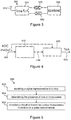
- Figure 4 illustrates a simplified block diagram of a part of the baseband range-determining-module 340 arranged to perform ToA measurements on received-data-packets.
- a channel estimate generator component 410 is arranged to receive the digital representation of the received RF signal 405 output by the ADC 330 and to generate a channel estimate 415 for a transmission channel between the communication device 300 and a transmitter device from which the received RF signal is being transmitted.
- a classification module 420 is arranged to receive the channel estimate information 415 generated by the channel estimate generation component 410, and the digital representation of the received RF signal 405, and to determine a ToA measurement 425 for a peak within the received RF signal based at least partly on the channel estimate information 415.
- a signal received via a multipath channel will comprise a plurality of multipath components, which will show up in the taps of the channel impulse response.
- the classification module is configured to determine one or more characteristics of the one or more pulses and classify the receiver as either proximal to or distal from the transmitter based on the one or more characteristics.
- the characteristics of the pulses relate to the channel characteristics of the channel impulse response. Characteristics that may be used to classify the relative position of a transmitter and receiver are discussed below with regard to Figures 5 , 6a and 6b .
- the classification module 420 may also be arranged to identify a Line-of-Sight (LoS) component of the received signal based on the channel estimate information 415, and to determine a ToA measurement 425 for the LoS component.
- LoS Line-of-Sight
- the channel estimation component 410 may including a symbol correlator arranged to receive the digital representation of the received RF signal 405 output by the ADC 330, and to perform cross-correlation of the received signal 405 with a reference pattern. The correlator may compare the reference pattern to a section of the received signal to determine when a match occurs.
- Figure 5 illustrates a method 500 for operating a range-determining-module for a transceiver.
- a signal representative of a chirp from a transmitter is received 502 at the receiver.
- the chirp may be transmitted as a UWB signal.
- the signal that is received differs from the originally transmitted chirp due to the transfer function of the environment through which the chirp signal travels from the transmitter to the receiver.
- the received signal is therefore a channel impulse response, which may contain one or more pulses, or peaks in the signal, that relate to the original chirp, depending on the channel characteristics of the environment.
- the presence of the one or more pulses in the received signal is determined 504.
- the determination of the presence of one or more pulses may be achieved by correlating the received signal with a reference signal, as is known in the art.
- the receiver is classified 506, or categorized, as either proximal to or distal from the transmitter based on one or more characteristics of the one or more pulses in addition to a time-of-arrival of the one or more pulses.
- the one or more characteristics of the one or more pulses is indicative of the channel characteristics for the signal sent from the transmitter to the receiver.
- the time-of-arrival of the one or more pulses may be assessed in an initial step and, depending upon the outcome of the initial step, the assessment may be validated by then considering the one or more characteristics.
- the validation of the ToF measurement using the one or more characteristics may be used if the ToF measurement indicates that there is a moderate or high probability that the receiver is proximal to the transmitter. For example, the validation may be used when the ToF measurement indicates that the receiver is less than 2 or 3 times a threshold distance away from the transmitter. In this way, the combination of ToF measurement combined with the specific channel characteristics in / around a vehicle may be used to decide whether a key is inside or outside of a car (whether the transmitter is proximal to or distal from the receiver).
- the time-of-flight (ToF) of the one or more pulses may be a ToF of the first detected pulse (line-of-sight ToF).
- the one or more characteristic may include non-time-of-flight characteristics, such as:
- Figures 6a and 6b illustrate exemplar profiles which relate to channelling pulse responses received at a receiver following the transmission of a chirp signal by a transmitter.
- a received chirp signal differs from that originally transmitted due to the propagation of the signal through the environment between the transmitter and the receiver.
- Figure 6a illustrates an example profile (not actual data) indicative of a channelling pulse response of an arrangement in which a transmitter and receiver are both provided in a confined space of complex geometry, such as the interior of a car.
- the transmitter may be provided within a key fob that is situated within a user's pocket between a car seat and the user, and the receiver may be provided in a base station in the vehicle.
- Figure 6b illustrates an example profile (not actual data) indicative of a channelling pulse response of an arrangement in which the transmitter and receiver are separated by an expansive open terrain.
- the transmitter may be situated in a key fob that the user is holding in their hand some distance away from a vehicle, and where the receiver is provided in a base station within or on the vehicle. It can be seen that various characteristics of the exemplary signals differ between the case in which the receiver is proximal to the transmitter ( Figure 6a ) and the example in which the receiver is distal from the transmitter ( Figure 6b ).
- the proximal profile 610 illustrated in Figure 6a is a higher energy signal than the distal profile 650 illustrated in Figure 6b (note non-equivalent vertical axis scales in figure 6a and 6b ).
- a variety of methodologies may be used in order to determine the amplitude or energy, or relative amplitude or energy, of a signal.
- a hamming window may be used in order to select a signal that is considered to be associated with a particular chirp, or portion of such a signal.
- a hamming window is shown between outer markers 612, 614, 652, 654 that are a particular interval away from the most significant detected peak 616, 656.
- An integral may be taken between the respective sets of outer markers 612, 614, 652, 654.
- the amplitude, intensity or energy of a signal may be integrated as a function of time, distance or arbitrary units.
- the type of signal may be classified as, for example, representative of the case where the receiver is proximal to or distal from the transmitter based on a comparison between the determined amplitude, intensity or energy and a threshold value.
- the signal may be categorised as being representative of the case where the transmitter is distal from the receiver. Conversely, when the determined quantity is less than the threshold value it may be determined that the signal is representative of the case that the receiver is proximal to the transmitter.
- the reliability of the use of amplitude, intensity or energy metrics may be improved by normalising the integrated value by an absolute value of a peak within the signal, such as the maximum height of the peaks within the signal.
- the proximity of the receiver and the transmitter may therefore be categorized based on a comparison between a threshold level and the measured energy, intensity or amplitude within an interval.
- the interval may be five to ten nanoseconds.
- the threshold level may be set at 80% of the integral of a signal over the interval for the distal case.
- the integral of the reflections within the interval between the outer markers 612, 614 in Figure 6a may result in a value of 30; whereas the integral of the signal without substantial reflections between the outer markers 652, 654 in Figure 6b may result in a value of 60.
- a threshold value may be set at 48 in this case (80% of the distal value of 60). Given an equal distance between the transmitter and receiver, the transmitted energy tends to be greater in the distal case than the proximal case because energy is lost from the signal for each reflection and there are more reflections in the proximal case due to complex in-vehicle geometry. Therefore, when the energy of the signal is used as a cross-check for whether or not the transmitter is proximal to the receiver (within the vehicle) close to a boundary condition, the loss of signal energy with distance can be ignored and the transmitter may be determined to be distal to the receiver (outside the vehicle) if the energy of pulse received within the interval exceeds the threshold level.
- the proximal profile 610 and the distal profile 650 Another characteristic that differs between the proximal profile 610 and the distal profile 650 is the number of peaks within the profile.
- the proximal profile has a greater number of peaks 618 (8 peaks) with a maximum value greater than a threshold level 620 than the number of peaks 658 (1 peak) of the distal profile 650 compared with the same threshold 620.
- the difference in the number of peaks can be explained by considering the environment through which the signals are propagated. In a compact environment such as the interior of a vehicle in which the transmitter is proximal to the receiver, a number of services of the vehicle each provide respective signal propagation paths and so result in the generation of multiple peaks within the channelling pulse response.
- the proximity of the receiver and the transmitter may therefore be categorized based on a comparison between a threshold number of pulses and the measured number of pulses in an interval that have a magnitude greater than a magnitude threshold.
- the interval may be ten to twenty nanoseconds (shown between the first outer marker 612 and an extended interval marker 615 in Figure 6a and between the first outer marker 652 and an extended interval marker 653 in Figure 6b ).
- the threshold magnitude 620 may be calculated from a standard deviation of a noise level 630 in Figures 6a and 6b .
- the threshold magnitude 620 may be 3 times the noise level.
- the threshold number of pulses may be 3 pulses. That is, if more than 3 pulses within the interval exceed a threshold magnitude then the receiver may be determined as being proximal to the transmitter (within 30-60 cm, for example).
- the typical spacing between the reflection surfaces relates to the typical spacing seen between reflection peaks in the channelling pulse response.
- the in-car environment may have multiple reflections with differences between individual paths in the 50 cm range (paths from the roof, the windows, the seats, the doors, etc).
- the channel characteristics for the car outside environment has less paths and the respective length difference is larger in the range of > 1 m.
- the hamming window defined by the outer markets 612, 614 of the proximal profiles 610 comprises a plurality of peaks, whereas the same size window in the distal window only contains a single significant peak 658.
- the proximity of the receiver and the transmitter may therefore be categorized based on a comparison between a threshold pulse spacing and the measured pulse spacing.
- the threshold pulse spacing may correspond to a distance of 30 cm to 60 cm, for example. That is, if the measured pulse spacing corresponds to a distance of less than 60 cm then the receiver is determined as being proximal to the transmitter (within 60 cm).
- the earliest significant peak is received at an earlier time 617 for the proximal profile 610 than the corresponding time 656 for the earliest peak 658 in the distal profile 650.
- a time of flight, or distance determined from the instant time, or bin number, of the earliest peak therefore provides an indicator of the distance between the receiver and the transmitter.
- the determined distance may be compared with a threshold distance in order to determine whether the receiver is proximal to or distal from the transmitter.
- the quantity compared with the distance may have units of time, distance or be unit less.
- a vehicle passive keyless entry system may be provided with a range-classifying-module that implements one or more of the above methods that use a characteristic of a receiver signal in addition to the time of flight information.
- a range-classifying-module that implements one or more of the above methods that use a characteristic of a receiver signal in addition to the time of flight information.
- such a system may enable sufficiently accurate determination of the relative position of the transmitter and receiver using only a single node, or anchor, to receive the signal representative of a chirp. Such a system may therefore be of reduced complexity compared to implementations that require multiple anchors.
- the set of instructions/method steps described above are implemented as functional and software instructions embodied as a set of executable instructions which are effected on a computer or machine which is programmed with and controlled by said executable instructions. Such instructions are loaded for execution on a processor (such as one or more CPUs).
- processor includes microprocessors, microcontrollers, processor modules or subsystems (including one or more microprocessors or microcontrollers), or other control or computing devices.
- a processor can refer to a single component or to plural components.
- the set of instructions/methods illustrated herein and data and instructions associated therewith are stored in respective storage devices, which are implemented as one or more non-transient machine or computer-readable or computer-usable storage media or mediums.
- Such computer-readable or computer usable storage medium or media is (are) considered to be part of an article (or article of manufacture).
- An article or article of manufacture can refer to any manufactured single component or multiple components.
- the non-transient machine or computer usable media or mediums as defined herein excludes signals, but such media or mediums may be capable of receiving and processing information from signals and/or other transient mediums.
- Example embodiments of the material discussed in this specification can be implemented in whole or in part through network, computer, or data based devices and/or services. These may include cloud, internet, intranet, mobile, desktop, processor, look-up table, microcontroller, consumer equipment, infrastructure, or other enabling devices and services. As may be used herein and in the claims, the following non-exclusive definitions are provided.
- one or more instructions or steps discussed herein are automated.
- the terms automated or automatically mean controlled operation of an apparatus, system, and/or process using computers and/or mechanical/electrical devices without the necessity of human intervention, observation, effort and/or decision.
- any components said to be coupled may be coupled or connected either directly or indirectly.
- additional components may be located between the two components that are said to be coupled.
Landscapes
- Engineering & Computer Science (AREA)
- Physics & Mathematics (AREA)
- General Physics & Mathematics (AREA)
- Radar, Positioning & Navigation (AREA)
- Remote Sensing (AREA)
- Computer Networks & Wireless Communication (AREA)
- Signal Processing (AREA)
- Radar Systems Or Details Thereof (AREA)
Claims (13)
- Entfernungsklassifizierungsmodul (420) für einen Fahrzeugfunkempfänger (300), wobei das Entfernungsklassifizierungsmodul (420) dazu ausgebildet ist:ein Signal zu empfangen, das für einen Chirp von einem Sender repräsentativ ist;das Vorhandensein eines oder mehrerer Pulse im empfangenen Signal zu bestimmen; undden Empfänger als entweder proximal zu oder distal vom Sender zu klassifizieren, auf Grundlage einer Kombination von:(a) einer Ankunftszeit des einen oder der mehreren Pulse; und(b) einer oder mehrerer Eigenschaften des einen oder der mehreren Pulse;wobei die eine oder mehreren Eigenschaften des einen oder der mehreren Pulse von einer Kanaleigenschaft eines Kanals zwischen dem Sender und dem Empfänger abhängig sind, undwobei der Empfänger auf der Grundlage, dass die eine oder mehreren Eigenschaften anzeigen, dass sich der Sender entweder innerhalb oder außerhalb des Fahrzeugs befindet, als entweder proximal zu oder distal vom Sender klassifiziert wird.
- Entfernungsklassifizierungsmodul (420) nach Anspruch 1, wobei die eine oder mehreren Eigenschaften des einen oder der mehreren Pulse von einer Ankunftszeit des einen oder der mehreren Pulse unabhängig sind.
- Entfernungsklassifizierungsmodul (420) nach Anspruch 1 oder 2, wobei die eine oder mehreren Eigenschaften eine Trennung zwischen Pulsen in wenigstens einem Abschnitt des Signals umfassen.
- Entfernungsklassifizierungsmodul (420) nach einem der vorhergehenden Ansprüche, wobei die eine oder mehreren Eigenschaften eine Energie, Stärke oder Amplitude wenigstens eines Abschnitts des Signals umfassen.
- Entfernungsklassifizierungsmodul (420) nach einem der vorhergehenden Ansprüche, wobei die eine oder mehreren Eigenschaften die Anzahl von Pulsen in wenigstens einem Abschnitt des Signals umfassen.
- Entfernungsklassifizierungsmodul (420) nach einem der vorhergehenden Ansprüche, wobei die eine oder mehreren Eigenschaften eine oder mehrere Nicht-Laufzeit-Eigenschaften des einen oder der mehreren Pulse umfassen.
- Entfernungsklassifizierungsmodul (420) nach einem der vorhergehenden Ansprüche, wobei die eine oder mehreren Eigenschaften eine einzelne Eigenschaft einer Mehrzahl von Pulsen umfassen.
- Entfernungsklassifizierungsmodul (420) nach einem der vorhergehenden Ansprüche, das dazu ausgebildet ist, eine getrennte Entscheidung für jede der einen oder mehreren Eigenschaften und die Ankunftszeit-Messung vorzunehmen, und den Empfänger auf Grundlage der getrennten Entscheidungen als entweder proximal zu oder distal vom Sender zu klassifizieren.
- Entfernungsklassifizierungsmodul (420) nach einem der vorhergehenden Ansprüche, wobei die Ankunftszeit auf einer Ankunftszeit des zuerst empfangenen signifikanten Pulses des einen oder der mehreren Pulse basiert.
- Entfernungsklassifizierungsmodul (420) nach einem der vorhergehenden Ansprüche, wobei der Chirp ein Ultrabreitband(UWB)-Puls ist.
- Passives schlüsselloses Zugangssystem für ein Fahrzeug, umfassend einen Funkempfänger (300) mit dem Entfernungsklassifizierungsmodul (420) nach einem der vorhergehenden Ansprüche.
- Passives schlüsselloses Zugangssystem für ein Fahrzeug nach Anspruch 11, wobei das passive schlüssellose Zugangssystem für ein Fahrzeug nur einen einzelnen Funkempfänger (300) zum Empfang des Signals, das für einen Chirp repräsentativ ist, umfasst.
- Verfahren zur Entfernungsklassifizierung, umfassend:Empfangen (502), an einem Fahrzeugempfänger (300),eines Signals, das für einen Chirp von einem Sender repräsentativ ist;Bestimmen (504) des Vorhandenseins eines oder mehrerer Pulse im empfangenen Signal; undKlassifizieren (506) des Empfängers als entweder proximal zu oder distal vom Sender auf Grundlage von:(a) einer oder mehrerer Eigenschaften des einen oder der mehreren Pulse; und(b) einer Ankunftszeit des einen oder der mehreren Pulse;wobei die eine oder mehreren Eigenschaften des einen oder der mehreren Pulse von einer Kanaleigenschaft eines Kanals zwischen dem Sender und dem Empfänger abhängig sind, undwobei der Empfänger auf der Grundlage, dass die eine oder mehreren Eigenschaften anzeigen, dass sich der Sender entweder innerhalb oder außerhalb des Fahrzeugs befindet, als entweder proximal zu oder distal vom Sender klassifiziert wird.
Priority Applications (2)
| Application Number | Priority Date | Filing Date | Title |
|---|---|---|---|
| EP17179377.1A EP3425420B1 (de) | 2017-07-03 | 2017-07-03 | Entfernungsmessvorrichtung und -verfahren |
| US16/004,226 US10768280B2 (en) | 2017-07-03 | 2018-06-08 | Ranging apparatus and method |
Applications Claiming Priority (1)
| Application Number | Priority Date | Filing Date | Title |
|---|---|---|---|
| EP17179377.1A EP3425420B1 (de) | 2017-07-03 | 2017-07-03 | Entfernungsmessvorrichtung und -verfahren |
Publications (2)
| Publication Number | Publication Date |
|---|---|
| EP3425420A1 EP3425420A1 (de) | 2019-01-09 |
| EP3425420B1 true EP3425420B1 (de) | 2021-11-17 |
Family
ID=59276606
Family Applications (1)
| Application Number | Title | Priority Date | Filing Date |
|---|---|---|---|
| EP17179377.1A Not-in-force EP3425420B1 (de) | 2017-07-03 | 2017-07-03 | Entfernungsmessvorrichtung und -verfahren |
Country Status (2)
| Country | Link |
|---|---|
| US (1) | US10768280B2 (de) |
| EP (1) | EP3425420B1 (de) |
Cited By (1)
| Publication number | Priority date | Publication date | Assignee | Title |
|---|---|---|---|---|
| DE102024137919A1 (de) * | 2024-10-28 | 2026-04-30 | GM Global Technology Operations LLC | Intelligente Fahrzeugsysteme und Steuerlogik für verbesserte Remote Key Ranging Security durch Bereichswertstapelung |
Families Citing this family (7)
| Publication number | Priority date | Publication date | Assignee | Title |
|---|---|---|---|---|
| US10735035B1 (en) | 2019-03-11 | 2020-08-04 | Apple Inc. | Sensor circuit with tracking filter and leakage rejection |
| US11402485B2 (en) * | 2019-04-30 | 2022-08-02 | Robert Bosch Gmbh | Ultra-wideband intelligent sensing system and method |
| KR102580345B1 (ko) | 2019-07-01 | 2023-09-20 | 삼성전자주식회사 | 레인징을 수행하는 전자 장치 및 방법 |
| DE102019211264B4 (de) | 2019-07-30 | 2025-03-20 | Continental Automotive Technologies GmbH | Steuerungseinrichtung für ein Kraftfahrzeugzugangs- oder Lokalisierungssystem und Verfahren |
| SE2050676A1 (en) | 2020-06-09 | 2021-12-10 | Assa Abloy Ab | Determining when a portable key device is located on a front side or on a back side |
| SE545859C2 (en) * | 2020-06-09 | 2024-02-27 | Assa Abloy Ab | Location determiner |
| EP4148462B1 (de) * | 2021-09-10 | 2025-05-14 | Nxp B.V. | Uwb-entfernungsmessverfahren, vorrichtung und system |
Family Cites Families (32)
| Publication number | Priority date | Publication date | Assignee | Title |
|---|---|---|---|---|
| US7786864B1 (en) * | 2000-09-08 | 2010-08-31 | Automotive Technologies International, Inc. | Vehicular RFID and sensor assemblies |
| US6570486B1 (en) * | 1999-04-09 | 2003-05-27 | Delphi Automotive Systems | Passive remote access control system |
| DE60028586T2 (de) * | 2000-12-22 | 2006-12-21 | Ford Global Technologies, LLC, Dearborn | Ein System zur Kraftfahrzeug- Zustandsanzeige |
| DE10334625A1 (de) * | 2003-07-29 | 2005-03-03 | Siemens Ag | Verfahren zum Nachweis einer Berechtigung zum Ver-und Entriegeln und/oder der Benutzung eines Objektes sowie Sicherheitsvorrichtung |
| US7046119B2 (en) * | 2004-05-19 | 2006-05-16 | Lear Corporation | Vehicle independent passive entry system |
| US7466219B2 (en) * | 2004-10-19 | 2008-12-16 | Sanyo Electric Co., Ltd. | Communication device and distance calculation system |
| US7400243B2 (en) * | 2005-06-28 | 2008-07-15 | Mitsubishi Denki Kabushiki Kaisha | Communication apparatus for vehicle |
| JP5095144B2 (ja) * | 2006-07-06 | 2012-12-12 | カルソニックカンセイ株式会社 | 車両用キーレス装置 |
| US7791457B2 (en) * | 2006-12-15 | 2010-09-07 | Lear Corporation | Method and apparatus for an anti-theft system against radio relay attack in passive keyless entry/start systems |
| US8335598B2 (en) * | 2008-09-23 | 2012-12-18 | Lear Corporation | System and method for detecting radio frequency signals and controlling vehicle operations in response thereto |
| US8126450B2 (en) * | 2008-09-24 | 2012-02-28 | Embarq Holdings Company Llc | System and method for key free access to a vehicle |
| DE102009002448A1 (de) * | 2009-04-16 | 2010-10-21 | Huf Hülsbeck & Fürst Gmbh & Co. Kg | Verfahren zur Sicherung einer Keyless-Entry-Kommunikation für Kraftfahrzeuge |
| JP5451168B2 (ja) * | 2009-04-28 | 2014-03-26 | アルプス電気株式会社 | 車両のキーレスエントリー装置 |
| US8547253B2 (en) * | 2009-09-04 | 2013-10-01 | GM Global Technology Operations LLC | Method of determining vehicle location from key fob |
| US8478482B2 (en) * | 2010-03-10 | 2013-07-02 | Nissan North America, Inc. | Position detection for activation of device and methods thereof |
| US20120092129A1 (en) * | 2010-10-19 | 2012-04-19 | Honda Motor Co., Ltd. | Method to track vehicle key near vehicle for smart entry |
| US20120129545A1 (en) * | 2010-11-19 | 2012-05-24 | IIlume Software, Inc. | Systems and methods for selectively invoking positioning systems for mobile device control applications using multiple sensing modalities |
| US8706350B2 (en) * | 2010-12-17 | 2014-04-22 | GM Global Technology Operations LLC | Secondary sensing for intelligent passive entry passive start polling |
| US20120268242A1 (en) * | 2011-04-21 | 2012-10-25 | Delphi Technologies, Inc. | Vehicle security system and method of operation based on a nomadic device location |
| US9554286B2 (en) * | 2011-12-02 | 2017-01-24 | Lear Corporation | Apparatus and method for detecting a location of a wireless device |
| US9386142B2 (en) * | 2011-12-14 | 2016-07-05 | Dean A Craine | Driver electronic device automatic deactivation system and method |
| DE102012003015A1 (de) * | 2012-02-15 | 2013-08-22 | Audi Ag | Startsystem für einen Kraftwagen, Kraftwagen mit einem Startsystem und Verfahren zum Betreiben eines Startsystems für einen Kraftwagen |
| US20130342379A1 (en) * | 2012-06-25 | 2013-12-26 | Lear Corporation | Vehicle Remote Function System and Method |
| GB2510737B (en) | 2012-06-25 | 2015-05-13 | Lear Corp | Vehicle remote function system and method |
| US9536364B2 (en) * | 2013-02-25 | 2017-01-03 | GM Global Technology Operations LLC | Vehicle integration of BLE nodes to enable passive entry and passive start features |
| US8930045B2 (en) * | 2013-05-01 | 2015-01-06 | Delphi Technologies, Inc. | Relay attack prevention for passive entry passive start (PEPS) vehicle security systems |
| US10543808B2 (en) * | 2013-07-22 | 2020-01-28 | Trw Automotive U.S. Llc | Passive remote keyless entry system with level-based anti-theft feature |
| US9754139B2 (en) * | 2013-09-30 | 2017-09-05 | Ricoh Co., Ltd | Real-time wireless power transfer control for passive backscattering devices |
| US20150208207A1 (en) * | 2014-01-22 | 2015-07-23 | Lear Corporation | Wireless device localization |
| JP2016171486A (ja) * | 2015-03-13 | 2016-09-23 | オムロンオートモーティブエレクトロニクス株式会社 | 車両無線通信システム、車両制御装置、携帯機 |
| US9967717B2 (en) * | 2015-09-01 | 2018-05-08 | Ford Global Technologies, Llc | Efficient tracking of personal device locations |
| US10328898B2 (en) * | 2016-10-12 | 2019-06-25 | Denso International America, Inc. | Passive entry / passive start systems and methods for vehicles |
-
2017
- 2017-07-03 EP EP17179377.1A patent/EP3425420B1/de not_active Not-in-force
-
2018
- 2018-06-08 US US16/004,226 patent/US10768280B2/en not_active Expired - Fee Related
Cited By (1)
| Publication number | Priority date | Publication date | Assignee | Title |
|---|---|---|---|---|
| DE102024137919A1 (de) * | 2024-10-28 | 2026-04-30 | GM Global Technology Operations LLC | Intelligente Fahrzeugsysteme und Steuerlogik für verbesserte Remote Key Ranging Security durch Bereichswertstapelung |
Also Published As
| Publication number | Publication date |
|---|---|
| US10768280B2 (en) | 2020-09-08 |
| US20190004155A1 (en) | 2019-01-03 |
| EP3425420A1 (de) | 2019-01-09 |
Similar Documents
| Publication | Publication Date | Title |
|---|---|---|
| US10768280B2 (en) | Ranging apparatus and method | |
| US8126405B2 (en) | Method for estimating condition of wireless channels | |
| KR101040705B1 (ko) | 무선 측위 시스템 및 측위 방법 | |
| CN114339602A (zh) | 基于连接锚点与移动电子装置之间的通信特性而选择测距锚点的方法和设备 | |
| US9019159B2 (en) | Ranging diversity-reception method and receiver | |
| WO2018148687A1 (en) | Enhanced automotive passive entry | |
| CN103217662B (zh) | 用于检测无线设备的位置的装置和方法 | |
| WO2003024145A1 (en) | System and method for identification of transmitters with limited information | |
| Tiemann et al. | Ultra-wideband antenna-induced error prediction using deep learning on channel response data | |
| CA2532050A1 (en) | Target localization using tdoa distributed antenna | |
| US9372253B2 (en) | Wireless positioning apparatus | |
| US20120095673A1 (en) | Apparatus and method for providing driving information for vehicles based on high speed movement long distance impuse radio ultra wideband | |
| US10383085B2 (en) | Range determining module and associated methods and apparatus | |
| JP5087909B2 (ja) | 無線測位システムおよび無線測位方法 | |
| CN116068515A (zh) | 雷达设备和雷达方法 | |
| Bellusci et al. | Model of distance and bandwidth dependency of TOA-based UWB ranging error | |
| KR101582404B1 (ko) | Uwb 레이더를 이용하여 목표물의 수를 카운팅 방법 및 장치 | |
| US7729659B2 (en) | Method for signaling quality of range estimates in UWB devices | |
| Park et al. | PedLoc: UWB-based pedestrian localization for autonomous vehicles | |
| US7003325B2 (en) | Mobile communication system and method of estimating location of mobile station | |
| CN110876192B (zh) | 无线节点的定位 | |
| CN115278731A (zh) | 通信环境判定方法、数据处理装置、车辆和存储介质 | |
| US10830860B2 (en) | Electronic apparatus, wireless reception method, and wireless system | |
| CN118102209A (zh) | 操作rf接入系统的功率和业务优化方法 | |
| Srirangarajan et al. | Localization in wireless sensor networks under non line-of-sight propagation |
Legal Events
| Date | Code | Title | Description |
|---|---|---|---|
| PUAI | Public reference made under article 153(3) epc to a published international application that has entered the european phase |
Free format text: ORIGINAL CODE: 0009012 |
|
| STAA | Information on the status of an ep patent application or granted ep patent |
Free format text: STATUS: THE APPLICATION HAS BEEN PUBLISHED |
|
| AK | Designated contracting states |
Kind code of ref document: A1 Designated state(s): AL AT BE BG CH CY CZ DE DK EE ES FI FR GB GR HR HU IE IS IT LI LT LU LV MC MK MT NL NO PL PT RO RS SE SI SK SM TR |
|
| AX | Request for extension of the european patent |
Extension state: BA ME |
|
| STAA | Information on the status of an ep patent application or granted ep patent |
Free format text: STATUS: REQUEST FOR EXAMINATION WAS MADE |
|
| 17P | Request for examination filed |
Effective date: 20190709 |
|
| RBV | Designated contracting states (corrected) |
Designated state(s): AL AT BE BG CH CY CZ DE DK EE ES FI FR GB GR HR HU IE IS IT LI LT LU LV MC MK MT NL NO PL PT RO RS SE SI SK SM TR |
|
| GRAP | Despatch of communication of intention to grant a patent |
Free format text: ORIGINAL CODE: EPIDOSNIGR1 |
|
| STAA | Information on the status of an ep patent application or granted ep patent |
Free format text: STATUS: GRANT OF PATENT IS INTENDED |
|
| INTG | Intention to grant announced |
Effective date: 20210803 |
|
| GRAS | Grant fee paid |
Free format text: ORIGINAL CODE: EPIDOSNIGR3 |
|
| GRAA | (expected) grant |
Free format text: ORIGINAL CODE: 0009210 |
|
| STAA | Information on the status of an ep patent application or granted ep patent |
Free format text: STATUS: THE PATENT HAS BEEN GRANTED |
|
| AK | Designated contracting states |
Kind code of ref document: B1 Designated state(s): AL AT BE BG CH CY CZ DE DK EE ES FI FR GB GR HR HU IE IS IT LI LT LU LV MC MK MT NL NO PL PT RO RS SE SI SK SM TR |
|
| REG | Reference to a national code |
Ref country code: GB Ref legal event code: FG4D |
|
| REG | Reference to a national code |
Ref country code: DE Ref legal event code: R096 Ref document number: 602017049342 Country of ref document: DE |
|
| REG | Reference to a national code |
Ref country code: IE Ref legal event code: FG4D |
|
| REG | Reference to a national code |
Ref country code: AT Ref legal event code: REF Ref document number: 1448490 Country of ref document: AT Kind code of ref document: T Effective date: 20211215 |
|
| REG | Reference to a national code |
Ref country code: LT Ref legal event code: MG9D |
|
| REG | Reference to a national code |
Ref country code: NL Ref legal event code: MP Effective date: 20211117 |
|
| REG | Reference to a national code |
Ref country code: AT Ref legal event code: MK05 Ref document number: 1448490 Country of ref document: AT Kind code of ref document: T Effective date: 20211117 |
|
| PG25 | Lapsed in a contracting state [announced via postgrant information from national office to epo] |
Ref country code: RS Free format text: LAPSE BECAUSE OF FAILURE TO SUBMIT A TRANSLATION OF THE DESCRIPTION OR TO PAY THE FEE WITHIN THE PRESCRIBED TIME-LIMIT Effective date: 20211117 Ref country code: LT Free format text: LAPSE BECAUSE OF FAILURE TO SUBMIT A TRANSLATION OF THE DESCRIPTION OR TO PAY THE FEE WITHIN THE PRESCRIBED TIME-LIMIT Effective date: 20211117 Ref country code: FI Free format text: LAPSE BECAUSE OF FAILURE TO SUBMIT A TRANSLATION OF THE DESCRIPTION OR TO PAY THE FEE WITHIN THE PRESCRIBED TIME-LIMIT Effective date: 20211117 Ref country code: BG Free format text: LAPSE BECAUSE OF FAILURE TO SUBMIT A TRANSLATION OF THE DESCRIPTION OR TO PAY THE FEE WITHIN THE PRESCRIBED TIME-LIMIT Effective date: 20220217 Ref country code: AT Free format text: LAPSE BECAUSE OF FAILURE TO SUBMIT A TRANSLATION OF THE DESCRIPTION OR TO PAY THE FEE WITHIN THE PRESCRIBED TIME-LIMIT Effective date: 20211117 |
|
| PG25 | Lapsed in a contracting state [announced via postgrant information from national office to epo] |
Ref country code: IS Free format text: LAPSE BECAUSE OF FAILURE TO SUBMIT A TRANSLATION OF THE DESCRIPTION OR TO PAY THE FEE WITHIN THE PRESCRIBED TIME-LIMIT Effective date: 20220317 Ref country code: SE Free format text: LAPSE BECAUSE OF FAILURE TO SUBMIT A TRANSLATION OF THE DESCRIPTION OR TO PAY THE FEE WITHIN THE PRESCRIBED TIME-LIMIT Effective date: 20211117 Ref country code: PT Free format text: LAPSE BECAUSE OF FAILURE TO SUBMIT A TRANSLATION OF THE DESCRIPTION OR TO PAY THE FEE WITHIN THE PRESCRIBED TIME-LIMIT Effective date: 20220317 Ref country code: PL Free format text: LAPSE BECAUSE OF FAILURE TO SUBMIT A TRANSLATION OF THE DESCRIPTION OR TO PAY THE FEE WITHIN THE PRESCRIBED TIME-LIMIT Effective date: 20211117 Ref country code: NO Free format text: LAPSE BECAUSE OF FAILURE TO SUBMIT A TRANSLATION OF THE DESCRIPTION OR TO PAY THE FEE WITHIN THE PRESCRIBED TIME-LIMIT Effective date: 20220217 Ref country code: NL Free format text: LAPSE BECAUSE OF FAILURE TO SUBMIT A TRANSLATION OF THE DESCRIPTION OR TO PAY THE FEE WITHIN THE PRESCRIBED TIME-LIMIT Effective date: 20211117 Ref country code: LV Free format text: LAPSE BECAUSE OF FAILURE TO SUBMIT A TRANSLATION OF THE DESCRIPTION OR TO PAY THE FEE WITHIN THE PRESCRIBED TIME-LIMIT Effective date: 20211117 Ref country code: HR Free format text: LAPSE BECAUSE OF FAILURE TO SUBMIT A TRANSLATION OF THE DESCRIPTION OR TO PAY THE FEE WITHIN THE PRESCRIBED TIME-LIMIT Effective date: 20211117 Ref country code: GR Free format text: LAPSE BECAUSE OF FAILURE TO SUBMIT A TRANSLATION OF THE DESCRIPTION OR TO PAY THE FEE WITHIN THE PRESCRIBED TIME-LIMIT Effective date: 20220218 Ref country code: ES Free format text: LAPSE BECAUSE OF FAILURE TO SUBMIT A TRANSLATION OF THE DESCRIPTION OR TO PAY THE FEE WITHIN THE PRESCRIBED TIME-LIMIT Effective date: 20211117 |
|
| PG25 | Lapsed in a contracting state [announced via postgrant information from national office to epo] |
Ref country code: SM Free format text: LAPSE BECAUSE OF FAILURE TO SUBMIT A TRANSLATION OF THE DESCRIPTION OR TO PAY THE FEE WITHIN THE PRESCRIBED TIME-LIMIT Effective date: 20211117 Ref country code: SK Free format text: LAPSE BECAUSE OF FAILURE TO SUBMIT A TRANSLATION OF THE DESCRIPTION OR TO PAY THE FEE WITHIN THE PRESCRIBED TIME-LIMIT Effective date: 20211117 Ref country code: RO Free format text: LAPSE BECAUSE OF FAILURE TO SUBMIT A TRANSLATION OF THE DESCRIPTION OR TO PAY THE FEE WITHIN THE PRESCRIBED TIME-LIMIT Effective date: 20211117 Ref country code: EE Free format text: LAPSE BECAUSE OF FAILURE TO SUBMIT A TRANSLATION OF THE DESCRIPTION OR TO PAY THE FEE WITHIN THE PRESCRIBED TIME-LIMIT Effective date: 20211117 Ref country code: DK Free format text: LAPSE BECAUSE OF FAILURE TO SUBMIT A TRANSLATION OF THE DESCRIPTION OR TO PAY THE FEE WITHIN THE PRESCRIBED TIME-LIMIT Effective date: 20211117 Ref country code: CZ Free format text: LAPSE BECAUSE OF FAILURE TO SUBMIT A TRANSLATION OF THE DESCRIPTION OR TO PAY THE FEE WITHIN THE PRESCRIBED TIME-LIMIT Effective date: 20211117 |
|
| REG | Reference to a national code |
Ref country code: DE Ref legal event code: R097 Ref document number: 602017049342 Country of ref document: DE |
|
| PLBE | No opposition filed within time limit |
Free format text: ORIGINAL CODE: 0009261 |
|
| STAA | Information on the status of an ep patent application or granted ep patent |
Free format text: STATUS: NO OPPOSITION FILED WITHIN TIME LIMIT |
|
| 26N | No opposition filed |
Effective date: 20220818 |
|
| PG25 | Lapsed in a contracting state [announced via postgrant information from national office to epo] |
Ref country code: AL Free format text: LAPSE BECAUSE OF FAILURE TO SUBMIT A TRANSLATION OF THE DESCRIPTION OR TO PAY THE FEE WITHIN THE PRESCRIBED TIME-LIMIT Effective date: 20211117 |
|
| PG25 | Lapsed in a contracting state [announced via postgrant information from national office to epo] |
Ref country code: SI Free format text: LAPSE BECAUSE OF FAILURE TO SUBMIT A TRANSLATION OF THE DESCRIPTION OR TO PAY THE FEE WITHIN THE PRESCRIBED TIME-LIMIT Effective date: 20211117 |
|
| PG25 | Lapsed in a contracting state [announced via postgrant information from national office to epo] |
Ref country code: MC Free format text: LAPSE BECAUSE OF FAILURE TO SUBMIT A TRANSLATION OF THE DESCRIPTION OR TO PAY THE FEE WITHIN THE PRESCRIBED TIME-LIMIT Effective date: 20211117 |
|
| REG | Reference to a national code |
Ref country code: CH Ref legal event code: PL |
|
| GBPC | Gb: european patent ceased through non-payment of renewal fee |
Effective date: 20220703 |
|
| REG | Reference to a national code |
Ref country code: BE Ref legal event code: MM Effective date: 20220731 |
|
| PG25 | Lapsed in a contracting state [announced via postgrant information from national office to epo] |
Ref country code: LU Free format text: LAPSE BECAUSE OF NON-PAYMENT OF DUE FEES Effective date: 20220703 Ref country code: LI Free format text: LAPSE BECAUSE OF NON-PAYMENT OF DUE FEES Effective date: 20220731 Ref country code: CH Free format text: LAPSE BECAUSE OF NON-PAYMENT OF DUE FEES Effective date: 20220731 |
|
| PG25 | Lapsed in a contracting state [announced via postgrant information from national office to epo] |
Ref country code: IT Free format text: LAPSE BECAUSE OF FAILURE TO SUBMIT A TRANSLATION OF THE DESCRIPTION OR TO PAY THE FEE WITHIN THE PRESCRIBED TIME-LIMIT Effective date: 20211117 Ref country code: GB Free format text: LAPSE BECAUSE OF NON-PAYMENT OF DUE FEES Effective date: 20220703 Ref country code: BE Free format text: LAPSE BECAUSE OF NON-PAYMENT OF DUE FEES Effective date: 20220731 |
|
| PG25 | Lapsed in a contracting state [announced via postgrant information from national office to epo] |
Ref country code: IE Free format text: LAPSE BECAUSE OF NON-PAYMENT OF DUE FEES Effective date: 20220703 |
|
| PGFP | Annual fee paid to national office [announced via postgrant information from national office to epo] |
Ref country code: FR Payment date: 20230621 Year of fee payment: 7 |
|
| P01 | Opt-out of the competence of the unified patent court (upc) registered |
Effective date: 20230725 |
|
| PGFP | Annual fee paid to national office [announced via postgrant information from national office to epo] |
Ref country code: DE Payment date: 20230620 Year of fee payment: 7 |
|
| PG25 | Lapsed in a contracting state [announced via postgrant information from national office to epo] |
Ref country code: HU Free format text: LAPSE BECAUSE OF FAILURE TO SUBMIT A TRANSLATION OF THE DESCRIPTION OR TO PAY THE FEE WITHIN THE PRESCRIBED TIME-LIMIT; INVALID AB INITIO Effective date: 20170703 |
|
| PG25 | Lapsed in a contracting state [announced via postgrant information from national office to epo] |
Ref country code: MK Free format text: LAPSE BECAUSE OF FAILURE TO SUBMIT A TRANSLATION OF THE DESCRIPTION OR TO PAY THE FEE WITHIN THE PRESCRIBED TIME-LIMIT Effective date: 20211117 Ref country code: CY Free format text: LAPSE BECAUSE OF FAILURE TO SUBMIT A TRANSLATION OF THE DESCRIPTION OR TO PAY THE FEE WITHIN THE PRESCRIBED TIME-LIMIT Effective date: 20211117 |
|
| PG25 | Lapsed in a contracting state [announced via postgrant information from national office to epo] |
Ref country code: TR Free format text: LAPSE BECAUSE OF FAILURE TO SUBMIT A TRANSLATION OF THE DESCRIPTION OR TO PAY THE FEE WITHIN THE PRESCRIBED TIME-LIMIT Effective date: 20211117 |
|
| PG25 | Lapsed in a contracting state [announced via postgrant information from national office to epo] |
Ref country code: MT Free format text: LAPSE BECAUSE OF FAILURE TO SUBMIT A TRANSLATION OF THE DESCRIPTION OR TO PAY THE FEE WITHIN THE PRESCRIBED TIME-LIMIT Effective date: 20211117 |
|
| REG | Reference to a national code |
Ref country code: DE Ref legal event code: R119 Ref document number: 602017049342 Country of ref document: DE |
|
| PG25 | Lapsed in a contracting state [announced via postgrant information from national office to epo] |
Ref country code: DE Free format text: LAPSE BECAUSE OF NON-PAYMENT OF DUE FEES Effective date: 20250201 |
|
| PG25 | Lapsed in a contracting state [announced via postgrant information from national office to epo] |
Ref country code: FR Free format text: LAPSE BECAUSE OF NON-PAYMENT OF DUE FEES Effective date: 20240731 |