EP3425628A1 - Procédé de reconnaissance vocale, support d'enregistrement, dispositif de reconnaissance vocale et robot - Google Patents
Procédé de reconnaissance vocale, support d'enregistrement, dispositif de reconnaissance vocale et robot Download PDFInfo
- Publication number
- EP3425628A1 EP3425628A1 EP18181408.8A EP18181408A EP3425628A1 EP 3425628 A1 EP3425628 A1 EP 3425628A1 EP 18181408 A EP18181408 A EP 18181408A EP 3425628 A1 EP3425628 A1 EP 3425628A1
- Authority
- EP
- European Patent Office
- Prior art keywords
- speech
- phoneme
- word
- state
- phonemes
- Prior art date
- Legal status (The legal status is an assumption and is not a legal conclusion. Google has not performed a legal analysis and makes no representation as to the accuracy of the status listed.)
- Withdrawn
Links
- 238000000034 method Methods 0.000 title claims abstract description 53
- 230000007704 transition Effects 0.000 claims description 28
- 239000000284 extract Substances 0.000 claims description 20
- 230000007246 mechanism Effects 0.000 claims description 4
- 235000021438 curry Nutrition 0.000 description 52
- 238000010586 diagram Methods 0.000 description 34
- 230000004044 response Effects 0.000 description 32
- 230000005236 sound signal Effects 0.000 description 25
- 241000167854 Bourreria succulenta Species 0.000 description 21
- 235000019693 cherries Nutrition 0.000 description 21
- 230000008569 process Effects 0.000 description 20
- 230000009471 action Effects 0.000 description 14
- 230000008901 benefit Effects 0.000 description 6
- 238000004891 communication Methods 0.000 description 6
- 235000020046 sherry Nutrition 0.000 description 6
- 241000209094 Oryza Species 0.000 description 5
- 235000007164 Oryza sativa Nutrition 0.000 description 5
- 239000000470 constituent Substances 0.000 description 5
- 235000009566 rice Nutrition 0.000 description 5
- 238000004590 computer program Methods 0.000 description 4
- 230000006870 function Effects 0.000 description 4
- 230000015556 catabolic process Effects 0.000 description 2
- 238000000605 extraction Methods 0.000 description 2
- 230000010365 information processing Effects 0.000 description 2
- 238000004458 analytical method Methods 0.000 description 1
- 238000004364 calculation method Methods 0.000 description 1
- 230000008859 change Effects 0.000 description 1
- 238000005516 engineering process Methods 0.000 description 1
- 235000013305 food Nutrition 0.000 description 1
- 239000013307 optical fiber Substances 0.000 description 1
Images






Classifications
-
- G—PHYSICS
- G10—MUSICAL INSTRUMENTS; ACOUSTICS
- G10L—SPEECH ANALYSIS TECHNIQUES OR SPEECH SYNTHESIS; SPEECH RECOGNITION; SPEECH OR VOICE PROCESSING TECHNIQUES; SPEECH OR AUDIO CODING OR DECODING
- G10L15/00—Speech recognition
- G10L15/08—Speech classification or search
-
- G—PHYSICS
- G10—MUSICAL INSTRUMENTS; ACOUSTICS
- G10L—SPEECH ANALYSIS TECHNIQUES OR SPEECH SYNTHESIS; SPEECH RECOGNITION; SPEECH OR VOICE PROCESSING TECHNIQUES; SPEECH OR AUDIO CODING OR DECODING
- G10L15/00—Speech recognition
- G10L15/02—Feature extraction for speech recognition; Selection of recognition unit
-
- G—PHYSICS
- G10—MUSICAL INSTRUMENTS; ACOUSTICS
- G10L—SPEECH ANALYSIS TECHNIQUES OR SPEECH SYNTHESIS; SPEECH RECOGNITION; SPEECH OR VOICE PROCESSING TECHNIQUES; SPEECH OR AUDIO CODING OR DECODING
- G10L15/00—Speech recognition
- G10L15/22—Procedures used during a speech recognition process, e.g. man-machine dialogue
-
- G—PHYSICS
- G10—MUSICAL INSTRUMENTS; ACOUSTICS
- G10L—SPEECH ANALYSIS TECHNIQUES OR SPEECH SYNTHESIS; SPEECH RECOGNITION; SPEECH OR VOICE PROCESSING TECHNIQUES; SPEECH OR AUDIO CODING OR DECODING
- G10L15/00—Speech recognition
- G10L15/26—Speech to text systems
-
- G—PHYSICS
- G10—MUSICAL INSTRUMENTS; ACOUSTICS
- G10L—SPEECH ANALYSIS TECHNIQUES OR SPEECH SYNTHESIS; SPEECH RECOGNITION; SPEECH OR VOICE PROCESSING TECHNIQUES; SPEECH OR AUDIO CODING OR DECODING
- G10L15/00—Speech recognition
- G10L15/28—Constructional details of speech recognition systems
- G10L15/32—Multiple recognisers used in sequence or in parallel; Score combination systems therefor, e.g. voting systems
-
- G—PHYSICS
- G10—MUSICAL INSTRUMENTS; ACOUSTICS
- G10L—SPEECH ANALYSIS TECHNIQUES OR SPEECH SYNTHESIS; SPEECH RECOGNITION; SPEECH OR VOICE PROCESSING TECHNIQUES; SPEECH OR AUDIO CODING OR DECODING
- G10L21/00—Speech or voice signal processing techniques to produce another audible or non-audible signal, e.g. visual or tactile, in order to modify its quality or its intelligibility
- G10L21/02—Speech enhancement, e.g. noise reduction or echo cancellation
- G10L21/0208—Noise filtering
-
- G—PHYSICS
- G10—MUSICAL INSTRUMENTS; ACOUSTICS
- G10L—SPEECH ANALYSIS TECHNIQUES OR SPEECH SYNTHESIS; SPEECH RECOGNITION; SPEECH OR VOICE PROCESSING TECHNIQUES; SPEECH OR AUDIO CODING OR DECODING
- G10L15/00—Speech recognition
- G10L15/08—Speech classification or search
- G10L15/18—Speech classification or search using natural language modelling
- G10L15/183—Speech classification or search using natural language modelling using context dependencies, e.g. language models
- G10L15/187—Phonemic context, e.g. pronunciation rules, phonotactical constraints or phoneme n-grams
-
- G—PHYSICS
- G10—MUSICAL INSTRUMENTS; ACOUSTICS
- G10L—SPEECH ANALYSIS TECHNIQUES OR SPEECH SYNTHESIS; SPEECH RECOGNITION; SPEECH OR VOICE PROCESSING TECHNIQUES; SPEECH OR AUDIO CODING OR DECODING
- G10L15/00—Speech recognition
- G10L15/02—Feature extraction for speech recognition; Selection of recognition unit
- G10L2015/025—Phonemes, fenemes or fenones being the recognition units
-
- G—PHYSICS
- G10—MUSICAL INSTRUMENTS; ACOUSTICS
- G10L—SPEECH ANALYSIS TECHNIQUES OR SPEECH SYNTHESIS; SPEECH RECOGNITION; SPEECH OR VOICE PROCESSING TECHNIQUES; SPEECH OR AUDIO CODING OR DECODING
- G10L15/00—Speech recognition
- G10L15/22—Procedures used during a speech recognition process, e.g. man-machine dialogue
- G10L2015/223—Execution procedure of a spoken command
Definitions
- the present disclosure relates to a technique in voice recognition.
- Patent Document 1 Japanese Unexamined Patent Application Publication No. 11-249688 discloses a voice recognition method as described below.
- sound data of a speech is divided into multiple phoneme sections x, a phoneme model is assigned to each phoneme section x, likelihood Psn of a phoneme model p assigned to the n-th phoneme section x is obtained, and difference likelihood Pdn is obtained which is difference between the likelihood Psn and the largest value Pmaxn of likelihood of phoneme models other than the phoneme model p for the phoneme section x.
- each of the likelihood Psn and the difference likelihood Pdn is inputted to a correct phoneme section likelihood model and an incorrect phoneme likelihood model to obtain likelihood Lnc of the correct phoneme section likelihood model and likelihood Lni of the incorrect phoneme likelihood model.
- difference likelihood cn between the likelihood Lnc and the likelihood Lni is obtained, and the sum of the difference likelihood cn for all the phoneme sections is obtained as word confidence level WC. If the word confidence level WC is higher than or equal to a threshold, the phoneme string assigned to the sound data is outputted. If word confidence level WC is lower than the threshold, the phoneme string is rejected.
- Patent Document 1 only the phoneme likelihood is taken into consideration, and language likelihood is not at all. Thus, there is a problem that a phoneme string natural as language cannot be reproduced.
- Non-Patent Document 1 discloses a method of performing voice recognition on a speech and estimating the word string by using acoustic likelihood and language likelihood. Specifically, in Non-Patent Document 1, word string W that maximizes the product of the probability in the right side of Formula (1) is selected as recognition result.
- w is a word string
- w) is the probability (acoustic likelihood) that the phoneme string of word string w is O, which is calculated from acoustic models.
- P(w) is the probability (language likelihood) indicating likelihood of w as language, which is calculated from language models based on occurrence frequency information of consecutive words, such as n-gram.
- the product of this acoustic likelihood and the language likelihood is outputted as the certainty of recognition result (the confidence level of the sentence) together with the recognition result.
- W argmax w P O
- Non-Patent Document 1 if an inputted speech is unclear or is strongly affected by noise, the confidence level of the sentence is low. Then, if the confidence level of the sentence is low, there exists a problem that the probability of including an error in recognition result is high.
- the techniques disclosed here feature a voice recognition method including: receiving via a microphone a first speech that a speaker makes intending one word, the first speech including N phonemes, where N is a natural number of 2 or more; calculating occurrence probabilities of all kinds of phonemes for each of the N phonemes included in the first speech; recognizing a phoneme string, in which phonemes each having the highest probability are lined in order, to be a first phoneme string corresponding to the first speech, the phonemes corresponding to the respective N phonemes from a first phoneme to an N-th phoneme included in the first speech; calculating a first value by multiplying together occurrence probabilities that the N phonemes included in the first phoneme string have; if the first value is smaller than a first threshold, outputting a voice to prompt the speaker to repeat the one word, via a loudspeaker; receiving via the microphone a second speech that the speaker repeats intending the one word, the second speech including M phonemes, where M is a natural number of 2 or more; calculating occurrence
- This disclosure improves recognition accuracy even if the speaker is a little child or even under the environment where inputted speeches are strongly affected by noise.
- Techniques related to voice dialogue systems have been investigated for analyzing a speech content from voice that the user speaks and returning a natural response based on the analysis result to achieve natural dialogue with the user or to provide a service such as controlling a device or providing information.
- the recognition accuracy of general voice recognition systems for adults exceeds 90%. Even if a system cannot recognize a speech, the system discards the recognition result the confidence level of which is low and asks the speaker to speak slowly or clearly through a repetition request, and thus the system provides enough capability in acquiring recognition result having high confidence levels.
- Non-Patent Document 1 A technique disclosed in Non-Patent Document 1 is capable of outputting a word string like language, but it does not include disclosure on a repetition request for the case where recognition result with a low confidence level is obtained. Hence, Non-Patent Document 1 does not solve the above problem.
- Patent Document 1 only discloses that when recognition result with a low confidence level is obtained, the recognition result is discarded, but does not include disclosure on a repetition request. Hence, Patent Document 1 does not solve the above problem, either, as with Non-Patent Document 1.
- a voice recognition method is a voice recognition method including: receiving via a microphone a first speech that a speaker makes intending one word, the first speech including N phonemes, where N is a natural number of 2 or more; calculating occurrence probabilities of all kinds of phonemes for each of the N phonemes included in the first speech; recognizing a phoneme string, in which phonemes each having the highest probability are lined in order, to be a first phoneme string corresponding to the first speech, the phonemes corresponding to the respective N phonemes from a first phoneme to an N-th phoneme included in the first speech; calculating a first value by multiplying together occurrence probabilities that the N phonemes included in the first phoneme string have; if the first value is smaller than a first threshold, outputting a voice to prompt the speaker to repeat the one word, via a loudspeaker; receiving via the microphone a second speech that the speaker repeats intending the one word, the second speech including M phonemes, where M is a natural number of 2 or more;
- this configuration improves the recognition accuracy even if the speaker is a little child or even under the environment where inputted speeches are strongly affected by noise.
- the voice recognition method may further include: if the number of the extracted words is plural, outputting a voice to ask the speaker whether the speaker said each of the extracted words, via the loudspeaker; receiving an affirmative answer or a negative answer from the speaker via the microphone; and recognizing a word corresponding to the affirmative answer to be the one word.
- the recognition accuracy can be improved because if multiple words including phonemes having high reliability out of the first phoneme string and the second phoneme string are extracted from the dictionary, which of the words the speaker said is checked directly with the speaker.
- the first speech intending the one word string is divided into T frames, and a word string that maximizes the product of probability P A1 (o t ,s t
- the word string of the first speech is not discarded.
- s t-1 ) of the phoneme string for the second speech in the state s t is calculated, and then the product of the sum and probability P L (s t ,s t-1 ) of the word string in the state s t is calculated as combined confidence level X.
- the word string that maximizes combined confidence level X is recognized as the one word.
- this configuration improves the recognition accuracy even if the speaker is a little child or even under the environment where inputted speeches are strongly affected by noise.
- the first speech intending the one word string is divided into T frames, and the product of probability P A1 (o t ,s t
- the first word strings having top M confidence levels X1 are extracted, and the second speech is obtained through a repetition request.
- the second word strings having top M confidence levels X2 are extracted. If there is a common word string between the first word string and the second word string, the common word string is recognized as the one word string.
- the recognition result is not discarded, and the recognition result is utilized if recognition result having low reliability is obtained for a second speech.
- the word string recognized in both the first speech and the second speech is recognized as the word string of the one word, which improves the accuracy in recognizing the word string of the one word.
- this configuration improves the recognition accuracy even if the speaker is a little child or even under the environment where inputted speeches are strongly affected by noise.
- the voice recognition method described above may be applied to robots.
- the present disclosure can be implemented not only as a voice recognition method that executes the characteristic processing described above but also as a voice recognition device including a processor that executes characteristic steps included in the voice recognition method, for example.
- the present disclosure can be also implemented as a computer program that causes a computer to execute characteristic steps included in the voice recognition method. Then, it goes without saying that such a computer program can be distributed via a non-transitory computer-readable recording medium, such as a CD-ROM, or a communication network, such as the Internet.
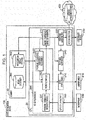
- Fig. 1 is a diagram illustrating an example of the overall configuration of a voice dialogue system in Embodiment 1.
- the voice dialogue system illustrated in Fig. 1 includes a voice recognition device 100, microphone 400, loudspeaker 410, service application server 420, and controlled device 430.
- the voice recognition device 100 includes a central processing unit (CPU) 20, which is a processor, and a memory 30.
- the CPU 20 includes a voice recognizer 200, word confidence level determiner 210, intention interpreter 220, action selector 230, response generator 240, voice synthesizer 250, and speech extractor 260.
- the memory 30 includes a word dictionary 301 and a recognition result storage 302.
- the voice recognizer 200 includes a phoneme estimator 201, word estimator 202, and phoneme occurrence probability determiner 203.
- the word dictionary 301 stores combinations of words and phoneme strings that can be recognized by the voice recognition device 100.
- Fig. 7 is a diagram illustrating an example of data structure of the word dictionary.
- words such as "Curry” and “Carry”
- phoneme strings of the words such as "K AH1 R IY0" and "K AE1 R IY0” are stored with those associated with each other.
- a program that causes a computer to function as the voice recognition device 100 is stored in the memory 30 incorporated in a robot or a terminal in which the voice recognition device 100 is implemented.
- the program is executed by a processor such as the CPU 20.
- All the constituents included in the voice recognition device 100 may be implemented in one terminal, or alternatively the constituents may be separately implemented in another terminal or a server that is connected via a certain network, such as optical fibers, wireless, or public telephone lines.
- Voice dialogue processing may be provided by the voice recognition device 100 and another terminal or a server communicating with each other.
- the microphone 400 is, for example, a directional microphone and is incorporated in the terminal or robot in which the voice recognition device 100 is implemented.
- the microphone 400 may be any sound pickup device, such as a handheld microphone, pin microphone, or desktop microphone, for example. In this case, the microphone 400 is connected via wired or wireless communication to the terminal in which the voice recognition device 100 is implemented.
- the microphone 400 may be a microphone mounted on a device such as a smartphone or tablet terminal, having sound pickup and communication functions.
- the loudspeaker 410 may be incorporated in the terminal or robot in which the voice recognition device 100 is implemented or may be connected via wired or wireless communication to the terminal or robot in which the voice recognition device 100 is implemented.
- the loudspeaker 410 may be a loudspeaker mounted on a device such as a smartphone or tablet terminal, having sound pickup and communication functions.
- the service application server 420 is a cloud server that provides users with multiple services, such as weather, storytelling, news, and games, via a network. For example, the service application server 420 acquires voice recognition result performed by the voice recognition device 100 and determines a service to be performed, in accordance with the recognition result. Services provided by the service application server 420 may be implemented with a program having a function of acquiring execution results in the service application server 420 via a network, or may be implemented with programs stored in both the service application server 420 and a memory on the robot or terminal in which the voice recognition device 100 is implemented.
- the controlled device 430 is an appliance, such as a television set or an air conditioner that are connected to the voice recognition device 100 via wired or wireless communication and controlled by receiving voice recognition result from the voice recognition device 100.
- the speech extractor 260 extracts speech sound signals from the sound signals outputted from the microphone 400 and outputs them to the phoneme estimator 201.
- the speech extractor 260 detects a start of speech, for example, when sound larger than or equal to a specified sound level has continued for a specified period or more, and starts outputting the sound signal, inputted from the microphone 400, to the phoneme estimator 201.
- the speech extractor 260 stops outputting the sound signal to the phoneme estimator 201.
- the speech extractor 260 extracts a sound signal of a voice that a speaker utters intending one word. It is assumed that the speaker is a little child in the language learning stage.
- the phoneme estimator 201 divides the sound signal inputted from the speech extractor 260 into multiple sound sections each having a specified time unit and calculates the occurrence probability of each of all kinds of phonemes for each phoneme section.
- a phoneme means a minimum unit of speech sound in language and is represented by a symbol such as "AA” or "AE”. All kinds of phonemes mean all the phonemes used for speech. All kinds of phonemes here are modeled by acoustic models. Examples of acoustic models include Hidden Markov Models (HMM), for example.
- HMM Hidden Markov Models
- the phoneme estimator 201 may combine consecutive common phoneme sections as a single phoneme section by using HMM to estimate a phoneme string. Then, the phoneme estimator 201 estimates that a combination of phonemes that maximizes the product of occurrence probabilities in all the phoneme sections is the phoneme string uttered by the speaker.
- the word estimator 202 extracts a word that most matches the phoneme string estimated by the phoneme estimator 201, from the word dictionary 301 , and estimates the extracted word to be a word spoken by the speaker.
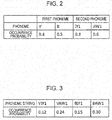
- Fig. 2 is a diagram illustrating an example of occurrence probabilities calculated for every phoneme in a speech including two phonemes.
- Fig. 3 is a diagram in which the products of occurrence probabilities of combinations of phonemes at the first phoneme and phonemes at the second phoneme in Fig. 2 are organized.
- occurrence probabilities of phonemes “V” and “B” are calculated to be “0.4” and “0.5”, respectively, for the first phoneme, and occurrence probabilities of phonemes “IY1" and “AW1” are calculated to be “0.3” and "0.6”, respectively, for the second phoneme.
- the combination that maximizes the product of occurrence probabilities of phonemes at the first phoneme and the second phoneme is "BAW1", the occurrence probability of which is "0.30".
- the word dictionary 301 is searched for the phoneme string "BAW1”, and a word matching the phoneme string "BAW1” is outputted as recognition result.
- the word confidence level determiner 210 compares the confidence level (an example of a first value and a second value) of the word recognized by the word estimator 202 with a specified threshold TH1 (an example of a first threshold). If the confidence level of the word is lower than threshold TH1, the word confidence level determiner 210 stores recognition result including the phoneme string of the word recognized by the word estimator 202 and the occurrence probabilities of the phonemes into the recognition result storage 302 as first recognition result for the first speech. In this case, the word confidence level determiner 210 outputs an instruction to generate a voice to prompt repetition of the speech to the response generator 240 in order to get the speaker to speak the one word again.
- TH1 an example of a first threshold
- the word confidence level determiner 210 determines whether the confidence level of the second recognition result is lower than threshold TH1.
- the phoneme occurrence probability determiner 203 extracts phonemes the occurrence probabilities of which are higher than or equal to threshold TH2 from both the word recognized in the first recognition result and the word recognized in the second recognition result.
- the word estimator 202 extracts a word including the phoneme string extracted by the phoneme occurrence probability determiner 203 from the word dictionary 301 and determines the word as the final recognition result based on the extraction result.
- the word confidence level determiner 210 outputs the recognition result to the intention interpreter 220.
- the intention interpreter 220 estimates the type of response (for example, back-channel feedback, or an answer to a question) and the type of action (a word game, hide and seek, or control of a television set) from the recognition result. Then, the intention interpreter 220 outputs estimation result of the type of response to the response generator 240 while outputting estimation result of the type of action to the action selector 230.
- the type of response for example, back-channel feedback, or an answer to a question
- the type of action a word game, hide and seek, or control of a television set
- the action selector 230 determines a service to be performed or a controlled device 430 to be controlled from the estimation result by the intention interpreter 220. Then, if the action selector 230 determines to perform a service, the action selector 230 transmits a provision request for the service to be performed to the service application server 420. If the action selector 230 determines to control the controlled device 430, the action selector 230 outputs a control instruction to the controlled device 430 to be controlled.
- the response generator 240 When the response generator 240 receives the estimation result of the type of response from the intention interpreter 220, the response generator 240 generates a response sentence corresponding to the estimation result. When the response generator 240 receives an instruction to generate a voice to prompt repetition of the speech from the word confidence level determiner 210, the response generator 240 generates a response sentence for asking the speaker to repeat the one word.
- the voice synthesizer 250 converts the response sentence generated by the response generator 240 into a sound signal and outputs the sound signal to the loudspeaker 410.
- the loudspeaker 410 converts the sound signal outputted from the voice synthesizer 250 into sound and outputs the sound to the outside.
- Fig. 4 is a flowchart illustrating an example of recognition processing in Embodiment 1.
- the speech extractor 260 determines whether there is a sound input at the microphone 400 (step S100). If it is determined that there is no sound input (NO at step S100), the processing at step S100 is repeated until there is a sound input.
- the speech extractor 260 extracts a speech sound signal from the sound signal outputted from the microphone 400 (step S101).
- the voice recognizer 200 performs voice recognition processing (step S102). Specifically, the phoneme estimator 201 divides the sound signal extracted from the speech extractor 260 into multiple sound sections, generates a feature amount for the sound signal of each sound section, and matches the generated feature amount with the acoustic models to estimate a phoneme for each sound section. At this time, the phoneme estimator 201 calculates the occurrence probabilities of the phonemes for every sound section and combines sound sections of consecutive identical phonemes into one, using HMM. For example, assuming that a speech sound includes a first phoneme, second phoneme, and third phoneme, the phoneme estimator 201 calculates occurrence probabilities of all kinds of phonemes for each of the first phoneme, second phoneme, and third phoneme.
- the occurrence probability of each of all kinds of phonemes is calculated for the first phoneme in this way.
- the probability of the phoneme “AA” is “0.4”; the phoneme “AE”, “0.1”; the phoneme “AH”, “0.2”; and so on.
- the occurrence probability of each of all kinds of phonemes is calculated in the same way as for the first phoneme.
- the phoneme estimator 201 estimates that a combination of three phonemes that maximizes the product of the occurrence probabilities of the first phoneme, second phoneme, and third phoneme is the phoneme string of the speech sound.
- the word estimator 202 refers to the word dictionary 301 stored in the memory 30 to select a word that matches the phoneme string estimated by the phoneme estimator 201. If there is no word matching the phoneme string in the word dictionary 301, the word estimator 202 makes the phoneme estimator 201 estimate the phoneme string of the word for which the product of occurrence probabilities of the phonemes is the second largest. Then, the word estimator 202 searches the word dictionary 301 for a word matching the estimated phoneme string.
- the word estimator 202 employs the product of the occurrence probabilities of the phonemes in the matched word as the confidence level of the word, and outputs the phoneme string of the matched word and the occurrence probabilities of the phonemes included in the phoneme string as the recognition result to the word confidence level determiner 210.
- the word confidence level determiner 210 determines whether the confidence level of the recognized word is higher than or equal to threshold TH1 (step S103). If the confidence level of the word is higher than or equal to threshold TH1 (YES at step S103), the word confidence level determiner 210 determines whether first recognition result is stored in the recognition result storage 302 (step S104).
- the first recognition result means the recognition result of a voice spoken before the voice is obtained at step S101, the recognition result being stored in the recognition result storage 302.
- this recognition result is first recognition result.
- the word confidence level determiner 210 erases the first recognition result stored in the recognition result storage 302 (step S105) and outputs the recognition result to the intention interpreter 220.
- the intention interpreter 220 performs intention understanding processing based on the recognition result (step S106).
- step S106 the intention interpreter 220 estimates the type of response and the type of action from the recognition result.
- step S107 the response generator 240 generates a response sentence corresponding to the estimated type of response.
- the action selector 230 determines a service to be performed or a controlled device 430 to be controlled based on the estimated type of action. If a service is determined, the action selector 230 transmits a provision request for the service to the service application server 420. If a controlled device 430 is determined, the action selector 230 outputs a control instruction to the controlled device 430 to be controlled.
- the word confidence level determiner 210 refers to the recognition result storage 302 to determine whether first recognition result is stored therein (step S110). If first recognition result is not stored (NO at step S110), the word confidence level determiner 210 stores the phoneme string of the word estimated by the word estimator 202 and the occurrence probabilities of the phonemes into the recognition result storage 302 as the recognition result for the first speech (first recognition result) (step S109), and the word confidence level determiner 210 outputs an instruction to generate a voice to prompt repetition of the speech, to the response generator 240.
- the response generator 240 generates a response sentence for a repetition request, such as "Please speak slowly again?" and makes the voice recognizer 200 generate a sound signal for the generated response sentence and output the sound of the generated sound signal from the loudspeaker 410 (step S108).
- the voice recognition device 100 is put into a standby state for waiting for the speaker to repeat the speech intending the one word, and the process returns to step S100.
- step S110 When the speaker performs a second speech through this repetition request, second recognition result is obtained for the second speech in the same way as for the first speech through the processing from step S100 to step S102. Then, if the confidence level of the second recognition result is lower than threshold TH1, determination result at step S103 is NO, and the process proceeds to step S110.
- step S103 if the confidence level of the second recognition result is higher or equal to threshold TH1 (YES at step S103), the second recognition result is determined to be the word that the speaker intends, and the processing from step S105 to step S107 is executed.
- the phoneme occurrence probability determiner 203 extracts phonemes having occurrence probabilities higher than or equal to a specified threshold TH2 (an example of a second threshold) from each of the first recognition result stored in the recognition result storage 302 and the second recognition result for the repetition of the speech by the speaker, obtained at step S102 (step S111).
- a specified threshold TH2 an example of a second threshold
- the word estimator 202 refers to the word dictionary 301 to extract words including phonemes having occurrence probabilities higher than or equal to threshold TH2 in the phoneme string of the first recognition result, as recognition candidate words (step S112).
- the word estimator 202 narrows down the recognition candidate words by choosing the words including phonemes having occurrence probabilities higher than or equal to threshold TH2 in the phoneme string of the second recognition result, from the list of the recognition candidate words extracted at step S112 (step S113).
- Fig. 5 is a diagram illustrating an example of a dialogue in Embodiment 1.
- the word “ROBO” indicates a robot in which the voice recognition device 100 is implemented, and the numbers attached after the "ROBO” indicate the order of speeches.
- the word “CHILD” indicates a little child who talks with the robot, and the numbers attached after the "CHILD” indicate the order of speeches.
- the robot says to the little child, "What is your favorite food?" (ROBO1). Responding to it, the little child says, "Curry” (CHILD1). However, in this case, because the confidence level of the word recognized for the speech "Curry” (CHILD1) is low, the robot performs a repetition request at step S108.
- Fig. 6 is a diagram illustrating an example of the first recognition result and the second recognition result for the dialogue example in Fig. 5 .
- the word "Sherry” is recognized for the little child's speech “Curry” in the first recognition result, and the confidence level of this word is lower than threshold TH1.
- the first recognition result is stored in the recognition result storage 302.
- the recognized word is "Sherry”
- the recognized phoneme string is "SH”, ..., "IY0”
- the occurrence probabilities of the phonemes are "0.2", ..., and "0.8".
- the robot Since the confidence level of the first recognition result is low, the robot makes a repetition request by saying, "Please speak slowly again.” Then, the little child says again, "Curry”, but "Color” is recognized as the second recognition result, and the confidence level is also lower than or equal to threshold TH1 in the second recognition result.
- the recognized word is "Color”
- the recognized phoneme string is "K”, ..., "ER0”
- the occurrence probabilities of the phonemes are "0.8", ..., and "0.2”.
- threshold TH2 which is a threshold for the occurrence probability of a phoneme, is defined to be 0.7.
- the phoneme occurrence probability determiner 203 extracts phoneme "R” and phoneme “IY0”, the occurrence probabilities of which are higher than or equal to 0.7, out of the first recognition result.
- the phoneme occurrence probability determiner 203 also extracts phoneme "K” and phoneme "AH1”, the occurrence probabilities of which are higher than or equal to 0.7, out of the second recognition result.
- the word estimator 202 refers to the word dictionary 301 to extract words including the phoneme string of consecutive "R" and "IY0" extracted from the first recognition result, as recognition candidate words.
- the words including the phoneme string of the consecutive phonemes "RIY0" are "Curry”, “Carry”, “Sherry”, and "Curry rice”.
- the word estimator 202 extracts "Curry”, “Carry”, “Sherry”, and "Curry rice” as recognition candidate words.
- Fig. 8 is a diagram illustrating an example of the recognition candidate words extracted from the first recognition result.
- the word estimator 202 extracts the words including the phoneme string of the consecutive phonemes "KAH1" extracted from the second recognition result out of the extracted recognition candidate words, to narrow down the recognition candidate words.
- the words including the phoneme string of the consecutive phonemes "KAH1" are "Curry", and "Curry rice”.
- the word estimator 202 selects "Curry” and “Curry rice” as final recognition candidate words at step S113.
- the word estimator 202 makes a determination of YES at step S115.
- the word estimator 202 makes the voice synthesizer 250 generate sound signals for checking speeches, such as "Did you say, 'Curry'?" and "Did you say, 'Curry rice'?”, to check the recognition candidate words one by one and outputs the sound signals from the loudspeaker 410.
- the speaker responding to the checking speeches, the speaker makes, for example, an affirmative speech (for example, "Yes") or a negative speech (for example, "No").
- the word estimator 202 recognizes an affirmative speech as a response to the checking speech
- the word estimator 202 recognizes the word corresponding the checking speech as a speech intending the one word.
- the word estimator 202 recognizes a negative speech as a response to the checking speech
- the word estimator 202 performs a checking speech for the next recognition candidate word.
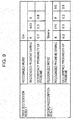
- Fig. 9 is a diagram illustrating another example of processing to narrow down recognition candidate words from the first recognition result and the second recognition result in Embodiment 1.
- the example in Fig. 9 illustrates a narrowing method for the case where phonemes having occurrence probabilities higher than or equal to threshold TH2 are not consecutive in the first recognition result and the second recognition result.
- the dialogue example of Fig. 9 is the same as that of Fig. 5 .
- the first recognition result in which the word "Car” is recognized for a speech "Curry” and the second recognition result in which the word "Sherry” is recognized for a repetition speech “Curry” are obtained.
- the word estimator 202 extracts words in which phonemes including "K” and “R” are lined such that "K” precedes "R” regardless of whether there is a phoneme between "K” and “R”, as recognition candidate words from the word dictionary 301.
- the phoneme occurrence probability determiner 203 extracts the words including phoneme "IY0" out of the extracted recognition candidate words to further narrow down the recognition candidate words.
- step S114 if the number of the narrowed recognition candidate words is reduced to one at step S114 (YES at step S114), the word estimator 202 determines the selected word as the recognition result and moves the process to step S105, then the processing from step S105 onward is executed.
- the phoneme occurrence probability determiner 203 determines whether the number of the narrowed recognition candidate words is reduced to a number larger than or equal to two and smaller than or equal to threshold TH3 (step S115). If the number of the narrowed recognition candidate words is larger than or equal to two and smaller than or equal to threshold TH3 (YES at step S115), the word estimator 202 instructs the voice synthesizer 250 to perform a checking speech to check each of the narrowed recognition candidate words one by one with the speaker (step S116). Examples of the checking speech include, for example, a speech "Did you say 'Curry'?" for the case where the narrowed recognition candidate words include "Curry".
- step S117 If the speaker makes an affirmative speech, such as "Yes” or "I did" in response to a checking speech, the word estimator 202 concludes the recognition candidate word that was affirmed to be the recognition result. If the recognition result is concluded at step S117 (YES at step S117), the process moves to step S105, and the processing from step S105 onward is executed.
- step S109 the word estimator 202 stores the second recognition result into the recognition result storage 302 of the memory 30.
- the recognition result is overwritten on the past recognition result.
- the word estimator 202 may put all the narrowed recognition candidate words into the second recognition result and store this second recognition result into the recognition result storage 302.
- the phoneme occurrence probability determiner 203 abandons the recognition and terminates the processing.
- the voice recognition device 100 in Embodiment 1 even if recognition result having low reliability is obtained from a first speech, the recognition result is not discarded, and the recognition result is utilized if recognition result having low reliability is obtained from a second speech. Thus, even when a repetition request does not lead to acquisition of reliable recognition result, reliable phonemes selected out of the phoneme string included in the first recognition result and the phoneme string included in the second recognition result are used to recognize the one word. As a result, the accuracy in recognizing one word can be improved.
- the voice recognition device 100 may acquire a third recognition result by making a further repetition request. Then, if the confidence level of the third recognition result is lower than threshold TH1, the phoneme occurrence probability determiner 203 may perform a narrowing process using the first, second, and third recognition results.
- the phoneme occurrence probability determiner 203 may further narrows down the recognition candidate words that have been narrowed down using the first and second recognition results, by selecting the words including the phonemes the occurrence probabilities of which are higher than or equal to threshold TH2 out of the phoneme string recognized in the third recognition result. If the number of recognition candidate words does not become lower than or equal to threshold TH3 even with this process, the phoneme occurrence probability determiner 203 may make a further repetition request and repeat the repetition request until the number of recognition candidate words becomes lower than or equal to threshold TH3.
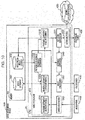
- Fig. 10 is a diagram illustrating an example of the overall configuration of a voice dialogue system in Embodiment 2.
- Fig. 10 is different from Fig. 1 in that the word estimator 202, phoneme occurrence probability determiner 203, and word confidence level determiner 210 are replaced with a sentence estimator 1202, phoneme occurrence probability combiner 1203, and sentence confidence level determiner 1210.
- the voice recognizer 200 in Embodiment 1 has a configuration capable of recognizing only one word as a sound, while the voice recognizer 200 in Embodiment 2 has a configuration capable of recognizing a sentence (word string) including any words.
- the phoneme estimator 201 estimates a phoneme string by using Hidden Markov Models (HMM), and the sentence estimator 1202 estimate a sentence (word string) by using a finite state grammar or an n-gram.
- HMM Hidden Markov Models
- Combination of HMM and a finite state grammar or an n-gram constitutes a search space of a directed graph in which multiple phonemes are connected in the form of a network.
- voice recognition processing comes down to a problem of network route search.
- the voice recognition processing is processing to find a network route most matching an inputted sound signal and obtain a word string corresponding to the route as the recognition result.
- the voice recognition processing is processing to obtain word string W(S) that maximizes the product of occurrence probabilities of the phonemes and the words in the following Formula (2).
- W ⁇ argmax W S ⁇ t 1 T P A o t , s t
- Fig. 11 is a diagram illustrating an example of a sound signal, which is divided into multiple frames. As illustrated in Fig. 11 , the frames are what an inputted sound signal is divided into at certain time intervals, for example, every 25 msec.
- Symbol o t represents the feature vector in the t-th frame.
- the feature vector is an example of a physical quantity used to estimate phonemes and is obtained from the sound level of a sound signal.
- T is the number of frames indicating the length of an inputted sound signal.
- For the feature vector for example, Mel-Frequency Cepstrum Coefficients can be employed.
- Symbol s t represent the state where processing has reached the t-th frame.
- the rightward arrow 1101 indicates state s t .
- a phoneme string "IH1 T S S R R EY1 N N IY0" or "IH1 T S R EY1 N IY0" is estimated.
- IH1 T S S R R EY1 N N IY0" and “IH1 T S R EY1 N IY0” depend on the difference of the acoustic model.
- the phoneme estimator 201 uses an acoustic model in which consecutive identical phonemes are combined, the estimation result of state s t is the latter.
- hereinafter description will be provided using an acoustic model of one phoneme per frame.
- a word string "It's" is estimated.
- s t-1 ) represent the probability of transitioning from the phoneme string corresponding to state s t-1 to the phoneme string corresponding to state s t (the occurrence probability of the phoneme string).
- P L (s t ,s t-1 ) represents the probability of the language model of transitioning from the word string corresponding to state s t-1 to the word string corresponding to state s t (the occurrence probability of the word string).
- occurrence probability P L (s t ,s t-1 ) of the word string is applied when state s t-1 and state s t indicates a boundary of words.
- Occurrence probability P L (s t ,s t-1 ) of the word string is 1 at positions other than boundaries of words.
- W(S) represents state transition process S, in other words, the word string corresponding to state s t .
- the word string as final estimation for a sound signal of an inputted speech corresponds to the phoneme string from the first frame to the t-th frame.
- the phoneme string is estimated in order from the beginning, like from the first frame, then, the second frame, ..., and the t-th frame.
- the phoneme estimator 201 first estimates as many phoneme strings as possible for the sound signal of the speech.
- the phoneme strings that can be estimated include, in addition to the phoneme string for the entire speech, the consecutive phoneme strings from the beginning of the speech to middles of the speech, such as the phoneme string for the first frame, the phoneme string for the first frame to the second frame, the phoneme string for the first frame to the third frame, and so on.
- the sentence estimator 1202 assigns as many assignable words as possible to the estimated phoneme strings. Then, the sentence estimator 1202 multiplies the occurrence probability of each estimated phoneme string by the occurrence probability of assigned words and determines the combination of a phoneme string and the words that make the largest value as the final estimation of the word string.
- the product of the occurrence probability of an estimated phoneme string and the occurrence probabilities of estimated words indicates the confidence level of the word string constituted of the estimated phoneme string and the words assigned thereto.
- occurrence probability P A (o 2 ,s 2
- occurrence probability P A of the phoneme string "IH1 T S R EY1 N IY0" is higher than occurrence probability P A of the phoneme string "IH1 T S R EH1 D IY0".
- the sentence estimator 1202 first, assigns words to the phoneme string estimated by the phoneme estimator 201. For example, in the case where the phoneme string of state s 10 is estimated to be "IH1 T S R EY1 N IY0", words "It's rainy" are assigned. Next, the sentence estimator 1202 calculates occurrence probability P L (s t ,s t-1 ) of the word string by using the occurrence probability of each word determined by a language model such as n-gram for each of the assigned words.
- word occurrence probability P L (s t ,s t-1 ) for "It's rainy” means the probability that "rainy” appears next to "It's”
- word occurrence probability P L (s t ,s t-1 ) for "It's ready” means the probability that "ready” appears next to "It's”.
- the occurrence probabilities of these words are stored in the word dictionary 301.
- word occurrence probability for the phoneme string "IH1 T S R EY1 N IY0" of state s 10 if the word occurrence probability of "It's rainy" is higher than the word occurrence probability of "It's ready", word occurrence probability P L (s t ,s t-1 ) for "It's rainy today” will be higher than word occurrence probability P L (s t ,s t-1 ) for "It's ready today”.
- the calculation of word occurrence probability is the same regardless of which n-gram (n is a natural number) is utilized.
- the sentence confidence level determiner 1210 multiplies together occurrence probability P A (o t ,s t
- the phoneme occurrence probability combiner 1203 combines the occurrence probabilities of each phoneme by summing the occurrence probability of each phoneme in the first speech and the occurrence probability of each phoneme in the second speech. Note that when the occurrence probabilities of each phoneme are combined, the sentence estimator 1202 uses the combined occurrence probability of each phoneme to calculate the confidence levels of multiple word strings by using the same approach as used for the first speech. Then, the sentence estimator 1202 selects the word string having the highest confidence level as the final recognition result. In other words, the sentence estimator 1202 takes word string W(s) in Formula (3) as the final recognition result.
- the first speech means a response to a question from the voice recognition device 100 or a speech that the user makes when the user talks to the voice recognition device 100, instead of a response speech to a repetition request.
- the second speech means a response speech to a repetition request, which is a speech that the speaker makes intending the first speech.
- P A1 represents the phoneme-string occurrence probability of the first speech
- P A2 represents the phoneme-string occurrence probability of the second speech.
- the sum of the value obtained by multiplying the occurrence probability of each phoneme in the first speech by weight value ⁇ /( ⁇ + ⁇ ) and the value obtained by multiplying the occurrence probability of each phoneme in the second speech by weight value ⁇ /( ⁇ + ⁇ ) may be used for the sum of the occurrence probabilities.
- the sentence confidence level determiner 1210 determines whether the confidence level of the recognition result for the first speech estimated by the sentence estimator 1202 (the product of the phoneme-string occurrence probability and the word-string occurrence probability) is higher than or equal to threshold TH1. Then, if the confidence level is lower than threshold TH1, the sentence confidence level determiner 1210 stores the recognition result for the first speech into the recognition result storage 302 as the first recognition result and performs a repetition request.
- the first recognition result includes necessary information to estimate the word string, for example, a recognized word string, the phoneme string corresponding to the word string, and the occurrence probabilities of the phonemes included in the phoneme string.
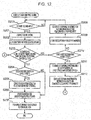
- Fig. 12 is a flowchart illustrating an example of the recognition processing in Embodiment 2. Processing at steps S200 and S201 is the same as that of steps S100 and S101 illustrated in Fig. 4 .
- the voice recognizer 200 performs voice recognition processing (step S202). Specifically, the phoneme estimator 201 estimates a phoneme of each sound section using an acoustic model in the same way as in Embodiment 1. The sentence estimator 1202 assigns word strings registered in the word dictionary 301 to the phoneme string estimated by the phoneme estimator 201. At this time, the sentence estimator 1202 assigns assignable word strings to each of all the phoneme strings estimated by the phoneme estimator 201 and obtains one or more word strings for each estimated phoneme string.
- the sentence estimator 1202 outputs the word string that maximizes the product of the phoneme-string occurrence probability and the occurrence probability of the assigned word string as the recognition result, and the sentence estimator 1202 also outputs the largest value of the product to the sentence confidence level determiner 1210 as the confidence level of the word string obtained as the recognition result.
- the sentence confidence level determiner 1210 determines whether the confidence level of the word string recognized by the sentence estimator 1202 is higher than or equal to threshold TH1 (step S203). If the confidence level of the sentence is higher than or equal to threshold TH1 (YES at step S203), the process proceeds to step S204. Steps S204 to S207 are the same as steps S104 to S107 illustrated in Fig. 4 .
- the sentence confidence level determiner 1210 refers to the recognition result storage 302 to determine whether first recognition result is stored therein (step S210). If first recognition result is not stored (NO at step S210), the sentence confidence level determiner 1210 stores the word string recognized by the sentence estimator 1202, the phoneme string corresponding to the word string, and the occurrence probability of each phoneme obtained from P A (o t ,s t
- step S208 in the same way as in step S108 in Fig.
- the voice recognition device 100 performs a repetition request. With this repetition request, the speaker makes a second speech. Through the processing from step S200 to step S202, second recognition result for the second speech is obtained in the same way for the first speech. Then, if the confidence level of the second recognition result is lower than threshold TH1, determination result at step S203 is NO, and the process proceeds to step S210.
- step S203 If the confidence level of the second recognition result is higher than or equal to threshold TH1 (YES at step S203), the second recognition result is determined as the one word string that the speaker intends, and the processing from step S205 to step S207 is executed.
- the phoneme occurrence probability combiner 1203 obtains the sum of the occurrence probability of each phoneme in the phoneme string included in the first recognition result stored in the recognition result storage 302 and the occurrence probability of each phoneme in the phoneme string of the second speech obtained at step S202 (step S211).
- the sentence estimator 1202 multiplies together the sums of the occurrence probabilities of each phoneme in the first speech and the second speech to calculate combined occurrence probability described later, and multiplies this combined occurrence probability by the word occurrence probability to calculate the confidence level of each word string. Then the sentence estimator 1202 recognizes the word string providing the largest confidence level as the one word string of the speech that the speaker made (step S212). When the processing at step S212 ends, the process moves to step S203.
- Embodiment 2 Next, a specific example of Embodiment 2 will be described.
- a model capable of estimating only two word strings (sentences), "It's curry” and "It's cherry”, is used to describe a voice recognition device 100 which recognizes a sentence.
- the phoneme estimator 201 estimates the phoneme string for a speech to be "IH1 T S K AH1 R YI0" or "IH1 T S CH EH1 R YI0".
- the occurrence probability of each phoneme string is calculated as the product of the occurrence probabilities of the phonemes included in each phoneme string.
- Fig. 13 is a diagram illustrating an example of a search space for the case where a 1-gram language model is employed for the specific example of Embodiment 2.
- each set of alphabet letters indicates a phoneme, and the numerical value written under each set of alphabet letters is the occurrence probability of the phoneme.
- This search space includes elements “sil” at both the beginning and the end and the phoneme string "IH1 T S K AH1 R YI0" and the phoneme string "IH1 T S CH EH1 R YI0". Specifically, this search space begins with the element "sil”, continues to "IH1 T S", then separates into two phoneme strings, "K AH1 R IYO" and "CH EH1 R IYO", and reaches the last element "sil".
- the occurrence probability of the phoneme string "IH1 T S K AH1 R YI0" is calculated to be 0.7 ⁇ 0.8 ⁇ 0.8 ⁇ ... ⁇ 0.5 ⁇ 0.9
- the occurrence probability of the phoneme string "IH1 T S CH EH1 R YI0" is calculated to be 0.7 ⁇ 0.8 ⁇ 0.8 ⁇ ... ⁇ 0.5 ⁇ 0.9.
- the sentence estimator 1202 assigns these three words to the phoneme strings to obtain the search space illustrated in Fig. 13 .
- the numerical value attached at the right side of each word indicates the occurrence probability of the word.
- n-gram is used for the word occurrence probability.
- the occurrence probability of a word depends on the immediately preceding word.
- 1-gram is used. Since 1-gram does not depends on the immediately preceding word, the occurrence probability of a word itself is utilized. In this case, the probability that "It's" is said as the first word is 1. Then, the probability that it is followed by "Curry” is 0.6, and the probability that it is followed by "Cherry” is 0.4.
- the sentence estimator 1202 extracts all the routes connecting the front element "sil” to the last element “sil” as phoneme strings and assigns assignable words to each phoneme string out of the words registered in the word dictionary 301 to obtain multiple word strings.
- the word “It's” is assigned to the phoneme string "IH1 T S”
- the word “Curry” is assigned to the phoneme string "K AH1 R IY0”
- the word “Cherry” is assigned to the phoneme string "CH EH1 R IY0”. Accordingly, in the example of Fig. 13 , the word strings “It's curry” and "It's cherry” are obtained.
- the multiplication value "0.7 ⁇ 0.8 ⁇ ... ⁇ 0.9” is obtained by multiplying together the occurrence probabilities of all the phonemes included in the phoneme string "IH1 T S K AH1 R YI0" and "sil” of the word string "It's curry", and the above multiplication value is multiplied by the occurrence probability "1" of the word “It's” and the occurrence probability "0.6” of the word “Curry” to obtain the confidence level of the word string "It's curry". In the same way as above, the confidence level of the word string "It's cherry” is obtained.
- the word string having the highest confidence level is estimated to be the recognition result.
- the word string "It's curry” is selected to be the recognition result.
- Fig. 14 illustrates a 2-gram dictionary consisting of only the three words, "It's", “Curry”, and “Cherry”.
- Fig. 14 is a diagram illustrating an example of a word dictionary 301 for the case of employing a 2-gram language model for the specific example of Embodiment 2.
- the 2-gram combinations that can be obtained from “sil” and the three words, "It's", “Curry”, and “Cherry", are as follows.
- possible 2-gram combinations are three sets for “sil”: “It's”, “Curry”, and “Cherry”; three sets for “Curry”: “It's”, “Cherry”, and “sil”; three sets for “Cherry”: “It's”, “Curry”, and “sil”; and three sets for “It's”: “Curry”, “Cherry”, and “sil”.
- a total of 3 ⁇ 4 12 sets combinations are possible. Accordingly, these twelve combinations of 2-gram word strings are registered in the word dictionary 301 illustrated in Fig. 14 .
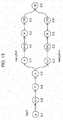
- Fig. 15 is a diagram illustrating an example of a search space employing the 2-gram language model for the specific example of Embodiment 2. Note that in Fig. 15 , the occurrence probabilities of the phoneme strings and each phoneme are the same as those in Fig. 13 .
- the probability that "It's" appears at the first word in other words, the probability that "It's" appears next to the element "sil” is 0.6.
- the probability that "Curry” appears next to “It's” is 0.5, and the probability that "Cherry” appears next to “It's” is 0.3. Further, the probability that "sil” appears next to “Curry” is 0.5, and the probability that "sil” appears next to “Cherry” is 0.5.
- the word string that maximizes the product of the occurrence probability of the phoneme string and the occurrence probabilities of the 2-gram word strings in each route illustrated in the graph of Fig. 15 is selected as the recognition result.
- the product of the occurrence probabilities of the phonemes in the phoneme string "IH1 T S K AH1 R YI0" and the occurrence probabilities of "sil-It's", “It's curry", and “Curry-sil” (0.6, 0.5, and 0.5, respectively) is calculated to be the confidence level of the word string "It's curry".
- the confidence level of the word string "It's cherry” is also calculated.
- the word string "It's curry” is selected as the final recognition result.
- n-gram is 3-gram or more.
- the sentence confidence level determiner 1210 determines whether the confidence level of the word string estimated by the sentence estimator 1202 is higher than or equal to threshold TH1. If both the confidence level of the first recognition result for the first speech and the confidence level of the second recognition result for the second speech are lower than threshold TH1, the phoneme occurrence probability combiner 1203 multiplies the sums together, each sum obtained by summing the occurrence probability of each phoneme in the first speech and the occurrence probability of each phoneme in the second speech, to calculate the combined occurrence probability.
- the sentence estimator 1202 uses the combined occurrence probability calculated by the phoneme occurrence probability combiner 1203 to recognize the word string (sentence).
- Fig. 16 is a diagram illustrating a search space for the case where the occurrence probabilities of each phoneme in the first recognition result and each phoneme in the second recognition result are combined in the specific example of Embodiment 2.
- Fig. 16 indicates a directed graph of the phoneme string "IH1 T S K AH1 R YI0" and the phoneme string "IH1 T S CH EH1 R YI0" as well as the occurrence probability of each phoneme in the first speech and those of the second speech in the same way as in Fig. 15 .
- 1-gram words are assigned.
- the numerical value written immediately under each phoneme indicates the occurrence probability for the first speech
- the numerical value immediately under the numerical value for the first speech indicates the occurrence probability for the second speech.
- the combined occurrence probability of the phoneme string "IH1 T S K AH1 R YI0" is (0.7 + 0.6) ⁇ (0.8 + 0.7) ⁇ ... ⁇ (0.5 + 0.6) ⁇ (0.9 + 0.9).
- the combined occurrence probability of the phoneme string "IH1 T S CH EH1 R YI0" is (0.7 + 0.6) ⁇ (0.8 + 0.7) ⁇ ... ⁇ (0.5 + 0.6) ⁇ (0.9 + 0.9).
- the sentence estimator 1202 assigns the 1-gram word strings registered in the word dictionary 301 for each of the phoneme string "IH1 T S K AH1 R YI0" and the phoneme string "IH1 T S CH EH1 R YI0".
- the sentence estimator 1202 multiplies the combined occurrence probability calculated by the phoneme occurrence probability combiner 1203 by the word occurrence probabilities to calculate the confidence level of each word string. Then, the sentence estimator 1202 recognizes the phoneme string having the highest confidence level as the one word string that the speaker intends.
- the confidence level of the word string "It's curry” is calculated to be (0.7 + 0.6) ⁇ (0.8 + 0.7) ⁇ ... ⁇ (0.9 + 0.9) ⁇ 1 ⁇ 0.6.
- the confidence level of the word string "It's cherry” is calculated to be (0.7 + 0.6) ⁇ (0.8 + 0.7) ⁇ ... ⁇ (0.9 + 0.9) ⁇ 1 ⁇ 0.4.
- the voice recognition device 100 in Embodiment 2 even if recognition result having low reliability is obtained for a first speech, the recognition result is not discarded but utilized if recognition result having low reliability is obtained for a second speech. Thus, even when a repetition request does not lead to acquisition of reliable recognition result, both the recognition results are combined to recognize the one word string, which improves the accuracy in recognizing the one word string.
- the recognition result stored in the recognition result storage 302 at step S209 may include not only the immediately preceding recognition result but also multiple past recognition results obtained by repetition requests.
- the phoneme occurrence probability combiner 1203, at step S211 may combine the occurrence probabilities of each phoneme in multiple phoneme strings obtained as multiple past recognition results with the occurrence probability of each phoneme in the phoneme string obtained as the latest recognition result.
- Fig. 17 is a diagram illustrating an example of the overall configuration of a voice dialogue system in Embodiment 3.
- Fig. 17 is different from Fig. 10 in that the phoneme occurrence probability combiner 1203 is eliminated, and a common candidate extractor 270 is added.
- the sentence estimator 1202 estimates the word string in the same way as in Embodiment 2 but does not select the word string having the highest confidence level as the recognition result.
- the sentence estimator 1202 extracts top n word strings in descending order of the confidence level as recognition candidates and regards the top n recognition candidates (n-best) as the recognition result.
- N-best means top n recognition candidates in descending order of the confidence level out of the multiple recognition candidates included in the recognition result.
- the common candidate extractor 270 compares recognition candidates (n-best) for the first speech with recognition candidates (n-best) for the second speech, extracts common recognition candidates, and determines a final recognition word string based on the extraction result.
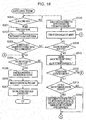
- Fig. 18 is a flowchart for explaining an example of recognition processing in Embodiment 3.
- Processing from step S300 to step S307 is basically the same as the processing from step S200 to step S207 illustrated in Fig. 12 .
- the sentence confidence level determiner 1210 determines whether the largest value of the confidence level for the first recognition result estimated by the sentence estimator 1202 is larger than or equal to threshold TH1.
- step S303 If the largest value of the confidence level for the first recognition result is larger than or equal to threshold TH1 at step S303 (YES step S303), the recognition candidate having the largest value is determined as the one word string that the speaker intended, and the processing from step S305 to step S307 is executed.
- the sentence confidence level determiner 1210 refers to the recognition result storage 302 to determine whether first recognition result is stored therein (step S310). If first recognition result is not stored (NO at step S310), as illustrated in Fig. 19 , the sentence confidence level determiner 1210 acquires, as n-best, n recognition candidates out of the recognition candidates included in the recognition result for the first speech in descending order of the confidence level (the product of the occurrence probabilities of the phonemes and the products of the occurrence probabilities of the words) from the sentence estimator 1202, and stores the acquired candidates into the recognition result storage 302.
- step S308 the voice recognition device 100 performs a repetition request in the same way as in step S208 illustrated in Fig. 10 .
- the speaker makes a second speech.
- step S302 second recognition result for the second speech is obtained in the same way for the first speech. Then, if the largest value of the confidence level in the second recognition result is lower than threshold TH1, determination result at step S303 is NO, and the process proceeds to step S310.
- step S303 if the largest value of the confidence level in the second recognition result is larger than or equal to threshold TH1 (YES at step S303), the recognition candidate having the largest value is determined as the one word string that the speaker intends, and the processing from step S305 to step S307 is executed.
- the common candidate extractor 270 compares the n-best candidates for the first recognition result and the n-best candidates for the second recognition result (step S311).
- the common candidate extractor 270 determines from the comparison result whether there is a common recognition candidate (step S312). If there is a common recognition candidate (YES at step S312), the common candidate extractor 270 determines whether there are multiple common candidates (step S313). If there are multiple common recognition candidates (YES at step S313), the common candidate extractor 270 calculates the sum of the confidence level of the first recognition result and the confidence level of the second recognition result for each of the multiple common recognition candidates. Then, the common candidate extractor 270 may determine the recognition candidate having the largest sum of the confidence level as the final recognition result or may determines multiple recognition candidates selected in descending order of the sum of the confidence levels as the final recognition result. When the processing at step S314 ends, the process moves to step S304. In addition, the common candidate extractor 270 may perform checking speeches described at step S116 in Fig. 4 for the multiple recognition candidates obtained in descending order of the sum of the confidence levels and determine the recognition candidate that the speaker agreed to as the final recognition result.
- Fig. 19 is a diagram illustrating an example of 5-best candidates for the first recognition result in Embodiment 3.
- Fig. 20 is a diagram illustrating an example of 5-best candidates for the second recognition result in Embodiment 3.
- the common recognition candidates between Figs. 19 and 20 are "I like curry” and "I want curry”.
- "I like curry” having the largest sum of the confidence level is determined as the final recognition result.
- both of the recognition candidates may be determined as the final confidence levels.
- the process moves to step S309.
- the common candidate extractor 270 also stores the second recognition result into the recognition result storage 302 in addition to the first recognition result at step S309, and outputs to the response generator 240 an instruction to generate a response sentence for a repetition request to perform a further repetition request to the speaker (step S308).
- a third recognition result is obtained.
- the first, second, and third recognition results are compared, and common recognition candidates are extracted. In this case, if there is a recognition candidate that is common at least two of the first, second, and third recognition results, the recognition candidate is extracted as a common recognition result.
- the voice recognition device 100 even if recognition result having low reliability is obtained for a first speech, the recognition result is not discarded but utilized if recognition result having low reliability is obtained for a second speech. Thus, even when a repetition request does not lead to acquisition of reliable recognition result, word strings recognized in both the first speech and the second speech are used to recognize the one word string, which improves the accuracy in recognizing the one word string.
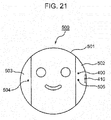
- the voice recognition device 100 may be implemented in a robot 500 as illustrated in Fig. 21.
- Fig. 21 is an external view of the robot 500 in which the voice recognition device 100 according to one of Embodiments 1 to 3 is implemented.
- the robot 500 includes a main housing 501 in a spherical belt shape, first spherical crown portion 502, and second spherical crown portion 503.
- the main housing 501, first spherical crown portion 502, and second spherical crown portion 503 constitute a sphere as a whole.
- the robot 500 has a spherical shape.
- the robot 500 has a camera 504 on the second spherical crown portion 503 and a distance sensor 505, loudspeaker 410, and microphone 400 on the first spherical crown portion 502.
- the camera 504 acquires images of the surrounding environment of the robot 500.
- the distance sensor 505 acquires information of the distance from the robot 500 to the surrounding environment.
- the robot 500 includes the camera 504 on the second spherical crown portion 503 and the distance sensor 505, loudspeaker 410, and microphone 400 on the first spherical crown portion 502, the arrangement is not limited to this.
- a camera 504, distance sensor 505, loudspeaker 410, and microphone 400 only need to be included in at least one of the first spherical crown portion 502 and the second spherical crown portion 503.
- the center of the first spherical crown portion 502 and the center of the second spherical crown portion 503 are fixedly connected to each other with a shaft (not illustrated) provided inside the main housing 501.
- the main housing 501 is rotatably attached to the shaft.
- a frame (not illustrated) and a display (not illustrated) are also attached to the shaft. Attached to the frame is a first motor (not illustrated) to rotate the main housing 501. Rotation of this first motor (not illustrated) rotates the main housing 501 relative to the first spherical crown portion 502 and the second spherical crown portion 503, which moves the robot 500 forward or backward.
- the first motor and the main housing 501 is an example of a moving mechanism.
- the camera 504, distance sensor 505, microphone 400, and loudspeaker 410 are kept facing ahead of the robot 1.
- the display shows an image depicting the eyes and mouth of the robot 1. This display is attached such that the angle of the display relative to the shaft can be adjusted by the power of the second motor (not illustrated). Thus, the direction of the eyes and mouth of the robot is adjusted by adjusting the angle of the display to the shaft. Note that since the display is attached to the shaft separately from the main housing 501, the angle of the display to the shaft does not change even when the main housing 501 rotates. Thus, the robot 500 can move forward or backward with the direction of the eyes and mouth kept fixed.
Landscapes
- Engineering & Computer Science (AREA)
- Physics & Mathematics (AREA)
- Computational Linguistics (AREA)
- Health & Medical Sciences (AREA)
- Audiology, Speech & Language Pathology (AREA)
- Human Computer Interaction (AREA)
- Acoustics & Sound (AREA)
- Multimedia (AREA)
- Computer Vision & Pattern Recognition (AREA)
- Quality & Reliability (AREA)
- Signal Processing (AREA)
- Machine Translation (AREA)
- Document Processing Apparatus (AREA)
Applications Claiming Priority (2)
| Application Number | Priority Date | Filing Date | Title |
|---|---|---|---|
| JP2017131762 | 2017-07-05 | ||
| JP2018038717A JP2019015950A (ja) | 2017-07-05 | 2018-03-05 | 音声認識方法、プログラム、音声認識装置、及びロボット |
Publications (1)
| Publication Number | Publication Date |
|---|---|
| EP3425628A1 true EP3425628A1 (fr) | 2019-01-09 |
Family
ID=62846044
Family Applications (1)
| Application Number | Title | Priority Date | Filing Date |
|---|---|---|---|
| EP18181408.8A Withdrawn EP3425628A1 (fr) | 2017-07-05 | 2018-07-03 | Procédé de reconnaissance vocale, support d'enregistrement, dispositif de reconnaissance vocale et robot |
Country Status (3)
| Country | Link |
|---|---|
| US (1) | US10650802B2 (fr) |
| EP (1) | EP3425628A1 (fr) |
| CN (1) | CN109215631A (fr) |
Cited By (1)
| Publication number | Priority date | Publication date | Assignee | Title |
|---|---|---|---|---|
| WO2022193892A1 (fr) * | 2021-03-16 | 2022-09-22 | 深圳地平线机器人科技有限公司 | Procédé et appareil d'interaction vocale, ainsi que support de stockage lisible par ordinateur et dispositif électronique |
Families Citing this family (13)
| Publication number | Priority date | Publication date | Assignee | Title |
|---|---|---|---|---|
| US10957322B2 (en) * | 2016-09-09 | 2021-03-23 | Sony Corporation | Speech processing apparatus, information processing apparatus, speech processing method, and information processing method |
| JP7500582B2 (ja) * | 2019-01-25 | 2024-06-17 | ソウル マシーンズ リミティド | 発話アニメーションのリアルタイム生成 |
| US11107475B2 (en) * | 2019-05-09 | 2021-08-31 | Rovi Guides, Inc. | Word correction using automatic speech recognition (ASR) incremental response |
| US11367438B2 (en) * | 2019-05-16 | 2022-06-21 | Lg Electronics Inc. | Artificial intelligence apparatus for recognizing speech of user and method for the same |
| US11043218B1 (en) * | 2019-06-26 | 2021-06-22 | Amazon Technologies, Inc. | Wakeword and acoustic event detection |
| CN110265018B (zh) * | 2019-07-01 | 2022-03-04 | 成都启英泰伦科技有限公司 | 一种连续发出的重复命令词识别方法 |
| CN112242144A (zh) * | 2019-07-17 | 2021-01-19 | 百度在线网络技术(北京)有限公司 | 基于流式注意力模型的语音识别解码方法、装置、设备以及计算机可读存储介质 |
| JP7322830B2 (ja) * | 2020-07-28 | 2023-08-08 | トヨタ自動車株式会社 | 情報出力システムおよび情報出力方法 |
| US11830486B2 (en) * | 2020-10-13 | 2023-11-28 | Google Llc | Detecting near matches to a hotword or phrase |
| US12008048B2 (en) | 2021-01-04 | 2024-06-11 | Oracle International Corporation | Drill back to original audio clip in virtual assistant initiated lists and reminders |
| CN113792852B (zh) * | 2021-09-09 | 2024-03-19 | 湖南艾科诺维科技有限公司 | 基于并行神经网络的信号调制方式识别系统及识别方法 |
| CN114359450A (zh) * | 2022-01-17 | 2022-04-15 | 小哆智能科技(北京)有限公司 | 一种模拟虚拟人物说话的方法及装置 |
| US12562152B2 (en) * | 2022-12-08 | 2026-02-24 | Google Llc | Voice-history based speech biasing |
Citations (6)
| Publication number | Priority date | Publication date | Assignee | Title |
|---|---|---|---|---|
| US5712957A (en) * | 1995-09-08 | 1998-01-27 | Carnegie Mellon University | Locating and correcting erroneously recognized portions of utterances by rescoring based on two n-best lists |
| JPH11249688A (ja) | 1998-03-05 | 1999-09-17 | Mitsubishi Electric Corp | 音声認識装置およびその方法 |
| US20080059167A1 (en) * | 2006-08-12 | 2008-03-06 | International Business Machines Corporation | Speech Recognition System |
| US20100076765A1 (en) * | 2008-09-19 | 2010-03-25 | Microsoft Corporation | Structured models of repitition for speech recognition |
| US20150199965A1 (en) * | 2014-01-16 | 2015-07-16 | CloudCar Inc. | System and method for recognition and automatic correction of voice commands |
| US9123339B1 (en) * | 2010-11-23 | 2015-09-01 | Google Inc. | Speech recognition using repeated utterances |
Family Cites Families (7)
| Publication number | Priority date | Publication date | Assignee | Title |
|---|---|---|---|---|
| JPH02132498A (ja) * | 1988-11-14 | 1990-05-21 | A T R Jido Honyaku Denwa Kenkyusho:Kk | Hmm音韻認識方式 |
| DE60124559T2 (de) * | 2000-07-13 | 2007-09-06 | Asahi Kasei Kabushiki Kaisha | Einrichtung und verfahren zur spracherkennung |
| GB0426347D0 (en) * | 2004-12-01 | 2005-01-05 | Ibm | Methods, apparatus and computer programs for automatic speech recognition |
| US8831183B2 (en) * | 2006-12-22 | 2014-09-09 | Genesys Telecommunications Laboratories, Inc | Method for selecting interactive voice response modes using human voice detection analysis |
| DE112008001763T5 (de) * | 2007-07-09 | 2010-04-29 | Mitsubishi Electric Corporation | Spracherkennungsvorrichtung und Navigationssystem |
| US9418679B2 (en) * | 2014-08-12 | 2016-08-16 | Honeywell International Inc. | Methods and apparatus for interpreting received speech data using speech recognition |
| FR3041140B1 (fr) * | 2015-09-15 | 2017-10-20 | Dassault Aviat | Reconnaissance vocale automatique avec detection d'au moins un element contextuel, et application au pilotage et a la maintenance d'un aeronef |
-
2018
- 2018-06-27 CN CN201810674290.6A patent/CN109215631A/zh active Pending
- 2018-06-27 US US16/019,701 patent/US10650802B2/en not_active Expired - Fee Related
- 2018-07-03 EP EP18181408.8A patent/EP3425628A1/fr not_active Withdrawn
Patent Citations (6)
| Publication number | Priority date | Publication date | Assignee | Title |
|---|---|---|---|---|
| US5712957A (en) * | 1995-09-08 | 1998-01-27 | Carnegie Mellon University | Locating and correcting erroneously recognized portions of utterances by rescoring based on two n-best lists |
| JPH11249688A (ja) | 1998-03-05 | 1999-09-17 | Mitsubishi Electric Corp | 音声認識装置およびその方法 |
| US20080059167A1 (en) * | 2006-08-12 | 2008-03-06 | International Business Machines Corporation | Speech Recognition System |
| US20100076765A1 (en) * | 2008-09-19 | 2010-03-25 | Microsoft Corporation | Structured models of repitition for speech recognition |
| US9123339B1 (en) * | 2010-11-23 | 2015-09-01 | Google Inc. | Speech recognition using repeated utterances |
| US20150199965A1 (en) * | 2014-01-16 | 2015-07-16 | CloudCar Inc. | System and method for recognition and automatic correction of voice commands |
Non-Patent Citations (2)
| Title |
|---|
| HORI.T; TSUKADA.H: "Speech Recognition Using Weighted Finite-State Transducers", JOURNAL OF INFORMATION PROCESSING SOCIETY OF JAPAN, vol. 45, no. 10, October 2004 (2004-10-01), pages 1020 - 1026 |
| T. HORI ET AL: "Speech Recognition Using Weighted Finite-State Transducers", JOURNAL OF INFORMATION PROCESSING SOCIETY OF JAPAN, 1 October 2004 (2004-10-01), pages 1020 - 1026, XP055517707, Retrieved from the Internet <URL:https://ci.nii.ac.jp/lognavi?name=ipsj&lang=en&id=http%3A%2F%2Fid.nii.ac.jp%2F1001%2F00065159%2F&naid=110002769590> [retrieved on 20181022] * |
Cited By (2)
| Publication number | Priority date | Publication date | Assignee | Title |
|---|---|---|---|---|
| WO2022193892A1 (fr) * | 2021-03-16 | 2022-09-22 | 深圳地平线机器人科技有限公司 | Procédé et appareil d'interaction vocale, ainsi que support de stockage lisible par ordinateur et dispositif électronique |
| US12592228B2 (en) | 2021-03-16 | 2026-03-31 | Shenzhen Horizon Robotics Technology Co., Ltd. | Speech interaction method, and apparatus, computer readable storage medium, and electronic device |
Also Published As
| Publication number | Publication date |
|---|---|
| US10650802B2 (en) | 2020-05-12 |
| US20190013008A1 (en) | 2019-01-10 |
| CN109215631A (zh) | 2019-01-15 |
Similar Documents
| Publication | Publication Date | Title |
|---|---|---|
| US10650802B2 (en) | Voice recognition method, recording medium, voice recognition device, and robot | |
| JP6574169B2 (ja) | 多方向の復号をする音声認識 | |
| US7698136B1 (en) | Methods and apparatus for flexible speech recognition | |
| US10008197B2 (en) | Keyword detector and keyword detection method | |
| EP3114679B1 (fr) | Prévision de prononciation pour une reconnaissance vocale | |
| US8660842B2 (en) | Enhancing speech recognition using visual information | |
| JP5172021B2 (ja) | 自動音声認識音響モデルの適合 | |
| KR102850999B1 (ko) | 대화 동안 텍스트 음성 변환에서의 즉각적인 학습 | |
| US9711136B2 (en) | Speech recognition device and speech recognition method | |
| US20060184360A1 (en) | Adaptive multi-pass speech recognition system | |
| WO2001022400A1 (fr) | Reconnaissance de la parole iterative a partir de multiples vecteurs de caracteristiques | |
| US7181395B1 (en) | Methods and apparatus for automatic generation of multiple pronunciations from acoustic data | |
| KR101153078B1 (ko) | 음성 분류 및 음성 인식을 위한 은닉 조건부 랜덤 필드모델 | |
| JP6797338B2 (ja) | 情報処理装置、情報処理方法及びプログラム | |
| US10460722B1 (en) | Acoustic trigger detection | |
| US20210398521A1 (en) | Method and device for providing voice recognition service | |
| CN112133285A (zh) | 语音识别方法、装置、存储介质和电子设备 | |
| JP5315976B2 (ja) | 音声認識装置、音声認識方法、および、プログラム | |
| US20070038453A1 (en) | Speech recognition system | |
| WO2002103675A1 (fr) | Architecture de systeme de reconnaissance vocale repartie sur la base client-serveur | |
| KR20210052563A (ko) | 문맥 기반의 음성인식 서비스를 제공하기 위한 방법 및 장치 | |
| JP2019015950A (ja) | 音声認識方法、プログラム、音声認識装置、及びロボット | |
| US11043212B2 (en) | Speech signal processing and evaluation | |
| CN120375865A (zh) | 具有语音模式识别功能的人工智能压力反馈装置 | |
| JP3039399B2 (ja) | 非母国語音声認識装置 |
Legal Events
| Date | Code | Title | Description |
|---|---|---|---|
| PUAI | Public reference made under article 153(3) epc to a published international application that has entered the european phase |
Free format text: ORIGINAL CODE: 0009012 |
|
| AK | Designated contracting states |
Kind code of ref document: A1 Designated state(s): AL AT BE BG CH CY CZ DE DK EE ES FI FR GB GR HR HU IE IS IT LI LT LU LV MC MK MT NL NO PL PT RO RS SE SI SK SM TR |
|
| AX | Request for extension of the european patent |
Extension state: BA ME |
|
| STAA | Information on the status of an ep patent application or granted ep patent |
Free format text: STATUS: THE APPLICATION IS DEEMED TO BE WITHDRAWN |
|
| 18D | Application deemed to be withdrawn |
Effective date: 20190710 |