EP3426182B1 - Procédés et compositions de régénération et/ou de réparation de tissu dentaire - Google Patents
Procédés et compositions de régénération et/ou de réparation de tissu dentaire Download PDFInfo
- Publication number
- EP3426182B1 EP3426182B1 EP17763983.8A EP17763983A EP3426182B1 EP 3426182 B1 EP3426182 B1 EP 3426182B1 EP 17763983 A EP17763983 A EP 17763983A EP 3426182 B1 EP3426182 B1 EP 3426182B1
- Authority
- EP
- European Patent Office
- Prior art keywords
- alkyl
- heterocyclyl
- triacrylate
- alkynyl
- alkenyl
- Prior art date
- Legal status (The legal status is an assumption and is not a legal conclusion. Google has not performed a legal analysis and makes no representation as to the accuracy of the status listed.)
- Active
Links
Images








Classifications
-
- A—HUMAN NECESSITIES
- A61—MEDICAL OR VETERINARY SCIENCE; HYGIENE
- A61L—METHODS OR APPARATUS FOR STERILISING MATERIALS OR OBJECTS IN GENERAL; DISINFECTION, STERILISATION OR DEODORISATION OF AIR; CHEMICAL ASPECTS OF BANDAGES, DRESSINGS, ABSORBENT PADS OR SURGICAL ARTICLES; MATERIALS FOR BANDAGES, DRESSINGS, ABSORBENT PADS OR SURGICAL ARTICLES
- A61L27/00—Materials for grafts or prostheses or for coating grafts or prostheses
- A61L27/36—Materials for grafts or prostheses or for coating grafts or prostheses containing ingredients of undetermined constitution or reaction products thereof, e.g. transplant tissue, natural bone, extracellular matrix
- A61L27/38—Materials for grafts or prostheses or for coating grafts or prostheses containing ingredients of undetermined constitution or reaction products thereof, e.g. transplant tissue, natural bone, extracellular matrix containing added animal cells
- A61L27/3804—Materials for grafts or prostheses or for coating grafts or prostheses containing ingredients of undetermined constitution or reaction products thereof, e.g. transplant tissue, natural bone, extracellular matrix containing added animal cells characterised by specific cells or progenitors thereof, e.g. fibroblasts, connective tissue cells, kidney cells
- A61L27/3834—Cells able to produce different cell types, e.g. hematopoietic stem cells, mesenchymal stem cells, marrow stromal cells, embryonic stem cells
-
- A—HUMAN NECESSITIES
- A61—MEDICAL OR VETERINARY SCIENCE; HYGIENE
- A61K—PREPARATIONS FOR MEDICAL, DENTAL OR TOILETRY PURPOSES
- A61K31/00—Medicinal preparations containing organic active ingredients
- A61K31/21—Esters, e.g. nitroglycerine, selenocyanates
- A61K31/215—Esters, e.g. nitroglycerine, selenocyanates of carboxylic acids
-
- A—HUMAN NECESSITIES
- A61—MEDICAL OR VETERINARY SCIENCE; HYGIENE
- A61K—PREPARATIONS FOR MEDICAL, DENTAL OR TOILETRY PURPOSES
- A61K31/00—Medicinal preparations containing organic active ingredients
- A61K31/21—Esters, e.g. nitroglycerine, selenocyanates
- A61K31/215—Esters, e.g. nitroglycerine, selenocyanates of carboxylic acids
- A61K31/22—Esters, e.g. nitroglycerine, selenocyanates of carboxylic acids of acyclic acids, e.g. pravastatin
- A61K31/225—Polycarboxylic acids
-
- A—HUMAN NECESSITIES
- A61—MEDICAL OR VETERINARY SCIENCE; HYGIENE
- A61K—PREPARATIONS FOR MEDICAL, DENTAL OR TOILETRY PURPOSES
- A61K31/00—Medicinal preparations containing organic active ingredients
- A61K31/21—Esters, e.g. nitroglycerine, selenocyanates
- A61K31/27—Esters, e.g. nitroglycerine, selenocyanates of carbamic or thiocarbamic acids, meprobamate, carbachol, neostigmine
-
- A—HUMAN NECESSITIES
- A61—MEDICAL OR VETERINARY SCIENCE; HYGIENE
- A61K—PREPARATIONS FOR MEDICAL, DENTAL OR TOILETRY PURPOSES
- A61K35/00—Medicinal preparations containing materials or reaction products thereof with undetermined constitution
- A61K35/12—Materials from mammals; Compositions comprising non-specified tissues or cells; Compositions comprising non-embryonic stem cells; Genetically modified cells
- A61K35/32—Bones; Osteocytes; Osteoblasts; Tendons; Tenocytes; Teeth; Odontoblasts; Cartilage; Chondrocytes; Synovial membrane
-
- A—HUMAN NECESSITIES
- A61—MEDICAL OR VETERINARY SCIENCE; HYGIENE
- A61K—PREPARATIONS FOR MEDICAL, DENTAL OR TOILETRY PURPOSES
- A61K6/00—Preparations for dentistry
- A61K6/50—Preparations specially adapted for dental root treatment
- A61K6/54—Filling; Sealing
-
- A—HUMAN NECESSITIES
- A61—MEDICAL OR VETERINARY SCIENCE; HYGIENE
- A61L—METHODS OR APPARATUS FOR STERILISING MATERIALS OR OBJECTS IN GENERAL; DISINFECTION, STERILISATION OR DEODORISATION OF AIR; CHEMICAL ASPECTS OF BANDAGES, DRESSINGS, ABSORBENT PADS OR SURGICAL ARTICLES; MATERIALS FOR BANDAGES, DRESSINGS, ABSORBENT PADS OR SURGICAL ARTICLES
- A61L27/00—Materials for grafts or prostheses or for coating grafts or prostheses
- A61L27/14—Macromolecular materials
- A61L27/16—Macromolecular materials obtained by reactions only involving carbon-to-carbon unsaturated bonds
-
- A—HUMAN NECESSITIES
- A61—MEDICAL OR VETERINARY SCIENCE; HYGIENE
- A61L—METHODS OR APPARATUS FOR STERILISING MATERIALS OR OBJECTS IN GENERAL; DISINFECTION, STERILISATION OR DEODORISATION OF AIR; CHEMICAL ASPECTS OF BANDAGES, DRESSINGS, ABSORBENT PADS OR SURGICAL ARTICLES; MATERIALS FOR BANDAGES, DRESSINGS, ABSORBENT PADS OR SURGICAL ARTICLES
- A61L27/00—Materials for grafts or prostheses or for coating grafts or prostheses
- A61L27/50—Materials characterised by their function or physical properties, e.g. injectable or lubricating compositions, shape-memory materials, surface modified materials
- A61L27/52—Hydrogels or hydrocolloids
-
- A—HUMAN NECESSITIES
- A61—MEDICAL OR VETERINARY SCIENCE; HYGIENE
- A61C—DENTISTRY; APPARATUS OR METHODS FOR ORAL OR DENTAL HYGIENE
- A61C5/00—Filling or capping teeth
-
- A—HUMAN NECESSITIES
- A61—MEDICAL OR VETERINARY SCIENCE; HYGIENE
- A61L—METHODS OR APPARATUS FOR STERILISING MATERIALS OR OBJECTS IN GENERAL; DISINFECTION, STERILISATION OR DEODORISATION OF AIR; CHEMICAL ASPECTS OF BANDAGES, DRESSINGS, ABSORBENT PADS OR SURGICAL ARTICLES; MATERIALS FOR BANDAGES, DRESSINGS, ABSORBENT PADS OR SURGICAL ARTICLES
- A61L2430/00—Materials or treatment for tissue regeneration
- A61L2430/12—Materials or treatment for tissue regeneration for dental implants or prostheses
-
- C—CHEMISTRY; METALLURGY
- C08—ORGANIC MACROMOLECULAR COMPOUNDS; THEIR PREPARATION OR CHEMICAL WORKING-UP; COMPOSITIONS BASED THEREON
- C08L—COMPOSITIONS OF MACROMOLECULAR COMPOUNDS
- C08L2203/00—Applications
- C08L2203/02—Applications for biomedical use
-
- C—CHEMISTRY; METALLURGY
- C08—ORGANIC MACROMOLECULAR COMPOUNDS; THEIR PREPARATION OR CHEMICAL WORKING-UP; COMPOSITIONS BASED THEREON
- C08L—COMPOSITIONS OF MACROMOLECULAR COMPOUNDS
- C08L33/00—Compositions of homopolymers or copolymers of compounds having one or more unsaturated aliphatic radicals, each having only one carbon-to-carbon double bond, and only one being terminated by only one carboxyl radical, or of salts, anhydrides, esters, amides, imides or nitriles thereof; Compositions of derivatives of such polymers
- C08L33/04—Homopolymers or copolymers of esters
- C08L33/06—Homopolymers or copolymers of esters of esters containing only carbon, hydrogen and oxygen, which oxygen atoms are present only as part of the carboxyl radical
- C08L33/10—Homopolymers or copolymers of methacrylic acid esters
-
- C—CHEMISTRY; METALLURGY
- C08—ORGANIC MACROMOLECULAR COMPOUNDS; THEIR PREPARATION OR CHEMICAL WORKING-UP; COMPOSITIONS BASED THEREON
- C08L—COMPOSITIONS OF MACROMOLECULAR COMPOUNDS
- C08L5/00—Compositions of polysaccharides or of their derivatives not provided for in groups C08L1/00 or C08L3/00
-
- C—CHEMISTRY; METALLURGY
- C08—ORGANIC MACROMOLECULAR COMPOUNDS; THEIR PREPARATION OR CHEMICAL WORKING-UP; COMPOSITIONS BASED THEREON
- C08L—COMPOSITIONS OF MACROMOLECULAR COMPOUNDS
- C08L67/00—Compositions of polyesters obtained by reactions forming a carboxylic ester link in the main chain; Compositions of derivatives of such polymers
- C08L67/04—Polyesters derived from hydroxycarboxylic acids, e.g. lactones
Definitions
- Dental diseases such as caries and periodontal diseases have historically been considered the most important global oral health burdens.
- dental caries is still a major oral health problem in most industrialized countries, affecting 60-90% of school-age children and the vast majority of adults.
- the overall economic cost of dental procedures is up to thousands of dollars per tooth over the course of a patient's life, and the gross domestic cost of endodontic procedures alone in the U.S. is estimated to total $8.2 billion annually ( Brown LJ, N. K., Johns BA, Warren M (2003) ADA Health Policy Resources Center Dental Health Policy Analysis Series; American Dental Association Survey Center (2002) American Dental Association ).
- the global economic burden of dental disease was estimated to be $442 billion in 2010 ( Listl S. et al., 2015 Journal of Dental Research 94(10): 1355-1361 ).
- a tooth is biologically viable largely because of the dental pulp.
- Dental pulp is a delicate connective tissue interspersed with tiny blood vessels, lymphatics, nerves, and undifferentiated connective tissue cells. Like other connective tissues throughout the body, it reacts to bacterial infection or to other stimuli by an inflammatory response known as pulpitis, which is the most common cause of toothache. Most cases of pulpitis are primarily a result of dental caries in which bacteria or their products invade the dentin and pulp tissue.
- the breakdown of enamel by bacteria can result in irreversible damage to the dentin and dental pulp.
- Root canal treatment is not suitable for all infected teeth.
- WO 2008/147366 describes a dental restorative composite comprising a first monomer; a polymerization initiator; and a microsphere encapsulating a second monomer, wherein said second monomer is released from said microsphere and polymerized by said polymerization initiator.
- the present invention is based, at least in part, on the discovery that certain novel therapeutic biomaterials are compatible with dental pulp stem cells and are capable of promoting dentin and/or dental pulp repair and/or regeneration.
- certain novel therapeutic biomaterials are compatible with dental pulp stem cells and are capable of promoting dentin and/or dental pulp repair and/or regeneration.
- the present inventors have surprisingly discovered that, in contrast to methyacrylates and other acrylates, such as diacrylates, triacrylates are able to stimulate dental pulp stem cell (DPCS) adhesion, proliferation and differentiation, thus facilitating the regeneration of dentin and/or dental pulp and preserving the vitality of the tooth.
- DPCS dental pulp stem cell
- the present invention provides compositions for use in dental tissue repair and/or regeneration.
- the compositions include a triacrylate capable of promoting adhesion and/or proliferation of dental pulp stem cells (DPSCs); and a porous scaffold.
- DPSCs dental pulp stem cells
- the scaffold comprises a hydrogel.
- the hydrogel is selected from the group consisting of collagen, alginate, polysaccharide, gelatin, chitosan, hyaluronic acid (HA), polyethylene glycol (PEG), poly(glycolide) (PGA), poly(L-lactide) (PLA), poly(lactide-co-glycolide) (PLGA), and polylactic-coglycolic acid.
- the triacrylate is selected from the group consisting of trimethylolpropane propoxylate triacrylate, trimethylolpropane triacrylate, pentaerythritol triacrylate, trimethylolpropane ethoxylate triacrylate, succinic acid triacrylate and combinations thereof.
- the triacrylate is trimethylolpropane propoxylate triacrylate. In other embodiments, the triacrylate is trimethylolpropane triacrylate. In some embodiments, the triacrylate is pentaerythritol triacrylate. In other embodiments, the triacrylate is trimethylolpropane ethoxylate triacrylate. In yet another embodiment, the triacrylate is succinic acid triacrylate.
- the triacrylate is modified triacrylate.
- the triacrylate is a compound of Formula I, comprising the structure: or a pharmaceutically acceptable salt thereof.
- R 1 is selected from the group consisting of -COOR a , - OCOR a , -NR a COOR a , -OCON(R a ) 2 , -NR b COR a , -CON(R a ) 2 , -COR a and-NHCON(R a ) 2 ;
- R a is selected from the group consisting of hydrogen, C 1 -C 12 alkyl, C 1 -C 12 alkoxy, C 2 -C 12 alkenyl, C 2 -C 12 alkynyl, C 3 -C 12 cycloalkyl, C 2 -C 11 heterocyclyl, C 6 -C 14 aryl, -N(R b ) 2 , -SR b , and -OR b ; wherein the C 1 -C 12 alkyl, C 1 -C 12 alkoxy, C 2 -C 12 alkenyl, C 2 -C 12 ;
- R 1 is -OCON(R a ) 2 ; wherein R a is selected from the group consisting of hydrogen and C 1 -C 8 alkyl; wherein the C 1 -C 6 alkyl is optionally substituted by one or four groups selected from halogen, hydroxy, amino, carboxy, C 1 -C 6 alkyl, C 1 -C 4 carbonylamino, and C 1 -C 4 alkoxy.
- R 1 is -OCOR a ; wherein R a is selected from the group consisting of hydrogen, C 1 -C 12 alkyl, C 1 -C 12 alkoxy, C 2 -C 12 alkenyl, C 2 -C 12 alkynyl, C 3 -C 12 cycloalkyl, C 2 -C 11 heterocyclyl, C 6 -C 14 aryl, -N(R b ) 2 , -SR b , and -OR b ; wherein the C 1 -C 12 alkyl, C 1 -C 12 alkoxy, C 2 -C 12 alkenyl, C 2 -C 12 alkynyl, C 3 -C 12 cycloalkyl, C 2 -C 11 heterocyclyl, and C 6 -C 14 aryl groups are optionally substituted with one or four groups selected from the group consisting of hydrogen, halogen, hydroxy, cyano, amino, C 1 -C 12 al
- the compound is of the following structural formula, or a pharmaceutical salt thereof; wherein R is selected from the group consisting of hydrogen, bromo, iodo, fluoro, C 1 -C 12 alkyl, C 2 -C 12 alkenyl, C 2 -C 12 alkynyl, C 3 -C 12 cycloalkyl, C 2 -C 11 heterocyclyl, C 6 -C 14 aryl, -N(R d ) 2 , -SR d , and -OR e ; wherein the C 1 -C 12 alkyl, C 2 -C 12 alkenyl, C 2 -C 12 alkynyl, C 3 -C 12 cycloalkyl, C 2 -C 11 heterocyclyl, and C 6 -C 14 aryl groups are optionally substituted by one or more groups selected from the group consisting of halogen, hydroxy, cyano, amino, C 1 -C 12 alkyl, C 1
- modification of the triacrylate increases the ability of the triacrylate to promote adhesion and/or proliferation of dental pulp stem cells (DPSCs). In other embodiments, modification of the triacrylate increases the ability of the triacrylate to promote dental tissue repair and/or regeneration.
- DPSCs dental pulp stem cells
- the composition further comprises a plurality of dental pulp stem cells (DPSCs).
- DPSCs dental pulp stem cells
- Compounds of formula II can be used in the compositions for use according to the claimed invention, and comprise the structure: or a pharmaceutically acceptable salt thereof; wherein R is selected from the group consisting of hydrogen, bromo, iodo, fluoro, C 1 -C 12 alkyl, C 2 -C 12 alkenyl, C 2 -C 12 alkynyl, C 3 -C 12 cycloalkyl, C 2 -C 11 heterocyclyl, C 6 -C 14 aryl, -N(R d ) 2 , -SR d , and -OR e ; wherein the C 1 -C 12 alkyl, C 2 -C 12 alkenyl, C 2 -C 12 alkynyl, C 3 -C 12 cycloalkyl, C 2 -C 11 heterocyclyl, and C 6 -C 14 aryl groups are optionally substituted by one or more groups selected from the group consisting of halogen, hydroxy, cyano
- R is selected from the groups consisting of hydrogen, bromo, iodo, fluoro, C 1 -C 6 alkyl, C 2 -C 6 alkenyl, C 2 -C 6 alkynyl, C 3 -C 8 cycloalkyl, C 2 -C 6 heterocyclyl, C 6 -C 12 aryl, -N(R d ) 2 , -SR d , and -OR e ; wherein C 1 -C 6 alkyl, C 2 -C 6 alkenyl, C 2 -C 6 alkynyl, C 3 -C 6 cycloalkyl, C 2 -C 6 heterocyclyl, C 6 -C 12 aryl are optionally substituted by one to four groups selected from halogen, hydroxy, and C 1 -C 4 alkoxy; R d is independently selected from the groups consisting of hydrogen, C 1 -C 6 alkyl, C 3 -C 8 cyclo
- R is selected from the group consisting of hydrogen, C 1 -C 12 alkyl, C 2 -C 12 alkenyl, C 2 -C 12 alkynyl, C 3 -C 12 cycloalkyl, C 2 -C 11 heterocyclyl, C 6 -C 14 aryl,-N(R d ) 2 , -SR d , and -OR e ; wherein the C 1 -C 12 alkyl, C 2 -C 12 alkenyl, C 2 -C 12 alkynyl, C 3 -C 12 cycloalkyl, C 2 -C 11 heterocyclyl, and C 6 -C 14 aryl groups are optionally substituted by one or more groups selected from the group consisting of halogen, hydroxy, cyano, amino, C 1 -C 12 alkyl, C 1 -C 12 alkenyl, C 1 -C 12 alkynyl, C 1 -C 12 alkoxy, C 3
- R is selected from the group consisting of hydrogen, C 1 -C 12 alkyl, -N(R d ) 2 , -SR d , and -OR e ; wherein the C 1 -C 12 alkyl is optionally substituted by one or more groups selected from the group consisting of halogen, hydroxy, cyano, amino, C 1 -C 12 alkyl, C 1 -C 12 alkylamino, and di(C 1 -C 12 alkyl)amino; R d is independently selected from the group consisting of hydrogen and C 1 -C 12 alkyl, or wherein the two R d groups may form a heterocyclyl with the nitrogen to which they are connected, wherein the C 1 -C 12 alkyl is optionally substituted by one of more groups selected from halogen, hydroxy, and C 1 -C 4 alkoxy; and R e is independently selected from the group consisting of C 2 -C 12 alkyl, benzyl, and
- the aryl is anthracenyl, naphthyl, and phenyl.
- the heterocyclyl is aziridinyl, oxiranyl, thiiranyl, oxaziridinyl, dioxiranyl, azetidinyl, oxetanyl, thietanyl, pyrrolidinyl, tetrahydrofuranyl, thiolanyl, imidazolidinyl, pyrazolidinyl, oxazolidinyl, isoxazolidinyl, thiazolidinyl, isothiazolidinyl, dioxolanyl, dithiolanyl, oxathiolanyl, piperidinyl, tetrahydropyranyl, thianyl, piperazinyl, morpholinyl, thiomorpholinyl, dioxanyl, dithianyl, trioxanyl, trithianyl, azepanyl, oxepanyl, thiepanyl,
- a compound of formula III can be used in the compositions for use according to the claimed invention, and comprises the structure: or a pharmaceutically acceptable salt thereof.
- a compound of formula IV can be used in the compositions for use according to the claimed invention, and comprises the structure: or a pharmaceutically acceptable salt thereof.
- the triacrylate is polymerized triacrylate. In other embodiments, the triacrylate is polymerized by ultraviolet (UV) irradiation.
- UV ultraviolet
- the dental tissue is a dental pulp tissue. In other embodiments, the dental tissue is a dentin tissue.
- the composition further promotes migration and/or differentiation of DPSCs.
- the composition is suitable for treating a dental pulp infection. In other embodiments, the composition is suitable for delivering to a natural or artificial cavity or chamber of a tooth in a subject. In some embodiments, the composition is delivered by injection.
- the present invention provides a composition for use in dental tissue repair and/or regeneration in a subject in need thereof.
- the dental tissue is contacted with a composition comprising a triacrylate capable of promoting adhesion and/or proliferation of dental pump stem cells (DPSCs); and DPSCs are allowed to adhere to the composition and proliferate, thereby promoting repair and/or regeneration of the dental tissue.
- DPSCs dental pump stem cells
- the dental tissue is a dental pulp tissue. In other embodiments, the dental tissue is a dentin tissue. In some embodiments, the dental tissue is selected from the group consisting of a dental pulp tissue, a coronal pulp tissue, a radicular pulp tissue, a dentin tissue, a periapical tissue, a periapical connective tissue, a periodontal tissue, an accessory canal tissue, an apical foramen tissue, a foramina tissue, an odontoblastic layer, a bone tissue, a gum tissue, a blood vessel tissue, a nerve tissue, a cementum tissue, a neodentin tissue, and tissues associated with dental pulp comprising any of ameloblasts, fibroblasts, odontoblasts, histiocytes, macrophage, granulocytes mast cells or plasma cells.
- the triacrylate is selected from the group consisting of trimethylolpropane propoxylate triacrylate, trimethylolpropane triacrylate, pentaerythritol triacrylate, trimethylolpropane ethoxylate triacrylate, succinic acid triacrylate and combinations thereof.
- the triacrylate is trimethylolpropane propoxylate triacrylate. In other embodiments, the triacrylate is trimethylolpropane triacrylate. In some embodiments, the triacrylate is pentaerythritol triacrylate. In other embodiments, the triacrylate is trimethylolpropane ethoxylate triacrylate. In yet another embodiment, the triacrylate is succinic acid triacrylate.
- the triacrylate is modified triacrylate.
- the triacrylate is a compound of Formula I, comprising the structure: or a pharmaceutically acceptable salt thereof.
- R 1 is selected from the group consisting of -COOR a ,-OCOR a , -NR a COOR a , -OCON(R a ) 2 , -NR b COR a , -CON(R a ) 2 , -COR a and-NHCON(R a ) 2 ;
- R a is selected from the group consisting of hydrogen, C 1 -C 12 alkyl, C 1 -C 12 alkoxy, C 2 -C 12 alkenyl, C 2 -C 12 alkynyl, C 3 -C 12 cycloalkyl, C 2 -C 11 heterocyclyl, C 6 -C 14 aryl, -N(R b ) 2 , -SR b , and -OR b ; wherein the C 1 -C 12 alkyl, C 1 -C 12 alkoxy, C 2 -C 12 alkenyl, C 2 -C 12 alky
- R 1 is -OCON(R a ) 2 ; wherein R a is selected from the group consisting of hydrogen and C 1 -C 8 alkyl; wherein the C 1 -C 6 alkyl is optionally substituted by one or four groups selected from halogen, hydroxy, amino, carboxy, C 1 -C 6 alkyl, C 1 -C 4 carbonylamino, and C 1 -C 4 alkoxy.
- R 1 is -OCOR a ; wherein R a is selected from the group consisting of hydrogen, C 1 -C 12 alkyl, C 1 -C 12 alkoxy, C 2 -C 12 alkenyl, C 2 -C 12 alkynyl, C 3 -C 12 cycloalkyl, C 2 -C 11 heterocyclyl, C 6 -C 14 aryl, -N(R b ) 2 , -SR b , and -OR b ; wherein the C 1 -C 12 alkyl, C 1 -C 12 alkoxy, C 2 -C 12 alkenyl, C 2 -C 12 alkynyl, C 3 -C 12 cycloalkyl, C 2 -C 11 heterocyclyl, and C 6 -C 14 aryl groups are optionally substituted with one or four groups selected from the group consisting of hydrogen, halogen, hydroxy, cyano, amino, C 1 -C 12 al
- the compound is of the following structural formula, or a pharmaceutical salt thereof; wherein R is selected from the group consisting of hydrogen, bromo, iodo, fluoro, C 1 -C 12 alkyl, C 2 -C 12 alkenyl, C 2 -C 12 alkynyl, C 3 -C 12 cycloalkyl, C 2 -C 11 heterocyclyl, C 6 -C 14 aryl, -N(R d ) 2 , -SR d , and -OR e ; wherein the C 1 -C 12 alkyl, C 2 -C 12 alkenyl, C 2 -C 12 alkynyl, C 3 -C 12 cycloalkyl, C 2 -C 11 heterocyclyl, and C 6 -C 14 aryl groups are optionally substituted by one or more groups selected from the group consisting of halogen, hydroxy, cyano, amino, C 1 -C 12 alkyl, C 1
- modification of the triacrylate increases the ability of the triacrylate to promote adhesion and/or proliferation of dental pulp stem cells (DPSCs). In other embodiments, modification of the triacrylate increases the ability of the triacrylate to promote dental tissue repair and/or regeneration.
- DPSCs dental pulp stem cells
- the triacrylates comprises any compounds as described herein.
- the triacrylate is polymerized prior to contacting the dental tissue. In other embodiments, the triacrylate is polymerized after contacting the dental tissue. In some embodiments, the triacrylate is polymerized by UV irradiation.
- the dental tissue is contacted by delivering the composition into a natural or artificial cavity or chamber of a tooth within a porous scaffold.
- the scaffold comprises a hydrogel.
- the hydrogel is selected from the group consisting of collagen, alginate, polysaccharide, gelatin, chitosan, hyaluronic acid (HA), polyethylene glycol (PEG), poly(glycolide) (PGA), poly(L-lactide) (PLA), poly(lactide-co-glycolide) (PLGA), and polylactic-coglycolic acid.
- the dental tissue is contacted by delivering the composition into a natural or artificial cavity or chamber of a tooth as a monomer.
- the monomer is polymerized after delivery into the natural or artificial cavity or chamber of the tooth by in situ polymerization.
- the monomer is polymerized by UV irradiation.
- the composition further promotes migration and/or differentiation of DPSCs.
- the composition comprises a bioactive agent.
- the bioactive agent is a compound selected from the group consisting of a chemotactic compound, an osteogenic compound, a dentinogenic compound, an amelogenic compound, an angiogenic compound, and combinations thereof.
- the bioactive agent is an antibiotic or an analgesic.
- the composition further comprises a cell. In other embodiments, the composition is free of a bioactive agent or a cell.
- the subject is a mammal. In other embodiments, the subject is a human.
- the present invention provides a composition for use in promoting differentiation of dental pulp stem cells (DPSCs) by contacting the dental pulp stem cells (DPSCs) with a composition comprising a triacrylate and a porous scaffold, wherein the triacrylate is capable of promoting adhesion and/or proliferation of DPSCs.
- DPSCs are allowed to adhere to the composition and proliferate, thereby promoting differentiation of the DPSCs.
- the triacrylate is selected from the group consisting of trimethylolpropane propoxylate triacrylate, trimethylolpropane triacrylate, pentaerythritol triacrylate, trimethylolpropane ethoxylate triacrylate, succinic acid triacrylate and combinations thereof.
- the triacrylate is trimethylolpropane propoxylate triacrylate. In other embodiments, the triacrylate is trimethylolpropane triacrylate. In some embodiments, the triacrylate is pentaerythritol triacrylate. In other embodiments, the triacrylate is trimethylolpropane ethoxylate triacrylate. In yet another embodiment, the triacrylate is succinic acid triacrylate.
- the triacrylate is modified triacrylate.
- the triacrylate is a compound of Formula I, comprising the structure: or a pharmaceutically acceptable salt thereof.
- R 1 is selected from the group consisting of -COOR a ,-OCOR a , -NR a COOR a , -OCON(R a ) 2 , -NR b COR a , -CON(R a ) 2 , -COR a and-NHCON(R a ) 2 ;
- R a is selected from the group consisting of hydrogen, C 1 -C 12 alkyl, C 1 -C 12 alkoxy, C 2 -C 12 alkenyl, C 2 -C 12 alkynyl, C 3 -C 12 cycloalkyl, C 2 -C 11 heterocyclyl, C 6 -C 14 aryl, -N(R b ) 2 , -SR b , and -OR b ; wherein the C 1 -C 12 alkyl, C 1 -C 12 alkoxy, C 2 -C 12 alkenyl, C 2 -C 12 alky
- R 1 is -OCON(R a ) 2 ; wherein R a is selected from the group consisting of hydrogen and C 1 -C 8 alkyl; wherein the C 1 -C 6 alkyl is optionally substituted by one or four groups selected from halogen, hydroxy, amino, carboxy, C 1 -C 6 alkyl, C 1 -C 4 carbonylamino, and C 1 -C 4 alkoxy.
- R 1 is -OCOR a ; wherein R a is selected from the group consisting of hydrogen, C 1 -C 12 alkyl, C 1 -C 12 alkoxy, C 2 -C 12 alkenyl, C 2 -C 12 alkynyl, C 3 -C 12 cycloalkyl, C 2 -C 11 heterocyclyl, C 6 -C 14 aryl, -N(R b ) 2 , -SR b , and -OR b ; wherein the C 1 -C 12 alkyl, C 1 -C 12 alkoxy, C 2 -C 12 alkenyl, C 2 -C 12 alkynyl, C 3 -C 12 cycloalkyl, C 2 -C 11 heterocyclyl, and C 6 -C 14 aryl groups are optionally substituted with one or four groups selected from the group consisting of hydrogen, halogen, hydroxy, cyano, amino, C 1 -C 12 al
- the compound is of the following structural formula, or a pharmaceutical salt thereof; wherein R is selected from the group consisting of hydrogen, bromo, iodo, fluoro, C 1 -C 12 alkyl, C 2 -C 12 alkenyl, C 2 -C 12 alkynyl, C 3 -C 12 cycloalkyl, C 2 -C 11 heterocyclyl, C 6 -C 14 aryl, -N(R d ) 2 , -SR d , and -OR e ; wherein the C 1 -C 12 alkyl, C 2 -C 12 alkenyl, C 2 -C 12 alkynyl, C 3 -C 12 cycloalkyl, C 2 -C 11 heterocyclyl, and C 6 -C 14 aryl groups are optionally substituted by one or more groups selected from the group consisting of halogen, hydroxy, cyano, amino, C 1 -C 12 alkyl, C 1
- modification of the triacrylate increases the ability of the triacrylate to promote adhesion and/or proliferation of dental pulp stem cells (DPSCs). In other embodiments, modification of the triacrylate increases the ability of the triacrylate to promote dental tissue repair and/or regeneration.
- DPSCs dental pulp stem cells
- the triacrylates comprises any compounds as described herein.
- the triacrylate is polymerized prior to contacting the dental tissue. In other embodiments, the triacrylate is polymerized after contacting the dental tissue. In some embodiments, the triacrylate is polymerized by UV irradiation.
- the triacrylate is polymerized prior to contacting the dental tissue. In other embodiments, the triacrylate is polymerized after contacting the dental tissue. In some embodiments, the triacrylate is polymerized by UV irradiation.
- the dental tissue is contacted by delivering the composition into a natural or artificial cavity or chamber of a tooth within a porous scaffold.
- the scaffold comprises a hydrogel.
- the hydrogel is selected from the group consisting of collagen, alginate, polysaccharide, gelatin, chitosan, hyaluronic acid (HA), polyethylene glycol (PEG), poly(glycolide) (PGA), poly(L-lactide) (PLA), poly(lactide-co-glycolide) (PLGA), and polylactic-coglycolic acid.
- the dental tissue is contacted by delivering the composition into a natural or artificial cavity or chamber of a tooth as a monomer.
- the monomer is polymerized after delivery into the natural or artificial cavity or chamber of the tooth by in situ polymerization.
- the monomer is polymerized by UV irradiation.
- the composition further promotes migration and/or differentiation of DPSCs.
- the composition comprises a bioactive agent.
- the bioactive agent is a compound selected from the group consisting of a chemotactic compound, an osteogenic compound, a dentinogenic compound, an amelogenic compound, an angiogenic compound, and combinations thereof.
- the bioactive agent is an antibiotic or an analgesic.
- the composition further comprises a cell. In other embodiments, the composition is free of a bioactive agent or a cell.
- the subject is a mammal. In other embodiments, the subject is a human.
- the marker of DPSC differentiation is selected from the group consisting of BGLAP, DSPP, RUNX2, TGFB1, DMPl, ALP and SPP1.
- the expression level of a marker of DPSC differentiation is assessed by a method selected from the group consisting of immunofluorescence, quantitative PCR, and Western blot analysis.
- compositions for use in treating a periodontal disease in a subject in need thereof are contacted with a composition comprising a triacrylate and a porous scaffold, wherein the triacrylate is capable of promoting adhesion and/or proliferation of dental pulp stem cells (DPSCs).
- DPSCs dental pulp stem cells
- the present invention provides a composition for use in treating a dental pulp infection in a subject in need thereof.
- a dental pulp tissue is contacted with a composition comprising a triacrylate and a porous scaffold, wherein the triacrylate is capable of promoting adhesion and/or proliferation of dental pulp stem cells (DPSCs).
- DPSCs dental pulp stem cells
- Dental pulp tissue is regenerated by allowing DPSCs to adhere to the composition and proliferate, thereby treating dental pulp infection in the subject.
- the triacrylate is selected from the group consisting of trimethylolpropane propoxylate triacrylate, trimethylolpropane triacrylate, pentaerythritol triacrylate, trimethylolpropane ethoxylate triacrylate, succinic acid triacrylate and combinations thereof.
- the triacrylate is trimethylolpropane propoxylate triacrylate. In other embodiments, the triacrylate is trimethylolpropane triacrylate. In some embodiments, the triacrylate is pentaerythritol triacrylate. In other embodiments, the triacrylate is trimethylolpropane ethoxylate triacrylate. In yet another embodiment, the triacrylate is succinic acid triacrylate.
- the triacrylate is modified triacrylate.
- the triacrylate is a compound of Formula I, comprising the structure: or a pharmaceutically acceptable salt thereof.
- R 1 is selected from the group consisting of -COOR a , - OCOR a , -NR a COOR a , -OCON(R a ) 2 , -NR b COR a , -CON(R a ) 2 , -COR a and - NHCON(R a ) 2 ;
- R a is selected from the group consisting of hydrogen, C 1 -C 12 alkyl, C 1 -C 12 alkoxy, C 2 -C) 2 alkenyl, C 2 -C 12 alkynyl, C 3 -C 12 cycloalkyl, C 2 -C 11 heterocyclyl, C 6 -C 14 aryl, -N(R b ) 2 , -SR b , and -OR b ; wherein the C 1 -C 12 alkyl, C 1 -C 12 alkoxy, C 2 -C 12 alkenyl, C 2 -C
- R 1 is -OCON(R a ) 2 ; wherein R a is selected from the group consisting of hydrogen and C 1 -C 8 alkyl; wherein the C 1 -C 6 alkyl is optionally substituted by one or four groups selected from halogen, hydroxy, amino, carboxy, C 1 -C 6 alkyl, C 1 -C 4 carbonylamino, and C 1 -C 4 alkoxy.
- R 1 is -OCOR a ; wherein R a is selected from the group consisting of hydrogen, C 1 -C 12 alkyl, C 1 -C 12 alkoxy, C 2 -C 12 alkenyl, C 2 -C 12 alkynyl, C 3 -C 12 cycloalkyl, C 2 -C 11 heterocyclyl, C 6 -C 14 aryl, -N(R b ) 2 , -SR b , and -OR b ; wherein the C 1 -C 12 alkyl, C 1 -C 12 alkoxy, C 2 -C 12 alkenyl, C 2 -C 12 alkynyl, C 3 -C 12 cycloalkyl, C 2 -C 11 heterocyclyl, and C 6 -C 14 aryl groups are optionally substituted with one or four groups selected from the group consisting of hydrogen, halogen, hydroxy, cyano, amino, C 1 -C 12 al
- the compound is of the following structural formula, or a pharmaceutical salt thereof; wherein R is selected from the group consisting of hydrogen, bromo, iodo, fluoro, C 1 -C 12 alkyl, C 2 -C 12 alkenyl, C 2 -C 12 alkynyl, C 3 -C 12 cycloalkyl, C 2 -C 11 heterocyclyl, C 6 -C 14 aryl, -N(R d ) 2 , -SR d , and -OR e ; wherein the C 1 -C 12 alkyl, C 2 -C 12 alkenyl, C 2 -C 12 alkynyl, C 3 -C 12 cycloalkyl, C 2 -C 11 heterocyclyl, and C 6 -C 14 aryl groups are optionally substituted by one or more groups selected from the group consisting of halogen, hydroxy, cyano, amino, C 1 -C 12 alkyl, C 1
- modification of the triacrylate increases the ability of the triacrylate to promote adhesion and/or proliferation of dental pulp stem cells (DPSCs). In other embodiments, modification of the triacrylate increases the ability of the triacrylate to promote dental tissue repair and/or regeneration.
- DPSCs dental pulp stem cells
- the triacrylates comprises any compounds as described herein.
- the triacrylate is polymerized prior to contacting the dental tissue. In other embodiments, the triacrylate is polymerized after contacting the dental tissue. In some embodiments, the triacrylate is polymerized by UV irradiation.
- the triacrylate is polymerized prior to contacting the dental tissue. In other embodiments, the triacrylate is polymerized after contacting the dental tissue. In some embodiments, the triacrylate is polymerized by UV irradiation.
- the dental tissue is contacted by delivering the composition into a natural or artificial cavity or chamber of a tooth within a scaffold.
- the scaffold comprises a hydrogel.
- the hydrogel is selected from the group consisting of collagen, alginate, polysaccharide, gelatin, chitosan, hyaluronic acid (HA), polyethylene glycol (PEG), poly(glycolide) (PGA), poly(L-lactide) (PLA), poly(lactide-co-glycolide) (PLGA), and polylactic-coglycolic acid.
- the dental tissue is contacted by delivering the composition into a natural or artificial cavity or chamber of a tooth as a monomer.
- the monomer is polymerized after delivery into the natural or artificial cavity or chamber of the tooth by in situ polymerization.
- the monomer is polymerized by UV irradiation.
- the composition further promotes migration and/or differentiation of DPSCs.
- the composition comprises a bioactive agent.
- the bioactive agent is a compound selected from the group consisting of a chemotactic compound, an osteogenic compound, a dentinogenic compound, an amelogenic compound, an angiogenic compound, and combinations thereof.
- the bioactive agent is an antibiotic or an analgesic.
- the composition further comprises a cell. In other embodiments, the composition is free of a bioactive agent or a cell.
- the subject is a mammal. In other embodiments, the subject is a human.
- kits comprising a composition comprising a triacrylate and a porous scaffold, wherein the triacrylate is capable of promoting adhesion and/or proliferation of dental pulp stem cells (DPSCs); and instructions for delivery of the composition into a dental tissue of a subject to treat a dental condition in the subject.
- DPSCs dental pulp stem cells
- the dental tissue is a dental pulp tissue. In other embodiments, the dental tissue is a dentin tissue.
- kits comprise any compounds as described herein.
- dental repair e.g., restoration
- materials comprising a composition described herein.
- the present invention is based, at least in part, on the discovery of certain therapeutic biomaterials that are capable of promoting dentin and/or dental pulp repair and/or regeneration.
- the present inventors have surprisingly discovered that, in contrast to methacrylates or other acrylates, such as diacrylates, triacrylates are able to stimulate dental pulp stem cell (DPCS) adhesion, proliferation and/or differentiation, thus, facilitating the regeneration of dentin and/or dental pulp and preserving the vitality of the tooth.
- DPCS dental pulp stem cell
- the present invention provides compositions for use in promoting repair and/or regeneration of a dental tissue in a subject in need thereof.
- Other embodiments of the invention include compositions for use in promoting differentiation of dental pulp stem cells, and compositions for use in treating a dental pulp infection in a subject in need thereof.
- Also disclosed herein, but not part of the claimed invention are methods for identifying a compound useful for dental tissue repair and/or regeneration, and methods for identifying a compound useful for treating dental infections. Novel modified triacrylates and uses thereof are also provided herein.
- an element means one element or more than one element.
- compositions, methods, and respective component(s) thereof are used in reference to compositions, methods, and respective component(s) thereof, that are essential to the invention, yet open to the inclusion of unspecified elements, whether essential or not.
- compositions, methods, and respective components thereof as described herein, which are exclusive of any element not recited in that description of the embodiment.
- a progenitor cell e.g., a stem cell
- stem cells include embryonic stem cells, which are totipotent, i.e., capable of differentiating into all cell types of the organism from which they were derived, and adult stem cells, which are pluripotent, i.e., capable of differentiating into almost all cell types including types from all three germ layers, multipotent, i.e.,capable of differentiating into several cell types of a closely related family of cells, or unipotent, i.e., capable of differentiating into only one type of cell but distinguished from non-stem cells by the ability to self-renew by mitosis.
- a dental stem cell is a progenitor cell derived from vertebrate tooth pulp.
- a DSC can be from any tooth of any vertebrate that has teeth.
- the dental stem cell is derived from a deciduous tooth.
- the dental stem cell is derived from a premolar, a molar, an incisor or a canine.
- DSCs are capable of differentiating into cells of all three germ types and, thus, are pluripotent cells.
- the DSCs are dental pulp stem cells (DPSCs).
- a dental tissue refers to dental pulp, coronal pulp (e.g ., occlusal, mesial, distal, buccal, lingual or floor), radicular pulp, periapical tissue, periapical connective tissue, periodontal tissue, accessory canals, apical foramen, foramina, Zone of Rinaggio, zone of Weil, odontoblastic layer, bone, gum, blood vessels, nerves, nerve plexus of Raschkow, cementum, dentin, sclerotic dentin, tertiary dentin, reactionary dentin, reparative dentin, dentinal tubules, neodentin, or any tissues associated with dental pulp containing any of ameloblasts, fibroblasts, odontoblasts, or immune cells including, but not limited to, histiocytes, macrophage, granulocytes, mast cells or plasma cells.
- coronal pulp e.g occlusal, mesi
- dentin refers to a calcified tissue of the body, and along with enamel, cementum, and dental pulp is one of the four major components of teeth. Dentin is usually covered by enamel on the crown and cementum on the root and surrounds the entire pulp. The formation of dentin, known as dentinogenesis, begins prior to the formation of enamel and is initiated by the odontoblasts of the pulp. An odontoblast is a cell found in the oral cavity of a mammal that produces dentin.
- the term "dental pulp” refers to a soft living tissue inside a tooth and is confined within the coronal region and root canals of the tooth.
- the dental pulp contains cells that provide odontogenic, nutritive, sensory and defensive functions to the mature pulp and allows the preservation of vitality during normal homeostatic maintenance and during wound repair after injury.
- the most predominant cell type in the dental pulp is the fibroblast, but the pulp also contains odontoblasts, blood cells, Schwann cells, endothelial cells, pericytes, undifferentiated mesenchymal cells or dental pulp stem cells.
- Cells involved in the immune response such as macrophages, mast cells, antigen processing cells, dendritic cells, and plasma cells can also be found in the pulp during time of inflammation.
- treatment delaying or preventing the onset of such a disease or disorder, reversing, alleviating, ameliorating, inhibiting, slowing or stopping the progression, aggravation or deterioration, the progression or severity of a condition associated with such a disease or disorder, e.g., a dental infection.
- the symptoms of a disease or disorder are alleviated by at least 5%, at least 10%, at least 20%, at least 30%, at least 40%, or at least 50%.
- a "subject” means a human or animal. Usually the animal is a vertebrate such as a primate, rodent, domestic animal or game animal. Primates include chimpanzees, cynomologous monkeys, spider monkeys, and macaques, e.g ., Rhesus. Rodents include mice, rats, woodchucks, ferrets, rabbits and hamsters.
- Domestic and game animals include cows, horses, pigs, deer, bison, buffalo, feline species, e.g ., domestic cat, canine species, e.g., dog, fox, wolf, avian species, e.g., chicken, emu, ostrich, and fish, e.g., trout, catfish and salmon.
- Patient or subject includes any subset of the foregoing, e.g., all of the above, but excluding one or more groups or species such as humans, primates or rodents.
- the subject is a mammal, e.g., a primate, e.g., a human.
- the terms, "patient” and "subject" are used interchangeably herein.
- the subject is a mammal.
- the mammal can be a human, non-human primate, mouse, rat, dog, cat, horse, or cow. Mammals other than humans can be advantageously used as subjects that represent animal models of dental diseases or injuries, or other related pathologies.
- a subject can be male or female.
- the subject can be an adult, an adolescent or a child.
- a subject can be one who has been previously diagnosed with or identified as suffering from or having a risk for developing an injury, disease or condition associated with dental tissue, such as dental trauma, dental infections, pulpitis or dental caries.
- alkyl refers to a fully saturated branched or unbranched hydrocarbon moiety.
- the alkyl comprises 1 to 6 carbon atoms, or 1 to 4 carbon atoms.
- an alkyl comprises from 6 to 20 carbon atoms.
- Representative examples of alkyl include, but are not limited to, methyl, ethyl, n-propyl, iso-propyl, n-butyl, sec-butyl, iso-butyl, tert-butyl, n-pentyl, isopentyl, neopentyl, or n-hexyl.
- Alkenyl refers to an unsaturated hydrocarbon group which may be linear or branched and has at least one carbon-carbon double bond. Alkenyl groups with 2-6 carbon atoms can be preferred. The alkenyl group may contain 1, 2 or 3 carbon-carbon double bonds, or more. Examples of alkenyl groups include ethenyl, n-propenyl, isopropenyl, n-but-2-enyl, n-hex-3-enyl and the like.
- Alkynyl refers to an unsaturated hydrocarbon group which may be linear or branched and has at least one carbon-carbon triple bond. Alkynyl groups with 2-6 carbon atoms can be preferred. The alkynyl group may contain 1, 2 or 3 carbon-carbon triple bonds, or more. Examples of alkynyl groups include ethynyl, n-propynyl, n-but-2-ynyl, n-hex-3-ynyl and the like.
- C x-xx The number of carbon atoms in a group is specified herein by the prefix “C x-xx ", wherein x and xx are integers.
- C 1-4 alkyl is an alkyl group which has from 1 to 4 carbon atoms.
- Aryl by itself or as part of another substituent refers to a monovalent aromatic hydrocarbon group having the stated number of carbon atoms (i.e ., C 5 -C 14 means from 5 to 14 carbon atoms).
- Typical aryl groups include, but are not limited to, groups derived from aceanthrylene, acenaphthylene, acephenanthrylene, anthracene, azulene, benzene, chrysene, coronene, fluoranthene, fluorene, hexacene, hexaphene, hexylene, as-indacene, s-indacene, indane, indene, naphthalene, octacene, octophene, octalene, ovalene, penta-2,4-diene, pentacene, pentalene, pentaphene, perylene, phenalene, phenant
- heterocyclyl refers to a saturated or unsaturated, monocyclic or bicyclic (e.g., fused, bridged or spiro ring systems) ring system which has from 3- to 11-ring members, or in particular 3 to 7 ring members, or in particular 4- to 9- ring members, at least one of which is a heteroatom, and up to 4 ( e.g., 1, 2, 3, or 4) of which may be heteroatoms, wherein the heteroatoms are independently selected from O, S and N, and wherein C can be oxidized (e.g., C(O)), N can be oxidized (e.g., N(O)) or quaternized, and S can be optionally oxidized to sulfoxide and sulfone.
- C can be oxidized
- N can be oxidized
- S can be optionally oxidized to sulfoxide and sulfone.
- Heterocyclic rings include heteroaryl rings.
- heteroaryl refers to an aromatic 3 or 11 membered monocyclic ring system, for example, a 5 or 6 memebered monocyclic ring system, having 1 to 4 heteroatoms independently selected from O, S and N, and wherein N can be oxidized (e.g., N(O)) or quaternized, and S can be optionally oxidized to sulfoxide and sulfone.
- the heterocyclyl group can be attached at a heteroatom or a carbon atom.
- heterocyclyls include aziridinyl, oxiranyl, thiiranyl, oxaziridinyl, dioxiranyl, azetidinyl, oxetanyl, thietanyl, pyrrolidinyl, tetrahydrofuranyl, thiolanyl, imidazolidinyl, pyrazolidinyl, oxazolidinyl, isoxazolidinyl, thiazolidinyl, isothiazolidinyl, dioxolanyl, dithiolanyl, oxathiolanyl, piperidinyl, tetrahydropyranyl, thianyl, piperazinyl, morpholinyl, thiomorpholinyl, dioxanyl, dithianyl, trioxanyl, trithianyl, azepanyl, oxepanyl, thiepanyl, dihydro
- bicyclic heterocyclic ring systems include 3-azabicyclo[3.1.0]hexanyl, 3-azabicyclo[3.1.1]heptanyl, 2-azaspiro[3.3]heptanyl, 2-oxa-6-azaspiro[3.3]heptanyl, and 5-azaspiro[2.3]hexanyl.
- cycloalkyl refers to completely saturated monocyclic, bicyclic, fused or spiro hydrocarbon groups of 3-11 carbon atoms, or 4-9 carbon atoms.
- exemplary monocyclic carbocyclyl groups include, but are not limited to, cyclopropyl, cyclobutyl, cyclopentyl, cyclohexyl, cycloheptyl, cyclopropenyl, cyclobutenyl, cyclopenentyl, cyclohexenyl, cycloheptenyl, cyclobutadienyl, cyclopentadienyl, cyclohexadienyl, cycloheptadienyl, phenyl and cycloheptatrienyl.
- Exemplary bicyclic carbocyclyl groups include bicyclo[2.1.1]hexyl, bicyclo[2.2.1]heptyl, bicyclo[2.2.1]heptenyl, tricyclo[2.2.1.0 2,6 ]heptanyl, 6,6-dimethylbicyclo[3.1.1]heptyl, or 2,6,6-trimethylbicyclo[3.1.1]heptyl, spiro[2.2]pentanyl, and spiro[3.3]heptanyl.
- bridged ring system is a ring system that has a carbocyclyl or heterocyclyl ring wherein two non-adjacent atoms of the ring are connected (bridged) by one or more (preferably from one to three) atoms selected from C, N, O, or S.
- a bridged ring system may have from 3-11 ring members.
- spiro ring system is a ring system that has two rings each of which are independently selected from a carbocyclyl or a heterocyclyl, wherein the two ring structures having one ring atom in common. Spiro ring systems have from 3 to 11 ring members.
- fused ring system is a ring system that has a carbocyclyl or heterocyclyl ring wherein two adjacent atoms of the ring are connected by two atoms selected from C, N, O, or S.
- a fused ring system may have from 3-11 ring members.
- the present invention provides compositions for use in dental tissue repair and/or regeneration.
- the compositions include a triacrylate capable of promoting dental pulp stem cell (DPSC) adhesion and/or proliferation and a porous scaffold.
- DPSC dental pulp stem cell
- compositions of the present invention comprise a triacrylate capable of promoting dental pulp stem cells adhesion and/or proliferation.
- the triacrylates of the present invention have significant and unique advantages compared with other types of polyfunctional acrylates, e.g ., diacrylates. Unlike diacrylates, which cause severe pain and damage to the pulp and which are not suitable for use in dental tissue repair and/or regeneration, triacrylates have been demonstrated in the present invention to be capable of promoting adhesion and/or proliferation of dental pulp stem cells without any disturbance to the vitality of the cells.
- triacrylates have been shown to be able to induce differentiation of dental pulp stem cells into a mature and functional cell type, e.g ., an odontoblast, which promotes the formation of dentin/pulp structure in a tooth.
- triacrylates are compatible with the dental pulp tissue, further indicating that these materials have a therapeutic potential for repair and/or regeneration of dental tissue in a subject in need thereof.
- triacrylates suitable for use in the compositions of the present invention may include, but are not limited to, trimethylolpropane propoxylate triacrylate, trimethylolpropane triacrylate, pentaerythritol triacrylate, trimethylolpropane ethoxylate triacrylate, succinic acid triacrylate, or any other compounds that share a similar chemical structure, or a similar chemical or mechanical property as trimethylolpropane propoxylate triacrylate, trimethylolpropane triacrylate, pentaerythritol triacrylate, trimethylolpropane ethoxylate triacrylate, and/or succinic acid triacrylate, and combinations thereof.
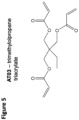
- the triacrylate is trimethylolpropane propoxylate triacrylate as shown below:
- the triacrylate is trimethylolpropane triacrylate as shown below:
- the triacrylate is pentaerythritol triacrylate as shown below:
- the triacrylate is trimethylolpropane ethoxylate triacrylate as shown below:
- the triacrylate is succinic acid triacrylate as shown below:
- the triacrylate is a modified triacrylate.
- Modification of triacrylates can be performed by any known methods in the art, for example, via chemical reactions such as dehydration, nucleophilic substitution or elimination, and sulfur mediated substitution.
- the triacrylate is modified by a reaction with an isocyanate to form a urethane bond.
- Triacrylates can be modified with any functional group known in the art. For example, a hydroxyl group and/or a carboxyl group on a triacrylate allows addition of a variety of functional groups onto the original triacrylate. Modification of triacrylates with additional chemistries may increase their ability to promote adhesion, migration, proliferation, differentiation of dental pulp stem cells (DPSCs), thus, further promoting dental tissue repair and/or regeneration.
- DPSCs dental pulp stem cells
- pentaerythritol triacrylate is modified as a compound of Formula I shown below:
- R 1 is -OCON(R a ) 2 ; wherein R a is selected from the group consisting of hydrogen and C 1 -C 8 alkyl; wherein the C 1 -C 6 alkyl is optionally substituted by one or four groups selected from halogen, hydroxy, amino, carboxy, C 1 -C 6 alkyl, C 1 -C 4 carbonylamino, and C 1 -C 4 alkoxy.
- R 1
- R 1 is -OCOR a ; wherein R a is selected from the group consisting of hydrogen, C 1 -C 12 alkyl, C 1 -C 12 alkoxy, C 2 -C 12 alkenyl, C 2 -C 12 alkynyl, C 3 -C 12 cycloalkyl, C 2 -C 11 heterocyclyl, C 6 -C 14 aryl, -N(R b ) 2 , -SR b , and -OR b ; wherein the C 1 -C 12 alkyl, C 1 -C 12 alkoxy, C 2 -C 12 alkenyl, C 2 -C 12 alkynyl, C 3 -C 12 cycloalkyl, C 2 -C 11 heterocyclyl, and C 6 -C 14 aryl groups are optionally substituted with one or four groups selected from the group consisting of hydrogen, halogen, hydroxy, cyano, amino, C 1 -C 12 al
- the compound is of the following structural formula,
- the triacrylate can be a monomer or it can be polymerized.
- the terms "polymerized” or “polymerization” refer to a process of reacting monomer molecules together in a chemical reaction to form polymer chains or three-dimensional networks. Polymerization of triacrylates can be performed by any methods known in the art, e.g., by photo-polymerization.
- the triacrylate is polymerized prior to contacting a dental tissue. In other embodiments, the triacrylate is polymerized after contacting the dental tissue.
- Photo-polymerization reactions are chain-growth polymerizations which are initiated by the absorption of visible or ultraviolet light.
- the light may be absorbed either directly by the reactant monomer, or else by a photoinitiator.
- Photoinitiators are compounds that upon radiation of light decompose into reactive species that activate polymerization of specific functional groups on the monomer.
- Photopolymerized systems are typically cured through ultraviolet (UV) radiation, since UV light is more energetic; however, the development of dye-based photoinitiator systems have allowed for the use of visible light, having potential advantages of processes that are more simple and safe to handle.
- UV ultraviolet
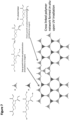
- Photo-polymerization of triacrylate monomers can be performed with a thiol-ene crosslinker upon UV irradiation, as demonstrated in Example 1 below ( Figure 7 ).
- a thiol-ene crosslinker can be any compound having a thiol ('SH') functional group.
- compositions of the present invention further comprise a porous scaffold.
- the scaffold may provide a matrix for cells to adhere and guide the process of tissue repair or regeneration in vivo.
- the scaffold may have the shape of any mammalian tooth, or cavity or chamber therein.
- a scaffold can have the shape of a human incisor, a human cuspid, a human bicuspid or a human molar, or a cavity or chamber therein.
- a scaffold can be fabricated with any material recognized as useful by a skilled artisan. Suitable scaffold materials are discussed in, for example, Ma and Elisseeff, ed. (2005) Scaffolding in Tissue Engineering, CRC, ISBN 1574445219 ; Saltzman (2004) Tissue Engineering: Engineering Principles for the Design of Replacement Organs and Tissues, Oxford ISBN 019514130X .
- the materials utilized to fabricate the scaffold for use in the present invention can generally be categorized into three types: (1) naturally derived materials, including ECM molecules, such as collagens and hyaluronic acid, (2) polysaccharides, such as alginate, agars, agaroses, chitosan, and the like that can be formed into hydrogels of sufficient porosity to serve as tissue scaffolds, and (3) biocompatible synthetic materials including any of a variety of polymers or co-polymers, whether biodegradable or non-biodegradable, that do not elicit adverse affects when implanted into tissue.
- naturally derived materials including ECM molecules, such as collagens and hyaluronic acid
- polysaccharides such as alginate, agars, agaroses, chitosan, and the like that can be formed into hydrogels of sufficient porosity to serve as tissue scaffolds
- biocompatible synthetic materials including any of a variety of polymers or co-polymers, whether biodegradable or non-
- any one of a variety of naturally-derived scaffold-like materials may be used to provide a framework for dental tissue growth in accordance with the present invention. Because the scaffold, or substantial portions thereof, is applied to a natural or artificial cavity or chamber of a tooth in a subject, one will generally prefer to use a scaffold that is derived from a biological tissue that is compatible with the tooth. Such biocompatibility requires that the tissue scaffold does not cause any significant adverse or untoward reactions when administered to the subject. By using a biocompatible tissue scaffold significant immune responses and inflammatory reactions will be avoided.
- tissue scaffold-like materials are available that may be used as scaffolds in accordance with this invention, including those scaffolds fabricated from human, animal or plant tissue. Potential advantages of these types of materials are their biocompatibility and their biological activity. As many of these molecules are found within tissues, they may not induce any foreign body reactions and are presumably receptive to the cell-mediated remodeling that occurs during tissue repair and regeneration ( Yannas et al., 1989, Proc. Nat'l Acad. Sci. U.S.A. 86(3):933-7 ).
- ECM molecules such as collagen may be used as scaffold materials in for the compositions of the invention.
- Type I collagen the most prevalent ECM molecule in the body, may be readily isolated from animal tissues and has been extensively utilized to fabricate cell delivery devices ( Green et al., 1979, Proc. Natl. Acad. Sci. U S A,, 76(11):5665-8 ; Yannas et al., 1981, Trans. Am. Soc. Artif. Intern. Organs, 27:19-23 ; Bell et al., 1981, Science 211 (4486):1052-4 ; Stem et al., 1990, J.
- This material can be processed into a wide variety of structures for use in the invention, e.g., films, sponges and fibers ( Green et al., 1979, Proc. Natl. Acad. Sci. U S A,, 76(11):5665-8 ; Yannas et al., 1981, Trans. Am. Soc. Artif. Intern. Organs, 27:19-23 ; Bell et al., 1981, Science 211 (4486):1052-4 ; Stem et al., 1990, J.
- Polysaccharides may also be used as scaffolds in accordance with the compositions of the invention.
- Polysaccharides are carbohydrates characterized by the presence of a repeating structure in which the interunit linkages are of the O-glycoside type.
- the hydrophilicity of polysaccharides along with the ease in which they can be formed into hydrogels, makes these materials ideal for use in the compositions of the invention.
- the variety of saccharide monomers and the variety of possible O-glycoside linkages result in a diversity of polysaccharide structures and conformations.
- Polysaccharides may be derived from different sources including plants (starch, cellulose), animal (glycogen), algae and seaweeds (alginate and agarose) and microorganisms.
- Alginate a polysaccharide isolated from seaweed, may also be used as a scaffold for the compositions of the present invention.
- Water soluble sodium alginate readily binds calcium, forming an insoluble calcium alginate hydrocolloid (Sutherland, 1991). These gentle gelling conditions have made alginate a popular material as an injectable cell delivery vehicle ( Atala et al., 1994, J. Urol. 152(2 Pt 2):641-3 ). Accordingly, in some embodiment, the compositions of the present invention may be delivered by injection.
- Synthetic polymers are attractive scaffold materials as they can be readily produced with a wide range of reproducible properties and structures.
- Polymer scaffolds also provide mechanical support against compressive and tensile forces, thus maintaining the shape and integrity of the scaffold in the environment of the tooth.
- the morphology of the scaffold can guide the structure of an engineered tissue ( Vacanti et al., 1988, J. Pediatr. Surg., 23(1 Pt 2):3-9 ), including the size, shape and vascularization of the tissue ( Mooney et al., 1994, Cell Transplant, 3(2):203-10 ; Mooney et al., 1995, J. Biomed. Mater. Res., 29(8):959-65 ; Mooney et al., 1996, Biotechnol. Prog., 12(6):865-8 ).
- the proper design of these scaffolds allows them to exhibit the required range of mechanical and biological functions.
- Synthetic polymeric materials can be precisely controlled in material properties and quality.
- synthetic polymers can be processed with various techniques and supplied consistently in large quantities. The mechanical and physical properties of synthetic polymers can be readily adjusted through variation of molecular structures so as to fulfill their functions without the use of either fillers or additives.
- Non-limiting examples of potentially useful materials for all or part of a scaffold used in the compositions of the invention include poly(ethylene) glycol, poly(lactide) (PLA), poly(glycolic acid) (PGA), poly(lactide-co-glycolide) (PLGA), poly( ⁇ -hydroxy acid), poly(caprolactone), polyanhydride, polyglactin, polycarbonates, polyamides, polyanhydrides, polyamino acids, polyorthoesters, polyacetals, polycyanoacrylates), polyphosphazene, degradable polyurethanes, polyacrylates, ethylene-vinyl acetate polymers and other acyl substituted cellulose acetates and derivatives thereof, polyurethanes, polystyrenes, polyvinyl chloride, polyvinyl fluoride, polyvinyl pyrrolidone, poly(vinylimidazole), chlorosulphonated polyolifins, polyethylene oxide, polyvinyl alcohol, Tef
- the scaffold comprises a hydrogel.
- a hydrogel is understood to have a network of polymer chains that are hydrophilic, sometimes found as a colloidal gel in which water is the dispersion medium.
- Hydrogels can be highly absorbent (e.g., over about 80%, 85%, 90%, 95%, 99%, or 99.9% water) natural or synthetic polymers. Hydrogels can also possess a degree of flexibility similar to natural tissue, due to their significant water content.
- a hydrogel can include, for example, polyvinyl alcohol, sodium polyacrylate, acrylate polymers or copolymers with hydrophilic groups.
- Natural hydrogels can include agarose, methylcellulose, hyaluronan, or other naturally derived polymers.
- the hydrogel is selected from the group consisting of collagen, alginate, polysaccharide, gelatin, chitosan, hyaluronic acid (HA), polyethylene glycol (PEG), poly(glycolide) (PGA), poly(L-lactide) (PLA), poly(lactide-co-glycolide) (PLGA), and polylactic-coglycolic acid.
- the hydrogel is an alginate.
- a scaffold used in the compositions of the present invention has a high porosity.
- Such a porous structure provides space for cell migration, adhesion, and the growth of new dental tissue.
- Pores and channels of a scaffold can be engineered to be of various diameters.
- the pores of the scaffold can have a diameter range from micrometers to millimeters.
- the pores of the matrix material include microchannels.
- Microchannels can have an average diameter of about 0.1 ⁇ m to about 1,000 ⁇ m, e.g., about 50 ⁇ m to about 500 ⁇ m (for example about 100 ⁇ m, 150 ⁇ m, about 200 ⁇ m, about 250 ⁇ m, about 300 ⁇ m, about 350 ⁇ m, about 400 ⁇ m, about 450 ⁇ m, about 500 ⁇ m, or about 550 ⁇ m).
- microchannel diameters can have any distribution including a normal distribution or a non-normal distribution.
- microchannels are a naturally occurring feature of the scaffold material(s).
- microchannels are engineered to occur in the scaffold materials.
- compositions of the invention can be incorporated into a scaffold by any known method.
- the triacrylates are imbedded in a gel, e.g., an alginate gel.
- the triacrylate may be incorporated into the pores of an alginate gel.
- the triacrylates of the invention may be chemically tethered to, or absorbed in, the scaffold by methods known in the art.
- Chemical modification methods may be used to covalently link the triacrylates on the surface of a scaffold.
- the surface functional groups of a scaffold can be coupled with reactive functional groups of the triacrylates to form covalent bonds using coupling agents well known in the art such as aldehyde compounds, carbodiimides, and the like.
- a spacer molecule can be used to gap the surface reactive groups and the reactive groups of the triacrylates to allow more flexibility of such molecules on the surface of the scaffold.
- Other similar methods of attaching triacrylates to the interior or exterior of a scaffold will be known to one of skill in the art.
- composition of the present invention may further comprise a bioactive agent for repair and/or regeneration of a dental tissue.
- bioactive agents refer to biological materials, for example, cytokines; growth factors; antibodies; antibiotics and differentiation factors.
- a bioactive agent is a compound selected from the group consisting of a chemotactic compound, an osteogenic compound, a dentinogenic compound, an amelogenic compound, a cementogenic compound, an angiogenic compound, an odontogenic compound, a neurogenic compound, and combinations thereof.
- a chemotactic compound is a compound that attracts cells.
- An osteogenic compound is a compound that encourages new bone synthesis.
- a dentinogenic compound is a compound that encourages new dentin synthesis.
- An amelogenic compound is a compound that encourages tooth enamel synthesis.
- a cementogenic compound is a compound that encourages cementum synthesis.
- An angiogenic compound is a compound that encourages blood vessel formation.
- An odontogenic compound is a compound that encourages tooth formation.
- a neurogenic compound is a compound that encourages nerve formation.
- a composition described herein may include more than one bioactive agent, for example two, three, four, or more bioactive agents
- Non-limiting examples of additional bioactive agents suitable for inclusion in the compositions of the invention include platelet-derived growth factor (PDGF), endothelial cell growth factor (ECGF), transforming growth factor- ⁇ 1 (TGF- ⁇ 1), epidermal growth factor (EGF), stromal cell-derived factor-1 (SDF1), a bone morphogenetic protein (BMP), a growth and differentiation factor (GDF), insulin-like growth factor-1 (IGF1), vascular endothelial growth factor (VEGF), fibroblast growth factor (FGF), a dentin matrix protein, a dentin sialoprotein, a bone sialoprotein, amelogenin, an integrin, vascular endothelial growth factor (VEGF), basic fibroblast growth factor (bFGF), angiogenin, angiopoietin-1, del-1, follistatin, granulocyte colony-stimulating factor (G-CSF), hepatocyte growth factor/scatter factor (HGF/SF), inter
- a bioactive agent can be from any mammalian species.
- the bioactive agent is a human bioactive agent, particularly when the mammal being treated is a human.
- the bioactive ingredient can be a recombinant bioactive agent.
- suitable bioactive agents include therapeutic agents.
- therapeutic agent refers to a substance used in the diagnosis, treatment, or prevention of a disease, e.g ., dental infections or diseases. Any therapeutic agent known to those of ordinary skill in the art to be of benefit in the diagnosis, treatment or prevention of a dental infection or disease is contemplated as a therapeutic agent in the context of the present invention.
- Therapeutic agents include pharmaceutically active compounds, hormones, growth factors, antibodies, anti-tumor drugs, antibiotics, anti-inflammatory agents, analgesic drugs or combinations thereof. Any of the therapeutic agents may be combined to the extent such combination is biologically compatible.
- Exemplified antibiotics may include, but not limited to, tetracyclines, penicillin, streptomycin, amoxicillin, augmentin, clindamycin, azithromycin and aureomycin.
- Exemplified analgesic may include, but not limited to, paracetamol, diclofenac, ketoprofen, aspirin, naproxen, indomethacin, ketorolac, ibuprofen, piroxicam, celecoxib, meloxicam, mefenemic acid, rofecoxib, and nimesulide.
- Additional therapeutic agents may include, but are not limited to, those found in Harrison's Principles of Internal Medicine, 13th Edition, Eds. T. R. Harrison et al. McGraw-Hill N.Y., N.Y .; Physicians Desk Reference, 50th Edition, 1997, Oradell N.J., Medical Economics Co. ; Pharmacological Basis of Therapeutics, 8th Edition, Goodman and Gilman, 1990 ; United States Pharmacopeia, The National Formulary, USP XII NF XVII, 1990 ; current edition of Goodman and Oilman's The Pharmacological Basis of Therapeutics ; and current edition of The Merck Index .
- the amount of therapeutic agents included in a composition of the invention depends on various factors including, for example, the specific agent; function which it should carry out; required period of time for release of the agent; quantity to be administered.
- dosage of a therapeutic agent i.e., amount of therapeutic agent in composition, is selected from the range of about 0.001% (w/w) to about 10% (w/w); about 1% (w/w) to about 5% (w/w); or about 0.1% (w/w) to about 1% (w/w).
- compositions of the present invention may further comprise a cell, e.g. a dental pulp stem cell.
- a cell e.g. a dental pulp stem cell.
- Dental pulp stem cells are multi-potent neural crest-derived stem cells with therapeutic potential for dentin and/or dental pulp regeneration.
- Dental pulp stem cells can be obtained from any tooth of any vertebrate that has teeth.
- the dental pulp stem cell is derived from the pulp tissue from a baby tooth.
- the dental pulp stem cell is derived from the pulp tissue from a premolar, a molar, an incisor or a canine.
- the dental pulp stem cells can differentiate into a more mature and functional cell, for example, an odontoblast.
- an odontoblast is a cell found in the oral cavity of a mammal that initiates the process of dentinogensis, resulting in the formation of dentin.
- the dental pulp stem cells can produce a dentin and /or pulp tissue structure in vivo and in vitro.
- One way to incorporate cells into the compositions is by incubating a triacrylate of the present invention in an aqueous solution comprising the cells to be incorporated.
- the aqueous solution can comprise enough cells to repair and/or regenerate dental tissue, e.g ., from about 10 4 to about 10 8 cells/ml, about 10 4 to about 10 6 cells/m, about 10 6 to about 10 8 cells/ml, about 10 4 cells/ml to about 10 5 cells/ml, about 10 4 cells/ml to about 10 7 cells/ml, or about 10 5 cells/ml to about 10 8 cells/ml.
- the composition comprises more that one cell type.
- Cells amenable to be incorporated into the compositions of the invention include, but are not limited to, stem cells (embryonic stem cells, mesenchymal stem cells, dental stem cells, bonemarrow derived stem cells and hematopoietic stem cells), progenitor cells, vascular endothelial cells, endothelial progenitor cells, mesenchymal cells, ameloblasts, and neural stem cells, odontoblasts, or immune cells including, but not limited to, histiocytes, macrophage, granulocytes, mast cells or plasma cells.
- the cell is a genetically modified cell.
- a cell can be genetically modified to express and secrete a desired compound, e.g ., a bioactive agent, a growth factor, differentiation factor, or a cytokine.
- a desired compound e.g ., a bioactive agent, a growth factor, differentiation factor, or a cytokine.
- compositions of the present invention are free of a bioactive agent.
- application of a triacrylate and a plurality of dental pulp stem cells to the dental tissue is sufficient to enhance DPSC adhesion, proliferation and/or differentiation, thus promoting repair and/or regeneration of dental tissue.
- compositions of the present invention may be combined with existing dental composite materials to provide an additional effect to the existing material, and could potentially lead to enhanced dental tissue repair and/or regeneration.
- compositions of the present invention are suitable for delivering to a natural or artificial cavity or chamber of a tooth in a subject. Delivery of the compositions to a subject can be accomplished by any appropriate route known in the art. As used herein, the term “delivery” refers to the placement of a composition into a subject by a method or route which results in at least partial localization of the composition at a desired site such that a desired effect is produced.
- Exemplary modes of delivery include, but are not limited to, injection, insertion, implantation, or delivery within a scaffold that encapsulates the composition of the invention at the target tissue, e.g ., dental tissue.
- the composition is delivered to a natural or artificial cavity or chamber of a tooth of a subject by injection.
- the compositions are polymerized prior to delivery.
- the composition may be delivered as a monomer, wherein the monomer is polymerized upon delivering into a natural or artificial cavity or chamber of a tooth by in situ polymerization.
- compositions of the present invention are also suitable as cell culture substrates.
- Biological studies in vitro use polymer substrates to adhere and culture cells. Surface chemistry regulates how cells interact with these materials. Currenlty, plasma-treated polystyrene is widely used in cell studies due it its ability to adsorb proteins from serum and proteins expressed by cells, which are required for cell adhesion and function. However, it is not well understood how treated-polystyrene affects the biology of the cells. Additionally, plasma treatment alters the surface chemistry by adding polar chemical groups in an uncontrolled manner and adds to manufacturing costs.
- the compositions of the present invention e.g ., triacrylate
- these triacrylates provide a more physiologic substrate for cells in vitro, without requiring additional surface treatments, compared with tissue culture plastic. Culturewares that are coated with triacrylates and are cured with UV light are highly scalable with commercial manufacturing.
- novel compounds of Formula II or a pharmaceutically acceptable salt thereof, comprising the structure:
- R is selected from the group consisting of hydrogen, Ci-C 12 alkyl, C 2 -C 12 alkenyl, C 2 -C 12 alkynyl, C 3 -C 12 cycloalkyl, C 2 -C 11 heterocyclyl, C 6 -C 14 aryl, - N(R d ) 2 , -SR d , and -OR e ; wherein the C 1 -C 12 alkyl, C 2 -C 12 alkenyl, C 2 -C 12 alkynyl, C 3 -C 12 cycloalkyl, C 2 -C 11 heterocyclyl, and C 6 -C 14 aryl groups are optionally substituted by one or more groups selected from the group consisting of halogen, hydroxy, cyano, amino, C 1 -C 12 alkyl, C 1 -C 12 alkenyl, C 1 -C 12 alkynyl, C 1 -C 12 alkoxy, C 3
- R is selected from the group consisting of hydrogen, C 1 -C 12 alkyl, -N(R d ) 2 , -SR d , and -OR e ; wherein the C 1 -C 12 alkyl is optionally substituted by one or more groups selected from the group consisting of halogen, hydroxy, cyano, amino, C 1 -C 12 alkyl, C 1 -C 12 alkylamino, and di(C 1 -C 12 alkyl)amino;
- the aryl is anthracenyl, naphthyl, and phenyl.
- the heterocyclyl is aziridinyl, oxiranyl, thiiranyl, oxaziridinyl, dioxiranyl, azetidinyl, oxetanyl, thietanyl, pyrrolidinyl, tetrahydrofuranyl, thiolanyl, imidazolidinyl, pyrazolidinyl, oxazolidinyl, isoxazolidinyl, thiazolidinyl, isothiazolidinyl, dioxolanyl, dithiolanyl, oxathiolanyl, piperidinyl, tetrahydropyranyl, thianyl, piperazinyl, morpholinyl, thiomorpholinyl, dioxanyl, dithianyl, trioxanyl, trithianyl, azepanyl, oxepanyl, thiepanyl,
- the present invention further provides a composition for use in dental tissue repair and/or regeneration wherein the composition comprises a modified succinic acid triacrylate compound comprising the chemical structure shown above (Formula II), and a porous scaffold.
- modified succinic acid triacrylate compounds may have an enhanced ability to promote adhesion, migration, proliferation and/or differentiation of dental pulp stem cells (DPSCs), thus, further promoting dental tissue repair and/or regeneration.
- DPSCs dental pulp stem cells
- compositions for use in dental tissue repair and/or regeneration wherein the compositions comprise a pentaerythitol triacrylate-4-((4-hydroxybutyl)amino)-4-oxobutanoic acid compound comprising the chemical structure of Formula III.
- compositions for use in dental tissue repair and/or regeneration wherein the compositions comprise a compound comprising the chemical structure of Formula IV and a porous scaffold. These compositions are suitable for use in the methods uf the as described below.
- the methods include contacting the dental tissue with a composition comprising a triacrylate capable of promoting dental pulp stem cell (DPSC) adhesion and/or proliferation; and allowing DPSCs to adhere and/or proliferate, thereby promoting repair and/or regeneration of the dental tissue.
- a composition comprising a triacrylate capable of promoting dental pulp stem cell (DPSC) adhesion and/or proliferation; and allowing DPSCs to adhere and/or proliferate, thereby promoting repair and/or regeneration of the dental tissue.
- DPSC dental pulp stem cell
- the term "contacting" is intended to include any form of interaction (e.g., direct or indirect interaction) of a composition and a dental tissue or a plurality of dental tissues.
- Contacting a dental tissue or a plurality of dental tissues with a composition may be performed either in vivo or in vitro.
- the dental tissue or a plurality of dental tissues are contacted with the composition in vitro and subsequently transferred into a subject in an ex vivo method of administration.
- Contacting the dental tissue or a plurality of dental tissues with the composition in vivo may be done, for example, by injecting the composition into the dental tissue or a plurality of dental tissues, or by injecting the composition into another area adjacent to the dental tissue or a plurality of dental tissues, such that dental cells within the dental tissue or a plurality of dental tissues will travel towards the composition.
- contacting a dental tissue or a plurality of dental tissues in vitro may be done by incubating the dental tissue or a plurality of dental tissues with a composition.
- the in vitro contact may occur by incubating a dental tissue or a plurality of dental tissues with the composition for a period of time, such as, for example, about 1 hour, about 2 hours, about 4 hours, about 8 hours, about 24 hours, about 48 hours, about 72 hours, about 96 hours, about 120 hours, about 144 hours, about 168 hours, or longer than 168 hours, or ranges thereof.
- regeneration encompasses both regeneration of tissue with recourse to exactly the type of tissue to be regenerated, in the sense of an increase in the mass of the tissue, as well as the production of new tissue starting from a different type of tissue or cell than that to be produced.
- tissue regeneration refers to the process by which new dental tissues from progenitor cells, such as stem cells, e.g ., dental pulp stem cells.
- Dental repair can encompass dental restoration, e.g ., using a dental restoration material, e.g., comprising a composition described herein, e.g., a composition comprising a triacrylate described herein.
- a dental restoration material e.g., comprising a composition described herein, e.g., a composition comprising a triacrylate described herein.
- the methods disclosed herein are suitable for repair and/or regeneration of any type of dental tissue including, but not limited to, a dental pulp tissue, a coronal pulp tissue, a radicular pulp tissue, a periapical tissue, a periapical connective tissue, a periodontal tissue, an accessory canal tissue, an apical foramen tissue, a foramina tissue, a Zone of Rinaggio tissue, a zone of Weil tissue, an odontoblastic layer, a bone tissue, a gum tissue, a blood vessel tissue, a nerve tissue, a nerve plexus of Raschkow tissue, a cementum tissue, a dentin tissue, a sclerotic dentin tissue, a tertiary dentin tissue, a reactionary dentin tissue, a reparative dentin tissue, a dentinal tubule tissue, a neodentin tissue, and any tissues associated with dental pulp containing any of ameloblasts, fibroblasts
- the dental tissue is a dental pulp tissue. In other embodiments, the dental tissue is a dentin tissue.
- the compositions of the present invention can provide a substrate for the growth of cells or formation of tissue.
- the compositions promote adhesion, migration, differentiation and/or proliferation of a dental tissue to repair and/or regenerate the dental tissue.
- the composition is suitable for treating a dental infection in a subject in need thereof.
- the methods disclosed herein include contacting the dental tissue with a composition comprising a triacrylate capable of promoting dental pulp stem cell (DPSC) adhesion and.or proliferation.
- the dental tissue can be contacted with the composition by any known routes in the art, e.g. , by delivering the composition to a natural or artificial cavity or chamber of a tooth in a subject.
- delivery refers to the placement of a composition into a subject by a method or route which results in at least partial localization of the composition at a desired site such that a desired effect is produced.
- Exemplary modes of delivery include, but are not limited to, injection, insertion, implantation, or delivery within a scaffold that encapsulates the composition of the invention at the target tissue, e.g ., dental tissue.
- the composition is delivered to a natural or artificial cavity or chamber of a tooth of a subject by injection.
- the compositions may be delivered as a monomer, wherein the composition is polymerized upon delivering into a natural or artificial cavity or chamber of a tooth by in situ polymerization.
- the triacrylate is polymerized by UV irradiation.
- the compositions, e.g ., triacrylates may be delivered as a polymer, wherein the triacrylates are polymerized prior delivering into a natural or artificial cavity or chamber of a tooth.
- compositions of the present invention comprise a porous scaffold, wherein the composition is delivered into a natural or artificial cavity or chamber of a tooth within the scaffold.
- the triacrylates may be chemically tethered to, or absorbed in the scaffold by methods known in the art.
- the scaffold may comprise a particle that encapsulates the triacrylates.
- a mammal is a primate, e.g ., a human or an animal.
- the animal is a vertebrate such as a primate, rodent, domestic animal or game animal.
- Primates include chimpanzees, cynomologous monkeys, spider monkeys, and macaques, e.g. , Rhesus.
- Rodents include mice, rats, woodchucks, ferrets, rabbits and hamsters.
- Domestic and game animals include cows, horses, pigs, deer, bison, buffalo, feline species, e.g., domestic cat, canine species, e.g., dog, fox, wolf, avian species, e.g., chicken, emu, ostrich, and fish, e.g., trout, catfish and salmon.
- a subject is selected from the group consisting of a human, a dog, a pig, a cow, a rabbit, a horse, a cat, a mouse and a rat.
- the subject is a human.
- the present invention further provides compositions for use in promoting differentiation of dental pulp stem cells.
- the dental pulp stem cells are contacted with a composition comprising a triacrylate and a porous scaffold, wherein the triacrylate is of promoting dental pulp stem cells adhesion and/or proliferation, and allowing dental pulp stem cells to adhere and/or proliferate, thereby promoting differentiation of the dental pulp stem cells.
- Dental pulp stem cells are multi-potent stem cells derived from neural crest of a tooth pulp. DPSCs can be obtained from any tooth of any vertebrate that has teeth.
- the dental pulp stem cell is derived from the pulp tissue from a baby tooth.
- the dental pulp stem cell is derived from the pulp tissue from a premolar, a molar, an incisor or a canine.
- the dental pulp stem cells can differentiate into a more mature and functional cell, for example, an odontoblast.
- an odontoblast is a cell found in the oral cavity of a mammal that initiates the process of dentinogenesis, resulting in the formation of dentin.
- the dental pulp stem cells can produce a dentin and /or pulp tissue structure in vivo and in vitro.
- DPSC differentiation Further disclosed herein is a step of assessing DPSC differentiation.
- Methods for measuring DPSC differentiation are well known in the art.
- expression levels of DPSC differentiation markers can be measured to determine the state of DPSC differentiation.
- Markers of DPSC differentiation are known in the art. Examples of such markers include, but are not limited to, BGLAP, DSPP, RUNX2, TGFB1, DMP1, ALP and SPP1. Expression levels of DPSC differentiation markers can be measured using RNA-based and/or protein-based assays.
- RNA may be extracted from cells using RNA extraction techniques including, for example, using acid phenol/guanidine isothiocyanate extraction (RNAzol B; Biogenesis), RNeasy RNA preparation kits (Qiagen) or PAXgene (PreAnalytix, Switzerland).
- Typical assay formats utilizing ribonucleic acid hybridization include nuclear run-on assays, RT-PCR, RNase protection assays ( Melton et al., Nuc. Acids Res. 12:7035 ), Northern blotting and In situ hybridization. Gene expression can also be detected by microarray analysis.
- RNA samples are first separated by size via electrophoresis in an agarose gel under denaturing conditions. The RNA is then transferred to a membrane, crosslinked and hybridized with a labeled probe.
- Nonisotopic or high specific activity radiolabeled probes can be used including random-primed, nick-translated, or PCR-generated DNA probes, in vitro transcribed RNA probes, and oligonucleotides. Additionally, sequences with only partial homology (e.g ., cDNA from a different species or genomic DNA fragments that might contain an exon) may be used as probes.
- ISH In situ hybridization
- Radiolabeled probes are visualized with liquid film dried onto the slides, while nonisotopically labeled probes are conveniently detected with colorimetric or fluorescent reagents. This latter method of detection is the basis for Fluorescent In Situ Hybridisation (FISH).
- FISH Fluorescent In Situ Hybridisation
- Methods for detection which can be employed include radioactive labels, enzyme labels, chemiluminescent labels, fluorescent labels and other suitable labels.
- RT-PCR is used to amplify RNA targets.
- the reverse transcriptase enzyme is used to convert RNA to complementary DNA (cDNA) which can then be amplified to facilitate detection.
- Relative quantitative RT-PCR involves amplifying an internal control simultaneously with the gene of interest. The internal control is used to normalize the samples. Once normalized, direct comparisons of relative abundance of a specific mRNA can be made across the samples. Commonly used internal controls include, for example, GAPDH, HPRT, actin and cyclophilin.
- Expression of a marker of dental pulp stem cell differentiation can also be assessed at the protein level, using a detection reagent that detects the protein product encoded by the mRNA of the biomarker, directly or indirectly.
- a detection reagent that detects the protein product encoded by the mRNA of the biomarker, directly or indirectly.
- an antibody reagent is available that binds specifically to a biomarker protein product to be detected, then such an antibody reagent can be used to detect the expression of the biomarker in a sample from the subject, using techniques, such as immunohistochemistry, ELISA, FACS analysis, and the like.
- markers at the protein level include methods such as electrophoresis, capillary electrophoresis, high performance liquid chromatography (HPLC), thin layer chromatography (TLC), hyperdiffusion chromatography, and the like, or various immunological methods such as fluid or gel precipitation reactions, immunodiffusion (single or double), immunoelectrophoresis, radioimmunoassay (RIA), enzyme-linked immunosorbent assays (ELISAs), immunofluorescent assays, and Western blotting.
- methods for detecting the marker at the protein level include methods such as electrophoresis, capillary electrophoresis, high performance liquid chromatography (HPLC), thin layer chromatography (TLC), hyperdiffusion chromatography, and the like, or various immunological methods such as fluid or gel precipitation reactions, immunodiffusion (single or double), immunoelectrophoresis, radioimmunoassay (RIA), enzyme-linked immunosorbent assays (ELISAs), immunofluorescent assays, and
- the present invention provides compositions for use in treating periodontal disease e.g., a dental pulp infection, in a subject in need thereof.
- a dental pulp tissue is contacted with a composition comprising a triacrylate and a porous scaffold, wherein the triacrylate is capable of promoting dental pulp stem cell (DPSC) adhesion and/or proliferation; and dental pulp tissue is regenerated by allowing DPSCs to adhere and/or proliferate; thereby treating the periodontal disease in the subject.
- DPSC dental pulp stem cell
- Periodontal diseases generally range from simple gum inflammation to serious disease that results in major damage to the soft tissue and bone that support the teeth. Periodontal disease results in loss of bony attachment to the root surface from chronic inflammation. Current treatment involves debriding the tissue to remove inflammed tissue. However the scaling involved in this procedure results in a loss of the cementum layer that connects the periodontal ligament from the bone to the root of the tooth. Thus, it is very difficult for the healed periodontal ligament to attach to the root after treatment. Triacrylates of the invention can be used as a varnish or coating on the roots of teeth to support re-attachment of the periodontal ligament after scaling and debridement.
- the present invention provides compositions for use in treating a dental infection, e.g., a dental pulp infection, in a subject in need thereof.
- Dental infections may arise from pulpitis, i.e., inflammation of the dental pulp tissue, which begins on the tooth's surface as dental caries. Dental infections may result in an exposure of pulp tissue, and eventually lead to a decay and/or loss of dentin and/or pulp, which are conventionally treated by endodontic surgery, e.g. , root canal therapy.
- Root canal therapy is commonly used in the case of severe caries where a substantial portion of the dentin and pulp tissue has been degraded, often into the vicinity of the root canal.
- the entire pulp tissue (healthy or diseased), and some of the dentin are removed.
- Gutta-percha is used to fill the void formed in the root canal and coronal regions of the tooth, a resin or amalgam filing is used to replace the pulp, and often a metal or porcelain crown is cemented into place.
- root canal therapy completely devitalizes a tooth and hence terminates dentin formation.
- the synthetic materials typically used to replace lost tooth structure are not capable of completely replacing the function of the lost tissue, and often fail over time making the tooth prone to fracture and subsequent loss.
- the present invention eliminates the need for root canal therapy while preserving the remaining pulp and regenerating new dentin.
- the present invention provides compositions for use in treating infection of a dental pulp in a subject in need thereof.
- a dental pulp tissue is contacted with a composition comprising a triacrylate and a porous scaffold, wherein the triacrylate is capable of promoting dental pulp stem cell (DPSC) adhesion and/or proliferation; and optionally, regenerating dental pulp tissue by allowing DPSCs to adhere and proliferate; thereby treating the dental pulp infection in the subject.
- DPSC dental pulp stem cell
- infection of a dental pulp may result in exposure of dental pulp tissue.
- the dental tissue is contacted with the composition in vitro and subsequently transferred into a subject in an ex vivo method of administration.
- the dental tissue is contacted with the composition in vivo, for example, by delivering the composition into or near the dental tissue by any methods as described herein.
- Exemplary modes of delivery include, but are not limited to, injection, insertion, implantation, or delivery within a scaffold that encapsulates the composition of the invention at the target tissue, e.g ., dental tissue.
- the composition is delivered to a natural or artificial cavity or chamber of a tooth of a subject by injection.
- the composition may be delivered as a triacrylate monomer, wherein the monomer is polymerized upon delivering into a natural or artificial cavity or chamber of a tooth by in situ polymerization.
- the monomer is polymerized by UV irradiation.
- the compositions, e.g ., triacrylates may be delivered as a polymer, wherein the triacrylates are polymerized prior delivering into a natural or artificial cavity or chamber of a tooth.
- the triacrylate composition of the present invention further comprises a scaffold, wherein the composition is delivered into a natural or artificial cavity or chamber of a tooth within the scaffold.
- the triacrylate may be chemically tethered to, or absorbed in the scaffold by methods known in the art.
- the scaffold may comprise a particle that encapsulates the triacrylate.
- the triacrylate may be released from the scaffold upon delivery at the target site.
- contacting a dental tissue with a composition may occur for a period of time, such as, for example, about 1 hour, about 2 hours, about 4 hours, about 8 hours, about 24 hours, about 48 hours, about 72 hours, about 96 hours, about 120 hours, about 144 hours, about 168 hours, or longer than 168 hours.
- the dental tissue is contacted with the composition for a sufficient period of time to allow cells from the exposed pulp tissue to migrate toward the composition, adhere and proliferate, thus regenerating the dentin and/or pulp tissue.
- These methods generally include providing a plurality of dental pulp stem cells, and contacting the plurality of the dental pulp stem cells with a test compound.
- the methods include determining the effect of a test compound (or a plurality of test compounds or a library of test compounds) on a biological activity of dental pulp stem cells, e.g., cell adhesion, using methods known in the art or described herein.
- Compounds identified as increasing a biological activity of dental pulp stem cells, e.g., adhesion or differentiation, using the assays described herein are useful for, e.g., promoting dental tissue repair and/or regeneration and/or treating dental infections.
- the term "contacting" i.e. , contacting a cell e.g. a dental pulp stem cell, with a compound
- incubating the compound and the cell together in vitro e.g., adding the compound to cells in culture
- administering the compound e.g., administering the compound to a subject such that the compound and cells of the subject are contacted in vivo.
- test compound includes reagents or test agents which are employed in the methods or assays are present in the compositions of the invention.
- compound or test compound includes compounds that have not previously been identified as, or recognized to be, agents that increase a biological activity of dental pulp stem cells, e.g., cell adhesion, are useful for promoting dental tissue repair and/or regeneration, or treating dental infections in a subject.
- more than one compound e.g ., a plurality of compounds, can be tested at the same time in a screening assay for their ability to increase a biological activity of dental pulp stem cells, e.g., cell adhesion, to promote dental tissue repair and/or regeneration, or treat dental infections in a subject.
- library of test compounds refers to a panel comprising a multiplicity of test compounds.
- Examples of compounds or test compounds include, but are not limited to, nucleic acids (e.g ., DNA and RNA), carbohydrates, lipids, proteins, peptides, peptidomimetics, small molecules, polymers, naturally derived materials including ECM molecules, such as collagens and hyaluronic acid, polysaccharides such as alginate, agars, agarose and the like that can be formed into hydrogels, biocompatible synthetic materials including any of a variety of polymers or co-polymers, and other drugs.
- nucleic acids e.g ., DNA and RNA
- carbohydrates lipids, proteins, peptides, peptidomimetics
- small molecules polymers
- naturally derived materials including ECM molecules, such as collagens and hyaluronic acid, polysaccharides such as alginate, agars, agarose and the like that can be formed into hydrogels
- biocompatible synthetic materials including any of a variety of polymers or co-polymers, and other
- Compounds can be obtained using any of the numerous approaches in combinatorial library methods known in the art, for example: biological libraries; spatially addressable parallel solid phase or solution phase libraries; synthetic library; the "one-bead one-compound” library method; and synthetic library methods using affinity chromatography selection.
- the biological library approach is limited to peptide libraries, while the other four approaches are applicable to peptide, non-peptide oligomer or small molecule libraries of compounds ( Lam (1997) Anticancer Drug Des. 12:145 ; U.S. Patent No. 5,738,996 ; and U.S. Patent No. 5,807,683 ).
- the ability of a test compound to increase a biological activity of dental pulp stem cells, e.g., cell adhesion, as compared to an appropriate control is measured in a screening assay of the invention.
- an “appropriate control” or “suitable control” is any one or more controls or standards (positive and/or negative) familiar to one of ordinary skill in the art useful for comparison purposes.
- a “suitable control” or “appropriate control” is a value, level, activity, determined in the absence of a test compound, as described herein. For example, a biological activity or read-out of such a biological activity may be determined in the presence and absence of a test compound.
- a “suitable control” or “appropriate control” is a value, level, activity, determined in the presence of a compound that is known to have no effect on the biological activity of dental pulp stem cells, e.g., a negative control.
- a "suitable control” or “appropriate control” is a value, level, activity, determined in the presence of a compound that is known to have an effect on the biological activity of dental pulp stem cells, e.g., a positive control, so that the positive response can be compared to the unknown response of the test compound.
- Different biological activities of dental pulp stem cells are suitable to be tested in the screening assays.
- the effect of test compounds on dental pulp stem cell adhesion, proliferation, viability, and/or differentiation can be tested.
- Methods of performing the adhesion assays, proliferation assays, viability assays, and differentiation assays are known in the art.
- adhesion of dental pulp stem cells on various polymers were determined, and polymers that support dental pulp stem cells adhesion were identified.
- the methods described herein comprise a combination of two or more of the assays described herein.
- a compound that increase a biological activity of dental pulp stem cells e.g., cell adhesion
- the selected test compound (or "compound of interest") from the adhesion assay were subsequently tested for their effect on dental pulp stem cell differentiation.
- Exemplified markers for dental pulp stem cell differentiation may include, but not limited to, BGLAP, DSPP, RUNX2, TGFB1, DMP1, ALP, SPP1, and any markers known in the art.
- compounds identified in the subject screening assays can be used in methods of modulating one or more of the biological activities of dental pulp stem cells.
- a test compound is identified to increase a biological activity of dental pulp stem cells, e.g., cell adhesion, by one of the variety of methods described herein
- the selected test compound can then be further evaluated for its effect on additional activity of the cells, for example by contacting the compound of interest with cells either in vivo (e.g., by administering the compound of interest to a subject) or ex vivo ( e.g., by isolating cells from the subject and contacting the isolated cells with the compound of interest or, alternatively, by contacting the compound of interest with a cell line) and determining the effect of the compound of interest on the cells, as compared to an appropriate control (such as untreated cells or cells treated with a control compound, or carrier, that does not modulate the biological response).
- an appropriate control such as untreated cells or cells treated with a control compound, or carrier, that does not modulate the biological response
- kits can include a composition described herein and, in certain embodiments, instructions for administration. Such kits can facilitate performance of the methods described herein.
- the different components of the composition can be packaged in separate containers and admixed immediately before use.
- Components include, but are not limited to a triacrylate, e.g.
- trimethylolpropane propoxylate triacrylate trimethylolpropane triacrylate, pentaerythritol triacrylate, trimethylolpropane ethoxylate triacrylate, succinic acid triacrylate, a cell or a plurality of cells, e.g., dental pulp stem cells, a bioactive agent, e.g., an antibiotic, an antiinflammatory, or any bioactive agent as described above; a scaffold, e.g., a hydrogel, or any other agents as described above.
- a pack or dispenser device which may contain one or more unit dosage forms containing the composition.
- the pack may, for example, comprise metal or plastic foil such as a blister pack.
- Such packaging of the components separately can also, in certain instances, permit long-term storage without losing activity of the components.
- kits of the invention may optionally comprise additional components useful for performing the methods of the invention.
- the kits may comprise solutions for preparation of triacrylates, cell culture medium suitable for cells, e.g., dental stem pulp cells, one or more sample compartments.
- kits can be supplied with instructional materials which describe performance of the methods of the invention.
- Kits may include instructions for in situ polymerization of monomers with crosslinking reagents, e.g., thiol-ene crosslinkers.
- kits include instructions for culturing cells in vitro.
- kits include instructions for administration or delivery of a composition to a tooth of a subject, e.g. , a natural or artificial cavity or chamber of a tooth.
- Instructions may be printed on paper or other substrate, and/or may be supplied as an electronic-readable medium, such as a floppy disc, mini-CD-ROM, CD-ROM, DVD-ROM, Zip disc, videotape, audio tape, and the like.
- Detailed instructions may not be physically associated with the kit; instead, a user may be directed to an Internet web site specified by the manufacturer or distributor of the kit.
- Polymer microarray allows simultaneous screening of diverse polymer chemistries to propel material discovery for biological applications.
- a high-through screen polymer screen was performed using polymer microarrays ( Anderson, DG et al., 2004, Nature Biotechnology 22, 863-866 ; Mei, Y et al., 2010, Nature Materials 9, 768-778 ; Celiz, AD, et al.,2015, Advanced Materials doi:10.1002/adma.201501351 ).
- DPSCs were procured from human donor teeth and expanded in tissue culture to be used in the experimental workflow, which involved screening, scaling up the materials to cell culture substrates, materials characterization, and biological characterization ( Figure 3A ).
- UV-sterilized polymer coatings were left on plates for 30 minutes, then washed three times with Hanks' balanced salt solution (HBSS). Subsequently, polymer coatings were incubated in serum free alpha-MEM with ascorbic acid and penicillin/streptomycin for 48 hours. Plates were replaced with fresh media prior to addition of cells.
- HBSS Hanks' balanced salt solution
- DPSCs Human dental pulp stem cells was passaged twice on tissue culture polystyrene (TCP) to enrich adherent DPSC population in complete media (alpha minimum essential media (MEM) with ascorbic acid, 20% fetal bovine serum, and 1% pencillin/streptomycin).
- complete media alpha minimum essential media (MEM) with ascorbic acid, 20% fetal bovine serum, and 1% pencillin/streptomycin.
- DPSCs isolated from a donor's extracted third molar were passaged on TCP before seeding onto arrays.
- DPSCs were seeded at high (80,000 cells per array) and low seeding density (8,000 cells per array) on two arrays in serum-free media conditions (alpha MEM with 0.1 mM ascorbic acid and 1% penicillin/streptomycin at 37 °C under 5% CO 2 ).
- Fluorescence imaging and cell counting revealed polymer hits with mean cell numbers that are different from the overall mean cell number per spot ( Figure 3C ). Out of those hits, three polymers, AT03 (trimethylolpropane triacrylate), AT06 (pentaerythritol triacrylate) and AT07 (trimethylolpropane ethoxylate triacrylate), demonstrated the highest relative DPSC adhesion after 48 hours ( Figure 4 ).
- AT03 and AT06 were very consistent in chemical structure ( Figures 5 and 6 ).
- thiol-ene chemistry was employed to scale up hit monomers AT03 and AT06 to bulk polymers, by adding a tri-thiol and photoinitiator ( Figure 8A ).
- the thiol and triacrylates polymerize by both chain growth and network polymerization to yield fast curing in about 30 seconds, which was demonstrated by rheological measurements of the storage and loss moduli of AT03 ( Figure 8B ).
- the storage modulus increased to 10 megapascals (10 7 Pa) by 60 seconds.
- Methacrylate monomers are commonly used in dental fillings.
- the ability of DPSCs to adhere to trimethacrylates was assessed and compared with triacrylates.
- a trimethacrylate, BT01 ( Figure 9A ), was generated in order to directly compare the behavior of DPSCs on triacrylates, AT03 and AT06, and trimethacrylate.
- BT01 was similarly polymerized with the tri-thiol.
- the mechanical properties of the resulting polymers were tested by compression and tension tests. The results demonstrate that the polymers yield similar compressive modulus of around 300 MPa.
- AT06 showed significantly higher tensile strength of close to 40 MPa, compared to a mean of between 20-30 MPa for BT01 and AT03 ( Figure 9B ).
- polymers AT03 trimethylolpropane triacrylate
- AT06 penentaerythritol triacrylate
- DPSCs were seeded at a density of 75,000 cells/cm 2 onto 12-well plates coated with polymers or tissue culture plastic control in serum-free conditions (alpha MEM with ascorbic acid and penicillin/streptomycin). Cells were adhered for 48 hours and imaged with phase contrast microscopy ( Figure 10A ).
- DPSC cell count and phase images over 48 hours showed that DPSCs proliferate on the tissue culture plastic and triacrylate AT03, but not on trimethacrylate BT01 or control BisGMA, which is a methacrylate used in commercially available dental materials ( Figure 12A , scale bar 400 um).
- the cell counts on BisGMA were below the level of detection. Livedead staining at 8 and 48 hours showed that cells adhered to AT03 are viable similar to TCP, but viable cells are significantly less on BT01 and BisGMA ( Figure 12B ).
- Immunostaining for proliferation marker Ki67 and confocal microscopy showed that DPSCs on AT03 were positive for Ki67, which was consistent with the imaging and cell count data ( Figure 12C , F-actin green, Ki67 red).
- AT03 trimethylolpropane triacrylate
- AT06 penentaerythritol triacrylate
- DPSCs were seeded at a density of 75,000 cells/cm 2 onto 12-well plates coated with polymers and TCP control in serum-free conditions (alpha MEM with ascorbic acid and penicillin/streptomycin). Media was changed every 2-3 days. Cells were imaged with phase contrast microscopy ( Figure 11A ).
- DPSCs were switched from serum-free media into differentiation media, gene expression levels of DPSC differentiation markers were changed significantly in both AT03 and AT06 coated plates.
- DPSCs were seeded at a density of 75,000 cells/cm 2 onto 12-well plates coated with polymers or TCP control in serum-free conditions (alpha MEM with ascorbic acid and penicillin/streptomycin). After cells were adhered and reached confluency over 72 hours, media was switched for differentiation conditions to differentiation media (alpha MEM with 10 mM beta-glycerophosphate, 10 nM dexamethasone, and 50 ug/mL (283.4 ⁇ M) ascorbic acid, 10% FBS).
- TGF-beta1 is known to regulate dentin regeneration.
- Figure 16A shows how the addition of TGF-beta1 induced significant upregulation of gene expression of DSPP over 21 days in the TCP control, as well as AT06 and AT03. Under similar conditions without TGF-beta1, the cells do not express increased levels of DSPP ( Figure 16C ).
- ALP alkaline phosphatase
- ALP is considered to play a key role in the mineralization of reparative dentin
- Col I is the predominant collagen in dentin that provides a structural framework for inorganic deposition.
- ALP and Col I are protein markers of early odontoblast development and are therefore associated with an intense secretory activity of the cell, whereas protein markers of late development (such as OCN) indicate that cells enter into a quiescent phase ( Larmas M. 2008, J Dent Res; 87: 198 ).
- SPP1 also known as secreted phosphoprotein 1, OPN, osteopontin is a multifunctional sialic acid-rich phosphorylated glycoprotein highly expressed in the bone, teeth, and several pathologic calcification sites of soft tissues.
- SPP1 is an important middlestage marker related both to bone formation and resorption, and recently Sodek et al. reported that SPP1 is also related to host defenses or tissue repair ( Sodek J, et al., 2000 Crit Rev Oral Biol Med; 11: 279-303 ).
- SPP1 contains several cell-adhesive domains, such as the integrin binding arginine-glysine-aspartate sequence, and thus mediates the cell-matrix interaction to cause adhesion, migration, and cytodifferentiation ( Liaw L, et al., 1995 J Clin Invest; 95: 713-24 ).
- DPSCs on AT03 and AT06 were shown to express markers of odontoblasts that produce dentin, dentin sialophosphoprotein (DSPP), with the addition of TGF ⁇ 1. Therefore, a significant increase in the expression levels of these DPSC differentiation markers further validated the finding that AT03 and AT06 were capable of both promoting DPSC adhesion and increasing DPSC differentiation, demonstrating that these biomaterials may have a great therapeutic potential to promote dentin regeneration in vivo by stimulating DPSC proliferation and differentiation.
- ALP alkaline phosphatase
- SPP1 osteopontin
- Dental composite resins are types of synthetic resins which are used in dentistry as restorative material or adhesives.
- a commonly used dental composite is bisphenol A-glycidyl methacrylate (Bis-GMA).
- Bis-GMA is the reaction product of bisphenol A and glycidyl methacrylate that undergoes polymerization when exposed to ultraviolet light or mixed with a catalyst. It is used as a bond implant material and as the resin component of dental sealants and composite restorative materials.
- DPSCs were seeding onto 12-well plates coated with polymers or tissue culture plastic control in serum-free conditions (alpha MEM with ascorbic acid and penicillin/streptomycin). After 48 hours, the plates were washed with Hank's balanced salt solution (HBSS) to remove non-adhered cells, and remaining adhered cells were stained with calcein AM and ethidium homodimer-1 to characterize the live and dead cells, respectively. The labeled cells were imaged with phase contrast microscopy.
- HBSS Hank's balanced salt solution
- the triacrylates of the invention represent a novel biomaterial for improving dental treatments and can be practically used in a clinical context.
- the clinical potential of using AT03 therapeutically in dentistry was demonstrated in a rodent model of dental pulp injury. 6-week year old male SD rats were anesthetized and surgery was performed on their first and second molars to partial resect the pulp tissue. This relates clinically to a partial pulpotomy in human patients, which is used to treat decay and pulp injury in pediatric patients. Hemostasis and drying of the tissue was obtained by pressure with cotton points. After proper isolation, the AT03-thiol prepolymer was applied to the cavity and cured inside the tooth ( Figure 17A ). The control was application of a clinically used materials in dentistry - a calcium hydroxide paste, dental adhesive, and a resin composite filling. Animals recovered from anesthesia and were sacrificed after 8 weeks.
- triacrylate polymers AT03 and AT06 adhere to primary human periodontal ligament fibroblasts similar to tissue culture control (TCP).
- TCP tissue culture control
- PDLFs Human periodontal ligament fibroplasts
- PDLFs Human periodontal ligament fibroplasts
- Cells were adhered on 12-well culture plates coated with AT03 and AT06, as well as a tissue culture plate control, in serum-free media at 25k cells/cm 2 . Phase images show confluent monolayers, scale bar 1 mm. Imaging and cell counts of viable cells were performed after 48 hours, and similar cell counts and percentage viability were observed for cells on AT03, AT06 and TCP control.
- the triacrylates of the invention may be used as a varnish or coating on the roots of teeth to support re-attachment of the periodontal ligament after scaling and debridement.
- Plasma-treated polystyrene is widely used in cell studies due it its ability to adsorb proteins, from serum and expressed by cells, which are required for cell adhesion and function. However, it is not well understood how treated-polystyrene affects the biology of the cells. Additionally, plasma treatment alters the surface chemistry by adding polar chemical groups in an uncontrolled manner and adds to manufacturing costs.
- triacrylate materials are suitable as cell culture substrates, without any additional surface modifications.
- Cell culture plates were coated with triacrylates using "thiol-ene" polymerization. Briefly, all triacrylates were mixed with a multifunctional thiol, trimethylolpropane tris(3-mercaptopropionate), in a 1:0.5 molar ratio [acrylate:thiol] with photoinitiator, 2,2-Dimethoxy-2-phenylacetophenone (1% w/w), in the bulk and polymerized using UV light.
- DPSCs Primary human dental pulp stem cells adhere and function on triacrylate polymers similar to tissue culture-treated polystyrene, without cytotoxicity seen on methacrylate and trimethacrylate materials. Confluent monolayers of DPSCs require integrin ⁇ 1 to remain adhered on triacrylates, as shown by loss of attachment with the addition of a blocking antibody, whereas cells on tissue culture plastic were not significantly affected by blocking ⁇ 1. After culturing 21 days in differentiation induction media with TGF ⁇ 1, DPSCs expressed increased levels of differentiation markers compared to tissue culture plastic. Adherence to triacrylates was also observed by other cell types, such as primary human periodontal fibroblasts. These data demonstrate that triacrylates provide a more physiologic substrate for cells in vitro, without requiring additional surface treatments, compared with tissue culture plastic.
Landscapes
- Health & Medical Sciences (AREA)
- Life Sciences & Earth Sciences (AREA)
- Chemical & Material Sciences (AREA)
- Animal Behavior & Ethology (AREA)
- Epidemiology (AREA)
- General Health & Medical Sciences (AREA)
- Veterinary Medicine (AREA)
- Public Health (AREA)
- Medicinal Chemistry (AREA)
- Oral & Maxillofacial Surgery (AREA)
- Engineering & Computer Science (AREA)
- Biomedical Technology (AREA)
- Pharmacology & Pharmacy (AREA)
- Dermatology (AREA)
- Transplantation (AREA)
- Cell Biology (AREA)
- Emergency Medicine (AREA)
- Chemical Kinetics & Catalysis (AREA)
- Zoology (AREA)
- Developmental Biology & Embryology (AREA)
- Hematology (AREA)
- Urology & Nephrology (AREA)
- Dispersion Chemistry (AREA)
- Botany (AREA)
- Orthopedic Medicine & Surgery (AREA)
- Immunology (AREA)
- Virology (AREA)
- Biotechnology (AREA)
- Rheumatology (AREA)
- Pharmaceuticals Containing Other Organic And Inorganic Compounds (AREA)
- Polymers & Plastics (AREA)
- Organic Chemistry (AREA)
Claims (13)
- Composition pour une utilisation dans la réparation et/ou la régénération d'un tissu dentaire, comprenant un triacrylate et un échafaudage poreux, dans laquelle le triacrylate favorise l'adhérence et/ou la prolifération de cellules souches de pulpe dentaire (DPSC).
- Composition pour une utilisation selon la revendication 1, dans laquelle l'échafaudage comprend un hydrogel, facultativement dans laquelle l'hydrogel est sélectionné dans le groupe consistant en un collagène, un alginate, un polysaccharide, une gélatine, un chitosane, l'acide hyaluronique (HA), un polyéthylène glycol (PEG), un poly(glycolide) (PGA), un poly(L-lactide) (PLA), un poly(lactide-co-glycolide) (PLGA), et un poly-acide lactique-co-glycolique.
- Composition pour une utilisation selon la revendication 1, dans laquelle le triacrylate est sélectionné dans le groupe consistant en le triacrylate de propoxylate de triméthylolpropane, le triacrylate de triméthylolpropane, le triacrylate de pentaérythritol, le triacrylate d'éthoxylate de triméthylolpropane, le triacrylate d'acide succinique et les combinaisons de ceux-ci.
- Composition pour une utilisation selon la revendication 1, dans laquelle(a) le triacrylate est un composé de formule I, comprenant la structure :
 ou un sel pharmaceutiquement acceptable de celuici ;dans laquelle R1 est sélectionné dans le groupe consistant en -COORa, -OCORa, -NRaCOORa, -OCON(Ra)2, - NRbCORa, -CON(Ra)2, -CORa et -NHCON(Ra)2 ;Ra est sélectionné dans le groupe consistant en un hydrogène, un alkyle en C1 à C12, un alcoxy en C1 à C12, un alcényle en C2 à C12, un alcynyle en C2 à C12, un cycloalkyle en C3 à C12, un hétérocyclyle en C2 à C11, un aryle en C6 à C14, -N(Rb)2, -SRb, et -ORb ; dans laquelle les groupes alkyle en C1 à C12, alcoxy en C1 à C12, alcényle en C2 à C12, alcynyle en C2 à C12, cycloalkyle en C3 à C12, hétérocyclyle en C2 à C11 et aryle en C6 à C14 sont facultativement substitués avec un ou quatre groupes sélectionnés dans le groupe consistant en un hydrogène, un halogène, un hydroxy, un cyano, un amino, un alkyle en C1 à C12, un alcoxy en C1 à C12, un alcényle en C1 à C12, un alcynyle en C1 à C12, un cycloalkyle en C3 à C12, un hétérocyclyle en C2 à C11, un aryle en C6 à C14, un (alkyle en C1 à C12) amino, un di (alkyle en C1 à C12) amino, -COORc, -OCORc, -NRcCOORc, -OCON(Rc)2, -NRcCORc, -CON(Rc)2, -CORc et -NHCON(Rc)2 ;Rb est sélectionné indépendamment dans le groupe consistant en un hydrogène, un alkyle en C1 à C12, un alcoxy en C1 à C12, un alcényle en C2 à C12, un alcynyle en C2 à C12, un cycloalkyle en C3 à C12, un aryle en C6 à C14 et un hétérocyclyle en C2 à C11, ou dans laquelle les deux groupes Rb peuvent former un hétérocyclyle avec l'azote, l'oxygène ou le soufre auquel ils sont liés, dans laquelle les groupes alkyle en C1 à C12, alcoxy en C1 à C12, alcényle en C2 à C12, alcynyle en C2 à C12, cycloalkyle en C3 à C12, aryle en C6 à C14 et hétérocyclyle en C2 à C11 sont facultativement substitués avec un ou plusieurs groupes sélectionnés parmi un halogène, un hydroxy, un amino, un carboxy, un alkyle en C1 à C6, un carbonylamino en C1 à C4 et un alcoxy en C1 à C4 ; etRc est sélectionné indépendamment dans le groupe consistant en un hydrogène, un alkyle en C1 à C12, un alcoxy en C1 à C12, un alcényle en C2 à C12, un alcynyle en C2 à C12, un cycloalkyle en C3 à C12, un aryle en C6 à C14 et un hétérocyclyle en C2 à C11, ou dans laquelle les deux groupes Rc peuvent former un hétérocyclyle avec l'azote ou le soufre auquel ils sont liés, dans laquelle les groupes alkyle en C1 à C12, alcoxy en C1 à C12, alcényle en C2 à C12, alcynyle en C2 à C12, cycloalkyle en C3 à C12, aryle en C6 à C14 et hétérocyclyle en C2 à C11 sont facultativement substitués avec un ou plusieurs groupes sélectionnés parmi un halogène, un hydroxy, un amino, un carboxy, un alkyle en C1 à C6, un carbonylamino en C1 à C4 et un alcoxy en C1 à C4 ; ou(b) le triacrylate est un composé de formule II, comprenant la structure :
 ou un sel pharmaceutiquement acceptable de celuici ; dans laquelleR est sélectionné dans le groupe consistant en un hydrogène, un bromo, un iodo, un fluoro, un alkyle en C1 à C12, un alcényle en C2 à C12, un alcynyle en C2 à C12, un cycloalkyle en C3 à C12, un hétérocyclyle en C2 à C11, un aryle en C6 à C14, -N(Rd)2, -SRd et -ORe ; dans laquelle les groupes alkyle en C1 à C12, alcényle en C2 à C12, alcynyle en C2 à C12, cycloalkyle en C3 à C12, hétérocyclyle en C2 à C11 et aryle en C6 à C14 sont facultativement substitués avec un ou plusieurs groupes sélectionnés dans le groupe consistant en un halogène, un hydroxy, un cyano, un amino, un alkyle en C1 à C12, un alcényle en C1 à C12, un alcynyle en C1 à C12, un alcoxy en C1 à C12, un cycloalkyle en C3 à C12, un hétérocyclyle en C2 à C11, un aryle en C6 à C14, un (alkyle en C1 à C12)amino et un di (alkyle en C1 à C12)amino ;Rd est sélectionné indépendamment dans le groupe consistant en un hydrogène, un alkyle en C1 à C12, un alcényle en C2 à C12, un alcynyle en C2 à C12, un cycloalkyle en C3 à C12, un aryle en C6 à C14 et un hétérocyclyle en C2 à C11, ou dans laquelle les deux groupes Rd peuvent former un hétérocyclyle avec l'azote auquel ils sont liés, dans laquelle les groupes alkyle en C1 à C12, alcényle en C2 à C12, alcynyle en C2 à C12, cycloalkyle en C3 à C12, aryle en C6 à C14 et hétérocyclyle en C2 à C11 sont facultativement substitués avec un ou plusieurs groupes sélectionnés parmi un halogène, un hydroxy et un alcoxy en C1 à C4 ; etRe est sélectionné indépendamment dans le groupe consistant en un alkyle en C2 à C12, un alcényle en C2 à C12, un alcynyle en C2 à C12, un benzyle et un phényle, dans laquelle les groupes alkyle en C2 à C12, alcényle en C2 à C12, alcynyle en C2 à C12, benzyle et phényle sont facultativement substitués à partir du groupe consistant en un halogène, un hydroxy et un alcoxy en C1 à C4.
 - Composition pour une utilisation selon la revendication 1, dans laquelle la composition comprend en outre une pluralité de cellules souches de pulpe dentaire (DPSC).
- Composition pour une utilisation selon la revendication 1, dans laquelle le triacrylate est un composé de formule II, comprenant la structure :
 (a) R est sélectionné parmi les groupes consistant en un hydrogène, un bromo, un iodo, un fluoro, un alkyle en C2 à C6, un alcényle en C2 à C6, un alcynyle en C2 à C6, un cycloalkyle en C3 à Ce, un hétérocyclyle en C2 à C6, un aryle en C6 à C12, -N(Rd)2, -SRd et -ORe ; dans laquelle les groupes alkyle en C2 à C6, alcényle en C2 à C6, alcynyle en C2 à C6, cycloalkyle en C3 à C6, hétérocyclyle en C2 à C6, aryle en C6 à C12 sont facultativement substitués avec un ou quatre groupes sélectionnés parmi un halogène, un hydroxy et un alcoxy en C1 à C4 ;Rd est sélectionné indépendamment parmi les groupes consistant en un hydrogène, un alkyle en C1 à C6, un cycloalkyle en C3 à Ce, un aryle en C6 à C14 et un hétérocyclyle en C2 à C11, dans laquelle les groupes alkyle en C1 à C6, cycloalkyle en C3 à Ce, aryle en C6 à C14 et hétérocyclyle en C2 à C11 sont facultativement substitués avec un ou plusieurs groupes sélectionnés parmi un halogène, un hydroxy et un alcoxy en C1 à C4 ; etRe est sélectionné indépendamment parmi les groupes consistant en un alkyle en C2 à Ce, un benzyle et un phényle, les groupes alkyle en C2 à C6, benzyle et phényle sont facultativement substitués à partir des groupes consistant en un halogène, un hydroxy et un alcoxy en C1 à C4 ;(b) R est sélectionné dans le groupe consistant en un hydrogène, un alkyle en C2 à C12, un alcényle en C2 à C12, un alcynyle en C2 à C12, un cycloalkyle en C3 à C12, un hétérocyclyle en C2 à C11, un aryle en C6 à C14, -N(Rd)2, -SRd et -ORe ; dans laquelle les groupes alkyle en C2 à C12, alcényle en C2 à C12, alcynyle en C2 à C12, cycloalkyle en C3 à C12, hétérocyclyle en C2 à C11 et aryle en C6 à C14 sont facultativement substitués avec un ou plusieurs groupes sélectionnés dans le groupe consistant en un halogène, un hydroxy, un cyano, un amino, un alkyle en C2 à C12, un alcényle en C1 à C12, un alcynyle en C1 à C12, un alcoxy en C1 à C12, un cycloalkyle en C3 à C12, un hétérocyclyle en C2 à C11, un aryle en C6 à C14, un (alkyle en C1 à C12) amino et un di (alkyle en C1 à C12) amino ;Rd est sélectionné indépendamment dans le groupe consistant en un hydrogène, un alkyle en C1 à C12, un alcényle en C2 à C12, un alcynyle en C2 à C12, un cycloalkyle en C3 à C12, un aryle en C6 à C14 et un hétérocyclyle en C2 à C11, ou dans laquelle les deux groupes Rd peuvent former un hétérocyclyle avec l'azote auquel ils sont liés, dans laquelle les groupes alkyle en C1 à C12, alcényle en C2 à C12, alcynyle en C2 à C12, cycloalkyle en C3 à C12, aryle en C6 à C14 et hétérocyclyle en C2 à C11 sont facultativement substitués avec un ou plusieurs groupes sélectionnés parmi un halogène, un hydroxy et un alcoxy en C1 à C4 ; etRe est sélectionné indépendamment dans le groupe consistant en un alkyle en C2 à C12, un alcényle en C2 à C12, un alcynyle en C2 à C12, un benzyle et un phényle, dans laquelle les groupes alkyle en C2 à C12, alcényle en C2 à C12, alcynyle en C2 à C12, benzyle et phényle sont facultativement substitués à partir du groupe consistant en un halogène, un hydroxy et un alcoxy en C1 à C4 ;(c) R est sélectionné dans le groupe consistant en un hydrogène, un alkyle en C2 à C12, -N(Rd)2, -SRd et - ORe ; dans laquelle l'alkyle en C2 à C12 est facultativement substitué avec un ou plusieurs groupes sélectionnés dans le groupe consistant en un halogène, un hydroxy, un cyano, un amino, un alkyle en C2 à C12, un (alkyle en C1 à C12) amino et un di (alkyle en C1 à C12) amino ;Rd est sélectionné indépendamment dans le groupe consistant en un hydrogène et un alkyle en C1 à C12, ou dans laquelle les deux groupes Rd peuvent former un hétérocyclyle avec l'azote auquel ils sont liés, dans laquelle l'alkyle en C1 à C12 est facultativement substitué avec un ou plusieurs groupes sélectionnés parmi un halogène, un hydroxy et un alcoxy en C1 à C4 ; etRe est sélectionné indépendamment dans le groupe consistant en un alkyle en C2 à C12, un benzyle et un phényle, dans laquelle les groupes alkyle en C2 à C12, benzyle et phényle sont facultativement substitués à partir du groupe consistant en un halogène, un hydroxy et un alcoxy en C1 à C4 ; (d) dans laquelle l'aryle est un anthracényle, un naphtyle et un phényle ; ou (e) dans laquelle l'hétérocyclyle est un aziridinyle, un oxiranyle, un thiiranyle, un oxaziridinyle, un dioxiranyle, un azétidinyle, un oxétanyle, un thiétanyle, un pyrrolidinyle, un tétrahydrofuranyle, un thiolanyle, un imidazolidinyle, un pyrazolidinyle, un oxazolidinyle, un isoxazolidinyle, un thiazolidinyle, un isothiazolidinyle, un dioxolanyle, un dithiolanyle, un oxathiolanyle, un pipéridinyle, un tétrahydropyranyle, un thianyle, un pipérazinyle, un morpholinyle, un thiomorpholinyle, un dioxanyle, un dithianyle, un trioxanyle, un trithianyle, un azépanyle, un oxépanyle, un thiépanyle, un dihydrofuranyle, un imidazolinyle, un dihydropyranyle, un azirinyle, un oxirényle, un thiirényle, un diazirinyle, un azétyle, un oxétyle, un thiétyle, un pyrrolyle, un furanyle, un thiophényle (ou thiényle), un imidazolyle, un pyrazolyle, un oxazolyle, un isoxazolyle, un thiazolyle, un isothiazolyle, un furazanyle, un oxadiazolyle, un thiadiazolyle, un dithiazolyle, un triazolyle, un tétrazolyle, un pyridinyle, un pyranyle, un thiopyranyle, un pyrazinyle, un pyrimidinyle, un pyridazinyle, un oxazinyle, un thiazinyle, un dioxinyle, un dithiinyle, un oxathianyle, un triazinyle, un tétrazinyle, un azépinyle, un oxépinyle, un thiépinyle, un diazépinyle, un thiazépinyle, 3-azabicyclo[3.1.0]hexanyle, un 3-azabicyclo[3.1.1]heptanyle, un 2-azaspiro[3.3]heptanyle, un 2-oxa-6-azaspiro[3.3]heptanyle, ou un 5-azaspiro [2.3]hexanyle.
 - Composition pour une utilisation selon la revendication 1, dans laquelle le triacrylate est un composé de formule III, comprenant la structure :

- Composition pour une utilisation selon la revendication 1, dans laquelle le triacrylate est un composé de formule IV, comprenant la structure :

- Composition à utiliser pour favoriser la différenciation de cellules souches de pulpe dentaire (DPSC), ou pour traiter une infection de la pulpe dentaire chez un sujet en ayant besoin,dans laquelle la composition comprend un triacrylate et un échafaudage poreux ; dans laquelle le triacrylate favorise l'adhérence et/ou la prolifération de cellules souches de pulpe dentaire (DPSC) ; etdans laquelle la composition est mise en contact avec le tissu de pulpe dentaire, ce qui permet aux DPSC d'adhérer à la composition et/ou de proliférer.
- Composition pour une utilisation selon la revendication 9, dans laquelle le triacrylate comprend le composé selon l'une quelconque des revendications 6, 7 et 8.
- Composition pour une utilisation selon la revendication 9, dans laquelle la composition comprend en outre une cellule.
- Composition pour une utilisation selon la revendication 9, dans laquelle le sujet est un humain.
- Kit comprenant :une composition comprenant un triacrylate et un échafaudage poreux ; dans lequel le triacrylate favorise l'adhérence et/ou la prolifération de cellules souches de pulpe dentaire (DPSC) ; etdes instructions pour l'administration de la composition dans un tissu dentaire d'un sujet pour traiter une affection dentaire chez le sujet.
Applications Claiming Priority (2)
| Application Number | Priority Date | Filing Date | Title |
|---|---|---|---|
| US201662305733P | 2016-03-09 | 2016-03-09 | |
| PCT/US2017/021324 WO2017156102A1 (fr) | 2016-03-09 | 2017-03-08 | Procédés et compositions de régénération et/ou de réparation de tissu dentaire |
Publications (3)
| Publication Number | Publication Date |
|---|---|
| EP3426182A1 EP3426182A1 (fr) | 2019-01-16 |
| EP3426182A4 EP3426182A4 (fr) | 2019-11-13 |
| EP3426182B1 true EP3426182B1 (fr) | 2024-05-01 |
Family
ID=59789804
Family Applications (1)
| Application Number | Title | Priority Date | Filing Date |
|---|---|---|---|
| EP17763983.8A Active EP3426182B1 (fr) | 2016-03-09 | 2017-03-08 | Procédés et compositions de régénération et/ou de réparation de tissu dentaire |
Country Status (3)
| Country | Link |
|---|---|
| US (2) | US11224679B2 (fr) |
| EP (1) | EP3426182B1 (fr) |
| WO (1) | WO2017156102A1 (fr) |
Families Citing this family (4)
| Publication number | Priority date | Publication date | Assignee | Title |
|---|---|---|---|---|
| EP3943061A1 (fr) * | 2020-07-22 | 2022-01-26 | Wael Hassan Khalil | Matériau biocomposite pour application endodontique |
| AU2022429961A1 (en) * | 2021-12-30 | 2024-08-29 | Sigilon Therapeutics, Inc. | Modified polysaccharide polymers and related compositions and methods thereof |
| KR102779289B1 (ko) * | 2022-03-11 | 2025-03-11 | 서울대학교산학협력단 | 수복상아질 재생 활성을 갖는 펩타이드 및 이의 용도 |
| WO2025184228A1 (fr) * | 2024-02-26 | 2025-09-04 | Smartweave, Inc. | Mécanismes thérapeutiques personnalisables intelligents et systèmes de régénération et de croissance de tissu |
Family Cites Families (9)
| Publication number | Priority date | Publication date | Assignee | Title |
|---|---|---|---|---|
| US3835090A (en) * | 1972-02-03 | 1974-09-10 | Johnson & Johnson | Dental restorative cement compositions |
| US7309232B2 (en) | 2003-10-10 | 2007-12-18 | Dentigenix Inc. | Methods for treating dental conditions using tissue scaffolds |
| KR100911843B1 (ko) * | 2005-02-21 | 2009-08-11 | 비스코, 인크 | 비휘발성 치과용 조성물 |
| WO2006116530A2 (fr) * | 2005-04-28 | 2006-11-02 | The Trustees Of Columbia University In The City Of New York | Compositions et procedes pour traiter des inflammations pulpaires induites par infection ou par traumatisme |
| US8735463B2 (en) * | 2007-05-31 | 2014-05-27 | Creighton University | Self-healing dental composites and related methods |
| EP2192886B1 (fr) * | 2007-08-28 | 2017-12-20 | Pioneer Surgical Technology, Inc. | Produits cimentaires, leurs procédés de fabrication et leurs utilisations |
| WO2011030552A1 (fr) * | 2009-09-11 | 2011-03-17 | 独立行政法人国立長寿医療研究センター | Obturateur de canal radiculaire pour dent non extraite et procédé d'extraction destiné à la régénération du tissu dentaire |
| AT12407U1 (de) | 2010-07-02 | 2012-05-15 | Stephan Lampl | Zahnfrontverblendungskörper |
| US8454980B2 (en) * | 2011-01-26 | 2013-06-04 | Stanley William Whitson | Hydrogel bioscaffold and coating for bone and tooth repair |
-
2017
- 2017-03-08 EP EP17763983.8A patent/EP3426182B1/fr active Active
- 2017-03-08 US US16/082,808 patent/US11224679B2/en active Active
- 2017-03-08 WO PCT/US2017/021324 patent/WO2017156102A1/fr not_active Ceased
-
2021
- 2021-12-08 US US17/545,205 patent/US20220249741A1/en not_active Abandoned
Also Published As
| Publication number | Publication date |
|---|---|
| US11224679B2 (en) | 2022-01-18 |
| EP3426182A4 (fr) | 2019-11-13 |
| US20190091373A1 (en) | 2019-03-28 |
| WO2017156102A1 (fr) | 2017-09-14 |
| EP3426182A1 (fr) | 2019-01-16 |
| US20220249741A1 (en) | 2022-08-11 |
Similar Documents
| Publication | Publication Date | Title |
|---|---|---|
| US20220249741A1 (en) | Methods and compositions for dental tissue repair and/or regeneration | |
| Li et al. | Porous chitosan bilayer membrane containing TGF-β1 loaded microspheres for pulp capping and reparative dentin formation in a dog model | |
| Inuyama et al. | Effects of hyaluronic acid sponge as a scaffold on odontoblastic cell line and amputated dental pulp | |
| US9688741B2 (en) | Elastic hydrogel | |
| EP1456357B1 (fr) | Cellules souches multipotentes de type embryonnaire derivees de dents et utilisations de ces cellules | |
| Shen et al. | 6-Bromoindirubin-3′-oxime promotes osteogenic differentiation of periodontal ligament stem cells and facilitates bone regeneration in a mouse periodontitis model | |
| Sueyama et al. | Implantation of endothelial cells with mesenchymal stem cells accelerates dental pulp tissue regeneration/healing in pulpotomized rat molars | |
| EP2476442B1 (fr) | Obturateur de canal radiculaire pour dent non extraite et procédé d'extraction destiné à la régénération du tissu dentaire | |
| Bhoj et al. | A first step in de novo synthesis of a living pulp tissue replacement using dental pulp MSCs and tissue growth factors, encapsulated within a bioinspired alginate hydrogel | |
| Xu et al. | A bioinspired and high-strengthed hydrogel for regeneration of perforated temporomandibular joint disc: Construction and pleiotropic immunomodulatory effects | |
| Nakashima et al. | Pulp regeneration: current approaches, challenges, and novel rejuvenating strategies for an aging population | |
| Ning et al. | Microfiber-reinforced composite hydrogels loaded with rat adipose-derived stem cells and BMP-2 for the treatment of medication-related osteonecrosis of the jaw in a rat model | |
| Cristaldi et al. | Growth and osteogenic differentiation of discarded gingiva-derived mesenchymal stem cells on a commercial scaffold | |
| Yoo et al. | Effect of conditioned medium from preameloblasts on regenerative cellular differentiation of the immature teeth with necrotic pulp and apical periodontitis | |
| KR20230161580A (ko) | 유치 줄기세포 배양액을 유효성분으로 포함하는 혈관 및 신경 재생용 조성물 | |
| Zhang et al. | Research and development of microenvironment’s influence on stem cells from the apical papilla–construction of novel research microdevices: tooth-on-a-chip | |
| US11969487B2 (en) | Non-cellular root canal filling material and non-cellular dental tissue regeneration promoting kit | |
| Li et al. | Stemness maintenance of stem cells derived from human exfoliated deciduous teeth (SHED) in 3D spheroid formation through the TGF-β/Smad signaling pathway | |
| Sismanoglu et al. | Regenerative dentistry: Applications of bioactive materials in dentin-pulp complex | |
| Wang et al. | Irisin‐Loaded Cerium‐Containing Mesoporous Bioactive Glass for Effective Immunomodulation and Odontogenesis of Dental Pulp Cells | |
| Song et al. | Bioactive small molecules in calcium phosphate scaffold enhanced osteogenic differentiation of human induced pluripotent stem cells | |
| CN115737784A (zh) | 骨膜蛋白的应用、产品及产品制备方法 | |
| Gui et al. | Application and mechanism study of EMD-Gel composite scaffold in dental pulp tissue repair | |
| Ahmed et al. | Dental Pulp Stem Cells in Endodontics: Advances, Applications, and Challenges | |
| DEEPYANTI et al. | Regenerative Endodontics |
Legal Events
| Date | Code | Title | Description |
|---|---|---|---|
| STAA | Information on the status of an ep patent application or granted ep patent |
Free format text: STATUS: THE INTERNATIONAL PUBLICATION HAS BEEN MADE |
|
| PUAI | Public reference made under article 153(3) epc to a published international application that has entered the european phase |
Free format text: ORIGINAL CODE: 0009012 |
|
| STAA | Information on the status of an ep patent application or granted ep patent |
Free format text: STATUS: REQUEST FOR EXAMINATION WAS MADE |
|
| 17P | Request for examination filed |
Effective date: 20180907 |
|
| AK | Designated contracting states |
Kind code of ref document: A1 Designated state(s): AL AT BE BG CH CY CZ DE DK EE ES FI FR GB GR HR HU IE IS IT LI LT LU LV MC MK MT NL NO PL PT RO RS SE SI SK SM TR |
|
| AX | Request for extension of the european patent |
Extension state: BA ME |
|
| RIN1 | Information on inventor provided before grant (corrected) |
Inventor name: VINING, KYLE Inventor name: CELIZ, ADAM, D. Inventor name: MOONEY, DAVID, J. |
|
| DAV | Request for validation of the european patent (deleted) | ||
| DAX | Request for extension of the european patent (deleted) | ||
| A4 | Supplementary search report drawn up and despatched |
Effective date: 20191011 |
|
| RIC1 | Information provided on ipc code assigned before grant |
Ipc: A61K 35/32 20150101ALI20191004BHEP Ipc: A61K 31/78 20060101ALI20191004BHEP Ipc: A61L 27/52 20060101ALI20191004BHEP Ipc: A61L 27/38 20060101ALI20191004BHEP Ipc: A61K 6/00 20060101AFI20191004BHEP Ipc: A61L 27/16 20060101ALI20191004BHEP |
|
| STAA | Information on the status of an ep patent application or granted ep patent |
Free format text: STATUS: EXAMINATION IS IN PROGRESS |
|
| 17Q | First examination report despatched |
Effective date: 20200818 |
|
| REG | Reference to a national code |
Ref country code: DE Free format text: PREVIOUS MAIN CLASS: A61C0005000000 Ref country code: DE Ref legal event code: R079 Ref document number: 602017081567 Country of ref document: DE Free format text: PREVIOUS MAIN CLASS: A61C0005000000 Ipc: A61K0035320000 |
|
| GRAP | Despatch of communication of intention to grant a patent |
Free format text: ORIGINAL CODE: EPIDOSNIGR1 |
|
| STAA | Information on the status of an ep patent application or granted ep patent |
Free format text: STATUS: GRANT OF PATENT IS INTENDED |
|
| RIC1 | Information provided on ipc code assigned before grant |
Ipc: A61K 31/27 20060101ALI20230912BHEP Ipc: A61K 31/225 20060101ALI20230912BHEP Ipc: A61K 31/215 20060101ALI20230912BHEP Ipc: A61K 6/54 20200101ALI20230912BHEP Ipc: A61L 27/52 20060101ALI20230912BHEP Ipc: A61L 27/38 20060101ALI20230912BHEP Ipc: A61L 27/16 20060101ALI20230912BHEP Ipc: A61K 35/32 20150101AFI20230912BHEP |
|
| INTG | Intention to grant announced |
Effective date: 20231009 |
|
| GRAS | Grant fee paid |
Free format text: ORIGINAL CODE: EPIDOSNIGR3 |
|
| GRAA | (expected) grant |
Free format text: ORIGINAL CODE: 0009210 |
|
| STAA | Information on the status of an ep patent application or granted ep patent |
Free format text: STATUS: THE PATENT HAS BEEN GRANTED |
|
| AK | Designated contracting states |
Kind code of ref document: B1 Designated state(s): AL AT BE BG CH CY CZ DE DK EE ES FI FR GB GR HR HU IE IS IT LI LT LU LV MC MK MT NL NO PL PT RO RS SE SI SK SM TR |
|
| REG | Reference to a national code |
Ref country code: GB Ref legal event code: FG4D |
|
| REG | Reference to a national code |
Ref country code: CH Ref legal event code: EP |
|
| REG | Reference to a national code |
Ref country code: IE Ref legal event code: FG4D |
|
| REG | Reference to a national code |
Ref country code: DE Ref legal event code: R096 Ref document number: 602017081567 Country of ref document: DE |
|
| REG | Reference to a national code |
Ref country code: LT Ref legal event code: MG9D |
|
| REG | Reference to a national code |
Ref country code: NL Ref legal event code: MP Effective date: 20240501 |
|
| REG | Reference to a national code |
Ref country code: DE Ref legal event code: R082 Ref document number: 602017081567 Country of ref document: DE Representative=s name: STRAUS, ALEXANDER, DIPL.-CHEM.UNIV. DR.PHIL., DE |
|
| PG25 | Lapsed in a contracting state [announced via postgrant information from national office to epo] |
Ref country code: IS Free format text: LAPSE BECAUSE OF FAILURE TO SUBMIT A TRANSLATION OF THE DESCRIPTION OR TO PAY THE FEE WITHIN THE PRESCRIBED TIME-LIMIT Effective date: 20240901 |
|
| PG25 | Lapsed in a contracting state [announced via postgrant information from national office to epo] |
Ref country code: BG Free format text: LAPSE BECAUSE OF FAILURE TO SUBMIT A TRANSLATION OF THE DESCRIPTION OR TO PAY THE FEE WITHIN THE PRESCRIBED TIME-LIMIT Effective date: 20240501 |
|
| PG25 | Lapsed in a contracting state [announced via postgrant information from national office to epo] |
Ref country code: FI Free format text: LAPSE BECAUSE OF FAILURE TO SUBMIT A TRANSLATION OF THE DESCRIPTION OR TO PAY THE FEE WITHIN THE PRESCRIBED TIME-LIMIT Effective date: 20240501 Ref country code: HR Free format text: LAPSE BECAUSE OF FAILURE TO SUBMIT A TRANSLATION OF THE DESCRIPTION OR TO PAY THE FEE WITHIN THE PRESCRIBED TIME-LIMIT Effective date: 20240501 |
|
| PG25 | Lapsed in a contracting state [announced via postgrant information from national office to epo] |
Ref country code: GR Free format text: LAPSE BECAUSE OF FAILURE TO SUBMIT A TRANSLATION OF THE DESCRIPTION OR TO PAY THE FEE WITHIN THE PRESCRIBED TIME-LIMIT Effective date: 20240802 |
|
| PG25 | Lapsed in a contracting state [announced via postgrant information from national office to epo] |
Ref country code: PT Free format text: LAPSE BECAUSE OF FAILURE TO SUBMIT A TRANSLATION OF THE DESCRIPTION OR TO PAY THE FEE WITHIN THE PRESCRIBED TIME-LIMIT Effective date: 20240902 |
|
| REG | Reference to a national code |
Ref country code: AT Ref legal event code: MK05 Ref document number: 1681452 Country of ref document: AT Kind code of ref document: T Effective date: 20240501 |
|
| PG25 | Lapsed in a contracting state [announced via postgrant information from national office to epo] |
Ref country code: NL Free format text: LAPSE BECAUSE OF FAILURE TO SUBMIT A TRANSLATION OF THE DESCRIPTION OR TO PAY THE FEE WITHIN THE PRESCRIBED TIME-LIMIT Effective date: 20240501 |
|
| PG25 | Lapsed in a contracting state [announced via postgrant information from national office to epo] |
Ref country code: ES Free format text: LAPSE BECAUSE OF FAILURE TO SUBMIT A TRANSLATION OF THE DESCRIPTION OR TO PAY THE FEE WITHIN THE PRESCRIBED TIME-LIMIT Effective date: 20240501 |
|
| PG25 | Lapsed in a contracting state [announced via postgrant information from national office to epo] |
Ref country code: AT Free format text: LAPSE BECAUSE OF FAILURE TO SUBMIT A TRANSLATION OF THE DESCRIPTION OR TO PAY THE FEE WITHIN THE PRESCRIBED TIME-LIMIT Effective date: 20240501 |
|
| PG25 | Lapsed in a contracting state [announced via postgrant information from national office to epo] |
Ref country code: PL Free format text: LAPSE BECAUSE OF FAILURE TO SUBMIT A TRANSLATION OF THE DESCRIPTION OR TO PAY THE FEE WITHIN THE PRESCRIBED TIME-LIMIT Effective date: 20240501 |
|
| PG25 | Lapsed in a contracting state [announced via postgrant information from national office to epo] |
Ref country code: LV Free format text: LAPSE BECAUSE OF FAILURE TO SUBMIT A TRANSLATION OF THE DESCRIPTION OR TO PAY THE FEE WITHIN THE PRESCRIBED TIME-LIMIT Effective date: 20240501 |
|
| PG25 | Lapsed in a contracting state [announced via postgrant information from national office to epo] |
Ref country code: PT Free format text: LAPSE BECAUSE OF FAILURE TO SUBMIT A TRANSLATION OF THE DESCRIPTION OR TO PAY THE FEE WITHIN THE PRESCRIBED TIME-LIMIT Effective date: 20240902 Ref country code: PL Free format text: LAPSE BECAUSE OF FAILURE TO SUBMIT A TRANSLATION OF THE DESCRIPTION OR TO PAY THE FEE WITHIN THE PRESCRIBED TIME-LIMIT Effective date: 20240501 Ref country code: NO Free format text: LAPSE BECAUSE OF FAILURE TO SUBMIT A TRANSLATION OF THE DESCRIPTION OR TO PAY THE FEE WITHIN THE PRESCRIBED TIME-LIMIT Effective date: 20240801 Ref country code: NL Free format text: LAPSE BECAUSE OF FAILURE TO SUBMIT A TRANSLATION OF THE DESCRIPTION OR TO PAY THE FEE WITHIN THE PRESCRIBED TIME-LIMIT Effective date: 20240501 Ref country code: LV Free format text: LAPSE BECAUSE OF FAILURE TO SUBMIT A TRANSLATION OF THE DESCRIPTION OR TO PAY THE FEE WITHIN THE PRESCRIBED TIME-LIMIT Effective date: 20240501 Ref country code: IS Free format text: LAPSE BECAUSE OF FAILURE TO SUBMIT A TRANSLATION OF THE DESCRIPTION OR TO PAY THE FEE WITHIN THE PRESCRIBED TIME-LIMIT Effective date: 20240901 Ref country code: HR Free format text: LAPSE BECAUSE OF FAILURE TO SUBMIT A TRANSLATION OF THE DESCRIPTION OR TO PAY THE FEE WITHIN THE PRESCRIBED TIME-LIMIT Effective date: 20240501 Ref country code: GR Free format text: LAPSE BECAUSE OF FAILURE TO SUBMIT A TRANSLATION OF THE DESCRIPTION OR TO PAY THE FEE WITHIN THE PRESCRIBED TIME-LIMIT Effective date: 20240802 Ref country code: FI Free format text: LAPSE BECAUSE OF FAILURE TO SUBMIT A TRANSLATION OF THE DESCRIPTION OR TO PAY THE FEE WITHIN THE PRESCRIBED TIME-LIMIT Effective date: 20240501 Ref country code: ES Free format text: LAPSE BECAUSE OF FAILURE TO SUBMIT A TRANSLATION OF THE DESCRIPTION OR TO PAY THE FEE WITHIN THE PRESCRIBED TIME-LIMIT Effective date: 20240501 Ref country code: BG Free format text: LAPSE BECAUSE OF FAILURE TO SUBMIT A TRANSLATION OF THE DESCRIPTION OR TO PAY THE FEE WITHIN THE PRESCRIBED TIME-LIMIT Effective date: 20240501 Ref country code: AT Free format text: LAPSE BECAUSE OF FAILURE TO SUBMIT A TRANSLATION OF THE DESCRIPTION OR TO PAY THE FEE WITHIN THE PRESCRIBED TIME-LIMIT Effective date: 20240501 Ref country code: RS Free format text: LAPSE BECAUSE OF FAILURE TO SUBMIT A TRANSLATION OF THE DESCRIPTION OR TO PAY THE FEE WITHIN THE PRESCRIBED TIME-LIMIT Effective date: 20240801 |
|
| PG25 | Lapsed in a contracting state [announced via postgrant information from national office to epo] |
Ref country code: DK Free format text: LAPSE BECAUSE OF FAILURE TO SUBMIT A TRANSLATION OF THE DESCRIPTION OR TO PAY THE FEE WITHIN THE PRESCRIBED TIME-LIMIT Effective date: 20240501 |
|
| PG25 | Lapsed in a contracting state [announced via postgrant information from national office to epo] |
Ref country code: EE Free format text: LAPSE BECAUSE OF FAILURE TO SUBMIT A TRANSLATION OF THE DESCRIPTION OR TO PAY THE FEE WITHIN THE PRESCRIBED TIME-LIMIT Effective date: 20240501 |
|
| PG25 | Lapsed in a contracting state [announced via postgrant information from national office to epo] |
Ref country code: CZ Free format text: LAPSE BECAUSE OF FAILURE TO SUBMIT A TRANSLATION OF THE DESCRIPTION OR TO PAY THE FEE WITHIN THE PRESCRIBED TIME-LIMIT Effective date: 20240501 |
|
| PG25 | Lapsed in a contracting state [announced via postgrant information from national office to epo] |
Ref country code: RO Free format text: LAPSE BECAUSE OF FAILURE TO SUBMIT A TRANSLATION OF THE DESCRIPTION OR TO PAY THE FEE WITHIN THE PRESCRIBED TIME-LIMIT Effective date: 20240501 Ref country code: SK Free format text: LAPSE BECAUSE OF FAILURE TO SUBMIT A TRANSLATION OF THE DESCRIPTION OR TO PAY THE FEE WITHIN THE PRESCRIBED TIME-LIMIT Effective date: 20240501 |
|
| PG25 | Lapsed in a contracting state [announced via postgrant information from national office to epo] |
Ref country code: SM Free format text: LAPSE BECAUSE OF FAILURE TO SUBMIT A TRANSLATION OF THE DESCRIPTION OR TO PAY THE FEE WITHIN THE PRESCRIBED TIME-LIMIT Effective date: 20240501 |
|
| PG25 | Lapsed in a contracting state [announced via postgrant information from national office to epo] |
Ref country code: SM Free format text: LAPSE BECAUSE OF FAILURE TO SUBMIT A TRANSLATION OF THE DESCRIPTION OR TO PAY THE FEE WITHIN THE PRESCRIBED TIME-LIMIT Effective date: 20240501 Ref country code: SK Free format text: LAPSE BECAUSE OF FAILURE TO SUBMIT A TRANSLATION OF THE DESCRIPTION OR TO PAY THE FEE WITHIN THE PRESCRIBED TIME-LIMIT Effective date: 20240501 Ref country code: RO Free format text: LAPSE BECAUSE OF FAILURE TO SUBMIT A TRANSLATION OF THE DESCRIPTION OR TO PAY THE FEE WITHIN THE PRESCRIBED TIME-LIMIT Effective date: 20240501 Ref country code: EE Free format text: LAPSE BECAUSE OF FAILURE TO SUBMIT A TRANSLATION OF THE DESCRIPTION OR TO PAY THE FEE WITHIN THE PRESCRIBED TIME-LIMIT Effective date: 20240501 Ref country code: DK Free format text: LAPSE BECAUSE OF FAILURE TO SUBMIT A TRANSLATION OF THE DESCRIPTION OR TO PAY THE FEE WITHIN THE PRESCRIBED TIME-LIMIT Effective date: 20240501 Ref country code: CZ Free format text: LAPSE BECAUSE OF FAILURE TO SUBMIT A TRANSLATION OF THE DESCRIPTION OR TO PAY THE FEE WITHIN THE PRESCRIBED TIME-LIMIT Effective date: 20240501 |
|
| REG | Reference to a national code |
Ref country code: DE Ref legal event code: R097 Ref document number: 602017081567 Country of ref document: DE |
|
| PG25 | Lapsed in a contracting state [announced via postgrant information from national office to epo] |
Ref country code: IT Free format text: LAPSE BECAUSE OF FAILURE TO SUBMIT A TRANSLATION OF THE DESCRIPTION OR TO PAY THE FEE WITHIN THE PRESCRIBED TIME-LIMIT Effective date: 20240501 |
|
| PLBE | No opposition filed within time limit |
Free format text: ORIGINAL CODE: 0009261 |
|
| STAA | Information on the status of an ep patent application or granted ep patent |
Free format text: STATUS: NO OPPOSITION FILED WITHIN TIME LIMIT |
|
| 26N | No opposition filed |
Effective date: 20250204 |
|
| PG25 | Lapsed in a contracting state [announced via postgrant information from national office to epo] |
Ref country code: SI Free format text: LAPSE BECAUSE OF FAILURE TO SUBMIT A TRANSLATION OF THE DESCRIPTION OR TO PAY THE FEE WITHIN THE PRESCRIBED TIME-LIMIT Effective date: 20240501 |
|
| PG25 | Lapsed in a contracting state [announced via postgrant information from national office to epo] |
Ref country code: SE Free format text: LAPSE BECAUSE OF FAILURE TO SUBMIT A TRANSLATION OF THE DESCRIPTION OR TO PAY THE FEE WITHIN THE PRESCRIBED TIME-LIMIT Effective date: 20240501 |
|
| PG25 | Lapsed in a contracting state [announced via postgrant information from national office to epo] |
Ref country code: MC Free format text: LAPSE BECAUSE OF FAILURE TO SUBMIT A TRANSLATION OF THE DESCRIPTION OR TO PAY THE FEE WITHIN THE PRESCRIBED TIME-LIMIT Effective date: 20240501 |
|
| REG | Reference to a national code |
Ref country code: CH Ref legal event code: H13 Free format text: ST27 STATUS EVENT CODE: U-0-0-H10-H13 (AS PROVIDED BY THE NATIONAL OFFICE) Effective date: 20251023 |
|
| PG25 | Lapsed in a contracting state [announced via postgrant information from national office to epo] |
Ref country code: LU Free format text: LAPSE BECAUSE OF NON-PAYMENT OF DUE FEES Effective date: 20250308 |
|
| REG | Reference to a national code |
Ref country code: BE Ref legal event code: MM Effective date: 20250331 |
|
| PG25 | Lapsed in a contracting state [announced via postgrant information from national office to epo] |
Ref country code: BE Free format text: LAPSE BECAUSE OF NON-PAYMENT OF DUE FEES Effective date: 20250331 |
|
| PG25 | Lapsed in a contracting state [announced via postgrant information from national office to epo] |
Ref country code: CH Free format text: LAPSE BECAUSE OF NON-PAYMENT OF DUE FEES Effective date: 20250331 |
|
| PG25 | Lapsed in a contracting state [announced via postgrant information from national office to epo] |
Ref country code: IE Free format text: LAPSE BECAUSE OF NON-PAYMENT OF DUE FEES Effective date: 20250308 |
|
| PGFP | Annual fee paid to national office [announced via postgrant information from national office to epo] |
Ref country code: GB Payment date: 20260327 Year of fee payment: 10 |
|
| PGFP | Annual fee paid to national office [announced via postgrant information from national office to epo] |
Ref country code: DE Payment date: 20260327 Year of fee payment: 10 |
|
| PGFP | Annual fee paid to national office [announced via postgrant information from national office to epo] |
Ref country code: FR Payment date: 20260325 Year of fee payment: 10 |