EP3426741B1 - Compositions de polyaryléthercétone et procédé de revêtement d'une surface métallique - Google Patents
Compositions de polyaryléthercétone et procédé de revêtement d'une surface métallique Download PDFInfo
- Publication number
- EP3426741B1 EP3426741B1 EP17707589.2A EP17707589A EP3426741B1 EP 3426741 B1 EP3426741 B1 EP 3426741B1 EP 17707589 A EP17707589 A EP 17707589A EP 3426741 B1 EP3426741 B1 EP 3426741B1
- Authority
- EP
- European Patent Office
- Prior art keywords
- paek
- units
- recurring units
- blend
- moles
- Prior art date
- Legal status (The legal status is an assumption and is not a legal conclusion. Google has not performed a legal analysis and makes no representation as to the accuracy of the status listed.)
- Active
Links
- QCBWQSUBBNBVOK-UHFFFAOYSA-N Cc(cc1)ccc1C(c1cccc(C(c(cc2)ccc2Oc(cc2)ccc2-c(cc2)ccc2OC)=O)c1)=O Chemical compound Cc(cc1)ccc1C(c1cccc(C(c(cc2)ccc2Oc(cc2)ccc2-c(cc2)ccc2OC)=O)c1)=O QCBWQSUBBNBVOK-UHFFFAOYSA-N 0.000 description 2
- JWVLQLQJWYYUHK-UHFFFAOYSA-N Cc1cccc(Oc(cc2)ccc2C(c(cc2)ccc2OC)=O)c1 Chemical compound Cc1cccc(Oc(cc2)ccc2C(c(cc2)ccc2OC)=O)c1 JWVLQLQJWYYUHK-UHFFFAOYSA-N 0.000 description 2
- 0 C*C=CC(C(CC(C=C*(C=C1)OC)=C*1N)=O)=C Chemical compound C*C=CC(C(CC(C=C*(C=C1)OC)=C*1N)=O)=C 0.000 description 1
Classifications
-
- C—CHEMISTRY; METALLURGY
- C09—DYES; PAINTS; POLISHES; NATURAL RESINS; ADHESIVES; COMPOSITIONS NOT OTHERWISE PROVIDED FOR; APPLICATIONS OF MATERIALS NOT OTHERWISE PROVIDED FOR
- C09D—COATING COMPOSITIONS, e.g. PAINTS, VARNISHES OR LACQUERS; FILLING PASTES; CHEMICAL PAINT OR INK REMOVERS; INKS; CORRECTING FLUIDS; WOODSTAINS; PASTES OR SOLIDS FOR COLOURING OR PRINTING; USE OF MATERIALS THEREFOR
- C09D171/00—Coating compositions based on polyethers obtained by reactions forming an ether link in the main chain; Coating compositions based on derivatives of such polymers
- C09D171/08—Polyethers derived from hydroxy compounds or from their metallic derivatives
- C09D171/10—Polyethers derived from hydroxy compounds or from their metallic derivatives from phenols
- C09D171/12—Polyphenylene oxides
-
- B—PERFORMING OPERATIONS; TRANSPORTING
- B29—WORKING OF PLASTICS; WORKING OF SUBSTANCES IN A PLASTIC STATE IN GENERAL
- B29B—PREPARATION OR PRETREATMENT OF THE MATERIAL TO BE SHAPED; MAKING GRANULES OR PREFORMS; RECOVERY OF PLASTICS OR OTHER CONSTITUENTS OF WASTE MATERIAL CONTAINING PLASTICS
- B29B9/00—Making granules
- B29B9/16—Auxiliary treatment of granules
-
- B—PERFORMING OPERATIONS; TRANSPORTING
- B29—WORKING OF PLASTICS; WORKING OF SUBSTANCES IN A PLASTIC STATE IN GENERAL
- B29B—PREPARATION OR PRETREATMENT OF THE MATERIAL TO BE SHAPED; MAKING GRANULES OR PREFORMS; RECOVERY OF PLASTICS OR OTHER CONSTITUENTS OF WASTE MATERIAL CONTAINING PLASTICS
- B29B7/00—Mixing; Kneading
- B29B7/002—Methods
- B29B7/005—Methods for mixing in batches
-
- B—PERFORMING OPERATIONS; TRANSPORTING
- B29—WORKING OF PLASTICS; WORKING OF SUBSTANCES IN A PLASTIC STATE IN GENERAL
- B29B—PREPARATION OR PRETREATMENT OF THE MATERIAL TO BE SHAPED; MAKING GRANULES OR PREFORMS; RECOVERY OF PLASTICS OR OTHER CONSTITUENTS OF WASTE MATERIAL CONTAINING PLASTICS
- B29B9/00—Making granules
- B29B9/12—Making granules characterised by structure or composition
- B29B9/14—Making granules characterised by structure or composition fibre-reinforced
-
- C—CHEMISTRY; METALLURGY
- C08—ORGANIC MACROMOLECULAR COMPOUNDS; THEIR PREPARATION OR CHEMICAL WORKING-UP; COMPOSITIONS BASED THEREON
- C08G—MACROMOLECULAR COMPOUNDS OBTAINED OTHERWISE THAN BY REACTIONS ONLY INVOLVING UNSATURATED CARBON-TO-CARBON BONDS
- C08G65/00—Macromolecular compounds obtained by reactions forming an ether link in the main chain of the macromolecule
- C08G65/34—Macromolecular compounds obtained by reactions forming an ether link in the main chain of the macromolecule from hydroxy compounds or their metallic derivatives
- C08G65/38—Macromolecular compounds obtained by reactions forming an ether link in the main chain of the macromolecule from hydroxy compounds or their metallic derivatives derived from phenols
- C08G65/40—Macromolecular compounds obtained by reactions forming an ether link in the main chain of the macromolecule from hydroxy compounds or their metallic derivatives derived from phenols from phenols (I) and other compounds (II), e.g. OH-Ar-OH + X-Ar-X, where X is halogen atom, i.e. leaving group
- C08G65/4012—Other compound (II) containing a ketone group, e.g. X-Ar-C(=O)-Ar-X for polyetherketones
-
- C—CHEMISTRY; METALLURGY
- C08—ORGANIC MACROMOLECULAR COMPOUNDS; THEIR PREPARATION OR CHEMICAL WORKING-UP; COMPOSITIONS BASED THEREON
- C08G—MACROMOLECULAR COMPOUNDS OBTAINED OTHERWISE THAN BY REACTIONS ONLY INVOLVING UNSATURATED CARBON-TO-CARBON BONDS
- C08G65/00—Macromolecular compounds obtained by reactions forming an ether link in the main chain of the macromolecule
- C08G65/34—Macromolecular compounds obtained by reactions forming an ether link in the main chain of the macromolecule from hydroxy compounds or their metallic derivatives
- C08G65/38—Macromolecular compounds obtained by reactions forming an ether link in the main chain of the macromolecule from hydroxy compounds or their metallic derivatives derived from phenols
- C08G65/40—Macromolecular compounds obtained by reactions forming an ether link in the main chain of the macromolecule from hydroxy compounds or their metallic derivatives derived from phenols from phenols (I) and other compounds (II), e.g. OH-Ar-OH + X-Ar-X, where X is halogen atom, i.e. leaving group
- C08G65/4012—Other compound (II) containing a ketone group, e.g. X-Ar-C(=O)-Ar-X for polyetherketones
- C08G65/4018—(I) or (II) containing halogens other than as leaving group (X)
- C08G65/4025—(I) or (II) containing fluorine other than as leaving group (X)
-
- C—CHEMISTRY; METALLURGY
- C08—ORGANIC MACROMOLECULAR COMPOUNDS; THEIR PREPARATION OR CHEMICAL WORKING-UP; COMPOSITIONS BASED THEREON
- C08L—COMPOSITIONS OF MACROMOLECULAR COMPOUNDS
- C08L71/00—Compositions of polyethers obtained by reactions forming an ether link in the main chain; Compositions of derivatives of such polymers
-
- C—CHEMISTRY; METALLURGY
- C09—DYES; PAINTS; POLISHES; NATURAL RESINS; ADHESIVES; COMPOSITIONS NOT OTHERWISE PROVIDED FOR; APPLICATIONS OF MATERIALS NOT OTHERWISE PROVIDED FOR
- C09D—COATING COMPOSITIONS, e.g. PAINTS, VARNISHES OR LACQUERS; FILLING PASTES; CHEMICAL PAINT OR INK REMOVERS; INKS; CORRECTING FLUIDS; WOODSTAINS; PASTES OR SOLIDS FOR COLOURING OR PRINTING; USE OF MATERIALS THEREFOR
- C09D171/00—Coating compositions based on polyethers obtained by reactions forming an ether link in the main chain; Coating compositions based on derivatives of such polymers
-
- C—CHEMISTRY; METALLURGY
- C23—COATING METALLIC MATERIAL; COATING MATERIAL WITH METALLIC MATERIAL; CHEMICAL SURFACE TREATMENT; DIFFUSION TREATMENT OF METALLIC MATERIAL; COATING BY VACUUM EVAPORATION, BY SPUTTERING, BY ION IMPLANTATION OR BY CHEMICAL VAPOUR DEPOSITION, IN GENERAL; INHIBITING CORROSION OF METALLIC MATERIAL OR INCRUSTATION IN GENERAL
- C23C—COATING METALLIC MATERIAL; COATING MATERIAL WITH METALLIC MATERIAL; SURFACE TREATMENT OF METALLIC MATERIAL BY DIFFUSION INTO THE SURFACE, BY CHEMICAL CONVERSION OR SUBSTITUTION; COATING BY VACUUM EVAPORATION, BY SPUTTERING, BY ION IMPLANTATION OR BY CHEMICAL VAPOUR DEPOSITION, IN GENERAL
- C23C26/00—Coating not provided for in groups C23C2/00 - C23C24/00
-
- H—ELECTRICITY
- H01—ELECTRIC ELEMENTS
- H01B—CABLES; CONDUCTORS; INSULATORS; SELECTION OF MATERIALS FOR THEIR CONDUCTIVE, INSULATING OR DIELECTRIC PROPERTIES
- H01B3/00—Insulators or insulating bodies characterised by the insulating materials; Selection of materials for their insulating or dielectric properties
- H01B3/18—Insulators or insulating bodies characterised by the insulating materials; Selection of materials for their insulating or dielectric properties mainly consisting of organic substances
- H01B3/30—Insulators or insulating bodies characterised by the insulating materials; Selection of materials for their insulating or dielectric properties mainly consisting of organic substances plastics; resins; waxes
- H01B3/36—Insulators or insulating bodies characterised by the insulating materials; Selection of materials for their insulating or dielectric properties mainly consisting of organic substances plastics; resins; waxes condensation products of phenols with aldehydes or ketones
-
- B—PERFORMING OPERATIONS; TRANSPORTING
- B29—WORKING OF PLASTICS; WORKING OF SUBSTANCES IN A PLASTIC STATE IN GENERAL
- B29B—PREPARATION OR PRETREATMENT OF THE MATERIAL TO BE SHAPED; MAKING GRANULES OR PREFORMS; RECOVERY OF PLASTICS OR OTHER CONSTITUENTS OF WASTE MATERIAL CONTAINING PLASTICS
- B29B7/00—Mixing; Kneading
- B29B7/02—Mixing; Kneading non-continuous, with mechanical mixing or kneading devices, i.e. batch type
- B29B7/06—Mixing; Kneading non-continuous, with mechanical mixing or kneading devices, i.e. batch type with movable mixing or kneading devices
- B29B7/10—Mixing; Kneading non-continuous, with mechanical mixing or kneading devices, i.e. batch type with movable mixing or kneading devices rotary
- B29B7/12—Mixing; Kneading non-continuous, with mechanical mixing or kneading devices, i.e. batch type with movable mixing or kneading devices rotary with single shaft
- B29B7/16—Mixing; Kneading non-continuous, with mechanical mixing or kneading devices, i.e. batch type with movable mixing or kneading devices rotary with single shaft with paddles or arms
-
- C—CHEMISTRY; METALLURGY
- C08—ORGANIC MACROMOLECULAR COMPOUNDS; THEIR PREPARATION OR CHEMICAL WORKING-UP; COMPOSITIONS BASED THEREON
- C08G—MACROMOLECULAR COMPOUNDS OBTAINED OTHERWISE THAN BY REACTIONS ONLY INVOLVING UNSATURATED CARBON-TO-CARBON BONDS
- C08G2650/00—Macromolecular compounds obtained by reactions forming an ether link in the main chain of the macromolecule
- C08G2650/28—Macromolecular compounds obtained by reactions forming an ether link in the main chain of the macromolecule characterised by the polymer type
- C08G2650/38—Macromolecular compounds obtained by reactions forming an ether link in the main chain of the macromolecule characterised by the polymer type containing oxygen in addition to the ether group
- C08G2650/40—Macromolecular compounds obtained by reactions forming an ether link in the main chain of the macromolecule characterised by the polymer type containing oxygen in addition to the ether group containing ketone groups, e.g. polyarylethylketones, PEEK or PEK
-
- H—ELECTRICITY
- H01—ELECTRIC ELEMENTS
- H01B—CABLES; CONDUCTORS; INSULATORS; SELECTION OF MATERIALS FOR THEIR CONDUCTIVE, INSULATING OR DIELECTRIC PROPERTIES
- H01B13/00—Apparatus or processes specially adapted for manufacturing conductors or cables
- H01B13/06—Insulating conductors or cables
Definitions
- the present invention relates to polymer compositions and uses thereof, in particular to a method of coating a metal surface with said compositions. More particularly, the compositions are polyarylether ketone compositions endowed with high temperature performance, good chemical resistance and, at the same time, high adhesion to metal surfaces and high ductility and toughness.
- Polyarylether ketones are polymers comprising repeating units having formulas: (-Ar-X-) and (-Ar'-Y-) in which:
- PAEKs in particular polyarylether ether ketones (PEEKs), which comprise repeating units of formula: -[O-Ph-C(O)-Ph-O-Ph]-
- EP 0184458 A (IMPERIAL CHEMICAL INDUSTRIES PLC) 11/06/1986 discloses a PAEK comprising the repeating units of formulas: -[Ph-O-Ph-C(O)-Ph-O]- and -[Ph-Ph-O-Ph-C(O)-Ph-O]-
- US 20120160829 A (ARKEMA FRANCE) 28/06/2012 discloses a polymer composition containing at least one PAEK, optionally filled with fibres or other elements increasing the modulus, and with ferrimagnetic or ferromagnetic conductive particles.
- the composition can be used in the manufacture of articles that can be welded by induction in an alternating electromagnetic field. Even if it is stated that sometimes PAEK mixtures must be used in order to optimize the properties of the materials, the examples disclose only compositions containing a polyether ketone ketone (PEKK) and iron powders. This patent document does not teach to use the composition for the coating of metal surfaces.
- PEKK polyether ketone ketone
- US 8536265 B (VICTREX MANUFACTURING COMPANY) 20/10/2011 discloses a PAEK polymeric material, for example a PEEK, and composite materials comprising said material.
- the polymeric material has a melt viscosity (MV) in the range 0.05 to 0.12 kNsm -2 , preferably in the range 0.085 to 0.095 kNsm -2 .
- MV melt viscosity
- the composite material may comprise one or more of said PAEK polymeric materials, composite materials comprising only a single type of PAEK material, preferably PEEK, are preferred.
- the PAEK can be used in injection moulding or extrusion to manufacture components having relatively thin walls.
- WO 2013/092492 SOLVAY SPECIALTY POLYMERS USA
- mobile electronic devices comprising at least one structural part made of a polymer composition (C) comprising at least one polyarylether ketone (PAEK), at least one aromatic sulfone polymer (SP) such as polyphenyl sulfone (PPSU), polyether sulfone (PESU), polysulfone (PSU) or mixture thereof, and at least one reinforcing filler.
- C polymer composition
- PESK polyarylether ketone
- SP aromatic sulfone polymer
- PPSU polyphenyl sulfone
- PESU polyether sulfone
- PSU polysulfone
- WO 2015/019047 A (VICTREX MANUFACTURING LIMITED) 12/02/2015 discloses a component which comprises a first part and a second part, wherein said second part is in contact with said first part, wherein:
- the second polymer of the component has a melting temperature (T m ) that is less than the melting temperature (T m ) of the first polymer.
- the first semi-crystalline polymer is a PEEK and the second polymer comprises is a PEEK-PEDEK.
- T m melting temperature
- the first and second part can be secured together with a high-strength physico-chemical interaction to provide components which are highly chemically resistant and have long term mechanical properties.
- the component is manufactured by contacting a first part comprising the first polymers or a precursor of said first part with a second part comprising the second polymer.
- a molten first polymer possibly including fillers, is overmoulded around the second part.
- This patent document does not disclose or suggest blends of different PAEKs and their use for metal coating applications.
- WO 2015/124903 A (VICTREX MANUFACTURING LIMITED) 27/08/2015 relates to a sintering process for manufacturing objects using electromagnetic radiations, said process comprising using a polymeric material which is a PEEK-PEDEK, optionally, in combination with fillers and radiation absorbers.
- the polymeric material can be a so called "virgin PEEK-PEDEK” or a mixture (blend) of a virgin and re-cycled PEEK-PEDEK. This patent document does not disclose mixtures of PEEK-PEDEK with other polymers.
- WO 2015/189567 A (VICTREX MANUFACTURING LIMITED) 17/12/2015 discloses a component (e.g. a part of an electronic device for connection to the worldwide web or for communication) comprising a first part and a second part in contact with the first one, wherein:
- WO 2015/198063 A (VICTREX MANUFACTURING LIMITED) 30/12/2015 relates to polymeric materials which define a component comprising a first part and a second part, wherein a third part is positioned between the first and second part.
- Each part comprises polymeric materials, namely PAEKs.
- part A comprises a polymeric material (A), which is a PAEK, and another polymeric material (C) which is a PEEK-PEDEK.
- A polymeric material
- C polymeric material
- WO 2016/016643 A (VICTREX MANUFACTURING LIMITED) 04/02/2016 relates to a blend comprising:
- This blend can be part of a composition comprising also a thermoplastic polymer (C), preferably a polysulfone and a fibrous filler.
- C thermoplastic polymer
- the blend or composition can be used for the manufacture of injection moulded components or extruded components.
- WO 2009/058362 A1 (POLYMICS, LTD) 07/05/2009 relates to protective films for substrates, including metals, said films being formed by a polymer base layer and a polymer top layer, wherein the top layer has a higher elongation at break and a higher crystallinity than the base layer.
- example IV of this document discloses a protective film formed by co-extrusion of an amorphous PEKK as base layer and a semi-crystalline PEEK as top layer.
- the film is applied to an aluminum sheet by pressing and heating at 335°C; at this temperature (which is higher than the melting temperature of the amorphous PEKK and lower that the melting temperature of the semi-crystalline PEEK), the semi-crystalline PEEK does not melt, while the amorphous PEKK softens and bonds to the aluminum sheet.
- a blend i.e. a uniform mixture, of the two polymers is not formed.
- bulk diffusion or convective processes are required, which do not occur when two polymers with different melting temperature are contacted and heated at a temperature higher than that of the lowest melting component but lower than that of the highest melting component.
- the film disclosed in WO 2009/058362 A1 is not a uniform blend, its protective efficacy might be negatively affected if the top layer is damaged and the base layer is exposed.
- EP 01 138 128 A1 (UNION CARBIDE CORPORATION) 24/04/1985 relates to blends comprising at least two poly(aryl ether) polymers that are said to be useful, for example, for electrical wire and connector applications.
- the polymer blends therein disclosed have a single crystalline melting point (T m ) and a single glass transition temperature (T g ).
- T m single crystalline melting point
- T g single glass transition temperature
- US 2016/0115314 (ARKEMA FRANCE) 28/04/2016 relates to a PEEK-based composition comprising a certain amount of PEKK, wherein the PEKK comprises a definite ratio of terephthalic and isophthalic units. It is stated (par. [0071]) that the incorporation of PEKK in a PEEK-based composition brings about an increase in two mechanical properties which are generally antagonistic, namely the yield point stress and the elongation at break. It is also stated (par. [0072]) that the crystallization kinetics are slowed down, thereby reducing the internal stresses of the material (which dispenses with lengthy and expensive post annealing stage) and allowing to obtain non deformed parts having the desired optimum geometry. However, this document is silent on the adhesion of the composition to metal substrates.
- the Applicant has surprisingly found out that blends of at least two different PAEK polymers can be advantageously used for applications in which it is necessary to improve adhesion to metal, toughness and impact resistance, while retaining high strength, temperature performance and chemical resistance; in particular, the Applicant has found out that such mixtures can be used for metal coating applications.
- the invention relates to a method [method (M)] of coating a metal surface, said method comprising applying to a metal surface a PAEK composition [composition (C)], said composition comprising a polymer blend [blend (B)] consisting of:
- the present invention relates to certain blends (B) and compositions (C) for carrying out method (M).
- the invention relates to finished articles [articles (A)] comprising compositions (C), in particular to a metal surfaces coated with composition (C) [surface (S)] and to articles [articles (A')] comprising said surface.
- PAEK-1 The polyaryl ether ketone
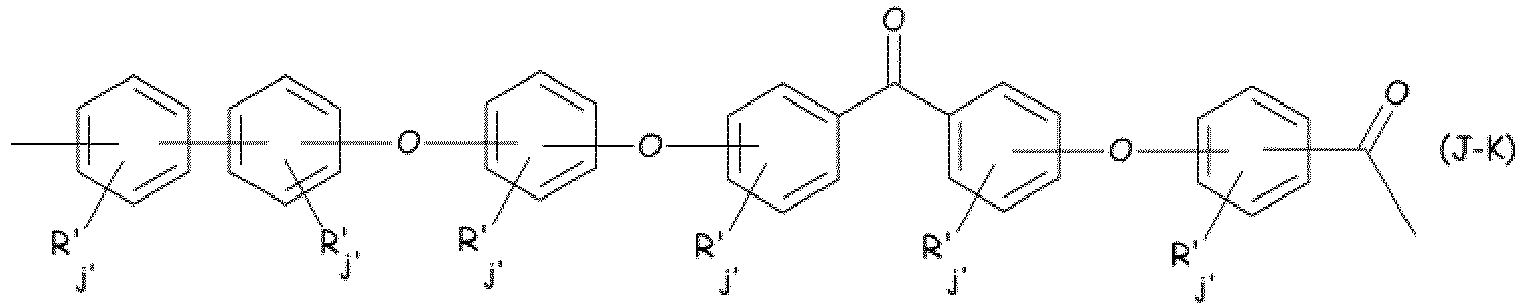
- the PAEK which constitutes (PAEK-1) is any polymer comprising recurring units (R1), wherein at least 50% moles of said recurring units comply with at least one of the formulae (J-A)-(J-Q) here below: wherein:
- the respective phenylene moieties may independently have 1,2-, 1,4- or 1,3 -linkages to the other moieties different from R' in the recurring unit.
- said phenylene moieties have 1,3- or 1,4- linkages, more preferably they have 1,4-linkages.
- j' is preferably at each occurrence zero, that is to say that the phenylene moieties have no other substituents than those enabling linkages in the main chain of the polymer.
- Preferred recurring units (R1) are thus selected from those of formulae (J'-A) - (J'-Q) here below:
- the (PAEK-1) comprises at least 50% moles of the recurring units (J-A), (J-B), (J-C) or (J-O). More advantageously, the (PAEK-1) comprises at least 60% moles, more advantageously at least 70% moles, still more advantageously at least 80% moles, and most advantageously at least 90% of the recurring units (J-A), (J-B), (J-C) or (J-O).
- units (J-A), (J-B), (J-C) and (J-O) are (J'-A), (J'-B), (J'-C) and (J'-O) units.
- PAEK-1 examples include KetaSpire® PEEK from Solvay Specialty Polymers, Vestakeep® PEEK from Evonik, Victrex® PEEK, PEEK-HT and PEEK-ST from Victrex®, Cypek® FC and Cypek® HT PEKK from Cytec.
- the (PAEK-1) is a PEEK wherein at least 50% moles of the recurring units are recurring units (J-A).
- at least 60% moles, more preferably at least 70% moles, still more preferably at least 80% moles, most preferably at least 90% moles and most preferably at least 95% of the recurring units of (PAEK-1) are recurring units (J-A).
- substantially all of the recurring units means at least 98% moles of the recurring units.
- Preferred recurring units (J-A) are those complying with formula (J'-A). Excellent results were obtained when the PAEK-1 contained at least 98% moles units (J'-A), namely with PEEKs available from Solvay Specialty Polymers USA with trademarks KetaSpire® KT-880 NL and KetaSpire® KT-890 NL.
- the (PAEK-1) exhibits a melt viscosity of at least 0.05 kN-s/m 2 measured according to ASTM D3835 at 400 °C and 1000 s-1 using a tungsten carbide die of 0.5 x 3.175 mm, more preferably of at least 0.07 kN-s/m 2 , more preferably of at least 0.08 kN-s/m 2 .
- the (PAEK-1) exhibits a melt viscosity of at most 0.65 kN-s/m 2 measured according to ASTM D3835 at 400 °C and 1000 s-1 using a tungsten carbide die of 0.5 x 3.175 mm, more preferably of at most 0.60 kN-s/m 2 , more preferably of at most 0.50 kN-s/m 2 .
- the (PAEK-1) exhibits an inherent viscosity measured according to ASTM D2857-95, at 0.1% in concentrated sulfuric acid at 25 °C, of at least 0.4 dL/g, more preferably of at least 0.5 dL/g, most preferably of at least 0.6 dL/g.
- the (PAEK-1) exhibits an inherent viscosity measured at 0.1% in concentrated sulfuric acid at 25 °C, of at most 2.0 dL/g, more preferably of at most 1.7 dLg/, most preferably of at most 1.5 dL/g.
- PAEK-2 The polyaryl ether ketone
- the (PAEK-2) is any polymer comprising recurring units (R2), wherein at least 50% moles of said recurring units comply with at least one of formulae (J-A) - (J-Q) as defined above, selected in such a way as the PAEK-2 is amorphous or crystalline and exhibits a melting temperature T m of 315 °C or lower.
- the respective phenylene moieties may independently have 1,2-, 1,4- or 1,3 -linkages to the other moieties different from R' in the recurring unit.
- said phenylene moieties have 1,3- or 1,4- linkages; more preferably they have 1,4-linkages, except units (J-A), (J-B) and (J-Q), which more preferably independently have 1,3 and 1,4-linkages.
- j' is preferably at each occurrence zero, that is to say that the phenylene moieties have no other substituents than those enabling linkages in the main chain of the polymer.
- Preferred recurring units (R2) are thus selected from those of formulae (J'-A) to (J'-Q) as defined above and also from units (J"-A), (J"-B) and (J"-Q) herein below:
- the (PAEK-2) is a polyarylether ketone ketone (PEKK), i.e. a polymer wherein at least 50% moles of the recurring units of PAEK-2 are a combination of units (J'-B) and (J"-B).
- PEKK polyarylether ketone ketone
- Cypek® DS-E or DS-M PEKK available from Cytec.
- the (PAEK-2) is a PEEK-PEDEK, i.e. a polymer wherein at least 50% moles of the recurring units of PAEK-2 are a combination of recurring units (J'-A) and (J'-D) as defined above.
- at least 60% moles, preferably at least 70% moles, still more preferably at least 80% moles and most preferably at least 90% moles of the recurring units of the PEEK-PEDEK are recurring units (J'-A) and (J'-D). More preferably, at least 95% moles of the recurring units of the PEEK-PEDEK are recurring units (J'-A) and (J'-D).
- all of the recurring units of the PEEK-PEDEK are recurring units (J'-A) and (J'-D).
- PEEK-PEDEK polymers can be manufactured according to the method disclosed in the aforementioned EP 0184458 A2 to Imperial Chemical Industries PLC.
- the molar ratio of recurring units (J'-A)/(J'-D) is in the range 65/35 to 85/15.
- all recurring units were (J'-A) and (J'-D) units in the following (J'-A)/(J'-D) molar ratios: 65/35, 70/30, 75/25, 80/20 and 85/15.
- the (PAEK-2) is a sulfonated PEEK, i.e. PEEK in which at least 50% moles of the recurring units are recurring units (J'''-A) here below: and substantially all the rest of the recurring units are recurring units of formula (J'-A) as defined above.
- Sulfonated PEEK can be manufactured by sulfonation reaction of a PEEK; in particular, a sulfonated PEEK in which at least 50% moles of the recurring units are recurring units (J'''-A) can be manufactured by sulfonation reaction of a PEEK wherein substantially all recurring units are recurring units (J'-A).
- these preferred (PAEK-2) contain at least 98% moles of a combination of recurring units (J'-A) and (J'''-A), wherein recurring units (J'''-A) comprise at least 50% moles of the overall recurring units contained in the (PAEK-2).
- At least 50% moles of the recurring units of the (PAEK-2) are recurring units (J'-P).
- Preferably at least 60% moles, preferably at least 70% moles, still more preferably at least 80% moles and most preferably at least 90% moles of the recurring units of the (PAEK-2) are recurring units (J'-P).
- More preferably, at least 95% moles of the recurring units of the PAEK-2 are recurring units (J'-P).
- Most preferably, all of the recurring units of the PAEK-2 are recurring units (J'-P).
- This PAEK-2 can be manufactured according to known methods by polycondensation reaction of bisphenol A with a 4,4'-dihalodibenzophenone, typically 4,4'-difluorodibenzophenone.
- At least 50% moles of the recurring units of the (PAEK-2) is a combination of recurring units (J'-A) and (J"-A).
- Preferably at least 60% moles, preferably at least 70% moles, still more preferably at least 80% moles and most preferably at least 90% moles of the recurring units of the (PAEK-2) are recurring units (J'-A) and (J"-A).
- More preferably, at least 95% moles of the recurring units of the (PAEK-2) are recurring units (J'-A) and (J"-A).
- Most preferably, all of the recurring units of the (PAEK-2) are recurring units (J'-A) and (J"-A).
- At least 50% moles of the recurring units of the (PAEK-2) are recurring units (J"-A).
- Preferably at least 60% moles, preferably at least 70% moles, still more preferably at least 80% moles and most preferably at least 90% moles of the recurring units of the (PAEK-2) are recurring units (J"-A).
- More preferably, at least 95% moles of the recurring units of the (PAEK-2) are recurring units (J"-A).
- Most preferably, all of the recurring units of the (PAEK-2) are recurring units (J"-A).
- At least 50% moles of the recurring units of the (PAEK-2) are recurring units (J"-Q).
- Preferably at least 60% moles, preferably at least 70% moles, still more preferably at least 80% moles and most preferably at least 90% moles of the recurring units of the (PAEK-2) are recurring units (J"-Q).
- More preferably, at least 95% moles of the recurring units of the (PAEK-2) are recurring units (J"-Q).
- Most preferably, all of the recurring units of the (PAEK-2) are recurring units (J"-Q).
- the (PAEK-2) exhibits a melt viscosity of at least 0.03 kN-s/m 2 measured according to ASTM D3835 at 400 °C and 1000 s -1 using a tungsten carbide die of 0.5 x 3.175 mm, more preferably of at least 0.04 kN-s/m 2 , more preferably of at least 0.05 kN-s/m 2 .
- the (PAEK-2) exhibits a melt viscosity of at most 0.65 kN-s/m 2 measured according to ASTM D3835 at 400 °C and 1000 s -1 using a tungsten carbide die of 0.5 x 3.175 mm, more preferably of at most 0.60 kN-s/m 2 , more preferably of at most 0.50 kN-s/m 2 .
- the (PAEK-2) exhibits an inherent viscosity measured according to ASTM D2857-95 at 0.1% in concentrated sulfuric acid at 25 °C, of at least 0.2 dL/g, more preferably of at least 0.3 dLg/, most preferably of at least 0.4 dL/g.
- the (PAEK-2) exhibits an inherent viscosity measured at 0.1% in concentrated sulfuric acid at 25 °C, of at most 2.0 dL/g, more preferably of at most 1.7 dLg/, most preferably of at most 1.5 dL/g.
- the (PAEK-2) exhibits a 5 % weight loss at a temperature ("T d ”) of no less than about 300 °C, no less than about 350 °C, or no less than about 400 °C, as measured by thermal gravimetric analysis ("TGA") according to the ASTM D3850 standard. TGA measurements are performed with starting temperature of 30° C, an ending temperature of 800° C, a ramp rate of 10° C/minute and under a nitrogen atmosphere using a flow rate of 60 mL/minute.
- the (PAEK-1) and the (PAEK-2) are blended together to provide a blend (B) according to methods known in the art. More than one (PAEK-1) and more than one (PAEK-2) can be used in blends (B); however, blends (B) preferably comprise only one (PAEK-1) in combination with one (PAEK-2).
- blends (B) preferably comprise only one (PAEK-1) in combination with one (PAEK-2).
- the term "blend” is intended to mean a homogeneous (or uniform) physical mixture of the two polymers.
- a blend is obtainable by any method known in the art wherein convection is the dominant mixing motion, including melt-mixing (or melt compounding), solution blending and latex mixing.
- blend (B) is manufactured by melt compounding, as explained in detail below with reference to composition (C).
- blend (B) can be manufactured by powder blending as explained in detail below with reference to composition (C).
- (PAEK-1) and (PAEK-2) are mixed in variable weight ratios, provided that the weight of (PAEK-1) is higher than the weight of (PAEK-2), i.e. (PAEK-1) comprises more than 50%wt of blend (B).
- the (PAEK-1) comprises at least 60%wt of blend (B), preferably at least 70% of blend (B), more preferably at least 75% wt of blend (B).
- the (PAEK-1) comprises at least 90%wt of blend (B).
- Preferred examples of blends (B-1) are:
- the blend is a blend (B-1a) or (B-1b).
- method (M) is advantageously carried out with a blend (B-2) comprising:
- method (M) is carried out with:
- method (M) is carried out with blend (B2-b).
- Blends (B-1) in which the (PAEK-2) is not a PEEK-PEDEK represent a further aspect of the present invention.
- Advantageous examples of such blends are those comprising:
- Blends (B-2) also represent a further aspect of the present invention; blends (B-2a) and (B2-b) being preferred, blend (B2-b) being more preferred.
- composition (C) exhibits a good chemical resistance and preferably exhibits an enthalpy of fusion measured on the 2 nd heat DSC scan of at least 19 J/g of polymer (that is excluding optional ingredients as detailed below), more preferably of at least 26 J/g polymer, more preferably of at least 32 J/g of polymer, more preferably of at least 39 J/g of polymer and most preferably of at least 43 J/g of polymer.
- composition (C) exhibits good chemical resistance demonstrated in Environmental Stress Cracking Resistance (ESCR) experiments carried out as described in detail in the Experimental Section below.
- ESCR Environmental Stress Cracking Resistance
- the composition (C) exhibits a critical strain to failure of at least 0.5% after a 24 hour immersion exposure in either toluene or methyl ethyl ketone at room temperature. More preferably the composition (C) exhibits a critical strain to failure of at least 0.7% after this exposure, and most preferably of at least 0.9%.
- a composition (C) for carrying out method (M) can be constituted only of a blend (B) as defined above or may comprise additional ingredients, in particular reinforcing fillers.
- a composition (C) comprises, preferably consists of, a blend (B) as defined above and at least one reinforcing filler.
- a large selection of reinforcing fillers may be included in composition (C). They are preferably selected from fibrous and particulate fillers.
- a fibrous reinforcing filler is a material having length, width and thickness, wherein the average length is significantly larger than both the width and thickness.
- such a material has an aspect ratio, defined as the average ratio between the length and the largest of the width and thickness of at least 5.
- the aspect ratio of the reinforcing fibers is at least 10, more preferably at least 20, still more preferably at least 50.
- the reinforcing filler is selected from mineral fillers (such as talc, mica, kaolin, calcium carbonate, calcium silicate, magnesium carbonate), glass fiber, carbon fibers, synthetic polymeric fiber, aramid fiber, aluminum fiber, titanium fiber, magnesium fiber, boron carbide fibers, rock wool fiber, steel fiber, wollastonite, etc. Still more preferably, it is selected from mica, kaolin, calcium silicate magnesium carbonate.
- the filler is chosen from fibrous fillers.
- the reinforcing filler is chosen from glass fibers and carbon fibers. Excellent results were obtained when glass fibers were used.
- Glass fibers are silica-based glass compounds that contain several metal oxides which can be tailored to create different types of glass.
- the main oxide is silica in the form of silica sand; the other oxides such as calcium, sodium and aluminium are incorporated to reduce the melting temperature and impede crystallization.
- Glass fibers may have a round cross-section or a non-circular cross-section (so called "flat glass fibers"), including oval, elliptical or rectangular.
- the glass fibers may be added as endless fibers or as chopped glass fibers or as milled glass fibers, whereas chopped glass fibers are preferred.
- the glass fibers have generally an equivalent diameter of 5 to 20 preferably of 5 to 15 mm and more preferably of 5 to 10 mm. All glass fiber types, such as A, C, D, E, M, S, R, T glass fibers (as described in chapter 5.2.3, pages 43-48 of Additives for Plastics Handbook, 2nd ed, John Murphy ), or any mixtures thereof or mixtures thereof may be used, however, E and S glass fibers are preferred.
- the filler is a particulate filler.
- particulate fillers are zinc oxide, zinc sulphide, mica, silica, talc, alumina, kaolin, calcium sulfate, calcium carbonate, titanium oxide, clay, glass powder, nickel carbonate, iron oxide, quartz powder, magnesium carbonate, fluorocarbon resin, barium sulphate, graphite, carbon powder and nanotubes.
- the non-fibrous fillers may be introduced in the form of powder or in the form of flaky particles.
- composition (C) comprises at least one fibrous reinforcing filler and at least one particulate reinforcing filler.
- the at least one reinforcing filler is present in an amount of advantageously at least 5 wt. %, preferably at least 10 wt. %, more preferably at least 15 wt. %, still more preferably at least 20 wt. %, even more preferably at least 25 wt. %, yet even more preferably at least 26 wt. %, and most preferably at least 28 wt. %, based on the total weight of the polymer composition (C).
- the reinforcing filler is also present in an amount of advantageously at most 50 wt. %, preferably at most 45 wt. %, more preferably at most 40 wt. %, still more preferably at most 35 wt. %, even more preferably at most 34 wt. %, and most preferably at most 32 wt. %, based on the total weight of the polymer composition (C).
- the reinforcing filler is present in an amount ranging from 20 to 50 wt. %, more preferably from 25 to 45 wt. %, still more preferably from 26 to 40 wt. % and most preferably from 28 to 34 wt. %, based on the total weight of the polymer composition (C).
- composition (C) may further optionally comprise an additional polymer selected from polyaryl ether sulfones (PAES), polyphenylene sulfides (PPS) and polyetherimides (PEI) or a mixture thereof in an amount not higher that 50% wt with respect to the overall weight of (PAEK-1) and (PAEK-2).
- PAES polyaryl ether sulfones
- PPS polyphenylene sulfides
- PEI polyetherimides
- composition (C) may further optionally comprise additional additives such as ultraviolet light stabilizers, heat stabilizers, antioxidants, pigments, processing aids, lubricants, flame retardants, and/or conductivity additive such as carbon black and carbon nanofibrils.
- additional additives such as ultraviolet light stabilizers, heat stabilizers, antioxidants, pigments, processing aids, lubricants, flame retardants, and/or conductivity additive such as carbon black and carbon nanofibrils.
- the composition (C) does not comprise ferromagnetic or ferromagnetic conductive particles.
- the composition does not comprise more than 0.5 wt% of a low molecular weight aromatic compound; preferably, it does not comprise more than 0.5 wt% of an aromatic compound having a molecular weight up to 3,000 g/mol.
- compositions (C) comprise, preferably consist of:
- compositions (C) comprise:
- composition (C) Manufacture of composition (C) and uses thereof
- Composition (C) can be manufactured by any known melt-mixing process that is suitable for preparing thermoplastic compositions. Such process is typically carried out by heating (PAEK-1) and (PAEK-2) at least at the melting temperature of PAEK-1 (which is the highest melting component of the blend) or above, thereby forming a blend (B) in the molten form, followed by extrusion and pelletization.
- the process can be carried out in a melt-mixing apparatus, for which any melt-mixing apparatus known to the one skilled in the art of preparing polymer compositions by melt mixing can be used. Suitable melt-mixing apparatus are, for example, kneaders, Banbury mixers, single-screw extruders, and twin-screw extruders.
- the constituting components for forming the composition are fed to the melt-mixing apparatus and melt-mixed in that apparatus.
- the constituting components may be fed simultaneously as a powder mixture or granule mixture, also known as dry-blend, or may be fed separately.
- composition (C) comprises one or more of the optional ingredients
- such ingredients are added to the molten blend (B) and mixed; if more than one additional ingredient is used, such ingredients are preferably pre-mixed before addition to the molten melt (B).
- the composition (C) can be manufactured by powder blending. Such process is typically carried out by mixing fine powders (at least 90% passing thru a 150 ⁇ m screen or finer) of (PAEK-1) and (PAEK-2) in the desired amounts. This process can be carried out in a solids or fine powder mixer.
- the mixer types usable for this purpose include tumble type mixers, ribbon type mixers, impeller type mixers, also known as high intensity mixers, shaker type mixers, as well as other types of solids and powders mixers known in the art.
- composition (C) is obtained in the form of pellets or powder which are subsequently fabricated into a finished article [article (A)].
- composition (C) shall be heated to a temperature above the melting temperature of PAEK-1 before being fabricated into a finished article.
- composition (C) is used in a method (M) to manufacture coatings for metal surfaces.
- the composition (C) can also be used in a 3D printing (also known as additive manufacturing) fabrication technique such as fused filament fabrication (FFF) or selective laser sintering (SLS).
- 3D printing fabrication equipments of the FFF type include, as an example, the equipment manufactured by Stratasys, Inc. and sold under the Fortus® trademark. Examples of SLS based 3D printing equipment are available from EOS corporation such as the ones sold under the EOSINT® trademark.
- the composition (C) can also be used in making a stock shape that can be used for subsequent machining into a finished part.
- the stock shape can be in the form of a rod, a slab, a sheet, a tube, a billet, or in any other three dimensional shape that lends itself to further machining into a finished article.
- the stock shape can be produced by extrusion, injection molding or compression molding, as well as by other polymer melt fabrication techniques known in the art.
- composition (C) and articles (A') comprising said surface
- the coated metal surface (S) according to the present invention is manufactured by a method (M) which comprises applying a composition (C) to a metal surface.
- the metal surface can have any shape, i.e. can be either a 2-dimensional (or planar) surface or a 3-dimensional surface. Part or all of the metal surface can be covered with composition (C).
- the metal surface contains aluminium and/or copper or steel.
- the metal surface can be, for example the surface of a wire, such as an electrical wire or cable, or the surface of a structural part of an electronic device, in particular an electronic device for mobile communication.
- a wire such as an electrical wire or cable
- an electronic device for mobile communication Non limiting examples of devices for mobile communication are laptops, mobile phones, GPSs, tablets, personal digital assistants, portable recording devices, portable reproducing devices and portable radio receivers.
- composition (C) is overmoulded over the metal surface.
- pellets of composition (C) are melted above their melting temperature to form a molten composition (C), which is contacted with the surface of the metal article.
- the contact is preferably carried out in a mould for injection moulding.
- composition (C) is applied to the metal surface by powder coating or slurry coating.
- the surface Before contacting composition (C) with the metal surface, the surface can be suitably treated in order to remove contaminants and/or grease and/or to chemically modify the surface and/or to alter the surface profile.
- treatment are abrasion of the surface to roughen it, addition of adhesion promotion agents, chemical etching, functionalization of the surface by exposure to plasma and/or radiation (for instance laser or UV radiation) or any combination of these.
- the metal surface is a chemically nano-etched metal surface as described in EP 1459882 A (Taisei Plas Co., Ltd.) 07/08/2003 and EP1559542 A (Taisei Plas Co., Ltd.) 03/08/2005 (so-called nano-molding technology or NMT-treated).
- a structural part of an electronic device is generally assembled with other components in order to manufacture an electronic device, in particular a mobile electronic device.
- Articles (A') comprising a surface at least part of which is coated according to method (M) of the present invention are a further object of the present invention.
- articles (A') are selected from a wire, such as an electrical wire or cable, or a structural part of an electronic device, in particular an electronic device for mobile communication.
- devices for mobile communication are laptops, mobile phones, GPSs, tablets, personal digital assistants, portable recording devices, portable reproducing devices and portable radio receivers.
- the metal surface-composition assembly preferably exhibits a lap shear strength of at least 10 MPa or 1450 psi as measured by ASTM D1002.
- PEEK aromatic polyetheretherketone
- Cypek® DS-E and DS-M PEKK are amorphous polyether ketone ketones (PEKK) available from Cytec. Cypek® DS-E and DS-M PEKK comprise recurring units (J'-B) and (J"-B) in 55/45 - 65/35 molar ratio. The "Td 5% Loss" of the DS-E polymer is 542 °C.
- Cypek® FC PEKK is a crystalline polyether ketone ketone (PEKK) available from Cytec. Cypek® FC PEKK comprises recurring units (J'-B) and (J"-B) in 66/34 - 75/25 molar ratio.
- 4,4'-Biphenol, polymer grade was procured from SI, USA.
- 1,3-Bis(4'fluorobenzoyl)benzene 99% was procured from 3B Scientific Corp., IL, USA and purified by recrystallization in monochlorobenzene before use to reach a final purity at 99+% by HPLC.
- Resorcinol technical grade, was procured from Indspec, USA. 4,4'-Difluorobenzophenone, polymer grade, was procured from Jintan, China. Diphenyl sulfone (polymer grade) was procured from Proviron (99.8% pure). Sodium carbonate, light soda ash, was procured from Solvay S.A., France. Potassium carbonate with a d90 ⁇ 45 ⁇ m was procured from Armand products. Lithium chloride (anhydrous grade) was procured from Acros.
- Fiberglass Chopped E type glass fiber OCV910A was procured from Owens Corning.
- the melting temperature T m was determined as the peak temperature of the melting endotherm on the 2 nd heat scan in differential scanning calorimeter (DSC) according to ASTM D3418-03, E1356-03, E793-06, E794-06. Details of the procedure as used in this invention are as follows: a TA Instruments DSC Q20 was used with nitrogen as carrier gas (99.998% purity, 50 mL/min). Temperature and heat flow calibrations were done using indium. Sample size was 5 to 7 mg. The weight was recorded ⁇ 0.01 mg. The heat cycles were:
- the melting temperature T m was determined as the peak temperature of the melting endotherm on the 2nd heat scan.
- the enthalpy of fusion was determined on the 2nd heat scan.
- the melting of the composition was taken as the area over a linear baseline drawn from 220°C to a temperature above the last endotherm (typically 370-380°C).
- the enthalpy of fusion is determined as the area under the melting endotherm on the 2nd heat scan in differential scanning calorimeter (DSC) according to ASTM D3418-03, E1356-03, E793-06, E794-06 and using heating and cooling rates of 20 °C/min.
- the enthalpy of fusion is determined on the 2nd heat scan and is taken as the area over a linear baseline drawn from above the Tg to a temperature above end of the endotherm.
- the enthalpy of fusion measured is corrected for filler content to express the enthalpy of fusion relatively to the polymer content only, excluding the filler.
- Environmental Stress Cracking Resistance was evaluated by immersion of flex bars mounted on a parabola shaped fixture which provides a continually variable curvature radius and applied strain from 0 to 2.0%. The testing was performed in organic solvents like toluene and methyl ethyl ketone. Failure is defined as the occurrence of any cracking or crazing at or beneath the surface of the exposed bars, no matter how minor. Failure is also considered to have occurred if the material exhibits any signs of swelling, softening or solvation by the solvent at any strain level. The test wass performed on ASTM flexural bars 5 in long by 0.5 in wide by 0.125 in in thickness annealed at 200 °C for 2 h.
- the reaction mixture was heated slowly to 130°C. An azeotrope toluene/water was collected and the water separated. The reaction mixture was held for 4 hours at 130 °C while removing water through the azeotrope. At 130°C, a solution of 107.63 g of 4,4'-difluorodibenzophenone (0.493 mol) in 169.70 g of N,N-dimethylacetamide was added via an addition funnel to the reaction mixture over 30 minutes. At the end of the addition, the reaction mixture was heated to 165°C. After 40 minutes at 165°C, 4.279 g of 4,4'-difluorodibenzophenone were added to the reaction mixture while keeping a nitrogen purge on the reactor.
- the polymer was shown to be amorphous with a Tg (half height) of 157 °C.
- the glass transition temperature Tg and the melting temperature T m were determined according to ASTM D3418, and as per the specific details described above, from the 2nd heat scan in a differential scanning calorimeter using a heating rate of 20°C/minute from 30 to 400 °C.
- Size exclusion chromatography was performed using methylene chloride as a mobile phase. Two, 5 micron (“ ⁇ m”) mixed D SEC columns with guard columns (Agilent Technologies) was used for separation. An ultraviolet detector of 254nm was used to obtain the chromatograms. A flow rate of 1.5 mL/min and injection volume of 20 micro liters (" ⁇ L") of a 0.2% weight by volume (“w/v”) solution in mobile phase was selected. Calibration was performed using narrow calibration standards of Polystyrene (Agilent Technologies) (Calibration Curve: 1) Type: Relative, Narrow calibration standard calibration 2) Fit : 3rd order regression). Empower Pro GPC software (Waters) was used to acquire data, calibrate and determine molecular weight.
- SEC Size exclusion chromatography
- the "Td 5% Loss” of the polymer was 498 °C.
- the “Td 5% Loss” refers to the average temperature at which the material lost 5% of its weight as determined by thermogravimetric analysis (“TGA") according to the ASTM D3850 standard. TGA was performed on a TA Instruments TGA Q500 from 30 °C to 800 °C under nitrogen (60 mL/min) at 10 °C/minute.
- the synthesized copolymer was represented by the following formula:
- Example 3 preparation of PEEK-PEDEK copolymer 70/30 [repeat units (J'-A) and (J'-D)]
- the reaction mixture was heated slowly to 150 °C.
- a mixture of 26.876 g of Na 2 CO 3 and 0.1524 g of K 2 CO 3 was added via a powder dispenser to the reaction mixture over 30 minutes.
- the reaction mixture was heated to 320 °C at 1°C/minute.
- 6.415 g of 4,4'-difluorobenzophenone were added to the reaction mixture while keeping a nitrogen purge on the reactor.
- 0.418 g of lithium chloride were added to the reaction mixture.
- another 2.138 g of 4,4'-difluorobenzophenone were added to the reactor and the reaction mixture was kept at temperature for 15 minutes.
- the reactor content was then poured from the reactor into a SS pan and cooled.
- the solid was broken up and ground in an attrition mill through a 2 mm screen.
- Diphenyl sulfone and salts were extracted from the mixture with acetone and water at pH between 1 and 12.
- the powder was then removed from the reactor and dried at 120 °C under vacuum for 12 hours yielding 73 g of a white powder.
- the repeat unit of the polymer is:
- the melt viscosity measured by capillary rheolology at 400 °C, 1000 s-1 using a tungsten carbide die of 0.5 x 3.175 mm was 0.19 kN-s/m 2 .
- the "Td 5% Loss" of the polymer was 561 °C.
- Example 4 preparation of PEEK-PEDEK copolymer 75/25 [ repeat units (J'-A) and (J'-D)]
- the reaction mixture was heated slowly to 150 °C.
- a mixture of 26.876 g of Na 2 CO 3 and 0.169 g of K 2 CO 3 was added via a powder dispenser to the reaction mixture over 30 minutes.
- the reaction mixture was heated to 320 °C at 1°C/minute.
- 6.415 g of 4,4'-difluorobenzophenone were added to the reaction mixture while keeping a nitrogen purge on the reactor.
- 0.418 g of lithium chloride were added to the reaction mixture.
- another 2.138 g of 4,4'-difluorobenzophenone were added to the reactor and the reaction mixture was kept at temperature for 15 minutes.
- the reactor content was then poured from the reactor into a SS pan and cooled.
- the solid was broken up and ground in an attrition mill through a 2 mm screen.
- Diphenyl sulfone and salts were extracted from the mixture with acetone and water at pH between 1 and 12.
- the powder was then removed from the reactor and dried at 120 °C under vacuum for 12 hours yielding 74 g of a white powder.
- the repeat unit of the polymer is:
- the melt viscosity measured by capillary rheolology at 400 °C, 1000 s-1 using a tungsten carbide die of 0.5 x 3.175 mm was 0.15 kN-s/m 2 .
- the "Td 5% Loss" of the polymer was 557 °C.
- Example 5 preparation of PEEK-PEDEK copolymer 80/20 [repeat units (J'-A) and (J'-D)]
- the reaction mixture was heated slowly to 150 °C.
- a mixture of 27.339 g of Na 2 CO 3 and 0.171 g of K 2 CO 3 was added via a powder dispenser to the reaction mixture over 30 minutes.
- the reaction mixture was heated to 320 °C at 1 °C/minute.
- 6.577 g of 4,4'-difluorobenzophenone were added to the reaction mixture while keeping a nitrogen purge on the reactor.
- 1.285 g of lithium chloride were added to the reaction mixture.
- another 2.192 g of 4,4'-difluorobenzophenone were added to the reactor and the reaction mixture was kept at temperature for 15 minutes.
- the reactor content was then poured from the reactor into a SS pan and cooled.
- the solid was broken up and ground in an attrition mill through a 2 mm screen.
- Diphenyl sulfone and salts were extracted from the mixture with acetone and water at pH between 1 and 12.
- the powder was then removed from the reactor and dried at 120 °C under vacuum for 12 hours yielding 72 g of a white powder.
- the repeat unit of the polymer is:
- the melt viscosity measured by capillary rheolology at 400 °C, 1000 s-1 using a tungsten carbide die of 0.5 x 3.175 mm was 0.20 kN-s/m 2 .
- the "Td 5% Loss" of the polymer was 561 °C.
- Example 6 preparation of a PEmEK polymer [repeat units (J"-A)]
- the reaction mixture was heated slowly to 150 °C.
- a mixture of 28.742 g of Na 2 CO 3 and 0.182 g of K 2 CO 3 was added via a powder dispenser to the reaction mixture over 30 minutes.
- the reaction mixture was heated to 275 °C at 1°C/minute.
- 6.860 g of 4,4'-difluorobenzophenone were added to the reaction mixture while keeping a nitrogen purge on the reactor.
- 0.447 g of lithium chloride were added to the reaction mixture. 10 minutes later, another 2.287 g of 4,4'-difluorobenzophenone were added to the reactor and the reaction mixture was kept at temperature for 15 minutes.
- the reactor content was then poured from the reactor into a stainless steeel pan and cooled.
- the solid was broken up and ground in an attrition mill through a 2 mm screen.
- Diphenyl sulfone and salts were extracted from the mixture with acetone and water at pH between 1 and 12.
- the powder was then removed from the reactor and dried at 120 °C under vacuum for 12 hours yielding 67 g of a light brown powder.
- the repeat unit of the polymer is 100% (J"-A):
- melt viscosity measured by capillary rheology at 410 °C, 46 s-1 according to ASTM 3835 was 0.33 kN-s/m2.
- the polymer was found to be amorphous with a Tg of 122 °C.
- Example 7 preparation of a PEDEKmK polymer [repeat units (J"-Q)]
- the reaction mixture was heated slowly to 150 °C. At 150 °C, a mixture of 17.662 g of Na 2 CO 3 and 0.111 g of K 2 CO 3 was added via a powder dispenser to the reaction mixture over 30 minutes. At the end of the addition, the reaction mixture was heated to 320 °C at 1°C/minute. After 1 minute at 275 °C, 2.076 g of 1,3-bis(4'-fluorobenzoyl)benzene were added to the reaction mixture while keeping a nitrogen purge on the reactor. After 5 minutes, 0.550 g of lithium chloride were added to the reaction mixture. 10 minutes later, another 1.038 g of 1,3-bis(4'-fluorobenzoyl)benzene were added to the reactor and the reaction mixture was kept at temperature for 15 minutes.
- the reactor content was then poured from the reactor into a stainless steel pan and cooled.
- the solid was broken up and ground in an attrition mill through a 2 mm screen.
- Diphenyl sulfone and salts were extracted from the mixture with acetone and water at pH between 1 and 12.
- the powder was then removed from the reactor and dried at 120 °C under vacuum for 12 hours yielding 69 g of a white powder.
- the repeat unit of the polymer is 100% (J"-Q):
- melt viscosity measured by capillary rheology at 410 °C, 46 s -1 according to ASTM 3835 was 0.23 kN-s/m2.
- Neat polymer blends consisting of a PEEK as PAEK-1 and a PEAK-2 in Table 1 were produced by melt compounding on a Coperion® ZSK 26 or a Berstorff co-rotating intermeshing twin-screw extruder. Compounding conditions on each machine utilized barrel temperature set points between 340 and 350°C.
- Testing specimens were molded using a temperature profile of 349-354°C rear, 371-377°C middle, and 377-390°C front zones with mold temperatures between 150 and 200°C for blends of PEEK/PAEK-2.
- Neat (i.e. without additional ingredients) blends of PEEK and PEEK-PEDEK [blends (B-1b) in the description] having the composition indicated in Table 1a show advantageous performance over neat PEEK (Table 1).
- Blends of PEEK/PEEK-PEDEK demonstrate high flow, shown by examples E5 and E6, similar to Ketaspire® KT-890 PEEK (comparative example C1).
- the PEEK/PEEK-PEDEK modulus and strength are similar to those of neat PEEK (comparative example C1) while exhibiting higher ductility by tensile strain at break in comparison to neat PEEK. Additionally, notched impact and dynatup impact performance demonstrated similar or better performance over neat PEEK.
- the improved performance in Dynatup failure mode where the number of brittle versus ductile failure modes are noted, is especially improved in example E5 where only 25% PAEK-2 blended into PEEK improves the performance of the blend to 100% ductile failure mode in dynatup testing.
- Similar performance was observed in compositions (C) comprising blends of PEEK/PEEK-PEDEK and glass fibers as reinforcing fibers with results shown in Table 2.
- Table 2 show that the use of PEEK-PEDEK as PAEK-2 improves flow, modulus, and strength of over control compositions comprising only PEEK-PEDEK and glass fibers (controls C12 - C14).
- the data shows improved ductility by tensile strain at break for examples E8 through E11 in comparison to a control composition comprising PEEK and glass fibers (comparative example C7) and notched impact over such control composition.
- the notched Izod performance was improved while tensile strength and tensile modulus exhibited similar performance to PEEK, comparative example C7.
- Example E16 in Table 3 the two polymeric ingredients of the composition (PAEK-1, PAEK-2) were first tumble blended for 20 minutes in a 5-gallon drum to create a premix of the resins. The premix was next metered to the feed throat of a 25 mm Berstorff co-rotating intermeshing twin-screw extruder having 8 barrel sections. The resin mix was metered at a rate of 17.5 Ib/hr using a gravimetric feeder. Fiberglass was fed at barrel section 6, also using a gravimetric feeder, at a rate of 7.5 Ib/hr for a total compounding throughput rate of 25 Ib/hr.
- the Barrel section temperature settings during compounding were 330 °C for barrel zone 2 and 340 °C for barrel zones 3-8 and for the adaptor and die.
- the temperature of the melt was monitored during the compounding run using a handheld temperature probe and was determined to be in the 380-390°C range.
- Vacuum venting was provided at barrel section 7 achieving a vacuum level of 25 in Hg to remove moisture and any other volatile residues from the compound.
- the extrudate of the compounded was stranded from the die and cooled in a water bath and then cut into cylindrical pellets approximately 3.0 mm in length and 2.7 mm in diameter.
- the composition of comparative example C15 was prepared in a similar manner to that described above for example E16.
- the pellets obtained from the compounding process above were first dried in a 150 °C desiccated convection air oven for approximately 16 hours (overnight) in preparation for injection molding. Injection molding was performed for two purposes: 1) to produce 3.2 mm (0.125 in) thick ASTM tensile and flexural specimens for mechanical property testing. Type I tensile ASTM specimens and 5 in x 0.5 in x 0.125 in flexural specimens were injection molded using 30% glass fiber reinforced PEEK injection molding guidelines provided by the supplier (Solvay Specialty Polymers). 2) Injection molding of lap shear over-molded specimens was also carried out on NMT-treated aluminum grade A-6061 coupons that are 4.5 mm long x 1.75 mm wide x 2 mm thick.
- the over-molded aluminum/plastic assembly that was obtained from the molding described above was tested for lap shear strength in an Instron® tensile test apparatus following the guidelines of ASTM D1002.
- a positioning fixture supplied by Taiseiplas was used to hold the assembly in place in the Instron grips and to maintain the alignment of the metal and plastic pieces during the tensile pull on the two materials to assure that the force applied on the lap interface is a purely shear force.
- a pull rate of 0.05 in/min was used for this testing and the lap shear strength of each specimen was calculated by dividing the load needed to break apart each assembly divided by the nominal overlap area of the joint.
- the lap shear strength is what we refer to here interchangeably as adhesion strength of the plastic to the metal substrate.
- the lap shear adhesion strength of the composition of Example E16 comprising 52%wt PEEK and 17.5% wt PEKK [blend (B-1a) in the description] outperformed the the control composition containing PEKK only by a large margin (comparative example C15).
- the adhesion of the composition prepared according to the instant invention is approximately double that of the state of the control composition.
- the mechanical properties of the composition according to this invention are for the most part on par with those of the control composition.
- Table 3 Lap shear adhesion of glass fiber reinforced PEEK and PEEK/PEKK blend compositions onto NMT treated A-6061 aluminum coupons
- Example C15 E16 Ketaspire® KT-880P PEEK 70.0 52.5 Cypek® DS-E PEKK --- 17.5 OCV-910A Glass Fiber 30.0 30.0 PEEK/PEKK ratio 100/0 75/25 NMT Lap Shear Mean (MPa) 17.1 34.7 NMT Lap Shear Std.
- the two polymeric ingredients of the composition were first tumble blended for 20 minutes in a 5-gallon drum to create a premix of the resins.
- the premix was next metered to the feed throat of a 25 mm Berstorff co-rotating intermeshing twin-screw extruder having 8 barrel sections.
- the resin mix was metered at a rate of 12.6 Ib/hr using a gravimetric feeder.
- Fiberglass was fed at barrel section 6, also using a gravimetric feeder, at a rate of 5.4 Ib/hr for a total compounding throughput rate of 18 Ib/hr.
- the Barrel section temperature settings during compounding were 330°C for barrel zone 2 and 340°C for barrel zones 3-8 and for the adaptor and die.
- the temperature of the melt was monitored during the compounding run using a handheld temperature probe and was determined to be in the 380-390°C range.
- Vacuum venting was provided at barrel section 7 achieving a vacuum level of 25 in Hg to remove moisture and any other volatile residues from the compound.
- the extrudate of the compounded was stranded from the die and cooled in a water bath and then cut into cylindrical pellets approximately 3.0 mm in length and 2.7 mm in diameter.
- the composition of Control C15 was prepared in a similar manner to that described above for Examples E19 to E24.
- control compositions C17 and C18 were prepared in a similar manner as for C15, except that the temperature setting for the Barrel section temperature settings during compounding were 300 °C for barrel zone 2 and 340 °C for barrel zones 3-8 and for the adaptor and die.
- the melting temperature T m was determined as the peak temperature of the melting endotherm on the 2nd heat scan in DSC at 20°C/minute.
- Examples C25 to E33 adhesion of compositions C15, C17 and C18 and E19 to E14 to aluminum
- the aluminum substrates were laser etched (MinilaseTM, from Tykma Technologies) to form a crosshatch pattern having a distance of about 100 ⁇ m between parallel lines. Following etching, the metal substrates were rinsed in acetone or isopropanol and dried in a vacuum oven at about 50 Torr to about 100 Torr and at about 50° C or 100° C.
- a PEEK/PAEK-2 composition was deposited on the metal substrates using injection molding (pellets predried at 120°C/25" Hg vacuum for 4 hours).
- the metal substrates were preheated to a temperature of about 190° C to about 200°C in an oven and, subsequently, on a hotplate.
- the preheated substrates were then placed in an injection mold heated to about 199°C.
- the PEEK/PAEK-2 composition was then injected, into the mold, at a temperature between from about 370°C to about 380°C to form the lap shear samples.
- the lap shear sample was removed from the mold and allowed to continue to cool to room temperature.
- the lap shear stress values, measured at 0.05 in/minute, listed in TABLE 5 are averaged over the number of lap shear samples in the corresponding Sample Set.
- the enthalpy of fusion, indicative of the degree of crystallinity of the compositions, derived from the melting endotherm on the 2nd heat scan in DSC at 20°C/minute is also indicated in table 5.
- the results of the lap shear test measurements are reported with respect to lap shear stress at break as well and were further analyzed to determine the type of failure at break.
- the samples were analyzed to determine if the failure was "Adhesive”, “Cohesive”, “Partially Cohesive” or "Specimen Break.”
- Adhesive failures were characterized by a lack of visually detectable polymer on the metal and lack of visually detectable metal on the polymer, on the fracture surface of the sample.
- Cohesive failures were characterized by a visually detectable amount of polymer on the metal or a visually detectable amount of metal on the polymer, on the fracture surface of the sample.
- the improvement observed with only 25 wt% of PAEK-2 [PAEK-2 to (PAEK-1+PAEK-2) ratio] as in E21 and E23 is surprising based on the lap shear results of C17 and C18, comprising only PAEK-2 and glass fibers [100 wt% PAEK-2 to (PAEK-1+PAEK-2) ratio]. Therefore, these results demonstrate that in the compositions according to the invention there is a unique combination of adhesion and crystallinity (chemical resistance).
- compositions were evaluated also for adhesion to copper.
- the conditions of testing were the same as for examples C25 to E33 except that the metal substrates were formed from copper (electrical grade)
- the copper substrates were rinsed with acetone, air dried then chemically etched by immersion in an aqueous solution containing 12.2 wt% ferric sulfate pentahydrate and 7.8% sulfuric acid (for 1 minute at 65°C), rinsing with demineralized water, immersion in an aqueous solution containing 5.5 wt% potassium bichromate and 9.9 wt% sulfuric acid (5 minutes at room temperature) and rinsing with demineralized water. Following etching, the metal substrates were rinsed with demineralized water and dried in a vacuum oven at about 50 Torr to about 100 Torr and at about 120° C.
- compositions of Examples E37, E38 and C39 in Table 7 were first tumble blended for 20 minutes in a 5-gallon drum to create a premix of the resins.
- a 40% glass filled PEEK was produced from Ketaspire® 880KT PEEK as a precursor to the final compositions.
- a Coperion® ZSK 26 co-rotating intermeshing extruder was used to produce the precursor compound. Upstream barrel temperatures were at a set point of 360 °C, a transition barrel at 350 °C, downstream barrels at 340 °C, and the adapter and die at a set point of 350 °C before the melt exited the extruder to be cooled and pelletized.
- OCV 910A glass fibers were introduced into the polymer melt downstream in the extruder.
- the measured melt temperature of the extrudate exiting the die was 390 °C, acquired by hand-held temperature probe.
- the final composition was achieved by mixing the 40% glass filled PEEK pellets thus obtained and additional PEEK (KetaSpire® KT-880P) (for the preparation of C39) or polymers powder PAEK-2 prepared according to synthesis examples 6 and 7 (for the preparation on E37 and E38) to reach a final level of 30 wt% glass fibers in the composition.
- the premix was next metered to the feed throat of a 18 mm Leistritz co-rotating intermeshing twin-screw extruder having 8 barrel sections.
- the resin mix was metered at a rate of 5 to 6 Ib/hr using a gravimetric feeder.
- the Barrel section temperature settings during compounding were 370 °C for barrel zone 1 and 355 °C for barrel zones 2-5 and for the adaptor and die.
- the temperature of the melt was monitored during the compounding run using a handheld temperature probe and was determined to be in the 380-390 °C range.
- Vacuum venting was provided at barrel section 7 achieving a vacuum level of 8 mm Hg to remove moisture and any other volatile residues from the compound.
- the extrudate of the compounded was stranded from the die and cooled in a water bath and then cut into cylindrical pellets approximately 3.0 mm in length and 2.7 mm in diameter.
- compositions E37 and E38 were prepared in a similar manner as for C39, except that the temperature setting for the Barrel section temperature settings during compounding were 280 °C for barrel zone 1 and 345 °C for barrel zones 2-5 and for the adaptor and die.
- the melting temperature T m was determined as the peak temperature of the melting endotherm on the 2nd heat scan in DSC at 20 °C/minute.
- TABLE 7 Composition PAEK-2 Polymer Repeat Unit Source (synth esis exampl e) PAEK-2 T m (°C) PEEK wt% PAEK-2 wt% GF wt% PEEK/PAEK -2 wt/wt ratio E37 (J"-A) Ex. 6 ND a 52.5 17.5 30 75/25 E38 (J"-Q) Ex. 7 306 52.5 17.5 30 75/25 C39 None - 70 0 30 100/0 a : no melting endotherm detected on the second heat DSC scan
- the enthalpy (heat) of fusion indicative of the degree of crystallinity of the compositions, derived from the melting endotherm on the 2nd heat scan in DSC at 20 °C/minute is also indicated in Table 8.
- compositions of comparative Example C43 and Examples E44 and E45 having a 60/40 PEEK (KetaSpire® KT-880)/PAEK-2 ratio, as specified in Table 9 below, were prepared by first tumble blending in powder form the polymers to be blended at the desired ratios for about 20 minutes to create a premix of the polymers. This was followed by melt compounding using a 26 mm Coperion® co-rotating partially intermeshing twin screw extruder having a length to diameter (L/D) ratio of 48:1. The extruder had 12 barrel sections with barrel sections 2 through 7 being heated with a temperature setting of 350 °C while barrel sections 8-12 and the die were heated to a temperature set point of 360 °C.
- the melt temperature recorded for the extrudate as it exited the die ranged between 394 and 398 °C for all the compositions.
- the feeding of the extruder was such that the polymer components were metered gravimetrically at the extruder feed hopper, while the glass fiber was metered also using a gravimetric feeder at the proportion corresponding to the 30 wt.% level in each composition at barrel section 7.
- the extruder was operated at a total throughput rate of 40 Ib/hr (18.15 kg/hr) which corresponded to a resin feed rate of 28 Ib/hr (12.70 kg/hr) and a glass fiber feed rate of 12 Ib/hr (5.44 kg/hr).
- the extruder screw speed was set at 200 rpm throughout and the extruder torque reading was maintained in the 60-70% range during compounding of all the compositions.
- Vacuum venting with a vacuum level > 25 in Hg was applied at barrel section 10 during compounding to strip off moisture and any possible residual volatiles from the compound.
- the extrudate from each of the runs was stranded and cooled in a water trough and then pelletized into pellets approximately 2.7 mm in diameter and 3.0 mm in length.
- the aluminum substrates were laser etched (MinilaseTM, from Tykma Technologies) to form a crosshatch pattern having a distance of about 100 ⁇ m between parallel lines. Following etching, the metal substrates were rinsed in acetone or isopropanol and dried in a vacuum oven at about 50 Torr to about 100 Torr and at about 50° C or 100° C.
- a PAEK1/PAEK2 composition was deposited on the metal substrates using injection molding (pellets pre-dried at 120 °C/25" Hg vacuum for 4 hours).
- the metal substrates were preheated to a temperature of about 190° C to about 200° C in an oven and, subsequently, on a hotplate.
- the preheated substrates were then placed in an injection mold heated to about 199° C.
- the PAEK1/PAEK2 composition was then injected, into the mold, at a temperature between from about 370° C to about 380° C to form the lap shear samples.
- the lap shear sample was removed from the mold and allowed to continue to cool to room temperature.
- the lap shear stress values, measured at 0.05 in/minute, listed in TABLE 10 are averaged over the number of lap shear samples in the corresponding Sample Set.
- the heat of fusion, indicative of the degree of crystallinity of the compositions, derived from the melting endotherm on the 2nd heat scan in DSC at 20 °C/minute is also indicated in TABLE 10.
- the results of the lap shear test measurements are reported with respect to lap shear stress at break as well and were further analyzed to determine the type of failure at break.
- the samples were analyzed to determine if the failure was "Adhesive”, “Cohesive”, “Partially Cohesive” or "Specimen Break.”
- Adhesive failures were characterized by a lack of visually detectable polymer on the metal and lack of visually detectable metal on the polymer, on the fracture surface of the sample.
- Cohesive failures were characterized by a visually detectable amount of polymer on the metal or a visually detectable amount of metal on the polymer, on the fracture surface of the sample.
Landscapes
- Chemical & Material Sciences (AREA)
- Organic Chemistry (AREA)
- Chemical Kinetics & Catalysis (AREA)
- Engineering & Computer Science (AREA)
- Health & Medical Sciences (AREA)
- Medicinal Chemistry (AREA)
- Polymers & Plastics (AREA)
- Materials Engineering (AREA)
- Mechanical Engineering (AREA)
- Life Sciences & Earth Sciences (AREA)
- Wood Science & Technology (AREA)
- Physics & Mathematics (AREA)
- Spectroscopy & Molecular Physics (AREA)
- Metallurgy (AREA)
- Compositions Of Macromolecular Compounds (AREA)
Claims (19)
- Procédé de revêtement d'une surface métallique, ledit procédé comprenant l'application à une surface métallique d'une composition polymère comprenant un mélange de polymères [mélange (B)] composé :- d'une première polyaryléthercétone (PAEK-1) et- d'une deuxième polyaryléthercétone (PAEK-2),dans lequel la (PAEK-1) est cristalline et présente une température de fusion Tm de 330 °C ou plus et la (PAEK-2) est soit amorphe, soit cristalline et présente une température de fusion Tm de 315 °C ou moins, et dans lequel la (PAEK-1) constitue plus de 50 % en poids du mélange (B), la température de fusion ayant été mesurée comme indiqué dans la description,
et dans lequel la composition est chauffée jusqu'à une température supérieure à la température de fusion de la (PAEK-1) avant d'être appliquée à la surface métallique, et
dans lequel le mélange (B) est un mélange physique homogène des deux polymères (PAEK-1) et (PAEK-2). - Procédé selon la revendication 1 dans lequel la (PAEK-1) comprend des motifs récurrents (R1), au moins 50 % en moles desdits motifs récurrents répondant à au moins une des formules (J-A)-(J-Q) ci-dessous :




 - chacun des R', identique ou différent des autres, est choisi dans le groupe constitué par un halogène, un alkyle, un alcényle, un alcynyle, un aryle, un éther, un thioéther, un acide carboxylique, un ester, un amide, un imide, un sulfonate de métal alcalin ou alcalino-terreux, un sulfonate d'alkyle, un phosphonate de métal alcalin ou alcalino-terreux, un phosphonate d'alkyle, une amine et un ammonium quaternaire ;- j' vaut 0 ou est un entier de 1 à 4 ; et- Y' est un groupe alkylidène.
 - Procédé selon la revendication 2 dans lequel au moins 50 % en moles des motifs récurrents (R1) sont des motifs de formule (J-A), (J-B), (J-C) ou (J-O).
- Procédé selon la revendication 2 ou 3, dans lequel les groupements phénylène dans les motifs récurrents (R1) ont des liaisons 1,4.
- Procédé selon l'une quelconque des revendications 2 à 4 dans lequel j' vaut zéro à chaque occurrence.
- Procédé selon la revendication 5 comprenant au moins 98 % en moles de motifs récurrents répondant à la formule (J'-A) ci-dessous :

- Procédé selon l'une quelconque des revendications 1 à 4 dans lequel la (PAEK-2) comprend au moins 50 % en moles de motifs récurrents (R2) répondant à au moins une des formules (J-A)-(J-Q) telles que définies dans la revendication 2, dans lequel, dans les motifs (J-A), (J-B) et (J-Q), les groupements phénylène ont indépendamment des liaisons 1,3 et 1,4, tandis que dans les motifs (J-C)-(J-P), les groupements phénylène ont des liaisons 1,4.
- Procédé selon la revendication 7 dans lequel j' vaut zéro à chaque occurrence.
- Procédé selon la revendication 1 dans lequel le mélange (B) est un mélange (B-1) comprenant :- une (PAEK-1) qui est une polyétheréthercétone comprenant au moins 98 % en moles de motifs récurrents de formule(J'-A) :
 - une (PAEK-2) dans laquelle au moins 50 % en moles des motifs récurrents sont une combinaison de motifs de formules (J'-B) et (J"-B), une combinaison de motifs de formules (J'-A) et (J'-D), des motifs de formule (J'''-A), des motifs de formule (J'-P), ou une combinaison de motifs de formules (J'-A) et (J"-A), lesdits motifs répondant aux formules ci-dessous :

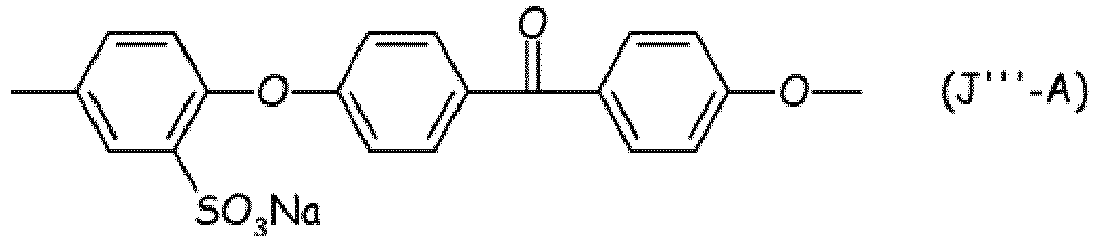



- Procédé selon la revendication 9 dans lequel le mélange (B-1) est choisi parmi :1) un mélange (B-1a), comprenant :- une (PAEK-1) dans laquelle tous les motifs récurrents sont des motifs de formule (J'-A) et- une (PAEK-2) dans laquelle tous les motifs récurrents sont une combinaison de motifs de formules (J'-B) et (J"-B) ;2) un mélange (B-1b), comprenant :- une (PAEK-1) dans laquelle tous les motifs récurrents sont des motifs de formule (J'-A) et- une (PAEK-2) dans laquelle tous les motifs récurrents sont une combinaison de motifs de formules (J'-A) et (J'-D) ;3) un mélange (B-1c), comprenant :- une (PAEK-1) dans laquelle tous les motifs récurrents sont des motifs de formule (J'-A) et- une (PAEK-2) dans laquelle tous les motifs récurrents sont des motifs récurrents de formule (J'-P) ;4) un mélange (B-1d), comprenant :- une (PAEK-1) dans laquelle tous les motifs récurrents sont des motifs de formule (J'-A) et- une (PAEK-2) dans laquelle au moins 50 % en moles des motifs récurrents sont des motifs récurrents (J"'-A) ;5) un mélange (B-1e), comprenant :- une (PAEK-1) qui est une PEEK dans laquelle au moins 98 % en moles des motifs récurrents sont des motifs de formule (J'-A) et- une (PAEK-2) qui est PAEK dans laquelle au moins 95 % en moles des motifs récurrents sont des motifs récurrents (J'-A) et (J"-A).
- Procédé selon l'une quelconque des revendications 1 à 10 dans lequel la composition polymère comprend une charge de renforcement.
- Procédé selon la revendication 1 dans lequel le mélange (B) est un mélange (B-2) comprenant une (PAEK-2) qui est PAEK dans laquelle au moins 50 % en moles des motifs récurrents répondent à la formule (J"-A) ou (J"-Q) ci-dessous :


- Procédé selon la revendication 11 dans lequel le mélange (B-2) comprend une (PAEK-1) dans laquelle au moins 50 % en moles des motifs récurrents répondent à la formule (J'-A), avec une combinaison de motifs (J'-B) et (J"-B), ou à la formule (J'-C) ci-dessous :


- Procédé selon la revendication 13 dans lequel le mélange (B-2) est choisi parmi :1) un mélange (B-2a), comprenant :- une (PAEK-1) qui est une PEEK dans laquelle au moins 98 % en moles des motifs récurrents sont des motifs de formule (J'-A) et- une (PAEK-2) qui est une PAEK dans laquelle au moins 95 % en moles des motifs récurrents sont des motifs récurrents (J"-A) ;2) un mélange (B-2b), comprenant :- une (PAEK-1) qui est une PEEK dans laquelle au moins 98 % en moles des motifs récurrents sont des motifs de formule (J'-A) et- une (PAEK-2) qui est une PAEK dans laquelle au moins 95 % en moles des motifs récurrents sont des motifs récurrents (J"-Q).
- Composition polymère comprenant un mélange de polymères (B-2) tel que défini dans la revendication 12.
- Composition polymère comprenant un mélange de polymères (B-2a) et (B-2b) tel que défini dans la revendication 14.
- Surface métallique revêtue d'une composition polymère comprenant un mélange de polymères [mélange (B-2)] selon la revendication 15.
- Surface métallique de la revendication 17 qui est la surface d'un fil, ou la surface d'une pièce de structure d'un dispositif électronique.
- Fil ou dispositif électronique ou pièce de celui-ci comprenant au moins une surface selon la revendication 17 ou 18.
Applications Claiming Priority (4)
| Application Number | Priority Date | Filing Date | Title |
|---|---|---|---|
| US201662305731P | 2016-03-09 | 2016-03-09 | |
| EP16168380 | 2016-05-04 | ||
| US201662407911P | 2016-10-13 | 2016-10-13 | |
| PCT/EP2017/055064 WO2017153290A1 (fr) | 2016-03-09 | 2017-03-03 | Compositions de polyaryléthercétone et procédé de revêtement d'une surface métallique |
Publications (2)
| Publication Number | Publication Date |
|---|---|
| EP3426741A1 EP3426741A1 (fr) | 2019-01-16 |
| EP3426741B1 true EP3426741B1 (fr) | 2020-10-21 |
Family
ID=56068660
Family Applications (1)
| Application Number | Title | Priority Date | Filing Date |
|---|---|---|---|
| EP17707589.2A Active EP3426741B1 (fr) | 2016-03-09 | 2017-03-03 | Compositions de polyaryléthercétone et procédé de revêtement d'une surface métallique |
Country Status (4)
| Country | Link |
|---|---|
| US (1) | US10808143B2 (fr) |
| EP (1) | EP3426741B1 (fr) |
| CN (1) | CN108779365B (fr) |
| WO (1) | WO2017153290A1 (fr) |
Families Citing this family (20)
| Publication number | Priority date | Publication date | Assignee | Title |
|---|---|---|---|---|
| CN110312752B (zh) | 2016-12-21 | 2022-05-06 | 索尔维特殊聚合物美国有限责任公司 | 聚(醚酮酮)聚合物、相应的合成方法和聚合物组合物以及由其制成的制品 |
| EP3559084B2 (fr) | 2016-12-21 | 2024-10-16 | Solvay Specialty Polymers USA, LLC | Polymères poly (éther-cétone-cétone), procédés de synthèse correspondants et compositions de polymères et articles ainsi fabriqués |
| JP7284153B2 (ja) | 2017-09-14 | 2023-05-30 | ソルベイ スペシャルティ ポリマーズ ユーエスエー, エルエルシー | ポリマー-金属接合 |
| US11267938B2 (en) | 2017-12-20 | 2022-03-08 | Solvay Specialty Polymers Usa, Inc | Method of making a shaped article comprising printing layers of a polymer composition comprising at least one PEEK-PEmEK copolymer |
| JP6547014B1 (ja) | 2018-01-23 | 2019-07-17 | ダイキン工業株式会社 | 造形用粉末 |
| US12024588B2 (en) | 2018-03-28 | 2024-07-02 | Victrex Manufacturing Limited | Copolymers and process for their manufacture |
| WO2019215304A1 (fr) * | 2018-05-11 | 2019-11-14 | Solvay Specialty Polymers Usa, Llc | Compositions de polymère |
| US11426818B2 (en) | 2018-08-10 | 2022-08-30 | The Research Foundation for the State University | Additive manufacturing processes and additively manufactured products |
| US10619032B2 (en) * | 2018-09-18 | 2020-04-14 | Hexcel Corporation | Polymer powder and method of preparing the same |
| CN112898531B (zh) * | 2018-10-15 | 2021-12-21 | 广东嘉元新材料有限公司 | 一种聚芳醚酮改性水性聚氨酯树脂 |
| JP2019127041A (ja) * | 2019-03-15 | 2019-08-01 | ダイキン工業株式会社 | 造形用粉末 |
| JP7197420B2 (ja) * | 2019-03-29 | 2022-12-27 | エセックス古河マグネットワイヤジャパン株式会社 | 絶縁電線、コイル、及び電気・電子機器 |
| US20220267518A1 (en) * | 2019-06-20 | 2022-08-25 | Solvay Specialty Polymers Usa, Llc | PEEK-PEoDEK COPOLYMER AND METHOD OF MAKING THE COPOLYMER |
| CN113321920A (zh) * | 2020-02-28 | 2021-08-31 | 中国科学院大连化学物理研究所 | 一种聚芳醚酮(砜)共混合金的泡沫材料及其制备方法 |
| GB2600905A (en) * | 2020-06-18 | 2022-05-18 | Victrex Mfg Ltd | Polymeric material and use thereof |
| GB202010909D0 (en) * | 2020-07-15 | 2020-08-26 | Victrex Mfg Ltd | Copolymers, their preparation and use |
| AU2022222330A1 (en) * | 2021-02-22 | 2023-08-17 | Cytec Industries Inc. | Films for multiple layers assemblies |
| AU2022224447A1 (en) * | 2021-02-22 | 2023-08-24 | Cytec Industries Inc. | Films for multiple layers assemblies |
| CN116897106A (zh) * | 2021-02-22 | 2023-10-17 | 索尔维特殊聚合物美国有限责任公司 | 用于多层组件的膜 |
| GB202113671D0 (en) * | 2021-09-24 | 2021-11-10 | Victrex Mfg Ltd | Insulated conductor and method of manufacture |
Citations (8)
| Publication number | Priority date | Publication date | Assignee | Title |
|---|---|---|---|---|
| EP0138128A1 (fr) | 1983-09-29 | 1985-04-24 | Amoco Corporation | Mélanges de polyarylcétones |
| US5342664A (en) | 1990-12-14 | 1994-08-30 | Hoechst Aktiengesellschaft | Alloys made from partly crystalline and amorphous poly (aryl ether ketone) compounds |
| EP1459882A1 (fr) | 2001-12-28 | 2004-09-22 | Taisei Plas Co., Ltd. | Materiau composite en alliage d'aluminium et en resine, procede de production correspondant |
| WO2009058362A1 (fr) | 2007-11-02 | 2009-05-07 | Polymics, Ltd. | Structure de protection de substrat à haute température |
| WO2015019047A1 (fr) | 2013-08-09 | 2015-02-12 | Victrex Manufacturing Limited | Matériaux polymères |
| WO2015189567A1 (fr) | 2014-06-09 | 2015-12-17 | Victrex Manufacturing Limited | Matériaux polymères |
| EP3012297A1 (fr) | 2014-10-22 | 2016-04-27 | Arkema France | Composition à base de poly (arylène éther cétone) ayant des propriétés améliorées |
| WO2016092087A1 (fr) | 2014-12-12 | 2016-06-16 | Solvay Specialty Polymers Usa, Llc | Compositions de poly(éther d'aryle) pour des jonctions polymère-métal et jonctions polymère-métal et procédés de fabrication correspondants |
Family Cites Families (13)
| Publication number | Priority date | Publication date | Assignee | Title |
|---|---|---|---|---|
| EP0184458B1 (fr) | 1984-12-05 | 1989-10-18 | Imperial Chemical Industries Plc | Polyéthercétones thermoplastiques aromatiques |
| US20040054021A1 (en) * | 2001-01-16 | 2004-03-18 | Seargeant Kenneth Malcolm | Foamed material |
| KR100827916B1 (ko) | 2002-11-08 | 2008-05-07 | 다이세이 플라스 가부시끼가이샤 | 알루미늄 합금과 수지조성물의 복합체 및 그 제조방법 |
| GB0322598D0 (en) | 2003-09-26 | 2003-10-29 | Victrex Mfg Ltd | Polymeric material |
| KR101702936B1 (ko) * | 2008-10-31 | 2017-02-06 | 폴리믹스, 리미티드 | (4하이드록시페닐)프탈라진1(2h)온 공단량체 유닛을 함유하는 고온 용융 가공성 반-결정 폴리(아릴 에테르 케톤) |
| FR2947277B1 (fr) | 2009-06-30 | 2012-05-11 | Arkema France | Composition de polyarylene-ether-cetone pour soudure par induction |
| CN105255152B (zh) * | 2009-10-29 | 2018-01-30 | 昆山普利米斯聚合材料有限公司 | 聚(芳醚酮二氮杂萘酮)的高温聚合物掺合物 |
| JP6339020B2 (ja) | 2011-12-21 | 2018-06-06 | ソルベイ スペシャルティ ポリマーズ ユーエスエー, エルエルシー | 携帯電子装置用の高性能ポリマー組成物 |
| US9650494B2 (en) * | 2012-11-05 | 2017-05-16 | King Abdullah University Of Science And Technology | Polymer nanocomposites and methods of making nanocomposites |
| GB2526243B (en) | 2014-02-24 | 2021-07-14 | Victrex Mfg Ltd | Polymeric materials |
| GB201411511D0 (en) | 2014-06-27 | 2014-08-13 | Victrex Mfg Ltd | Polymeric materials |
| GB201413489D0 (en) | 2014-07-30 | 2014-09-10 | Victrex Mfg Ltd | Polymeric materials |
| CN104356379B (zh) * | 2014-10-22 | 2016-07-06 | 常州大学 | 一类含二异丙基芴结构的可溶性聚芳醚酮及其制备方法 |
-
2017
- 2017-03-03 CN CN201780018620.XA patent/CN108779365B/zh active Active
- 2017-03-03 EP EP17707589.2A patent/EP3426741B1/fr active Active
- 2017-03-03 WO PCT/EP2017/055064 patent/WO2017153290A1/fr not_active Ceased
- 2017-03-03 US US16/082,846 patent/US10808143B2/en active Active
Patent Citations (8)
| Publication number | Priority date | Publication date | Assignee | Title |
|---|---|---|---|---|
| EP0138128A1 (fr) | 1983-09-29 | 1985-04-24 | Amoco Corporation | Mélanges de polyarylcétones |
| US5342664A (en) | 1990-12-14 | 1994-08-30 | Hoechst Aktiengesellschaft | Alloys made from partly crystalline and amorphous poly (aryl ether ketone) compounds |
| EP1459882A1 (fr) | 2001-12-28 | 2004-09-22 | Taisei Plas Co., Ltd. | Materiau composite en alliage d'aluminium et en resine, procede de production correspondant |
| WO2009058362A1 (fr) | 2007-11-02 | 2009-05-07 | Polymics, Ltd. | Structure de protection de substrat à haute température |
| WO2015019047A1 (fr) | 2013-08-09 | 2015-02-12 | Victrex Manufacturing Limited | Matériaux polymères |
| WO2015189567A1 (fr) | 2014-06-09 | 2015-12-17 | Victrex Manufacturing Limited | Matériaux polymères |
| EP3012297A1 (fr) | 2014-10-22 | 2016-04-27 | Arkema France | Composition à base de poly (arylène éther cétone) ayant des propriétés améliorées |
| WO2016092087A1 (fr) | 2014-12-12 | 2016-06-16 | Solvay Specialty Polymers Usa, Llc | Compositions de poly(éther d'aryle) pour des jonctions polymère-métal et jonctions polymère-métal et procédés de fabrication correspondants |
Non-Patent Citations (9)
| Title |
|---|
| "BITS 2010 Poster Session, BiTS Workshop 2010", 2010, Retrieved from the Internet <URL:https:/ /www.testconx.org/archive/archive2010/2010poster.pdf> |
| ANONYMOUS: "Burn-in & Test Socket WorkshopTM", 2010, Retrieved from the Internet <URL:https://www.testconx.org/archive/archive2010/archive2010.htm> |
| ANONYMOUS: "Injection molding Victrex®", VICTREX PLC, 1 February 2016 (2016-02-01), pages 16pp, XP055934056 |
| ANONYMOUS: "Kepstan™ Technical Data - 6000 Series", ARKEMA FRANCE, 1 March 2013 (2013-03-01), pages 2pp, XP055934064 |
| ANONYMOUS: "Propriétés Guide Victrex®", VICTREX POLYMER SOLUTIONS, 1 April 2012 (2012-04-01), pages 26pp, XP055934055 |
| G. LUCCHETTA; F. MARINELLO; P.F. BARIANI;: "Aluminum sheet surface roughness correlation with adhesion in polymer metal hybrid overmolding", CIRP ANNALS., ELSEVIER BV, NL, CH, FR, vol. 60, no. 1, NL, CH, FR , pages 559 - 562, XP028222638, ISSN: 0007-8506, DOI: 10.1016/j.cirp.2011.03.073 |
| M.RAMA RAO, V.L. RAO, T.S. RADHAKRISHNAN, S. RAMACHANDRAN: "Synthesis, characterization and thermal degradation studies of poly(ether ether ketone) copolymers", POLYMER, ELSEVIER, AMSTERDAM, NL, vol. 33, no. 13, 1 January 1992 (1992-01-01), AMSTERDAM, NL, pages 2834 - 2839, XP055483513, ISSN: 0032-3861, DOI: 10.1016/0032-3861(92)90461-5 |
| RAMANI K., MORIARTY B.: "THERMOPLASTIC BONDING TO METALS VIA INJECTION MOLDING FOR MACRO-COMPOSITE MANUFACTURE.", POLYMER ENGINEERING AND SCIENCE, BROOKFIELD CENTER., US, vol. 38., no. 05., 1 May 1998 (1998-05-01), US , pages 870 - 877., XP000848974, ISSN: 0032-3888, DOI: 10.1002/pen.10253 |
| STANILAND P A: "SYNTHESIS AND PROPERTIES OF NOVEL POLYETHERKETONES AND POLYETHERSULPHONES", BULLETIN DES SOCIéTéS CHIMIQUES BELGES : VLAAMSE CHEMISCHE VERENIGING, CENTERICK, BE, vol. 98, no. 09/10, 1 January 1989 (1989-01-01), BE , pages 667, XP008025133, ISSN: 0037-9646 |
Also Published As
| Publication number | Publication date |
|---|---|
| US20190031908A1 (en) | 2019-01-31 |
| EP3426741A1 (fr) | 2019-01-16 |
| WO2017153290A1 (fr) | 2017-09-14 |
| CN108779365B (zh) | 2021-07-09 |
| CN108779365A (zh) | 2018-11-09 |
| US10808143B2 (en) | 2020-10-20 |
Similar Documents
| Publication | Publication Date | Title |
|---|---|---|
| EP3426741B1 (fr) | Compositions de polyaryléthercétone et procédé de revêtement d'une surface métallique | |
| CN101395220B (zh) | 新型聚亚芳基组合物 | |
| JP5252400B2 (ja) | 新規なポリアリーレン組成物 | |
| CN109071800B (zh) | 增容的聚合物组合物 | |
| US8541505B2 (en) | Poly(arylene ether) composition with improved melt flow and method for the preparation thereof | |
| CN101309970B (zh) | 热塑性方法、组合物和制品 | |
| CN111417670B (zh) | 制造PEEK-PEmEK共聚物的方法和由该方法获得的共聚物 | |
| JP6943871B2 (ja) | ポリアリールエーテルケトン組成物、及び金属表面を被覆する方法 | |
| EP3681933B1 (fr) | Jonction polymère-métal | |
| WO2018024744A1 (fr) | Compositions de poly(aryléthercétone) (paec) comprenant un composé aromatique de bas poids moléculaire | |
| TW200801116A (en) | New polymer composition | |
| CN111032783B (zh) | 包含聚(芳基醚砜)、聚(芳基醚酮)、至少一种聚苯硫醚以及玻璃纤维的玻璃填充的聚合物组合物 | |
| EP4124635A1 (fr) | Compositions placables de sulfure de poly(phénylène) et de poly(phénylène éther) | |
| CN110914337A (zh) | 高流动性聚合物组合物 | |
| CN116981552B (zh) | 用于激光直接成型工艺的聚苯硫醚组合物及其成型制品 | |
| CN101613526A (zh) | 具有改善的熔体流动性的聚(亚芳基醚)组合物和其制备方法 | |
| CN109843973B (zh) | 包含低分子量芳香族化合物的聚(芳醚酮)(paek)组合物 | |
| CN111372998A (zh) | 热塑性聚酰胺组合物及其制备方法和应用 | |
| EP3298071B1 (fr) | Compositions de poly(aryléthercétone) | |
| US11718748B2 (en) | Composition, method for the manufacture thereof, and articles made therefrom | |
| EP3448935B1 (fr) | Compositions de polymere compatibilisees | |
| JP2012131968A (ja) | 金属膜を形成した反射板 | |
| JP2001234053A (ja) | 樹脂組成物 |
Legal Events
| Date | Code | Title | Description |
|---|---|---|---|
| STAA | Information on the status of an ep patent application or granted ep patent |
Free format text: STATUS: UNKNOWN |
|
| STAA | Information on the status of an ep patent application or granted ep patent |
Free format text: STATUS: THE INTERNATIONAL PUBLICATION HAS BEEN MADE |
|
| PUAI | Public reference made under article 153(3) epc to a published international application that has entered the european phase |
Free format text: ORIGINAL CODE: 0009012 |
|
| STAA | Information on the status of an ep patent application or granted ep patent |
Free format text: STATUS: REQUEST FOR EXAMINATION WAS MADE |
|
| 17P | Request for examination filed |
Effective date: 20181009 |
|
| AK | Designated contracting states |
Kind code of ref document: A1 Designated state(s): AL AT BE BG CH CY CZ DE DK EE ES FI FR GB GR HR HU IE IS IT LI LT LU LV MC MK MT NL NO PL PT RO RS SE SI SK SM TR |
|
| AX | Request for extension of the european patent |
Extension state: BA ME |
|
| DAV | Request for validation of the european patent (deleted) | ||
| DAX | Request for extension of the european patent (deleted) | ||
| STAA | Information on the status of an ep patent application or granted ep patent |
Free format text: STATUS: EXAMINATION IS IN PROGRESS |
|
| 17Q | First examination report despatched |
Effective date: 20191217 |
|
| GRAP | Despatch of communication of intention to grant a patent |
Free format text: ORIGINAL CODE: EPIDOSNIGR1 |
|
| STAA | Information on the status of an ep patent application or granted ep patent |
Free format text: STATUS: GRANT OF PATENT IS INTENDED |
|
| RIC1 | Information provided on ipc code assigned before grant |
Ipc: C09D 171/00 20060101AFI20200506BHEP Ipc: H01B 3/36 20060101ALI20200506BHEP Ipc: C08L 71/00 20060101ALI20200506BHEP Ipc: C08G 65/40 20060101ALI20200506BHEP |
|
| INTG | Intention to grant announced |
Effective date: 20200603 |
|
| GRAS | Grant fee paid |
Free format text: ORIGINAL CODE: EPIDOSNIGR3 |
|
| GRAA | (expected) grant |
Free format text: ORIGINAL CODE: 0009210 |
|
| STAA | Information on the status of an ep patent application or granted ep patent |
Free format text: STATUS: THE PATENT HAS BEEN GRANTED |
|
| AK | Designated contracting states |
Kind code of ref document: B1 Designated state(s): AL AT BE BG CH CY CZ DE DK EE ES FI FR GB GR HR HU IE IS IT LI LT LU LV MC MK MT NL NO PL PT RO RS SE SI SK SM TR |
|
| REG | Reference to a national code |
Ref country code: GB Ref legal event code: FG4D |
|
| REG | Reference to a national code |
Ref country code: CH Ref legal event code: EP |
|
| REG | Reference to a national code |
Ref country code: DE Ref legal event code: R096 Ref document number: 602017025815 Country of ref document: DE |
|
| REG | Reference to a national code |
Ref country code: IE Ref legal event code: FG4D |
|
| REG | Reference to a national code |
Ref country code: AT Ref legal event code: REF Ref document number: 1325862 Country of ref document: AT Kind code of ref document: T Effective date: 20201115 |
|
| REG | Reference to a national code |
Ref country code: AT Ref legal event code: MK05 Ref document number: 1325862 Country of ref document: AT Kind code of ref document: T Effective date: 20201021 |
|
| REG | Reference to a national code |
Ref country code: NL Ref legal event code: MP Effective date: 20201021 |
|
| PG25 | Lapsed in a contracting state [announced via postgrant information from national office to epo] |
Ref country code: PT Free format text: LAPSE BECAUSE OF FAILURE TO SUBMIT A TRANSLATION OF THE DESCRIPTION OR TO PAY THE FEE WITHIN THE PRESCRIBED TIME-LIMIT Effective date: 20210222 Ref country code: RS Free format text: LAPSE BECAUSE OF FAILURE TO SUBMIT A TRANSLATION OF THE DESCRIPTION OR TO PAY THE FEE WITHIN THE PRESCRIBED TIME-LIMIT Effective date: 20201021 Ref country code: NO Free format text: LAPSE BECAUSE OF FAILURE TO SUBMIT A TRANSLATION OF THE DESCRIPTION OR TO PAY THE FEE WITHIN THE PRESCRIBED TIME-LIMIT Effective date: 20210121 Ref country code: FI Free format text: LAPSE BECAUSE OF FAILURE TO SUBMIT A TRANSLATION OF THE DESCRIPTION OR TO PAY THE FEE WITHIN THE PRESCRIBED TIME-LIMIT Effective date: 20201021 Ref country code: GR Free format text: LAPSE BECAUSE OF FAILURE TO SUBMIT A TRANSLATION OF THE DESCRIPTION OR TO PAY THE FEE WITHIN THE PRESCRIBED TIME-LIMIT Effective date: 20210122 |
|
| REG | Reference to a national code |
Ref country code: LT Ref legal event code: MG4D |
|
| PG25 | Lapsed in a contracting state [announced via postgrant information from national office to epo] |
Ref country code: AT Free format text: LAPSE BECAUSE OF FAILURE TO SUBMIT A TRANSLATION OF THE DESCRIPTION OR TO PAY THE FEE WITHIN THE PRESCRIBED TIME-LIMIT Effective date: 20201021 Ref country code: ES Free format text: LAPSE BECAUSE OF FAILURE TO SUBMIT A TRANSLATION OF THE DESCRIPTION OR TO PAY THE FEE WITHIN THE PRESCRIBED TIME-LIMIT Effective date: 20201021 Ref country code: IS Free format text: LAPSE BECAUSE OF FAILURE TO SUBMIT A TRANSLATION OF THE DESCRIPTION OR TO PAY THE FEE WITHIN THE PRESCRIBED TIME-LIMIT Effective date: 20210221 Ref country code: LV Free format text: LAPSE BECAUSE OF FAILURE TO SUBMIT A TRANSLATION OF THE DESCRIPTION OR TO PAY THE FEE WITHIN THE PRESCRIBED TIME-LIMIT Effective date: 20201021 Ref country code: PL Free format text: LAPSE BECAUSE OF FAILURE TO SUBMIT A TRANSLATION OF THE DESCRIPTION OR TO PAY THE FEE WITHIN THE PRESCRIBED TIME-LIMIT Effective date: 20201021 Ref country code: BG Free format text: LAPSE BECAUSE OF FAILURE TO SUBMIT A TRANSLATION OF THE DESCRIPTION OR TO PAY THE FEE WITHIN THE PRESCRIBED TIME-LIMIT Effective date: 20210121 Ref country code: SE Free format text: LAPSE BECAUSE OF FAILURE TO SUBMIT A TRANSLATION OF THE DESCRIPTION OR TO PAY THE FEE WITHIN THE PRESCRIBED TIME-LIMIT Effective date: 20201021 |
|
| PG25 | Lapsed in a contracting state [announced via postgrant information from national office to epo] |
Ref country code: HR Free format text: LAPSE BECAUSE OF FAILURE TO SUBMIT A TRANSLATION OF THE DESCRIPTION OR TO PAY THE FEE WITHIN THE PRESCRIBED TIME-LIMIT Effective date: 20201021 Ref country code: NL Free format text: LAPSE BECAUSE OF FAILURE TO SUBMIT A TRANSLATION OF THE DESCRIPTION OR TO PAY THE FEE WITHIN THE PRESCRIBED TIME-LIMIT Effective date: 20201021 |
|
| REG | Reference to a national code |
Ref country code: DE Ref legal event code: R026 Ref document number: 602017025815 Country of ref document: DE |
|
| PLBI | Opposition filed |
Free format text: ORIGINAL CODE: 0009260 |
|
| PG25 | Lapsed in a contracting state [announced via postgrant information from national office to epo] |
Ref country code: LT Free format text: LAPSE BECAUSE OF FAILURE TO SUBMIT A TRANSLATION OF THE DESCRIPTION OR TO PAY THE FEE WITHIN THE PRESCRIBED TIME-LIMIT Effective date: 20201021 Ref country code: EE Free format text: LAPSE BECAUSE OF FAILURE TO SUBMIT A TRANSLATION OF THE DESCRIPTION OR TO PAY THE FEE WITHIN THE PRESCRIBED TIME-LIMIT Effective date: 20201021 Ref country code: CZ Free format text: LAPSE BECAUSE OF FAILURE TO SUBMIT A TRANSLATION OF THE DESCRIPTION OR TO PAY THE FEE WITHIN THE PRESCRIBED TIME-LIMIT Effective date: 20201021 Ref country code: SM Free format text: LAPSE BECAUSE OF FAILURE TO SUBMIT A TRANSLATION OF THE DESCRIPTION OR TO PAY THE FEE WITHIN THE PRESCRIBED TIME-LIMIT Effective date: 20201021 Ref country code: RO Free format text: LAPSE BECAUSE OF FAILURE TO SUBMIT A TRANSLATION OF THE DESCRIPTION OR TO PAY THE FEE WITHIN THE PRESCRIBED TIME-LIMIT Effective date: 20201021 Ref country code: SK Free format text: LAPSE BECAUSE OF FAILURE TO SUBMIT A TRANSLATION OF THE DESCRIPTION OR TO PAY THE FEE WITHIN THE PRESCRIBED TIME-LIMIT Effective date: 20201021 |
|
| PLAX | Notice of opposition and request to file observation + time limit sent |
Free format text: ORIGINAL CODE: EPIDOSNOBS2 |
|
| 26 | Opposition filed |
Opponent name: ARKEMA FRANCE Effective date: 20210721 |
|
| PG25 | Lapsed in a contracting state [announced via postgrant information from national office to epo] |
Ref country code: DK Free format text: LAPSE BECAUSE OF FAILURE TO SUBMIT A TRANSLATION OF THE DESCRIPTION OR TO PAY THE FEE WITHIN THE PRESCRIBED TIME-LIMIT Effective date: 20201021 |
|
| PG25 | Lapsed in a contracting state [announced via postgrant information from national office to epo] |
Ref country code: AL Free format text: LAPSE BECAUSE OF FAILURE TO SUBMIT A TRANSLATION OF THE DESCRIPTION OR TO PAY THE FEE WITHIN THE PRESCRIBED TIME-LIMIT Effective date: 20201021 Ref country code: IT Free format text: LAPSE BECAUSE OF FAILURE TO SUBMIT A TRANSLATION OF THE DESCRIPTION OR TO PAY THE FEE WITHIN THE PRESCRIBED TIME-LIMIT Effective date: 20201021 Ref country code: MC Free format text: LAPSE BECAUSE OF FAILURE TO SUBMIT A TRANSLATION OF THE DESCRIPTION OR TO PAY THE FEE WITHIN THE PRESCRIBED TIME-LIMIT Effective date: 20201021 |
|
| REG | Reference to a national code |
Ref country code: CH Ref legal event code: PL |
|
| PG25 | Lapsed in a contracting state [announced via postgrant information from national office to epo] |
Ref country code: SI Free format text: LAPSE BECAUSE OF FAILURE TO SUBMIT A TRANSLATION OF THE DESCRIPTION OR TO PAY THE FEE WITHIN THE PRESCRIBED TIME-LIMIT Effective date: 20201021 |
|
| PLBB | Reply of patent proprietor to notice(s) of opposition received |
Free format text: ORIGINAL CODE: EPIDOSNOBS3 |
|
| REG | Reference to a national code |
Ref country code: BE Ref legal event code: MM Effective date: 20210331 |
|
| PG25 | Lapsed in a contracting state [announced via postgrant information from national office to epo] |
Ref country code: LI Free format text: LAPSE BECAUSE OF NON-PAYMENT OF DUE FEES Effective date: 20210331 Ref country code: LU Free format text: LAPSE BECAUSE OF NON-PAYMENT OF DUE FEES Effective date: 20210303 Ref country code: CH Free format text: LAPSE BECAUSE OF NON-PAYMENT OF DUE FEES Effective date: 20210331 Ref country code: IE Free format text: LAPSE BECAUSE OF NON-PAYMENT OF DUE FEES Effective date: 20210303 |
|
| PG25 | Lapsed in a contracting state [announced via postgrant information from national office to epo] |
Ref country code: IS Free format text: LAPSE BECAUSE OF FAILURE TO SUBMIT A TRANSLATION OF THE DESCRIPTION OR TO PAY THE FEE WITHIN THE PRESCRIBED TIME-LIMIT Effective date: 20210221 |
|
| PG25 | Lapsed in a contracting state [announced via postgrant information from national office to epo] |
Ref country code: BE Free format text: LAPSE BECAUSE OF NON-PAYMENT OF DUE FEES Effective date: 20210331 |
|
| REG | Reference to a national code |
Ref country code: DE Ref legal event code: R100 Ref document number: 602017025815 Country of ref document: DE |
|
| PLCK | Communication despatched that opposition was rejected |
Free format text: ORIGINAL CODE: EPIDOSNREJ1 |
|
| PLBN | Opposition rejected |
Free format text: ORIGINAL CODE: 0009273 |
|
| STAA | Information on the status of an ep patent application or granted ep patent |
Free format text: STATUS: OPPOSITION REJECTED |
|
| PG25 | Lapsed in a contracting state [announced via postgrant information from national office to epo] |
Ref country code: CY Free format text: LAPSE BECAUSE OF FAILURE TO SUBMIT A TRANSLATION OF THE DESCRIPTION OR TO PAY THE FEE WITHIN THE PRESCRIBED TIME-LIMIT Effective date: 20201021 |
|
| 27O | Opposition rejected |
Effective date: 20230207 |
|
| PG25 | Lapsed in a contracting state [announced via postgrant information from national office to epo] |
Ref country code: HU Free format text: LAPSE BECAUSE OF FAILURE TO SUBMIT A TRANSLATION OF THE DESCRIPTION OR TO PAY THE FEE WITHIN THE PRESCRIBED TIME-LIMIT; INVALID AB INITIO Effective date: 20170303 |
|
| P01 | Opt-out of the competence of the unified patent court (upc) registered |
Effective date: 20230624 |
|
| PG25 | Lapsed in a contracting state [announced via postgrant information from national office to epo] |
Ref country code: MK Free format text: LAPSE BECAUSE OF FAILURE TO SUBMIT A TRANSLATION OF THE DESCRIPTION OR TO PAY THE FEE WITHIN THE PRESCRIBED TIME-LIMIT Effective date: 20201021 |
|
| PG25 | Lapsed in a contracting state [announced via postgrant information from national office to epo] |
Ref country code: MT Free format text: LAPSE BECAUSE OF FAILURE TO SUBMIT A TRANSLATION OF THE DESCRIPTION OR TO PAY THE FEE WITHIN THE PRESCRIBED TIME-LIMIT Effective date: 20201021 |
|
| PG25 | Lapsed in a contracting state [announced via postgrant information from national office to epo] |
Ref country code: TR Free format text: LAPSE BECAUSE OF FAILURE TO SUBMIT A TRANSLATION OF THE DESCRIPTION OR TO PAY THE FEE WITHIN THE PRESCRIBED TIME-LIMIT Effective date: 20201021 |
|
| PGFP | Annual fee paid to national office [announced via postgrant information from national office to epo] |
Ref country code: GB Payment date: 20260202 Year of fee payment: 10 |
|
| PGFP | Annual fee paid to national office [announced via postgrant information from national office to epo] |
Ref country code: DE Payment date: 20260204 Year of fee payment: 10 |
|
| PGFP | Annual fee paid to national office [announced via postgrant information from national office to epo] |
Ref country code: FR Payment date: 20260209 Year of fee payment: 10 |