EP3427794A1 - Mise en place d'une prothèse auditive - Google Patents
Mise en place d'une prothèse auditive Download PDFInfo
- Publication number
- EP3427794A1 EP3427794A1 EP18183222.1A EP18183222A EP3427794A1 EP 3427794 A1 EP3427794 A1 EP 3427794A1 EP 18183222 A EP18183222 A EP 18183222A EP 3427794 A1 EP3427794 A1 EP 3427794A1
- Authority
- EP
- European Patent Office
- Prior art keywords
- acoustic
- electric
- channel
- channels
- threshold
- Prior art date
- Legal status (The legal status is an assumption and is not a legal conclusion. Google has not performed a legal analysis and makes no representation as to the accuracy of the status listed.)
- Granted
Links
Images


Classifications
-
- A—HUMAN NECESSITIES
- A61—MEDICAL OR VETERINARY SCIENCE; HYGIENE
- A61N—ELECTROTHERAPY; MAGNETOTHERAPY; RADIATION THERAPY; ULTRASOUND THERAPY
- A61N1/00—Electrotherapy; Circuits therefor
- A61N1/18—Applying electric currents by contact electrodes
- A61N1/32—Applying electric currents by contact electrodes alternating or intermittent currents
- A61N1/36—Applying electric currents by contact electrodes alternating or intermittent currents for stimulation
- A61N1/372—Arrangements in connection with the implantation of stimulators
- A61N1/37211—Means for communicating with stimulators
- A61N1/37235—Aspects of the external programmer
- A61N1/37247—User interfaces, e.g. input or presentation means
-
- A—HUMAN NECESSITIES
- A61—MEDICAL OR VETERINARY SCIENCE; HYGIENE
- A61N—ELECTROTHERAPY; MAGNETOTHERAPY; RADIATION THERAPY; ULTRASOUND THERAPY
- A61N1/00—Electrotherapy; Circuits therefor
- A61N1/18—Applying electric currents by contact electrodes
- A61N1/32—Applying electric currents by contact electrodes alternating or intermittent currents
- A61N1/36—Applying electric currents by contact electrodes alternating or intermittent currents for stimulation
- A61N1/36036—Applying electric currents by contact electrodes alternating or intermittent currents for stimulation of the outer, middle or inner ear
- A61N1/36038—Cochlear stimulation
- A61N1/36039—Cochlear stimulation fitting procedures
-
- H—ELECTRICITY
- H04—ELECTRIC COMMUNICATION TECHNIQUE
- H04R—LOUDSPEAKERS, MICROPHONES, GRAMOPHONE PICK-UPS OR LIKE ACOUSTIC ELECTROMECHANICAL TRANSDUCERS; ELECTRIC HEARING AIDS; PUBLIC ADDRESS SYSTEMS
- H04R25/00—Electric hearing aids
- H04R25/60—Mounting or interconnection of hearing aid parts, e.g. inside tips, housings or to ossicles
- H04R25/604—Mounting or interconnection of hearing aid parts, e.g. inside tips, housings or to ossicles of acoustic or vibrational transducers
- H04R25/606—Mounting or interconnection of hearing aid parts, e.g. inside tips, housings or to ossicles of acoustic or vibrational transducers acting directly on the eardrum, the ossicles or the skull, e.g. mastoid, tooth, maxillary or mandibular bone, or mechanically stimulating the cochlea, e.g. at the oval window
-
- H—ELECTRICITY
- H04—ELECTRIC COMMUNICATION TECHNIQUE
- H04R—LOUDSPEAKERS, MICROPHONES, GRAMOPHONE PICK-UPS OR LIKE ACOUSTIC ELECTROMECHANICAL TRANSDUCERS; ELECTRIC HEARING AIDS; PUBLIC ADDRESS SYSTEMS
- H04R25/00—Electric hearing aids
- H04R25/70—Adaptation of deaf aid to hearing loss, e.g. initial electronic fitting
-
- H—ELECTRICITY
- H04—ELECTRIC COMMUNICATION TECHNIQUE
- H04R—LOUDSPEAKERS, MICROPHONES, GRAMOPHONE PICK-UPS OR LIKE ACOUSTIC ELECTROMECHANICAL TRANSDUCERS; ELECTRIC HEARING AIDS; PUBLIC ADDRESS SYSTEMS
- H04R2225/00—Details of deaf aids covered by H04R25/00, not provided for in any of its subgroups
- H04R2225/67—Implantable hearing aids or parts thereof not covered by H04R25/606
-
- H—ELECTRICITY
- H04—ELECTRIC COMMUNICATION TECHNIQUE
- H04R—LOUDSPEAKERS, MICROPHONES, GRAMOPHONE PICK-UPS OR LIKE ACOUSTIC ELECTROMECHANICAL TRANSDUCERS; ELECTRIC HEARING AIDS; PUBLIC ADDRESS SYSTEMS
- H04R2460/00—Details of hearing devices, i.e. of ear- or headphones covered by H04R1/10 or H04R5/033 but not provided for in any of their subgroups, or of hearing aids covered by H04R25/00 but not provided for in any of its subgroups
- H04R2460/13—Hearing devices using bone conduction transducers
Definitions
- the present invention relates generally to auditory prostheses and more particularly to fitting an auditory prosthesis.
- Hearing aids are used to provide acoustic stimulation to assist hearing impaired persons.
- Cochlear implants have been used to assist those persons with more severe sensorineural hearing loss.
- hybrid systems There is a benefit for some users with hearing loss in providing both electrical stimulation and acoustic or mechanical stimulation, referred to hereafter as hybrid systems.
- Sensorineural hearing loss typically affects the higher frequency range most severely, corresponding to the more basal areas of the cochlea.
- hybrid systems typically provide electrical stimulation in the higher frequency ranges, and mechanical stimulation in the lower frequency range.
- a first protocol is used for fitting the electrical part of stimulation, being similar to that used for a regular cochlear implant.
- Another protocol is used for the acoustic part of the stimulation, being comparable to that used for regular hearing aids.
- a further issue relates to young children. It can be difficult to reliably fit young children (or others) who are unable to communicate their percepts to the clinician.
- a method for adjusting the response curve of a hybrid hearing prosthesis system including at least a filter bank, a processor, an acoustic stimulator, an electrical stimulator and an electrode array, the filter bank operatively providing output channel signals corresponding to amplitude in predefined channels, and the processor operatively applying input/output parameters to the output channel signals to produce acoustic stimuli, the method including: for each channel for which acoustic stimulation is contemplated, providing an acoustic stimulus at a known level; determining the evoked neural response to each stimulus using the implanted electrode array; compiling the sum of evoked neural responses across multiple channels to produce a response curve, and comparing the response curve to a predetermined response curve; and adjusting one or more selected input/output parameters of one or more channels, so that the adjusted response curve best matches the predetermined response curve.
- a method for optimizing the response curve of a hearing system including acoustic stimulation, the system including at least a filter bank, a processor, an acoustic stimulator, and at least one electrode, the filter bank operatively providing output channel signals corresponding to amplitude in predefined channels, and the processor operatively applying input/output parameters to the output channel signals to produce acoustic stimuli, the method comprising: for each acoustic channel, providing an acoustic stimulus at a known level; determining the evoked neural response to each stimulus using the implanted electrode; compiling the sum of evoked neural responses across multiple channels to produce a response curve, and comparing the response curve to a predetermined response curve; and adjusting one or more selected input/output parameters of one or more channels, so that the adjusted response curve best matches the predetermined response curve.
- a method for optimizing the response curve of a hearing system including acoustic stimulation, the system including at least a filter bank, a processor, and an acoustic or mechanical stimulator, the filter bank operatively providing channel signals corresponding to acoustic amplitude in predefined channels, and the processor operatively applying input/output parameters to the channel signals to produce acoustic stimuli within output channels, the method including: for each output channel, providing an acoustic stimulus at known level, so as to determine threshold and comfortable levels for the user; for each channel signal, varying the acoustic stimulus so as to determine a desired aided output threshold, being a minimum acoustic level corresponding operatively to the threshold level for that channel; thereby defining the threshold, comfortable level and desired aided threshold for each channel for the user, and defining the fitting parameters by reference to those levels.
- a method of visualizing and controlling the stimulation parameters for a hybrid device comprising: displaying, by a graphic user interface (GUI), a set of electric channel indicators indicative of the threshold and comfort levels within each said channel; and displaying, by said GUI, a set of acoustic channel indicators indicative of the threshold and comfort levels within each said channel, said electric channel indicator and said acoustic channel indicators being scaled and displayed so as to be visible on a single display with visually comparable ranges.
- GUI graphic user interface
- a method for fitting an acoustic device to a user comprising: for each channel, determining a minimum audible level desired for input sounds falling within the channel; determining the detection thresholds and comfort levels for acoustic stimulation by behavioral or objective measurements, and thereby deriving the acoustic stimulation processing parameters required for the channel.
- an embodiment of the present invention provides that in a system including acoustic or mechanical stimulation, such as a hybrid system, behavioural or objective responses to acoustic stimuli can be used to set the input output (I/O) functions for each acoustic channel, and the gains required to obtain the desired I/O functions adjusted for one or more channels, so that the actual response curve across channels matches a predetermined response curve.
- a system including acoustic or mechanical stimulation such as a hybrid system
- behavioural or objective responses to acoustic stimuli can be used to set the input output (I/O) functions for each acoustic channel, and the gains required to obtain the desired I/O functions adjusted for one or more channels, so that the actual response curve across channels matches a predetermined response curve.
- the embodiment provides a GUI based fitting method for hybrid systems, wherein the clinician can view the acoustic and electric channel settings on a single scrccn in a comparable way.
- a hybrid system for the purposes of the present specification and claims, is any auditory prosthesis which is configured to apply more than one form of stimulation, such as electrical, acoustic, or mechanical stimulation.
- the hybrid system may apply both electrical and acoustic stimulation.
- the electrical stimulation may be, for example, applied via an intra-cochlea electrode array, or some other form of neural stimulation device.
- the acoustic stimulation may be any form of acoustic stimulation, such as, for example, stimulation applied using an external hearing aid (in the ear, in the canal, or otherwise) or earphone.
- the mechanical stimulation may include stimulation applied by, for example a bone anchored hearing aid (BAHA) (also sometimes referred to as a bone conduction device), a middle ear or other implanted mechanical stimulator (e.g., an implanted mechanical actuator), or any other type of mechanical stimulation system.
- BAHA bone anchored hearing aid
- middle ear or other implanted mechanical stimulator
- an embodiment of the present invention is applicable wherever a behavioral response or an evoked electrical response can be measured in a system using mechanical or acoustic stimulation, and it is not limited to hybrid devices. It is applicable to any form of acoustic or mechanical stimulation, such as those described above. It may be applied to a system with fully implanted components, a partly implanted system, or to a fully external system.
- hybrid system or hybrid device should be construed in this broad way for the purposes of this patent application.
- the exemplary embodiment(s) also could be used in a solely acoustic or mechanical system, which may include a suitable implanted sensing electrode, or may include use of an observed behavioral response. It will be appreciated that the implementations are described for illustrative purposes, and their features are not intended to be limitative of the scope of the present invention.
- a hybrid electric-acoustic hearing prosthesis may comprise a cochlear implant that provides electrical stimulation, combined with an acoustic or mechanical stimulator, for example an car-phonc, a BAHA or an implanted mechanical actuator. Electrical stimulation is commonly applied using electrical currents applied to a plurality of electrodes placed into the cochlea. Acoustic stimulation may be useful in cases where, for example, residual hearing function is still to be found in the low-frequency or apical region of the cochlea.
- low-frequency sound may be provided through an acoustic or mechanical stimulation processing path (e.g., via a hearing aid, BAHA or other mechanical device) and high frequency sounds may be provided through an electrical stimulation processing path (e.g., via intra-cochlea electrodes).
- acoustic or mechanical stimulation processing path e.g., via a hearing aid, BAHA or other mechanical device
- high frequency sounds may be provided through an electrical stimulation processing path (e.g., via intra-cochlea electrodes).
- cochlear prostheses may apply electrical stimulation to a recipient's cochlea.
- This stimulation may be applied via direct electrical stimulation of auditory nerve cells to bypass absent or defective hair cells that normally transduce acoustic vibrations into neural activity.
- Such devices generally use multi-contact electrodes inserted into the scala tympani of the cochlca so that the electrodes may differentially activate auditory neurons that normally encode differential pitches of sound.
- Such devices are also used to treat a smaller number of patients with bilateral degeneration of the auditory nerve.
- the cochlear prosthetic device provides stimulation of the cochlear nucleus in the brainstem, such devices are often referred to as auditory brain stem implants (ABI).
- ABSI auditory brain stem implants
- cochlear prostheses with which embodiments of the present invention may be implemented include, but are not limited to, those systems described in U.S. Pat. Nos. 4,532,930 , 6,537,200 , 6,565,503 , 6,575,894 and 6,697,674 , the entire contents and disclosures of which are hereby incorporated by reference herein.
- cochlear prostheses generally include an external, wearable control unit that determines a pattern of electrical stimulation that is provided to an implanted stimulator unit containing active circuitry in a hermetic enclosure. Electrical stimuli are delivered through electrodes to provide electrical stimulation of auditory nerve cells.
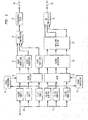
- Figure 1 is an exemplary block diagram of a hybrid cochlear prosthesis configured to apply acoustic and electrical stimulation.
- the exemplary cochlear prosthesis comprises both acoustic and electric processing paths. It will be understood that this is only one of many such approaches for a hybrid cochlear prosthesis.
- the functional blocks illustrated in Figure 1 may be implemented in, for example, the sound processor/receiver of the cochlear prosthesis.
- the sound processor/receiver may be referred to as a sound processor when used for applying electrical stimulation and a receiver when used for applying acoustic stimulation.
- These functional blocks may be implemented for example by hardware and/or software or a combination of same.
- an input sound signal is received and presented to a filter bank, comprising a plurality of band-pass filters for filter bands 1 to N, labelled as 10, and a plurality of band-pass filter for filter bands N+1 to N+M, labelled as 20.
- the filter bands 10 from 1 to N are processed within the acoustic processing path of the cochlear prosthesis, and filter bands 20 from N+1 to N+M are processed within the electrical path of the cochlear prosthesis. It will be appreciated that the frequencies processed along the acoustic and electrical paths may overlap in some implementations.
- the values of N and M may depend upon the characteristics of the stimulation devices, the processing approach, and the stimulation strategy, as will be appreciated by those skilled in the art.
- the outputs of band-pass filters 10 are provided to a signal processor 11 for processing, and the gain/limiting controller 12, As will be described below, each of the signal processor 11 and gain limiting controller 12 process the signal according to the band levels and the input/output function..
- the signal for each channel is then provided to a phase corrector 13 for phase correction.
- a reconstructor 14 then combines the channels so as to construct an audio signal.
- the combined signal is then delayed by a programmable delay 15 and presented acoustically 16 to the recipient using, for example, a speaker..
- the delay helps improve synchronization between corresponding acoustic and electric stimuli.
- electrical processing is more complex and may take a larger amount of time to complete.
- the programmable delay 15 may apply a delay to the acoustic signal from reconstructor 14 to synchronize the acoustic signal 16 and electric stimulation signal 26.
- the outputs of filters 20 are processed by a signal processor 21.
- a gain controller 22 applies a gain to the processed signal in accordance with predetermined parameters, determined as part of the fitting process.
- a maxima selector 23 may then select channels for application of stimulation in accordance with the speech processing strategy in use. Although in this example, a maxima selector 23 selects suitable maxima 23 bands 20 according to the determined speech processing strategy, in other embodiments different mechanisms may be used for selecting the channels for application of stimulation.
- the selected channels, including their amplitude, are then mapped by amplitude mapper 24 to corresponding electrodes (e.g., electrode 1, 2, ...N) and current levels.
- the stimulation signals are then passed through the RF multiplexer 25 and output as stimulation instructions 26 for particular electrodes. This signal may then, for example, be transmitted to an internal component of the cochlear prosthesis where the instructions are processed by a stimulation controller that then provides stimulation via the electrodes in accordance with the instructions.
- the input sound dynamic range is "mapped" to the individual's electric hearing range for each electrode or channel, defined by the minimum detectable electrical stimulation level, or threshold TE, and the maximum tolerable electrical stimulation level, or comfort level CE, for each intra-cochlear electrode.
- a nominal input dynamic range is commonly defined by the minimum input sound level T SPL that will produce electrical stimulation corresponding to T E , and a sound level C SPL which will produce electrical stimulation at the comfort level C E for any given frequency analysis band.
- Some existing systems relate a particular electrode to a particular frequency channel, and it is this type of system that will be referred to specifically in the following example.
- some systems have virtual electrodes between the actual electrodes, in which a portion of the stimulation current is passed through neighboring electrodes, and the present invention is also applicable to such systems. In all these systems, there exists a transformation of input sound level, conveniently in decibels, to an electric output level expressed commonly as current amplitude in Amperes.
- acoustic stimulation via an acoustic amplification prosthesis usually in the form of an external hearing aid
- the transformation remains in the acoustic domain with sound input transformed to sound output levels expressed in decibels sound pressure level (or Newtons for mechanical actuators).
- the form of the input-output function may be linear or non-linear, the latter being commonly the case in cochlear implants.
- the function may be defined from a number of points (knee-points) joined by straight lines, as is commonly the case in acoustic prostheses. Between knee-points the functions may also be curvcd, typically according to logarithmic or exponential mathematical expressions, known as loudness growth functions.
- Linear gain function with additional output limiting
- DRC dynamic range compression function
- the DRC curve is defined by two points, or two pairs of parameters: the maximum gain G max at a pre-defined input level (or lower knee-point), usually 40-50 dB, and the MPO at a second pre-defined input level (or upper knee-point), usually 80-90 dB.
- Figure 2 accordingly illustrates the input/output function for each acoustic channel.
- the action of fitting parameters T A / G R , and C A / MPO are indicated by the circles.
- the nominal gain G for each acoustic channel is derived from measurement of the individual's residual hearing function, along with the maximum power output MPO for that channel.
- the residual hearing sensitivity or "threshold" T HL and the maximum comfortable level (MCL or UCL) are commonly measured using a range of pure-tones of different frequency presented to each ear separately via standard audiological headphones. These measurements characterize each individual's residual hearing relative to "normal" listeners with average monaural thresholds of 0 dBHL. These data are commonly presented in a graph called an audiogram, such as illustrated in Figure 3.
- Figure 3 shows exemplary audiograms for left and right ears of a sample user.
- the nominal gain and MPO for each audio channel are calculated from the value of T HL using prescriptive rules.
- Various prescriptive formulae exist in the prior art based upon different rationales. These forumalae incorporate the transformation of hearing characteristics in terms of dBHL to dBSPL, the difference between in-the-ear and external earphones, different vent sizes for ear-moulds, the characteristics of speech signals and the properties of impaired hearing.
- the DSL rule has the rationale to restore the audibility of speech signals across a number of acoustic channels
- the NAL-RP rule incorporates the fact that a loss of high-frequency hearing, important for speech understanding, can be compensated for by providing additional audibility in the low frequencies.
- prescriptive rules may be approximated by polynomial formulae of the form a + b T HL + c T 2 HL , where the coefficients a, b and c are defined for each test frequency or acoustic channel with the corresponding T HL for that frequency.
- Table 1 illustrates parameters in the prescription of optimal input/output characteristics of acoustic channels for a number of acoustic channel centre frequencies. In particular, it indicates the averages and ranges of the coefficients for each acoustic channel which best fit the preferred and optimal gains and MPOs.
- the formulae arc usually defined for each pure-tone test frequency to derive a gain G and MPO at each test frequency, and then where the test frequencies do not coincide with the centre frequencies of the acoustic channels the gain and MPO may be arrived at via interpolation.
- the nominal prescribed gain for each acoustic channel is most often defined for a 60dB sound input, called G R .
- the complete input/output function for LinearOL or DRC schemes may be defined as in Figure 2 .
- the present use of G R as a reference is advantageous in that it allows for simple switching between schemes such as LinearOL and DRC according to user preference. Fine tuning of the frequency-gain and frequency-MPO response of the system can be achieved through simple controls, without resorting to direct manipulation of parameter variations such as compression ratio (the slope of the middle part of the gain function) and maximum gain, which might otherwise depend on the specific details of implementation.
- the minimum audible level for sound heard through the sound processor T SPL may be defined as for a cochlear implant speech processor ( Figure 2 ). Detection thresholds T A and comfort levels C A may be measured for pure-tones corresponding to the centre frequencies of the acoustic channels. These signals may be generated through the sound processor/receiver thereby minimizing errors resulting from the averaging of receiver, ear canal and ear mould characteristics. This provides an alternative method to using G R and MPO to define the input/output functions of the acoustic channels.
- One particular advantage is that the minimum level for audibility of input sound signals is directly controlled via T SPL .
- the input/output function can now be simply manipulated via T SPL using the measured parameters T A and C A in a similar way to typical cochlear implant sound processors.
- An additional advantage is that in the present implementation there are more acoustic channels for T A than there are standard test frequencies for T HL , and accordingly the individual's residual hearing function may be better characterized and hence compensated for.
- T SPL is a new approach to fitting acoustic hearing prostheses, and allows for an improved mapping of channels and outputs levels to the user preferred thresholds.
- GUI graphical user interface
- Figure 4 A graphical user interface(GUI) is illustrated in Figure 4 for the fitting of hybrid stimulation devices.
- This GUI may be displayed on any suitable display (e.g.., an LCD display) in accordance with instructions received from a computer or other suitable device executing the fitting method.
- Acoustic channels 30 and electric channels 40 are presented to the user in a similar way: In the illustrated example thresholds T A and comfortable levels C A for acoustic stimulation for the left 4 channels, and thresholds T E and comfortable levels C E for electric stimulation for the remaining channels may be adjusted. In the illustrated GUI, a color may be associated with each input sound channel 50 to indicate whether it is being used for electrical or acoustic stimulation. A band 41 indicates graphically a suggested acoustic threshold fitting range.
- This latter described scheme employing T A and C A parameters measured through the acoustic signal path can be extended to acoustic or mechanical, external or implanted hearing prostheses which stimulate across a wider range of frequencies and which do not incorporate an electrical stimulation component (e.g. bone anchored hearing aids and middle-ear hearing prostheses).
- an electrical stimulation component e.g. bone anchored hearing aids and middle-ear hearing prostheses.
- This approach to an interface can also be employed where the channels for acoustic and electric stimulation overlap.
- a split vertical indicator could be used to show the electric and acoustic levels on the interface, or extra parallel channels provided.
- the entire fitting scheme for all forms of stimulation can be visualized at once by the fitting professional.
- this interface allows for the levels to be not only viewed, but adjusted as required. For example, a mouse click on the appropriate bar allows (for example) the comfort level to be increased or decreased.
- This method of representation of residual hearing function is particularly desirable in a combined electric-acoustic fitting system and obviates the need for prescriptive rules for G R and MPO.
- a function such as in Figure 2
- the current embodiment is concerned with the optimum processing of low-frequency sound for individuals where high-frequency sensations are restored via electrical stimulation through a cochlear implant.
- the slope of the residual hearing function is steep, and accordingly there can be large changes (e.g., >30dB) in thresholds for adjacent test frequencies (half to one octave). It is therefore advantageous to have more acoustic channels than there are test frequencies in order to better approximate the desired, or "target", frequency-gain or frequency-MPO response obtained from the prescriptive rule.
- the present embodiment there is the capability to adjust acoustic channels in order to avoid slope limitations imposed by the overlap of the underlying band-pass filters.
- Gains for the centre frequency of acoustic channels 1-5 are set to the target frequency-gain response (solid line). Due to the width of the underlying band-pass filters, the total frequency-gain response of the system (thick-dash line) does not correspond to that of the target. According to this embodiment of the present invention, by deactivating channels 3 and 4 the total frequency-gain response (thick-dotted line) better matches the target.
- the total frequency-gain response of the combination of all acoustic channels is modeled and iterative adjustments are made to the response of each acoustic channel such that the best match is obtained between the desired target response and the actual response.
- Acoustic channels may be completely deactivated as in Figure 5 , or their response may be simply reduced so that when a dominant channel with a high gain (e.g. channel 4, Figure 5 ) is in compression (i.e. when the instantaneous channel gain is less than G MAX ) sufficient gain is still provided in the lower frequency channels.
- the use of a larger number of low-frequency channels also provides greater flexibility in the cross-over or cut-off frequency between acoustic channels and electric channels, which is required in order to optimally fit individuals with a wide range of residual hearing characteristics. This defines the frequency where stimulation changes from acoustic to electrical.
- the upper limit in frequency for acoustic stimulation may be determined via a variety of means, for example:
- the cut off frequency may also be determined from measuring neural responses to acoustic or mechanical stimuli, such as the action potential generated by the cochlear nerve or the cochlear microphonic produced by remaining outer hair cells. These measures may be achieved using the integrated telemetry system, which includes the recording of neural responses via the cochlear implant electrodes and implant electronics.
- EAPs Acoustically evoked potentials
- the apical intracochlear electrodes are close to the region where residual hearing is expected and therefore the responses are expected to be relatively large as compared to when electrodes are placed on the promontory, outside the cochlea, as in classical electrocochleography.
- the thresholds obtained for Acoustically Evoked Compound Action Potentials are likely to be at or close to audiometric thresholds when recorded via a sensitive amplifier (noise level after averaging below 1 microvolt). This has already been demonstrated for conventional electrocochleography (see for example Eggermont et al 1974).[ Methods in electrocochleography. Acta Otolaryngol Suppl. 1974;316:17-24 .]
- acoustically evoked CAPs can be obtained by alternating the phase of short tone pips (10 ms) as in conventional electrocochleography.
- the tone pips should include short rise and fall times (to get rid of frequency splatter at the beginning and end of the stimulus). For the frequencies below 1kHz one might choose longer tone pips to ensure that the tone pip contains at least several cycles.
- the tone pip can be applied through the acoustical part of a combined electric and acoustic stimulation system but one might also develop a device that puts the receiver far from the ear and delivers the acoustical stimulus through a tube if the receiver causes artifacts.
- the recording of the electrophysiological signal is preferably implemented in a CI containing a battery or capacitor so that no RF has to be transmitted during the recording of the potential.
- Two buffers can be included in the sampling of the alternating stimuli.
- the individual buffers can be used to monitor the microphonics at a time period beyond the compound action potential.
- the filter settings of the amplifier can be adapted.
- the cut-off frequency can be determined objectively such as is useful in the case of young children.
- the amplitude of the response or the threshold to obtain a response T EP can be used to determine values for G R or T A in a similar fashion to the determination of electric hearing thresholds from neural responses to electric stimulation. These values can be compared to the fitting range for acoustic thresholds (as illustrated in Figure 4 ) in order to automatically select the cut-off frequency / acoustic-electric channel boundary.
- the recordings can be used to give insight into the condition of hair cells, cochlear frequency selectivity and potentially neural disturbances such as neural synchrony and pathological adaptation. In these cases it may be better to reduce the cut-off frequency so that more of the complete frequency range is covered by electrical stimulation.
- Evoked potentials may be recorded at the time of fitting of the device or recorded and stored automatically every time the sound processor is placed on the ear/head. In this way hearing can be monitored for changes on a daily basis and these changes are compensated for.
Landscapes
- Health & Medical Sciences (AREA)
- Engineering & Computer Science (AREA)
- General Health & Medical Sciences (AREA)
- Otolaryngology (AREA)
- Nuclear Medicine, Radiotherapy & Molecular Imaging (AREA)
- Radiology & Medical Imaging (AREA)
- Life Sciences & Earth Sciences (AREA)
- Animal Behavior & Ethology (AREA)
- Biomedical Technology (AREA)
- Public Health (AREA)
- Veterinary Medicine (AREA)
- Acoustics & Sound (AREA)
- Neurosurgery (AREA)
- Physics & Mathematics (AREA)
- Signal Processing (AREA)
- Human Computer Interaction (AREA)
- Prostheses (AREA)
- Measurement Of The Respiration, Hearing Ability, Form, And Blood Characteristics Of Living Organisms (AREA)
Applications Claiming Priority (3)
| Application Number | Priority Date | Filing Date | Title |
|---|---|---|---|
| US12/914,206 US9155886B2 (en) | 2010-10-28 | 2010-10-28 | Fitting an auditory prosthesis |
| PCT/IB2011/054808 WO2012056427A2 (fr) | 2010-10-28 | 2011-10-28 | Réglage d'une prothèse auditive |
| EP11835727.6A EP2633703B1 (fr) | 2010-10-28 | 2011-10-28 | Réglage d'une prothèse auditive |
Related Parent Applications (2)
| Application Number | Title | Priority Date | Filing Date |
|---|---|---|---|
| EP11835727.6A Division EP2633703B1 (fr) | 2010-10-28 | 2011-10-28 | Réglage d'une prothèse auditive |
| EP11835727.6A Division-Into EP2633703B1 (fr) | 2010-10-28 | 2011-10-28 | Réglage d'une prothèse auditive |
Publications (2)
| Publication Number | Publication Date |
|---|---|
| EP3427794A1 true EP3427794A1 (fr) | 2019-01-16 |
| EP3427794B1 EP3427794B1 (fr) | 2023-07-19 |
Family
ID=45994484
Family Applications (2)
| Application Number | Title | Priority Date | Filing Date |
|---|---|---|---|
| EP11835727.6A Active EP2633703B1 (fr) | 2010-10-28 | 2011-10-28 | Réglage d'une prothèse auditive |
| EP18183222.1A Active EP3427794B1 (fr) | 2010-10-28 | 2011-10-28 | Mise en place d'une prothèse auditive |
Family Applications Before (1)
| Application Number | Title | Priority Date | Filing Date |
|---|---|---|---|
| EP11835727.6A Active EP2633703B1 (fr) | 2010-10-28 | 2011-10-28 | Réglage d'une prothèse auditive |
Country Status (5)
| Country | Link |
|---|---|
| US (2) | US9155886B2 (fr) |
| EP (2) | EP2633703B1 (fr) |
| CN (1) | CN103229519B (fr) |
| AU (1) | AU2011322087B2 (fr) |
| WO (1) | WO2012056427A2 (fr) |
Families Citing this family (49)
| Publication number | Priority date | Publication date | Assignee | Title |
|---|---|---|---|---|
| US9011508B2 (en) * | 2007-11-30 | 2015-04-21 | Lockheed Martin Corporation | Broad wavelength profile to homogenize the absorption profile in optical stimulation of nerves |
| WO2009076721A1 (fr) * | 2007-12-18 | 2009-06-25 | Cochlear Limited | Procédé et système d'ajustage d'un implant cochléaire |
| DE102009060093B4 (de) * | 2009-12-22 | 2011-11-17 | Siemens Medical Instruments Pte. Ltd. | Verfahren und Anordnung zum Einstellen eines Hörgeräts durch Erfassung der Höranstrengung |
| US9155886B2 (en) | 2010-10-28 | 2015-10-13 | Cochlear Limited | Fitting an auditory prosthesis |
| EP2827945A1 (fr) * | 2012-03-22 | 2015-01-28 | Advanced Bionics AG | Systèmes de programmation pour provoquer des réponses évoquées chez un patient portant un implant cochléaire et exécuter des actions prédéterminées en fonction des réponses évoquées |
| WO2014024050A2 (fr) * | 2012-08-07 | 2014-02-13 | Cochlear Limited | Stratégie de réglage de paramètres de perception auditive pour une prothèse auditive |
| US9174053B2 (en) | 2013-03-08 | 2015-11-03 | Boston Scientific Neuromodulation Corporation | Neuromodulation using modulated pulse train |
| US9900709B2 (en) * | 2013-03-15 | 2018-02-20 | Cochlear Limited | Determining impedance-related phenomena in vibrating actuator and identifying device system characteristics based thereon |
| US9656071B2 (en) | 2013-03-15 | 2017-05-23 | Cochlear Limited | Control for hearing prosthesis fitting |
| US20140364681A1 (en) | 2013-06-05 | 2014-12-11 | Martin Hillbratt | Prosthesis state and feedback path based parameter management |
| DK3115079T3 (da) * | 2013-07-11 | 2019-06-17 | Oticon Medical As | Signalprocessor til en høreanordning |
| WO2015024581A1 (fr) | 2013-08-19 | 2015-02-26 | Advanced Bionics Ag | Dispositif et procédé de stimulation neurale de la cochlée |
| WO2015123161A1 (fr) * | 2014-02-11 | 2015-08-20 | Med-El Elektromedizinische Geraete Gmbh | Détermination d'une amplitude de potentiel d'action neuronale basée sur une géométrie différentielle multidimensionnelle |
| EP2919483B1 (fr) * | 2014-03-11 | 2019-05-08 | Oticon Medical A/S | Système d'assistance auditive bilatérale et procédé d'adaptation d'un tel système |
| EP3139998A1 (fr) * | 2014-05-07 | 2017-03-15 | Advanced Bionics AG | Systeme d'assistance auditive a implant cochleaire et son procede d'installation |
| WO2016004970A1 (fr) | 2014-07-07 | 2016-01-14 | Advanced Bionics Ag | Système pour une stimulation auditive neuronale et acoustique combinée |
| EP3180076B1 (fr) | 2014-08-14 | 2019-08-07 | Advanced Bionics AG | Systèmes d'ajustement progressif d'un paramètre de contrôle associé à un système d'implant cochléaire |
| CN106687173A (zh) | 2014-09-15 | 2017-05-17 | 波士顿科学神经调制公司 | 用于对神经刺激脉冲模式进行编程的图形用户界面 |
| EP3204109B1 (fr) | 2014-10-06 | 2018-12-12 | Advanced Bionics AG | Systèmes d'ajustement de système de stimulation électro-acoustique à un patient |
| WO2016057017A1 (fr) | 2014-10-06 | 2016-04-14 | Advanced Bionics Ag | Systèmes et procédés pour un auto-ajustement d'un système de stimulation électroacoustique sur un patient |
| US9808623B2 (en) * | 2014-10-07 | 2017-11-07 | Oticon Medical A/S | Hearing system |
| US9787274B2 (en) | 2014-10-20 | 2017-10-10 | Harman International Industries, Incorporated | Automatic sound equalization device |
| JP6452836B2 (ja) | 2014-11-04 | 2019-01-16 | ボストン サイエンティフィック ニューロモデュレイション コーポレイション | 複合神経刺激パターンをプログラムする方法及び装置 |
| CN106999706B (zh) * | 2014-12-18 | 2020-04-03 | Med-El电气医疗器械有限公司 | 听力植入刺激的频率和延迟的双侧匹配 |
| EP3242716B1 (fr) * | 2015-01-09 | 2019-05-29 | MED-EL Elektromedizinische Geräte GmbH | Pose d'implant cochléaire par l'intermédiaire de fibres nerveuses efférentes |
| DK3470112T3 (en) * | 2015-01-13 | 2020-06-22 | Oticon Medical As | Cochlear implantat |
| FR3038485B1 (fr) * | 2015-07-02 | 2018-10-12 | Swiss Acoustic Laboratoire De Correction Auditive | Procede et systeme permettant de fournir une assistance auditive |
| EP3328481B1 (fr) | 2015-07-30 | 2019-05-15 | Boston Scientific Neuromodulation Corporation | Interface utilisateur de stimulation électrique à motifs personnalisés |
| US10575108B2 (en) * | 2015-08-24 | 2020-02-25 | Cochlear Limited | Prosthesis functionality control and data presentation |
| US10456586B2 (en) | 2015-10-15 | 2019-10-29 | Boston Scientific Neuromodulation Corporation | User interface for neurostimulation waveform composition |
| US10321247B2 (en) | 2015-11-27 | 2019-06-11 | Cochlear Limited | External component with inductance and mechanical vibratory functionality |
| EP3386585B1 (fr) | 2015-12-08 | 2019-10-30 | Advanced Bionics AG | Système de stimulation auditive bimodal |
| US10009698B2 (en) * | 2015-12-16 | 2018-06-26 | Cochlear Limited | Bone conduction device having magnets integrated with housing |
| CN108883274B (zh) * | 2016-02-29 | 2022-03-18 | 领先仿生公司 | 用于使用诱发的响应来确定行为听力图值的系统和方法 |
| WO2017182931A1 (fr) * | 2016-04-22 | 2017-10-26 | Cochlear Limited | Essais d'électrocochléographie dans les prothèses auditives |
| US10701498B2 (en) * | 2016-06-07 | 2020-06-30 | Regents Of The University Of Minnesota | Systems and methods for treating tinnitus and enhancing hearing |
| US10357656B2 (en) | 2016-07-12 | 2019-07-23 | Cochlear Limited | Hearing prosthesis programming |
| US10500392B2 (en) | 2016-08-24 | 2019-12-10 | Cochlear Limited | Monitoring stimulating assembly insertion |
| US10194814B2 (en) * | 2016-09-28 | 2019-02-05 | Cochlear Limited | Perception change-based adjustments in hearing prostheses |
| TWI609367B (zh) * | 2016-10-20 | 2017-12-21 | 宏碁股份有限公司 | 電子裝置及利用窗化濾波器差異之特定頻段補償增益方法 |
| US20180110982A1 (en) * | 2016-10-21 | 2018-04-26 | John Michael Heasman | Objective determination of acoustic prescriptions |
| US10668284B2 (en) | 2017-02-16 | 2020-06-02 | Advanced Bionics Ag | Systems and methods for determining a stapedius reflex threshold based on electro-acoustic stimulation |
| US11478640B2 (en) * | 2017-03-23 | 2022-10-25 | Advanced Bionics Ag | Fitting device for bimodal hearing stimulation system |
| US11032127B2 (en) | 2017-06-26 | 2021-06-08 | Verisign, Inc. | Resilient domain name service (DNS) resolution when an authoritative name server is unavailable |
| US20210031039A1 (en) * | 2018-01-24 | 2021-02-04 | Cochlear Limited | Comparison techniques for prosthesis fitting |
| CN108834020A (zh) * | 2018-07-17 | 2018-11-16 | 苏州科技大学 | 一种保护耳朵听力的音量调节方法和系统 |
| TWI690214B (zh) * | 2018-11-02 | 2020-04-01 | 美商音美得股份有限公司 | 結合式頻譜增益適配模組及其方法、音訊處理系統及其施行方法 |
| WO2022058829A1 (fr) * | 2020-09-18 | 2022-03-24 | Cochlear Limited | Optimisation de paramètres sur la base de différents degrés de focalisation |
| KR20240154008A (ko) * | 2022-02-17 | 2024-10-24 | 메이오 파운데이션 포 메디칼 에쥬케이션 앤드 리써치 | 멀티모드 사운드 인식 청각 자극 시스템 및 방법 |
Citations (9)
| Publication number | Priority date | Publication date | Assignee | Title |
|---|---|---|---|---|
| US4532930A (en) | 1983-04-11 | 1985-08-06 | Commonwealth Of Australia, Dept. Of Science & Technology | Cochlear implant system for an auditory prosthesis |
| US20010056291A1 (en) * | 2000-06-19 | 2001-12-27 | Yitzhak Zilberman | Hybrid middle ear/cochlea implant system |
| US6537200B2 (en) | 2000-03-28 | 2003-03-25 | Cochlear Limited | Partially or fully implantable hearing system |
| US6565503B2 (en) | 2000-04-13 | 2003-05-20 | Cochlear Limited | At least partially implantable system for rehabilitation of hearing disorder |
| US6575894B2 (en) | 2000-04-13 | 2003-06-10 | Cochlear Limited | At least partially implantable system for rehabilitation of a hearing disorder |
| US6697674B2 (en) | 2000-04-13 | 2004-02-24 | Cochlear Limited | At least partially implantable system for rehabilitation of a hearing disorder |
| WO2005097255A1 (fr) * | 2004-04-02 | 2005-10-20 | Advanced Bionics Corporation | Procedes et systemes de reglage d'une stimulation acoustique et electrique |
| US20060287690A1 (en) | 2004-05-10 | 2006-12-21 | Cochlear Limited | Simultaneous delivery of electrical and acoustical stimulation in a hearing prosthesis |
| US20070135862A1 (en) * | 2005-12-08 | 2007-06-14 | Cochlear Limited | Multimodal auditory fitting |
Family Cites Families (26)
| Publication number | Priority date | Publication date | Assignee | Title |
|---|---|---|---|---|
| US3989904A (en) * | 1974-12-30 | 1976-11-02 | John L. Holmes | Method and apparatus for setting an aural prosthesis to provide specific auditory deficiency corrections |
| DE3003315C2 (de) * | 1980-01-30 | 1982-09-16 | Siemens AG, 1000 Berlin und 8000 München | Verfahren zur Erzeugung von elektrokutanen Reizmustern als Träger akustischer Information und Gerät zur Durchführung dieses Verfahren |
| EP0676930B1 (fr) | 1992-12-22 | 2000-03-22 | Cochlear Limited | Appareil et systeme de telemetrie |
| US5706352A (en) | 1993-04-07 | 1998-01-06 | K/S Himpp | Adaptive gain and filtering circuit for a sound reproduction system |
| AUPN533195A0 (en) | 1995-09-07 | 1995-10-05 | Cochlear Pty. Limited | Derived threshold and comfort level for auditory prostheses |
| US5954628A (en) | 1997-08-07 | 1999-09-21 | St. Croix Medical, Inc. | Capacitive input transducers for middle ear sensing |
| US7010136B1 (en) | 1999-02-17 | 2006-03-07 | Micro Ear Technology, Inc. | Resonant response matching circuit for hearing aid |
| AUPQ249999A0 (en) | 1999-08-27 | 1999-09-23 | Cochlear Limited | Optimizing cochlear implant electrode selection |
| US7058182B2 (en) | 1999-10-06 | 2006-06-06 | Gn Resound A/S | Apparatus and methods for hearing aid performance measurement, fitting, and initialization |
| US7076308B1 (en) | 2001-08-17 | 2006-07-11 | Advanced Bionics Corporation | Cochlear implant and simplified method of fitting same |
| AUPS318202A0 (en) | 2002-06-26 | 2002-07-18 | Cochlear Limited | Parametric fitting of a cochlear implant |
| US7117038B1 (en) | 2002-09-20 | 2006-10-03 | Advanced Bionics Corporation | Method and system for obtaining stapedial reflexes in cochlear implant users using multiband stimuli |
| US20040167586A1 (en) | 2003-02-21 | 2004-08-26 | Overstreet Edward H. | Charge normalization for electrical stimulation of excitable tissue to facilitate the comparison of neural responses to behavioral measurements having different parameters |
| US7290895B2 (en) * | 2003-08-08 | 2007-11-06 | Production Resource Group, L.L.C. | File system for a stage lighting array system |
| CN1902936B (zh) * | 2004-01-13 | 2011-04-20 | 皇家飞利浦电子股份有限公司 | 用于过滤家庭网络内容的方法和系统 |
| CA2569724A1 (fr) | 2004-06-15 | 2005-12-29 | Cochlear Americas | Determination automatique du seuil d'une reponse neuronale evoquee |
| US8095983B2 (en) * | 2005-03-15 | 2012-01-10 | Mu Dynamics, Inc. | Platform for analyzing the security of communication protocols and channels |
| JP2007115293A (ja) * | 2005-10-17 | 2007-05-10 | Toshiba Corp | 情報記憶媒体、プログラム、情報再生方法、情報再生装置、データ転送方法、及びデータ処理方法 |
| US7761789B2 (en) * | 2006-01-13 | 2010-07-20 | Ricoh Company, Ltd. | Methods for computing a navigation path |
| US8571675B2 (en) | 2006-04-21 | 2013-10-29 | Cochlear Limited | Determining operating parameters for a stimulating medical device |
| WO2008031169A1 (fr) | 2006-09-14 | 2008-03-20 | Cochlear Limited | Procédé de configuration d'un implant médical |
| DK2071873T3 (en) | 2007-12-11 | 2017-08-28 | Bernafon Ag | A hearing aid system comprising a custom filter and a measurement method |
| WO2010077621A1 (fr) | 2008-12-08 | 2010-07-08 | Med-El Elektromedizinische Geraete Gmbh | Procédé de montage d'un implant cochléaire avec rétroaction du patient |
| CN101646123B (zh) * | 2009-08-28 | 2012-09-05 | 中国科学院声学研究所 | 一种模拟听觉感知模型的滤波器组 |
| EP2475420B1 (fr) * | 2009-09-11 | 2015-09-02 | MED-EL Elektromedizinische Geräte GmbH | Stimulation d'implant cochléaire avec faible taux d'impulsions, conjointement avec une représentation séparée de fréquences fondamentales et de distinctions voisées/non voisées |
| US9155886B2 (en) | 2010-10-28 | 2015-10-13 | Cochlear Limited | Fitting an auditory prosthesis |
-
2010
- 2010-10-28 US US12/914,206 patent/US9155886B2/en active Active
-
2011
- 2011-10-28 EP EP11835727.6A patent/EP2633703B1/fr active Active
- 2011-10-28 CN CN201180052435.5A patent/CN103229519B/zh active Active
- 2011-10-28 WO PCT/IB2011/054808 patent/WO2012056427A2/fr not_active Ceased
- 2011-10-28 AU AU2011322087A patent/AU2011322087B2/en not_active Ceased
- 2011-10-28 EP EP18183222.1A patent/EP3427794B1/fr active Active
-
2015
- 2015-09-15 US US14/854,785 patent/US9623254B2/en active Active
Patent Citations (9)
| Publication number | Priority date | Publication date | Assignee | Title |
|---|---|---|---|---|
| US4532930A (en) | 1983-04-11 | 1985-08-06 | Commonwealth Of Australia, Dept. Of Science & Technology | Cochlear implant system for an auditory prosthesis |
| US6537200B2 (en) | 2000-03-28 | 2003-03-25 | Cochlear Limited | Partially or fully implantable hearing system |
| US6565503B2 (en) | 2000-04-13 | 2003-05-20 | Cochlear Limited | At least partially implantable system for rehabilitation of hearing disorder |
| US6575894B2 (en) | 2000-04-13 | 2003-06-10 | Cochlear Limited | At least partially implantable system for rehabilitation of a hearing disorder |
| US6697674B2 (en) | 2000-04-13 | 2004-02-24 | Cochlear Limited | At least partially implantable system for rehabilitation of a hearing disorder |
| US20010056291A1 (en) * | 2000-06-19 | 2001-12-27 | Yitzhak Zilberman | Hybrid middle ear/cochlea implant system |
| WO2005097255A1 (fr) * | 2004-04-02 | 2005-10-20 | Advanced Bionics Corporation | Procedes et systemes de reglage d'une stimulation acoustique et electrique |
| US20060287690A1 (en) | 2004-05-10 | 2006-12-21 | Cochlear Limited | Simultaneous delivery of electrical and acoustical stimulation in a hearing prosthesis |
| US20070135862A1 (en) * | 2005-12-08 | 2007-06-14 | Cochlear Limited | Multimodal auditory fitting |
Non-Patent Citations (1)
| Title |
|---|
| EGGERMONT ET AL.: "Methods in electrocochleography", ACTA OTOLARYNGOL, vol. 316, 1974, pages 17 - 24 |
Also Published As
| Publication number | Publication date |
|---|---|
| EP2633703A4 (fr) | 2014-04-09 |
| WO2012056427A3 (fr) | 2012-06-21 |
| CN103229519B (zh) | 2016-03-16 |
| EP3427794B1 (fr) | 2023-07-19 |
| AU2011322087B2 (en) | 2015-08-13 |
| AU2011322087A1 (en) | 2013-05-02 |
| WO2012056427A2 (fr) | 2012-05-03 |
| CN103229519A (zh) | 2013-07-31 |
| EP2633703B1 (fr) | 2018-08-15 |
| EP2633703A2 (fr) | 2013-09-04 |
| US9623254B2 (en) | 2017-04-18 |
| US20160045749A1 (en) | 2016-02-18 |
| WO2012056427A9 (fr) | 2013-08-22 |
| US9155886B2 (en) | 2015-10-13 |
| US20120109006A1 (en) | 2012-05-03 |
Similar Documents
| Publication | Publication Date | Title |
|---|---|---|
| US9623254B2 (en) | Fitting an auditory prosthesis | |
| US8565889B2 (en) | Method for fitting a cochlear implant with patient feedback | |
| US20090076569A1 (en) | Fitting a prosthetic hearing implant for a recipient | |
| US10798504B2 (en) | Bimodal hearing stimulation system and method of fitting the same | |
| AU2018203596B2 (en) | Fitting Device, System and Method for Fitting a Cochlear Implant | |
| CN110520188B (zh) | 双模式听觉刺激系统 | |
| US9204231B1 (en) | Independent volume control in a bilateral auditory prosthesis system | |
| US9050465B2 (en) | Methods and systems for facilitating adjustment of one or more fitting parameters by an auditory prosthesis patient | |
| AU2015339077B2 (en) | Tinnitus fitting method in CI and ABI patients | |
| CN108883274B (zh) | 用于使用诱发的响应来确定行为听力图值的系统和方法 | |
| US20110081033A1 (en) | Method for adjusting an audio transducing processor | |
| WO2025041015A1 (fr) | Réglage de paramètre de stimulation électrique-acoustique | |
| WO2024194760A1 (fr) | Commande de stimulation électro-acoustique |
Legal Events
| Date | Code | Title | Description |
|---|---|---|---|
| PUAI | Public reference made under article 153(3) epc to a published international application that has entered the european phase |
Free format text: ORIGINAL CODE: 0009012 |
|
| STAA | Information on the status of an ep patent application or granted ep patent |
Free format text: STATUS: THE APPLICATION HAS BEEN PUBLISHED |
|
| AC | Divisional application: reference to earlier application |
Ref document number: 2633703 Country of ref document: EP Kind code of ref document: P |
|
| AK | Designated contracting states |
Kind code of ref document: A1 Designated state(s): AL AT BE BG CH CY CZ DE DK EE ES FI FR GB GR HR HU IE IS IT LI LT LU LV MC MK MT NL NO PL PT RO RS SE SI SK SM TR |
|
| STAA | Information on the status of an ep patent application or granted ep patent |
Free format text: STATUS: REQUEST FOR EXAMINATION WAS MADE |
|
| 17P | Request for examination filed |
Effective date: 20190709 |
|
| RBV | Designated contracting states (corrected) |
Designated state(s): AL AT BE BG CH CY CZ DE DK EE ES FI FR GB GR HR HU IE IS IT LI LT LU LV MC MK MT NL NO PL PT RO RS SE SI SK SM TR |
|
| STAA | Information on the status of an ep patent application or granted ep patent |
Free format text: STATUS: EXAMINATION IS IN PROGRESS |
|
| 17Q | First examination report despatched |
Effective date: 20220609 |
|
| GRAP | Despatch of communication of intention to grant a patent |
Free format text: ORIGINAL CODE: EPIDOSNIGR1 |
|
| STAA | Information on the status of an ep patent application or granted ep patent |
Free format text: STATUS: GRANT OF PATENT IS INTENDED |
|
| INTG | Intention to grant announced |
Effective date: 20230216 |
|
| GRAS | Grant fee paid |
Free format text: ORIGINAL CODE: EPIDOSNIGR3 |
|
| P01 | Opt-out of the competence of the unified patent court (upc) registered |
Effective date: 20230505 |
|
| GRAA | (expected) grant |
Free format text: ORIGINAL CODE: 0009210 |
|
| STAA | Information on the status of an ep patent application or granted ep patent |
Free format text: STATUS: THE PATENT HAS BEEN GRANTED |
|
| AC | Divisional application: reference to earlier application |
Ref document number: 2633703 Country of ref document: EP Kind code of ref document: P |
|
| AK | Designated contracting states |
Kind code of ref document: B1 Designated state(s): AL AT BE BG CH CY CZ DE DK EE ES FI FR GB GR HR HU IE IS IT LI LT LU LV MC MK MT NL NO PL PT RO RS SE SI SK SM TR |
|
| REG | Reference to a national code |
Ref country code: GB Ref legal event code: FG4D |
|
| REG | Reference to a national code |
Ref country code: CH Ref legal event code: EP |
|
| REG | Reference to a national code |
Ref country code: DE Ref legal event code: R096 Ref document number: 602011074093 Country of ref document: DE |
|
| REG | Reference to a national code |
Ref country code: IE Ref legal event code: FG4D |
|
| REG | Reference to a national code |
Ref country code: LT Ref legal event code: MG9D |
|
| REG | Reference to a national code |
Ref country code: NL Ref legal event code: MP Effective date: 20230719 |
|
| REG | Reference to a national code |
Ref country code: AT Ref legal event code: MK05 Ref document number: 1588855 Country of ref document: AT Kind code of ref document: T Effective date: 20230719 |
|
| PG25 | Lapsed in a contracting state [announced via postgrant information from national office to epo] |
Ref country code: NL Free format text: LAPSE BECAUSE OF FAILURE TO SUBMIT A TRANSLATION OF THE DESCRIPTION OR TO PAY THE FEE WITHIN THE PRESCRIBED TIME-LIMIT Effective date: 20230719 |
|
| PG25 | Lapsed in a contracting state [announced via postgrant information from national office to epo] |
Ref country code: GR Free format text: LAPSE BECAUSE OF FAILURE TO SUBMIT A TRANSLATION OF THE DESCRIPTION OR TO PAY THE FEE WITHIN THE PRESCRIBED TIME-LIMIT Effective date: 20231020 |
|
| PG25 | Lapsed in a contracting state [announced via postgrant information from national office to epo] |
Ref country code: IS Free format text: LAPSE BECAUSE OF FAILURE TO SUBMIT A TRANSLATION OF THE DESCRIPTION OR TO PAY THE FEE WITHIN THE PRESCRIBED TIME-LIMIT Effective date: 20231119 |
|
| PG25 | Lapsed in a contracting state [announced via postgrant information from national office to epo] |
Ref country code: SE Free format text: LAPSE BECAUSE OF FAILURE TO SUBMIT A TRANSLATION OF THE DESCRIPTION OR TO PAY THE FEE WITHIN THE PRESCRIBED TIME-LIMIT Effective date: 20230719 Ref country code: RS Free format text: LAPSE BECAUSE OF FAILURE TO SUBMIT A TRANSLATION OF THE DESCRIPTION OR TO PAY THE FEE WITHIN THE PRESCRIBED TIME-LIMIT Effective date: 20230719 Ref country code: PT Free format text: LAPSE BECAUSE OF FAILURE TO SUBMIT A TRANSLATION OF THE DESCRIPTION OR TO PAY THE FEE WITHIN THE PRESCRIBED TIME-LIMIT Effective date: 20231120 Ref country code: NO Free format text: LAPSE BECAUSE OF FAILURE TO SUBMIT A TRANSLATION OF THE DESCRIPTION OR TO PAY THE FEE WITHIN THE PRESCRIBED TIME-LIMIT Effective date: 20231019 Ref country code: LV Free format text: LAPSE BECAUSE OF FAILURE TO SUBMIT A TRANSLATION OF THE DESCRIPTION OR TO PAY THE FEE WITHIN THE PRESCRIBED TIME-LIMIT Effective date: 20230719 Ref country code: LT Free format text: LAPSE BECAUSE OF FAILURE TO SUBMIT A TRANSLATION OF THE DESCRIPTION OR TO PAY THE FEE WITHIN THE PRESCRIBED TIME-LIMIT Effective date: 20230719 Ref country code: IS Free format text: LAPSE BECAUSE OF FAILURE TO SUBMIT A TRANSLATION OF THE DESCRIPTION OR TO PAY THE FEE WITHIN THE PRESCRIBED TIME-LIMIT Effective date: 20231119 Ref country code: HR Free format text: LAPSE BECAUSE OF FAILURE TO SUBMIT A TRANSLATION OF THE DESCRIPTION OR TO PAY THE FEE WITHIN THE PRESCRIBED TIME-LIMIT Effective date: 20230719 Ref country code: GR Free format text: LAPSE BECAUSE OF FAILURE TO SUBMIT A TRANSLATION OF THE DESCRIPTION OR TO PAY THE FEE WITHIN THE PRESCRIBED TIME-LIMIT Effective date: 20231020 Ref country code: FI Free format text: LAPSE BECAUSE OF FAILURE TO SUBMIT A TRANSLATION OF THE DESCRIPTION OR TO PAY THE FEE WITHIN THE PRESCRIBED TIME-LIMIT Effective date: 20230719 Ref country code: AT Free format text: LAPSE BECAUSE OF FAILURE TO SUBMIT A TRANSLATION OF THE DESCRIPTION OR TO PAY THE FEE WITHIN THE PRESCRIBED TIME-LIMIT Effective date: 20230719 |
|
| PG25 | Lapsed in a contracting state [announced via postgrant information from national office to epo] |
Ref country code: PL Free format text: LAPSE BECAUSE OF FAILURE TO SUBMIT A TRANSLATION OF THE DESCRIPTION OR TO PAY THE FEE WITHIN THE PRESCRIBED TIME-LIMIT Effective date: 20230719 |
|
| REG | Reference to a national code |
Ref country code: DE Ref legal event code: R097 Ref document number: 602011074093 Country of ref document: DE |
|
| PG25 | Lapsed in a contracting state [announced via postgrant information from national office to epo] |
Ref country code: ES Free format text: LAPSE BECAUSE OF FAILURE TO SUBMIT A TRANSLATION OF THE DESCRIPTION OR TO PAY THE FEE WITHIN THE PRESCRIBED TIME-LIMIT Effective date: 20230719 |
|
| PG25 | Lapsed in a contracting state [announced via postgrant information from national office to epo] |
Ref country code: SM Free format text: LAPSE BECAUSE OF FAILURE TO SUBMIT A TRANSLATION OF THE DESCRIPTION OR TO PAY THE FEE WITHIN THE PRESCRIBED TIME-LIMIT Effective date: 20230719 Ref country code: RO Free format text: LAPSE BECAUSE OF FAILURE TO SUBMIT A TRANSLATION OF THE DESCRIPTION OR TO PAY THE FEE WITHIN THE PRESCRIBED TIME-LIMIT Effective date: 20230719 Ref country code: ES Free format text: LAPSE BECAUSE OF FAILURE TO SUBMIT A TRANSLATION OF THE DESCRIPTION OR TO PAY THE FEE WITHIN THE PRESCRIBED TIME-LIMIT Effective date: 20230719 Ref country code: EE Free format text: LAPSE BECAUSE OF FAILURE TO SUBMIT A TRANSLATION OF THE DESCRIPTION OR TO PAY THE FEE WITHIN THE PRESCRIBED TIME-LIMIT Effective date: 20230719 Ref country code: DK Free format text: LAPSE BECAUSE OF FAILURE TO SUBMIT A TRANSLATION OF THE DESCRIPTION OR TO PAY THE FEE WITHIN THE PRESCRIBED TIME-LIMIT Effective date: 20230719 Ref country code: CZ Free format text: LAPSE BECAUSE OF FAILURE TO SUBMIT A TRANSLATION OF THE DESCRIPTION OR TO PAY THE FEE WITHIN THE PRESCRIBED TIME-LIMIT Effective date: 20230719 Ref country code: SK Free format text: LAPSE BECAUSE OF FAILURE TO SUBMIT A TRANSLATION OF THE DESCRIPTION OR TO PAY THE FEE WITHIN THE PRESCRIBED TIME-LIMIT Effective date: 20230719 |
|
| PLBE | No opposition filed within time limit |
Free format text: ORIGINAL CODE: 0009261 |
|
| STAA | Information on the status of an ep patent application or granted ep patent |
Free format text: STATUS: NO OPPOSITION FILED WITHIN TIME LIMIT |
|
| PG25 | Lapsed in a contracting state [announced via postgrant information from national office to epo] |
Ref country code: IT Free format text: LAPSE BECAUSE OF FAILURE TO SUBMIT A TRANSLATION OF THE DESCRIPTION OR TO PAY THE FEE WITHIN THE PRESCRIBED TIME-LIMIT Effective date: 20230719 Ref country code: MC Free format text: LAPSE BECAUSE OF FAILURE TO SUBMIT A TRANSLATION OF THE DESCRIPTION OR TO PAY THE FEE WITHIN THE PRESCRIBED TIME-LIMIT Effective date: 20230719 |
|
| REG | Reference to a national code |
Ref country code: CH Ref legal event code: PL |
|
| REG | Reference to a national code |
Ref country code: BE Ref legal event code: MM Effective date: 20231031 |
|
| PG25 | Lapsed in a contracting state [announced via postgrant information from national office to epo] |
Ref country code: LU Free format text: LAPSE BECAUSE OF NON-PAYMENT OF DUE FEES Effective date: 20231028 |
|
| 26N | No opposition filed |
Effective date: 20240422 |
|
| GBPC | Gb: european patent ceased through non-payment of renewal fee |
Effective date: 20231028 |
|
| PG25 | Lapsed in a contracting state [announced via postgrant information from national office to epo] |
Ref country code: LU Free format text: LAPSE BECAUSE OF NON-PAYMENT OF DUE FEES Effective date: 20231028 |
|
| PG25 | Lapsed in a contracting state [announced via postgrant information from national office to epo] |
Ref country code: GB Free format text: LAPSE BECAUSE OF NON-PAYMENT OF DUE FEES Effective date: 20231028 |
|
| PG25 | Lapsed in a contracting state [announced via postgrant information from national office to epo] |
Ref country code: CH Free format text: LAPSE BECAUSE OF NON-PAYMENT OF DUE FEES Effective date: 20231031 |
|
| PG25 | Lapsed in a contracting state [announced via postgrant information from national office to epo] |
Ref country code: GB Free format text: LAPSE BECAUSE OF NON-PAYMENT OF DUE FEES Effective date: 20231028 Ref country code: CH Free format text: LAPSE BECAUSE OF NON-PAYMENT OF DUE FEES Effective date: 20231031 Ref country code: SI Free format text: LAPSE BECAUSE OF FAILURE TO SUBMIT A TRANSLATION OF THE DESCRIPTION OR TO PAY THE FEE WITHIN THE PRESCRIBED TIME-LIMIT Effective date: 20230719 |
|
| PG25 | Lapsed in a contracting state [announced via postgrant information from national office to epo] |
Ref country code: BE Free format text: LAPSE BECAUSE OF NON-PAYMENT OF DUE FEES Effective date: 20231031 |
|
| PG25 | Lapsed in a contracting state [announced via postgrant information from national office to epo] |
Ref country code: IE Free format text: LAPSE BECAUSE OF NON-PAYMENT OF DUE FEES Effective date: 20231028 |
|
| PG25 | Lapsed in a contracting state [announced via postgrant information from national office to epo] |
Ref country code: IE Free format text: LAPSE BECAUSE OF NON-PAYMENT OF DUE FEES Effective date: 20231028 |
|
| PG25 | Lapsed in a contracting state [announced via postgrant information from national office to epo] |
Ref country code: BG Free format text: LAPSE BECAUSE OF FAILURE TO SUBMIT A TRANSLATION OF THE DESCRIPTION OR TO PAY THE FEE WITHIN THE PRESCRIBED TIME-LIMIT Effective date: 20230719 |
|
| PG25 | Lapsed in a contracting state [announced via postgrant information from national office to epo] |
Ref country code: BG Free format text: LAPSE BECAUSE OF FAILURE TO SUBMIT A TRANSLATION OF THE DESCRIPTION OR TO PAY THE FEE WITHIN THE PRESCRIBED TIME-LIMIT Effective date: 20230719 |
|
| PG25 | Lapsed in a contracting state [announced via postgrant information from national office to epo] |
Ref country code: CY Free format text: LAPSE BECAUSE OF FAILURE TO SUBMIT A TRANSLATION OF THE DESCRIPTION OR TO PAY THE FEE WITHIN THE PRESCRIBED TIME-LIMIT; INVALID AB INITIO Effective date: 20111028 |
|
| PG25 | Lapsed in a contracting state [announced via postgrant information from national office to epo] |
Ref country code: HU Free format text: LAPSE BECAUSE OF FAILURE TO SUBMIT A TRANSLATION OF THE DESCRIPTION OR TO PAY THE FEE WITHIN THE PRESCRIBED TIME-LIMIT; INVALID AB INITIO Effective date: 20111028 |
|
| PGFP | Annual fee paid to national office [announced via postgrant information from national office to epo] |
Ref country code: FR Payment date: 20250908 Year of fee payment: 15 |
|
| PG25 | Lapsed in a contracting state [announced via postgrant information from national office to epo] |
Ref country code: TR Free format text: LAPSE BECAUSE OF FAILURE TO SUBMIT A TRANSLATION OF THE DESCRIPTION OR TO PAY THE FEE WITHIN THE PRESCRIBED TIME-LIMIT Effective date: 20230719 |
|
| PGFP | Annual fee paid to national office [announced via postgrant information from national office to epo] |
Ref country code: DE Payment date: 20250902 Year of fee payment: 15 |