EP3428984B1 - Thermoelektrisches umwandlungsmaterial, thermoelektrische umwandlungsvorrichtung, thermochemische batterie und thermoelektrischer sensor mit diesem material - Google Patents
Thermoelektrisches umwandlungsmaterial, thermoelektrische umwandlungsvorrichtung, thermochemische batterie und thermoelektrischer sensor mit diesem material Download PDFInfo
- Publication number
- EP3428984B1 EP3428984B1 EP17763386.4A EP17763386A EP3428984B1 EP 3428984 B1 EP3428984 B1 EP 3428984B1 EP 17763386 A EP17763386 A EP 17763386A EP 3428984 B1 EP3428984 B1 EP 3428984B1
- Authority
- EP
- European Patent Office
- Prior art keywords
- thermoelectric conversion
- cyclodextrin
- conversion material
- compound
- electrode
- Prior art date
- Legal status (The legal status is an assumption and is not a legal conclusion. Google has not performed a legal analysis and makes no representation as to the accuracy of the status listed.)
- Active
Links
Images







Classifications
-
- G—PHYSICS
- G01—MEASURING; TESTING
- G01J—MEASUREMENT OF INTENSITY, VELOCITY, SPECTRAL CONTENT, POLARISATION, PHASE OR PULSE CHARACTERISTICS OF INFRARED, VISIBLE OR ULTRAVIOLET LIGHT; COLORIMETRY; RADIATION PYROMETRY
- G01J5/00—Radiation pyrometry, e.g. infrared or optical thermometry
- G01J5/10—Radiation pyrometry, e.g. infrared or optical thermometry using electric radiation detectors
- G01J5/12—Radiation pyrometry, e.g. infrared or optical thermometry using electric radiation detectors using thermoelectric elements, e.g. thermocouples
-
- G—PHYSICS
- G01—MEASURING; TESTING
- G01K—MEASURING TEMPERATURE; MEASURING QUANTITY OF HEAT; THERMALLY-SENSITIVE ELEMENTS NOT OTHERWISE PROVIDED FOR
- G01K7/00—Measuring temperature based on the use of electric or magnetic elements directly sensitive to heat ; Power supply therefor, e.g. using thermoelectric elements
- G01K7/02—Measuring temperature based on the use of electric or magnetic elements directly sensitive to heat ; Power supply therefor, e.g. using thermoelectric elements using thermoelectric elements, e.g. thermocouples
-
- H—ELECTRICITY
- H01—ELECTRIC ELEMENTS
- H01M—PROCESSES OR MEANS, e.g. BATTERIES, FOR THE DIRECT CONVERSION OF CHEMICAL ENERGY INTO ELECTRICAL ENERGY
- H01M14/00—Electrochemical current or voltage generators not provided for in groups H01M6/00 - H01M12/00; Manufacture thereof
-
- H—ELECTRICITY
- H10—SEMICONDUCTOR DEVICES; ELECTRIC SOLID-STATE DEVICES NOT OTHERWISE PROVIDED FOR
- H10N—ELECTRIC SOLID-STATE DEVICES NOT OTHERWISE PROVIDED FOR
- H10N10/00—Thermoelectric devices comprising a junction of dissimilar materials, i.e. devices exhibiting Seebeck or Peltier effects
- H10N10/01—Manufacture or treatment
-
- H—ELECTRICITY
- H10—SEMICONDUCTOR DEVICES; ELECTRIC SOLID-STATE DEVICES NOT OTHERWISE PROVIDED FOR
- H10N—ELECTRIC SOLID-STATE DEVICES NOT OTHERWISE PROVIDED FOR
- H10N10/00—Thermoelectric devices comprising a junction of dissimilar materials, i.e. devices exhibiting Seebeck or Peltier effects
- H10N10/10—Thermoelectric devices comprising a junction of dissimilar materials, i.e. devices exhibiting Seebeck or Peltier effects operating with only the Peltier or Seebeck effects
-
- H—ELECTRICITY
- H10—SEMICONDUCTOR DEVICES; ELECTRIC SOLID-STATE DEVICES NOT OTHERWISE PROVIDED FOR
- H10N—ELECTRIC SOLID-STATE DEVICES NOT OTHERWISE PROVIDED FOR
- H10N10/00—Thermoelectric devices comprising a junction of dissimilar materials, i.e. devices exhibiting Seebeck or Peltier effects
- H10N10/80—Constructional details
- H10N10/81—Structural details of the junction
-
- H—ELECTRICITY
- H10—SEMICONDUCTOR DEVICES; ELECTRIC SOLID-STATE DEVICES NOT OTHERWISE PROVIDED FOR
- H10N—ELECTRIC SOLID-STATE DEVICES NOT OTHERWISE PROVIDED FOR
- H10N10/00—Thermoelectric devices comprising a junction of dissimilar materials, i.e. devices exhibiting Seebeck or Peltier effects
- H10N10/80—Constructional details
- H10N10/85—Thermoelectric active materials
- H10N10/851—Thermoelectric active materials comprising inorganic compositions
-
- H—ELECTRICITY
- H10—SEMICONDUCTOR DEVICES; ELECTRIC SOLID-STATE DEVICES NOT OTHERWISE PROVIDED FOR
- H10N—ELECTRIC SOLID-STATE DEVICES NOT OTHERWISE PROVIDED FOR
- H10N10/00—Thermoelectric devices comprising a junction of dissimilar materials, i.e. devices exhibiting Seebeck or Peltier effects
- H10N10/80—Constructional details
- H10N10/85—Thermoelectric active materials
- H10N10/856—Thermoelectric active materials comprising organic compositions
-
- H—ELECTRICITY
- H01—ELECTRIC ELEMENTS
- H01M—PROCESSES OR MEANS, e.g. BATTERIES, FOR THE DIRECT CONVERSION OF CHEMICAL ENERGY INTO ELECTRICAL ENERGY
- H01M2220/00—Batteries for particular applications
- H01M2220/30—Batteries in portable systems, e.g. mobile phone, laptop
-
- H—ELECTRICITY
- H01—ELECTRIC ELEMENTS
- H01M—PROCESSES OR MEANS, e.g. BATTERIES, FOR THE DIRECT CONVERSION OF CHEMICAL ENERGY INTO ELECTRICAL ENERGY
- H01M6/00—Primary cells; Manufacture thereof
- H01M6/30—Deferred-action cells
- H01M6/36—Deferred-action cells containing electrolyte and made operational by physical means, e.g. thermal cells
Definitions
- the present invention relates to a thermoelectric conversion material, a thermoelectric conversion device having the thermoelectric conversion material, a thermo-electrochemical cell, and a thermoelectric sensor.
- thermoelectric conversion material In order to convert minute energy such as waste heat into electric power, a thermoelectric conversion material has attracted attention in recent years. Among them, it is expected that thin and efficient thermoelectric conversion materials are used as energy sources for mobile devices and the like.
- a conventional alloy-based thermoelectric conversion material has a disadvantage of high thermal conductivity and low Seebeck coefficient (Se). Therefore, thermo-electrochemical cells, which are one type of thermoelectric conversion materials using a solution of ions capable of oxidation and reduction, have attracted attention in recent years (Non-Patent Document 1).
- thermo-electrochemical cells can be manufactured at low cost while Seebeck coefficient (Se) is one order of magnitude larger.
- Seebeck coefficient is about 600 ⁇ V/K, which is known to be higher than that of the alloy based thermoelectric conversion material.
- conductivity of the electrolyte was low. Further improvement of the Seebeck coefficient is required (Non-Patent Document 2).
- Hassan et al. 2015 ( Hassan A.H Alzahrani et. al., "Combining thermogalvanic corrosion and thermogalvanic redox couples for improved electrochemical waste heat harvesting", Electrochemistry Communications 58, 2015, p. 76-79 ) describes a study investigating coupling thermogalvanic redox processes with thermogalvanic corrosion.
- the present invention provides a new method of improving Seebeck coefficient, and focuses on a compound which can captures only one of the redox pair selectively at a low temperature and can release it at a high temperature.
- the redox pair is an iodide ion (I - ) and a triiodide ion (I 3 - )
- I 3 - is captured by cyclodextrin at a low temperature and I 3 - is released at a high temperature by adding cyclodextrin to an electrolytic solution containing the redox pair.
- I 3 - is captured by cyclodextrin at a low temperature
- I 3 - is released at a high temperature by adding cyclodextrin to an electrolytic solution containing the redox pair.
- thermoelectric conversion materials by adding a capture compound which captures only one of the redox pair selectively at low temperature and releases it at high temperature to the electrolyte.
- a capture compound which captures only one of the redox pair selectively at low temperature and releases it at high temperature to the electrolyte.
- Seebeck coefficient Se up to 2 mV/K by adding cyclodextrin which captures a triiodide ion at a low temperature and releasing it at a high temperature, in order to improve the performance of the device.
- thermoelectric conversion material it is possible to improve Seebeck coefficient over the conventional thermoelectric conversion material by adding a capture compound to the electrolyte wherein the capture compound is capable of capturing only one of a redox pair selectively at a low temperature and releases it at a high temperature.
- a capture compound to the electrolyte wherein the capture compound is capable of capturing only one of a redox pair selectively at a low temperature and releases it at a high temperature.
- cyclodextrin to a thermo-electrochemical cell comprising an iodide ion and a triiodide ion, it is possible to improve Seebeck coefficient up to about 2000 ⁇ V/K.
- thermoelectric conversion material of the present invention includes a redox pair and a capture compound that captures only one of the redox pair selectively at a low temperature and releases it at a high temperature.
- thermoelectric conversion material refers to a material that directly converts heat to electricity or directly converts electricity to heat, such as a material which can be used in a device using Seebeck effect, a device using Peltier effect, a device using Thomson effect, or the like.
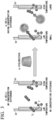
- FIG. 1 is a conceptual diagram showing a thermoelectric conversion device including a thermoelectric conversion material of the present invention.
- the capture compound is not particularly limited as long as it is a capture compound which captures only one of the redox pair selectively at a low temperature and releases it at a high temperature.
- the capture compound may be a polymer such as a cyclic compound or a spiral compound which is capable of capturing a target into the capture compound.
- the capture compound may be a self-assembly compound at low temperature.
- An example of the cyclic compound is cyclodextrin.
- An example of the helical compound is starch.
- the capture compound is one or more selected from the group consisting of cyclodextrin, starch, polyvinyl pyrrolidone, polyethylene oxide, polyethylene glycol and the like, more preferably cyclodextrin.
- the redox pair is composed of an active species of oxidizing agent and an active species of reducing agent.
- the active species of oxidizing agent may be reduced to the active species of reducing agent by reduction reaction; or the active species of reducing agent may be oxidized to the active species of oxidizing agent by oxidation reaction.
- the redox pair is preferably a pair of an iodide ion and a triiodide ion.
- thermoelectric conversion material of the present invention contains an ionic electrolyte, the ionic electrolyte being an ionic liquid, the ionic liquid being an aqueous solvent containing water and an organic solvent or water.
- the ionic electrolyte is an aqueous solvent or water
- the redox pair undergoes redox reaction in an aqueous solvent or water and the capture compound selectively capturing only one of the redox pair in an aqueous solvent or water at low temperature, and releasing it at high temperature.
- the ionic electrolyte may contain ions other than the redox pair.
- the ionic electrolyte is an aqueous solvent or water, it preferably contains alkali ions.
- the capture compound is preferably cyclodextrin capable of capturing triiodide ion, and more preferably ⁇ -cyclodextrin.
- the ionic electrolyte is an aqueous solvent or water. It is preferable that the aqueous solvent or water further contains an alkali ion.
- thermoelectric conversion device of the present invention has the thermoelectric conversion material and the pair of electrodes described above.
- the "thermoelectric conversion device” is a device including all of a thermoelectric conversion device capable of interconverting thermal energy and electric energy, such as a Seebeck device using a thermoelectric conversion material, a Peltier device or the like; and a known device using a thermoelectric conversion material.
- thermoelectric conversion device of the present invention includes, for example, a redox pair, a capture compound that captures only one of the redox pair selectively at a low temperature and releases it at a high temperature, an ionic electrolyte, a first electrode and a second electrode.
- the electrolyte is in physical contact with the at least a part of surface of the first electrode and at least a part of surface of the second electrode.
- the capture compound is not particularly limited as long as it is a capture compound which captures only one of the redox pair selectively at a low temperature and releases it at a high temperature.
- the capture compound may be a polymer such as a cyclic compound or a spiral compound which is capable of capturing a target into the capture compound. It is preferable that the capture compound is a host compound that forms an inclusion compound by inclusion of a capturing target.
- the capture compound may be a self-assembly compound at low temperature.
- An example of the cyclic compound is cyclodextrin.
- spiral compound examples include starch, polyvinyl pyrrolidone, and polyethylene oxide.
- host compound examples include cyclodextrin, starch, polyvinyl pyrrolidone, and polyethylene oxide.
- the capture compound is one or more selected from the group consisting of cyclodextrin, starch, polyvinyl pyrrolidone, polyethylene oxide, polyethylene glycol and the like, and it is more preferably that the capture compound is cyclodextrin.
- the cyclodextrin may be one or more compounds selected from the group consisting of ⁇ -cyclodextrin ( ⁇ -CD), ⁇ -cyclodextrin ( ⁇ -CD), ⁇ -cyclodextrin ( ⁇ -CD), hexakis-(2,6-di-O-methyl)- ⁇ -cyclodextrin (Di-O-Me- ⁇ -CD) and hexakis-(2,3,6-tri-O-methyl)- ⁇ -cyclodextrin (Tri-O-Me- ⁇ -CD).
- ⁇ -CD ⁇ -cyclodextrin
- ⁇ -CD ⁇ -cyclodextrin
- ⁇ -CD ⁇ -cyclodextrin
- ⁇ -CD ⁇ -cyclodextrin
- ⁇ -CD hexakis-(2,6-di-O-methyl)- ⁇ -cyclodextrin
- Tri-O-Me- ⁇ -CD hexakis-(2,3,
- the cyclodextrin may be one or more compounds selected from the group consisting of ⁇ -cyclodextrin ( ⁇ -CD), hexakis-(2,6-di-O-methyl)- ⁇ -cyclodextrin (Di-O-Me- ⁇ -CD), and hexakis-(2,3,6-Tri-O-methyl)- ⁇ -cyclodextrin (Tri-O-Me- ⁇ -CD).
- ⁇ -CD ⁇ -cyclodextrin
- Di-O-Me- ⁇ -CD hexakis-(2,6-di-O-methyl)- ⁇ -cyclodextrin
- Tri-O-Me- ⁇ -CD hexakis-(2,3,6-Tri-O-methyl)- ⁇ -cyclodextrin
- the redox pair includes an active species of oxidizing agent and an active species of reducing agent.
- the active species of oxidizing agent can be reduced to the active species of reducing agent by reduction reaction or the active species of reducing agent can be oxidized to the active species of oxidizing agent by oxidation reaction.
- the redox pair is preferably a pair selected from the group consisting of a pair of iodide ion and triiodide ion, a pair of ferrocyanide ion and ferricyanide ion, a pair of tris(bipyridine) cobalt (II) and tris(bipyridine) cobalt (III), and a pair of ferrocene monocarboxylic acid (Fe(II)) and ferrocenium monocarboxylic acid (Fe(III)). It is preferably that the redox pair is a pair of an iodide ion and a triiodide ion.
- the ionic electrolyte is an aqueous solvent containing water and an organic solvent or water.
- an oxidation-reduction reaction occurs in a redox pair in an aqueous solvent or water, and the capture compound selectively captures only one of the redox pair in an aqueous solvent or water at low temperature and releasing it at high temperature.
- the aqueous electrolyte further contains an alkali ion such as potassium ion.
- a conductive material such as platinum or carbon may be used. Since platinum has a high dissolution potential and excellent corrosion resistance, platinum is preferable. From the viewpoint of low manufacturing cost and large surface area, carbon such as graphite is preferable.
- thermoelectric conversion device for example, in the first electrode, an oxidation reaction in which one reducing agent of the redox pair is changed to the other oxidizing agent occurs; and in the second electrode, a reduction reaction in which the oxidizing agent is changed to the reducing agent occurs.
- An example of the thermoelectric conversion device is a power generating device such as Seebeck device in which there is a temperature difference between the first electrode and the second electrode, and a potential difference arises due to the temperature difference, and as a result, a thermoelectromotive force between the first electrode and the second electrode is generated.
- thermoelectric conversion device of the second embodiment of the present invention for example, in the first electrode, an oxidation reaction in which one reducing agent of the redox pair is changed to the other oxidizing agent occurs; and in the second electrode, a reduction reaction in which the oxidizing agent is changed to the reducing agent occurs.
- thermoelectric conversion device is a cooling or heating device such as a Peltier device in which there is a potential difference between the first electrode and the second electrode, and a temperature difference arises due to the potential difference, and as a result, heat transfer between the first electrode and the second electrode is generated.
- thermoelectric conversion device of the third embodiment of the present invention for example, an oxidation reaction of a redox pair occurs in the first electrode at the low temperature side and a reduction reaction of the redox pair occurs in the second electrode at the high temperature side.
- An Example of the thermoelectric conversion device is an n-Type Seebeck device in which a capture compound captures the oxidizing species of the redox pair and a thermoelectromotive force between the first electrode and the second electrode is generated.
- thermoelectric conversion device of the fourth embodiment of the present invention includes, for example, iodide ion and triiodide ion, cyclodextrin, water or an aqueous solvent, as well as a first electrode at a low temperature side and a second electrode at a high temperature side.
- the aqueous electrolyte physically contacts at least a part of the surface of the first electrode and a part of the surface of the second electrode.
- at least the material of the electrode surface which is partly in contact with the electrolytic solution is an electrically conductive material such as platinum, carbon, or the like. Among them, since platinum having a high dissolution potential and excellent corrosion resistance, platinum is particularly preferable. From the viewpoint of low manufacturing cost and large surface area, carbon such as graphite is preferable.
- the aqueous electrolyte preferably further contains an alkali ion such as potassium ion.
- thermo-electrochemical cell of the present invention includes a Seebeck device in which a temperature difference between the first electrode and the second electrode is generated by using the thermoelectric conversion material of the present invention, and the oxidation-reduction reaction occurs at the first electrode and the second electrodes based on the temperature difference, and as a result, a potential difference between the first electrode and the second electrode is generated.
- a Seebeck device is evaluated by the Seebeck coefficient (Se) shown by the following numerical formula 1.
- S e ⁇ E T H ⁇ T L ⁇ T
- thermoelectric conversion material of the thermo-electrochemical cell of the present invention includes a redox pair and a capture compound that captures only one of the redox pair selectively at a low temperature and releases it at high temperature.
- concentration of the active species of oxidizing agent ([Ox]) and the concentration of the active species of reducing agent ([Red]) of the redox pair the electrode temperature (T) and the standard potential (Ef), at the first electrode or the second electrode
- Ef the oxidation-reduction potential of the redox pair can be expressed by the following formula (2) of Nernst equation.
- E E f + RT nF ln Ox Red
- the oxidation-reduction potential (E) of the redox pair is dependent on the standard potential (Ef), the temperature, the concentration of active species of oxidizing agent ([Ox]) and the concentration of active species of the reducing agent ([Red]) of the redox pair.
- the capture compound that captures only one of the redox pair selectively at a low temperature and that releases it at a high temperature is included, for example, in the vicinity of the first electrode at the low temperature side, an active species of oxidizing agent generated by oxidation in the oxidation reaction are captured, and as a result, the concentration of the active species of oxidizing agent ([Ox]) are decreased.
- the active species of oxidizing agent which is the reaction product of the reduction reaction is released, and the concentration of active species of oxidizing agent ([Ox]) is increased.
- thermo-electrochemical cell of the first embodiment of the present invention includes iodide ion, triiodide ion, ⁇ -cyclodextrin, water or an aqueous solvent, as well as the first electrode at the low temperature side and the second electrode at the high temperature side.
- Inclusion of I 3 - by ⁇ -cyclodextrin represented by chemical formula (1) selectively includes hydrophobic I 3 - rather than hydrophilic I - as disclosed in the prior art.
- FIG. 2 is a conceptual diagram showing selective inclusion of I 3 - by ⁇ -cyclodextrin in the vicinity of the electrode at the low temperature side.
- the active species of oxidizing agent I 3 - generated in the oxidation reaction (I - /I 3 - ) is captured and the concentration of oxidizing species ([I 3 - ]) is decreased.
- the active species of oxidizing agent which is a reaction product of the reduction reaction (I 3 - /I - ) is released to increase the concentration of active species of oxidizing agent ([I 3 - ]).
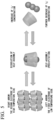
- FIG. 3 is a conceptual diagram showing selective inclusion of I 3 - near the first electrode at low-temperature side by adding ⁇ -cyclodextrin ( ⁇ -CD).
- FIG. 4 shows a relationship between Seebeck coefficient (Se), and a ratio ([ ⁇ -CD] 0 /[I 3 - ] 0 ) of addition concentration of ⁇ - cyclodextrin ( [ ⁇ -CD] 0 ) and addition concentration of I 3 - ([I 3 - ] 0 ); and the relationship between a concentration of free I 3 - and [ ⁇ -CD] 0 /[I 3 - ] 0 .
- the concentration difference of free I 3 - between at the first electrode at 10 °C (broken line) and at the second electrode at 40°C (solid line) increases.
- Binding constants of ⁇ -CD and I 3 - obtained from isothermal titration calorimetry are shown in the following Table 1. When the temperature raises 30 °C, the binding constant of ⁇ -CD and I 3 - decreases by 12%. [Table 1] Binding Constants of ⁇ -CD and I 3 - (Isothermal Titration Calorimetry) 10°C 40°C 3.7 ⁇ 10 5 4.4 ⁇ 10 4
- the solid line in FIG. 4 is the Seebeck coefficient (Se) obtained by simulation using the formula (4) of Nernst equation. It was shown that the Seebeck coefficient increases with the concentration difference of I 3 - .
- E E f + RT 2 F ln I 3 ⁇ I ⁇ 3
- thermo-electrochemical cell of the second embodiment of the present invention is the same as that of the thermo-electrochemical cell of the first embodiment, except for further addition of alkali ions such as potassium ions. By adding alkali ions, a higher Seebeck coefficient can be obtained.
- a dark green precipitate K[( ⁇ -CDh-I 5 ] is generated in the vicinity of the first electrode, further reducing the concentration of I 3 - .
- the amount of precipitation in the vicinity of the first electrode at the low temperature side is greater than the amount of precipitation near the second electrode at high temperature side.
- the concentration difference of I 3 - increases by generating precipitation.
- the Seebeck coefficient increases to the maximum 1.96mV/K. The reasons of obtaining the Seebeck coefficient are listed as follows. ( FIG. 5 )
- FIG. 5 is a conceptual diagram showing that inclusion compounds of ⁇ -cyclodextrin and I 3 - further self-assemble with potassium ions when potassium ions are added.
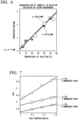
- FIG. 6 is a diagram showing the complex concentration in the solution evaluated at 353 nm absorbance of a complex of ⁇ -cyclodextrin and I 3 - .
- the complex of ⁇ -cyclodextrin and I 3 - self-assemble and the concentration thereof in the solution decreases.
- Table 2 shows data of concentrations of I 3 - in the case of having precipitation and no precipitation when the first electrode is 10°C and the second electrode is 40°C.
- Concentrations of I 3 - [mM] 10°C 40°C Ratio of Concentrations Precipitation 9.9 ⁇ 10 -4 2.6 ⁇ 10 -2 26 times No Precipitation 4.2 ⁇ 10 -3 3.2 ⁇ 10 -2 7.6 times
- the reason of increasing Seebeck coefficient by adding potassium ion is that the concentration difference of I 3 - increases by formation of precipitate.
- thermo-electrochemical cells of the third and the fourth embodiments of the present invention are the same as the thermo-electrochemical cell of the first embodiment, except that ⁇ -cyclodextrin ( ⁇ -CD) and ⁇ -cyclodextrin ( ⁇ -CD) were used instead of ⁇ -cyclodextrin ( ⁇ -CD), respectively.
- FIG. 7 are an Arrhenius plots of binding constants for forming inclusion compounds of I 3 - ion and ⁇ -cyclodextrin ( ⁇ -CD), I 3 - ion and ⁇ -cyclodextrin ( ⁇ -CD), and I 3 - ion and ⁇ -cyclodextrin ( ⁇ -CD).
- ⁇ -CD I 3 - ion and ⁇ -cyclodextrin
- ⁇ -CD I 3 - ion and ⁇ -cyclodextrin
- ⁇ -CD I 3 - ion and ⁇ -cyclodextrin
- thermo-electrochemical cells having ⁇ -cyclodextrin and ⁇ -cyclodextrin cannot obtain Seebeck coefficients (Se) as high as ⁇ -cyclodextrin. However, they show higher Seebeck coefficients (Se) than that without addition of cyclodextrin.
- FIG. 7 are an Arrhenius plots of binding constants for forming inclusion compounds of I 3 - ion and ⁇ - cyclodextrin ( ⁇ -CD), I 3 - ion and ⁇ - cyclodextrin ( ⁇ -CD), and I 3- ion and ⁇ -cyclodextrin ( ⁇ -CD).
- thermo-electrochemical cell of the fifth embodiment of the present invention is the same as that of the thermo-electrochemical cell of the first embodiment, except that amylose (a main component of starch) is used as a capture compound, instead of cyclodextrin. Similarly, the Seebeck coefficient is improved.
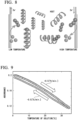
- Amylose the main component of starch, incorporates (captures) iodine as shown in FIG. 8 .
- amylose starch
- FIG. 9 is a diagram showing a change in absorbance (observation wavelength: 552 nm) of an iodine-starch complex. As the temperature rises, the concentration decreases and as the temperature decreases, the concentration increases.
- thermo-electrochemical cell of the fifth embodiment of the present invention as in the first embodiment, the Seebeck coefficient is improved by addition of starch.
- thermoelectric sensor of the present invention is an apparatus that senses a temperature difference between electrodes using each of the above-described thermoelectric conversion materials of the present invention. Since the thermoelectric conversion materials of the present invention have high Seebeck coefficients, the thermoelectric sensor has a high sensitivity when it is used as a temperature sensor.
- An example of the thermoelectric sensor is a thermoelectric sensor made of a thermoelectric conversion device which includes a thermoelectric conversion material including the above-mentioned ⁇ -cyclodextrin, an iodide ion, a triiodide ion, and an aqueous solution containing potassium ions; and a first and second platinum electrodes.
- thermoelectric sensor it is possible to generate a voltage of 2 mV even if the temperature difference between the first and second electrodes is only 1 °C.
- thermoelectric sensor By connecting the thermoelectric sensor to a device which is capable of measuring a potential difference with a highly accurate, such as voltmeter or the like, it is possible to create a sensor that can recognize a temperature difference of about 0.000001 °C. If this temperature difference is capable of being recognized, for example, a heat transmitted from a body temperature of a person behind a wall heats one of electrodes, and as a result, the sensor can sense the person. In addition, a weak infrared radiation radiated from a heat source can be sensed. Furthermore, when a material which is capable of generating heat by absorbing a specific light such as ultraviolet ray is provided at one electrode side, it can be applied to a thermoelectric sensor for sensing a slight light.
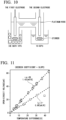
- I 2 (317 mg, 1.25 mmol), KI (415 mg, 2.50 mmol) and water were added to an H-type container having two tubes as shown in FIG. 10 , and a solution having [KI] 50 mM and [ KI 3 ] 50 mM were prepared.
- 0.2 mmol of ⁇ -CD 25 mM was added, followed by dilution with a KI aqueous solution to obtain [KI 3 ] 2.5 mM, [KI] 10 mM, and [ ⁇ -CD] 4 mM.
- the first test tube of the two H type test tubes was set in an ice bath and the temperature in the vicinity of the first electrode was held at 10 °C.
- the second test tube was set in a thermostat capable of adjusting at 10 to 50 °C, and the temperature in the vicinity of the second electrode was adjusted to 10 to 50 °C.
- Platinum wires were inserted to each of the first tube and the second tube containing an aqueous solution having [KI 3 ] 2.5 mM, [KI] 10 mM, and [ ⁇ -CD] 4mM.
- a Seebeck coefficient was determined from a slope of a straight line shown in FIG. 11 .
- the Seebeck coefficients were increased from 0.86 mV/K to 1.43 mV/K by adding ⁇ -cyclodextrin.
- Example 2 is the same as that of Example 1, except for addition of HCl (0.1 M).
- FIG. 12 is a diagram showing a Seebeck coefficient (solid line) [mV/K] after addition of HCl. As the same as that in Example 1, from Figures 12 , the Seebeck Coefficient (Se) is increased from 0.56mV/K without addition of ⁇ -CD to 1.16 mV/K after the addition of the same.
- FIG. 12 also shows comparison with Example 1. The activity of I 3 - /I - was changed by adding HCl. Se was decreased from 1.43 mV/K to 1.16 mV/K with addition of ⁇ -CD, and it decreased from 0.86 mV/K to 0.56 mV/K without addition of ⁇ -CD.
- FIG. 13 is a diagram showing increase of power density (electrolyte: HCl) due to I 3 - inclusion.
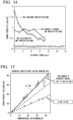
- FIG 14 is a diagram in which the temporal change in the power density of a cell to which ⁇ -CD and an electrolyte ( ⁇ >: HCl) were added was recorded.
- Example 3 is the same as that of Example 1, except for the addition of KCl (0.2 M).
- FIG. 15 shows the Seebeck coefficient (solid line, mV/K) after addition of KCl.
- the Seebeck coefficient (Se) increased from 0.86 mV/K without ⁇ -CD to 1.96 mV/K after addition of ⁇ -CD.
- FIG. 15 also shows a comparison with Example 1. Addition of KCl did not change the activity of I 3 - /I - . When ⁇ -CD was added, Se increased from 1.43mV/K to 1.96mV/K, and when ⁇ -CD was not added, Se was 0.86mV/K without change.
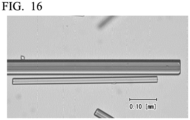
- Example 3 unlike Examples 1 and 2, a dark green precipitate K[( ⁇ -CD) 2 -I 5 ] was observed. It is considered that Seebeck coefficient increases because of the formation of precipitates.
- FIG. 16 An acicular crystals was obtained by allowing the above solution to stand for 2 days ( FIG. 16 ).
- the crystal structure thereof was measured by an X-ray diffraction apparatus (XRD), and the analysis result thereof is shown in FIG.17 .
- XRD X-ray diffraction apparatus
- FIG 14 is a diagram in which the temporal change in the power density of a cell to which ⁇ -CD and an electrolyte (o: KCl) were added was recorded.
- Thermo-electrochemical cells of Example 4 were the same as that of the thermo-electrochemical cell of Example 1, except that ⁇ -cyclodextrin ( ⁇ -CD) was replaced with ⁇ -cyclodextrin ( ⁇ -CD), ⁇ -cyclodextrin ( ⁇ -CD), hexakis-(2,6-di-O-methyl)- ⁇ -( ⁇ -cyclodextrin) (Di-O-Me- ⁇ -CD), and hexakis-(2,3,6-tri-O-methyl)- ⁇ -cyclodextrin (Tri-O-Me- ⁇ -CD), respectively.
- ⁇ -cyclodextrin ⁇ -CD
- ⁇ -CD ⁇ -cyclodextrin
- ⁇ -CD hexakis-(2,6-di-O-methyl)- ⁇ -( ⁇ -cyclodextrin)
- Tri-O-Me- ⁇ -CD hexakis-(2,3,6-tri-
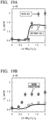
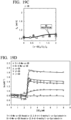
- FIGs.19A, 19B , and 19C are diagrams showing the relationships between the Seebeck coefficient and the relative concentrations of the host molecules, in which an added concentration of cyclodextrin ([CD] 0 ) was 0 to 5 mM, an added concentration of triiodide ion ([I 3 - ] 0 ) was 2.5 mM, a concentration of iodide ion ([I - ]) was 10 mM, and a concentration of potassium chloride ([KCl]) was 0, 200 mM.
- an added concentration of cyclodextrin [CD] 0
- an added concentration of triiodide ion [I 3 - ] 0
- a concentration of iodide ion ([I - ]) was 10 mM
- a concentration of potassium chloride ([KCl]) was 0, 200 mM.
- FIG. 19D is a graph showing the relationship between Seebeck coefficients and the concentrations of five kinds of host molecules, which is a graph showing the relationship between the added concentration of cyclodextrin ([CD] 0 ) 0 to 8 mM, the added concentration of triiodide ion ([I 3 - ] 0 ) was 2.5 mM, and the concentration of iodide ion ([I - ]) was 10 mM.
- Se when 4 mM hexakis-(2,6-di-O-methyl)- ⁇ -cyclodextrin was added, Se was 1.5 mV/K. When hexakis-(2,3,6-tri-O-methyl)- ⁇ -cyclodextrin was added, Tri-O-Me- ⁇ -CD-I 3 - inclusion compound was formed. For example, when 4 mM hexakis-(2,3,6-tri-O-methyl)- ⁇ -cyclodextrin was added, Se was 1.85 mV/K.
- FIG. 20 is a diagram of a curve of a current density vs a voltage and a curve of power density vs a voltage without addition of KCl.
- concentration of each ion in the solution are shown as follows.
- FIG. 21 is a diagram of a curve of a current density vs a voltage and a curve of power density vs a voltage with addition of 200 mM KCl.
- concentration of each ion in the solution is shown as follows.
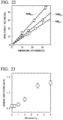
- Example 5 was the same as in Example 1, except that instead of cyclodextrin, starch was added with addition concentration 0, 30, and 60mM (glu equivalent) in terms of glucose. Seebeck coefficient was evaluated, and the relationship between the open-circuit voltage (Voc) and the temperature difference between the electrodes was evaluated, after adding starch at a concentration 0, 30, or 60mM (glu equivalent) in terms of glucose, and Seebeck Coefficient shown in FIG. 22 was determined.
- FIG. 23 is a graph showing the relationship between the Seebeck coefficient and the ratio ([6gluose]/[I 3 - ]) of the starch concentration (6 glucose equivalent concentration, 6 gluose) and I 3 - concentration .
- FIG. 24 is a graph showing a temporal change in power density when 0.2 M of KCl was added in this example in which starch was added.
- FIG.24 also includes a graph showing a temporal change in power density when 0.2 M of KCl was added in Example 3 in which ⁇ -cyclodextrin was added.
- Example 6 a Seebeck coefficient was evaluated similarly as in Example 1, except that polyethylene glycol 4000(Kishida Chemical Co., Ltd., average molecular weight is 2,700 to 3,400) (PEG 4000) was added instead of cyclodextrin.
- FIG. 25 is a diagram showing a relationship between the Seebeck coefficient and polyethylene glycol 3000 concentration (in terms of monomer, mM monomer ). As shown in FIG. 25 , when the added concentration was 10 mM in terms of monomer, the Seebeck coefficient was 1.35 mV/K.
- Example 7 a Seebeck coefficient was evaluated similarly as in Example 1, except that polyvinyl pyrrolidone (Kishida Chemical Co., Ltd., molecular weight 40,000) (PVP) was added instead of cyclodextrin.
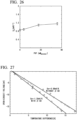
- FIG. 26 is a graph showing the relationship between Seebeck coefficient and polyvinyl pyrrolidone concentration (monomer-equivalent concentration, mM monomer ). When the addition concentration was 20 mM in terms of monomer, the Seebeck coefficient was 1.15 mV/K.
- Example 8 a Seebeck coefficient was evaluated similarly as in Example 1, except that as a redox pair ferrocene monocarboxylic acid (Fe(II)) (manufactured by Sigma-Aldrich) and its oxidation product ferrocenium monocarboxylic acid (Fe(III)) was used instead of iodide ion and triiodide ion, and ⁇ - cyclodextrin was added instead of ⁇ -cyclodextrin. As shown in FIG.
Landscapes
- Chemical & Material Sciences (AREA)
- Physics & Mathematics (AREA)
- General Physics & Mathematics (AREA)
- Chemical Kinetics & Catalysis (AREA)
- Electrochemistry (AREA)
- General Chemical & Material Sciences (AREA)
- Inorganic Chemistry (AREA)
- Engineering & Computer Science (AREA)
- Manufacturing & Machinery (AREA)
- Spectroscopy & Molecular Physics (AREA)
- Hybrid Cells (AREA)
- Measuring Temperature Or Quantity Of Heat (AREA)
Claims (13)
- Thermoelektrisches Umwandlungsmaterial, umfassend:ein Redoxpaar;eine Einfangverbindung, welche nur eines des Redoxpaares selektiv bei niedriger Temperatur einfängt und das nur eine des Redoxpaares bei hoher Temperatur freisetzt; undWasser oder ein wässriges Lösungsmittel, umfassend Wasser und ein organisches Lösungsmittel.
- Thermoelektrisches Umwandlungsmaterial nach Anspruch 1, wobei die Einfangverbindung mindestens eine ist, ausgewählt aus der Gruppe, bestehend aus einer zyklischen Verbindung und einer Spiralverbindung.
- Thermoelektrisches Umwandlungsmaterial nach Anspruch 1 oder 2, wobei die Einfangverbindung ein Selbstassemblierungsmolekül bei einer niedrigen Temperatur ist.
- Thermoelektrisches Umwandlungsmaterial nach Anspruch 1 oder 2, wobei die Einfangverbindung eine Wirtsverbindung ist, welche eine Einschlussverbindung bildet.
- Thermoelektrisches Umwandlungsmaterial nach Anspruch 1 oder 2, wobei die Einfangverbindung eine oder mehrere ist, ausgewählt aus der Gruppe bestehend aus Cyclodextrin, Stärke, Polyvinylpyrrolidon, Polyethylenoxid und Polyethylenglykol.
- Thermoelektrisches Umwandlungsmaterial nach einem der Ansprüche 1 bis 5, wobei das Redoxpaar ein Paar ist, ausgewählt aus der Gruppe, bestehend aus lodid-lon und Triiodid-lon, Ferrocyanid-Ion und Ferricyanid-Ion, und Tris(bipyridin)-Kobalt (II) und Tris(bipyridin)-Kobalt (III).
- Thermoelektrisches Umwandlungsmaterial nach einem der Ansprüche 1 bis 6, wobei das thermoelektrische Umwandlungsmaterial ferner einen Elektrolyten zur Selbstassemblierung der Einfangverbindung bei einer niedrigen Temperatur umfasst.
- Thermoelektrische Umwandlungsvorrichtung, umfassend:
das thermoelektrische Umwandlungsmaterial nach einem der Ansprüche 1 bis 7 und ein Elektrodenpaar. - Thermoelektrische Umwandlungsvorrichtung nach Anspruch 8, wobei das Elektrodenpaar auf unterschiedliche Temperaturen eingestellt ist.
- Thermoelektrochemische Zelle, umfassend:
die thermoelektrische Umwandlungsvorrichtung nach Anspruch 8 oder 9. - Thermoelektrischer Sensor, umfassend:
die thermoelektrische Umwandlungsvorrichtung nach Anspruch 8 oder 9. - Verfahren zum Einfangen eines Redoxpaares in einem thermoelektrischen Umwandlungsmaterial nach Anspruch 1, umfassend einen Schritt des:
Einfangens nur eines des Redoxpaares bei niedriger Temperatur und Freisetzens des nur einen des Redoxpaares bei hoher Temperatur unter Verwendung einer Einfangverbindung, welche in dem thermoelektrischen Umwandlungsmaterial enthalten ist. - Thermoelektrisches Umwandlungsmaterial nach einem der Ansprüche 1 bis 6, welches ein Material ist, welches Wärme direkt in Elektrizität umwandelt oder Elektrizität direkt in Wärme umwandelt.
Applications Claiming Priority (2)
| Application Number | Priority Date | Filing Date | Title |
|---|---|---|---|
| JP2016046309 | 2016-03-09 | ||
| PCT/JP2017/009511 WO2017155046A1 (ja) | 2016-03-09 | 2017-03-09 | 熱電変換材料とそれを有する熱電変換装置、熱化学電池及び熱電センサー |
Publications (3)
| Publication Number | Publication Date |
|---|---|
| EP3428984A1 EP3428984A1 (de) | 2019-01-16 |
| EP3428984A4 EP3428984A4 (de) | 2019-11-20 |
| EP3428984B1 true EP3428984B1 (de) | 2025-02-19 |
Family
ID=59789631
Family Applications (1)
| Application Number | Title | Priority Date | Filing Date |
|---|---|---|---|
| EP17763386.4A Active EP3428984B1 (de) | 2016-03-09 | 2017-03-09 | Thermoelektrisches umwandlungsmaterial, thermoelektrische umwandlungsvorrichtung, thermochemische batterie und thermoelektrischer sensor mit diesem material |
Country Status (5)
| Country | Link |
|---|---|
| US (1) | US11367824B2 (de) |
| EP (1) | EP3428984B1 (de) |
| JP (1) | JP6511708B2 (de) |
| CN (1) | CN108780837B (de) |
| WO (1) | WO2017155046A1 (de) |
Families Citing this family (11)
| Publication number | Priority date | Publication date | Assignee | Title |
|---|---|---|---|---|
| JP7164177B2 (ja) * | 2018-12-27 | 2022-11-01 | 国立大学法人東北大学 | 温度センサ及びその製造方法 |
| CN112713233B (zh) * | 2019-10-25 | 2023-09-26 | 南方科技大学 | 准固态离子型热电转换材料、热电转换器件及其应用 |
| JP7540186B2 (ja) * | 2020-04-02 | 2024-08-27 | artience株式会社 | 熱化学電池電極用導電性組成物 |
| JP7540184B2 (ja) * | 2020-04-02 | 2024-08-27 | artience株式会社 | 熱化学電池電極用導電性組成物 |
| JP7540185B2 (ja) * | 2020-04-02 | 2024-08-27 | artience株式会社 | 熱化学電池電極用導電性組成物 |
| KR20230014712A (ko) * | 2020-05-21 | 2023-01-30 | 덴카 주식회사 | 열전변환용 n형 재료와 그 제조 방법, 도펀트 및 열전변환 소자 |
| ES2934182B2 (es) * | 2021-07-20 | 2023-12-11 | Univ Jaume I | Dispositivo termoelectrico influenciado por especies redox |
| JP7743959B2 (ja) * | 2021-10-05 | 2025-09-25 | 国立大学法人 東京大学 | 熱電変換用電解液、これを備える熱電変換素子、熱化学電池、温度調節装置、および熱電センサー |
| CN114204061B (zh) * | 2021-11-19 | 2024-05-17 | 华中科技大学 | 一种热化学电池及器件 |
| JP7800355B2 (ja) * | 2022-09-12 | 2026-01-16 | artience株式会社 | 電解質組成物及び電池 |
| WO2025040254A1 (de) | 2023-08-23 | 2025-02-27 | Heionit Gmbh | Energiewandlermaterial und galvanische zelle |
Citations (1)
| Publication number | Priority date | Publication date | Assignee | Title |
|---|---|---|---|---|
| US20060225782A1 (en) * | 2005-03-21 | 2006-10-12 | Howard Berke | Photovoltaic cells having a thermoelectric material |
Family Cites Families (10)
| Publication number | Priority date | Publication date | Assignee | Title |
|---|---|---|---|---|
| US5310608A (en) * | 1992-10-21 | 1994-05-10 | Nippon Telegraph And Telephone Corporation | Temperature difference storage battery |
| JP4164652B2 (ja) * | 2001-11-29 | 2008-10-15 | エスケー化研株式会社 | 熱電変換材料及びその製造方法 |
| JP2004235011A (ja) * | 2003-01-30 | 2004-08-19 | Mitsubishi Paper Mills Ltd | ヨウ素−シクロデキストリン包接化物用いた電解液、並びにそれを用いた光電変換素子 |
| JP2005071895A (ja) * | 2003-08-27 | 2005-03-17 | Toyo Ink Mfg Co Ltd | 色素増感型光電変換素子用電解質組成物、それを用いた光電変換素子。 |
| JP2006216252A (ja) * | 2005-02-01 | 2006-08-17 | Fujitsu Ltd | 光電池及び光電変換方法 |
| JP4982361B2 (ja) * | 2005-05-19 | 2012-07-25 | 日宝化学株式会社 | 電解質組成物 |
| US20090114272A1 (en) | 2005-07-07 | 2009-05-07 | Nippon Kayaku Kabushiki Kaisha | Sealing Agent for Photoelectric Converter and Photoelectric Converter Using Same |
| US8779126B2 (en) * | 2008-10-29 | 2014-07-15 | Fujifilm Corporation | Dye, photoelectric conversion element using the same, photoelectrochemical cell, and method of producing dye |
| US20110048525A1 (en) * | 2008-11-26 | 2011-03-03 | Sony Corporation | Functional device and method for producing the same |
| WO2015164907A1 (en) * | 2014-05-01 | 2015-11-05 | Monash University | Thermo-electrochemical cell and method of use |
-
2017
- 2017-03-09 EP EP17763386.4A patent/EP3428984B1/de active Active
- 2017-03-09 US US16/082,476 patent/US11367824B2/en active Active
- 2017-03-09 JP JP2018504591A patent/JP6511708B2/ja active Active
- 2017-03-09 WO PCT/JP2017/009511 patent/WO2017155046A1/ja not_active Ceased
- 2017-03-09 CN CN201780015254.2A patent/CN108780837B/zh active Active
Patent Citations (1)
| Publication number | Priority date | Publication date | Assignee | Title |
|---|---|---|---|---|
| US20060225782A1 (en) * | 2005-03-21 | 2006-10-12 | Howard Berke | Photovoltaic cells having a thermoelectric material |
Non-Patent Citations (1)
| Title |
|---|
| ALZAHRANI HASSAN A H ET AL: "Combining thermogalvanic corrosion and thermogalvanic redox couples for improved electrochemical waste heat harvesting", ELECTROCHEMISTRY COMMUNICATIONS, ELSEVIER AMSTERDAM, NL, vol. 58, 18 June 2015 (2015-06-18), pages 76 - 79, XP029247692, ISSN: 1388-2481, DOI: 10.1016/J.ELECOM.2015.06.007 * |
Also Published As
| Publication number | Publication date |
|---|---|
| WO2017155046A1 (ja) | 2017-09-14 |
| JP6511708B2 (ja) | 2019-05-15 |
| US11367824B2 (en) | 2022-06-21 |
| EP3428984A4 (de) | 2019-11-20 |
| EP3428984A1 (de) | 2019-01-16 |
| CN108780837A (zh) | 2018-11-09 |
| JPWO2017155046A1 (ja) | 2018-11-22 |
| US20190081224A1 (en) | 2019-03-14 |
| CN108780837B (zh) | 2022-03-15 |
Similar Documents
| Publication | Publication Date | Title |
|---|---|---|
| EP3428984A1 (de) | Thermoelektrisches umwandlungsmaterial, thermoelektrische umwandlungsvorrichtung, thermochemische batterie und thermoelektrischer sensor mit diesem material | |
| He et al. | The dual-function of hematite-based photoelectrochemical sensor for solar-to-electricity conversion and self-powered glucose detection | |
| Lv et al. | Facile synthesis of novel CuO/Cu2O nanosheets on copper foil for high sensitive nonenzymatic glucose biosensor | |
| Lu et al. | In situ synthesis of palladium nanoparticle–graphene nanohybrids and their application in nonenzymatic glucose biosensors | |
| Amalraj et al. | Synthesis of core-shell-like structure SnS2-SnO2 integrated with graphene nanosheets for the electrochemical detection of furazolidone drug in furoxone tablet | |
| Manikandan et al. | High performance supercapacitor and non-enzymatic hydrogen peroxide sensor based on tellurium nanoparticles | |
| Kumar et al. | Influence of cationic surfactant cetyltrimethylammonium bromide for electrochemical detection of guanine, uric acid and dopamine | |
| Marimuthu et al. | Synthesis and characterization of non-enzymatic hydrogen peroxide sensor of polypyrrole coated cobalt nanocomposites | |
| Zhe et al. | Surface engineering of carbon selenide nanofilms on carbon cloth: an advanced and ultrasensitive self-supporting binder-free electrode for nitrite sensing | |
| Ji et al. | Synthesize thickness copper (I) sulfide nanoplates on copper rod and it's application as nonenzymatic cholesterol sensor | |
| Thao et al. | The role of copper nanoparticles decorating polydopamine/graphene film as catalyst in the enhancement of uric acid sensing | |
| Ahmad et al. | Synthesis of MoS2/WO3 hybrid composite for hydrazine sensing applications | |
| Wang et al. | The Au/ZnSe/ZnO heterojunction improves the electron transfer behavior to enhance the detection performance of ascorbic acid | |
| Ji et al. | Mxene-based capacitive enzyme-free biofuel cell self-powered sensor for lead ion detection in human plasma | |
| Saraswathi et al. | NiO embedded PANI/Ti3C2TX MXene detector for electrochemical enzyme free glucose detection | |
| Wang et al. | Self-powered photoelectrochemical/visual sensing platform based on PEDOT/BiOBr0. 8I0. 2 organic-inorganic hybrid material and MWCNTs/SnS2 heterojunction for the ultrasensitive detection of programmed death ligand-1 | |
| Tang et al. | NiCo layered double hydroxide nanosheet arrays constructed via in-situ plasma etching as non-enzymatic electrochemical sensor for glucose in food | |
| Zou et al. | Non-enzymatic SnO2-nanowire/GCE amperometric sensor for H2O2 sensing | |
| Chu et al. | A flexible and self-supported nanoporous gold wire electrode with a seamless structure for electrochemical ascorbic acid sensor | |
| Zhang et al. | A rapid synthesis of LDHs nanosheets/electrochemical reduction of graphene oxide nanocomposites to simultaneously detect ascorbic acid, dopamine, and uric acid | |
| Tamilalagan et al. | Rationally designed urchin-like structured cobalt diselenide (o-CoSe2) for the sensitive voltammetric detection of carbendazim fungicide in vegetables and water samples | |
| Yao et al. | Enhanced glucose sensing performance of pn Cu2O homojunction promoted by Cu (I)/Cu (III) redox process | |
| Ebrahimiasl et al. | Electrochemical detection of insulin in blood serum using Ppy/GF nanocomposite modified pencil graphite electrode | |
| Ghorui et al. | Hydroxyl radical assisted enzyme-free electrochemical detection and oxidation of cholesterol by a galvanically deposited layer-by-layer ZnO/WO 3 thin film nanocomposite | |
| Khaliq et al. | Multifunctional tunable Cu 2 O and CuInS 2 quantum dots on TiO 2 nanotubes for efficient chemical oxidation of cholesterol and ibuprofen |
Legal Events
| Date | Code | Title | Description |
|---|---|---|---|
| STAA | Information on the status of an ep patent application or granted ep patent |
Free format text: STATUS: THE INTERNATIONAL PUBLICATION HAS BEEN MADE |
|
| PUAI | Public reference made under article 153(3) epc to a published international application that has entered the european phase |
Free format text: ORIGINAL CODE: 0009012 |
|
| STAA | Information on the status of an ep patent application or granted ep patent |
Free format text: STATUS: REQUEST FOR EXAMINATION WAS MADE |
|
| 17P | Request for examination filed |
Effective date: 20180905 |
|
| AK | Designated contracting states |
Kind code of ref document: A1 Designated state(s): AL AT BE BG CH CY CZ DE DK EE ES FI FR GB GR HR HU IE IS IT LI LT LU LV MC MK MT NL NO PL PT RO RS SE SI SK SM TR |
|
| AX | Request for extension of the european patent |
Extension state: BA ME |
|
| DAV | Request for validation of the european patent (deleted) | ||
| DAX | Request for extension of the european patent (deleted) | ||
| A4 | Supplementary search report drawn up and despatched |
Effective date: 20191023 |
|
| RIC1 | Information provided on ipc code assigned before grant |
Ipc: H01M 14/00 20060101ALI20191016BHEP Ipc: H01L 51/00 20060101ALI20191016BHEP Ipc: G01K 7/02 20060101ALI20191016BHEP Ipc: H01L 37/00 20060101AFI20191016BHEP Ipc: H01L 35/24 20060101ALI20191016BHEP |
|
| STAA | Information on the status of an ep patent application or granted ep patent |
Free format text: STATUS: EXAMINATION IS IN PROGRESS |
|
| 17Q | First examination report despatched |
Effective date: 20220919 |
|
| REG | Reference to a national code |
Ref country code: DE Free format text: PREVIOUS MAIN CLASS: H01L0037000000 Ref country code: DE Ref legal event code: R079 Ref document number: 602017087852 Country of ref document: DE Free format text: PREVIOUS MAIN CLASS: H01L0037000000 Ipc: G01K0007020000 |
|
| GRAP | Despatch of communication of intention to grant a patent |
Free format text: ORIGINAL CODE: EPIDOSNIGR1 |
|
| STAA | Information on the status of an ep patent application or granted ep patent |
Free format text: STATUS: GRANT OF PATENT IS INTENDED |
|
| RIC1 | Information provided on ipc code assigned before grant |
Ipc: H10N 10/81 20230101ALI20241116BHEP Ipc: H10N 10/10 20230101ALI20241116BHEP Ipc: H10N 10/01 20230101ALI20241116BHEP Ipc: H01M 6/36 20060101ALI20241116BHEP Ipc: H01M 14/00 20060101ALI20241116BHEP Ipc: G01K 7/02 20060101AFI20241116BHEP |
|
| INTG | Intention to grant announced |
Effective date: 20241203 |
|
| GRAS | Grant fee paid |
Free format text: ORIGINAL CODE: EPIDOSNIGR3 |
|
| GRAA | (expected) grant |
Free format text: ORIGINAL CODE: 0009210 |
|
| STAA | Information on the status of an ep patent application or granted ep patent |
Free format text: STATUS: THE PATENT HAS BEEN GRANTED |
|
| AK | Designated contracting states |
Kind code of ref document: B1 Designated state(s): AL AT BE BG CH CY CZ DE DK EE ES FI FR GB GR HR HU IE IS IT LI LT LU LV MC MK MT NL NO PL PT RO RS SE SI SK SM TR |
|
| REG | Reference to a national code |
Ref country code: GB Ref legal event code: FG4D |
|
| RIN1 | Information on inventor provided before grant (corrected) |
Inventor name: KIMIZUKA, NOBUO Inventor name: ZHOU, HONGYAO Inventor name: YAMADA, TEPPEI |
|
| REG | Reference to a national code |
Ref country code: CH Ref legal event code: EP |
|
| REG | Reference to a national code |
Ref country code: DE Ref legal event code: R096 Ref document number: 602017087852 Country of ref document: DE |
|
| REG | Reference to a national code |
Ref country code: IE Ref legal event code: FG4D |
|
| REG | Reference to a national code |
Ref country code: NL Ref legal event code: MP Effective date: 20250219 |
|
| PG25 | Lapsed in a contracting state [announced via postgrant information from national office to epo] |
Ref country code: RS Free format text: LAPSE BECAUSE OF FAILURE TO SUBMIT A TRANSLATION OF THE DESCRIPTION OR TO PAY THE FEE WITHIN THE PRESCRIBED TIME-LIMIT Effective date: 20250519 |
|
| PG25 | Lapsed in a contracting state [announced via postgrant information from national office to epo] |
Ref country code: FI Free format text: LAPSE BECAUSE OF FAILURE TO SUBMIT A TRANSLATION OF THE DESCRIPTION OR TO PAY THE FEE WITHIN THE PRESCRIBED TIME-LIMIT Effective date: 20250219 |
|
| PG25 | Lapsed in a contracting state [announced via postgrant information from national office to epo] |
Ref country code: PL Free format text: LAPSE BECAUSE OF FAILURE TO SUBMIT A TRANSLATION OF THE DESCRIPTION OR TO PAY THE FEE WITHIN THE PRESCRIBED TIME-LIMIT Effective date: 20250219 |
|
| PG25 | Lapsed in a contracting state [announced via postgrant information from national office to epo] |
Ref country code: ES Free format text: LAPSE BECAUSE OF FAILURE TO SUBMIT A TRANSLATION OF THE DESCRIPTION OR TO PAY THE FEE WITHIN THE PRESCRIBED TIME-LIMIT Effective date: 20250219 |
|
| REG | Reference to a national code |
Ref country code: LT Ref legal event code: MG9D |
|
| PG25 | Lapsed in a contracting state [announced via postgrant information from national office to epo] |
Ref country code: IS Free format text: LAPSE BECAUSE OF FAILURE TO SUBMIT A TRANSLATION OF THE DESCRIPTION OR TO PAY THE FEE WITHIN THE PRESCRIBED TIME-LIMIT Effective date: 20250619 Ref country code: NO Free format text: LAPSE BECAUSE OF FAILURE TO SUBMIT A TRANSLATION OF THE DESCRIPTION OR TO PAY THE FEE WITHIN THE PRESCRIBED TIME-LIMIT Effective date: 20250519 |
|
| PG25 | Lapsed in a contracting state [announced via postgrant information from national office to epo] |
Ref country code: NL Free format text: LAPSE BECAUSE OF FAILURE TO SUBMIT A TRANSLATION OF THE DESCRIPTION OR TO PAY THE FEE WITHIN THE PRESCRIBED TIME-LIMIT Effective date: 20250219 |
|
| PG25 | Lapsed in a contracting state [announced via postgrant information from national office to epo] |
Ref country code: HR Free format text: LAPSE BECAUSE OF FAILURE TO SUBMIT A TRANSLATION OF THE DESCRIPTION OR TO PAY THE FEE WITHIN THE PRESCRIBED TIME-LIMIT Effective date: 20250219 |
|
| PG25 | Lapsed in a contracting state [announced via postgrant information from national office to epo] |
Ref country code: PT Free format text: LAPSE BECAUSE OF FAILURE TO SUBMIT A TRANSLATION OF THE DESCRIPTION OR TO PAY THE FEE WITHIN THE PRESCRIBED TIME-LIMIT Effective date: 20250620 Ref country code: LV Free format text: LAPSE BECAUSE OF FAILURE TO SUBMIT A TRANSLATION OF THE DESCRIPTION OR TO PAY THE FEE WITHIN THE PRESCRIBED TIME-LIMIT Effective date: 20250219 |
|
| PG25 | Lapsed in a contracting state [announced via postgrant information from national office to epo] |
Ref country code: GR Free format text: LAPSE BECAUSE OF FAILURE TO SUBMIT A TRANSLATION OF THE DESCRIPTION OR TO PAY THE FEE WITHIN THE PRESCRIBED TIME-LIMIT Effective date: 20250520 Ref country code: BG Free format text: LAPSE BECAUSE OF FAILURE TO SUBMIT A TRANSLATION OF THE DESCRIPTION OR TO PAY THE FEE WITHIN THE PRESCRIBED TIME-LIMIT Effective date: 20250219 |
|
| REG | Reference to a national code |
Ref country code: AT Ref legal event code: MK05 Ref document number: 1768666 Country of ref document: AT Kind code of ref document: T Effective date: 20250219 |
|
| PG25 | Lapsed in a contracting state [announced via postgrant information from national office to epo] |
Ref country code: SE Free format text: LAPSE BECAUSE OF FAILURE TO SUBMIT A TRANSLATION OF THE DESCRIPTION OR TO PAY THE FEE WITHIN THE PRESCRIBED TIME-LIMIT Effective date: 20250219 |
|
| PG25 | Lapsed in a contracting state [announced via postgrant information from national office to epo] |
Ref country code: SM Free format text: LAPSE BECAUSE OF FAILURE TO SUBMIT A TRANSLATION OF THE DESCRIPTION OR TO PAY THE FEE WITHIN THE PRESCRIBED TIME-LIMIT Effective date: 20250219 |
|
| PG25 | Lapsed in a contracting state [announced via postgrant information from national office to epo] |
Ref country code: DK Free format text: LAPSE BECAUSE OF FAILURE TO SUBMIT A TRANSLATION OF THE DESCRIPTION OR TO PAY THE FEE WITHIN THE PRESCRIBED TIME-LIMIT Effective date: 20250219 |
|
| PG25 | Lapsed in a contracting state [announced via postgrant information from national office to epo] |
Ref country code: IT Free format text: LAPSE BECAUSE OF FAILURE TO SUBMIT A TRANSLATION OF THE DESCRIPTION OR TO PAY THE FEE WITHIN THE PRESCRIBED TIME-LIMIT Effective date: 20250219 |
|
| PG25 | Lapsed in a contracting state [announced via postgrant information from national office to epo] |
Ref country code: AT Free format text: LAPSE BECAUSE OF FAILURE TO SUBMIT A TRANSLATION OF THE DESCRIPTION OR TO PAY THE FEE WITHIN THE PRESCRIBED TIME-LIMIT Effective date: 20250219 |
|
| PG25 | Lapsed in a contracting state [announced via postgrant information from national office to epo] |
Ref country code: EE Free format text: LAPSE BECAUSE OF FAILURE TO SUBMIT A TRANSLATION OF THE DESCRIPTION OR TO PAY THE FEE WITHIN THE PRESCRIBED TIME-LIMIT Effective date: 20250219 Ref country code: CZ Free format text: LAPSE BECAUSE OF FAILURE TO SUBMIT A TRANSLATION OF THE DESCRIPTION OR TO PAY THE FEE WITHIN THE PRESCRIBED TIME-LIMIT Effective date: 20250219 |
|
| REG | Reference to a national code |
Ref country code: CH Ref legal event code: H13 Free format text: ST27 STATUS EVENT CODE: U-0-0-H10-H13 (AS PROVIDED BY THE NATIONAL OFFICE) Effective date: 20251023 |
|
| PG25 | Lapsed in a contracting state [announced via postgrant information from national office to epo] |
Ref country code: RO Free format text: LAPSE BECAUSE OF FAILURE TO SUBMIT A TRANSLATION OF THE DESCRIPTION OR TO PAY THE FEE WITHIN THE PRESCRIBED TIME-LIMIT Effective date: 20250219 |
|
| PG25 | Lapsed in a contracting state [announced via postgrant information from national office to epo] |
Ref country code: SK Free format text: LAPSE BECAUSE OF FAILURE TO SUBMIT A TRANSLATION OF THE DESCRIPTION OR TO PAY THE FEE WITHIN THE PRESCRIBED TIME-LIMIT Effective date: 20250219 |
|
| PG25 | Lapsed in a contracting state [announced via postgrant information from national office to epo] |
Ref country code: LU Free format text: LAPSE BECAUSE OF NON-PAYMENT OF DUE FEES Effective date: 20250309 |
|
| REG | Reference to a national code |
Ref country code: DE Ref legal event code: R097 Ref document number: 602017087852 Country of ref document: DE |
|
| REG | Reference to a national code |
Ref country code: BE Ref legal event code: MM Effective date: 20250331 |
|
| PG25 | Lapsed in a contracting state [announced via postgrant information from national office to epo] |
Ref country code: MC Free format text: LAPSE BECAUSE OF FAILURE TO SUBMIT A TRANSLATION OF THE DESCRIPTION OR TO PAY THE FEE WITHIN THE PRESCRIBED TIME-LIMIT Effective date: 20250219 |
|
| PLBE | No opposition filed within time limit |
Free format text: ORIGINAL CODE: 0009261 |
|
| STAA | Information on the status of an ep patent application or granted ep patent |
Free format text: STATUS: NO OPPOSITION FILED WITHIN TIME LIMIT |
|
| PG25 | Lapsed in a contracting state [announced via postgrant information from national office to epo] |
Ref country code: BE Free format text: LAPSE BECAUSE OF NON-PAYMENT OF DUE FEES Effective date: 20250331 |
|
| PG25 | Lapsed in a contracting state [announced via postgrant information from national office to epo] |
Ref country code: CH Free format text: LAPSE BECAUSE OF NON-PAYMENT OF DUE FEES Effective date: 20250331 |
|
| PG25 | Lapsed in a contracting state [announced via postgrant information from national office to epo] |
Ref country code: IE Free format text: LAPSE BECAUSE OF NON-PAYMENT OF DUE FEES Effective date: 20250309 |
|
| 26N | No opposition filed |
Effective date: 20251120 |
|
| PGFP | Annual fee paid to national office [announced via postgrant information from national office to epo] |
Ref country code: GB Payment date: 20260209 Year of fee payment: 10 |
|
| PGFP | Annual fee paid to national office [announced via postgrant information from national office to epo] |
Ref country code: DE Payment date: 20260205 Year of fee payment: 10 |
|
| PGFP | Annual fee paid to national office [announced via postgrant information from national office to epo] |
Ref country code: FR Payment date: 20260209 Year of fee payment: 10 |