EP3430751B1 - Détermination de cause dtx - Google Patents
Détermination de cause dtx Download PDFInfo
- Publication number
- EP3430751B1 EP3430751B1 EP16716309.6A EP16716309A EP3430751B1 EP 3430751 B1 EP3430751 B1 EP 3430751B1 EP 16716309 A EP16716309 A EP 16716309A EP 3430751 B1 EP3430751 B1 EP 3430751B1
- Authority
- EP
- European Patent Office
- Prior art keywords
- dtx
- data
- grant
- nack
- assignment
- Prior art date
- Legal status (The legal status is an assumption and is not a legal conclusion. Google has not performed a legal analysis and makes no representation as to the accuracy of the status listed.)
- Active
Links
Images

Classifications
-
- H—ELECTRICITY
- H04—ELECTRIC COMMUNICATION TECHNIQUE
- H04L—TRANSMISSION OF DIGITAL INFORMATION, e.g. TELEGRAPHIC COMMUNICATION
- H04L1/00—Arrangements for detecting or preventing errors in the information received
- H04L1/0001—Systems modifying transmission characteristics according to link quality, e.g. power backoff
- H04L1/0023—Systems modifying transmission characteristics according to link quality, e.g. power backoff characterised by the signalling
- H04L1/0027—Scheduling of signalling, e.g. occurrence thereof
-
- H—ELECTRICITY
- H04—ELECTRIC COMMUNICATION TECHNIQUE
- H04L—TRANSMISSION OF DIGITAL INFORMATION, e.g. TELEGRAPHIC COMMUNICATION
- H04L1/00—Arrangements for detecting or preventing errors in the information received
- H04L1/12—Arrangements for detecting or preventing errors in the information received by using return channel
- H04L1/16—Arrangements for detecting or preventing errors in the information received by using return channel in which the return channel carries supervisory signals, e.g. repetition request signals
- H04L1/18—Automatic repetition systems, e.g. Van Duuren systems
- H04L1/1812—Hybrid protocols; Hybrid automatic repeat request [HARQ]
-
- H—ELECTRICITY
- H04—ELECTRIC COMMUNICATION TECHNIQUE
- H04L—TRANSMISSION OF DIGITAL INFORMATION, e.g. TELEGRAPHIC COMMUNICATION
- H04L1/00—Arrangements for detecting or preventing errors in the information received
- H04L1/12—Arrangements for detecting or preventing errors in the information received by using return channel
- H04L1/16—Arrangements for detecting or preventing errors in the information received by using return channel in which the return channel carries supervisory signals, e.g. repetition request signals
- H04L1/18—Automatic repetition systems, e.g. Van Duuren systems
- H04L1/1829—Arrangements specially adapted for the receiver end
- H04L1/1861—Physical mapping arrangements
-
- H—ELECTRICITY
- H04—ELECTRIC COMMUNICATION TECHNIQUE
- H04L—TRANSMISSION OF DIGITAL INFORMATION, e.g. TELEGRAPHIC COMMUNICATION
- H04L5/00—Arrangements affording multiple use of the transmission path
- H04L5/003—Arrangements for allocating sub-channels of the transmission path
- H04L5/0053—Allocation of signalling, i.e. of overhead other than pilot signals
-
- H—ELECTRICITY
- H04—ELECTRIC COMMUNICATION TECHNIQUE
- H04L—TRANSMISSION OF DIGITAL INFORMATION, e.g. TELEGRAPHIC COMMUNICATION
- H04L5/00—Arrangements affording multiple use of the transmission path
- H04L5/003—Arrangements for allocating sub-channels of the transmission path
- H04L5/0053—Allocation of signalling, i.e. of overhead other than pilot signals
- H04L5/0055—Physical resource allocation for ACK/NACK
-
- H—ELECTRICITY
- H04—ELECTRIC COMMUNICATION TECHNIQUE
- H04W—WIRELESS COMMUNICATION NETWORKS
- H04W72/00—Local resource management
- H04W72/20—Control channels or signalling for resource management
- H04W72/23—Control channels or signalling for resource management in the downlink direction of a wireless link, i.e. towards a terminal
-
- H—ELECTRICITY
- H04—ELECTRIC COMMUNICATION TECHNIQUE
- H04W—WIRELESS COMMUNICATION NETWORKS
- H04W76/00—Connection management
- H04W76/20—Manipulation of established connections
- H04W76/28—Discontinuous transmission [DTX]; Discontinuous reception [DRX]
-
- H—ELECTRICITY
- H04—ELECTRIC COMMUNICATION TECHNIQUE
- H04L—TRANSMISSION OF DIGITAL INFORMATION, e.g. TELEGRAPHIC COMMUNICATION
- H04L1/00—Arrangements for detecting or preventing errors in the information received
- H04L1/12—Arrangements for detecting or preventing errors in the information received by using return channel
- H04L2001/125—Arrangements for preventing errors in the return channel
Definitions
- the present disclosure generally relates to the technical field of telecommunication, and particularly to a method of determining a DTX cause and an access node using the method.
- PDCCH Physical Downlink Control Channel
- EPDCCH Enhanced Physical Downlink Control Channel
- PDSCH data there are also DL data related to the DL assignment transmitted on PDSCH, which are also referred to as PDSCH data, and could be real payload data to the UE, dummy data, etc.
- UE-specific UL grant and DL assignment are, in a DL subframe, signaled independent to each other through PDCCH/EPDCCH.
- the HARQ ACK/NACK can be sent on PUCCH (which is also referred to as PUCCH HARQ ACK/NACK) or on PUSCH (which is also referred to as PUSCH HARQ ACK/NACK) where the HARQ ACK/NACK is multiplexed with the PUSCH data. This depends on e.g.
- the UE supports simultaneous PUSCH and PUCCH transmissions (which is a capability of UE that was introduced in 3GPP Rel-10, in which the HARQ ACK/NACK is transmitted on PUCCH only); or whether the PUSCH data are sent in the same UL subframe in a case that the UE does not support the simultaneous PUSCH and PUCCH transmissions; and also depends on whether a skipPadding bit is set for the UE (e.g. in 3GPP Rel-13), which will be discussed later.
- the HARQ ACK/NACK will be sent on the PUCCH unless there is a coinciding PUSCH transmission in the same UL subframe.
- the HARQ ACK/NACK will be sent (i.e., multiplexed) together with the PUSCH data on PUSCH resources.
- the HARQ ACK/NACK will be sent on the PUCCH.
- a BLER Block Error Rate
- PDSCH and PUSCH are typically around 10 times higher, i.e. about 10%
- a probability for missed detection for HARQ ACK/NACK on PUCCH is around 1%.
- the access node e.g., eNodeB
- applies two separate energy detection schemes i.e., DTX (Discontinuous Transmission) schemes, to find if an UL grant and a DL assignment have been received by the UE, respectively.
- the eNodeB For the UL grant, the eNodeB tries to detect an UL signal at allocated PUSCH resources. If there is no UL signal received, e.g. no energy detected at the allocated PUSCH resources, the eNodeB will consider it as a DTX, which may be caused by either the UL grant being not received or erroneously decoded by the UE, or the PUSCH data being transmitted from the UE but not received by the eNodeB. The eNodeB will then schedule an UL grant re-transmission.
- eNodeB For the DL assignment, eNodeB tries to detect the HARQ ACK/NACK transmitted on UL, either on PUCCH or on PUSCH, to determine if the previous DL data are received by the UE. If there is no HARQ ACK/NACK detected on UL at the expected resources where the HARQ ACK/NACK shall transmit, the eNodeB will consider the DL assignment as either not detected or the UL HARQ ACK/NACK as not received. A DL re-transmission will then be scheduled by the eNodeB.
- decoding results for the PUSCH data and the HARQ ACK/NACK multiplexed with the PUSCH data could be different, i.e. the PUSCH data could be correctly decoded while the HARQ ACK/NACK multiplexed with the PUSCH data is erroneously decoded.
- the BLER target for the PUSCH data on PUSCH is around 10% and for the HARQ ACK/NACK multiplexed with the PUSCH data is around 1%, it is actually the reversed results that are more likely, e.g. PUSCH data are erroneously received and the HARQ ACK/NACK multiplexed with the PUSCH data is correctly decoded.
- a skip-padding-in-uplink alternative is introduced (which is disclosed in e.g. R2-156296, R2 - 157032, R2 - 157033 available from http://www.3gpp.org/).
- the "skipPadding" bit is set and signaled to the UE (which is also referred to as “skipPadding UE") through a RRC signaling or on a separate dynamic grant, the UE is allowed to not transmit at all if there is no data in an UL buffer.
- the UE in previous 3GPP releases (which is also referred to as "legacy UE", in order to be distinguished from the skipPadding UE in e.g.
- 3GPP Rel-13 was obliged to transmit on granted PUSCH resources even when it had not enough data in the UL buffer of the UE; and then the UE transmitted padding data.
- UE is used for referring to either the legacy UE or the skipPadding UE, unless otherwise indicated.
- the eNodeB cannot know if the DTX on PUSCH is due to a third DTX case:
- This third DTX case is only applicable to the UL grant.
- the eNodeB transmits only the UL grant or only the DL assignment to the UE on PDCCH/EPDCCH and gets no feedback from the UE, i.e., detects a DTX
- a DL problem e.g. UL grant or DL assignment on PDCCH/EPDCCH being erroneously decoded or being not received by the UE
- an UL problem e.g. PUSCH data or HARQ ACK/NACK being lost
- the UE might require at least two separate PDCCH/EPDCCH physical resources, at least one for UL and at least one for DL scheduling, simultaneously.
- PDCCH/EPDCCH resources which causes PDCCH/EPDCCH resource utilization inefficiency. This is extremely important in NX (Next generation), where simultaneous UL and DL transmissions in the same subframe is more frequent.
- a technical solution of enabling the eNodeB to differentiate whether a DTX is caused by a DL problem (UL grant or DL assignment on PDCCH/EPDCCH being erroneously decoded or being not received by the UE) or by an UL problem (e.g. PUSCH data or HARQ ACK/NACK being lost) is desired so as to improve DTX robustness.
- the techniques described herein may be used for various wireless communication networks such as CDMA, TDMA, FDMA, OFDMA, SC-FDMA and other networks.
- the terms “network” and “system” are often used interchangeably.
- the techniques described herein may be used for the wireless networks and radio technologies mentioned herein as well as other wireless networks and radio technologies proposed in the future. For clarity, certain aspects of the techniques are described below for LTE, and LTE terminology is used in much of the description below.
- access node used herein refer to any of entities capable of accessing to any of wireless communication networks.
- the access node may comprise a NodeB, eNodeB etc.
- the DTX robustness scheme based on results of the combined energy detection scheme in the access node can be improved to further determine a cause of DTX, i.e., whether the DTX is caused by a UL problem or a DL problem.
- the method 100 may comprise steps S101 to S105, in which step S101 occurs on DL, and steps S103 and S105 occur on UL.
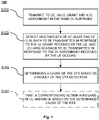
- step S101 the UL grant and the DL assignment are transmitted by the access node to the UE in the same DL subframe.
- the UL grant and the DL assignment transmitted in the same DL subframe may exhibit more similar DL channel characteristics and code rates, and thus may achieve more similar error probabilities for the UE to decode the UL grant and the DL assignment, which can be regarded as "substantially identical" and thus can be not taken into account in the DTX cause determination of the present disclosure.
- the DL assignment and the UL grant are decoded by the UE with substantially equal error probabilities.
- the DL assignment and the UL grant may be decoded by the UE with substantially equal error probabilities, it can be determined that either both of the DL assignment and the UL grant are correctly received by the UE, or neither of the DL assignment and the UL grant is correctly received by the UE. From the UE transmissions (HARQ ACK/NACK and UL data), an improved DTX robustness handling in the access node thus can be obtained.
- the method 100 may also be applied to a case where the DL assignment and the UL grant are decoded by the UE with unequal error probabilities, e.g. 1% versus 10%, as long as the error probabilities are known. In this case, the method 100 needs to take the unequal error probabilities into account.
- the equal error probabilities may be achieved by transmitting the UL grant and the DL assignment in the same DL subframe as described above so that the DL assignment and the UL grant have the same code rates and the same channel characteristics.
- Other ways are possible, e.g., if the DL assignment has a much better channel than the UL grant, it is possible to set a lower higher code rate for the UL grant to compensate for the worse channel, and still get equal error probabilities for the two DL control channels (e.g. PDCCHs/EPDCCHs).
- PDCCHs/EPDCCHs two DL control channels
- the UL grant and the DL assignment are transmitted by the access node to the UE in the same DL subframe, which may have substantially identical DL channel characteristics and substantially identical code rates to achieve substantially equal error probabilities for the UE to decode the UL grant and the DL assignment for better determining the DTX cause subsequently.
- the UL grant and the DL assignment may be transmitted to the UE on DL physical resources which experience substantially identical channel conditions.
- substantially identical means, e.g., that the DL physical resources are so close in time and frequency that - considering an expected channel variation rate - any difference in channel conditions is too small to reasonably explain why a transmission in one DL physical resource succeeds and a transmission in the other DL physical resource fails. That is, given the expected channel variation rate, the DL physical resources are sufficiently close so that if they differ with respect to transmit success/transmit failure, this is NOT attributable to the channel variation.
- the UL grant may be allocated to one PDCCH/EPDCCH and the DL assignment may be allocated to another PDCCH/EPDCCH; and the two PDCCHs/EPDCCHs are preferably assigned as close as possible to each other in the DL time-frequency domain, such that they will experience "substantially identical" DL channel conditions.
- the equal error probabilities for the DL assignment and the UL grant are generally less affected by the channel variation and are closer to each other than the embodiment in which the UL grant and the DL assignment is transmitted in the same DL subframe.
- the access node may allocate PDCCH CCEs (Control Channel Element) for the UL grant and the DL assignment in the PDCCH locations which experience substantially identical channel conditions. This ensures that the PDCCH transmissions of the UL grant and the DL assignment are subject to the substantial identical DL channel conditions.
- PDCCH CCEs Control Channel Element
- the PDCCH transmissions of the UL grant and the DL assignment are spread over the entire DL system bandwidth and over all OFDM symbols used for control data (typically 1 to 3 OFDM symbols). This implies that the PDCCH transmissions of the UL grant and the DL assignment will have similar DL channels.
- the access node can, at least to some degree, control if the EPDCCHs are sent on the same PRBs or not.
- the EPDCCHs for transmitting the UL grant and the DL assignment shall be assigned on the same PRB pairs, and the access node may allocate EPDCCH ECCEs (Enhanced Control Channel Element) for the UL grant and the DL assignment in the same PRB pair(s).
- EPDCCH ECCEs Enhanced Control Channel Element
- the UL grant and the DL assignment may be transmitted to the UE on the same DL physical resources, which would require the UL grant and the DL assignment to be jointly coded.
- the equal error probabilities for the DL assignment and the UL grant are generally even less affected by the channel variation and are closer to each other than the previous two embodiments.
- the UL grant and the DL assignment transmitted on the same DL physical resources would get exactly the same error probability.
- the coding result for both of the UL grant and the DL assignment would be the same, i.e. both are correctly decoded (i.e., CRC ok) or both are incorrectly decoded (i.e., CRC not ok).
- the UE in the above embodiments may be a legacy UE or a skipPadding UE.
- the only difference for the skipPadding UE from the legacy UE consists in that there will be no transmission on the UL shared channel (e.g. PUSCH), if there are no data in the UL buffer.
- the UL shared channel e.g. PUSCH
- the method 100 may be applied to a future UE as well.
- the DL physical resources with a larger size but containing both the UL grant and the DL assignment in a combined DCI format may be allocated.
- the UL grant and the DL assignment are transmitted in the same DL subframe, the UL data and the HARQ ACK/NACK will be located in the same UL subframe.
- step S103 the access node detects whether DTX of at least one of (1) UL data to be transmitted in response to the UL grant received by the UE and (2) HARQ ACK/NACK to be transmitted in response to DL data related to the DL assignment received by the UE occurs. And in step S105, the access node determines a cause of the DTX based on a result of the DTX detection.
- simultaneous transmissions on an UL shared channel (e.g. PUSCH) and on an UL control channel (e.g. PUCCH) is a capability of UE that was introduced in 3GPP Rel-10, in which the HARQ ACK/NACK is transmitted on the UL control channel (e.g. PUCCH) only.
- the UE in a case that the UE supports the simultaneous transmissions on an UL shared channel and on an UL control channel, e.g., the UE is configured for simultaneous PUSCH and PUCCH transmissions, the UL shared channel (e.g. PUSCH) allows transmission of the UL data and the UL control channel (e.g. PUCCH) allows transmission of the HARQ ACK/NACK.
- the access node makes determinations in step S105 of
- the method 100 may comprise a step S107, in which the access node may take a corresponding action in regard of the UL and/or DL based on the cause of the DTX determined in step S105, in order to implement the improved DTX robustness scheme.
- Table 1 Relationships between combined DTX detection results obtained in step S103 and DTX causes determined in step S105 as well as actions suggested to be performed in step S107 are outlined in Table 1 as presented below.
- Table 1 UL Data HARQ ACK/NACK On UL Shared Channel
- DTX Cause and Suggested Action Note DTX DTX DTX Probable Cause: UL grant is missing.
- a Suggested Action Retransmission without toggling NDI (New Data Indication) and without stepping RVI (Redundancy Version Indicator).
- DTX DTX Not DTX Probable Cause UE has received UL grant but UL shared channel is too weak.
- B Suggested Action Both non-adaptive retransmission and adaptive retransmission with separate grant on UL is possible.
- step RVI to obtain redundancy version incremental gain.
- DTX Not DTX DTX Not a possible outcome since DTX of UL data will always cause DTX of HARQ ACK / NACK On UL Shared Channel.
- X DTX Not DTX Not DTX Not a possible outcome since DTX of UL data will always cause DTX ofHARQ ACK / NACK On UL Shared Channel.
- C Suggested Action Increase power of UL Control Channel.
- Not DTX DTX Not DTX Probable Cause all channels are good. Suggested Action: No action Not DTX Not DTX DTX Not a possible outcome since the HARQ ACK / NACK will be transmitted on UL Control Channel. X Not DTX Not DTX Not DTX Not a possible outcome since the HARQ ACK / NACK will be transmitted on UL Control Channel. X
- A”, “B” and “C” in the “Note” column refer to the three outcomes A), B) and C) respectively in the case that UE supports the simultaneous transmissions on an UL shared channel and on an UL control channel and is a legacy UE which was obliged to transmit on granted UL shared channel even when it had not enough data in the UL buffer of the UE where padding data are transmitted, as previously described.
- "X” in the “Note” column refers to outcomes which are not possible, and reasons are given in corresponding "DTX Cause and Suggested Action” columns in italics. Items in the "HARQ ACK/NACK On UL Shared Channel” column in bold italics represent non-valid HARQ ACK/NACK mapping to UL Shared Channel, since simultaneous transmissions on UL shared channel and on UL control channel are assumed.
- any HARQ ACK/NACK should always be transmitted on the UL control channel in the case of simultaneous transmissions on UL shared channel and on UL control channel, there is no HARQ ACK/NACK decoding required on the UL shared channel in this case, i.e., the "HARQ ACK/NACK On UL Shared Channel" column is not required to be considered in the present embodiment.
- step S107 focuses on determining, by the access node, the cause of DTX precisely based on the combined feedback information related to UL data and the HARQ ACK/NACK. Based on the above principle of the present disclosure, the access node may take a more appropriate action to improve the DTX case.
- Suggested Actions as performed in step S107 are listed in Table 1 (as well as in Tables 2 and 3 to be described later), it will be understood by the skilled in the art that they are only examples of actions to be taken by the access node to improve the DTX case. However, the skilled in the art may contemplate any actions which can be taken by the access node to improve the DTX case in practice, all of which are within the scope of the present disclosure. That is, step S107 does not constitute a part of the principle of the present disclosure and is not essential to the present disclosure.
- the UE in a case that the UE supports the simultaneous transmissions on an UL shared channel and on an UL control channel, e.g., the UE is configured for simultaneous PUSCH and PUCCH transmissions, the UL shared channel (e.g. PUSCH) allows transmission of the UL data and the UL control channel (e.g. PUCCH) allows transmission of the HARQ ACK/NACK.
- the UE is allowed to not transmit padding data if there is no data in an UL buffer, i.e., the UE is a skipPadding UE as previously mentioned for which a skipPadding bit is set, the access node performs operations of:
- the method 100 may comprise the step S107, in which the access node may take a corresponding action in regard of the UL and/or DL based on the cause of the DTX determined in step S105, in order to implement the improved DTX robustness.
- D Suggested Action Both non-adaptive retransmission and adaptive retransmission with separate grant on UL is possible.
- step RVI When retransmission grant is issued, step RVI to obtain redundancy version incremental gain.
- Probable Cause No data in UL buffer, i.e. no padding data and no UL data transmitted.
- Suggested action No retransmission is needed.
- DTX Not DTX DTX Not a possible outcome since DTX of UL data will always cause DTX of HARQ ACK / NACK On UL Shared Channel.
- X DTX Not DTX Not DTX Not DTX Not a possible outcome since DTX of UL data will always cause DTX of HARQ ACK / NACK On UL Shared Channel.
- X Not DTX DTX DTX Probable Cause UL Control Channel is too weak.
- C' Suggested Action Increase power of UL Control Channel.
- Suggested Action No action Not DTX Not DTX DTX Not a possible outcome since the HARQ ACK / NACK will be transmitted on UL Control Channel.
- A' ", "D” and “C' “ in the “Note” column refer to the three outcomes A'), D) and C') respectively in the case that UE supports the simultaneous transmissions on an UL shared channel and on an UL control channel and is allowed to not transmit padding data if there is no data in an UL buffer, as previously described.
- "X” in the “Note” column refers to outcomes which are not possible, and reasons are given in corresponding "DTX Cause and Suggested Action” columns in italics. Items in the "HARQ ACK/NACK On UL Shared Channel” column in bold italics represent non-valid HARQ ACK/NACK mapping to UL Shared Channel, since simultaneous transmissions on UL shared channel and on UL control channel are assumed.
- any HARQ ACK/NACK should always be transmitted on the UL control channel in the case of simultaneous transmissions on UL shared channel and on UL control channel, there is no HARQ ACK/NACK decoding required on the UL shared channel in this case, i.e., the "HARQ ACK/NACK On UL Shared Channel" column is not required to be considered in the present embodiment.
- the UL shared channel allows transmission of the UL data; the HARQ ACK/NACK is allowed to be transmitted on the UL shared channel by multiplexing with the UL data if there are data to be transmitted on the UL shared channel, and the HARQ ACK/NACK is allowed to be transmitted on the UL control channel if there is no data to be transmitted on the UL shared channel.
- the access node performs operations of:
- the method 100 may comprise the step S107, in which the access node may take a corresponding action in regard of the UL and/or DL based on the cause of the DTX determined in step S105.
- DTX Not DTX DTX Not a possible outcome since DTX of UL data will always cause DTX of HARQ ACK / NACK On UL Shared Channel.
- X DTX Not DTX Not DTX Not a possible outcome since DTX of UL data will always cause DTX of HARQ ACK / NACK On UL Shared Channel.
- E, F and G in the “Note” column refer to the three outcomes E), F) and G) respectively in the case that UE does not support the simultaneous transmissions on an UL shared channel and on an UL control channel and is allowed to not transmit padding data if there is no data in an UL buffer, as previously described.
- "X” in the “Note” column refers to outcomes which are not possible, and reasons are given in corresponding "DTX Cause and Suggested Action” columns in italics. Items in the "HARQ ACK/NACK On UL Shared Channel” column in bold italics represent non-valid HARQ ACK/NACK mapping to UL Control Channel, since simultaneous transmissions on UL shared channel and on UL control channel are not assumed.
- FIG. 2 illustratively shows a schematic structure diagram of an access node according to an embodiment of the present disclosure.
- the access node 200 in Fig. 2 may perform the method 100 described previously with reference to Fig. 1 .
- the access node 200 comprises a transceiver 201, a detection unit 203 and a determination unit 205.
- the transceiver 201 is configured to transmit in step S101, to a UE, an UL grant and a DL assignment in a same DL subframe.
- the transceiver 201 may be configured to transmit in step S101, to the UE, the UL grant and the DL assignment on DL physical resources which experience substantially identical channel conditions.
- the transceiver 201 may be configured to transmit in step S101, to the UE, the UL grant and the DL assignment on same DL physical resources.
- the detection unit 203 is configured to detect, in step S103, whether DTX of at least one of (1) UL data to be transmitted in response to the UL grant received by the UE and (2) HARQ ACK/NACK to be transmitted in response to DL data related to the DL assignment received by the UE occurs.
- the determination unit 205 is configured to determine, in step S105, a cause of the DTX based on a result of the DTX detection from the detection unit 203.
- the UE supports simultaneous transmissions on an UL shared channel and on an UL control channel
- the UL shared channel e.g. PUSCH
- the UL control channel e.g. PUCCH
- the determination unit 203 of the access node 200 is particularly configured to:
- the access node may further comprise a processing unit 207, which takes a corresponding action in regard of the UL and/or DL based on the cause of the DTX determined by the determination unit 205 in step S107.
- the UE in a case that the UE supports the simultaneous transmissions on an UL shared channel and on an UL control channel, e.g., the UE is configured for simultaneous PUSCH and PUCCH transmissions, the UL shared channel (e.g. PUSCH) allows transmission of the UL data and the UL control channel (e.g. PUCCH) allows transmission of the HARQ ACK/NACK.
- the UE is allowed to not transmit padding data if there is no data in an UL buffer, i.e., the UE is a skipPadding UE as previously mentioned for which a skipPadding bit is set
- the determination unit 203 of the access node 200 is configured to:
- the processing unit 207 takes a corresponding action in regard of the UL and/or DL based on the cause of the DTX determined by the determination unit 205 in step S107.
- the UL shared channel (e.g. PUSCH) allows transmission of the UL data; the HARQ ACK/NACK is allowed to be transmitted on the UL shared channel (e.g. PUSCH) by multiplexing with the UL data if there are data to be transmitted on the UL shared channel (e.g. PUSCH), and the HARQ ACK / NACK is allowed to be transmitted on the UL control channel (e.g. PUCCH), if there is no data to be transmitted on the UL shared channel (e.g. PUSCH).
- the determination unit 203 is configured to:
- the processing unit 207 takes a corresponding action in regard of the UL and/or DL based on the cause of the DTX determined by the determination unit 205 in step S107.
- Relationships between combined DTX detection results of the detection unit 203 and DTX causes determined by the determination unit 203 as well as actions suggested to be performed by the processing unit 207 are outlined in Table 3 as previously presented.
- FIG. 3 illustratively shows a schematic structure diagram of an access node according to another embodiment of the present disclosure.
- the access node 300 in Fig. 3 may perform the method 300 described previously with reference to Fig. 1 .
- the access node 300 comprises at least one controller or processor 303 comprising e.g., any suitable Central Processing Unit, CPU, microcontroller, Digital Signal Processor, DSP, etc., capable of executing computer program code.
- the computer program code may be stored in a memory 305.
- the memory 305 may be any combination of a RAM (Read And Write Memory) and a ROM (Read Only Memory).
- the memory may also comprise persistent storage, which, for example, can be any single one or combination of magnetic memory, optical memory, or solid state memory or even remotely mounted memory.
- the example access node 300 further comprises a communication interface 301 arranged for wireless communication with other devices or nodes, such as a UE served by the access node.
- the computer program code when loaded from the memory 305 and run in the processor 303, causes access node 300 to perform the methods according to the disclosure, such as the method 100 as previously described.
- the computer program code when executed, cause access node 300 to transmit, via the communication interface 301, to a UE, an UL grant and a DL assignment in a same DL subframe; detect whether DTX of at least one of 1) UL data to be transmitted in response to the UL grant received by the UE, and 2) HARQ ACK/NACK to be transmitted in response to DL data related to the DL assignment received by the UE occurs; and determine a cause of the DTX based on a result of the DTX detection.
- the DL physical resources for the UL grant and the DL physical resources for the DL assignment may require separate two CRCs (Cycle Redundancy Check), which may cause the DL physical resource utilization inefficiency.
- the DL control channel e.g. PDCCH/EPDCCH
- physical resources may be saved by saving some coded DCI (DL Control Information) bits (e.g. only one CRC required and 16 bits saved), compared to the case in which the UL grant and the DL assignment are signaled on separate DL physical resources.
- aspects of the disclosure may also be embodied as methods and/or computer program products. Accordingly, the disclosure may be embodied in hardware and/or in hardware/software (including firmware, resident software, microcode, etc.). Furthermore, the embodiments may take the form of a computer program product on a computer-usable or computer-readable storage medium having computer-usable or computer-readable program code embodied in the medium for use by or in connection with an instruction execution system. Such instruction execution system may be implemented in a standalone or distributed manner.
- the actual software code or specialized control hardware used to implement embodiments described herein is not limiting of the disclosure. Thus, the operation and behavior of the aspects were described without reference to the specific software code, it being understood that those skilled in the art will be able to design software and control hardware to implement the aspects based on the description herein.
- logic may include hardware, such as an application specific integrated circuit or field programmable gate array or a combination of hardware and software.
Landscapes
- Engineering & Computer Science (AREA)
- Signal Processing (AREA)
- Computer Networks & Wireless Communication (AREA)
- Quality & Reliability (AREA)
- Mobile Radio Communication Systems (AREA)
Claims (9)
- Procédé (100) au niveau d'un noeud d'accès, comprenant :la transmission (S101), à un équipement utilisateur, UE, d'une attribution de liaison montante, UL, et d"une attribution de liaison descendante, DL, dans une même sous-trame DL ;le fait de détecter (S103) si une transmission discontinue, DTX, d'au moins l'un des éléments suivants : 1) des données UL à transmettre en réponse à l'attribution UL reçue par l'UE, et 2) un ACK/NACK de demande de répétition automatique hybride, HARQ, à transmettre en réponse à des données DL liées à l'attribution DL reçue par l'UE, se produit ; etla détermination (S105) d'une cause de la DTX sur la base d'un résultat de la détection de la DTX, dans lequel :en réponse à la détection (S103) du fait que la DTX à la fois des données UL et de l'ACK/NACK HARQ se produit, déterminer (S105) que la DTX est causée par un problème DL dans lequel ni l'attribution UL ni l'attribution DL transmises dans la même sous-trame DL ne sont détectées par l'UE ;en réponse à la détection (S103) du fait que la DTX des données UL uniquement se produit, déterminer (S105) que la DTX est causée par un problème UL dans lequel le canal partagé UL est trop faible ;en réponse à la détection (S103) du fait que la DTX de l'ACK/NACK HARQ uniquement se produit, déterminer (S105) que la DTX est causée par un problème UL dans lequel le canal de commande UL est trop faible ;dans lequel, dans un cas où l'UE supporte des transmissions simultanées sur un canal partagé UL et sur un canal de commande UL, le canal partagé UL permet la transmission des données UL et le canal de commande UL permet la transmission de l'ACK/NACK HARQ ; dans lequel, dans un cas où l'UE est autorisé à ne pas transmettre de données de remplissage s'il n'y a pas de données dans un tampon UL, l'étape de détermination (S105) comprend :en réponse à la détection (S103) du fait que la DTX à la fois des données UL et de l'ACK/NACK HARQ se produit, la détermination (S105) que la DTX est causée par un problème DL dans lequel ni l'attribution UL ni l'attribution DL transmises dans la même sous-trame DL ne sont détectées par l'UE ;en réponse à la détection (S103) du fait que la DTX des données UL uniquement se produit, la détermination (S105) que la DTX est causée par l'absence de données dans le tampon UL à transmettre par l'UE ou que le canal partagé UL est trop faible ;en réponse à la détection (S103) du fait que la DTX de l'ACK/NACK HARQ uniquement se produit, la détermination (S105) que la DTX est causée par un problème UL dans lequel le canal de commande UL est trop faible.
- Procédé (100) selon la revendication 1, comprenant en outre la prise (S107) d'une action correspondante concernant l'UL et/ou la DL sur la base de la cause déterminée de la DTX.
- Procédé (100) selon l'une quelconque des revendications précédentes, dans lequel l'attribution UL et l'attribution DL sont transmises à l'UE sur des ressources physiques DL qui présentent des conditions de canal sensiblement identiques.
- Procédé (100) selon l'une quelconque des revendications précédentes, dans lequel l'attribution UL et l'attribution DL sont transmises à l'UE sur les mêmes ressources physiques DL.
- Noeud d'accès (300), comprenant :une interface de communication (301) agencée pour une communication sans fil,au moins un processeur (303), etune mémoire (305) comprenant des instructions qui, lorsqu'elles sont exécutées par ledit au moins un processeur (303), amènent ledit noeud d'accès (300) à :transmettre, par le biais de l'interface de communication (301), à un équipement utilisateur, UE, une attribution de liaison montante, UL, et une attribution de liaison descendante, DL, dans une même sous-trame DL ;détecter si une transmission discontinue, DTX, d'au moins l'un des éléments suivants : 1) des données UL à transmettre en réponse à l'attribution UL reçue par l'UE, et 2) un ACK/NACK de demande de répétition automatique hybride, HARQ, à transmettre en réponse à des données DL liées à l'attribution DL reçue par l'UE, se produit ; etdéterminer une cause de la DTX sur la base d'un résultat de la détection de la DTX, dans lequel :en réponse à la détection du fait que la DTX à la fois des données UL et de l'ACK/NACK HARQ se produit, déterminer que la DTX est causée par un problème DL dans lequel ni l'attribution UL ni l'attribution DL transmises dans la même sous-trame DL ne sont détectées par l'UE ;en réponse à la détection du fait que la DTX des données UL uniquement se produit, déterminer que la DTX est causée par un problème UL dans lequel le canal partagé UL est trop faible ;en réponse à la détection du fait que la DTX de l'ACK/NACK HARQ uniquement se produit, déterminer que la DTX est causée par un problème UL dans lequel le canal de commande UL est trop faible ;dans lequel, dans un cas où l'UE supporte des transmissions simultanées sur un canal partagé UL et sur un canal de commande UL, le canal partagé UL permet la transmission des données UL et le canal de commande UL permet la transmission de l'ACK/NACK HARQ ; dans lequel, dans un cas où l'UE est autorisé à ne pas transmettre de données de remplissage s'il n'y a pas de données dans un tampon UL, l'étape de détermination (S105) comprend :en réponse à la détection (S103) du fait que la DTX à la fois des données UL et de l'ACK/NACK HARQ se produit, la détermination (S105) que la DTX est causée par un problème DL dans lequel ni l'attribution UL ni l'attribution DL transmises dans la même sous-trame DL ne sont détectées par l'UE ;en réponse à la détection (S103) du fait que la DTX des données UL uniquement se produit, la détermination (S105) que la DTX est causée par l'absence de données dans le tampon UL à transmettre par l'UE ou que le canal partagé UL est trop faible ;en réponse à la détection (S103) du fait que la DTX de l'ACK/NACK HARQ uniquement se produit, la détermination (S105) que la DTX est causée par un problème UL dans lequel le canal de commande UL est trop faible.
- Noeud d'accès (300) selon la revendication 5, dans lequel la mémoire (305) comporte en outre des instructions qui, lorsqu'elles sont exécutées par ledit au moins un processeur (303), amènent ledit noeud d'accès (300) à prendre une action correspondante concernant l'UL et/ou la DL sur la base de la cause déterminée de la DTX.
- Noeud d'accès (300) selon l'une quelconque des revendications 5-6, dans lequel l'attribution UL et l'attribution DL sont transmises à l'UE sur des ressources physiques DL qui présentent des conditions de canal identiques.
- Programme informatique comprenant des instructions qui, lorsqu'elles sont exécutées, amènent un ou plusieurs dispositifs informatiques à effectuer le procédé de l'une quelconque des revendications 1 à 4.
- Produit de programme informatique comprenant un support lisible par ordinateur stockant des instructions qui, lorsqu'elles sont exécutées, amènent un ou plusieurs dispositifs informatiques à effectuer le procédé de l'une quelconque des revendications 1 à 4.
Applications Claiming Priority (1)
| Application Number | Priority Date | Filing Date | Title |
|---|---|---|---|
| PCT/SE2016/050214 WO2017160194A1 (fr) | 2016-03-16 | 2016-03-16 | Détermination de cause dtx |
Publications (2)
| Publication Number | Publication Date |
|---|---|
| EP3430751A1 EP3430751A1 (fr) | 2019-01-23 |
| EP3430751B1 true EP3430751B1 (fr) | 2023-01-25 |
Family
ID=55752686
Family Applications (1)
| Application Number | Title | Priority Date | Filing Date |
|---|---|---|---|
| EP16716309.6A Active EP3430751B1 (fr) | 2016-03-16 | 2016-03-16 | Détermination de cause dtx |
Country Status (3)
| Country | Link |
|---|---|
| US (1) | US10667324B2 (fr) |
| EP (1) | EP3430751B1 (fr) |
| WO (1) | WO2017160194A1 (fr) |
Families Citing this family (6)
| Publication number | Priority date | Publication date | Assignee | Title |
|---|---|---|---|---|
| EP3456132B1 (fr) * | 2016-05-12 | 2024-02-21 | Nokia Technologies Oy | Procédés et appareils pour sauter une émission de bloc de transport en fonction d'une émission d'informations de commande de liaison montante |
| US10091810B2 (en) | 2016-11-04 | 2018-10-02 | Qualcomm Incorporated | Network configured uplink control feedback for 5G new radio (NR) |
| WO2019104470A1 (fr) * | 2017-11-28 | 2019-06-06 | 南通朗恒通信技术有限公司 | Procédé et appareil utilisés dans un dispositif de station de base d'un spectre de fréquences sans licence |
| US11950251B2 (en) * | 2020-07-23 | 2024-04-02 | Qualcomm Incorporated | Configured grant based physical uplink shared channel transmission with associated scheduling request |
| US11985683B2 (en) * | 2021-09-29 | 2024-05-14 | Qualcomm Incorporated | Conditions for simultaneous physical uplink shared channel transmissions |
| KR20240111212A (ko) * | 2023-01-09 | 2024-07-16 | 삼성전자주식회사 | 슬립 모드 제어를 위한 통신 방법 및 장치 |
Family Cites Families (5)
| Publication number | Priority date | Publication date | Assignee | Title |
|---|---|---|---|---|
| WO2015105291A1 (fr) * | 2014-01-10 | 2015-07-16 | 엘지전자 주식회사 | Procédé et appareil de transmission d'accusé de réception dans un système de communications sans fil |
| WO2015140601A1 (fr) * | 2014-03-21 | 2015-09-24 | Telefonaktiebolaget L M Ericsson (Publ) | Boucle externe adaptative pour une adaptation de liaison de canal de liaison descendante physique |
| US10742562B2 (en) * | 2015-07-16 | 2020-08-11 | Samsung Electronics Co., Ltd. | Method and apparatus for adaptive control of contention window in LAA |
| EP3550920B1 (fr) * | 2015-08-21 | 2020-11-25 | Panasonic Intellectual Property Corporation of America | Indication de transmission de liaison montante |
| US10498497B2 (en) * | 2015-09-09 | 2019-12-03 | Lg Electronics Inc. | Broadcast signal transmitting device, broadcast signal receiving device, broadcast signal transmitting method and broadcast signal receiving method |
-
2016
- 2016-03-16 US US16/063,046 patent/US10667324B2/en not_active Expired - Fee Related
- 2016-03-16 WO PCT/SE2016/050214 patent/WO2017160194A1/fr not_active Ceased
- 2016-03-16 EP EP16716309.6A patent/EP3430751B1/fr active Active
Non-Patent Citations (1)
| Title |
|---|
| ERICSSON: "Skipping padding in SPS- and dynamic grants", vol. RAN WG2, no. Malmö, Sweden; 20151005 - 20151009, 4 October 2015 (2015-10-04), XP051005231, Retrieved from the Internet <URL:http://www.3gpp.org/ftp/Meetings_3GPP_SYNC/RAN2/Docs/> [retrieved on 20151004] * |
Also Published As
| Publication number | Publication date |
|---|---|
| US10667324B2 (en) | 2020-05-26 |
| US20180368176A1 (en) | 2018-12-20 |
| WO2017160194A1 (fr) | 2017-09-21 |
| EP3430751A1 (fr) | 2019-01-23 |
Similar Documents
| Publication | Publication Date | Title |
|---|---|---|
| US10778377B2 (en) | Methods, apparatuses and user equipment for hybrid automatic repeat request transmission | |
| US11240813B2 (en) | Method for sending control information, user equipment, and base station | |
| EP2294743B1 (fr) | Groupage d'informations d'accusé de réception dans un système de communication sans fil | |
| US10667324B2 (en) | Determining DTX cause | |
| JP5302391B2 (ja) | ハイブリッド自動再送要求プロトコルの信頼性向上 | |
| US20190174335A1 (en) | HARQ Frame Data Structure and Method of Transmitting and Receiving with HARQ in Systems Using Blind Detection | |
| EP3881469B1 (fr) | Harq de liaison montante dans des réseaux cellulaires de communication sans fil | |
| CN101547077B (zh) | 一种传输ack/nack信息的方法 | |
| JP5723012B2 (ja) | 通信システムにおける方法及び装置 | |
| US20090196204A1 (en) | Methods and devices relating to downlink assignments | |
| CN107852281B (zh) | 基带处理器、基站、用户设备、及其方法 | |
| US20150043473A1 (en) | Method and wireless equipment for performing harq | |
| CN103973418A (zh) | 一种基于信道激活检测的传输方法及装置 | |
| WO2018054347A1 (fr) | Conception améliorée de systèmes de communication connaissant une erreur de rafale | |
| US10999016B2 (en) | Control information sending method, control information receiving method, network device, and terminal device | |
| WO2018028682A1 (fr) | Procédé et appareil de transmission de données, et système associé | |
| CN104144043A (zh) | 一种混合自动重传请求合并的方法 | |
| WO2015018004A1 (fr) | Amélioration de la robustesse d'une indication de configuration de liaison montante/descendante duplexée par répartition temporelle | |
| JP2019146258A (ja) | 制御情報を送信するための方法、ユーザ機器、及び基地局 | |
| CN113170333A (zh) | 一种利用信道估计数据检测局部非连续传输(dtx)的方法和装置 |
Legal Events
| Date | Code | Title | Description |
|---|---|---|---|
| STAA | Information on the status of an ep patent application or granted ep patent |
Free format text: STATUS: THE INTERNATIONAL PUBLICATION HAS BEEN MADE |
|
| PUAI | Public reference made under article 153(3) epc to a published international application that has entered the european phase |
Free format text: ORIGINAL CODE: 0009012 |
|
| STAA | Information on the status of an ep patent application or granted ep patent |
Free format text: STATUS: REQUEST FOR EXAMINATION WAS MADE |
|
| 17P | Request for examination filed |
Effective date: 20180531 |
|
| AK | Designated contracting states |
Kind code of ref document: A1 Designated state(s): AL AT BE BG CH CY CZ DE DK EE ES FI FR GB GR HR HU IE IS IT LI LT LU LV MC MK MT NL NO PL PT RO RS SE SI SK SM TR |
|
| AX | Request for extension of the european patent |
Extension state: BA ME |
|
| DAV | Request for validation of the european patent (deleted) | ||
| DAX | Request for extension of the european patent (deleted) | ||
| STAA | Information on the status of an ep patent application or granted ep patent |
Free format text: STATUS: EXAMINATION IS IN PROGRESS |
|
| 17Q | First examination report despatched |
Effective date: 20210614 |
|
| GRAP | Despatch of communication of intention to grant a patent |
Free format text: ORIGINAL CODE: EPIDOSNIGR1 |
|
| STAA | Information on the status of an ep patent application or granted ep patent |
Free format text: STATUS: GRANT OF PATENT IS INTENDED |
|
| GRAS | Grant fee paid |
Free format text: ORIGINAL CODE: EPIDOSNIGR3 |
|
| INTG | Intention to grant announced |
Effective date: 20221123 |
|
| GRAA | (expected) grant |
Free format text: ORIGINAL CODE: 0009210 |
|
| STAA | Information on the status of an ep patent application or granted ep patent |
Free format text: STATUS: THE PATENT HAS BEEN GRANTED |
|
| AK | Designated contracting states |
Kind code of ref document: B1 Designated state(s): AL AT BE BG CH CY CZ DE DK EE ES FI FR GB GR HR HU IE IS IT LI LT LU LV MC MK MT NL NO PL PT RO RS SE SI SK SM TR |
|
| REG | Reference to a national code |
Ref country code: GB Ref legal event code: FG4D |
|
| REG | Reference to a national code |
Ref country code: CH Ref legal event code: EP |
|
| REG | Reference to a national code |
Ref country code: AT Ref legal event code: REF Ref document number: 1546524 Country of ref document: AT Kind code of ref document: T Effective date: 20230215 Ref country code: IE Ref legal event code: FG4D |
|
| REG | Reference to a national code |
Ref country code: DE Ref legal event code: R096 Ref document number: 602016077604 Country of ref document: DE |
|
| REG | Reference to a national code |
Ref country code: LT Ref legal event code: MG9D |
|
| REG | Reference to a national code |
Ref country code: NL Ref legal event code: MP Effective date: 20230125 |
|
| REG | Reference to a national code |
Ref country code: AT Ref legal event code: MK05 Ref document number: 1546524 Country of ref document: AT Kind code of ref document: T Effective date: 20230125 |
|
| PG25 | Lapsed in a contracting state [announced via postgrant information from national office to epo] |
Ref country code: NL Free format text: LAPSE BECAUSE OF FAILURE TO SUBMIT A TRANSLATION OF THE DESCRIPTION OR TO PAY THE FEE WITHIN THE PRESCRIBED TIME-LIMIT Effective date: 20230125 |
|
| PG25 | Lapsed in a contracting state [announced via postgrant information from national office to epo] |
Ref country code: RS Free format text: LAPSE BECAUSE OF FAILURE TO SUBMIT A TRANSLATION OF THE DESCRIPTION OR TO PAY THE FEE WITHIN THE PRESCRIBED TIME-LIMIT Effective date: 20230125 Ref country code: PT Free format text: LAPSE BECAUSE OF FAILURE TO SUBMIT A TRANSLATION OF THE DESCRIPTION OR TO PAY THE FEE WITHIN THE PRESCRIBED TIME-LIMIT Effective date: 20230525 Ref country code: NO Free format text: LAPSE BECAUSE OF FAILURE TO SUBMIT A TRANSLATION OF THE DESCRIPTION OR TO PAY THE FEE WITHIN THE PRESCRIBED TIME-LIMIT Effective date: 20230425 Ref country code: LV Free format text: LAPSE BECAUSE OF FAILURE TO SUBMIT A TRANSLATION OF THE DESCRIPTION OR TO PAY THE FEE WITHIN THE PRESCRIBED TIME-LIMIT Effective date: 20230125 Ref country code: LT Free format text: LAPSE BECAUSE OF FAILURE TO SUBMIT A TRANSLATION OF THE DESCRIPTION OR TO PAY THE FEE WITHIN THE PRESCRIBED TIME-LIMIT Effective date: 20230125 Ref country code: HR Free format text: LAPSE BECAUSE OF FAILURE TO SUBMIT A TRANSLATION OF THE DESCRIPTION OR TO PAY THE FEE WITHIN THE PRESCRIBED TIME-LIMIT Effective date: 20230125 Ref country code: ES Free format text: LAPSE BECAUSE OF FAILURE TO SUBMIT A TRANSLATION OF THE DESCRIPTION OR TO PAY THE FEE WITHIN THE PRESCRIBED TIME-LIMIT Effective date: 20230125 Ref country code: AT Free format text: LAPSE BECAUSE OF FAILURE TO SUBMIT A TRANSLATION OF THE DESCRIPTION OR TO PAY THE FEE WITHIN THE PRESCRIBED TIME-LIMIT Effective date: 20230125 |
|
| PG25 | Lapsed in a contracting state [announced via postgrant information from national office to epo] |
Ref country code: SE Free format text: LAPSE BECAUSE OF FAILURE TO SUBMIT A TRANSLATION OF THE DESCRIPTION OR TO PAY THE FEE WITHIN THE PRESCRIBED TIME-LIMIT Effective date: 20230125 Ref country code: PL Free format text: LAPSE BECAUSE OF FAILURE TO SUBMIT A TRANSLATION OF THE DESCRIPTION OR TO PAY THE FEE WITHIN THE PRESCRIBED TIME-LIMIT Effective date: 20230125 Ref country code: IS Free format text: LAPSE BECAUSE OF FAILURE TO SUBMIT A TRANSLATION OF THE DESCRIPTION OR TO PAY THE FEE WITHIN THE PRESCRIBED TIME-LIMIT Effective date: 20230525 Ref country code: GR Free format text: LAPSE BECAUSE OF FAILURE TO SUBMIT A TRANSLATION OF THE DESCRIPTION OR TO PAY THE FEE WITHIN THE PRESCRIBED TIME-LIMIT Effective date: 20230426 Ref country code: FI Free format text: LAPSE BECAUSE OF FAILURE TO SUBMIT A TRANSLATION OF THE DESCRIPTION OR TO PAY THE FEE WITHIN THE PRESCRIBED TIME-LIMIT Effective date: 20230125 |
|
| REG | Reference to a national code |
Ref country code: DE Ref legal event code: R097 Ref document number: 602016077604 Country of ref document: DE |
|
| PG25 | Lapsed in a contracting state [announced via postgrant information from national office to epo] |
Ref country code: SM Free format text: LAPSE BECAUSE OF FAILURE TO SUBMIT A TRANSLATION OF THE DESCRIPTION OR TO PAY THE FEE WITHIN THE PRESCRIBED TIME-LIMIT Effective date: 20230125 Ref country code: RO Free format text: LAPSE BECAUSE OF FAILURE TO SUBMIT A TRANSLATION OF THE DESCRIPTION OR TO PAY THE FEE WITHIN THE PRESCRIBED TIME-LIMIT Effective date: 20230125 Ref country code: MC Free format text: LAPSE BECAUSE OF FAILURE TO SUBMIT A TRANSLATION OF THE DESCRIPTION OR TO PAY THE FEE WITHIN THE PRESCRIBED TIME-LIMIT Effective date: 20230125 Ref country code: EE Free format text: LAPSE BECAUSE OF FAILURE TO SUBMIT A TRANSLATION OF THE DESCRIPTION OR TO PAY THE FEE WITHIN THE PRESCRIBED TIME-LIMIT Effective date: 20230125 Ref country code: DK Free format text: LAPSE BECAUSE OF FAILURE TO SUBMIT A TRANSLATION OF THE DESCRIPTION OR TO PAY THE FEE WITHIN THE PRESCRIBED TIME-LIMIT Effective date: 20230125 Ref country code: CZ Free format text: LAPSE BECAUSE OF FAILURE TO SUBMIT A TRANSLATION OF THE DESCRIPTION OR TO PAY THE FEE WITHIN THE PRESCRIBED TIME-LIMIT Effective date: 20230125 |
|
| REG | Reference to a national code |
Ref country code: CH Ref legal event code: PL |
|
| PG25 | Lapsed in a contracting state [announced via postgrant information from national office to epo] |
Ref country code: SK Free format text: LAPSE BECAUSE OF FAILURE TO SUBMIT A TRANSLATION OF THE DESCRIPTION OR TO PAY THE FEE WITHIN THE PRESCRIBED TIME-LIMIT Effective date: 20230125 |
|
| REG | Reference to a national code |
Ref country code: BE Ref legal event code: MM Effective date: 20230331 |
|
| PLBE | No opposition filed within time limit |
Free format text: ORIGINAL CODE: 0009261 |
|
| STAA | Information on the status of an ep patent application or granted ep patent |
Free format text: STATUS: NO OPPOSITION FILED WITHIN TIME LIMIT |
|
| PG25 | Lapsed in a contracting state [announced via postgrant information from national office to epo] |
Ref country code: LU Free format text: LAPSE BECAUSE OF NON-PAYMENT OF DUE FEES Effective date: 20230316 |
|
| 26N | No opposition filed |
Effective date: 20231026 |
|
| REG | Reference to a national code |
Ref country code: IE Ref legal event code: MM4A |
|
| PG25 | Lapsed in a contracting state [announced via postgrant information from national office to epo] |
Ref country code: SI Free format text: LAPSE BECAUSE OF FAILURE TO SUBMIT A TRANSLATION OF THE DESCRIPTION OR TO PAY THE FEE WITHIN THE PRESCRIBED TIME-LIMIT Effective date: 20230125 Ref country code: LI Free format text: LAPSE BECAUSE OF NON-PAYMENT OF DUE FEES Effective date: 20230331 Ref country code: IE Free format text: LAPSE BECAUSE OF NON-PAYMENT OF DUE FEES Effective date: 20230316 Ref country code: FR Free format text: LAPSE BECAUSE OF NON-PAYMENT OF DUE FEES Effective date: 20230325 Ref country code: CH Free format text: LAPSE BECAUSE OF NON-PAYMENT OF DUE FEES Effective date: 20230331 |
|
| PG25 | Lapsed in a contracting state [announced via postgrant information from national office to epo] |
Ref country code: BE Free format text: LAPSE BECAUSE OF NON-PAYMENT OF DUE FEES Effective date: 20230331 |
|
| PG25 | Lapsed in a contracting state [announced via postgrant information from national office to epo] |
Ref country code: IT Free format text: LAPSE BECAUSE OF FAILURE TO SUBMIT A TRANSLATION OF THE DESCRIPTION OR TO PAY THE FEE WITHIN THE PRESCRIBED TIME-LIMIT Effective date: 20230125 |
|
| PG25 | Lapsed in a contracting state [announced via postgrant information from national office to epo] |
Ref country code: BG Free format text: LAPSE BECAUSE OF FAILURE TO SUBMIT A TRANSLATION OF THE DESCRIPTION OR TO PAY THE FEE WITHIN THE PRESCRIBED TIME-LIMIT Effective date: 20230125 |
|
| PG25 | Lapsed in a contracting state [announced via postgrant information from national office to epo] |
Ref country code: BG Free format text: LAPSE BECAUSE OF FAILURE TO SUBMIT A TRANSLATION OF THE DESCRIPTION OR TO PAY THE FEE WITHIN THE PRESCRIBED TIME-LIMIT Effective date: 20230125 |
|
| PG25 | Lapsed in a contracting state [announced via postgrant information from national office to epo] |
Ref country code: CY Free format text: LAPSE BECAUSE OF FAILURE TO SUBMIT A TRANSLATION OF THE DESCRIPTION OR TO PAY THE FEE WITHIN THE PRESCRIBED TIME-LIMIT; INVALID AB INITIO Effective date: 20160316 |
|
| PG25 | Lapsed in a contracting state [announced via postgrant information from national office to epo] |
Ref country code: HU Free format text: LAPSE BECAUSE OF FAILURE TO SUBMIT A TRANSLATION OF THE DESCRIPTION OR TO PAY THE FEE WITHIN THE PRESCRIBED TIME-LIMIT; INVALID AB INITIO Effective date: 20160316 |
|
| PG25 | Lapsed in a contracting state [announced via postgrant information from national office to epo] |
Ref country code: TR Free format text: LAPSE BECAUSE OF FAILURE TO SUBMIT A TRANSLATION OF THE DESCRIPTION OR TO PAY THE FEE WITHIN THE PRESCRIBED TIME-LIMIT Effective date: 20230125 |
|
| PGFP | Annual fee paid to national office [announced via postgrant information from national office to epo] |
Ref country code: GB Payment date: 20260327 Year of fee payment: 11 |
|
| PGFP | Annual fee paid to national office [announced via postgrant information from national office to epo] |
Ref country code: DE Payment date: 20260327 Year of fee payment: 11 |