EP3430896A1 - Informationsverarbeitungsvorrichtung, informationsverarbeitungsverfahren und programm - Google Patents
Informationsverarbeitungsvorrichtung, informationsverarbeitungsverfahren und programm Download PDFInfo
- Publication number
- EP3430896A1 EP3430896A1 EP17766117.0A EP17766117A EP3430896A1 EP 3430896 A1 EP3430896 A1 EP 3430896A1 EP 17766117 A EP17766117 A EP 17766117A EP 3430896 A1 EP3430896 A1 EP 3430896A1
- Authority
- EP
- European Patent Office
- Prior art keywords
- prediction
- livestock
- farming
- information processing
- processing device
- Prior art date
- Legal status (The legal status is an assumption and is not a legal conclusion. Google has not performed a legal analysis and makes no representation as to the accuracy of the status listed.)
- Granted
Links
Images




Classifications
-
- A—HUMAN NECESSITIES
- A01—AGRICULTURE; FORESTRY; ANIMAL HUSBANDRY; HUNTING; TRAPPING; FISHING
- A01K—ANIMAL HUSBANDRY; AVICULTURE; APICULTURE; PISCICULTURE; FISHING; REARING OR BREEDING ANIMALS, NOT OTHERWISE PROVIDED FOR; NEW BREEDS OF ANIMALS
- A01K29/00—Other apparatus for animal husbandry
- A01K29/005—Monitoring or measuring activity
-
- G—PHYSICS
- G06—COMPUTING OR CALCULATING; COUNTING
- G06F—ELECTRIC DIGITAL DATA PROCESSING
- G06F18/00—Pattern recognition
- G06F18/20—Analysing
- G06F18/21—Design or setup of recognition systems or techniques; Extraction of features in feature space; Blind source separation
- G06F18/213—Feature extraction, e.g. by transforming the feature space; Summarisation; Mappings, e.g. subspace methods
-
- G—PHYSICS
- G06—COMPUTING OR CALCULATING; COUNTING
- G06Q—INFORMATION AND COMMUNICATION TECHNOLOGY [ICT] SPECIALLY ADAPTED FOR ADMINISTRATIVE, COMMERCIAL, FINANCIAL, MANAGERIAL OR SUPERVISORY PURPOSES; SYSTEMS OR METHODS SPECIALLY ADAPTED FOR ADMINISTRATIVE, COMMERCIAL, FINANCIAL, MANAGERIAL OR SUPERVISORY PURPOSES, NOT OTHERWISE PROVIDED FOR
- G06Q50/00—Information and communication technology [ICT] specially adapted for implementation of business processes of specific business sectors, e.g. utilities or tourism
- G06Q50/02—Agriculture; Fishing; Forestry; Mining
-
- A—HUMAN NECESSITIES
- A01—AGRICULTURE; FORESTRY; ANIMAL HUSBANDRY; HUNTING; TRAPPING; FISHING
- A01K—ANIMAL HUSBANDRY; AVICULTURE; APICULTURE; PISCICULTURE; FISHING; REARING OR BREEDING ANIMALS, NOT OTHERWISE PROVIDED FOR; NEW BREEDS OF ANIMALS
- A01K11/00—Marking of animals
- A01K11/006—Automatic identification systems for animals, e.g. electronic devices, transponders for animals
- A01K11/008—Automatic identification systems for animals, e.g. electronic devices, transponders for animals incorporating global positioning system [GPS]
Definitions
- the present disclosure relates to an information processing device, an information processing method, and a program.
- Patent Literature 1 describes a comprehensive breeding management support system assumed to perform consistent processing of data collection, analysis, prediction, feedback, and the like.
- Patent Literature 1 JP H7-008128A
- Predicting a growth reaction of livestock by varying the above-described factors is important for livestock farming management in order to gain maximum profits at a minimum cast.
- research on growth prediction for livestock farming has been progressing in various places.
- an information processing device including: an acquisition unit configured to acquire a plurality of pieces of livestock-farming-related information related to livestock farming; a prediction unit configured to predict a future value of an arbitrary parameter related to livestock farming on a basis of a prediction model generated on a basis of the livestock-farming-related information; and a prediction result presentation unit configured to present a prediction result obtained by the prediction unit at a predetermined timing related to livestock farming.
- an information processing method including: acquiring a plurality of pieces of livestock-farming-related information related to livestock farming; predicting a future value of an arbitrary parameter related to livestock farming on a basis of a prediction model generated on a basis of the livestock-farming-related information; and presenting a result of the prediction at a predetermined timing related to livestock farming.
- a program causing a computer to function as: a means for acquiring a plurality of pieces of livestock-farming-related information related to livestock farming; a means for predicting a future value of an arbitrary parameter related to livestock farming on a basis of a prediction model generated on a basis of the livestock-farming-related information; and a means for presenting a result of the prediction at a predetermined timing related to livestock farming.
- the present embodiment provides a system including a sensing system in which livestock farmers can readily measure conditions of pieces of livestock, a prediction model generation device based on a large scale of data, a mechanism which presents necessary predictions that can be easily understood when necessary, and a mechanism in which livestock farmers can add newly measured data.
- a sensing system in which livestock farmers can readily measure conditions of pieces of livestock
- a prediction model generation device based on a large scale of data
- a mechanism which presents necessary predictions that can be easily understood when necessary and a mechanism in which livestock farmers can add newly measured data.
- prediction results resulting from selectable options for behaviors performed with respect to livestock will be displayed for each of the options, and risks and effects will be introduced as the prediction results.
- prediction result display timings will be determined in the context of livestock and livestock farming users. Sensing units for measuring data in sufficient amounts with sufficient reliability will be studied.
- the information processing system 1000 includes an information processing device (server) 500, a sensing unit 600, and a terminal 700 of a user (livestock farmer).
- the information processing device 500 and the sensing unit 600, and the information processing device 500 and the terminal 700 are connected in a wired or wireless manner to transmit and receive information.
- a connection method thereof is not particularly limited.
- the terminal 700 is configured as an electronic apparatus, for example, a mobile terminal such as a smartphone, a wearable terminal, a tablet terminal, eyeglasses that can present information, or a personal computer (PC).
- the terminal 700 has a display unit 702 configured with a liquid crystal display or the like and an operation input unit 704 such as a touch sensor with which operations of a user are input.
- the information processing device 500 may be a server configured in, for example, a cloud computing system.
- communication between the information processing device 500 and the sensing unit 600 may be periodic uploading or uploading in accordance with an acquisition request.
- the sensing unit 600 may upload a measured raw signal or may analyze part thereof and transmit the result to the information processing device 500.
- the sensing unit 600 may have a communication unit and transmit sensed data to the information processing device 500.
- a plurality of sensor results may be transmitted to the information processing device 500 from a communication unit of a terminal such as a smartphone having a plurality of sensors.
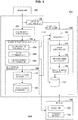
- the information processing device 500 has a sensed information acquisition unit 100, a prediction model generation unit 200, and a prediction application unit 300.
- the prediction model generation unit 200 includes a prediction model generation unit 110 and a prediction model accumulation unit (database) 120.
- the prediction application unit 300 has a prediction unit 130, an option extraction unit 140, a prediction timing control unit 150, and a prediction result presentation unit 160.
- the prediction model generation unit 200 and the prediction application unit 300 configure a predictor.
- each of the constituent elements illustrated in FIG. 1 is configured as a circuit (hardware), or a central processing unit such as a CPU, and a program (software) for causing the them to function.
- the sensed information acquisition unit 100 and the predictor are assumed to be asynchronous. As will be described below, a configuration in which a context is recognized on the basis of partial sensor data and all sensor information necessary for the predictor is requested is conceivable.
- the sensed information acquisition unit 100 acquires a sensor signal when a sensor (the sensing unit 600) mounted on a piece of livestock, mounted in a livestock environment, mounted on a farmer, or the like senses chronological data.
- the sensing unit 600 is constituted by various sensors.
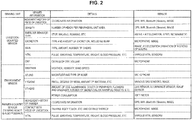
- FIG. 2 is a schematic diagram illustrating types of the sensing unit 600, sensed information detected by the various sensors, details of the sensed information, and sensors to be used in sensing.
- the types of the sensing unit 600 include a livestock-mounted sensor mounted on a piece of livestock, an environment sensor that acquires environment information of a facility or the like for breeding livestock, and a farmer-mounted sensor that is mounted in a livestock breeder, a robot, or the like in a farm.
- data to be sensed data to be sensed from livestock, data to be sensed from an environment such as a barn, and data to be sensed from a person such as a breeder are exemplified.
- techniques of the sensing unit 600 to acquire sensed information although acquisition through wired communication, acquisition through wireless communication, and the like are exemplified in addition to direct acquisition of information, the techniques are not limited thereto.
- the sensing unit 600 may include a portion that efficiently acquires sensor values by controlling the cameras and livestock in accordance with the system.
- fixed cameras may be mounted at positions of the heads of livestock taken when the livestock are fed.
- delicious food may be sprinkled to the position of the cameras to entice the livestock.
- a moving camera may move on a rail or the like to image peripheries of the eyes of the livestock in a stable.
- images of the livestock may be captured through automatic and remote control using a system in which a drone reaches peripheries of the faces of the livestock.
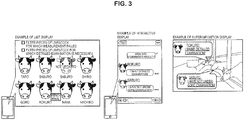
- FIG. 3 is a schematic diagram for describing evaluation of a sensing situation and re-measurement in a case in which the sensing unit 600 senses cows in a barn.
- the sensing unit 600 or the sensed information acquisition unit 100 can include a constituent element that determines insufficient sensing results by itself. Accordingly, a sensing situation with respect to a sensing result can be evaluated and determined and then presented to a user.
- FIG. 1 illustrates a configuration of the sensed information acquisition unit 100 evaluating and determining sensing situations.
- the sensed information acquisition unit 100 has a sensing situation evaluation unit 100a, an output determination unit 100b, and a sensed information presentation unit 100c.
- the sensing situation evaluation unit 100a evaluates a sensing situation.
- evaluation indexes for example, shake, blur, and the like appearing in a captured image of a camera are used.
- the sensing situation evaluation unit 100a for example, evaluates shake or blur from data of a captured image on the basis of a contrast value of the image, and if there is a certain level of shake or blur or higher, sensing results are set to be unavailable.
- information of a deviation from a past history of livestock e.g., a sudden rise in a blood glucose level 3 times higher than an average value of the past three months
- information regarding a deviation from a livestock group that has been inspected in the same period e.g., a blood glucose value of a specific kind of livestock that is three times higher than an average blood glucose value of 100 heads of livestock other than the aforementioned livestock
- the output determination unit 100b determines whether output of an evaluation result is possible, and if output is possible, the sensing situation presentation unit 100c presents the evaluation result to the terminal 700 of the user.
- the sensing situation presentation unit 100c presents the evaluation result to the terminal 700 of the user.
- list display illustrated in FIG. 3 a list of pieces of livestock for which measurement has failed, pieces of livestock which need precise observation, and pieces of normal livestock is illustrated.
- the output determination unit 100b may perform discrete display and determination ("measurement failure” and “detailed examination is necessary or the like"), and express a level of stability of a sensing situation with a continuous value using a color scale.
- the sensing result of "Rokuro” indicating "abnormal” and the sensing result of "Saburo” indicating “not updated” are illustrated in interactive-formatted timeline display.
- interactive-formatted timeline display and images of cows acquired from eyeglasses that a user is wearing are displayed in a superimposed manner.
- the livestock may be expressed as if the livestock were speaking in combination with sound.
- a timing at which the livestock moo may be detected to output display and sound at that timing.
- the sensing unit 600 can acquire information that can be measured from livestock such as acceleration, heights, weights, amounts of exercise, excretion amounts, static information such as sex and ancestries, and images measured with external cameras. In addition, the sensing unit 600 can acquire information that can be measured from surrounding environments such as temperatures, weather, barn densities, and feed distribution ratios. In addition, the sensing unit 600 can acquire information of final outputs (information desired to be predicted) such as meat grades, consumer reputation, weights, and death times. In addition, the sensing unit 600 can acquire transitions of time-series information by using a database.
- sensor values used by the information processing device 500 may be outputs of sensors acquired by the sensing unit 600 as they are, or results of features extracted by a feature amount extraction unit 125 from outputs of the sensors may be used.
- data such as image data obtained through capturing of the camera, sound data acquired by a microphone, acceleration, position information (GPS), vital data, and temperatures can be used.
- Information extracted by the feature amount extraction unit 125 includes, for example, information including muddiness of eyes extracted from image data of faces of cows, positions of eyes, and the like.
- the prediction model generation unit 110 generates a prediction model on the basis of the information acquired by the sensed information acquisition unit 100.
- the information acquired by the sensed information acquisition unit 100 is accumulated in a database to generate a prediction model from the accumulated information.
- the prediction model generation unit 110 learns the information acquired by the sensed information acquisition unit 100 through, for example, linear regression, an SVN, a neural network, or the like to generate a prediction model.
- the prediction model accumulation unit 120 is a database in which prediction models are accumulated.
- the prediction application unit 300 presents users with necessary prediction when it is necessary. In addition, final decisions are set to be made by livestock farmers on the basis of predicted results.
- the prediction unit 130 performs prediction on the basis of prediction models. As an example, prediction by the prediction unit 130 is performed when it is determined that prediction is necessary. As described above, acquisition of sensed information by the sensed information acquisition unit 100 is asynchronous with prediction presentation timings. For example, when a user selects an amount and type of feed, the system may also use information including a degree of exercise of cows and the like. To determine degrees of exercise and the like, for example, it is desirable to cause a motion sensor or the like to operate at all times, and even in that case, acquisition of sensed information by the sensed information acquisition unit 100 is set to be asynchronous with prediction presentation timings.
- the option extraction unit 140 extracts options that are prediction targets to be presented to a user.
- the option extraction unit 140 extracts, for example, a plurality of types of feed as a plurality of options as will be described below with reference to FIG. 4A to FIG. 4C .
- the prediction unit 130 performs prediction on each of the options extracted by the option extraction unit 140.
- the prediction timing control unit 150 controls presentation timings of prediction results.
- the prediction timing control unit 150 can use contexts of livestock or users (livestock farmers) as presentation timings of prediction.
- the prediction timing control unit 150 in principle, presents a user with a prediction result at a timing at which the user performs any action.
- a behavior acquisition unit 128 acquires behavior of the user and performs presentation of a prediction result on the basis of the acquired behavior.
- the behavior acquisition unit 128 detects a timing at which the user feeds livestock and presents the user with information regarding the feed such as the type and effects of the feed at that timing.
- the behavior acquisition unit 128 can acquire timings at which the user should feed the livestock by comparing the information.
- prediction results may be presented in accordance with contexts of the user. In a case in which there is something to be prepared, for example, prediction results may be presented "when the user starts moving toward a barn" or "when the user approaches a barn.”
- a presentation timing may be set by directly detecting a motion of the user using a camera or a motion sensor, or a predetermined schedule (information that the user goes to the barn at 7 in the morning or the like) may be used.
- a presentation device may be changed in accordance with a presentation timing, or an option extraction condition may be changed.
- a presentation expression may be changed in accordance with a presentation device.
- the information processing device 500 may actively generate a presentation timing.
- notification may be conditionally provided directly to a terminal of a veterinarian.
- an existing communication means may be used. A sense of intimacy can also be improved by using a metaphor of "a message from a cow," for example. Accordingly, the user can easily acquire the information, unlike a method for users starting a dedicated device to get information.
- the prediction result presentation unit 160 performs a process for presenting prediction results.
- the prediction result presentation unit 160 performs a process for presenting prediction results resulting from selectable options for behaviors performed with respect to livestock, for example, for each of the options.
- risks and effects are presented.
- the number of optimal solutions may not be one.
- a presentation method can be customized by learning a preference of the user from information representing what the user finally selected (a past history). There is a technique of, for example, changing candidates of information to be presented, changing the order of presentation, and causing display of information that is selected at all times to stand out on the basis of a past history.
- Information presented by the prediction result presentation unit 160 is transmitted to the terminal 700 of the user and displayed on the display unit 702 of the terminal 700 of the user 700.
- a prediction value in a case in which a variable controllable by the user is changed can be displayed. Displaying effects and probabilities easily understandable can help the user easily make a determination. Since ex post presentation of information is meaningless, information may be presented to the terminal 700 of the user in real time. Information may be presented to a device (feed distributor) to cause the device to automatically adjust assigned feed distribution.
- FIG. 9 is a flowchart illustrating a process of the prediction timing control unit 150.
- Context recognition includes recognition of a time, a position and behavior of the user, an abnormal behavior of a cow, a cumulative value, and the like.
- Context recognition can be performed by, for example, a motion sensor or the like, and as an example, the technique described in JP 2006-345269A or the like can be used. As described above, sensing operates asynchronously with the predictor and can be easily realized by performing acquisition of results (pull-type or push-type).
- Step S12 it is determined whether a prediction corresponding to a current context has been registered. Then, in the case in which a prediction corresponding to the current context has been registered, the process proceeds to Step S14.
- Step S14 extraction of options is performed by the option extraction unit 140, and in the next Step S16, prediction with regard to each of the extracted options is performed by the prediction unit 130.
- Step S18 presentation of a prediction result is performed by the prediction result presentation unit 160.
- Step S20 it is determined whether a process continuation condition is satisfied, and in a case in which the continuation condition is satisfied, the process returns to Step S10. On the other hand, in a case in which the continuation condition is not satisfied, the process ends.
- the process of FIG. 9 can be applied also to a system in which "a prediction is replied only when a user inquires."
- a prediction is started.
- the inquired content is recognized as a context, and in a case in which the continuation condition is not satisfied, the process ends.
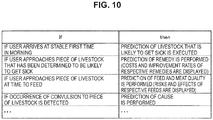
- the prediction application unit 300 executes prediction (a "then” clause) as illustrated in FIG. 10 .
- Step S12 of FIG. 9 in a case in which a certain event occurs, if the event is registered as in (the "If” clauses) of FIG. 10 , prediction is executed (the “then” clauses).
- Conditional statements can be registered by the user (in creation of a recipe, for example, a fixed phrase "a prediction that XX if XX is replied" is used). The conditional statements are shared by users, and introduction of a new function and the like are also possible.
- a ratio of "If” clauses to “then” clauses is set to 1 to 1 for the sake of simplification in FIG. 10 , the ratio may be 1 to many. In that case, all prediction results may be displayed at once, or prediction results may be displayed in accordance with a setting of a user or in a preset order.
- a list of prediction candidates may be displayed first, and the user may select a prediction from the terminal 700.
- a prediction option selected by the user the previous time may be displayed.
- the prediction result presentation unit 160 holds information regarding a preference for selection of the user on the basis of a history of predictions selected by the user when similar prediction results are presented in the past, and when a similar prediction result is presented the next time, an option that is presumed to be selected by the user is presumed, and emphasis display is performed on the option by setting the option as default, displaying the option on an initial screen, displaying the option with a cursor placed thereon, or the like.
- options may each be displayed in order from those having greater differences or may be displayed at random.
- FIG. 11 is a schematic diagram illustrating a cycle in which prediction is performed.
- a data accumulation cycle A
- information acquired by the sensed information acquisition unit 100 and actually-measured output values are accumulated in the database.
- the actually-measured output values include information regarding respective cows such as meat grades (fat marbling), death, swelling, blindness, and weights.
- a prediction model is generated from information accumulated in the database.
- the prediction unit 130 executes prediction and the prediction result presentation unit 160 presents a prediction result. Since results are accumulated in the system, the data for which prediction has been executed makes the database rich and improves prediction accuracy.
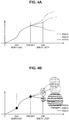
- FIG. 4A to FIG. 4C are schematic diagrams illustrating presentation examples of prediction results obtained by the prediction result presentation unit 160.
- the examples illustrated in FIG. 4 show results obtained by predicting future weights of livestock in a case in which three different kinds of feed A, B, and C are given to the livestock all as options. With such past time-series logs, future predictions may be expressed using a graph and the like.
- uncertainty of prediction increases as the number of days from the present to a future prediction day becomes larger, and thus uncertainty of prediction may be predicted using intuitive expression.
- FIG. 4A illustrates uncertainty of prediction with concentrations of lines indicating characteristics, and the prediction becomes more uncertain as the concentrations become weaker.
- FIG. 4A illustrates uncertainty of prediction with concentrations of lines indicating characteristics, and the prediction becomes more uncertain as the concentrations become weaker.
- FIG. 4A illustrates uncertainty of prediction with concentrations of lines indicating characteristics, and the prediction becomes more uncertain as the concentrations become weaker.
- FIG. 4A illustrates uncertainty of prediction with concentrations of lines indicating characteristics
- FIG. 4B illustrates degrees of uncertainty of prediction with sizes of circles, similarly to forecast cycles of typhoons, and the circles are displayed to become larger as the number of days from the present to a future prediction day becomes larger.
- FIG. 4C illustrates uncertainty of prediction with ranges of the respective characteristics, and the ranges are displayed to become larger as the number of days from the present to a future prediction day becomes larger.
- Uncertainty of prediction may be shared in predictions. For example, in FIG. 4A to FIG. 4C , uncertainty after one month is common in FIG. 4A to FIG. 4C .
- Uncertainty of prediction may be calculated using, for example, time as an element.
- an attenuation rate may be changed at each time of prediction.
- Uncertainty of prediction may be calculated using, for example, a data amount as an element. For example, although the feed A has a high probability due to many times of implementation, the feed C shows uncertainty due to fewer times of implementation.
- Prediction illustrated in FIG. 4A to FIG. 4C can be performed through learning or the like based on a large scale of data. Progress in weights of livestock, changes in meat quality, and the like are correlated with the fact "the feed has been given this much.” On the basis of many evidences of the effect "weight is changed” caused by “the feed has been given this much” and data thereof, a relation between the cause and effect can be ascertained, and thus it is possible to predict "how will the weight be” if "the feed is given this much” now.
- the prediction model generation unit 110 generates a prediction model on the basis of many evidences of the effect "weight is changed” caused by the fact "the feed has been given this much” and data thereof.
- learning techniques for example, linear regression, an SVN, a neural network, and the like can be used.
- prediction can be performed by using logs of a number of other cows.
- a generic prediction model can also be used.
- his/her own logs are accumulated, they are used to reduce influence of, for example, "individual differences” or the like, and thus more precise prediction can be performed.
- for learning only his/her own logs may be used or the logs may be used together with a generic model.
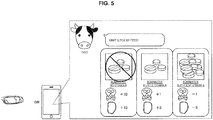
- FIG. 5 is a schematic diagram illustrating another presentation example of prediction results obtained by the prediction result presentation unit 160.
- FIG. 5 illustrates the example of an operation-linked graph representation in which risks (death risks of a cow) and effects (meat quality) are expressed at the same time.
- the risks and effects exhibited in a case in which vitamin A is given to the cow are shown.
- the above-described risks and effects may be expressed in the form of, for example, % values, or may be expressed to be standardized with numerical values from -10 to +10 and the like in order to make them easily understandable.
- the death risk becomes +10
- the meat quality becomes +10 as well.
- the death risk becomes +1
- the meat quality becomes +3.
- the death risk becomes -1, and the meat quality becomes -3.
- the option extraction unit 140 extracts a plurality of parameters (a vitamin A dose, a death risk of the cow, and meat quality) to be predicted by the prediction unit 130.
- the prediction unit 130 predicts combinations of future values of a plurality of parameters (the death risk of the cow and meat quality).
- FIG. 5 three types of combinations of future values are shown.
- the user can specify and select any one on the terminal 700.
- the selection result of the user is transmitted to the information processing device 500 and accumulated in a database 170. Accordingly, a preference of the user can be determined from information accumulated in the database 170.
- the selection result of the user is transmitted to the adjustment device. Accordingly, a vitamin A dose can be automatically adjusted by the adjustment device.
- the prediction result presentation unit 160 may present the user with an option (a vitamin A dose) of a cow when the user moves to the front of the cow.
- the prediction result presentation unit 160 may present the user with a recommended option (a vitamin A dose) with a cursor pointing at the option. Accordingly, the user can perform operations more easily.
- a prediction result may be presented with a cursor pointing at an option in accordance with a tendency of the user.
- the prediction unit 130 predicts an option that the user is likely to select on the basis of information accumulated in the database 170, the prediction result presentation unit 160 presents the option by matching a cursor on the basis of information regarding the option predicted by the prediction unit 130 that the user is likely to select.
- the option extraction unit 140 Although the three options illustrated in FIG. 5 are extracted by the option extraction unit 140, there are cases in which presentation of only similar candidates is meaningless, and thus a representative value may be determined through, for example, clustering or the like.
- FIG. 6 is a schematic diagram illustrating another presentation example of prediction results obtained by the prediction result presentation unit 160.
- FIG. 6 illustrates the example of another operation-linked graph representation in which risks and effects are expressed at the same time.
- the user operates a mobile terminal with a touch panel to reduce a vitamin A dose, and thus if a "reduce more" button is operated, an indicator for the mortality rate and meat quality (an expected rate of fat marbling) changes in accordance with the vitamin A dose.
- an "administer" button is operated to increase the vitamin A dose, the indicator for the mortality rate and meat quality (an expected rate of fat marbling) changes in accordance with the vitamin A dose.
- prediction values may be rendered (displayed) for a condition adjusted by the user.
- a dose may be absolutely freely determined by the user, or a preset value may have a form in which the value can be finely adjusted.
- an increase or a decrease of the graphs may be displayed in an animation in conjunction with an operation of the user. For example, when a dose exceeds a certain or a designated risk level, a warning may be expressed with a changing sound or color. In addition, if a dose exceeds a certain or a designated target value, target achievement may be expressed with a changing sound or color.
- FIG. 7 is a schematic diagram illustrating still another presentation example of a prediction result by the prediction result presentation unit 160.
- individual control of prediction values is presented in the examples described so far, individual control may be difficult for large-scale farms.
- the user may decide only rough policies and the system may perform automatic control.
- rough "policies" may be designated and control may be performed such that risks and effects brought in a case in which the user takes a single action with respect to all cows that the user is breeding are aggregated and an effect to be noted is maximized.
- the example illustrated in FIG. 7 shows discretionary designation and individual rescue. In the left drawing of FIG.
- hierarchical clustering for example, Ward's method may be performed, and if the user continuously designates a specific cluster, a hierarchical cluster result one layer deeper may be presented or the like. In addition, determination of whether to cross the layer may be realized using a counter or the like.
- FIG. 8 is a schematic diagram illustrating still another presentation example of a prediction result by the prediction result presentation unit 160, illustrating an example in which a presentation timing is autonomously controlled.
- a cow (Rokuro) saying "I had light sleep recently” is displayed in accordance with a sensing result of a cow (Rokuro).
- a cow (Rokuro) saying "Taro collapsed! is displayed in accordance with a sensing result of a cow (Taro).
- a timing at which such a report is performed may be actively created by the system.
- Information without urgency such as a simple report may be sent on time through an existing communication system, for example, an e-mail or an SNS, and can be read by a livestock farmer at free time.
- a notification may be set to reach the user by interruption.
- a veterinarian may be directly informed of the emergency on condition. If a notification is passed through a livestock farmer in a case of a grave emergency, it takes time for checking the situation, which may delay the notification. In such a case, the notification may be set to directly reach a terminal of an attending veterinarian or the like from the information processing device 500. However, since there is concern of a cost such as a veterinary medical expense increasing if detailed information is delivered, it may be set to send a notification to the veterinarian, for example, only for an event of a specific piece of livestock (e.g. a cow that is likely to get the meat grade A5) or under a specific condition (e.g. an urgency rank of A). Furthermore, these setting may be provided as fixed-rate services.
- a prediction model is generated on the basis of sensed information acquired by the sensed information acquisition unit 100, and in a case in which prediction is performed on the basis of the prediction model, the prediction result is presented to be visually easily understood at a desired timing of the user. Accordingly, the user can take a proper future measure in accordance with the prediction result.
- present technology may also be configured as below.
Landscapes
- Engineering & Computer Science (AREA)
- Life Sciences & Earth Sciences (AREA)
- Theoretical Computer Science (AREA)
- Environmental Sciences (AREA)
- Computer Vision & Pattern Recognition (AREA)
- Data Mining & Analysis (AREA)
- Animal Husbandry (AREA)
- Physics & Mathematics (AREA)
- General Physics & Mathematics (AREA)
- Biophysics (AREA)
- Biodiversity & Conservation Biology (AREA)
- Artificial Intelligence (AREA)
- Business, Economics & Management (AREA)
- Evolutionary Biology (AREA)
- General Engineering & Computer Science (AREA)
- Bioinformatics & Computational Biology (AREA)
- Bioinformatics & Cheminformatics (AREA)
- Evolutionary Computation (AREA)
- Economics (AREA)
- Marketing (AREA)
- Marine Sciences & Fisheries (AREA)
- Health & Medical Sciences (AREA)
- Agronomy & Crop Science (AREA)
- General Health & Medical Sciences (AREA)
- Human Resources & Organizations (AREA)
- Mining & Mineral Resources (AREA)
- Primary Health Care (AREA)
- Strategic Management (AREA)
- Tourism & Hospitality (AREA)
- General Business, Economics & Management (AREA)
- Management, Administration, Business Operations System, And Electronic Commerce (AREA)
- Medical Treatment And Welfare Office Work (AREA)
Applications Claiming Priority (2)
| Application Number | Priority Date | Filing Date | Title |
|---|---|---|---|
| JP2016050484 | 2016-03-15 | ||
| PCT/JP2017/004052 WO2017159109A1 (ja) | 2016-03-15 | 2017-02-03 | 情報処理装置、情報処理方法及びプログラム |
Publications (3)
| Publication Number | Publication Date |
|---|---|
| EP3430896A1 true EP3430896A1 (de) | 2019-01-23 |
| EP3430896A4 EP3430896A4 (de) | 2019-03-27 |
| EP3430896B1 EP3430896B1 (de) | 2020-05-13 |
Family
ID=59850703
Family Applications (1)
| Application Number | Title | Priority Date | Filing Date |
|---|---|---|---|
| EP17766117.0A Active EP3430896B1 (de) | 2016-03-15 | 2017-02-03 | Informationsverarbeitungsvorrichtung, informationsverarbeitungsverfahren und programm |
Country Status (4)
| Country | Link |
|---|---|
| US (1) | US11412713B2 (de) |
| EP (1) | EP3430896B1 (de) |
| JP (1) | JP6844609B2 (de) |
| WO (1) | WO2017159109A1 (de) |
Families Citing this family (15)
| Publication number | Priority date | Publication date | Assignee | Title |
|---|---|---|---|---|
| JP6704164B1 (ja) * | 2019-03-11 | 2020-06-03 | 株式会社Eco‐Pork | 畜産自動管理システム |
| JP6942764B2 (ja) | 2019-08-07 | 2021-09-29 | キヤノン株式会社 | システム、クライアント端末、その制御方法 |
| JP6734457B1 (ja) * | 2019-10-28 | 2020-08-05 | アニコム ホールディングス株式会社 | 疾患予測システム、保険料算出システム及び疾患予測方法 |
| JP6727597B1 (ja) * | 2019-12-02 | 2020-07-22 | 株式会社Eco‐Pork | 動産担保評価システム、動産担保評価サーバ、動産担保評価方法、及び動産担保評価プログラム |
| JP6736107B1 (ja) * | 2019-12-02 | 2020-08-05 | 株式会社Eco‐Pork | 畜産情報管理システム、畜産情報管理サーバ、畜産情報管理方法、及び畜産情報管理プログラム |
| JP6781440B1 (ja) * | 2020-02-27 | 2020-11-04 | 株式会社Eco‐Pork | 畜産情報管理システム、畜産情報管理サーバ、畜産情報管理方法、及び畜産情報管理プログラム |
| CN111126720B (zh) * | 2020-02-28 | 2024-09-24 | 深圳前海微众银行股份有限公司 | 养殖场风险预测方法、装置、设备及存储介质 |
| JP7483242B2 (ja) * | 2020-03-06 | 2024-05-15 | 株式会社田中衡機工業所 | 情報処理装置及び予測プログラム |
| JP6727603B1 (ja) * | 2020-04-22 | 2020-07-22 | 株式会社Eco‐Pork | 動産担保評価システム、動産担保評価サーバ、動産担保評価方法、及び動産担保評価プログラム |
| JP7211595B2 (ja) * | 2020-11-02 | 2023-01-24 | 国立大学法人北海道国立大学機構 | 異常行動検知装置、異常行動検知プログラムおよび異常行動検知方法 |
| CN113703504B (zh) * | 2021-09-26 | 2022-12-30 | 中国热带农业科学院湛江实验站 | 一种基于物联网的畜牧养殖用温湿度控制系统及方法 |
| JP7211602B1 (ja) * | 2021-10-19 | 2023-01-24 | ジャラ テック プライベートリミテッド | 養殖支援システム |
| KR20230094873A (ko) * | 2021-12-21 | 2023-06-28 | 파이프트리스마트팜 주식회사 | 양계 데이터 처리 방법 및 장치 |
| US20230342902A1 (en) * | 2022-04-22 | 2023-10-26 | Iclassifier Inc. | Method and system for automated evaluation of animals |
| JP7637220B1 (ja) * | 2023-12-21 | 2025-02-27 | 太平洋工業株式会社 | 家畜管理装置及び表示制御プログラム及びアプリケーションプログラム |
Family Cites Families (9)
| Publication number | Priority date | Publication date | Assignee | Title |
|---|---|---|---|---|
| JPH07102057B2 (ja) | 1993-06-25 | 1995-11-08 | 全国農業協同組合連合会 | 家畜飼養管理システム |
| JP4507992B2 (ja) | 2005-06-09 | 2010-07-21 | ソニー株式会社 | 情報処理装置および方法、並びにプログラム |
| GB2437250C (en) * | 2006-04-18 | 2012-08-15 | Iti Scotland Ltd | Method and system for monitoring the condition of livestock |
| JP2008148569A (ja) | 2006-12-14 | 2008-07-03 | Oki Electric Ind Co Ltd | 飼育支援システム |
| JP5060978B2 (ja) * | 2008-01-25 | 2012-10-31 | オリンパス株式会社 | 情報提示システム、プログラム、情報記憶媒体及び情報提示システムの制御方法 |
| JP5440080B2 (ja) | 2009-10-02 | 2014-03-12 | ソニー株式会社 | 行動パターン解析システム、携帯端末、行動パターン解析方法、及びプログラム |
| WO2013145302A1 (ja) | 2012-03-30 | 2013-10-03 | 富士通株式会社 | 発情報知方法、発情報知装置、および発情報知プログラム |
| US9871692B1 (en) * | 2015-05-12 | 2018-01-16 | Alarm.Com Incorporated | Cooperative monitoring networks |
| US20160345832A1 (en) * | 2015-05-25 | 2016-12-01 | Wearless Tech Inc | System and method for monitoring biological status through contactless sensing |
-
2017
- 2017-02-03 JP JP2018505330A patent/JP6844609B2/ja active Active
- 2017-02-03 EP EP17766117.0A patent/EP3430896B1/de active Active
- 2017-02-03 US US16/081,671 patent/US11412713B2/en active Active
- 2017-02-03 WO PCT/JP2017/004052 patent/WO2017159109A1/ja not_active Ceased
Also Published As
| Publication number | Publication date |
|---|---|
| JP6844609B2 (ja) | 2021-03-17 |
| WO2017159109A1 (ja) | 2017-09-21 |
| US11412713B2 (en) | 2022-08-16 |
| EP3430896B1 (de) | 2020-05-13 |
| US20210204520A1 (en) | 2021-07-08 |
| EP3430896A4 (de) | 2019-03-27 |
| JPWO2017159109A1 (ja) | 2019-01-24 |
Similar Documents
| Publication | Publication Date | Title |
|---|---|---|
| EP3430896B1 (de) | Informationsverarbeitungsvorrichtung, informationsverarbeitungsverfahren und programm | |
| KR102022893B1 (ko) | 반려동물 케어 방법 및 이를 이용하는 시스템 | |
| KR102022883B1 (ko) | 애완동물의 행태와 감정을 보여주는 그래픽 사용자 인터페이스 제공 방법 및 장치 | |
| CN113488175A (zh) | 牲畜健康监控方法、装置、存储介质及电子设备 | |
| EP3203396A1 (de) | System und verfahren zur analyse von glucoseüberwachungsdaten, die den blutzuckerspielgel angeben, und computerprogrammprodukt | |
| US20250168605A1 (en) | Messaging-based logging and alerting system | |
| Wittek et al. | Supervised machine learning aided behavior classification in pigeons | |
| KR102563874B1 (ko) | 인공지능 기반 오토크롤링을 수행하는 전자장치 및 영양소 정보를 제공하는 전자장치 | |
| US20220183811A1 (en) | Estrus determination device for sow, method for determining estrus of sow, and program for determining estrus of sow | |
| KR102751141B1 (ko) | 청소년 성장 및 기저질환 환자의 식단 관리 시스템 | |
| US12394527B2 (en) | Systems and methods for detecting eating patterns of a pet | |
| Gaikwad et al. | Smart Beehive Monitoring System using IoT | |
| US20260051408A1 (en) | System | |
| US20260056182A1 (en) | System | |
| US20260053081A1 (en) | System | |
| JP2018085083A (ja) | 健康管理プログラム | |
| CN115211386A (zh) | 牲畜健康监控方法、装置、存储介质及电子设备 | |
| US20260058016A1 (en) | System | |
| KR102932551B1 (ko) | 인공지능 기반 영양상태 평가정보 제공 장치 및 방법 | |
| KR20260037922A (ko) | 인공지능 기반 맞춤형 식단 및 건강 관리 정보 제공 장치 및 방법 | |
| US20260051010A1 (en) | System | |
| JP2025060556A (ja) | システム | |
| JP2026029442A (ja) | システム | |
| JP2026034028A (ja) | システム | |
| CN117828175A (zh) | 流浪动物的投喂屋的数据处理方法和装置 |
Legal Events
| Date | Code | Title | Description |
|---|---|---|---|
| STAA | Information on the status of an ep patent application or granted ep patent |
Free format text: STATUS: THE INTERNATIONAL PUBLICATION HAS BEEN MADE |
|
| PUAI | Public reference made under article 153(3) epc to a published international application that has entered the european phase |
Free format text: ORIGINAL CODE: 0009012 |
|
| STAA | Information on the status of an ep patent application or granted ep patent |
Free format text: STATUS: REQUEST FOR EXAMINATION WAS MADE |
|
| 17P | Request for examination filed |
Effective date: 20181008 |
|
| AK | Designated contracting states |
Kind code of ref document: A1 Designated state(s): AL AT BE BG CH CY CZ DE DK EE ES FI FR GB GR HR HU IE IS IT LI LT LU LV MC MK MT NL NO PL PT RO RS SE SI SK SM TR |
|
| AX | Request for extension of the european patent |
Extension state: BA ME |
|
| A4 | Supplementary search report drawn up and despatched |
Effective date: 20190222 |
|
| RIC1 | Information provided on ipc code assigned before grant |
Ipc: G06Q 50/02 20120101ALI20190218BHEP Ipc: A01K 29/00 20060101AFI20190218BHEP |
|
| DAV | Request for validation of the european patent (deleted) | ||
| DAX | Request for extension of the european patent (deleted) | ||
| GRAP | Despatch of communication of intention to grant a patent |
Free format text: ORIGINAL CODE: EPIDOSNIGR1 |
|
| STAA | Information on the status of an ep patent application or granted ep patent |
Free format text: STATUS: GRANT OF PATENT IS INTENDED |
|
| INTG | Intention to grant announced |
Effective date: 20191210 |
|
| GRAS | Grant fee paid |
Free format text: ORIGINAL CODE: EPIDOSNIGR3 |
|
| GRAA | (expected) grant |
Free format text: ORIGINAL CODE: 0009210 |
|
| STAA | Information on the status of an ep patent application or granted ep patent |
Free format text: STATUS: THE PATENT HAS BEEN GRANTED |
|
| AK | Designated contracting states |
Kind code of ref document: B1 Designated state(s): AL AT BE BG CH CY CZ DE DK EE ES FI FR GB GR HR HU IE IS IT LI LT LU LV MC MK MT NL NO PL PT RO RS SE SI SK SM TR |
|
| REG | Reference to a national code |
Ref country code: GB Ref legal event code: FG4D |
|
| REG | Reference to a national code |
Ref country code: CH Ref legal event code: EP |
|
| REG | Reference to a national code |
Ref country code: DE Ref legal event code: R096 Ref document number: 602017016751 Country of ref document: DE |
|
| REG | Reference to a national code |
Ref country code: AT Ref legal event code: REF Ref document number: 1268997 Country of ref document: AT Kind code of ref document: T Effective date: 20200615 |
|
| REG | Reference to a national code |
Ref country code: LT Ref legal event code: MG4D |
|
| REG | Reference to a national code |
Ref country code: NL Ref legal event code: MP Effective date: 20200513 |
|
| PG25 | Lapsed in a contracting state [announced via postgrant information from national office to epo] |
Ref country code: LT Free format text: LAPSE BECAUSE OF FAILURE TO SUBMIT A TRANSLATION OF THE DESCRIPTION OR TO PAY THE FEE WITHIN THE PRESCRIBED TIME-LIMIT Effective date: 20200513 Ref country code: SE Free format text: LAPSE BECAUSE OF FAILURE TO SUBMIT A TRANSLATION OF THE DESCRIPTION OR TO PAY THE FEE WITHIN THE PRESCRIBED TIME-LIMIT Effective date: 20200513 Ref country code: NO Free format text: LAPSE BECAUSE OF FAILURE TO SUBMIT A TRANSLATION OF THE DESCRIPTION OR TO PAY THE FEE WITHIN THE PRESCRIBED TIME-LIMIT Effective date: 20200813 Ref country code: GR Free format text: LAPSE BECAUSE OF FAILURE TO SUBMIT A TRANSLATION OF THE DESCRIPTION OR TO PAY THE FEE WITHIN THE PRESCRIBED TIME-LIMIT Effective date: 20200814 Ref country code: FI Free format text: LAPSE BECAUSE OF FAILURE TO SUBMIT A TRANSLATION OF THE DESCRIPTION OR TO PAY THE FEE WITHIN THE PRESCRIBED TIME-LIMIT Effective date: 20200513 Ref country code: IS Free format text: LAPSE BECAUSE OF FAILURE TO SUBMIT A TRANSLATION OF THE DESCRIPTION OR TO PAY THE FEE WITHIN THE PRESCRIBED TIME-LIMIT Effective date: 20200913 Ref country code: PT Free format text: LAPSE BECAUSE OF FAILURE TO SUBMIT A TRANSLATION OF THE DESCRIPTION OR TO PAY THE FEE WITHIN THE PRESCRIBED TIME-LIMIT Effective date: 20200914 |
|
| PG25 | Lapsed in a contracting state [announced via postgrant information from national office to epo] |
Ref country code: RS Free format text: LAPSE BECAUSE OF FAILURE TO SUBMIT A TRANSLATION OF THE DESCRIPTION OR TO PAY THE FEE WITHIN THE PRESCRIBED TIME-LIMIT Effective date: 20200513 Ref country code: LV Free format text: LAPSE BECAUSE OF FAILURE TO SUBMIT A TRANSLATION OF THE DESCRIPTION OR TO PAY THE FEE WITHIN THE PRESCRIBED TIME-LIMIT Effective date: 20200513 Ref country code: HR Free format text: LAPSE BECAUSE OF FAILURE TO SUBMIT A TRANSLATION OF THE DESCRIPTION OR TO PAY THE FEE WITHIN THE PRESCRIBED TIME-LIMIT Effective date: 20200513 Ref country code: BG Free format text: LAPSE BECAUSE OF FAILURE TO SUBMIT A TRANSLATION OF THE DESCRIPTION OR TO PAY THE FEE WITHIN THE PRESCRIBED TIME-LIMIT Effective date: 20200813 |
|
| REG | Reference to a national code |
Ref country code: AT Ref legal event code: MK05 Ref document number: 1268997 Country of ref document: AT Kind code of ref document: T Effective date: 20200513 |
|
| PG25 | Lapsed in a contracting state [announced via postgrant information from national office to epo] |
Ref country code: NL Free format text: LAPSE BECAUSE OF FAILURE TO SUBMIT A TRANSLATION OF THE DESCRIPTION OR TO PAY THE FEE WITHIN THE PRESCRIBED TIME-LIMIT Effective date: 20200513 Ref country code: AL Free format text: LAPSE BECAUSE OF FAILURE TO SUBMIT A TRANSLATION OF THE DESCRIPTION OR TO PAY THE FEE WITHIN THE PRESCRIBED TIME-LIMIT Effective date: 20200513 |
|
| PG25 | Lapsed in a contracting state [announced via postgrant information from national office to epo] |
Ref country code: EE Free format text: LAPSE BECAUSE OF FAILURE TO SUBMIT A TRANSLATION OF THE DESCRIPTION OR TO PAY THE FEE WITHIN THE PRESCRIBED TIME-LIMIT Effective date: 20200513 Ref country code: SM Free format text: LAPSE BECAUSE OF FAILURE TO SUBMIT A TRANSLATION OF THE DESCRIPTION OR TO PAY THE FEE WITHIN THE PRESCRIBED TIME-LIMIT Effective date: 20200513 Ref country code: RO Free format text: LAPSE BECAUSE OF FAILURE TO SUBMIT A TRANSLATION OF THE DESCRIPTION OR TO PAY THE FEE WITHIN THE PRESCRIBED TIME-LIMIT Effective date: 20200513 Ref country code: IT Free format text: LAPSE BECAUSE OF FAILURE TO SUBMIT A TRANSLATION OF THE DESCRIPTION OR TO PAY THE FEE WITHIN THE PRESCRIBED TIME-LIMIT Effective date: 20200513 Ref country code: CZ Free format text: LAPSE BECAUSE OF FAILURE TO SUBMIT A TRANSLATION OF THE DESCRIPTION OR TO PAY THE FEE WITHIN THE PRESCRIBED TIME-LIMIT Effective date: 20200513 Ref country code: ES Free format text: LAPSE BECAUSE OF FAILURE TO SUBMIT A TRANSLATION OF THE DESCRIPTION OR TO PAY THE FEE WITHIN THE PRESCRIBED TIME-LIMIT Effective date: 20200513 Ref country code: AT Free format text: LAPSE BECAUSE OF FAILURE TO SUBMIT A TRANSLATION OF THE DESCRIPTION OR TO PAY THE FEE WITHIN THE PRESCRIBED TIME-LIMIT Effective date: 20200513 Ref country code: DK Free format text: LAPSE BECAUSE OF FAILURE TO SUBMIT A TRANSLATION OF THE DESCRIPTION OR TO PAY THE FEE WITHIN THE PRESCRIBED TIME-LIMIT Effective date: 20200513 |
|
| REG | Reference to a national code |
Ref country code: DE Ref legal event code: R097 Ref document number: 602017016751 Country of ref document: DE |
|
| PG25 | Lapsed in a contracting state [announced via postgrant information from national office to epo] |
Ref country code: SK Free format text: LAPSE BECAUSE OF FAILURE TO SUBMIT A TRANSLATION OF THE DESCRIPTION OR TO PAY THE FEE WITHIN THE PRESCRIBED TIME-LIMIT Effective date: 20200513 Ref country code: PL Free format text: LAPSE BECAUSE OF FAILURE TO SUBMIT A TRANSLATION OF THE DESCRIPTION OR TO PAY THE FEE WITHIN THE PRESCRIBED TIME-LIMIT Effective date: 20200513 |
|
| PLBE | No opposition filed within time limit |
Free format text: ORIGINAL CODE: 0009261 |
|
| STAA | Information on the status of an ep patent application or granted ep patent |
Free format text: STATUS: NO OPPOSITION FILED WITHIN TIME LIMIT |
|
| 26N | No opposition filed |
Effective date: 20210216 |
|
| PG25 | Lapsed in a contracting state [announced via postgrant information from national office to epo] |
Ref country code: SI Free format text: LAPSE BECAUSE OF FAILURE TO SUBMIT A TRANSLATION OF THE DESCRIPTION OR TO PAY THE FEE WITHIN THE PRESCRIBED TIME-LIMIT Effective date: 20200513 |
|
| PG25 | Lapsed in a contracting state [announced via postgrant information from national office to epo] |
Ref country code: MC Free format text: LAPSE BECAUSE OF FAILURE TO SUBMIT A TRANSLATION OF THE DESCRIPTION OR TO PAY THE FEE WITHIN THE PRESCRIBED TIME-LIMIT Effective date: 20200513 |
|
| GBPC | Gb: european patent ceased through non-payment of renewal fee |
Effective date: 20210203 |
|
| REG | Reference to a national code |
Ref country code: BE Ref legal event code: MM Effective date: 20210228 |
|
| PG25 | Lapsed in a contracting state [announced via postgrant information from national office to epo] |
Ref country code: LI Free format text: LAPSE BECAUSE OF NON-PAYMENT OF DUE FEES Effective date: 20210228 Ref country code: LU Free format text: LAPSE BECAUSE OF NON-PAYMENT OF DUE FEES Effective date: 20210203 Ref country code: CH Free format text: LAPSE BECAUSE OF NON-PAYMENT OF DUE FEES Effective date: 20210228 |
|
| PG25 | Lapsed in a contracting state [announced via postgrant information from national office to epo] |
Ref country code: FR Free format text: LAPSE BECAUSE OF NON-PAYMENT OF DUE FEES Effective date: 20210228 Ref country code: IE Free format text: LAPSE BECAUSE OF NON-PAYMENT OF DUE FEES Effective date: 20210203 Ref country code: GB Free format text: LAPSE BECAUSE OF NON-PAYMENT OF DUE FEES Effective date: 20210203 |
|
| PG25 | Lapsed in a contracting state [announced via postgrant information from national office to epo] |
Ref country code: BE Free format text: LAPSE BECAUSE OF NON-PAYMENT OF DUE FEES Effective date: 20210228 |
|
| PG25 | Lapsed in a contracting state [announced via postgrant information from national office to epo] |
Ref country code: CY Free format text: LAPSE BECAUSE OF FAILURE TO SUBMIT A TRANSLATION OF THE DESCRIPTION OR TO PAY THE FEE WITHIN THE PRESCRIBED TIME-LIMIT Effective date: 20200513 |
|
| P01 | Opt-out of the competence of the unified patent court (upc) registered |
Effective date: 20230528 |
|
| PG25 | Lapsed in a contracting state [announced via postgrant information from national office to epo] |
Ref country code: HU Free format text: LAPSE BECAUSE OF FAILURE TO SUBMIT A TRANSLATION OF THE DESCRIPTION OR TO PAY THE FEE WITHIN THE PRESCRIBED TIME-LIMIT; INVALID AB INITIO Effective date: 20170203 |
|
| PG25 | Lapsed in a contracting state [announced via postgrant information from national office to epo] |
Ref country code: MK Free format text: LAPSE BECAUSE OF FAILURE TO SUBMIT A TRANSLATION OF THE DESCRIPTION OR TO PAY THE FEE WITHIN THE PRESCRIBED TIME-LIMIT Effective date: 20200513 |
|
| PG25 | Lapsed in a contracting state [announced via postgrant information from national office to epo] |
Ref country code: TR Free format text: LAPSE BECAUSE OF FAILURE TO SUBMIT A TRANSLATION OF THE DESCRIPTION OR TO PAY THE FEE WITHIN THE PRESCRIBED TIME-LIMIT Effective date: 20200513 |
|
| PG25 | Lapsed in a contracting state [announced via postgrant information from national office to epo] |
Ref country code: MT Free format text: LAPSE BECAUSE OF FAILURE TO SUBMIT A TRANSLATION OF THE DESCRIPTION OR TO PAY THE FEE WITHIN THE PRESCRIBED TIME-LIMIT Effective date: 20200513 |
|
| PGFP | Annual fee paid to national office [announced via postgrant information from national office to epo] |
Ref country code: DE Payment date: 20250122 Year of fee payment: 9 |