EP3430954A1 - Machine à pain automatique - Google Patents
Machine à pain automatique Download PDFInfo
- Publication number
- EP3430954A1 EP3430954A1 EP17766340.8A EP17766340A EP3430954A1 EP 3430954 A1 EP3430954 A1 EP 3430954A1 EP 17766340 A EP17766340 A EP 17766340A EP 3430954 A1 EP3430954 A1 EP 3430954A1
- Authority
- EP
- European Patent Office
- Prior art keywords
- bread
- pulverizing
- rice
- temperature
- controller
- Prior art date
- Legal status (The legal status is an assumption and is not a legal conclusion. Google has not performed a legal analysis and makes no representation as to the accuracy of the status listed.)
- Withdrawn
Links
Images









Classifications
-
- A—HUMAN NECESSITIES
- A21—BAKING; EDIBLE DOUGHS
- A21B—BAKERS' OVENS; MACHINES OR EQUIPMENT FOR BAKING
- A21B7/00—Baking plants
- A21B7/005—Baking plants in combination with mixing or kneading devices
-
- A—HUMAN NECESSITIES
- A21—BAKING; EDIBLE DOUGHS
- A21C—MACHINES OR EQUIPMENT FOR MAKING OR PROCESSING DOUGHS; HANDLING BAKED ARTICLES MADE FROM DOUGH
- A21C1/00—Mixing or kneading machines for the preparation of dough
-
- A—HUMAN NECESSITIES
- A21—BAKING; EDIBLE DOUGHS
- A21C—MACHINES OR EQUIPMENT FOR MAKING OR PROCESSING DOUGHS; HANDLING BAKED ARTICLES MADE FROM DOUGH
- A21C1/00—Mixing or kneading machines for the preparation of dough
- A21C1/006—Methods
-
- A—HUMAN NECESSITIES
- A21—BAKING; EDIBLE DOUGHS
- A21C—MACHINES OR EQUIPMENT FOR MAKING OR PROCESSING DOUGHS; HANDLING BAKED ARTICLES MADE FROM DOUGH
- A21C1/00—Mixing or kneading machines for the preparation of dough
- A21C1/02—Mixing or kneading machines for the preparation of dough with vertically-mounted tools; Machines for whipping or beating
-
- A—HUMAN NECESSITIES
- A21—BAKING; EDIBLE DOUGHS
- A21C—MACHINES OR EQUIPMENT FOR MAKING OR PROCESSING DOUGHS; HANDLING BAKED ARTICLES MADE FROM DOUGH
- A21C1/00—Mixing or kneading machines for the preparation of dough
- A21C1/14—Structural elements of mixing or kneading machines; Parts; Accessories
- A21C1/145—Controlling; Testing; Measuring
- A21C1/146—Measuring properties of the dough, e.g. moisture, electrical conductivity, temperature
-
- A—HUMAN NECESSITIES
- A47—FURNITURE; DOMESTIC ARTICLES OR APPLIANCES; COFFEE MILLS; SPICE MILLS; SUCTION CLEANERS IN GENERAL
- A47J—KITCHEN EQUIPMENT; COFFEE MILLS; SPICE MILLS; APPARATUS FOR MAKING BEVERAGES
- A47J37/00—Baking; Roasting; Grilling; Frying
-
- A—HUMAN NECESSITIES
- A47—FURNITURE; DOMESTIC ARTICLES OR APPLIANCES; COFFEE MILLS; SPICE MILLS; SUCTION CLEANERS IN GENERAL
- A47J—KITCHEN EQUIPMENT; COFFEE MILLS; SPICE MILLS; APPARATUS FOR MAKING BEVERAGES
- A47J43/00—Implements for preparing or holding food, not provided for in other groups of this subclass
- A47J43/04—Machines for domestic use not covered elsewhere, e.g. for grinding, mixing, stirring, kneading, emulsifying, whipping or beating foodstuffs, e.g. power-driven
- A47J43/046—Machines for domestic use not covered elsewhere, e.g. for grinding, mixing, stirring, kneading, emulsifying, whipping or beating foodstuffs, e.g. power-driven with tools driven from the bottom side
Definitions
- the present disclosure relates to automatic bread makers that allow users to make bread easily at home.
- Patent Literature 1 discloses an automatic bread maker capable of making bread by automatically performing processes from kneading bread-making material based on the program of a microcomputer. Besides, inexpensive, user-friendly rice cookers having a bread-making function also have been known (see Patent Literature 2, for example).
- Rice-flour bread contains an amount of polysaccharide greater than wheat-flour bread, which provides the rice-flour bread with a moist texture and natural sweetness. Since being wheat-free, the rice-flour bread can be eaten with no worry by a person with an allergy to wheat.
- Patent Literature 4 discloses an automatic bread maker having a structure similar to that described in Patent Literature 3. According to the bread maker, pulverizing and kneading are carried out with a single blade.
- Patent Literature 5 optimizes shear viscosity of bread dough containing rice flour as the main material and offers a preferable rise by fermentation.
- the method enables bread making without wheat flour and gluten.
- Patent Literatures 1 and 2 make bread using wheat flour, not rice, as the main material.
- Patent Literature 5 cannot provide bread made from raw grains of rice. Further, obtaining a preferable rise of bread by the method above depends largely on the combination ratio between rice flour and water and on the kinds of rice flour. From the reason, the bread making method is unsuitable for household use.
- the present disclosure addresses the pending problems above and has the purpose to provide an automatic bread maker capable of preparing rice paste suitable for bread making with no use of wheat flour and gluten.
- the automatic bread maker of the present disclosure has a baking case for accommodating the materials of bread, a heater for heating the baking case, and a temperature detector for detecting temperature of the baking case.
- the automatic bread maker further has a pulverizing and mixing section and a controller.
- the pulverizing and mixing section is disposed at the bottom of the baking case. While rotating, the pulverizing and mixing section pulverizes and mixes the materials of bread in the baking case.
- the controller controls the heater and the pulverizing and mixing section according to the temperature of the baking case.
- the bread-making process of the present disclosure has a pulverizing step for making rice paste from the bread-making material and a mixing step for mixing the rice paste after the pulverizing step.
- the controller controls the pulverizing step and the mixing step.
- the controller rotates the pulverizing and mixing section at a rotational speed range the same as that in the mixing step.
- the structure of the embodiment suppresses heat generated by friction when the kneading blade pulverizes the grains of raw rice. This suppresses gelatinization of rice starch, providing the rice paste with stable viscosity.
- the automatic bread maker of the first exemplary embodiment of the present disclosure has a baking case for accommodating materials of bread making, a heater for heating the baking case, and a temperature detector for detecting the temperature of the baking case.
- the automatic bread maker further has a pulverizing and mixing section and a controller.
- the pulverizing and mixing section is disposed on the bottom of the baking case. While rotating, the pulverizing and mixing section pulverizes and mixes the materials of bread in the baking case.
- the controller controls the heater and the pulverizing and mixing section according to the temperature of the baking case.
- the bread-making process of the present disclosure has a pulverizing step for making rice paste from the bread-making material and a mixing step for mixing the rice paste after the pulverizing step.
- the controller controls the pulverizing step and the mixing step.
- the controller rotates the pulverizing and mixing section at a rotational speed range the same as that in the mixing step.
- the structure of an embodiment suppresses heat generated by friction when the kneading blade pulverizes the grains of raw rice. This suppresses gelatinization of rice starch, providing the rice paste with stable viscosity.
- the pulverizing and mixing section has a pulverizing part for pulverizing the bread-making material and a mixing part for mixing the material.
- the baking case has a protruding part at the bottom.
- the protruding part has a plurality of protrusions formed radially from the center of the baking case. Between a top of each protrusion and the pulverizing part, a gap smaller than the minor axis of grain of rice is formed. Between the bottom and the pulverizing part, a gap greater than the minor axis of grain of rice is formed.
- the material of bread can be pulverized and mixed in a single case. This eliminates the need of changing a case for pulverizing material into another one for mixing, shortening the time required for making bread.
- the automatic bread maker of the third exemplary embodiment of the present disclosure in addition to the structure of the first exemplary embodiment, further has an automatic feeder in which yeast can be preset.
- the controller effects control of the automatic feeder so as to feed the yeast into the baking case after the mixing step.
- the structure of the embodiment prepares rice paste suitable for bread making with no use of wheat flour and gluten.
- the automatic bread maker of the fourth exemplary embodiment of the present disclosure in addition to the structure of the first exemplary embodiment, further has a cooler for cooling the bread-making material.
- the controller effects control of the cooler so as to work according to a temperature-rising speed of rice paste determined on the temperature detected by the temperature detector in the pulverizing step.
- the bread maker offers gluten-free bread with a preferable rise having no depressed part from grains of raw rice only (that is, not including rice flour).
- the controller effects control of the cooler so as to increase the output of the cooler when the temperature-rising speed goes beyond a predetermined value.
- the structure of the embodiment cools rice paste properly so that the fermentation step starts at a temperature of rice paste lower than a predetermined temperature, which protects the rice paste from excessive fermentation.
- the controller effects control of the cooler so as to decrease the output of the cooler and to maintain the output at a decreased level for at least a predetermined period.
- the structure of the embodiment protects the rice paste from drying due to long-time cooling, allowing the rice paste to have a preferable rise in the fermentation step.
- the automatic bread maker of the seventh exemplary embodiment of the present disclosure in addition to the structure of the fourth exemplary embodiment, has a logging function that takes operation logs, so that the cooler is controlled according to the logs.
- the bread maker offers gluten-free bread with a preferable rise having no depressed part from grains of raw rice only (that is, not including rice flour).
- the controller shortens the time for the pulverizing step when cooling by the cooler-even if being at the maximum-output level-is unable to suppress the temperature-rising speed of the rice paste.
- the fermentation step starts at a temperature of rice paste lower than a predetermined temperature, allowing the rice paste to be protected from excessive fermentation.
- FIG. 1 is a cross section view of an automatic bread maker in accordance with the first exemplary embodiment of the present disclosure.
- the automatic bread maker of the embodiment has baking chamber 22 disposed in main unit 21 and baking case 23 that is removably disposed in baking chamber 22 and accommodates materials for making bread.
- Kneading blade 24 is disposed in baking case 23. Kneading blade 24 is connected to motor 20 via rotating shaft 40 and power-transmitting section 41. Kneading blade 24 serves as the pulverizing and mixing section for pulverizing and mixing the bread-making materials.
- Cooler 30 is disposed close to baking case 23. Having cooling fan 30a and suction opening 30b, cooler 30 cools the bread-making materials in baking case 23 by discharging hot air from baking chamber 22 into the outside.
- Automatic feeders 46 through 48 are disposed on the inner side of outer lid 25 disposed at an upper section of main unit 21, automatic feeders 46 through 48 are disposed.
- Automatic feeder 46 puts yeast (accommodated in the feeder in advance) into baking case 23.
- Automatic feeder 47 puts bread-making materials (accommodated in the feeder in advance) such as wheat flour, Joshin-ko (a kind of rice flour), and Mochi-ko (sweet rice flour), into baking case 23.
- Automatic feeder 48 puts a filling to be mixed into bread (accommodated in the feeder in advance) into baking case 23.
- Vibrator 45 is disposed adjacent to automatic feeder 47.
- vibrator 45 For smooth feeding, vibrator 45 provides bread-making materials accommodated in automatic feeder 47 with vibration to avoid lumps in the flour.
- Automatic feeder 47 accommodates Joshin-ko (a kind of rice flour), and Mochi-ko (sweet rice flour), for example, and puts them into the case at an appropriate time, because such a material is not suitable for being heated with the materials for making rice paste.
- outer lid 25 that covers an opening and operating section 28 used for user's input operation.
- Heater 26 and temperature detector 27 are disposed in baking chamber 22. Heater 26 heats baking case 23. Temperature detector 27 makes contact with baking case 23 and detects the temperature of baking case 23 to indirectly detect the temperature of the bread-making materials.
- Controller 29 is formed of a microcomputer and controls the automatic bread maker, which will be described later.
- Controller 29 is not necessarily formed of a microcomputer; however, employing a microcomputer, since it is programmable, can easily change processing procedures, increasing degrees of freedom in designing.
- controller 29 can be formed of a logic circuit. Controller 29 may be formed of physically one device or a plurality of devices. When controller 29 is formed of a plurality of devices, each of the devices may work for different control items. In that case, the plurality of devices corresponds to a single controller.
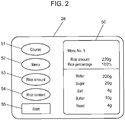
- FIG. 2 illustrates operating section 28 of the automatic bread maker of the exemplary embodiment. As shown in FIG. 2 , operating section 28 has display 50, setting buttons 51 through 54, and start button 55.
- Display 50 displays setting items.
- the user uses setting button 51 to choose between the following two: one is a conventional bread making course using wheat flour (hereinafter, simply referred to a bread making course) and the other is a rice-flour bread making course in which rice paste is prepared first to make bread using it.
- setting button 53 When the rice-flour bread making course is chosen, the user uses setting button 53 to set the amount of rice to be used.
- Setting button 54 enables the user to change a contained amount of rice in the bread to be baked. According to the amount of rice determined by setting button 53 and the contained amount of rice determined by setting button 54, display 50 shows an amount of bread-making material other than rice.
- start button 55 When the user pushes start button 55, the course chosen by the user will start.
- FIG. 3 is a control block diagram of the automatic bread maker of the exemplary embodiment.
- controller 29 receives data from setting buttons 51 through 54 and start button 55. Controller 29 effects control of display 50 so as to show the setting items entered into operation section 28 by the user. Receiving data detected by temperature detector 27, controller 29 obtains the temperature of the bread-making materials.
- Controller 29 controls motor 20, heater 26, automatic feeders 46 through 48, cooling fan 30a, and vibrator 45. Controller 29 controls kneading blade 24 via motor 20.
- controller 29 governs the bread-making process from fermentation of the bread-making materials to baking, including the pulverizing step in which rice paste as the bread-making material is made from grains of raw rice and water, and the mixing step in which the rice paste is mixed well.
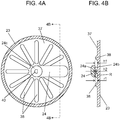
- FIG. 4A is a plane section view of baking case 23 of the automatic bread maker of the exemplary embodiment.
- FIG. 4B is a cross section view, taken along the line 4B-4B of FIG. 4A .
- baking case 23 has bottom 37 of a round shape.
- Rotating shaft 40 having a D-cutout part is disposed at the center of bottom 37.
- Kneading blade 24 has mixing part 24a, pulverizing part 24b, and boss 24c that are an integrally-formed structure.
- Baking case 23 is so designed that, when a predetermined amount of rice grains and water are put into the case, kneading blade 24 is immersed in the water.
- Fitting boss 24c with rotating shaft 40 allows kneading blade 24 to be disposed so as to extend from rotating shaft 40 to the radial direction of bottom 37.
- Motor 20 rotates kneading blade 24 via power-transmitting section 41 and rotating shaft 40.
- Mixing part 24a has a streamline cross-section, like a wing, seen in the rotating direction of kneading blade 24. Mixing part 24a mixes the bread-making materials.
- the bottom of kneading blade 24 forms pulverizing part 24b for pulverizing the bread-making materials.
- Bottom 37 has protruding section 38 formed of a plurality of protrusions each of which extends radially from a proximity area to the center toward a proximity area to the outer periphery.
- Gap h1 is formed between bottom 37 and pulverizing part 24b.
- Gap h2 is formed between protruding section 38 and pulverizing part 24b.
- a grain of rice is vertically long; rice grain R has an oval cross-section at the center in the lengthwise direction of the grain.
- gap h1 is determined to be greater than minor axis r1 of rice grain R
- gap h2 is determined to be smaller than minor axis r1 of rice grain R.
- FIG. 5 and FIG. 6 are cross section views of baking case 23 and kneading blade 24 of the automatic bread maker of the embodiment; specifically, FIG. 5 shows the state before the step of pulverizing rice grains, whereas FIG. 6 shows the state during the pulverizing step.
- rice grain R enters from gap h1 one after another and they are trapped in the space between adjacent two protrusions of protruding section 38.
- rice grain R undergoes shear stress and compression stress produced by pulverizing part 24b and protruding section 38.
- the application of force pulverizes rice grain R well.
- Rice paste P is thus completed (see FIG. 6 ).
- the structure allows the bread-making materials to be pulverized and mixed in a single case. This eliminates the need of changing a case for pulverizing material into another one for mixing, which shortens the time required for making bread.
- kneading blade 24 is so designed that the whole structure of the blade is immersed in the rice paste when a predetermined amount of rice paste is set in baking case 23.
- rice paste is prepared from the grains of raw rice-with no use of wheat flour or gluten-to make bread.
- the rice-flour bread making course will be described.
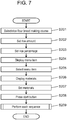
- FIG. 7 is a flowchart of the rice-flour bread making course in accordance with the embodiment.
- step S201 the user chooses the rice-flour bread making course with use of setting button 51.
- step S202 the user sets an amount of rice with use of setting button 53 (in step S202) and then determines a contained amount of rice in the bread with use of setting button 54 (in step S203).
- step S204 display 50 may show a menu common to the rice-flour bread making course and the bread making course (to make white bread and raisin-added bread, for example), or may show a menu unique to the rice-flour bread making course and a kind of rice.
- the menu unique to the rice-flour bread making course has, for example, a sweetness level and a moisture level of finished bread as a menu item.
- step S205 the user selects a desired menu from the display with use of setting button 52.
- step S206 display 50 shows a necessary amount of materials according to the set contents of the user.
- step S207 the user puts a predetermined amount of water and rice grains into baking case 23. At that time, the user also sets a predetermined amount of yeast into automatic feeder 46, a predetermined amount of rice flour into automatic feeder 47, and a predetermined amount of a filling (to be added into bread) into automatic feeder 48.
- step S208 the user pushes start button 55 to start the rice-flour bread making course.
- step S209 receiving the temperature of bread-making materials detected by temperature detector 27, controller 29 effects control of heater 26 and kneading blade 24 so as to perform the starch-swelling step, the pulverizing step, the mixing step, the resting step, and the baking step on the basis of a predetermined sequence suitable for the set contents by the user.
- FIG. 8 is a flowchart showing the detail of a predetermined sequence carried out in step S209.
- step S211 for the swelling process in step S211, heater 26, kneading blade 24, and cooling fan 30a start working.
- the rice grains absorb water, and are heated and mixed, by which the rice sufficiently swell with no gelatinization of starch.
- step S211 rice paste having a desired shear viscosity is prepared.
- a blade that rotates at a high speed more than 3000 rpm is commonly used.
- pulverizing rice grains by high-speed rotating kneading blade 24 produces a large amount of friction heat between rice grains and kneading blade 24.
- the friction heat causes gelatinization of starch, which makes difficult to provide rice paste with stable viscosity.
- Kneading blade 24 of the embodiment rotates in a low-speed rotation range (of approximately 300 rpm) in the pulverizing step.
- Low-speed rotation of kneading blade 24 in rice paste produces a random flow in the rice paste, by which the shear viscosity of rice paste is efficiently controlled.
- rice grains are pulverized by a kneading blade rotating at a high-speed and then rice paste is mixed by the kneading blade with the speed lowered.
- kneading blade 24 is rotated at a rotation speed range the same as that in the mixing step. The rotation-speed control minimizes damage to rice starch.
- the structure of the embodiment has another advantage. Compared to pulverizing at a high speed of 3000 rpm and higher, the cutting noise in the step can be decreased.
- heater 26 heats up rice grains so as to encourage swelling of starch.
- the heating temperature is automatically set to a temperature in a range between 20°C and 65°C so as to be suitable for a selected type of rice (for example, the appropriate range for Koshihikari is from 25°C to 45°C).
- Shear resistance of the rice paste is obtained by detecting resistance force on rotating kneading blade 24 from a current value of motor 20. Shear viscosity of the rice paste is small in the early stage where starch of rice is not yet swelled, but it becomes large as the paste is heated and mixed. To obtain an appropriate shear viscosity, motor 20, heater 26, and cooling fan 30a work according to a detected shear resistance.
- Rotating kneading blade 24 facilitates swelling of starch, increasing shear viscosity of rice paste.
- Heater 26 controls the temperature of the rice paste at which a starch-degrading enzyme actively works.
- Cooling fan 30a discharges hot air containing steam from baking chamber 22 to the outside of main unit 21, by which rice paste is cooled down, and at the same time, fluid in the rice paste decreases; accordingly, shear viscosity of the rice paste increases.
- step S212 heater 26 turns off, but kneading blade 24 and cooling fan 30 keep working for pulverizing rice grains.
- step S213 automatic feeder 47 puts rice flour into the chamber. Prior to the rice-flour feeding, cooling fan 30a turns off to prevent rice flour from getting into suction opening 30b.
- step S214 kneading blade 24 and cooling fan 30a work for the mixing step in which the rice flour is mixed with the rice paste.
- step S215 automatic feeder 46 puts yeast into the baking chamber. At the time, prior to the yeast feeding, cooling fan 30a turns off to prevent yeast from getting into suction opening 30b.
- step S216 automatic feeder 48 puts a filling to be added, for example, raisin into the chamber. Prior to the feeding, cooling fan 30a turns off to prevent the filling from getting into suction opening 30b.
- step S217 is for mixing the material.
- Step S218 is the fermentation step in which the mixture of rice paste and rice flour is rested to have fermentation.
- heater 26 and kneading blade 24 are turned off, cooler 30 turns on.
- Step S219 is the baking step.
- the bread made by the rice-flour bread making course of the embodiment has a further preferable rise and is softer, chewyer, and sweeter than the bread made by the ordinary bread making course.
- a gluconeogenic enzyme which is contained in rice grains, has a different temperature dependency between an outer layer section and an inner layer section of a grain of rice.
- a gluconeogenic enzyme contained in the inner layer section has an optimum temperature of 60°C.
- the automatic bread maker performs all the bread making process, providing a finish of bread with uniformity.
- kneading blade 24 mixes grains of raw rice and water in the rice-paste preparing step, which facilitates uniform water absorption of rice grains. Mixing the materials with application of heat allows the rice paste to have uniform temperature distribution.
- the yeast vigorously acts for making bread rise in the temperature range between 27°C and 36°C. It stops acting at 4°C or lower, and dies at 60°C or higher. The temperature of just finished rice paste is too much higher for applying yeast.
- cooling fan 30a rapidly lowers down the temperature of the rice paste so as not to ruin the yeast, shortening the time required for making bread.
- rice-flour bread Compared to wheat-flour bread, rice-flour bread has a modest rise as it bakes and therefore the height of bread often does not reach the upper section of baking case 23. In the baking step, the upper part of bread is often heated insufficiently.
- a heater may be disposed in the upper section of baking case 23 so as to heat the upper part of bread.
- a reflection plate may be disposed in the upper section of baking case 23 so as to reflect heat of heater 26.
- FIG. 9 is a cross section view of an automatic bread maker of the second exemplary embodiment of the present disclosure.
- a part the same as that or corresponding to that in the first exemplary embodiment has a similar reference mark and description thereof will be omitted to eliminate redundancy.
- the automatic bread maker of the exemplary embodiment shown in FIG. 9 has a structure that differs from the structure of the first exemplary embodiment in having automatic feeders 33a through 33c and 34, instead of automatic feeders 46 through 48.
- Automatic feeders 33a through 33c each of which accommodates a bubble-inducing material, feed them into baking case 23.
- the bubble-inducing material means a group of yeast, such as dry yeast, raw yeast, natural yeast, Guar Gum, Koji (malted rice), and baking powder.
- Automatic feeder 34 accommodates salt and sugar therein and feeds them into baking case 23. Automatic feeders 33a through 33c, and 34 are controlled by controller 29.
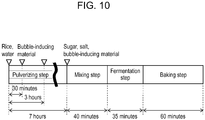
- FIG. 10 illustrates the bread-making process of the automatic bread maker of the embodiment.
- the user selects the item of 'raw rice grains and water' by setting button 51.
- the pulverizing step starts, as shown in FIG. 10 .
- the bread making materials in baking case 23, i.e., raw rice grains and water are pulverized by rotation of kneading blade 24 driven by motor 20.
- Each of automatic feeders 33a, 33b feeds a bubble-inducing material into baking case 23 at a predetermined time.
- automatic feeder 33c feeds a bubble-inducing material into baking case 23 for fermentation of rice paste.
- automatic feeder 33a carries out the first-time feeding of the bubble-inducing material into baking case 23. This facilitates hydration between starch and protein in the rice paste and uniform distribution of air contained in the rice paste. This allows the materials to be fine grained dough for making gluten-free bread with a preferable rise. At that time, the bread making material is still a mixture of raw rice grains, water, and rice paste.
- automatic feeder 33b carries out the second-time feeding of the bubble-inducing material into baking case 23.
- the second-time feeding further facilitates hydration between starch and protein in the rice paste and uniform distribution of air contained in the rice paste. This allows the materials to be further fine-grained dough for providing gluten-free bread with a further preferable rise and improved eating quality.
- the bread making material is still a mixture of raw rice grains, water, and rice paste, like the state just after the first-time feeding of the bubble-inducing material.
- the percentage of rice paste of the total amount after the second-time feeding becomes larger than that just after the first-time feeding.
- the bread making material is continuously pulverized and mixed even after the second-time feeding of the bubble-inducing material. In seven hours since the start of the pulverizing step, rice paste is completed.
- gelatinization temperature of starch is believed to be 50°C to 80°C.
- cooler 30 starts cooling of the bread making material, while maintaining the temperature of the material in a range between 28°C and 33°C.
- FIG. 11A and FIG. 11B shows a relation between temperature, time, and output of the cooler in the pulverizing step of the embodiment.
- the bread making material has a temperature of 30°C when application of heat starts.
- cooler 30 outputs twice as much as normal.
- cooler 30 With an increase in output of cooler 30, the bread making material has a gradual rise in temperature. In contrast, as shown in FIG. 11B , when the material has a temperature rise not less than 1°C per minute, cooler 30 keeps the output at a constant level.
- automatic feeder 33c feeds bubble-inducing material, sugar, and salt into baking case 23.
- motor 20 changes the rotation speed of kneading blade 24, which is timed to the start of the mixing step in which the bubble-inducing material, sugar, and salt are mixed with each other.
- the mixing of the bubble-inducing material, sugar, and salt are completed.
- the bread making material is formed into rice paste in which the bubble-inducing material, sugar, and salt are uniformly dispersed.
- Heater 26 and cooler 30 work together so that the temperature of the bread making material is maintained at the optimum range (between 38°C and 42°C) of the fermentation step.
- the baking step starts.
- the temperature of baking case 23 should preferably be between 160°C and 180°C in the baking step and the baking time should preferably be around 40 minutes.
- controller 29 effects control of cooler 30 so as to change the output in response to the temperature-rising speed of the bread making material in the pulverizing step.
- cooler 30 increases the output to cool the rice paste.
- the fermentation step starts at a temperature of rice paste lower than a predetermined temperature, allowing the rice paste to be protected from excessive fermentation. As a result, gluten-free bread having a preferable rise with no depressed part is obtained.
- the structure of the third exemplary embodiment is described below.
- the automatic bread maker has a structure the same as that of the second exemplary embodiment.
- controller 29 effects control of cooler 30 so as to decrease the output after a predetermined period of time has passed since the output increased.
- Controller 29 has a logging function that takes logs during operation of the automatic bread maker. According to the logs, controller 29 controls cooler 30.
- FIG. 12 shows a relation between temperature, time, and output of the cooler in the pulverizing step of the embodiment.
- the structure of the embodiment has steps the same as those of the second exemplary embodiment until cooler 30 starts to work after one hour has passed since the pulverizing step started.
- cooler 30 decreases the output and maintains the decreased level for at least 20 minutes.
- the mixing step, the fermentation step, and the baking step that follow the completion of the pulverizing step are the same as those described above.
- Controller 29 logs a series of operations.
- cooler 30 decreases the output when a predetermined period of time has passed since the output increased.
- the output control protects the rice paste from drying due to cooling for a long time, providing soft rice paste with a preferable rise in the fermentation step.
- Controller 29 effects control of cooler 30 according to the logs. Even when the user makes bread in a high-temperature environment, the bread maker offers gluten-free bread having a preferable rise with no depressed part from grains of raw rice only (that is, not including rice flour).
- the structure of the fourth exemplary embodiment is described below.
- the automatic bread maker has a structure the same as that of the second exemplary embodiment.
- the structure of the embodiment shortens the period of the pulverizing step. Therefore, the fermentation step starts at a temperature of rice paste lower than a predetermined temperature, allowing the rice paste to be protected from excessive fermentation.
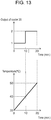
- FIG. 13 shows a relation between temperature, time, and output of the cooler in the exemplary embodiment.
- FIG. 14 illustrates the bread making process of the automatic bread maker of the embodiment.
- the structure of the embodiment has steps the same as those of the second exemplary embodiment until cooler 30 starts to work after one hour has passed since the pulverizing step started.
- cooler 30 outputs twice as much as normal, like in the second exemplary embodiment.
- controller 29 shortens the pulverizing step to four or five hours, as shown in FIG. 14 .
- the mixing step, the fermentation step, and the baking step that follow the completion of the pulverizing step are the same as those described above.
- the structure of the present disclosure is applicable to an automatic bread maker.
Landscapes
- Engineering & Computer Science (AREA)
- Food Science & Technology (AREA)
- Life Sciences & Earth Sciences (AREA)
- Mechanical Engineering (AREA)
- Baking, Grill, Roasting (AREA)
Applications Claiming Priority (3)
| Application Number | Priority Date | Filing Date | Title |
|---|---|---|---|
| JP2016049292A JP6627078B2 (ja) | 2016-03-14 | 2016-03-14 | 自動製パン器 |
| JP2016053351A JP6528084B2 (ja) | 2016-03-17 | 2016-03-17 | 自動製パン器 |
| PCT/JP2017/007653 WO2017159337A1 (fr) | 2016-03-14 | 2017-02-28 | Machine à pain automatique |
Publications (2)
| Publication Number | Publication Date |
|---|---|
| EP3430954A1 true EP3430954A1 (fr) | 2019-01-23 |
| EP3430954A4 EP3430954A4 (fr) | 2019-03-20 |
Family
ID=59850373
Family Applications (1)
| Application Number | Title | Priority Date | Filing Date |
|---|---|---|---|
| EP17766340.8A Withdrawn EP3430954A4 (fr) | 2016-03-14 | 2017-02-28 | Machine à pain automatique |
Country Status (3)
| Country | Link |
|---|---|
| US (1) | US20190069558A1 (fr) |
| EP (1) | EP3430954A4 (fr) |
| WO (1) | WO2017159337A1 (fr) |
Families Citing this family (2)
| Publication number | Priority date | Publication date | Assignee | Title |
|---|---|---|---|---|
| US20190216100A1 (en) * | 2018-01-12 | 2019-07-18 | Ingen Robotics Pvt. Ltd. | Apparatus and method for quick and precise dosing of water |
| CN115053967B (zh) * | 2022-08-04 | 2022-11-01 | 北京逯博士行为医学科技研究院有限公司 | 基于减脂的营养餐包制备方法 |
Family Cites Families (11)
| Publication number | Priority date | Publication date | Assignee | Title |
|---|---|---|---|---|
| JPS5996245U (ja) * | 1983-06-02 | 1984-06-29 | 株式会社コトブキ | 伸縮式階段状観覧席 |
| JPS62104538A (ja) * | 1985-10-29 | 1987-05-15 | レオン自動機株式会社 | パン生地類の混練中の品質管理方法及びそのための混練装置 |
| WO2010115306A1 (fr) * | 2009-04-09 | 2010-10-14 | Peng Weijie | Centrifugeuse |
| JP5609002B2 (ja) * | 2009-04-10 | 2014-10-22 | 三洋電機株式会社 | 加熱調理食品生地製造方法及び生地製造装置 |
| WO2011024779A1 (fr) * | 2009-08-25 | 2011-03-03 | 三洋電機株式会社 | Machine à pain automatique |
| WO2011024776A1 (fr) * | 2009-08-25 | 2011-03-03 | 三洋電機株式会社 | Machine à pain automatique |
| JP2011172723A (ja) * | 2010-02-24 | 2011-09-08 | Sanyo Electric Co Ltd | 自動製パン器 |
| JP5027941B1 (ja) * | 2011-03-01 | 2012-09-19 | 福盛 尊子 | 加熱調理食品生地の製造方法、加熱調理食品の製造装置及び加熱調理食品 |
| JP5824617B2 (ja) * | 2012-03-16 | 2015-11-25 | パナソニックIpマネジメント株式会社 | パン生地生成機及びそのパン生地を用いた製パン機 |
| JP6028223B2 (ja) * | 2012-10-24 | 2016-11-16 | パナソニックIpマネジメント株式会社 | 自動製パン器 |
| CN104026996B (zh) * | 2013-05-14 | 2016-03-23 | 深圳市联创三金电器有限公司 | 磨盘式面包机、磨碎方法和装备有磨盘组件的容器 |
-
2017
- 2017-02-28 US US16/083,595 patent/US20190069558A1/en not_active Abandoned
- 2017-02-28 WO PCT/JP2017/007653 patent/WO2017159337A1/fr not_active Ceased
- 2017-02-28 EP EP17766340.8A patent/EP3430954A4/fr not_active Withdrawn
Also Published As
| Publication number | Publication date |
|---|---|
| EP3430954A4 (fr) | 2019-03-20 |
| WO2017159337A1 (fr) | 2017-09-21 |
| US20190069558A1 (en) | 2019-03-07 |
Similar Documents
| Publication | Publication Date | Title |
|---|---|---|
| JP5810280B2 (ja) | 自動製パン器 | |
| JP5418212B2 (ja) | 自動製パン器 | |
| JP5617871B2 (ja) | 自動製パン器 | |
| EP3430954A1 (fr) | Machine à pain automatique | |
| CN105193299A (zh) | 自动制面包机 | |
| JP5716162B2 (ja) | 自動製パン機 | |
| JP5824617B2 (ja) | パン生地生成機及びそのパン生地を用いた製パン機 | |
| JP6627078B2 (ja) | 自動製パン器 | |
| JP6528084B2 (ja) | 自動製パン器 | |
| JP5810278B2 (ja) | 自動製パン器 | |
| JP4660284B2 (ja) | 自動製パン機 | |
| JP6082975B2 (ja) | 自動製パン器 | |
| JP2016165374A (ja) | 自動製パン器 | |
| JP2016150125A (ja) | 自動製パン器 | |
| JP2011110274A (ja) | 自動製パン器 | |
| JP2016129581A (ja) | 自動製パン器 | |
| JP4383233B2 (ja) | 自動製パン器 | |
| JP7141331B2 (ja) | 餅調理器 | |
| JP6082976B2 (ja) | 自動製パン器 | |
| JP5938556B2 (ja) | 自動製パン器 | |
| JP5870244B2 (ja) | 自動製パン機 | |
| JP6417542B2 (ja) | 自動製パン器 | |
| JP6641561B2 (ja) | 調理器 | |
| JP7297434B2 (ja) | 餅調理器 | |
| WO2010117053A1 (fr) | Procédé de production de produit alimentaire destiné à la cuisson traité et dispositif de production de cet aliment |
Legal Events
| Date | Code | Title | Description |
|---|---|---|---|
| STAA | Information on the status of an ep patent application or granted ep patent |
Free format text: STATUS: THE INTERNATIONAL PUBLICATION HAS BEEN MADE |
|
| PUAI | Public reference made under article 153(3) epc to a published international application that has entered the european phase |
Free format text: ORIGINAL CODE: 0009012 |
|
| STAA | Information on the status of an ep patent application or granted ep patent |
Free format text: STATUS: REQUEST FOR EXAMINATION WAS MADE |
|
| 17P | Request for examination filed |
Effective date: 20180723 |
|
| AK | Designated contracting states |
Kind code of ref document: A1 Designated state(s): AL AT BE BG CH CY CZ DE DK EE ES FI FR GB GR HR HU IE IS IT LI LT LU LV MC MK MT NL NO PL PT RO RS SE SI SK SM TR |
|
| AX | Request for extension of the european patent |
Extension state: BA ME |
|
| A4 | Supplementary search report drawn up and despatched |
Effective date: 20190214 |
|
| RIC1 | Information provided on ipc code assigned before grant |
Ipc: A21C 1/00 20060101ALI20190208BHEP Ipc: A47J 43/046 20060101ALI20190208BHEP Ipc: A21C 1/02 20060101ALI20190208BHEP Ipc: A47J 37/00 20060101AFI20190208BHEP Ipc: A21B 7/00 20060101ALI20190208BHEP |
|
| DAV | Request for validation of the european patent (deleted) | ||
| DAX | Request for extension of the european patent (deleted) | ||
| STAA | Information on the status of an ep patent application or granted ep patent |
Free format text: STATUS: EXAMINATION IS IN PROGRESS |
|
| 17Q | First examination report despatched |
Effective date: 20201203 |
|
| GRAP | Despatch of communication of intention to grant a patent |
Free format text: ORIGINAL CODE: EPIDOSNIGR1 |
|
| STAA | Information on the status of an ep patent application or granted ep patent |
Free format text: STATUS: GRANT OF PATENT IS INTENDED |
|
| INTG | Intention to grant announced |
Effective date: 20250210 |
|
| STAA | Information on the status of an ep patent application or granted ep patent |
Free format text: STATUS: THE APPLICATION IS DEEMED TO BE WITHDRAWN |
|
| 18D | Application deemed to be withdrawn |
Effective date: 20250611 |