EP3431476B1 - Organisches elektrisches element und elektronische vorrichtung daraus - Google Patents
Organisches elektrisches element und elektronische vorrichtung daraus Download PDFInfo
- Publication number
- EP3431476B1 EP3431476B1 EP17766990.0A EP17766990A EP3431476B1 EP 3431476 B1 EP3431476 B1 EP 3431476B1 EP 17766990 A EP17766990 A EP 17766990A EP 3431476 B1 EP3431476 B1 EP 3431476B1
- Authority
- EP
- European Patent Office
- Prior art keywords
- group
- sub
- compound
- formula
- ring
- Prior art date
- Legal status (The legal status is an assumption and is not a legal conclusion. Google has not performed a legal analysis and makes no representation as to the accuracy of the status listed.)
- Active
Links
Images


Classifications
-
- C—CHEMISTRY; METALLURGY
- C07—ORGANIC CHEMISTRY
- C07D—HETEROCYCLIC COMPOUNDS
- C07D487/00—Heterocyclic compounds containing nitrogen atoms as the only ring hetero atoms in the condensed system, not provided for by groups C07D451/00 - C07D477/00
- C07D487/02—Heterocyclic compounds containing nitrogen atoms as the only ring hetero atoms in the condensed system, not provided for by groups C07D451/00 - C07D477/00 in which the condensed system contains two hetero rings
- C07D487/04—Ortho-condensed systems
-
- C—CHEMISTRY; METALLURGY
- C07—ORGANIC CHEMISTRY
- C07D—HETEROCYCLIC COMPOUNDS
- C07D209/00—Heterocyclic compounds containing five-membered rings, condensed with other rings, with one nitrogen atom as the only ring hetero atom
- C07D209/56—Ring systems containing three or more rings
-
- C—CHEMISTRY; METALLURGY
- C07—ORGANIC CHEMISTRY
- C07D—HETEROCYCLIC COMPOUNDS
- C07D209/00—Heterocyclic compounds containing five-membered rings, condensed with other rings, with one nitrogen atom as the only ring hetero atom
- C07D209/56—Ring systems containing three or more rings
- C07D209/80—[b, c]- or [b, d]-condensed
-
- C—CHEMISTRY; METALLURGY
- C07—ORGANIC CHEMISTRY
- C07D—HETEROCYCLIC COMPOUNDS
- C07D209/00—Heterocyclic compounds containing five-membered rings, condensed with other rings, with one nitrogen atom as the only ring hetero atom
- C07D209/56—Ring systems containing three or more rings
- C07D209/80—[b, c]- or [b, d]-condensed
- C07D209/82—Carbazoles; Hydrogenated carbazoles
-
- C—CHEMISTRY; METALLURGY
- C07—ORGANIC CHEMISTRY
- C07D—HETEROCYCLIC COMPOUNDS
- C07D209/00—Heterocyclic compounds containing five-membered rings, condensed with other rings, with one nitrogen atom as the only ring hetero atom
- C07D209/56—Ring systems containing three or more rings
- C07D209/80—[b, c]- or [b, d]-condensed
- C07D209/82—Carbazoles; Hydrogenated carbazoles
- C07D209/86—Carbazoles; Hydrogenated carbazoles with only hydrogen atoms, hydrocarbon or substituted hydrocarbon radicals, directly attached to carbon atoms of the ring system
-
- C—CHEMISTRY; METALLURGY
- C07—ORGANIC CHEMISTRY
- C07D—HETEROCYCLIC COMPOUNDS
- C07D209/00—Heterocyclic compounds containing five-membered rings, condensed with other rings, with one nitrogen atom as the only ring hetero atom
- C07D209/56—Ring systems containing three or more rings
- C07D209/80—[b, c]- or [b, d]-condensed
- C07D209/82—Carbazoles; Hydrogenated carbazoles
- C07D209/88—Carbazoles; Hydrogenated carbazoles with hetero atoms or with carbon atoms having three bonds to hetero atoms with at the most one bond to halogen, e.g. ester or nitrile radicals, directly attached to carbon atoms of the ring system
-
- C—CHEMISTRY; METALLURGY
- C07—ORGANIC CHEMISTRY
- C07D—HETEROCYCLIC COMPOUNDS
- C07D401/00—Heterocyclic compounds containing two or more hetero rings, having nitrogen atoms as the only ring hetero atoms, at least one ring being a six-membered ring with only one nitrogen atom
- C07D401/02—Heterocyclic compounds containing two or more hetero rings, having nitrogen atoms as the only ring hetero atoms, at least one ring being a six-membered ring with only one nitrogen atom containing two hetero rings
- C07D401/04—Heterocyclic compounds containing two or more hetero rings, having nitrogen atoms as the only ring hetero atoms, at least one ring being a six-membered ring with only one nitrogen atom containing two hetero rings directly linked by a ring-member-to-ring-member bond
-
- C—CHEMISTRY; METALLURGY
- C07—ORGANIC CHEMISTRY
- C07D—HETEROCYCLIC COMPOUNDS
- C07D401/00—Heterocyclic compounds containing two or more hetero rings, having nitrogen atoms as the only ring hetero atoms, at least one ring being a six-membered ring with only one nitrogen atom
- C07D401/02—Heterocyclic compounds containing two or more hetero rings, having nitrogen atoms as the only ring hetero atoms, at least one ring being a six-membered ring with only one nitrogen atom containing two hetero rings
- C07D401/12—Heterocyclic compounds containing two or more hetero rings, having nitrogen atoms as the only ring hetero atoms, at least one ring being a six-membered ring with only one nitrogen atom containing two hetero rings linked by a chain containing hetero atoms as chain links
-
- C—CHEMISTRY; METALLURGY
- C07—ORGANIC CHEMISTRY
- C07D—HETEROCYCLIC COMPOUNDS
- C07D401/00—Heterocyclic compounds containing two or more hetero rings, having nitrogen atoms as the only ring hetero atoms, at least one ring being a six-membered ring with only one nitrogen atom
- C07D401/14—Heterocyclic compounds containing two or more hetero rings, having nitrogen atoms as the only ring hetero atoms, at least one ring being a six-membered ring with only one nitrogen atom containing three or more hetero rings
-
- C—CHEMISTRY; METALLURGY
- C07—ORGANIC CHEMISTRY
- C07D—HETEROCYCLIC COMPOUNDS
- C07D403/00—Heterocyclic compounds containing two or more hetero rings, having nitrogen atoms as the only ring hetero atoms, not provided for by group C07D401/00
- C07D403/02—Heterocyclic compounds containing two or more hetero rings, having nitrogen atoms as the only ring hetero atoms, not provided for by group C07D401/00 containing two hetero rings
- C07D403/04—Heterocyclic compounds containing two or more hetero rings, having nitrogen atoms as the only ring hetero atoms, not provided for by group C07D401/00 containing two hetero rings directly linked by a ring-member-to-ring-member bond
-
- C—CHEMISTRY; METALLURGY
- C07—ORGANIC CHEMISTRY
- C07D—HETEROCYCLIC COMPOUNDS
- C07D403/00—Heterocyclic compounds containing two or more hetero rings, having nitrogen atoms as the only ring hetero atoms, not provided for by group C07D401/00
- C07D403/02—Heterocyclic compounds containing two or more hetero rings, having nitrogen atoms as the only ring hetero atoms, not provided for by group C07D401/00 containing two hetero rings
- C07D403/10—Heterocyclic compounds containing two or more hetero rings, having nitrogen atoms as the only ring hetero atoms, not provided for by group C07D401/00 containing two hetero rings linked by a carbon chain containing aromatic rings
-
- C—CHEMISTRY; METALLURGY
- C07—ORGANIC CHEMISTRY
- C07D—HETEROCYCLIC COMPOUNDS
- C07D405/00—Heterocyclic compounds containing both one or more hetero rings having oxygen atoms as the only ring hetero atoms, and one or more rings having nitrogen as the only ring hetero atom
- C07D405/02—Heterocyclic compounds containing both one or more hetero rings having oxygen atoms as the only ring hetero atoms, and one or more rings having nitrogen as the only ring hetero atom containing two hetero rings
- C07D405/12—Heterocyclic compounds containing both one or more hetero rings having oxygen atoms as the only ring hetero atoms, and one or more rings having nitrogen as the only ring hetero atom containing two hetero rings linked by a chain containing hetero atoms as chain links
-
- C—CHEMISTRY; METALLURGY
- C07—ORGANIC CHEMISTRY
- C07D—HETEROCYCLIC COMPOUNDS
- C07D405/00—Heterocyclic compounds containing both one or more hetero rings having oxygen atoms as the only ring hetero atoms, and one or more rings having nitrogen as the only ring hetero atom
- C07D405/14—Heterocyclic compounds containing both one or more hetero rings having oxygen atoms as the only ring hetero atoms, and one or more rings having nitrogen as the only ring hetero atom containing three or more hetero rings
-
- C—CHEMISTRY; METALLURGY
- C07—ORGANIC CHEMISTRY
- C07D—HETEROCYCLIC COMPOUNDS
- C07D409/00—Heterocyclic compounds containing two or more hetero rings, at least one ring having sulfur atoms as the only ring hetero atoms
- C07D409/02—Heterocyclic compounds containing two or more hetero rings, at least one ring having sulfur atoms as the only ring hetero atoms containing two hetero rings
- C07D409/04—Heterocyclic compounds containing two or more hetero rings, at least one ring having sulfur atoms as the only ring hetero atoms containing two hetero rings directly linked by a ring-member-to-ring-member bond
-
- C—CHEMISTRY; METALLURGY
- C07—ORGANIC CHEMISTRY
- C07D—HETEROCYCLIC COMPOUNDS
- C07D409/00—Heterocyclic compounds containing two or more hetero rings, at least one ring having sulfur atoms as the only ring hetero atoms
- C07D409/02—Heterocyclic compounds containing two or more hetero rings, at least one ring having sulfur atoms as the only ring hetero atoms containing two hetero rings
- C07D409/12—Heterocyclic compounds containing two or more hetero rings, at least one ring having sulfur atoms as the only ring hetero atoms containing two hetero rings linked by a chain containing hetero atoms as chain links
-
- C—CHEMISTRY; METALLURGY
- C07—ORGANIC CHEMISTRY
- C07D—HETEROCYCLIC COMPOUNDS
- C07D409/00—Heterocyclic compounds containing two or more hetero rings, at least one ring having sulfur atoms as the only ring hetero atoms
- C07D409/14—Heterocyclic compounds containing two or more hetero rings, at least one ring having sulfur atoms as the only ring hetero atoms containing three or more hetero rings
-
- C—CHEMISTRY; METALLURGY
- C07—ORGANIC CHEMISTRY
- C07D—HETEROCYCLIC COMPOUNDS
- C07D491/00—Heterocyclic compounds containing in the condensed ring system both one or more rings having oxygen atoms as the only ring hetero atoms and one or more rings having nitrogen atoms as the only ring hetero atoms, not provided for by groups C07D451/00 - C07D459/00, C07D463/00, C07D477/00 or C07D489/00
- C07D491/02—Heterocyclic compounds containing in the condensed ring system both one or more rings having oxygen atoms as the only ring hetero atoms and one or more rings having nitrogen atoms as the only ring hetero atoms, not provided for by groups C07D451/00 - C07D459/00, C07D463/00, C07D477/00 or C07D489/00 in which the condensed system contains two hetero rings
- C07D491/04—Ortho-condensed systems
- C07D491/044—Ortho-condensed systems with only one oxygen atom as ring hetero atom in the oxygen-containing ring
- C07D491/048—Ortho-condensed systems with only one oxygen atom as ring hetero atom in the oxygen-containing ring the oxygen-containing ring being five-membered
-
- C—CHEMISTRY; METALLURGY
- C07—ORGANIC CHEMISTRY
- C07D—HETEROCYCLIC COMPOUNDS
- C07D495/00—Heterocyclic compounds containing in the condensed system at least one hetero ring having sulfur atoms as the only ring hetero atoms
- C07D495/02—Heterocyclic compounds containing in the condensed system at least one hetero ring having sulfur atoms as the only ring hetero atoms in which the condensed system contains two hetero rings
- C07D495/04—Ortho-condensed systems
-
- C—CHEMISTRY; METALLURGY
- C07—ORGANIC CHEMISTRY
- C07D—HETEROCYCLIC COMPOUNDS
- C07D519/00—Heterocyclic compounds containing more than one system of two or more relevant hetero rings condensed among themselves or condensed with a common carbocyclic ring system not provided for in groups C07D453/00 or C07D455/00
-
- C—CHEMISTRY; METALLURGY
- C09—DYES; PAINTS; POLISHES; NATURAL RESINS; ADHESIVES; COMPOSITIONS NOT OTHERWISE PROVIDED FOR; APPLICATIONS OF MATERIALS NOT OTHERWISE PROVIDED FOR
- C09K—MATERIALS FOR MISCELLANEOUS APPLICATIONS, NOT PROVIDED FOR ELSEWHERE
- C09K11/00—Luminescent materials, e.g. electroluminescent or chemiluminescent
- C09K11/06—Luminescent materials, e.g. electroluminescent or chemiluminescent containing organic luminescent materials
-
- H—ELECTRICITY
- H10—SEMICONDUCTOR DEVICES; ELECTRIC SOLID-STATE DEVICES NOT OTHERWISE PROVIDED FOR
- H10K—ORGANIC ELECTRIC SOLID-STATE DEVICES
- H10K85/00—Organic materials used in the body or electrodes of devices covered by this subclass
- H10K85/60—Organic compounds having low molecular weight
- H10K85/615—Polycyclic condensed aromatic hydrocarbons, e.g. anthracene
-
- H—ELECTRICITY
- H10—SEMICONDUCTOR DEVICES; ELECTRIC SOLID-STATE DEVICES NOT OTHERWISE PROVIDED FOR
- H10K—ORGANIC ELECTRIC SOLID-STATE DEVICES
- H10K85/00—Organic materials used in the body or electrodes of devices covered by this subclass
- H10K85/60—Organic compounds having low molecular weight
- H10K85/615—Polycyclic condensed aromatic hydrocarbons, e.g. anthracene
- H10K85/624—Polycyclic condensed aromatic hydrocarbons, e.g. anthracene containing six or more rings
-
- H—ELECTRICITY
- H10—SEMICONDUCTOR DEVICES; ELECTRIC SOLID-STATE DEVICES NOT OTHERWISE PROVIDED FOR
- H10K—ORGANIC ELECTRIC SOLID-STATE DEVICES
- H10K85/00—Organic materials used in the body or electrodes of devices covered by this subclass
- H10K85/60—Organic compounds having low molecular weight
- H10K85/631—Amine compounds having at least two aryl rest on at least one amine-nitrogen atom, e.g. triphenylamine
-
- H—ELECTRICITY
- H10—SEMICONDUCTOR DEVICES; ELECTRIC SOLID-STATE DEVICES NOT OTHERWISE PROVIDED FOR
- H10K—ORGANIC ELECTRIC SOLID-STATE DEVICES
- H10K85/00—Organic materials used in the body or electrodes of devices covered by this subclass
- H10K85/60—Organic compounds having low molecular weight
- H10K85/631—Amine compounds having at least two aryl rest on at least one amine-nitrogen atom, e.g. triphenylamine
- H10K85/633—Amine compounds having at least two aryl rest on at least one amine-nitrogen atom, e.g. triphenylamine comprising polycyclic condensed aromatic hydrocarbons as substituents on the nitrogen atom
-
- H—ELECTRICITY
- H10—SEMICONDUCTOR DEVICES; ELECTRIC SOLID-STATE DEVICES NOT OTHERWISE PROVIDED FOR
- H10K—ORGANIC ELECTRIC SOLID-STATE DEVICES
- H10K85/00—Organic materials used in the body or electrodes of devices covered by this subclass
- H10K85/60—Organic compounds having low molecular weight
- H10K85/631—Amine compounds having at least two aryl rest on at least one amine-nitrogen atom, e.g. triphenylamine
- H10K85/636—Amine compounds having at least two aryl rest on at least one amine-nitrogen atom, e.g. triphenylamine comprising heteroaromatic hydrocarbons as substituents on the nitrogen atom
-
- H—ELECTRICITY
- H10—SEMICONDUCTOR DEVICES; ELECTRIC SOLID-STATE DEVICES NOT OTHERWISE PROVIDED FOR
- H10K—ORGANIC ELECTRIC SOLID-STATE DEVICES
- H10K85/00—Organic materials used in the body or electrodes of devices covered by this subclass
- H10K85/60—Organic compounds having low molecular weight
- H10K85/649—Aromatic compounds comprising a hetero atom
- H10K85/657—Polycyclic condensed heteroaromatic hydrocarbons
-
- H—ELECTRICITY
- H10—SEMICONDUCTOR DEVICES; ELECTRIC SOLID-STATE DEVICES NOT OTHERWISE PROVIDED FOR
- H10K—ORGANIC ELECTRIC SOLID-STATE DEVICES
- H10K85/00—Organic materials used in the body or electrodes of devices covered by this subclass
- H10K85/60—Organic compounds having low molecular weight
- H10K85/649—Aromatic compounds comprising a hetero atom
- H10K85/657—Polycyclic condensed heteroaromatic hydrocarbons
- H10K85/6572—Polycyclic condensed heteroaromatic hydrocarbons comprising only nitrogen in the heteroaromatic polycondensed ring system, e.g. phenanthroline or carbazole
-
- C—CHEMISTRY; METALLURGY
- C09—DYES; PAINTS; POLISHES; NATURAL RESINS; ADHESIVES; COMPOSITIONS NOT OTHERWISE PROVIDED FOR; APPLICATIONS OF MATERIALS NOT OTHERWISE PROVIDED FOR
- C09K—MATERIALS FOR MISCELLANEOUS APPLICATIONS, NOT PROVIDED FOR ELSEWHERE
- C09K2211/00—Chemical nature of organic luminescent or tenebrescent compounds
- C09K2211/10—Non-macromolecular compounds
- C09K2211/1018—Heterocyclic compounds
-
- C—CHEMISTRY; METALLURGY
- C09—DYES; PAINTS; POLISHES; NATURAL RESINS; ADHESIVES; COMPOSITIONS NOT OTHERWISE PROVIDED FOR; APPLICATIONS OF MATERIALS NOT OTHERWISE PROVIDED FOR
- C09K—MATERIALS FOR MISCELLANEOUS APPLICATIONS, NOT PROVIDED FOR ELSEWHERE
- C09K2211/00—Chemical nature of organic luminescent or tenebrescent compounds
- C09K2211/10—Non-macromolecular compounds
- C09K2211/1018—Heterocyclic compounds
- C09K2211/1022—Heterocyclic compounds bridged by heteroatoms, e.g. N, P, Si or B
-
- H—ELECTRICITY
- H10—SEMICONDUCTOR DEVICES; ELECTRIC SOLID-STATE DEVICES NOT OTHERWISE PROVIDED FOR
- H10K—ORGANIC ELECTRIC SOLID-STATE DEVICES
- H10K10/00—Organic devices specially adapted for rectifying, amplifying, oscillating or switching; Organic capacitors or resistors having potential barriers
-
- H—ELECTRICITY
- H10—SEMICONDUCTOR DEVICES; ELECTRIC SOLID-STATE DEVICES NOT OTHERWISE PROVIDED FOR
- H10K—ORGANIC ELECTRIC SOLID-STATE DEVICES
- H10K10/00—Organic devices specially adapted for rectifying, amplifying, oscillating or switching; Organic capacitors or resistors having potential barriers
- H10K10/40—Organic transistors
-
- H—ELECTRICITY
- H10—SEMICONDUCTOR DEVICES; ELECTRIC SOLID-STATE DEVICES NOT OTHERWISE PROVIDED FOR
- H10K—ORGANIC ELECTRIC SOLID-STATE DEVICES
- H10K2101/00—Properties of the organic materials covered by group H10K85/00
- H10K2101/10—Triplet emission
-
- H—ELECTRICITY
- H10—SEMICONDUCTOR DEVICES; ELECTRIC SOLID-STATE DEVICES NOT OTHERWISE PROVIDED FOR
- H10K—ORGANIC ELECTRIC SOLID-STATE DEVICES
- H10K2101/00—Properties of the organic materials covered by group H10K85/00
- H10K2101/90—Multiple hosts in the emissive layer
-
- H—ELECTRICITY
- H10—SEMICONDUCTOR DEVICES; ELECTRIC SOLID-STATE DEVICES NOT OTHERWISE PROVIDED FOR
- H10K—ORGANIC ELECTRIC SOLID-STATE DEVICES
- H10K30/00—Organic devices sensitive to infrared radiation, light, electromagnetic radiation of shorter wavelength or corpuscular radiation
-
- H—ELECTRICITY
- H10—SEMICONDUCTOR DEVICES; ELECTRIC SOLID-STATE DEVICES NOT OTHERWISE PROVIDED FOR
- H10K—ORGANIC ELECTRIC SOLID-STATE DEVICES
- H10K30/00—Organic devices sensitive to infrared radiation, light, electromagnetic radiation of shorter wavelength or corpuscular radiation
- H10K30/50—Photovoltaic [PV] devices
-
- H—ELECTRICITY
- H10—SEMICONDUCTOR DEVICES; ELECTRIC SOLID-STATE DEVICES NOT OTHERWISE PROVIDED FOR
- H10K—ORGANIC ELECTRIC SOLID-STATE DEVICES
- H10K50/00—Organic light-emitting devices
- H10K50/10—OLEDs or polymer light-emitting diodes [PLED]
- H10K50/11—OLEDs or polymer light-emitting diodes [PLED] characterised by the electroluminescent [EL] layers
-
- H—ELECTRICITY
- H10—SEMICONDUCTOR DEVICES; ELECTRIC SOLID-STATE DEVICES NOT OTHERWISE PROVIDED FOR
- H10K—ORGANIC ELECTRIC SOLID-STATE DEVICES
- H10K50/00—Organic light-emitting devices
- H10K50/10—OLEDs or polymer light-emitting diodes [PLED]
- H10K50/11—OLEDs or polymer light-emitting diodes [PLED] characterised by the electroluminescent [EL] layers
- H10K50/12—OLEDs or polymer light-emitting diodes [PLED] characterised by the electroluminescent [EL] layers comprising dopants
-
- H—ELECTRICITY
- H10—SEMICONDUCTOR DEVICES; ELECTRIC SOLID-STATE DEVICES NOT OTHERWISE PROVIDED FOR
- H10K—ORGANIC ELECTRIC SOLID-STATE DEVICES
- H10K50/00—Organic light-emitting devices
- H10K50/10—OLEDs or polymer light-emitting diodes [PLED]
- H10K50/14—Carrier transporting layers
- H10K50/15—Hole transporting layers
-
- H—ELECTRICITY
- H10—SEMICONDUCTOR DEVICES; ELECTRIC SOLID-STATE DEVICES NOT OTHERWISE PROVIDED FOR
- H10K—ORGANIC ELECTRIC SOLID-STATE DEVICES
- H10K50/00—Organic light-emitting devices
- H10K50/10—OLEDs or polymer light-emitting diodes [PLED]
- H10K50/14—Carrier transporting layers
- H10K50/16—Electron transporting layers
-
- H—ELECTRICITY
- H10—SEMICONDUCTOR DEVICES; ELECTRIC SOLID-STATE DEVICES NOT OTHERWISE PROVIDED FOR
- H10K—ORGANIC ELECTRIC SOLID-STATE DEVICES
- H10K50/00—Organic light-emitting devices
- H10K50/10—OLEDs or polymer light-emitting diodes [PLED]
- H10K50/17—Carrier injection layers
-
- H—ELECTRICITY
- H10—SEMICONDUCTOR DEVICES; ELECTRIC SOLID-STATE DEVICES NOT OTHERWISE PROVIDED FOR
- H10K—ORGANIC ELECTRIC SOLID-STATE DEVICES
- H10K50/00—Organic light-emitting devices
- H10K50/10—OLEDs or polymer light-emitting diodes [PLED]
- H10K50/17—Carrier injection layers
- H10K50/171—Electron injection layers
-
- H—ELECTRICITY
- H10—SEMICONDUCTOR DEVICES; ELECTRIC SOLID-STATE DEVICES NOT OTHERWISE PROVIDED FOR
- H10K—ORGANIC ELECTRIC SOLID-STATE DEVICES
- H10K50/00—Organic light-emitting devices
- H10K50/10—OLEDs or polymer light-emitting diodes [PLED]
- H10K50/18—Carrier blocking layers
-
- H—ELECTRICITY
- H10—SEMICONDUCTOR DEVICES; ELECTRIC SOLID-STATE DEVICES NOT OTHERWISE PROVIDED FOR
- H10K—ORGANIC ELECTRIC SOLID-STATE DEVICES
- H10K85/00—Organic materials used in the body or electrodes of devices covered by this subclass
- H10K85/60—Organic compounds having low molecular weight
- H10K85/615—Polycyclic condensed aromatic hydrocarbons, e.g. anthracene
- H10K85/626—Polycyclic condensed aromatic hydrocarbons, e.g. anthracene containing more than one polycyclic condensed aromatic rings, e.g. bis-anthracene
-
- H—ELECTRICITY
- H10—SEMICONDUCTOR DEVICES; ELECTRIC SOLID-STATE DEVICES NOT OTHERWISE PROVIDED FOR
- H10K—ORGANIC ELECTRIC SOLID-STATE DEVICES
- H10K85/00—Organic materials used in the body or electrodes of devices covered by this subclass
- H10K85/60—Organic compounds having low molecular weight
- H10K85/649—Aromatic compounds comprising a hetero atom
- H10K85/654—Aromatic compounds comprising a hetero atom comprising only nitrogen as heteroatom
-
- H—ELECTRICITY
- H10—SEMICONDUCTOR DEVICES; ELECTRIC SOLID-STATE DEVICES NOT OTHERWISE PROVIDED FOR
- H10K—ORGANIC ELECTRIC SOLID-STATE DEVICES
- H10K85/00—Organic materials used in the body or electrodes of devices covered by this subclass
- H10K85/60—Organic compounds having low molecular weight
- H10K85/649—Aromatic compounds comprising a hetero atom
- H10K85/657—Polycyclic condensed heteroaromatic hydrocarbons
- H10K85/6574—Polycyclic condensed heteroaromatic hydrocarbons comprising only oxygen in the heteroaromatic polycondensed ring system, e.g. cumarine dyes
-
- H—ELECTRICITY
- H10—SEMICONDUCTOR DEVICES; ELECTRIC SOLID-STATE DEVICES NOT OTHERWISE PROVIDED FOR
- H10K—ORGANIC ELECTRIC SOLID-STATE DEVICES
- H10K85/00—Organic materials used in the body or electrodes of devices covered by this subclass
- H10K85/60—Organic compounds having low molecular weight
- H10K85/649—Aromatic compounds comprising a hetero atom
- H10K85/657—Polycyclic condensed heteroaromatic hydrocarbons
- H10K85/6576—Polycyclic condensed heteroaromatic hydrocarbons comprising only sulfur in the heteroaromatic polycondensed ring system, e.g. benzothiophene
-
- Y—GENERAL TAGGING OF NEW TECHNOLOGICAL DEVELOPMENTS; GENERAL TAGGING OF CROSS-SECTIONAL TECHNOLOGIES SPANNING OVER SEVERAL SECTIONS OF THE IPC; TECHNICAL SUBJECTS COVERED BY FORMER USPC CROSS-REFERENCE ART COLLECTIONS [XRACs] AND DIGESTS
- Y02—TECHNOLOGIES OR APPLICATIONS FOR MITIGATION OR ADAPTATION AGAINST CLIMATE CHANGE
- Y02E—REDUCTION OF GREENHOUSE GAS [GHG] EMISSIONS, RELATED TO ENERGY GENERATION, TRANSMISSION OR DISTRIBUTION
- Y02E10/00—Energy generation through renewable energy sources
- Y02E10/50—Photovoltaic [PV] energy
- Y02E10/549—Organic PV cells
Definitions
- the present invention relates to compound for organic electric element, organic electric element using the same, and an electronic device thereof.
- organic light emitting phenomenon refers to a phenomenon that converts electric energy into light energy by using an organic material.
- An organic electric element using an organic light emitting phenomenon usually has a structure including an anode, a cathode, and an organic material layer interposed there between.
- the organic material layer is often composed of a multi-layered structure composed of different materials, and for example, may include a hole injection layer, a hole transport layer, an emitting layer, an electron transport layer, an electron injection layer and the like.
- a material used as an organic material layer in an organic electric element may be classified into a light emitting material and a charge transport material, such as a hole injection material, a hole transport material, an electron transport material, an electron injection material and the like depending on its function.
- the difference in properties according to the material structure is so large that it is applied to various layers as a material of an organic electric element.
- it has characteristics of different band gaps (HOMO, LUMO), electrical characteristics, chemical properties, and physical properties depending on the number of rings, fused positions and the type and arrangement of heteroatoms, therefore application development for layers of various organic electric elements using the same has been progressed.
- Patent Documents 1 to 4 the performance of the 5-membered cyclic compound in the polycyclic compound has been reported depending on the hetero type, arrangement, substituent type, fused position, and the like.
- Patent Documents 1 and 2 disclose an embodiment in which the indolecarbazole core in which the hetero atom in the 5-membered cyclic compound is composed only of nitrogen (N) is used, and an aryl group substituted or unsubstituted in N of indolocarbazole is used.
- N nitrogen
- Patent Documents 1 and 2 disclose an embodiment in which the indolecarbazole core in which the hetero atom in the 5-membered cyclic compound is composed only of nitrogen (N) is used, and an aryl group substituted or unsubstituted in N of indolocarbazole is used.
- N nitrogen
- Patent Documents 1 and 2 disclose an embodiment in which the indolecarbazole core in which the hetero atom in the 5-membered cyclic compound is composed only of nitrogen (N) is used, and an aryl group substituted or unsubstituted in N of indolocarbazole is used.
- the prior invention 1 there exists only a simple ary
- Patent Documents 3 and 4 disclose a compound in which pyridine, pyrimidine, triazine or the like containing an aryl group and N is substituted for an indolecarbazole core having a hetero atom N in the same 5-membered cyclic compound as in the above Patent Documents 1 and 2, however only the use examples for phosphorescent green host materials are described, and the performance for other heterocyclic compounds substituted for indolecarbazole core is not described.
- Patent Document 5 Nitrogen (N), oxygen (O), sulfur (S), carbon and the like are described as heteroatom in the 5-membered cyclic compound, however there are only examples using the same heteroatom in the performance measurement data, the performance characteristics of a 5-membered cyclic compound containing a different heteroatom could not be confirmed. Therefore, the patent document does not disclose solutions to low charge carrier mobility and low oxidation stability of a 5-membered cyclic compound containing same heteroatom.
- the 5-membered cyclic compound molecules are generally laminated, as the adjacent ⁇ - electrons increase, they have a strong electrical interaction, and this is closely related to the charge carrier mobility, particularly, the same 5-membered cyclic compound of N-N type has an edge-to-face morphology as an order of arrangement of molecules when molecules are laminated, otherwise a different 5-membered cyclic compound with different heteroatoms has an antiparallel cofacial ⁇ -stacking structure in which the packing structure of the molecules is opposite to each other, so that the arrangement order of the molecules becomes face-to-face morphology. It is reported that the steric effect of the substituent substituted on the asymmetrically arranged hetero atom N as the cause of this laminated structure causes relatively high carrier mobility and high oxidation stability ( Org. Lett. 2008, 10, 1199 ).
- Patent Document 6 an example of using as a fluorescent host material for various polycyclic compounds having seven or more membered cyclic compounds has been reported.
- Patent Document 7 an organic element comprising two electrodes and a phosphorescent light emitting layer comprising a first and a second host and a phosphorescent dopant material which contains a metal complex is disclosed.
- Patent Document 8 an organic electric element comprising a first electrode; a second electrode; and an organic layer between the first electrode and the second electrode is described.
- the LUMO and HOMO levels of the host material have a great influence on the efficiency and life span of the organic electric element, this is because the charge balance control in the emitting layer, the quenching of the dopant, and the reduction in efficiency and life span due to light emission at the interface of the hole transport layer can be prevented, depending on whether electron and hole injection in the emitting layer can be efficiently controlled.
- the TRTP (Time Resolved Transient PL) measurement method is a method of observing a decay time over time after irradiating the host thin film with a pulsed light source, and therefore it is possible to identify the energy transfer method by observing the energy transfer and the lag time.
- the TRTP measurement can distinguish between fluorescence and phosphorescence, an energy transfer method in a mixed host material, an exciplex energy transfer method, and a TADF energy transfer method.
- the present invention has been proposed in order to solve the problems of the phosphorescent host material, and an object of the present invention is, by controlling the HOMO level of a host material of a phosphorescent emitting organic electric element including a phosphorescent dopant, to provide a compound capable of controlling charge balance and of improving efficiency and life span in an emitting layer, and an organic electric element using the same and an electronic device thereof.
- the present invention can contain a mixture of a specific second host material in combination with a specific first host material as a main component so that the energy barrier of the emitting layer and the adjacent layer can be reduced, and provide high efficiency and long life span of the organic electric element by maximizing the charge balance in the emitting layer.
- the present invention provides an organic electronic element characterized by comprising a first electrode, a second electrode, and an organic material layer formed between the first electrode and the second electrode, wherein the organic material layer comprises an emitting layer, wherein the emitting layer comprises a first host compound represented by Formula 1 and a second host compound represented by Formula 2.
- the present invention also provides organic electric elements and electronic devices using the compounds represented by the Formulas.
- the mixture according to the present invention as a phosphorescent host material, it is possible to achieve a high luminous efficiency and a low driving voltage of an organic electric element, and the life span of the device can be greatly improved.
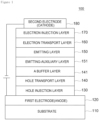
- Fig. 1 is an illustration of an organic electroluminescent device according to the present invention.
- Fig. 2 shows the PL lifetime results of compounds 1-54 according to the present invention.
- Figure 3 shows the PL lifetime results of compounds 3-6 according to the present invention.
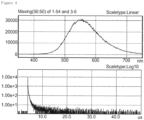
- FIG. 4 shows the PL lifetime results when compound 1-54 and compound 3-6 according to the present invention were mixed.
- alkyl or “alkyl group” , as used herein, has a single bond of 1 to 60 carbon atoms, and means saturated aliphatic functional radicals including a linear alkyl group, a branched chain alkyl group, a cycloalkyl group (alicyclic), an cycloalkyl group substituted with a alkyl or an alkyl group substituted with a cycloalkyl.
- haloalkyl or “halogen alkyl” , as used herein, includes an alkyl group substituted with a halogen.
- heteroalkyl means alkyl substituted one or more of carbon atoms consisting of an alkyl with hetero atom.
- alkenyl or “alkynyl” , as used herein, has double or triple bonds of 2 to 60 carbon atoms, but is not limited thereto, and includes a linear or a branched chain group.
- cycloalkyl means alkyl forming a ring having 3 to 60 carbon atoms, but is not limited thereto.
- alkoxyl group means an oxygen radical attached to an alkyl group, but is not limited thereto, and has 1 to 60 carbon atoms.
- alkenoxyl group means an oxygen radical attached to an alkenyl group, but is not limited thereto, and has 2 to 60 carbon atoms.
- aryloxyl group or “aryloxy group” , as used herein, means an oxygen radical attached to an aryl group, but is not limited thereto, and has 6 to 60 carbon atoms.
- aryl group or “arylene group” , as used herein, has 6 to 60 carbon atoms, but is not limited thereto.
- the aryl group or arylene group means a monocyclic and polycyclic aromatic group, and may also be formed in conjunction with an adjacent group.
- Examples of “aryl group” may include a phenyl group, a biphenyl group, a fluorene group, or a spirofluorene group.
- aryl or "ar” means a radical substituted with an aryl group.
- an arylalkyl may be an alkyl substituted with an aryl
- an arylalkenyl may be an alkenyl substituted with aryl
- a radical substituted with an aryl has a number of carbon atoms as defined herein.
- prefixes when prefixes are named subsequently, it means that substituents are listed in the order described first.
- an arylalkoxy means an alkoxy substituted with an aryl
- an alkoxylcarbonyl means a carbonyl substituted with an alkoxyl
- an arylcarbonylalkenyl also means an alkenyl substituted with an arylcarbonyl, wherein the arylcarbonyl may be a carbonyl substituted with an aryl.
- heteroalkyl means alkyl containing one or more of hetero atoms.
- heterocyclic group contains one or more heteroatoms, but is not limited thereto, has 2 to 60 carbon atoms, includes any one of monocyclic and polycyclic rings, and may include heteroaliphatic ring and/or heteroaromatic ring. Also, the heterocyclic group may also be formed in conjunction with an adjacent group. Unless otherwise stated, the term “heteroatom” , as used herein, represents at least one of N, O, S, P, or Si.
- heterocyclic group may include a ring containing SO 2 instead of carbon consisting of cycle.
- heterocyclic group includes compound below.
- aliphatic means an aliphatic hydrocarbon having 1 to 60 carbon atoms
- aliphatic ring means an aliphatic hydrocarbon ring having 3 to 60 carbon atoms.
- ring means an aliphatic ring having 3 to 60 carbon atoms, or an aromatic ring having 6 to 60 carbon atoms, or a hetero ring having 2 to 60 carbon atoms, or a fused ring formed by the combination of them, and includes a saturated or unsaturated ring.
- hetero compounds or hetero radicals other than the above-mentioned hetero compounds include, but are not limited thereto, one or more heteroatoms.
- carbonyl is represented by -COR' , wherein R' may be hydrogen, an alkyl having 1 to 20 carbon atoms, an aryl having 6 to 30 carbon atoms, a cycloalkyl having 3 to 30 carbon atoms, an alkenyl having 2 to 20 carbon atoms, an alkynyl having 2 to 20 carbon atoms, or the combination of these.
- ether as used herein, is represented by -R-O-R' , wherein R or R' may be independently hydrogen, an alkyl having 1 to 20 carbon atoms, an aryl having 6 to 30 carbon atoms, a cycloalkyl having 3 to 30 carbon atoms, an alkenyl having 2 to 20 carbon atoms, an alkynyl having 2 to 20 carbon atoms, or the combination of these.
- substituted or unsubstituted means that substitution is substituted by at least one substituent selected from the group consisting of, but is not limited thereto, deuterium, halogen, an amino group, a nitrile group, a nitro group, a C 1 -C 20 alkyl group, a C 1 -C 20 alkoxyl group, a C 1 -C 20 alkylamine group, a C 1 -C 20 alkylthiophene group, a C 6 -C 20 arylthiophene group, a C 2 -C 20 alkenyl group, a C 2 -C 20 alkynyl group, a C 3 -C 20 cycloalkyl group, a C 6 -C 20 aryl group, a C 6 -C 20 aryl group substituted by deuterium, a C 8 -C 20 arylalkenyl group, a silane group
- the Formula used in the present invention is applied in the same manner as the substituent definition according to the definition of the exponent of the following Formula, wherein, when a is an integer of zero, the substituent R 1 is absent, when a is an integer of 1, the sole substituent R 1 is linked to any one of the carbon constituting the benzene ring, when a is an integer of 2 or 3, they are respectively combined as follows, in which R 1 may be the same as or different from each other, and when a is an integer of 4 to 6, and it is bonded to the carbon of the benzene ring in a similar manner, whereas the indication of hydrogen bonded to the carbon forming the benzene ring is omitted.
- the terms "ortho”, “meta”, and “para” used in the present invention refer to the substitution positions of all substituents, and the ortho position indicates the position of the substituent immediately adjacent to the compound, for example, when benzene is used, it means 1 or 2 position, and the meta position is the next substitution position of the neighbor substitution position, when benzene as an example stands for 1 or 3 position, and the para position is the next substitution position of the meta position, which means 1 and 4 position when benzene is taken as an example.
- a more detailed example of the substitution position is as follows, and it can be confirmed that the ortho-, and meta-position are substituted by non-linear type and para- positions are substituted by linear type.
- the present invention provides an organic electronic element characterized by comprising a first electrode, a second electrode, and an organic material layer formed between the first electrode and the second electrode, wherein the organic material layer comprises an emitting layer, wherein the emitting layer comprises a first host compound represented by Formula 1 as the phosphorescent emitting layer and a second host compound represented by Formula 2, wherein
- the present invention also provides a compound represented by the Formula 2
- the first host compound represented by Formula 1 includes a compound represented by Formula 3 or Formula 4 below wherein R 1 , R 2 , L 1 , Ar 1 , Ar 2 , Ar 3 , a and b are the same as defined above.
- L 1 and L 2 are selected from the group consisting of the following Formulas (A-1) to (A-12), wherein
- the present invention provides a compound wherein the first host compound represented by the Formula 1 is represented by any one of the following Formulas 5 to 8, wherein
- the present invention also provides an organic electric element wherein the first host compound represented by Formula 1 is represented by any one of Formulas 9 to 20 below, wherein R 1 , R 2 , L 1 , Ar 1 , Ar 2 , Ar 3 , a and b are the same as defined above. Also, the first host compound represented by Formula 1 includes a compound represented by Formula 21 to Formula 22 below, wherein R 1 , R 2 , L1, Ar 1 , Ar 2 , Ar 3 , a and b are the same as defined above.
- the present invention also provides an organic electric element wherein n is 1 in Formula 1 and n is 2 in Formula 2.
- the present invention provides an organic electric element wherein the first host compound represented by Formula 1 comprises a compound represented by Formula 23 below, wherein
- the present invention provides an organic electric element wherein the second host compound represented by Formula 2 comprises a compound represented by Formula 24 or Formula 25 below, wherein R 3 , R 4 , R 5 , Ar 4 , L 2 , c, d, e, A, B, X 1 and X 2 are the same as defined above.
- the present invention also provides an organic electric element comprising a compound wherein A and B in Formula 2 are selected from the group consisting of the following Formulas (B-1) to (B-7), wherein
- R 4 in the Formula 2 includes a compound necessarily forming an aromatic ring or a heteroaromatic ring.
- the present invention provides a compound wherein the second host compound represented by Formula 2 includes a compound represented by any one of the following Formulas 26 to 45, wherein Ar 4 , X 1 . X 2 , R 3 , R 4 , R 5 , L 2 , c, d, and e are the same as defined above.
- the second host compound represented by Formula 2 comprises any one of compounds represented by Formulas 46 to 53 below, wherein R 3 , R 4 , R 5 , Ar 4 , L 2 , c, d, e, A, B, R' and R" are the same as defined above.
- the first host compound represented by Formula 1 is any one of the following Compounds 1-1 to 1-68 and Compounds 2-1 to 2-68.
- the second host compound represented by Formula 2 includes any one of the following Compounds 3-1 to 3-88.
- the organic electric element(100) includes a first electrode(120) formed on a substrate(110), a second electrode(180), and an organic material layer including the compound represented by Formula 1 between the first electrode(120) and the second electrode(180).
- the first electrode(120) may be an anode (positive electrode)
- the second electrode(180) may be a cathode (negative electrode).
- the first electrode may be a cathode
- the second electrode may be an anode.
- the organic material layer may include a hole injection layer(130), a hole transport layer(140), an emitting layer(150), an electron transport layer(160), and an electron injection layer(170) formed in sequence on the first electrode(120). Here, the remaining layers except the emitting layer(150) may not be formed.
- the organic material layer may further include a hole blocking layer, an electron blocking layer, an emitting-auxiliary layer(151), an electron transport auxiliary layer, a buffer layer(141), etc., and the electron transport layer(160) and the like may serve as a hole blocking layer.
- the organic electric element according to the present invention may further include a protective layer formed on at least one side of the first and second electrodes, which is a side opposite to the organic material layer.
- the band gap, the electrical characteristics, the interface characteristics, and the like may vary depending on which substituent is bonded at which position, therefore the choice of core and the combination of sub-substituents associated therewith is also very important, and in particular, when the optimal combination of energy levels and T1 values and unique properties of materials(mobility, interfacial characteristics, etc.) of each organic material layer is achieved, a long life span and high efficiency can be achieved at the same time.
- the organic electroluminescent device may be manufactured using a PVD (physical vapor deposition) method.
- a metal or a metal oxide having conductivity or an alloy thereof is deposited on a substrate to form a cathode, and the organic material layer including the hole injection layer(130), the hole transport layer(140), the emitting layer(150), the electron transport layer(160), and the electron injection layer(170) is formed thereon, and then depositing a material usable as a cathode thereon can manufacture an organic electroluminescent device according to an embodiment of the present invention.
- an emission auxiliary layer(151) may be further formed between the hole transport layer(140) and the emitting layer(150), and an electron transport auxiliary layer may be further formed between the emitting layer(150) and the electron transport layer (160).
- the present invention may further include a light efficiency enhancing layer formed on at least one of the opposite side to the organic material layer among one side of the first electrode, or one of the opposite side to the organic material layer among one side of the second electrode.
- the present invention provides the organic electric element wherein the organic material layer is formed by one of a spin coating process, a nozzle printing process, an inkjet printing process, a slot coating process, a dip coating process or a roll-to-roll process, and since the organic material layer according to the present invention can be formed by various methods, the scope of the present invention is not limited by the method of forming the organic material layer.
- the present invention provides an organic electric element wherein the emitting layer in the organic material layer is a phosphorescent light emitting layer.
- the compounds represented by Formula 1 and by Formula 2 are mixed in a ratio of any one of 1: 9 to 9: 1 to be included in the emitting layer of the organic material layer.
- the compounds represented by Formula 1 and by Formula 2 are mixed in a ratio of any one of 1: 9 to 5: 5 to be included in the emitting layer of the organic material layer.
- the mixing ratio of the compound represented by the Formula 1 and by the Formula 2 is 2: 8 or 3: 7 to be included in the emitting layer of the organic material layer.
- the organic electric element according to an embodiment of the present invention may be a front emission type, a back emission type, or a both-sided emission type, depending on the material used.
- WOLED White Organic Light Emitting Device
- R red
- G green
- B blue
- CCM color conversion material
- the present invention also provides an electronic device comprising a display device including the organic electric element; and a control unit for driving the display device.
- the present invention provides an electronic device characterized in that the organic electric element is at least one of an OLED, an organic solar cell, an organic photo conductor, an organic transistor and an element for monochromic or white illumination.
- the electronic device may be a wired/wireless communication terminal which is currently used or will be used in the future, and covers all kinds of electronic devices including a mobile communication terminal such as a cellular phone, a personal digital assistant (PDA), an electronic dictionary, a point-to-multipoint (PMP), a remote controller, a navigation unit, a game player, various kinds of TVs, and various kinds of computers.
- a mobile communication terminal such as a cellular phone, a personal digital assistant (PDA), an electronic dictionary, a point-to-multipoint (PMP), a remote controller, a navigation unit, a game player, various kinds of TVs, and various kinds of computers.
- the final products 1 represented by Formula 1 of the present invention can be synthesized by reaction between Sub 1 and Sub 2 as illustrated in the following Reaction Scheme 1.
- Sub 2 of reaction scheme 1 can be synthesized by the reaction path of reaction scheme 3 below, but is not limited thereto.
- Bromobenzene (37.1 g, 236.2 mmol) was added to a round bottom flask and dissolved in toluene (2200 mL), aniline (20 g, 214.8 mmol), Pd 2 (dba) 3 (9.83 g, 10.7 mmol), P(t-Bu) 3 (4.34g, 21.5mmol), NaOt-Bu (62 g, 644.3 mmol) were added in the order and stirred at 100 ° C. After the reaction was completed, the reaction mixture was extracted with ether and water. The organic layer was dried over MgSO 4 and concentrated. The resulting compound was separated by silicagel column chromatography and recrystallized to obtain 28 g of the product (yield: 77%).
- the final product 2 represented by Formula 2 of the present invention is prepared by reacting Sub 3 and Sub 4 as shown in Reaction Scheme 4 below.
- Sub 3 of Reaction Scheme 4 can be synthesized by the reaction path of Reaction Scheme 5 below, but is not limited thereto.
- Sub 3-4-1 (20 g, 56.3 mmol) and triphenylphosphine (37 g, 141 mmol) were dissolved in o-dichlorobenzene (235 mL) and refluxed for 24 hours. When the reaction was completed, the solvent was removed using reduced pressure distillation. The resulting compound was separated by silicagel column chromatography and recrystallized to obtain Sub 3(1) (13.6g, 75%).
- Sub 3-4-2 (20 g, 56.3 mmol), triphenylphosphine (44.28 g, 0.17 mol), ⁇ dichlorobenzene (235 mL) were carried out in the same manner as in Sub 3(1) to give the product Sub 3(2) (12 g, 66%).
- Sub 3-2-3 (46.1 g, 111 mmol), Sub 3-3 (26.7 g, 131 mmol), K 2 CO 3 (45.6g, 330mmol), Pd(PPh 3 ) 4 (7.63 g, 6.6 mmol) were carried out in the same manner as in Sub 3-4-1 to give the product Sub 3-4-3 (29.6 g, 65 %).
- Sub 3-4-3 (20.7 g, 50 mmol), triphenylphosphine (32.7 g, 125 mmol), ⁇ dichlorobenzene (205 mL) were carried out in the same manner as in Sub 3(1) to give the product Sub 3(7) (13.0 g, 68 %).
- Sub 3-1-4 (55.6 g, 160 mmol), bis(pinacolato)diboron (44.7 g, 176 mmol), KOAc (47.1 g, 480 mmol), PdCl 2 (dppf) (3.92 g, 4.8 mmol) were carried out in the same manner as in Sub 3-2-1 to give the product Sub 3-2-4 (47.9 g, 76 %).
- Sub 3-2-4 (43.4 g, 110 mmol), Sub 3-3 (26.7 g, 132 mmol), K 2 CO 3 (45.6 g, 330 mmol), Pd(PPh 3 ) 4 (7.63 g, 6.6 mmol) were carried out in the same manner as in Sub 3-4-1 to give the product Sub 3-4-4 (27.4 g, 64 %).
- Sub 3-1-5 (51.7 g, 160 mmol), bis(pinacolato)diboron (44.7 g, 176 mmol), KOAc (47.1 g, 480 mmol), PdCl 2 (dppf) (3.92 g, 4.8 mmol) were carried out in the same manner as in Sub 3-2-1 to give the product Sub 3-2-5 (46.2 g, 78 %).
- Sub 3-2-5 (40.7 g, 110 mmol), Sub 3-3-1 (33.2 g, 132 mmol), K 2 CO 3 (45.6 g, 330 mmol), Pd(PPh 3 ) 4 (7.62 g, 6.6 mmol) were carried out in the same manner as in Sub 3-4-1 to give the product Sub 3-4-5 (30.6 g, 67 %).
- Sub 3-1-6 (59.6 g, 160 mmol), bis(pinacolato)diboron (44.7 g, 176 mmol), KOAc (47.1 g, 480 mmol), PdCl 2 (dppf) (3.92 g, 4.8 mmol) were carried out in the same manner as in Sub 3-2-1 to give the product Sub 3-2-6 (50.4 g, 75 %).
- Sub 3-2-6 (46.1 g, 110 mmol), Sub 3-3-2 (33.3 g, 132 mmol), K 2 CO 3 (45.6 g, 330 mmol), Pd(PPh 3 ) 4 (7.63 g, 6.6 mmol) were carried out in the same manner as in Sub 3-4-1 to give the product Sub 3-4-6 (32.2 g, 63 %).
- Sub 3-1-7 (47.5 g, 160 mmol), bis(pinacolato)diboron (44.7 g, 176 mmol), KOAc (47.1 g, 480 mmol), PdCl 2 (dppf) (3.92 g, 4.8 mmol) were carried out in the same manner as in Sub 3-2-1 to give the product Sub 3-2-7 (43.0 g, 78 %).
- Sub 3-2-7 (37.9 g, 110 mmol), Sub 3-3-1 (33.3 g, 132 mmol), K 2 CO 3 (45.7 g, 330 mmol), Pd(PPh 3 ) 4 (7.64 g, 6.6 mmol) were carried out in the same manner as in Sub 3-4-1 to give the product Sub 3-4-7 (27.4 g, 64 %).
- Sub 3-1-8 (43.7 g, 160 mmol), bis(pinacolato)diboron (44.7 g, 176 mmol), KOAc (47.1 g, 480 mmol), PdCl 2 (dppf) (3.9 g, 4.8 mmol) were carried out in the same manner as in Sub 3-2-1 to give the product Sub 3-2-8 (38.4 g, 75 %).
- Sub 3-2-8 (35.2 g, 110 mmol), Sub 3-3-3 (39.9 g, 132 mmol), K 2 CO 3 (45.6 g, 330 mmol), Pd(PPh 3 ) 4 (7.6 g, 6.6 mmol) were carried out in the same manner as in Sub 3-4-1 to give the product Sub 3-4-8 (31.5 g, 69 %).
- Sub 3-4-8 (20.8 g, 50 mmol), triphenylphosphine (32.8 g, 125 mmol), ⁇ dichlorobenzene (205 mL) were carried out in the same manner as in Sub 3(1) to give the product Sub 3(66) (12.5 g, 65 %).
- Sub 1 + Sub 2 -> Final Products 1 reaction in Reaction Scheme 1 the synthetic reaction of Sub 2 in Reaction Scheme 3, Sub 3 + Sub 4 -> Final Products 2 reaction in Reaction Scheme 4 are all based on the Buchwald-Hartwig cross coupling reaction
- Sub 1-3 + Sub 1-4 -> Sub 1 reaction in Reaction Scheme 2 and Sub 3-2 + Sub 3-3 -> Sub 3-4 in Reaction Scheme 5 are all based on the Suzuki cross-coupling reaction
- Sub 3-4 -> Sub 3 in Reaction Scheme 5 is based on the PPh3-mediated reductive cyclization reaction ( J. Org. Chem. 2005, 70, 5014 .)
- the above reactions will proceed even if a substituent not specifically mentioned is bonded.
- Example 1 Manufacture and evaluation of Red organic light emitting diode First, on an ITO layer(anode) formed on a glass substrate, N 1 -(naphthalen-2-yl)-N 4 ,N 4 -bis(4-(naphthalen-2-yl(phenyl)amino)phenyl)-N 1 -phenyl benzene-1,4-diamine(hereinafter will be abbreviated as 2-TNATA) was vacuum-deposited to form a hole injection layer with a thickness of 60 nm, and N,N' -bis(1-naphthalenyl)-N,N' -bis-phenyl-(1,1' -biphenyl)-4,4' -diamine (hereinafter will be abbreviated as NPB) was vacuum-deposited to form a hole transport layer with a thickness of 60 nm.
- 2-TNATA N 1 -(naphthalen-2-yl)-N 4 ,N 4
- a mixture of the compounds represented by the Formulas 1 and 2 as a host in a ratio of 3: 7 was used as a host, and as a dopant, a light emitting layer with a thickness of 30 nm was deposited on the hole transport layer by doping (piq) 2 Ir(acac) [bis-(1-phenylisoquinolyl)iridium(III)acetylacetonate] with a weight of 95: 5.
- BAlq (1,1' -bisphenyl)-4-olato)bis(2-methyl-8-quinolinolato)aluminum
- BAlq was vacuum deposited as a hole blocking layer to a thickness of 10 nm
- tris(8-quinolinol)aluminum (hereinafter abbreviated as Alq3) was deposited to a thickness of 40 nm as an electron transport layer.
- Alq3 tris(8-quinolinol)aluminum
- Alq3 tris(8-quinolinol)aluminum
- An organic electroluminescent device was manufactured in the same manner as in Example 1, except that the compound represented by Formula 2 was used as a host alone.
- An organic electroluminescent device was manufactured in the same manner as in Example 1, except that the comparative compound 1 was used as a host alone.
- An organic electroluminescent device was manufactured in the same manner as in Example 1, except that the comparative compound 2 was used as a host alone.
- An organic electroluminescent device was manufactured in the same manner as in Example 1, except that the comparative compound 3 was used as a host alone.
- An organic electroluminescent device was manufactured in the same manner as in Example 1, except that the comparative compound 4 was used as a host alone.
- An organic electroluminescent device was manufactured in the same manner as in Example 1, except that comparative compound 1 and comparative compound 2 were mixed and used as a host.
- An organic electroluminescent device was manufactured in the same manner as in Example 1, except that comparative compound 3 and comparative compound 4 were mixed and used as a host.
- Comparative Examples 1 to 7 the compounds of the present invention represented by the Formula 2 and comparative compounds 1 to 4 are used alone as a phosphorescent host, wherein Comparative Examples 1 to 3 using the compounds (3-6, 3-61, and 3-74) of the present invention had higher efficiency and longer life span than Comparative Examples 4 to 7 using the comparative compound.
- Comparative Example 8 and Comparative Example 9 in which Comparative Compound 1 and Comparative Compound 2 or Comparative Compound 3 and Comparative Compound 4 were mixed and used as a phosphorescent host were found to exhibit higher efficiency than Comparative Examples 1 to 7 using the single substance.
- Comparative Example 9 using a mixture containing a polycyclic compound having a different heteroatom (N, S) among the 5-membered compounds had higher efficiency than Comparative Example 8 mixed a 5-membered heterocyclic compound having the same nitrogen atom.
- Comparative Example 10 using a mixture of Compound 2-5 corresponding to Formula 1 and Comparative Compound 3, and Comparative Example 9 using a mixture of Comparative Compound 3 and Comparative Compound 4, when the comparative compound 3 was commonly used and the biscarbazole substance (Comparative Example 9) and Compound 2-5 corresponding to the present invention compound 1 were used as the host material, it was confirmed that Comparative Example 10 using the compound 2-5 exhibited a higher efficiency and a relatively longer life span.
- Example 1 to 100 using the mixture of the compound of the Formula 1 and the Formula 2 as a host exhibited remarkably high efficiency and long life span and a low driving voltage than the Comparative Example 1 to 10.
- the inventors of the present invention have found that, in the case of a mixture of the substance of the Formula 1 and the substance of the Formula 2, they have novel characteristics other than those for the respective materials, and have measured the PL lifetime using the substance (1-54) of Formula 1, the substance (3-6) of Formula 2, and the mixture (1-54 + 3-6) of the present invention as shown in the Table 8.
- the mixture of the compound of the present invention was measured by fabricating the device in (2:8, 3:7, 4:6, 5:5).
Landscapes
- Chemical & Material Sciences (AREA)
- Organic Chemistry (AREA)
- Engineering & Computer Science (AREA)
- Materials Engineering (AREA)
- Physics & Mathematics (AREA)
- Spectroscopy & Molecular Physics (AREA)
- Optics & Photonics (AREA)
- Electroluminescent Light Sources (AREA)
- Nitrogen Condensed Heterocyclic Rings (AREA)
- Indole Compounds (AREA)
- Devices For Indicating Variable Information By Combining Individual Elements (AREA)
- Plural Heterocyclic Compounds (AREA)
- Heterocyclic Carbon Compounds Containing A Hetero Ring Having Oxygen Or Sulfur (AREA)
- Nitrogen And Oxygen Or Sulfur-Condensed Heterocyclic Ring Systems (AREA)
Claims (16)
- Organisches elektrisches Element (100), umfassend:eine erste Elektrode (120), eine zweite Elektrode (180) und eine organische Materialschicht, die zwischen der ersten Elektrode und der zweiten Elektrode ausgebildet ist, wobei die organische Materialschicht eine emittierende Schicht (150) umfasst,wobei die emittierende Schicht eine erste Hostverbindung, die durch Formel 1 dargestellt wird, als die phosphoreszierendes Licht emittierende Schicht und eine zweite Hostverbindung, die durch Formel 2 dargestellt wird, umfasst,
 1) Ar1, Ar2, Ar3 und Ar4 jeweils unabhängig ausgewählt sind aus der Gruppe bestehend aus einer C6-C60-Arylgruppe; einer Fluorenyl-Gruppe; einer heterozyklischen C2-C60-Gruppe, die mindestens ein Heteroatom aus O, N, S, Si und P beinhaltet; einer kondensierten Ring-Gruppe aus einem aliphatischen C3-C60-Ring und einem aromatischen C6-C60-Ring; einer C1-C50-Alkylgruppe; einer C2-C20-Alkenylgruppe; einer C2-C20-Alkinylgruppe; einer C1-C30-Alkoxygruppe; einer C6-C30 Aryloxygruppe;2) a eine ganze Zahl von 0 bis 4 ist, und b eine ganze Zahl von 0 bis 3 ist, und c und e eine ganze Zahl von 0 bis 10 sind, und d eine ganze Zahl von 0 bis 2 ist,3) R1, R2, R3, R4 und R5 gleich oder unterschiedlich sein können, und jeweils unabhängig ausgewählt sind aus der Gruppe bestehend aus Deuterium; Halogen; einer C6-C60-Arylgruppe;
einer Fluorenyl-Gruppe; einer heterozyklischen C2-C60-Gruppe, die mindestens ein Heteroatom aus O, N, S, Si oder P beinhaltet; einer kondensierten Ring-Gruppe aus einem aliphatischen C3-C60-Ring und einem aromatischen C6-C60-Ring; einer C1-C50-Alkylgruppe; einer C2-C20-Alkenylgruppe; einer C2-C20-Alkinylgruppe; einer C1-C30-Alkoxygruppe; einer C6-C30-Aryloxygruppe; oder in dem Fall, dass a, b, c und e 2 oder mehr sind, und d 2 ist, R1, R2, R3, R4 und R5 jeweils in einer Vielzahl vorkommen und gleich oder unterschiedlich sind, und eine Vielzahl von R1 oder eine Vielzahl von R2 oder eine Vielzahl von R3 oder eine Vielzahl von R4 oder eine Vielzahl von R5 aneinander gebunden sein können, um einen Ring zu bilden,4) L1 und L2 jeweils unabhängig ausgewählt sind aus der Gruppe bestehend aus einer Einfachbindung, einer C6-C60-Arylengruppe, und einer Fluorenylen-Gruppe; einer kondensierten Ring-Gruppe aus einem aliphatischen C3-C60-Ring und einem aromatischen C6-C60-Ring; und einer heterozyklischen C2-C60-Gruppe,5) A und B jeweils unabhängig eine C6-C60-Arylgruppe oder eine heterozyklische C2-C20-Gruppe sind, wobei A und B beide eine substituierte oder unsubstituierte C6-Arylgruppe (Phenylgruppe) sind, d 2 ist und die R4 aneinander gebunden sind, um einen Ring, um einen aromatischen oder Heteroring zu bilden,6) i und j unabhängig 0 oder 1 sind, mit der Maßgabe, dass i + j 1 oder mehr ist, und wenn i oder j 0 ist, dies eine direkte Bindung bedeutet,7) X1 und X2 unabhängig NR', O, S oder CR'R" sind, wobei R' und R" unabhängig Wasserstoff; eine C6-C60-Arylgruppe; eine Fluorenyl-Gruppe; eine heterozyklische C3-C60-Gruppe; oder eine C1-C50-Alkylgruppe sind; wobei R' und R" aneinander gebunden sein können, um eine Spiroverbindung zu bilden, und8) n eine ganze Zahl von 1 oder 2 ist, wenn n 2 ist, zwei Ar2 gleich oder unterschiedlich sind, und zwei Ar3 jeweils gleich oder unterschiedlich sind, und wobei eine Arylgruppe, Fluorenyl-Gruppe, Arylengruppe, heterozyklische Gruppe, kondensierte Ring-Gruppe, Alkylgruppe, Alkenylgruppe, Alkoxygruppe und Aryloxygruppe mit einem oder mehreren Substituenten ausgewählt aus der Gruppe bestehend aus Deuterium; Halogen; einer C1-C20-Alkylgruppe; einer C2-C20-Alkenylgruppe; einer C2-C20-Alkinylgruppe; einer C6-C20-Arylgruppe; einer mit Deuterium substituierten C6-C20-Arylgruppe; einer Fluorenyl-Gruppe; einer heterozyklischen C2-C20-Gruppe substituiert sein kann; wobei die Substituenten sich miteinander kombinieren können und einen gesättigten oder ungesättigten Ring bilden, wobei der Begriff 'Ring' einen aliphatischen C3-C60-Ring oder einen aromatischen C6-C60-Ring oder einen heterozyklischen C2-C60-Ring oder einen kondensierten Ring bedeutet, der durch die Kombination davon gebildet wird. - Organisches elektrisches Element nach Anspruch 1, wobei die erste Hostverbindung, die durch die Formel 1 dargestellt wird, eine Verbindung umfasst, die durch die nachstehende Formel 3 oder Formel 4, Formel 21 oder Formel 22 dargestellt wird,


- Organisches elektrisches Element nach Anspruch 1, wobei L1 und L2 aus der Gruppe bestehend aus den folgenden Formeln (A-1) bis (A-12) ausgewählt sind,


 1) a', c', d' und e' eine ganze Zahl von 0 bis 4 sind, und b' eine ganze Zahl von 0 bis 5 ist, und f' und g' eine ganze Zahl von 0 bis 3 sind, und h' eine ganze Zahl von 0 bis 1 ist,3) R6, R7 und R8 gleich oder unterschiedlich sind, und jeweils unabhängig ausgewählt sind aus der Gruppe bestehend aus Deuterium; Halogen; einer C6-C60-Arylgruppe; einer Fluorenyl-Gruppe; einer heterozyklischen C2-C60-Gruppe, die mindestens ein Heteroatom aus O, N, S, Si oder P beinhaltet; einer kondensierten Ring-Gruppe aus einem aliphatischen C3-C60-Ring und einem aromatischen C6-C60-Ring; einer C1-C50-Alkylgruppe; einer C2-C20-Alkenylgruppe; einer C2-C20-Alkinylgruppe; einer C1-C30-Alkoxygruppe; einer C6-C30 Aryloxygruppe;
oder wenn f' und g' zwei oder mehr sind, sie gleich oder voneinander unterschiedlich sind, und eine Vielzahl von R6 oder eine Vielzahl von R7 oder eine Vielzahl von R8 aneinander gebunden sein können, um einen aromatischen oder einen heteroaromatischen Ring zu bilden, zwei benachbarte R6 und R7, oder R7 und R8 verbunden sein können, um einen aromatischen oder heteroaromatischen Ring zu bilden,3) Y NR', O, S oder CR'R" ist4) R' und R" gleich wie in Anspruch 1 definiert sind, und5) Z1, Z2 und Z3 unabhängig voneinander CR' oder N sind und zumindest eines davon N ist. - Organisches elektrisches Element nach Anspruch 1, wobei die erste Hostverbindung, die durch die Formel 1 dargestellt wird, durch eine der folgenden Formeln 5 bis 20 dargestellt wird,


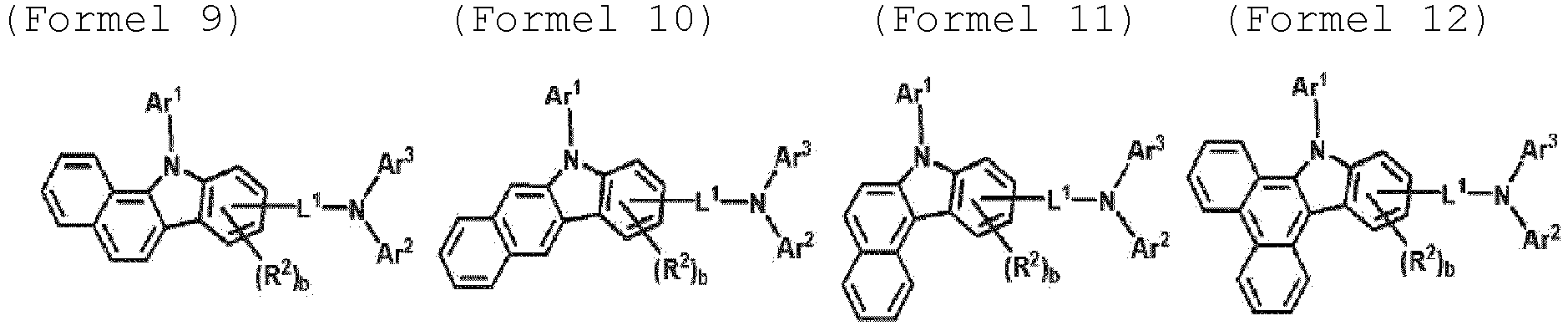

 1) R1, R2, Ar1, Ar2, Ar3, a, b, R' und R" gleich wie in Anspruch 1 definiert sind,2) R6 und R7 gleich oder unterschiedlich sind, und jeweils unabhängig ausgewählt sind aus der Gruppe bestehend aus Deuterium; Halogen; einer C6-C60-Arylgruppe; einer Fluorenyl-Gruppe; einer heterozyklischen C2-C60-Gruppe, die mindestens ein Heteroatom aus O, N, S, Si oder P beinhaltet; einer kondensierten Ring-Gruppe aus einem aliphatischen C3-C60-Ring und einem aromatischen C6-C60-Ring; einer C1-C50-Alkylgruppe; einer C2-C20-Alkenylgruppe; einer C2-C20-Alkinylgruppe; einer C1-C30-Alkoxygruppe; einer C6-C30 Aryloxygruppe; oder in dem Fall, dass f' und g' 2 oder mehr sind, jedes davon in der Vielzahl gleich oder unterschiedlich ist, und eine Vielzahl von R6 oder eine Vielzahl von R7 oder eine Vielzahl von R8 oder benachbarte R6 und R7 oder benachbarte R7 und R8 aneinander gebunden sein können, um einen aromatischen oder einen heteroaromatischen Ring zu bilden,3) a', c' und d' jeweils eine ganze Zahl von 0 bis 4 sind, und f' und g' jeweils eine ganze Zahl von 0 bis 3 sind,4) Y NR', O, S oder CR'R" ist.
 - Organisches elektrisches Element nach Anspruch 1, wobei die erste Hostverbindung, die durch die Formel 1 dargestellt wird, eine Verbindung umfasst, die durch die nachstehende Formel 23 dargestellt wird,
 1) R1, R2, L1, Ar1, Ar2, a, b und n gleich wie in Anspruch 1 definiert sind,2) f eine ganze Zahl von 0 bis 3 ist, und g eine ganze Zahl von 0 bis 4 ist,3) R9 und R10 gleich oder unterschiedlich sind, und jeweils unabhängig ausgewählt sind aus der Gruppe bestehend aus Deuterium; Halogen; einer C6-C60-Arylgruppe; einer Fluorenyl-Gruppe; einer heterozyklischen C2-C60-Gruppe, die mindestens ein Heteroatom aus O, N, S, Si oder P beinhaltet; einer kondensierten Ring-Gruppe aus einem aliphatischen C3-C60-Ring und einem aromatischen C6-C60-Ring; einer C1-C50-Alkylgruppe; einer C2-C20-Alkenylgruppe; einer C2-C20-Alkinylgruppe; einer C1-C30-Alkoxygruppe; einer C6-C30 Aryloxygruppe; oder in dem Fall, dass f und g zwei oder mehr sind, jedes davon in der Vielzahl gleich oder unterschiedlich ist, und eine Vielzahl von R9 oder eine Vielzahl von R10 oder benachbarte R9 und R10 aneinander gebunden sein können, um einen aromatischen oder einen heteroaromatischen Ring zu bilden,4) Y NR', O, S oder CR'R" ist, und5) R' und R" gleich wie in Anspruch 1 definiert sind.
 - Organisches elektrisches Element nach Anspruch 1, wobei die zweite Hostverbindung, die durch die Formel 2 dargestellt wird, eine Verbindung umfasst, die durch die nachstehende Formel 24 oder Formel 25 dargestellt wird,

- Organisches elektrisches Element nach Anspruch 1, wobei A und B in der Formel 2 aus der Gruppe bestehend aus den folgenden Formeln (B-1) bis (B-7) ausgewählt sind,

 1) Z4 bis Z50 CR' oder N sind,2) R' gleich wie in Anspruch 1 definiert ist, und3) * die zu kondensierende Position angibt.
 - Organisches elektrisches Element nach Anspruch 1, wobei R4 in Formel 2 eine Verbindung umfasst, die einen aromatischen Ring oder einen heteroaromatischen Ring bildet.
- Organisches elektrisches Element nach Anspruch 1, wobei die zweite Hostverbindung, die durch Formel 2 dargestellt wird, eine Verbindung umfasst, die durch eine der folgenden Formeln 26 bis 45 dargestellt wird,


Ar4, X1, X2, R3, R4, R5, L2, c, d und e gleich wie in Anspruch 1 definiert sind. - Organisches elektrisches Element nach Anspruch 1, wobei die zweite Hostverbindung, die durch die Formel 2 dargestellt wird, eine beliebige der Verbindungen umfasst, die durch die Formeln 46 bis 53 dargestellt werden,


R3, R4, R5, Ar4, L2, c, d, e, A, B, R' und R" gleich wie in Anspruch 1 definiert sind. - Organisches elektrisches Element nach Anspruch 1, wobei die erste Hostverbindung, die durch Formel 1 dargestellt wird, eine beliebige der folgenden Verbindungen 1-1 bis 1-68 und Verbindungen 2-1 bis 2-68 ist:
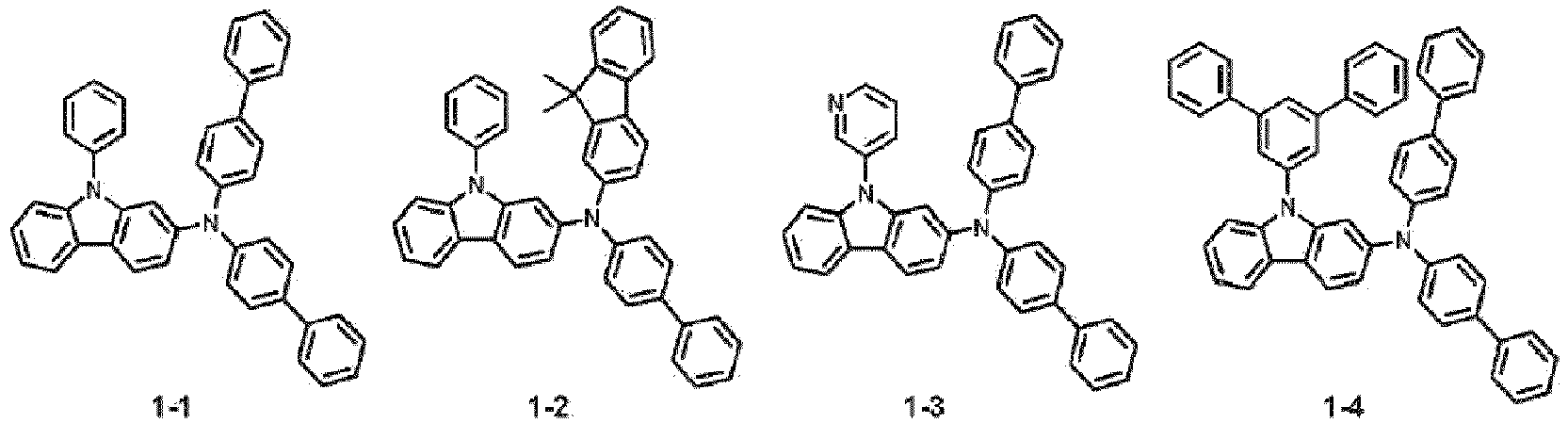


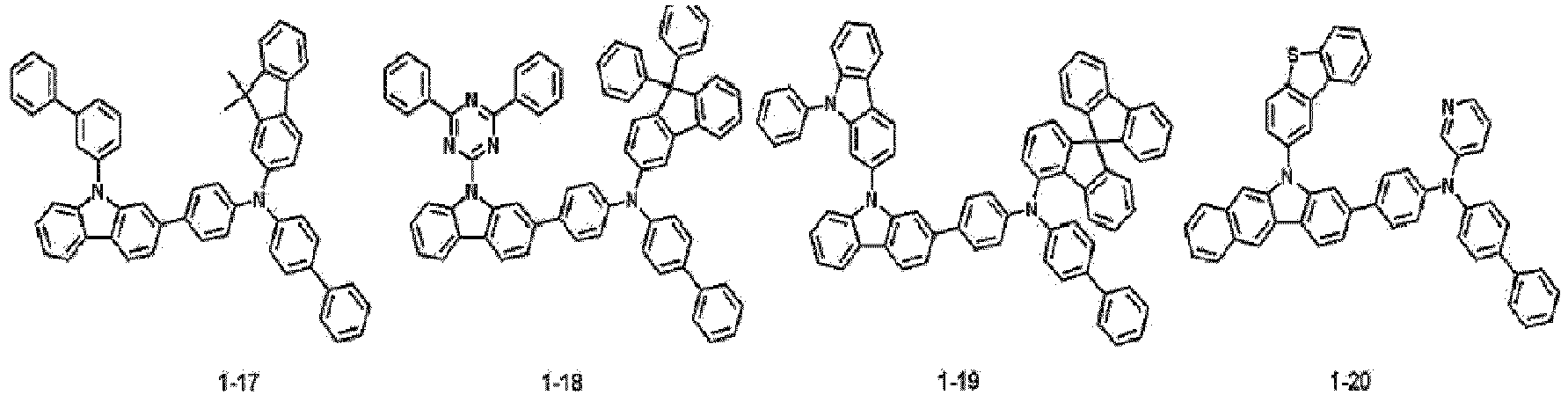


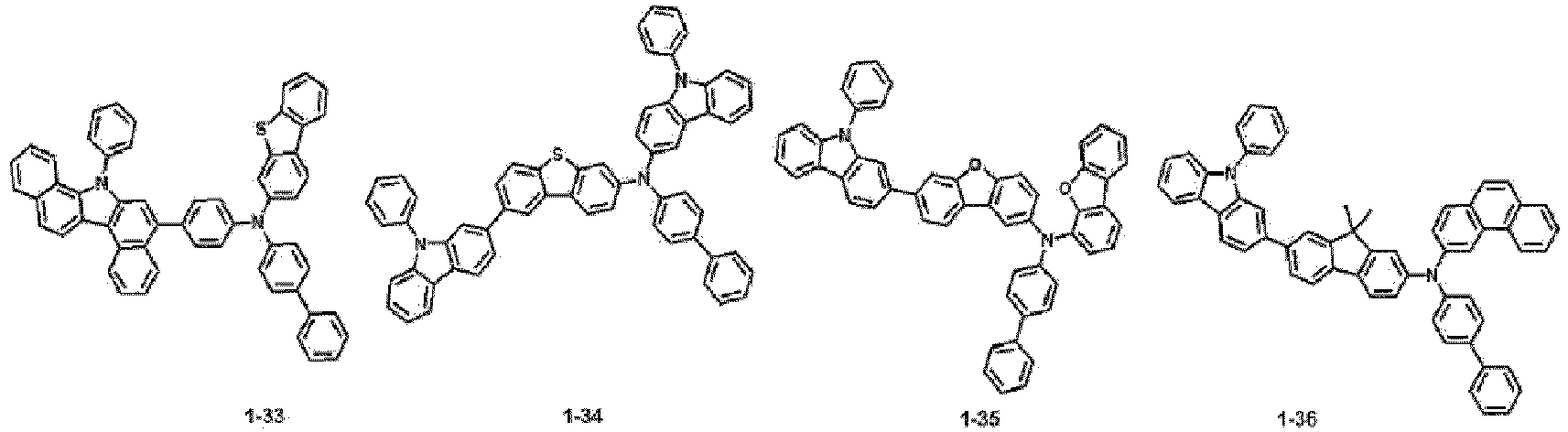


- Organisches elektrisches Element nach Anspruch 1, wobei die zweite Hostverbindung, die durch Formel 2 dargestellt wird, eine beliebige der folgenden Verbindungen 3-1 bis 3-88 umfasst:


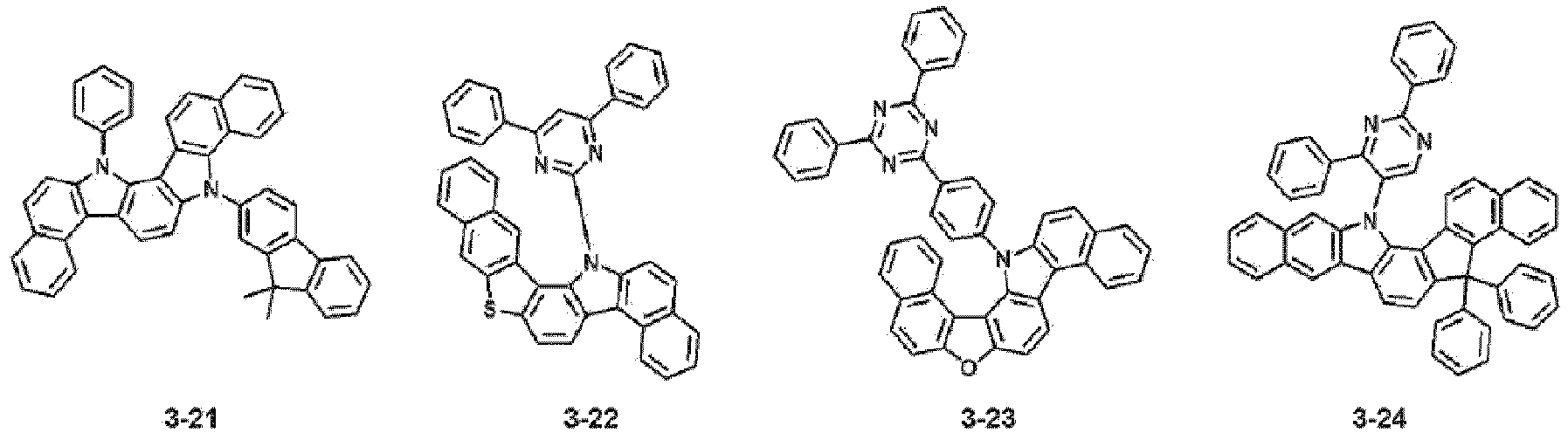


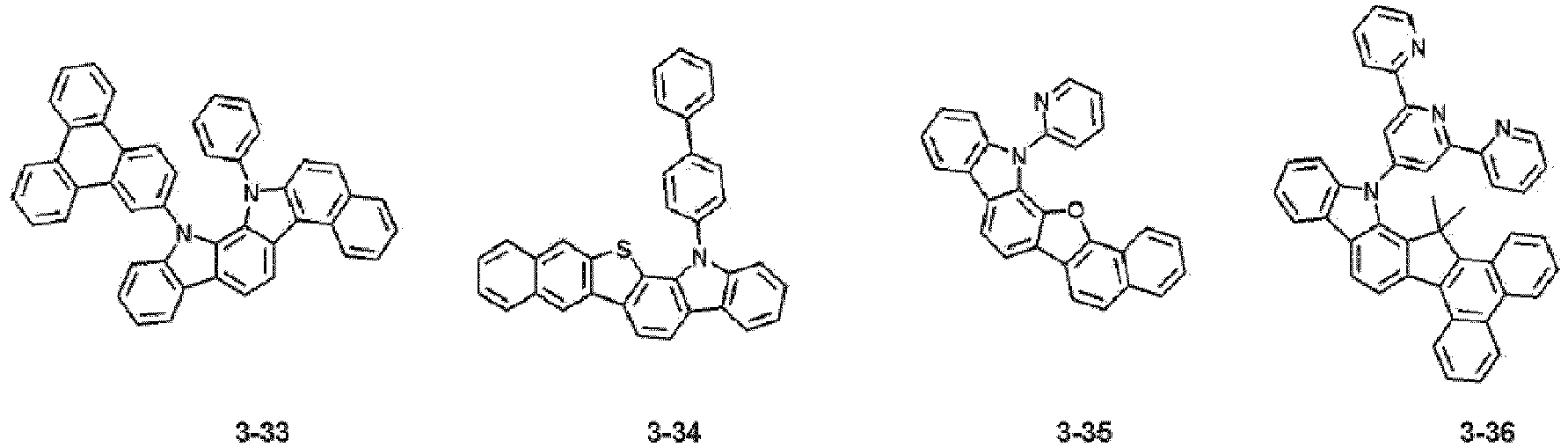


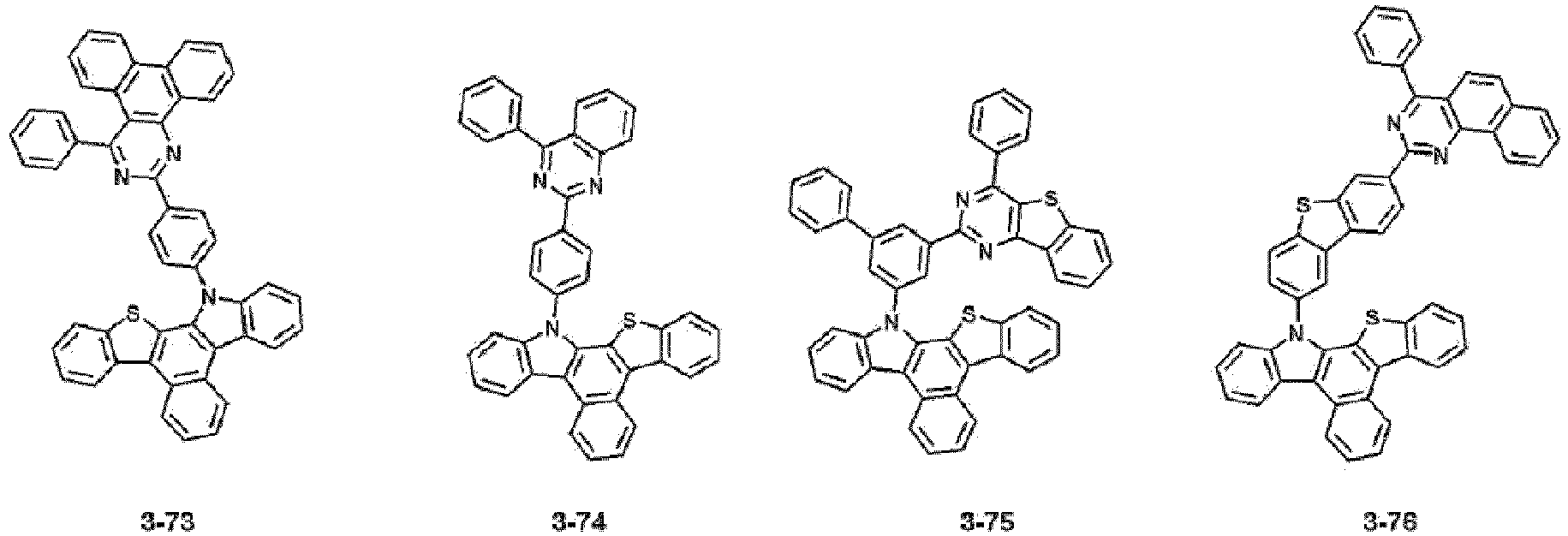


- Organisches elektrisches Element nach Anspruch 1, wobei die Verbindungen, die durch Formel 1 und Formel 2 dargestellt werden, in einem Verhältnis von 1:9 bis 9:1 gemischt werden, um in die emittierende Schicht aufgenommen zu werden.
- Organisches elektrisches Element nach Anspruch 1, wobei die Verbindungen, die durch Formel 1 und Formel 2 dargestellt werden, in einem Verhältnis von 1:9 bis 5:5 gemischt werden, um in die emittierende Schicht aufgenommen zu werden.
- Organisches elektrisches Element nach Anspruch 1, wobei die Verbindungen, die durch Formel 1 und Formel 2 dargestellt werden, in einem Verhältnis von 2:8 oder 3:7 gemischt werden, um in die emittierende Schicht aufgenommen zu werden.
- Elektronische Vorrichtung, umfassend eine Anzeigevorrichtung, die das organische elektrische Element nach Anspruch 1 und eine Steuereinheit zum Ansteuern der Anzeigevorrichtung beinhaltet.
Applications Claiming Priority (4)
| Application Number | Priority Date | Filing Date | Title |
|---|---|---|---|
| KR20160031744 | 2016-03-16 | ||
| KR1020160038502 | 2016-03-30 | ||
| KR1020160126778A KR101786749B1 (ko) | 2016-09-30 | 2016-09-30 | 유기전기소자용 화합물, 이를 이용한 유기전기소자 및 그 전자 장치 |
| PCT/KR2017/002828 WO2017160089A1 (ko) | 2016-03-16 | 2017-03-16 | 유기전기소자용 화합물, 이를 이용한 유기전기소자 및 그 전자 장치 |
Publications (3)
| Publication Number | Publication Date |
|---|---|
| EP3431476A1 EP3431476A1 (de) | 2019-01-23 |
| EP3431476A4 EP3431476A4 (de) | 2019-12-11 |
| EP3431476B1 true EP3431476B1 (de) | 2024-09-04 |
Family
ID=59851085
Family Applications (1)
| Application Number | Title | Priority Date | Filing Date |
|---|---|---|---|
| EP17766990.0A Active EP3431476B1 (de) | 2016-03-16 | 2017-03-16 | Organisches elektrisches element und elektronische vorrichtung daraus |
Country Status (5)
| Country | Link |
|---|---|
| US (2) | US20180123051A1 (de) |
| EP (1) | EP3431476B1 (de) |
| JP (1) | JP6655097B2 (de) |
| CN (2) | CN113013347B (de) |
| WO (1) | WO2017160089A1 (de) |
Families Citing this family (28)
| Publication number | Priority date | Publication date | Assignee | Title |
|---|---|---|---|---|
| KR102598350B1 (ko) | 2017-09-26 | 2023-11-07 | 롬엔드하스전자재료코리아유한회사 | 유기 전계 발광 화합물 및 이를 포함하는 유기 전계 발광 소자 |
| KR102219645B1 (ko) * | 2018-04-10 | 2021-02-24 | 삼성에스디아이 주식회사 | 조성물, 유기 광전자 소자 및 표시 장치 |
| KR102508374B1 (ko) | 2018-04-17 | 2023-03-10 | 엘티소재주식회사 | 헤테로고리 화합물 및 이를 포함하는 유기 발광 소자 |
| KR102448566B1 (ko) * | 2018-12-04 | 2022-09-27 | 삼성에스디아이 주식회사 | 유기 광전자 소자 및 표시 장치 |
| US20220029104A1 (en) * | 2018-12-06 | 2022-01-27 | Duk San Neolux Co., Ltd. | Compound for organic electronic element, organic electronic element using the same, and an electronic device thereof |
| CN110016037B (zh) * | 2019-03-08 | 2021-10-22 | 中山大学 | 一种新型氮杂稠环化合物及其制备方法和应用 |
| CN110330506A (zh) * | 2019-04-29 | 2019-10-15 | 宁波卢米蓝新材料有限公司 | 一种稠合多环化合物及其制备方法和用途 |
| KR102869108B1 (ko) * | 2019-10-24 | 2025-10-14 | 듀폰스페셜티머터리얼스코리아 유한회사 | 복수 종의 호스트 재료 및 이를 포함하는 유기 전계 발광 소자 |
| CN113013365A (zh) * | 2019-12-20 | 2021-06-22 | 罗门哈斯电子材料韩国有限公司 | 多种主体材料及包含其的有机电致发光装置 |
| JP7592639B2 (ja) * | 2020-01-15 | 2024-12-02 | 出光興産株式会社 | 化合物、有機エレクトロルミネッセンス素子用材料、有機エレクトロルミネッセンス素子及び電子機器 |
| CN112079767B (zh) * | 2020-09-04 | 2022-05-31 | 江苏三月科技股份有限公司 | 芳胺类化合物及包含其的有机电致发光器件 |
| KR102935478B1 (ko) | 2020-12-08 | 2026-03-10 | 삼성디스플레이 주식회사 | 발광 소자 및 발광 소자용 아민 화합물 |
| CN114133351B (zh) * | 2021-03-31 | 2023-05-23 | 陕西莱特光电材料股份有限公司 | 含氮化合物及包含其的电子元件和电子装置 |
| JP7767042B2 (ja) * | 2021-06-29 | 2025-11-11 | 保土谷化学工業株式会社 | 化合物、正孔輸送材料、およびそれを用いた光電変換素子 |
| EP4631325A1 (de) | 2022-12-08 | 2025-10-15 | Merck Patent GmbH | Organische elektronische vorrichtung und spezielle materialien für organische elektronische vorrichtungen |
| KR20250124370A (ko) | 2022-12-19 | 2025-08-19 | 메르크 파텐트 게엠베하 | 전자 디바이스용 재료 |
| CN120826409A (zh) | 2023-03-20 | 2025-10-21 | 默克专利有限公司 | 用于有机电致发光器件的材料 |
| KR20260058873A (ko) | 2023-08-29 | 2026-04-29 | 메르크 파텐트 게엠베하 | 유기 전계발광 디바이스용 재료 |
| CN121753521A (zh) | 2023-08-30 | 2026-03-27 | 默克专利有限公司 | 用于有机发光器件的材料 |
| CN121773745A (zh) | 2023-08-30 | 2026-03-31 | 默克专利有限公司 | 用于有机发光器件的材料 |
| CN121753522A (zh) | 2023-08-30 | 2026-03-27 | 默克专利有限公司 | 用于有机发光器件的材料 |
| CN121969629A (zh) | 2023-10-04 | 2026-05-01 | 默克专利有限公司 | 用于有机电致发光器件的材料 |
| WO2025104058A1 (de) | 2023-11-16 | 2025-05-22 | Merck Patent Gmbh | Materialien für organische elektronische vorrichtungen |
| WO2025119821A1 (en) | 2023-12-05 | 2025-06-12 | Merck Patent Gmbh | Material composition for organic electroluminescent devices |
| WO2025168515A1 (de) | 2024-02-06 | 2025-08-14 | Merck Patent Gmbh | Materialien für organische elektronische vorrichtungen |
| WO2025228800A1 (de) | 2024-04-30 | 2025-11-06 | Merck Patent Gmbh | Materialien für organische elektronische vorrichtungen |
| WO2026017612A1 (en) | 2024-07-15 | 2026-01-22 | Merck Patent Gmbh | Organic light-emitting device |
| WO2026017608A1 (de) | 2024-07-15 | 2026-01-22 | Merck Patent Gmbh | Materialien für organische lichtemittierende vorrichtungen |
Family Cites Families (34)
| Publication number | Priority date | Publication date | Assignee | Title |
|---|---|---|---|---|
| US5952115A (en) | 1997-10-02 | 1999-09-14 | Xerox Corporation | Electroluminescent devices |
| US5843607A (en) | 1997-10-02 | 1998-12-01 | Xerox Corporation | Indolocarbazole photoconductors |
| KR100573137B1 (ko) * | 2004-04-02 | 2006-04-24 | 삼성에스디아이 주식회사 | 플루오렌계 화합물 및 이를 이용한 유기 전계 발광 소자 |
| KR100751316B1 (ko) * | 2004-06-25 | 2007-08-22 | 삼성에스디아이 주식회사 | 유기 전계 발광 소자 |
| US7597967B2 (en) * | 2004-12-17 | 2009-10-06 | Eastman Kodak Company | Phosphorescent OLEDs with exciton blocking layer |
| WO2007063796A1 (ja) | 2005-12-01 | 2007-06-07 | Nippon Steel Chemical Co., Ltd. | 有機電界発光素子 |
| EP2080762B1 (de) | 2006-11-09 | 2016-09-14 | Nippon Steel & Sumikin Chemical Co., Ltd. | Verbindung für organische elektrolumineszenzvorrichtung und organische elektrolumineszenzvorrichtung |
| KR101366287B1 (ko) | 2007-12-03 | 2014-03-12 | 엘지전자 주식회사 | 식기 수납체 및 이를 이용한 식기 세척기 |
| KR101523124B1 (ko) | 2008-06-05 | 2015-05-26 | 이데미쓰 고산 가부시키가이샤 | 할로젠 화합물, 다환계 화합물 및 그것을 사용한 유기 전기발광 소자 |
| KR101511072B1 (ko) * | 2009-03-20 | 2015-04-10 | 롬엔드하스전자재료코리아유한회사 | 신규한 유기 발광 화합물 및 이를 포함하는 유기 전계 발광소자 |
| WO2011037429A2 (ko) * | 2009-09-28 | 2011-03-31 | 덕산하이메탈(주) | 아릴 고리가 축합된 복소환 5원자고리 유도체를 가지는 화합물 및 이를 이용한 유기전기소자, 그 단말 |
| WO2011055932A2 (ko) * | 2009-11-05 | 2011-05-12 | 덕산하이메탈(주) | 유기화합물 및 이를 이용한 유기전기소자, 그 단말 |
| KR101322828B1 (ko) * | 2009-11-05 | 2013-10-25 | 덕산하이메탈(주) | 유기화합물 및 이를 이용한 유기전기소자, 그 단말 |
| KR101219492B1 (ko) * | 2009-12-11 | 2013-01-28 | 삼성디스플레이 주식회사 | 오원자 헤테로 고리를 포함하는 화합물 및 이를 이용한 유기전기소자, 그 단말 |
| KR101181261B1 (ko) * | 2010-04-21 | 2012-09-10 | 덕산하이메탈(주) | 다이벤조사이오펜과 아릴아민 유도체를 가지는 화합물 및 이를 이용한 유기전기소자, 그 단말 |
| KR20120081539A (ko) * | 2011-01-11 | 2012-07-19 | (주)씨에스엘쏠라 | 유기발광화합물 및 이를 이용한 유기 광소자 |
| KR101894023B1 (ko) * | 2011-05-11 | 2018-10-05 | 삼성디스플레이 주식회사 | 축합환 화합물, 이를 포함하는 유기 발광 소자 및 평판 표시 장치 |
| US20140217378A1 (en) * | 2011-06-24 | 2014-08-07 | Idemitsu Kosan Co., Ltd. | Organic electroluminescent element |
| KR20130096334A (ko) * | 2011-06-24 | 2013-08-30 | 덕산하이메탈(주) | 유기전기소자, 및 유기전기소자용 화합물 |
| US20140299865A1 (en) * | 2011-10-21 | 2014-10-09 | Idemitsu Kosan Co., Ltd. | Organic electroluminescence element and material for organic electroluminescence element |
| WO2013105747A1 (ko) * | 2012-01-13 | 2013-07-18 | 덕산하이메탈(주) | 유기전기 소자용 화합물, 이를 이용한 유기전기소자 및 그 전자 장치 |
| KR20140018789A (ko) * | 2012-07-31 | 2014-02-13 | 에스케이케미칼주식회사 | 유기전계발광소자용 화합물 및 이를 포함하는 유기전계발광소자 |
| KR101497138B1 (ko) * | 2012-08-21 | 2015-02-27 | 제일모직 주식회사 | 유기광전자소자 및 이를 포함하는 표시장치 |
| KR20140043224A (ko) * | 2012-09-26 | 2014-04-08 | 희성소재 (주) | 신규한 화합물 및 이를 포함하는 유기전계발광소자 |
| KR101455156B1 (ko) * | 2012-11-13 | 2014-10-27 | 덕산하이메탈(주) | 유기전기 소자용 화합물, 이를 이용한 유기전기소자 및 그 전자 장치 |
| KR102098093B1 (ko) * | 2012-12-06 | 2020-04-08 | 덕산네오룩스 주식회사 | 유기전기 소자용 화합물, 이를 이용한 유기전기소자 및 그 전자 장치 |
| KR20150035317A (ko) * | 2013-09-27 | 2015-04-06 | 삼성디스플레이 주식회사 | 유기 발광 소자 |
| KR102177213B1 (ko) * | 2014-01-20 | 2020-11-11 | 삼성디스플레이 주식회사 | 유기 발광 소자 |
| KR20150126755A (ko) * | 2014-05-02 | 2015-11-13 | 삼성디스플레이 주식회사 | 유기 발광 소자 |
| KR101561566B1 (ko) * | 2014-05-28 | 2015-10-27 | 덕산네오룩스 주식회사 | 유기전기 소자용 화합물, 이를 이용한 유기전기소자 및 그 전자 장치 |
| KR102273047B1 (ko) * | 2014-06-30 | 2021-07-06 | 삼성디스플레이 주식회사 | 유기 발광 소자 |
| WO2016013875A1 (en) * | 2014-07-22 | 2016-01-28 | Rohm And Haas Electronic Materials Korea Ltd. | Organic electroluminescent device |
| KR101921680B1 (ko) * | 2014-07-24 | 2019-02-13 | 덕산네오룩스 주식회사 | 유기전기소자 및 이를 포함하는 전자 장치 |
| JP6181116B2 (ja) * | 2014-07-24 | 2017-08-16 | ドク サン ネオルクス カンパニー リミテッド | 有機電子素子及びこれを含む電子装置 |
-
2017
- 2017-03-16 CN CN202110258761.7A patent/CN113013347B/zh active Active
- 2017-03-16 JP JP2017549492A patent/JP6655097B2/ja active Active
- 2017-03-16 CN CN201780001181.1A patent/CN107531718B/zh active Active
- 2017-03-16 EP EP17766990.0A patent/EP3431476B1/de active Active
- 2017-03-16 US US15/566,628 patent/US20180123051A1/en not_active Abandoned
- 2017-03-16 WO PCT/KR2017/002828 patent/WO2017160089A1/ko not_active Ceased
-
2021
- 2021-03-25 US US17/213,157 patent/US12503472B2/en active Active
Also Published As
| Publication number | Publication date |
|---|---|
| JP6655097B2 (ja) | 2020-02-26 |
| US20180123051A1 (en) | 2018-05-03 |
| US20210242410A1 (en) | 2021-08-05 |
| CN113013347B (zh) | 2024-09-06 |
| CN107531718A (zh) | 2018-01-02 |
| WO2017160089A1 (ko) | 2017-09-21 |
| CN107531718B (zh) | 2021-04-06 |
| US12503472B2 (en) | 2025-12-23 |
| CN113013347A (zh) | 2021-06-22 |
| EP3431476A4 (de) | 2019-12-11 |
| JP2018513132A (ja) | 2018-05-24 |
| EP3431476A1 (de) | 2019-01-23 |
Similar Documents
| Publication | Publication Date | Title |
|---|---|---|
| US12503472B2 (en) | Compound for organic electric element, organic electric element using the same, and electronic device thereof | |
| US11713291B2 (en) | Compound for organic electronic device, organic electronic device using same, and electronic apparatus thereof | |
| US11271172B2 (en) | Compound for organic electronic element, organic electronic element using same, and electronic device thereof | |
| US12108662B2 (en) | Compound for organic electronic element, organic electronic element using same and electronic device therefor | |
| KR101934385B1 (ko) | 유기전기소자용 화합물, 이를 이용한 유기전기소자 및 그 전자 장치 | |
| US20220093870A1 (en) | Compound for organic electronic element, organic electronic element using same and electronic device therefor | |
| KR102005912B1 (ko) | 유기전기소자용 화합물, 이를 이용한 유기전기소자 및 그 전자 장치 | |
| KR102069588B1 (ko) | 유기전기소자용 화합물, 이를 이용한 유기전기소자 및 그 전자 장치 | |
| US11271165B2 (en) | Compound for organic electric element, organic electric element using same, and electronic device comprising same organic electronic element | |
| US11008280B2 (en) | Compound for organic electric element, organic electric element using same, and electronic device comprising same organic electronic element | |
| US10995069B2 (en) | Compound for organic electric element, organic electric element using same, and electronic device comprising same | |
| US11024805B2 (en) | Compound for organic electric element, organic electric element using same, and electronic device thereof | |
| US20190189927A1 (en) | Compound for organic electronic element, organic electronic element using same, and electronic device thereof | |
| KR102366506B1 (ko) | 유기전기소자용 화합물, 이를 이용한 유기전기소자 및 그 전자 장치 | |
| KR101786749B1 (ko) | 유기전기소자용 화합물, 이를 이용한 유기전기소자 및 그 전자 장치 | |
| KR102326511B1 (ko) | 유기전기소자용 화합물, 이를 이용한 유기전기소자 및 그 전자 장치 | |
| KR102094237B1 (ko) | 유기전기소자용 화합물, 이를 이용한 유기전기소자 및 그 전자 장치 | |
| KR102429424B1 (ko) | 유기전기소자용 화합물, 이를 이용한 유기전기소자 및 그 전자 장치 |
Legal Events
| Date | Code | Title | Description |
|---|---|---|---|
| STAA | Information on the status of an ep patent application or granted ep patent |
Free format text: STATUS: THE INTERNATIONAL PUBLICATION HAS BEEN MADE |
|
| PUAI | Public reference made under article 153(3) epc to a published international application that has entered the european phase |
Free format text: ORIGINAL CODE: 0009012 |
|
| STAA | Information on the status of an ep patent application or granted ep patent |
Free format text: STATUS: REQUEST FOR EXAMINATION WAS MADE |
|
| 17P | Request for examination filed |
Effective date: 20170927 |
|
| AK | Designated contracting states |
Kind code of ref document: A1 Designated state(s): AL AT BE BG CH CY CZ DE DK EE ES FI FR GB GR HR HU IE IS IT LI LT LU LV MC MK MT NL NO PL PT RO RS SE SI SK SM TR |
|
| AX | Request for extension of the european patent |
Extension state: BA ME |
|
| DAV | Request for validation of the european patent (deleted) | ||
| DAX | Request for extension of the european patent (deleted) | ||
| RIN1 | Information on inventor provided before grant (corrected) |
Inventor name: KIM, DAE SUNG Inventor name: PARK, MOO JIN Inventor name: LEE, SUN HEE Inventor name: LEE, MUN JAE Inventor name: MUN, SOUNG YUN Inventor name: KWON, JAE TAEK Inventor name: HWANG, SUN PIL Inventor name: JUNG, HO YOUNG Inventor name: LEE, BUM SUNG |
|
| A4 | Supplementary search report drawn up and despatched |
Effective date: 20191111 |
|
| RIC1 | Information provided on ipc code assigned before grant |
Ipc: C07D 487/04 20060101AFI20191105BHEP Ipc: H01L 51/00 20060101ALI20191105BHEP Ipc: C07D 209/82 20060101ALI20191105BHEP Ipc: C07D 495/04 20060101ALI20191105BHEP Ipc: C07D 491/048 20060101ALI20191105BHEP Ipc: C09K 11/06 20060101ALI20191105BHEP Ipc: C07D 209/56 20060101ALI20191105BHEP Ipc: H01L 51/50 20060101ALI20191105BHEP |
|
| STAA | Information on the status of an ep patent application or granted ep patent |
Free format text: STATUS: EXAMINATION IS IN PROGRESS |
|
| 17Q | First examination report despatched |
Effective date: 20211214 |
|
| P01 | Opt-out of the competence of the unified patent court (upc) registered |
Effective date: 20230530 |
|
| REG | Reference to a national code |
Ref country code: DE Free format text: PREVIOUS MAIN CLASS: C07D0487040000 Ref country code: DE Ref legal event code: R079 Ref document number: 602017084645 Country of ref document: DE Free format text: PREVIOUS MAIN CLASS: C07D0487040000 Ipc: H10K0085600000 |
|
| RIC1 | Information provided on ipc code assigned before grant |
Ipc: C09K 11/06 20060101ALI20240417BHEP Ipc: C07D 209/82 20060101ALI20240417BHEP Ipc: C07D 209/56 20060101ALI20240417BHEP Ipc: C07D 495/04 20060101ALI20240417BHEP Ipc: C07D 487/04 20060101ALI20240417BHEP Ipc: H10K 85/60 20230101AFI20240417BHEP |
|
| RIC1 | Information provided on ipc code assigned before grant |
Ipc: H10K 101/10 20230101ALN20240515BHEP Ipc: H10K 50/11 20230101ALN20240515BHEP Ipc: C09K 11/06 20060101ALI20240515BHEP Ipc: C07D 209/82 20060101ALI20240515BHEP Ipc: C07D 209/56 20060101ALI20240515BHEP Ipc: C07D 495/04 20060101ALI20240515BHEP Ipc: C07D 487/04 20060101ALI20240515BHEP Ipc: H10K 85/60 20230101AFI20240515BHEP |
|
| GRAP | Despatch of communication of intention to grant a patent |
Free format text: ORIGINAL CODE: EPIDOSNIGR1 |
|
| STAA | Information on the status of an ep patent application or granted ep patent |
Free format text: STATUS: GRANT OF PATENT IS INTENDED |
|
| RIC1 | Information provided on ipc code assigned before grant |
Ipc: H10K 101/10 20230101ALN20240521BHEP Ipc: H10K 50/11 20230101ALN20240521BHEP Ipc: C09K 11/06 20060101ALI20240521BHEP Ipc: C07D 209/82 20060101ALI20240521BHEP Ipc: C07D 209/56 20060101ALI20240521BHEP Ipc: C07D 495/04 20060101ALI20240521BHEP Ipc: C07D 487/04 20060101ALI20240521BHEP Ipc: H10K 85/60 20230101AFI20240521BHEP |
|
| INTG | Intention to grant announced |
Effective date: 20240626 |
|
| RAP3 | Party data changed (applicant data changed or rights of an application transferred) |
Owner name: DUK SAN NEOLUX CO., LTD. |
|
| RIC1 | Information provided on ipc code assigned before grant |
Ipc: H10K 101/10 20230101ALN20240614BHEP Ipc: H10K 50/11 20230101ALN20240614BHEP Ipc: C09K 11/06 20060101ALI20240614BHEP Ipc: C07D 209/82 20060101ALI20240614BHEP Ipc: C07D 209/56 20060101ALI20240614BHEP Ipc: C07D 495/04 20060101ALI20240614BHEP Ipc: C07D 487/04 20060101ALI20240614BHEP Ipc: H10K 85/60 20230101AFI20240614BHEP |
|
| GRAS | Grant fee paid |
Free format text: ORIGINAL CODE: EPIDOSNIGR3 |
|
| GRAA | (expected) grant |
Free format text: ORIGINAL CODE: 0009210 |
|
| STAA | Information on the status of an ep patent application or granted ep patent |
Free format text: STATUS: THE PATENT HAS BEEN GRANTED |
|
| AK | Designated contracting states |
Kind code of ref document: B1 Designated state(s): AL AT BE BG CH CY CZ DE DK EE ES FI FR GB GR HR HU IE IS IT LI LT LU LV MC MK MT NL NO PL PT RO RS SE SI SK SM TR |
|
| REG | Reference to a national code |
Ref country code: GB Ref legal event code: FG4D |
|
| REG | Reference to a national code |
Ref country code: CH Ref legal event code: EP |
|
| REG | Reference to a national code |
Ref country code: DE Ref legal event code: R096 Ref document number: 602017084645 Country of ref document: DE |
|
| REG | Reference to a national code |
Ref country code: IE Ref legal event code: FG4D |
|
| REG | Reference to a national code |
Ref country code: LT Ref legal event code: MG9D |
|
| REG | Reference to a national code |
Ref country code: NL Ref legal event code: MP Effective date: 20240904 |
|
| PG25 | Lapsed in a contracting state [announced via postgrant information from national office to epo] |
Ref country code: NO Free format text: LAPSE BECAUSE OF FAILURE TO SUBMIT A TRANSLATION OF THE DESCRIPTION OR TO PAY THE FEE WITHIN THE PRESCRIBED TIME-LIMIT Effective date: 20241204 |
|
| PG25 | Lapsed in a contracting state [announced via postgrant information from national office to epo] |
Ref country code: PL Free format text: LAPSE BECAUSE OF FAILURE TO SUBMIT A TRANSLATION OF THE DESCRIPTION OR TO PAY THE FEE WITHIN THE PRESCRIBED TIME-LIMIT Effective date: 20240904 Ref country code: GR Free format text: LAPSE BECAUSE OF FAILURE TO SUBMIT A TRANSLATION OF THE DESCRIPTION OR TO PAY THE FEE WITHIN THE PRESCRIBED TIME-LIMIT Effective date: 20241205 Ref country code: FI Free format text: LAPSE BECAUSE OF FAILURE TO SUBMIT A TRANSLATION OF THE DESCRIPTION OR TO PAY THE FEE WITHIN THE PRESCRIBED TIME-LIMIT Effective date: 20240904 |
|
| PG25 | Lapsed in a contracting state [announced via postgrant information from national office to epo] |
Ref country code: BG Free format text: LAPSE BECAUSE OF FAILURE TO SUBMIT A TRANSLATION OF THE DESCRIPTION OR TO PAY THE FEE WITHIN THE PRESCRIBED TIME-LIMIT Effective date: 20240904 |
|
| PG25 | Lapsed in a contracting state [announced via postgrant information from national office to epo] |
Ref country code: LV Free format text: LAPSE BECAUSE OF FAILURE TO SUBMIT A TRANSLATION OF THE DESCRIPTION OR TO PAY THE FEE WITHIN THE PRESCRIBED TIME-LIMIT Effective date: 20240904 |
|
| PG25 | Lapsed in a contracting state [announced via postgrant information from national office to epo] |
Ref country code: HR Free format text: LAPSE BECAUSE OF FAILURE TO SUBMIT A TRANSLATION OF THE DESCRIPTION OR TO PAY THE FEE WITHIN THE PRESCRIBED TIME-LIMIT Effective date: 20240904 |
|
| PG25 | Lapsed in a contracting state [announced via postgrant information from national office to epo] |
Ref country code: ES Free format text: LAPSE BECAUSE OF FAILURE TO SUBMIT A TRANSLATION OF THE DESCRIPTION OR TO PAY THE FEE WITHIN THE PRESCRIBED TIME-LIMIT Effective date: 20240904 Ref country code: RS Free format text: LAPSE BECAUSE OF FAILURE TO SUBMIT A TRANSLATION OF THE DESCRIPTION OR TO PAY THE FEE WITHIN THE PRESCRIBED TIME-LIMIT Effective date: 20241204 |
|
| PG25 | Lapsed in a contracting state [announced via postgrant information from national office to epo] |
Ref country code: RS Free format text: LAPSE BECAUSE OF FAILURE TO SUBMIT A TRANSLATION OF THE DESCRIPTION OR TO PAY THE FEE WITHIN THE PRESCRIBED TIME-LIMIT Effective date: 20241204 Ref country code: PL Free format text: LAPSE BECAUSE OF FAILURE TO SUBMIT A TRANSLATION OF THE DESCRIPTION OR TO PAY THE FEE WITHIN THE PRESCRIBED TIME-LIMIT Effective date: 20240904 Ref country code: NO Free format text: LAPSE BECAUSE OF FAILURE TO SUBMIT A TRANSLATION OF THE DESCRIPTION OR TO PAY THE FEE WITHIN THE PRESCRIBED TIME-LIMIT Effective date: 20241204 Ref country code: LV Free format text: LAPSE BECAUSE OF FAILURE TO SUBMIT A TRANSLATION OF THE DESCRIPTION OR TO PAY THE FEE WITHIN THE PRESCRIBED TIME-LIMIT Effective date: 20240904 Ref country code: HR Free format text: LAPSE BECAUSE OF FAILURE TO SUBMIT A TRANSLATION OF THE DESCRIPTION OR TO PAY THE FEE WITHIN THE PRESCRIBED TIME-LIMIT Effective date: 20240904 Ref country code: GR Free format text: LAPSE BECAUSE OF FAILURE TO SUBMIT A TRANSLATION OF THE DESCRIPTION OR TO PAY THE FEE WITHIN THE PRESCRIBED TIME-LIMIT Effective date: 20241205 Ref country code: FI Free format text: LAPSE BECAUSE OF FAILURE TO SUBMIT A TRANSLATION OF THE DESCRIPTION OR TO PAY THE FEE WITHIN THE PRESCRIBED TIME-LIMIT Effective date: 20240904 Ref country code: ES Free format text: LAPSE BECAUSE OF FAILURE TO SUBMIT A TRANSLATION OF THE DESCRIPTION OR TO PAY THE FEE WITHIN THE PRESCRIBED TIME-LIMIT Effective date: 20240904 Ref country code: BG Free format text: LAPSE BECAUSE OF FAILURE TO SUBMIT A TRANSLATION OF THE DESCRIPTION OR TO PAY THE FEE WITHIN THE PRESCRIBED TIME-LIMIT Effective date: 20240904 |
|
| REG | Reference to a national code |
Ref country code: AT Ref legal event code: MK05 Ref document number: 1721792 Country of ref document: AT Kind code of ref document: T Effective date: 20240904 |
|
| PG25 | Lapsed in a contracting state [announced via postgrant information from national office to epo] |
Ref country code: NL Free format text: LAPSE BECAUSE OF FAILURE TO SUBMIT A TRANSLATION OF THE DESCRIPTION OR TO PAY THE FEE WITHIN THE PRESCRIBED TIME-LIMIT Effective date: 20240904 |
|
| PG25 | Lapsed in a contracting state [announced via postgrant information from national office to epo] |
Ref country code: PT Free format text: LAPSE BECAUSE OF FAILURE TO SUBMIT A TRANSLATION OF THE DESCRIPTION OR TO PAY THE FEE WITHIN THE PRESCRIBED TIME-LIMIT Effective date: 20250106 Ref country code: IS Free format text: LAPSE BECAUSE OF FAILURE TO SUBMIT A TRANSLATION OF THE DESCRIPTION OR TO PAY THE FEE WITHIN THE PRESCRIBED TIME-LIMIT Effective date: 20250104 |
|
| PG25 | Lapsed in a contracting state [announced via postgrant information from national office to epo] |
Ref country code: SM Free format text: LAPSE BECAUSE OF FAILURE TO SUBMIT A TRANSLATION OF THE DESCRIPTION OR TO PAY THE FEE WITHIN THE PRESCRIBED TIME-LIMIT Effective date: 20240904 Ref country code: RO Free format text: LAPSE BECAUSE OF FAILURE TO SUBMIT A TRANSLATION OF THE DESCRIPTION OR TO PAY THE FEE WITHIN THE PRESCRIBED TIME-LIMIT Effective date: 20240904 |
|
| PG25 | Lapsed in a contracting state [announced via postgrant information from national office to epo] |
Ref country code: EE Free format text: LAPSE BECAUSE OF FAILURE TO SUBMIT A TRANSLATION OF THE DESCRIPTION OR TO PAY THE FEE WITHIN THE PRESCRIBED TIME-LIMIT Effective date: 20240904 Ref country code: AT Free format text: LAPSE BECAUSE OF FAILURE TO SUBMIT A TRANSLATION OF THE DESCRIPTION OR TO PAY THE FEE WITHIN THE PRESCRIBED TIME-LIMIT Effective date: 20240904 |
|
| PG25 | Lapsed in a contracting state [announced via postgrant information from national office to epo] |
Ref country code: CZ Free format text: LAPSE BECAUSE OF FAILURE TO SUBMIT A TRANSLATION OF THE DESCRIPTION OR TO PAY THE FEE WITHIN THE PRESCRIBED TIME-LIMIT Effective date: 20240904 |
|
| PG25 | Lapsed in a contracting state [announced via postgrant information from national office to epo] |
Ref country code: IT Free format text: LAPSE BECAUSE OF FAILURE TO SUBMIT A TRANSLATION OF THE DESCRIPTION OR TO PAY THE FEE WITHIN THE PRESCRIBED TIME-LIMIT Effective date: 20240904 Ref country code: SK Free format text: LAPSE BECAUSE OF FAILURE TO SUBMIT A TRANSLATION OF THE DESCRIPTION OR TO PAY THE FEE WITHIN THE PRESCRIBED TIME-LIMIT Effective date: 20240904 |
|
| REG | Reference to a national code |
Ref country code: DE Ref legal event code: R097 Ref document number: 602017084645 Country of ref document: DE |
|
| PG25 | Lapsed in a contracting state [announced via postgrant information from national office to epo] |
Ref country code: DK Free format text: LAPSE BECAUSE OF FAILURE TO SUBMIT A TRANSLATION OF THE DESCRIPTION OR TO PAY THE FEE WITHIN THE PRESCRIBED TIME-LIMIT Effective date: 20240904 |
|
| PLBE | No opposition filed within time limit |
Free format text: ORIGINAL CODE: 0009261 |
|
| STAA | Information on the status of an ep patent application or granted ep patent |
Free format text: STATUS: NO OPPOSITION FILED WITHIN TIME LIMIT |
|
| 26N | No opposition filed |
Effective date: 20250605 |
|
| PG25 | Lapsed in a contracting state [announced via postgrant information from national office to epo] |
Ref country code: SE Free format text: LAPSE BECAUSE OF FAILURE TO SUBMIT A TRANSLATION OF THE DESCRIPTION OR TO PAY THE FEE WITHIN THE PRESCRIBED TIME-LIMIT Effective date: 20240904 |
|
| PG25 | Lapsed in a contracting state [announced via postgrant information from national office to epo] |
Ref country code: MC Free format text: LAPSE BECAUSE OF FAILURE TO SUBMIT A TRANSLATION OF THE DESCRIPTION OR TO PAY THE FEE WITHIN THE PRESCRIBED TIME-LIMIT Effective date: 20240904 |
|
| REG | Reference to a national code |
Ref country code: CH Ref legal event code: H13 Free format text: ST27 STATUS EVENT CODE: U-0-0-H10-H13 (AS PROVIDED BY THE NATIONAL OFFICE) Effective date: 20251023 |
|
| PG25 | Lapsed in a contracting state [announced via postgrant information from national office to epo] |
Ref country code: LU Free format text: LAPSE BECAUSE OF NON-PAYMENT OF DUE FEES Effective date: 20250316 |
|
| GBPC | Gb: european patent ceased through non-payment of renewal fee |
Effective date: 20250316 |
|
| REG | Reference to a national code |
Ref country code: BE Ref legal event code: MM Effective date: 20250331 |
|
| PG25 | Lapsed in a contracting state [announced via postgrant information from national office to epo] |
Ref country code: GB Free format text: LAPSE BECAUSE OF NON-PAYMENT OF DUE FEES Effective date: 20250316 |
|
| PG25 | Lapsed in a contracting state [announced via postgrant information from national office to epo] |
Ref country code: FR Free format text: LAPSE BECAUSE OF NON-PAYMENT OF DUE FEES Effective date: 20250331 |
|
| PG25 | Lapsed in a contracting state [announced via postgrant information from national office to epo] |
Ref country code: BE Free format text: LAPSE BECAUSE OF NON-PAYMENT OF DUE FEES Effective date: 20250331 |
|
| PG25 | Lapsed in a contracting state [announced via postgrant information from national office to epo] |
Ref country code: CH Free format text: LAPSE BECAUSE OF NON-PAYMENT OF DUE FEES Effective date: 20250331 |
|
| PG25 | Lapsed in a contracting state [announced via postgrant information from national office to epo] |
Ref country code: IE Free format text: LAPSE BECAUSE OF NON-PAYMENT OF DUE FEES Effective date: 20250316 |
|
| PGFP | Annual fee paid to national office [announced via postgrant information from national office to epo] |
Ref country code: DE Payment date: 20260319 Year of fee payment: 10 |