EP3431978B1 - Procédé et dispositif permettant de surveiller et/ou de déterminer l'état d'une sonde de mesure - Google Patents
Procédé et dispositif permettant de surveiller et/ou de déterminer l'état d'une sonde de mesure Download PDFInfo
- Publication number
- EP3431978B1 EP3431978B1 EP17181636.6A EP17181636A EP3431978B1 EP 3431978 B1 EP3431978 B1 EP 3431978B1 EP 17181636 A EP17181636 A EP 17181636A EP 3431978 B1 EP3431978 B1 EP 3431978B1
- Authority
- EP
- European Patent Office
- Prior art keywords
- electrode
- signal
- test signal
- measurement signal
- measuring
- Prior art date
- Legal status (The legal status is an assumption and is not a legal conclusion. Google has not performed a legal analysis and makes no representation as to the accuracy of the status listed.)
- Active
Links
Images

Classifications
-
- G—PHYSICS
- G01—MEASURING; TESTING
- G01N—INVESTIGATING OR ANALYSING MATERIALS BY DETERMINING THEIR CHEMICAL OR PHYSICAL PROPERTIES
- G01N27/00—Investigating or analysing materials by the use of electric, electrochemical, or magnetic means
- G01N27/26—Investigating or analysing materials by the use of electric, electrochemical, or magnetic means by investigating electrochemical variables; by using electrolysis or electrophoresis
- G01N27/416—Systems
- G01N27/4163—Systems checking the operation of, or calibrating, the measuring apparatus
- G01N27/4165—Systems checking the operation of, or calibrating, the measuring apparatus for pH meters
-
- G—PHYSICS
- G01—MEASURING; TESTING
- G01N—INVESTIGATING OR ANALYSING MATERIALS BY DETERMINING THEIR CHEMICAL OR PHYSICAL PROPERTIES
- G01N27/00—Investigating or analysing materials by the use of electric, electrochemical, or magnetic means
- G01N27/26—Investigating or analysing materials by the use of electric, electrochemical, or magnetic means by investigating electrochemical variables; by using electrolysis or electrophoresis
- G01N27/416—Systems
- G01N27/4163—Systems checking the operation of, or calibrating, the measuring apparatus
-
- G—PHYSICS
- G01—MEASURING; TESTING
- G01N—INVESTIGATING OR ANALYSING MATERIALS BY DETERMINING THEIR CHEMICAL OR PHYSICAL PROPERTIES
- G01N27/00—Investigating or analysing materials by the use of electric, electrochemical, or magnetic means
- G01N27/26—Investigating or analysing materials by the use of electric, electrochemical, or magnetic means by investigating electrochemical variables; by using electrolysis or electrophoresis
- G01N27/28—Electrolytic cell components
- G01N27/30—Electrodes, e.g. test electrodes; Half-cells
- G01N27/302—Electrodes, e.g. test electrodes; Half-cells pH sensitive, e.g. quinhydron, antimony or hydrogen electrodes
-
- G—PHYSICS
- G01—MEASURING; TESTING
- G01N—INVESTIGATING OR ANALYSING MATERIALS BY DETERMINING THEIR CHEMICAL OR PHYSICAL PROPERTIES
- G01N27/00—Investigating or analysing materials by the use of electric, electrochemical, or magnetic means
- G01N27/26—Investigating or analysing materials by the use of electric, electrochemical, or magnetic means by investigating electrochemical variables; by using electrolysis or electrophoresis
- G01N27/403—Cells and electrode assemblies
- G01N27/4035—Combination of a single ion-sensing electrode and a single reference electrode
-
- G—PHYSICS
- G01—MEASURING; TESTING
- G01N—INVESTIGATING OR ANALYSING MATERIALS BY DETERMINING THEIR CHEMICAL OR PHYSICAL PROPERTIES
- G01N27/00—Investigating or analysing materials by the use of electric, electrochemical, or magnetic means
- G01N27/26—Investigating or analysing materials by the use of electric, electrochemical, or magnetic means by investigating electrochemical variables; by using electrolysis or electrophoresis
- G01N27/28—Electrolytic cell components
- G01N27/30—Electrodes, e.g. test electrodes; Half-cells
- G01N27/333—Ion-selective electrodes or membranes
Definitions
- the present disclosure relates to a method and device for monitoring and/or determining the condition of a measuring probe adapted to measure at least one property of a process material, such as for example an ion-sensitive measuring probe, in particular a pH-measuring probe, an oxygen-measuring probe, or a CO 2 -measuring probe. More particularly, the present disclosure relates to stimulation means, used notably for measuring resistance of a measuring circuit of the measuring probe.
- the monitoring and control of industrial processes is based on the measurement of process variables that are determined by means of suitable measuring probes.
- a complete measuring system consists of a housing, a measuring probe, a cable and a measurement converter (also called a transmitter).
- the measuring probe is brought into contact with the process that is to be measured or monitored, for example by immersing the probe in the process material and holding it there.
- the measuring probe serves to measure specific properties of the process.
- Measurement signals are sent through the cable to the transmitter, which communicates with a process control system and converts the measuring signals into readable data.
- the measuring probes are selected depending on the process material properties that are to be measured.
- an electrochemical measuring probe such as for example a pH-measuring probe or an oxygen-measuring probe is subject to a load-dependent wear process which is inherent in the functional principle of the probe and which normally leads to a continuous change of the measurement characteristics of the measuring probe.
- patent document GB 2 333 161 A discloses for example means for limiting leakage currents from the signal measuring circuit to the stimulation circuit.
- the measuring signal is still influenced by the stimulation circuit, since the signal measuring circuit is coupled and influenced by the glass resistance circuit used for testing / diagnostic reasons.
- the described solution does not allow the direct determination of the impedance of the glass electrode on its own, but instead of the circuit formed by the glass electrode immersed in the process material.
- a measuring system comprising a measuring probe for use in contact with a process material, at least one electrical characteristic of a sensing element of an electrode included in the measuring probe, adapted to be used with measuring probes delivering weak measurement signal, connected to the measuring signal circuit.
- the present invention concerns a measuring system comprising a measuring probe for use in contact with a process material.
- the measuring probe may be selected from the group consisting of: a pH-measuring probe, an oxygen-measuring probe and a C02-measuring probe.
- the measuring system comprises an electrode provided with a sensing element arranged so as to deliver a measurement signal into a measurement signal circuit, the electrode voltage being related to at least one property of the process material when the electrode is in contact with the process material.
- the sensing element of the electrode may comprise an active layer behaving as a voltage source, the electrode voltage being not null when the electrode is not in contact with the process material.
- the electrode may comprise a solid-state pH sensor comprising an active layer behaving as a voltage source.
- the electrode may comprise an ion pH sensitive glass substrate and several layers on top of said ion pH sensitive glass substrate.
- the layers may comprise an elementar/lithium layer, a Lithium Phosphorus Oxynitride - generally designed by the acronym LiPON - layer, and a protective layer adapted to limit degradations of the lithium layer as well as to provide a packaging structure for stabilizing the whole glass electrode against environmental influences.
- the electrical potential of the glass electrode of the measuring probe 1 is not null, even when the glass electrode is not in contact with the process material 6.
- the measuring system comprises a signal-processing unit adapted to determine a measurement quantity related to the at least one property of the process material during operation of the measuring probe according to the measurement signal.
- the measuring system comprises a signal source configured to deliver, during a verification phase, a test signal into a test signal circuit.
- the test signal can be one signal or a combination of signals from the following non-exhaustive list: pulses, bipolar pulses, rectangular, triangular, sinusoidal, sawtooth.
- the measuring system comprises a coupling element arranged to ensure galvanic isolation between the measurement signal circuit and the test signal circuit.
- the signal-processing unit is configured, during the verification phase, to determine at least one electrical characteristic of the sensing element of the electrode by observing the measurement signal altered by the test signal.
- the at least one electrical characteristic of the sensing element may be the resistance of the sensing element.
- the test signal circuit and the measurement signal circuit are now galvanically separated circuits. Consequently, it is now possible to provide the measurement quantity related to the at least one property of the process material - for example a pH value - with improved accuracy compared to prior known solutions, since the measuring signal circuit is not affected anymore by leakage currents from the test signal circuit. Also, as electrical separation between the test signal circuit and the measurement signal circuit is achieved, the test signal circuit cannot be influenced anymore by the electrical characteristics of the sensing element of the electrode.
- the measuring signal coming for example from the glass electrode (in the case of a solid-state pH sensor, a voltage typically varying around 3V) is directly altered by the test signal. Therefore, the invention allows determining directly at least one electrical characteristic of the glass electrode - i.e. impedance of the glass electrode on its own, instead of measuring characteristics of the glass electrode and the process material as previously known- i.e. impedance measured between a glass electrode and a reference electrode.
- the coupling element is arranged so as that the test signal is fed into an inductive element generating accordingly an electromagnetic field altering the measurement signal in the measurement signal circuit.
- the coupling element may comprise a transformer provided with a primary winding connected between the test signal circuit and a second ground connection, and a secondary winding connected between the measurement signal circuit and the signal-processing unit. The primary winding and the secondary winding being electrically isolated. The effective galvanic isolation ensured by the use of the inductive element is particularly advantageous, since leakage currents are completely removed.
- the elimination of leakage currents from the test signal circuit affecting the measurement signal circuit is particularly advantageous, since a high level of accuracy in measurements of the at least one electrical characteristic can be achieved, even with measuring systems comprising an electrode provided with a solid-state pH sensor with an active layer behaving as a voltage source.
- This solution consequently allows obtaining a measuring system, insensitive to the disturbances of the leakage currents from the test signal circuit, and are considerably more efficient compared to known solution using a capacitive element as coupling element between the test signal circuit and the measurement signal circuit which cannot completely prevent leakage currents and consequently cannot ensure an effective galvanic isolation between the test signal circuit and the measurement signal circuit.
- Using a transformer as a coupling element is also a reliable and cost-effective solution.
- the coupling element may comprise mechanical, optical and/or electrical means for ensuring the galvanic isolation between the measurement signal circuit and the test signal circuit.
- the present invention also concerns a method for determining, during a verification phase, in a measuring system comprising a measuring probe for use in contact with a process material, at least one electrical characteristic of a sensing element of an electrode included in the measuring probe.
- the method is notably adapted to be implemented in the measuring system according to the first aspect. The method comprises the following steps:
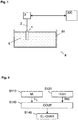
- FIG. 1 illustrates a measuring system with a container 8 comprising a holding vessel 81 filled with a process material 6.
- the properties of the process material 6 are measured by means of at least one measuring probe 1 which is connected through signal-transmitting device 2 to an evaluating device 3.
- the evaluating devices 3, which, among other functions, serve as measurement converters, are coupled to a processing device 300, for example a computer.
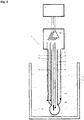
- an electrochemical measuring probe such as for example a pH-measuring probe, which in the configuration of a single rod measuring chain includes a glass electrode 16, a reference electrode 15, and an auxiliary electrode 18, is represented schematically in FIG. 2 .
- the glass electrode with a conductor lead element 16 and the reference electrode with a reference lead element 15 are constructively combined in one unit.
- the conductor lead element 16 is immersed in a solution with a defined pH value, specifically an inner buffer 14, which establishes the electrically conductive connection between the inside of the glass membrane 111 and the conductor lead element 16.
- the reference lead element 15 is immersed in an electrolyte, specifically an outer buffer 13 which, by way of a porous separating wall or diaphragm 121, allows an exchange of electrical charges to take place with the measurement material 6.
- the electrical potentials of the signal source (seen as signal source SQ1 in FIG. 3 ) which during the measurement set themselves up at the conductor lead element 16, at the reference lead element 15, and/or at the auxiliary electrode 18 are measured and then further processed with the signal-processing unit OP, preferably an operational amplifier.
- the signal-processing unit OP preferably an operational amplifier.
- a temperature-measuring sensor 17 is arranged, which provides the possibility to automatically compensate for temperature effects and to register temperature cycles.
- the signal-processing unit OP which will be described in more detail below, is incorporated in the head of the measuring probe 1 and connected by way of signal lead 2 to the evaluating device 3.
- the measuring probe 1 is a solid-state pH sensor comprising an active layer behaving as a voltage source.
- the glass electrode 16 of the measuring probe 1 comprises typically an ion pH sensitive glass substrate and several layers on top of said ion pH sensitive glass substrate.
- the layers may comprise an elementar/lithium layer, a Lithium Phosphorus Oxynitride - generally designed by the acronym LiPON - layer, and a protective layer adapted to limit degradations of the lithium layer as well as to provide a packaging structure for stabilizing the whole glass electrode against environmental influences.
- the electrical potential of the glass electrode 16 of the measuring probe 1 is not null, even when the conductor lead element 16 is not immersed in the holding vessel 81 filled with the process material 6.
- FIG. 3 shows the measuring device of FIG. 2 in an advantageous embodiment with a measuring probe 1 which includes at least one electrode EL, for example a glass electrode and a reference electrode, delivering a measuring signal.
- a measuring probe 1 which includes at least one electrode EL, for example a glass electrode and a reference electrode, delivering a measuring signal.
- an electrode voltage U E may be observed either only when the measuring probe 1 is immersed in the process material 6 or constantly - in the case of use of a solid-state pH sensor, for example.
- the electrode EL itself forms a voltage source SQ1 whose internal resistance is represented in the drawing as the electrode resistance R E .
- the voltage source SQ1 is coupled to a first ground connection GC1.
- the glass membrane of a glass electrode represents a very high resistance, while the transition resistance of the reference electrode results in a relatively low resistance value.
- the electrode resistance R E is dependent on the temperature observed at the measuring probe 1, and becomes very small above 100 degrees Celsius.
- the measuring signal more particularly the electrode voltage U E , is sent for processing to a signal processing unit OP by way of a measuring signal circuit 19.
- the not yet processed, partially processed or fully processed signals are transmitted through a connecting lead 2b to a signal evaluating unit PROC.
- the signal-evaluating unit PROC is incorporated in an evaluating device 3 or a transmitter 3 and can communicate through internal connections with a memory unit MEM and a communication unit COM.
- the processed and/or evaluated measurements can subsequently be passed on to be used for example for the control and monitoring of the process system.
- the evaluating unit 3 or the transmitter TR includes a variety of components such as a communication unit COM, a signal-evaluating unit PROC, and/or a memory unit MEM, which are connected bi-directionally among each other and thus are able to exchange data, instruction or programs.
- the communication unit COM coordinates all activities of the measuring probe 1 and of the evaluating device 3 and establishes the communication to the master computer 300. Through the connection 2a, instructions are transmitted from the communication unit COM to a stimulation controller unit SCU in the measuring probe 1.
- the communication unit COM can also issue instructions to the signal-evaluating unit PROC, receive data from the signal-evaluating unit PROC, or also store data and programs in the memory unit MEM.
- the stimulation controller unit SCU which can also be incorporated in the signal-processing unit OP, functions as a controller element for the switching element S1 by sending control signals through the control output terminals CL1, thereby triggering responses in the switching element S1.
- the switching elements can be configured as mechanical or electronic elements or as semiconductor elements such as transistors. However, the switching operations can also be performed directly with the controller unit CU.
- a test signal SIG such as bipolar pulses
- the test signal SIG can be delivered, by way of a test signal circuit 20, during a verification phase to a coupling element Q2.
- the test signal SIG can be generated by way of a signal source SQ2.
- the test signal SIG is used for example to determine the resistance of the glass electrode 16, as described for example in patent document US 2009/0251152 A1 .
- the coupling element Q2 ensures galvanic isolation between the measuring signal circuit 19 carrying the electrode voltage U E and the test signal circuit 20 carrying the test signal SIG. Consequently, the coupling element Q2 also allows modulating the electrode voltage U E with the test signal SIG.
- the coupling element Q2 is arranged to prevent leakage of current from the test signal circuit 20 to the measurement signal circuit 19.
- the coupling element Q2 is arranged so as that the test signal SIG is fed into an inductive element generating accordingly an electromagnetic field altering the electrode voltage U E .
- the coupling element Q2 may comprise a transformer provided with a primary winding connected between the test signal circuit 20 and a second ground connection GC2 and a secondary winding connected between the measurement signal circuit 19 and the signal-processing unit OP. The primary winding and the secondary winding are not electrically connected, but inductively coupled.
- the coupling element Q2 may comprise mechanical, optical and/or electrical means for ensuring the galvanic isolation between the measurement signal circuit 19 carrying the electrode voltage UE and the test signal circuit 20 carrying the measurement signal SIG.
- Fig. 4 schematically represents a method for determining, during a verification phase, at least one electrical characteristic - for example its resistance - of the sensing element of an electrode. The method comprises the following steps:
Landscapes
- Chemical & Material Sciences (AREA)
- Life Sciences & Earth Sciences (AREA)
- Health & Medical Sciences (AREA)
- Physics & Mathematics (AREA)
- Chemical Kinetics & Catalysis (AREA)
- Electrochemistry (AREA)
- Molecular Biology (AREA)
- Analytical Chemistry (AREA)
- Biochemistry (AREA)
- General Health & Medical Sciences (AREA)
- General Physics & Mathematics (AREA)
- Immunology (AREA)
- Pathology (AREA)
- Investigating Or Analyzing Materials By The Use Of Electric Means (AREA)
Claims (8)
- Système de mesure (8) comprenant une sonde de mesure (1) destinée à être utilisée en contact avec un matériau de traitement (6), comprenant :• un circuit de signal de mesure (19) ;• un circuit de signal de test (20) ;• une électrode (EL) pourvue d'un élément de détection agencé de manière à délivrer un signal de mesure dans le circuit de signal de mesure (19), la tension d'électrode étant liée à au moins une propriété du matériau de traitement lorsque l'électrode est en contact avec le matériau de traitement ;• une unité de traitement de signal (OP) conçue pour déterminer une quantité de mesure liée à l'au moins une propriété du matériau de traitement pendant le fonctionnement de la sonde de mesure en fonction du signal de mesure ;• une source de signal (SQ2) configurée pour délivrer, pendant une phase de vérification, un signal de test (SIG) dans le circuit de signal de test (20) ;• un élément de couplage (Q2) agencé pour moduler la tension d'électrode UE avec le signal de test SIG et pour assurer une isolation galvanique entre le circuit de signal de mesure (19) et le circuit de signal de test (20).
- Système de mesure selon la revendication 1, dans lequel l'élément de couplage (Q2) est agencé de sorte que le signal de test (SIG) est introduit dans un élément inductif générant en conséquence un champ électromagnétique modifiant le signal de mesure dans le circuit de signal de mesure.
- Système de mesure selon la revendication 2, dans lequel l'élément de couplage (Q2) comprend un transformateur pourvu :• d'un enroulement primaire relié entre le circuit de signal de test (20) et une seconde mise à la terre (GC2) ; et,• d'un enroulement secondaire relié entre le circuit de signal de mesure (19) et l'unité de traitement de signal (OP),
l'enroulement primaire et l'enroulement secondaire étant isolés électriquement. - Système de mesure selon l'une quelconque des revendications 1 à 3, dans lequel l'unité de traitement de signal (OP) est configurée, pendant la phase de vérification, pour déterminer au moins une caractéristique électrique de l'élément de détection de l'électrode (16) en observant le signal de mesure modifié par le signal de test.
- Système de mesure selon l'une quelconque des revendications 1 à 4, dans lequel l'élément de détection de l'électrode comprend une couche active se comportant comme une source de tension, la tension d'électrode n'étant pas nulle lorsque l'électrode n'est pas en contact avec le matériau de traitement.
- Système de mesure selon l'une quelconque des revendications 1 à 5, dans lequel la sonde de mesure est choisie dans le groupe comprenant : une sonde de mesure de pH, une sonde de mesure d'oxygène et une sonde de mesure de CO2.
- Système de mesure selon les revendications 5 et 6, dans lequel l'élément de détection de l'électrode comprend une couche d'oxynitrure de lithium et de phosphore.
- Procédé permettant de déterminer, pendant une phase de vérification, dans un système de mesure (8) comprenant une sonde de mesure (1) destinée à être utilisée en contact avec un matériau de traitement (6), au moins une caractéristique électrique d'un élément de détection d'une électrode (16) incluse dans la sonde de mesure (1), comprenant les étapes suivantes :• la transmission (S110) dans un circuit de signal (20) d'un signal de mesure délivré par l'élément de détection, le signal de mesure étant lié à au moins une propriété du matériau de traitement lorsque l'électrode est en contact avec le matériau de traitement ;• la transmission (S120), pendant une phase de vérification, dans un circuit de test (20), d'un signal de test (SIG) ;• la modification (S130) du signal de mesure avec le signal de test (SIG) en assurant une isolation galvanique entre le circuit de signal de mesure et le circuit de signal de test ;• la détermination (S140) de l'au moins une caractéristique électrique de l'élément de détection de l'électrode, en observant le signal de mesure modifié par le signal de test.
Priority Applications (4)
| Application Number | Priority Date | Filing Date | Title |
|---|---|---|---|
| ES17181636T ES2835779T3 (es) | 2017-07-17 | 2017-07-17 | Procedimiento y dispositivo para monitorear y/o determinar el estado de una sonda de medición |
| EP17181636.6A EP3431978B1 (fr) | 2017-07-17 | 2017-07-17 | Procédé et dispositif permettant de surveiller et/ou de déterminer l'état d'une sonde de mesure |
| US16/036,387 US10718736B2 (en) | 2017-07-17 | 2018-07-16 | Method and device for monitoring and/or determining the condition of a measuring probe |
| CN201810783602.7A CN109270149B (zh) | 2017-07-17 | 2018-07-17 | 用于监测和/或确定测量探头的状况的改进的方法及装置 |
Applications Claiming Priority (1)
| Application Number | Priority Date | Filing Date | Title |
|---|---|---|---|
| EP17181636.6A EP3431978B1 (fr) | 2017-07-17 | 2017-07-17 | Procédé et dispositif permettant de surveiller et/ou de déterminer l'état d'une sonde de mesure |
Publications (2)
| Publication Number | Publication Date |
|---|---|
| EP3431978A1 EP3431978A1 (fr) | 2019-01-23 |
| EP3431978B1 true EP3431978B1 (fr) | 2020-09-02 |
Family
ID=59366262
Family Applications (1)
| Application Number | Title | Priority Date | Filing Date |
|---|---|---|---|
| EP17181636.6A Active EP3431978B1 (fr) | 2017-07-17 | 2017-07-17 | Procédé et dispositif permettant de surveiller et/ou de déterminer l'état d'une sonde de mesure |
Country Status (4)
| Country | Link |
|---|---|
| US (1) | US10718736B2 (fr) |
| EP (1) | EP3431978B1 (fr) |
| CN (1) | CN109270149B (fr) |
| ES (1) | ES2835779T3 (fr) |
Families Citing this family (1)
| Publication number | Priority date | Publication date | Assignee | Title |
|---|---|---|---|---|
| EP3792622B1 (fr) * | 2019-09-10 | 2023-06-07 | Mettler-Toledo GmbH | Unité d'interface pour coupler une sonde à un système de mesure |
Family Cites Families (15)
| Publication number | Priority date | Publication date | Assignee | Title |
|---|---|---|---|---|
| US3661748A (en) * | 1970-04-07 | 1972-05-09 | Instrumentation Labor Inc | Fault sensing instrumentation |
| AU8868882A (en) * | 1982-09-24 | 1984-03-29 | Petty, J.D. | Electrode monitor |
| EP0354958B1 (fr) * | 1987-03-05 | 1994-08-03 | Terumo Kabushiki Kaisha | Appareil permettant de mesurer des donnees relatives a un etre vivant |
| US5206540A (en) * | 1991-05-09 | 1993-04-27 | Unitrode Corporation | Transformer isolated drive circuit |
| GB2333161B (en) | 1997-12-24 | 2002-06-12 | Abb Kent Taylor Ltd | Electrode integrity checking |
| DE10055090A1 (de) * | 2000-11-07 | 2002-05-08 | Conducta Endress & Hauser | Steckverbinder zum Anschluss einer Übertragungsleitung an mindestens einen Sensor |
| EP1611666B1 (fr) * | 2003-04-10 | 2006-12-27 | Z-Laser Optoelektronik GmbH | Bloc d'alimentation |
| US7250857B2 (en) * | 2003-08-07 | 2007-07-31 | Simmonds Precision Products, Inc. | Multiplexer method and system for intrinsically safe applications and a multiplexer switch for use therein |
| DE102004063249A1 (de) * | 2004-12-23 | 2006-07-13 | Fraunhofer-Gesellschaft zur Förderung der angewandten Forschung e.V. | Sensorsystem und Verfahren zur kapazitiven Messung elektromagnetischer Signale biologischen Ursprungs |
| FR2910162B1 (fr) * | 2006-12-18 | 2009-12-11 | Schneider Electric Ind Sas | Dispositif de couplage de signal de mesure a isolation electrique et appareil electrique comportant un tel dispositif |
| EP1936367A1 (fr) | 2006-12-22 | 2008-06-25 | Mettler-Toledo AG | Procédé et dispositif destinés à la surveillance et/ou la détermination de l'état d'une sonde de mesure |
| US7950264B2 (en) | 2007-11-30 | 2011-05-31 | Endress + Hauser Conducta Gesellschaft für Mess-und Regeltechnik mbH + Co. KG | Disposable measurement arrangement and method of testing and/or calibrating it |
| WO2009078418A1 (fr) * | 2007-12-18 | 2009-06-25 | Horiba, Ltd. | Electrode sélective d'ions |
| KR101029873B1 (ko) * | 2008-12-05 | 2011-04-18 | 한국과학기술원 | 이산화탄소 측정장치 |
| DE102010044180A1 (de) * | 2010-11-19 | 2012-05-24 | Endress + Hauser Gmbh + Co. Kg | Vorrichtung zur Bestimmung und/oder Überwachung mindestens einer Prozessgröße |
-
2017
- 2017-07-17 EP EP17181636.6A patent/EP3431978B1/fr active Active
- 2017-07-17 ES ES17181636T patent/ES2835779T3/es active Active
-
2018
- 2018-07-16 US US16/036,387 patent/US10718736B2/en active Active
- 2018-07-17 CN CN201810783602.7A patent/CN109270149B/zh active Active
Non-Patent Citations (1)
| Title |
|---|
| None * |
Also Published As
| Publication number | Publication date |
|---|---|
| CN109270149A (zh) | 2019-01-25 |
| CN109270149B (zh) | 2023-04-07 |
| EP3431978A1 (fr) | 2019-01-23 |
| US10718736B2 (en) | 2020-07-21 |
| ES2835779T3 (es) | 2021-06-23 |
| US20190017961A1 (en) | 2019-01-17 |
Similar Documents
| Publication | Publication Date | Title |
|---|---|---|
| US4822456A (en) | Ion measuring apparatus and monitoring system | |
| US20110023586A1 (en) | Water analysis sensor arrangement | |
| EP1456637A2 (fr) | Capteur de ph avec mise a la masse d'une solution interne | |
| CN104122313B (zh) | 多电极离子探头 | |
| JP6670432B2 (ja) | 統合型イオン検出装置および方法 | |
| EP2010899B1 (fr) | Sonde de ph différentielle | |
| CN110702748B (zh) | 电位传感器组件以及监测电位传感器的传感器功能的方法 | |
| US10718736B2 (en) | Method and device for monitoring and/or determining the condition of a measuring probe | |
| US9128035B2 (en) | Sensor for registering an analyte concentration | |
| KR101590531B1 (ko) | pH 측정 장치 | |
| US20080283399A1 (en) | Potentiometric process analytic sensor with isolated temperature sensor | |
| US12379341B2 (en) | pH sensor with backup pH sensing electrode | |
| US9772300B2 (en) | Inductive conductivity sensor for measuring the specific electrical conductivity of a medium | |
| CN112083052B (zh) | 电位计探针 | |
| WO2023192761A1 (fr) | Capteur de ph avec électrode de référence secondaire | |
| WO2011155815A1 (fr) | Electrode de référence miniaturisée réutilisable | |
| US11119065B2 (en) | Electromagnetic sensor | |
| KR20190050976A (ko) | 모세관 전기영동 음극 시스템 및 방법 | |
| US11549966B2 (en) | Interface unit for coupling a probe to a measuring system | |
| CN219830933U (zh) | 一种电化学复合传感器 | |
| US20050040038A1 (en) | Diagnostic electro-chemical reference half cell | |
| JP2009092414A (ja) | イオン濃度測定装置 | |
| CN101223438A (zh) | 用于测量探头的信号传输设备和相关的传输方法 | |
| NO141103B (no) | Anordning for maaling av ione- eller molekylarkonsentrasjoner |
Legal Events
| Date | Code | Title | Description |
|---|---|---|---|
| PUAI | Public reference made under article 153(3) epc to a published international application that has entered the european phase |
Free format text: ORIGINAL CODE: 0009012 |
|
| STAA | Information on the status of an ep patent application or granted ep patent |
Free format text: STATUS: THE APPLICATION HAS BEEN PUBLISHED |
|
| AK | Designated contracting states |
Kind code of ref document: A1 Designated state(s): AL AT BE BG CH CY CZ DE DK EE ES FI FR GB GR HR HU IE IS IT LI LT LU LV MC MK MT NL NO PL PT RO RS SE SI SK SM TR |
|
| AX | Request for extension of the european patent |
Extension state: BA ME |
|
| STAA | Information on the status of an ep patent application or granted ep patent |
Free format text: STATUS: REQUEST FOR EXAMINATION WAS MADE |
|
| 17P | Request for examination filed |
Effective date: 20190725 |
|
| RBV | Designated contracting states (corrected) |
Designated state(s): AL AT BE BG CH CY CZ DE DK EE ES FI FR GB GR HR HU IE IS IT LI LT LU LV MC MK MT NL NO PL PT RO RS SE SI SK SM TR |
|
| GRAP | Despatch of communication of intention to grant a patent |
Free format text: ORIGINAL CODE: EPIDOSNIGR1 |
|
| STAA | Information on the status of an ep patent application or granted ep patent |
Free format text: STATUS: GRANT OF PATENT IS INTENDED |
|
| INTG | Intention to grant announced |
Effective date: 20200417 |
|
| GRAS | Grant fee paid |
Free format text: ORIGINAL CODE: EPIDOSNIGR3 |
|
| GRAA | (expected) grant |
Free format text: ORIGINAL CODE: 0009210 |
|
| STAA | Information on the status of an ep patent application or granted ep patent |
Free format text: STATUS: THE PATENT HAS BEEN GRANTED |
|
| AK | Designated contracting states |
Kind code of ref document: B1 Designated state(s): AL AT BE BG CH CY CZ DE DK EE ES FI FR GB GR HR HU IE IS IT LI LT LU LV MC MK MT NL NO PL PT RO RS SE SI SK SM TR |
|
| REG | Reference to a national code |
Ref country code: GB Ref legal event code: FG4D |
|
| REG | Reference to a national code |
Ref country code: AT Ref legal event code: REF Ref document number: 1309427 Country of ref document: AT Kind code of ref document: T Effective date: 20200915 Ref country code: CH Ref legal event code: EP |
|
| REG | Reference to a national code |
Ref country code: DE Ref legal event code: R096 Ref document number: 602017022658 Country of ref document: DE |
|
| REG | Reference to a national code |
Ref country code: IE Ref legal event code: FG4D |
|
| REG | Reference to a national code |
Ref country code: NL Ref legal event code: FP |
|
| REG | Reference to a national code |
Ref country code: LT Ref legal event code: MG4D |
|
| PG25 | Lapsed in a contracting state [announced via postgrant information from national office to epo] |
Ref country code: LT Free format text: LAPSE BECAUSE OF FAILURE TO SUBMIT A TRANSLATION OF THE DESCRIPTION OR TO PAY THE FEE WITHIN THE PRESCRIBED TIME-LIMIT Effective date: 20200902 Ref country code: HR Free format text: LAPSE BECAUSE OF FAILURE TO SUBMIT A TRANSLATION OF THE DESCRIPTION OR TO PAY THE FEE WITHIN THE PRESCRIBED TIME-LIMIT Effective date: 20200902 Ref country code: SE Free format text: LAPSE BECAUSE OF FAILURE TO SUBMIT A TRANSLATION OF THE DESCRIPTION OR TO PAY THE FEE WITHIN THE PRESCRIBED TIME-LIMIT Effective date: 20200902 Ref country code: GR Free format text: LAPSE BECAUSE OF FAILURE TO SUBMIT A TRANSLATION OF THE DESCRIPTION OR TO PAY THE FEE WITHIN THE PRESCRIBED TIME-LIMIT Effective date: 20201203 Ref country code: FI Free format text: LAPSE BECAUSE OF FAILURE TO SUBMIT A TRANSLATION OF THE DESCRIPTION OR TO PAY THE FEE WITHIN THE PRESCRIBED TIME-LIMIT Effective date: 20200902 Ref country code: NO Free format text: LAPSE BECAUSE OF FAILURE TO SUBMIT A TRANSLATION OF THE DESCRIPTION OR TO PAY THE FEE WITHIN THE PRESCRIBED TIME-LIMIT Effective date: 20201202 Ref country code: BG Free format text: LAPSE BECAUSE OF FAILURE TO SUBMIT A TRANSLATION OF THE DESCRIPTION OR TO PAY THE FEE WITHIN THE PRESCRIBED TIME-LIMIT Effective date: 20201202 |
|
| REG | Reference to a national code |
Ref country code: AT Ref legal event code: MK05 Ref document number: 1309427 Country of ref document: AT Kind code of ref document: T Effective date: 20200902 |
|
| PG25 | Lapsed in a contracting state [announced via postgrant information from national office to epo] |
Ref country code: PL Free format text: LAPSE BECAUSE OF FAILURE TO SUBMIT A TRANSLATION OF THE DESCRIPTION OR TO PAY THE FEE WITHIN THE PRESCRIBED TIME-LIMIT Effective date: 20200902 Ref country code: RS Free format text: LAPSE BECAUSE OF FAILURE TO SUBMIT A TRANSLATION OF THE DESCRIPTION OR TO PAY THE FEE WITHIN THE PRESCRIBED TIME-LIMIT Effective date: 20200902 Ref country code: LV Free format text: LAPSE BECAUSE OF FAILURE TO SUBMIT A TRANSLATION OF THE DESCRIPTION OR TO PAY THE FEE WITHIN THE PRESCRIBED TIME-LIMIT Effective date: 20200902 |
|
| PG25 | Lapsed in a contracting state [announced via postgrant information from national office to epo] |
Ref country code: CZ Free format text: LAPSE BECAUSE OF FAILURE TO SUBMIT A TRANSLATION OF THE DESCRIPTION OR TO PAY THE FEE WITHIN THE PRESCRIBED TIME-LIMIT Effective date: 20200902 Ref country code: RO Free format text: LAPSE BECAUSE OF FAILURE TO SUBMIT A TRANSLATION OF THE DESCRIPTION OR TO PAY THE FEE WITHIN THE PRESCRIBED TIME-LIMIT Effective date: 20200902 Ref country code: PT Free format text: LAPSE BECAUSE OF FAILURE TO SUBMIT A TRANSLATION OF THE DESCRIPTION OR TO PAY THE FEE WITHIN THE PRESCRIBED TIME-LIMIT Effective date: 20210104 Ref country code: EE Free format text: LAPSE BECAUSE OF FAILURE TO SUBMIT A TRANSLATION OF THE DESCRIPTION OR TO PAY THE FEE WITHIN THE PRESCRIBED TIME-LIMIT Effective date: 20200902 Ref country code: SM Free format text: LAPSE BECAUSE OF FAILURE TO SUBMIT A TRANSLATION OF THE DESCRIPTION OR TO PAY THE FEE WITHIN THE PRESCRIBED TIME-LIMIT Effective date: 20200902 |
|
| PG25 | Lapsed in a contracting state [announced via postgrant information from national office to epo] |
Ref country code: AL Free format text: LAPSE BECAUSE OF FAILURE TO SUBMIT A TRANSLATION OF THE DESCRIPTION OR TO PAY THE FEE WITHIN THE PRESCRIBED TIME-LIMIT Effective date: 20200902 Ref country code: AT Free format text: LAPSE BECAUSE OF FAILURE TO SUBMIT A TRANSLATION OF THE DESCRIPTION OR TO PAY THE FEE WITHIN THE PRESCRIBED TIME-LIMIT Effective date: 20200902 Ref country code: IS Free format text: LAPSE BECAUSE OF FAILURE TO SUBMIT A TRANSLATION OF THE DESCRIPTION OR TO PAY THE FEE WITHIN THE PRESCRIBED TIME-LIMIT Effective date: 20210102 |
|
| REG | Reference to a national code |
Ref country code: DE Ref legal event code: R097 Ref document number: 602017022658 Country of ref document: DE |
|
| REG | Reference to a national code |
Ref country code: ES Ref legal event code: FG2A Ref document number: 2835779 Country of ref document: ES Kind code of ref document: T3 Effective date: 20210623 |
|
| PG25 | Lapsed in a contracting state [announced via postgrant information from national office to epo] |
Ref country code: SK Free format text: LAPSE BECAUSE OF FAILURE TO SUBMIT A TRANSLATION OF THE DESCRIPTION OR TO PAY THE FEE WITHIN THE PRESCRIBED TIME-LIMIT Effective date: 20200902 |
|
| PLBE | No opposition filed within time limit |
Free format text: ORIGINAL CODE: 0009261 |
|
| STAA | Information on the status of an ep patent application or granted ep patent |
Free format text: STATUS: NO OPPOSITION FILED WITHIN TIME LIMIT |
|
| 26N | No opposition filed |
Effective date: 20210603 |
|
| PG25 | Lapsed in a contracting state [announced via postgrant information from national office to epo] |
Ref country code: DK Free format text: LAPSE BECAUSE OF FAILURE TO SUBMIT A TRANSLATION OF THE DESCRIPTION OR TO PAY THE FEE WITHIN THE PRESCRIBED TIME-LIMIT Effective date: 20200902 Ref country code: SI Free format text: LAPSE BECAUSE OF FAILURE TO SUBMIT A TRANSLATION OF THE DESCRIPTION OR TO PAY THE FEE WITHIN THE PRESCRIBED TIME-LIMIT Effective date: 20200902 |
|
| PG25 | Lapsed in a contracting state [announced via postgrant information from national office to epo] |
Ref country code: MC Free format text: LAPSE BECAUSE OF FAILURE TO SUBMIT A TRANSLATION OF THE DESCRIPTION OR TO PAY THE FEE WITHIN THE PRESCRIBED TIME-LIMIT Effective date: 20200902 |
|
| REG | Reference to a national code |
Ref country code: BE Ref legal event code: MM Effective date: 20210731 |
|
| PG25 | Lapsed in a contracting state [announced via postgrant information from national office to epo] |
Ref country code: LU Free format text: LAPSE BECAUSE OF NON-PAYMENT OF DUE FEES Effective date: 20210717 |
|
| PG25 | Lapsed in a contracting state [announced via postgrant information from national office to epo] |
Ref country code: IE Free format text: LAPSE BECAUSE OF NON-PAYMENT OF DUE FEES Effective date: 20210717 Ref country code: BE Free format text: LAPSE BECAUSE OF NON-PAYMENT OF DUE FEES Effective date: 20210731 |
|
| PG25 | Lapsed in a contracting state [announced via postgrant information from national office to epo] |
Ref country code: CY Free format text: LAPSE BECAUSE OF FAILURE TO SUBMIT A TRANSLATION OF THE DESCRIPTION OR TO PAY THE FEE WITHIN THE PRESCRIBED TIME-LIMIT Effective date: 20200902 |
|
| PG25 | Lapsed in a contracting state [announced via postgrant information from national office to epo] |
Ref country code: HU Free format text: LAPSE BECAUSE OF FAILURE TO SUBMIT A TRANSLATION OF THE DESCRIPTION OR TO PAY THE FEE WITHIN THE PRESCRIBED TIME-LIMIT; INVALID AB INITIO Effective date: 20170717 |
|
| PG25 | Lapsed in a contracting state [announced via postgrant information from national office to epo] |
Ref country code: MK Free format text: LAPSE BECAUSE OF FAILURE TO SUBMIT A TRANSLATION OF THE DESCRIPTION OR TO PAY THE FEE WITHIN THE PRESCRIBED TIME-LIMIT Effective date: 20200902 |
|
| PG25 | Lapsed in a contracting state [announced via postgrant information from national office to epo] |
Ref country code: MT Free format text: LAPSE BECAUSE OF FAILURE TO SUBMIT A TRANSLATION OF THE DESCRIPTION OR TO PAY THE FEE WITHIN THE PRESCRIBED TIME-LIMIT Effective date: 20200902 |
|
| PGFP | Annual fee paid to national office [announced via postgrant information from national office to epo] |
Ref country code: NL Payment date: 20250724 Year of fee payment: 9 |
|
| PGFP | Annual fee paid to national office [announced via postgrant information from national office to epo] |
Ref country code: ES Payment date: 20250811 Year of fee payment: 9 |
|
| PGFP | Annual fee paid to national office [announced via postgrant information from national office to epo] |
Ref country code: DE Payment date: 20250714 Year of fee payment: 9 |
|
| PGFP | Annual fee paid to national office [announced via postgrant information from national office to epo] |
Ref country code: IT Payment date: 20250721 Year of fee payment: 9 |
|
| PGFP | Annual fee paid to national office [announced via postgrant information from national office to epo] |
Ref country code: GB Payment date: 20250722 Year of fee payment: 9 |
|
| PGFP | Annual fee paid to national office [announced via postgrant information from national office to epo] |
Ref country code: FR Payment date: 20250725 Year of fee payment: 9 |
|
| PGFP | Annual fee paid to national office [announced via postgrant information from national office to epo] |
Ref country code: CH Payment date: 20250801 Year of fee payment: 9 |
|
| PG25 | Lapsed in a contracting state [announced via postgrant information from national office to epo] |
Ref country code: TR Free format text: LAPSE BECAUSE OF FAILURE TO SUBMIT A TRANSLATION OF THE DESCRIPTION OR TO PAY THE FEE WITHIN THE PRESCRIBED TIME-LIMIT Effective date: 20200902 |