EP3432500A1 - Procédé de transmission point à point basé sur l'utilisation d'un schéma de codage d'effacement et protocole tcp/ip - Google Patents
Procédé de transmission point à point basé sur l'utilisation d'un schéma de codage d'effacement et protocole tcp/ip Download PDFInfo
- Publication number
- EP3432500A1 EP3432500A1 EP17305951.0A EP17305951A EP3432500A1 EP 3432500 A1 EP3432500 A1 EP 3432500A1 EP 17305951 A EP17305951 A EP 17305951A EP 3432500 A1 EP3432500 A1 EP 3432500A1
- Authority
- EP
- European Patent Office
- Prior art keywords
- packet
- source
- tcp
- ecn
- module
- Prior art date
- Legal status (The legal status is an assumption and is not a legal conclusion. Google has not performed a legal analysis and makes no representation as to the accuracy of the status listed.)
- Withdrawn
Links
- 238000000034 method Methods 0.000 title claims abstract description 57
- 230000007246 mechanism Effects 0.000 claims abstract description 90
- 238000011084 recovery Methods 0.000 claims abstract description 83
- 230000005540 biological transmission Effects 0.000 claims abstract description 72
- 230000009467 reduction Effects 0.000 claims abstract description 21
- 230000008439 repair process Effects 0.000 claims description 45
- 230000008569 process Effects 0.000 claims description 8
- 238000012545 processing Methods 0.000 claims description 8
- 208000027744 congestion Diseases 0.000 description 84
- 230000007423 decrease Effects 0.000 description 12
- 238000004891 communication Methods 0.000 description 6
- 230000006855 networking Effects 0.000 description 3
- 230000011664 signaling Effects 0.000 description 3
- 239000000654 additive Substances 0.000 description 2
- 230000000996 additive effect Effects 0.000 description 2
- 230000001143 conditioned effect Effects 0.000 description 2
- 238000001514 detection method Methods 0.000 description 2
- 238000012057 exposure response modelling Methods 0.000 description 2
- 230000000873 masking effect Effects 0.000 description 2
- 230000009471 action Effects 0.000 description 1
- 230000003466 anti-cipated effect Effects 0.000 description 1
- 238000013461 design Methods 0.000 description 1
- 238000011161 development Methods 0.000 description 1
- 230000018109 developmental process Effects 0.000 description 1
- 230000004069 differentiation Effects 0.000 description 1
- 238000002592 echocardiography Methods 0.000 description 1
- 230000000694 effects Effects 0.000 description 1
- 238000005562 fading Methods 0.000 description 1
- 230000003993 interaction Effects 0.000 description 1
- 230000007774 longterm Effects 0.000 description 1
- 238000007726 management method Methods 0.000 description 1
- 230000004048 modification Effects 0.000 description 1
- 238000012986 modification Methods 0.000 description 1
- 230000004044 response Effects 0.000 description 1
- 230000007727 signaling mechanism Effects 0.000 description 1
Images




Classifications
-
- H—ELECTRICITY
- H04—ELECTRIC COMMUNICATION TECHNIQUE
- H04L—TRANSMISSION OF DIGITAL INFORMATION, e.g. TELEGRAPHIC COMMUNICATION
- H04L1/00—Arrangements for detecting or preventing errors in the information received
- H04L1/004—Arrangements for detecting or preventing errors in the information received by using forward error control
- H04L1/0045—Arrangements at the receiver end
-
- H—ELECTRICITY
- H04—ELECTRIC COMMUNICATION TECHNIQUE
- H04L—TRANSMISSION OF DIGITAL INFORMATION, e.g. TELEGRAPHIC COMMUNICATION
- H04L1/00—Arrangements for detecting or preventing errors in the information received
- H04L1/0001—Systems modifying transmission characteristics according to link quality, e.g. power backoff
- H04L1/0002—Systems modifying transmission characteristics according to link quality, e.g. power backoff by adapting the transmission rate
-
- H—ELECTRICITY
- H04—ELECTRIC COMMUNICATION TECHNIQUE
- H04L—TRANSMISSION OF DIGITAL INFORMATION, e.g. TELEGRAPHIC COMMUNICATION
- H04L69/00—Network arrangements, protocols or services independent of the application payload and not provided for in the other groups of this subclass
- H04L69/30—Definitions, standards or architectural aspects of layered protocol stacks
- H04L69/32—Architecture of open systems interconnection [OSI] 7-layer type protocol stacks, e.g. the interfaces between the data link level and the physical level
- H04L69/321—Interlayer communication protocols or service data unit [SDU] definitions; Interfaces between layers
-
- H—ELECTRICITY
- H04—ELECTRIC COMMUNICATION TECHNIQUE
- H04L—TRANSMISSION OF DIGITAL INFORMATION, e.g. TELEGRAPHIC COMMUNICATION
- H04L69/00—Network arrangements, protocols or services independent of the application payload and not provided for in the other groups of this subclass
- H04L69/40—Network arrangements, protocols or services independent of the application payload and not provided for in the other groups of this subclass for recovering from a failure of a protocol instance or entity, e.g. service redundancy protocols, protocol state redundancy or protocol service redirection
-
- H—ELECTRICITY
- H04—ELECTRIC COMMUNICATION TECHNIQUE
- H04L—TRANSMISSION OF DIGITAL INFORMATION, e.g. TELEGRAPHIC COMMUNICATION
- H04L1/00—Arrangements for detecting or preventing errors in the information received
- H04L1/004—Arrangements for detecting or preventing errors in the information received by using forward error control
- H04L1/0041—Arrangements at the transmitter end
-
- H—ELECTRICITY
- H04—ELECTRIC COMMUNICATION TECHNIQUE
- H04L—TRANSMISSION OF DIGITAL INFORMATION, e.g. TELEGRAPHIC COMMUNICATION
- H04L1/00—Arrangements for detecting or preventing errors in the information received
- H04L1/12—Arrangements for detecting or preventing errors in the information received by using return channel
- H04L1/16—Arrangements for detecting or preventing errors in the information received by using return channel in which the return channel carries supervisory signals, e.g. repetition request signals
- H04L1/18—Automatic repetition systems, e.g. Van Duuren systems
- H04L1/1809—Selective-repeat protocols
Definitions
- the present invention concerns a reliable point-to-point transmitting method based on the joint use of an error recovery mechanism with the TCP protocol.
- the present invention also concerns a telecommunication system using any telecommunication network that implements the reliable point-to-point transmitting method according to the invention.
- ECM Error Recovery Mechanism
- the first type of ERM is the Automatic Repeat reQuest denoted as ARQ in the following.
- ARQ enables a signaling return channel via a return transmission path from the receiving device and sends acknowledgment packets to feedback either well or not received packets at destination in order for the sender to retransmit missing packets to the destination.
- ERM Erasure Coding denoted as EC in the following.
- EC adds redundancy packets on a forward transmission path from a sending device to a receiving device to correct missing packets at destination.
- erasure coding schemes There are two main classes among erasure coding schemes: block codes and window codes.
- the Automatic Repeat reQuest is in particular implemented by the Transmission Control Protocol TCP, inside some link layer protocols and also by some block codes that enable both EC and ARQ and are known as Hybrid-ARQ.
- ERM types permit therefore to correct one or more lost packets when either a packet is dropped due to congestion, for example a packet may be dropped by a router when the routing queue is full, or the packet is corrupted during the transmission, for example a packet is modified or truncated by an interference which makes the packet unreadable at destination.
- ERMs make more reliable transmission channels.
- TCP implements its own ERM mechanism, denoted ERM #1 in the following and based on ARQ.
- the ARQ mechanism used by TCP is tightly linked to another TCP algorithm called congestion control, which manages the TCP sending rate as a function of the network state to prevent network congestion.
- congestion control which manages the TCP sending rate as a function of the network state to prevent network congestion.
- a congestion event can either be a duplicate acknowledgment packet that signals one or several lost packets (known as loss-based TCP), a specifying marking inside the TCP header known as Explicit Congestion Notification marking indicating that the network crossed becomes congested or finally and depending of the TCP version, an increase of the forwarding delay estimated by TCP (known as delay-based TCP).
- All TCP version can be either loss-based, delay-based or hybrid (delay and loss-based). However, all implements the ECN principle. Today in the Internet, only loss-based (GNU/Linux, *BSD, MAC OSX) or hybrid TCP (Windows) are used.
- a network congestion means that a router queue on the path is full and thus, the router queue drops new arrival packets.
- TCP considers all lost packets as a congestion indication and follows an Additive Increase Multiplicative Decrease (AIMD) algorithm to compute its sending rate. Basically, TCP attempts to fetch the whole available link capacity by gradually increasing the TCP sending rate (Additive Increase phase). Since all TCP stacks in the Internet behave following the same principle, we observe in the long term behavior a fair-share between all TCP flows sharing the same bottleneck link. This algorithm is thus crucial for the sustainability of the Internet network.
- AIMD Additive Increase Multiplicative Decrease
- losses could be either due to congestion or error links. Although congestion losses are pervasive over wired links, errors link usually occur over wireless links and are mostly due to fading, handover, mobility, etc.
- TCP considers all losses as a congestion indication and always reacts by halving its sending rate.
- ERM#2 a supplementary ERM scheme below TCP, denoted ERM#2 in the following, to mask these losses.
- ERM#2 a supplementary ERM scheme below TCP
- CTCP Coded TCP
- RNLC Network Coded TCP
- the aim of the invention is therefore as a first technical problem to propose an alternative solution to Coded TCP that can be easily deployed and does not require any modification of the TCP protocol currently used in the Internet.
- a second technical problem is to propose a point-to-point IP transmitting method, based upon an ERM jointly used with an existing sender-based TCP protocol, and that overrides the issue of masking the path losses to the TCP control mechanism without modifying the TCP congestion control mechanism.
- a third technical problem is also to provide a point-to-point IP transmitting method, based upon an ERM jointly used with an existing sender-based TCP protocol, that preserves the TCP fair-share property and that increases the packets delivery ratio, the packet delivery ratio being the ratio of packets that are successfully delivered to a destination compared to the number of packets that have been sent by the sender.
- the invention aims at solving the first technical problem and the second technical problem.
- the invention relates to a point-to-point method for transmitting reliably a stream of source IP packets packets between a source sending device and a receiving device through an interconnecting network, the interconnecting network including a forward transmission path from the source sending device to the receiving device and a return path from the receiving device to the source sending device, the source sending device being configured for sending source IP packets and/or repair packets, the receiving device being configured for receiving the source IP packets and/or the repair packets and recovering source IP packets.
- the source sending device and the receiving device implements: through the use of a first dedicated hardware and/or software module a Transport Control Protocol TCP including an ARQ first error recovery mechanism ERM #1, and through the use of a second dedicated hardware and/or software module a second error recovery mechanism ERM #2.
- the source sending device and the receiving device are compatible to manage an IP Explicit Congestion Notification (ECN) mechanism.
- ECN IP Explicit Congestion Notification
- the point-to-point transmitting method might incorporate one or several of the following features, taken in any technically admissible combination:
- the invention also relates to a telecommunication system for point-to-point transmitting a stream of source IP packets comprising: a source sending device for sending source IP packets and /or repair packets(s), a receiving device for receiving the source IP packet and/or the repair packets and recovering source IP packets, a forward transmission path from the source sending device to the receiving device, and a return path from the receiving device to the source sending device.
- the source sending device and the receiving device have each a first dedicated hardware and/or software module implementing a Transport Control Protocol TCP including an ARQ first error recovery mechanism ERM #1, and a second dedicated hardware and/or software module implementing a second error recovery mechanism ERM #2.
- the source sending device and the receiving device are compatible to manage an IP Explicit Congestion Notification (ECN) mechanism.
- the second module of the source sending device is configured for: converting TCP packet(s) into source IP packet(s) and/or repair packet(s) on the basis of second error recovery mechanism ERM #2; then sending the source IP and repair packet(s) on the forward transmission path to the receiving device.
- the second module of the receiving device is configured for : receiving the source IP packet(s) and/or the repair packet(s) sent through the forward transmission path.
- the telecommunications system is characterized in that the second module of the receiving device is configured for:
- the telecommunication system might incorporate one or several of the following features, taken in any technically admissible combination:
- TCP Transmission Control Protocol
- IP Internet Protocol
- TCP headers include identification information and various flags that can specify the type of packet.
- IP headers include information specifying the IP addresses of the sending and receiving devices as well as various flags providing information on the packet.
- TCP can acknowledge data by sending an acknowledgment that specifies the offset in the data-stream until which the destination has received data.
- Such an acknowledgment packet has the ACK flag in the TCP header set and specifies the next expected sequence number in the byte-stream via the acknowledgment number in the TCP header.
- the acknowledgment packets can be used by the sending device to adjust the rate at which it transmits packets. For example, the sending device can decrease the rate at which it transmits packets if it has not received any acknowledgment packets for a predefined number of transmitted packets. Additionally, the sending device can decrease the rate at which it transmits packets if next received acknowledgment packets continually indicate that some transmitted packets have not been delivered.
- TCP and IP implements the Explicit Congestion Notification (ECN) scheme.
- ECN Explicit Congestion Notification
- Explicit Congestion Notification is a scheme allowing to notify congestion occurring at the network layer preventively to a TCP source.
- the current version is specified in RFC 3168.
- the IP header contains a two-bit ECN field, consisting of the ECN-Capable Transport (ECT) bit and the Congestion Experienced (CE) bit.
- the ECT bit is set by a sender to indicate to routers or any ECN-compliant networking layer devices that it is able to use the ECN mechanism while the CE bit is marked to notify congestion.
- the TCP header contains additional two bits: the ECN-Echo bit (ECE) and the Congestion Window Reduced (CWR) bit.
- an ECN-enable networking device (such as a router) sets the CE bit in the IP header when they might otherwise drop the packet; or possibly when the queue is at least half full; or for any other reason implying a decision to decrease TCP sources sending rate.
- the IP layer reports the ECN mark inside the TCP header to make the mark visible to TCP.
- receiver echoes the CE status back to the sender in the ECE bit of the next ACK; the reason for using the ECE bit is that this bit belongs to the TCP header and thus the TCP layer can be aware of this congestion indication.
- TCP senders treat ACKs with the ECE bit set the same as if a loss occurred and halves its congestion window (i.e. its sending rate). Because there is no actual loss, the arriving ACKs can still pace continued sliding-windows sending. The TCP Fast Recovery mechanism is not needed. When the TCP sender has responded to an ECE bit, it sets the CWR bit.
- the receiver Once the receiver has received a packet with the CE bit set in the IP layer, it sets the ECE bit in all subsequent ACKs until it receives a data packet with the CWR bit set. This provides for reliable communication of the congestion information, and helps the sender respond just once to multiple packet losses within a single windowful.
- the initial packet marking is done at the IP layer, but the generation of the marked ACK and the sender response to marked packets is at the TCP layer.
- the main concept of invention lays on ECN mechanism and proposes to enable the use of this signaling mechanism by an ERM below the TCP transport layer. Note that the invention does not require the collaboration of any intermediate routers and only implements the ECN marking procedure as defined in RFC 3168. The way to use the ECN principle follows the RFC 3168 and remains independent from the design of the operating system and/or Internet related components.
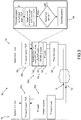
- a telecommunication system 2 according to the invention comprises:
- the telecommunication system 2 comprises a routing network 12 interconnecting the source sending device 4 and the receiving device 6.
- the routing network 12 can comprise at least one transit node(s) such as a router or a repeater for example.
- the routing network can be also merely restricted to two transmission links.
- the forward transmission path 8 here is made with a forward link 14 from the source sending device 4 to the receiving device 6 through the routing network 12.
- the return transmission path 10 is made with a return link 16 from the receiving device 6 to the source sending device 4 through the routing network 12.
- the source sending device 4 and the receiving device 6 have each a first dedicated hardware and/or software module 24, 26 implementing a Transport Control Protocol TCP and its ARQ error mechanism forming a first error recovery mechanism ERM #1 of first type.
- the source sending device 4 and the receiving device 6 have each a second dedicated hardware and/or software module 34, 36 implementing a second error recovery mechanism ERM #2 of first type ARQ or second type EC.
- the first error recovery mechanism ERM #1 i.e. the standard TCP Automatic Repeat reQuest (ARQ) control is applied to the correctly received source IP packets and the recovered source IP packets from the second error recovery error mechanism ERM #2.
- ARQ Automatic Repeat reQuest
- the second error recovery mechanism ERM #2 is based on an erasure on-the-fly encoding/decoding scheme (also called elastic window encoding/decoding scheme), or a block encoding/decoding scheme, or a mere second Automatic Repeat reQuest (ARQ) control scheme, or an hybrid Automatic Repeat reQuest (ARQ) control scheme using Forward Error Coding.
- an erasure on-the-fly encoding/decoding scheme also called elastic window encoding/decoding scheme
- ARQ second Automatic Repeat reQuest
- ARQ hybrid Automatic Repeat reQuest
- the sending device 4 is configured for:
- the receiving device 6 is configured for:
- the second module 36 of the receiving device 6 is configured for:
- the first module 26 of the receiving device 6 is configured for processing the reporting bit(s) of the actual or virtual marked ECN bits CE set inside the corresponding TCP header(s) and feeds back these ECN signals to the sending device 4 through the return transmission path 10 following any method compatible with the RFC 3168.
- the first module 26 of the receiving device is configured for:
- the source sending device 4 is configured for, upon receiving the feedback ECN signals, taking prescribed steps to reduce the sending rate at which the source sending device 4 transmits packets, these prescribed steps being compliant with the RFC 3168.
- the source sending device is configured for:
- a telecommunication system 42 according to the invention comprises:
- the source sending device 4 1 and the receiving device 6 1 have each a first dedicated hardware and/or software module 24 1 , 26 1 implementing a Transport Control Protocol TCP and its ARQ error mechanism forming a first error recovery mechanism ERM #1 of first type.
- the source sending device 4 1 and the receiving device 6 1 have each a second dedicated hardware and/or software module 34 1 , 36 1 implementing a second error recovery mechanism ERM #2 of first type ARQ or second type EC.
- the first dedicated hardware and/or software module 24 1 , 26 1 and the second dedicated hardware and/or software module 34 1 are respectively identical to the first dedicated hardware and/or software module 24, 26 and the second dedicated hardware and/or software module 34 as described in Figure 1 .
- the second dedicated hardware and/or software module 36 1 corresponds to a first configuration of the second module 36 of the receiving device 6 and is configured for:
- the stacks 43 at IP layer (OSI layer 3) forming the second module 36 1 and comprised between the Physical layer stack 44 and the transport layer/ TCP stack 45 comprises a second error recovery mechanism ERM #2 decoder 45, followed subsequently by an actual marking 46 of IP ECN bit inside the IP header and a predetermined IP layer stack 47 compliant with the RFC 3168.
- IP ECN bit stack 46 sandwiched between the ERM#2 decoder 45 and IP layer stack 47, is conditioned to the recovery status of the decoded IP packets.
- a telecommunication system 52 according to the invention comprises:
- the source sending device 4 2 and the receiving device 6 2 have each a first dedicated hardware and/or software module 24 2 , 26 2 implementing a Transport Control Protocol TCP and its ARQ error mechanism forming a first error recovery mechanism ERM #1 of first type.
- the source sending device 4 2 and the receiving device 6 2 have each a second dedicated hardware and/or software module 34 2 , 36 2 implementing a second error recovery mechanism ERM #2 of first type ARQ or second type EC.
- the first dedicated hardware and/or software module 24 2 , 26 2 and the second dedicated hardware and/or software module 34 2 are respectively identical to the first dedicated hardware and/or software module 24, 26 and the second dedicated hardware and/or software module 34 as described in Figure 1 .
- the second dedicated hardware and/or software module 36 2 corresponds to a second configuration of the second module 36 of the receiving device 6 and is configured for:
- the stacks 53 at IP layer (OSI layer 3) forming the second module 36 2 and comprised between the Physical layer stack 54 and the transport layer/ TCP stack 55 comprises a predetermined IP layer stack 55 compliant with the RFC 3168, followed subsequently by a second error recovery mechanism ERM #2 decoder 56 and a reporting 57 of a virtual marked IP ECN bit inside the TCP header.
- IP ECN bit stack 47 sandwiched between the ERM#2 decoder 46 and IP layer stack, is conditioned to the recovery status of the decoded IP packets.
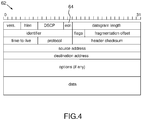
- a first Explicit Congestion Field 64 of two bits corresponding the 15 th and 16 th bit of the IP header comprises the Congestion Experienced flag that corresponds to the 16 th bit and is set to 1 when a congestion or a transmission error experience is notified to the second module of the receiving device.
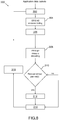
- a point-to-point transmitting method 100 for transmitting reliably a stream of source IP packets is implemented by the telecommunications system 2 of Figure 1 .
- the transmitting method 100 comprises a set of steps.
- the first dedicated hardware and/or software module 24 of the sending device 4 receives new incoming source IP application data packet(s) from the sender application layer (not shown in the Figure 5 ) and TCP acknowledgment packet(s), and processes the new incoming source application data packet(s) and TCP acknowledgment packet(s) according to TCP to generate new or repeated sender TCP/IP packets.
- the second dedicated hardware and/or software module 34 of the sending device 4 converts the new or repeated sender TCP/IP packets into source IP packets and/or repair packets on the basis of a second error recovery mechanism ERM #2.
- the second error recovery mechanism ERM #2 is based as an EC on an erasure on-the-fly encoding/decoding scheme (also called elastic window encoding/decoding scheme or a block encoding/decoding scheme or an hybrid Automatic Repeat reQuest (ARQ) control scheme using Forward Error Coding, or is based on a second standalone Automatic Repeat reQuest (ARQ) control scheme given that the TCP uses a first Automatic Repeat reQuest (ARQ) control scheme as ERM#1.
- an erasure on-the-fly encoding/decoding scheme also called elastic window encoding/decoding scheme or a block encoding/decoding scheme or an hybrid Automatic Repeat reQuest (ARQ) control scheme using Forward Error Coding
- ARQ Automatic Repeat reQuest
- the second dedicated hardware and/or software module 34 of the sending device 4 will not use for this second encoding step 104 any implicit information provided by the repeated TCP/IP packets.
- the sending device 4 sends the source IP packet(s) and/or the repair packet(s) on the forward transmission path 8.
- the second dedicated hardware and/or software module 36 of the receiving device 6 receives the source IP packet(s) and/or the repair packet(s) sent through the forward transmission path 8, recovers the lost source IP packet(s) by using the second error recovery mechanism ERM #2 when a recover becomes possible, and keeps ready to be forwarded to the first module 26 or the layer IP stack of the second module 36 the current source IP packet correctly received or the current recovered lost source IP packets.
- No repair packet is forwarded by the second module to the first module.
- a subsequent fifth step 110 it is determined by the second module 36 of the receiving device 6 whether the current source IP packet(s) is (or are) source IP packet(s) correctly received or is (or are) recovered lost packet(s).
- the second module 36 of the receiving device 6 transmits the recovered TCP lost packet(s) with the actually marked ECN bit CE reported inside the ECN field of the TCP header or the virtually marked ECN bit reported inside the ECN field of the TCP header, or the source TCP/IP packet(s) correctly received.
- the first module 26 of the receiving device 6 processes the reporting bit(s) of the actual or virtual marked ECN bits CE set inside the corresponding TCP header(s).
- the first module 26 of the receiving device 6 feedbacks these ECN signals to the sending device 4 through the return transmission path 10 following any method compatible with the RFC 3168.
- the first module 26 of the receiving device determines that the TCP reporting bit of the actual or virtual IP CE flag is set, and in a TCP header of a corresponding acknowledgment packet sets an Explicit Congestion Notification Echo ECN-E flag compliant with the RFC 3168.
- the first module 26 of the receiving device 6 transmits the said acknowledgment packet wherein the Explicit Congestion Notification Echo ECN-E flag is set to the source sending device 4 through the return transmission path 10.
- the source sending device 4 Upon receiving the feedback ECN signals, the source sending device 4 takes in the first step 102 prescribed steps to reduce the sending rate at which the source sending device 4 transmits packets, these prescribed steps being compliant with the RFC 3168.
- the source sending device 4 upon receipt of the acknowledgment packet with the ECN-E flag set therein the source sending device 4 takes prescribed steps to reduce the sending rate at which the source sending device 4 transmits packets.
- the second module 36 of the receiving device 6 forwards directly to the first module or to the IP layer stack the received decoded current IP packet.
- the first module 26 of the receiving device 6 processes the reporting bit(s) of the actual ECN bits CE set inside the corresponding TCP header(s).
- the first module 26 of the receiving device 6 feeds back these ECN signals to the sending device 4 through the return transmission path 10 following any method compatible with the RFC 3168.
- the first module 26 of the receiving device 6 detects this set CE flag and in the TCP header of an acknowledgment packet sets an Explicit Congestion Notification Echo ECE flag according to an established Explicit Congestion Notification mechanism of the Transport Control Protocol TCP. In case no CE flag has been set previously, the first module 26 of the receiving device 6 does not activate Explicit Congestion Notification Echo ECE flag in an acknowledgment packet.
- the point-to-point transmission method according to the invention as described in figure 5 combines a second Error Recovery Mechanism ERM #2, for instance an erasure coding EC scheme, and a TCP/IP Explicit Congestion Notification mechanism.
- This point-to-point transmission is carried out by a telecommunication system 202 similar to the system 2 of Figure 1 .
- the method according to the invention permits to anticipate and avoid network congestion caused by a queue overflow and/or transmission errors.
- forward transmission path 208 comprises at least one intermediate network device 212 that is non ECN-capable, as a non ECN-capable router for example.
- the source sending device 4 forms a source IP packet 214 comprising an IP header and a TCP header.
- the source sending device 4 which is configured as an ECN-capable computing device has set the Congestion Experience flag to an initial state (bit of the flag set to zero) corresponding to an absence of congestion.
- the second module 36 of the receiving device 6 will not detect the near congestion and will not anticipate the need to reduce the sending rate but will let the TCP protocol at the first module level control the congestion by other means.
- the second module 36 can correct erased packets, anticipate earlier the network congestion when rebuilding the lost packets and prevent congestion by reducing the sending rate of the sending device. Thus the delivery ratio is improved while meeting the Internet equity requirement.
- the second module 36 of the receiving device 6 upon rebuilding lost packets, for instance the rebuilt packet 216, sets the Congestion Experience flag (bit set to 1) in the IP header while keeping the Explicit Congestion notification Echo ECE in the TCP header to the initial state (bit set to 0). Then, the IP layer of the second module 36 of the receiver 6 reports the actually marked CE bit in the ECE flag of the TCP header (ECE bit set to 1) as prescribed by the RFC 3168.
- the first module 26 of the receiving device 6 Upon the detection of the Explicit Congestion notification Echo (ECE) flag in the TCP header of the packet 216, the first module 26 of the receiving device 6 generates an acknowledgment packet 218 wherein the Explicit Congestion notification Echo flag is set and sends the acknowledgment packet 218 to the sending device 4 on the return transmitting path.
- ECE Explicit Congestion notification Echo
- the point-to-point transmission method according to the invention as described in Figure 5 combines a second Error Recovery Mechanism ERM #2, for instance an erasure coding/decoding EC scheme, and a TCP/IP Explicit Congestion Notification mechanism.
- This point-to-point transmission is carried out by a telecommunication system 252, similar to the system 2 of Figure 1 .
- the forward transmission path 258 comprises at least one intermediate network device 262 that is an ECN-capable router.
- the ECE flag (bit set to 1) can be processed by the first module 26 in charge of TCP protocol handling.
- an intermediate router is compatible with ECN, i.e. is an ECN-capable router, and implements an algorithm of marking the field of the Congestion Experienced CE flag
- the intermediate router will mark this CE flag on all the IP packets that will pass through the said intermediate router 262 when its queuing file will reach a predetermined threshold as defined for instance by a network administrator and equal as example to 80% of the queuing file occupation.
- This CE marking will permit therefore through the ECE the report by the receiving device 6 in its feedback or return messages, i.e. TCP acknowledgments, the source terminal to decrease its transmission rate whereas no loss has been yet observed.
- TCP acknowledgments i.e. TCP acknowledgments
- the point-to-point transmission method 102 is compatible with this ECN marking mechanism and let this mechanism operate when the network is equipped with ECN-capable routers.
- the source sending device 4 forms a source IP packet 264 comprising an IP header and a TCP header.
- the source sending device 4 which is configured as an ECN-capable computing device has set the Congestion Experience flag to an initial state (bit of the flag set to zero) corresponding to an absence of congestion.
- the packet 264 Once the packet 264 has been formed by the sending device 4, it can be transmitted to the receiving device 6 via network communications that can pass through the router 262.
- the packet 264 sent by the sending device 4 is altered in a modified packet 266 wherein the Congestion Experienced flag is set (bit set to 1). Then, the IP layer of the second module 36 reports the status of the CE flag in the ECE flag (ECE bit set to 1) inside the TCP header.
- the second module 36 of the receiving device 6 forwards directly the IP decoded modified packet to the first module 26. Then, the first module 26 of the receiving device 6 forms an acknowledgment packet 268 wherein the Explicit Congestion notification Echo ECE flag is set and sends the acknowledgment packet 268 to the return transmission path.
- the second module 36 can correct erased packets, anticipate earlier the network congestion and prevent this congestion by reducing the sending rate of the sending device.
- the delivery ratio is improved while meeting the Internet equity requirement.
- the second module 36 of the receiving device 6 upon rebuilding or recovering lost source IP packets, in at least one recovered packet(s), sets the Congestion Experience flag (bit set to 1) in the IP header while keeping the Explicit Congestion notification Echo in the TCP header to the initial state (bit set to 0). Then, the IP layer of the second module 36 reports the status of the CE flag in the ECE flag (ECE bit set to 1) inside the TCP header.
- the first module 26 1 of the receiver device 6 1 upon the detection of Explicit Congestion notification Echo (ECE) flag in the TCP header of the IP packet, the first module 26 1 of the receiver device 6 1 generates an acknowledgment packet 268 wherein the Explicit Congestion notification Echo flag is set and sends the acknowledgment packet 268 to the sending device 4 on the return transmitting path.
- ECE Explicit Congestion notification Echo
- the point-to-point transmitting method 302 transmits also a stream of source IP packets on the telecommunication system 2 of Figure 1 .
- the second Error Recovery Mechanism ERM #2 used by the point-to-point transmitting method 302 is a particular erasure coding/decode scheme of the on-the-fly erasure coding type, for example the on-the-fly erasure coding scheme described in the article of P.U. Tournoux et al.,"On-the-Fly Erasure Coding for a Real-Time Video Applications", in in IEEE Transactions on Multimedia, vol. 13, no. 4, pp. 797-812, Aug. 2011, doi: 10.1109/TMM.2011.2126564 .
- the transmitting method 300 comprises a set of steps.
- the first dedicated hardware and/or software module 24 of the sending device 4 receives new incoming source IP application data packet(s) from the sender application layer (not shown in the Figure 8 ) and TCP acknowledgment packet(s), and processes the new incoming source application data packet(s) and TCP acknowledgment packet(s) according to TCP to generate new or repeated sender TCP/IP packets.
- the second dedicated hardware and/or software module 34 of the sending device 4 converts the new or repeated sender TCP/IP packets into source IP packets and/or repair packets on the basis of the ERM #2 on-the-fly erasure coding scheme.
- the sending device 4 sends the source IP packet(s) and/or the repair packet(s) on the forward transmission path 8.
- the second dedicated hardware and or software module 36 of the receiving device 6 receives the source IP packet(s) and/or the repair packet(s) sent through the forward transmission path 8, recovers the lost source IP packet(s) by using the decoding scheme of the on-the-fly erasure coding scheme when a successful decoding becomes possible, and keeps ready to be forwarded to the first module 26 or the layer IP stack of the second receiving device 6 the current source IP packet correctly received or the current recovered lost source IP packets.
- No repair packet is forwarded by the second module to the first module.
- a subsequent fifth step 310 it is determined by the second module 36 of the receiving device 6 whether the current source IP packet(s) is (or are) source IP packet(s) correctly received or is (or are) recovered packet(s).
- the second module 36 of the receiving device 6 transmits the recovered TCP lost packet(s) with the actually marked ECN bit CE reported inside the ECN field of the TCP header of the virtually marked ECN bit reported inside the ECN field of the TCP header, or the source TCP/IP packet(s) correctly received.
- the first module 26 of the receiving device 6 processes the reporting bit(s) of the actual or virtual marked ECN bit(s) CE set inside the TCP header(s).
- the first module 26 of the receiving device 6 feedbacks these ECN signals to the sending device 4 through the return transmission path 10 following any method compatible with the RFC 3168.
- the first module 26 of the receiving device determines that the TCP reporting bit of the actual or virtual IP CE flag is set, and in a TCP header of a corresponding acknowledgment packet sets an Explicit Congestion Notification Echo ECN-E flag compliant with the RFC 3168.
- the first module 26 of the receiving device 6 transmits the said acknowledgment packet wherein the Explicit Congestion Notification Echo ECN-E flag is set to the source sending device 4 through the return transmission path 10.
- the source sending device 4 Upon receiving the feedback ECN signals, the source sending device 4 takes in the first step 302 prescribed steps to reduce the sending rate at which the source sending device 4 transmits packets, these prescribed steps being compliant with the RFC 3168.
- the source sending device 4 upon receipt of the acknowledgment packet with the ECE flag set therein the source sending device 4 takes prescribed steps to reduce the sending rate at which the source sending device 4 transmits packets.
- the second module 36 of the receiving device 6 forwards directly to the first module 26 or to the IP layer stack of the second module the received decoded current IP packet.
- the first module 26 of the receiving device 6 processes the reporting bit(s) of the actual ECN bits CE set inside the corresponding TCP header(s).
- the first module 26 of the receiving device 6 feed backs these ECN signals to the sending device 4 through the return transmission path 10 following any method compatible with the RFC 3168.
- the first module 26 of the receiving device 6 detects this set CE flag and in the TCP header of an acknowledgment packet sets an Explicit Congestion notification Echo ECE flag according to an established Explicit Congestion Notification mechanism of the Transport Control Protocol TCP. In case no CE flag has been set previously, the first module 26 of the receiving device 6 does not activate Explicit Congestion notification Echo ECE flag in an acknowledgment packet.
- the acknowledgment packet is sent to the sending device 4 in the eight step 316.
- the coding/decoding operation is located in the OSI layer model is located below the transport layer.
- the erasure on-the-fly coding/decoding algorithm can also operate a proxy, the architecture deployment involving no engineering issue.
Landscapes
- Engineering & Computer Science (AREA)
- Computer Networks & Wireless Communication (AREA)
- Signal Processing (AREA)
- Computer Security & Cryptography (AREA)
- Quality & Reliability (AREA)
- Data Exchanges In Wide-Area Networks (AREA)
- Communication Control (AREA)
Priority Applications (2)
| Application Number | Priority Date | Filing Date | Title |
|---|---|---|---|
| EP17305951.0A EP3432500A1 (fr) | 2017-07-18 | 2017-07-18 | Procédé de transmission point à point basé sur l'utilisation d'un schéma de codage d'effacement et protocole tcp/ip |
| PCT/EP2018/067431 WO2019015931A1 (fr) | 2017-07-18 | 2018-06-28 | Procédé de transmission point à point basé sur l'utilisation d'un schéma de codage d'effacement et d'un protocole tcp/ip |
Applications Claiming Priority (1)
| Application Number | Priority Date | Filing Date | Title |
|---|---|---|---|
| EP17305951.0A EP3432500A1 (fr) | 2017-07-18 | 2017-07-18 | Procédé de transmission point à point basé sur l'utilisation d'un schéma de codage d'effacement et protocole tcp/ip |
Publications (1)
| Publication Number | Publication Date |
|---|---|
| EP3432500A1 true EP3432500A1 (fr) | 2019-01-23 |
Family
ID=59895242
Family Applications (1)
| Application Number | Title | Priority Date | Filing Date |
|---|---|---|---|
| EP17305951.0A Withdrawn EP3432500A1 (fr) | 2017-07-18 | 2017-07-18 | Procédé de transmission point à point basé sur l'utilisation d'un schéma de codage d'effacement et protocole tcp/ip |
Country Status (2)
| Country | Link |
|---|---|
| EP (1) | EP3432500A1 (fr) |
| WO (1) | WO2019015931A1 (fr) |
Families Citing this family (1)
| Publication number | Priority date | Publication date | Assignee | Title |
|---|---|---|---|---|
| CN114301694B (zh) * | 2021-12-29 | 2024-03-15 | 赛尔网络有限公司 | 网络异常流量分析方法、装置、设备及介质 |
Citations (4)
| Publication number | Priority date | Publication date | Assignee | Title |
|---|---|---|---|---|
| US6741555B1 (en) * | 2000-06-14 | 2004-05-25 | Nokia Internet Communictions Inc. | Enhancement of explicit congestion notification (ECN) for wireless network applications |
| US20100046371A1 (en) | 2008-05-29 | 2010-02-25 | Jay Kumar Sundararajan | Feedback-based online network coding |
| WO2010092323A2 (fr) * | 2009-02-12 | 2010-08-19 | British Telecommunications Public Limited Compan | Transmission de données |
| US8130776B1 (en) | 2009-08-28 | 2012-03-06 | Massachusetts Institute Of Technology | Method and apparatus providing network coding based flow control |
-
2017
- 2017-07-18 EP EP17305951.0A patent/EP3432500A1/fr not_active Withdrawn
-
2018
- 2018-06-28 WO PCT/EP2018/067431 patent/WO2019015931A1/fr not_active Ceased
Patent Citations (4)
| Publication number | Priority date | Publication date | Assignee | Title |
|---|---|---|---|---|
| US6741555B1 (en) * | 2000-06-14 | 2004-05-25 | Nokia Internet Communictions Inc. | Enhancement of explicit congestion notification (ECN) for wireless network applications |
| US20100046371A1 (en) | 2008-05-29 | 2010-02-25 | Jay Kumar Sundararajan | Feedback-based online network coding |
| WO2010092323A2 (fr) * | 2009-02-12 | 2010-08-19 | British Telecommunications Public Limited Compan | Transmission de données |
| US8130776B1 (en) | 2009-08-28 | 2012-03-06 | Massachusetts Institute Of Technology | Method and apparatus providing network coding based flow control |
Non-Patent Citations (3)
| Title |
|---|
| P.U. TOURNOUX ET AL.: "On-the-Fly Erasure Coding for a Real-Time Video Applications", IEEE TRANSACTIONS ON MULTIMEDIA, vol. 13, no. 4, August 2011 (2011-08-01), pages 797 - 812, XP011330163, DOI: doi:10.1109/TMM.2011.2126564 |
| RAMAKRISHNAN TERAOPTIC NETWORKS S FLOYD ACIRI D BLACK EMC K: "The Addition of Explicit Congestion Notification (ECN) to IP; rfc3168.txt", THE ADDITION OF EXPLICIT CONGESTION NOTIFICATION (ECN) TO IP; RFC3168.TXT, INTERNET ENGINEERING TASK FORCE, IETF; STANDARD, INTERNET SOCIETY (ISOC) 4, RUE DES FALAISES CH- 1205 GENEVA, SWITZERLAND, 1 September 2001 (2001-09-01), XP015008949 * |
| TAO HAN ET AL: "On Accelerating Content Delivery in Mobile Networks", IEEE COMMUNICATIONS SURVEYS AND TUTORIALS, INSTITUTE OF ELECTRICAL AND ELECTRONICS ENGINEERS, US, vol. 15, no. 3, 1 July 2013 (2013-07-01), pages 1314 - 1333, XP011523246, ISSN: 1553-877X, DOI: 10.1109/SURV.2012.100412.00094 * |
Also Published As
| Publication number | Publication date |
|---|---|
| WO2019015931A1 (fr) | 2019-01-24 |
Similar Documents
| Publication | Publication Date | Title |
|---|---|---|
| US12388574B2 (en) | Disabling hybrid automatic repeat request (HARQ) acknowledgments for packets for which acknowledgements are supported at network or higher layer | |
| US11063884B2 (en) | Ethernet enhancements | |
| US5974028A (en) | System and method for improving transport protocol performance in communication networks having lossy links | |
| US8842528B2 (en) | System and method for improving transport protocol performance in communication networks having lossy links | |
| Ong et al. | An introduction to the stream control transmission protocol (SCTP) | |
| US9577791B2 (en) | Notification by network element of packet drops | |
| Balakrishnan et al. | Explicit loss notification and wireless web performance | |
| CN115580379A (zh) | 一种多链路网络传输方法及系统 | |
| WO2021208694A1 (fr) | Procédé de transmission de données et dispositif de réseau | |
| EP1139602A1 (fr) | Procédé et dispositif de multidiffusion | |
| Ha et al. | TCP with network coding enhanced in bi-directional loss tolerance | |
| US7653060B2 (en) | System and method for implementing ASI over long distances | |
| Maisuria et al. | Overview of techniques for improving QoS of TCP over wireless links | |
| WO2019015931A1 (fr) | Procédé de transmission point à point basé sur l'utilisation d'un schéma de codage d'effacement et d'un protocole tcp/ip | |
| US20250150384A1 (en) | Switch controller, sending controller and methods for use in switch controller and sending controller | |
| US7013418B1 (en) | Method and apparatus for reliable delivery of status information for multiple sets of data units in a single packet | |
| EP1733527B1 (fr) | Technique de gestion d'unités de données désuètes | |
| KR20010113124A (ko) | 패킷 전송을 위한 메시지 처리방법 | |
| Sachs et al. | A Radio Resource Efficient Link Layer for Error Tolerant Applications | |
| KR20020038376A (ko) | 전송속도 향상된 슬라이딩 윈도우 방법 | |
| GB2476472A (en) | Combining unacknowledged and queued packets to form ARQ retransmission packet such that queued packet can be recovered from other packets and not sent |
Legal Events
| Date | Code | Title | Description |
|---|---|---|---|
| PUAI | Public reference made under article 153(3) epc to a published international application that has entered the european phase |
Free format text: ORIGINAL CODE: 0009012 |
|
| STAA | Information on the status of an ep patent application or granted ep patent |
Free format text: STATUS: THE APPLICATION HAS BEEN PUBLISHED |
|
| AK | Designated contracting states |
Kind code of ref document: A1 Designated state(s): AL AT BE BG CH CY CZ DE DK EE ES FI FR GB GR HR HU IE IS IT LI LT LU LV MC MK MT NL NO PL PT RO RS SE SI SK SM TR |
|
| AX | Request for extension of the european patent |
Extension state: BA ME |
|
| STAA | Information on the status of an ep patent application or granted ep patent |
Free format text: STATUS: REQUEST FOR EXAMINATION WAS MADE |
|
| 17P | Request for examination filed |
Effective date: 20190516 |
|
| RBV | Designated contracting states (corrected) |
Designated state(s): AL AT BE BG CH CY CZ DE DK EE ES FI FR GB GR HR HU IE IS IT LI LT LU LV MC MK MT NL NO PL PT RO RS SE SI SK SM TR |
|
| STAA | Information on the status of an ep patent application or granted ep patent |
Free format text: STATUS: EXAMINATION IS IN PROGRESS |
|
| 17Q | First examination report despatched |
Effective date: 20191002 |
|
| STAA | Information on the status of an ep patent application or granted ep patent |
Free format text: STATUS: THE APPLICATION IS DEEMED TO BE WITHDRAWN |
|
| 18D | Application deemed to be withdrawn |
Effective date: 20200603 |