EP3434221A1 - System zur steuerung von korrektem bohren im kieferknochen - Google Patents
System zur steuerung von korrektem bohren im kieferknochen Download PDFInfo
- Publication number
- EP3434221A1 EP3434221A1 EP18184812.8A EP18184812A EP3434221A1 EP 3434221 A1 EP3434221 A1 EP 3434221A1 EP 18184812 A EP18184812 A EP 18184812A EP 3434221 A1 EP3434221 A1 EP 3434221A1
- Authority
- EP
- European Patent Office
- Prior art keywords
- microprocessor
- drilling
- micromotor
- destined
- sensor
- Prior art date
- Legal status (The legal status is an assumption and is not a legal conclusion. Google has not performed a legal analysis and makes no representation as to the accuracy of the status listed.)
- Ceased
Links
Images
Classifications
-
- A—HUMAN NECESSITIES
- A61—MEDICAL OR VETERINARY SCIENCE; HYGIENE
- A61C—DENTISTRY; APPARATUS OR METHODS FOR ORAL OR DENTAL HYGIENE
- A61C1/00—Dental machines for boring or cutting ; General features of dental machines or apparatus, e.g. hand-piece design
- A61C1/08—Machine parts specially adapted for dentistry
- A61C1/18—Flexible shafts; Clutches or the like; Bearings or lubricating arrangements; Drives or transmissions
- A61C1/185—Drives or transmissions
- A61C1/186—Drives or transmissions with torque adjusting or limiting means
-
- A—HUMAN NECESSITIES
- A61—MEDICAL OR VETERINARY SCIENCE; HYGIENE
- A61C—DENTISTRY; APPARATUS OR METHODS FOR ORAL OR DENTAL HYGIENE
- A61C1/00—Dental machines for boring or cutting ; General features of dental machines or apparatus, e.g. hand-piece design
- A61C1/0007—Control devices or systems
- A61C1/0015—Electrical systems
- A61C1/003—Control of rotation of instrument
-
- A—HUMAN NECESSITIES
- A61—MEDICAL OR VETERINARY SCIENCE; HYGIENE
- A61C—DENTISTRY; APPARATUS OR METHODS FOR ORAL OR DENTAL HYGIENE
- A61C1/00—Dental machines for boring or cutting ; General features of dental machines or apparatus, e.g. hand-piece design
- A61C1/08—Machine parts specially adapted for dentistry
- A61C1/082—Positioning or guiding, e.g. of drills
- A61C1/084—Positioning or guiding, e.g. of drills of implanting tools
-
- A—HUMAN NECESSITIES
- A61—MEDICAL OR VETERINARY SCIENCE; HYGIENE
- A61C—DENTISTRY; APPARATUS OR METHODS FOR ORAL OR DENTAL HYGIENE
- A61C1/00—Dental machines for boring or cutting ; General features of dental machines or apparatus, e.g. hand-piece design
- A61C1/0007—Control devices or systems
- A61C1/0015—Electrical systems
- A61C1/0023—Foot control
-
- A—HUMAN NECESSITIES
- A61—MEDICAL OR VETERINARY SCIENCE; HYGIENE
- A61C—DENTISTRY; APPARATUS OR METHODS FOR ORAL OR DENTAL HYGIENE
- A61C2204/00—Features not otherwise provided for
- A61C2204/005—Features not otherwise provided for using chip tag or any electronic identification mean, e.g. RFID
Definitions
- the present invention relates to a system for controlling correct bone drilling for insertion operations of dental prostheses.
- cutters of whatever type they may be and for any application, when they rotate during drilling, heat up due to friction from contact with the material they are drilling.
- This heat is consequently transmitted to the body they are drilling, heating it according to the capacity of the body being drilled or cutter that is operating to dissipate heat.
- bone drilling is a fundamental aspect.
- Bone drilling is carried out with handpieces equipped with micromotors specifically studied for this use. Furthermore, not only are the motor and handpiece designed for this specific use, but the rotating instruments (cutters) are also specialized.
- the bone tissue that is perforated consists, in variable percentages, of an inorganic part (calcium with various crystalline structures) and an organic part (collagen) maintained by a pool of cells belonging to the connective and osteocytic line.
- the organic part is, like all the tissues of our body, very sensitive to temperature. It should be taken into account that, over 45°C, the proteins, which form the matrix of the organic substance, lose their structural organization with the death of the single cell. This event does not necessarily represent the death of the whole bone, but it makes healing processes much longer and less predictable.
- This objective biological consideration influences the attitude that clinicians have during the drilling of the bone tissue, especially if this must incorporate an alloplastic device without the onset of surrounding inflammatory processes.
- the present applicant has developed an invention, which is the object of European patent EP1842484 , which relates to an electric motor control system for surgical applications.
- This system is based on the fact that the motor can be programmed according to the predefined type of processing. And this processing can depend on the patient's anamnestic data or on the pre-operative data identified, for example, radiologically.
- a specific electronics allows useful information to be obtained for the programming of the motor referring to the rotation rate and quantity of absorbed current which, correctly parameterized, suggest the type of substrate involved and resistance of the instrumentation or device used, and also the interface with the instrument kit makes it possible to suggest the correct sequence of the instruments to be used.
- the objective is to avoid the risk of deteriorating, with bone drilling, the capacity of the organic tissue of initiating immediate and correct healing processes.
- the main objective of the present invention is to identify a system that is capable of avoiding such irreversible deterioration.
- a further objective of the present invention is to provide a system for controlling correct bone drilling for insertion operations of dental prostheses capable of solving the drawbacks of the known art indicated above in an extremely simple, economical and particularly functional manner.
- a further objective of the present invention is to provide a particularly advantageous system which is such as to not create problems to the bone that is being drilled.
- the aim is to detect and monitor whether one is operating in compliance with the thermal criticality of the drill tip.
- the bone drilling is in fact carried out with handpieces equipped with micromotors and bearing specific cutters.
- This bone drilling operation in the patient's mouth must be carried out not exceeding the deproteinization temperatures so as not to lose the structural organization of the cells leading to the death of the individual cells.
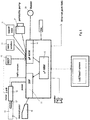
- the system according to the invention provides for three different specifically dedicated microprocessors:
- the attached figure proposes a schematization in some main elements of an arrangement of a system according to the present invention.
- This group 16 is also referred to as the "MAD" system (Micro Angle Detector) and assists the physician during the initial drilling phase during an implantology operation, allowing this operation to be effected knowing the inclination of the hole for creating a correct implant alveolus.
- MAD Micro Angle Detector
- the first microprocessor 11 is a unit for the real-time control of the surgical motor and relative resources which can act directly on the functions of the motor itself.
- This unit can also be defined as DSP (Digital Signal Processor) or RTU (Real Time Motor Control Unit).
- the microprocessor or unit 11 manages the surgical micromotor 12 of the handpiece 13, controls the torque and speed of this micromotor 12, manages the movement anomalies and calculates the parameters relating to the behavior of the handpiece 13 together with the group 16.
- a control pedal 18 is connected to the microprocessor or unit 11 which can act directly on the behavior of the micromotor 12 in relation to specific programmed parameters.
- the control of the micromotor 12 is therefore delegated to the above-mentioned first microprocessor or unit 11 which communicates with the main microprocessor 15 called MCU (Main Control Unit).
- MCU Main Control Unit
- the microprocessor or unit 11 interfaces with the main microprocessor 15 through a bidirectional serial channel.
- the second microprocessor 14 destined for auxiliary services has been seen to be operatively connected to the group 16 for calculating the angle of the drilling bit 17.
- this second microprocessor 14 is operatively connected to a card 19, called "Smart Base”, of a surgical tray (not shown).
- This tray comprises a base plate which detects, through an electronic/electromechanical sensor, whether the drills are present, and indicates their absence by means of an acoustic and/or visual warning device 20 (for example a buzzer or a LED) and supplies this information to the microprocessor 14, which in turn is connected to the main microprocessor 15.
- an acoustic and/or visual warning device 20 for example a buzzer or a LED
- This exchange of information is also managed on a serial protocol.
- the card or "Smart Base" 19 is connected to the microprocessor 14 via Bluetooth.
- the second microprocessor 14 is destined for managing a peristaltic pump 21 and a second and third sensor 22 and 23.
- the second sensor 22 is positioned on the handpiece 13 and is connected by cable.
- the third sensor 23 on the other hand is positioned on the patient and communicates via wireless (bluetooth).
- the second sensor 22 is usually indicated as "Mad Drill” integral with the drill and the third sensor 23 as "Mad Head” or compensator, integral with the patient's head or jaw. In any case, both sensors 22 and 23 are managed by the second microprocessor 14.
- the data exchange between the main microprocessor MCU 15 and the second microprocessor 14 is on serial protocol.
- the second microprocessor 14 sends a series of variables to the main microprocessor MCU 15 in order to monitor the state of the group 16 and sensors 22, 23 (angle, compensated angle, battery status, calibration state of the sensors, etc.).
- the above-mentioned second microprocessor 14 receives, from the main microprocessor MCU 15, a series of variables for controlling the group 16, the sensors 22, 23 and the peristaltic pump 21 in order to define and adjust parameters (target angle, calibration control, pump on/off, reset alarms, pump rate, etc.).
- the second microprocessor 14 sends to the main microprocessor MCU 15, a series of variables for monitoring the state of the surgical micromotor 12 (speed, motor torque, depth of the tapping, alarms, useful energy for the cutter, state of the buttons of the pedal board, rotation direction, calibration result, motor alarms - over-speed, over-current, motor blocked, etc.).
- the second microprocessor 14 receives from the main microprocessor MCU 15, a series of variables for controlling the surgical micromotor 12 (speed, motor torque limit, tapping depth, thread pitch, rotation direction, calibration control, running control, alarm reset, etc.).
- pedal 18 has been provided, which communicates directly with the first microprocessor 11.
- the "accelerator” function has been introduced using a potentiometric pedal.
- a hardware block of the micromotor 12 has been provided if the accelerator of the pedal 18 is released.
- the hardware block on the micromotor 12 is able to stop the micromotor in any condition in which the control software is located (as it is specifically a hardware block).
- the pedal 18 is connected to the first microprocessor 11 by cable.
- the group 16 has been said to assist the physician during the initial drilling phase.
- the group is equipped with a sound signal that allows the physician to know how far it is from the initial inclination value by changing the frequency of the sound pulse without taking his eyes off the patient's mouth. An increase in the sound frequency will indicate approach towards the inclination set, vice versa a decrease in the frequency of the sound pulse will indicate removal from this value.
- the first microprocessor 11 has been specifically studied and designed for controlling the micromotor 12.
- the use of this specific microprocessor 11 allows the performance of the micromotor control to be improved in terms of precision and reliability.
- the second microprocessor 14 is destined for managing the auxiliary services (group 16, sensors 22, 23, peristaltic pump 21, card 19 ("Smart Base”) and surgical tray with control of the presence and withdrawal correctness and use of the drilling cutters (for example through an electronic/electromechanical sensor that detects if they are present, etc.).
- auxiliary services group 16, sensors 22, 23, peristaltic pump 21, card 19 ("Smart Base") and surgical tray with control of the presence and withdrawal correctness and use of the drilling cutters (for example through an electronic/electromechanical sensor that detects if they are present, etc.).
- the third microprocessor 15 or main microprocessor MCU (for example an iMX6 microprocessor) on which the Android runs with the user interface that correlates and controls the other two microprocessors, determining the maintenance of specific predetermined requirements.
- main microprocessor MCU for example an iMX6 microprocessor
- the first microprocessor 11 and the main microprocessor 15 are included in the calculation of the thermal risk index.
- the thermal risk index is calculated as follows:
- the algorithm If the algorithm assumes an excessive overheating of the tip of the cutter, it provides an alarm signal to the Android system that will appropriately alert the operator.
- the system of the invention allows numerous parameters to be taken into account such as the speed of the cutter, the drilling time, the drilling technique, the cutter size (diameter), the presence or absence of an external cooling system with fresh physiological solution, the pressure exerted on the cutter, the wear of the cutter, etc.
- the temperature is a consequence of the amount of friction that develops during the preparation of the hole and, while having different causes, it can be identified as the amount of energy needed for maintaining the rotation of that instrument.
- a system according to the invention it is possible to constantly monitor the torque during the rotation phases so as to "derive" or estimate the temperature of the cutter or at least identify a threshold value above which the risk of irreversible damage can be reached.
Landscapes
- Health & Medical Sciences (AREA)
- Oral & Maxillofacial Surgery (AREA)
- Dentistry (AREA)
- Epidemiology (AREA)
- Life Sciences & Earth Sciences (AREA)
- Animal Behavior & Ethology (AREA)
- General Health & Medical Sciences (AREA)
- Public Health (AREA)
- Veterinary Medicine (AREA)
- Engineering & Computer Science (AREA)
- Water Supply & Treatment (AREA)
- Surgical Instruments (AREA)
- Dental Tools And Instruments Or Auxiliary Dental Instruments (AREA)
Applications Claiming Priority (1)
| Application Number | Priority Date | Filing Date | Title |
|---|---|---|---|
| IT102017000085598A IT201700085598A1 (it) | 2017-07-26 | 2017-07-26 | Sistema di controllo della corretta foratura dell’osso per operazioni di inserimento di protesi odontoiatriche |
Publications (1)
| Publication Number | Publication Date |
|---|---|
| EP3434221A1 true EP3434221A1 (de) | 2019-01-30 |
Family
ID=60451091
Family Applications (1)
| Application Number | Title | Priority Date | Filing Date |
|---|---|---|---|
| EP18184812.8A Ceased EP3434221A1 (de) | 2017-07-26 | 2018-07-20 | System zur steuerung von korrektem bohren im kieferknochen |
Country Status (2)
| Country | Link |
|---|---|
| EP (1) | EP3434221A1 (de) |
| IT (1) | IT201700085598A1 (de) |
Cited By (2)
| Publication number | Priority date | Publication date | Assignee | Title |
|---|---|---|---|---|
| CN113340332A (zh) * | 2021-05-27 | 2021-09-03 | 西安交通大学 | 一种光电传感器标定装置及方法 |
| WO2021220041A1 (en) * | 2020-05-01 | 2021-11-04 | Khan Ahmadi Nikoo | Smart jaw drilling machine in implant placement |
Citations (6)
| Publication number | Priority date | Publication date | Assignee | Title |
|---|---|---|---|---|
| US5516285A (en) * | 1993-09-27 | 1996-05-14 | Yacker; Miles J. | Temperature gauge for surgical drills and method employing same |
| EP1842484A1 (de) | 2006-04-04 | 2007-10-10 | I.D.I. Evolution S.r.l. | Steuersystem eines Elektromotors für chirurgische Anwendungen |
| US20090148806A1 (en) * | 2006-10-31 | 2009-06-11 | Kaltenbach & Voigt Gmbh | Control Device for the Drive of a Dental Handpiece |
| US20120107762A1 (en) * | 2009-07-01 | 2012-05-03 | Kaltenbach & Voigt Gmbh | Method And System For Operating A Medical, In Particular A Dental, Handpiece |
| US20160067010A1 (en) * | 2014-09-05 | 2016-03-10 | Yoon NAM | Apparatus and method for correcting three dimensional space-angle of drill for dental hand piece |
| US20160157964A1 (en) * | 2014-12-09 | 2016-06-09 | Biomet 3I, Llc | Robotic device for dental surgery |
-
2017
- 2017-07-26 IT IT102017000085598A patent/IT201700085598A1/it unknown
-
2018
- 2018-07-20 EP EP18184812.8A patent/EP3434221A1/de not_active Ceased
Patent Citations (6)
| Publication number | Priority date | Publication date | Assignee | Title |
|---|---|---|---|---|
| US5516285A (en) * | 1993-09-27 | 1996-05-14 | Yacker; Miles J. | Temperature gauge for surgical drills and method employing same |
| EP1842484A1 (de) | 2006-04-04 | 2007-10-10 | I.D.I. Evolution S.r.l. | Steuersystem eines Elektromotors für chirurgische Anwendungen |
| US20090148806A1 (en) * | 2006-10-31 | 2009-06-11 | Kaltenbach & Voigt Gmbh | Control Device for the Drive of a Dental Handpiece |
| US20120107762A1 (en) * | 2009-07-01 | 2012-05-03 | Kaltenbach & Voigt Gmbh | Method And System For Operating A Medical, In Particular A Dental, Handpiece |
| US20160067010A1 (en) * | 2014-09-05 | 2016-03-10 | Yoon NAM | Apparatus and method for correcting three dimensional space-angle of drill for dental hand piece |
| US20160157964A1 (en) * | 2014-12-09 | 2016-06-09 | Biomet 3I, Llc | Robotic device for dental surgery |
Cited By (3)
| Publication number | Priority date | Publication date | Assignee | Title |
|---|---|---|---|---|
| WO2021220041A1 (en) * | 2020-05-01 | 2021-11-04 | Khan Ahmadi Nikoo | Smart jaw drilling machine in implant placement |
| CN113340332A (zh) * | 2021-05-27 | 2021-09-03 | 西安交通大学 | 一种光电传感器标定装置及方法 |
| CN113340332B (zh) * | 2021-05-27 | 2022-07-12 | 西安交通大学 | 一种光电传感器标定装置及方法 |
Also Published As
| Publication number | Publication date |
|---|---|
| IT201700085598A1 (it) | 2019-01-26 |
Similar Documents
| Publication | Publication Date | Title |
|---|---|---|
| JP7191700B2 (ja) | トルク制限スクリュードライバ装置、システムおよび方法 | |
| US11839385B2 (en) | Driving devices and methods for determining material strength in real-time | |
| US20130018400A1 (en) | Status control for electrically powered surgical tool systems | |
| US20110245833A1 (en) | Depth controllable and measurable medical driver devices and methods of use | |
| US20200192323A1 (en) | Electrically controllable rotary pressure device and method for controlling the same | |
| US20260108257A1 (en) | Surgical System For Determining Breakthrough Depth Of Cutting Tools | |
| EP3434221A1 (de) | System zur steuerung von korrektem bohren im kieferknochen | |
| US20220273316A1 (en) | Electronic module for a surgical instrument | |
| WO2013050851A1 (en) | Fracture repair kit in orthopedic surgery | |
| Sumer et al. | Assessment of heat generation during implant insertion | |
| Arias et al. | Heat generation during removal of an abutment screw fragment from dental implants | |
| EP1842484B1 (de) | Steuersystem eines Elektromotors für chirurgische Anwendungen | |
| EP1738712B1 (de) | Zusatzgerät zur zahnärztlichen Behandlung | |
| EP1815816B1 (de) | Zusatzgerät zur zahnärztlichen Behandlung | |
| WO2021154622A1 (en) | Dental instrument pressure indication |
Legal Events
| Date | Code | Title | Description |
|---|---|---|---|
| PUAI | Public reference made under article 153(3) epc to a published international application that has entered the european phase |
Free format text: ORIGINAL CODE: 0009012 |
|
| STAA | Information on the status of an ep patent application or granted ep patent |
Free format text: STATUS: THE APPLICATION HAS BEEN PUBLISHED |
|
| AK | Designated contracting states |
Kind code of ref document: A1 Designated state(s): AL AT BE BG CH CY CZ DE DK EE ES FI FR GB GR HR HU IE IS IT LI LT LU LV MC MK MT NL NO PL PT RO RS SE SI SK SM TR |
|
| AX | Request for extension of the european patent |
Extension state: BA ME |
|
| STAA | Information on the status of an ep patent application or granted ep patent |
Free format text: STATUS: REQUEST FOR EXAMINATION WAS MADE |
|
| 17P | Request for examination filed |
Effective date: 20190718 |
|
| RBV | Designated contracting states (corrected) |
Designated state(s): AL AT BE BG CH CY CZ DE DK EE ES FI FR GB GR HR HU IE IS IT LI LT LU LV MC MK MT NL NO PL PT RO RS SE SI SK SM TR |
|
| STAA | Information on the status of an ep patent application or granted ep patent |
Free format text: STATUS: EXAMINATION IS IN PROGRESS |
|
| 17Q | First examination report despatched |
Effective date: 20200525 |
|
| STAA | Information on the status of an ep patent application or granted ep patent |
Free format text: STATUS: THE APPLICATION HAS BEEN REFUSED |
|
| 18R | Application refused |
Effective date: 20220126 |