EP3435455A1 - Électrode contenant du graphite et procédé associé - Google Patents
Électrode contenant du graphite et procédé associé Download PDFInfo
- Publication number
- EP3435455A1 EP3435455A1 EP18193820.0A EP18193820A EP3435455A1 EP 3435455 A1 EP3435455 A1 EP 3435455A1 EP 18193820 A EP18193820 A EP 18193820A EP 3435455 A1 EP3435455 A1 EP 3435455A1
- Authority
- EP
- European Patent Office
- Prior art keywords
- graphite
- containing elements
- graphitization
- degree
- electrode
- Prior art date
- Legal status (The legal status is an assumption and is not a legal conclusion. Google has not performed a legal analysis and makes no representation as to the accuracy of the status listed.)
- Withdrawn
Links
Images
Classifications
-
- H—ELECTRICITY
- H01—ELECTRIC ELEMENTS
- H01M—PROCESSES OR MEANS, e.g. BATTERIES, FOR THE DIRECT CONVERSION OF CHEMICAL ENERGY INTO ELECTRICAL ENERGY
- H01M4/00—Electrodes
- H01M4/02—Electrodes composed of, or comprising, active material
- H01M4/36—Selection of substances as active materials, active masses, active liquids
- H01M4/58—Selection of substances as active materials, active masses, active liquids of inorganic compounds other than oxides or hydroxides, e.g. sulfides, selenides, tellurides, halogenides or LiCoFy; of polyanionic structures, e.g. phosphates, silicates or borates
- H01M4/583—Carbonaceous material, e.g. graphite-intercalation compounds or CFx
-
- H—ELECTRICITY
- H01—ELECTRIC ELEMENTS
- H01M—PROCESSES OR MEANS, e.g. BATTERIES, FOR THE DIRECT CONVERSION OF CHEMICAL ENERGY INTO ELECTRICAL ENERGY
- H01M4/00—Electrodes
- H01M4/86—Inert electrodes with catalytic activity, e.g. for fuel cells
- H01M4/8605—Porous electrodes
-
- H—ELECTRICITY
- H01—ELECTRIC ELEMENTS
- H01M—PROCESSES OR MEANS, e.g. BATTERIES, FOR THE DIRECT CONVERSION OF CHEMICAL ENERGY INTO ELECTRICAL ENERGY
- H01M4/00—Electrodes
- H01M4/86—Inert electrodes with catalytic activity, e.g. for fuel cells
- H01M4/8605—Porous electrodes
- H01M4/8615—Bifunctional electrodes for rechargeable cells
-
- H—ELECTRICITY
- H01—ELECTRIC ELEMENTS
- H01M—PROCESSES OR MEANS, e.g. BATTERIES, FOR THE DIRECT CONVERSION OF CHEMICAL ENERGY INTO ELECTRICAL ENERGY
- H01M4/00—Electrodes
- H01M4/86—Inert electrodes with catalytic activity, e.g. for fuel cells
- H01M4/8647—Inert electrodes with catalytic activity, e.g. for fuel cells consisting of more than one material, e.g. consisting of composites
- H01M4/8652—Inert electrodes with catalytic activity, e.g. for fuel cells consisting of more than one material, e.g. consisting of composites as mixture
-
- H—ELECTRICITY
- H01—ELECTRIC ELEMENTS
- H01M—PROCESSES OR MEANS, e.g. BATTERIES, FOR THE DIRECT CONVERSION OF CHEMICAL ENERGY INTO ELECTRICAL ENERGY
- H01M4/00—Electrodes
- H01M4/86—Inert electrodes with catalytic activity, e.g. for fuel cells
- H01M4/88—Processes of manufacture
- H01M4/8878—Treatment steps after deposition of the catalytic active composition or after shaping of the electrode being free-standing body
- H01M4/8882—Heat treatment, e.g. drying, baking
- H01M4/8885—Sintering or firing
-
- H—ELECTRICITY
- H01—ELECTRIC ELEMENTS
- H01M—PROCESSES OR MEANS, e.g. BATTERIES, FOR THE DIRECT CONVERSION OF CHEMICAL ENERGY INTO ELECTRICAL ENERGY
- H01M4/00—Electrodes
- H01M4/86—Inert electrodes with catalytic activity, e.g. for fuel cells
- H01M4/96—Carbon-based electrodes
-
- H—ELECTRICITY
- H01—ELECTRIC ELEMENTS
- H01M—PROCESSES OR MEANS, e.g. BATTERIES, FOR THE DIRECT CONVERSION OF CHEMICAL ENERGY INTO ELECTRICAL ENERGY
- H01M8/00—Fuel cells; Manufacture thereof
- H01M8/18—Regenerative fuel cells, e.g. redox flow batteries or secondary fuel cells
- H01M8/184—Regeneration by electrochemical means
- H01M8/188—Regeneration by electrochemical means by recharging of redox couples containing fluids; Redox flow type batteries
-
- H—ELECTRICITY
- H01—ELECTRIC ELEMENTS
- H01M—PROCESSES OR MEANS, e.g. BATTERIES, FOR THE DIRECT CONVERSION OF CHEMICAL ENERGY INTO ELECTRICAL ENERGY
- H01M8/00—Fuel cells; Manufacture thereof
- H01M8/20—Indirect fuel cells, e.g. fuel cells with redox couple being irreversible
-
- Y—GENERAL TAGGING OF NEW TECHNOLOGICAL DEVELOPMENTS; GENERAL TAGGING OF CROSS-SECTIONAL TECHNOLOGIES SPANNING OVER SEVERAL SECTIONS OF THE IPC; TECHNICAL SUBJECTS COVERED BY FORMER USPC CROSS-REFERENCE ART COLLECTIONS [XRACs] AND DIGESTS
- Y02—TECHNOLOGIES OR APPLICATIONS FOR MITIGATION OR ADAPTATION AGAINST CLIMATE CHANGE
- Y02E—REDUCTION OF GREENHOUSE GAS [GHG] EMISSIONS, RELATED TO ENERGY GENERATION, TRANSMISSION OR DISTRIBUTION
- Y02E60/00—Enabling technologies; Technologies with a potential or indirect contribution to GHG emissions mitigation
- Y02E60/10—Energy storage using batteries
-
- Y—GENERAL TAGGING OF NEW TECHNOLOGICAL DEVELOPMENTS; GENERAL TAGGING OF CROSS-SECTIONAL TECHNOLOGIES SPANNING OVER SEVERAL SECTIONS OF THE IPC; TECHNICAL SUBJECTS COVERED BY FORMER USPC CROSS-REFERENCE ART COLLECTIONS [XRACs] AND DIGESTS
- Y02—TECHNOLOGIES OR APPLICATIONS FOR MITIGATION OR ADAPTATION AGAINST CLIMATE CHANGE
- Y02E—REDUCTION OF GREENHOUSE GAS [GHG] EMISSIONS, RELATED TO ENERGY GENERATION, TRANSMISSION OR DISTRIBUTION
- Y02E60/00—Enabling technologies; Technologies with a potential or indirect contribution to GHG emissions mitigation
- Y02E60/30—Hydrogen technology
- Y02E60/50—Fuel cells
Definitions
- Flow batteries also known as redox flow batteries or redox flow cells, are designed to convert electrical energy into chemical energy that can be stored and later released when there is demand.
- a flow battery may be used with a renewable energy system, such as a wind-powered system, to store energy that exceeds consumer demand and later release that energy when there is greater demand.
- a typical flow battery includes a redox flow cell that has a negative electrode and a positive electrode separated by an electrolyte layer, which may include a separator, such as an ion-exchange membrane.
- a negative fluid electrolyte (sometimes referred to as the anolyte) is delivered to the negative electrode and a positive fluid electrolyte (sometimes referred to as the catholyte) is delivered to the positive electrode to drive electrochemically reversible redox reactions.
- the electrical energy supplied causes a chemical reduction reaction in one electrolyte and an oxidation reaction in the other electrolyte.
- the separator prevents the electrolytes from rapidly mixing but permits selected ions to pass through to complete the redox reactions.
- Flow batteries are distinguished from other electrochemical devices by, inter alia, the use of externally-supplied, fluid electrolyte solutions that include reactants that participate in reversible electrochemical reactions.
- a graphite-containing electrode that includes a porous body that has a plurality of first graphite-containing elements and a plurality of second graphite-containing elements intermingled with the first graphite-containing elements.
- the first graphite-containing elements have a first degree of graphitization and the second graphite-containing elements have a second, different degree of graphitization.
- an electrochemical device that includes the graphite-containing electrode.
- the method includes providing a plurality of first graphite-containing elements and a plurality of second graphite-containing elements.
- the first graphite-containing elements have a first degree of graphitization and the second graphite-containing elements have a second, different degree of graphitization.
- the first graphite-containing elements and the second graphite-containing elements are treated with an oxidizer to provide oxygen-containing sites bonded on the surfaces of the first graphite-containing elements and the second graphite-containing elements
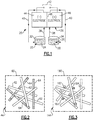
- Figure 1 schematically illustrates selected portions of an example electrochemical device, which in this example is a flow battery 20 for selectively storing and discharging electrical energy.
- the flow battery 20 can be used to convert electrical energy generated in a renewable energy system to chemical energy that is stored until a later time when there is greater demand at which the flow battery 20 then converts the chemical energy back into electrical energy.
- the flow battery 20 can supply the electric energy to an electric grid, for example.
- the disclosed flow battery 20 includes features for enhanced stability.
- the flow battery 20 includes at least one liquid electrolyte 22 that has at least one electrochemically active species 24 that functions in a redox pair with regard to a second reactant 26, which can be another liquid electrolyte with at least one electrochemically active specie 30, or any other electrochemically active specie such as hydrogen or oxygen, for example.
- the electrochemically active species are based on vanadium, bromine, iron, chromium, zinc, cerium, lead, sulfur or combinations thereof.
- the liquid electrolytes 22/26 are solutions that include one or more of the electrochemically active species 24/30.
- the fluid electrolytes 22/26 are contained in respective storage portions 32 and 34, such as tanks. As shown, the storage portions 32 and 34 are substantially equivalent cylindrical storage tanks; however, the storage portions 32/34 can alternatively have other shapes and sizes.
- the fluid electrolytes 22/26 are delivered (e.g., pumped) to one or more electrochemical cells 36 of the flow battery 20 through respective feed lines 38 and are returned from the electrochemical cell 36 to the storage portions 32/34 via return lines 40.
- the storage portions 32/34 are external of the electrochemical cell 36 and are fluidly connected with the electrochemical cell 36 to circulate the liquid electrolytes 22/26 there through.
- the fluid electrolytes 22/26 are delivered to the electrochemical cell 36 to either convert electrical energy into chemical energy or convert chemical energy into electrical energy that can be discharged.
- the electrical energy is transmitted to and from the electrochemical cell 36 through an electrical pathway 42 that completes the circuit and allows the completion of the electrochemical redox reactions.
- the electrochemical cell 36 includes a first electrode 44 and a second electrode 46.
- a separator 48 such as an ion-exchange membrane, is arranged between, and in contact with, the electrodes 44/46.
- the first electrode 44 is a negative electrode and the second electrode 46 is a positive electrode.
- the electrochemical cell 36 can include bipolar plates with flow field channels for delivering the fluid electrolytes 22/26 to the electrodes 44/46.
- the electrochemical cell 36 can be configured for "flow-through" operation where the fluid electrolytes 22/26 are pumped directly into the electrodes 44/46 without the use of flow field channels.
- the electrodes 44/46 can be porous carbon-based materials that are electrically conductive and electrochemically active for the desired redox reactions.
- one or both of the electrodes 44/46 include fibrous carbon paper or felt materials that have an electrochemically active surface.
- the electrode 44 includes a porous body 60.
- the porous body 60 can be a sheet that is relatively thin in comparison to its width and length but is not limited to sheets.
- the porous body 60 is a fibrous structure that includes a plurality of first graphite-containing elements 62 and a plurality of second graphite-containing elements 64 (shaded) that are intermingled with the first graphite-containing elements 62.
- both the first graphite-containing elements 62 and the second graphite-containing elements 64 are fibers.
- the fiber has a uniform diameter along its length and is elongated with regard its diameter.
- the first graphite-containing elements 62 have a first degree of graphitization and the second graphite-containing element 64 have a second, different degree of graphitization.
- at least the first graphite-containing elements 62 include portions that are graphite and portions of non-graphite carbon, such as amorphous carbon.
- the second graphite-containing elements 64 can be all or substantially all graphite, or can also include portions of non-graphite carbon, such as amorphous carbon.
- the degree of graphitization of the first and second graphite-containing elements 62/64 is believed to ultimately influence the chemical and electrochemical stability of the electrode 44 in electrochemical devices, such as the flow battery 20.
- a graphite electrode can be treated in an oxidizer to activate the surfaces for electrochemical activity with the reactants, such as the fluid electrolytes 22/26.
- the treatment produces oxygen-containing sites on the carbon surface, at least some of which participate in the catalysis of the electrochemical reactions of the active species.
- the degree of graphitization influences the amount of oxygen containing surface groups produced in the activation treatment, the type and amount of chemically different oxygen containing surface groups produced in the activation treatment, or both.
- the oxygen-containing sites can chemically or electrochemically reduce (i.e., decay) over time due to exposure to voltage cycling during operation of the electrochemical device, and thus electrochemical performance diminishes.
- the decay can be influenced by adjusting the degree of graphitization to control the amount of oxygen containing surface groups produced in the activation treatment and/or the type and amount of chemically different oxygen-containing surface groups.
- the degree of graphitization influences a decay rate.
- a lower degree of graphitization provides a lower decay rate (i.e., greater stability) while a greater degree of graphitization provides a relatively higher decay rate (i.e., lower stability).
- decay rate can be represented as a slope of a trend of average voltage versus number of cycles over a given operating range. This trend can be compared for different electrodes by plotting, for example, voltage loss per cycle versus thermal conductivity of electrode, because thermal conductivity is a proxy for degree of graphitization.
- the degree of graphitization also influences other properties, such as electrical conductivity, thermal conductivity and strength. Accordingly, although a lower degree of graphitization may be desired for lower decay and greater stability, electrodes of electrochemical devices can also require a good balance with the other properties.
- the electrode 44 having the first graphite-containing elements 62 with the first degree of graphitization and the second graphite-containing element 64 with the second degree of graphitization provides a combination of good stability imparted by the first graphite-containing elements 62 with other desirable properties imparted by the second graphite-containing elements 64.
- the first degree of graphitization is 20%, and the second degree of graphitization is 40%. In another example, the degrees of graphitization differ by at least 25%. In a further example, the porous body 60 has, by weight, 20 % of the first graphite-containing elements 62 and 80 % of the second graphite-containing elements 64.
- Figure 3 shows another example electrode 144 having a porous body 160.
- like reference numerals designate like elements where appropriate and reference numerals with the addition of one-hundred or multiples thereof designate modified elements that are understood to incorporate the same features and benefits of the corresponding elements.
- the first graphite-containing elements 162 are non-fiber particles 162 and the second graphite-containing elements 164 are fibers.
- the non-fiber particles do not have a uniform diameter and are thus distinguishable from fibers.
- the non-fiber particles can be coated onto the surfaces of the fibers or reside interstitially in voids between the fibers.
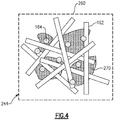
- Figure 4 shows another example electrode 244, which is a modified version of the electrode 144.
- the electrode 244 further includes a binder 270, such as phenolic resin, that holds the first and second graphite-containing elements 162/164 together.
- the graphite-containing elements may be self-adhering.
- the electrodes 44/144/244 also embody a method of fabrication.
- the method includes providing the first graphite-containing elements 62/162 and the second graphite-containing elements 64/164.
- the first graphite-containing elements 62/162 and the second graphite-containing elements 64/164 have differing degrees of graphitization.
- the first graphite-containing elements 62/162 and the second graphite-containing elements 64/164 are then treated with an oxidizer to produce carbon containing surface groups on the surfaces thereof.
- the treatment can include exposing the first graphite-containing elements 62/162 and the second graphite-containing elements 64/164 to an acid, heating the first graphite-containing elements 62/162 and the second graphite-containing elements 64/164 in oxidizer, such as air, or a combination thereof. It is to be understood, however, that other treatments can additionally or alternatively be used.
- the amount of oxygen-containing surface groups produced in the treatment and/or the type and amount of chemically different surface groups produced in the treatment differs between the first graphite-containing elements 62/162 and the second graphite-containing elements 64/164.
- the first graphite-containing elements 62/162 and the second graphite-containing elements 64/164 are intermingled to form the porous body 60/160/260, such as a sheet, and then treated to oxidize the surfaces thereof.
- the formation of sheets or other fibrous structures is known and is therefore not further discussed herein.
- the degree of graphitization of the first graphite-containing elements 62/162 and the second graphite-containing elements 64/164 can be adjusted by controlling a temperature at which the elements are graphitized.
- the first graphite-containing elements 62/162 and the second graphite-containing elements 64/164 are each fabricated from known carbon starting materials. The carbon starting material is then heated in an environment free or substantially free of oxygen to convert the carbon from one form, such as an amorphous form, to graphite. The temperature and time at which the carbon starting material is treated can be adjusted to control the degree of graphitization.
- first graphite-containing elements 62/162 at a first condition with regard to temperature and time and treating the second graphite-containing elements 64/164 at a second, different condition, differing degrees of graphitization can be produced.
- different carbon starting materials can also be used to influence the degree of graphitization.
Landscapes
- Chemical & Material Sciences (AREA)
- Chemical Kinetics & Catalysis (AREA)
- Electrochemistry (AREA)
- General Chemical & Material Sciences (AREA)
- Engineering & Computer Science (AREA)
- Manufacturing & Machinery (AREA)
- Life Sciences & Earth Sciences (AREA)
- Sustainable Development (AREA)
- Sustainable Energy (AREA)
- Thermal Sciences (AREA)
- Physics & Mathematics (AREA)
- Inorganic Chemistry (AREA)
- Composite Materials (AREA)
- Inert Electrodes (AREA)
- Fuel Cell (AREA)
Priority Applications (1)
| Application Number | Priority Date | Filing Date | Title |
|---|---|---|---|
| EP18193820.0A EP3435455A1 (fr) | 2012-12-23 | 2012-12-23 | Électrode contenant du graphite et procédé associé |
Applications Claiming Priority (3)
| Application Number | Priority Date | Filing Date | Title |
|---|---|---|---|
| EP12890260.8A EP2936593B1 (fr) | 2012-12-23 | 2012-12-23 | Électrode contenant du graphite et procédé lié à celle-ci |
| EP18193820.0A EP3435455A1 (fr) | 2012-12-23 | 2012-12-23 | Électrode contenant du graphite et procédé associé |
| PCT/US2012/071549 WO2014098918A1 (fr) | 2012-12-23 | 2012-12-23 | Électrode contenant du graphite et procédé lié à celle-ci |
Related Parent Applications (2)
| Application Number | Title | Priority Date | Filing Date |
|---|---|---|---|
| EP12890260.8A Division-Into EP2936593B1 (fr) | 2012-12-23 | 2012-12-23 | Électrode contenant du graphite et procédé lié à celle-ci |
| EP12890260.8A Division EP2936593B1 (fr) | 2012-12-23 | 2012-12-23 | Électrode contenant du graphite et procédé lié à celle-ci |
Publications (1)
| Publication Number | Publication Date |
|---|---|
| EP3435455A1 true EP3435455A1 (fr) | 2019-01-30 |
Family
ID=50978972
Family Applications (2)
| Application Number | Title | Priority Date | Filing Date |
|---|---|---|---|
| EP12890260.8A Active EP2936593B1 (fr) | 2012-12-23 | 2012-12-23 | Électrode contenant du graphite et procédé lié à celle-ci |
| EP18193820.0A Withdrawn EP3435455A1 (fr) | 2012-12-23 | 2012-12-23 | Électrode contenant du graphite et procédé associé |
Family Applications Before (1)
| Application Number | Title | Priority Date | Filing Date |
|---|---|---|---|
| EP12890260.8A Active EP2936593B1 (fr) | 2012-12-23 | 2012-12-23 | Électrode contenant du graphite et procédé lié à celle-ci |
Country Status (4)
| Country | Link |
|---|---|
| US (1) | US10944108B2 (fr) |
| EP (2) | EP2936593B1 (fr) |
| JP (1) | JP6300824B2 (fr) |
| WO (1) | WO2014098918A1 (fr) |
Families Citing this family (2)
| Publication number | Priority date | Publication date | Assignee | Title |
|---|---|---|---|---|
| PT3375030T (pt) * | 2015-11-13 | 2020-09-04 | Avalon Battery Canada Corp | Elétrodo melhorado para bateria de fluxo redox |
| CN114824162A (zh) * | 2022-04-12 | 2022-07-29 | 湖南阿斯米科技有限公司 | 一种锂离子电池石墨类负极材料石墨化工艺及系统 |
Citations (3)
| Publication number | Priority date | Publication date | Assignee | Title |
|---|---|---|---|---|
| US5792577A (en) * | 1995-11-24 | 1998-08-11 | Petoca, Ltd. | Negative electrode material for use in lithium-ion secondary battery and process for producing the same |
| US6287729B1 (en) * | 1998-11-25 | 2001-09-11 | Petoca, Ltd. | Graphite materials for negative electrode used in lithium secondary battery |
| WO2012097164A1 (fr) * | 2011-01-13 | 2012-07-19 | Enervault Corporation | Électrode poreuse à conductivité améliorée |
Family Cites Families (18)
| Publication number | Priority date | Publication date | Assignee | Title |
|---|---|---|---|---|
| US5028500A (en) * | 1989-05-11 | 1991-07-02 | Moli Energy Limited | Carbonaceous electrodes for lithium cells |
| CN1086929A (zh) * | 1992-09-04 | 1994-05-18 | 单一检索有限公司 | 挠性塑料电极及其制造方法 |
| JP3216661B2 (ja) * | 1992-09-29 | 2001-10-09 | 新神戸電機株式会社 | 非水電解液二次電池 |
| JP3167295B2 (ja) * | 1998-07-10 | 2001-05-21 | 住友電気工業株式会社 | 電池電極材 |
| JP3824795B2 (ja) * | 1998-12-02 | 2006-09-20 | 東海カーボン株式会社 | 固体高分子型燃料電池用セパレータ部材の製造方法 |
| JP2000268878A (ja) * | 1999-03-17 | 2000-09-29 | Toyota Central Res & Dev Lab Inc | リチウムイオン二次電池 |
| JP2001216974A (ja) * | 2000-02-02 | 2001-08-10 | Sumitomo Electric Ind Ltd | 電池電極材、電池電極材の製造方法、電気化学電池、全バナジウムレドックスフロー電池および全バナジウムレドックスフロー電池の電極の再賦活化方法 |
| JP2002141071A (ja) * | 2000-10-31 | 2002-05-17 | Matsushita Electric Ind Co Ltd | 燃料電池用多孔質電極およびその製造方法 |
| KR100449208B1 (ko) * | 2000-10-31 | 2004-09-18 | 마쯔시다덴기산교 가부시키가이샤 | 고분자 전해질형 연료전지 |
| JP4252846B2 (ja) | 2002-07-31 | 2009-04-08 | パナソニック株式会社 | リチウム二次電池 |
| US20040229041A1 (en) | 2003-05-16 | 2004-11-18 | Caisong Zou | Graphite granules and their method of fabrication |
| KR20060022230A (ko) | 2003-07-22 | 2006-03-09 | 비와이디 컴퍼니 리미티드 | 개질된 흑연 미립자 및 이의 제조방법 |
| KR20080040049A (ko) * | 2004-01-05 | 2008-05-07 | 쇼와 덴코 가부시키가이샤 | 리튬전지용 음극재 및 리튬전지 |
| US7648788B2 (en) * | 2004-04-28 | 2010-01-19 | Nissan Motor Co., Ltd. | Membrane-electrode assembly for fuel cell and fuel cell using same |
| JP2007012325A (ja) * | 2005-06-28 | 2007-01-18 | Nissan Motor Co Ltd | 固体高分子型燃料電池用電極及びこれを用いた固体高分子型燃料電池 |
| JP2007335163A (ja) * | 2006-06-13 | 2007-12-27 | Matsushita Electric Ind Co Ltd | 膜触媒層接合体、膜電極接合体および高分子電解質形燃料電池 |
| JP2009193910A (ja) * | 2008-02-18 | 2009-08-27 | Toppan Printing Co Ltd | 膜電極接合体及び固体高分子型燃料電池 |
| KR101067867B1 (ko) | 2010-04-14 | 2011-09-27 | 전자부품연구원 | 레독스 흐름 전지용 일체화된 흑연/dsa 전극, 이의 제조방법 및 이를 포함하는 레독스 흐름 전지 |
-
2012
- 2012-12-23 US US14/652,131 patent/US10944108B2/en active Active
- 2012-12-23 EP EP12890260.8A patent/EP2936593B1/fr active Active
- 2012-12-23 EP EP18193820.0A patent/EP3435455A1/fr not_active Withdrawn
- 2012-12-23 JP JP2015549345A patent/JP6300824B2/ja active Active
- 2012-12-23 WO PCT/US2012/071549 patent/WO2014098918A1/fr not_active Ceased
Patent Citations (3)
| Publication number | Priority date | Publication date | Assignee | Title |
|---|---|---|---|---|
| US5792577A (en) * | 1995-11-24 | 1998-08-11 | Petoca, Ltd. | Negative electrode material for use in lithium-ion secondary battery and process for producing the same |
| US6287729B1 (en) * | 1998-11-25 | 2001-09-11 | Petoca, Ltd. | Graphite materials for negative electrode used in lithium secondary battery |
| WO2012097164A1 (fr) * | 2011-01-13 | 2012-07-19 | Enervault Corporation | Électrode poreuse à conductivité améliorée |
Non-Patent Citations (3)
| Title |
|---|
| FRANK R. FERET: "Determination of the crystallinity of calcined and graphitic cokes by X-ray diffraction", THE ANALYST, vol. 123, no. 4, 1 April 1998 (1998-04-01), pages 595 - 600, XP055339801, ISSN: 0003-2654, DOI: 10.1039/a707845e * |
| M. BEATRIZ VÁZQUEZ-SANTOS ET AL: "Comparative XRD, Raman, and TEM Study on Graphitization of PBO-Derived Carbon Fibers", JOURNAL OF PHYSICAL CHEMISTRY C, vol. 116, no. 1, 22 November 2011 (2011-11-22), pages 257 - 268, XP055515942, ISSN: 1932-7447, DOI: 10.1021/jp2084499 * |
| WANG YI-MING ET AL: "Study on Structural Evolution of Synthetic Graphite Derived from Lignite Prepared by High Temperature-High Pressure Method", CRYSTALS, vol. 12, no. 4, 27 March 2022 (2022-03-27), CH, pages 464, XP093057267, ISSN: 2073-4352, DOI: 10.3390/cryst12040464 * |
Also Published As
| Publication number | Publication date |
|---|---|
| US20150340709A1 (en) | 2015-11-26 |
| EP2936593A1 (fr) | 2015-10-28 |
| JP6300824B2 (ja) | 2018-03-28 |
| EP2936593B1 (fr) | 2018-11-21 |
| JP2016509336A (ja) | 2016-03-24 |
| EP2936593A4 (fr) | 2015-11-11 |
| WO2014098918A1 (fr) | 2014-06-26 |
| US10944108B2 (en) | 2021-03-09 |
Similar Documents
| Publication | Publication Date | Title |
|---|---|---|
| KR101719887B1 (ko) | 카본 페이퍼를 갖는 플로우 배터리 | |
| CN103636039B (zh) | 有多个不同孔径和/或不同层电极的液流电池 | |
| US8822057B2 (en) | High surface area flow battery electrodes | |
| CN108292772B (zh) | 双极板及包括该双极板的氧化还原液流电池 | |
| EP2929582B1 (fr) | Batterie à flux comportant un dispositif limiteur de tension | |
| US20160013497A1 (en) | Improved electrode for flow batteries | |
| JP2018528331A (ja) | レドックスフロー電池のための炭素フェルト電極の準備のためのプロセス | |
| EP2997617A1 (fr) | Batterie à flux munie d'une membrane d'échange d'ions hydratée ayant des tailles maximales des groupes du domaine aqueux | |
| JP2017010809A (ja) | レドックスフロー電池、及びレドックスフロー電池用電極 | |
| US10944108B2 (en) | Graphite-containing electrode and method related thereto | |
| WO2016164017A1 (fr) | Procédé de traitement d'une électrode de carbone | |
| KR101679940B1 (ko) | 향상된 내구성을 갖는 플로우 배터리 | |
| WO2014098917A1 (fr) | Électrode de carbone et procédé correspondant | |
| JP6557824B2 (ja) | 炭素電極及び炭素電極の製造方法 | |
| WO2019212053A1 (fr) | Procédé de fonctionnement d'une batterie redox | |
| JP2016192255A (ja) | バナジウムレドックス電池 | |
| JPS61143949A (ja) | 電池の負極活物質 | |
| HK1163364A (en) | Electrodes for use in bacterial fuel cells and bacterial electrolysis cells and bacterial fuel cells and bacterial electrolysis cells employing such electrodes | |
| JP2007080721A (ja) | 充電装置 |
Legal Events
| Date | Code | Title | Description |
|---|---|---|---|
| PUAI | Public reference made under article 153(3) epc to a published international application that has entered the european phase |
Free format text: ORIGINAL CODE: 0009012 |
|
| STAA | Information on the status of an ep patent application or granted ep patent |
Free format text: STATUS: THE APPLICATION HAS BEEN PUBLISHED |
|
| AC | Divisional application: reference to earlier application |
Ref document number: 2936593 Country of ref document: EP Kind code of ref document: P |
|
| AK | Designated contracting states |
Kind code of ref document: A1 Designated state(s): AL AT BE BG CH CY CZ DE DK EE ES FI FR GB GR HR HU IE IS IT LI LT LU LV MC MK MT NL NO PL PT RO RS SE SI SK SM TR |
|
| STAA | Information on the status of an ep patent application or granted ep patent |
Free format text: STATUS: REQUEST FOR EXAMINATION WAS MADE |
|
| 17P | Request for examination filed |
Effective date: 20190726 |
|
| RBV | Designated contracting states (corrected) |
Designated state(s): AL AT BE BG CH CY CZ DE DK EE ES FI FR GB GR HR HU IE IS IT LI LT LU LV MC MK MT NL NO PL PT RO RS SE SI SK SM TR |
|
| STAA | Information on the status of an ep patent application or granted ep patent |
Free format text: STATUS: EXAMINATION IS IN PROGRESS |
|
| 17Q | First examination report despatched |
Effective date: 20201118 |
|
| RAP1 | Party data changed (applicant data changed or rights of an application transferred) |
Owner name: RAYTHEON TECHNOLOGIES CORPORATION |
|
| RAP3 | Party data changed (applicant data changed or rights of an application transferred) |
Owner name: RTX CORPORATION |
|
| STAA | Information on the status of an ep patent application or granted ep patent |
Free format text: STATUS: THE APPLICATION HAS BEEN WITHDRAWN |
|
| 18W | Application withdrawn |
Effective date: 20231031 |