EP3435510A1 - Système d'alimentation électrique et procédé de commande - Google Patents
Système d'alimentation électrique et procédé de commande Download PDFInfo
- Publication number
- EP3435510A1 EP3435510A1 EP17769876.8A EP17769876A EP3435510A1 EP 3435510 A1 EP3435510 A1 EP 3435510A1 EP 17769876 A EP17769876 A EP 17769876A EP 3435510 A1 EP3435510 A1 EP 3435510A1
- Authority
- EP
- European Patent Office
- Prior art keywords
- phase
- voltage
- inverter
- power
- target output
- Prior art date
- Legal status (The legal status is an assumption and is not a legal conclusion. Google has not performed a legal analysis and makes no representation as to the accuracy of the status listed.)
- Withdrawn
Links
Images




Classifications
-
- H—ELECTRICITY
- H02—GENERATION; CONVERSION OR DISTRIBUTION OF ELECTRIC POWER
- H02H—EMERGENCY PROTECTIVE CIRCUIT ARRANGEMENTS
- H02H7/00—Emergency protective circuit arrangements specially adapted for specific types of electric machines or apparatus or for sectionalised protection of cable or line systems, and effecting automatic switching in the event of an undesired change from normal working conditions
- H02H7/06—Emergency protective circuit arrangements specially adapted for specific types of electric machines or apparatus or for sectionalised protection of cable or line systems, and effecting automatic switching in the event of an undesired change from normal working conditions for dynamo-electric generators; for synchronous capacitors
-
- G—PHYSICS
- G05—CONTROLLING; REGULATING
- G05B—CONTROL OR REGULATING SYSTEMS IN GENERAL; FUNCTIONAL ELEMENTS OF SUCH SYSTEMS; MONITORING OR TESTING ARRANGEMENTS FOR SUCH SYSTEMS OR ELEMENTS
- G05B11/00—Automatic controllers
- G05B11/01—Automatic controllers electric
- G05B11/36—Automatic controllers electric with provision for obtaining particular characteristics, e.g. proportional, integral, differential
- G05B11/42—Automatic controllers electric with provision for obtaining particular characteristics, e.g. proportional, integral, differential for obtaining a characteristic which is both proportional and time-dependent, e.g. P. I., P. I. D.
-
- H—ELECTRICITY
- H02—GENERATION; CONVERSION OR DISTRIBUTION OF ELECTRIC POWER
- H02J—ELECTRIC POWER NETWORKS; CIRCUIT ARRANGEMENTS OR SYSTEMS FOR SUPPLYING OR DISTRIBUTING ELECTRIC POWER; SYSTEMS FOR STORING ELECTRIC ENERGY
- H02J13/00—Circuit arrangements for providing remote monitoring or remote control of equipment in a power distribution network
- H02J13/12—Monitoring network conditions, e.g. electrical magnitudes or operational status
-
- H—ELECTRICITY
- H02—GENERATION; CONVERSION OR DISTRIBUTION OF ELECTRIC POWER
- H02J—ELECTRIC POWER NETWORKS; CIRCUIT ARRANGEMENTS OR SYSTEMS FOR SUPPLYING OR DISTRIBUTING ELECTRIC POWER; SYSTEMS FOR STORING ELECTRIC ENERGY
- H02J3/00—Circuit arrangements for AC mains or AC distribution networks
- H02J3/26—Arrangements for eliminating or reducing asymmetry in polyphase networks
-
- H—ELECTRICITY
- H02—GENERATION; CONVERSION OR DISTRIBUTION OF ELECTRIC POWER
- H02J—ELECTRIC POWER NETWORKS; CIRCUIT ARRANGEMENTS OR SYSTEMS FOR SUPPLYING OR DISTRIBUTING ELECTRIC POWER; SYSTEMS FOR STORING ELECTRIC ENERGY
- H02J3/00—Circuit arrangements for AC mains or AC distribution networks
- H02J3/28—Arrangements for balancing of the load in networks by storage of energy
- H02J3/32—Arrangements for balancing of the load in networks by storage of energy using batteries or super capacitors with converting means
-
- H—ELECTRICITY
- H02—GENERATION; CONVERSION OR DISTRIBUTION OF ELECTRIC POWER
- H02J—ELECTRIC POWER NETWORKS; CIRCUIT ARRANGEMENTS OR SYSTEMS FOR SUPPLYING OR DISTRIBUTING ELECTRIC POWER; SYSTEMS FOR STORING ELECTRIC ENERGY
- H02J3/00—Circuit arrangements for AC mains or AC distribution networks
- H02J3/38—Arrangements for feeding a single network from two or more generators or sources in parallel; Arrangements for feeding already energised networks from additional generators or sources in parallel
-
- H—ELECTRICITY
- H02—GENERATION; CONVERSION OR DISTRIBUTION OF ELECTRIC POWER
- H02M—APPARATUS FOR CONVERSION BETWEEN AC AND AC, BETWEEN AC AND DC, OR BETWEEN DC AND DC, AND FOR USE WITH MAINS OR SIMILAR POWER SUPPLY SYSTEMS; CONVERSION OF DC OR AC INPUT POWER INTO SURGE OUTPUT POWER; CONTROL OR REGULATION THEREOF
- H02M7/00—Conversion of AC power input into DC power output; Conversion of DC power input into AC power output
- H02M7/42—Conversion of DC power input into AC power output without possibility of reversal
- H02M7/44—Conversion of DC power input into AC power output without possibility of reversal by static converters
-
- H—ELECTRICITY
- H02—GENERATION; CONVERSION OR DISTRIBUTION OF ELECTRIC POWER
- H02M—APPARATUS FOR CONVERSION BETWEEN AC AND AC, BETWEEN AC AND DC, OR BETWEEN DC AND DC, AND FOR USE WITH MAINS OR SIMILAR POWER SUPPLY SYSTEMS; CONVERSION OF DC OR AC INPUT POWER INTO SURGE OUTPUT POWER; CONTROL OR REGULATION THEREOF
- H02M7/00—Conversion of AC power input into DC power output; Conversion of DC power input into AC power output
- H02M7/42—Conversion of DC power input into AC power output without possibility of reversal
- H02M7/44—Conversion of DC power input into AC power output without possibility of reversal by static converters
- H02M7/48—Conversion of DC power input into AC power output without possibility of reversal by static converters using discharge tubes with control electrode or semiconductor devices with control electrode
-
- H—ELECTRICITY
- H02—GENERATION; CONVERSION OR DISTRIBUTION OF ELECTRIC POWER
- H02P—CONTROL OR REGULATION OF ELECTRIC MOTORS, ELECTRIC GENERATORS OR DYNAMO-ELECTRIC CONVERTERS; CONTROLLING TRANSFORMERS, REACTORS OR CHOKE COILS
- H02P9/00—Arrangements for controlling electric generators for the purpose of obtaining a desired output
- H02P9/42—Arrangements for controlling electric generators for the purpose of obtaining a desired output to obtain desired frequency without varying speed of the generator
Definitions
- the present invention relates to a power supply system, and a control method used in the power supply system.
- unbalanced current occurs in the case where a single-phase load and a three-phase load coexist as consumer loads. Unbalanced current decreases the output efficiency of the synchronous generator and, as negative-phase-sequence current of the synchronous generator, causes damage to the synchronous generator due to heating and the like.
- a device that provides a power storage battery and a power conditioner in a consumer and compensates, by the power conditioner, for an unbalance of line current of low-voltage power distribution lines and the like has been proposed (see PTL 1).
- a dispersed power source linked with an inverter such as a solar power generation device, has been widely used in recent years.
- the present invention has an object of providing a power supply system in which an inverter linked with a dispersed power source is connected to a power generation device such as a synchronous generator, and the inverter is controlled to supply power to a consumer and compensate for negative-phase-sequence current of the power generation device.
- the present invention also has an object of providing a control method used to control the inverter in the power supply system.
- a power supply system includes: a power distribution system that is connected to a consumer load, the power distribution system being a three-phase power distribution system; a power generation device that is connected to the power distribution system; an inverter that is connected to the power distribution system, supplies power to the consumer load, and compensates for an unbalanced current of the power generation device; an inverter output component calculator that calculates a voltage positive-phase-sequence component, a current positive-phase-sequence component, a voltage angular velocity, and a voltage value relating to the inverter, based on a three-phase voltage and a three-phase current output from the inverter to the power distribution system; a power generation device output component calculator that calculates a current negative-phase-sequence component and a voltage phase relating to the power generation device, based on a three-phase voltage and a three-phase current output from the power generation device to the power distribution system; an active and reactive power calculator that
- a control method is a control method in a power supply system that includes: a power distribution system that is connected to a consumer load, the power distribution system being a three-phase power distribution system; a power generation device that is connected to the power distribution system; and an inverter that is connected to the power distribution system, supplies power to the consumer load, and compensates for an unbalanced current of the power generation device, the control method including: calculating a voltage positive-phase-sequence component, a current positive-phase-senquence component, a voltage angular velocity, and a voltage value relating to the inverter, based on a three-phase voltage and a three-phase current output from the inverter to the power distribution system; calculating a current negative-phase-sequence component and a voltage phase relating to the power generation device, based on a three-phase voltage and a three-phase current output from the power generation device to the power distribution system; calculating an active power and
- a power generation device such as a synchronous generator and an inverter can supply power to a consumer, and the inverter can compensate for negative-phase-sequence current of the power generation device.
- a power supply system according to an embodiment of the present invention is described below.
- FIG. 1 is a diagram illustrating the schematic structure of power supply system 1 according to this embodiment.
- Power supply system 1 is a system for supplying power to a consumer (power use facility) by synchronous generator 11 and inverter 21 that is linked with dispersed power source 23.
- Power supply system 1 includes synchronous generator 11, inverter 21, energy storage 22, dispersed power source 23, control device 100, and power distribution system 40, as illustrated in FIG. 1 .
- Power distribution system 40 includes power distribution lines forming a three-phase transmission path. Power distribution system 40 is connected to synchronous generator 11 and inverter 21 at junction 41, and transmits power to the consumer. Power distribution system 40 is connected to consumer load 30 (e.g. power use appliance) in the consumer. Consumer load 30 includes three-phase load 32 connected to each of the power distribution lines of three phases, and single-phase load 31 connected to part of the power distribution lines of three phases,, as illustrated in FIG. 1 .
- consumer load 30 includes three-phase load 32 connected to each of the power distribution lines of three phases, and single-phase load 31 connected to part of the power distribution lines of three phases,, as illustrated in FIG. 1 .
- Synchronous generator 11 is a power generation device that generates AC power synchronous with the rotational speed of a magnetic field, such as a diesel generator or a gas engine generator. Synchronous generator 11 is connected to power distribution system 40 that transmits generated power.
- Dispersed power source (dispersion type power source) 23 is a power source that generates power by any of various power generation methods such as solar power generation, wind power generation, and fuel cell.
- Energy storage 22 is a medium that stores power (energy) generated by dispersed power source 23, such as a storage battery. Energy storage 22 is connected to dispersed power source 23 and inverter 21.
- Inverter 21 is a power conversion device that converts DC power from energy storage 22, into AC power. Inverter 21 is connected to power distribution system 40 that transmits AC power. Inverter 21 can supply power to consumer load 30 via power distribution system 40. Inverter 21 also has a function of compensating for negative-phase-sequence current of synchronous generator 11 as unbalanced current, under control of control device 100. The unbalanced current can occur in power distribution system 40, due to the influence of consumer load 30 or the like.
- Control device 100 is a device that is composed of, for example, electronic circuitry including an integrated circuit of a microprocessor, memory, and the like, and controls inverter 21 by performing a predetermined control method.
- control device 100 may be a device integrated with inverter 21.
- Control device 100 determines a control (gate command) parameter (gate command value) for inverter 21, and controls inverter 21.
- control device 100 determines the gate command value, based on a result of detecting (measuring) voltage and current output from synchronous generator 11 to power distribution system 40, and information (own terminal information) of voltage and current output from inverter 21 to power distribution system 40, which is obtained by measurement and the like.
- Control device 100 includes inverter output component calculator 110, active and reactive power calculator 120, target output voltage generator 130, target output phase generator 140, power generation device output component calculator 150, negative-phase-sequence compensation voltage generator 160, and gate command value calculator 190 as functional structural elements, as illustrated in FIG. 1 .
- Inverter output component calculator 110 has a function of calculating and outputting voltage positive-phase-sequence component V + out_dg(dq), current positive-phase-senquence component I + out_dg(dq), voltage value Vout_dg, and voltage angular velocity ⁇ g_dg, based on input own terminal information.
- the input own terminal information includes voltage Vout_dg(abc) and current Iout_dg(abc) output from inverter 21 to power distribution system 40.
- Voltage Vout_dg(abc) represents voltages Vout_dg_a, Vout_dg_b, and Vout_dg_c for respective axis components of an abc coordinate system, i.e. three phases.
- Voltage positive-phase-sequence component V + out_dg(dq) represents voltage positive-phase-sequence component V + out_dg_d as a d-axis component and voltage positive-phase-sequence component V + out_dg_q as a q-axis component in a dq coordinate system having orthogonal d axis and q axis.
- Current positive-phase-sequence component I + out_dg(dq) represents current positive-phase-sequence component I + out_dg_d as a d-axis component and current positive-phase-senquence component I + out_dg_q as a q-axis component in the dq coordinate system having orthogonal d axis and q axis.
- Active and reactive power calculator 120 has a function of calculating and outputting active power Pout_dg and reactive power Qout_dg, based on voltage positive-phase-sequence component V + out_dg(dq) and current positive-phase-sequence component I + out_dg(dq) received from inverter output component calculator 110.
- Target output voltage generator 130 has a function of generating and outputting target output voltage E_dg, based on voltage value Vout_dg received from inverter output component calculator 110 and reactive power Qout_dg received from active and reactive power calculator 120.
- Target output voltage E_dg is the amplitude of a vector in a complex plane combining voltages of three phases.
- Target output phase generator 140 has a function of generating and outputting target output phase ⁇ m_dg, based on voltage angular velocity ⁇ g_dg received from inverter output component calculator 110 and active power Pout_dg received from active and reactive power calculator 120.
- Target output phase ⁇ m_dg is the phase of the vector in the complex plane combining voltages of three phases.
- Power generation device output component calculator 150 has a function of calculating and outputting current negative-phase-sequence component I - out_sg(dq) and voltage phase ⁇ g_sg, based on voltage Vout_sg(abc) and current Iout_sg(abc) output from synchronous generator 11 to power distribution system 40.
- Voltage Vout_sg(abc) represents voltages Vout_sg_a, Vout_sg_b, and Vout_sg_c for respective axis components of the abc coordinate system, i.e. three phases.
- Current Iout_sg(abc) represents currents Iout_sg_a, Iout_sg_b, and Iout_sg_c for three phases.
- Current negative-phase-sequence component I - out_sg(dq) represents current negative-phase-sequence component Iout_sg_d as a d-axis component and current negative-phase-sequence component I + out_sg_q as a q-axis component in the dq coordinate system having orthogonal d axis and q axis.
- Negative-phase-sequence compensation voltage generator 160 has a function of generating and outputting first compensation voltage ⁇ V( ⁇ ), based on current negative-phase-sequence component I - out_sg(dq) and voltage phase ⁇ g_sg received from power generation device output component calculator 150.
- Gate command value calculator 190 has a function of determining a gate command value by a value obtained by coordinate-converting ( ⁇ conversion) target output voltage E_dg output from target output voltage generator 130, target output phase ⁇ m_dg output from target output phase generator 140, and first compensation voltage ⁇ V( ⁇ ) output from negative-phase-sequence compensation voltage generator 160. Gate command value calculator 190 issues a gate command based on the determined gate command value, thus controlling inverter 21.
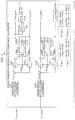
- inverter output component calculator 110 The structure of inverter output component calculator 110 is described below, with reference to FIG. 2 .
- FIG. 2 illustrates an example of the structure of inverter output component calculator 110.
- Inverter output component calculator 110 includes three-phase to two-phase converters 111a and 111b, converters (T + ) 112a and 112b, converters (T - ) 113a and 113b, converters (T +2 ) 114a and 114b, converters (T -2 ) 115a and 115b, low-pass filters (LPF) 116a to 116d, phase synchronization circuit (PLL) 117, and calculator 118, as illustrated in the drawing.
- LPF low-pass filters
- Three-phase to two-phase converter 111a converts symmetrical three-phase AC voltage Vout_dg(abc) represented in the abc coordinate system into two-phase AC voltage Vout_dg( ⁇ ) represented in the ⁇ coordinate system, i.e. two-phase coordinate ( ⁇ , ⁇ ), and outputs voltage Vout_dg( ⁇ ).
- Voltage Vout_dg( ⁇ ) represents voltage Vout_dg_ ⁇ as an ⁇ -axis component and voltage Vout_dg_ ⁇ as a ⁇ -axis component.
- Converter (T + ) 112a, converter (T - ) 113a, converter (T +2 ) 114a, converter (T -2 ) 115a, LPFs 116a and 116b, and, PLL 117 for dq conversion and the like calculate voltage phase ⁇ g_dg according to voltage Vout_dg( ⁇ ) output from three-phase to two-phase converter 111a, and calculate voltage positive-phase-senquence component V + out_dg(dq) and voltage angular velocity ⁇ g_dg.
- Calculated voltage positive-phase-sequence component V + out_dg(dq) and voltage angular velocity ⁇ g_dg are output from inverter output component calculator 110.
- Calculated voltage phase ⁇ g_dg is recursively used in converter (T + ) 112a, converter (T - ) 113a, converter (T +2 ) 114a, and converter (T -2 ) 115a.
- Calculator 118 calculates the magnitude of voltage positive-phase-sequence component V + out_dg(dq), to calculate voltage value Vout_dg. Calculated voltage value Vout_dg is output from inverter output component calculator 110.
- Three-phase to two-phase converter 111b converts symmetrical three-phase AC current Iout_dg(abc) represented in the abc coordinate system into two-phase AC current Iout_dg( ⁇ ) represented in the ⁇ coordinate system, i.e. two-phase coordinate ( ⁇ , ⁇ ), and outputs current Iout_dg( ⁇ ).
- Current Iout_dg( ⁇ ) represents current Iout_dg_ ⁇ as an ⁇ -axis component and current Iout_dg_ ⁇ as a ⁇ -axis component.
- Converter (T + ) 112b, converter (T - ) 113b, converter (T +2 ) 114b, converter (T -2 ) 115b, and LPFs 116c and 116d for dq conversion and the like calculate current positive-phase-sequence component I + out_dg(dq), according to current Iout_dg( ⁇ ) output from three-phase to two-phase converter 111b and voltage phase ⁇ g_dg.
- Calculated current positive-phase-senquence component I + out_dg(dq) is output from inverter output component calculator 110.
- power generation device output component calculator 150 The structure of power generation device output component calculator 150 is described below, with reference to FIG. 3 .
- FIG. 3 illustrates an example of the structure of power generation device output component calculator 150.
- Power generation device output component calculator 150 includes three-phase to two-phase converters 121a and 121b, converters (T + ) 122a and 122b, converters (T - ) 123a and 123b, converters (T +2 ) 124a and 124b, converters (T -2 ) 125a and 125b, LPFs 126a to 126d, and PLL 127, as illustrated in the drawing.
- Three-phase to two-phase converter 121a converts symmetrical three-phase AC voltage Vout_sg(abc) represented in the abc coordinate system into two-phase AC voltage Vout_sg( ⁇ ) represented in the ⁇ coordinate system, and outputs voltage Vout_sg( ⁇ ).
- Voltage Vout_sg( ⁇ ) represents voltage Vout_sg_ ⁇ as an ⁇ -axis component and voltage Vout_sg_ ⁇ as a ⁇ -axis component.
- Converter (T + ) 122a, converter (T - ) 123a, converter (T +2 ) 124a, converter (T -2 ) 125a, LPFs 126a and 126b, and PLL 127 for dq conversion and the like calculate voltage phase ⁇ g_sg according to voltage Vout_sg( ⁇ ) output from three-phase to two-phase converter 121a, and calculate voltage positive-phase-sequence component V + out_sg(dq) and voltage angular velocity ⁇ g_sg.
- Calculated voltage phase ⁇ g_sg is output from power generation device output component calculator 150.
- Calculated voltage phase ⁇ g_sg is further recursively used in converter (T + ) 122a, converter (T - ) 123a, converter (T +2 ) 124a, and converter (T -2 ) 125a.
- Three-phase to two-phase converter 121b converts symmetrical three-phase AC current Iout_sg(abc) represented in the abc coordinate system into two-phase AC current Iout_sg( ⁇ ) represented in the ⁇ coordinate system, and outputs current Iout_sg( ⁇ ).
- Current Iout_sg( ⁇ ) represents current Iout_sg_ ⁇ as an ⁇ -axis component and current Iout_sg_ ⁇ as a ⁇ -axis component.
- Converter (T + ) 122b, converter (T - ) 123b, converter (T +2 ) 124b, converter (T -2 ) 125b, and LPFs 126c and 126d for dq conversion and the like calculate current negative-phase-sequence component I - out_sg(dq), according to current Iout_sg( ⁇ ) output from three-phase to two-phase converter 121b and voltage phase ⁇ g_sg.
- Calculated current negative-phase-sequence component I - out_sg(dq) is output from power generation device output component calculator 150.
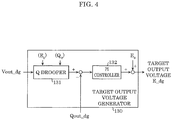
- target output voltage generator 130 The structure of target output voltage generator 130 is described below, with reference to FIG. 4 .
- FIG. 4 illustrates an example of the structure of target output voltage generator 130.
- Target output voltage generator 130 includes Q drooper 131 and PI controller 132, as illustrated in the drawing.
- Q drooper 131 has a function of performing droop control to provide droop property between a deviation between voltage value Vout_dg received from inverter output component calculator 110 and predetermined command output voltage value E0 and a deviation between predetermined command reactive power Q0 and target output reactive power, and calculating and outputting the target output reactive power.
- Predetermined command output voltage value E0 is set beforehand, and is, for example, 200 V.
- Predetermined command reactive power Q0 is set beforehand, and is, for example, 0 var.
- Predetermined command output voltage value E0 and predetermined command reactive power Q0 may be stored inside beforehand, or acquired from outside.
- PI controller 132 has a function of calculating target output voltage E_dg.
- PI controller 132 has a function of performing PI control to eliminate a deviation between the target output reactive power output from Q drooper 131 and reactive power Qout_dg received from active and reactive power calculator 120 to thereby follow predetermined command output voltage value E0, thus causing output of target output voltage E_dg from target output voltage generator 130.
- Target output voltage E_dg is the amplitude of the vector in the complex plane combining voltages of three phases.
- target output phase generator 140 The structure of target output phase generator 140 is described below, with reference to FIG. 5 .
- FIG. 5 illustrates an example of the structure of target output phase generator 140.
- Target output phase generator 140 includes governor model unit 141, calculator 142, and integrator 143, as illustrated in the drawing.
- Governor model unit 141 has a function of performing droop control (speed control) to provide droop property between a deviation between target output angular velocity ⁇ m_dg, which is a time derivative of target output phase ⁇ m_dg, and predetermined command angular velocity ⁇ 0 and a deviation between predetermined command active power P0 and target output active power, and calculating and outputting target output active power Pin_dg.
- Predetermined command angular velocity ⁇ 0 is set beforehand, and is, for example, 314 rad/s or 376.8 rad/s.
- Predetermined command active power P0 is set beforehand, and is, for example, 1000 W.
- Predetermined command angular velocity ⁇ 0 and predetermined command active power P0 may be stored inside beforehand, or acquired from outside.
- Calculator 142 has a function of calculating target output angular velocity ⁇ m_dg, based on voltage angular velocity ⁇ g_dg received from inverter output component calculator 110, active power Pout_dg received from active and reactive power calculator 120, and target output active power Pin_dg output from governor model unit 141.
- virtual inertia constant Jdg used for the calculation of target output angular velocity ⁇ m_dg in calculator 142 represents the magnitude of rotational inertia with which a rotating object to be simulated by the inverter tries to maintain the same rotational motion
- virtual damping constant Ddg represents the magnitude of energy acting in a direction of attenuating the rotation.
- Integrator 143 has a function of calculating and outputting target output phase ⁇ m_dg by time-integrating target output angular velocity ⁇ m_dg calculated by calculator 142.
- Target output phase ⁇ m_dg is the phase of the vector in the complex plane combining voltages of three phases.
- negative-phase-sequence compensation voltage generator 160 The structure of negative-phase-sequence compensation voltage generator 160 is described below, with reference to FIG. 6 .
- FIG. 6 illustrates an example of the structure of negative-phase-sequence compensation voltage generator 160.
- Negative-phase-sequence compensation voltage generator 160 includes PI controllers 161a and 161b and converter ((T - ) -1 ) 162, as illustrated in the drawing.
- PI controllers 161a and 161b have a function of performing PI control for causing current negative-phase-sequence component I - out_sg(dq) received from power generation device output component calculator 150, i.e. current negative-phase-sequence component I - out_sg_d and current negative-phase-sequence component I - out_sg_q, to be zero (0).
- This PI control is control for compensating for negative-phase-sequence current of synchronous generator 11.
- Converter ((T - ) -1 ) 162 converts the input, by the inverse of matrix T - (see FIG. 3 ) set according to voltage phase ⁇ g_sg received from power generation device output component calculator 150.
- inverter 21 operates in response to the gate command (command based on the value obtained by coordinate-converting target output voltage E_dg, target output phase ⁇ m_dg, and first compensation voltage ⁇ V( ⁇ )) received from control device 100 with the foregoing structure. Inverter 21 can thus supply power to consumer load 30 and compensate for negative-phase-sequence current of synchronous generator 11.
- inverter 21 linked with dispersed power source 23 as an example operates as a voltage source as with synchronous generator 11, so that individual operation is possible.
- Power supply system 1a which is a modification to part of power supply system 1 so as to perform control for inserting virtual impedance into inverter 21 is described below.
- FIG. 7 is a diagram illustrating the schematic structure of power supply system 1a according to this embodiment.
- Power supply system 1a includes synchronous generator 11, inverter 21, energy storage 22, dispersed power source 23, control device 100a, and power distribution system 40, as illustrated in FIG. 7 .
- Control device 100a includes virtual impedance unit 170 in addition to the structure of control device 100 in Embodiment 1.
- Features of control device 100a not particularly described here are the same as those of control device 100.
- Virtual impedance unit 170 has a function of calculating, based on own terminal information (current Iout_dg(abc) output from inverter 21), virtual impedance inserted into inverter 21, and outputting second compensation voltage ⁇ V2( ⁇ ) according to the virtual impedance.
- inverter 21 operates in response to the gate command (command based on the value obtained by coordinate-converting target output voltage E_dg, target output phase ⁇ m_dg, and first compensation voltage ⁇ V( ⁇ ) and the value obtained by coordinate-converting second compensation voltage ⁇ V2( ⁇ )) received from control device 100a with the foregoing structure.
- gate command command based on the value obtained by coordinate-converting target output voltage E_dg, target output phase ⁇ m_dg, and first compensation voltage ⁇ V( ⁇ ) and the value obtained by coordinate-converting second compensation voltage ⁇ V2( ⁇ )
- the functional structural elements (functional structural elements for performing a control method for controlling inverter 21) in each of control devices 100 and 100a in the foregoing embodiments may be realized by hardware (such as electronic circuitry) without using software, or realized by software.
- a process by software is realized by a microprocessor in each of control devices 100 and 100a executing a control program stored in memory.
- the control program may be recorded in a recording medium and distributed or circulated. For example, by installing the distributed control program in a device such as a computer and causing a microprocessor in the device to execute the program, the functions of each of control devices 100 and 100a can be realized.
- inverter 21 operates in response to the gate command, and can thus supply power to consumer load 30 and compensate for negative-phase-sequence current of the power generation device (synchronous generator 11). This prevents damage to the power generation device.
- the voltage positive-phase-sequence component, current positive-phase-sequence component, and voltage value of inverter 21 usable for the generation of the gate command are calculated in correspondence with the three-phase voltage and current output from inverter 21 to power distribution system 40.
- the current negative-phase-sequence component and voltage phase of the power generation device usable for the generation of the gate command are calculated in correspondence with the three-phase voltage and current output from the power generation device to power distribution system 40.
- inverter 21 controlled by the gate command produces appropriate output depending on, for example, the state of consumer load 30 which may vary.
- inverter 21 controlled by the gate command produces appropriate output depending on, for example, the state of consumer load 30 which may vary.
- inverter 21 controlled by the gate command can compensate for negative-phase-sequence current of the power generation device (synchronous generator 11).
- inverter 21 can supply power to consumer load 30, and compensate for negative-phase-sequence current of the power generation device (synchronous generator 11). This prevents damage to the power generation device.
Landscapes
- Engineering & Computer Science (AREA)
- Power Engineering (AREA)
- Physics & Mathematics (AREA)
- General Physics & Mathematics (AREA)
- Automation & Control Theory (AREA)
- Inverter Devices (AREA)
- Supply And Distribution Of Alternating Current (AREA)
Applications Claiming Priority (2)
| Application Number | Priority Date | Filing Date | Title |
|---|---|---|---|
| JP2016060960 | 2016-03-24 | ||
| PCT/JP2017/008656 WO2017163831A1 (fr) | 2016-03-24 | 2017-03-06 | Système d'alimentation électrique et procédé de commande |
Publications (2)
| Publication Number | Publication Date |
|---|---|
| EP3435510A4 EP3435510A4 (fr) | 2019-01-30 |
| EP3435510A1 true EP3435510A1 (fr) | 2019-01-30 |
Family
ID=59900101
Family Applications (1)
| Application Number | Title | Priority Date | Filing Date |
|---|---|---|---|
| EP17769876.8A Withdrawn EP3435510A1 (fr) | 2016-03-24 | 2017-03-06 | Système d'alimentation électrique et procédé de commande |
Country Status (4)
| Country | Link |
|---|---|
| US (1) | US20210175711A1 (fr) |
| EP (1) | EP3435510A1 (fr) |
| JP (1) | JP6414795B2 (fr) |
| WO (1) | WO2017163831A1 (fr) |
Cited By (1)
| Publication number | Priority date | Publication date | Assignee | Title |
|---|---|---|---|---|
| EP3836331A4 (fr) * | 2019-10-09 | 2021-06-16 | Toshiba Mitsubishi-Electric Industrial Systems Corporation | Dispositif de conversion de puissance |
Families Citing this family (10)
| Publication number | Priority date | Publication date | Assignee | Title |
|---|---|---|---|---|
| JP7112973B2 (ja) * | 2019-02-01 | 2022-08-04 | 三菱重工エンジン&ターボチャージャ株式会社 | 指令生成装置および指令生成方法 |
| JP7324653B2 (ja) * | 2019-08-09 | 2023-08-10 | 三菱重工エンジン&ターボチャージャ株式会社 | 指令生成装置および指令生成方法 |
| US20230029830A1 (en) * | 2021-07-27 | 2023-02-02 | Rhombus Energy Solutions, Inc. | System and Method for Electric Vehicle Charger use in Non-Charging Mode |
| CN113708390B (zh) * | 2021-08-11 | 2022-11-29 | 国网浙江省电力有限公司电力科学研究院 | 配电台区三相不平衡治理的智能设备实时控制方法及系统 |
| CN113890065A (zh) * | 2021-11-09 | 2022-01-04 | 广东志成冠军集团有限公司 | 柴储独立微电网及其虚拟动态同步控制方法、系统 |
| CN114844065B (zh) * | 2022-05-17 | 2025-10-17 | 浙江艾罗网络能源技术股份有限公司 | 三相不平衡输出控制方法及其系统 |
| CN116859711B (zh) * | 2023-06-27 | 2024-04-12 | 中科沃业江苏生物有限公司 | 一种基于iabc优化模糊pid的恒流泵控制系统 |
| CN118842013B (zh) * | 2024-06-26 | 2025-10-03 | 广东电网有限责任公司 | 基于负序电流注入的三相电压源变换器分相功率控制方法 |
| WO2026048044A1 (fr) * | 2024-09-02 | 2026-03-05 | 株式会社Tmeic | Conditionneur |
| JP7796392B1 (ja) * | 2024-09-30 | 2026-01-09 | ダイキン工業株式会社 | 制御装置、パワーコンディショナ、ヒートポンプシステムおよび電力脈動調整システム |
Family Cites Families (5)
| Publication number | Priority date | Publication date | Assignee | Title |
|---|---|---|---|---|
| JP3104242B2 (ja) * | 1990-06-27 | 2000-10-30 | 株式会社明電舎 | 不平衡補償付灯動共用発電装置 |
| WO1999044276A1 (fr) * | 1998-02-26 | 1999-09-02 | Trace Technologies | Organe de regulation de tension pour l'alimentation par un onduleur d'une charge triphasee non equilibree |
| JP2004180363A (ja) * | 2002-11-25 | 2004-06-24 | Tm T & D Kk | 電力系統の逆相分電圧補償システム |
| JP6265826B2 (ja) * | 2014-04-30 | 2018-01-24 | 川崎重工業株式会社 | 単相系統に接続される電力変換装置 |
| JP6185436B2 (ja) * | 2014-07-16 | 2017-08-23 | 株式会社神戸製鋼所 | 不平衡補償装置 |
-
2017
- 2017-03-06 EP EP17769876.8A patent/EP3435510A1/fr not_active Withdrawn
- 2017-03-06 JP JP2018507181A patent/JP6414795B2/ja active Active
- 2017-03-06 WO PCT/JP2017/008656 patent/WO2017163831A1/fr not_active Ceased
- 2017-03-06 US US16/071,093 patent/US20210175711A1/en not_active Abandoned
Cited By (2)
| Publication number | Priority date | Publication date | Assignee | Title |
|---|---|---|---|---|
| EP3836331A4 (fr) * | 2019-10-09 | 2021-06-16 | Toshiba Mitsubishi-Electric Industrial Systems Corporation | Dispositif de conversion de puissance |
| US11601068B2 (en) | 2019-10-09 | 2023-03-07 | Toshiba Mitsubishi-Electric Industrial Systems Corporation | Power conversion device |
Also Published As
| Publication number | Publication date |
|---|---|
| JPWO2017163831A1 (ja) | 2018-06-21 |
| US20210175711A1 (en) | 2021-06-10 |
| JP6414795B2 (ja) | 2018-10-31 |
| EP3435510A4 (fr) | 2019-01-30 |
| WO2017163831A1 (fr) | 2017-09-28 |
Similar Documents
| Publication | Publication Date | Title |
|---|---|---|
| EP3435510A1 (fr) | Système d'alimentation électrique et procédé de commande | |
| Bubshait et al. | Power quality enhancement for a grid connected wind turbine energy system | |
| D'Arco et al. | Small-signal modelling and parametric sensitivity of a virtual synchronous machine | |
| EP2529462B1 (fr) | Procédé pour l'émulation d'une machine synchrone | |
| EP2963759A1 (fr) | Dispositif convertisseur de courant pour connexion au réseau | |
| Pournazarian et al. | Simultaneous optimization of virtual synchronous generators (VSG) parameters in islanded microgrids supplying induction motors | |
| Yoo et al. | Sensorless operation of a PWM rectifier for a distributed generation | |
| Marques et al. | Stator flux active damping methods for field-oriented doubly fed induction generator | |
| CN117439122B (zh) | 储能系统改善电网频率特性的方法及相关装置 | |
| Tarrasó et al. | Synchronous power controller for distributed generation units | |
| D’Arco et al. | Improving the power reference tracking of virtual synchronous machines by feed-forward control | |
| Gupta et al. | AES-FLL control of RES powered microgrid for power quality improvement with synchronization control | |
| US12266935B2 (en) | Power conversion device | |
| Hirase et al. | Effects of suppressing frequency fluctuations by parallel operation of virtual synchronous generator in microgrids | |
| Aquib et al. | Model reference adaptive system based apparent power sharing in inverter based microgrids | |
| KR101732028B1 (ko) | 풍력 발전기 및 그의 계통연계점 불평형 전압 보상 제어 방법 | |
| Günther et al. | Influences of virtual inertia control on the mechanical drive train of wind turbines | |
| Cai et al. | A new mitigation strategy of AC-side active power fluctuation under three-phase unbalanced grid conditions | |
| Campos et al. | Control of a PMSG based wind power system using abc-frame under distorted and asymmetrical voltage conditions | |
| Arya et al. | Control approach to improve the power quality for effective utilization of single phase induction generator | |
| Jin et al. | Application of static compensators in small AC systems with constant power loads | |
| Özer et al. | Power quality improvement of DSTATCOM using fast hybrid-PLL-based control method for wind energy applications | |
| CN117871929B (zh) | 确定svg在暂态过电压抑制期间的最大电流的方法及装置 | |
| CN120728649B (zh) | Svg相间均衡控制方法、装置、设备、介质及程序产品 | |
| CN117439124B (zh) | 采用储能系统改善电网频率的方法及相关装置 |
Legal Events
| Date | Code | Title | Description |
|---|---|---|---|
| STAA | Information on the status of an ep patent application or granted ep patent |
Free format text: STATUS: THE INTERNATIONAL PUBLICATION HAS BEEN MADE |
|
| PUAI | Public reference made under article 153(3) epc to a published international application that has entered the european phase |
Free format text: ORIGINAL CODE: 0009012 |
|
| STAA | Information on the status of an ep patent application or granted ep patent |
Free format text: STATUS: REQUEST FOR EXAMINATION WAS MADE |
|
| 17P | Request for examination filed |
Effective date: 20180713 |
|
| A4 | Supplementary search report drawn up and despatched |
Effective date: 20181206 |
|
| AK | Designated contracting states |
Kind code of ref document: A1 Designated state(s): AL AT BE BG CH CY CZ DE DK EE ES FI FR GB GR HR HU IE IS IT LI LT LU LV MC MK MT NL NO PL PT RO RS SE SI SK SM TR |
|
| AX | Request for extension of the european patent |
Extension state: BA ME |
|
| DAV | Request for validation of the european patent (deleted) | ||
| DAX | Request for extension of the european patent (deleted) | ||
| STAA | Information on the status of an ep patent application or granted ep patent |
Free format text: STATUS: THE APPLICATION IS DEEMED TO BE WITHDRAWN |
|
| 18D | Application deemed to be withdrawn |
Effective date: 20190716 |