EP3436464B1 - Complexes métalliques - Google Patents
Complexes métalliques Download PDFInfo
- Publication number
- EP3436464B1 EP3436464B1 EP17713542.3A EP17713542A EP3436464B1 EP 3436464 B1 EP3436464 B1 EP 3436464B1 EP 17713542 A EP17713542 A EP 17713542A EP 3436464 B1 EP3436464 B1 EP 3436464B1
- Authority
- EP
- European Patent Office
- Prior art keywords
- metal complex
- independently
- formula
- group
- aromatic rings
- Prior art date
- Legal status (The legal status is an assumption and is not a legal conclusion. Google has not performed a legal analysis and makes no representation as to the accuracy of the status listed.)
- Active
Links
- 0 Cc1ccccc1C* Chemical compound Cc1ccccc1C* 0.000 description 1
Classifications
-
- C—CHEMISTRY; METALLURGY
- C07—ORGANIC CHEMISTRY
- C07F—ACYCLIC, CARBOCYCLIC OR HETEROCYCLIC COMPOUNDS CONTAINING ELEMENTS OTHER THAN CARBON, HYDROGEN, HALOGEN, OXYGEN, NITROGEN, SULFUR, SELENIUM OR TELLURIUM
- C07F7/00—Compounds containing elements of Groups 4 or 14 of the Periodic Table
-
- B—PERFORMING OPERATIONS; TRANSPORTING
- B01—PHYSICAL OR CHEMICAL PROCESSES OR APPARATUS IN GENERAL
- B01J—CHEMICAL OR PHYSICAL PROCESSES, e.g. CATALYSIS OR COLLOID CHEMISTRY; THEIR RELEVANT APPARATUS
- B01J31/00—Catalysts comprising hydrides, coordination complexes or organic compounds
- B01J31/26—Catalysts comprising hydrides, coordination complexes or organic compounds containing in addition, inorganic metal compounds not provided for in groups B01J31/02 - B01J31/24
- B01J31/38—Catalysts comprising hydrides, coordination complexes or organic compounds containing in addition, inorganic metal compounds not provided for in groups B01J31/02 - B01J31/24 of titanium, zirconium or hafnium
-
- C—CHEMISTRY; METALLURGY
- C07—ORGANIC CHEMISTRY
- C07F—ACYCLIC, CARBOCYCLIC OR HETEROCYCLIC COMPOUNDS CONTAINING ELEMENTS OTHER THAN CARBON, HYDROGEN, HALOGEN, OXYGEN, NITROGEN, SULFUR, SELENIUM OR TELLURIUM
- C07F7/00—Compounds containing elements of Groups 4 or 14 of the Periodic Table
- C07F7/003—Compounds containing elements of Groups 4 or 14 of the Periodic Table without C-Metal linkages
-
- C—CHEMISTRY; METALLURGY
- C07—ORGANIC CHEMISTRY
- C07F—ACYCLIC, CARBOCYCLIC OR HETEROCYCLIC COMPOUNDS CONTAINING ELEMENTS OTHER THAN CARBON, HYDROGEN, HALOGEN, OXYGEN, NITROGEN, SULFUR, SELENIUM OR TELLURIUM
- C07F7/00—Compounds containing elements of Groups 4 or 14 of the Periodic Table
- C07F7/28—Titanium compounds
-
- C—CHEMISTRY; METALLURGY
- C08—ORGANIC MACROMOLECULAR COMPOUNDS; THEIR PREPARATION OR CHEMICAL WORKING-UP; COMPOSITIONS BASED THEREON
- C08F—MACROMOLECULAR COMPOUNDS OBTAINED BY REACTIONS ONLY INVOLVING CARBON-TO-CARBON UNSATURATED BONDS
- C08F210/00—Copolymers of unsaturated aliphatic hydrocarbons having only one carbon-to-carbon double bond
- C08F210/16—Copolymers of ethene with alpha-alkenes, e.g. EP rubbers
-
- C—CHEMISTRY; METALLURGY
- C08—ORGANIC MACROMOLECULAR COMPOUNDS; THEIR PREPARATION OR CHEMICAL WORKING-UP; COMPOSITIONS BASED THEREON
- C08F—MACROMOLECULAR COMPOUNDS OBTAINED BY REACTIONS ONLY INVOLVING CARBON-TO-CARBON UNSATURATED BONDS
- C08F4/00—Polymerisation catalysts
- C08F4/42—Metals; Metal hydrides; Metallo-organic compounds; Use thereof as catalyst precursors
- C08F4/44—Metals; Metal hydrides; Metallo-organic compounds; Use thereof as catalyst precursors selected from light metals, zinc, cadmium, mercury, copper, silver, gold, boron, gallium, indium, thallium, rare earths or actinides
- C08F4/60—Metals; Metal hydrides; Metallo-organic compounds; Use thereof as catalyst precursors selected from light metals, zinc, cadmium, mercury, copper, silver, gold, boron, gallium, indium, thallium, rare earths or actinides together with refractory metals, iron group metals, platinum group metals, manganese, rhenium technetium or compounds thereof
- C08F4/62—Refractory metals or compounds thereof
- C08F4/64—Titanium, zirconium, hafnium or compounds thereof
- C08F4/647—Catalysts containing a specific non-metal or metal-free compound
- C08F4/649—Catalysts containing a specific non-metal or metal-free compound organic
- C08F4/6493—Catalysts containing a specific non-metal or metal-free compound organic containing halogen
-
- C—CHEMISTRY; METALLURGY
- C08—ORGANIC MACROMOLECULAR COMPOUNDS; THEIR PREPARATION OR CHEMICAL WORKING-UP; COMPOSITIONS BASED THEREON
- C08F—MACROMOLECULAR COMPOUNDS OBTAINED BY REACTIONS ONLY INVOLVING CARBON-TO-CARBON UNSATURATED BONDS
- C08F4/00—Polymerisation catalysts
- C08F4/42—Metals; Metal hydrides; Metallo-organic compounds; Use thereof as catalyst precursors
- C08F4/44—Metals; Metal hydrides; Metallo-organic compounds; Use thereof as catalyst precursors selected from light metals, zinc, cadmium, mercury, copper, silver, gold, boron, gallium, indium, thallium, rare earths or actinides
- C08F4/60—Metals; Metal hydrides; Metallo-organic compounds; Use thereof as catalyst precursors selected from light metals, zinc, cadmium, mercury, copper, silver, gold, boron, gallium, indium, thallium, rare earths or actinides together with refractory metals, iron group metals, platinum group metals, manganese, rhenium technetium or compounds thereof
- C08F4/62—Refractory metals or compounds thereof
- C08F4/64—Titanium, zirconium, hafnium or compounds thereof
- C08F4/659—Component covered by group C08F4/64 containing a transition metal-carbon bond
-
- C—CHEMISTRY; METALLURGY
- C08—ORGANIC MACROMOLECULAR COMPOUNDS; THEIR PREPARATION OR CHEMICAL WORKING-UP; COMPOSITIONS BASED THEREON
- C08F—MACROMOLECULAR COMPOUNDS OBTAINED BY REACTIONS ONLY INVOLVING CARBON-TO-CARBON UNSATURATED BONDS
- C08F4/00—Polymerisation catalysts
- C08F4/42—Metals; Metal hydrides; Metallo-organic compounds; Use thereof as catalyst precursors
- C08F4/44—Metals; Metal hydrides; Metallo-organic compounds; Use thereof as catalyst precursors selected from light metals, zinc, cadmium, mercury, copper, silver, gold, boron, gallium, indium, thallium, rare earths or actinides
- C08F4/60—Metals; Metal hydrides; Metallo-organic compounds; Use thereof as catalyst precursors selected from light metals, zinc, cadmium, mercury, copper, silver, gold, boron, gallium, indium, thallium, rare earths or actinides together with refractory metals, iron group metals, platinum group metals, manganese, rhenium technetium or compounds thereof
- C08F4/62—Refractory metals or compounds thereof
- C08F4/64—Titanium, zirconium, hafnium or compounds thereof
- C08F4/659—Component covered by group C08F4/64 containing a transition metal-carbon bond
- C08F4/65912—Component covered by group C08F4/64 containing a transition metal-carbon bond in combination with an organoaluminium compound
-
- C—CHEMISTRY; METALLURGY
- C08—ORGANIC MACROMOLECULAR COMPOUNDS; THEIR PREPARATION OR CHEMICAL WORKING-UP; COMPOSITIONS BASED THEREON
- C08F—MACROMOLECULAR COMPOUNDS OBTAINED BY REACTIONS ONLY INVOLVING CARBON-TO-CARBON UNSATURATED BONDS
- C08F4/00—Polymerisation catalysts
- C08F4/42—Metals; Metal hydrides; Metallo-organic compounds; Use thereof as catalyst precursors
- C08F4/44—Metals; Metal hydrides; Metallo-organic compounds; Use thereof as catalyst precursors selected from light metals, zinc, cadmium, mercury, copper, silver, gold, boron, gallium, indium, thallium, rare earths or actinides
- C08F4/60—Metals; Metal hydrides; Metallo-organic compounds; Use thereof as catalyst precursors selected from light metals, zinc, cadmium, mercury, copper, silver, gold, boron, gallium, indium, thallium, rare earths or actinides together with refractory metals, iron group metals, platinum group metals, manganese, rhenium technetium or compounds thereof
- C08F4/62—Refractory metals or compounds thereof
- C08F4/64—Titanium, zirconium, hafnium or compounds thereof
- C08F4/659—Component covered by group C08F4/64 containing a transition metal-carbon bond
- C08F4/65916—Component covered by group C08F4/64 containing a transition metal-carbon bond supported on a carrier, e.g. silica, MgCl2, polymer
-
- B—PERFORMING OPERATIONS; TRANSPORTING
- B01—PHYSICAL OR CHEMICAL PROCESSES OR APPARATUS IN GENERAL
- B01J—CHEMICAL OR PHYSICAL PROCESSES, e.g. CATALYSIS OR COLLOID CHEMISTRY; THEIR RELEVANT APPARATUS
- B01J2231/00—Catalytic reactions performed with catalysts classified in B01J31/00
- B01J2231/10—Polymerisation reactions involving at least dual use catalysts, e.g. for both oligomerisation and polymerisation
- B01J2231/12—Olefin polymerisation or copolymerisation
-
- B—PERFORMING OPERATIONS; TRANSPORTING
- B01—PHYSICAL OR CHEMICAL PROCESSES OR APPARATUS IN GENERAL
- B01J—CHEMICAL OR PHYSICAL PROCESSES, e.g. CATALYSIS OR COLLOID CHEMISTRY; THEIR RELEVANT APPARATUS
- B01J2531/00—Additional information regarding catalytic systems classified in B01J31/00
- B01J2531/40—Complexes comprising metals of Group IV (IVA or IVB) as the central metal
- B01J2531/46—Titanium
-
- B—PERFORMING OPERATIONS; TRANSPORTING
- B01—PHYSICAL OR CHEMICAL PROCESSES OR APPARATUS IN GENERAL
- B01J—CHEMICAL OR PHYSICAL PROCESSES, e.g. CATALYSIS OR COLLOID CHEMISTRY; THEIR RELEVANT APPARATUS
- B01J2531/00—Additional information regarding catalytic systems classified in B01J31/00
- B01J2531/40—Complexes comprising metals of Group IV (IVA or IVB) as the central metal
- B01J2531/48—Zirconium
-
- B—PERFORMING OPERATIONS; TRANSPORTING
- B01—PHYSICAL OR CHEMICAL PROCESSES OR APPARATUS IN GENERAL
- B01J—CHEMICAL OR PHYSICAL PROCESSES, e.g. CATALYSIS OR COLLOID CHEMISTRY; THEIR RELEVANT APPARATUS
- B01J2531/00—Additional information regarding catalytic systems classified in B01J31/00
- B01J2531/40—Complexes comprising metals of Group IV (IVA or IVB) as the central metal
- B01J2531/49—Hafnium
Definitions
- Embodiments of the present disclosure are directed towards metal complexes, more specifically, embodiments are directed towards metal complexes that can be utilized to form polymers.
- Polymers may be utilized for a number of products including films and pipes, among other.
- Polymers can be formed by reacting one or more types of monomer in a polymerization reaction.
- EP 1,241,175 describes a transition metal compound and a catalyst for polymerization of an olefin.
- M is Zr, Hf, or Ti; each Het is independently a heterocyclic ring that includes N, O and/or S; each L is independently a bridging group (CR 2 ) m where m is 0, 1, 2, 3, or 4; O; S; or NR-, where each R is independently selected from the group including hydrogen, alkyls, alkenyls, alkynyls, cycloalkyls, aryls, acyls, aroyls, alkoxys, aryloxys, alkylthiols, dialkylamines, alkylamidos, alkoxycarbonyls, aryloxycarbonyls, carbomoyls, alkyl- and dialkyl-carbamoyls, acyloxys, acylaminos, aroylaminos, aromatic rings, fused aromatic rings and combinations thereof; each X is independently Cl, Br, I, or alkyl; each R 1 is independently selected from the group including
- the present disclosure provides metal complexes of Formula II: wherein the metal complex of Formula II is formed by reacting a metal complex of Formula I with a polar organic material selected from the group of ketones, aldehydes, imines, and combinations thereof; each A is independently O, S, or N-R 4 ; and each R 2 , R 3 and, R 4 are independently selected from the group including hydrogen, alkyls, alkenyls, alkynyls, cycloalkyls, aryls, acyls, aroyls, alkoxys, aryloxys, alkylthiols, dialkylamines, alkylamidos, alkoxycarbonyls, aryloxycarbonyls, carbomoyls, alkyl- and dialkyl-carbamoyls, acyloxys, acylaminos, aroylaminos, aromatic rings, fused aromatic rings, and combinations thereof or R 2 and R 3 are combined to be an o
- organic compounds of Formula III wherein the organic compound of Formula III is formed by reacting a metal complex of Formula II with a protic material; each A is independently O, S, or N-R 4 ; and each R 2 , R 3 and, R 4 are independently selected from the group including hydrogen, alkyls, alkenyls, alkynyls, cycloalkyls, aryls, acyls, aroyls, alkoxys, aryloxys, alkylthiols, dialkylamines, alkylamidos, alkoxycarbonyls, aryloxycarbonyls, carbomoyls, alkyl- and dialkyl-carbamoyls, acyloxys, acylaminos, aroylaminos, aromatic rings, fused aromatic rings, and combinations thereof or R 2 and R 3 are combined to be an oxo group, an alkylimino group, or a thio group.
- the present disclosure provides supported metal complexes including the metal complex of Formula I, an activator, and a support materal.
- the present disclosure provides supported metal complexes including the metal complex of Formula II, an activator, and a support materal.
- the present disclosure provides methods for forming a metal complex including reacting an aryl-heteroaryl compound with a metal dihalide precursor to form a metal complex of Formula I.
- the methods can include reacting the metal complex of Formula I with a polar organic material selected from the group of and combinations thereof to form a metal complex of Formula II.
- the present disclosure provides methods for forming organic compounds of Formula III.
- the present disclosure provides methods for forming a polymer including contacting an olefin with a metal complex of Formula I.
- the present disclosure provides methods for forming a polymer including contacting an olefin with a metal complex of Formula II.
- metal complexes and methods of forming the same are described herein.
- the metal complexes described herein may be utilized as polymerization catalysts.
- embodiments of the present disclosure can provide an activity of 1000 grams of polymer per gram of supported metal complex, e.g., a supported catalyst as discussed herein, 1200 grams of polymer per gram of supported metal complex, 1400 grams of polymer per gram of supported metal complex, or even a greater activity.
- the metal complexes disclosed herein may advantageously be formed without a ligand purification step.
- Forming metal complexes without a ligand purification step may reduce manufacturing times and/or manufacturing costs associated with metal complex formation, decrease the number of synthesis steps required to generate the metal complex, and/or eliminate production of waste due to used solvents and byproducts usually utilized for ligand synthesis.
- Embodiments of the present disclosure provide a metal complex of Formula I: wherein M is Zr, Hf, or Ti; each Het is independently a heterocyclic ring that includes N, O and/or S; each L is independently a bridging group (CR 2 ) m where m is 0, 1, 2, 3, or 4; O; S; or NR-, where each R is independently selected from the group including hydrogen, alkyls, alkenyls, alkynyls, cycloalkyls, aryls, acyls, aroyls, alkoxys, aryloxys, alkylthiols, dialkylamines, alkylamidos, alkoxycarbonyls, aryloxycarbonyls, carbomoyls, alkyl- and dialkyl-carbamoyls, acyloxys, acylaminos, aroylaminos, aromatic rings, fused aromatic rings and combinations thereof; each X is independently Cl, Br
- heterocyclics which may also be referred to as heteocyclic compounds or heterocycles, include, but are not limited to pyridine, thiophene, furan, phosphole, imidazole, imidazoline, pyrazole, thiazole, isothiazole, triazole, oxadiazole, thiadiazole, dithiazole, pyridine, pyran, thiopyran, diazine, oxazine, thiazine, pyridazine, pyrimidine, quinoline, isoquinoline, oxazole, pyrimidine, benzofuran, benzothiophene, combinations thereof, and derivatives thereof, among others.
- the heterocyclic includes N, O, and/or S.
- a bridging group may bridge, e.g., connect, one or more elements of a compound, e.g., the metal complex of Formula I, to one or more other elements of that compound.
- the bridging groups include (CR 2 ) m where m is 0, 1, 2, 3, or 4; O; S; or NR - , where each R is independently selected from the group including hydrogen, alkyls, alkenyls, alkynyls, cycloalkyls, aryls, acyls, aroyls, alkoxys, aryloxys, alkylthiols, dialkylamines, alkylamidos, alkoxycarbonyls, aryloxycarbonyls, carbomoyls, alkyl- and dialkyl-carbamoyls, acyloxys, acylaminos, aroylaminos, aromatic rings, fused aromatic rings, and combinations thereof.
- the bridging group L may be (CR 2 ) m , where m is 0; in other words L may be absent. While one skilled in the art clearly understands the meaning of Formula I where L is absent, the metal complex where L is absent may also be represented by the following Formula I(a): wherein each E independently represents a heteroatom.
- heterocyclics include N, O, or S.
- the heterocyclics are each represented by the circular structures including a respective E.
- the metal complexes of Formula I may be formed by reacting an aryl-heteroaryl compound with a metal dihalide precursor.
- an aryl-heteroaryl compound includes an aryl group and a heteroaryl group.
- Aryl-heteroaryl compounds may be obtained commercially and/or may be prepared via various synthesis methods.
- aryl refers to an aromatic group.
- an aryl group may be derived from benzene, among others.
- Some specific examples of materials that include an aryl group are 4-t-butylbenzeneboronic acid and the metal complex of Formula I.
- An aryl group of the metal complex of Formula I may include one or more substituent groups.
- each aryl group has a respective substituent group (R 1 ) n .
- Each (R 1 ) n may be independently selected from hydrogen, alkyls, alkenyls, alkynyls, cycloalkyls, aryls, acyls, aroyls, alkoxys, aryloxys, alkylthiols, dialkylamines, alkylamidos, alkoxycarbonyls, aryloxycarbonyls, carbomoyls, alkyl- and dialkyl-carbamoyls, acyloxys, acylaminos, aroylaminos, aromatic rings, fused aromatic rings, and combinations thereof, among others.
- (R 1 ) n may be selected from methyl, ethyl, propyl, butyl, pentyl, hexyl, cyclopentyl, cyclohexyl, benzyl, phenyl, methylphenyl, and tert-butylphenyl groups, including all their isomers, for example, among others.
- each "n" is independently an integer having a value of one to five.
- each n may independently be an integer having a value of one, two, three, four, or five.
- heteroaryl refers to an aromatic group having one or more atoms other than carbon in the ring.
- each heteroaryl group includes a respective heteroatom "E".
- E is independently N, O, or S.
- materials that include a heteroaryl group are thiophene, pyridine, isoxazole, pyrazole, pyrrole, furan, imidazole, oxazole, derivatives thereof, and the metal complex of Formula I.
- the metal complexes of Formula I may be formed by reacting an aryl-heteroaryl compound with a metal dihalide precursor.
- the metal dihalide precursor which may be referred to as an organometallic precursor, includes a metal atom, i.e., the "M" of the metal complex of Formula I.
- M is Zr, Hf, or Ti.
- the metal dihalide precursor includes at least two halogen atoms.
- the metal dihalide precursor includes at least two chlorine atoms.
- the metal dihalide precursor may be a metal dichloride precursor.
- the metal dihalide precursor may include other atoms and/or functional groups.
- the metal dihalide precursor may include a number of benzyl groups.
- a specific example of the metal dihalide precursor is dibenzyldichlorozirconium etherate, i.e., Bn 2 ZrCl 2 -ether.
- the aryl-heteroaryl compound and the metal dihalide precursor can be reacted in various concentrations to form the metal complexes of Formula I.
- the aryl-heteroaryl compound and the metal dihalide can be reacted at a molar ratio from 1:20 to 20:1 moles of aryl-heteroaryl compound to moles of metal dihalide precursor.
- the aryl-heteroaryl compound and the metal dihalide precursor can be reacted at various temperatures to form the metal complexes of Formula I.
- the aryl-heteroaryl compound and the metal dihalide can be reacted at a temperature from 0°C to 150 °C.
- the aryl-heteroaryl compound and the metal dihalide precursor can be reacted in the presence of additional materials.
- the aryl-heteroaryl compound and the metal dihalide can be reacted in the presence of a solvent, a catalyst, and/or an accelerator, among others.
- the metal complexes of Formula I may be utilized as polymerization catalysts. Additionally, the metal complexes of Formula I may be utilized to form a metal complex of Formula II: wherein the metal complex of Formula II is formed by reacting the metal complex of Formula I with a polar organic material selected from the group of ketones, aldehydes, imines, and combinations thereof; each A is independently O, S, or N-R 4 ; and each R 2 , R 3 and, R 4 are independently selected from the group including hydrogen, alkyls, alkenyls, alkynyls, cycloalkyls, aryls, acyls, aroyls, alkoxys, aryloxys, alkylthiols, dialkylamines, alkylamidos, alkoxycarbonyls, aryloxycarbonyls, carbomoyls, alkyl- and dialkyl-carbamoyls, acyloxys, acylaminos, aroy
- the bridging group L which is shown in Formula II, may be (CR 2 ) m , where m is 0; in other words L may be absent. While one skilled in the art clearly understands the meaning of Formula II where L is absent, the metal complex where L is absent may also be represented by the following Formula II(a):
- the metal complexes of Formula II may be formed by reacting a metal complex of Formula I with a polar organic material.
- the polar organic material include ketones, aldehydes, imines, and combinations thereof, among others.
- a metal complex of Formula II may be formed by reacting a metal complex of Formula I and acetone.
- the polar organic material may be selected from nitriles, imines, carbodimides, cyanates, isocyanates, and combinations thereof.
- the metal complex of Formula I and the polar organic material can be reacted in various concentrations to form the metal complexes of Formula II.
- the metal complex of Formula I and the polar organic material can be reacted at a molar ratio from 1:5000 to 200:1 moles of the metal complex of Formula I to moles of polar organic material, among other molar ratios of moles of the metal complex of Formula I to moles of polar organic material.
- the metal complex of Formula I and the polar organic material can be reacted at various temperatures to form the metal complexes of Formula II.
- the metal complex of Formula I and the polar organic material can be reacted at a temperature from 0 °C to 150 °C.
- the metal complex of Formula I and the polar organic material can be reacted in the presence of additional materials.
- the metal complex of Formula I and polar organic material can be reacted in the presence of a solvent, a catalyst, and/or an accelerator, among others.
- each A is independently O, S, or N-R 4 ; and each R 2 , R 3 and, R 4 are independently selected from the group including hydrogen, alkyls, alkenyls, alkynyls, cycloalkyls, aryls, acyls, aroyls, alkoxys, aryloxys, alkylthiols, dialkylamines, alkylamidos, alkoxycarbonyls, aryloxycarbonyls, carbomoyls, alkyl- and dialkyl-carbamoyls, acyloxys, acylaminos, aroylaminos, aromatic rings, fused aromatic rings, and combinations thereof or R 2 and R 3 are combined to be an oxo group, an alkylimino group, or a thio group.
- a protic material include water and hydrochlor
- metal complexes of Formula II and the protic material can be reacted in various concentrations to form the organic compounds of Formula III.
- metal complexes of Formula II and the protic material can be reacted at a molar ratio from 1:50 to 50:1 moles of metal complexes of Formula II to moles of protic material.
- the metal complexes of Formula II and the protic material can be reacted at various temperatures to form the organic compounds of Formula III.
- the metal complexes of Formula II and the protic material can be reacted at a temperature from 0 °C to 150 °C.
- Embodiments of the present disclosure provide a supported metal complex.
- the metal complexes of Formula I and/or the metal complexes of Formula II may be combined with a support material to form a supported metal complex.
- the support material include inorganic oxides such as silica, alumina, titania, zirconia, thoria, as well as mixtures of such oxides such as, for example, silica-chromium, silica-alumina, silica-titania, among others.
- the amount of support material employed in forming the supported metal complex may be from about 1 to about 80 percent by weight, or from about 10 to about 60 percent by weight, or from about 20 to about 50 percent by weight, based on the total weight of the supported metal complex.
- the supported metal complex may include an activator.
- the activator may be an alumoxane.
- Alumoxanes can be described as oligomeric compounds containing --Al(R 5 )--O-- subunits, where R 5 is an alkyl group.
- Examples of alumoxanes include methylalumoxane (MAO), modified methylalumoxane (MMAO), ethylalumoxane, and isobutylalumoxane, among others.
- MMAO modified methylalumoxane
- ethylalumoxane ethylalumoxane
- isobutylalumoxane among others.
- a mixture of different alumoxanes and modified alumoxanes may also be utilized.
- the activator can be included at a molar ratio from 1:5 to 1000:1 moles of the activator to moles of the metal complex.
- the supported metal complex may be formed by various known methods. For instance, the metal complex of Formula I and/or the metal complex of Formula II may be contacted with the support material in a solution, in a slurry, or in solid form, or some combination thereof, and may be heated to desirable temperature, for a specified time, for forming the supported metal complex.
- the supported metal complex may be formed by combining one or more metal complexes with one or more activators and then combining the resulting mixture with one or more support materials, for example.
- the supported metal complex may be formed by combining one or more activators with one or more support materials and then combining the resulting mixture with one or more metal complexes, for example.
- the components may be combined in the presence of a liquid diluent.
- the diluent may be employed for forming a suspension.
- Hydrocarbons such as linear or branched alkanes including n-hexane, n-pentane and isopentane; aromatics such as toluene and xylene; and halogenated hydrocarbons such as dichloromethane are useful as the diluent, among others.
- the contact time for the one or more activators and one or more metal complexes may vary, e.g., depending on one or more of the conditions of temperature, pressure, type of mixing apparatus, and/or the quantities of the components to be combined when forming the supported metal complex.
- the supported metal complex may be formed by a spray dried process. For instance, a suspension of one or more of the metal complexes, one or more activators, and one or more support materials may be formed in a liquid diluent and then the suspension may be spray dried.
- Spray drying may be performed by spraying the suspension through a heated nozzle into a stream of heated inert drying gas, such as nitrogen, argon, or propane to evaporate the diluent and produce solid-form particles, e.g., the supported metal complex disclosed herein.
- heated inert drying gas such as nitrogen, argon, or propane to evaporate the diluent and produce solid-form particles, e.g., the supported metal complex disclosed herein.
- the volumetric flow of the drying gas may be considerably larger than the volumetric flow of the suspension.
- Atomization of the suspension may be accomplished using an atomizing nozzle or a centrifugal high speed disc atomizer, for example.
- the amounts of metal complex and activator compound employed in the suspension of metal complex, activator and support material may vary, for example, based upon on the type of activator utilized. For instance, when the activator is a branched or cyclic alumoxane the mole ratio of aluminum atoms (from the activator) to the metal "M" (from the metal complex) in the suspension may be between about 10 and about 5000, or between about 50 to about 1000, or between about 100 to about 500.
- the amount of support material employed in forming the suspension may be from about 1 to about 80 percent by weight, or from about 10 to about 60 percent by weight, or from about 20 to about 50 percent by weight, based on the total weight of the supported metal complex.
- the spray dried, supported metal complex may be a particulate material.
- the particles of supported metal complex may have an average particle size of 5 to 500, or from 10 to 80, micrometers, among others.
- the metal complexes disclosed herein may be utilized as polymerization catalysts.
- the metal complexes disclosed herein may be utilized to form polymers.
- Polymerization processes, which utilize the metal complexes disclosed herein include contacting an olefin with one or more of the metal complexes.
- Polymerization processes, which utilize the metal complexes disclosed herein include solution polymerization processes, gas phase polymerization processes, slurry phase polymerization processes, high pressure polymerization processes, and combinations thereof.
- the polymerization process may be a gas phase or slurry phase polymerization of one or more olefins at least one of which is ethylene or propylene.
- the reactor may be a gas phase fluidized bed polymerization reactor, for example.
- the metal complexes disclosed herein may be used for a variety of applications including prepolymerization and/or polymerization processes over a range of temperatures and pressures.
- the prepolymerization and/or polymerization process temperatures may be in the range of from -60 °C to about 280 °C, from 50 °C to about 200 °C, or from 60 °C to 120 °C, for example.
- the polymerization process may utilize one or more olefin monomers having from 2 to 30 carbon atoms; for a number of applications the polymerization process may utilize one or more olefin monomers having from 2 to 12 carbon atoms; and for a number of applications the polymerization process may utilize one or more olefin monomers having from 2 to 8 carbon atoms.
- the polymerization process may utilized two or more olefins or comonomers such as ethylene, propylene, 1-butene, 1-pentene, 4-methyl-1-pentene, 1-hexene, 1-octene 1-decene, among others.
- the monomers may include, but are not limited to, norbornene, norbornadiene, isobutylene, isoprene, vinylbenzocyclobutane, styrenes, alkyl substituted styrene, ethylidene norbornene, dicyclopentadiene and cyclopentene.
- a copolymer of ethylene can be produced, where with ethylene, a comonomer having at least one alpha-olefin having from 4 to 15 carbon atoms, preferably from 4 to 12 carbon atoms, and most preferably from 4 to 8 carbon atoms, is polymerized in a gas phase process.
- ethylene or propylene can be polymerized with at least two different comonomers, optionally one of which may be a diene, to form a terpolymer.
- the polymerization process may be a gas phase or slurry phase process, for polymerizing propylene alone or with one or more other monomers including ethylene, and/or other olefins having from 4 to 12 carbon atoms.
- the polymerization process may comprise contacting ethylene and optionally an alpha-olefin with one or more of the metal complexes disclosed herein in a reactor under polymerization conditions to produce the ethylene polymer or copolymer.
- Gas phase polymerization processes are known. Gas phase polymerization processes are described in, for example, U.S. Pat. Nos. 4,543,399 , 4,588,790 , 5,028,670 , 5,317,036 , 5,352,749 , 5,405,922 , 5,436,304 , 5,453,471 , 5,462,999 , 5,616,661 , 5,668,228 , 5,627,242 , 5,665,818 , and 5,677,375 , among others.
- a slurry polymerization process may utilize a pressure in the range of from about 1 to about 50 atmospheres, or even greater, and a temperature in the range of 0 °C to about 120 °C.
- a suspension of solid, particulate polymer can be formed in a liquid polymerization diluent medium to which components such as one or more of the metal complexes disclosed herein, ethylene, comonomers, and/or hydrogen, may be added.
- the suspension, including diluent can be intermittently or continuously removed from the reactor where the volatile components are separated from the polymer and recycled, optionally after a distillation, to the reactor.
- the liquid diluent employed in the polymerization medium can be an alkane having from 3 to 7 carbon atoms; for some applications a branched alkane can be utilized.
- the medium employed can be a liquid under the conditions of polymerization and relatively inert. When a propane medium is used the process may be operated above the reaction diluent critical temperature and pressure. Preferably, a hexane or an isobutane medium is employed.
- the polymerization process may be referred to as a particle form polymerization or a slurry process where the temperature is kept below the temperature at which the polymer goes into solution.
- a particle form polymerization or a slurry process where the temperature is kept below the temperature at which the polymer goes into solution.
- Such technique is known and described in, for instance, U.S. Pat. No. 3,248,179 .
- Other slurry processes that may be utilized include those employing a loop reactor and those utilizing a plurality of stirred reactors in series, parallel, or combinations thereof. Examples of slurry processes include continuous loop or stirred tank processes. Also, other examples of slurry processes are described in U.S. Pat. No. 4,613,484 . Examples of solution processes are described in U.S. Pat. Nos. 4,271,060 , 5,001,205 , 5,236,998 and 5,589,555 .
- An aryl-heteroaryl compound was prepared as follows. 2-bromopyridine (4.00 g), 4-t-butylbenzeneboronic acid (5.86 g), tetrahydrofuran (40 mL) and potassium hydroxide (4.26 g) were added to a container. [(P t Bu 3 )PdBr] 2 (0.19 g) was slowly added to the contents of the container, which resulted in generation of heat and tetrahydrofuran reflux. The contents of the container were stirred for 40 minutes, after which solvent was removed by rotovap. Ether (200 mL) and NaOH (1M, 150 mL) were added to the contents of the container and stirred for 20 minutes.
- Dibenzyldichlorozirconium etherate a metal dihalide precursor, was prepared as follows. Tetrabenzylzirconium (5.00g) was added to zirconium(IV) chloride (2.56g) in ether (35 mL) to form a slurry. After stirring for 90 min, the slurry was filtered to remove trace gray solids, and the filtrate held in the freezer to crystallize the product. The liquid layer was decanted and the crystalline product dried in vacuo to yield 7.00g of dibenzyldichlorozirconium etherate. The structure was confirmed by 1 H and 13 C NMR
- Example 1 a metal complex of Formula I, was prepared as follows. 2-(4- t Bu-C 6 H 4 )-pyridine (1.97 g), as prepared above, dibenzyldichlorozirconium etherate (2.00 g), as prepared above, and toluene were added to a container and maintained at 60 °C for two hours, after which the contents of the container were cooled to room temperature. Solvent was removed from the contents of the container by vacuum to yield Example 1, which was washed with hexane (three 10 mL washes) and then dried.
- Example 1 a metal complex of Formula I, was shown by 1 H and 13 C NMR; the yield was 2.59 g (96%).
- Example 2 a metal complex of Formula II, was prepared as follows.
- Example 1 (0.900 g), dry acetone (0.37 mL), and toluene (9 mL) were added to a container and maintained at 50 °C for approximately twelve hours to yield Example 2.
- a portion (0.2 mL) of the contents of the container was withdrawn and combined with water to protonolyze the organic ligand, which was then extracted into ether and analyzed by GC/MS. The GC/MS indicated conversion to the expected pyridyl alcohol.
- Example 2 was crystallized from the toluene, and shown by single crystal X-ray crystallography to have the structure of Formula II.
- Example 3 a supported metal complex, was prepared as follows.
- Example 2 (6 mL, 0.0115M) and a toluene solution of dicyclohexylcarbodiimide (1 mL, 0.14M) were sealed in a first container and maintained at 50 °C for approximately twelve hours.
- Davison 757-875 silica (1.00 g), toluene (4 mL), and methylaluminoxane (30 wt% in toluene, 1.0 mL) were added to a second container and stirred for 30 minutes at room temperature. The contents of the first container and the second container were combined and stirred for 60 minutes at room temperature. Volatiles were removed by vacuum to provide Example 3 (1.402 g).
- Example 3 was utilized for ethylene polymerization reactions conducted in a lab-scale gas phase polymerization reactor (2 liter, stainless steel autoclave equipped with a variable speed mechanical agitator).
- a lab-scale gas phase polymerization reactor (2 liter, stainless steel autoclave equipped with a variable speed mechanical agitator).
- the reactor was charged with dried NaCl (400 g) and heated to 105 °C under a stream of nitrogen for one hour. Then the reactor was purged 6 times with nitrogen, silica supported methylaluminoxane was added as a scavenger to the reactor, the reactor temperature was adjusted to approximately 85 °C, the reactor was sealed, and the contents of the reactor were lightly stirred.
- the reactor was preloaded with hydrogen, ethylene, and 1-hexene to a total pressure of 240 PSI (1655 kPa).
- Example 3 (30 mg) was charged into the reactor using a stainless steel bomb to start polymerization.
- the reactor temperature was maintained at 85 °C for the 60 minute polymerization, where hydrogen, C 6 /C 2 ratio and ethylene pressure were maintained constant.
- the reactor was cooled down, vented and opened.
- the resulting mixture (containing polymer product and residual salt) was washed with water, and dried. Polymer product yield was approximately 30.1 g, indicating that Example 3 was an effective polymerization catalyst.
Landscapes
- Chemical & Material Sciences (AREA)
- Organic Chemistry (AREA)
- Chemical Kinetics & Catalysis (AREA)
- Health & Medical Sciences (AREA)
- Medicinal Chemistry (AREA)
- Polymers & Plastics (AREA)
- Materials Engineering (AREA)
- Engineering & Computer Science (AREA)
- Crystallography & Structural Chemistry (AREA)
- Inorganic Chemistry (AREA)
- Transition And Organic Metals Composition Catalysts For Addition Polymerization (AREA)
- Polymers With Sulfur, Phosphorus Or Metals In The Main Chain (AREA)
- Detergent Compositions (AREA)
Claims (14)
- Un complexe métallique de Formule I :

- Un complexe métallique de Formule II :

- Le complexe métallique de la revendication 2, dans lequel M est Zr.
- Le complexe métallique de la revendication 3, dans lequel chaque hétérocyclique inclut N.
- Le complexe métallique de la revendication 4, dans lequel le matériau organique polaire est une cétone.
- Le complexe métallique de la revendication 4, dans lequel la cétone est l'acétone.
- Un complexe métallique supporté comprenant :le complexe métallique de la revendication 1 ;un activateur ; etun matériau de support.
- Un complexe métallique supporté comprenant :le complexe métallique de la revendication 2 ;un activateur ; etun matériau de support.
- Un procédé pour la formation d'un complexe métallique comprenant :
la réaction d'un composé aryl-hétéroaryle avec un précurseur de dihalogénure métallique afin de former un complexe métallique de Formule I :
- Le procédé de la revendication 9, dans lequel le dihalogénure métallique est l'éthérate de dibenzyldichlorozirconium.
- Le procédé de la revendication 9, comprenant en outre :
la réaction du complexe métallique de la revendication 9 avec un matériau organique polaire sélectionné dans le groupe des cétones, des aldéhydes, des imines et des combinaisons de ceux-ci afin de former un complexe métallique de Formule II :
- Le procédé de la revendication 11, dans lequel le matériau organique polaire est une cétone.
- Un procédé de formation d'un polymère comprenant :
la mise en contact d'une oléfine avec un complexe métallique de Formule I :
- Un procédé de formation d'un polymère comprenant :
la mise en contact d'une oléfine avec un complexe métallique de Formule II :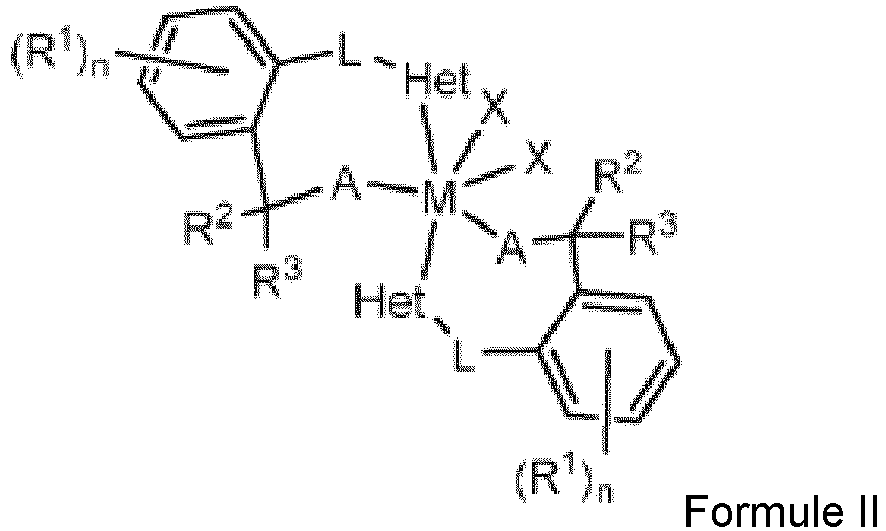
Applications Claiming Priority (2)
| Application Number | Priority Date | Filing Date | Title |
|---|---|---|---|
| US201662314480P | 2016-03-29 | 2016-03-29 | |
| PCT/US2017/022008 WO2017172332A1 (fr) | 2016-03-29 | 2017-03-13 | Complexes métalliques |
Publications (2)
| Publication Number | Publication Date |
|---|---|
| EP3436464A1 EP3436464A1 (fr) | 2019-02-06 |
| EP3436464B1 true EP3436464B1 (fr) | 2020-08-05 |
Family
ID=58410477
Family Applications (1)
| Application Number | Title | Priority Date | Filing Date |
|---|---|---|---|
| EP17713542.3A Active EP3436464B1 (fr) | 2016-03-29 | 2017-03-13 | Complexes métalliques |
Country Status (10)
| Country | Link |
|---|---|
| US (1) | US10730966B2 (fr) |
| EP (1) | EP3436464B1 (fr) |
| JP (1) | JP7125896B2 (fr) |
| KR (1) | KR102359117B1 (fr) |
| CN (1) | CN108779130B (fr) |
| BR (1) | BR112018068845B1 (fr) |
| ES (1) | ES2818733T3 (fr) |
| RU (1) | RU2747481C2 (fr) |
| SG (1) | SG11201808175UA (fr) |
| WO (1) | WO2017172332A1 (fr) |
Families Citing this family (1)
| Publication number | Priority date | Publication date | Assignee | Title |
|---|---|---|---|---|
| EP3531782B1 (fr) * | 2016-11-02 | 2022-10-26 | Huawei Technologies Co., Ltd. | Procédé, dispositif, et système d'envoi d'informations |
Citations (1)
| Publication number | Priority date | Publication date | Assignee | Title |
|---|---|---|---|---|
| WO2002085820A2 (fr) * | 2001-04-20 | 2002-10-31 | Indiana University | Composes organiques chiraux et complexes de coordination metalliques de ceux-ci |
Family Cites Families (27)
| Publication number | Priority date | Publication date | Assignee | Title |
|---|---|---|---|---|
| US3248179A (en) | 1962-02-26 | 1966-04-26 | Phillips Petroleum Co | Method and apparatus for the production of solid polymers of olefins |
| US4271060A (en) | 1979-09-17 | 1981-06-02 | Phillips Petroleum Company | Solution polymerization process |
| US4543399A (en) | 1982-03-24 | 1985-09-24 | Union Carbide Corporation | Fluidized bed reaction systems |
| US4588790A (en) | 1982-03-24 | 1986-05-13 | Union Carbide Corporation | Method for fluidized bed polymerization |
| US4613484A (en) | 1984-11-30 | 1986-09-23 | Phillips Petroleum Company | Loop reactor settling leg system for separation of solid polymers and liquid diluent |
| US5001205A (en) | 1988-06-16 | 1991-03-19 | Exxon Chemical Patents Inc. | Process for production of a high molecular weight ethylene α-olefin elastomer with a metallocene alumoxane catalyst |
| FR2634212B1 (fr) | 1988-07-15 | 1991-04-19 | Bp Chimie Sa | Appareillage et procede de polymerisation d'olefines en phase gazeuse dans un reacteur a lit fluidise |
| US5236998A (en) | 1991-03-07 | 1993-08-17 | Occidental Chemical Corporation | Process for the manufacture of linear polyethylene containing α-alkene commonomers |
| US5589555A (en) | 1991-10-03 | 1996-12-31 | Novacor Chemicals (International) S.A. | Control of a solution process for polymerization of ethylene |
| US5352749A (en) | 1992-03-19 | 1994-10-04 | Exxon Chemical Patents, Inc. | Process for polymerizing monomers in fluidized beds |
| US5436304A (en) | 1992-03-19 | 1995-07-25 | Exxon Chemical Patents Inc. | Process for polymerizing monomers in fluidized beds |
| US5317036A (en) | 1992-10-16 | 1994-05-31 | Union Carbide Chemicals & Plastics Technology Corporation | Gas phase polymerization reactions utilizing soluble unsupported catalysts |
| US5462999A (en) | 1993-04-26 | 1995-10-31 | Exxon Chemical Patents Inc. | Process for polymerizing monomers in fluidized beds |
| JP3077940B2 (ja) | 1993-04-26 | 2000-08-21 | エクソン・ケミカル・パテンツ・インク | 流動層重合法のための安定な操作条件を決定する方法 |
| ZA943399B (en) | 1993-05-20 | 1995-11-17 | Bp Chem Int Ltd | Polymerisation process |
| US5453471B1 (en) | 1994-08-02 | 1999-02-09 | Carbide Chemicals & Plastics T | Gas phase polymerization process |
| US5616661A (en) | 1995-03-31 | 1997-04-01 | Union Carbide Chemicals & Plastics Technology Corporation | Process for controlling particle growth during production of sticky polymers |
| US5677375A (en) | 1995-07-21 | 1997-10-14 | Union Carbide Chemicals & Plastics Technology Corporation | Process for producing an in situ polyethylene blend |
| US5665818A (en) | 1996-03-05 | 1997-09-09 | Union Carbide Chemicals & Plastics Technology Corporation | High activity staged reactor process |
| US5627242A (en) | 1996-03-28 | 1997-05-06 | Union Carbide Chemicals & Plastics Technology Corporation | Process for controlling gas phase fluidized bed polymerization reactor |
| EP1334139A2 (fr) | 2000-11-07 | 2003-08-13 | Symyx Technologies, Inc. | Ligands de pyridylamine substitues, complexes, catalyseurs et procedes pour la polymerisation, et polymeres |
| DE60228632D1 (de) * | 2001-03-12 | 2008-10-09 | Tosoh Corp | Katalysator auf Basis einer Übergangsmetallverbindung für die Olefinpolymerisation und Verwendung des Katalysators für die Olefinpolymerisation |
| JP4857475B2 (ja) * | 2001-03-12 | 2012-01-18 | 東ソー株式会社 | 遷移金属化合物、オレフィン重合用触媒およびオレフィンの重合方法 |
| ATE430789T1 (de) * | 2004-12-23 | 2009-05-15 | Ciba Holding Inc | Elektrolumineszierende metallkomplexe mit nukleophilen carbenliganden |
| US7973116B2 (en) | 2008-07-25 | 2011-07-05 | Exxonmobil Chemical Patents Inc. | Pyridyldiamido transition metal complexes, production and use thereof |
| US8674040B2 (en) * | 2008-07-25 | 2014-03-18 | Exxonmobil Chemical Patents Inc. | Pyridyldiamido transition metal complexes, production and use thereof |
| US20110294972A1 (en) * | 2010-05-27 | 2011-12-01 | Basell Polyolefine Gmbh | Olefin Polymerization Catalysts |
-
2017
- 2017-03-13 KR KR1020187028999A patent/KR102359117B1/ko active Active
- 2017-03-13 EP EP17713542.3A patent/EP3436464B1/fr active Active
- 2017-03-13 US US16/089,478 patent/US10730966B2/en active Active
- 2017-03-13 JP JP2018547479A patent/JP7125896B2/ja active Active
- 2017-03-13 SG SG11201808175UA patent/SG11201808175UA/en unknown
- 2017-03-13 WO PCT/US2017/022008 patent/WO2017172332A1/fr not_active Ceased
- 2017-03-13 RU RU2018136105A patent/RU2747481C2/ru active
- 2017-03-13 BR BR112018068845-2A patent/BR112018068845B1/pt active IP Right Grant
- 2017-03-13 ES ES17713542T patent/ES2818733T3/es active Active
- 2017-03-13 CN CN201780015632.7A patent/CN108779130B/zh active Active
Patent Citations (1)
| Publication number | Priority date | Publication date | Assignee | Title |
|---|---|---|---|---|
| WO2002085820A2 (fr) * | 2001-04-20 | 2002-10-31 | Indiana University | Composes organiques chiraux et complexes de coordination metalliques de ceux-ci |
Also Published As
| Publication number | Publication date |
|---|---|
| US10730966B2 (en) | 2020-08-04 |
| CN108779130A (zh) | 2018-11-09 |
| JP7125896B2 (ja) | 2022-08-25 |
| JP2019513130A (ja) | 2019-05-23 |
| BR112018068845A2 (pt) | 2019-01-22 |
| WO2017172332A1 (fr) | 2017-10-05 |
| KR20180128927A (ko) | 2018-12-04 |
| RU2747481C2 (ru) | 2021-05-05 |
| BR112018068845B1 (pt) | 2022-10-11 |
| RU2018136105A (ru) | 2020-04-13 |
| CN108779130B (zh) | 2021-12-31 |
| ES2818733T3 (es) | 2021-04-13 |
| KR102359117B1 (ko) | 2022-02-08 |
| RU2018136105A3 (fr) | 2020-04-20 |
| SG11201808175UA (en) | 2018-10-30 |
| CA3019327A1 (fr) | 2017-10-05 |
| EP3436464A1 (fr) | 2019-02-06 |
| US20190144570A1 (en) | 2019-05-16 |
Similar Documents
| Publication | Publication Date | Title |
|---|---|---|
| JP5844398B2 (ja) | エチレンα−オレフィン共重合体 | |
| JP6571190B2 (ja) | オレフィンオリゴマー化方法 | |
| CA2168564A1 (fr) | Compositions catalytiques | |
| KR20230018410A (ko) | 감쇠된 하이브리드 촉매 | |
| US10414843B2 (en) | Spray dried catalyst compositions, methods for preparation and use in olefin polymerization processes | |
| CZ274993A3 (en) | Process for preparing polyolefin waxes | |
| EP3436464B1 (fr) | Complexes métalliques | |
| KR101237467B1 (ko) | 새로운 포스트 메탈로센형 전이 금속 화합물 및 이를 이용한 올레핀 중합체의 제조방법 | |
| CA3019327C (fr) | Complexes metalliques | |
| KR20230017245A (ko) | 감쇠된 포스트-메탈로센 촉매 | |
| WO2018232503A1 (fr) | Catalyseurs à base d'un métal de transition du groupe 4 et d'un métal des terres rares non-cyclopentadiényle rigide, pour polymérisation d'oléfines | |
| US11613593B2 (en) | Ansa-bis(inden-2-yl) catalysts for producing vinylidene-terminated polyalphaolefins | |
| KR100193152B1 (ko) | 2핵 헤테로 메탈로센 촉매와 그 제조 방법 | |
| US5821310A (en) | Organometallic compounds and catalyst compositions | |
| JP7630551B2 (ja) | ポリオレフィン生成物の生成 | |
| KR102614265B1 (ko) | 메탈로센 담지 촉매의 제조방법 및 메탈로센 담지 촉매 | |
| KR101818371B1 (ko) | 탠덤 촉매 시스템 및 이를 이용한 폴리에틸렌 제조방법 | |
| KR101205474B1 (ko) | 금속 화합물 및 이를 이용한 올레핀 중합체의 제조방법 | |
| JP6453458B2 (ja) | リガンド化合物、オレフィンオリゴマー化用触媒系、およびこれを用いたオレフィンオリゴマー化方法 | |
| KR101809652B1 (ko) | 올레핀 올리고머화용 촉매계, 및 이를 이용한 올레핀 올리고머화 방법 | |
| CN120091867A (zh) | 使用大体积官能化n-芳基双膦胺配体的铬催化的乙烯低聚反应 | |
| US20210079029A1 (en) | Polymerisation of olefins | |
| JP2002527446A (ja) | 固定した架橋を有するメタロセン | |
| KR20140070418A (ko) | 포스트 메탈로센형 리간드 화합물, 이의 제조방법, 유기 금속 화합물 및 이의 제조방법 |
Legal Events
| Date | Code | Title | Description |
|---|---|---|---|
| STAA | Information on the status of an ep patent application or granted ep patent |
Free format text: STATUS: UNKNOWN |
|
| STAA | Information on the status of an ep patent application or granted ep patent |
Free format text: STATUS: THE INTERNATIONAL PUBLICATION HAS BEEN MADE |
|
| PUAI | Public reference made under article 153(3) epc to a published international application that has entered the european phase |
Free format text: ORIGINAL CODE: 0009012 |
|
| STAA | Information on the status of an ep patent application or granted ep patent |
Free format text: STATUS: REQUEST FOR EXAMINATION WAS MADE |
|
| 17P | Request for examination filed |
Effective date: 20181026 |
|
| AK | Designated contracting states |
Kind code of ref document: A1 Designated state(s): AL AT BE BG CH CY CZ DE DK EE ES FI FR GB GR HR HU IE IS IT LI LT LU LV MC MK MT NL NO PL PT RO RS SE SI SK SM TR |
|
| AX | Request for extension of the european patent |
Extension state: BA ME |
|
| DAV | Request for validation of the european patent (deleted) | ||
| DAX | Request for extension of the european patent (deleted) | ||
| STAA | Information on the status of an ep patent application or granted ep patent |
Free format text: STATUS: EXAMINATION IS IN PROGRESS |
|
| 17Q | First examination report despatched |
Effective date: 20191030 |
|
| GRAP | Despatch of communication of intention to grant a patent |
Free format text: ORIGINAL CODE: EPIDOSNIGR1 |
|
| STAA | Information on the status of an ep patent application or granted ep patent |
Free format text: STATUS: GRANT OF PATENT IS INTENDED |
|
| INTG | Intention to grant announced |
Effective date: 20200227 |
|
| GRAS | Grant fee paid |
Free format text: ORIGINAL CODE: EPIDOSNIGR3 |
|
| GRAA | (expected) grant |
Free format text: ORIGINAL CODE: 0009210 |
|
| STAA | Information on the status of an ep patent application or granted ep patent |
Free format text: STATUS: THE PATENT HAS BEEN GRANTED |
|
| AK | Designated contracting states |
Kind code of ref document: B1 Designated state(s): AL AT BE BG CH CY CZ DE DK EE ES FI FR GB GR HR HU IE IS IT LI LT LU LV MC MK MT NL NO PL PT RO RS SE SI SK SM TR |
|
| REG | Reference to a national code |
Ref country code: GB Ref legal event code: FG4D |
|
| REG | Reference to a national code |
Ref country code: CH Ref legal event code: EP |
|
| REG | Reference to a national code |
Ref country code: AT Ref legal event code: REF Ref document number: 1298584 Country of ref document: AT Kind code of ref document: T Effective date: 20200815 |
|
| REG | Reference to a national code |
Ref country code: DE Ref legal event code: R096 Ref document number: 602017021022 Country of ref document: DE |
|
| REG | Reference to a national code |
Ref country code: IE Ref legal event code: FG4D |
|
| REG | Reference to a national code |
Ref country code: NL Ref legal event code: FP |
|
| REG | Reference to a national code |
Ref country code: LT Ref legal event code: MG4D |
|
| REG | Reference to a national code |
Ref country code: AT Ref legal event code: MK05 Ref document number: 1298584 Country of ref document: AT Kind code of ref document: T Effective date: 20200805 |
|
| PG25 | Lapsed in a contracting state [announced via postgrant information from national office to epo] |
Ref country code: HR Free format text: LAPSE BECAUSE OF FAILURE TO SUBMIT A TRANSLATION OF THE DESCRIPTION OR TO PAY THE FEE WITHIN THE PRESCRIBED TIME-LIMIT Effective date: 20200805 Ref country code: AT Free format text: LAPSE BECAUSE OF FAILURE TO SUBMIT A TRANSLATION OF THE DESCRIPTION OR TO PAY THE FEE WITHIN THE PRESCRIBED TIME-LIMIT Effective date: 20200805 Ref country code: LT Free format text: LAPSE BECAUSE OF FAILURE TO SUBMIT A TRANSLATION OF THE DESCRIPTION OR TO PAY THE FEE WITHIN THE PRESCRIBED TIME-LIMIT Effective date: 20200805 Ref country code: NO Free format text: LAPSE BECAUSE OF FAILURE TO SUBMIT A TRANSLATION OF THE DESCRIPTION OR TO PAY THE FEE WITHIN THE PRESCRIBED TIME-LIMIT Effective date: 20201105 Ref country code: GR Free format text: LAPSE BECAUSE OF FAILURE TO SUBMIT A TRANSLATION OF THE DESCRIPTION OR TO PAY THE FEE WITHIN THE PRESCRIBED TIME-LIMIT Effective date: 20201106 Ref country code: FI Free format text: LAPSE BECAUSE OF FAILURE TO SUBMIT A TRANSLATION OF THE DESCRIPTION OR TO PAY THE FEE WITHIN THE PRESCRIBED TIME-LIMIT Effective date: 20200805 Ref country code: PT Free format text: LAPSE BECAUSE OF FAILURE TO SUBMIT A TRANSLATION OF THE DESCRIPTION OR TO PAY THE FEE WITHIN THE PRESCRIBED TIME-LIMIT Effective date: 20201207 Ref country code: SE Free format text: LAPSE BECAUSE OF FAILURE TO SUBMIT A TRANSLATION OF THE DESCRIPTION OR TO PAY THE FEE WITHIN THE PRESCRIBED TIME-LIMIT Effective date: 20200805 Ref country code: BG Free format text: LAPSE BECAUSE OF FAILURE TO SUBMIT A TRANSLATION OF THE DESCRIPTION OR TO PAY THE FEE WITHIN THE PRESCRIBED TIME-LIMIT Effective date: 20201105 |
|
| PG25 | Lapsed in a contracting state [announced via postgrant information from national office to epo] |
Ref country code: LV Free format text: LAPSE BECAUSE OF FAILURE TO SUBMIT A TRANSLATION OF THE DESCRIPTION OR TO PAY THE FEE WITHIN THE PRESCRIBED TIME-LIMIT Effective date: 20200805 Ref country code: RS Free format text: LAPSE BECAUSE OF FAILURE TO SUBMIT A TRANSLATION OF THE DESCRIPTION OR TO PAY THE FEE WITHIN THE PRESCRIBED TIME-LIMIT Effective date: 20200805 Ref country code: PL Free format text: LAPSE BECAUSE OF FAILURE TO SUBMIT A TRANSLATION OF THE DESCRIPTION OR TO PAY THE FEE WITHIN THE PRESCRIBED TIME-LIMIT Effective date: 20200805 Ref country code: IS Free format text: LAPSE BECAUSE OF FAILURE TO SUBMIT A TRANSLATION OF THE DESCRIPTION OR TO PAY THE FEE WITHIN THE PRESCRIBED TIME-LIMIT Effective date: 20201205 |
|
| REG | Reference to a national code |
Ref country code: ES Ref legal event code: FG2A Ref document number: 2818733 Country of ref document: ES Kind code of ref document: T3 Effective date: 20210413 |
|
| PG25 | Lapsed in a contracting state [announced via postgrant information from national office to epo] |
Ref country code: SM Free format text: LAPSE BECAUSE OF FAILURE TO SUBMIT A TRANSLATION OF THE DESCRIPTION OR TO PAY THE FEE WITHIN THE PRESCRIBED TIME-LIMIT Effective date: 20200805 Ref country code: EE Free format text: LAPSE BECAUSE OF FAILURE TO SUBMIT A TRANSLATION OF THE DESCRIPTION OR TO PAY THE FEE WITHIN THE PRESCRIBED TIME-LIMIT Effective date: 20200805 Ref country code: DK Free format text: LAPSE BECAUSE OF FAILURE TO SUBMIT A TRANSLATION OF THE DESCRIPTION OR TO PAY THE FEE WITHIN THE PRESCRIBED TIME-LIMIT Effective date: 20200805 Ref country code: CZ Free format text: LAPSE BECAUSE OF FAILURE TO SUBMIT A TRANSLATION OF THE DESCRIPTION OR TO PAY THE FEE WITHIN THE PRESCRIBED TIME-LIMIT Effective date: 20200805 Ref country code: RO Free format text: LAPSE BECAUSE OF FAILURE TO SUBMIT A TRANSLATION OF THE DESCRIPTION OR TO PAY THE FEE WITHIN THE PRESCRIBED TIME-LIMIT Effective date: 20200805 |
|
| REG | Reference to a national code |
Ref country code: DE Ref legal event code: R097 Ref document number: 602017021022 Country of ref document: DE |
|
| PG25 | Lapsed in a contracting state [announced via postgrant information from national office to epo] |
Ref country code: AL Free format text: LAPSE BECAUSE OF FAILURE TO SUBMIT A TRANSLATION OF THE DESCRIPTION OR TO PAY THE FEE WITHIN THE PRESCRIBED TIME-LIMIT Effective date: 20200805 |
|
| PLBE | No opposition filed within time limit |
Free format text: ORIGINAL CODE: 0009261 |
|
| STAA | Information on the status of an ep patent application or granted ep patent |
Free format text: STATUS: NO OPPOSITION FILED WITHIN TIME LIMIT |
|
| PG25 | Lapsed in a contracting state [announced via postgrant information from national office to epo] |
Ref country code: SK Free format text: LAPSE BECAUSE OF FAILURE TO SUBMIT A TRANSLATION OF THE DESCRIPTION OR TO PAY THE FEE WITHIN THE PRESCRIBED TIME-LIMIT Effective date: 20200805 |
|
| 26N | No opposition filed |
Effective date: 20210507 |
|
| PG25 | Lapsed in a contracting state [announced via postgrant information from national office to epo] |
Ref country code: SI Free format text: LAPSE BECAUSE OF FAILURE TO SUBMIT A TRANSLATION OF THE DESCRIPTION OR TO PAY THE FEE WITHIN THE PRESCRIBED TIME-LIMIT Effective date: 20200805 |
|
| PG25 | Lapsed in a contracting state [announced via postgrant information from national office to epo] |
Ref country code: MC Free format text: LAPSE BECAUSE OF FAILURE TO SUBMIT A TRANSLATION OF THE DESCRIPTION OR TO PAY THE FEE WITHIN THE PRESCRIBED TIME-LIMIT Effective date: 20200805 |
|
| REG | Reference to a national code |
Ref country code: CH Ref legal event code: PL |
|
| GBPC | Gb: european patent ceased through non-payment of renewal fee |
Effective date: 20210313 |
|
| PG25 | Lapsed in a contracting state [announced via postgrant information from national office to epo] |
Ref country code: IE Free format text: LAPSE BECAUSE OF NON-PAYMENT OF DUE FEES Effective date: 20210313 Ref country code: GB Free format text: LAPSE BECAUSE OF NON-PAYMENT OF DUE FEES Effective date: 20210313 Ref country code: LU Free format text: LAPSE BECAUSE OF NON-PAYMENT OF DUE FEES Effective date: 20210313 Ref country code: LI Free format text: LAPSE BECAUSE OF NON-PAYMENT OF DUE FEES Effective date: 20210331 Ref country code: CH Free format text: LAPSE BECAUSE OF NON-PAYMENT OF DUE FEES Effective date: 20210331 |
|
| PG25 | Lapsed in a contracting state [announced via postgrant information from national office to epo] |
Ref country code: CY Free format text: LAPSE BECAUSE OF FAILURE TO SUBMIT A TRANSLATION OF THE DESCRIPTION OR TO PAY THE FEE WITHIN THE PRESCRIBED TIME-LIMIT Effective date: 20200805 |
|
| P01 | Opt-out of the competence of the unified patent court (upc) registered |
Effective date: 20230526 |
|
| PG25 | Lapsed in a contracting state [announced via postgrant information from national office to epo] |
Ref country code: HU Free format text: LAPSE BECAUSE OF FAILURE TO SUBMIT A TRANSLATION OF THE DESCRIPTION OR TO PAY THE FEE WITHIN THE PRESCRIBED TIME-LIMIT; INVALID AB INITIO Effective date: 20170313 |
|
| PG25 | Lapsed in a contracting state [announced via postgrant information from national office to epo] |
Ref country code: MK Free format text: LAPSE BECAUSE OF FAILURE TO SUBMIT A TRANSLATION OF THE DESCRIPTION OR TO PAY THE FEE WITHIN THE PRESCRIBED TIME-LIMIT Effective date: 20200805 |
|
| PG25 | Lapsed in a contracting state [announced via postgrant information from national office to epo] |
Ref country code: MT Free format text: LAPSE BECAUSE OF FAILURE TO SUBMIT A TRANSLATION OF THE DESCRIPTION OR TO PAY THE FEE WITHIN THE PRESCRIBED TIME-LIMIT Effective date: 20200805 |
|
| PGFP | Annual fee paid to national office [announced via postgrant information from national office to epo] |
Ref country code: FR Payment date: 20241231 Year of fee payment: 9 |
|
| PGFP | Annual fee paid to national office [announced via postgrant information from national office to epo] |
Ref country code: NL Payment date: 20250107 Year of fee payment: 9 |
|
| PGFP | Annual fee paid to national office [announced via postgrant information from national office to epo] |
Ref country code: DE Payment date: 20241231 Year of fee payment: 9 |
|
| PGFP | Annual fee paid to national office [announced via postgrant information from national office to epo] |
Ref country code: BE Payment date: 20250107 Year of fee payment: 9 |
|
| PGFP | Annual fee paid to national office [announced via postgrant information from national office to epo] |
Ref country code: IT Payment date: 20250211 Year of fee payment: 9 |
|
| PGFP | Annual fee paid to national office [announced via postgrant information from national office to epo] |
Ref country code: ES Payment date: 20250410 Year of fee payment: 9 |
|
| PG25 | Lapsed in a contracting state [announced via postgrant information from national office to epo] |
Ref country code: TR Free format text: LAPSE BECAUSE OF FAILURE TO SUBMIT A TRANSLATION OF THE DESCRIPTION OR TO PAY THE FEE WITHIN THE PRESCRIBED TIME-LIMIT Effective date: 20200805 |