EP3436860B1 - Joint à plusieurs éléments, et enceinte - Google Patents
Joint à plusieurs éléments, et enceinte Download PDFInfo
- Publication number
- EP3436860B1 EP3436860B1 EP17716481.1A EP17716481A EP3436860B1 EP 3436860 B1 EP3436860 B1 EP 3436860B1 EP 17716481 A EP17716481 A EP 17716481A EP 3436860 B1 EP3436860 B1 EP 3436860B1
- Authority
- EP
- European Patent Office
- Prior art keywords
- port
- seal
- sealing unit
- seam
- peripheral surface
- Prior art date
- Legal status (The legal status is an assumption and is not a legal conclusion. Google has not performed a legal analysis and makes no representation as to the accuracy of the status listed.)
- Active
Links
Images






Classifications
-
- F—MECHANICAL ENGINEERING; LIGHTING; HEATING; WEAPONS; BLASTING
- F16—ENGINEERING ELEMENTS AND UNITS; GENERAL MEASURES FOR PRODUCING AND MAINTAINING EFFECTIVE FUNCTIONING OF MACHINES OR INSTALLATIONS; THERMAL INSULATION IN GENERAL
- F16J—PISTONS; CYLINDERS; SEALINGS
- F16J15/00—Sealings
- F16J15/02—Sealings between relatively-stationary surfaces
- F16J15/021—Sealings between relatively-stationary surfaces with elastic packing
- F16J15/022—Sealings between relatively-stationary surfaces with elastic packing characterised by structure or material
-
- G—PHYSICS
- G02—OPTICS
- G02B—OPTICAL ELEMENTS, SYSTEMS OR APPARATUS
- G02B6/00—Light guides; Structural details of arrangements comprising light guides and other optical elements, e.g. couplings
- G02B6/44—Mechanical structures for providing tensile strength and external protection for fibres, e.g. optical transmission cables
- G02B6/4439—Auxiliary devices
- G02B6/4471—Terminating devices ; Cable clamps
- G02B6/44775—Cable seals e.g. feed-through
-
- G—PHYSICS
- G02—OPTICS
- G02B—OPTICAL ELEMENTS, SYSTEMS OR APPARATUS
- G02B6/00—Light guides; Structural details of arrangements comprising light guides and other optical elements, e.g. couplings
- G02B6/44—Mechanical structures for providing tensile strength and external protection for fibres, e.g. optical transmission cables
- G02B6/4439—Auxiliary devices
- G02B6/444—Systems or boxes with surplus lengths
- G02B6/4441—Boxes
- G02B6/4442—Cap coupling boxes
- G02B6/4444—Seals
-
- H—ELECTRICITY
- H02—GENERATION; CONVERSION OR DISTRIBUTION OF ELECTRIC POWER
- H02G—INSTALLATION OF ELECTRIC CABLES OR LINES, OR OF COMBINED OPTICAL AND ELECTRIC CABLES OR LINES
- H02G3/00—Installations of electric cables or lines or protective tubing therefor in or on buildings, equivalent structures or vehicles
- H02G3/02—Details
- H02G3/08—Distribution boxes; Connection or junction boxes
- H02G3/088—Dustproof, splashproof, drip-proof, waterproof, or flameproof casings or inlets
-
- G—PHYSICS
- G02—OPTICS
- G02B—OPTICAL ELEMENTS, SYSTEMS OR APPARATUS
- G02B6/00—Light guides; Structural details of arrangements comprising light guides and other optical elements, e.g. couplings
- G02B6/44—Mechanical structures for providing tensile strength and external protection for fibres, e.g. optical transmission cables
- G02B6/4439—Auxiliary devices
- G02B6/444—Systems or boxes with surplus lengths
- G02B6/4441—Boxes
- G02B6/4446—Cable boxes, e.g. splicing boxes with two or more multi fibre cables
Definitions
- Telecommunications systems typically employ a network of telecommunications cables capable of transmitting large volumes of data and voice signals over relatively long distances.
- the telecommunications cables can include fiber optic cables, electrical cables, or combinations of electrical and fiber optic cables.
- a typical telecommunications network also includes a plurality of telecommunications enclosures integrated throughout the network of telecommunications cables.
- the telecommunications enclosures are adapted to house and protect telecommunications components such as splices, termination panels, power splitters, and wavelength division multiplexers. It is often preferred for the telecommunications enclosures to be re-enterable.
- re-enterable means that the telecommunications enclosures can be re-opened to allow access to the telecommunications components housed therein without requiring the removal and destruction of the telecommunications enclosures.
- certain telecommunications enclosures can include separate access panels that can be opened to access the interiors of the enclosures and then closed to re-seal the enclosures.
- Other telecommunications enclosures take the form of elongated sleeves formed by wrap-around covers or half-shells having longitudinal edges that are joined by clamps or other retainers.
- Still other telecommunications enclosures include two half-pieces that are joined together through clamps, wedges, or other structures.
- Telecommunications enclosures are typically sealed to inhibit the intrusion of moisture or other contaminants. Improvements in seal design are desired.
- US 5,825,961 (A ) relates to fiber optic cable closures for enclosing fiber optic cable splices.
- the present disclosure relates generally to an enclosure sealing unit.
- the sealing unit includes a first and second body, where the second body is disposed on the first body and is softer than the first body.
- the present invention provides a seal for a telecommunications enclosure.
- the seal includes a first body made of a first material.
- the first body defines a port and the port defines a port axis.
- the first body further includes a first axial face, an opposite second axial face, and a peripheral surface.
- the peripheral surface surrounds the first body between the first axial face and second axial face and the peripheral surface further surrounds the port.
- the seal also includes a second body made of a second material.
- the second body is disposed on at least the peripheral surface of the first body.
- the second material is softer than the first material of the first body.
- the first body is pre-formed and the second body is over-molded so as to surround the first body.
- FIG. 1 shows a telecommunications enclosure 100 in accordance with the principles of the present disclosure.
- the enclosure 100 includes a housing 102 having a cover 104 and a base 106, the base defining a plurality of sealing troughs 108.
- FIG. 2 shows the base 106 of the enclosure 100, with the cover 104 opened, in accordance with the principles of the present disclosure.
- the enclosure 100 also includes a plurality of sealing units 110 (see FIGS. 3-11 ) that fit within the sealing troughs 108.
- Each sealing unit 110 defines a plurality of cable ports 112.
- each sealing unit 110 is configured for providing seals about structures (e.g., cables, plugs, etc.) routed though the cable ports 112 and is also configured for providing a peripheral seal between the housing 102 and each sealing unit 110.
- the cable can be either fiber optic cables or copper cables.
- the cables can be main distribution cables and they may loop or pass through the enclosure 100 so that one portion of the cable enters the enclosure 100 through one of the cable ports 112 and another portion of the cable exits the enclosure 100 through the other cable ports 112.
- FIGS 3-7 show a single sealing unit 110 in an open position.
- the sealing unit 110 includes a plurality of ports 112a, 112b, a first body 114, and a second body 116.
- the second body 116 is disposed on at least a portion of the first body 114.
- the sealing unit 110 is generally U-shaped so as to mate with a generally U-shaped trough of an enclosure.
- the sealing unit includes a generally flat top surface 111, generally flat side surfaces 109, and an arcuate shaped bottom surface 115.
- the sealing unit 110 can be a variety of different shapes to fit within differently shaped troughs.
- each port 112 includes only a single port 112. In still other embodiments, the sealing unit 110 includes more than two ports.
- Each port 112a, 112b defines a port axis 113a, 113b. When structures are routed through and within the ports 112a, 112b, the structures, such as a cable, lie along the axes 113a, 113b of the particular port 112a, 112b in which the structure is positioned.
- each port 112 includes tapered walls 117. The tapered walls 117 allow the ports 112a, 112b to have an inner diameter at one side that is larger than the inner diameter of an opposite side of the ports 112a, 112b. This tapered wall configuration allows for variety of differently sized structures to be sealed within the ports 112.
- the sealing unit 110 is a wrap-around seal.
- the wrap-around configuration allows the sealing unit 110 to be wrapped around a structure, such as a cable, during installation to allow for lateral insertion of a structure into the ports 112. This is advantageous if the structure that is to be sealed does not have a terminated end. For example, a cable could be looped with the enclosure 100, stored, and then routed back out of the enclosure 100 without being terminated.
- the sealing unit 110 includes a pair of seams 118, 120 that are separable.
- the first seam 118 provides lateral access to the port 112a from the outside of the sealing unit 110.
- the second seam 120 provides lateral access to port 112b from port 112a.
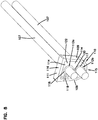
- the sealing unit 110 has an open position (shown in FIGS. 3-7 ) and a closed position (shown in FIGS. 8-9 ).
- the sealing unit 110 can be in the open position during installation.
- both seams 118, 120 are also open, allowing lateral access to the port 112a, 112b.
- the sealing unit 110 is in the closed positon, the seams 118, 120 are closed providing sealed ports 112a, 112b from both each other and from the exterior of the sealing unit 110.
- the sealing unit 110 forms a seal around a pair of structures 107 that are positioned within the ports 112a, 112b.
- the first body 114 of the sealing unit 110 includes first and second axial faces 122, 124.
- the first axial face 122 being larger than the second axial face 124.
- the first body 114 further includes a peripheral surface 126 that surrounds the first body 114 between the first and second axial faces 122, 124.
- the peripheral surface 126 further surrounds and defines the ports 112a, 112b and the seams 118, 120.
- the first body 114 includes a pair of flaps 128 at the second axial face 124 that at least partially cover the ports 112a, 112b.
- the flaps 128 can include a plurality of radial slits 130 to allow the flaps 128 to spread out around a structure, such as a cable, that is inserted into the ports 112a, 112b.
- the flaps 128 can be arranged in a truncated conical shape.
- the first body 114 is comprised of a resilient, compressible material. By being compressible, the volume of first body 114 changes as the amount of pressure being exerted on the first body 114 changes. In some embodiments, the volume of the first body 114 can shrink when under pressure. In some embodiments, the first body 114 is comprised of a rubber, thermoplastic elastomer, or vulcanized rubber. In some embodiments, the first body 114 is a rubber with a durometer hardness of between about Shore A 10 and about Shore A 70. In some embodiments, the first body 114 has a durometer hardness between about Shore A 20 and about Shore A 60.
- the first body 114 has a durometer hardness between about Shore A 20 and about Shore A 50. In some embodiments, the first body 114 has a durometer hardness between about Shore A 20 and about Shore A 40. In some embodiments, the first body 114 has a durometer hardness between about Shore A 20 and about Shore A 30.
- thermoplastic elastomer refers to an elastomer comprising a thermoreversible network.
- Thermoplastic elastomers sometimes referred to as thermoplastic rubbers, are a class of copolymers or a physical mix of polymers (usually a plastic and a rubber) which consist of materials with both thermoplastic and elastomeric properties.
- thermoplastic refers to a polymer that softens when exposed to heat and returns to a more rigid condition when cooled.
- the term "elastomer” refers to a polymer that displays rubber-like elasticity. Elastomers exhibit viscoelasticity (having both viscosity and elasticity) and very weak inter-molecular forces, generally having low Young's modulus and high failure strain compared with other materials. The term is often used interchangeably with the term rubber, although the latter is preferred when referring to vulcanisates.
- vulcanization refers to chemical crosslinking of high molar-mass linear or branched polymers to give a polymer network. The polymer network often displays rubberlike elasticity; however, a high concentration of crosslinks can lead to rigid materials.
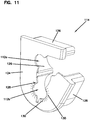
- the second body 116 of the sealing unit 110 is shown.
- the second body 116 is configured to be disposed on the peripheral surface 126 of the first body 114.
- the second body 116 is comprised of a softer material than the first body 114.
- the second body 116 forms a more flexible seal around an exterior 132 of the sealing unit 110.
- the first and second axial faces 122, 124 of the first body 114 remain substantially exposed and not covered by the second body 116.
- the second body 116 includes a hinge region 134.
- the hinge region 134 allows the sealing unit 110 that has a wrap-around design to more easily move between the open positon and the closed position because the material comprising the second body 116 is softer than the first body 114.
- the hinge region 134 of the second body 116 can be continuous, traveling from the walls 117 of the port 112b to the outer edge of the second body 116.
- the majority of the volume of the hinge region 134 is comprised of the second body 116.
- the second body 116 is comprised of an incompressible material. It will be appreciated that various materials can be used to form the second body 116 element.
- Example materials include elastomers, including natural or synthetic rubbers (e.g., EPDM rubber or silicone rubber).
- polymeric foam e.g., open cell or closed cell
- silicone foam e.g., open cell or closed cell
- the second body 116 may comprise gel and/or gel combined with another material such as an elastomer.
- the gel may, for example, comprise silicone gel, urea gel, urethane gel, thermoplastic gel, or any suitable gel or geloid sealing material.
- Example gels are normally substantially incompressible when placed under a compressive force and normally flow and conform to their surroundings thereby forming sealed contact with other surfaces.
- Example gels include oil-extended polymers.
- the polymer may, for example, comprise an elastomer, or a block copolymer having relatively hard blocks and relatively elastomeric blocks.
- Example copolymers include styrene-butadiene or styrene-isoprene di-block or tri-block copolymers.
- the polymer of the gel may include one or more styrene-ethylene-propylene-styrene block copolymers.
- Example extender oils used in example gels may, for example, be hydrocarbon oils (e.g., paraffinic or naphthenic oils or polypropene oils, or mixtures thereof).
- the second body 116 can also include additives such as moisture scavengers, antioxidants, tackifiers, pigments and/or fungicides.
- the second body 116 can have an ultimate elongation greater than 100 percent with substantially elastic deformation to an elongation of at least 100 percent.
- the second body 116 can have an ultimate elongation of at least 200 percent, or at least 500 percent, or at least 1000 percent. Ultimate elongation can be determined by the testing protocol set forth at ASTM D412.
- the second body 116 is comprised of mastic material.
- the mastic material can be comprised of a variety of different types of materials such as butyl, EPDM, epoxy or silicone mastic.
- the second body 116 is comprised of a material that has a tackiness to the touch.
- the second body 116 is comprised of a material that is tackier to the touch than the material of the first body 114.
- the second body 116 has a uniform thickness T of less than about 5 millimeters. In some embodiments, the second body 116 has a uniform thickness T of less than 4 millimeters. In some embodiments, the second body 116 has a uniform thickness T of less than 3 millimeters. In some embodiments, the second body 116 has a uniform thickness T of less than 2 millimeters. In some embodiments, the second body 116 has a uniform thickness T of less than 1 millimeter. In some embodiments, the second body 116 has twice the thickness at the seams 118, 120.
- the first body 114 occupies more volume of the total volume of the sealing unit 110 than the second body 116. In some embodiments, the first body 114 comprises at least 50 percent of the total volume of the sealing unit 110. In other embodiments, the first body 114 comprises at least 60 percent of the total volume of the sealing unit 110. In other embodiments, the first body 114 comprises at least 70 percent of the total volume of the sealing unit 110. In other embodiments, the first body 114 comprises at least 80 percent of the total volume of the sealing unit 110. In other embodiments, the first body 114 comprises at least 90 percent of the total volume of the sealing unit 110.
- the sealing unit 110 By surrounding the first body 114 with the softer second body 116, the sealing unit 110 creates a multi-component seal capable of effectively sealing a structure to satisfy IP65 standards. Specifically, the sealing unit forms a seal around a structure contained with the ports 112a, 112b and also a seal with the exterior 132 of the sealing unit 110 and the seal trough 108, cover 104, and base 106 of the enclosure 100 (see FIGS. 1 and 2 ).
- a force is exerted on the sealing unit 110 (e.g., by the cover 104 of the enclosure on the top surface 111)
- the second body 116 due to its incompressibility, will seek to fill its container, or trough 108, completely.
- the second body 116 will then begin to at least partially compress the first body 114 if continued force is exerted on the second body 116.
- the first body 114 exerts a spring force back on the second body 116, thereby helping to create a more complete seal around the exterior 132 of the sealing unit 110 with the seal trough 108, cover 104, and base 106 and also around the structure contained within the ports 112a, 112b, such as a cable.
- the spring force exerted on the second body 116 by the first body 114 also helps to maintain the seal even if the second body 116 reduces volume over time due to oil bleed-out or other reason.
- the sealing unit 110 may be molded.
- the first body 114 is first individually created by molding, extrusion, or a like process.
- the pre-formed first body 114 is then placed into a mold that is shaped like the sealing unit 110.
- the material that makes up the second body 116 is then injected around the first body 114 and fills the void area in the mold that fully surrounds the first body 114. Due to the continuous configuration of the second body 116, a single injection port can be utilized when injecting the material that makes up the second body 116.
- the sealing unit 110 of present disclosure can be described in a variety of different ways.
- the sealing unit can include a main body made of a first material and a liner disposed thereon that is made of a second, softer, material.
- the liner can include three parts; an outer liner, a port liner, and a seam liner.
- the outer liner surrounds the outer periphery of the main body.
- the port liner surrounds the port, or ports. In the case of a circular port, the port liner surrounds the circumference of the port.
- the seam liner surrounds a seam connecting the outer periphery of the sealing unit with the first port, and the seam liner can also surround a seam connecting the first port with a second port of the sealing unit.
- the seam liner extends to provide communication through a first seam between the port liner and the outer liner. In some embodiments, the seam liner extends to provide communication through a second seam to provide communication between first port and a second port of the sealing unit. In one example, the seam liner can have a predefined separation zone at which the second material of the seam liner separates when the seam is opened. In another example, the seam liner can line a single side of a seam and seal with the main body when in a closed position, and separate away from the main body when the seam is in the open position. In some embodiments, the liner can include a hinge portion providing second material communication between the port liner of a second port and the outer liner.
- the liner has a uniform thickness of less than about 5 millimeters. In some embodiments, the liner has a uniform thickness of less than about 4 millimeters. In some embodiments, the liner has a uniform thickness of less than about 3 millimeters. In some embodiments, the liner has a uniform thickness of less than about 2 millimeters. In some embodiments, the liner has a uniform thickness of less than about 1 millimeter. In some embodiments, the seam liner has twice the thickness of the uniform thickness of the outer and port liners.
Landscapes
- Physics & Mathematics (AREA)
- Engineering & Computer Science (AREA)
- General Engineering & Computer Science (AREA)
- General Physics & Mathematics (AREA)
- Optics & Photonics (AREA)
- Structural Engineering (AREA)
- Civil Engineering (AREA)
- Architecture (AREA)
- Mechanical Engineering (AREA)
- Casings For Electric Apparatus (AREA)
- Gasket Seals (AREA)
- Structure Of Receivers (AREA)
- Transmitters (AREA)
Claims (15)
- Élément d'étanchéité (110) pour un boîtier de télécommunications (100), l'élément d'étanchéité (110) comprenant :un premier corps (114) fait d'un premier matériau, le premier corps (114) définissant un orifice (112), l'orifice (112) définissant un axe d'orifice (113), le premier corps (114) comprenant en outre une première face axiale (122), et une deuxième face axiale à l'opposé (124), et une surface périphérique (126), la surface périphérique (126) entourant le premier corps (114) entre la première face axiale (122) et la deuxième face axiale (124), la surface périphérique (126) entourant en outre l'orifice (112) ; etun deuxième corps (116) fait d'un deuxième matériau, le deuxième corps (116) étant disposé sur au moins la surface périphérique (126) du premier corps (114), dans lequel le deuxième matériau est plus mou que le premier matériau du premier corps (114).caractérisé en ce que le premier corps (114) est préformé et le deuxième corps (116) est surmoulé de sorte à entourer le premier corps (114).
- Élément d'étanchéité (110) selon la revendication 1, comprenant en outre un premier joint (118) configuré pour permettre un accès latéral à l'orifice (112) lorsque le premier joint (118) est dans une position ouverte.
- Élément d'étanchéité (110) selon la revendication 1, dans lequel le premier corps (114) définit en outre un deuxième orifice (112), le deuxième orifice (112) définissant un axe de deuxième orifice (113).
- Élément d'étanchéité (110) selon la revendication 3, dans lequel les premier et deuxième orifices (112) ont des parois coniques (117).
- Élément d'étanchéité (110) selon la revendication 3, comprenant en outre un premier joint (118) configuré pour permettre un accès latéral à l'orifice (112) lorsque le premier joint (118) est dans une position ouverte, et un deuxième joint (120) configuré pour permettre un accès latéral au deuxième orifice (112) lorsque le deuxième joint (120) est dans une position ouverte.
- Élément d'étanchéité (110) selon la revendication 5, dans lequel le deuxième corps (116) est également disposé sur le premier corps (114) au niveau des premier et deuxième joints (118, 120).
- Élément d'étanchéité (110) selon la revendication 1, dans lequel l'orifice (112) a des parois coniques (117).
- Élément d'étanchéité (110) selon la revendication 1, dans lequel le premier corps (114) constitue environ 50 pour cent du volume de l'élément d'étanchéité (110).
- Élément d'étanchéité (110) selon la revendication 1, dans lequel la surface périphérique (126) du premier corps (114) comprend une surface supérieure plate (111), des surfaces latérales généralement plates (109) et une surface inférieure de forme arquée (115).
- Élément d'étanchéité (110) selon la revendication 9, comprenant en outre un premier joint (118) dans le premier corps (114) reliant l'orifice (112) à une surface latérale unique (109) du premier corps (114).
- Élément d'étanchéité (110) selon la revendication 9, dans lequel le deuxième corps (116) est disposé sur les surfaces supérieure (111), inférieure (115) et latérales (109) du premier corps (114), dans lequel le deuxième corps (116) est également déposé sur des parois (117) de l'orifice (112) .
- Élément d'étanchéité (110) selon la revendication 1, dans lequel le matériau qui comprend le premier corps (114) est un matériau en caoutchouc.
- Élément d'étanchéité (110) selon la revendication 1, dans lequel le deuxième matériau du deuxième corps (116) est incompressible
- Élément d'étanchéité (110) selon l'une quelconque des revendications 1-13, comprenant en outre un boîtier de télécommunications (100), dans lequel le boîtier (100) comprend un creux (108) destiné à recevoir l'élément d'étanchéité (110).
- Procédé de fabrication d'un élément d'étanchéité (110) comprenant :le pré-moulage d'un premier corps (114) fait d'un premier matériau, le premier corps (114) définissant un orifice (112), l'orifice (112) définissant un axe d'orifice (113), le premier corps (114) comprenant en outre une première face axiale (122), une deuxième face axiale à l'opposé (124), et une surface périphérique (126), la surface périphérique (126) entourant le premier corps (114) entre la première face axiale (122) et la deuxième face axiale (124), la surface périphérique (126) entourant en outre l'orifice (112) ; etle surmoulage d'un deuxième corps (116) pour entourer le premier corps (114), le deuxième corps (116) étant fait d'un deuxième matériau, le deuxième corps (116) étant disposé sur au moins la surface périphérique (126) du premier corps (114), dans lequel le deuxième matériau est plus mou que le premier matériau du premier corps (114).
Applications Claiming Priority (2)
| Application Number | Priority Date | Filing Date | Title |
|---|---|---|---|
| US201662317266P | 2016-04-01 | 2016-04-01 | |
| PCT/EP2017/057445 WO2017167819A1 (fr) | 2016-04-01 | 2017-03-29 | Joint à plusieurs éléments, et enceinte |
Publications (2)
| Publication Number | Publication Date |
|---|---|
| EP3436860A1 EP3436860A1 (fr) | 2019-02-06 |
| EP3436860B1 true EP3436860B1 (fr) | 2021-03-10 |
Family
ID=58530515
Family Applications (1)
| Application Number | Title | Priority Date | Filing Date |
|---|---|---|---|
| EP17716481.1A Active EP3436860B1 (fr) | 2016-04-01 | 2017-03-29 | Joint à plusieurs éléments, et enceinte |
Country Status (7)
| Country | Link |
|---|---|
| US (2) | US10935135B2 (fr) |
| EP (1) | EP3436860B1 (fr) |
| CN (1) | CN108780202B (fr) |
| AU (1) | AU2017242526B2 (fr) |
| ES (1) | ES2865496T3 (fr) |
| MX (1) | MX2018010185A (fr) |
| WO (1) | WO2017167819A1 (fr) |
Families Citing this family (10)
| Publication number | Priority date | Publication date | Assignee | Title |
|---|---|---|---|---|
| TWI651034B (zh) * | 2018-06-01 | 2019-02-11 | 和碩聯合科技股份有限公司 | 一種防水結構 |
| WO2020061283A1 (fr) | 2018-09-21 | 2020-03-26 | Commscope Technologies Llc | Dispositif d'étanchéité de câble à fibre optique |
| GB201907840D0 (en) * | 2019-06-03 | 2019-07-17 | Hellermanntyton Data Ltd | Fibre management enclosure |
| US12095244B2 (en) | 2019-09-24 | 2024-09-17 | Commscope Technologies Llc | Composite cable seal |
| US12124098B2 (en) | 2019-11-11 | 2024-10-22 | Commscope Technologies Llc | Cable sealing arrangement for an enclosure |
| WO2023278680A1 (fr) * | 2021-06-30 | 2023-01-05 | Preformed Line Products Co. | Passe-fil pour enceinte d'épissure et enceinte d'épissure comprenant un passe-fil |
| WO2023056286A1 (fr) | 2021-09-29 | 2023-04-06 | Commscope Technologies Llc | Agencement d'étanchéité pour une entrée de câbles dans une enceinte |
| USD1037188S1 (en) * | 2021-12-22 | 2024-07-30 | NSi Industries, LLC | Single gang electrical device enclosure |
| USD1071945S1 (en) * | 2022-02-18 | 2025-04-22 | Siemens Aktiengesellschaft | Data processing device |
| WO2024127237A1 (fr) * | 2022-12-12 | 2024-06-20 | Stanley, Stephen | Œillet d'étanchéité |
Family Cites Families (50)
| Publication number | Priority date | Publication date | Assignee | Title |
|---|---|---|---|---|
| DE1750240C3 (de) * | 1968-04-10 | 1975-02-20 | Vereinigte Flugtechnische Werkefokker Gmbh, 2800 Bremen | Wanddurchführung zur Befestigung von mehreren parallelen Rohren, elektrischen Kabeln od.dgl |
| TR24079A (tr) | 1988-11-09 | 1991-03-01 | Raychem Sa Nv | Kapama duezenegi |
| US5059748A (en) * | 1990-04-26 | 1991-10-22 | Raychem Corporation | Cable splice enclosure |
| US5313546A (en) * | 1991-11-29 | 1994-05-17 | Sirti, S.P.A. | Hermetically sealed joint cover for fibre optic cables |
| US5545854A (en) * | 1993-12-29 | 1996-08-13 | Yazaki Corporation | Grommet for wire sealing |
| GB9404396D0 (en) | 1994-03-07 | 1994-04-20 | Raychem Sa Nv | Sealing arrangement |
| GB9503502D0 (en) | 1995-02-21 | 1995-04-12 | Raychem Sa Nv | Cable seal insert |
| US5793921A (en) * | 1995-03-20 | 1998-08-11 | Psi Telecommunications, Inc. | Kit and method for converting a conductive cable closure to a fiber optic cable closure |
| BR9609472A (pt) | 1995-06-30 | 1999-03-16 | Raychem Sa Nv | Inserção de vedação de cabos |
| ATE396413T1 (de) * | 1995-09-29 | 2008-06-15 | Minnesota Mining & Mfg | Spleissgehäuse für ein faseroptisches kabel |
| JP3560090B2 (ja) * | 1995-11-06 | 2004-09-02 | 株式会社ジャパンリーコム | ケーブル接続用クロージャ |
| JPH10336867A (ja) * | 1997-06-03 | 1998-12-18 | Japan Riicom:Kk | ケーブル接続用クロージャ |
| JP4044668B2 (ja) * | 1998-03-09 | 2008-02-06 | 株式会社ジャパンリーコム | ケーブル配線用クロージャにおける端面シール部材 |
| US6242700B1 (en) * | 1999-01-27 | 2001-06-05 | 3M Innovative Properties Company | End seal assembly for a splice case |
| US7038137B2 (en) * | 2003-06-18 | 2006-05-02 | Preformed Line Products Company | Fiber closure system |
| US7442884B2 (en) * | 2004-08-30 | 2008-10-28 | 3M Innovative Properties Company | Sealing member for enclosures |
| US20060247359A1 (en) * | 2005-04-28 | 2006-11-02 | 3M Innovative Properties Company | Sealant materials and methods of using thereof |
| US7186929B2 (en) * | 2005-07-08 | 2007-03-06 | 3M Innovative Properties Company | Sealing member for an entry port |
| US7388152B2 (en) * | 2005-08-29 | 2008-06-17 | Ocean Design, Inc. | Cable seal assembly and method |
| DE202006006019U1 (de) | 2006-04-11 | 2006-06-14 | CCS Technology, Inc., Wilmington | Dichtungskörper einer Kabelmuffe |
| DE202006008655U1 (de) | 2006-05-30 | 2006-08-03 | CCS Technology, Inc., Wilmington | Kabelmuffe zur strukturierten Ablage bzw. Handhabung von in Lichtwellenleiterkabeln geführten Lichtwellenleitern |
| DE202007003989U1 (de) * | 2007-03-14 | 2007-07-05 | Ccs Technology Inc., Wilmington | Dichtungskörper einer Kabelmuffe |
| DE102007015110A1 (de) * | 2007-03-29 | 2008-10-02 | Volkswagen Ag | Dichtendes Durchführungsteil für Leitungen und Kabel |
| US7738761B2 (en) * | 2007-08-27 | 2010-06-15 | Tyco Electronics Corporation | Fiber optic cable control clips and enclosure assemblies and methods incorporating the same |
| DE202007014971U1 (de) * | 2007-10-25 | 2007-12-20 | CCS Technology, Inc., Wilmington | Kabelmuffe |
| US8050528B2 (en) | 2008-06-05 | 2011-11-01 | Channell Commercial Corporation | Sealing gland system |
| CN101820159A (zh) * | 2009-02-26 | 2010-09-01 | 戚郁芬 | 具弹性橡胶收缩管防水装置的通信缆线接续盒 |
| CN201440599U (zh) * | 2009-04-30 | 2010-04-21 | 深圳日海通讯技术股份有限公司 | 一种密封件 |
| CN201417927Y (zh) * | 2009-06-26 | 2010-03-03 | 河北星河通信技术有限公司 | 盒扣一体的接头保护盒 |
| EP2330706B1 (fr) | 2009-12-03 | 2017-04-19 | CommScope Connectivity Belgium BVBA | Dispositif d'étanchéité à gel |
| CN102221735B (zh) * | 2010-04-16 | 2013-07-17 | 泰科电子(上海)有限公司 | 光缆接头盒 |
| CN201673706U (zh) * | 2010-06-11 | 2010-12-15 | 天津亿鑫通科技股份有限公司 | 一种弹性柔软型数据传输电缆 |
| BR112014000431A2 (pt) * | 2011-07-11 | 2017-06-13 | Tyco Electronics Raychem Bvba | caixa de telecomunicações com conjunto de bandejas de emenda |
| EP2557443B1 (fr) * | 2011-08-12 | 2014-03-05 | CCS Technology, Inc. | Fermeture de câble |
| WO2013170291A1 (fr) * | 2012-05-14 | 2013-11-21 | Next Wave Design Pty Ltd | Support de câble |
| WO2014005918A2 (fr) | 2012-07-02 | 2014-01-09 | Tyco Electronics Raychem Bvba | Réducteur de taille d'orifice pour câbles |
| MX342790B (es) | 2012-07-02 | 2016-10-12 | Tyco Electronics Raychem Bvba | Unidad de sellado de cable con módulos de sellado múltiple. |
| GB201212857D0 (en) * | 2012-07-19 | 2012-09-05 | Hubbell Ltd | Cable glands |
| DE102012112510A1 (de) | 2012-12-18 | 2014-06-18 | Reichle & De-Massari Ag | Kabelkontaktierungswitterungsschutz |
| WO2014095660A1 (fr) * | 2012-12-20 | 2014-06-26 | Tyco Electronics Raychem Bvba | Dispositif d'étanchéité de câble |
| BR102013009448A2 (pt) * | 2013-04-18 | 2014-12-30 | Furukawa Ind S A Produtos Eletricos | Caixa de emenda aérea para cabos de fibra óptica |
| CN103414146B (zh) * | 2013-07-31 | 2016-08-24 | 中国海洋石油总公司 | 一种海底电缆密封装置 |
| CN105659136A (zh) * | 2013-08-24 | 2016-06-08 | 泰科电子瑞侃有限公司 | 用于光缆外壳的密封结构 |
| DE102013114533A1 (de) | 2013-12-19 | 2015-06-25 | Reichle & De-Massari Ag | Dichtmodul |
| NZ722526A (en) * | 2014-02-14 | 2019-05-31 | Prysmian Spa | A port sealing device and assembly for an optical cable termination box |
| CN105093442B (zh) * | 2014-04-15 | 2018-08-24 | 泰科电子(上海)有限公司 | 光缆接续保护装置及其安装方法 |
| CN105315532B (zh) * | 2015-04-23 | 2017-12-22 | 欧宝聚合物江苏有限公司 | 一种热塑性柔软型低烟无卤电缆料及其制备方法 |
| CN105047264A (zh) * | 2015-06-11 | 2015-11-11 | 成都佳美嘉科技有限公司 | 抗拉伸电缆结构 |
| CN105090624B (zh) * | 2015-07-21 | 2017-05-03 | 上海怡博船务有限公司 | 一种电缆贯穿装置的压紧机构 |
| CN205069165U (zh) * | 2015-10-23 | 2016-03-02 | 安徽宏力特种线缆有限公司 | 弹性体绝缘护套软电缆 |
-
2017
- 2017-03-29 MX MX2018010185A patent/MX2018010185A/es unknown
- 2017-03-29 AU AU2017242526A patent/AU2017242526B2/en not_active Ceased
- 2017-03-29 EP EP17716481.1A patent/EP3436860B1/fr active Active
- 2017-03-29 ES ES17716481T patent/ES2865496T3/es active Active
- 2017-03-29 CN CN201780018389.4A patent/CN108780202B/zh not_active Expired - Fee Related
- 2017-03-29 WO PCT/EP2017/057445 patent/WO2017167819A1/fr not_active Ceased
- 2017-03-29 US US16/090,527 patent/US10935135B2/en active Active
-
2021
- 2021-03-01 US US17/188,389 patent/US11287039B2/en active Active
Non-Patent Citations (1)
| Title |
|---|
| None * |
Also Published As
| Publication number | Publication date |
|---|---|
| US10935135B2 (en) | 2021-03-02 |
| MX2018010185A (es) | 2019-05-02 |
| WO2017167819A1 (fr) | 2017-10-05 |
| US20210254715A1 (en) | 2021-08-19 |
| AU2017242526B2 (en) | 2022-01-13 |
| AU2017242526A1 (en) | 2018-09-06 |
| US11287039B2 (en) | 2022-03-29 |
| CN108780202A (zh) | 2018-11-09 |
| ES2865496T3 (es) | 2021-10-15 |
| EP3436860A1 (fr) | 2019-02-06 |
| US20190120380A1 (en) | 2019-04-25 |
| CN108780202B (zh) | 2021-06-15 |
Similar Documents
| Publication | Publication Date | Title |
|---|---|---|
| US11287039B2 (en) | Multi-component seal and enclosure | |
| US6118076A (en) | Cable seal insert | |
| US20170010431A1 (en) | Pressure actuated sealant assembly | |
| US12095244B2 (en) | Composite cable seal | |
| CN101218728B (zh) | 用于进入端口的密封元件 | |
| US9340336B2 (en) | Extruded seal carrier and method of use | |
| EP0835546B1 (fr) | Etancheite de cable | |
| EP2523286B1 (fr) | Dispositif de scellage de câble disposant d'un confinement hermétique autonome | |
| US20250085497A1 (en) | Cable sealing arrangement for an enclosure | |
| EP2523287A1 (fr) | Dispositif d'étanchéité de câble doté d'un mur de confinement étanche doté de portions mobiles permettant d'accommoder les câbles de différentes tailles | |
| US20250164732A1 (en) | Cable sealing arrangement for an enclosure | |
| US11215778B2 (en) | Cable seals with reinforcements | |
| US20250370208A1 (en) | Cable sealing modules for use with enclosure cable sealing units | |
| JP4703366B2 (ja) | 保護材 | |
| WO1996026566A1 (fr) | Element d'insertion pour l'obturation de cable | |
| JP2004129331A (ja) | ケーブル配線クロージャ用端面シール部材 |
Legal Events
| Date | Code | Title | Description |
|---|---|---|---|
| STAA | Information on the status of an ep patent application or granted ep patent |
Free format text: STATUS: UNKNOWN |
|
| STAA | Information on the status of an ep patent application or granted ep patent |
Free format text: STATUS: THE INTERNATIONAL PUBLICATION HAS BEEN MADE |
|
| PUAI | Public reference made under article 153(3) epc to a published international application that has entered the european phase |
Free format text: ORIGINAL CODE: 0009012 |
|
| STAA | Information on the status of an ep patent application or granted ep patent |
Free format text: STATUS: REQUEST FOR EXAMINATION WAS MADE |
|
| 17P | Request for examination filed |
Effective date: 20180820 |
|
| AK | Designated contracting states |
Kind code of ref document: A1 Designated state(s): AL AT BE BG CH CY CZ DE DK EE ES FI FR GB GR HR HU IE IS IT LI LT LU LV MC MK MT NL NO PL PT RO RS SE SI SK SM TR |
|
| AX | Request for extension of the european patent |
Extension state: BA ME |
|
| DAV | Request for validation of the european patent (deleted) | ||
| DAX | Request for extension of the european patent (deleted) | ||
| GRAP | Despatch of communication of intention to grant a patent |
Free format text: ORIGINAL CODE: EPIDOSNIGR1 |
|
| STAA | Information on the status of an ep patent application or granted ep patent |
Free format text: STATUS: GRANT OF PATENT IS INTENDED |
|
| INTG | Intention to grant announced |
Effective date: 20200930 |
|
| GRAS | Grant fee paid |
Free format text: ORIGINAL CODE: EPIDOSNIGR3 |
|
| GRAA | (expected) grant |
Free format text: ORIGINAL CODE: 0009210 |
|
| STAA | Information on the status of an ep patent application or granted ep patent |
Free format text: STATUS: THE PATENT HAS BEEN GRANTED |
|
| AK | Designated contracting states |
Kind code of ref document: B1 Designated state(s): AL AT BE BG CH CY CZ DE DK EE ES FI FR GB GR HR HU IE IS IT LI LT LU LV MC MK MT NL NO PL PT RO RS SE SI SK SM TR |
|
| REG | Reference to a national code |
Ref country code: GB Ref legal event code: FG4D |
|
| REG | Reference to a national code |
Ref country code: AT Ref legal event code: REF Ref document number: 1370464 Country of ref document: AT Kind code of ref document: T Effective date: 20210315 Ref country code: CH Ref legal event code: EP |
|
| REG | Reference to a national code |
Ref country code: IE Ref legal event code: FG4D |
|
| REG | Reference to a national code |
Ref country code: DE Ref legal event code: R096 Ref document number: 602017034278 Country of ref document: DE |
|
| REG | Reference to a national code |
Ref country code: LT Ref legal event code: MG9D |
|
| PG25 | Lapsed in a contracting state [announced via postgrant information from national office to epo] |
Ref country code: FI Free format text: LAPSE BECAUSE OF FAILURE TO SUBMIT A TRANSLATION OF THE DESCRIPTION OR TO PAY THE FEE WITHIN THE PRESCRIBED TIME-LIMIT Effective date: 20210310 Ref country code: GR Free format text: LAPSE BECAUSE OF FAILURE TO SUBMIT A TRANSLATION OF THE DESCRIPTION OR TO PAY THE FEE WITHIN THE PRESCRIBED TIME-LIMIT Effective date: 20210611 Ref country code: HR Free format text: LAPSE BECAUSE OF FAILURE TO SUBMIT A TRANSLATION OF THE DESCRIPTION OR TO PAY THE FEE WITHIN THE PRESCRIBED TIME-LIMIT Effective date: 20210310 Ref country code: NO Free format text: LAPSE BECAUSE OF FAILURE TO SUBMIT A TRANSLATION OF THE DESCRIPTION OR TO PAY THE FEE WITHIN THE PRESCRIBED TIME-LIMIT Effective date: 20210610 Ref country code: BG Free format text: LAPSE BECAUSE OF FAILURE TO SUBMIT A TRANSLATION OF THE DESCRIPTION OR TO PAY THE FEE WITHIN THE PRESCRIBED TIME-LIMIT Effective date: 20210610 Ref country code: LT Free format text: LAPSE BECAUSE OF FAILURE TO SUBMIT A TRANSLATION OF THE DESCRIPTION OR TO PAY THE FEE WITHIN THE PRESCRIBED TIME-LIMIT Effective date: 20210310 |
|
| REG | Reference to a national code |
Ref country code: AT Ref legal event code: MK05 Ref document number: 1370464 Country of ref document: AT Kind code of ref document: T Effective date: 20210310 |
|
| REG | Reference to a national code |
Ref country code: NL Ref legal event code: MP Effective date: 20210310 |
|
| PG25 | Lapsed in a contracting state [announced via postgrant information from national office to epo] |
Ref country code: LV Free format text: LAPSE BECAUSE OF FAILURE TO SUBMIT A TRANSLATION OF THE DESCRIPTION OR TO PAY THE FEE WITHIN THE PRESCRIBED TIME-LIMIT Effective date: 20210310 Ref country code: RS Free format text: LAPSE BECAUSE OF FAILURE TO SUBMIT A TRANSLATION OF THE DESCRIPTION OR TO PAY THE FEE WITHIN THE PRESCRIBED TIME-LIMIT Effective date: 20210310 Ref country code: SE Free format text: LAPSE BECAUSE OF FAILURE TO SUBMIT A TRANSLATION OF THE DESCRIPTION OR TO PAY THE FEE WITHIN THE PRESCRIBED TIME-LIMIT Effective date: 20210310 |
|
| PG25 | Lapsed in a contracting state [announced via postgrant information from national office to epo] |
Ref country code: NL Free format text: LAPSE BECAUSE OF FAILURE TO SUBMIT A TRANSLATION OF THE DESCRIPTION OR TO PAY THE FEE WITHIN THE PRESCRIBED TIME-LIMIT Effective date: 20210310 |
|
| REG | Reference to a national code |
Ref country code: ES Ref legal event code: FG2A Ref document number: 2865496 Country of ref document: ES Kind code of ref document: T3 Effective date: 20211015 |
|
| PG25 | Lapsed in a contracting state [announced via postgrant information from national office to epo] |
Ref country code: SM Free format text: LAPSE BECAUSE OF FAILURE TO SUBMIT A TRANSLATION OF THE DESCRIPTION OR TO PAY THE FEE WITHIN THE PRESCRIBED TIME-LIMIT Effective date: 20210310 Ref country code: AT Free format text: LAPSE BECAUSE OF FAILURE TO SUBMIT A TRANSLATION OF THE DESCRIPTION OR TO PAY THE FEE WITHIN THE PRESCRIBED TIME-LIMIT Effective date: 20210310 Ref country code: CZ Free format text: LAPSE BECAUSE OF FAILURE TO SUBMIT A TRANSLATION OF THE DESCRIPTION OR TO PAY THE FEE WITHIN THE PRESCRIBED TIME-LIMIT Effective date: 20210310 Ref country code: EE Free format text: LAPSE BECAUSE OF FAILURE TO SUBMIT A TRANSLATION OF THE DESCRIPTION OR TO PAY THE FEE WITHIN THE PRESCRIBED TIME-LIMIT Effective date: 20210310 |
|
| REG | Reference to a national code |
Ref country code: CH Ref legal event code: PL |
|
| PG25 | Lapsed in a contracting state [announced via postgrant information from national office to epo] |
Ref country code: IS Free format text: LAPSE BECAUSE OF FAILURE TO SUBMIT A TRANSLATION OF THE DESCRIPTION OR TO PAY THE FEE WITHIN THE PRESCRIBED TIME-LIMIT Effective date: 20210710 Ref country code: PL Free format text: LAPSE BECAUSE OF FAILURE TO SUBMIT A TRANSLATION OF THE DESCRIPTION OR TO PAY THE FEE WITHIN THE PRESCRIBED TIME-LIMIT Effective date: 20210310 Ref country code: PT Free format text: LAPSE BECAUSE OF FAILURE TO SUBMIT A TRANSLATION OF THE DESCRIPTION OR TO PAY THE FEE WITHIN THE PRESCRIBED TIME-LIMIT Effective date: 20210712 Ref country code: RO Free format text: LAPSE BECAUSE OF FAILURE TO SUBMIT A TRANSLATION OF THE DESCRIPTION OR TO PAY THE FEE WITHIN THE PRESCRIBED TIME-LIMIT Effective date: 20210310 Ref country code: SK Free format text: LAPSE BECAUSE OF FAILURE TO SUBMIT A TRANSLATION OF THE DESCRIPTION OR TO PAY THE FEE WITHIN THE PRESCRIBED TIME-LIMIT Effective date: 20210310 |
|
| REG | Reference to a national code |
Ref country code: DE Ref legal event code: R097 Ref document number: 602017034278 Country of ref document: DE |
|
| REG | Reference to a national code |
Ref country code: BE Ref legal event code: MM Effective date: 20210331 |
|
| PLBE | No opposition filed within time limit |
Free format text: ORIGINAL CODE: 0009261 |
|
| STAA | Information on the status of an ep patent application or granted ep patent |
Free format text: STATUS: NO OPPOSITION FILED WITHIN TIME LIMIT |
|
| PG25 | Lapsed in a contracting state [announced via postgrant information from national office to epo] |
Ref country code: IE Free format text: LAPSE BECAUSE OF NON-PAYMENT OF DUE FEES Effective date: 20210329 Ref country code: DK Free format text: LAPSE BECAUSE OF FAILURE TO SUBMIT A TRANSLATION OF THE DESCRIPTION OR TO PAY THE FEE WITHIN THE PRESCRIBED TIME-LIMIT Effective date: 20210310 Ref country code: CH Free format text: LAPSE BECAUSE OF NON-PAYMENT OF DUE FEES Effective date: 20210331 Ref country code: AL Free format text: LAPSE BECAUSE OF FAILURE TO SUBMIT A TRANSLATION OF THE DESCRIPTION OR TO PAY THE FEE WITHIN THE PRESCRIBED TIME-LIMIT Effective date: 20210310 Ref country code: LU Free format text: LAPSE BECAUSE OF NON-PAYMENT OF DUE FEES Effective date: 20210329 Ref country code: MC Free format text: LAPSE BECAUSE OF FAILURE TO SUBMIT A TRANSLATION OF THE DESCRIPTION OR TO PAY THE FEE WITHIN THE PRESCRIBED TIME-LIMIT Effective date: 20210310 Ref country code: LI Free format text: LAPSE BECAUSE OF NON-PAYMENT OF DUE FEES Effective date: 20210331 |
|
| 26N | No opposition filed |
Effective date: 20211213 |
|
| PG25 | Lapsed in a contracting state [announced via postgrant information from national office to epo] |
Ref country code: SI Free format text: LAPSE BECAUSE OF FAILURE TO SUBMIT A TRANSLATION OF THE DESCRIPTION OR TO PAY THE FEE WITHIN THE PRESCRIBED TIME-LIMIT Effective date: 20210310 |
|
| PG25 | Lapsed in a contracting state [announced via postgrant information from national office to epo] |
Ref country code: IT Free format text: LAPSE BECAUSE OF FAILURE TO SUBMIT A TRANSLATION OF THE DESCRIPTION OR TO PAY THE FEE WITHIN THE PRESCRIBED TIME-LIMIT Effective date: 20210310 |
|
| PG25 | Lapsed in a contracting state [announced via postgrant information from national office to epo] |
Ref country code: IS Free format text: LAPSE BECAUSE OF FAILURE TO SUBMIT A TRANSLATION OF THE DESCRIPTION OR TO PAY THE FEE WITHIN THE PRESCRIBED TIME-LIMIT Effective date: 20210710 Ref country code: FR Free format text: LAPSE BECAUSE OF NON-PAYMENT OF DUE FEES Effective date: 20210510 |
|
| PG25 | Lapsed in a contracting state [announced via postgrant information from national office to epo] |
Ref country code: BE Free format text: LAPSE BECAUSE OF NON-PAYMENT OF DUE FEES Effective date: 20210331 |
|
| PG25 | Lapsed in a contracting state [announced via postgrant information from national office to epo] |
Ref country code: CY Free format text: LAPSE BECAUSE OF FAILURE TO SUBMIT A TRANSLATION OF THE DESCRIPTION OR TO PAY THE FEE WITHIN THE PRESCRIBED TIME-LIMIT Effective date: 20210310 |
|
| P01 | Opt-out of the competence of the unified patent court (upc) registered |
Effective date: 20230530 |
|
| PG25 | Lapsed in a contracting state [announced via postgrant information from national office to epo] |
Ref country code: HU Free format text: LAPSE BECAUSE OF FAILURE TO SUBMIT A TRANSLATION OF THE DESCRIPTION OR TO PAY THE FEE WITHIN THE PRESCRIBED TIME-LIMIT; INVALID AB INITIO Effective date: 20170329 |
|
| PG25 | Lapsed in a contracting state [announced via postgrant information from national office to epo] |
Ref country code: MK Free format text: LAPSE BECAUSE OF FAILURE TO SUBMIT A TRANSLATION OF THE DESCRIPTION OR TO PAY THE FEE WITHIN THE PRESCRIBED TIME-LIMIT Effective date: 20210310 |
|
| PG25 | Lapsed in a contracting state [announced via postgrant information from national office to epo] |
Ref country code: TR Free format text: LAPSE BECAUSE OF FAILURE TO SUBMIT A TRANSLATION OF THE DESCRIPTION OR TO PAY THE FEE WITHIN THE PRESCRIBED TIME-LIMIT Effective date: 20210310 |
|
| PG25 | Lapsed in a contracting state [announced via postgrant information from national office to epo] |
Ref country code: MT Free format text: LAPSE BECAUSE OF FAILURE TO SUBMIT A TRANSLATION OF THE DESCRIPTION OR TO PAY THE FEE WITHIN THE PRESCRIBED TIME-LIMIT Effective date: 20210310 |
|
| PGFP | Annual fee paid to national office [announced via postgrant information from national office to epo] |
Ref country code: DE Payment date: 20250327 Year of fee payment: 9 |
|
| PGFP | Annual fee paid to national office [announced via postgrant information from national office to epo] |
Ref country code: GB Payment date: 20250327 Year of fee payment: 9 |
|
| PGFP | Annual fee paid to national office [announced via postgrant information from national office to epo] |
Ref country code: ES Payment date: 20250401 Year of fee payment: 9 |