EP3437330B1 - Aufhängung eines hörers in einem hörgerät - Google Patents
Aufhängung eines hörers in einem hörgerät Download PDFInfo
- Publication number
- EP3437330B1 EP3437330B1 EP16713458.4A EP16713458A EP3437330B1 EP 3437330 B1 EP3437330 B1 EP 3437330B1 EP 16713458 A EP16713458 A EP 16713458A EP 3437330 B1 EP3437330 B1 EP 3437330B1
- Authority
- EP
- European Patent Office
- Prior art keywords
- receiver
- khz
- suspension
- assisting device
- hearing
- Prior art date
- Legal status (The legal status is an assumption and is not a legal conclusion. Google has not performed a legal analysis and makes no representation as to the accuracy of the status listed.)
- Active
Links
Images


Classifications
-
- H—ELECTRICITY
- H04—ELECTRIC COMMUNICATION TECHNIQUE
- H04R—LOUDSPEAKERS, MICROPHONES, GRAMOPHONE PICK-UPS OR LIKE ACOUSTIC ELECTROMECHANICAL TRANSDUCERS; ELECTRIC HEARING AIDS; PUBLIC ADDRESS SYSTEMS
- H04R25/00—Electric hearing aids
- H04R25/45—Prevention of acoustic reaction, i.e. acoustic oscillatory feedback
- H04R25/456—Prevention of acoustic reaction, i.e. acoustic oscillatory feedback mechanically
-
- H—ELECTRICITY
- H04—ELECTRIC COMMUNICATION TECHNIQUE
- H04R—LOUDSPEAKERS, MICROPHONES, GRAMOPHONE PICK-UPS OR LIKE ACOUSTIC ELECTROMECHANICAL TRANSDUCERS; ELECTRIC HEARING AIDS; PUBLIC ADDRESS SYSTEMS
- H04R1/00—Details of transducers, loudspeakers or microphones
- H04R1/20—Arrangements for obtaining desired frequency or directional characteristics
- H04R1/22—Arrangements for obtaining desired frequency or directional characteristics for obtaining desired frequency characteristic only
- H04R1/28—Transducer mountings or enclosures modified by provision of mechanical or acoustic impedances, e.g. resonator, damping means
- H04R1/2869—Reduction of undesired resonances, i.e. standing waves within enclosure, or of undesired vibrations, i.e. of the enclosure itself
- H04R1/2873—Reduction of undesired resonances, i.e. standing waves within enclosure, or of undesired vibrations, i.e. of the enclosure itself for loudspeaker transducers
-
- H—ELECTRICITY
- H04—ELECTRIC COMMUNICATION TECHNIQUE
- H04R—LOUDSPEAKERS, MICROPHONES, GRAMOPHONE PICK-UPS OR LIKE ACOUSTIC ELECTROMECHANICAL TRANSDUCERS; ELECTRIC HEARING AIDS; PUBLIC ADDRESS SYSTEMS
- H04R2225/00—Details of deaf aids covered by H04R25/00, not provided for in any of its subgroups
- H04R2225/025—In the ear hearing aids [ITE] hearing aids
-
- H—ELECTRICITY
- H04—ELECTRIC COMMUNICATION TECHNIQUE
- H04R—LOUDSPEAKERS, MICROPHONES, GRAMOPHONE PICK-UPS OR LIKE ACOUSTIC ELECTROMECHANICAL TRANSDUCERS; ELECTRIC HEARING AIDS; PUBLIC ADDRESS SYSTEMS
- H04R2225/00—Details of deaf aids covered by H04R25/00, not provided for in any of its subgroups
- H04R2225/57—Aspects of electrical interconnection between hearing aid parts
-
- H—ELECTRICITY
- H04—ELECTRIC COMMUNICATION TECHNIQUE
- H04R—LOUDSPEAKERS, MICROPHONES, GRAMOPHONE PICK-UPS OR LIKE ACOUSTIC ELECTROMECHANICAL TRANSDUCERS; ELECTRIC HEARING AIDS; PUBLIC ADDRESS SYSTEMS
- H04R25/00—Electric hearing aids
- H04R25/60—Mounting or interconnection of hearing aid parts, e.g. inside tips, housings or to ossicles
-
- H—ELECTRICITY
- H04—ELECTRIC COMMUNICATION TECHNIQUE
- H04R—LOUDSPEAKERS, MICROPHONES, GRAMOPHONE PICK-UPS OR LIKE ACOUSTIC ELECTROMECHANICAL TRANSDUCERS; ELECTRIC HEARING AIDS; PUBLIC ADDRESS SYSTEMS
- H04R25/00—Electric hearing aids
- H04R25/60—Mounting or interconnection of hearing aid parts, e.g. inside tips, housings or to ossicles
- H04R25/604—Mounting or interconnection of hearing aid parts, e.g. inside tips, housings or to ossicles of acoustic or vibrational transducers
Definitions
- the present invention relates to a hearing assisting device.
- the invention more specifically relates to a hearing assisting device comprising a receiver for generation of acoustic signals and a fixture for positioning the receiver, wherein a suspension supports the receiver within the fixture.
- the receiver When applying special low vibration receivers it is possible to hard-mount the receiver, i.e. mounting it directly to the structure in the hearing aid, e.g. directly to the hearing aid housing, without any suspension, and avoid feedback problems.
- a low vibration receiver could be a double receiver or dual diaphragm receiver or back to back receiver, which comprises two receivers in an arrangement balanced to minimise vibrations, arranged in the same receiver housing and having one common sound outlet.
- a solution to this problem is a hearing assisting device, where the receiver is arranged in a suspension and the first mechanical resonance frequency of the receiver in the suspension is in the range 6 kHz to 10 kHz.
- An advantage of this solution is that it is possible to achieve a high resistance against mechanical shock and a low risk of feedback problems at the same time. There will be other resonance frequencies at higher frequency.
- the combination of the receiver and the suspension has a first resonance frequency in the range 6 kHz to 10 kHz in any main direction.
- Main directions could be directions extending perpendicular or substantially perpendicular to surfaces of the receiver.
- the receiver is a reduced vibration type receiver. This is defined such that at the frequencies 1 kHz, 3 kHz, 6 kHz and 8 kHz, the receiver has a maximum level of vibration at -20 dB, -10 dB, 0 dB and 10 dB, respectively, when measured in relation to 1 m/s 2 /Pa for a freely suspended receiver, e.g. producing a sound pressure in a 711 coupler.
- Using this type of receiver in a suspension with the resonance frequency in the range of 6 kHz to 10 kHz has been found to provide a solution with almost no risk of feedback problems, and still a very high resistance against mechanical shock.
- the receiver is a double receiver, i.e. a dual diaphragm receiver.
- This is a receiver type where the two diaphragms are balanced in order to minimize the mechanical vibrations from the receiver.
- a few double receivers on the market will exhibit vibration levels lower than the above mentioned maximum values pertaining to a reduced vibration type receiver, and will thus lower the risk of feedback further.
- the suspension comprises at least four supporting ridges.
- the cross sectional shape of the receiver is rectangular or approximately rectangular, and the supporting ridges are arranged on at least two different surfaces of the receiver.
- a typical receiver has a box-shape with six surfaces; one surface typically reserved for electrical terminals. Another surface, typically the one opposite to the one with terminals, is provided with the sound outlet. In practice, this leaves four surfaces for suspension ridges. Having ridges on at least two surfaces secures a good stability of the receiver's position.
- ridges are arranged at or towards opposite ends of the receiver, where opposite ends are defined for the longest dimension of the receiver. This makes the position of the receiver more stable and thereby improves reliability.
- the ridges are arranged on a sleeve arranged around the receiver, the sleeve being made from the same material as the ridges, e.g. integral with the ridges. This has the advantage of being a simple and reliable way to position the ridges at the receiver.
- the suspension has a mechanical resonance frequency in the range 6.5 kHz to 9.5 kHz or in the range 7.5 kHz to 9.5 kHz. These ranges have been found to be more preferred ranges.
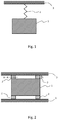
- Figure 1 shows a model of a suspended receiver 1 connected through a suspension 2 to a fixture 3.
- the fixture 3 could be the housing of the hearing assisting device or a structure connected to the housing.
- the suspension 2 is often made from a resilient material such as a rubber or a rubber like material, e.g. a silicone or butyl.
- the suspension 2 is in practice arranged as a number of ridges or fins extending from the receiver 1 to the fixture 3.
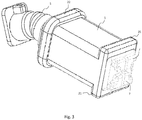
- Figure 2 shows a practical example of the suspension, where the suspension comprises four ridges 2 squeezed between the fixture 3 and the receiver 1.
- the ridges hold on to the receiver by a combination of compression and surface friction.
- the plane A-A illustrates were the cross-sectional area A is measured.
- the area A would then be the total cross-sectional area for the four ridges.
- the upper right ridge it is indicated how the height or length L is measured.
- the area A may be defined as the average cross-sectional area along the height L. This is a preferred measure if the cross sectional area varies along the height L. However, most often the cross sectional area A will be constant or substantially constant along the height L, i.e. when moving from the receiver 1 to the fixture 3.
- the receiver suspension cannot be considered hard mounted. Therefore, several other resonances will be present, and the transfer of vibrations to the microphones of the hearing assistive device may become large enough to cause feedback problems.
- the level of vibrations at the microphones will be sufficiently low to avoid feedback problems at the more common levels of amplification applied in a hearing assistive device.
- a resonance frequency of the receiver in the suspension should be equal to or less than 10 kHz, i.e. f 0 ⁇ 10 kHz.
- the system i.e. the receiver arrangement in a suspension
- the receiver arrangement in a suspension has a resonance frequency above 10 kHz, it will be too stiff to absorb mechanical shocks, i.e. the acceleration or deceleration of the receiver will be too large, and the receiver may be damaged.
- the limit at 10 kHz has been found by testing of receivers commonly used for hearing assisting devices.
- the resonance frequency should be in the range 6 kHz to 10 kHz, i.e. 6 kHz ⁇ f 0 ⁇ 10 kHz.
- these limits on the resonance frequency should apply to vibrations of the receiver in any direction. This can be achieved by placing and shaping the ridges accordingly.
- the suspension should be designed according to the actual receiver to be suspended in order to ensure that the resulting first system resonance frequency is in the range 6 kHz to 10 kHz, or in the range 7.5 kHz to 9.5 kHz. As shown above, especially the mass of the receiver is relevant. Typical mass of a receiver for a hearing aid is in the range 0.05 - 1.0 gram.
- An example of a relatively small dual receiver is Sonion 4400 having dimensions 5.00 x 2.70 x 1.96 mm 3 , and a weight of 0.065 gram.
- An example of a relatively large receiver is Sonion 2000 having the dimensions 9.47 x 7.18 x 4.10 mm 3 , and the weight 0.94 gram. Both receivers are widely used for hearing aids.
- An example could be Silicone, 20 Shore A, having an E-module of 4.81 ⁇ 10 6 N/m 2 .
- Another example could be Butyl, 50 Shore A, having an E-module of 1.64 ⁇ 10 8 N/m 2 .
- the dimensions of the ridges can be adapted to obtain the desired resonance frequency of the system.
- the total cross-sectional area A for the ridges will typically be less than or equal to 140 mm 2 .
- the height or length L of the ridges is often designed to be in the range 0.2 - 2.0 mm. Often the parameters will be selected such that the suspension takes up a minimum amount of space, or preferably, such that the receiver with the suspension, when arranged in the hearing assisting device, takes up a minimum amount of space.
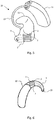
- Figure 3 shows an example of a receiver 1 arranged with receiver suspension ridges 21, 22.
- Figure 3 also illustrates electrical terminals 7 for connecting the receiver 1 to the electronics.
- a sound outlet tubing 5 is illustrated. It is seen that at one end of the receiver two ridges 21 are situated at opposite sides of the receiver. At the other end of the receiver one ridge 22 is arranged to encircle the receiver, i.e. to extend over the four sides of the receiver.
- ridges can be applied, the important parameter being the resonance frequency of the suspension. Placing ridges at both ends (in the longest dimension) of the receiver, does however ensure some stability, and may make correct placement during assembling more certain.
- the receiver is a reduced vibration type receiver.
- reduced vibration type is meant that the level of vibrations is significantly lower than for standard receivers. This can e.g. be achieved by a double receiver, i.e. a dual diaphragm receiver.
- the level of vibration is here measured as the acceleration per output sound pressure in an IEC 711 coupler or ear simulator (IEC referring to an International Electrotechnical Commission standard. The standard may also be referred to as IEC 60 318-4).
- IEC 711 coupler or ear simulator IEC referring to an International Electrotechnical Commission standard. The standard may also be referred to as IEC 60 318-4.
- Such a coupler may be considered as a model ear to be applied as a reference ear and is used for testing of hearing aids and receivers.
- the 711 coupler is considered to have a volume close to the volume seen from the earplug or the hearing aid in an average person's ear canal.
- couplers and ear simulators reference is given to H. Dillon: “Hearing Aids", Boomerang Press, 2001 .
- the level of vibration is measured with the receivers freely suspended, i.e. no limits on their movements.
- the level of vibrations is measured as dB relative to 1 m/s 2 /Pa, and in this context, a reduced vibration type receiver should have the following maximum level of vibrations:
- FIG 4 shows how the receiver 1 with suspension ridges 21, 22 may be arranged inside a housing of a hearing assistive device.
- the receiver 1 has been arranged with suspending ridges at each end in an elongated direction, where the electrical terminals 7 are often arranged at one end and a sound outlet, connected to a tubing 5, is often arranged at the opposite end.
- One ridge 22 is arranged to encircle the receiver, and is here arranged at one end of the elongated receiver.
- two ridges 21, each connected to the receiver on one side are arranged. These two ridges are arranged onto opposing surfaces.
- the ridges may be arranged in any pattern whereby the needed resonance frequency can be achieved. However, ridges will often not be arranged on the surface comprising the electrical terminals 7 or on the surface comprising the sound outlet.
- the suspension i.e. the ridges 21, 22, abuts fixtures 8, 9 in the casing or housing of the hearing assistive device.
- fixtures 8, 9 may be the housing of the device, or it may be elements, which are connected in a non-moveable manner to the housing.
- the different ridges 21, 22 arranged at the receiver may be interconnected by a thin layer of the same material as the ridges is made from, e.g. being integral with the layer.
- This layer together with the ridges may be formed as a sleeve inside which the receiver can be arranged.
- the thin layer should preferably have a thickness of less than 0.2 mm, such as less than 0.1 mm. If the material is resilient or elastic, the sleeve can be manufactured to hold the receiver inside in a fixed position.
- FIG. 5 shows an example of a suspended receiver 1 arranged in the earplug part 12 of a Receiver-In-The-Ear (RITE) hearing aid 10. Suspending ridges 2 holding the receiver 1 are illustrated.
- the receiver is connected to a sound tube 5 inside the earplug part 12.
- the earplug part 12 is connected to a Behind-The-Ear part 11 through an electrical wire 13.
- the hearing assisting device may also be adapted for arrangement completely in the ear canal, or for arrangement partly in the ear canal and partly in the concha part of the ear.
- FIG. 6 shows a Behind-The-Ear (BTE) hearing aid 10, where the receiver 1, suspended by ridges 2, is arranged in the BTE part.
- the receiver is connected to a sound tube 5 guiding the sound to a sound outlet 15 from the BTE part. From this sound outlet 15 the sound is guided by a tubing (not shown) to the ear canal.
- BTE Behind-The-Ear
- Figure 7 shows different examples of how the supporting ridges may be shaped.
- the supporting ridges In pane a) and b) the supporting ridges have a triangular cross-sectional shape. This shape will provide a softer suspension.
- the number of triangular supporting ridges can vary, which is the case for any shape of the supporting ridges.
- pane c) shows supporting ridges having a cross-sectional shape of a half circle.
- Pane d) shows supporting ridges having a square cross-sectional shape. This shape could also be rectangular.
- a square or rectangular shape provides a high stability of the suspension, and a more rigid supporting ridge compared to the triangular and half circle shape, when the same material is applied.
- pane d) shows that the suspension can comprise cubic shaped supporting elements. These are shown to be arranged towards corners of the receiver, but could also be arranged in other positions.
- the supporting elements of pane d) are more like feet, i.e. providing support in a point in comparison to the supporting ridges, which supports along a line. These point like supports, or feet, could have other shapes such as pyramid, half spheres or cone shaped.
- the suspension can also be a massive layer of a resilient or rubber like material covering a major part, or four surfaces of the receiver.
- the thickness and the material E-module is then selected to achieve the first resonance frequency in the range from 6 kHz to 10 kHz.
Landscapes
- Acoustics & Sound (AREA)
- General Health & Medical Sciences (AREA)
- Neurosurgery (AREA)
- Otolaryngology (AREA)
- Physics & Mathematics (AREA)
- Engineering & Computer Science (AREA)
- Health & Medical Sciences (AREA)
- Signal Processing (AREA)
- Apparatuses For Generation Of Mechanical Vibrations (AREA)
- Telephone Set Structure (AREA)
- Piezo-Electric Transducers For Audible Bands (AREA)
- Details Of Audible-Bandwidth Transducers (AREA)
- Obtaining Desirable Characteristics In Audible-Bandwidth Transducers (AREA)
Claims (11)
- Hörhilfevorrichtung, umfassend einen Empfänger (1) zum Erzeugen von akustischen Signalen und eine Befestigung (3) zum Positionieren des Empfängers (1),
wobei eine Aufhängung (2) den Empfänger (1) an der Befestigung (3) hält, dadurch gekennzeichnet, dass die Kombination des Empfängers (1) und der Aufhängung (2) eine erste mechanische Resonanzfrequenz im Bereich von 6 kHz bis 10 kHz aufweist. - Hörhilfevorrichtung nach Anspruch 1, wobei der Empfänger ein Empfänger vom Typ mit verringerter Schwingung, z.B. ein Empfäger ist, der jeweils bei den Frequenzen 1, 3, 6 und 8 kHz eine Schwingungsstufe bei -20, -10, 0 und 10 dB ausgibt, wenn sie in Beziehung zu 1 m/s2/Pa für einen frei aufgehängten Empfänger gemessen wird.
- Hörhilfevorrichtung nach Anspruch 1 oder 2, wobei der Empfänger ein Doppelempfänger, z.B. ein Doppelmembranempfänger ist.
- Hörilfevorrichtung nach Anspruch 1 oder 2, wobei die Aufhängung mindestens vier Trägergrate umfasst.
- Hörhilfevorrichtung nach Anspruch 4, wobei die Querschnittform des Empfängers rechteckig oder annähernd rechteckig ist und wobei die Trägergrate an mindestens zwei unterschiedlichen Oberflächen des Empfängers angeordnet sind.
- Hörhilfevorrichtung nach Anspruch 5, wobei die Grate an gegenüberliegenden Enden des Empfängers angeordnet sind, wobei gegenüberliegende Enden für eine längste Abmessung des Empfängers definiert sind.
- Hörhilfevorrichtung nach Anspruch 4, wobei die Grate an einer Muffe angeordnet sind, die um den Empfänger herum angeordnet ist, wobei die Muffe aus demselben Material wie die Grate gefertigt ist.
- Hörhilfevorrichtung nach Anspruch 1 oder 2, wobei der Empfänger, der in der Aufhängung angeordnet ist, eine Resonanzfrequenz im Bereich 6 kHz bis 10 kHz in einer beliebigen Richtung aufweisen wird.
- Hörhilfevorrichtung nach Anspruch 1 oder 2, wobei die Aufhängung eine mchanische Resonanzfrequenz im Bereich von 6,5 kHz bis 9,5 kHz, vorzugsweise im Bereich von 7,5 kHz bis 9,5 kHz aufweist.
- Hörhilfevorrichtung nach Anspruch 1 oder 2, wobei der Empfänger mit der Aufhängung in einem Teil hinter dem Ohr der Hörhilfevorrichtung angeordnet ist.
- Hörhilfevorrichtung nach Anspruch 1 oder 2, wobei der Empfänger mit der Aufhängung in einem Ohrkanalteil der Hörhilfevorrichtung angeordnet ist.
Applications Claiming Priority (1)
| Application Number | Priority Date | Filing Date | Title |
|---|---|---|---|
| PCT/EP2016/057226 WO2017167395A1 (en) | 2016-04-01 | 2016-04-01 | Receiver suspension for a hearing assisting device |
Publications (2)
| Publication Number | Publication Date |
|---|---|
| EP3437330A1 EP3437330A1 (de) | 2019-02-06 |
| EP3437330B1 true EP3437330B1 (de) | 2021-06-09 |
Family
ID=55646603
Family Applications (1)
| Application Number | Title | Priority Date | Filing Date |
|---|---|---|---|
| EP16713458.4A Active EP3437330B1 (de) | 2016-04-01 | 2016-04-01 | Aufhängung eines hörers in einem hörgerät |
Country Status (5)
| Country | Link |
|---|---|
| US (1) | US11082777B2 (de) |
| EP (1) | EP3437330B1 (de) |
| CN (1) | CN108886662B (de) |
| DK (1) | DK3437330T3 (de) |
| WO (1) | WO2017167395A1 (de) |
Families Citing this family (6)
| Publication number | Priority date | Publication date | Assignee | Title |
|---|---|---|---|---|
| DE102021206009B4 (de) * | 2021-06-14 | 2024-08-08 | Sivantos Pte. Ltd. | Hörvorrichtung |
| EP4156708B1 (de) * | 2021-09-24 | 2026-03-04 | GN Hearing A/S | Aufhängung eines hörers eines hörgeräts |
| US12238482B2 (en) | 2021-09-24 | 2025-02-25 | Gn Hearing A/S | Suspension of a receiver of a hearing device |
| DK181516B1 (en) * | 2022-04-27 | 2024-03-22 | Gn Hearing As | Hearing device with a suspended microphone |
| DE102023202591B4 (de) * | 2023-03-22 | 2025-01-09 | Sivantos Pte. Ltd. | Lautsprechersystem für eine im Ohr zu tragende Hörvorrichtung |
| EP4557762A1 (de) * | 2023-11-16 | 2025-05-21 | GN Hearing A/S | Hörgerät mit festmontiertem empfänger |
Citations (12)
| Publication number | Priority date | Publication date | Assignee | Title |
|---|---|---|---|---|
| US3030455A (en) | 1958-12-08 | 1962-04-17 | Harry A Pearson | Bone-conduction all-in-one transistor amplifier hearing aid |
| US3197576A (en) | 1964-04-02 | 1965-07-27 | Dahlberg Electronics | In-the-ear hearing aid |
| US4706778A (en) | 1985-11-15 | 1987-11-17 | Topholm & Westermann Aps | In-the-ear-canal hearing aid |
| WO2004049757A1 (en) | 2002-11-22 | 2004-06-10 | Knowles Electronics, Llc | An apparatus for energy transfer in a balanced receiver assembly and manufacturing method thereof |
| US20080112584A1 (en) | 2006-11-09 | 2008-05-15 | Phonak Ag | Support mount for electronic components |
| US20090074220A1 (en) | 2007-08-14 | 2009-03-19 | Insound Medical, Inc. | Combined microphone and receiver assembly for extended wear canal hearing devices |
| US20120083860A1 (en) | 2009-03-24 | 2012-04-05 | Osseofon Ab | Bone conduction transducer with improved high frequency response |
| US20130163791A1 (en) | 2011-12-23 | 2013-06-27 | Xin Qi | Bone conduction speaker and compound vibration device thereof |
| EP2750413A1 (de) | 2012-12-28 | 2014-07-02 | Sonion Nederland B.V. | Hörgerät |
| US20140305735A1 (en) | 2011-03-21 | 2014-10-16 | Sonion Nederland B.V. | Moving armature receiver assemblies with vibration suppression |
| US8983096B2 (en) | 2012-09-10 | 2015-03-17 | Apple Inc. | Bone-conduction pickup transducer for microphonic applications |
| EP2559264B1 (de) | 2010-04-14 | 2015-05-27 | GN ReSound A/S | Hörgerät mit schallschlauch |
Family Cites Families (7)
| Publication number | Priority date | Publication date | Assignee | Title |
|---|---|---|---|---|
| EP1248496A3 (de) | 2001-04-04 | 2005-11-02 | Sonionmicrotronic Nederland B.V. | Akustischer Empfänger mit verbesserter mechanischer Aufhängung |
| US7460680B2 (en) * | 2003-06-30 | 2008-12-02 | Siemens Hearing Instruments, Inc. | Feedback reducing receiver mount and assembly |
| CA2555157C (en) * | 2004-03-03 | 2010-04-27 | Widex A/S | Hearing aid comprising adaptive feedback suppression system |
| US20070036378A1 (en) * | 2005-07-15 | 2007-02-15 | Knowles Electronics, Llc | Shock resistant and vibration isolated electroacoustical transducer assembly |
| US8331595B2 (en) * | 2008-06-11 | 2012-12-11 | Sonion Nederland Bv | Hearing instrument with improved venting and miniature loudspeaker therefore |
| DE102011007848A1 (de) | 2011-04-21 | 2012-10-25 | Siemens Medical Instruments Pte. Ltd. | Reduktion von akustischen Rückkopplungen durch vibrationstechnische Verkürzung des Hörgeräts |
| EP2753102A1 (de) * | 2013-01-07 | 2014-07-09 | Oticon A/s | Hörgerät mit einer im Ohr tragbaren Komponente |
-
2016
- 2016-04-01 EP EP16713458.4A patent/EP3437330B1/de active Active
- 2016-04-01 DK DK16713458.4T patent/DK3437330T3/da active
- 2016-04-01 CN CN201680084029.XA patent/CN108886662B/zh active Active
- 2016-04-01 WO PCT/EP2016/057226 patent/WO2017167395A1/en not_active Ceased
- 2016-04-01 US US16/089,759 patent/US11082777B2/en active Active
Patent Citations (12)
| Publication number | Priority date | Publication date | Assignee | Title |
|---|---|---|---|---|
| US3030455A (en) | 1958-12-08 | 1962-04-17 | Harry A Pearson | Bone-conduction all-in-one transistor amplifier hearing aid |
| US3197576A (en) | 1964-04-02 | 1965-07-27 | Dahlberg Electronics | In-the-ear hearing aid |
| US4706778A (en) | 1985-11-15 | 1987-11-17 | Topholm & Westermann Aps | In-the-ear-canal hearing aid |
| WO2004049757A1 (en) | 2002-11-22 | 2004-06-10 | Knowles Electronics, Llc | An apparatus for energy transfer in a balanced receiver assembly and manufacturing method thereof |
| US20080112584A1 (en) | 2006-11-09 | 2008-05-15 | Phonak Ag | Support mount for electronic components |
| US20090074220A1 (en) | 2007-08-14 | 2009-03-19 | Insound Medical, Inc. | Combined microphone and receiver assembly for extended wear canal hearing devices |
| US20120083860A1 (en) | 2009-03-24 | 2012-04-05 | Osseofon Ab | Bone conduction transducer with improved high frequency response |
| EP2559264B1 (de) | 2010-04-14 | 2015-05-27 | GN ReSound A/S | Hörgerät mit schallschlauch |
| US20140305735A1 (en) | 2011-03-21 | 2014-10-16 | Sonion Nederland B.V. | Moving armature receiver assemblies with vibration suppression |
| US20130163791A1 (en) | 2011-12-23 | 2013-06-27 | Xin Qi | Bone conduction speaker and compound vibration device thereof |
| US8983096B2 (en) | 2012-09-10 | 2015-03-17 | Apple Inc. | Bone-conduction pickup transducer for microphonic applications |
| EP2750413A1 (de) | 2012-12-28 | 2014-07-02 | Sonion Nederland B.V. | Hörgerät |
Also Published As
| Publication number | Publication date |
|---|---|
| WO2017167395A1 (en) | 2017-10-05 |
| US11082777B2 (en) | 2021-08-03 |
| EP3437330A1 (de) | 2019-02-06 |
| DK3437330T3 (da) | 2021-07-05 |
| US20200314563A1 (en) | 2020-10-01 |
| CN108886662B (zh) | 2021-07-06 |
| CN108886662A (zh) | 2018-11-23 |
Similar Documents
| Publication | Publication Date | Title |
|---|---|---|
| EP3437330B1 (de) | Aufhängung eines hörers in einem hörgerät | |
| US12279102B2 (en) | Audio transducers | |
| US20190230449A1 (en) | High fidelity and reduced feedback contact hearing apparatus and methods | |
| EP3994734A1 (de) | Piezoelektrischer wandler für trommelfell | |
| JP7805415B2 (ja) | オーディオトランスデューサに関するシステム、方法、およびデバイス | |
| US9807520B2 (en) | Acoustic device and method of using the same | |
| MXPA06002815A (es) | Aparato de audio. | |
| EP3337191A1 (de) | Empfängeranordnung | |
| CN217985354U (zh) | 换能装置及耳机 | |
| WO2024021380A1 (zh) | 换能装置、扬声器和声学输出装置 | |
| CN117041793A (zh) | 一种耳机 | |
| EP2991377B1 (de) | Akustische vorrichtung | |
| CN204948349U (zh) | 压电电声换能器 | |
| CN106358130A (zh) | 压电电声换能器 | |
| US12317045B2 (en) | Balanced armature receiver having improved frequency response | |
| CN202713596U (zh) | 骨传导扬声器 | |
| EP4543044A1 (de) | Akustisches element, akustische vorrichtung und herstellungsverfahren für ein akustisches element | |
| CN205595998U (zh) | 用于声学装置的电机、接收器及音频设备 | |
| CN222531830U (zh) | 用于需要佩戴在耳中的听力装置的扬声器系统 | |
| CN207505102U (zh) | 耳挂及应用该耳挂的耳机 | |
| JP4701054B2 (ja) | 圧電発音体 | |
| KR102250272B1 (ko) | 인체 이식형 보청기 제조방법 | |
| CN218830549U (zh) | 耳机及其换能装置 | |
| JPS5931093Y2 (ja) | 骨導型受話器 | |
| WO2013009962A2 (en) | W dome speaker |
Legal Events
| Date | Code | Title | Description |
|---|---|---|---|
| STAA | Information on the status of an ep patent application or granted ep patent |
Free format text: STATUS: UNKNOWN |
|
| STAA | Information on the status of an ep patent application or granted ep patent |
Free format text: STATUS: THE INTERNATIONAL PUBLICATION HAS BEEN MADE |
|
| PUAI | Public reference made under article 153(3) epc to a published international application that has entered the european phase |
Free format text: ORIGINAL CODE: 0009012 |
|
| STAA | Information on the status of an ep patent application or granted ep patent |
Free format text: STATUS: REQUEST FOR EXAMINATION WAS MADE |
|
| 17P | Request for examination filed |
Effective date: 20181102 |
|
| AK | Designated contracting states |
Kind code of ref document: A1 Designated state(s): AL AT BE BG CH CY CZ DE DK EE ES FI FR GB GR HR HU IE IS IT LI LT LU LV MC MK MT NL NO PL PT RO RS SE SI SK SM TR |
|
| AX | Request for extension of the european patent |
Extension state: BA ME |
|
| DAV | Request for validation of the european patent (deleted) | ||
| DAX | Request for extension of the european patent (deleted) | ||
| STAA | Information on the status of an ep patent application or granted ep patent |
Free format text: STATUS: EXAMINATION IS IN PROGRESS |
|
| 17Q | First examination report despatched |
Effective date: 20200211 |
|
| GRAJ | Information related to disapproval of communication of intention to grant by the applicant or resumption of examination proceedings by the epo deleted |
Free format text: ORIGINAL CODE: EPIDOSDIGR1 |
|
| GRAP | Despatch of communication of intention to grant a patent |
Free format text: ORIGINAL CODE: EPIDOSNIGR1 |
|
| INTG | Intention to grant announced |
Effective date: 20210118 |
|
| GRAP | Despatch of communication of intention to grant a patent |
Free format text: ORIGINAL CODE: EPIDOSNIGR1 |
|
| STAA | Information on the status of an ep patent application or granted ep patent |
Free format text: STATUS: GRANT OF PATENT IS INTENDED |
|
| INTC | Intention to grant announced (deleted) | ||
| INTG | Intention to grant announced |
Effective date: 20210204 |
|
| GRAS | Grant fee paid |
Free format text: ORIGINAL CODE: EPIDOSNIGR3 |
|
| INTG | Intention to grant announced |
Effective date: 20210204 |
|
| GRAA | (expected) grant |
Free format text: ORIGINAL CODE: 0009210 |
|
| STAA | Information on the status of an ep patent application or granted ep patent |
Free format text: STATUS: THE PATENT HAS BEEN GRANTED |
|
| AK | Designated contracting states |
Kind code of ref document: B1 Designated state(s): AL AT BE BG CH CY CZ DE DK EE ES FI FR GB GR HR HU IE IS IT LI LT LU LV MC MK MT NL NO PL PT RO RS SE SI SK SM TR |
|
| REG | Reference to a national code |
Ref country code: GB Ref legal event code: FG4D |
|
| REG | Reference to a national code |
Ref country code: CH Ref legal event code: EP Ref country code: AT Ref legal event code: REF Ref document number: 1401454 Country of ref document: AT Kind code of ref document: T Effective date: 20210615 |
|
| REG | Reference to a national code |
Ref country code: DE Ref legal event code: R096 Ref document number: 602016059087 Country of ref document: DE |
|
| REG | Reference to a national code |
Ref country code: DK Ref legal event code: T3 Effective date: 20210629 |
|
| REG | Reference to a national code |
Ref country code: IE Ref legal event code: FG4D |
|
| REG | Reference to a national code |
Ref country code: LT Ref legal event code: MG9D |
|
| PG25 | Lapsed in a contracting state [announced via postgrant information from national office to epo] |
Ref country code: HR Free format text: LAPSE BECAUSE OF FAILURE TO SUBMIT A TRANSLATION OF THE DESCRIPTION OR TO PAY THE FEE WITHIN THE PRESCRIBED TIME-LIMIT Effective date: 20210609 Ref country code: BG Free format text: LAPSE BECAUSE OF FAILURE TO SUBMIT A TRANSLATION OF THE DESCRIPTION OR TO PAY THE FEE WITHIN THE PRESCRIBED TIME-LIMIT Effective date: 20210909 Ref country code: FI Free format text: LAPSE BECAUSE OF FAILURE TO SUBMIT A TRANSLATION OF THE DESCRIPTION OR TO PAY THE FEE WITHIN THE PRESCRIBED TIME-LIMIT Effective date: 20210609 Ref country code: LT Free format text: LAPSE BECAUSE OF FAILURE TO SUBMIT A TRANSLATION OF THE DESCRIPTION OR TO PAY THE FEE WITHIN THE PRESCRIBED TIME-LIMIT Effective date: 20210609 |
|
| REG | Reference to a national code |
Ref country code: AT Ref legal event code: MK05 Ref document number: 1401454 Country of ref document: AT Kind code of ref document: T Effective date: 20210609 |
|
| REG | Reference to a national code |
Ref country code: NL Ref legal event code: MP Effective date: 20210609 |
|
| PG25 | Lapsed in a contracting state [announced via postgrant information from national office to epo] |
Ref country code: NO Free format text: LAPSE BECAUSE OF FAILURE TO SUBMIT A TRANSLATION OF THE DESCRIPTION OR TO PAY THE FEE WITHIN THE PRESCRIBED TIME-LIMIT Effective date: 20210909 Ref country code: SE Free format text: LAPSE BECAUSE OF FAILURE TO SUBMIT A TRANSLATION OF THE DESCRIPTION OR TO PAY THE FEE WITHIN THE PRESCRIBED TIME-LIMIT Effective date: 20210609 Ref country code: RS Free format text: LAPSE BECAUSE OF FAILURE TO SUBMIT A TRANSLATION OF THE DESCRIPTION OR TO PAY THE FEE WITHIN THE PRESCRIBED TIME-LIMIT Effective date: 20210609 Ref country code: GR Free format text: LAPSE BECAUSE OF FAILURE TO SUBMIT A TRANSLATION OF THE DESCRIPTION OR TO PAY THE FEE WITHIN THE PRESCRIBED TIME-LIMIT Effective date: 20210910 Ref country code: LV Free format text: LAPSE BECAUSE OF FAILURE TO SUBMIT A TRANSLATION OF THE DESCRIPTION OR TO PAY THE FEE WITHIN THE PRESCRIBED TIME-LIMIT Effective date: 20210609 |
|
| PG25 | Lapsed in a contracting state [announced via postgrant information from national office to epo] |
Ref country code: AT Free format text: LAPSE BECAUSE OF FAILURE TO SUBMIT A TRANSLATION OF THE DESCRIPTION OR TO PAY THE FEE WITHIN THE PRESCRIBED TIME-LIMIT Effective date: 20210609 Ref country code: ES Free format text: LAPSE BECAUSE OF FAILURE TO SUBMIT A TRANSLATION OF THE DESCRIPTION OR TO PAY THE FEE WITHIN THE PRESCRIBED TIME-LIMIT Effective date: 20210609 Ref country code: RO Free format text: LAPSE BECAUSE OF FAILURE TO SUBMIT A TRANSLATION OF THE DESCRIPTION OR TO PAY THE FEE WITHIN THE PRESCRIBED TIME-LIMIT Effective date: 20210609 Ref country code: NL Free format text: LAPSE BECAUSE OF FAILURE TO SUBMIT A TRANSLATION OF THE DESCRIPTION OR TO PAY THE FEE WITHIN THE PRESCRIBED TIME-LIMIT Effective date: 20210609 Ref country code: PT Free format text: LAPSE BECAUSE OF FAILURE TO SUBMIT A TRANSLATION OF THE DESCRIPTION OR TO PAY THE FEE WITHIN THE PRESCRIBED TIME-LIMIT Effective date: 20211011 Ref country code: SM Free format text: LAPSE BECAUSE OF FAILURE TO SUBMIT A TRANSLATION OF THE DESCRIPTION OR TO PAY THE FEE WITHIN THE PRESCRIBED TIME-LIMIT Effective date: 20210609 Ref country code: SK Free format text: LAPSE BECAUSE OF FAILURE TO SUBMIT A TRANSLATION OF THE DESCRIPTION OR TO PAY THE FEE WITHIN THE PRESCRIBED TIME-LIMIT Effective date: 20210609 Ref country code: CZ Free format text: LAPSE BECAUSE OF FAILURE TO SUBMIT A TRANSLATION OF THE DESCRIPTION OR TO PAY THE FEE WITHIN THE PRESCRIBED TIME-LIMIT Effective date: 20210609 Ref country code: EE Free format text: LAPSE BECAUSE OF FAILURE TO SUBMIT A TRANSLATION OF THE DESCRIPTION OR TO PAY THE FEE WITHIN THE PRESCRIBED TIME-LIMIT Effective date: 20210609 |
|
| PG25 | Lapsed in a contracting state [announced via postgrant information from national office to epo] |
Ref country code: PL Free format text: LAPSE BECAUSE OF FAILURE TO SUBMIT A TRANSLATION OF THE DESCRIPTION OR TO PAY THE FEE WITHIN THE PRESCRIBED TIME-LIMIT Effective date: 20210609 |
|
| REG | Reference to a national code |
Ref country code: DE Ref legal event code: R026 Ref document number: 602016059087 Country of ref document: DE |
|
| PLBI | Opposition filed |
Free format text: ORIGINAL CODE: 0009260 |
|
| PLAX | Notice of opposition and request to file observation + time limit sent |
Free format text: ORIGINAL CODE: EPIDOSNOBS2 |
|
| 26 | Opposition filed |
Opponent name: GN HEARING A/S Effective date: 20220309 |
|
| PG25 | Lapsed in a contracting state [announced via postgrant information from national office to epo] |
Ref country code: AL Free format text: LAPSE BECAUSE OF FAILURE TO SUBMIT A TRANSLATION OF THE DESCRIPTION OR TO PAY THE FEE WITHIN THE PRESCRIBED TIME-LIMIT Effective date: 20210609 |
|
| PLBB | Reply of patent proprietor to notice(s) of opposition received |
Free format text: ORIGINAL CODE: EPIDOSNOBS3 |
|
| PG25 | Lapsed in a contracting state [announced via postgrant information from national office to epo] |
Ref country code: IT Free format text: LAPSE BECAUSE OF FAILURE TO SUBMIT A TRANSLATION OF THE DESCRIPTION OR TO PAY THE FEE WITHIN THE PRESCRIBED TIME-LIMIT Effective date: 20210609 |
|
| GBPC | Gb: european patent ceased through non-payment of renewal fee |
Effective date: 20220401 |
|
| REG | Reference to a national code |
Ref country code: BE Ref legal event code: MM Effective date: 20220430 |
|
| PG25 | Lapsed in a contracting state [announced via postgrant information from national office to epo] |
Ref country code: MC Free format text: LAPSE BECAUSE OF FAILURE TO SUBMIT A TRANSLATION OF THE DESCRIPTION OR TO PAY THE FEE WITHIN THE PRESCRIBED TIME-LIMIT Effective date: 20210609 Ref country code: LU Free format text: LAPSE BECAUSE OF NON-PAYMENT OF DUE FEES Effective date: 20220401 Ref country code: GB Free format text: LAPSE BECAUSE OF NON-PAYMENT OF DUE FEES Effective date: 20220401 Ref country code: FR Free format text: LAPSE BECAUSE OF NON-PAYMENT OF DUE FEES Effective date: 20220430 |
|
| PG25 | Lapsed in a contracting state [announced via postgrant information from national office to epo] |
Ref country code: BE Free format text: LAPSE BECAUSE OF NON-PAYMENT OF DUE FEES Effective date: 20220430 |
|
| PG25 | Lapsed in a contracting state [announced via postgrant information from national office to epo] |
Ref country code: IE Free format text: LAPSE BECAUSE OF NON-PAYMENT OF DUE FEES Effective date: 20220401 |
|
| RAP2 | Party data changed (patent owner data changed or rights of a patent transferred) |
Owner name: WIDEX A/S |
|
| PG25 | Lapsed in a contracting state [announced via postgrant information from national office to epo] |
Ref country code: HU Free format text: LAPSE BECAUSE OF FAILURE TO SUBMIT A TRANSLATION OF THE DESCRIPTION OR TO PAY THE FEE WITHIN THE PRESCRIBED TIME-LIMIT; INVALID AB INITIO Effective date: 20160401 |
|
| PG25 | Lapsed in a contracting state [announced via postgrant information from national office to epo] |
Ref country code: MK Free format text: LAPSE BECAUSE OF FAILURE TO SUBMIT A TRANSLATION OF THE DESCRIPTION OR TO PAY THE FEE WITHIN THE PRESCRIBED TIME-LIMIT Effective date: 20210609 Ref country code: CY Free format text: LAPSE BECAUSE OF FAILURE TO SUBMIT A TRANSLATION OF THE DESCRIPTION OR TO PAY THE FEE WITHIN THE PRESCRIBED TIME-LIMIT Effective date: 20210609 |
|
| PLCK | Communication despatched that opposition was rejected |
Free format text: ORIGINAL CODE: EPIDOSNREJ1 |
|
| REG | Reference to a national code |
Ref country code: DE Ref legal event code: R100 Ref document number: 602016059087 Country of ref document: DE |
|
| PG25 | Lapsed in a contracting state [announced via postgrant information from national office to epo] |
Ref country code: TR Free format text: LAPSE BECAUSE OF FAILURE TO SUBMIT A TRANSLATION OF THE DESCRIPTION OR TO PAY THE FEE WITHIN THE PRESCRIBED TIME-LIMIT Effective date: 20210609 |
|
| PLBN | Opposition rejected |
Free format text: ORIGINAL CODE: 0009273 |
|
| STAA | Information on the status of an ep patent application or granted ep patent |
Free format text: STATUS: OPPOSITION REJECTED |
|
| PG25 | Lapsed in a contracting state [announced via postgrant information from national office to epo] |
Ref country code: MT Free format text: LAPSE BECAUSE OF FAILURE TO SUBMIT A TRANSLATION OF THE DESCRIPTION OR TO PAY THE FEE WITHIN THE PRESCRIBED TIME-LIMIT Effective date: 20210609 |
|
| 27O | Opposition rejected |
Effective date: 20240603 |
|
| PGFP | Annual fee paid to national office [announced via postgrant information from national office to epo] |
Ref country code: DE Payment date: 20250319 Year of fee payment: 10 |
|
| PGFP | Annual fee paid to national office [announced via postgrant information from national office to epo] |
Ref country code: CH Payment date: 20250501 Year of fee payment: 10 |
|
| PGFP | Annual fee paid to national office [announced via postgrant information from national office to epo] |
Ref country code: DK Payment date: 20260319 Year of fee payment: 11 |