EP3437366B1 - Filtrage d'information de mobilité contrôlé par le réseau - Google Patents
Filtrage d'information de mobilité contrôlé par le réseau Download PDFInfo
- Publication number
- EP3437366B1 EP3437366B1 EP16715742.9A EP16715742A EP3437366B1 EP 3437366 B1 EP3437366 B1 EP 3437366B1 EP 16715742 A EP16715742 A EP 16715742A EP 3437366 B1 EP3437366 B1 EP 3437366B1
- Authority
- EP
- European Patent Office
- Prior art keywords
- mobility
- cell
- filtering criteria
- network
- cells
- Prior art date
- Legal status (The legal status is an assumption and is not a legal conclusion. Google has not performed a legal analysis and makes no representation as to the accuracy of the status listed.)
- Not-in-force
Links
Images



Classifications
-
- H—ELECTRICITY
- H04—ELECTRIC COMMUNICATION TECHNIQUE
- H04W—WIRELESS COMMUNICATION NETWORKS
- H04W24/00—Supervisory, monitoring or testing arrangements
- H04W24/02—Arrangements for optimising operational condition
-
- H—ELECTRICITY
- H04—ELECTRIC COMMUNICATION TECHNIQUE
- H04W—WIRELESS COMMUNICATION NETWORKS
- H04W24/00—Supervisory, monitoring or testing arrangements
- H04W24/10—Scheduling measurement reports ; Arrangements for measurement reports
-
- H—ELECTRICITY
- H04—ELECTRIC COMMUNICATION TECHNIQUE
- H04W—WIRELESS COMMUNICATION NETWORKS
- H04W36/00—Hand-off or reselection arrangements
- H04W36/0005—Control or signalling for completing the hand-off
- H04W36/0055—Transmission or use of information for re-establishing the radio link
- H04W36/0061—Transmission or use of information for re-establishing the radio link of neighbour cell information
-
- H—ELECTRICITY
- H04—ELECTRIC COMMUNICATION TECHNIQUE
- H04W—WIRELESS COMMUNICATION NETWORKS
- H04W36/00—Hand-off or reselection arrangements
- H04W36/04—Reselecting a cell layer in multi-layered cells
-
- H—ELECTRICITY
- H04—ELECTRIC COMMUNICATION TECHNIQUE
- H04W—WIRELESS COMMUNICATION NETWORKS
- H04W36/00—Hand-off or reselection arrangements
- H04W36/0005—Control or signalling for completing the hand-off
- H04W36/0083—Determination of parameters used for hand-off, e.g. generation or modification of neighbour cell lists
- H04W36/00835—Determination of neighbour cell lists
Definitions
- embodiments of the invention relate to mobile telecommunications and, more particularly, methods, apparatus, computer program products and the like for network-controlled filtering of cell mobility information measured and reported by User Equipment (UE) and subsequently used by the network in making handover decisions.
- UE User Equipment
- Kinetic networks are a developing concept in the wireless network realm that relies on moving cells, in which the moving cell involves base station-type transmissions from mobile devices of different types, which act as base stations either on a permanent or temporary basis.
- One type of moving cell is a conventional base station that is equipped with wireless backhaul (e.g., via separate Radio Access Technology (RAT)) and, therefore, can be movable or moving (e.g., a conventional base station with wireless backhaul affixed to a moving transportation means).
- RAT Radio Access Technology
- UE User Equipment
- the mobility characteristics of the moving/mobile cell should be taken into account in order to ensure that the UE is utilizing a moving/mobile cell that has similar mobility characteristics as the UE.
- An example of such operation is described in WO 2015082252 .
- GB 2472792 relates to a mobile telephone that obtains and reports neighbor cell capability information in response to a request from a serving base station. The reported neighbor cell capability information is used by the serving base station to control handover decisions and load balancing.
- Embodiments address the above needs and/or achieve other advantages by providing apparatus, systems, computer program products, methods or the like for network-controlled filtering of cell reporting conducted by UEs in a moving/mobile cell environment.
- the present invention provides for the network to instruct currently-connected UEs to only report neighboring cells that meet (or exceed) network-defined mobility filtering criteria (i.e ., filtering parameters/thresholds or the like).
- network-defined mobility filtering criteria i.e ., filtering parameters/thresholds or the like.
- Other non-mobility filtering criteria may also be defined by the network, e.g., criteria related to signal strength and/or quality of signal.
- the UEs will apply the mobility filtering criteria to at least the mobility data associated with neighboring cells to determine which of the neighboring cells meet or exceed the mobility filtering criteria.
- the UEs will additionally apply the non-mobility filtering criteria to other reported data associated with neighboring cells to determine which of the neighboring cells meet or exceed both the mobility and the non-mobility filtering criteria.
- the UEs communicate a detected cell report back to the network, which, according to specific embodiments of the invention, may be limited to identification of the neighboring cells that meet or exceed the mobility filtering criteria or the mobility and non-mobility filtering criteria (i.e., the detected cell report may not contain any of the actual mobility data or non-mobility data from the neighboring cells).
- the network-defined mobility filtering criteria may be absolute mobility criteria that is independent of the mobility of the UE and/or the network-defined mobility filtering criteria may be relative mobility criteria that is dependent upon the mobility characteristics of the UE.
- the UE applies the mobility filtering criteria to the mobility data associated with neighboring cells in conjunction with the UE's own mobility characteristics to determine which of the neighboring cells meet or exceed the mobility filtering criteria.
- a process is provided for ensuring that UEs are connected to, or otherwise handed over to, cells that meet or exceed network-defined mobility criteria, which according to the criteria may equate to cells that have mobility characteristics similar to the UE.
- the present invention provides for limiting the amount of information that is required to be reported back to the network, i.e., the detected cell report may, in certain embodiments, be limited to only identifying those neighboring cells that meet or exceed the mobility filtering criteria or the mobility filtering criteria and the non-mobility filtering criteria.
- control signalling is limited and it is allowed for the reporting to occur absent modification to the existing uplink UE measurement reporting scheme.
- a method for network-controlled filtering of detected cell reporting defines first embodiments.
- the method includes receiving, at a UE, a network-based request to report detectable neighboring cells, which includes mobility filtering criteria (otherwise referred to as filtering parameters or thresholds).
- the method further includes receiving, at the UE, cell mobility data associated with one or more neighboring cells and determining, at the UE, which of the one or more neighboring cells meets or exceeds the mobility filtering criteria based at least on application of the cell mobility data to the mobility filtering.
- the method includes, in response to determining that at least one neighboring cell meets or exceeds the mobility filtering criteria, communicating, to the network, a detected cell report that identifies the at least one neighboring cell that has been determined to meet or exceed the mobility filtering criteria.
- receiving the request to report detectable neighboring cells may further include receiving, at a UE, a network-based request to report detectable neighboring cells, which includes non-mobility filtering criteria.
- receiving cell mobility data may further include receiving, at the UE, other non-mobility cell data from the neighboring cells and determining may further include determining, at the UE, which of the one or more neighboring cells meets or exceeds the mobility filtering criteria and the non-mobility filtering criteria based at least on application of the cell mobility data to the mobility filtering criteria and the non-mobility cell data to the non-mobility filtering criteria.
- communicating the detected cell report may further include communicating, to the network, the detected cell report that identifies the at least one neighboring cell that has been determined to meet or exceed the mobility filtering criteria and meet or exceed the non-mobility filtering criteria.
- the detected cell report is limited to only identifying the at least one neighboring cell that has been determined to meet or exceed the mobility filtering criteria and, in some embodiments, the mobility filtering criteria and the non-mobility filtering criteria, while in other embodiments the detected cell report may additionally include cell mobility data and/or other cell data from the at least one neighboring cell that meets or exceeds the mobility filtering criteria and, in some embodiments, the mobility filtering criteria and the non-mobility filtering criteria.
- the detected cell report is devoid of any identification or cell data of neighboring cells that do need meet or exceed the mobility filtering criteria.
- the mobility filtering criteria includes one or more of absolute mobility filtering criteria, which is independent of the mobility characteristics of the UE and relative mobility filtering criteria, which is dependent upon the mobility characteristics of the UE.
- the absolute mobility filtering criteria may include, but is not limited to, one or more of ( i ) cells with a velocity below a predetermined threshold, ( ii ) cells moving at a predetermined direction, ( iii ) cells within a predetermined angle of velocity, or ( iv ) cells with a velocity of zero.
- the relative mobility filtering criteria may include, but is not limited to, one or more of ( i ) cells with a velocity within a threshold range of a velocity of the UE, ( ii ) cells moving in a direction within a threshold range of a direction of the UE, and ( iii ) cells having an angle of velocity within a threshold range of an angle of velocity of the UE.
- the method further includes determining or receiving, at the UE, UE mobility data and determining which of the one or more neighboring mobile cells meets or exceeds the mobility filtering criteria further includes determining, at the UE, which of the one or more neighboring mobile cells meets or exceeds the mobility filtering criteria based applying the mobile cell mobility data, in combination with the UE mobility data to the mobility filtering criteria.
- receiving the mobile cell mobility data further includes receiving a mobility vector from the one or more neighboring cells.
- the mobility vector identifies one or more of a current direction of movement of the cell, a current velocity of the cell, an average velocity of the cell and a current angle of velocity.
- receiving the network-based request to report detectable neighboring cells occurs in response to the UE reporting, to the network, an event that triggers the network to request reporting of detectable neighboring cells .
- the triggering event comprises a signal quality of a current serving cell being detected as below a predetermined signal quality threshold.
- the network-based request to report detectable neighboring cells is included within a Radio Resource Control (RRC) reconfiguration signal.
- RRC Radio Resource Control
- the RRC reconfiguration signal may be configured to include an eNodeB signaled field in the reporting configurations that includes the mobility filtering criteria.
- the method may include, in response to communicating the detected cell report, receiving, at the UE, a handover command from the network that specifies handover to one of the one or more neighboring mobile cells meets or exceeds the mobility filtering criteria and, in some embodiments, meets or exceeds the mobility filtering criteria and the non-mobility filtering criteria.
- a UE device for filtering detected cell reporting based on network-defined cell mobility filtering criteria defines second embodiments.
- the device includes a computing platform including a memory and a processor in communication with the memory.
- the device further includes a detected cell reporting and filtering module that is stored in the memory and executable by the processor.
- the detected cell reporting and filtering module is configured to receive a request to report detectable neighboring cells, which includes mobility filtering criteria.
- the module is further configured to receive cell mobility data associated with one or more neighboring cells and, based at least on the cell mobility data, determine which of the one or more neighboring cells meets or exceeds the mobility filtering criteria.
- the module is configured to, in response to determining that at least one neighboring cell meets or exceeds the mobility filtering criteria, communicate, to the network, a detected cell report that identifies the at least one neighboring cell that has been determined to meet or exceed the mobility filtering criteria.
- the module is configured to receive the request to report detectable neighboring cells which additionally includes non-mobility filtering criteria.
- the module is further configured to receive other non-mobility cell data from the neighboring cells and determine which of the one or more neighboring cells meets or exceeds the mobility filtering criteria and the non-mobility filtering criteria based at least on application of the cell mobility data to the mobility filtering criteria and the non-mobility cell data to the non-mobility filtering criteria.
- the module is further configured to communicate the detected cell report that identifies the at least one neighboring cell that has been determined to meet or exceed the mobility filtering criteria and meet or exceed the non-mobility filtering criteria.
- the detected cell report includes only the identification of the at least one neighboring cell that has been determined to meet or exceed the mobility filtering criteria and, in some embodiments, the mobility filtering criteria and the non-mobility filtering criteria, while in other embodiments of the device, the detected cell report additionally includes cell mobility data and/or other cell data from the at least one neighboring cell that has been determined to meet or exceed the mobility filtering criteria and, in some embodiments, the mobility filtering criteria and the non-mobility filtering criteria.
- the mobility filtering criteria includes at least one of absolute mobility filtering criteria independent of mobility of the UE and relative mobility filtering criteria dependent upon the mobility of the UE.
- the absolute mobility filtering criteria may include, but is not limited to, one or more of ( i ) cells with a velocity below a predetermined threshold, ( ii ) cells moving at a predetermined direction, ( iii ) cells within a predetermined angle of velocity, or ( iv ) cells with a velocity of zero.
- the dependent mobility filtering criteria may include but is not limited to, one or more of ( i ) cells with a velocity within a threshold range of a velocity of the UE, ( ii ) cells moving in a direction within a threshold range of a direction of the UE, and ( iii ) cells having an angle of velocity within a threshold range of an angle of velocity of the UE.
- the detected cell reporting and filtering module is further configured to determine or receive UE mobility data and determine which of the one or more neighboring mobile cells meets or exceeds the mobility filtering criteria based at least on the mobile cell mobility data and the UE mobility data.
- systems, apparatus, methods, and computer program products herein described in detail below provide for network-controlled filtering of detected cell reporting conducted by UEs in a moving/mobile cell environment.
- the network instructs currently-connected UEs to only report neighboring cells that meet network-defined mobility filtering criteria (i.e., filtering parameters/thresholds or the like) and, in some embodiments mobility and non-mobility filtering criteria.
- network-defined mobility filtering criteria i.e., filtering parameters/thresholds or the like
- mobility and non-mobility filtering criteria In response to receiving such instructions from the network, the UEs apply the mobility filtering criteria and, in some embodiments, additional non-mobility filtering criteria to at least the data associated with neighboring cells to determine which of the neighboring cells meet or exceed the mobility filtering criteria and, in some embodiments additional non-mobility filtering criteria.
- the UEs communicate a detected cell report back to the network, which, according to specific embodiments, may be limited to identification of the neighboring cells that meet the mobility filtering criteria (or mobility and non-mobility filtering criteria) or may be limited to mobility and/or non-mobility data related to the identified neighboring cells that meet the mobility filtering criteria (or mobility and non-mobility filtering criteria).
- a mobile device may be referred to as a node or user equipment ("UE").
- the device may connect to a wireless local area network (“WLAN”) or a mobile communication network (including evolution of 3GPP) LTE releases and 5 th Generation (“5G”) LTE releases).
- WLAN wireless local area network
- 5G 5 th Generation
- Any network described herein may have one or more base stations (“BS”), otherwise referred to as an eNodeB (eNB) and/or access points (“AP”).
- BS base stations
- eNB eNodeB
- AP access points
- the present invention provides for network-controlled UE filtering of detected cell reporting.
- the present invention provides for the network to instruct currently-connected UEs to only report neighboring cells that meet (or exceed) network-defined mobility filtering criteria (i.e ., filtering parameters/thresholds or the like) and, in some embodiments mobility and non-mobility filtering criteria.
- the mobility filtering criteria may be absolute mobility filtering criteria, which is independent of the mobility characteristics of the UE and/or the relative mobility filtering criteria, which is dependent upon the mobility characteristics of the UE.
- the UEs will apply the mobility filtering criteria and, in some embodiments, additional non-mobility filtering criteria to the data associated with neighboring cells and, in those embodiments in which the filtering criteria is relative to the UE's mobility characteristics, the mobility data of the UE to determine which of the neighboring cells meet or exceed the mobility filtering criteria and, in some embodiments the mobility and non-mobility filtering criteria.
- the UEs communicate a detected cell report back to the network, which, according to specific embodiments of the invention, may be limited to identification of the neighboring cells that meet or exceed the mobility filtering criteria or in some embodiments, the mobility and non-mobility filtering criteria.
- the detected cell report may additionally be configured to include the mobility and/or non-mobility data of the identified neighboring cells that meet the mobility filtering criteria.
- the present invention provides for the network to control the mobility filtering criteria employed by a UE in determining which neighboring cells will be reported back to the network as viable cell candidates for the UE handover.
- the present invention limits control signaling and allows for existing UE uplink measurement reporting schemes.
- the cellular network 100A of FIG. 1A comprises mobile cell 300A, which takes the form of a User Equipment (UE)/mobile terminal, which acts as a relaying UE for other UEs 300B which are wirelessly 400 connected to UE 300A (i.e., wireless backhaul e.g., with the same Radio Access Technology (RAT) as the mobile cell).
- the mobile cell 300A is wirelessly 400 connected to a stationary cell, such as a base station/eNodeB (eNB) 200, which is typically configured with a wired backhaul.
- eNB base station/eNodeB
- the cellular network 100B of FIG. 1B comprises a mobile cell 210, which takes the form of moving cell 210 disposed with a vehicle, such as cell located on a public transit vehicle or positioned in a geographic area that a temporarily high traffic load, commonly referred to as a "traffic hotspot", such as a concert, festival, sporting event or the like.
- the moving cell 210 includes wireless backhaul to a stationary cell (not shown in FIG. 1B ) typically via a RAT separate from the RAT used to communicate with connecting UEs 300B.
- the mobile cell 300A or 210 is a multi-radio and/or multi-antenna device.
- the mobile cell 200 may be equipped with LTE (Long Term Evolution) cellular band radio coverage with sector beam functionality and/or cm and mm distributed MIMO (Multiple-Input, Multiple-Output) system for 5G (Fifth Generation) configured for support of high data rate backhaul and mm wave mobile terminals with multi-beam function (e.g ., mm wave cellular system with sector array antenna to link to mobile terminals).
- LTE Long Term Evolution
- 5G Fifth Generation
- the mobile cell 300A or 210 may include a 4G (Fourth generation) LTE cellular band antenna array having omni coverage either with an omni antenna array or sector antenna array.
- UE 300B is mobile device that is currently in connected mode via the stationary cell 200 or one of the mobile cells 300A-1, 300A-2 or 300A-3.
- the reader will assume that UE 300B is currently connected to the stationary cell 200, which serves as the primary cell.
- the UE 300B experiences service quality degradation (e.g ., current link budget with the stationary cell 200 below a predefined threshold)
- UE 300B will report such an event to the primary cell (i.e., stationary cell 200).
- Primary cell i.e., stationary cell 200
- the UE will respond, with a request to report neighboring cell mobility that includes mobility filtering criteria.
- the UE will receive broadcast signals from mobile cells 300A-1, 300A-2, and 300A-3 that include a mobility vector.
- the mobility vector may include, at a minimum, directional data 10-1, 10-2, 10-3 and velocity/speed data 20-1, 20-2, 20-3 associated with the corresponding mobile cell 300A-1, 300A-2, and 300A-3.
- the UE 300B may receive/detect UE mobility data, including, at a minimum directional data 10 and velocity/speed data 20.
- UE 300B will apply the mobility filtering criteria to the neighboring cell mobility data and, in some embodiments the combination of the neighboring cell mobility data and the UE mobility data to determine one or more neighboring cells that met or exceed the mobility filtering criteria.
- UE 300B signals back to the network a report that identifies the one or more neighboring cell that meets or exceed the mobility filtering criteria. The network uses the information in the report to identify a likely candidate for handover of the connection to the UE 300B.
- the UE 300 includes a computing platform 302 having a memory 304 and at least one processor 306 in communication with the memory 304.
- Memory 304 may comprise volatile and non-volatile memory, such as read-only and/or random-access memory (RAM and ROM), EPROM, EEPROM, flash cards, or any memory common to computer platforms. Further, memory 304 may include one or more flash memory cells, or may be any secondary or tertiary storage device, such as magnetic media, optical media, tape, or soft or hard disk. Moreover, memory 304 may comprise cloud storage, such as provided by a cloud storage service and/or a cloud connection service.
- processor 306 may be an application-specific integrated circuit ("ASIC"), or other chipset, processor, logic circuit, or other data processing device.
- ASIC application-specific integrated circuit
- Processor 306 or other processor such as ASIC may execute an application programming interface (“API") (not shown in FIG. 3 ) that interfaces with any resident programs or modules, such as detected cell reporting and filtering module 308 and routines, sub-modules associated therewith or the like stored in the memory 304 of computing platform 302.
- API application programming interface
- Processor 306 includes various processing subsystems (not shown in FIG. 3 ) embodied in hardware, firmware, software, and combinations thereof, that enable the functionality of UE 300 and the operability of the UE 300 on a cellular network.
- processing subsystems allow for initiating and maintaining communications and exchanging data with other network apparatus.
- processing subsystems of processor 306 may include any subsystem used in conjunction with detected cell reporting and filtering module 308 and related algorithms, sub-algorithms, modules, sub-modules thereof.
- Computer platform 302 additionally includes a communications module (not shown in FIG. 3 ) embodied in hardware, firmware, software, and combinations thereof, that enables communications among the various components of the computing platform 302, as well as between the other networked apparatus.
- communication module may include the requisite hardware, firmware, software and/or combinations thereof for establishing and maintaining a network communication connection.
- the memory 304 of UE 300 includes detected cell reporting and filtering module 308 that is configured to filter cell mobility data in accordance with network-defined mobility filtering criteria and report, to the network, cell(s) that meet or exceed the filtering criteria accordance with embodiments of the invention.
- detected cell reporting and filtering module 308 is configured to receive, from the network (i.e., eNodeB or the like), a request to report detectable neighboring cells 310 that includes network-defined mobility filtering criteria 312 (otherwise, referred to as filtering parameters or thresholds).
- the request to report detectable neighboring cells 310 additionally includes non-mobility filtering criteria 313, such as received signal strength above a predefined threshold, signal quality above a predefined threshold or the like.
- non-mobility filtering criteria 313 such as received signal strength above a predefined threshold, signal quality above a predefined threshold or the like.
- the mobility filtering criteria 312 may be absolute mobility filtering criteria that is independent of the mobility of the UE and/or the criteria 312 may be relative mobility criteria 312 that is dependent upon the mobility of the UE.
- the detected cell reporting and filtering module 308 is further configured to receive cell data 316 from one or more neighboring cells 314, which may include mobility data, as well as, other non-mobility data (e.g., signal strength, quality and the like).
- the mobility data may take the form of a mobility vector, which may indicate, velocity, direction, angle of velocity and the like.
- the neighboring cells 314 may be mobile cells or stationary cells.
- Mobile cells as used herein, is any device that broadcasts signals that allows the device to be identified as a connectable cell (e.g., a cell ID, relay signal or the like) and transmits a mobility vector as a component of the device's broadcast signal.
- a stationary cell will not include a mobility vector in the broadcast signal and, as such, the absence of such in the broadcast signal indicates that the cell is stationary (e.g ., velocity of zero, no direction of movement and the like).
- the module 308 will additionally receive or determine UE data 318 which may include mobility data (e.g ., velocity, direction, angle of velocity and the like), as well as, other non-mobility data.
- mobility data e.g ., velocity, direction, angle of velocity and the like
- the detected cell reporting and filtering module 308 is configured to determine which of the neighboring cells are criteria-meeting neighboring cells 320 by applying the mobility filtering criteria 312 and, in some embodiments, the non-mobility filtering criteria 313 to at least the cell data 316 and, in some embodiments of the invention, the cell data 316 in conjunction with the UE data 318.
- the module 308 communicates a detected cell report 322 to the network that identifies the criteria-meeting neighboring cell 320.
- the detected cell report322 in order to maintain UE uplink measurement reporting schemes, is limited to only identifying the criteria-meeting neighboring cell(s) 320, while in other embodiments of the invention, the detected cell report322 may include the cell data 316 or the cell mobility data of the criteria-meeting neighboring cells 320.
- the detected cell report 322 may include identification of the neighboring cells 314 that did not meet the mobility filtering criteria 312 and/or the cell data 316 of the neighboring cells 314 that did not meet the mobility filtering criteria 312.
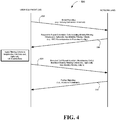
- a signaling diagram 500 is presented that highlights the signaling entailed in network-defined UE filtering of detected neighboring cells and subsequent detected cell reporting, in accordance with embodiments of the present invention.
- a first signal is sent from a UE to the network (e.g ., eNB) that reports a triggering event.
- the triggering event may any event that prompts the network to request detection of neighboring cells, for example, the triggering event may be the serving cell having a quality below a predefined threshold.
- the serving cell i.e., the cell that the UE is currently connected to
- the UE may currently be simultaneously connected to multiple cells, i.e., a primary cell and one or more secondary cells.
- the triggering event may include, but is not limited to, the current link budget of the primary cell or, optionally, one or more of the secondary cells, falling below a predefined quality threshold.
- the network i.e., the current primary cell communicates a request to the UE to report neighboring cells that includes at least mobility filtering criteria.
- the request may additionally include non-mobility filtering criteria.
- the request may be included within a dedicated signal, such as a Radio Resource Control (RRC) reconfiguration signal.
- RRC Radio Resource Control
- the filtering criteria may be included as an additional eNB signaled field in the reporting configurations.
- the mobility filtering criteria may be absolute and/or relative mobility filtering criteria.
- the absolute mobility criteria filtering may include, but is not limited to, velocity of the neighboring cell, direction of the neighboring cell, angle of velocity of the neighboring dell, Doppler estimate of the neighboring cell or the like.
- the relative mobility filtering criteria may include, but is not limited, to velocity of the neighboring cell being within a threshold range of the velocity of the UE, the direction of the neighboring cell being within a threshold range of the direction of movement of the UE, the angle of velocity of the neighboring cells being within a threshold range of an angle of velocity of the UE and the like.
- the UE In response to receiving the request, the UE will receive cell data (e.g., mobility vector(s)) from one or more neighboring cells and, in some embodiments, in which relative mobility filtering criteria is implemented, receive/determine UE data, specifically UE mobility data. Further, the UE applies the mobility filtering criteria and, in some embodiments the additional non-mobility filtering criteria to the cell data and, in some embodiments, the combination of cell data and UE data to determine which neighboring cells meet (or exceed) the mobility filtering criteria and, in some embodiments, the additional non-mobility filtering criteria.
- cell data e.g., mobility vector(s)
- the UE applies the mobility filtering criteria and, in some embodiments the additional non-mobility filtering criteria to the cell data and, in some embodiments, the combination of cell data and UE data to determine which neighboring cells meet (or exceed) the mobility filtering criteria and, in some embodiments, the additional non-mobility filtering criteria.
- a detected cell report is communicated to the network (i.e., the primary cell eNB) that identifies the one or more neighboring cells that meet the mobility filtering criteria and, in some embodiments, the additional non-mobility filtering criteria.
- the detected cell report may be limited to (only include) the identification of the one or more neighboring cells that meet the mobility filtering criteria and, in some embodiments, the additional non-mobility filtering criteria.
- the detected cell report may additionally include the cell data, specifically the cell mobility data (velocity, angle of velocity, Doppler estimate or the like) associated with the one or more neighboring cells that meet the mobility filtering criteria or the additional non-mobility filtering criteria.
- the request (Event 504) may include an indication that the report include the cell data of the one or more neighboring cells that meet the filtering criteria.
- the detected cell report may be configured to include identification of and/or cell data of the neighboring cells that were determined to not meet the mobility filtering criteria.
- the request (Event 504) may include an indication that the report include identification of and/or the cell data of the one or more neighboring cells that do not meet the mobility filtering criteria.
- Such further signaling may include, but is not limited to, a handover command to the UE that commands the UE to handover the connection to one of the identified neighboring cells that met the mobility filtering criteria and, in some embodiments, the additional non-mobility filtering criteria.
- a flow diagram is presented of a method 600 for network-controlled UE filtering of detected neighboring cells and subsequent detected cell reporting, in accordance with embodiments of the present invention.
- a UE receives a request, from a primary cell, to report neighboring cells that includes, at a minimum, mobility filtering criteria and, optionally, additional non-mobility filtering criteria.
- the request may be preceded by the UE reporting a triggering event.
- the triggering event may be any event experienced by the UE that requires the network to request detection of neighboring cells and/or reporting of neighboring cell mobility, such as, for example, a connected cell ( e.g., the primary cell) falling below a predetermined quality threshold.
- the mobility filtering criteria may be absolute mobility filtering criteria independent of UE mobility and/or relative mobility filtering criteria that is dependent upon UE mobility.
- the request may additionally request other information in the detected cell report, such as cell data, specifically mobility data associated with neighboring cells that meet the mobility filtering criteria, UE mobility data, identification of neighboring cells that do not meet the mobility filtering criteria and/or cell mobility data of neighboring cells that do not meet the mobility filtering criteria.
- the UE receives cell data, including mobility and in some embodiments non-mobility data, associated with one or more neighboring cells.
- the mobility data may be from a neighboring mobile cell in the form of a mobility vector broadcasted by a neighboring mobile cell.
- the mobility vector may include velocity and directional data.
- the cell mobility data may be from a neighboring stationary cell which, through lack of a broadcasted mobility vector, indicates that the cell is stationary.
- the UE may receive and/or determine mobility data associated with the UE.
- UE mobility data is required in those embodiments of the invention in which the filtering criteria is relative mobility filtering criteria dependent upon the mobility of the UE.
- the UE determines which of the one or more neighboring cells meets or exceeds the mobility filtering criteria and, optionally, in some embodiments, the additional non-mobility filtering criteria based on the cell data and, in some embodiments, in which the mobility filtering criteria includes relative mobility filtering criteria, based on a combination of the cell data and the UE data.
- the UE communicates a detected cell report to the network that identifies at least one neighboring cell that has been determined to meet or exceed the filtering criteria.
- the detected cell report may be limited to only identifying the neighboring cells that meet or exceed the mobility filtering criteria and, in some embodiments, the additional non-mobility filtering criteria.
- the detected cell report may include the cell data, specifically the cell mobility data (e.g ., velocity/speed, directions, angle(s) or the like) and/or identification of the neighboring cells that did not meet the filtering criteria.
- the UE may receive, from the network, a command to handover connection to one of the neighboring cells that meet or exceed the mobility filtering criteria and, in some embodiments, the additional non-mobility filtering criteria.
- systems, devices, methods, computer program products and the like described above detail network-controlled UE filtering of detectable neighboring cells.
- the present invention provides for the network to instruct currently-connected UEs to only report neighboring cells that meet network-defined mobility filtering criteria and, in some embodiments of the invention, additional non-mobility filtering criteria.
- the mobility filtering criteria may be absolute and/or relative mobility filtering criteria that is independent and/or dependent upon UE mobility characteristics.
- the UEs apply the mobility filtering criteria and, in some embodiments, non-mobility filtering criteria, to at least the data associated with neighboring cells, specifically the mobility data and, in some embodiments, the mobility data related to the UE, to determine which of the neighboring cells meet the filtering criteria.
- the UEs communicate a detected cell report back to the network, which, according to specific embodiments of the invention, may be limited to identification of the neighboring cells that meet the mobility filtering criteria and, in some embodiments additional non-mobility filtering criteria or, in some embodiments limited to identification along with the data, specifically the mobility data, associated with the identified neighboring cells that meet the mobility filtering criteria.
- Each processor described herein generally includes circuitry for implementing audio, visual, and/or logic functions.
- the processor may include a digital signal processor device, a microprocessor device, and various analog-to-digital converters, digital-to-analog converters, and other support circuits. Control and signal processing functions of the system in which the processor resides may be allocated between these devices according to their respective capabilities.
- the processor may also include functionality to operate one or more software programs based at least partially on computer-executable program code portions thereof, which may be stored, for example, in a memory.
- Each memory may include any computer-readable medium.
- memory may include volatile memory, such as volatile random access memory ("RAM") having a cache area for the temporary storage of data.
- RAM volatile random access memory
- Memory may also include non-volatile memory, which may be embedded and/or may be removable.
- the non-volatile memory may additionally or alternatively include an EEPROM, flash memory, and/or the like.
- the memory may store any one or more of pieces of information and data used by the system in which it resides to implement the functions of that system.
- any terms expressed in the singular form herein are meant to also include the plural form and/or vice versa, unless explicitly stated otherwise.
- “at least one” shall mean “one or more” and these phrases are intended to be interchangeable. Accordingly, the terms “a” and/or “an” shall mean “at least one” or “one or more,” even though the phrase “one or more” or “at least one” is also used herein.
- Like numbers refer to like elements throughout.
- the present invention may include and/or be embodied as an apparatus (including, for example, a system, machine, device, computer program product, and/or the like), as a method (including, for example, a computer-implemented process, and/or the like), or as any combination of the foregoing.
- embodiments of the present invention may take the form of an entirely software embodiment (including firmware, resident software, micro-code, stored procedures, etc.), an entirely hardware embodiment, or an embodiment combining software and hardware aspects that may generally be referred to herein as a "system.”
- embodiments of the present invention may take the form of a computer program product that includes a computer-readable storage medium having one or more computer-executable program code portions stored therein.
- a processor which may include one or more processors, may be "configured to" perform a certain function in a variety of ways, including, for example, by having one or more general-purpose circuits perform the function by executing one or more computer-executable program code portions embodied in a computer-readable medium, and/or by having one or more application-specific circuits perform the function.
- the computer-readable medium may include, but is not limited to, a non-transitory computer-readable medium, such as a tangible electronic, magnetic, optical, electromagnetic, infrared, and/or semiconductor system, device, and/or other apparatus.
- the non-transitory computer-readable medium includes a tangible medium such as a portable computer diskette, a hard disk, a random access memory (RAM), a read-only memory (“ROM”), an erasable programmable read-only memory (“EPROM” or Flash memory), a compact disc read-only memory (“CD-ROM”), and/or some other tangible optical and/or magnetic storage device.
- the computer-readable medium may be transitory, such as, for example, a propagation signal including computer-executable program code portions embodied therein.
- One or more computer-executable program code portions for carrying out operations of the present invention may include object-oriented, scripted, and/or unscripted programming languages, such as, for example, Java, Perl, Smalltalk, C++, SAS, SQL, Python, Objective C, JavaScript, and/or the like.
- the one or more computer-executable program code portions for carrying out operations of embodiments of the present invention are written in conventional procedural programming languages, such as the "C" programming languages and/or similar programming languages.
- the computer program code may alternatively or additionally be written in one or more multi-paradigm programming languages, such as, for example, F#.
- These one or more computer-executable program code portions may be provided to a processor of a general purpose computer, special purpose computer, and/or some other programmable information processing apparatus in order to produce a particular machine, such that the one or more computer-executable program code portions, which execute via the processor of the computer and/or other programmable information processing apparatus, create mechanisms for implementing the steps and/or functions represented by the flowchart(s) and/or block diagram block(s).
- the one or more computer-executable program code portions may be stored in a transitory and/or non-transitory computer-readable medium (e.g ., a memory, etc.) that can direct, instruct, and/or cause a computer and/or other programmable information processing apparatus to function in a particular manner, such that the computer-executable program code portions stored in the computer-readable medium produce an article of manufacture including instruction mechanisms which implement the steps and/or functions specified in the flowchart(s) and/or block diagram block(s).
- a transitory and/or non-transitory computer-readable medium e.g ., a memory, etc.
- the one or more computer-executable program code portions may also be loaded onto a computer and/or other programmable information processing apparatus to cause a series of operational steps to be performed on the computer and/or other programmable apparatus.
- this produces a computer-implemented process such that the one or more computer-executable program code portions which execute on the computer and/or other programmable apparatus provide operational steps to implement the steps specified in the flowchart(s) and/or the functions specified in the block diagram block(s).
- computer-implemented steps may be combined with, and/or replaced with, operator- and/or human-implemented steps in order to carry out an embodiment of the present invention.
Landscapes
- Engineering & Computer Science (AREA)
- Computer Networks & Wireless Communication (AREA)
- Signal Processing (AREA)
- Mobile Radio Communication Systems (AREA)
Claims (15)
- Procédé (600) pour le filtrage contrôlé par le réseau de rapports de cellules détectées, le procédé comprenant :la réception (602), au niveau d'un équipement utilisateur, UE,d'une demande basée sur le réseau pour signaler des cellules voisines détectables ;la réception (604), au niveau de l'UE, de données de cellule associées à une ou plusieurs cellules voisines ;caractérisé en ce que la demande comporte au moins des critères de filtrage de mobilité et en ce que le procédé comprend :le fait de déterminer (608), au niveau de l'UE, laquelle des une ou plusieurs cellules voisines satisfait ou dépasse les critères de filtrage de mobilité sur la base au moins des données de cellule ; eten réponse à la détermination qu'au moins une cellule voisine satisfait ou dépasse les critères de filtrage de mobilité, la communication (610), au réseau, d'un rapport de cellule détectée qui identifie l'au moins une cellule voisine qui a été déterminée comme satisfaisant ou dépassant les critères de filtrage de mobilité.
- Procédé selon la revendication 1, dans lequel la réception (602) de la demande basée sur le réseau pour signaler des cellules voisines détectables comprend en outre la réception de la demande basée sur le réseau pour signaler des cellules voisines détectables, dans lequel la demande comporte en outre des critères de filtrage de non-mobilité.
- Procédé selon la revendication 2, dans lequel la détermination (608) comprend en outre le fait de déterminer, au niveau de l'UE, laquelle des une ou plusieurs cellules voisines satisfait ou dépasse les critères de filtrage de mobilité et les critères de filtrage de non-mobilité sur la base au moins des données de cellule.
- Procédé selon la revendication 3, dans lequel la communication (610) comprend en outre la communication, au réseau, d'un rapport de cellule détectée qui identifie l'au moins une cellule voisine qui a été déterminée comme satisfaisant ou dépassant les critères de filtrage de mobilité et les critères de filtrage de non-mobilité.
- Procédé selon la revendication 1, dans lequel la communication (610) du rapport de cellule détectée comprend en outre la communication, au réseau, du rapport de cellule détectée qui comporte des données de cellule de l'au moins une cellule voisine qui a été déterminée comme satisfaisant ou dépassant les critères de filtrage de mobilité.
- Procédé selon la revendication 1, dans lequel les critères de filtrage de mobilité comporte les uns ou plusieurs parmi :des critères de filtrage de mobilité absolus, indépendants des caractéristiques de mobilité de l'UE, etdes critères de filtrage de mobilité relatifs, dépendants des caractéristiques de mobilité de l'UE.
- Procédé selon la revendication 6, dans lequel les critères de filtrage de mobilité absolus comportent les unes ou plusieurs parmi
des cellules dont la vitesse est inférieure à un seuil prédéterminé,
des cellules se déplaçant dans une direction prédéterminée,
des cellules dans un angle de vitesse prédéterminé, ou
des cellules avec une vitesse nulle. - Procédé selon la revendication 6, dans lequel les critères de filtrage de mobilité relatifs comportent les unes ou plusieurs parmi
des cellules dont la vitesse se situe dans une plage seuil d'une vitesse de l'UE,
des cellules se déplaçant dans une direction dans une plage seuil d'une direction de l'UE, et
des cellules ayant un angle de vitesse dans une plage seuil d'un angle de vitesse de l'UE. - Procédé selon la revendication 1, comprenant en outre la détermination ou la réception (606), au niveau de l'UE, de données UE.
- Procédé selon la revendication 9, dans lequel le fait de déterminer (608), au niveau de l'UE, laquelle des une ou plusieurs cellules voisines satisfait ou dépasse les critères de filtrage de mobilité comprend en outre le fait de déterminer au niveau de l'UE, laquelle des une ou plusieurs cellules voisines satisfait ou dépasse les critères de filtrage de mobilité sur la base au moins des données de cellule et des données UE.
- Procédé selon la revendication 1, dans lequel la réception (604), au niveau de l'UE, des données de cellule comprend en outre la réception, au niveau de l'UE, d'un vecteur de mobilité provenant des une ou plusieurs cellules voisines, dans lequel le vecteur de mobilité identifie l'un ou plusieurs parmi une direction actuelle du mouvement, une vitesse actuelle de la cellule, une vitesse moyenne de la cellule et un angle de vitesse actuel.
- Procédé selon la revendication 1, dans lequel la réception (602) de la demande basée sur le réseau se produit en réponse au signalement par l'UE d'un événement qui déclenche le réseau pour demander le signalement de la mobilité des cellules mobiles voisines.
- Procédé selon la revendication 12, dans lequel la réception (602) de la demande basée sur le réseau se produit en réponse au signalement par l'UE de l'événement, dans lequel l'événement comprend une qualité de signal d'une cellule de desserte actuelle détectée comme inférieure à un seuil de qualité de signal prédéterminé.
- Procédé selon la revendication 1, dans lequel la réception (602) de la demande basée sur le réseau comprend en outre la réception, au niveau de l'UE, d'un signal de reconfiguration de contrôle des ressources radio, RRC, qui comporte la demande pour signaler la mobilité des cellules mobiles voisines.
- Dispositif d'équipement utilisateur (300) pour filtrer les rapports de cellules détectées sur la base de critères de filtrage de mobilité de cellule définis par le réseau, le dispositif comprenant :une plateforme informatique (302) comportant une mémoire (304) et un processeur (306) en communication avec la mémoire ; etun module de rapport de cellule détectée (308) stocké dans la mémoire, exécutable par le processeur et configuré pour :recevoir, depuis un réseau, une demande (310) pour signaler des cellules voisines détectables,recevoir des données de cellule (316) associées à une ou plusieurs cellules voisines (314),caractérisé en ce que la demande (310) pour signaler des cellules voisines détectables comporte des critères de filtrage de mobilité (312) et en ce que le dispositif d'équipement utilisateur comprend en outre un module de filtrage (308) stocké dans la mémoire, exécutable par le processeur et configuré pour :déterminer laquelle des une ou plusieurs cellules voisines satisfait ou dépasse les critères de filtrage de mobilité sur la base au moins des données de cellule, eten réponse à la détermination qu'au moins une cellule voisine satisfait ou dépasse les critères de filtrage de mobilité, communiquer, au réseau, un rapport de cellule détectée (322) qui identifie l'au moins une cellule voisine qui a été déterminée comme satisfaisant ou dépassant les critères de filtrage de mobilité.
Applications Claiming Priority (1)
| Application Number | Priority Date | Filing Date | Title |
|---|---|---|---|
| PCT/US2016/024991 WO2017171754A1 (fr) | 2016-03-30 | 2016-03-30 | Filtrage commandé par le réseau d'informations de mobilité |
Publications (2)
| Publication Number | Publication Date |
|---|---|
| EP3437366A1 EP3437366A1 (fr) | 2019-02-06 |
| EP3437366B1 true EP3437366B1 (fr) | 2020-10-21 |
Family
ID=55702157
Family Applications (1)
| Application Number | Title | Priority Date | Filing Date |
|---|---|---|---|
| EP16715742.9A Not-in-force EP3437366B1 (fr) | 2016-03-30 | 2016-03-30 | Filtrage d'information de mobilité contrôlé par le réseau |
Country Status (4)
| Country | Link |
|---|---|
| US (1) | US11115883B2 (fr) |
| EP (1) | EP3437366B1 (fr) |
| CN (1) | CN108702659B (fr) |
| WO (1) | WO2017171754A1 (fr) |
Families Citing this family (6)
| Publication number | Priority date | Publication date | Assignee | Title |
|---|---|---|---|---|
| US11109258B2 (en) * | 2019-05-31 | 2021-08-31 | Apple Inc. | Crowd sourced privacy preserving access point mapping |
| WO2022025637A1 (fr) * | 2020-07-28 | 2022-02-03 | Samsung Electronics Co., Ltd. | Procédé et système d'accès au réseau mobile |
| US20230068437A1 (en) * | 2021-08-18 | 2023-03-02 | Regents Of The University Of Minnesota | Using user-side contextual factors to predict cellular radio throughput |
| WO2026073585A1 (fr) * | 2024-10-04 | 2026-04-09 | Nokia Technologies Oy | Création d'un rapport d'état de détection d'une ou plusieurs cellules |
| WO2026073586A1 (fr) * | 2024-10-04 | 2026-04-09 | Nokia Technologies Oy | Configuration pour rapporter un état de détection d'une ou de plusieurs cellules |
| WO2026073587A1 (fr) * | 2024-10-04 | 2026-04-09 | Nokia Technologies Oy | Création d'un rapport relatif à une ou plusieurs cellules détectées |
Family Cites Families (19)
| Publication number | Priority date | Publication date | Assignee | Title |
|---|---|---|---|---|
| KR101165625B1 (ko) * | 2004-05-10 | 2012-07-19 | 엘지전자 주식회사 | 광대역 무선 접속 시스템에서의 이동단말을 통한주변기지국 정보 제공 방법 |
| JP4465021B1 (ja) * | 2008-12-26 | 2010-05-19 | 株式会社エヌ・ティ・ティ・ドコモ | 移動通信方法及び移動局 |
| EP2424321B1 (fr) * | 2009-05-22 | 2016-01-13 | Huawei Technologies Co., Ltd. | Equipement utilisateur et son procédé d'accès |
| GB2472792A (en) * | 2009-08-17 | 2011-02-23 | Nec Corp | Measurement reporting in a mobile communications system |
| CN102056260B (zh) * | 2009-10-28 | 2014-12-10 | 中兴通讯股份有限公司 | 一种移动性参数的查询及协商方法/系统 |
| US20110105119A1 (en) * | 2009-11-02 | 2011-05-05 | Infineon Technologies Ag | Radio base stations, radio communication devices, methods for controlling a radio base station, and methods for controlling a radio communication device |
| KR101624879B1 (ko) * | 2009-12-23 | 2016-05-30 | 삼성전자주식회사 | 멀티 셀 환경에서의 기준신호 할당 방법, 관리 방법 및 상기 방법이 적용되는 네트워크 장치 및 단말 |
| US8886177B2 (en) * | 2010-01-26 | 2014-11-11 | Nokia Corporation | Measurement reporting of inter-rat cells of more than one rat in GERAN |
| WO2012140470A1 (fr) * | 2011-04-11 | 2012-10-18 | Nokia Corporation | Procédé et appareil pour configuration de mesure spécifique du type de cellule |
| WO2013025166A1 (fr) * | 2011-08-16 | 2013-02-21 | Telefonaktiebolaget L M Ericsson (Publ) | Fonctionnement d'un relais mobile dépendant d'un état de mobilité |
| CN103765844B (zh) * | 2011-08-30 | 2017-02-01 | 瑞典爱立信有限公司 | 用于选择目标核心网络以便切换终端的语音会话的方法和节点 |
| CN103052070A (zh) * | 2011-10-14 | 2013-04-17 | 中国移动通信集团江苏有限公司 | 一种多载频系统中载频配置优化方法和无线网络控制器 |
| US9369931B2 (en) | 2012-07-02 | 2016-06-14 | Telefonaktiebolaget Lm Ericsson (Publ) | Method and radio access node for incorporating a moving cell in a wireless communication network |
| US9253699B2 (en) * | 2013-01-29 | 2016-02-02 | Lg Electronics Inc. | Method and apparatus for controlling and supporting a dynamic cell on/off in wireless access system |
| WO2014135921A1 (fr) * | 2013-03-06 | 2014-09-12 | Here Global B.V. | Sélection d'ensembles de données de carte radiofréquence basée sur des informations de terminal mobile |
| CN105122886B (zh) * | 2013-03-08 | 2019-03-08 | 诺基亚技术有限公司 | 用于设备到设备通信的切换的方法和装置 |
| EP2916591B1 (fr) | 2013-12-03 | 2020-11-04 | Sony Corporation | Sélection d'une cellule dans un réseau de communication cellulaire sans fil |
| KR102186547B1 (ko) * | 2014-02-06 | 2020-12-04 | 삼성전자주식회사 | 선택 가능한 통신 서비스를 지원하는 무선 통신 방법 및 장치 |
| GB2526286A (en) | 2014-05-19 | 2015-11-25 | Vodafone Ip Licensing Ltd | Handover for base stations with cellular backhaul |
-
2016
- 2016-03-30 WO PCT/US2016/024991 patent/WO2017171754A1/fr not_active Ceased
- 2016-03-30 CN CN201680082670.XA patent/CN108702659B/zh not_active Expired - Fee Related
- 2016-03-30 EP EP16715742.9A patent/EP3437366B1/fr not_active Not-in-force
- 2016-03-30 US US16/074,272 patent/US11115883B2/en not_active Expired - Fee Related
Non-Patent Citations (1)
| Title |
|---|
| None * |
Also Published As
| Publication number | Publication date |
|---|---|
| WO2017171754A1 (fr) | 2017-10-05 |
| CN108702659A (zh) | 2018-10-23 |
| US20200229050A1 (en) | 2020-07-16 |
| US11115883B2 (en) | 2021-09-07 |
| CN108702659B (zh) | 2021-05-04 |
| EP3437366A1 (fr) | 2019-02-06 |
Similar Documents
| Publication | Publication Date | Title |
|---|---|---|
| EP3375216B1 (fr) | Procédé de positionnement dynamique pour des cellules mobiles | |
| EP3437366B1 (fr) | Filtrage d'information de mobilité contrôlé par le réseau | |
| US12063564B2 (en) | Telecommunications system, terminal device, infrastructure equipment and methods | |
| US20240049092A1 (en) | Cell reselection using expected cell serving time | |
| CN103002526B (zh) | 小区切换的控制和测量方法、装置及系统 | |
| EP3345426B1 (fr) | Procédures de mobilité entre faisceaux provenant de différents noeuds de réseau radio | |
| US10321363B2 (en) | Radio network nodes and methods for enabling mobility between said nodes | |
| US20160007261A1 (en) | Method and apparatus for handover | |
| CN101778438B (zh) | 协作通信方法和设备、切换方法及基站控制设备 | |
| US9148793B2 (en) | Radio communication system, radio base station, and communication control method | |
| EP3123806B1 (fr) | Configuration de connexion entre un terminal mobile et une station de base mobile sur la base d'une détection de mouvement conjoint | |
| US11516767B2 (en) | Network node, user equipment, and methods in a wireless communications network | |
| US9088925B1 (en) | Method and system for facilitating handoff of a UE to an earlier serving wireless network | |
| EP3089513A1 (fr) | Fournissement des informations liées à l'établissement d'une association entre un ou plusieurs émetteurs-récepteurs de station de base et émetteur-récepteur mobile dans un système de communication mobile | |
| EP3089515A1 (fr) | Appareils, procédés et programmes informatiques pour une unité de gestion de mobilité d'un premier et d'un second système de communication mobile et émetteur-récepteur mobile | |
| WO2021188020A1 (fr) | Rapport de mesure de mobilité déclenché par un nœud de réseau | |
| CN119111092A (zh) | 用于用户设备的增强测量报告 | |
| KR20260028862A (ko) | 이동성 관리 방법, 통신 장치 및 저장 매체 | |
| CN121509910A (zh) | 针对用于邻近服务区域的ntn上的mbs的mrb处理 |
Legal Events
| Date | Code | Title | Description |
|---|---|---|---|
| STAA | Information on the status of an ep patent application or granted ep patent |
Free format text: STATUS: THE INTERNATIONAL PUBLICATION HAS BEEN MADE |
|
| PUAI | Public reference made under article 153(3) epc to a published international application that has entered the european phase |
Free format text: ORIGINAL CODE: 0009012 |
|
| STAA | Information on the status of an ep patent application or granted ep patent |
Free format text: STATUS: REQUEST FOR EXAMINATION WAS MADE |
|
| 17P | Request for examination filed |
Effective date: 20181010 |
|
| AK | Designated contracting states |
Kind code of ref document: A1 Designated state(s): AL AT BE BG CH CY CZ DE DK EE ES FI FR GB GR HR HU IE IS IT LI LT LU LV MC MK MT NL NO PL PT RO RS SE SI SK SM TR |
|
| AX | Request for extension of the european patent |
Extension state: BA ME |
|
| DAV | Request for validation of the european patent (deleted) | ||
| DAX | Request for extension of the european patent (deleted) | ||
| STAA | Information on the status of an ep patent application or granted ep patent |
Free format text: STATUS: EXAMINATION IS IN PROGRESS |
|
| 17Q | First examination report despatched |
Effective date: 20191001 |
|
| REG | Reference to a national code |
Ref country code: DE Ref legal event code: R079 Ref document number: 602016046191 Country of ref document: DE Free format text: PREVIOUS MAIN CLASS: H04W0036000000 Ipc: H04W0024020000 |
|
| GRAP | Despatch of communication of intention to grant a patent |
Free format text: ORIGINAL CODE: EPIDOSNIGR1 |
|
| STAA | Information on the status of an ep patent application or granted ep patent |
Free format text: STATUS: GRANT OF PATENT IS INTENDED |
|
| RIC1 | Information provided on ipc code assigned before grant |
Ipc: H04W 36/00 20090101ALI20200512BHEP Ipc: H04W 24/10 20090101ALI20200512BHEP Ipc: H04W 24/02 20090101AFI20200512BHEP Ipc: H04W 88/02 20090101ALI20200512BHEP |
|
| INTG | Intention to grant announced |
Effective date: 20200605 |
|
| GRAS | Grant fee paid |
Free format text: ORIGINAL CODE: EPIDOSNIGR3 |
|
| GRAA | (expected) grant |
Free format text: ORIGINAL CODE: 0009210 |
|
| STAA | Information on the status of an ep patent application or granted ep patent |
Free format text: STATUS: THE PATENT HAS BEEN GRANTED |
|
| RAP1 | Party data changed (applicant data changed or rights of an application transferred) |
Owner name: SONY CORPORATION |
|
| AK | Designated contracting states |
Kind code of ref document: B1 Designated state(s): AL AT BE BG CH CY CZ DE DK EE ES FI FR GB GR HR HU IE IS IT LI LT LU LV MC MK MT NL NO PL PT RO RS SE SI SK SM TR |
|
| REG | Reference to a national code |
Ref country code: GB Ref legal event code: FG4D |
|
| REG | Reference to a national code |
Ref country code: CH Ref legal event code: EP |
|
| REG | Reference to a national code |
Ref country code: IE Ref legal event code: FG4D |
|
| REG | Reference to a national code |
Ref country code: DE Ref legal event code: R096 Ref document number: 602016046191 Country of ref document: DE |
|
| REG | Reference to a national code |
Ref country code: AT Ref legal event code: REF Ref document number: 1327117 Country of ref document: AT Kind code of ref document: T Effective date: 20201115 |
|
| REG | Reference to a national code |
Ref country code: AT Ref legal event code: MK05 Ref document number: 1327117 Country of ref document: AT Kind code of ref document: T Effective date: 20201021 |
|
| REG | Reference to a national code |
Ref country code: NL Ref legal event code: MP Effective date: 20201021 |
|
| PG25 | Lapsed in a contracting state [announced via postgrant information from national office to epo] |
Ref country code: NO Free format text: LAPSE BECAUSE OF FAILURE TO SUBMIT A TRANSLATION OF THE DESCRIPTION OR TO PAY THE FEE WITHIN THE PRESCRIBED TIME-LIMIT Effective date: 20210121 Ref country code: PT Free format text: LAPSE BECAUSE OF FAILURE TO SUBMIT A TRANSLATION OF THE DESCRIPTION OR TO PAY THE FEE WITHIN THE PRESCRIBED TIME-LIMIT Effective date: 20210222 Ref country code: RS Free format text: LAPSE BECAUSE OF FAILURE TO SUBMIT A TRANSLATION OF THE DESCRIPTION OR TO PAY THE FEE WITHIN THE PRESCRIBED TIME-LIMIT Effective date: 20201021 Ref country code: FI Free format text: LAPSE BECAUSE OF FAILURE TO SUBMIT A TRANSLATION OF THE DESCRIPTION OR TO PAY THE FEE WITHIN THE PRESCRIBED TIME-LIMIT Effective date: 20201021 Ref country code: GR Free format text: LAPSE BECAUSE OF FAILURE TO SUBMIT A TRANSLATION OF THE DESCRIPTION OR TO PAY THE FEE WITHIN THE PRESCRIBED TIME-LIMIT Effective date: 20210122 |
|
| REG | Reference to a national code |
Ref country code: LT Ref legal event code: MG4D |
|
| PG25 | Lapsed in a contracting state [announced via postgrant information from national office to epo] |
Ref country code: SE Free format text: LAPSE BECAUSE OF FAILURE TO SUBMIT A TRANSLATION OF THE DESCRIPTION OR TO PAY THE FEE WITHIN THE PRESCRIBED TIME-LIMIT Effective date: 20201021 Ref country code: AT Free format text: LAPSE BECAUSE OF FAILURE TO SUBMIT A TRANSLATION OF THE DESCRIPTION OR TO PAY THE FEE WITHIN THE PRESCRIBED TIME-LIMIT Effective date: 20201021 Ref country code: ES Free format text: LAPSE BECAUSE OF FAILURE TO SUBMIT A TRANSLATION OF THE DESCRIPTION OR TO PAY THE FEE WITHIN THE PRESCRIBED TIME-LIMIT Effective date: 20201021 Ref country code: BG Free format text: LAPSE BECAUSE OF FAILURE TO SUBMIT A TRANSLATION OF THE DESCRIPTION OR TO PAY THE FEE WITHIN THE PRESCRIBED TIME-LIMIT Effective date: 20210121 Ref country code: IS Free format text: LAPSE BECAUSE OF FAILURE TO SUBMIT A TRANSLATION OF THE DESCRIPTION OR TO PAY THE FEE WITHIN THE PRESCRIBED TIME-LIMIT Effective date: 20210221 Ref country code: PL Free format text: LAPSE BECAUSE OF FAILURE TO SUBMIT A TRANSLATION OF THE DESCRIPTION OR TO PAY THE FEE WITHIN THE PRESCRIBED TIME-LIMIT Effective date: 20201021 Ref country code: LV Free format text: LAPSE BECAUSE OF FAILURE TO SUBMIT A TRANSLATION OF THE DESCRIPTION OR TO PAY THE FEE WITHIN THE PRESCRIBED TIME-LIMIT Effective date: 20201021 |
|
| PG25 | Lapsed in a contracting state [announced via postgrant information from national office to epo] |
Ref country code: NL Free format text: LAPSE BECAUSE OF FAILURE TO SUBMIT A TRANSLATION OF THE DESCRIPTION OR TO PAY THE FEE WITHIN THE PRESCRIBED TIME-LIMIT Effective date: 20201021 Ref country code: HR Free format text: LAPSE BECAUSE OF FAILURE TO SUBMIT A TRANSLATION OF THE DESCRIPTION OR TO PAY THE FEE WITHIN THE PRESCRIBED TIME-LIMIT Effective date: 20201021 |
|
| REG | Reference to a national code |
Ref country code: DE Ref legal event code: R097 Ref document number: 602016046191 Country of ref document: DE |
|
| RAP4 | Party data changed (patent owner data changed or rights of a patent transferred) |
Owner name: SONY GROUP CORPORATION |
|
| PG25 | Lapsed in a contracting state [announced via postgrant information from national office to epo] |
Ref country code: EE Free format text: LAPSE BECAUSE OF FAILURE TO SUBMIT A TRANSLATION OF THE DESCRIPTION OR TO PAY THE FEE WITHIN THE PRESCRIBED TIME-LIMIT Effective date: 20201021 Ref country code: CZ Free format text: LAPSE BECAUSE OF FAILURE TO SUBMIT A TRANSLATION OF THE DESCRIPTION OR TO PAY THE FEE WITHIN THE PRESCRIBED TIME-LIMIT Effective date: 20201021 Ref country code: LT Free format text: LAPSE BECAUSE OF FAILURE TO SUBMIT A TRANSLATION OF THE DESCRIPTION OR TO PAY THE FEE WITHIN THE PRESCRIBED TIME-LIMIT Effective date: 20201021 Ref country code: SM Free format text: LAPSE BECAUSE OF FAILURE TO SUBMIT A TRANSLATION OF THE DESCRIPTION OR TO PAY THE FEE WITHIN THE PRESCRIBED TIME-LIMIT Effective date: 20201021 Ref country code: SK Free format text: LAPSE BECAUSE OF FAILURE TO SUBMIT A TRANSLATION OF THE DESCRIPTION OR TO PAY THE FEE WITHIN THE PRESCRIBED TIME-LIMIT Effective date: 20201021 Ref country code: RO Free format text: LAPSE BECAUSE OF FAILURE TO SUBMIT A TRANSLATION OF THE DESCRIPTION OR TO PAY THE FEE WITHIN THE PRESCRIBED TIME-LIMIT Effective date: 20201021 |
|
| PLBE | No opposition filed within time limit |
Free format text: ORIGINAL CODE: 0009261 |
|
| STAA | Information on the status of an ep patent application or granted ep patent |
Free format text: STATUS: NO OPPOSITION FILED WITHIN TIME LIMIT |
|
| PG25 | Lapsed in a contracting state [announced via postgrant information from national office to epo] |
Ref country code: DK Free format text: LAPSE BECAUSE OF FAILURE TO SUBMIT A TRANSLATION OF THE DESCRIPTION OR TO PAY THE FEE WITHIN THE PRESCRIBED TIME-LIMIT Effective date: 20201021 |
|
| 26N | No opposition filed |
Effective date: 20210722 |
|
| PG25 | Lapsed in a contracting state [announced via postgrant information from national office to epo] |
Ref country code: MC Free format text: LAPSE BECAUSE OF FAILURE TO SUBMIT A TRANSLATION OF THE DESCRIPTION OR TO PAY THE FEE WITHIN THE PRESCRIBED TIME-LIMIT Effective date: 20201021 Ref country code: AL Free format text: LAPSE BECAUSE OF FAILURE TO SUBMIT A TRANSLATION OF THE DESCRIPTION OR TO PAY THE FEE WITHIN THE PRESCRIBED TIME-LIMIT Effective date: 20201021 Ref country code: IT Free format text: LAPSE BECAUSE OF FAILURE TO SUBMIT A TRANSLATION OF THE DESCRIPTION OR TO PAY THE FEE WITHIN THE PRESCRIBED TIME-LIMIT Effective date: 20201021 |
|
| REG | Reference to a national code |
Ref country code: CH Ref legal event code: PL |
|
| PG25 | Lapsed in a contracting state [announced via postgrant information from national office to epo] |
Ref country code: SI Free format text: LAPSE BECAUSE OF FAILURE TO SUBMIT A TRANSLATION OF THE DESCRIPTION OR TO PAY THE FEE WITHIN THE PRESCRIBED TIME-LIMIT Effective date: 20201021 |
|
| REG | Reference to a national code |
Ref country code: BE Ref legal event code: MM Effective date: 20210331 |
|
| PG25 | Lapsed in a contracting state [announced via postgrant information from national office to epo] |
Ref country code: LI Free format text: LAPSE BECAUSE OF NON-PAYMENT OF DUE FEES Effective date: 20210331 Ref country code: LU Free format text: LAPSE BECAUSE OF NON-PAYMENT OF DUE FEES Effective date: 20210330 Ref country code: CH Free format text: LAPSE BECAUSE OF NON-PAYMENT OF DUE FEES Effective date: 20210331 Ref country code: IE Free format text: LAPSE BECAUSE OF NON-PAYMENT OF DUE FEES Effective date: 20210330 |
|
| PG25 | Lapsed in a contracting state [announced via postgrant information from national office to epo] |
Ref country code: IS Free format text: LAPSE BECAUSE OF FAILURE TO SUBMIT A TRANSLATION OF THE DESCRIPTION OR TO PAY THE FEE WITHIN THE PRESCRIBED TIME-LIMIT Effective date: 20210221 |
|
| PG25 | Lapsed in a contracting state [announced via postgrant information from national office to epo] |
Ref country code: BE Free format text: LAPSE BECAUSE OF NON-PAYMENT OF DUE FEES Effective date: 20210331 |
|
| PG25 | Lapsed in a contracting state [announced via postgrant information from national office to epo] |
Ref country code: CY Free format text: LAPSE BECAUSE OF FAILURE TO SUBMIT A TRANSLATION OF THE DESCRIPTION OR TO PAY THE FEE WITHIN THE PRESCRIBED TIME-LIMIT Effective date: 20201021 |
|
| P01 | Opt-out of the competence of the unified patent court (upc) registered |
Effective date: 20230528 |
|
| PG25 | Lapsed in a contracting state [announced via postgrant information from national office to epo] |
Ref country code: HU Free format text: LAPSE BECAUSE OF FAILURE TO SUBMIT A TRANSLATION OF THE DESCRIPTION OR TO PAY THE FEE WITHIN THE PRESCRIBED TIME-LIMIT; INVALID AB INITIO Effective date: 20160330 |
|
| PG25 | Lapsed in a contracting state [announced via postgrant information from national office to epo] |
Ref country code: MK Free format text: LAPSE BECAUSE OF FAILURE TO SUBMIT A TRANSLATION OF THE DESCRIPTION OR TO PAY THE FEE WITHIN THE PRESCRIBED TIME-LIMIT Effective date: 20201021 |
|
| PGFP | Annual fee paid to national office [announced via postgrant information from national office to epo] |
Ref country code: DE Payment date: 20240220 Year of fee payment: 9 Ref country code: GB Payment date: 20240220 Year of fee payment: 9 |
|
| PGFP | Annual fee paid to national office [announced via postgrant information from national office to epo] |
Ref country code: FR Payment date: 20240220 Year of fee payment: 9 |
|
| PG25 | Lapsed in a contracting state [announced via postgrant information from national office to epo] |
Ref country code: MT Free format text: LAPSE BECAUSE OF FAILURE TO SUBMIT A TRANSLATION OF THE DESCRIPTION OR TO PAY THE FEE WITHIN THE PRESCRIBED TIME-LIMIT Effective date: 20201021 |
|
| REG | Reference to a national code |
Ref country code: DE Ref legal event code: R119 Ref document number: 602016046191 Country of ref document: DE |
|
| GBPC | Gb: european patent ceased through non-payment of renewal fee |
Effective date: 20250330 |
|
| PG25 | Lapsed in a contracting state [announced via postgrant information from national office to epo] |
Ref country code: TR Free format text: LAPSE BECAUSE OF FAILURE TO SUBMIT A TRANSLATION OF THE DESCRIPTION OR TO PAY THE FEE WITHIN THE PRESCRIBED TIME-LIMIT Effective date: 20201021 |
|
| PG25 | Lapsed in a contracting state [announced via postgrant information from national office to epo] |
Ref country code: DE Free format text: LAPSE BECAUSE OF NON-PAYMENT OF DUE FEES Effective date: 20251001 |
|
| PG25 | Lapsed in a contracting state [announced via postgrant information from national office to epo] |
Ref country code: GB Free format text: LAPSE BECAUSE OF NON-PAYMENT OF DUE FEES Effective date: 20250330 |
|
| PG25 | Lapsed in a contracting state [announced via postgrant information from national office to epo] |
Ref country code: FR Free format text: LAPSE BECAUSE OF NON-PAYMENT OF DUE FEES Effective date: 20250331 |