EP3437604A1 - Vêtement comportant un tampon d'incontinence à gestion d'humidité - Google Patents
Vêtement comportant un tampon d'incontinence à gestion d'humidité Download PDFInfo
- Publication number
- EP3437604A1 EP3437604A1 EP18187529.5A EP18187529A EP3437604A1 EP 3437604 A1 EP3437604 A1 EP 3437604A1 EP 18187529 A EP18187529 A EP 18187529A EP 3437604 A1 EP3437604 A1 EP 3437604A1
- Authority
- EP
- European Patent Office
- Prior art keywords
- sheet
- liquid
- garment
- pad
- absorbent material
- Prior art date
- Legal status (The legal status is an assumption and is not a legal conclusion. Google has not performed a legal analysis and makes no representation as to the accuracy of the status listed.)
- Withdrawn
Links
- 206010021639 Incontinence Diseases 0.000 title claims abstract description 86
- 239000007788 liquid Substances 0.000 claims abstract description 396
- 239000000463 material Substances 0.000 claims abstract description 292
- 239000002250 absorbent Substances 0.000 claims abstract description 144
- 230000002745 absorbent Effects 0.000 claims abstract description 140
- 239000011358 absorbing material Substances 0.000 claims description 42
- 238000000034 method Methods 0.000 claims description 11
- 238000009954 braiding Methods 0.000 claims description 4
- 238000007667 floating Methods 0.000 claims description 3
- 238000009732 tufting Methods 0.000 claims description 3
- 230000000474 nursing effect Effects 0.000 claims description 2
- 239000011344 liquid material Substances 0.000 claims 1
- 230000035515 penetration Effects 0.000 claims 1
- 239000010410 layer Substances 0.000 description 43
- 238000010521 absorption reaction Methods 0.000 description 9
- 230000004888 barrier function Effects 0.000 description 8
- 239000004744 fabric Substances 0.000 description 8
- 239000002131 composite material Substances 0.000 description 7
- XLYOFNOQVPJJNP-UHFFFAOYSA-N water Substances O XLYOFNOQVPJJNP-UHFFFAOYSA-N 0.000 description 7
- 238000001035 drying Methods 0.000 description 6
- 238000005406 washing Methods 0.000 description 6
- 238000000576 coating method Methods 0.000 description 5
- 239000000835 fiber Substances 0.000 description 5
- 206010046543 Urinary incontinence Diseases 0.000 description 4
- 210000000481 breast Anatomy 0.000 description 4
- 238000009940 knitting Methods 0.000 description 4
- 230000002940 repellent Effects 0.000 description 4
- 239000005871 repellent Substances 0.000 description 4
- 239000000126 substance Substances 0.000 description 4
- 238000004140 cleaning Methods 0.000 description 3
- 239000011248 coating agent Substances 0.000 description 3
- 238000004519 manufacturing process Methods 0.000 description 3
- 239000002985 plastic film Substances 0.000 description 3
- 229920006255 plastic film Polymers 0.000 description 3
- 229920000742 Cotton Polymers 0.000 description 2
- MHAJPDPJQMAIIY-UHFFFAOYSA-N Hydrogen peroxide Chemical group OO MHAJPDPJQMAIIY-UHFFFAOYSA-N 0.000 description 2
- 229920002472 Starch Polymers 0.000 description 2
- 239000004433 Thermoplastic polyurethane Substances 0.000 description 2
- GWEVSGVZZGPLCZ-UHFFFAOYSA-N Titan oxide Chemical compound O=[Ti]=O GWEVSGVZZGPLCZ-UHFFFAOYSA-N 0.000 description 2
- 239000000853 adhesive Substances 0.000 description 2
- 230000000844 anti-bacterial effect Effects 0.000 description 2
- 230000000295 complement effect Effects 0.000 description 2
- 238000009826 distribution Methods 0.000 description 2
- 229910052500 inorganic mineral Inorganic materials 0.000 description 2
- 238000010409 ironing Methods 0.000 description 2
- 238000004900 laundering Methods 0.000 description 2
- 239000011707 mineral Substances 0.000 description 2
- 239000000203 mixture Substances 0.000 description 2
- 229920000642 polymer Polymers 0.000 description 2
- 102000004169 proteins and genes Human genes 0.000 description 2
- 108090000623 proteins and genes Proteins 0.000 description 2
- 239000004627 regenerated cellulose Substances 0.000 description 2
- 230000001846 repelling effect Effects 0.000 description 2
- 239000002356 single layer Substances 0.000 description 2
- 238000009987 spinning Methods 0.000 description 2
- 238000010186 staining Methods 0.000 description 2
- 239000008107 starch Substances 0.000 description 2
- 235000019698 starch Nutrition 0.000 description 2
- 229920002803 thermoplastic polyurethane Polymers 0.000 description 2
- 238000011282 treatment Methods 0.000 description 2
- 210000002700 urine Anatomy 0.000 description 2
- 238000003466 welding Methods 0.000 description 2
- 239000002759 woven fabric Substances 0.000 description 2
- 229920002284 Cellulose triacetate Polymers 0.000 description 1
- 208000032170 Congenital Abnormalities Diseases 0.000 description 1
- 206010010356 Congenital anomaly Diseases 0.000 description 1
- 208000012902 Nervous system disease Diseases 0.000 description 1
- 208000018737 Parkinson disease Diseases 0.000 description 1
- 239000004952 Polyamide Substances 0.000 description 1
- BLRPTPMANUNPDV-UHFFFAOYSA-N Silane Chemical group [SiH4] BLRPTPMANUNPDV-UHFFFAOYSA-N 0.000 description 1
- 208000006011 Stroke Diseases 0.000 description 1
- XEFQLINVKFYRCS-UHFFFAOYSA-N Triclosan Chemical group OC1=CC(Cl)=CC=C1OC1=CC=C(Cl)C=C1Cl XEFQLINVKFYRCS-UHFFFAOYSA-N 0.000 description 1
- 208000027418 Wounds and injury Diseases 0.000 description 1
- 238000004026 adhesive bonding Methods 0.000 description 1
- 230000001070 adhesive effect Effects 0.000 description 1
- 239000003463 adsorbent Substances 0.000 description 1
- 230000007698 birth defect Effects 0.000 description 1
- 230000000903 blocking effect Effects 0.000 description 1
- 229920002678 cellulose Polymers 0.000 description 1
- 239000001913 cellulose Substances 0.000 description 1
- 229920002301 cellulose acetate Polymers 0.000 description 1
- 230000035606 childbirth Effects 0.000 description 1
- 230000001684 chronic effect Effects 0.000 description 1
- 150000001875 compounds Chemical class 0.000 description 1
- 239000004020 conductor Substances 0.000 description 1
- 238000010276 construction Methods 0.000 description 1
- 230000006378 damage Effects 0.000 description 1
- 206010012601 diabetes mellitus Diseases 0.000 description 1
- 229940079593 drug Drugs 0.000 description 1
- 239000003814 drug Substances 0.000 description 1
- 238000001523 electrospinning Methods 0.000 description 1
- 238000005538 encapsulation Methods 0.000 description 1
- 238000005516 engineering process Methods 0.000 description 1
- 238000001914 filtration Methods 0.000 description 1
- 239000012530 fluid Substances 0.000 description 1
- 239000006260 foam Substances 0.000 description 1
- 239000006261 foam material Substances 0.000 description 1
- 210000004392 genitalia Anatomy 0.000 description 1
- 239000003292 glue Substances 0.000 description 1
- 239000008187 granular material Substances 0.000 description 1
- 239000000017 hydrogel Substances 0.000 description 1
- 229960002163 hydrogen peroxide Drugs 0.000 description 1
- 230000002209 hydrophobic effect Effects 0.000 description 1
- 208000015181 infectious disease Diseases 0.000 description 1
- 208000014674 injury Diseases 0.000 description 1
- 238000012423 maintenance Methods 0.000 description 1
- 239000012528 membrane Substances 0.000 description 1
- 230000009245 menopause Effects 0.000 description 1
- 230000027939 micturition Effects 0.000 description 1
- 239000002245 particle Substances 0.000 description 1
- 239000002984 plastic foam Substances 0.000 description 1
- 229920002239 polyacrylonitrile Polymers 0.000 description 1
- 229920002647 polyamide Polymers 0.000 description 1
- 229920000728 polyester Polymers 0.000 description 1
- 229920000098 polyolefin Polymers 0.000 description 1
- 229920002635 polyurethane Polymers 0.000 description 1
- 239000004814 polyurethane Substances 0.000 description 1
- 210000002307 prostate Anatomy 0.000 description 1
- 230000002787 reinforcement Effects 0.000 description 1
- 229910000077 silane Inorganic materials 0.000 description 1
- 229910052709 silver Inorganic materials 0.000 description 1
- 239000004332 silver Substances 0.000 description 1
- 229940100890 silver compound Drugs 0.000 description 1
- 150000003379 silver compounds Chemical class 0.000 description 1
- 239000007779 soft material Substances 0.000 description 1
- 208000020431 spinal cord injury Diseases 0.000 description 1
- 238000003892 spreading Methods 0.000 description 1
- 239000004749 staple nonwoven Substances 0.000 description 1
- 238000003860 storage Methods 0.000 description 1
- 238000001356 surgical procedure Methods 0.000 description 1
- 239000004753 textile Substances 0.000 description 1
- 239000004408 titanium dioxide Substances 0.000 description 1
- 229960003500 triclosan Drugs 0.000 description 1
- 238000009941 weaving Methods 0.000 description 1
- 238000009736 wetting Methods 0.000 description 1
- 229940043810 zinc pyrithione Drugs 0.000 description 1
- PICXIOQBANWBIZ-UHFFFAOYSA-N zinc;1-oxidopyridine-2-thione Chemical group [Zn+2].[O-]N1C=CC=CC1=S.[O-]N1C=CC=CC1=S PICXIOQBANWBIZ-UHFFFAOYSA-N 0.000 description 1
Images


Classifications
-
- A—HUMAN NECESSITIES
- A61—MEDICAL OR VETERINARY SCIENCE; HYGIENE
- A61F—FILTERS IMPLANTABLE INTO BLOOD VESSELS; PROSTHESES; DEVICES PROVIDING PATENCY TO, OR PREVENTING COLLAPSING OF, TUBULAR STRUCTURES OF THE BODY, e.g. STENTS; ORTHOPAEDIC, NURSING OR CONTRACEPTIVE DEVICES; FOMENTATION; TREATMENT OR PROTECTION OF EYES OR EARS; BANDAGES, DRESSINGS OR ABSORBENT PADS; FIRST-AID KITS
- A61F13/00—Bandages or dressings; Absorbent pads
- A61F13/15—Absorbent pads, e.g. sanitary towels, swabs or tampons for external or internal application to the body; Supporting or fastening means therefor; Tampon applicators
- A61F13/45—Absorbent pads, e.g. sanitary towels, swabs or tampons for external or internal application to the body; Supporting or fastening means therefor; Tampon applicators characterised by the shape
- A61F13/49—Absorbent pads, e.g. sanitary towels, swabs or tampons for external or internal application to the body; Supporting or fastening means therefor; Tampon applicators characterised by the shape specially adapted to be worn around the waist, e.g. diapers, nappies
- A61F13/494—Absorbent pads, e.g. sanitary towels, swabs or tampons for external or internal application to the body; Supporting or fastening means therefor; Tampon applicators characterised by the shape specially adapted to be worn around the waist, e.g. diapers, nappies characterised by edge leakage prevention means
-
- A—HUMAN NECESSITIES
- A61—MEDICAL OR VETERINARY SCIENCE; HYGIENE
- A61F—FILTERS IMPLANTABLE INTO BLOOD VESSELS; PROSTHESES; DEVICES PROVIDING PATENCY TO, OR PREVENTING COLLAPSING OF, TUBULAR STRUCTURES OF THE BODY, e.g. STENTS; ORTHOPAEDIC, NURSING OR CONTRACEPTIVE DEVICES; FOMENTATION; TREATMENT OR PROTECTION OF EYES OR EARS; BANDAGES, DRESSINGS OR ABSORBENT PADS; FIRST-AID KITS
- A61F13/00—Bandages or dressings; Absorbent pads
- A61F13/15—Absorbent pads, e.g. sanitary towels, swabs or tampons for external or internal application to the body; Supporting or fastening means therefor; Tampon applicators
- A61F13/45—Absorbent pads, e.g. sanitary towels, swabs or tampons for external or internal application to the body; Supporting or fastening means therefor; Tampon applicators characterised by the shape
- A61F13/49—Absorbent pads, e.g. sanitary towels, swabs or tampons for external or internal application to the body; Supporting or fastening means therefor; Tampon applicators characterised by the shape specially adapted to be worn around the waist, e.g. diapers, nappies
- A61F13/49003—Reusable, washable fabric diapers
- A61F13/49006—Reusable, washable fabric diapers the reusable article being in the form of pants or briefs, e.g. slip or panty for light incontinence
-
- A—HUMAN NECESSITIES
- A61—MEDICAL OR VETERINARY SCIENCE; HYGIENE
- A61F—FILTERS IMPLANTABLE INTO BLOOD VESSELS; PROSTHESES; DEVICES PROVIDING PATENCY TO, OR PREVENTING COLLAPSING OF, TUBULAR STRUCTURES OF THE BODY, e.g. STENTS; ORTHOPAEDIC, NURSING OR CONTRACEPTIVE DEVICES; FOMENTATION; TREATMENT OR PROTECTION OF EYES OR EARS; BANDAGES, DRESSINGS OR ABSORBENT PADS; FIRST-AID KITS
- A61F13/00—Bandages or dressings; Absorbent pads
- A61F13/15—Absorbent pads, e.g. sanitary towels, swabs or tampons for external or internal application to the body; Supporting or fastening means therefor; Tampon applicators
- A61F13/505—Absorbent pads, e.g. sanitary towels, swabs or tampons for external or internal application to the body; Supporting or fastening means therefor; Tampon applicators with separable parts, e.g. combination of disposable and reusable parts
Definitions
- the present invention relates to a garment, in particular an undergarment, more in particular underpants, having a moisture management incontinence pad attached therein, and to a method for producing such a garment and moisture management incontinence pad.
- Moisture management incontinence pads and undergarments containing such moisture management pads are known in the art, and commercial products have been developed for use with male as well as female individuals, adults as well as children. Incontinence is namely not limited to babies or children who not yet learned how to be clean. Incontinence additionally is not necessarily linked to the age of a human being and it includes but is not limited to urinary incontinence. In fact, incontinence may occur at various locations of the human body. As an example, it is believed that one woman out of three suffers from involuntary leakage of liquid from the body, including breast leakage as well as urinary incontinence.
- Urinary incontinence may for example be caused by medication.
- Male incontinence may be caused by health conditions including prostate surgery, neurologic disease or injury, such as Parkinson's disease, stroke or spinal cord injury; it may be due to obstructed urination and certain birth defects or chronic medical conditions such as diabetes.
- Post-micturition dribble is a condition, which involves involuntary loss of urine after finishing passing urine by a male individual, and cloths have been re-arranged, which may cause trousers to get wet.
- Female incontinence may involve periods of urinary incontinence caused by childbirth and menopause, but it may also involve leaking of fluid from female breasts in periods of breast-feeding.
- Sanitary towels are usually composed of a series of layers of liquid absorption material, reciprocally joined by seams. Sanitary towels are usually of the disposable type and have a flattened shape so as to be placed between the underwear and the skin of the person wearing the sanitary towel. In this position they hinder movement of the user and thereby determine a low level of comfort.
- Sanitary towels often comprise an upper layer made of a material suitable to contact the skin and to permit the transit of liquids or moisture, an absorbent layer suitable to absorb the liquids filtering through the upper layer, and a lower layer suitable to come into contact with the garments such as a bra or pair of knickers and prevent the passage of liquid to the garment, thereby preventing staining thereof.
- Reusable incontinence pads are known in the art as well. They typically include a moisture absorbing component, which is provided to contact the skin, and an overlying moisture barrier designed to prevent moisture leakage outwardly from the pad. These reusable pads are usually washable and recyclable.
- Products of the type described above are of fairly small size and are intended to be worn inside a pair of underpants and, during use, to be held in contact against the body of the user by pressure from the underpants.
- Fastening means in the form of self-adhesive glue may be present, which allows fastening inside underpants.
- Other types of fastening means include friction coatings and mechanical fastening means, such as press-studs and hook and loop surfaces.
- US2005/273068 discloses a moisture management incontinence pad adapted for placement within an undergarment worn by a user.
- the incontinence pad comprises a multi-layer fabric composite having an inside major surface for residing nearest the body of the user and an outside major surface for residing nearest the undergarment.
- the fabric composite comprises a plurality of overlying absorbent layers having respective first and second opposing end edges and first and second opposing side edges. To promote circulation between said overlying layers during laundering, the absorbent layers are unattached to one another along a portion of at least one of respective first and second side edges and first and second end edges.
- the multi-layer fabric is received in a liquid impermeable jacket, which covers the opposing end edges and opposing side edges of the absorbent layers.
- the jacket forms a vapor permeable moisture barrier between the composite and the undergarment.
- the jacket also defines an open moisture entry zone which communicates with a portion of the inside major surface of the fabric composite, whereby moisture is received through the entry zone and into the fabric composite for transport away from the body of the user.
- the free end of the fabric composite is releasably attachable inside the pocket of the jacket with buttons, such that the fabric composite is removable from the pocket and extendable outwardly from the jacket for laundering and drying.
- buttons at the indicated position in underpants is experienced as particularly uncomfortable.
- three separate parts have to be combined, i.e. the moisture management incontinence pad, the pocket and the underpants, which is not user friendly. Besides this, correct positioning of a removable moisture management incontinence pad in underpants in such a way that it will always take an optimal position to absorb moisture and preventing folding or moving of the pad during use, is extremely difficult.
- BE1010279 discloses a washable, reusable slip for incontinent individuals, children and adults.
- the slip is provided with an absorbent part and a liquid-tight layer arranged on the outside thereof.
- At least in the lower portion of the slip one or more channels of liquid-tight portions are provided, which connect to the liquid-tight layer and the absorbent section.
- facing edges of strips of opposite liquid tight sheets are folded towards and stitched onto a liquid permeable sheet.
- the strips of liquid tight sheet preferably comprise a woven material, provided with a water tight coating, on the side facing the absorbent layer.
- the present invention seeks to provide a solution to this problem.
- the present invention seeks to provide an under garment containing a moisture management incontinence pad, which garment is re-usable and washable, and shows a reduced risk to the occurrence of leaks from the liquid absorbing layer.
- the present invention also seeks to provide a moisture management incontinence pad and a method for producing such a garment and a moisture management incontinence pad for use with such a garment.
- the present invention relates to a garment comprising a moisture management incontinence pad (100) attached to the garment, wherein the incontinence pad comprises:
- the liquid absorbing material is fully covered or enveloped by a sheet of liquid impermeable material, so that the liquid absorbing material does not directly contact the garment, direct leaking of liquid that had been absorbed by the liquid absorbing material out of the moisture management incontinence pad and/or to the garment may be prevented or at least the risk to such leaking may be reduced to a minimum.
- the moisture management incontinence pad is connected to the garment exclusively along opposite sides or edges of the moisture management incontinence pad, which are formed by sheets or layers of liquid impervious material, which at the position of the connection to the garment do not contact the liquid absorbent material and are separated therefrom by an upright extending part of the liquid impervious ma terial.
- the risk to leaking of liquid along any connections connecting the moisture absorbent material to the liquid impervious sheets, or connecting the liquid impervious sheets to the material of the garment may be reduced to a minimum as well, because the liquid absorbent material is exclusively fastened or connected to the full thickness of inside sheets of liquid impermeable material which may possibly contact the liquid absorbing material, but which do not directly contact the garment, nor do they directly contact the skin of the user of the moisture management incontinence pad. Any inside sheets of liquid impermeable material, or parts thereof, which are connected to the liquid absorbent material, are separated either from the user and/or the garment by an additional sheet or layer of liquid impermeable material.
- the risk to leaking of liquid which has been absorbed by the liquid absorbing material towards the first and second fold flap of the third sheet of liquid impermeable material, which may contact the skin of the individual wearing the pad may be reduced to a minimum.
- the liquid absorbent material is exclusively connected to the cover flaps which are located between the liquid absorbent material and the fold flaps, and therefore contact the inside surface of the liquid absorbent material.
- the connection does not extend throughout the thickness of the first and second fold flaps, in particular not throughout the entire thickness thereof, which cover at least part of the first and second cover flaps which contact the inside face of the liquid absorbent material.
- connection thus serves as a source for liquid leakage, especially if the connection is established using needling or stitching and holes are punched which extend through the full thickness of the material, i.e. through the full thickness of the first and second end flaps into the liquid absorbing material, and/or through the full thickness of the first and second cover flaps into the sheet of liquid absorbent material.
- connection of the liquid absorbing material to the inside first, second and third sheet of liquid impermeable material may extend through part of the thickness of these material sheets, but does not extend through the full thickness up to an outside surface of these sheets, the risk to leaking of any liquid along that connection into and throughout the first, second and third sheet of liquid impermeable material, towards a lower side of the incontinence management pad, may be reduced to a minimum. This also improves wearing comfort, as the risk to a seam or connection contacting the skin, may be minimized.
- the moisture management incontinence pad of the present invention presents the additional advantage that it shows good shape or form stability, without requiring a connection between the liquid absorbing material and the outside sheet of liquid impermeable material, because of the particular arrangement of the first, second and third sheet of liquid impermeable material and the connection of these sheets to the liquid absorbing material.
- the fact that opposite sides of the moisture management pad are permanently attached to the garment contributes to maintaining this form stability. This permanent attachment may be achieved according to various methods known to the skilled person, such as needling, stitching, knitting, tufting, welding, using an adhesive etc.
- An advantage of these methods over the use of buttons, push buttons or engaging ribbons is that they occupy little room and show no protruding parts.
- any liquid that might have leaked along the connection of the liquid absorbent material to the first and/or second sheet is prevented from leaking or flowing to the garment to which the incontinence management pad is mounted, by the presence of a liquid closed connection which connects the first end flaps and the second end flaps which extend along the first end flaps.
- the second end flaps are double folded over the first end flaps.
- the liquid closed connection or the fold is namely open towards the volume or pocket delimited by the parts of the first and second liquid impermeable sheet which extend along the upright end sides of the liquid adsorbent material and the first and second fastening flaps, and is closed in the direction of the inside surface of the sheet of liquid absorbent material, so that a physical barrier is provided against the flowing of liquid from the liquid absorbent material towards the garment.
- any liquid that might have leaked along the connection of the liquid absorbent material to the third sheet is prevented from leaking or flowing to the garment to which the incontinence management pad is mounted, by the presence of a fold which connects the first and second cover flaps of the third sheet and the first and second fold flap which cover those cover flaps, in particular the first and second fold flap which are double folded thereover.
- the fold is open towards a volume delimited by the upward extending part of the third sheet which extends along the upright sides of the liquid absorbent material, and is closed in the direction of the inside surface of the sheet of liquid absorbent material.
- the moisture management incontinence pad of the present invention may be designed so that it can move with the garment in relation to the user's body, for example in a floating arrangement, so that an optimal positioning can be guaranteed in any position of the body.
- the moisture management incontinence pad may be fastened to a garment, whereas the remaining edges of the moisture management incontinence pad will not be fastened to the garment. This arrangement will in general facilitate cleaning and drying of the undergarment.
- liquid encompasses a wide variety of liquids, which may be polar or apolar, hydrophilic or hydrophobic.
- the wording "liquid” particularly refers to body liquids, which are generally water based or of which the main component is water.
- the wording "liquid” encompasses "moisture” and vice versa.
- the present invention relates to a garment comprising a moisture management incontinence pad 100 attached thereto and is suitable for a wide range of applications, and it may for example be adapted for use within a wide variety of undergarments 5, for example as a sanitary towel, a nappy, a nursing pad bra liner, a female undergarment - for example panties, bikini underwear, thongs, G-strings, swimsuits, nightwear etc. - a male undergarment - for example shorts, boxer shorts, boxer briefs, swimsuits, nightwear, etc.
- the garment containing the moisture management incontinence pad 100 of the present invention may also be adapted for use within children or adult diapers, in female bra's for example to protect women giving breast feeding, etc. It shall be clear that the garment of the present invention may be used within a wide variety of applications and a wide variety of undergarments, garments and clothing.
- the presence of the moisture management incontinence pad prevents clothing to be contacted by liquids or moisture excreted by the body, any staining caused by that contact.
- the shape of the moisture management incontinence pad 100 of the present invention is not critical to the invention, and a wide variety of shapes may be used.
- the skilled person will be capable of adapting the shape of the moisture management incontinence pad 100 of the present invention, taking into account the intended use., i.e. the nature of the garment into which it is to be attached.
- the moisture management incontinence pad 100 When designed for mounting in underpants, the moisture management incontinence pad 100 will usually take the form of a liner, for example a panty liner.
- the shape of the moisture management incontinence pad 100 will be adapted to the shape of the bra.
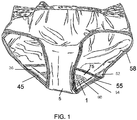
- the preferred embodiment of the garment comprising a moisture management incontinence pad 100 shown in figure 4A and B comprises at least one sheet 1 of a liquid absorbent material, with an inside surface 11 provided for residing nearest the body of a user and an outside surface 12 provided for residing nearest the undergarment 5.
- the sheet of liquid absorbent material further comprises opposite upright end sides 8, 9 in cross direction of the material, and opposite upright sides 6, 7 usually in longitudinal direction of the material, although these may also extend crosswise of the sheet of liquid absorbent material.
- the inside surface 11 of the sheet of liquid absorbent material is connected to the opposite upright end sides 8, 9 respectively by means of upper end edges 8" and 9', the outside surface 12 of the sheet of liquid absorbent material is connected to the opposite upright end sides 8, 9 respectively by means of lower end edges 8" and 9".
- the inside surface 11 of the sheet of liquid absorbent material is connected to the opposite upright sides 6, 7 respectively by means of upper end edges 6' and 7', the outside surface 12 of the sheet of liquid absorbent material is connected to the opposite upright sides 6, 7 respectively by means of lower side edges 6" and 7".
- the moisture management incontinence pad 100 further comprises:
- the inside surface 11 of the sheet of liquid absorbent material 1 provided for residing nearest the body of a user may be covered with or may comprise a one way layer of a liquid permeable material 15, which permits and even facilitates absorption of any liquid or moisture contacting the surface of the pad and ensures quick transfer of the absorbed liquid towards the liquid absorbing material 1.
- Layer 15 may for example act as a liquid acquisition and distribution layer and may be provided to collect and transfer liquid from the person wearing the pad to the lower sheet of liquid absorbent material 1, to ensure that the individual wearing the pad experiences a dry feeling, even after liquid or moisture expelled by that individual has been absorbed by the moisture management incontinence pad.
- Layer 15 may be made of a material which prevents back flow of liquid or moisture from the liquid absorbent layer back to the skin of the individual wearing the pad.
- Layer 15 may for example be made of a soft material as it may contact the skin of the wearer.
- Layer 15 may for example be made of a fleece material, however, any other material considered suitable by the skilled person may be used, such as natural, biodegradable fibre (usually starch fibre or cotton) permitting washing and thereby re-utilisation of the garment.
- Layer 15 may also be made of or include a material having anti-bacterial properties and/or it may be made of a material which has been coated or impregnated with an antibacterial substance, for example one or more compounds selected from silver, a silver compound, titanium dioxide, a quaternary silane, hydrogen peroxide, triclosan or zinc pyrithione.
- the layer 15 may further comprise a substance that combats odour, for example high surface area mineral compositions.
- the sheet of liquid absorbent material 1 may be made of any material considered suitable by the skilled person for absorbing liquids in general or body liquids in particular.
- the sheet of liquid absorbent material 1 may be made of a single layer of liquid absorbent material, or it may be a laminate of two or more layers as is shown in fig. 5 and 6 , wherein several layers are combined to form the liquid absorbent material.
- the individual layers forming the liquid absorbent material may be made of the same material, or of different materials. Where use is made of a laminate, the individual layers may adhere to each other over their entire contact surface, or along part of the contact surface only.
- liquid absorbent materials examples include bound, non-woven fibre cloth, so-called non-woven materials, woven materials, perforated plastic films, nets as well as open-cell or perforated foam material.
- suitable materials include natural, highly biodegradable fibre (usually starch fibre or cotton) permitting washing and thereby re-utilisation of the sanitary towel.
- Laminates for example laminates of non-woven material and plastic film, can also be used as long as they are capable of absorbing the liquid or moisture.
- Suitable materials for producing the liquid absorbent material 1 include one or more of the group consisting of polyamide, polyester, polyolefin, polyurethane, polyacrylonitrile, natural cellulose, regenerated cellulose, regenerated cellulose derivatives (i.e.
- the layer of the liquid absorbent material 1 may be produced using technologies such as knitting (warp knitting such as raschel Tricot, weft knitting such as circular or flat), weaving, non-woven methods (blow spinning, staple nonwoven, spun laid, air-laid, needle punched, thermal bonded, hydro-entangled, chemical bonded and so forth), electro-spinning, force-spinning etc.
- knitting warp knitting such as raschel Tricot, weft knitting such as circular or flat
- weaving non-woven methods (blow spinning, staple nonwoven, spun laid, air-laid, needle punched, thermal bonded, hydro-entangled, chemical bonded and so forth), electro-spinning, force-spinning etc.
- the material of which the layer of the liquid absorbent material 1 is made may also include one or more coatings, treatments encapsulation or entrapments, which would enhance its liquid and moisture management functionality, such as rate of absorbency/wicking, absorption capacity, rate of spreading and distribution, one way liquid or moisture transport etc.
- the sheet of liquid absorbent material 1 or one or more layers forming that sheet 1 may be made of or comprise a super-absorbent material, this is a liquid absorbent material capable of absorbing an amount of liquid which corresponds to many times the weight of the super-absorbent material.
- the sheet 1 of liquid absorbent material may further comprise a substance that combats odour, for example high surface area mineral compositions.
- the liquid absorbing material 1 of the pad 100 and of course the pad 100 in its entirety, may be formed with a dedicated three-dimensional shape which is adapted to at least partially, but preferably fully contact or surround the body part suffering from liquid leak, for example the genitals, or a breast if the pad is intended for use by female users.
- the pad and the moisture absorbent material may be given a shape which shows optimal fit with the shape of the body part to be covered.
- the first, second, third sheets of liquid impermeable material 10, 20, 30 may be made of the same material, or of different materials. Preferably however they are made of the same liquid impermeable material as this facilitates production of the pad. However, if the pad is intended for a particular application, where particular properties are envisaged, the nature of the material used to make the liquid impermeable sheets 10, 20, 30 may be selected to take into account the intended function.
- the sheets of liquid impermeable material 10, 20, 30 may comprise, consist of or include any fully or partly liquid-blocking, liquid repelling, moisture blocking or moisture repelling material known to the skilled person, in order that the pad may feel airy and comfortable to wear, to be breathable in dry form, while providing an effective barrier material upon exposure to liquid.
- the sheets of liquid impermeable material may be made of a material which is water or moisture repellent, or is coated with a coating providing such properties.
- a coating providing such properties.
- at least the side provided to face the user is water repellent, but preferably both opposite sides of the sheets of liquid impermeable material are water repellent.
- the liquid impermeable sheet 10, 20, 30 may be made of a liquid impermeable polymer (e.g. a thermoplastic polyurethane film), a liquid permeable or impermeable material coated with a hydrophobising material, for example a lightweight tightly knitted/woven fabric coated with SAP/hydrogel, or the liquid impermeable material may be a lightweight tightly knitted/woven fabric made using textile/SAP hybrid fibres.
- a liquid impermeable polymer e.g. a thermoplastic polyurethane film
- a liquid permeable or impermeable material coated with a hydrophobising material for example a lightweight tightly knitted/woven fabric coated with SAP/hydrogel
- the liquid impermeable material may be a lightweight tightly knitted/woven fabric made using textile/SAP hybrid fibres.
- the liquid impermeable material may be a liquid-proof membrane, or it may be made of a thin plastic film, or of a non-woven material which is made liquid impermeable by coating or treatment with a liquid resistent material, or of a plastic foam with closed cells, different kinds of liquid barrier laminates etc.
- the moisture management incontinence pad 100 comprises a first and a second inside sheet 10, 20 of a liquid impermeable material.
- the first inside sheet 10 is provided to extend along, preferably to envelope
- second inside sheet 20 is provided to extend along or to envelope
- At least a part 27, 57 of the first and second inside sheet 10, 20 is positioned and extends proximal to the outside surface 12 of the liquid absorbing material 1, i.e. the side of the liquid absorbing material pointing towards the undergarment.
- a first end flap 23 of the first inside sheet 10 is provided to extend mainly along the inside surface 11, in particular to reside on the inside surface 11, in a direction which extends along at least part of, but preferably along the entire length of the upright end side 8.
- a first end flap 24 of the second inside sheet 10 is provided to extend mainly along the inside surface 11, in particular to reside on inside surface 11, in a direction which extends along at least part of, but preferably along the entire length of upright end edge 9 of the sheet of liquid absorbent material 1.
- the first inside sheet 10 further preferably comprises a lower flap 21, which is provided to extend along the outside surface 12, in particular along the part of the outside surface 12 which runs along upright end edge 8 of the sheet of liquid absorbent material 1.
- the second inside sheet 20 further preferably comprises a lower flap 22, which is provided to extend along the outside surface 12, in particular along the part of the outside surface 12 which runs along upright end edge 9 of the sheet of liquid absorbent material 1.
- the first and second inside sheet 10, 20 may extend along the upright end sides 8, 9 of the liquid absorbing material or not, they may be made and used as separate sheets, which extend along part of the inside surface 11 of the liquid absorbent material and along part of the opposite outside surface 12 of the liquid absorbent material as described above.
- Lower flaps 21, 22 may be made as separate parts which are connected to the sheets 10, 20 along the lower end edges 8" and 9" of the liquid absorbent material.
- the connection is liquid tight, to minimize the risk to leaking of liquid past the connection.
- the first and second inside sheet 10, 20 may be made in one part and arranged in such a way that they are connected to each other along the outside surface of the liquid absorbent material, i.e.
- Making the first and second sheet 10, 20 in one part may increase the material thickness of the moisture management incontinence pad, and this may be desirable for some applications but may be undesired in other applications as well.
- making the first and second sheet 10, 20 in one part presents the advantage that the risk to liquid leaking into end pockets 65, 75 and further to the connection 51, 52 of the fourth sheet 40 and the first and second sheet 10, 20 is minimal.
- the first end flap 23 of the first inside sheet 10 is connected to a second end flap 33 of the first inside sheet
- the first end flap 24 of the second inside sheet 20 is connected to a second end flap 34 of the second inside sheet.
- the second end flap 33, 34 may be made in one part with the first end flap 23, 24 or the flaps are made as separate parts which are connected to each other, preferably by means of a liquid tight connection.
- the connection may for example be a mechanical connection, such as needling, stitching, braiding, stapling, glueing, welding, or any other equivalent connection technique considered suitable by the skilled person, which may be established in a liquid tight manner.
- the second end flap 33 covers, or in a preferred embodiment is double folded along a fold 25, over at least part of the first end flap 23 in cross direction of the incontinence pad 100 in the direction of the first upright end edge 8 of the liquid absorbing material.
- the second end flap 33 is connected to a first fastening flap 31 of the first inside sheet 10.
- the second end flap 34 covers, or in a preferred embodiment is double folded along a fold 26, over at least part of the first end flap 24 in the direction of the second upright end edge 14 of the liquid absorbing material.
- the second end flap is connected to a second fastening flap 32 of the first inside sheet 10.
- the first and second fastening flaps 31, 32 serve to connect the first and second inside sheet 10, 20 to respectively a third and a fourth end fastening flap 43, 44 on opposite end sides of the fourth sheet of liquid impermeable material, which is provided to form a liquid tight shield towards the undergarment.
- first end flap 23 and second end flap 33 on the one hand, and first end flap 24 and second end flap 34 on the other hand may be formed in one part and connected to each other by a fold, as is shown in figure 6 .
- second end flap 33 is folded with respect to first end flap 23 in a direction which points towards upright end edge 8 of the liquid absorbing material, the fold being located at the position of the inside surface 11 of the liquid absorbing material 1.
- second end flap 34 is folded with respect to first end flap 24 in a direction which points towards upright end edge 9 of the liquid absorbing material, the fold being located at the position of the inside surface 11 of the liquid absorbing material.
- Both the first end flap 23 of the first inside sheet 10, and the first end flap 24 of the second inside sheet 20 are connected 2 to the liquid absorbent material 1, in thickness direction of the liquid absorbent material.
- the connection 2 extends through the entire thickness of each of the end flaps 23, 24 and over at least part of the thickness of the liquid absorbent material, but the connection will preferably extend over the entire thickness of the liquid absorbent material 1.
- the connection 2 will generally not extend through the entire thickness of second end flaps 33, 34 up to the outside face 28, 29 of respectively the end flap 33, 34 provided to reside proximal to the individual wearing the moisture incontinence pad of this invention.
- the connection 2 will not extend towards, or into or through the second end flaps 33, 34.
- connection of the liquid absorbent material and the second end flaps 33, 34 as described above, which reside on a side of the incontinence pad provided to face the individual wearing the undergarment with the moisture incontinence pad ensures that the risk to leaking of liquid from the liquid absorbent material 1 towards the second end flaps 33, 34 and face 28, 29 provided to reside proximal to the individual wearing the moisture incontinence pad is minimal.
- connections for example in the form of stitching, needling, braiding, stapling, function as a transport means for leaking liquid and promote leaking of liquid along them.
- any liquid that may leak along the connection between the liquid absorbing material and the first end flaps 23, 24 may be collected in an end pocket 65, 75 which is entirely delimited by liquid impermeable material.
- first and second sheet 10, 20 respectively comprise lower flaps 21, 22 which extend crosswise of connection 2
- connection 2 to the liquid absorbent material may also extent towards and into those lower flaps 21, 22. This way form stability of the moisture management incontinence pad may be ensured, and maintenance of a desired positioning of the first and second sheet 10, 20 with respect to the liquid absorbent material.
- connection 2, 2' will usually not only serve to connect flap 35 and 85 to the moisture absorbent material, but may also connect flap 35 and 85 to respectively flap 33 and 34 at the position where flap 35 overlaps with flap 33, 34, and at the position where flap 85 overlaps with flaps 33, 34.
- flaps 35 and 85 may be connected to respectively flaps 21 and 22, 43 and 44, and 401 and 402.
- the connection 2, 2' will generally extend between opposite edges 51 and 52 of the moisture incontinence pad.
- the connection 2, 2' may be a continuous connection.
- connection 2, 2' is interrupted at the position of flaps 34 and 33 as is shown in figure 4B , wherein one or more interruptions 111 may be provided to minimize the risk that connection 2, 2' would function as a conductor for moisture from moisture absorbent layer 11 to flaps 33 and 34 and further to the undergarment.
- first sheet of liquid impermeable material 10 is provided to envelope a first end side of the liquid absorbent material as well as part of the adjoining inside and outside surface 11, 12, whereas the second sheet 20 is provided to envelope an opposite second end side of the liquid absorbent material as well as a part of the adjoining inside and outside surface 11, 12.
- the moisture management incontinence pad 100 further comprises a third sheet of a liquid impermeable material 30, which extends in longitudinal direction of the pad 100.
- the third sheet of liquid impermeable material 30 is provided to run along at least part of the outside surface 12 of the sheet of liquid absorbent material 1.
- the third sheet of liquid impermeable material 30 is provided to also run along opposite upright sides 6, 7 of the sheet of liquid absorbent material 1.
- the third sheet of liquid impermeable material 30 is further provided to run along a part of the inside surface 11 of the liquid impermeable material 30 which extends along the upright side edges 6, 7 of the liquid absorbent material 1.
- the undergarment is an underpants or slip
- the side edges will generally extend along the so-called bows 78, 79 of the underpants or slip.
- the bows may be provided with an additional reinforcement 58 as they are prone to wearing because of the frequent skin contact.
- the part 46, 47 of the third sheet 30 which extends along the outside surface 12 of the liquid absorbent material is connected to the liquid absorbent material 1 and to the parts 76, 77 of the third sheet 30 which extend along the upright opposite sides 6, 7of the liquid absorbent material 1.
- Cover flaps 35, 85 of the third sheet 30 are covered by respectively a first and second fold flap 36, 37, in a direction which extends towards the inside surface 11 and runs along the upright sides 6, 7.
- the third sheet is made in one part and cover flaps 35, 85 of the third sheet 30 are double folded along a fold 60, 80 to form fold flaps 36, 37.
- the fold 60 connecting part 35 to first fold flap 36 will generally extend along upright side 6.
- the fold 80 connecting part 85 to first fold flap 37 on an opposite side of the pad 100 will generally extend along upright side 7.
- First and second fold flap 36, 37 extend over a part of the inside surface 11 and point towards one another, they run along the longitudinal edges 16, 17 of the inside surface 11.
- the first and second fold flap 36, 37 are connected to respectively a first and a second side fastening flap 38, 39 of the third sheet 30 along which the moisture management incontinence pad may be fastened to a under garment (see fig. 5 ).
- the side fastening flaps 38, 39 extend from respectively the first and second fold flaps 36, 37 in a direction which points away from the first and second upright sides 6, 7 of the liquid absorbent material.
- the opposite longitudinal sides 6, 7 will often be formed by the opposite bows 78, 79 for accommodating respectively the left and right leg of the individual wearing the pant.
- the moisture management incontinence pad 100 also comprises a fourth sheet of a liquid impermeable material 40, which is positioned on a side of the third inside sheet 30 which points away from the liquid absorbent material 1,or in other words on the side of the third sheet of liquid impermeable material provided for positioning proximal to an undergarment.
- the fourth sheet 40 comprises a first and a second end fastening flap 43, 44 which are connected to respectively the first and second end fastening flap 31, 32 of the first and second inside liquid impermeable sheet 10, 20 at a position which beyond the liquid absorbent material 1.
- the fourth sheet of liquid impermeable material further comprises a first and a second lower side fastening flap 41, 42, which are connected to respectively the first and second side fasting flap 38, 39 of the third inside impermeable sheet 30 at a position which beyond the liquid absorbent material.
- the moisture management incontinence pad shows a first and second side pocket 45, 55 or side channel, which extend along the opposite longitudinal sides of the moisture management incontinence pad 100, and first and second end pockets or end channels 65, 75 along the opposite end edges of the moisture management incontinence pad 100.
- These pockets or channels may serve as a volume capable of storing liquid or moisture that may have leaked from the liquid absorbent material 1 through the liquid impermeable sheets 10, 20, 30 enveloping the liquid absorbent material.
- the side pockets or channels 45, 55 thus provide an additional barrier between the upright longitudinal sides 6, 7 of the liquid absorbent material and the connection 53, 54 of the third and fourth sheet of liquid impermeable material 30, 40, in the sense that they serve to accommodated an liquid that would have leaked through the upright flaps 76, 77 of the third sheet of liquid impermeable material 30.
- the presence of this liquid storage space 45, 55 may further minimize the risk of liquid leakage when at the position 53, 54 where the third and fourth sheet of liquid impermeable material are connected to each other, the third and fourth sheet 30, 40 are further also connected to the undergarment, as is shown in figure 5 .
- the first side pocket 45 is formed by respectively the upright side flap 76 of the third inside sheet 30 of liquid impermeable material, which extends along the upright side 6 of the moisture absorbing material 1, the first fold flap 36 of the third liquid impermeable sheet and the first lower side fastening flap 41 of the fourth liquid impermeable sheet 40.
- the second side pocket 55 is formed by respectively the upright side flap 77 of the third inside sheet 30 of liquid impermeable material, which extends along the upright extending side 7 of the moisture absorbing material 1, the second fold flap 37 of the third sheet and the second lower side fastening flap 42 of the fourth liquid impermeable sheet 40.
- the first end pocket 65 is formed by respectively the upright extending part 71 of the first inside sheet 10 of liquid impermeable material, which extends along the upright extending end edge 13 of the liquid or moisture absorbing material, the third end fastening flap 43 of the fourth sheet of moisture impermeable material 40, and the first end fastening flap 31 of the first sheet 10 of moisture impermeable material.
- the second end pocket 75 is formed by respectively the upright extending part 72 of the second inside sheet of liquid impermeable material 20, which extends along the upright extending end edge 14 of the moisture absorbing material, the fourth end fastening flap 44 of the fourth sheet of moisture impermeable material 40, and the second end fastening flap 32 of the second sheet 20 of moisture impermeable material.
- the upright sides 6 and 7 may be enclosed by an envelope at a position between the liquid absorbent material and the upright extending parts of the third liquid impervious sheet 30.
- the upright sides 8 and 9 may be enclosed by an envelope at a position between the liquid absorbent material and the upright extending parts of respectively the first and second liquid impervious sheet 10, 20. This way the risk to the occurrence of leaks may be further reduced.
- the liquid absorbent material and garment are always separated by a sheet or a part of a sheet of a liquid impermeable material, so that the risk to direct leakage of liquid or moisture from the liquid absorbent material to the garment is minimal. From the description above it also appears that the parts of the liquid impermeable sheets 10, 20, 30, 40 which may contact the garment, are not connected to or do not contain a connection to the liquid absorbent material 1.
- the risk to leaking of liquid absorbed by the liquid absorbing material towards the outside liquid impermeable layer 40 for example along a seam, a connection or any other contact technique, can be reduced to a minimum.
- a liquid in particular a water repellent material at the position of the first and second fold flaps 36, 37, i.e. the part of the third sheet which extends along the inside surface of the liquid absorbent material and may contact the wearer of the pad, as well as at the position of first and second end flaps 33, 34 of the first and second sheets 10, 20, the risk to the transfer of liquid from the liquid absorbent material 1 to a garment containing the pad, along those flaps may be reduced to a minimum.
- the first and second side fastening flap 41, 42 of the fourth sheet of liquid impermeable material may be used to fasten the incontinence pad of this invention to first and second side edges of the garment 78, 79, positioned on opposite sides of the garment and of the moisture management incontinence pad.
- fastening may be required along adjacent sides of the moisture management incontinence pad.
- the first and second end fastening flap 31, 32 are provided to be in a floating arrangement with respect to the garment in which the incontinence pad is to be used. Or in other words, when used in pants, the crosswise extending end edges 31, 32 are not fastened to the material of the underpants. This may facilitate cleaning, washing and drying of the pad when mounted in or fastened to the garment. This will also reduce the risk to visibility of the pad within the cloths worn on top of the under garment and will reduce the risk to tensioning of the under garment at the position of the pad. Moreover, the absence of fastening at that position further reduces the risk to the occurrence of leaks.
- first and second (39) side fastening flap of the third liquid impermeable sheet 30 are respectively connected to the first (41) and second (42) side fastening flap of the fourth liquid impermeable sheet and to the garment.
- first and second side fastening flaps 38, 39 may be connected to opposite edges of a garment.
- the connection may for example extend along a seam 53, 54, which connects inside sheet 30 and outside sheet 40.
- first and second side fastening flaps 38, 39 may be connected to an edge of the underpants which extends along the opening in the underpants for receiving a leg.
- Opposite fastening flaps 31, 32 which extend along cross sides 8, 9 of the pad 1, and when mounted into the underpants extend crosswise between the openings in the underpants for receiving the legs, will generally not be connected to the underpants.
- Connections 51, 52 generally serve to connect the first and second liquid impermeable sheet to the fourth liquid impermeable sheet, and will not connect the moisture absorbent pad to the underpants.
- the moisture absorbent pad may be connected to the undergarment along two opposite sides or edges, while the other sides or edges are loose from the undergarment.
- This way of connecting the moisture absorbent pad to the undergarment permits some movement of the pad within the garment which may be needed to permit washing, drying, ironing, and which may correct for any differences in expansion between the material of the undergarment and the pad during washing, drying, ironing or any other use.
- connecting of the moisture management incontinence pad may be preferred along other edges, for example two adjacent edges. In general, only part of the edges or sides of the moisture management incontinence pad will be connected to the garment, to accommodate for different expansion coefficient of the material of the pad and the garment.
- the third sheet 30 and the fourth sheet 40 of liquid impermeable material are fastened to each other on opposite sides of the liquid permeable material 1 along their respective fastening flaps at a position 53, 54 adjacent to and beyond the upright side edges 6, 7 of the liquid permeable material 1.
- the absence of a contact with and a connection to the liquid permeable material 1 assists in minimizing the risk to leaking of liquid from the liquid permeable material 1 along the connection.
- the liquid absorbent material, the liquid impermeable material and the under garment are at no position connected by one and the same connection. This provides a basis for minimizing the risk to liquid leakage.
- Connecting or fastening of the liquid impermeable sheets to each other and/or to the material of the garment may be achieved using any technique considered suitable by the skilled person, for example one or more techniques selected from the group of stitching, braiding, tufting, needling, or a combination of two or more of these techniques. However any other technique considered suitable by the skilled person may be used.
- the moisture management incontinence pad of the present invention may be made in one part with the afore-mentioned garments. In that case preferably only two opposite sides of the pad are fastened to the garment, whereas the remaining sides of the pad are not fastened to the garment. This will facilitate cleaning and drying of the pad, which may be adviseable because of the moisture absorbent properties of at least part of the material of the pad, and because a large part of the surface of the pad is covered by liquid impermeable material, which will complicate and prolong the time needed to dry. But more importantly, this will contribute to minimizing the risk to the occurrence of liquid leaks from the pad to the garment.
- the inventors have namely observed that this construction assists in minimizing the occurrence of liquid leaks to the material of the garment 5, especially at the position where for example the first 23, 24 end flaps and the second end flaps 33, 34 of the third sheet of liquid impermeable material are connected to the cover flap 35, 85 and the fold flap 36, 37 of the first and second sheet of liquid impermeable material.
- the pad 100 is made as a separate part provided for removable mounting in the garment.
- the pad preferably comprises fastening means for removably fastening the pad to a garment.
- Removable fastening may for example be achieved by the use of press studs, wherein one part of the stud is mounted to the pad and the complementary part is mounted to the garment; by the use of co-operating hook- and loopband, wherein one of both is mounted to the pad and the other complementary band is mounted to the garment; co-operating loops and hooks, wherein for example a hook is mounted to the garment and a loop to cooperate therewith is mounted to the pad.
- fastening means for removably fastening the pad to a garment.
- the present invention also relates to a garment which comprises one or more moisture management incontinence pads as described above.
- the pad of the present invention may be produced as follows.
- the sheet of liquid acquisition material 15 is connected to the sheet of liquid absorbent material 11.
- the sheet of liquid absorbent material 11 may comprise one single layer or several layers positioned on top of each other.
- the sheet of liquid acquisition material 15 is preferably connected to all the layers of the sheet of liquid absorbent material 11. More preferably the connection extends from a top surface 9 of the sheet of liquid acquisition material 15, up to the lower outside surface 12 of the sheet of liquid absorbent material.
- the first and second sheet of liquid impermeable material 10, 20 are connected to the pad 1.
- a part 3 in particular a lower flap of each of the first and second sheet of liquid impermeable material 10, 20 is positioned along the lower crosswise extending edges 8" and 9" of the pad 100, further from those lower edges along the upright sides 8 and 9 towards the upper crosswise extending edges 8' and 9', so that a flap of each of the first and second sheet 23, 24 extends along opposite sides of an upper face 90 of the pad 1.
- Parts 3, liquid absorbent material 11, preferably liquid acquisition material 15 and flap 23, respectively 24 are connected together. This may for example be achieved by means of a connection which extends through the thickness of these layers.
- connection extends along the length of the pad in cross direction.
- the first and second sheet are double folded over the flaps 23, 24 to form cover flaps 33, 34. It is remarked that the connection will preferably not extend through the cover flaps 33, 34.
- the width of the flaps 33, 34 and 23, 24 will be selected such that it is sufficiently small to leave a liquid absorption area 90 along the surface of the pad, for liquid acquisition, and sufficiently large to form a liquid barrier and prevent liquid flow from the liquid absorption area 90 towards the connections 51, 52.
- Cover flaps 33, 34 are extended to form fastening flaps 31, 32 which extend along upright cross sides 8, 9 of the pad 1.
- the first and second sheet of liquid impermeable material may be made in one part. In that case, the sheet will extend along the lower outside surface 12 of the pad 1.
- the third sheet 30 of liquid impermeable material is positioned along the lower surface 12 of the pad 1 of liquid absorbent material.
- the third sheet is then folded along the lower edges 6", 7" to extend along the upright longitudinal sides 6, 7 of the pad 1, and further along the upper edges 6', 7' to form flaps 35, 85 which extend along opposite longitudinal sides of the pad, along opposite sides of an upper face 90 of the pad 1.
- the width of the flaps 35, 85 and 36, 37 will be selected such that it is sufficiently small to leave a liquid absorption area 90 along the surface of the pad, for liquid acquisition, and sufficiently large to form a liquid barrier and prevent liquid flow from the liquid absorption area 90 towards the edges 53, 54.
- the part of the third sheet 30 extending along the lower surface 12 of the pad, preferably liquid acquisition material 15 and flaps 35, respectively 85 are connected together. This may for example be achieved by means of a connection which extends through the thickness of these layers. It is remarked that the connection will preferably not extend through the fold flaps 36, 37. Preferably the connection extends along the length of the pad in longitudinal direction.
- the fold flaps 36, 37 are double folded over the cover flaps 35, 85 respectively, along a fold which is closed at the position of the upper face 90 of the pad 1, and which is open towards upright longitudinal sides 6, 7, to form connection flaps 38, 39 along opposite longitudinal sides of the pad.
- an end part of the third sheet may extend along and cover an outer face of the first and second sheet. At that position connection 53, 54 will extend through the third sheet 30, as well as through first and second sheets 10, 20 respectively.
- the thus obtained pad having the first, second and third sheets of liquid impermeable material 10, 20, 30 connected to it, is positioned on a fourth sheet 40 of liquid impermeable material, along the face of the first, second and third sheets of liquid impermeable material 10, 20, 30 which points away from the liquid absorbent material.
- the fastening flaps 31, 32 of respectively the first and second sheet of liquid impermeable material 10, 20, are connected to the parts 43, 44 of the fourth sheet 40 which extend along upright cross sides 8, 9 of the pad 1.
- the connection is formed in thickness direction of the pad 1. This connection provides a form stable enveloping of the liquid absorbent material by sheets of liquid impermeable material. No connection to the garment is established. The inventors have namely observed that a connection along all the sides or edges of the pad shows a high risk to liquid leaks.
- Flaps 38, 39 of the third sheet of liquid impermeable material 30 are connected to the parts of the fourth sheet 41, 42 which extend along the longitudinal upright sides 6, 7 and to the material of the garment 5 present at that position. When used with underpants, this will be a connection which extends along or forms the bows 78, 79.
Landscapes
- Health & Medical Sciences (AREA)
- Epidemiology (AREA)
- Engineering & Computer Science (AREA)
- Biomedical Technology (AREA)
- Heart & Thoracic Surgery (AREA)
- Vascular Medicine (AREA)
- Life Sciences & Earth Sciences (AREA)
- Animal Behavior & Ethology (AREA)
- General Health & Medical Sciences (AREA)
- Public Health (AREA)
- Veterinary Medicine (AREA)
- Absorbent Articles And Supports Therefor (AREA)
- Orthopedics, Nursing, And Contraception (AREA)
Applications Claiming Priority (1)
| Application Number | Priority Date | Filing Date | Title |
|---|---|---|---|
| PCT/NL2017/050524 WO2019027318A1 (fr) | 2017-08-04 | 2017-08-04 | Serviette d'incontinence à gestion de l'humidité |
Publications (1)
| Publication Number | Publication Date |
|---|---|
| EP3437604A1 true EP3437604A1 (fr) | 2019-02-06 |
Family
ID=59702786
Family Applications (1)
| Application Number | Title | Priority Date | Filing Date |
|---|---|---|---|
| EP18187529.5A Withdrawn EP3437604A1 (fr) | 2017-08-04 | 2018-08-06 | Vêtement comportant un tampon d'incontinence à gestion d'humidité |
Country Status (2)
| Country | Link |
|---|---|
| EP (1) | EP3437604A1 (fr) |
| WO (1) | WO2019027318A1 (fr) |
Cited By (10)
| Publication number | Priority date | Publication date | Assignee | Title |
|---|---|---|---|---|
| WO2020036477A1 (fr) * | 2018-08-17 | 2020-02-20 | Barcia Tapia Silvia Maribel | Linge d'intérieur pour absorber des liquides |
| GB2592873A (en) * | 2019-11-05 | 2021-09-15 | Maybo Underwear Ltd | Washable incontinence undergarment |
| US11154431B1 (en) * | 2020-11-06 | 2021-10-26 | Mast Industries (Far East) Limited | Absorbent garment and method of manufacture thereof |
| EP3906906A1 (fr) * | 2020-05-07 | 2021-11-10 | Spacerpad AB | Produit sanitaire lavable |
| US11207225B2 (en) | 2019-08-02 | 2021-12-28 | Mas Innovation (Private) Limited | Absorbent pad for a garment |
| AU2021221700B1 (en) * | 2021-08-25 | 2022-11-24 | Ahmed, Wesam | Body fluid management inserts and garments |
| EP3975961A4 (fr) * | 2019-05-24 | 2023-04-19 | Jaimex Nominees Pty Ltd | Tampons absorbants et vêtements |
| US20230157376A1 (en) * | 2021-11-23 | 2023-05-25 | Honor Your Flow | Menstrual garment |
| EP4329692A4 (fr) * | 2021-04-28 | 2025-03-12 | Delta Galil Industries Ltd. | Sous-vêtement sans couture étanche aux fuites ayant une serviette de protection contre les fuites en tissu |
| EP4588463A1 (fr) * | 2024-01-22 | 2025-07-23 | Knix Wear Inc. | Ensembles de rétention de fluide à blocage d'humidité, vêtements les comprenant et procédés associés |
Families Citing this family (6)
| Publication number | Priority date | Publication date | Assignee | Title |
|---|---|---|---|---|
| US11752043B2 (en) * | 2020-03-11 | 2023-09-12 | Thinx Inc. | Technologies for incontinence underwear |
| CN116033842B (zh) * | 2020-06-19 | 2025-05-02 | 星克斯公司 | 用于失禁和月经服装和内衣的技术 |
| US20230109095A1 (en) * | 2021-10-04 | 2023-04-06 | Mast Industries (Far East) Limited | Absorbent garment and method of manufacture thereof |
| WO2024044366A1 (fr) * | 2022-08-26 | 2024-02-29 | Thinx Inc. | Structure de performance de gousset et vêtement la comprenant |
| US20260069469A1 (en) * | 2022-08-26 | 2026-03-12 | Thinx Inc. | Gusset performance structure and garment including same |
| AU2023342604A1 (en) * | 2022-09-13 | 2025-04-17 | Thinx Inc. | Gusset performance structure and garment including same |
Citations (2)
| Publication number | Priority date | Publication date | Assignee | Title |
|---|---|---|---|---|
| BE1010279A5 (nl) * | 1996-04-26 | 1998-05-05 | Peeters Marc | Slip voor incontinente personen. |
| US20050273068A1 (en) * | 2004-06-04 | 2005-12-08 | Mark Miskie | Moisture management incontinence device |
-
2017
- 2017-08-04 WO PCT/NL2017/050524 patent/WO2019027318A1/fr not_active Ceased
-
2018
- 2018-08-06 EP EP18187529.5A patent/EP3437604A1/fr not_active Withdrawn
Patent Citations (2)
| Publication number | Priority date | Publication date | Assignee | Title |
|---|---|---|---|---|
| BE1010279A5 (nl) * | 1996-04-26 | 1998-05-05 | Peeters Marc | Slip voor incontinente personen. |
| US20050273068A1 (en) * | 2004-06-04 | 2005-12-08 | Mark Miskie | Moisture management incontinence device |
Cited By (23)
| Publication number | Priority date | Publication date | Assignee | Title |
|---|---|---|---|---|
| WO2020036477A1 (fr) * | 2018-08-17 | 2020-02-20 | Barcia Tapia Silvia Maribel | Linge d'intérieur pour absorber des liquides |
| EP3975961A4 (fr) * | 2019-05-24 | 2023-04-19 | Jaimex Nominees Pty Ltd | Tampons absorbants et vêtements |
| US12171646B2 (en) | 2019-08-02 | 2024-12-24 | Mas Innovation (Private) Limited | Absorbent pad for a garment |
| US12004935B2 (en) | 2019-08-02 | 2024-06-11 | Mas Innovation (Private) Limited | Absorbent pad for a garment |
| US11207225B2 (en) | 2019-08-02 | 2021-12-28 | Mas Innovation (Private) Limited | Absorbent pad for a garment |
| US11752049B2 (en) | 2019-08-02 | 2023-09-12 | Mas Innovation (Private) Limited | Absorbent pad for a garment |
| GB2592873A (en) * | 2019-11-05 | 2021-09-15 | Maybo Underwear Ltd | Washable incontinence undergarment |
| EP3906906A1 (fr) * | 2020-05-07 | 2021-11-10 | Spacerpad AB | Produit sanitaire lavable |
| US12514761B2 (en) | 2020-05-07 | 2026-01-06 | Ab Lindex | Washable sanitary product |
| WO2021224482A1 (fr) * | 2020-05-07 | 2021-11-11 | Spacerpad Ab | Produit sanitaire lavable |
| EP3995021B1 (fr) * | 2020-11-06 | 2025-06-04 | Mast Industries (Far East) Limited | Vêtement absorbant et son procédé de fabrication |
| CN114431549A (zh) * | 2020-11-06 | 2022-05-06 | 玛斯特工业(远东)有限公司 | 吸收性服装及用于制造该吸收性服装的方法 |
| US11957552B2 (en) | 2020-11-06 | 2024-04-16 | Mast Industries (Far East) Limited | Absorbent garment and method of manufacture thereof |
| US11154431B1 (en) * | 2020-11-06 | 2021-10-26 | Mast Industries (Far East) Limited | Absorbent garment and method of manufacture thereof |
| EP4329692A4 (fr) * | 2021-04-28 | 2025-03-12 | Delta Galil Industries Ltd. | Sous-vêtement sans couture étanche aux fuites ayant une serviette de protection contre les fuites en tissu |
| EP4391981A4 (fr) * | 2021-08-25 | 2024-12-18 | Wesam Fawzi Ahmed | Inserts et vêtements de gestion de fluide corporel |
| US12239511B2 (en) | 2021-08-25 | 2025-03-04 | Wesam Fawz Ahmed | Body fluid management inserts and garments |
| WO2023023777A1 (fr) * | 2021-08-25 | 2023-03-02 | Wesam Fawzi Ahmed | Inserts et vêtements de gestion de fluide corporel |
| AU2021221700B1 (en) * | 2021-08-25 | 2022-11-24 | Ahmed, Wesam | Body fluid management inserts and garments |
| US12150494B2 (en) * | 2021-11-23 | 2024-11-26 | Honor Your Flow | Menstrual garment |
| US20230157376A1 (en) * | 2021-11-23 | 2023-05-25 | Honor Your Flow | Menstrual garment |
| EP4588463A1 (fr) * | 2024-01-22 | 2025-07-23 | Knix Wear Inc. | Ensembles de rétention de fluide à blocage d'humidité, vêtements les comprenant et procédés associés |
| US12599181B2 (en) | 2024-01-22 | 2026-04-14 | Knix Wear Inc. | Moisture lock fluid retention assemblies, garments including the same, and related methods |
Also Published As
| Publication number | Publication date |
|---|---|
| WO2019027318A1 (fr) | 2019-02-07 |
Similar Documents
| Publication | Publication Date | Title |
|---|---|---|
| KR102422176B1 (ko) | 의류용 흡수성 패드 | |
| WO2019027318A1 (fr) | Serviette d'incontinence à gestion de l'humidité | |
| US20200297556A1 (en) | Functional fabrics, protective garments made therefrom, and methods of making | |
| US20130045651A1 (en) | Integrated, washable and reusable three-dimensional (3d) multifunctional knitted fabric structure and method to produce the same | |
| US20180014983A1 (en) | Absorbable pad | |
| US20110224639A1 (en) | Absorbent Garment | |
| RU221607U1 (ru) | Многоразовая гигиеническая прокладка | |
| RU2784422C1 (ru) | Впитывающая прокладка для предмета одежды | |
| CN213607486U (zh) | 经期裤 | |
| RU113957U1 (ru) | Предмет функциональной одежды (варианты) | |
| AU2024317729A1 (en) | Reusable undergarment with absorbent crotch assembly | |
| RU117779U1 (ru) | Предмет функциональной одежды (варианты) | |
| RU107688U1 (ru) | Предмет функциональной одежды | |
| RU107687U1 (ru) | Предмет функциональной одежды | |
| RU107686U1 (ru) | Предмет функциональной одежды | |
| JP6131033B2 (ja) | 男性用下着 | |
| BR112022000568B1 (pt) | Almofada absorvente para uma peça de roupa | |
| JP2003135525A (ja) | 体液吸収性物品の着用に適した外装体およびこの外装体に用いられる補助部材 | |
| MXPA97008820A (en) | Indoor dress and breathable dress clothing and clothing for na |
Legal Events
| Date | Code | Title | Description |
|---|---|---|---|
| PUAI | Public reference made under article 153(3) epc to a published international application that has entered the european phase |
Free format text: ORIGINAL CODE: 0009012 |
|
| AK | Designated contracting states |
Kind code of ref document: A1 Designated state(s): AL AT BE BG CH CY CZ DE DK EE ES FI FR GB GR HR HU IE IS IT LI LT LU LV MC MK MT NL NO PL PT RO RS SE SI SK SM TR |
|
| AX | Request for extension of the european patent |
Extension state: BA ME |
|
| STAA | Information on the status of an ep patent application or granted ep patent |
Free format text: STATUS: THE APPLICATION IS DEEMED TO BE WITHDRAWN |
|
| 18D | Application deemed to be withdrawn |
Effective date: 20190807 |