EP3438364A1 - Panneau pour une structure de construction et procédé de fabrication d'un tel panneau - Google Patents
Panneau pour une structure de construction et procédé de fabrication d'un tel panneau Download PDFInfo
- Publication number
- EP3438364A1 EP3438364A1 EP17184648.8A EP17184648A EP3438364A1 EP 3438364 A1 EP3438364 A1 EP 3438364A1 EP 17184648 A EP17184648 A EP 17184648A EP 3438364 A1 EP3438364 A1 EP 3438364A1
- Authority
- EP
- European Patent Office
- Prior art keywords
- panel
- layer
- curvature
- mineral wool
- wool fibre
- Prior art date
- Legal status (The legal status is an assumption and is not a legal conclusion. Google has not performed a legal analysis and makes no representation as to the accuracy of the status listed.)
- Withdrawn
Links
- 238000004519 manufacturing process Methods 0.000 title claims description 14
- 239000011490 mineral wool Substances 0.000 claims abstract description 26
- 239000000835 fiber Substances 0.000 claims abstract description 25
- 239000000853 adhesive Substances 0.000 claims description 10
- 230000001070 adhesive effect Effects 0.000 claims description 10
- 238000000034 method Methods 0.000 claims description 6
- 239000002759 woven fabric Substances 0.000 claims description 3
- 239000003292 glue Substances 0.000 description 9
- 238000010276 construction Methods 0.000 description 8
- 239000004814 polyurethane Substances 0.000 description 7
- 239000006260 foam Substances 0.000 description 6
- 229920002635 polyurethane Polymers 0.000 description 5
- 230000006835 compression Effects 0.000 description 4
- 238000007906 compression Methods 0.000 description 4
- 238000009413 insulation Methods 0.000 description 4
- 239000000463 material Substances 0.000 description 4
- 230000000717 retained effect Effects 0.000 description 2
- 239000004575 stone Substances 0.000 description 2
- 210000002268 wool Anatomy 0.000 description 2
- 239000004793 Polystyrene Substances 0.000 description 1
- 101710149268 Probable ATP-dependent RNA helicase spindle-E Proteins 0.000 description 1
- 230000004308 accommodation Effects 0.000 description 1
- 238000001035 drying Methods 0.000 description 1
- 230000000694 effects Effects 0.000 description 1
- 239000004744 fabric Substances 0.000 description 1
- 239000003365 glass fiber Substances 0.000 description 1
- 229920002223 polystyrene Polymers 0.000 description 1
Images


Classifications
-
- E—FIXED CONSTRUCTIONS
- E04—BUILDING
- E04B—GENERAL BUILDING CONSTRUCTIONS; WALLS, e.g. PARTITIONS; ROOFS; FLOORS; CEILINGS; INSULATION OR OTHER PROTECTION OF BUILDINGS
- E04B1/00—Constructions in general; Structures which are not restricted either to walls, e.g. partitions, or floors or ceilings or roofs
- E04B1/32—Arched structures; Vaulted structures; Folded structures
- E04B1/3205—Structures with a longitudinal horizontal axis, e.g. cylindrical or prismatic structures
-
- E—FIXED CONSTRUCTIONS
- E04—BUILDING
- E04C—STRUCTURAL ELEMENTS; BUILDING MATERIALS
- E04C2/00—Building elements of relatively thin form for the construction of parts of buildings, e.g. sheet materials, slabs, or panels
- E04C2/02—Building elements of relatively thin form for the construction of parts of buildings, e.g. sheet materials, slabs, or panels characterised by specified materials
- E04C2/10—Building elements of relatively thin form for the construction of parts of buildings, e.g. sheet materials, slabs, or panels characterised by specified materials of wood, fibres, chips, vegetable stems, or the like; of plastics; of foamed products
- E04C2/16—Building elements of relatively thin form for the construction of parts of buildings, e.g. sheet materials, slabs, or panels characterised by specified materials of wood, fibres, chips, vegetable stems, or the like; of plastics; of foamed products of fibres, chips, vegetable stems, or the like
-
- E—FIXED CONSTRUCTIONS
- E04—BUILDING
- E04C—STRUCTURAL ELEMENTS; BUILDING MATERIALS
- E04C2/00—Building elements of relatively thin form for the construction of parts of buildings, e.g. sheet materials, slabs, or panels
- E04C2/30—Building elements of relatively thin form for the construction of parts of buildings, e.g. sheet materials, slabs, or panels characterised by the shape or structure
- E04C2/32—Building elements of relatively thin form for the construction of parts of buildings, e.g. sheet materials, slabs, or panels characterised by the shape or structure formed of corrugated or otherwise indented sheet-like material; composed of such layers with or without layers of flat sheet-like material
- E04C2/328—Building elements of relatively thin form for the construction of parts of buildings, e.g. sheet materials, slabs, or panels characterised by the shape or structure formed of corrugated or otherwise indented sheet-like material; composed of such layers with or without layers of flat sheet-like material slightly bowed or folded panels not otherwise provided for
-
- E—FIXED CONSTRUCTIONS
- E04—BUILDING
- E04B—GENERAL BUILDING CONSTRUCTIONS; WALLS, e.g. PARTITIONS; ROOFS; FLOORS; CEILINGS; INSULATION OR OTHER PROTECTION OF BUILDINGS
- E04B1/00—Constructions in general; Structures which are not restricted either to walls, e.g. partitions, or floors or ceilings or roofs
- E04B1/62—Insulation or other protection; Elements or use of specified material therefor
- E04B1/74—Heat, sound or noise insulation, absorption, or reflection; Other building methods affording favourable thermal or acoustical conditions, e.g. accumulating of heat within walls
- E04B1/76—Heat, sound or noise insulation, absorption, or reflection; Other building methods affording favourable thermal or acoustical conditions, e.g. accumulating of heat within walls specifically with respect to heat only
- E04B1/78—Heat insulating elements
- E04B1/80—Heat insulating elements slab-shaped
-
- E—FIXED CONSTRUCTIONS
- E04—BUILDING
- E04B—GENERAL BUILDING CONSTRUCTIONS; WALLS, e.g. PARTITIONS; ROOFS; FLOORS; CEILINGS; INSULATION OR OTHER PROTECTION OF BUILDINGS
- E04B1/00—Constructions in general; Structures which are not restricted either to walls, e.g. partitions, or floors or ceilings or roofs
- E04B1/32—Arched structures; Vaulted structures; Folded structures
- E04B2001/327—Arched structures; Vaulted structures; Folded structures comprised of a number of panels or blocs connected together forming a self-supporting structure
Definitions
- the present invention relates to a panel for a building structure and a method of manufacturing such panel.
- Building structures such as temporary building structures, that are simple and fast to erect by using suitable panels are well known from e.g. WO 2013/064150 .
- a shelter construction which comprises premade shells, i.e. preformed panels of e.g. polyurethane or polystyrene concrete for providing insulation. This is advantageous over the shelter constructions disclosed in GB 1,178,261 where the shells are made of glass fibre.
- a panelised portable shelter is known.
- Such shelters are building structures of a portable kind are used in addition or instead of tents to provide immediate shelter for refugees, victims of a natural disaster or the like where people are made home-less and are therefore in need for accommodation.
- a requirement for such shelters is therefore that it is easy to transport to a sometimes remote geographical area in which it is needed and that it is easy to erect.
- Tents have been widely used as a tent fulfils these criteria, but a drawback for tents is that there is no thermal insulation. A further drawback is the relatively short life time of tents.
- the building structure could also be a low cost or semi-permanent building, i.e. in regions with poverty or in situations where the building is needed for a limited number of years, e.g. for housing children or as a hunting lodge.
- a building structure such as a shelter of the above-identified kind
- a building panel with good insulation properties besides the above-mentioned properties.
- the panels should also allow for construction that facilitates a quick, simple and easy construction of such a shelter.
- a shelter panel is disclosed in PCT/EP2017/056918 (not yet published) with a sandwich of mineral wool materials with a low density core sandwiched between high density layers on each side and with the low density core extending beyond the side edges so that a tight assembly between panels can be provided.
- this object is achieved by a panel for mounting in a building structure, which is simple and easy to manufacture.
- a panel for a building structure said panel having a generally rectangular shape with a curvature, such that the panel has a convex outer surface and a concave inner surface with a set of side edge regions and a set of end edge regions, wherein the panel comprises a first, innermost mineral wool fibre layer forming the concave inner surface and having a first outer surface; and a second, outermost mineral wool fibre layer forming the convex outer surface and a second inner surface, and wherein said second layer is glued to the first layer by bonding said second inner surface to said first outer surface.
- a two-layered panel is provided made of two mineral wool fibre slabs which are formed and then glued together in a form and thereby retains the form.
- the manufacture is simple and suitable for production locally or even on site.
- the two slabs constituting the layers may be transported to the manufacturing site in stacks of flat elements, which ensures a compact transport unit which is easy and cost-efficient to handle.
- the panels are preferably formed with a predefined curvature, which is essentially formed as half-shells so that two panels may be provided forming an arc and a number of panels are similarly erected adjacent each other to form a building structure in the form of a shelter comprising a plurality of panels.
- a thermally insulating panel is provided providing the shelter structure with thermal insulation just as the shelter hereby also attains fire-retarding properties.
- the adhesive used may be any kind of glue, such as polyurethane glue or foam, for example SikaBond®-T2i, which is a 1-component polyurethane glue, Casco Nobel Superfix 3890, PU Construction- & Precision Foam 594 (Danalim), Construction Extra 292 (Danalim) or other suitable construction glues or foams.
- glue such as polyurethane glue or foam
- SikaBond®-T2i which is a 1-component polyurethane glue
- Casco Nobel Superfix 3890 PU Construction- & Precision Foam 594 (Danalim), Construction Extra 292 (Danalim) or other suitable construction glues or foams.
- the density of the first, innermost mineral wool fibre layer is provided with the same or a higher density than the second, outermost mineral wool fibre layer.
- the density of either of the layers be kept within the range of 100-180 kg/m 3 .
- the thickness of each mineral wool fibre layer is preferably 25-50 mm or less and preferably the mineral wool fibre layers have the same thickness.
- the panel is provided on the convex side with a facing layer for absorbing tension forces on the element when the shelter is erected.
- the facing layer may be a woven fabric or non-woven fleece.
- the panels are preferably assembled by tension bars which are mounted through channels in the panels.
- tension bars which are mounted through channels in the panels.
- grooves may be pre-formed, such as cut out, on at least one the first outer surface of the innermost layer and/or the second inner surface of the outermost layer for providing the channels for a tension mounting system.
- the grooves are cut perpendicular to the side edge regions. If necessary, one or more mounting tubes are provided substantially perpendicular to the side edge regions.
- a method of manufacturing a panel for a building structure of the kind described above comprising the steps of:
- the method preferably further includes the step of providing a counter form with a curvature shape congruently shaped relative to the predefined curvature of the panel form, and positioning said counter form against the innermost surface of the panel, and potentially biasing the counter form against the panel form to clamp the first and second layers in the form while the adhesive is curing.
- the panel form is a negative form with a predefined concave curvature.
- the panel form may be a positive form with a predefined convex curvature.
- grooves are preferably pre-cut on at least one of the first outer surface of the innermost layer and/or the second inner surface of the outermost layer perpendicular to the side edge regions thereof before said first and/or second layer is/are provided in the panel form.
- a panel for a temporary building structure such as a shelter
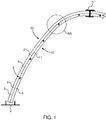
- the panel has a generally rectangular shape with a curvature, such that the panel has a convex outer surface 20 and a concave inner surface 10 with a set of side edge regions and a set of end edge regions.
- the panel comprises a first, innermost mineral wool fibre layer 1 forming the concave inner surface 10 and which has a first outer surface 11.
- the panel further comprises a second, outermost mineral wool fibre layer 2 forming the convex outer surface 20 and a second inner surface 21, at which surface 21 the second layer 2 is glued to the first layer 1 by an adhesive 9 bonding the second inner surface 11 to said first outer surface 21.
- a plurality of panels are assembled to a shelter.
- a mounting rail 4 may be provided in which the lower end of the panels on one side of the shelter are retained. At the top the other end sides of the panels are retained by a T-shaped mounting rail 5 to ensure that the abutting panels at the top are kept in position.
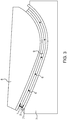
- the resulting two-layered panel is manufactured of two layers 1, 2 of mineral wool fibre slabs, which are positioned and formed in a negative form part 7 (see fig. 3 ) and during curing of the adhesive 9 a positive second form part 8 may be provided to ensure that the panel retains the curved form.
- the adhesive 9 used may be any kind of glue suitable for bonding mineral wool fibre materials, such as polyurethane glue or foam, for example SikaBond®-T2i, which is a 1-component polyurethane glue, Casco Nobel Superfix 3890, PU Construction- & Precision Foam 594 (Danalim), Construction Extra 292 (Danalim) or other suitable construction glues or foams.
- the form part 7, 8 is provided with a predefined curvature, which is essentially formed as half-shells so that two panels may be provided forming an arc and a number of panels are similarly erected adjacent each other to form a building structure in the form of a shelter comprising a plurality of panels (such as indicated in fig. 1 ).
- One of the form parts 7, 8 may include an opposite form part on the other side to enable a stack of panels to be made. This can save floor space at the manufacturing site, which may be important especially when working with glues requiring substantial drying or curing time.
- the two layers 1, 2 are made of mineral wool fibre material, preferably stone wool. This ensures a thermally insulating panel for the shelter structure as well as good fire-retarding properties.
- the density of the layers is preferably within the range of 100-180 kg/m 3 . Hereby, the sufficient strength and rigidity of the panel is achieved whilst the weight of the panel is kept low.
- the thickness of each mineral wool fibre layer is preferably 25-50 mm or less and preferably the mineral wool fibre layers 1, 2 have the same thickness.
- the panels As the panels are assembled in an arc-like structure in the shelter, the panels will be subjected to compression forces at their inner sides and potentially even tension forces on the outside surface. To ensure the form stability of the panels when subjected to such forces, it is advantageous to ensure a sufficient density of the innermost layer to absorb the compression forces without risking deformation of the panels. Therefore, the density of the innermost layer 1 may be higher than the outside layer 2. However, the density may also be the same, which may be advantageous for a cost perspective as the same slabs may be used for both the inner and outer layers 1, 2.
- the panel is provided with a facing layer 3 on the convex side.
- This facing layer 3 protects the outer surface of the panel and absorbs tension forces on the outer surface of the panel when the shelter is erected.
- the facing layer 3 may be a woven fabric or non-woven fleece.
- the panels may be provided with a facing, such as a fleece or fabric, on the concave inner side 10.
- a facing such as a fleece or fabric
- the effect of such a facing on the concave inner side 10 is mainly to add impact strength to surface, but also to provide improved aesthetics for inhabitants of the building structure.
- Such facing could be coloured or painted.
- the panels are preferably assembled by tension bars, which are mounted through channels 6 in the panels.
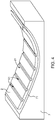
- grooves 61 may be pre-formed, such as cut out, on at least the first outer surface 11 of the innermost layer 1. It is also realised that in addition to or as an alternative the grooves 61 may be pre-formed in the second inner surface 21 of the outermost layer 2, such as shown in fig. 4 . When the two layers 1, 2 are then glued together, the grooves 61 will become channels 6 for a tension mounting system.
- the grooves 61 are cut perpendicular to the side edge regions of the panel. If necessary, mounting tubes 62 may be provided substantially perpendicular to the side edge regions in the grooves 61 (see fig. 5 ).
- the method of manufacturing the panel comprises the steps of placing a slab making up the first layer 1 in the negative form 7 with a predefined concave curvature 71, and then providing an adhesive 9 onto the inner surface 21 of said second layer 2, and then positioning the first layer 1 in the concavely shaped, adhesively coated second layer 2.
- a positive counter form part 8 with a convex shape congruently shaped relative to the predefined concave inner curvature 71 of the negative form part 7 may then be positioned abutting the concave innermost surface 10 of the panel, and potentially biasing the counter form part 8 against the negative form part 7 to clamp the first and second layers 1, 2 in the form while the adhesive is curing.
- the tension bar channels 6 may be drilled afterwards, or pre-made as grooves 61 pre-cut on at least one the first outer surface 11 of the innermost layer 1 and/or the second inner surface 21 of the outermost layer 2 perpendicular to the side edge regions thereof before said first and/or second layer 1, 2 is/are provided in the panel form.
- arc length 1.0 to 6.0 m and width of 0.4 to 2.0 m.
- Increasing the width reduces the number panels needed to provide a building structure, so assembly may be faster, but with increasing width manageability of the panels get worse.
- An advantage with increasing width is that the number of joints are reduced, and hence the risk of leakage.
Landscapes
- Engineering & Computer Science (AREA)
- Architecture (AREA)
- Civil Engineering (AREA)
- Structural Engineering (AREA)
- Life Sciences & Earth Sciences (AREA)
- Wood Science & Technology (AREA)
- Physics & Mathematics (AREA)
- Electromagnetism (AREA)
- Laminated Bodies (AREA)
Priority Applications (1)
| Application Number | Priority Date | Filing Date | Title |
|---|---|---|---|
| EP17184648.8A EP3438364A1 (fr) | 2017-08-03 | 2017-08-03 | Panneau pour une structure de construction et procédé de fabrication d'un tel panneau |
Applications Claiming Priority (1)
| Application Number | Priority Date | Filing Date | Title |
|---|---|---|---|
| EP17184648.8A EP3438364A1 (fr) | 2017-08-03 | 2017-08-03 | Panneau pour une structure de construction et procédé de fabrication d'un tel panneau |
Publications (1)
| Publication Number | Publication Date |
|---|---|
| EP3438364A1 true EP3438364A1 (fr) | 2019-02-06 |
Family
ID=59522980
Family Applications (1)
| Application Number | Title | Priority Date | Filing Date |
|---|---|---|---|
| EP17184648.8A Withdrawn EP3438364A1 (fr) | 2017-08-03 | 2017-08-03 | Panneau pour une structure de construction et procédé de fabrication d'un tel panneau |
Country Status (1)
| Country | Link |
|---|---|
| EP (1) | EP3438364A1 (fr) |
Citations (8)
| Publication number | Priority date | Publication date | Assignee | Title |
|---|---|---|---|---|
| GB1178261A (en) | 1966-01-25 | 1970-01-21 | English Electric Co Ltd | Improvements in or relating to Building Structures. |
| WO1990001090A1 (fr) * | 1988-07-25 | 1990-02-08 | Rockwool International A/S | Procede de fabrication de panneaux de plafond courbes et panneau de plafond ainsi fabrique |
| EP1111147A2 (fr) * | 1999-12-13 | 2001-06-27 | Fratelli Re S.r.l. | Structure d'un panneau monolithique courbe thermiquement et acoustiquement isolant, particulièrement utile pour recouvrir des bâtiments civils ou industriels |
| EP1826335A1 (fr) * | 2006-02-28 | 2007-08-29 | Rockwool International A/S | Système de façade isolée |
| EP2273024A2 (fr) * | 2009-07-09 | 2011-01-12 | Unilin BVBA | Elément de construction et construction de toiture |
| WO2013064150A1 (fr) | 2011-11-02 | 2013-05-10 | Evershelter Aps | Unité de construction servant d'abri immédiat ou permanent |
| FR2989704A1 (fr) * | 2012-04-24 | 2013-10-25 | Unilin Bvba | Elements de construction et construction de toiture |
| US8615934B1 (en) | 2011-10-07 | 2013-12-31 | Stephen C. Webb | Panelized portable shelter |
-
2017
- 2017-08-03 EP EP17184648.8A patent/EP3438364A1/fr not_active Withdrawn
Patent Citations (8)
| Publication number | Priority date | Publication date | Assignee | Title |
|---|---|---|---|---|
| GB1178261A (en) | 1966-01-25 | 1970-01-21 | English Electric Co Ltd | Improvements in or relating to Building Structures. |
| WO1990001090A1 (fr) * | 1988-07-25 | 1990-02-08 | Rockwool International A/S | Procede de fabrication de panneaux de plafond courbes et panneau de plafond ainsi fabrique |
| EP1111147A2 (fr) * | 1999-12-13 | 2001-06-27 | Fratelli Re S.r.l. | Structure d'un panneau monolithique courbe thermiquement et acoustiquement isolant, particulièrement utile pour recouvrir des bâtiments civils ou industriels |
| EP1826335A1 (fr) * | 2006-02-28 | 2007-08-29 | Rockwool International A/S | Système de façade isolée |
| EP2273024A2 (fr) * | 2009-07-09 | 2011-01-12 | Unilin BVBA | Elément de construction et construction de toiture |
| US8615934B1 (en) | 2011-10-07 | 2013-12-31 | Stephen C. Webb | Panelized portable shelter |
| WO2013064150A1 (fr) | 2011-11-02 | 2013-05-10 | Evershelter Aps | Unité de construction servant d'abri immédiat ou permanent |
| FR2989704A1 (fr) * | 2012-04-24 | 2013-10-25 | Unilin Bvba | Elements de construction et construction de toiture |
Similar Documents
| Publication | Publication Date | Title |
|---|---|---|
| EP3740628B1 (fr) | Panneau pour structure de construction présentant une courbure prédéfinie et procédé de fabrication d'un tel panneau | |
| US6226942B1 (en) | Building construction panels and method thereof | |
| US5285607A (en) | Building exterior wall panel | |
| US12129648B2 (en) | Wall assembly | |
| JP6281713B2 (ja) | 高断熱の建物を構築する方法ならびにその方法により構築された建物 | |
| CA3116773A1 (fr) | Ensembles de plancher, procedes de fabrication de ceux-ci et utilisation de tels ensembles dans un batiment | |
| EP3791031B1 (fr) | Structures de paroi en mousse présentant une résistance au cisaillement élevée et leurs procédés de fabrication | |
| US20130326986A1 (en) | System and Method for Light Steel Frame Construction | |
| JP4361863B2 (ja) | マット状無機繊維製断熱材およびその梱包体 | |
| US20100050549A1 (en) | Joint of parallel sandwich panels | |
| US9580906B1 (en) | Modular insulated building panels | |
| US4067758A (en) | Method of forming constructional elements | |
| US20220049489A1 (en) | Wall assembly | |
| EP2141299A2 (fr) | Panneau en sandwich et son procédé de production | |
| JP2019504225A (ja) | 断熱トラス | |
| EP3438364A1 (fr) | Panneau pour une structure de construction et procédé de fabrication d'un tel panneau | |
| US20090282777A1 (en) | Angle joint for sandwich panels and method of fabricating same | |
| US20140272311A1 (en) | Composite sandwich panels and method of forming round corners in composite sandwich panels | |
| EP3042003B1 (fr) | Élément de construction présentant première et seconde couche de couverture et un noyau intermédiaire en deux matériaux différents | |
| JPS58164850A (ja) | 屋内及び屋外面用断熱構造体 | |
| US20140260085A1 (en) | Columnar structural component and method of forming | |
| US8875475B2 (en) | Multiple panel beams and methods | |
| US20140260053A1 (en) | Columnar structural component and method of forming | |
| WO2017167634A1 (fr) | Panneau à monter dans une structure de bâtiment, et procédé de fabrication d'un tel panneau | |
| JPH07217070A (ja) | 建築用内外装構造材料 |
Legal Events
| Date | Code | Title | Description |
|---|---|---|---|
| PUAI | Public reference made under article 153(3) epc to a published international application that has entered the european phase |
Free format text: ORIGINAL CODE: 0009012 |
|
| AK | Designated contracting states |
Kind code of ref document: A1 Designated state(s): AL AT BE BG CH CY CZ DE DK EE ES FI FR GB GR HR HU IE IS IT LI LT LU LV MC MK MT NL NO PL PT RO RS SE SI SK SM TR |
|
| AX | Request for extension of the european patent |
Extension state: BA ME |
|
| STAA | Information on the status of an ep patent application or granted ep patent |
Free format text: STATUS: THE APPLICATION IS DEEMED TO BE WITHDRAWN |
|
| 18D | Application deemed to be withdrawn |
Effective date: 20190807 |