EP3438643B1 - Basislinienpulswertberechnungsverfahren und partikelzählverfahren eines hämatologischen analysators - Google Patents
Basislinienpulswertberechnungsverfahren und partikelzählverfahren eines hämatologischen analysators Download PDFInfo
- Publication number
- EP3438643B1 EP3438643B1 EP17773223.7A EP17773223A EP3438643B1 EP 3438643 B1 EP3438643 B1 EP 3438643B1 EP 17773223 A EP17773223 A EP 17773223A EP 3438643 B1 EP3438643 B1 EP 3438643B1
- Authority
- EP
- European Patent Office
- Prior art keywords
- data
- datum
- memory
- sampled
- pulse
- Prior art date
- Legal status (The legal status is an assumption and is not a legal conclusion. Google has not performed a legal analysis and makes no representation as to the accuracy of the status listed.)
- Active
Links
Images



Classifications
-
- G—PHYSICS
- G01—MEASURING; TESTING
- G01N—INVESTIGATING OR ANALYSING MATERIALS BY DETERMINING THEIR CHEMICAL OR PHYSICAL PROPERTIES
- G01N15/00—Investigating characteristics of particles; Investigating permeability, pore-volume or surface-area of porous materials
- G01N15/10—Investigating individual particles
- G01N15/14—Optical investigation techniques, e.g. flow cytometry
- G01N15/1456—Optical investigation techniques, e.g. flow cytometry without spatial resolution of the texture or inner structure of the particle, e.g. processing of pulse signals
- G01N15/1459—Optical investigation techniques, e.g. flow cytometry without spatial resolution of the texture or inner structure of the particle, e.g. processing of pulse signals the analysis being performed on a sample stream
-
- G—PHYSICS
- G01—MEASURING; TESTING
- G01N—INVESTIGATING OR ANALYSING MATERIALS BY DETERMINING THEIR CHEMICAL OR PHYSICAL PROPERTIES
- G01N15/00—Investigating characteristics of particles; Investigating permeability, pore-volume or surface-area of porous materials
- G01N15/10—Investigating individual particles
-
- G—PHYSICS
- G01—MEASURING; TESTING
- G01D—MEASURING NOT SPECIALLY ADAPTED FOR A SPECIFIC VARIABLE; ARRANGEMENTS FOR MEASURING TWO OR MORE VARIABLES NOT COVERED IN A SINGLE OTHER SUBCLASS; TARIFF METERING APPARATUS; MEASURING OR TESTING NOT OTHERWISE PROVIDED FOR
- G01D5/00—Mechanical means for transferring the output of a sensing member; Means for converting the output of a sensing member to another variable where the form or nature of the sensing member does not constrain the means for converting; Transducers not specially adapted for a specific variable
- G01D5/12—Mechanical means for transferring the output of a sensing member; Means for converting the output of a sensing member to another variable where the form or nature of the sensing member does not constrain the means for converting; Transducers not specially adapted for a specific variable using electric or magnetic means
- G01D5/244—Mechanical means for transferring the output of a sensing member; Means for converting the output of a sensing member to another variable where the form or nature of the sensing member does not constrain the means for converting; Transducers not specially adapted for a specific variable using electric or magnetic means influencing characteristics of pulses or pulse trains; generating pulses or pulse trains
- G01D5/24471—Error correction
- G01D5/2448—Correction of gain, threshold, offset or phase control
-
- G—PHYSICS
- G01—MEASURING; TESTING
- G01N—INVESTIGATING OR ANALYSING MATERIALS BY DETERMINING THEIR CHEMICAL OR PHYSICAL PROPERTIES
- G01N15/00—Investigating characteristics of particles; Investigating permeability, pore-volume or surface-area of porous materials
- G01N15/10—Investigating individual particles
- G01N15/1031—Investigating individual particles by measuring electrical or magnetic effects
- G01N15/12—Investigating individual particles by measuring electrical or magnetic effects by observing changes in resistance or impedance across apertures when traversed by individual particles, e.g. by using the Coulter principle
-
- G—PHYSICS
- G01—MEASURING; TESTING
- G01N—INVESTIGATING OR ANALYSING MATERIALS BY DETERMINING THEIR CHEMICAL OR PHYSICAL PROPERTIES
- G01N15/00—Investigating characteristics of particles; Investigating permeability, pore-volume or surface-area of porous materials
- G01N15/10—Investigating individual particles
- G01N15/14—Optical investigation techniques, e.g. flow cytometry
- G01N15/1429—Signal processing
-
- G—PHYSICS
- G01—MEASURING; TESTING
- G01R—MEASURING ELECTRIC VARIABLES; MEASURING MAGNETIC VARIABLES
- G01R29/00—Arrangements for measuring or indicating electric quantities not covered by groups G01R19/00 - G01R27/00
- G01R29/02—Measuring characteristics of individual pulses, e.g. deviation from pulse flatness, rise time or duration
-
- G—PHYSICS
- G01—MEASURING; TESTING
- G01N—INVESTIGATING OR ANALYSING MATERIALS BY DETERMINING THEIR CHEMICAL OR PHYSICAL PROPERTIES
- G01N15/00—Investigating characteristics of particles; Investigating permeability, pore-volume or surface-area of porous materials
- G01N15/10—Investigating individual particles
- G01N2015/1006—Investigating individual particles for cytology
-
- G—PHYSICS
- G01—MEASURING; TESTING
- G01N—INVESTIGATING OR ANALYSING MATERIALS BY DETERMINING THEIR CHEMICAL OR PHYSICAL PROPERTIES
- G01N15/00—Investigating characteristics of particles; Investigating permeability, pore-volume or surface-area of porous materials
- G01N15/10—Investigating individual particles
- G01N15/14—Optical investigation techniques, e.g. flow cytometry
- G01N2015/1402—Data analysis by thresholding or gating operations performed on the acquired signals or stored data
-
- G—PHYSICS
- G01—MEASURING; TESTING
- G01N—INVESTIGATING OR ANALYSING MATERIALS BY DETERMINING THEIR CHEMICAL OR PHYSICAL PROPERTIES
- G01N15/00—Investigating characteristics of particles; Investigating permeability, pore-volume or surface-area of porous materials
- G01N15/10—Investigating individual particles
- G01N15/14—Optical investigation techniques, e.g. flow cytometry
- G01N2015/1486—Counting the particles
-
- G—PHYSICS
- G16—INFORMATION AND COMMUNICATION TECHNOLOGY [ICT] SPECIALLY ADAPTED FOR SPECIFIC APPLICATION FIELDS
- G16B—BIOINFORMATICS, i.e. INFORMATION AND COMMUNICATION TECHNOLOGY [ICT] SPECIALLY ADAPTED FOR GENETIC OR PROTEIN-RELATED DATA PROCESSING IN COMPUTATIONAL MOLECULAR BIOLOGY
- G16B99/00—Subject matter not provided for in other groups of this subclass
Definitions
- a baseline value, a starting point, an end point, a peak value, a valley value and the like of the pulse signal are extracted from the pulse signal, the baseline value is subtracted from the extracted peak value to obtain absolute peak value data, then the volume of the particles is obtained according to a directly proportional relation between the peak value of the pulse and the volume of the particles, and the particles are counted. If the signal is not accurately judged, the accuracy of particle counting is affected.
- the latest baseline value can be quickly obtained, but when ripples, bubbles, jitters, sudden changes, electromagnetic interference and other noise interference cause baseline fluctuation, the noise superposed on the baseline is accumulated on the baseline value in the calculation method, thereby deviating from the real baseline value, causing misjudgment of the baseline value, affecting the calculation of the absolute pulse peak, and ultimately affecting the accuracy of the particle counting.
- the pulse baseline value calculation method comprises the step of calculating the average value of n consecutive sampling data on the condition that the absolute value of the difference between two arbitrary adjacent data among the n consecutive sampling data is smaller than a baseline threshold value and the n consecutive sampling data are nearest to a pulse starting point within a pulse non-sustainable period, wherein the average value represents the baseline threshold value.
- the baseline threshold value is preset and compared, and the sampling data of a noise-superimposed baseline are avoided.
- US 6,680,476 B1 discloses a summed TOFMS having a filter for identifying detector outputs that are likely the result of noise rather than ions striking the ion detector.
- the TOFMS stores a plurality of data values at locations specified by a register that counts clock pulses.
- the filter receives the ion measurements from the ion detector and generates an output measurement value corresponding to each ion measurement.
- the filter sets the output measurement value to a predetermined baseline value if the filter determines that the ion measurement is noise, otherwise the filter sets the output measurement value to the ion measurement.
- An adder responsive to the clock signal, forms the sum of the data value specified by the register value and the output measurement value and stores the sum in the memory at the location corresponding to the register value.
- the pulse starting point identification method includes the following steps:
- the sampling frequency of the w continuous sampled data is 1.5-3.5 MHz, and the numerical range of w is an integer of 5-10.
- the starting point threshold is a preset value, and the numerical range of the starting point threshold is 20-60.
- a particle counting method of a hematology analyzer wherein the particle counting method includes a pulse baseline value calculation method, and within pulse non-duration time, if an absolute value of a difference value between any two adjacent data of n continuous sampled data is less than a baseline threshold, and the n continuous sampled data are closest to a pulse starting point, an average value of the n continuous sampled data is calculated, and the average value is a pulse baseline value.
- the number of the n continuous sampled data is 2 m , and the value of m is selected from 2, 3, 4 or 5.
- the pulse baseline value calculation method of the present invention has the advantages of setting the baseline threshold and performing comparison, avoiding the sampled data of the baseline where the noise is superimposed, selecting the sampled data with noise or interference within an allowable range for calculation, avoiding accumulating the noise on the final baseline value, that is, eliminating the noise interference during the baseline calculation, making the baseline value be closer to the real data, greatly reducing the erroneous judgment of the baseline value, and making the particle count be more accurate.
- a particle counting method of a blood cell analyze includes a pulse identification method, and the pulse recognition method includes a pulse baseline value calculation method.
- the pulse recognition method includes a pulse baseline value calculation method.
- the pulse baseline value calculation steps after the baseline threshold is set and comparison is made, the sampled data of the baseline where the noise is superimposed can be avoided, the sampled data with noise or interference within an allowable range are selected for calculation, the accumulation of the noise on the final baseline value is avoided, that is, the noise interference during the baseline calculation is eliminated, the baseline value is closer to the real data, the erroneous judgment of the baseline value is greatly reduced, and the particle count is more accurate.
- the specific calculation method that the absolute value of the difference value between any two adjacent data of the n continuous sampled data is smaller than the baseline threshold is as follows: calculating the difference value between two adjacent data one by one according to the sampling time, comparing the sizes of the absolute value of the difference value and the baseline threshold one by one, and calculating all data arrays satisfying the condition that the absolute value of the difference value between any two adjacent data of the n continuous sampled data is smaller than the baseline threshold.
- the pulse baseline value calculation method includes the following steps:
- the pulse baseline value calculation step the pulse starting point is also judged. Once the system detects the pulse starting point, that is, the pulse starts, the pulse baseline value calculation step stops, and the pulse baseline value is the current stored value. Within the pulse non-duration time, through the above calculation solution, there may be multiple data arrays meeting the requirements, multiple baseline values are calculated, the baseline values are covered in a chronological order, therefore, when the baseline values need to be valued, the system stores the currently latest baseline value, that is, the data array closest to the pulse starting point is selected, and the baseline value of the data array is calculated.
- the number of the n continuous sampled data is 2 m , and the value of m is selected from 2, 3, 4 or 5. That is, the number of the continuous sampled data is 4, 8, 16, or 32, an even number of data are used for judgment, which is relatively simple during the calculation, is conducive to saving the CPU resources and reducing the cost of the CPU. Further, the value of n is 8.
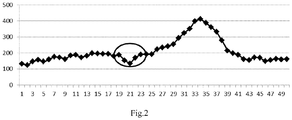
- Fig.2 is a voltage curve chart in a platelet detection process in the presence of downward interference, wherein the abscissa represents the number of sampled data, the vertical coordinate represents a measured voltage amplitude, the size of a pulse peak value x 34 is 413.
- Table 1 shows specific numerical values of sampled data x 1 -x 50 , and the data includes the sampled data within pulse non-duration time and the sampled data within pulse duration time. Taking the specific sampled data as an example to illustrate the pulse baseline value calculation steps in which the value of n is 8, the baseline threshold is 20, and the data x 22 is the pulse starting point:
- Fig.4 is a voltage curve chart in a red blood cell detection process in the presence of upward interference, wherein the abscissa represents the number of sampled data, the vertical coordinate represents a measured voltage amplitude, the size of a pulse peak value x 36 is 1314. Calculation is performed in such a manner that value of n is 8, the baseline threshold is 20, and the data x 23 is the pulse starting point.
- Table 3 shows specific numerical values of sampled data x 1 -x 50 in Fig. 4 , and the data include the sampled data within pulse non-duration time and the sampled data within pulse duration time.
- the pulse baseline value is the average value 262.12 of 8 data from x 15 to x 22 . It can be clearly seen in an area marked by a black circle in Fig.4 that the voltage curve has an upward interference before the starting of the pulse, the interference is within the interval of x 18 to x 20 , in the method of the prior art, the interference in the circle is calculated within the baseline value, however, the value interval of the baseline value calculation of the present invention is x 10 to x 17 , thereby avoiding the interference interval.
- Tests and calculation prove that the combination of any three numerical values of the value range of the sampling frequency of 1.5-3.5 MHz, the numerical range of n of 4, 8, 16 or 32 and the numerical range of the baseline threshold of 10-30, for example, the combination in which the sampling frequency is 1.5MHz, the value of n is 8 and the baseline threshold is 30; or the combination in which the sampling frequency is 2.3MHz, the value of n is 16 and the baseline threshold is 15; or combination in which the sampling frequency is 3MHz, the value of n is 32 and the baseline threshold is 22; or a combination in which the sampling frequency is3.5 MHz, the value of n is 4 and the baseline threshold is 10; can all avoid the sampled data of the baseline where the noise is superimposed, selecting the sampled data with noise or interference within an allowable range for calculation, eliminating the noise interference during the baseline calculation, making the baseline value be closer to the real data, greatly reducing the erroneous judgment of the baseline value, and making the particle count be more accurate.
- the sampling frequency of the w continuous sampled data is 1.5-3.5 MHz, and the numerical range of w is an integer of 5-10.
- the specific value of the sampling frequency is selected from one of 1.5, 1.7, 2, 2.3, 2.5, 2.8, 3, 3.2, 3.5, and the numerical value of w is selected from one of 5, 6, 7, 8, 9, and 10. Further, the numerical value of w is 7.
- the starting point threshold is a preset value, and the numerical range of the starting point threshold is 20-60.
- the numerical value of the starting point threshold is selected from one of 20, 22, 24, 25, 27, 29, 30, 32, 35, 37, 39, 40, 43, 45, 48, 50, 52, 55, 57, 60.
- the starting point threshold is 40.
- the main influence factor of the starting point threshold is the system noise, the starting point threshold is preset according to the magnitude of the system noise, and when the starting point threshold is detected, the interference of the noise interference can be removed, and the pulse starting point can be accurately detected.
- the numerical value of the sampling frequency, the numerical value of w and the numerical value of the starting point threshold can be randomly combined.
- Fig.6 is a voltage curve chart in a red blood cell detection process in the presence of downward interference, wherein the abscissa represents the number of sampled data, the vertical coordinate represents a voltage amplitude, the size of a pulse peak value x 32 is 884, Table 5 shows specific numerical values of sampled data x 1 -x 45 , and the data include the sampled data within pulse non-duration time and the sampled data within pulse duration time.
- the calculation steps of the pulse starting point by taking specific sampled data as an example in which the numerical value of w is 7 and the starting point threshold is 40:.
- the x 18 is the starting point of the current pulse.
- Fig.6 in the calculation process of the pulse starting point, if the pulse interference is encountered, the situation that individual sampling points are progressively decreased from the beginning of the pulse starting point, it can be clearly seen from a site marked by a black circle in Fig.6 that an obvious drop occurs at the x 24 point, all data in front of the x 24 point are removed very easily if the method in the prior art is applied to the calculation, the x 24 point is deemed as the pulse starting point, but the actual pulse starting point is x 18 , thus affecting the accuracy of the pulse width calculation.
Landscapes
- Chemical & Material Sciences (AREA)
- Physics & Mathematics (AREA)
- General Physics & Mathematics (AREA)
- General Health & Medical Sciences (AREA)
- Health & Medical Sciences (AREA)
- Life Sciences & Earth Sciences (AREA)
- Pathology (AREA)
- Biochemistry (AREA)
- Analytical Chemistry (AREA)
- Immunology (AREA)
- Dispersion Chemistry (AREA)
- Engineering & Computer Science (AREA)
- Signal Processing (AREA)
- Bioinformatics & Computational Biology (AREA)
- Biotechnology (AREA)
- Evolutionary Biology (AREA)
- Medical Informatics (AREA)
- Spectroscopy & Molecular Physics (AREA)
- Theoretical Computer Science (AREA)
- Bioinformatics & Cheminformatics (AREA)
- Measurement Of Current Or Voltage (AREA)
- Investigating Or Analysing Biological Materials (AREA)
Claims (8)
- Verfahren zur Berechnung eines Puls-Basiswertes, bei dem innerhalb der Puls-Nichtdauerzeit, falls ein Absolutwert eines Differenzwerts zwischen zwei beliebigen benachbarten Daten von n kontinuierlich abgetasteten Daten kleiner als ein Basislinien-Schwellenwert ist und die n kontinuierlich abgetasteten Daten einem Puls-Startpunkt am nächsten sind, ein Durchschnittswert der n kontinuierlich abgetasteten Daten berechnet wird und der Durchschnittswert ein Puls-Basiswert ist.
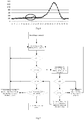
- Verfahren zur Berechnung des Puls-Basiswertes nach Anspruch 1, dadurch gekennzeichnet, dass es die folgenden Schritte umfasst:a) Voreinstellen eines Speichers, wobei der Speicher zum Speichern von abgetasteten Daten verwendet wird;b) Empfangen der abgetasteten Daten durch den Speicher in einer chronologischen Reihenfolge der Abtastung innerhalb der Puls-Nichtdauerzeit und akkumulatives Addieren von 1 zu einer gespeicherten Datennummer i in dem Speicher jedes Mal, wenn der Speicher ein abgetastetes Datum speichert;c) wenn i>1, Eintritt in Schritt d), andernfalls Rückkehr zu Schritt b) und weiteres Warten auf den Empfang der abgetasteten Daten;d) Beurteilen, ob ein Absolutwert eines Differenzwertes zwischen dem aktuellen abgetasteten Datum und dem vorhergehenden abgetasteten Datum kleiner als ein Basisschwellenwert ist, falls der Absolutwert kleiner als der Basisschwellenwert ist, andernfalls Eintreten in Schritt e), wobei Durchführen eines Null-Löschens für das i-te Datum in dem Speicher und die gespeicherte Datennummer i erfolgt, dann Zurückkehren zu Schritt b) und erneutes Starten, um die abgetasteten Daten zu empfangen; unde) Beurteilen, ob die gespeicherte Datennummer i gleich n ist, falls i=n, Berechnen des Durchschnittswerts der n Daten als den aktuellen Basislinienwert, dann Verwerfen des ersten Datums durch den Speicher und Verschieben der anderen n-1 Daten nach vorne, d.h. Speichern des n-ten Datums in dem (n-1)-ten Speicher, Subtrahieren von 1 von der gespeicherten Datennummer i, dann Zurückkehren zu Schritt b) und weiteres Warten auf den Empfang der abgetasteten Daten; und falls die gespeicherte Datennummer i nicht gleich n ist, direktes Rückkehren zu Schritt b) und Fortsetzen des Wartens auf den Empfang der abgetasteten Daten.
- Verfahren zur Berechnung des Puls-Basiswertes nach Anspruch 1 oder 2, wobei die Abtastfrequenz der n kontinuierlich abgetasteten Daten 1,5-3,5 MHz beträgt.
- Verfahren zur Berechnung des Puls-Basislinienwerts nach Anspruch 3, wobei die Anzahl der n kontinuierlich abgetasteten Daten 2m beträgt und der Wert von m aus 2, 3, 4 oder 5 ausgewählt ist.
- Verfahren zur Berechnung des Puls-Basiswertes nach Anspruch 1 oder 2, wobei der Puls-Startpunkt nach einem der folgenden Verfahren ermittelt wird: (1) wenn w Stücke kontinuierlicher abgetasteter Daten sukzessive und progressiv zunehmen und der Differenzwert zwischen dem w-ten Datum und dem ersten Datum in den w Daten größer ist als ein Startpunkt-Schwellenwert, dann ist der Puls-Startpunkt das erste Datum der w Stücke kontinuierlicher abgetasteter Daten; (2) oder wenn das j-te Datum der w-ten kontinuierlich abgetasteten Daten progressiv abnimmt, die anderen Daten progressiv ansteigen, währenddessen das (j+1)-te Datum größer ist als das (j-1)-te Datum und der Differenzwert zwischen dem w-ten Datum und dem ersten Datum in den w Daten größer ist als der Startpunkt-Schwellenwert, dann ist der Puls-Startpunkt das erste Datum der w-ten kontinuierlich abgetasteten Daten.
- Verfahren zur Berechnung des Puls-Basiswertes nach Anspruch 5, wobei das Verfahren zur Identifizierung des Puls-Startpunktes die folgenden Schritte umfasst:B1) Voreinstellen eines Speichers, wobei der Speicher zum Speichern von abgetasteten Daten verwendet wird;B2) Empfangen der abgetasteten Daten durch den Speicher in einer chronologischen Reihenfolge der Abtastung, jedes Mal, wenn der Speicher ein abgetastetes Datum speichert, akkumulatives Addieren von 1 zu einer gespeicherten Datennummer j in dem Speicher, nämlich Ersetzen von j durch (j+1);B3) wenn j>1, Eintritt in Schritt B4), andernfalls Rückkehr zu Schritt B2) und weiteres Warten auf den Empfang der abgetasteten Daten;B4) Beurteilung, ob der aktuelle abgetastete Datenwert y_j größer ist als der vorhergehende abgetastete Datenwert y_(j-1), wenn ja, Eintritt in Schritt B5), andernfalls Eintritt in Schritt B7);B5) Beurteilung, ob die gespeicherte Datennummer j gleich w ist, wenn j=w, Eintritt in Schritt B6); wenn j nicht gleich w ist, Rückkehr zu Schritt B2) und weiteres Warten auf den Empfang der abgetasteten Daten;B6) Beurteilen, ob der Differenzwert zwischen dem aktuellen abgetasteten Datenwert y_j und dem ersten Datenwert y_1 im Speicher größer als der Startpunkt-Schwellenwert ist, wenn der Differenzwert größer als der Startpunkt-Schwellenwert ist, Festlegen des ersten Datenwerts y_1 im Speicher als den Puls-Startpunkt; wenn der Differenzwert kleiner als der Startpunkt-Schwellenwert ist, Verwerfen des ersten Datums durch den Speicher, Vorrücken der anderen n-1 Daten, d.h. Speichern des w-ten Datums in dem (w-1)-ten Speicher, Subtrahieren von 1 von der gespeicherten Datennummer j, Zurückkehren zu Schritt B2) und weiteres Warten auf den Empfang der abgetasteten Daten;B7) Fortsetzen des Empfangs der abgetasteten Daten durch den Speicher, akkumulatives Addieren von 1 zu der gespeicherten Datennummer j im Speicher und akkumulatives Addieren von 1 zu einer progressiven Abnahme-Datenmarke q;B8) Beurteilen, ob q gleich 1 ist, wenn q=1, Eintreten in Schritt B9), oder andernfalls Eintreten in Schritt B10);B9) Beurteilen, ob der aktuelle abgetastete Datenwert y_j größer ist als der abgetastete Datenwert y_(j-2), wenn ja, Beurteilen, ob die gespeicherte Datennummer j gleich (w+1) ist, wenn ja, Ersetzen von j durch (j-1) und Zurückkehren zum Schritt B5), wenn nicht, Zurückkehren zum Schritt B5), oder andernfalls Eintreten in Schritt B10);undB10) Durchführen eines Null-Löschens für alle Daten im Speicher, der gespeicherten Datennummer j und der fortschreitenden Datenabnahme-Markierung q, Zurückkehren zu Schritt B2) und erneutes Starten, um die abgetasteten Daten zu empfangen.
- Verfahren zur Berechnung des Puls-Basiswertes nach Anspruch 6, wobei die Abtastfrequenz der w-teiligen kontinuierlichen Abtastdaten 1,5-3,5 MHz beträgt und der numerich4e Bereich von w eine ganze Zahl von 5-10 ist.
- Verfahren zur Berechnung des Puls-Basiswertes nach Anspruch 1, das als Partikelzählverfahren eines Hämatologie-Analysegerätes verwendet wird.
Applications Claiming Priority (2)
| Application Number | Priority Date | Filing Date | Title |
|---|---|---|---|
| CN201610199880.9A CN105866011B (zh) | 2016-03-31 | 2016-03-31 | 脉冲基线值计算方法及血球分析仪的粒子计数方法 |
| PCT/CN2017/078544 WO2017167193A1 (zh) | 2016-03-31 | 2017-03-29 | 脉冲基线值计算方法及血球分析仪的粒子计数方法 |
Publications (3)
| Publication Number | Publication Date |
|---|---|
| EP3438643A1 EP3438643A1 (de) | 2019-02-06 |
| EP3438643A4 EP3438643A4 (de) | 2019-11-20 |
| EP3438643B1 true EP3438643B1 (de) | 2021-10-27 |
Family
ID=56627536
Family Applications (1)
| Application Number | Title | Priority Date | Filing Date |
|---|---|---|---|
| EP17773223.7A Active EP3438643B1 (de) | 2016-03-31 | 2017-03-29 | Basislinienpulswertberechnungsverfahren und partikelzählverfahren eines hämatologischen analysators |
Country Status (4)
| Country | Link |
|---|---|
| US (1) | US11754489B2 (de) |
| EP (1) | EP3438643B1 (de) |
| CN (1) | CN105866011B (de) |
| WO (1) | WO2017167193A1 (de) |
Families Citing this family (16)
| Publication number | Priority date | Publication date | Assignee | Title |
|---|---|---|---|---|
| CN105866011B (zh) * | 2016-03-31 | 2018-10-26 | 艾康生物技术(杭州)有限公司 | 脉冲基线值计算方法及血球分析仪的粒子计数方法 |
| CN117531796A (zh) * | 2017-08-09 | 2024-02-09 | 利多(香港)有限公司 | 用于鞘流后池清洗装置的隔离池、鞘流后池清洗装置和血球分析仪 |
| CN110118715B (zh) * | 2018-02-06 | 2024-05-14 | 深圳市帝迈生物技术有限公司 | 一种血细胞脉冲信号分析装置以及方法 |
| CN110967246B (zh) * | 2018-09-29 | 2022-09-30 | 中国航发商用航空发动机有限责任公司 | 分离式霍普金森杆实验的数据处理方法及数据处理系统 |
| CN111122421A (zh) * | 2018-10-31 | 2020-05-08 | 深圳市帝迈生物技术有限公司 | 脉冲信号的基线处理方法以及装置、粒子检测系统 |
| US11184140B2 (en) * | 2018-11-01 | 2021-11-23 | Comcast Cable Communications, Llc | Uplink transmissions using multiple active resources |
| CN110257234A (zh) * | 2019-05-24 | 2019-09-20 | 军事科学院系统工程研究院卫勤保障技术研究所 | 一种基于电阻抗流式检测酵母形态及出芽比例的方法 |
| EP4610628A3 (de) * | 2020-09-22 | 2025-11-19 | Becton, Dickinson And Company | Verfahren zur kontinuierlichen messung des grundlinienrauschens in einem durchflusszytometer und systeme dafür |
| CN112945807A (zh) * | 2021-01-29 | 2021-06-11 | 深圳市科曼医疗设备有限公司 | 基于血液细胞分析仪的自动检测方法和装置 |
| CN115048032B (zh) * | 2021-03-09 | 2025-07-18 | 深圳市帝迈生物技术有限公司 | 脉冲信号的基线处理方法、识别方法和处理装置 |
| CN113109630B (zh) * | 2021-03-29 | 2022-10-04 | 深圳市科曼医疗设备有限公司 | 一种脉冲数据处理方法、装置及血液细胞分析仪 |
| CN115420868A (zh) * | 2022-08-30 | 2022-12-02 | 华能山东发电有限公司白杨河发电厂 | 一种工业循环水水质数据采样及处理方法 |
| CN115372262A (zh) * | 2022-09-13 | 2022-11-22 | 南京颐兰贝生物科技有限责任公司 | 一种五分类血液分析仪脉冲识别方法及装置 |
| CN115931037B (zh) * | 2022-12-23 | 2024-12-17 | 深圳市科曼医疗设备有限公司 | 粒子通道的堵孔识别方法、装置及系统、设备及存储介质 |
| CN116226115B (zh) * | 2023-05-10 | 2023-08-22 | 江西飞尚科技有限公司 | 一种智慧环保扬尘设备监测数据处理方法及系统 |
| CN116660970B (zh) * | 2023-07-07 | 2024-03-22 | 安徽中能聚控科技有限公司 | 一种基于中子伽马混合辐射的脉冲甄别方法及系统 |
Family Cites Families (15)
| Publication number | Priority date | Publication date | Assignee | Title |
|---|---|---|---|---|
| US6680476B1 (en) | 2002-11-22 | 2004-01-20 | Agilent Technologies, Inc. | Summed time-of-flight mass spectrometry utilizing thresholding to reduce noise |
| CN101344475B (zh) * | 2007-07-13 | 2011-09-07 | 深圳迈瑞生物医疗电子股份有限公司 | 信号基线处理装置及处理方法 |
| JP4882899B2 (ja) | 2007-07-25 | 2012-02-22 | ソニー株式会社 | 音声解析装置、および音声解析方法、並びにコンピュータ・プログラム |
| US7940105B2 (en) | 2008-08-08 | 2011-05-10 | Beckman Coulter, Inc. | High-resolution parametric signal restoration |
| CN102164104A (zh) * | 2011-01-12 | 2011-08-24 | 深圳市蓝韵实业有限公司 | 一种信号基线快速处理方法及装置 |
| CN102624367B (zh) * | 2011-01-30 | 2015-11-25 | 深圳迈瑞生物医疗电子股份有限公司 | 多通道脉冲同步识别装置和方法 |
| CN102289558B (zh) * | 2011-05-23 | 2014-10-01 | 公安部第一研究所 | 一种基于随机信号处理的基线调整方法 |
| CN102319064B (zh) * | 2011-10-13 | 2013-08-14 | 深圳市理邦精密仪器股份有限公司 | 一种提高胎心率数据减速识别准确性的装置和方法 |
| CN103006204B (zh) * | 2012-12-29 | 2014-07-16 | 重庆康如来科技有限公司 | 一种心电信号基线校准方法及装置 |
| CN103006205B (zh) * | 2012-12-29 | 2014-07-02 | 重庆邮电大学 | 一种心电信号基线识别器及识别方法 |
| US10288537B2 (en) * | 2013-02-04 | 2019-05-14 | Epona Biotech Ltd | Test fluid collection system |
| CN103969675B (zh) * | 2013-02-05 | 2017-08-04 | 苏州瑞派宁科技有限公司 | 数字化闪烁脉冲的基线校正方法及系统 |
| CN103235841B (zh) * | 2013-03-28 | 2015-12-23 | 中国科学院高能物理研究所 | 基线恢复方法及装置 |
| CN105078444B (zh) * | 2014-08-25 | 2020-02-14 | 深圳迈瑞生物医疗电子股份有限公司 | 一种噪声检测方法、装置及医疗检测设备 |
| CN105866011B (zh) | 2016-03-31 | 2018-10-26 | 艾康生物技术(杭州)有限公司 | 脉冲基线值计算方法及血球分析仪的粒子计数方法 |
-
2016
- 2016-03-31 CN CN201610199880.9A patent/CN105866011B/zh active Active
-
2017
- 2017-03-29 WO PCT/CN2017/078544 patent/WO2017167193A1/zh not_active Ceased
- 2017-03-29 US US16/091,044 patent/US11754489B2/en active Active
- 2017-03-29 EP EP17773223.7A patent/EP3438643B1/de active Active
Also Published As
| Publication number | Publication date |
|---|---|
| EP3438643A4 (de) | 2019-11-20 |
| US11754489B2 (en) | 2023-09-12 |
| CN105866011B (zh) | 2018-10-26 |
| CN105866011A (zh) | 2016-08-17 |
| EP3438643A1 (de) | 2019-02-06 |
| WO2017167193A1 (zh) | 2017-10-05 |
| US20190113437A1 (en) | 2019-04-18 |
Similar Documents
| Publication | Publication Date | Title |
|---|---|---|
| EP3438643B1 (de) | Basislinienpulswertberechnungsverfahren und partikelzählverfahren eines hämatologischen analysators | |
| KR101395268B1 (ko) | 펄스 처리 장치 및 방사선 분석 장치 | |
| EP2321661B1 (de) | Verfahren und system zur teilentladungsüberwachung | |
| JP2008501954A5 (de) | ||
| MXPA97006597A (en) | Method for the regulation and discrimination of the form of the impulse in a nucl spectroscopy system | |
| EP2179522B1 (de) | Steigungskorrektur für digitalen pulsprozessor | |
| US20100090677A1 (en) | Detecting and Handling Coincidence in Particle Analysis | |
| CN1182883A (zh) | 核谱学系统中用于调整和甄别脉冲形状的方法 | |
| CN102753963A (zh) | 使用材料的透射函数而辨识材料的方法及装置 | |
| CN111521915B (zh) | 一种高压直流线路起晕场强判定方法及系统 | |
| US11280771B2 (en) | Liquid chromatograph | |
| CN102624367B (zh) | 多通道脉冲同步识别装置和方法 | |
| JP2013519889A (ja) | 電離放射線のオンライン測定方法 | |
| CN120103088A (zh) | 一种高频放电信号识别方法 | |
| CN111060443B (zh) | 一种干扰脉冲识别方法、装置、存储介质及细胞计数设备 | |
| CN108931463B (zh) | 基于鞘流阻抗原理的血细胞脉冲识别方法及识别装置 | |
| CN113484617B (zh) | 一种脉冲幅度获取装置及脉冲幅度获取方法 | |
| JP3103047B2 (ja) | 核分光システムにおけるパルス波形調整及び弁別方法 | |
| US20250285854A1 (en) | Detector Bias Optimization and Monitoring on the Fly | |
| US12025626B2 (en) | Specimen analyzer | |
| CN107422362B (zh) | 一种能量谱和时间谱的降噪方法 | |
| JP5358441B2 (ja) | 自動動的ベースライン生成および調整 | |
| CN105353399B (zh) | 一种α/β射线流气式正比计数器高压工作点快速测定方法 | |
| Cumpson et al. | Simple Procedure for Precise Peak Maximum Estimation for Energy Calibration inAES andXPS | |
| Lessard | Stationarity and Ergodic Random Processes |
Legal Events
| Date | Code | Title | Description |
|---|---|---|---|
| STAA | Information on the status of an ep patent application or granted ep patent |
Free format text: STATUS: THE INTERNATIONAL PUBLICATION HAS BEEN MADE |
|
| PUAI | Public reference made under article 153(3) epc to a published international application that has entered the european phase |
Free format text: ORIGINAL CODE: 0009012 |
|
| STAA | Information on the status of an ep patent application or granted ep patent |
Free format text: STATUS: REQUEST FOR EXAMINATION WAS MADE |
|
| 17P | Request for examination filed |
Effective date: 20181030 |
|
| AK | Designated contracting states |
Kind code of ref document: A1 Designated state(s): AL AT BE BG CH CY CZ DE DK EE ES FI FR GB GR HR HU IE IS IT LI LT LU LV MC MK MT NL NO PL PT RO RS SE SI SK SM TR |
|
| AX | Request for extension of the european patent |
Extension state: BA ME |
|
| RIC1 | Information provided on ipc code assigned before grant |
Ipc: G01N 15/10 20060101AFI20171006BHEP Ipc: G06F 19/10 20110101ALI20171006BHEP |
|
| DAV | Request for validation of the european patent (deleted) | ||
| DAX | Request for extension of the european patent (deleted) | ||
| REG | Reference to a national code |
Ref country code: DE Ref legal event code: R079 Ref document number: 602017048316 Country of ref document: DE Free format text: PREVIOUS MAIN CLASS: G01N0015100000 Ipc: G01N0015120000 |
|
| A4 | Supplementary search report drawn up and despatched |
Effective date: 20191021 |
|
| RIC1 | Information provided on ipc code assigned before grant |
Ipc: G01N 15/12 20060101AFI20191015BHEP Ipc: G01R 29/02 20060101ALI20191015BHEP Ipc: G01D 5/244 20060101ALI20191015BHEP |
|
| GRAP | Despatch of communication of intention to grant a patent |
Free format text: ORIGINAL CODE: EPIDOSNIGR1 |
|
| STAA | Information on the status of an ep patent application or granted ep patent |
Free format text: STATUS: GRANT OF PATENT IS INTENDED |
|
| INTG | Intention to grant announced |
Effective date: 20210507 |
|
| GRAS | Grant fee paid |
Free format text: ORIGINAL CODE: EPIDOSNIGR3 |
|
| GRAA | (expected) grant |
Free format text: ORIGINAL CODE: 0009210 |
|
| STAA | Information on the status of an ep patent application or granted ep patent |
Free format text: STATUS: THE PATENT HAS BEEN GRANTED |
|
| AK | Designated contracting states |
Kind code of ref document: B1 Designated state(s): AL AT BE BG CH CY CZ DE DK EE ES FI FR GB GR HR HU IE IS IT LI LT LU LV MC MK MT NL NO PL PT RO RS SE SI SK SM TR |
|
| REG | Reference to a national code |
Ref country code: GB Ref legal event code: FG4D |
|
| REG | Reference to a national code |
Ref country code: CH Ref legal event code: EP |
|
| REG | Reference to a national code |
Ref country code: AT Ref legal event code: REF Ref document number: 1442214 Country of ref document: AT Kind code of ref document: T Effective date: 20211115 |
|
| REG | Reference to a national code |
Ref country code: DE Ref legal event code: R096 Ref document number: 602017048316 Country of ref document: DE |
|
| REG | Reference to a national code |
Ref country code: IE Ref legal event code: FG4D |
|
| REG | Reference to a national code |
Ref country code: LT Ref legal event code: MG9D |
|
| REG | Reference to a national code |
Ref country code: NL Ref legal event code: MP Effective date: 20211027 |
|
| REG | Reference to a national code |
Ref country code: AT Ref legal event code: MK05 Ref document number: 1442214 Country of ref document: AT Kind code of ref document: T Effective date: 20211027 |
|
| PG25 | Lapsed in a contracting state [announced via postgrant information from national office to epo] |
Ref country code: RS Free format text: LAPSE BECAUSE OF FAILURE TO SUBMIT A TRANSLATION OF THE DESCRIPTION OR TO PAY THE FEE WITHIN THE PRESCRIBED TIME-LIMIT Effective date: 20211027 Ref country code: LT Free format text: LAPSE BECAUSE OF FAILURE TO SUBMIT A TRANSLATION OF THE DESCRIPTION OR TO PAY THE FEE WITHIN THE PRESCRIBED TIME-LIMIT Effective date: 20211027 Ref country code: FI Free format text: LAPSE BECAUSE OF FAILURE TO SUBMIT A TRANSLATION OF THE DESCRIPTION OR TO PAY THE FEE WITHIN THE PRESCRIBED TIME-LIMIT Effective date: 20211027 Ref country code: BG Free format text: LAPSE BECAUSE OF FAILURE TO SUBMIT A TRANSLATION OF THE DESCRIPTION OR TO PAY THE FEE WITHIN THE PRESCRIBED TIME-LIMIT Effective date: 20220127 Ref country code: AT Free format text: LAPSE BECAUSE OF FAILURE TO SUBMIT A TRANSLATION OF THE DESCRIPTION OR TO PAY THE FEE WITHIN THE PRESCRIBED TIME-LIMIT Effective date: 20211027 |
|
| PG25 | Lapsed in a contracting state [announced via postgrant information from national office to epo] |
Ref country code: IS Free format text: LAPSE BECAUSE OF FAILURE TO SUBMIT A TRANSLATION OF THE DESCRIPTION OR TO PAY THE FEE WITHIN THE PRESCRIBED TIME-LIMIT Effective date: 20220227 Ref country code: SE Free format text: LAPSE BECAUSE OF FAILURE TO SUBMIT A TRANSLATION OF THE DESCRIPTION OR TO PAY THE FEE WITHIN THE PRESCRIBED TIME-LIMIT Effective date: 20211027 Ref country code: PT Free format text: LAPSE BECAUSE OF FAILURE TO SUBMIT A TRANSLATION OF THE DESCRIPTION OR TO PAY THE FEE WITHIN THE PRESCRIBED TIME-LIMIT Effective date: 20220228 Ref country code: PL Free format text: LAPSE BECAUSE OF FAILURE TO SUBMIT A TRANSLATION OF THE DESCRIPTION OR TO PAY THE FEE WITHIN THE PRESCRIBED TIME-LIMIT Effective date: 20211027 Ref country code: NO Free format text: LAPSE BECAUSE OF FAILURE TO SUBMIT A TRANSLATION OF THE DESCRIPTION OR TO PAY THE FEE WITHIN THE PRESCRIBED TIME-LIMIT Effective date: 20220127 Ref country code: NL Free format text: LAPSE BECAUSE OF FAILURE TO SUBMIT A TRANSLATION OF THE DESCRIPTION OR TO PAY THE FEE WITHIN THE PRESCRIBED TIME-LIMIT Effective date: 20211027 Ref country code: LV Free format text: LAPSE BECAUSE OF FAILURE TO SUBMIT A TRANSLATION OF THE DESCRIPTION OR TO PAY THE FEE WITHIN THE PRESCRIBED TIME-LIMIT Effective date: 20211027 Ref country code: HR Free format text: LAPSE BECAUSE OF FAILURE TO SUBMIT A TRANSLATION OF THE DESCRIPTION OR TO PAY THE FEE WITHIN THE PRESCRIBED TIME-LIMIT Effective date: 20211027 Ref country code: GR Free format text: LAPSE BECAUSE OF FAILURE TO SUBMIT A TRANSLATION OF THE DESCRIPTION OR TO PAY THE FEE WITHIN THE PRESCRIBED TIME-LIMIT Effective date: 20220128 Ref country code: ES Free format text: LAPSE BECAUSE OF FAILURE TO SUBMIT A TRANSLATION OF THE DESCRIPTION OR TO PAY THE FEE WITHIN THE PRESCRIBED TIME-LIMIT Effective date: 20211027 |
|
| REG | Reference to a national code |
Ref country code: DE Ref legal event code: R097 Ref document number: 602017048316 Country of ref document: DE |
|
| PG25 | Lapsed in a contracting state [announced via postgrant information from national office to epo] |
Ref country code: SM Free format text: LAPSE BECAUSE OF FAILURE TO SUBMIT A TRANSLATION OF THE DESCRIPTION OR TO PAY THE FEE WITHIN THE PRESCRIBED TIME-LIMIT Effective date: 20211027 Ref country code: SK Free format text: LAPSE BECAUSE OF FAILURE TO SUBMIT A TRANSLATION OF THE DESCRIPTION OR TO PAY THE FEE WITHIN THE PRESCRIBED TIME-LIMIT Effective date: 20211027 Ref country code: RO Free format text: LAPSE BECAUSE OF FAILURE TO SUBMIT A TRANSLATION OF THE DESCRIPTION OR TO PAY THE FEE WITHIN THE PRESCRIBED TIME-LIMIT Effective date: 20211027 Ref country code: EE Free format text: LAPSE BECAUSE OF FAILURE TO SUBMIT A TRANSLATION OF THE DESCRIPTION OR TO PAY THE FEE WITHIN THE PRESCRIBED TIME-LIMIT Effective date: 20211027 Ref country code: DK Free format text: LAPSE BECAUSE OF FAILURE TO SUBMIT A TRANSLATION OF THE DESCRIPTION OR TO PAY THE FEE WITHIN THE PRESCRIBED TIME-LIMIT Effective date: 20211027 Ref country code: CZ Free format text: LAPSE BECAUSE OF FAILURE TO SUBMIT A TRANSLATION OF THE DESCRIPTION OR TO PAY THE FEE WITHIN THE PRESCRIBED TIME-LIMIT Effective date: 20211027 |
|
| PLBE | No opposition filed within time limit |
Free format text: ORIGINAL CODE: 0009261 |
|
| STAA | Information on the status of an ep patent application or granted ep patent |
Free format text: STATUS: NO OPPOSITION FILED WITHIN TIME LIMIT |
|
| 26N | No opposition filed |
Effective date: 20220728 |
|
| PG25 | Lapsed in a contracting state [announced via postgrant information from national office to epo] |
Ref country code: MC Free format text: LAPSE BECAUSE OF FAILURE TO SUBMIT A TRANSLATION OF THE DESCRIPTION OR TO PAY THE FEE WITHIN THE PRESCRIBED TIME-LIMIT Effective date: 20211027 Ref country code: AL Free format text: LAPSE BECAUSE OF FAILURE TO SUBMIT A TRANSLATION OF THE DESCRIPTION OR TO PAY THE FEE WITHIN THE PRESCRIBED TIME-LIMIT Effective date: 20211027 |
|
| REG | Reference to a national code |
Ref country code: CH Ref legal event code: PL |
|
| PG25 | Lapsed in a contracting state [announced via postgrant information from national office to epo] |
Ref country code: SI Free format text: LAPSE BECAUSE OF FAILURE TO SUBMIT A TRANSLATION OF THE DESCRIPTION OR TO PAY THE FEE WITHIN THE PRESCRIBED TIME-LIMIT Effective date: 20211027 |
|
| REG | Reference to a national code |
Ref country code: BE Ref legal event code: MM Effective date: 20220331 |
|
| PG25 | Lapsed in a contracting state [announced via postgrant information from national office to epo] |
Ref country code: LU Free format text: LAPSE BECAUSE OF NON-PAYMENT OF DUE FEES Effective date: 20220329 Ref country code: LI Free format text: LAPSE BECAUSE OF NON-PAYMENT OF DUE FEES Effective date: 20220331 Ref country code: IE Free format text: LAPSE BECAUSE OF NON-PAYMENT OF DUE FEES Effective date: 20220329 Ref country code: CH Free format text: LAPSE BECAUSE OF NON-PAYMENT OF DUE FEES Effective date: 20220331 |
|
| PG25 | Lapsed in a contracting state [announced via postgrant information from national office to epo] |
Ref country code: BE Free format text: LAPSE BECAUSE OF NON-PAYMENT OF DUE FEES Effective date: 20220331 |
|
| PG25 | Lapsed in a contracting state [announced via postgrant information from national office to epo] |
Ref country code: IT Free format text: LAPSE BECAUSE OF FAILURE TO SUBMIT A TRANSLATION OF THE DESCRIPTION OR TO PAY THE FEE WITHIN THE PRESCRIBED TIME-LIMIT Effective date: 20211027 |
|
| P01 | Opt-out of the competence of the unified patent court (upc) registered |
Effective date: 20230516 |
|
| PG25 | Lapsed in a contracting state [announced via postgrant information from national office to epo] |
Ref country code: HU Free format text: LAPSE BECAUSE OF FAILURE TO SUBMIT A TRANSLATION OF THE DESCRIPTION OR TO PAY THE FEE WITHIN THE PRESCRIBED TIME-LIMIT; INVALID AB INITIO Effective date: 20170329 |
|
| PG25 | Lapsed in a contracting state [announced via postgrant information from national office to epo] |
Ref country code: MK Free format text: LAPSE BECAUSE OF FAILURE TO SUBMIT A TRANSLATION OF THE DESCRIPTION OR TO PAY THE FEE WITHIN THE PRESCRIBED TIME-LIMIT Effective date: 20211027 Ref country code: CY Free format text: LAPSE BECAUSE OF FAILURE TO SUBMIT A TRANSLATION OF THE DESCRIPTION OR TO PAY THE FEE WITHIN THE PRESCRIBED TIME-LIMIT Effective date: 20211027 |
|
| PG25 | Lapsed in a contracting state [announced via postgrant information from national office to epo] |
Ref country code: MT Free format text: LAPSE BECAUSE OF FAILURE TO SUBMIT A TRANSLATION OF THE DESCRIPTION OR TO PAY THE FEE WITHIN THE PRESCRIBED TIME-LIMIT Effective date: 20211027 |
|
| PG25 | Lapsed in a contracting state [announced via postgrant information from national office to epo] |
Ref country code: TR Free format text: LAPSE BECAUSE OF FAILURE TO SUBMIT A TRANSLATION OF THE DESCRIPTION OR TO PAY THE FEE WITHIN THE PRESCRIBED TIME-LIMIT Effective date: 20211027 |
|
| PGFP | Annual fee paid to national office [announced via postgrant information from national office to epo] |
Ref country code: GB Payment date: 20260323 Year of fee payment: 10 |
|
| PGFP | Annual fee paid to national office [announced via postgrant information from national office to epo] |
Ref country code: DE Payment date: 20260313 Year of fee payment: 10 |
|
| PGFP | Annual fee paid to national office [announced via postgrant information from national office to epo] |
Ref country code: FR Payment date: 20260330 Year of fee payment: 10 |