EP3439083B1 - Matériau actif d'électrode positive à base d'oxyde amorphe, son procédé de production et son utilisation - Google Patents
Matériau actif d'électrode positive à base d'oxyde amorphe, son procédé de production et son utilisation Download PDFInfo
- Publication number
- EP3439083B1 EP3439083B1 EP17774144.4A EP17774144A EP3439083B1 EP 3439083 B1 EP3439083 B1 EP 3439083B1 EP 17774144 A EP17774144 A EP 17774144A EP 3439083 B1 EP3439083 B1 EP 3439083B1
- Authority
- EP
- European Patent Office
- Prior art keywords
- positive electrode
- electrode active
- active material
- ion
- amorphous oxide
- Prior art date
- Legal status (The legal status is an assumption and is not a legal conclusion. Google has not performed a legal analysis and makes no representation as to the accuracy of the status listed.)
- Active
Links
Images





Classifications
-
- H—ELECTRICITY
- H01—ELECTRIC ELEMENTS
- H01M—PROCESSES OR MEANS, e.g. BATTERIES, FOR THE DIRECT CONVERSION OF CHEMICAL ENERGY INTO ELECTRICAL ENERGY
- H01M4/00—Electrodes
- H01M4/02—Electrodes composed of, or comprising, active material
- H01M4/36—Selection of substances as active materials, active masses, active liquids
- H01M4/58—Selection of substances as active materials, active masses, active liquids of inorganic compounds other than oxides or hydroxides, e.g. sulfides, selenides, tellurides, halogenides or LiCoFy; of polyanionic structures, e.g. phosphates, silicates or borates
-
- H—ELECTRICITY
- H01—ELECTRIC ELEMENTS
- H01M—PROCESSES OR MEANS, e.g. BATTERIES, FOR THE DIRECT CONVERSION OF CHEMICAL ENERGY INTO ELECTRICAL ENERGY
- H01M10/00—Secondary cells; Manufacture thereof
- H01M10/05—Accumulators with non-aqueous electrolyte
- H01M10/056—Accumulators with non-aqueous electrolyte characterised by the materials used as electrolytes, e.g. mixed inorganic/organic electrolytes
- H01M10/0561—Accumulators with non-aqueous electrolyte characterised by the materials used as electrolytes, e.g. mixed inorganic/organic electrolytes the electrolyte being constituted of inorganic materials only
- H01M10/0562—Solid materials
-
- H—ELECTRICITY
- H01—ELECTRIC ELEMENTS
- H01M—PROCESSES OR MEANS, e.g. BATTERIES, FOR THE DIRECT CONVERSION OF CHEMICAL ENERGY INTO ELECTRICAL ENERGY
- H01M4/00—Electrodes
- H01M4/02—Electrodes composed of, or comprising, active material
- H01M4/13—Electrodes for accumulators with non-aqueous electrolyte, e.g. for lithium-accumulators; Processes of manufacture thereof
- H01M4/131—Electrodes based on mixed oxides or hydroxides, or on mixtures of oxides or hydroxides, e.g. LiCoOx
-
- H—ELECTRICITY
- H01—ELECTRIC ELEMENTS
- H01M—PROCESSES OR MEANS, e.g. BATTERIES, FOR THE DIRECT CONVERSION OF CHEMICAL ENERGY INTO ELECTRICAL ENERGY
- H01M4/00—Electrodes
- H01M4/02—Electrodes composed of, or comprising, active material
- H01M4/13—Electrodes for accumulators with non-aqueous electrolyte, e.g. for lithium-accumulators; Processes of manufacture thereof
- H01M4/136—Electrodes based on inorganic compounds other than oxides or hydroxides, e.g. sulfides, selenides, tellurides, halogenides or LiCoFy
-
- H—ELECTRICITY
- H01—ELECTRIC ELEMENTS
- H01M—PROCESSES OR MEANS, e.g. BATTERIES, FOR THE DIRECT CONVERSION OF CHEMICAL ENERGY INTO ELECTRICAL ENERGY
- H01M4/00—Electrodes
- H01M4/02—Electrodes composed of, or comprising, active material
- H01M4/13—Electrodes for accumulators with non-aqueous electrolyte, e.g. for lithium-accumulators; Processes of manufacture thereof
- H01M4/139—Processes of manufacture
- H01M4/1391—Processes of manufacture of electrodes based on mixed oxides or hydroxides, or on mixtures of oxides or hydroxides, e.g. LiCoOx
-
- H—ELECTRICITY
- H01—ELECTRIC ELEMENTS
- H01M—PROCESSES OR MEANS, e.g. BATTERIES, FOR THE DIRECT CONVERSION OF CHEMICAL ENERGY INTO ELECTRICAL ENERGY
- H01M4/00—Electrodes
- H01M4/02—Electrodes composed of, or comprising, active material
- H01M4/13—Electrodes for accumulators with non-aqueous electrolyte, e.g. for lithium-accumulators; Processes of manufacture thereof
- H01M4/139—Processes of manufacture
- H01M4/1397—Processes of manufacture of electrodes based on inorganic compounds other than oxides or hydroxides, e.g. sulfides, selenides, tellurides, halogenides or LiCoFy
-
- H—ELECTRICITY
- H01—ELECTRIC ELEMENTS
- H01M—PROCESSES OR MEANS, e.g. BATTERIES, FOR THE DIRECT CONVERSION OF CHEMICAL ENERGY INTO ELECTRICAL ENERGY
- H01M4/00—Electrodes
- H01M4/02—Electrodes composed of, or comprising, active material
- H01M4/36—Selection of substances as active materials, active masses, active liquids
- H01M4/362—Composites
- H01M4/364—Composites as mixtures
-
- H—ELECTRICITY
- H01—ELECTRIC ELEMENTS
- H01M—PROCESSES OR MEANS, e.g. BATTERIES, FOR THE DIRECT CONVERSION OF CHEMICAL ENERGY INTO ELECTRICAL ENERGY
- H01M4/00—Electrodes
- H01M4/02—Electrodes composed of, or comprising, active material
- H01M4/36—Selection of substances as active materials, active masses, active liquids
- H01M4/48—Selection of substances as active materials, active masses, active liquids of inorganic oxides or hydroxides
- H01M4/485—Selection of substances as active materials, active masses, active liquids of inorganic oxides or hydroxides of mixed oxides or hydroxides for inserting or intercalating light metals, e.g. LiTi2O4 or LiTi2OxFy
-
- H—ELECTRICITY
- H01—ELECTRIC ELEMENTS
- H01M—PROCESSES OR MEANS, e.g. BATTERIES, FOR THE DIRECT CONVERSION OF CHEMICAL ENERGY INTO ELECTRICAL ENERGY
- H01M4/00—Electrodes
- H01M4/02—Electrodes composed of, or comprising, active material
- H01M4/36—Selection of substances as active materials, active masses, active liquids
- H01M4/48—Selection of substances as active materials, active masses, active liquids of inorganic oxides or hydroxides
- H01M4/50—Selection of substances as active materials, active masses, active liquids of inorganic oxides or hydroxides of manganese
- H01M4/505—Selection of substances as active materials, active masses, active liquids of inorganic oxides or hydroxides of manganese of mixed oxides or hydroxides containing manganese for inserting or intercalating light metals, e.g. LiMn2O4 or LiMn2OxFy
-
- H—ELECTRICITY
- H01—ELECTRIC ELEMENTS
- H01M—PROCESSES OR MEANS, e.g. BATTERIES, FOR THE DIRECT CONVERSION OF CHEMICAL ENERGY INTO ELECTRICAL ENERGY
- H01M4/00—Electrodes
- H01M4/02—Electrodes composed of, or comprising, active material
- H01M4/36—Selection of substances as active materials, active masses, active liquids
- H01M4/48—Selection of substances as active materials, active masses, active liquids of inorganic oxides or hydroxides
- H01M4/52—Selection of substances as active materials, active masses, active liquids of inorganic oxides or hydroxides of nickel, cobalt or iron
- H01M4/525—Selection of substances as active materials, active masses, active liquids of inorganic oxides or hydroxides of nickel, cobalt or iron of mixed oxides or hydroxides containing iron, cobalt or nickel for inserting or intercalating light metals, e.g. LiNiO2, LiCoO2 or LiCoOxFy
-
- H—ELECTRICITY
- H01—ELECTRIC ELEMENTS
- H01M—PROCESSES OR MEANS, e.g. BATTERIES, FOR THE DIRECT CONVERSION OF CHEMICAL ENERGY INTO ELECTRICAL ENERGY
- H01M4/00—Electrodes
- H01M4/02—Electrodes composed of, or comprising, active material
- H01M4/36—Selection of substances as active materials, active masses, active liquids
- H01M4/58—Selection of substances as active materials, active masses, active liquids of inorganic compounds other than oxides or hydroxides, e.g. sulfides, selenides, tellurides, halogenides or LiCoFy; of polyanionic structures, e.g. phosphates, silicates or borates
- H01M4/582—Halogenides
-
- H—ELECTRICITY
- H01—ELECTRIC ELEMENTS
- H01M—PROCESSES OR MEANS, e.g. BATTERIES, FOR THE DIRECT CONVERSION OF CHEMICAL ENERGY INTO ELECTRICAL ENERGY
- H01M4/00—Electrodes
- H01M4/02—Electrodes composed of, or comprising, active material
- H01M4/36—Selection of substances as active materials, active masses, active liquids
- H01M4/58—Selection of substances as active materials, active masses, active liquids of inorganic compounds other than oxides or hydroxides, e.g. sulfides, selenides, tellurides, halogenides or LiCoFy; of polyanionic structures, e.g. phosphates, silicates or borates
- H01M4/5825—Oxygenated metallic salts or polyanionic structures, e.g. borates, phosphates, silicates, olivines
-
- H—ELECTRICITY
- H01—ELECTRIC ELEMENTS
- H01M—PROCESSES OR MEANS, e.g. BATTERIES, FOR THE DIRECT CONVERSION OF CHEMICAL ENERGY INTO ELECTRICAL ENERGY
- H01M10/00—Secondary cells; Manufacture thereof
- H01M10/05—Accumulators with non-aqueous electrolyte
- H01M10/052—Li-accumulators
-
- H—ELECTRICITY
- H01—ELECTRIC ELEMENTS
- H01M—PROCESSES OR MEANS, e.g. BATTERIES, FOR THE DIRECT CONVERSION OF CHEMICAL ENERGY INTO ELECTRICAL ENERGY
- H01M10/00—Secondary cells; Manufacture thereof
- H01M10/05—Accumulators with non-aqueous electrolyte
- H01M10/052—Li-accumulators
- H01M10/0525—Rocking-chair batteries, i.e. batteries with lithium insertion or intercalation in both electrodes; Lithium-ion batteries
-
- H—ELECTRICITY
- H01—ELECTRIC ELEMENTS
- H01M—PROCESSES OR MEANS, e.g. BATTERIES, FOR THE DIRECT CONVERSION OF CHEMICAL ENERGY INTO ELECTRICAL ENERGY
- H01M4/00—Electrodes
- H01M4/02—Electrodes composed of, or comprising, active material
- H01M2004/026—Electrodes composed of, or comprising, active material characterised by the polarity
- H01M2004/028—Positive electrodes
-
- H—ELECTRICITY
- H01—ELECTRIC ELEMENTS
- H01M—PROCESSES OR MEANS, e.g. BATTERIES, FOR THE DIRECT CONVERSION OF CHEMICAL ENERGY INTO ELECTRICAL ENERGY
- H01M2300/00—Electrolytes
- H01M2300/0017—Non-aqueous electrolytes
- H01M2300/0065—Solid electrolytes
- H01M2300/0068—Solid electrolytes inorganic
- H01M2300/0071—Oxides
-
- Y—GENERAL TAGGING OF NEW TECHNOLOGICAL DEVELOPMENTS; GENERAL TAGGING OF CROSS-SECTIONAL TECHNOLOGIES SPANNING OVER SEVERAL SECTIONS OF THE IPC; TECHNICAL SUBJECTS COVERED BY FORMER USPC CROSS-REFERENCE ART COLLECTIONS [XRACs] AND DIGESTS
- Y02—TECHNOLOGIES OR APPLICATIONS FOR MITIGATION OR ADAPTATION AGAINST CLIMATE CHANGE
- Y02E—REDUCTION OF GREENHOUSE GAS [GHG] EMISSIONS, RELATED TO ENERGY GENERATION, TRANSMISSION OR DISTRIBUTION
- Y02E60/00—Enabling technologies; Technologies with a potential or indirect contribution to GHG emissions mitigation
- Y02E60/10—Energy storage using batteries
Definitions
- the present invention relates to an amorphous oxide-based positive electrode active material, a method for producing the same and use thereof. More specifically, the present invention relates to an amorphous oxide-based positive electrode active material that can exhibit high conductivity even in a relatively thick positive electrode, a method for producing the same, a positive electrode and an all-solid secondary battery containing the same.
- Lithium ion secondary batteries have high voltage and high capacity, and thus have been widely used as power supplies of mobile phones, digital cameras, camcorders, notebook computers, electric vehicles, and so on.
- the lithium secondary batteries which are commonly circulated, use a liquid electrolyte in which an electrolytic salt as an electrolyte is dissolved in a non-aqueous solvent. Since many non-aqueous solvents are flammable, there have been demands to secure safety of the lithium secondary batteries.
- Oxide-based solid electrolytes when, for example, solid electrolyte layers are formed therefrom, are required to be sintered. It is known that if a solid electrolyte is sintered with a positive electrode and a negative electrode at an extremely high sintering temperature, highly resistive phases are formed at interfaces between the electrodes and the electrolyte. In Patent Literature 1, the sintering temperature can be low, and as a result, formation of a highly resistive phase can be suppressed.
- an all-solid secondary battery contains, as requisite components other than a solid electrolyte layer, a positive electrode and a negative electrode.
- LiCoO 2 is used as a positive electrode active material that forms a positive electrode.
- LixMyPOz has been proposed as an electron conductive positive electrode active material that prevents formation of highly resistive phases at the interfaces described above ( Sabi et al., Journal of Power Sources, 258 (2014), p.54-60 : Non-Patent Literature 1).
- Non-Patent Literature 1 proposes formation of a positive electrode containing a positive electrode active material on a solid electrolyte layer by sputtering, and describes that the heat applied to the solid electrolyte layer during the formation can be reduced, thereby suppressing formation of highly resistive phases.
- Patent Literature 1 Japanese Unexamined Patent Application Publication No. 2015-76854
- Non-Patent Literature 1 Sabi et al., Journal of Power Sources, 258 (2014), p.54-60
- the positive electrode is formed by sputtering, a thick positive electrode could not be formed. Because the thickness of the positive electrode affects the capacity of the all-solid secondary battery, it is required to increase the thickness as much as possible. It is also desired to provide a positive electrode active material that can prevent formation of highly resistive phases at the interfaces with the solid electrolyte layer.
- the present invention provides an amorphous oxide-based positive electrode active material that is a production material of a positive electrode for an all-solid secondary battery, wherein: the amorphous oxide-based positive electrode active material (i) contains an alkali metal selected from Li and Na; a second metal selected from Co, Ni, Mn, Fe, Cr, V, Cu, Ti, Zn, Zr, Nb, Mo, Ru and Sn; an ionic species selected from phosphate ion, sulfate ion, borate ion, silicate ion, aluminate ion, germanate ion, nitrate ion, carbonate ion and halide ion; and an oxygen atom (except for the oxygen atom constituting the ionic species), wherein said amorphous oxide-based positive electrode active material exhibits an amorphous state such that a peak at minimum 2 ⁇ in an XRD pattern has a half-value width of 0.5 or more when measured with an X-ray
- the present invention further provides a method for producing the amorphous oxide-based positive electrode active material as defined above, wherein the amorphous oxide-based positive electrode active material is obtained by mixing raw materials thereof by mechanical milling.
- the present invention also provides a positive electrode with a thickness of 20 ⁇ m or more, containing the amorphous oxide-based positive electrode active material as defined above.
- the present invention further provides an all-solid secondary battery containing at least the positive electrode as defined above, a negative electrode and a solid electrolyte layer positioned between the positive electrode and the negative electrode.
- an amorphous oxide-based positive electrode active material that can exhibit high conductivity even in a relatively thick positive electrode can be provided.
- the present invention can provide an amorphous oxide-based positive electrode active material that can exhibit higher conductivity even in a relatively thick positive electrode when any of the following conditions are met.
- the amorphous oxide-based positive electrode active material (hereinafter merely referred to as "positive electrode active material”) contains an alkali metal selected from Li and Na, a second metal selected from Co, Ni, Mn, Fe, Cr, V, Cu, Ti, Zn, Zr, Nb, Mo, Ru and Sn, an ionic species selected from phosphate ion, sulfate ion, borate ion, silicate ion, aluminate ion, germanate ion, nitrate ion, carbonate ion and halide ion and an oxygen atom (except for the oxygen atom constituting the ionic species).
- an alkali metal selected from Li and Na
- a second metal selected from Co, Ni, Mn, Fe, Cr, V, Cu, Ti, Zn, Zr, Nb, Mo, Ru and Sn
- an ionic species selected from phosphate ion, sulfate ion, borate ion, silicate
- the positive electrode active material contains components derived from an alkali metal oxide and an alkali metal salt
- the alkali metal oxide is selected from the group consisting of lithium-based compounds of LiCoO 2 , LiNiO 2 , LiMnO 2 , Li 2 MnO 3 , Li(Ni, Co, Mn)O 2 , Li 2 TiO 3 , LiFeO 2 , LiCrO 2 , Li 2 CuO 2 , LiCuO 2 , LiMoO 2 , Li 2 RuO 3 , Li 3 NbO 4 , Li 3 V 2 (PO 4 ) 3 , LiMn 2 O 4 and Li(Ni, Mn)O 4 and sodium-based compounds of NaCoO 2 , NaNiO 2 , NaMnO 2 , Na 2 MnO 3 , Na(Ni, Co, Mn)O 2 , Na 2 TiO 3 , NaFeO 2 , NaCrO 2 , Na 2 CuO 2 , NaCuO 2
- the positive electrode active material contains components derived from LiCoO 2 and Li 3 PO 4 and/or Li 2 SO 4 . It is believed that an alkali metal salt having a relatively low melting point such as LiNO 3 easily follows an increase or decrease of the positive electrode volume due to charge and discharge reaction, and can prevent generation of irreversible capacity.
- the positive electrode active material may contain 5 to 20% by mole of LiNO 3 .
- the positive electrode active material may further contain an oxide of a metal selected from Co, Ni, Mn, Fe, Cr, V, Cu, Ti, Zn, Zr, Nb, Mo, Ru and Sn.
- a metal oxide may increase the battery capacity.
- TiO 2 and Mn 2 O 3 act to improve the reactivity of redox reaction, thereby exhibiting an improvement of the battery capacity.
- the metal oxide may be used at a molar ratio of 0.01 to 3 per 1 mole of the alkali metal oxide.
- the component derived from the alkali metal oxide and the component derived from the alkali metal salt exist in the positive electrode active material at a molar ratio of 1:9 to 9:1.
- the molar ratio of the component derived from the alkali metal salt is less than 1, it may be difficult to obtain amorphous positive electrode active material.
- the molar ratio is more than 9, the function of the electrode may not be exhibited.
- the molar ratio may be 1:9, 2:8, 3:7, 4:6, 5:5, 6:4, 7:3, 8:2 or 9:1.
- the molar ratio is more preferably 3:7 to 9:1 and still more preferably 5:5 to 8:2.
- the positive electrode active material may contain, as far as the positive electrode active material contains an amorphous phase, a crystalline phase within the range that does not inhibit the effect of the present invention.
- the crystal state containing an amorphous phase as a requisite phase and optionally containing a crystalline phase is referred to as an amorphous state.
- the resistance tends to be high because the formation of an interface becomes difficult, and thus it is desired to provide a positive electrode active material having low crystallinity (amorphous state).
- the density is lower than the crystalline state, and thus the positive electrode active material has high volume following capability during charge and discharge.
- the amorphous state as used herein is a state that may prevent generation of irreversible capacity and means to indicate a state, for example, in which a peak at minimum 2 ⁇ in an XRD pattern has a half-value width of 0.5 or more.
- the half-value width may be 0.5, 0.6, 0.7, 0.8, 0.9, 1.0, 1.1, 1.2, 1.3, 1.4, 1.5, 1.6, 1.7, 1.8, 1.9, 2.0, 2.5, 3.0, 3.5, 4.0, 4.5 or 5.0.
- the positive electrode active material may suitably contain a small amount of crystalline phase.
- a thick positive electrode is generally formed by pressing raw materials (material particles) in the form of particles such as a positive electrode active material. It is strongly desired to decrease, in a thick positive electrode, gaps (spaces) between material particles as much as possible and increase adhesiveness between the material particles from viewpoints of improving the battery properties. Material particles formed from a positive electrode active material containing a small amount of crystalline phase are easily crushed by pressing, and thus may improve adhesiveness between the material particles.
- the positive electrode active material may contain a crystalline phase at such an extent that the half-value width exhibited is 5.0 or less, 4.0 or less, 3.0 or less, 2.0 or less or 1.0 or less.
- a positive electrode with a thickness of 20 ⁇ m or more may be easily formed by pressing with the positive electrode active material, and thus the positive electrode active material is a suitable material for formation of a positive electrode for a bulk-type all-solid secondary battery having high capacity.
- the thickness of 20 ⁇ m or more is difficult to achieve by vapor deposition such as sputtering.
- the thickness may be 20 ⁇ m, 25 ⁇ m, 30 ⁇ m, 35 ⁇ m, 40 ⁇ m, 50 ⁇ m, 60 ⁇ m, 80 ⁇ m, 100 ⁇ m, 120 ⁇ m, 140 ⁇ m or 150 ⁇ m.
- the positive electrode active material may be produced by mixing raw materials thereof by mechanical milling. Particularly, it is predicted that Li 2 SO 4 may be decomposed by sputtering as in Non-Patent Literature 1 and it is difficult to form a positive electrodes from the positive electrode active material. Therefore, for Li 2 SO 4 , production by mechanical milling is advantageous.
- the treatment device and treatment conditions of mechanical milling are not particularly limited as far as the device and conditions allow sufficient mixing of raw materials to form a positive electrode active material in an amorphous state.
- the treatment device used may be generally a ball mill.
- a ball mill is preferable because high mechanical energy may be obtained.
- a planetary ball mill is preferable because high collision energy may be effectively generated due to rotation of pots as well as revolution of a disk.
- the treatment conditions may be appropriately set according to the treatment device used.
- raw materials may be uniformly mixed when the rotation speed is high and/or the treatment time is long.
- the conditions may be the rotation speed of 50 to 600 rounds per minute, the treatment time of 0.1 to 200 hours and 1 to 100 kWh/kg-raw material mixture.
- the treatment atmosphere is preferably an inert atmosphere such as argon.
- the treatment time is more preferably 10 to 70 hours in order to achieve a more suitable amorphous state.
- the raw materials are preferably in anhydrous state from viewpoints of avoiding hydrolysis reaction during mechanical milling.
- the raw materials contain crystalline water, it is preferable to subject the raw materials to heat treatment beforehand in an air for about 2 hours.
- the temperature of the heat treatment may be appropriately decided according to the type of raw materials.
- the alkali metal salt may be obtained by reaction of a hydroxide of lithium and/or sodium and a corresponding acid.
- the positive electrode contains at least the positive electrode active material.
- the positive electrode also has a thickness of 20 ⁇ m or more. It is difficult to form a positive electrode with a thickness of 20 ⁇ m or more by sputtering.
- the positive electrode may optionally contain an oxide-based solid electrolyte.
- the oxide-based solid electrolyte accounts for 30% by weight or less and more preferably 10% by weight or less in the positive electrode.
- oxide-based solid electrolyte examples include lithium salts such as Li 3 PO 4 , Li 2 SO 4 , Li 3 BO 3 and Li 2 CO 3 and sodium salts such as Na 3 PO 4 , Na 2 SO 4 , Na 3 BO 3 and Na 2 CO 3 .
- the oxide-based solid electrolyte may impart sufficient conductivity to the positive electrode even after heating at about 300°C or lower.
- the oxide-based solid electrolyte may be glass ceramic-like or glass-like.
- a solid electrolyte represented by b-1(Li 3 BO 3 )/b(Li 2 SO 4 ) the glass ceramic-like electrolyte tends to have higher conductivity when b is small and lower conductivity when b is large than a glass-like electrolyte.
- the glass ceramic-like electrolyte is generally obtained by heating a glass-like electrolyte at or above a crystallization temperature. Therefore, a glass ceramic-like electrolyte costs more than a glass-like electrolyte. Therefore, the electrolyte may be selected from the above electrolytes according to the performance and price of the desired all-solid battery.
- glass ceramic-like is such a state that a glass transition point that is present in the corresponding glass-like state does not exist any more.
- the glass ceramic-like may be such a state that crystalline portions are dispersed in a glass component in an amorphous state.
- the proportion of the crystalline portions is preferably 50% by weight or more and more preferably 80% by weight or more relative to the whole.
- the proportion of the crystalline portions may be measured by solid NMR.
- the glass transition temperature (Tg) may vary according to the constituent elements of the solid electrolyte.
- a solid electrolyte containing Li 3 BO 3 -Li 2 SO 4 has a glass transition temperature in the range of 190 to 250°C and a first crystallization temperature (Tc) in the range of 210 to 270°C.
- the upper limit of the heat treatment temperature is not particularly limited and is generally the first crystallization temperature + 100°C.
- the heat treatment time is a period during which a glass-like electrolyte may be transformed to a glass ceramic-like electrolyte, and is short when the heat treatment temperature is high and is long when the heat treatment temperature is low.
- the heat treatment temperature is generally in the range of 0.1 to 10 hours.
- the positive electrode may further contain a binder, a conductive agent and the like mixed therein.
- binder examples include polyvinylidene fluoride, polytetrafluoroethylene, polyvinyl alcohol, polyvinyl acetate, poly(methyl methacrylate), polyethylene and the like.
- Examples of the conductive agent include natural graphite, artificial graphite, acetylene black, ketjen black, Denka black, carbon black, vapor grown carbon fiber (VGCF) and the like.
- the positive electrode may be formed on a collector such as SUS, aluminum or copper.
- the positive electrode may be obtained in the form of pellets by, for example, mixing the positive electrode active material and optionally an oxide-based solid electrolyte, a binder, a conductive agent and the like and pressing the obtained mixture. Pressing may be conducted at a temperature of at or below 300°C and pressure of 100 to 800 MPa for 0.1 to 5 hours.
- the positive electrode active material of the present invention may impart high conductivity to a positive electrode even at a pressing temperature that is lower than the conventional temperature.
- the pressing may be combined with pressing during formation of a solid electrolyte layer. By combining, adhesiveness at the interface between the positive electrode and the solid electrolyte layer may be further improved.
- the all-solid secondary battery contains at least a positive electrode, a negative electrode and a solid electrolyte layer positioned between the positive electrode and the negative electrode.
- the positive electrode may be the one described above.
- the solid electrolyte layer may contain the solid electrolyte described in the section of the positive electrode.
- the negative electrode is not particularly limited.
- the negative electrode may only consist of a negative electrode active material or contain a negative electrode active material mixed with a binder, a conductive agent, an electrolyte and the like.
- Examples of the negative electrode active material include metals such as Li, Na, In and Sn, Li alloy, Na alloy, graphite, hard carbon and various transition metal oxides such as Li 4/3 Ti 5/3 O 4 , Na 3 V 2 (PO 4 ) 3 and SnO.
- the binder and the conductive agent may be any of those mentioned in the section of the positive electrode.
- the electrolyte may be any of oxide-based and sulfide-based solid electrolytes.
- the negative electrode may be obtained in the form of pellets by, for example, mixing the negative electrode active material and optionally a binder, a conductive agent, an electrolyte and the like and pressing the obtained mixture.
- the negative electrode active material is a metal sheet (foil) of a metal or an alloy thereof, the sheet may be directly used.
- the negative electrode may be formed on a collector such as SUS, aluminum or copper.
- the all-solid secondary battery may be obtained by, for example, stacking the positive electrode, an electrolyte layer and a negative electrode and pressing the same.
- Two types of positive electrode active materials were produced by the procedure described below from raw materials of LiCoO 2 and Li 3 PO 4 or Li 2 SO 4 .
- the two types of positive electrode active materials are hereinafter referred to as LiCoO 2 -Li 3 PO 4 and LiCoO 2 -Li 2 SO 4 , respectively.
- LiCoO 2 produced by Nippon Chemical Industrial Co., Ltd.
- Li 3 PO 4 produced by Wako Pure Chemical Industries, Ltd.
- Li 2 SO 4 obtained by dehydration of Li 2 SO 4 ⁇ H 2 O produced by Wako Pure Chemical Industries, Ltd.
- the obtained mixtures were subjected to mechanical milling to obtain two types of positive electrode active materials having a particle diameter of about 3 ⁇ m.
- a planetary ball mill Pulverisette P-7 produced by Fritsch GmbH, was used in which a pot and balls were made of ZrO 2 and the 45-ml pot contained 500 balls (40 g) respectively with a diameter of 5 mm.
- the mechanical milling was conducted at a rotation speed of 370 rpm at room temperature in an argon atmosphere for 20 hours.
- the positive electrode active material (80 mg) was pressed (pressure: 360 MPa) at room temperature (about 25°C) for 0.1 hours to obtain pellets with a diameter of 10 mm and a thickness of about 1 mm.
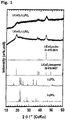
- Figure 1 indicates XRD patterns of the obtained pellets of two types of positive electrode active materials.
- Figure 1 also indicates XRD patterns of cubic LiCoO 2 , hexagonal LiCoO 2 , Li 3 PO 4 and Li 2 SO 4 . It is found from Figure 1 that the peaks corresponding to LiCoO 2 are broadened and thus the positive electrode active materials are in an amorphous state. Particularly, it is found that all 2 ⁇ peaks observed have half-value widths of 0.5 or more.
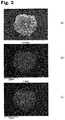
- Figure 2(a) indicates images of the LiCoO 2 -Li 2 SO 4 positive electrode active material obtained by scanning electron microscopy (SEM) and Figures 2(b) and (c) indicate energy dispersive X-ray spectroscopy (EDX) maps of Co and S atoms corresponding to Figure 2(a) . It is found from Figures 2(a) to (c) that Co and S are uniformly dispersed in particles of the obtained positive electrode active material. This indicates that reaction of original particles of LiCoO 2 and Li 2 SO 4 formed new particles of LiCoO 2 -Li 2 SO 4 .
- SEM scanning electron microscopy
- EDX energy dispersive X-ray spectroscopy
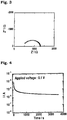
- Figure 3 indicates a Nyquist plot of the LiCoO 2 -Li 2 SO 4 positive electrode active material according to the alternating current impedance method and Figure 4 indicates a current behavior over time during direct current polarization measurement with an applied voltage of 0.1 V.
- Figure 3 means the result of measurement while the positive electrode active material was sandwiched between SUS plates
- Figure 4 means the result of measurement while the positive electrode active material was sandwiched between solid electrolyte layers (Li 3 PS 4 ) and further between Li plates. It is found from Figures 3 and 4 that LiCoO 2 -Li 2 SO 4 has an electron conductivity of 3.7 x 10 -5 Scm -1 and a lithium ion conductivity of 1.2 x 10 -6 Scm -1 .
- LiCoO 2 -Li 2 PO 4 has an electron conductivity of 2.5 x 10 -5 Scm -1 and a lithium ion conductivity of 5.3 x 10 -7 Scm -1 . Because the electron conductivity and the ion conductivity at room temperature are 10 -7 Scm -1 or more, the positive electrode active materials fulfil the requirement as positive electrodes for all-solid batteries.
- the solid electrolyte layer was prepared according to the procedure below.
- LiOH ⁇ H 2 O (produced by Wako Pure Chemical Industries, Ltd.) and H 3 BO 3 (produced by Wako Pure Chemical Industries, Ltd.) were mixed, heated at 500°C for 1 hour and sintered at 600°C for 2 hours to synthesize Li 3 BO 3 .
- Li 2 SO 4 ⁇ H 2 O (produced by Wako Pure Chemical Industries, Ltd.) was dehydrated by heating in an Ar atmosphere at 300°C for 3 hours to obtain Li 2 SO 4 .
- Li 3 BO 3 , Li 2 SO 4 and Li 2 CO 3 (produced by Wako Pure Chemical Industries, Ltd.) were weighed so as to be a molar ratio of 1:1:1 and mixed in a mortar, and the mixture was placed in a planetary ball mill.
- glass-like solid electrolyte (33Li 3 BO 3 ⁇ 33Li 2 SO 4 ⁇ 33Li 2 CO 3 ) having a particle diameter of a few ⁇ m was obtained.
- the planetary ball mill used was Pulverisette P-7 produced by Fritsch GmbH in which a pot and balls were made of zirconium oxide and the 45-ml pot contained 160 balls respectively with a diameter of 5 mm.
- the mechanical milling was conducted at a rotation speed of 370 rpm at room temperature in a globe box of a dry Ar atmosphere for 90 hours.
- the glass-like solid electrolyte was heated at 260°C which was at or above a crystallization temperature, to transform to glass ceramic and obtain a glass ceramic-like solid electrolyte.
- the obtained solid electrolyte (40 mg) was subjected to pressing at pressure of 720 MPa on a pellet molding machine having a molding unit with an area of 0.785 cm 2 to obtain a solid electrolyte layer (thickness: about 1 mm) in the form of pellets.
- the positive electrode (LiCoO 2 -Li 2 SO 4 ), the solid electrolyte layer and an indium foil as a counter electrode were stacked in this order and the stacked article was sandwiched between collectors made of stainless steel (SUS) to obtain a battery cell (all-solid lithium secondary battery).
- Figure 5 indicates sectional images of the cell. The cell was subjected to a charge-discharge test at 100°C and a current density of 0.13 mAcm -2 . The test result is indicated in the graph in Figure 6 .
- the left vertical axis indicates a potential relative to the Li-In counter electrode and the right vertical axis indicates a potential based on Li that was calculated by taking the potential difference between Li-In and Li which was 0.62 V into account.
- the positive electrode and the solid electrolyte layer were closely adhered at the interface without any gap, and the presence of a side reaction layer (highly resistive layer) was not observed at the interface. It is found that the positive electrode layer has a thickness of about 100 ⁇ m. It is found from Figure 6 that charge and discharge are feasible even with a so-called bulk-type all-solid secondary battery formed by pressing.
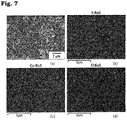
- Figure 7(a) indicates a sectional SEM image of the positive electrode
- Figures 7(b) to (d) indicate EDX maps of S, Co and O atoms corresponding to Figure 7(a) . It is found from Figures 7(a) to (d) that Co and S are uniformly dispersed in the obtained positive electrode active material.
- Figure 8 indicates XRD patterns of the pellets of the positive electrode before and after charge and after discharge.
- Figure 8 also indicates XRD patterns of hexagonal LiCoO 2 and Li 2 SO 4 .
- the peaks labelled with Si in Figure 8 mean peaks of a standard material. It is found from Figure 8 that the positive electrode active material is in an amorphous state even after charge and after discharge.
- a battery cell was prepared in the same manner as in Example 2 except that LiCoO 2 -Li 2 SO 4 was replaced by LiCoO 2 -Li 2 PO 4 , and was subjected to a charge-discharge test at 100°C and a current density of 0.13 mAcm -2 .
- the test result is indicated in the graph in Figure 9 . It is found from Figure 9 that charge and discharge are feasible even with a so-called bulk-type all-solid secondary battery formed by pressing.
- a positive electrode active material LiNiO 2 -Li 2 SO 4 , was obtained in the same manner as in Example 1 except that LiNiO 2 (Toshima Manufacturing Co., Ltd.) and Li 2 SO 4 ⁇ H 2 O (produced by Wako Pure Chemical Industries, Ltd.) were used and the treatment time of mechanical milling was changed to 50 hours.
- a battery cell obtained in the same manner as in Example 2 except that the above positive electrode active material was used was subjected to the charge-discharge test.
- the test result is indicated in the graph in Figure 10 . It is found from Figure 10 that charge and discharge is also feasible with LiNiO 2 -Li 2 SO 4 .
- LiNi 1/3 Mn 1/3 Co 1/3 O 2 -Li 2 SO 4 was obtained in the same manner as in Example 1 except that LiNi 1/3 Mn 1/3 Co 1/3 O 2 (produced by Toda Kogyo Corp.) and Li 2 SO 4 ⁇ H 2 O (produced by Wako Pure Chemical Industries, Ltd.) were used and the treatment time of mechanical milling was changed to 50 hours.
- a battery cell obtained in the same manner as in Example 2 except that the above positive electrode active material was used was subjected to the charge-discharge test.
- the test result is indicated in the graph in Figure 11 . It is found from Figure 11 that charge and discharge is also feasible with LiNi 1/3 Mn 1/3 Co 1/3 O 2 -Li 2 SO 4 .
- LiCoO 2 -Li 2 SO 4 Five types of positive electrode active materials, LiCoO 2 -Li 2 SO 4 , were obtained in the same manner as in Example 1 except that the molar ratio (x:1-x) between LiCoO 2 and Li 2 SO 4 was changed to 100:0, 90:10, 80:20, 70:30 and 60:40 and the treatment time of mechanical milling was changed to 50 hours.
- the positive electrode active materials were measured for XRD patterns in the same manner as in Example 1, which are indicated in Figure 12.
- Figure 12 also indicates XRD patterns of cubic LiCoO 2 , hexagonal LiCoO 2 , Li 3 PO 4 and Li 2 SO 4 . It is found from Figure 12 that peaks corresponding to LiCoO 2 are broadened and thus the positive electrode active materials are in an amorphous state. Particularly, it is found that all 2 ⁇ peaks observed have half-value widths of 0.5 or more.
- a battery cell obtained in the same manner as in Example 2 except that the above positive electrode active material was used was subjected to the charge-discharge test.
- the test result is indicated in the graph in Figure 13 . It is found from Figure 13 that charge and discharge is also feasible even when the proportion between LiCoO 2 and Li 2 SO 4 is varied.
- LiCoO 2 -Li 2 SO 4 Three types of positive electrode active materials, LiCoO 2 -Li 2 SO 4 , were obtained in the same manner as in Example 1 except that the molar ratio between LiCoO 2 and Li 2 SO 4 was changed to 80:20 and the treatment time of mechanical milling was changed to 1 hour, 10 hours and 50 hours.
- the positive electrode active materials were measured for XRD patterns in the same manner as in Example 1, which are indicated in Figure 14.
- Figure 14 also indicates XRD patterns of the mixture before mechanical milling, cubic LiCoO 2 , hexagonal LiCoO 2 , Li 3 PO 4 and Li 2 SO 4 . It is found from Figure 14 that the peaks corresponding LiCoO 2 are further broadened as the treatment time extends and the positive electrode active material is converted to an amorphous state.
- a battery cell obtained in the same manner as in Example 2 except that the above positive electrode active material was used was subjected to the charge-discharge test.
- the test result is indicated in the graph in Figure 15 . It is found from Figure 15 that the charge-discharge capacity increases as the treatment time extends.
- Positive electrode active materials LiCoO 2 -Li 2 MnO 3 -Li 2 SO 4 , were obtained in the same manner as in Example 1 except that the molar ratio 80-x:x between LiCoO 2 (produced by Nippon Chemical Industrial Co., Ltd.) and Li 2 MnO 3 (produced by Toshima Manufacturing Co., Ltd.) was changed to 40:40 or 60:20, the molar ratio between the sum of LiCoO 2 and Li 2 MnO 3 and Li 2 SO 4 was changed to 80:20 and the treatment time of mechanical milling was changed to 50 hours.
- the positive electrode active materials were measured for XRD patterns in the same manner as in Example 1, which are indicated in Figure 16.
- Figure 16 also indicates XRD patterns of Li 2 MnO 3 , cubic LiCoO 2 , hexagonal LiCoO 2 and Li 2 SO 4 . It is found from Figure 16 that the peaks corresponding to LiCoO 2 are broadened and thus the positive electrode active materials are in an amorphous state. Particularly, it is found that all 2 ⁇ peaks observed have half-value widths of 0.5 or more.
- a battery cell obtained in the same manner as in Example 2 except that the above positive electrode active material was used was subjected to the charge-discharge test.
- Positive electrode active materials LiCoO 2 -Li 2 TiO 3 -Li 2 SO 4 , were obtained in the same manner as in Example 1 except that the molar ratio 80-x:x between LiCoO 2 (produced by Nippon Chemical Industrial Co., Ltd.) and Li 2 TiO 3 (produced by Wako Pure Chemical Industries, Ltd.) was changed to 40:40 or 60:20, the molar ratio between the sum of LiCoO 2 and Li 2 TiO 3 and Li 2 SO 4 was changed to 80:20 and the treatment time of mechanical milling was changed to 50 hours.
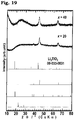
- the positive electrode active materials were measured for XRD patterns in the same manner as in Example 1, which are indicated in Figure 19.
- Figure 19 also indicates XRD patterns of Li 2 TiO 3 , cubic LiCoO 2 , hexagonal LiCoO 2 and Li 2 SO 4 . It is found from Figure 19 that the peaks corresponding to LiCoO 2 are broadened and thus the positive electrode active materials are in an amorphous state. Particularly, it is found that all 2 ⁇ peaks observed have half-value widths of 0.5 or more.
- a battery cell obtained in the same manner as in Example 2 except that the above positive electrode active material was used was subjected to the charge-discharge test.
- Li 2 CO 3 (produced by Nippon Chemical Industrial Co., Ltd.), TiO 2 (produced by Wako Pure Chemical Industries, Ltd.) and Mn 2 O 3 (Kojundo Chemical Laboratory Co., Ltd.) were mixed and the obtained mixture was sintered in air at 700°C for 2 hours. Pellets were obtained from the obtained sintered material. The pellets were sintered in air at 950°C for 96 hours to obtain crystalline Li 1.2 Ti 0.4 Mn 0.4 O 2 .
- Li 1.2 Ti 0.4 Mn 0.4 O 2 and Li 2 SO 4 obtained by dehydration of Li 2 SO 4 ⁇ H 2 O (produced by Wako Pure Chemical Industries, Ltd.) by heating in an Ar atmosphere at 300°C for 3 hours were weighed so as to be in the molar ratios of 7:3 and 8:2 and mixed in a mortar.
- the obtained mixtures were subjected to mechanical milling in the same manner as in Example 1 to obtain positive electrode active materials. It should be noted that in the treatment in the present Example, the number of balls was changed to 50 and the treatment time was changed to 50 hours.
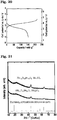
- the positive electrode active materials were measured for XRD patterns in the same manner as in Example 1, which are indicated in Figure 21.
- Figure 21 also indicates the XRD pattern of LiTiMnO 2 according to the published data. It is found from Figure 21 that the peaks corresponding to LiTiMnO 2 are broadened and thus the positive electrode active materials are in an amorphous state. Particularly, it is found that all 2 ⁇ peaks observed have half-value widths of 0.5 or more.
- the solid electrolyte used was 90Li 3 BO 3 ⁇ 10Li 2 SO 4 obtained in the same manner as in Example 1 except that Li 2 CO 3 was not used and the molar ratio between Li 3 BO 3 and Li 2 SO 4 was changed to 9:1.
- LiCoO 2 -Li 2 SO 4 -LiNO 3 Positive electrode active materials, LiCoO 2 -Li 2 SO 4 -LiNO 3 , were obtained in the same manner as in Example 1 except that LiCoO 2 (produced by Nippon Chemical Industrial Co., Ltd.), Li 2 SO 4 . H 2 O (produced by Wako Pure Chemical Industries, Ltd.) and LiNO 3 (produced by Wako Pure Chemical Industries, Ltd.) were used (the molar ratios between LiCoO 2 , Li 2 SO 4 - H 2 O and LiNO 3 were 80:15:5 and 70:20:10), the treatment time of mechanical milling was changed to 50 hours and the number of balls was changed to 67.
- LiCoO 2 produced by Nippon Chemical Industrial Co., Ltd.
- Li 2 SO 4 . H 2 O produced by Wako Pure Chemical Industries, Ltd.
- LiNO 3 produced by Wako Pure Chemical Industries, Ltd.
- the positive electrode active materials were measured for XRD patterns in the same manner as in Example 1, which are indicated in Figure 24.
- Figure 24 also indicates XRD patterns of hexagonal LiCoO 2 , LiNO 3 and Li 2 SO 4 . It is found from Figure 24 that the peaks corresponding to LiCoO 2 are broadened and thus the positive electrode active materials are in an amorphous state. Particularly, it is found that all 2 ⁇ peaks observed have half-value widths of 0.5 or more.
Landscapes
- Chemical & Material Sciences (AREA)
- Chemical Kinetics & Catalysis (AREA)
- Electrochemistry (AREA)
- General Chemical & Material Sciences (AREA)
- Inorganic Chemistry (AREA)
- Engineering & Computer Science (AREA)
- Materials Engineering (AREA)
- Manufacturing & Machinery (AREA)
- Composite Materials (AREA)
- Physics & Mathematics (AREA)
- Condensed Matter Physics & Semiconductors (AREA)
- General Physics & Mathematics (AREA)
- Crystallography & Structural Chemistry (AREA)
- Battery Electrode And Active Subsutance (AREA)
- Secondary Cells (AREA)
Claims (10)
- Matériau actif d'électrode positive à base d'oxyde amorphe constituant un matériau de production d'une électrode positive pour une batterie secondaire tout solide, comprenant un métal alcalin choisi parmi Li et Na ; un second métal choisi parmi Co, Ni, Mn, Fe, Cr, V, Cu, Ti, Zn, Zr, Nb, Mo, Ru et Sn ; une espèce ionique choisie parmi un ion phosphate, un ion sulfate, un ion borate, un ion silicate, un ion aluminate, un ion germanate, un ion nitrate, un ion carbonate et un ion halogénure ; et un atome d'oxygène à l'exclusion de l'atome d'oxygène constituant l'espèce ionique, dans lequel ledit matériau actif d'électrode positive à base d'oxyde amorphe présente un état amorphe tel qu'un pic à minimum 2θ dans un diagramme de diffraction des rayons X présente une demi-valeur de 0,5 ou plus telle que mesurée avec une source de rayons X qui est de type CuKα.
- Électrode positive d'une épaisseur de 20 µm ou plus pour une batterie secondaire tout solide, ladite électrode positive comprenant un matériau actif d'électrode positive à base d'oxyde amorphe selon la revendication 1.
- Matériau actif d'électrode positive à base d'oxyde amorphe selon la revendication 1, comprenant une phase amorphe et une phase cristalline.
- Électrode positive selon la revendication 2, dans laquelle ledit matériau actif d'électrode positive à base d'oxyde amorphe comprend des composants dérivés d'un oxyde de métal alcalin et d'un sel de métal alcalin, dans lequel l'oxyde de métal alcalin est choisi parmi le groupe consistant en des composés à base de lithium comprenant LiCoO2, LiNiO2, LiMnO2, Li2MnO3, Li(Ni, Co, Mn)O2, Li2TiO3, LiFeO2, LiCrO2, Li2CuO2, LiCuO2, LiMoO2, Li2RuO3, Li3NbO4, Li3V2(PO4)3, LiMn2O4 et Li(Ni, Mn)O4, et des composés à base de sodium comprenant NaCoO2, NaNiO2, NaMnO2, Na2MnO3, Na(Ni, Co, Mn)O2, NaFeO2, Na2TiO3, NaCrO2, Na2CuO2, NaCuO2, NaMoO2, Na2RuO3, Na3NbO4, Na3V2(PO4)3, NaMn2O4 et Na(Ni, Mn)O4, et le sel de métal alcalin est choisi parmi AxByOz, dans laquelle A est Li ou Na ; B est choisi parmi P, S, B, C, Si, Al, Ge et N ; x est supérieur ou égal à 1 ; y est supérieur ou égal à 1 ; z est supérieur ou égal à 1 ; et x, y et z sont des valeurs stœchiométriquement possibles, et AX, dans laquelle A est Li ou Na ; et X est choisi parmi F, Cl, Br et I.
- Électrode positive selon la revendication 4, dans laquelle le composant dérivé de l'oxyde de métal alcalin et le composant dérivé du sel de métal alcalin existent dans le matériau actif d'électrode positive à base d'oxyde amorphe à un rapport molaire de 1:9 à 9:1.
- Électrode positive selon la revendication 2, comprenant des composants dérivés de LiCoO2 et Li3PO4 et/ou Li2SO4.
- Électrode positive selon la revendication 2, dans laquelle ledit matériau actif d'électrode positive à base d'oxyde amorphe comprend une phase amorphe et une phase cristalline.
- Batterie secondaire tout solide comprenant au moins l'électrode positive selon la revendication 2, une électrode négative et une couche d'électrolyte solide positionnée entre l'électrode positive et l'électrode négative.
- Procédé de production du matériau actif d'électrode positive à base d'oxyde amorphe selon la revendication 1, dans lequel le matériau actif d'électrode positive à base d'oxyde amorphe est obtenu en mélangeant des matières premières de celui-ci par broyage mécanique.
- Utilisation d'un matériau actif d'électrode positive à base d'oxyde amorphe selon la revendication 1 pour la production d'une électrode positive d'une épaisseur de 20 µm ou plus pour une batterie secondaire tout solide.
Applications Claiming Priority (2)
| Application Number | Priority Date | Filing Date | Title |
|---|---|---|---|
| JP2016070298 | 2016-03-31 | ||
| PCT/JP2017/009294 WO2017169599A1 (fr) | 2016-03-31 | 2017-03-08 | Matériau actif d'électrode positive à base d'oxyde amorphe, son procédé de production et son utilisation |
Publications (3)
| Publication Number | Publication Date |
|---|---|
| EP3439083A1 EP3439083A1 (fr) | 2019-02-06 |
| EP3439083A4 EP3439083A4 (fr) | 2019-08-21 |
| EP3439083B1 true EP3439083B1 (fr) | 2021-09-29 |
Family
ID=59963063
Family Applications (1)
| Application Number | Title | Priority Date | Filing Date |
|---|---|---|---|
| EP17774144.4A Active EP3439083B1 (fr) | 2016-03-31 | 2017-03-08 | Matériau actif d'électrode positive à base d'oxyde amorphe, son procédé de production et son utilisation |
Country Status (5)
| Country | Link |
|---|---|
| US (1) | US11349123B2 (fr) |
| EP (1) | EP3439083B1 (fr) |
| JP (1) | JP6935926B2 (fr) |
| CN (1) | CN108886145B (fr) |
| WO (1) | WO2017169599A1 (fr) |
Families Citing this family (17)
| Publication number | Priority date | Publication date | Assignee | Title |
|---|---|---|---|---|
| JP7094570B2 (ja) * | 2017-10-31 | 2022-07-04 | 国立大学法人横浜国立大学 | リチウムイオン二次電池、電子機器及び車両 |
| JP7553352B2 (ja) * | 2018-03-28 | 2024-09-18 | Tdk株式会社 | 全固体電池 |
| JP2022013953A (ja) * | 2018-10-26 | 2022-01-19 | 株式会社豊田自動織機 | 電極及び固体型リチウムイオン二次電池 |
| PL3761405T3 (pl) * | 2018-10-31 | 2026-05-11 | Lg Energy Solution, Ltd. | Litowa bateria akumulatorowa |
| KR102757221B1 (ko) * | 2018-11-28 | 2025-01-21 | 현대자동차주식회사 | 리튬 이차전지 및 리튬 이차전지의 제조방법 |
| CN110400931B (zh) * | 2019-07-31 | 2022-09-02 | 陕西师范大学 | 一种具有超晶格有序结构的锰基储钠型正极材料及其制备方法 |
| CN113078299B (zh) * | 2020-01-06 | 2023-09-29 | 中国科学院物理研究所 | 钠锂铁锰基层状氧化物材料、制备方法和用途 |
| CN118318327A (zh) * | 2021-11-26 | 2024-07-09 | 公立大学法人大阪 | 氧化物系正极活性物质及其应用 |
| GB2613896A (en) * | 2021-12-20 | 2023-06-21 | Dyson Technology Ltd | A cathode composition |
| JP7797924B2 (ja) * | 2022-03-09 | 2026-01-14 | 株式会社豊田中央研究所 | リチウム複合酸化物、蓄電デバイス及びリチウム複合酸化物の製造方法 |
| US20260125275A1 (en) | 2022-05-30 | 2026-05-07 | Sumitomo Chemical Company, Limited | Lithium-containing oxide, electrode, and battery |
| JP7619341B2 (ja) * | 2022-08-15 | 2025-01-22 | トヨタ自動車株式会社 | 正極活物質、正極活物質層、全固体リチウムイオン電池、正極活物質の製造方法、及び全固体リチウムイオン電池の製造方法 |
| CN115632117A (zh) * | 2022-10-25 | 2023-01-20 | 湖北亿纬动力有限公司 | 一种锰基固溶体正极材料及制备方法与用途 |
| CN118117063B (zh) * | 2024-01-24 | 2025-09-26 | 中南大学 | NaaFebXcYd(BO3)e正极活性材料及其制备和在钠离子电池中的应用 |
| WO2025178830A1 (fr) * | 2024-02-21 | 2025-08-28 | Wildcat Discovery Technologies, Inc. | Cathodes à haute énergie redox anioniques |
| CN119419244B (zh) * | 2024-10-31 | 2025-09-23 | 蜂巢能源科技股份有限公司 | 一种复合正极材料及其制备方法和应用 |
| CN119038635B (zh) * | 2024-11-01 | 2025-04-08 | 宁波维科电池有限公司 | 一种非晶金属氧化物正极材料的制备方法及其应用 |
Family Cites Families (13)
| Publication number | Priority date | Publication date | Assignee | Title |
|---|---|---|---|---|
| CN1392623A (zh) * | 2001-06-15 | 2003-01-22 | 未来科技研究院有限公司 | 锂磷氧氮硫化合物电解质薄膜 |
| KR101065307B1 (ko) * | 2004-01-19 | 2011-09-16 | 삼성에스디아이 주식회사 | 리튬이차전지용 캐소드 활물질 및 이를 이용한 리튬이차전지 |
| JP5029540B2 (ja) * | 2008-09-01 | 2012-09-19 | ソニー株式会社 | 正極活物質、これを用いた正極および非水電解質二次電池 |
| JP5157781B2 (ja) * | 2008-09-25 | 2013-03-06 | トヨタ自動車株式会社 | 全固体リチウム二次電池 |
| JP2010177024A (ja) * | 2009-01-29 | 2010-08-12 | Sumitomo Electric Ind Ltd | 非水電解質電池用正極と非水電解質電池および非水電解質電池用正極の製造方法 |
| JP5549192B2 (ja) * | 2009-11-18 | 2014-07-16 | ソニー株式会社 | 固体電解質電池および正極活物質 |
| JP6051514B2 (ja) * | 2010-12-02 | 2016-12-27 | ソニー株式会社 | 固体電解質電池および正極活物質 |
| JP2013161646A (ja) * | 2012-02-03 | 2013-08-19 | Sumitomo Electric Ind Ltd | 非水電解質電池及びその製造方法、並びにこの電池を備える電動車両 |
| KR101623720B1 (ko) * | 2013-03-15 | 2016-05-26 | 주식회사 엘지화학 | 고용량 음극 활물질 및 이를 포함하는 리튬 이차전지 |
| JP6460316B2 (ja) * | 2013-12-09 | 2019-01-30 | 日本電気硝子株式会社 | ナトリウムイオン電池用電極合材、及びその製造方法並びにナトリウム全固体電池 |
| JP6362371B2 (ja) | 2014-03-18 | 2018-07-25 | 公立大学法人大阪府立大学 | 酸化物系固体電解質及びその用途 |
| JP6083406B2 (ja) * | 2014-03-19 | 2017-02-22 | トヨタ自動車株式会社 | 活物質粉体及びその製造方法 |
| JP2016035912A (ja) * | 2014-07-31 | 2016-03-17 | 富士フイルム株式会社 | 全固体二次電池、固体電解質組成物、これを用いた電池用電極シート、電池用電極シートの製造方法および全固体二次電池の製造方法 |
-
2017
- 2017-03-08 JP JP2018508899A patent/JP6935926B2/ja active Active
- 2017-03-08 EP EP17774144.4A patent/EP3439083B1/fr active Active
- 2017-03-08 CN CN201780021201.1A patent/CN108886145B/zh active Active
- 2017-03-08 WO PCT/JP2017/009294 patent/WO2017169599A1/fr not_active Ceased
- 2017-03-08 US US16/089,275 patent/US11349123B2/en active Active
Also Published As
| Publication number | Publication date |
|---|---|
| JP6935926B2 (ja) | 2021-09-15 |
| CN108886145B (zh) | 2022-03-15 |
| US20190181446A1 (en) | 2019-06-13 |
| CN108886145A (zh) | 2018-11-23 |
| JPWO2017169599A1 (ja) | 2019-02-14 |
| US11349123B2 (en) | 2022-05-31 |
| WO2017169599A1 (fr) | 2017-10-05 |
| EP3439083A1 (fr) | 2019-02-06 |
| EP3439083A4 (fr) | 2019-08-21 |
Similar Documents
| Publication | Publication Date | Title |
|---|---|---|
| US11349123B2 (en) | Amorphous oxide-based positive electrode active material, method for producing same and use of same | |
| US11404726B2 (en) | All-solid-state sodium ion secondary battery | |
| JP5817657B2 (ja) | 電池システム、電池システムの製造方法、電池の制御装置 | |
| JP5720753B2 (ja) | 硫化物固体電解質材料、電池および硫化物固体電解質材料の製造方法 | |
| JP6362371B2 (ja) | 酸化物系固体電解質及びその用途 | |
| JP5561383B2 (ja) | 硫化物固体電解質材料、電池および硫化物固体電解質材料の製造方法 | |
| Tian et al. | Effect of Nb-doping on electrochemical stability of Li4Ti5O12 discharged to 0 V | |
| JP6667985B2 (ja) | リチウムイオン(lithiumion)二次電池 | |
| CN113396494B (zh) | 正极材料和电池 | |
| JP7218725B2 (ja) | バイポーラ型全固体ナトリウムイオン二次電池 | |
| US20120021298A1 (en) | All-solid lithium ion secondary battery and electrode therefor | |
| Li et al. | Li-rich layer-structured cathode materials for high energy Li-ion batteries | |
| JP7810291B2 (ja) | 固体電池 | |
| WO2013084944A1 (fr) | Batterie | |
| EP3890063A1 (fr) | Matériau d'électrode négative et batterie | |
| WO2022244445A1 (fr) | Substance active de cathode revêtue, matériau de cathode et batterie | |
| WO2022255002A1 (fr) | Batterie | |
| JP2018046012A (ja) | 負極活物質、負極、及び非水電解質蓄電素子 | |
| WO2015001632A1 (fr) | Matériau de cathode pour batterie rechargeable lithium-ion, cathode pour batterie rechargeable lithium-ion, batterie rechargeable lithium-ion, et procédé de production de chacun de ceux-ci | |
| WO2023002827A1 (fr) | Matériau d'électrode positive et batterie | |
| WO2022219843A1 (fr) | Batterie | |
| KR20220112160A (ko) | 전고체 이차전지 | |
| WO2022191002A1 (fr) | Conducteur ionique et son utilisation | |
| EP4614612A1 (fr) | Procédé de fabrication d'un matériau actif d'électrode positive pour batterie secondaire au lithium-ion | |
| US20220263120A1 (en) | Solid electrolyte material, solid electrolyte including the same, all-solid secondary battery including the solid electrolyte, and method of preparing the solid electrolyte material |
Legal Events
| Date | Code | Title | Description |
|---|---|---|---|
| STAA | Information on the status of an ep patent application or granted ep patent |
Free format text: STATUS: THE INTERNATIONAL PUBLICATION HAS BEEN MADE |
|
| PUAI | Public reference made under article 153(3) epc to a published international application that has entered the european phase |
Free format text: ORIGINAL CODE: 0009012 |
|
| STAA | Information on the status of an ep patent application or granted ep patent |
Free format text: STATUS: REQUEST FOR EXAMINATION WAS MADE |
|
| 17P | Request for examination filed |
Effective date: 20181024 |
|
| AK | Designated contracting states |
Kind code of ref document: A1 Designated state(s): AL AT BE BG CH CY CZ DE DK EE ES FI FR GB GR HR HU IE IS IT LI LT LU LV MC MK MT NL NO PL PT RO RS SE SI SK SM TR |
|
| AX | Request for extension of the european patent |
Extension state: BA ME |
|
| DAV | Request for validation of the european patent (deleted) | ||
| DAX | Request for extension of the european patent (deleted) | ||
| A4 | Supplementary search report drawn up and despatched |
Effective date: 20190724 |
|
| RIC1 | Information provided on ipc code assigned before grant |
Ipc: H01M 4/58 20100101ALI20190718BHEP Ipc: H01M 10/052 20100101ALN20190718BHEP Ipc: H01M 4/1391 20100101ALI20190718BHEP Ipc: H01M 4/36 20060101ALI20190718BHEP Ipc: C01G 53/00 20060101ALI20190718BHEP Ipc: H01M 10/0562 20100101ALI20190718BHEP Ipc: H01M 4/131 20100101ALI20190718BHEP Ipc: H01M 4/525 20100101AFI20190718BHEP Ipc: H01M 4/136 20100101ALI20190718BHEP Ipc: H01M 4/1397 20100101ALI20190718BHEP Ipc: H01M 4/505 20100101ALI20190718BHEP Ipc: C01G 45/00 20060101ALI20190718BHEP Ipc: C01G 51/00 20060101ALI20190718BHEP Ipc: H01M 4/485 20100101ALI20190718BHEP |
|
| STAA | Information on the status of an ep patent application or granted ep patent |
Free format text: STATUS: EXAMINATION IS IN PROGRESS |
|
| 17Q | First examination report despatched |
Effective date: 20200526 |
|
| GRAP | Despatch of communication of intention to grant a patent |
Free format text: ORIGINAL CODE: EPIDOSNIGR1 |
|
| STAA | Information on the status of an ep patent application or granted ep patent |
Free format text: STATUS: GRANT OF PATENT IS INTENDED |
|
| RIC1 | Information provided on ipc code assigned before grant |
Ipc: H01M 10/052 20100101ALN20210527BHEP Ipc: C01G 45/00 20060101ALI20210527BHEP Ipc: C01G 53/00 20060101ALI20210527BHEP Ipc: C01G 51/00 20060101ALI20210527BHEP Ipc: H01M 4/1397 20100101ALI20210527BHEP Ipc: H01M 4/1391 20100101ALI20210527BHEP Ipc: H01M 4/136 20100101ALI20210527BHEP Ipc: H01M 4/131 20100101ALI20210527BHEP Ipc: H01M 10/0562 20100101ALI20210527BHEP Ipc: H01M 4/58 20100101ALI20210527BHEP Ipc: H01M 4/505 20100101ALI20210527BHEP Ipc: H01M 4/485 20100101ALI20210527BHEP Ipc: H01M 4/36 20060101ALI20210527BHEP Ipc: H01M 4/525 20100101AFI20210527BHEP |
|
| RIC1 | Information provided on ipc code assigned before grant |
Ipc: H01M 10/052 20100101ALN20210531BHEP Ipc: C01G 45/00 20060101ALI20210531BHEP Ipc: C01G 53/00 20060101ALI20210531BHEP Ipc: C01G 51/00 20060101ALI20210531BHEP Ipc: H01M 4/1397 20100101ALI20210531BHEP Ipc: H01M 4/1391 20100101ALI20210531BHEP Ipc: H01M 4/136 20100101ALI20210531BHEP Ipc: H01M 4/131 20100101ALI20210531BHEP Ipc: H01M 10/0562 20100101ALI20210531BHEP Ipc: H01M 4/58 20100101ALI20210531BHEP Ipc: H01M 4/505 20100101ALI20210531BHEP Ipc: H01M 4/485 20100101ALI20210531BHEP Ipc: H01M 4/36 20060101ALI20210531BHEP Ipc: H01M 4/525 20100101AFI20210531BHEP |
|
| INTG | Intention to grant announced |
Effective date: 20210618 |
|
| GRAS | Grant fee paid |
Free format text: ORIGINAL CODE: EPIDOSNIGR3 |
|
| GRAA | (expected) grant |
Free format text: ORIGINAL CODE: 0009210 |
|
| STAA | Information on the status of an ep patent application or granted ep patent |
Free format text: STATUS: THE PATENT HAS BEEN GRANTED |
|
| AK | Designated contracting states |
Kind code of ref document: B1 Designated state(s): AL AT BE BG CH CY CZ DE DK EE ES FI FR GB GR HR HU IE IS IT LI LT LU LV MC MK MT NL NO PL PT RO RS SE SI SK SM TR |
|
| REG | Reference to a national code |
Ref country code: GB Ref legal event code: FG4D |
|
| REG | Reference to a national code |
Ref country code: DE Ref legal event code: R096 Ref document number: 602017046822 Country of ref document: DE |
|
| REG | Reference to a national code |
Ref country code: CH Ref legal event code: EP Ref country code: AT Ref legal event code: REF Ref document number: 1434988 Country of ref document: AT Kind code of ref document: T Effective date: 20211015 |
|
| REG | Reference to a national code |
Ref country code: IE Ref legal event code: FG4D |
|
| REG | Reference to a national code |
Ref country code: DE Ref legal event code: R081 Ref document number: 602017046822 Country of ref document: DE Owner name: UNIVERSITY PUBLIC CORPORATION OSAKA, JP Free format text: FORMER OWNER: OSAKA PREFECTURE UNIVERSITY PUBLIC CORP., OSAKA, JP |
|
| REG | Reference to a national code |
Ref country code: LT Ref legal event code: MG9D |
|
| PG25 | Lapsed in a contracting state [announced via postgrant information from national office to epo] |
Ref country code: RS Free format text: LAPSE BECAUSE OF FAILURE TO SUBMIT A TRANSLATION OF THE DESCRIPTION OR TO PAY THE FEE WITHIN THE PRESCRIBED TIME-LIMIT Effective date: 20210929 Ref country code: SE Free format text: LAPSE BECAUSE OF FAILURE TO SUBMIT A TRANSLATION OF THE DESCRIPTION OR TO PAY THE FEE WITHIN THE PRESCRIBED TIME-LIMIT Effective date: 20210929 Ref country code: HR Free format text: LAPSE BECAUSE OF FAILURE TO SUBMIT A TRANSLATION OF THE DESCRIPTION OR TO PAY THE FEE WITHIN THE PRESCRIBED TIME-LIMIT Effective date: 20210929 Ref country code: NO Free format text: LAPSE BECAUSE OF FAILURE TO SUBMIT A TRANSLATION OF THE DESCRIPTION OR TO PAY THE FEE WITHIN THE PRESCRIBED TIME-LIMIT Effective date: 20211229 Ref country code: FI Free format text: LAPSE BECAUSE OF FAILURE TO SUBMIT A TRANSLATION OF THE DESCRIPTION OR TO PAY THE FEE WITHIN THE PRESCRIBED TIME-LIMIT Effective date: 20210929 Ref country code: LT Free format text: LAPSE BECAUSE OF FAILURE TO SUBMIT A TRANSLATION OF THE DESCRIPTION OR TO PAY THE FEE WITHIN THE PRESCRIBED TIME-LIMIT Effective date: 20210929 Ref country code: BG Free format text: LAPSE BECAUSE OF FAILURE TO SUBMIT A TRANSLATION OF THE DESCRIPTION OR TO PAY THE FEE WITHIN THE PRESCRIBED TIME-LIMIT Effective date: 20211229 |
|
| REG | Reference to a national code |
Ref country code: NL Ref legal event code: MP Effective date: 20210929 |
|
| REG | Reference to a national code |
Ref country code: AT Ref legal event code: MK05 Ref document number: 1434988 Country of ref document: AT Kind code of ref document: T Effective date: 20210929 |
|
| PG25 | Lapsed in a contracting state [announced via postgrant information from national office to epo] |
Ref country code: LV Free format text: LAPSE BECAUSE OF FAILURE TO SUBMIT A TRANSLATION OF THE DESCRIPTION OR TO PAY THE FEE WITHIN THE PRESCRIBED TIME-LIMIT Effective date: 20210929 Ref country code: GR Free format text: LAPSE BECAUSE OF FAILURE TO SUBMIT A TRANSLATION OF THE DESCRIPTION OR TO PAY THE FEE WITHIN THE PRESCRIBED TIME-LIMIT Effective date: 20211230 |
|
| PG25 | Lapsed in a contracting state [announced via postgrant information from national office to epo] |
Ref country code: AT Free format text: LAPSE BECAUSE OF FAILURE TO SUBMIT A TRANSLATION OF THE DESCRIPTION OR TO PAY THE FEE WITHIN THE PRESCRIBED TIME-LIMIT Effective date: 20210929 |
|
| PG25 | Lapsed in a contracting state [announced via postgrant information from national office to epo] |
Ref country code: IS Free format text: LAPSE BECAUSE OF FAILURE TO SUBMIT A TRANSLATION OF THE DESCRIPTION OR TO PAY THE FEE WITHIN THE PRESCRIBED TIME-LIMIT Effective date: 20220129 Ref country code: SK Free format text: LAPSE BECAUSE OF FAILURE TO SUBMIT A TRANSLATION OF THE DESCRIPTION OR TO PAY THE FEE WITHIN THE PRESCRIBED TIME-LIMIT Effective date: 20210929 Ref country code: RO Free format text: LAPSE BECAUSE OF FAILURE TO SUBMIT A TRANSLATION OF THE DESCRIPTION OR TO PAY THE FEE WITHIN THE PRESCRIBED TIME-LIMIT Effective date: 20210929 Ref country code: PT Free format text: LAPSE BECAUSE OF FAILURE TO SUBMIT A TRANSLATION OF THE DESCRIPTION OR TO PAY THE FEE WITHIN THE PRESCRIBED TIME-LIMIT Effective date: 20220131 Ref country code: PL Free format text: LAPSE BECAUSE OF FAILURE TO SUBMIT A TRANSLATION OF THE DESCRIPTION OR TO PAY THE FEE WITHIN THE PRESCRIBED TIME-LIMIT Effective date: 20210929 Ref country code: NL Free format text: LAPSE BECAUSE OF FAILURE TO SUBMIT A TRANSLATION OF THE DESCRIPTION OR TO PAY THE FEE WITHIN THE PRESCRIBED TIME-LIMIT Effective date: 20210929 Ref country code: ES Free format text: LAPSE BECAUSE OF FAILURE TO SUBMIT A TRANSLATION OF THE DESCRIPTION OR TO PAY THE FEE WITHIN THE PRESCRIBED TIME-LIMIT Effective date: 20210929 Ref country code: EE Free format text: LAPSE BECAUSE OF FAILURE TO SUBMIT A TRANSLATION OF THE DESCRIPTION OR TO PAY THE FEE WITHIN THE PRESCRIBED TIME-LIMIT Effective date: 20210929 Ref country code: CZ Free format text: LAPSE BECAUSE OF FAILURE TO SUBMIT A TRANSLATION OF THE DESCRIPTION OR TO PAY THE FEE WITHIN THE PRESCRIBED TIME-LIMIT Effective date: 20210929 Ref country code: AL Free format text: LAPSE BECAUSE OF FAILURE TO SUBMIT A TRANSLATION OF THE DESCRIPTION OR TO PAY THE FEE WITHIN THE PRESCRIBED TIME-LIMIT Effective date: 20210929 |
|
| REG | Reference to a national code |
Ref country code: DE Ref legal event code: R097 Ref document number: 602017046822 Country of ref document: DE |
|
| PG25 | Lapsed in a contracting state [announced via postgrant information from national office to epo] |
Ref country code: DK Free format text: LAPSE BECAUSE OF FAILURE TO SUBMIT A TRANSLATION OF THE DESCRIPTION OR TO PAY THE FEE WITHIN THE PRESCRIBED TIME-LIMIT Effective date: 20210929 |
|
| PLBE | No opposition filed within time limit |
Free format text: ORIGINAL CODE: 0009261 |
|
| STAA | Information on the status of an ep patent application or granted ep patent |
Free format text: STATUS: NO OPPOSITION FILED WITHIN TIME LIMIT |
|
| 26N | No opposition filed |
Effective date: 20220630 |
|
| PG25 | Lapsed in a contracting state [announced via postgrant information from national office to epo] |
Ref country code: MC Free format text: LAPSE BECAUSE OF FAILURE TO SUBMIT A TRANSLATION OF THE DESCRIPTION OR TO PAY THE FEE WITHIN THE PRESCRIBED TIME-LIMIT Effective date: 20210929 |
|
| REG | Reference to a national code |
Ref country code: CH Ref legal event code: PL |
|
| GBPC | Gb: european patent ceased through non-payment of renewal fee |
Effective date: 20220308 |
|
| PG25 | Lapsed in a contracting state [announced via postgrant information from national office to epo] |
Ref country code: SI Free format text: LAPSE BECAUSE OF FAILURE TO SUBMIT A TRANSLATION OF THE DESCRIPTION OR TO PAY THE FEE WITHIN THE PRESCRIBED TIME-LIMIT Effective date: 20210929 |
|
| REG | Reference to a national code |
Ref country code: BE Ref legal event code: MM Effective date: 20220331 |
|
| PG25 | Lapsed in a contracting state [announced via postgrant information from national office to epo] |
Ref country code: LU Free format text: LAPSE BECAUSE OF NON-PAYMENT OF DUE FEES Effective date: 20220308 Ref country code: LI Free format text: LAPSE BECAUSE OF NON-PAYMENT OF DUE FEES Effective date: 20220331 Ref country code: IT Free format text: LAPSE BECAUSE OF FAILURE TO SUBMIT A TRANSLATION OF THE DESCRIPTION OR TO PAY THE FEE WITHIN THE PRESCRIBED TIME-LIMIT Effective date: 20210929 Ref country code: IE Free format text: LAPSE BECAUSE OF NON-PAYMENT OF DUE FEES Effective date: 20220308 Ref country code: GB Free format text: LAPSE BECAUSE OF NON-PAYMENT OF DUE FEES Effective date: 20220308 Ref country code: FR Free format text: LAPSE BECAUSE OF NON-PAYMENT OF DUE FEES Effective date: 20220331 Ref country code: CH Free format text: LAPSE BECAUSE OF NON-PAYMENT OF DUE FEES Effective date: 20220331 |
|
| PG25 | Lapsed in a contracting state [announced via postgrant information from national office to epo] |
Ref country code: BE Free format text: LAPSE BECAUSE OF NON-PAYMENT OF DUE FEES Effective date: 20220331 |
|
| PG25 | Lapsed in a contracting state [announced via postgrant information from national office to epo] |
Ref country code: HU Free format text: LAPSE BECAUSE OF FAILURE TO SUBMIT A TRANSLATION OF THE DESCRIPTION OR TO PAY THE FEE WITHIN THE PRESCRIBED TIME-LIMIT; INVALID AB INITIO Effective date: 20170308 |
|
| PG25 | Lapsed in a contracting state [announced via postgrant information from national office to epo] |
Ref country code: SM Free format text: LAPSE BECAUSE OF FAILURE TO SUBMIT A TRANSLATION OF THE DESCRIPTION OR TO PAY THE FEE WITHIN THE PRESCRIBED TIME-LIMIT Effective date: 20210929 Ref country code: MK Free format text: LAPSE BECAUSE OF FAILURE TO SUBMIT A TRANSLATION OF THE DESCRIPTION OR TO PAY THE FEE WITHIN THE PRESCRIBED TIME-LIMIT Effective date: 20210929 Ref country code: CY Free format text: LAPSE BECAUSE OF FAILURE TO SUBMIT A TRANSLATION OF THE DESCRIPTION OR TO PAY THE FEE WITHIN THE PRESCRIBED TIME-LIMIT Effective date: 20210929 |
|
| PG25 | Lapsed in a contracting state [announced via postgrant information from national office to epo] |
Ref country code: TR Free format text: LAPSE BECAUSE OF FAILURE TO SUBMIT A TRANSLATION OF THE DESCRIPTION OR TO PAY THE FEE WITHIN THE PRESCRIBED TIME-LIMIT Effective date: 20210929 |
|
| PG25 | Lapsed in a contracting state [announced via postgrant information from national office to epo] |
Ref country code: MT Free format text: LAPSE BECAUSE OF FAILURE TO SUBMIT A TRANSLATION OF THE DESCRIPTION OR TO PAY THE FEE WITHIN THE PRESCRIBED TIME-LIMIT Effective date: 20210929 |
|
| PGFP | Annual fee paid to national office [announced via postgrant information from national office to epo] |
Ref country code: DE Payment date: 20260128 Year of fee payment: 10 |