EP3439900B1 - Reifen - Google Patents
Reifen Download PDFInfo
- Publication number
- EP3439900B1 EP3439900B1 EP17720193.6A EP17720193A EP3439900B1 EP 3439900 B1 EP3439900 B1 EP 3439900B1 EP 17720193 A EP17720193 A EP 17720193A EP 3439900 B1 EP3439900 B1 EP 3439900B1
- Authority
- EP
- European Patent Office
- Prior art keywords
- tyre
- parts
- coded matrix
- dark parts
- matrix symbol
- Prior art date
- Legal status (The legal status is an assumption and is not a legal conclusion. Google has not performed a legal analysis and makes no representation as to the accuracy of the status listed.)
- Active
Links
Images

Classifications
-
- B—PERFORMING OPERATIONS; TRANSPORTING
- B60—VEHICLES IN GENERAL
- B60C—VEHICLE TYRES; TYRE INFLATION; TYRE CHANGING; CONNECTING VALVES TO INFLATABLE ELASTIC BODIES IN GENERAL; DEVICES OR ARRANGEMENTS RELATED TO TYRES
- B60C13/00—Tyre sidewalls; Protecting, decorating, marking, or the like, thereof
- B60C13/001—Decorating, marking or the like
Definitions
- the present invention relates to a tire made of rubber material, at least one of the sidewalls of which comprises a coded matrix symbol.
- markings, inscriptions and codes are affixed to the sidewalls of the tires.
- the markings and inscriptions are typically used to identify the manufacturers, dimensions and references of the tires.
- Standardized codes such as QR code TM, Flashcode, MaxiCode TM, Datamatrix TM, and others, already widely used in applications where the code is printed on a medium, are beginning to be used in the world of tires.
- the sidewalls of the tires do not allow the codes to be printed in a conventional manner.
- the sides are generally very dark, made of rubber material, ie a support on which it is particularly difficult to highlight matrix codes in an easily visible manner.
- the document WO2015 / 165863 describes a tire of which at least one sidewall bears a matrix code.
- the matrix code comprises dark parts and light parts, the dark parts being composed of a texture integrally formed with the sidewall and contrasting with the rest of the tire.
- the matrix codes affixed according to the teaching of this document are liable to present restricted levels of visibility when the lighting conditions are not ideal, and / or in the event of the presence of dirt.
- the users who wish to receive the data made available by the code do not always have the possibility of recovering the data by another means in the event of unreadability. It is therefore essential that the readability of the matrix codes is really optimal and this throughout the time of use of the tire.
- the documents DE102013223566 and WO2016005572 disclose a tire having a symbol with dark parts and light parts.
- the invention provides various technical means.
- a first object of the invention consists in providing a tire made of rubber material provided with a coded matrix symbol with optimum readability characteristics.
- Another object of the invention consists in providing a tire made of rubber material provided with a reliable coded matrix symbol, and making it possible to recover the corresponding data with a minimum error percentage, or even substantially zero.
- the invention provides a tire made of rubber material as covered by independent claim 1.
- the second brightness L * 2 of the dark parts of the coded matrix symbol is between 5 and 18, and preferably between 8 and 16.
- the first brightness L * 1 of the light parts of the coded matrix symbol is between 20 and 35.
- the second luminosity L * 2 of the dark parts of the coded matrix symbol is between 8 and 16 and the first luminosity L * 1 of the light parts is between the second luminosity L * 2 of the dark parts increased by 8 points and the second brightness L * 2 of the dark parts increased by 16 points.
- the second brightness L * 2 of the dark parts is between 8 and 16 and the first brightness L * 1 of the light parts is between 20 and 26.
- two adjacent dark parts are separated by a partition.
- a partition has a thickness less than the width of a dark part. It is therefore narrower than the dark parts that it separates.
- the partitions constituting the partitions have a height relative to the hollow patterns constituting the dark parts of between 0.1 and 0.8 mm.
- the tops of the partitions are flush with the light parts.
- dark parts are generally square. Alternatively, they are square with rounded corners. Still as a variant, the dark parts are in the form of polygons made up of several grouped squares, each angle of which is substantially 90 degrees. These variant embodiments make it possible to maximize the surface of for easier decoding.
- the dark parts have the overall shape of a disc. This characteristic makes it possible to facilitate the step of recognizing the dark parts during decoding. Discs are easier to recognize than squares, in particular because their centers can be determined more precisely when the dark parts are partially altered. So even a shot with a slight blur can be decoded.
- the dark parts have at least one dimension between 0.2 mm and 1 mm, and more preferably between 0.3 and 0.7 mm.
- This variant makes it possible to miniaturize the size of the matrix code, miniaturization made possible by all the improvements mentioned aimed at facilitating the decoding.
- the dark parts are delimited by a groove. This arrangement favors the visualization of the dark parts by reinforcing the contrast vis-à-vis the light parts.
- At least one of the flanks comprises a protuberance for the protection of the coded matrix symbol.
- the protuberance is advantageously provided in the region of the axially outermost sidewall.
- the matrix symbol is advantageously arranged in the immediate vicinity of the protuberance, for maximum protection.
- the whole of the coded matrix symbol is embedded relative to the outer surface of the sidewall of the tire, the embedding depth of the coded matrix symbol preferably being between 0.2 mm and 0.8 mm.
- This variant embodiment makes it possible to protect the matrix code from the scrapings and scratches to which the sidewalls of the tires are subjected during severe use.
- the coded matrix symbol follows the radial curvature of at least one of the flanks.
- each sidewall of the tire comprises at least one coded matrix symbol. This variant allows decoding to be carried out even if one of the two codes has been altered or has become undecodable.
- the coded matrix symbols are different from one sidewall to the other of said tire.
- This variant makes it possible, for example, to provide information on the orientation of the tire, for example for a directional or asymmetric tire.
- the light parts of the coded matrix symbol are produced during a tire molding operation and the dark parts are produced by a laser engraving process after this molding operation.
- the dark parts are hollow relative to the light parts, the depth of hollow being between 0.1 and 0.8 mm, and more preferably between 0.2 and 0.5 mm. Thanks to such an arrangement, with grazing lighting when reading the code, the embedding makes it possible to generate a shadow reducing the brightness of the dark part and thus increasing the contrast.
- the dark parts are delimited by walls, these walls being inclined with respect to a normal N to the sidewall of the tire by a clearance angle ⁇ of between 5 and 50 degrees.
- the draft angle is between 5 and 20 degrees. The draft angle makes it possible to reduce the surface of the bottom liable to reflect light.
- the walls of a dark part preferentially meet in the center of this part.
- This arrangement makes it possible to form inverted pyramids. Thanks to this shaping, the risks of creating crack initiators are reduced and the stresses at the bottom of dark parts are better distributed.
- the end of the pyramid can be truncated or rounded in shape.
- the coded matrix symbol is suitable for coding data over 50 to 120 digits, and more preferably over 96 digits.
- the invention also provides a method for producing a coded matrix symbol on a tire, as covered by independent claim 17.
- This approach makes it possible to generate coded matrix symbols in a simple and efficient manner, with very great flexibility as regards the format of the code and the data to be encoded.
- the surface treatment is carried out using a laser.
- This device makes it possible to engrave zones according to a given coding configuration with very high precision and speed.
- the data to be encoded are easily obtained using an encoding tool or software, designed to provide sets of codes suitable for large quantities of tires to be identified.
- the codes can easily be individualized, for example making it possible to encode unique identification numbers for each of the tires.
- the use of the laser as well as its control parameters are adapted to remove the material from the tire sidewall just necessary so as to obtain the desired geometries.
- integral is understood to mean an element or zone of a body which is made of the same material as the body itself, in the continuity of the latter, without being added. An element coming from one source with another forms one and the same part with the latter.
- luminosity By “luminosity”, “luminance” or “clarity” is meant the parameter which characterizes the capacity of a surface to reflect light more or less.
- the luminosity L * is expressed in a scale going from 0 to 100 according to the colorimetric model L * a * b * established by the CIE (Commission Internationale de l'Eclairage) in 1976.
- the value 100 represents white or total reflection; the value 0, black or total absorption.
- a * and b * are chromaticity coordinates.
- the L * a * b * color model also defines a chromaticity diagram.
- a * and b * indicate the direction of the colors: + a * goes towards red, -a * towards green, + b * towards yellow, and -b * towards blue.
- the center of the diagram is achromatic. As the a * and b * values increase, and as we move away from the center of the diagram, the saturation increases.
- Modern tires have the particularity of having a dark color on their outer surface which does not favor the conditions for decoding the coded matrix symbols.
- the surface of the tires changes composition progressively following a migration of chemical substances contained inside the tire towards its external surface.
- the outer surface of the tire is thus gradually covered, for example, with waxes. These waxes are not transparent and change the color and appearance of the sidewall, further complicating the decoding of the coded matrix symbols.
- the decoding conditions are therefore often delicate, and high-performance decoders are preferably used.
- Very efficient decoding devices exist today. They are often provided with means to optimize decoding performance, such as suitable and controlled lighting, sophisticated software and specifically adapted, etc.
- the current decoding means have a very good ability to decode 2D code embodiments in all situations because they allow, in particular, controlled lighting of the code at the time of decoding. Thus, they make it possible to decode codes having a small difference in luminosity between dark parts and light parts.
- This capacity is very interesting for being able to decode 2D codes on tires that have aged.
- the coded matrix symbol produced on a tire according to the invention advantageously makes it possible to extend over time, when the tire is aged, the possibility of decoding a code arranged on the sidewall of the tire.
- the proposed technical solution also makes it possible to facilitate decoding by professional or non-professional means, such as for example of the “smartphone” type.
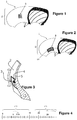
- the figure 1 shows a partial view of a tire 1 comprising an example of a coded matrix symbol 3 arranged substantially at mid-height of one of the sidewalls 2.
- the figure 2 shows another example with a coded matrix symbol 3 provided in the lower zone of the sidewall 2.
- the coded matrix symbol 3 is arranged along the circumferential curvature C1 of the tire, as shown in the figure.
- the coded matrix symbol has the shape of a rectangle and it extends around the circumference of the tire.
- the figure 3 illustrates another example of a coded matrix symbol 3 arranged on a sidewall 2. It is observed that the matrix symbol 3 is profiled along the radial curvature C2 of the sidewall of the tire.
- the figure 4 illustrates a known scale of luminance values, according to values from 0 to 100. According to this scale, absolute black has a value of 0, while that at the other end of the scale, absolute white has a value of 100.
- the figure 4 also illustrates examples of values for dark parts and light parts used with coded matrix symbols produced on a tire according to the invention.
- Said device is positioned on the part of the coded matrix symbol 3 that it is desired to measure and said device gives the values of the three parameters L *, a *, b *.
- SCI mode Specific reflection mode included
- a light setting of type D65 setting defined according to the International Commission on Illumination, CIE.
- the measuring device it is thus possible to quantify the difference in brightness between the dark parts and the light parts of the coded matrix symbol.
- the device for measuring the coded matrix symbol is, for example, the DataMan 8600 from Cognex®.
- the coded matrix symbols are produced using a method involving a phase carried out during the molding of the tire, and a phase carried out after demolding.
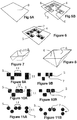
- This method consists first of all in providing a matrix code zone on a tire mold. Then, the tire is vulcanized with the mold comprising the imprint. After demoulding, and before a laser treatment step (described in more detail later), a clear zone 8 is obtained as shown in figure 5A .
- the walls 6 of the dark parts are formed. Thanks to this removal of material, the dark parts are hollow relative to the light parts 4.
- the level of depression, or depth of hollow formed by the dark parts is between 0.1 and 0.8 mm, and more preferably between 0.2 and 0.5 mm.
- the figure 6 illustrates the same matrix symbol after laser treatment.
- the dark parts 5 are at this stage provided with the surface finish making it possible to produce the brightness values predicted for these parts.
- the luminosity values are obtained by virtue of a step of producing a determined surface state in the background of the dark parts, this surface state exhibiting a roughness Rz of between 50 and 300 ⁇ m.
- the use of a laser has many advantages.
- the laser enables the surface treatment required to achieve the desired luminance levels to be carried out quickly and easily.
- the laser also makes it possible to produce different codes, without the molds having to be modified.
- the laser is also very suitable for an industrial process involving a very important volume of parts produced. For example, the codes to be engraved can be pre-programmed before large series laser engraving operations.
- the laser makes it possible to produce high quality codes, with excellent readability characteristics.
- the figures 7 and 8 schematically illustrate examples of shapes for the dark parts 5. It is observed that the dark parts 5 are delimited by walls 6, these walls 6 being inclined with respect to a normal N to the sidewall 2 of the tire with a clearance angle ⁇ included between 5 and 50 degrees and more preferably between 5 and 20 degrees.
- the figure 12 shows the normal N and the draft angle.
- the figure 8 shows an alternative embodiment in which the walls 6 of a dark part meet at the center of this part, thus forming an inverted pyramid. Alternatively, the top of the pyramid is rounded in shape.
- the figures 9A and 9B, 10A and 10B, 11A and 11B show examples of shapes and arrangement of dark parts 5 with respect to light parts 4.
- the dark parts 5 are recessed with respect to the light parts 4, due to the realization of these parts. dark parts by laser engraving.
- the dark parts are square ( figures 9A and 9B ), square with rounded corners ( figures 10A and 10B ), or disc-shaped ( figures 11A and 11B ).
- several dark parts 5 can be adjacent, and can in this case be separated by a partition 7, formed by the twinning of two opposite walls 6 of two neighboring dark parts. These partitions 7 make it possible to clearly visualize each of the dark parts 5, thus facilitating the decoding operations.
- Two or more adjacent dark portions may form a dark area 11 the area of which is substantially a multiple of the unit dark portions.
- the figures 9A, 10A and 11A illustrate such examples.
- the variant of the figure 11A provides a shape of the patterns constituting the dark disc-shaped parts, the adjacent patterns being distinct from each other and not touching at most at one point. This variant embodiment makes it possible to maximize the dark surface, while separating the dark parts from one another.
- round patterns are to facilitate decoding by image analysis.
- Each pattern constituting the dark parts is separated from its possible identical neighbors, which facilitates the determination of the perimeter of each part.
- a circular pattern has a symmetry of revolution with a center. This is therefore the simplest existing pattern. It also has the particularity, thanks to this simplicity, of being able to be more miniaturized than a square pattern.
- the square pattern with rounded corners is intermediate between the square and the round.
- the figures 12, 13, 14 and 15 illustrate examples of realization of dark parts. These parts are delimited by walls 6, as previously described. As shown in the figure 12 , the walls 6 are inclined at a relief angle a. This draft angle ⁇ is between 3 and 50 degrees. In a preferred embodiment, the draft angle ⁇ is between 5 and 20 degrees. In the examples of realization of figures 12, 13, 14 and 15 the roughness Rz of the dark parts is between 50 and 300 ⁇ m. To the figure 13 , the roughness Rz is low compared to the depth P1. Thus the Rz / P1 ratio is less than or equal to 0.1. The figure 14 illustrates another exemplary embodiment, in which the roughness Rz is close to the depth P1. Thus the Rz / P1 ratio is greater than or equal to 0.75. The figure 15 illustrates an exemplary embodiment in which grooves 9 are arranged at the periphery of the dark part 5. These grooves 9 allow better delimitation of this dark part, for optimum readability of the intelligent code.
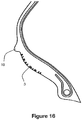
- the figure 16 illustrates an exemplary embodiment in which a flank comprises a protuberance 10 making it possible to ensure the protection of a coded matrix symbol 3 located in the immediate vicinity of the protuberance.
- the respective arrangements of the light and dark parts make it possible to achieve an almost infinite number of combinations, each corresponding to a distinct code.
- the data contained in the codes may vary as required. These data can for example include identifiers of size and / or type of tire, origin or name of the manufacturer, or unique serial number data for each tire.
- the coded matrix symbol is positioned in the lower zone of the tire, that is to say below the zone of maximum width of the sidewall.
- zone of maximum width of the sidewall is meant the set of points of this sidewall which are the most axially outer.
- each point of this zone of maximum width is according to a view in meridian section, at the greatest distance from an equatorial plane, distance measured in an axial direction, the tire being mounted and inflated on a rim recommended by the ETRTO.
- the coded matrix symbol is near a bead of the sidewall.
- the distance between the coded matrix symbol and the rim hook is between 5 and 30 mm. This distance is for example measured between a proximal part of the matrix symbol coded with the rim hook, that is to say a lower zone of the coded matrix symbol, and said rim hook.
Landscapes
- Engineering & Computer Science (AREA)
- Mechanical Engineering (AREA)
- Tires In General (AREA)
Claims (17)
- Reifen (1) aus Gummimaterial, von dem wenigstens eine der Flanken (2) ein codiertes Matrixsymbol (3) aufweist, das mit der wenigstens einen der Flanken (2) einstückig ausgebildet ist, das codierte Matrixsymbol (3) umfassend dunkle Abschnitte (5) und helle Abschnitte (4), dadurch gekennzeichnet, dass die hellen Abschnitte (4) eine erste Helligkeit L*1 aufweisen, die um wenigstens 5 Punkte höher als eine zweite Helligkeit L*2 der dunklen Abschnitte (5) ist, die Helligkeit L* auf einer Skala von 0 bis 100 gemäß dem kolorimetrischen Modell L*a*b* ausgedrückt wird, das 1976 von der Internationalen Beleuchtungskommission festgelegt wurde, der Wert 100 weiß oder die vollständige Reflexion repräsentiert, der Wert 0 schwarz oder die vollständige Absorption repräsentiert und in diesem kolorimetrischen Modell a* und b* Chromatizitätskoordinaten sind, und dadurch, dass die Rauheit Rz der dunklen Abschnitte (5) zwischen 50 und 300 µm beträgt.
- Reifen (1) nach Anspruch 1, dadurch gekennzeichnet, dass die zweite Helligkeit L*2 der dunklen Abschnitte (5) des codierten Matrixsymbols (3) zwischen 5 und 18 und vorzugsweise zwischen 8 und 16 liegt.
- Reifen (1) nach einem der Ansprüche 1 oder 2, dadurch gekennzeichnet, dass die erste Helligkeit L*1 der hellen Abschnitte (4) des codierten Matrixsymbols (3) zwischen 20 und 35 liegt.
- Reifen (1) nach Anspruch 1, dadurch gekennzeichnet, dass die zweite Helligkeit L*2 der dunklen Abschnitte (5) des codierten Matrixsymbols (3) zwischen 8 und 16 liegt, und dadurch, dass die erste Helligkeit L*1 der hellen Abschnitte (4) zwischen der zweiten Helligkeit L*2 der dunklen Abschnitte (5), die um 8 Punkte erhöht ist, und der zweiten Helligkeit L*2 der dunklen Abschnitte (5), die um 16 Punkte erhöht ist, liegt.
- Reifen (1) nach Anspruch 1, dadurch gekennzeichnet, dass die zweite Helligkeit L*2 der dunklen Abschnitte (5) zwischen 8 und 16 liegt, und dadurch, dass die erste Helligkeit L*1 der hellen Abschnitte (4) zwischen 20 und 26 liegt.
- Reifen (1) nach einem der Ansprüche 1 bis 5, dadurch gekennzeichnet, dass zwei benachbarte dunkle Abschnitte (5) durch ein Trennelement (7) getrennt sind.
- Reifen (1) nach einem der Ansprüche 1 bis 6, dadurch gekennzeichnet, dass die dunklen Abschnitte (5) allgemein quadratisch sind.
- Reifen (1) nach einem der Ansprüche 1 bis 7, dadurch gekennzeichnet, dass die dunklen Abschnitte (5) allgemein scheibenförmig sind.
- Reifen (1) nach einem der Ansprüche 1 bis 8, dadurch gekennzeichnet, dass die dunklen Abschnitte (5) wenigstens eine Abmessung zwischen 0,2 mm und 1 mm, besser noch zwischen 0,3 und 0,7 mm aufweisen.
- Reifen (1) nach einem der Ansprüche 1 bis 9, dadurch gekennzeichnet, dass die dunklen Abschnitte (5) von einer Furche (9) begrenzt sind.
- Reifen (1) nach einem der Ansprüche 1 bis 10, dadurch gekennzeichnet, dass die wenigstens eine der Flanken (2) einen Vorsprung (10) zum Schutz des codierten Matrixsymbols (3) umfasst.
- Reifen (1) nach einem der Ansprüche 1 bis 11, dadurch gekennzeichnet, dass das codierte Matrixsymbol (3) der radialen Krümmung der wenigstens einen der Flanken (2) folgt.
- Reifen (1) nach einem der Ansprüche 1 bis 12, dadurch gekennzeichnet, dass jede Flanke (2) des Reifens (1) wenigstens ein codiertes Matrixsymbol (3) aufweist.
- Reifen (1) nach Anspruch 13, dadurch gekennzeichnet, dass sich die codierten Matrixsymbole (3) von einer Flanke (2) des Reifens (1) zur anderen unterscheiden.
- Reifen (1) nach einem der Ansprüche 1 bis 14, dadurch gekennzeichnet, dass die hellen Abschnitte (4) des codierten Matrixsymbols (3) während eines Vorgangs des Formens des Reifens (1) und die dunklen Abschnitte (5) durch ein Lasergravurverfahren nach diesem Formungsvorgang hergestellt werden.
- Reifen (1) nach einem der Ansprüche 1 bis 15, dadurch gekennzeichnet, dass das codierte Matrixsymbol (3) geeignet ist, Daten auf 50 bis 120 Stellen und besser noch auf 96 Stellen zu codieren.
- Verfahren zur Herstellung eines codierten Matrixsymbols (3) auf einem Reifen (1), das codierte Matrixsymbol (3) umfassend dunkle Abschnitte (5) und helle Abschnitte (4), das Herstellungsverfahren aufweisend:- einen Schritt des Formens eines hellen Bereichs (8) auf einer Flanke (2) des Reifens (1);- einen Schritt des Lasergravierens der dunklen Abschnitte (5) des codierten Matrixsymbols (3) auf dem hellen Bereich (8) der Flanke (2) des Reifens (1), wobei die hellen Bereiche (4) des codierten Matrixsymbols (3) ungravierte Teilbereiche des hellen Bereichs (8) sind, dadurch gekennzeichnet, dass die hellen Abschnitte (4) eine erste Helligkeit L*1 aufweisen, die um wenigstens 5 Punkte höher als eine zweite Helligkeit L*2 der dunklen Abschnitte (5) ist, die Helligkeit L* auf einer Skala von 0 bis 100 gemäß dem kolorimetrischen Modell L*a*b* ausgedrückt wird, das 1976 von der Internationalen Beleuchtungskommission festgelegt wurde, der Wert 100 weiß oder die vollständige Reflexion repräsentiert, der Wert 0 schwarz oder die vollständige Absorption repräsentiert und in diesem kolorimetrischen Modell a* und b* Chromatizitätskoordinaten sind, und dadurch, dass die Rauheit Rz der dunklen Abschnitte (5) zwischen 50 und 300 µm beträgt.
Applications Claiming Priority (2)
| Application Number | Priority Date | Filing Date | Title |
|---|---|---|---|
| FR1600596A FR3049902A1 (fr) | 2016-04-08 | 2016-04-08 | Pneumatique pourvu d'un symbole matriciel code avec ecart de luminosite particulier |
| PCT/FR2017/050785 WO2017174919A1 (fr) | 2016-04-08 | 2017-04-04 | Pneumatique |
Publications (2)
| Publication Number | Publication Date |
|---|---|
| EP3439900A1 EP3439900A1 (de) | 2019-02-13 |
| EP3439900B1 true EP3439900B1 (de) | 2021-03-10 |
Family
ID=56101538
Family Applications (1)
| Application Number | Title | Priority Date | Filing Date |
|---|---|---|---|
| EP17720193.6A Active EP3439900B1 (de) | 2016-04-08 | 2017-04-04 | Reifen |
Country Status (3)
| Country | Link |
|---|---|
| EP (1) | EP3439900B1 (de) |
| FR (1) | FR3049902A1 (de) |
| WO (1) | WO2017174919A1 (de) |
Families Citing this family (3)
| Publication number | Priority date | Publication date | Assignee | Title |
|---|---|---|---|---|
| JP7140144B2 (ja) * | 2018-01-30 | 2022-09-21 | 横浜ゴム株式会社 | 空気入りタイヤ |
| CN112074423B (zh) * | 2018-06-18 | 2023-02-17 | 横滨橡胶株式会社 | 充气轮胎 |
| EP3983215B1 (de) * | 2019-06-13 | 2024-11-06 | Pirelli Tyre S.p.A. | Einsatz für ein werkzeug zum vulkanisieren von reifen für fahrzeugräder und verfahren zur herstellung des einsatzes |
Family Cites Families (3)
| Publication number | Priority date | Publication date | Assignee | Title |
|---|---|---|---|---|
| DE102013223566A1 (de) * | 2013-10-24 | 2015-04-30 | Benecke-Kaliko Ag | Produktoberfläche aufweisend einen optoelektronisch lesbaren Code |
| FR3020594B1 (fr) * | 2014-04-30 | 2018-01-05 | Compagnie Generale Des Etablissements Michelin | Pneumatique comportant un symbole matriciel a fort contraste sur le flanc |
| FR3023508B1 (fr) * | 2014-07-11 | 2017-12-08 | Michelin & Cie | Pneumatique comportant un marquage a fort contraste |
-
2016
- 2016-04-08 FR FR1600596A patent/FR3049902A1/fr not_active Withdrawn
-
2017
- 2017-04-04 EP EP17720193.6A patent/EP3439900B1/de active Active
- 2017-04-04 WO PCT/FR2017/050785 patent/WO2017174919A1/fr not_active Ceased
Non-Patent Citations (1)
| Title |
|---|
| None * |
Also Published As
| Publication number | Publication date |
|---|---|
| FR3049902A1 (fr) | 2017-10-13 |
| WO2017174919A1 (fr) | 2017-10-12 |
| EP3439900A1 (de) | 2019-02-13 |
Similar Documents
| Publication | Publication Date | Title |
|---|---|---|
| EP3439901B1 (de) | Reifen | |
| EP3137289B1 (de) | Formelement mit markierungseigenschaften für eine reifenform | |
| EP3741585B1 (de) | Reifen, der ein matrixsymbol mit starkem kontrast auf der seitenfläche besitzt | |
| EP3030433B1 (de) | Reifen mit einem besonderen profil auf einer seitenwand | |
| EP3592577B1 (de) | Reifen mit einer struktur an einer seitenwand | |
| CN101462470A (zh) | 具有刀槽形花纹的充气轮胎与刀槽形花纹胎面模件 | |
| CA2256551C (fr) | Procede de marquage par tampographie d'un jeton de jeu et dispositif de mise en oeuvre du procede | |
| WO2017174919A1 (fr) | Pneumatique | |
| EP3030410B1 (de) | Reifenform mit einem formgebenden teil, der mit abnehmbaren teilstücken vorgesehen ist | |
| EP3612340B1 (de) | Verfahren zum lasergravieren eines formelements für eine reifenform | |
| FR2939712A1 (fr) | Garniture de moule comprenant un element sacrificiel de liaison | |
| EP3160722B1 (de) | Formeinsatz mit einer kontrastreichen strukturierten oberfläche | |
| EP3030406B1 (de) | Reifenform mit einem ringförmigen einsatzstück zum formen eines profils | |
| US20200247077A1 (en) | Pneumatic tire with a textured surface, method of manufacturing, and textured mold | |
| FR3079168A1 (fr) | Pneumatique pourvu d'un motif particulier comprenant une pluralite de cavites | |
| EP3894239B1 (de) | Mit einer farbigen markierung und mit einer textur auf einer flanke versehener reifen | |
| EP4048511B1 (de) | Reifenvulkanisierform mit abnehmbarem einsatz und verfahren zur herstellung | |
| KR102414421B1 (ko) | 금형 및 그 금형의 제조 방법 | |
| EP1160069B1 (de) | Reifenformwerkzeug und Verfahren zur Erleichterung der Entlüftung eines Reifenformwerkzeuges | |
| CA3098210A1 (fr) | Pneumatique pourvu d'un marquage colore et d'une texture sur un flanc | |
| FR3082782A1 (fr) | Pneumatique comportant un flanc renforce |
Legal Events
| Date | Code | Title | Description |
|---|---|---|---|
| STAA | Information on the status of an ep patent application or granted ep patent |
Free format text: STATUS: UNKNOWN |
|
| STAA | Information on the status of an ep patent application or granted ep patent |
Free format text: STATUS: THE INTERNATIONAL PUBLICATION HAS BEEN MADE |
|
| PUAI | Public reference made under article 153(3) epc to a published international application that has entered the european phase |
Free format text: ORIGINAL CODE: 0009012 |
|
| STAA | Information on the status of an ep patent application or granted ep patent |
Free format text: STATUS: REQUEST FOR EXAMINATION WAS MADE |
|
| 17P | Request for examination filed |
Effective date: 20181108 |
|
| AK | Designated contracting states |
Kind code of ref document: A1 Designated state(s): AL AT BE BG CH CY CZ DE DK EE ES FI FR GB GR HR HU IE IS IT LI LT LU LV MC MK MT NL NO PL PT RO RS SE SI SK SM TR |
|
| AX | Request for extension of the european patent |
Extension state: BA ME |
|
| DAV | Request for validation of the european patent (deleted) | ||
| DAX | Request for extension of the european patent (deleted) | ||
| GRAP | Despatch of communication of intention to grant a patent |
Free format text: ORIGINAL CODE: EPIDOSNIGR1 |
|
| STAA | Information on the status of an ep patent application or granted ep patent |
Free format text: STATUS: GRANT OF PATENT IS INTENDED |
|
| INTG | Intention to grant announced |
Effective date: 20201117 |
|
| GRAS | Grant fee paid |
Free format text: ORIGINAL CODE: EPIDOSNIGR3 |
|
| GRAA | (expected) grant |
Free format text: ORIGINAL CODE: 0009210 |
|
| STAA | Information on the status of an ep patent application or granted ep patent |
Free format text: STATUS: THE PATENT HAS BEEN GRANTED |
|
| AK | Designated contracting states |
Kind code of ref document: B1 Designated state(s): AL AT BE BG CH CY CZ DE DK EE ES FI FR GB GR HR HU IE IS IT LI LT LU LV MC MK MT NL NO PL PT RO RS SE SI SK SM TR |
|
| REG | Reference to a national code |
Ref country code: GB Ref legal event code: FG4D Free format text: NOT ENGLISH |
|
| REG | Reference to a national code |
Ref country code: AT Ref legal event code: REF Ref document number: 1369407 Country of ref document: AT Kind code of ref document: T Effective date: 20210315 Ref country code: CH Ref legal event code: EP |
|
| REG | Reference to a national code |
Ref country code: IE Ref legal event code: FG4D Free format text: LANGUAGE OF EP DOCUMENT: FRENCH |
|
| REG | Reference to a national code |
Ref country code: DE Ref legal event code: R096 Ref document number: 602017034283 Country of ref document: DE |
|
| REG | Reference to a national code |
Ref country code: LT Ref legal event code: MG9D |
|
| PG25 | Lapsed in a contracting state [announced via postgrant information from national office to epo] |
Ref country code: LT Free format text: LAPSE BECAUSE OF FAILURE TO SUBMIT A TRANSLATION OF THE DESCRIPTION OR TO PAY THE FEE WITHIN THE PRESCRIBED TIME-LIMIT Effective date: 20210310 Ref country code: BG Free format text: LAPSE BECAUSE OF FAILURE TO SUBMIT A TRANSLATION OF THE DESCRIPTION OR TO PAY THE FEE WITHIN THE PRESCRIBED TIME-LIMIT Effective date: 20210610 Ref country code: FI Free format text: LAPSE BECAUSE OF FAILURE TO SUBMIT A TRANSLATION OF THE DESCRIPTION OR TO PAY THE FEE WITHIN THE PRESCRIBED TIME-LIMIT Effective date: 20210310 Ref country code: GR Free format text: LAPSE BECAUSE OF FAILURE TO SUBMIT A TRANSLATION OF THE DESCRIPTION OR TO PAY THE FEE WITHIN THE PRESCRIBED TIME-LIMIT Effective date: 20210611 Ref country code: HR Free format text: LAPSE BECAUSE OF FAILURE TO SUBMIT A TRANSLATION OF THE DESCRIPTION OR TO PAY THE FEE WITHIN THE PRESCRIBED TIME-LIMIT Effective date: 20210310 Ref country code: NO Free format text: LAPSE BECAUSE OF FAILURE TO SUBMIT A TRANSLATION OF THE DESCRIPTION OR TO PAY THE FEE WITHIN THE PRESCRIBED TIME-LIMIT Effective date: 20210610 |
|
| REG | Reference to a national code |
Ref country code: AT Ref legal event code: MK05 Ref document number: 1369407 Country of ref document: AT Kind code of ref document: T Effective date: 20210310 |
|
| REG | Reference to a national code |
Ref country code: NL Ref legal event code: MP Effective date: 20210310 |
|
| PG25 | Lapsed in a contracting state [announced via postgrant information from national office to epo] |
Ref country code: RS Free format text: LAPSE BECAUSE OF FAILURE TO SUBMIT A TRANSLATION OF THE DESCRIPTION OR TO PAY THE FEE WITHIN THE PRESCRIBED TIME-LIMIT Effective date: 20210310 Ref country code: LV Free format text: LAPSE BECAUSE OF FAILURE TO SUBMIT A TRANSLATION OF THE DESCRIPTION OR TO PAY THE FEE WITHIN THE PRESCRIBED TIME-LIMIT Effective date: 20210310 Ref country code: SE Free format text: LAPSE BECAUSE OF FAILURE TO SUBMIT A TRANSLATION OF THE DESCRIPTION OR TO PAY THE FEE WITHIN THE PRESCRIBED TIME-LIMIT Effective date: 20210310 |
|
| PG25 | Lapsed in a contracting state [announced via postgrant information from national office to epo] |
Ref country code: NL Free format text: LAPSE BECAUSE OF FAILURE TO SUBMIT A TRANSLATION OF THE DESCRIPTION OR TO PAY THE FEE WITHIN THE PRESCRIBED TIME-LIMIT Effective date: 20210310 |
|
| PG25 | Lapsed in a contracting state [announced via postgrant information from national office to epo] |
Ref country code: SM Free format text: LAPSE BECAUSE OF FAILURE TO SUBMIT A TRANSLATION OF THE DESCRIPTION OR TO PAY THE FEE WITHIN THE PRESCRIBED TIME-LIMIT Effective date: 20210310 Ref country code: AT Free format text: LAPSE BECAUSE OF FAILURE TO SUBMIT A TRANSLATION OF THE DESCRIPTION OR TO PAY THE FEE WITHIN THE PRESCRIBED TIME-LIMIT Effective date: 20210310 Ref country code: CZ Free format text: LAPSE BECAUSE OF FAILURE TO SUBMIT A TRANSLATION OF THE DESCRIPTION OR TO PAY THE FEE WITHIN THE PRESCRIBED TIME-LIMIT Effective date: 20210310 Ref country code: EE Free format text: LAPSE BECAUSE OF FAILURE TO SUBMIT A TRANSLATION OF THE DESCRIPTION OR TO PAY THE FEE WITHIN THE PRESCRIBED TIME-LIMIT Effective date: 20210310 |
|
| PG25 | Lapsed in a contracting state [announced via postgrant information from national office to epo] |
Ref country code: IS Free format text: LAPSE BECAUSE OF FAILURE TO SUBMIT A TRANSLATION OF THE DESCRIPTION OR TO PAY THE FEE WITHIN THE PRESCRIBED TIME-LIMIT Effective date: 20210710 Ref country code: PT Free format text: LAPSE BECAUSE OF FAILURE TO SUBMIT A TRANSLATION OF THE DESCRIPTION OR TO PAY THE FEE WITHIN THE PRESCRIBED TIME-LIMIT Effective date: 20210712 Ref country code: PL Free format text: LAPSE BECAUSE OF FAILURE TO SUBMIT A TRANSLATION OF THE DESCRIPTION OR TO PAY THE FEE WITHIN THE PRESCRIBED TIME-LIMIT Effective date: 20210310 Ref country code: RO Free format text: LAPSE BECAUSE OF FAILURE TO SUBMIT A TRANSLATION OF THE DESCRIPTION OR TO PAY THE FEE WITHIN THE PRESCRIBED TIME-LIMIT Effective date: 20210310 Ref country code: SK Free format text: LAPSE BECAUSE OF FAILURE TO SUBMIT A TRANSLATION OF THE DESCRIPTION OR TO PAY THE FEE WITHIN THE PRESCRIBED TIME-LIMIT Effective date: 20210310 |
|
| REG | Reference to a national code |
Ref country code: DE Ref legal event code: R097 Ref document number: 602017034283 Country of ref document: DE |
|
| PG25 | Lapsed in a contracting state [announced via postgrant information from national office to epo] |
Ref country code: LU Free format text: LAPSE BECAUSE OF NON-PAYMENT OF DUE FEES Effective date: 20210404 |
|
| PLBE | No opposition filed within time limit |
Free format text: ORIGINAL CODE: 0009261 |
|
| STAA | Information on the status of an ep patent application or granted ep patent |
Free format text: STATUS: NO OPPOSITION FILED WITHIN TIME LIMIT |
|
| REG | Reference to a national code |
Ref country code: BE Ref legal event code: MM Effective date: 20210430 |
|
| PG25 | Lapsed in a contracting state [announced via postgrant information from national office to epo] |
Ref country code: ES Free format text: LAPSE BECAUSE OF FAILURE TO SUBMIT A TRANSLATION OF THE DESCRIPTION OR TO PAY THE FEE WITHIN THE PRESCRIBED TIME-LIMIT Effective date: 20210310 Ref country code: DK Free format text: LAPSE BECAUSE OF FAILURE TO SUBMIT A TRANSLATION OF THE DESCRIPTION OR TO PAY THE FEE WITHIN THE PRESCRIBED TIME-LIMIT Effective date: 20210310 Ref country code: CH Free format text: LAPSE BECAUSE OF NON-PAYMENT OF DUE FEES Effective date: 20210430 Ref country code: AL Free format text: LAPSE BECAUSE OF FAILURE TO SUBMIT A TRANSLATION OF THE DESCRIPTION OR TO PAY THE FEE WITHIN THE PRESCRIBED TIME-LIMIT Effective date: 20210310 Ref country code: LI Free format text: LAPSE BECAUSE OF NON-PAYMENT OF DUE FEES Effective date: 20210430 Ref country code: MC Free format text: LAPSE BECAUSE OF FAILURE TO SUBMIT A TRANSLATION OF THE DESCRIPTION OR TO PAY THE FEE WITHIN THE PRESCRIBED TIME-LIMIT Effective date: 20210310 |
|
| 26N | No opposition filed |
Effective date: 20211213 |
|
| GBPC | Gb: european patent ceased through non-payment of renewal fee |
Effective date: 20210610 |
|
| PG25 | Lapsed in a contracting state [announced via postgrant information from national office to epo] |
Ref country code: SI Free format text: LAPSE BECAUSE OF FAILURE TO SUBMIT A TRANSLATION OF THE DESCRIPTION OR TO PAY THE FEE WITHIN THE PRESCRIBED TIME-LIMIT Effective date: 20210310 |
|
| PG25 | Lapsed in a contracting state [announced via postgrant information from national office to epo] |
Ref country code: IT Free format text: LAPSE BECAUSE OF FAILURE TO SUBMIT A TRANSLATION OF THE DESCRIPTION OR TO PAY THE FEE WITHIN THE PRESCRIBED TIME-LIMIT Effective date: 20210310 Ref country code: IE Free format text: LAPSE BECAUSE OF NON-PAYMENT OF DUE FEES Effective date: 20210404 Ref country code: GB Free format text: LAPSE BECAUSE OF NON-PAYMENT OF DUE FEES Effective date: 20210610 |
|
| PG25 | Lapsed in a contracting state [announced via postgrant information from national office to epo] |
Ref country code: IS Free format text: LAPSE BECAUSE OF FAILURE TO SUBMIT A TRANSLATION OF THE DESCRIPTION OR TO PAY THE FEE WITHIN THE PRESCRIBED TIME-LIMIT Effective date: 20210710 |
|
| PG25 | Lapsed in a contracting state [announced via postgrant information from national office to epo] |
Ref country code: BE Free format text: LAPSE BECAUSE OF NON-PAYMENT OF DUE FEES Effective date: 20210430 |
|
| PG25 | Lapsed in a contracting state [announced via postgrant information from national office to epo] |
Ref country code: CY Free format text: LAPSE BECAUSE OF FAILURE TO SUBMIT A TRANSLATION OF THE DESCRIPTION OR TO PAY THE FEE WITHIN THE PRESCRIBED TIME-LIMIT Effective date: 20210310 |
|
| PG25 | Lapsed in a contracting state [announced via postgrant information from national office to epo] |
Ref country code: HU Free format text: LAPSE BECAUSE OF FAILURE TO SUBMIT A TRANSLATION OF THE DESCRIPTION OR TO PAY THE FEE WITHIN THE PRESCRIBED TIME-LIMIT; INVALID AB INITIO Effective date: 20170404 |
|
| PG25 | Lapsed in a contracting state [announced via postgrant information from national office to epo] |
Ref country code: MK Free format text: LAPSE BECAUSE OF FAILURE TO SUBMIT A TRANSLATION OF THE DESCRIPTION OR TO PAY THE FEE WITHIN THE PRESCRIBED TIME-LIMIT Effective date: 20210310 |
|
| PG25 | Lapsed in a contracting state [announced via postgrant information from national office to epo] |
Ref country code: MT Free format text: LAPSE BECAUSE OF FAILURE TO SUBMIT A TRANSLATION OF THE DESCRIPTION OR TO PAY THE FEE WITHIN THE PRESCRIBED TIME-LIMIT Effective date: 20210310 |
|
| PGFP | Annual fee paid to national office [announced via postgrant information from national office to epo] |
Ref country code: DE Payment date: 20250422 Year of fee payment: 9 |
|
| PGFP | Annual fee paid to national office [announced via postgrant information from national office to epo] |
Ref country code: FR Payment date: 20250425 Year of fee payment: 9 |
|
| PG25 | Lapsed in a contracting state [announced via postgrant information from national office to epo] |
Ref country code: TR Free format text: LAPSE BECAUSE OF FAILURE TO SUBMIT A TRANSLATION OF THE DESCRIPTION OR TO PAY THE FEE WITHIN THE PRESCRIBED TIME-LIMIT Effective date: 20210310 |