EP3440040B1 - Procédé de préparation de l'hexafluorobutadiène - Google Patents
Procédé de préparation de l'hexafluorobutadiène Download PDFInfo
- Publication number
- EP3440040B1 EP3440040B1 EP17717778.9A EP17717778A EP3440040B1 EP 3440040 B1 EP3440040 B1 EP 3440040B1 EP 17717778 A EP17717778 A EP 17717778A EP 3440040 B1 EP3440040 B1 EP 3440040B1
- Authority
- EP
- European Patent Office
- Prior art keywords
- carried out
- stage
- stream
- process according
- fluorination
- Prior art date
- Legal status (The legal status is an assumption and is not a legal conclusion. Google has not performed a legal analysis and makes no representation as to the accuracy of the status listed.)
- Active
Links
Classifications
-
- C—CHEMISTRY; METALLURGY
- C07—ORGANIC CHEMISTRY
- C07C—ACYCLIC OR CARBOCYCLIC COMPOUNDS
- C07C17/00—Preparation of halogenated hydrocarbons
- C07C17/35—Preparation of halogenated hydrocarbons by reactions not affecting the number of carbon or of halogen atoms in the reaction
- C07C17/357—Preparation of halogenated hydrocarbons by reactions not affecting the number of carbon or of halogen atoms in the reaction by dehydrogenation
-
- C—CHEMISTRY; METALLURGY
- C07—ORGANIC CHEMISTRY
- C07C—ACYCLIC OR CARBOCYCLIC COMPOUNDS
- C07C17/00—Preparation of halogenated hydrocarbons
- C07C17/093—Preparation of halogenated hydrocarbons by replacement by halogens
- C07C17/20—Preparation of halogenated hydrocarbons by replacement by halogens of halogen atoms by other halogen atoms
- C07C17/21—Preparation of halogenated hydrocarbons by replacement by halogens of halogen atoms by other halogen atoms with simultaneous increase of the number of halogen atoms
-
- C—CHEMISTRY; METALLURGY
- C07—ORGANIC CHEMISTRY
- C07C—ACYCLIC OR CARBOCYCLIC COMPOUNDS
- C07C17/00—Preparation of halogenated hydrocarbons
- C07C17/23—Preparation of halogenated hydrocarbons by dehalogenation
-
- C—CHEMISTRY; METALLURGY
- C07—ORGANIC CHEMISTRY
- C07C—ACYCLIC OR CARBOCYCLIC COMPOUNDS
- C07C19/00—Acyclic saturated compounds containing halogen atoms
- C07C19/08—Acyclic saturated compounds containing halogen atoms containing fluorine
-
- C—CHEMISTRY; METALLURGY
- C07—ORGANIC CHEMISTRY
- C07C—ACYCLIC OR CARBOCYCLIC COMPOUNDS
- C07C21/00—Acyclic unsaturated compounds containing halogen atoms
- C07C21/02—Acyclic unsaturated compounds containing halogen atoms containing carbon-to-carbon double bonds
- C07C21/19—Halogenated dienes
- C07C21/20—Halogenated butadienes
Definitions
- the invention relates to a process for the preparation of hexafluorobutadiene.
- the invention relates to the preparation of hexafluorobutadiene from hexachlorobutadiene.
- Fluorinated compounds have great potential in many fields of application. However, the use of numerous compounds is limited because of their sometimes expensive and / or difficult to implement preparation method.
- hexafluorobutadiene is used in the etching of electronic compounds. Its preparation is carried out by various methods using C 2 coupling reactions to F 2 fluorine.
- the starting materials are often fluorinated organic compounds containing one or more atoms of another halogen.
- Another synthetic route consists in implementing fluorination reactions of hexachlorobutadiene in the liquid phase. However, these reactions do not allow complete fluorination of hexachlorobutadiene to form hexafluorobutadiene.
- US 3,287,425 describes the fluorination of hexachlorobutadiene in the presence of potassium fluoride to form a mixture of 2,2-dichloroperfluoropropane and 2-chloro-2-hydroperfluoropropane.
- step b) of fluorination can be carried out in the presence of a fluorination agent of formula A x + F x in which A is a cation and F denotes a fluoride ion F - .
- step b) of fluorination can be carried out in the presence of a fluorination agent of formula A x + F x in which A is H, Li, Na, K, Rb, Cs, Mg, Ca, Sr or Ba ; and x is 1 or 2.
- A is H, Li, Na, K, Rb, Cs, Mg, Ca, Sr or Ba ; and x is 1 or 2.
- step b) of fluorination can be carried out, in the liquid phase, in the presence of a polar aprotic solvent and a fluorination agent of formula A x + F x in which A is Li, Na , K, Mg or Ca; and x is 1 or 2; advantageously the aprotic polar solvent is chosen from the group consisting of an ether, an amide, an amine, a sulfoxide, a ketone, a nitrile or an ester.
- the aprotic polar organic solvent can have a boiling point above 100 ° C. at atmospheric pressure.
- the fluorination step b) can be carried out in the gas phase in the presence of a catalyst and of HF.
- the fluorination step b) can be carried out in the liquid phase in the presence of HF, advantageously in the presence of a catalyst based on metal halides or an ionic liquid.
- hydrochloric acid is also produced during the fluorination step; said second stream produced in step b) comprising 1,1,2,3,4,4-hexafluorobutane, hydrochloric acid and optionally unreacted fluorinating agent; advantageously the second stream obtained in step b) is separated into a first stream comprising hydrochloric acid and optionally the unreacted fluorinating agent and into a second stream comprising 1,1,2,3,4 4-hexafluorobutane.
- said second stream comprising 1,1,2,3,4,4-hexafluorobutane corresponds to said second stream comprising 1,1,2,3,4,4-hexafluorobutane mentioned in step c) of the present process.
- the hexafluorobutadiene formed in step c) can be recovered and subjected to a distillation step.
- step a) can be carried out in the presence of hydrogen.
- step a) can be implemented in the gas phase at a temperature above the boiling point of hexachlorobutadiene.
- step c) can be implemented by i) chlorination of said second stream comprising 1,1,2,3,4,4-hexafluorobutane then ii) dechlorination of the product obtained in i) by presence of a metallic reagent comprising zinc.
- the product obtained in i) is 1,2,3,4-tetrachloroperfluorobutane.
- Each step of the present process can be carried out in one or more reactors arranged in series.
- the present process can be carried out continuously or discontinuously.
- a catalyst is used in one of the process steps, said catalyst can be regenerated alternately with the implementation of the process step concerned.
- the hydrodechlorination reaction of hexachlorobutadiene carried out in step a) is carried out in the presence of hydrogen.
- the hydrogen is introduced in a stoichiometric or superstoichiometric amount.
- step a) can be implemented in the gas phase or in the liquid phase.
- step a) when step a) is carried out in the gaseous phase, this can be carried out at a temperature above the boiling point of hexachlorobutadiene.
- step a) when step a) is carried out in the gas phase, it can be carried out at a temperature above 220 ° C., preferably above 250 ° C., in particular above 270 ° C.
- the temperature at which step a) is carried out is between 220 ° C and 400 ° C, preferably between 240 ° C and 370 ° C.
- step a) of the present process can be implemented in the presence of a supported or unsupported catalyst, said catalyst comprising a transition metal chosen from the metals of columns 4 to 11 of the periodic table.
- said catalyst comprises a transition metal chosen from nickel, cobalt, iron, ruthenium, rhodium, palladium, rhenium, platinum, copper, iridium, osmium, vanadium, chromium, molybdenum, tungsten, zinc or a mixture of these.
- said catalyst comprises a transition metal chosen from nickel, cobalt, iron, ruthenium, rhodium, palladium, rhenium, platinum, copper and zinc or a mixture of these.
- the catalyst can be supported.
- the support can be activated carbon, silica or consist of aluminum, for example alumina, activated alumina or aluminum derivatives, such as aluminum halides and oxyhalides d aluminum, for example described in the document US 4,902,838 .
- the support can be activated carbon, alumina, silica or aluminosilicate.
- the support can have a specific surface greater than 50 m 2 / g, advantageously greater than 75 m 2 / g, preferably greater than 100 m 2 / g, in particular greater than 125 m 2 / g, and more particularly greater than 150m 2 / g.
- the catalyst used for the hydrodechlorination reaction can be in solid form, preferably in tablet form.
- the catalyst can be deposited on a fixed bed.
- said catalyst used in step a) of the present process comprises nickel, cobalt, iron, ruthenium, rhodium, palladium, rhenium, platinum, copper or zinc or a mixture of these dispersed on a support with a specific surface greater than 150 m 2 / g, in particular the support is silica, alumina or an aluminosilicate.
- said catalyst used in step a) of the present process comprises nickel, cobalt, iron, palladium, platinum or copper or a mixture of these dispersed on a support with a specific surface greater than 150m 2 / g, in particular the support is silica, alumina or an aluminosilicate.
- the content by weight of the metal in the catalyst is between 0.01% and 5% by weight, advantageously between 0.05% and 3% by weight, preferably between 0.1% and 2% by weight.
- the contact time between the catalyst and the reactants of step a) is between 2 s and 60 s, advantageously between 2 s and 45 s, preferably between 5 s and 30 s and in particular between 5 s and 20 s.
- Step a) of the present process can be carried out in the presence of an inert gas, advantageously in the presence of nitrogen, helium or argon, preferably in the presence of nitrogen.
- the hexachlorobutadiene is vaporized prior to its introduction into the hydrodechlorination reactor.
- the hexachlorobutadiene, after vaporization is mixed with hydrogen and optionally with an inert gas.
- the hexachlorobutadiene, after vaporization is mixed with hydrogen and nitrogen. This mixing can be carried out before introduction into the hydrodechlorination reactor or the mixing can be carried out directly in the hydrodechlorination reactor.
- the hydrogen is introduced with a flow rate of between 0.001 mol / h and 5 mol / h, advantageously between 0.005 mol / h and 0.5 mol / h.
- hexachlorobutadiene is introduced with a flow rate of between 0.001 moles / h and 5 moles / h, advantageously between 0.005 moles / h and 0.5 moles / h.
- said first stream obtained in step a) comprises HCl, unreacted hydrogen and optionally nitrogen.
- a step for separating the product flow obtained in step a) is implemented before step b).
- said separation step comprises the formation of a stream comprises HCl, the unreacted hydrogen and optionally nitrogen and a second stream comprises 1,2,3,4-tetrachlorobutadiene; in particular this second current is used in step b).
- step a) of the present process can be carried out in the liquid phase.
- step a) can be carried out in the presence of a solvent.
- step a) of the present process is carried out at a temperature between 70 ° C to 200 ° C.
- the solvent used can be a solvent which does not react with hydrogen under the operating conditions of step a) when the latter is carried out in the liquid phase.
- the solvent can be an ether, an ester or a hydrocarbon.
- the hydrocarbon can be an alkane of formula C n H 2n + 2 in which n is an integer from 5 to 20.
- ether refers to a compound of formula R 1 -OR 2 in which R1 and R2 represent independently of one another, a C 1 -C 20 , preferably C 2 -C 15 , in particular C 3 -C 10, alkyl; C 6 -C 18 aryl; a C 3 -C 20 cycloalkyl.
- alkyl denotes a monovalent radical derived from an alkane, linear or branched, comprising from 1 to 20 carbon atoms.
- cycloalkyl denotes a monovalent radical derived from a cycloalkane comprising from 3 to 20 carbon atoms.
- aryl denotes a monovalent radical originating from an arene comprising from 6 to 18 carbon atoms.
- esteer refers to a compound of formula R 1 -C (O) -OR 2 in which R1 and R2 represent, independently of one another, a C 1 -C 20 alkyl, preferably C 2 -C 15 , in particular C 3 -C 10 ; C 6 -C 18 aryl; a C 3 -C 20 cycloalkyl.
- hydrogen is introduced in an overstoichiometric amount.
- the reaction is carried out for a period of between 30 minutes and 10 hours, advantageously between 45 minutes and 7 hours, in particular between 1 hour and 4 hours.
- step a) is carried out in an autoclave with stirring.
- the autoclave is decompressed.
- a flow of nitrogen can be introduced into the autoclave before recovery of the reaction mixture.
- the latter can be concentrated before implementing step b) of the present process with it.
- Step b) of the present process is a fluorination reaction which can be carried out in the gas phase or in the liquid phase.
- the fluorination step b) is carried out in the gas phase.
- step b) of fluorination can be carried out in the presence of a fluorination agent of formula A x + F x in which A is a cation and F denotes a fluoride ion F - .
- step b) of fluorination is carried out in the presence of a fluorination agent of formula A x + F x in which A is H, Li, Na, K, Rb, Cs, Mg, Ca, Sr or Ba; and x is 1 or 2.
- the reaction can be carried out in the presence of a solid catalyst, supported or not.
- the catalyst can be a Lewis acid.
- the catalyst is based on a metal comprising a transition metal oxide or a halide or an oxyhalide of such a metal or the catalyst is a Lewis acid based on a metal comprising aluminum, the titanium, niobium, tantalum, tin, antimony, nickel, zinc, hafnium, zirconium or iron.
- the fluorinating agent is HF.
- the molar ratio between hydrofluoric acid and said first stream comprising 1,2,3,4-tetrachlorobutadiene obtained in step a) is between 1 and 100, preferably between 2 and 70, in particular between 5 and 55 .
- the temperature at which the fluorination step b) is carried out is between 100 ° C and 450 ° C, advantageously between 125 ° C and 400 ° C, preferably between 150 ° C and 380C ° .
- step b) of gas phase fluorination is carried out at a pressure between 1 and 20 barg, advantageously between 2 and 15 barg, preferably between 3 and 10 barg.
- step b) of the present process can be implemented at a temperature of 150 ° C. to 380 ° C., at a pressure of 3 to 10 barg, and with a molar ratio between the HF and comprising 1, 2,3,4-tetrachlorobutadiene obtained in step a) from 5 to 55.
- hydrochloric acid is also produced during step b) of fluorination.
- the hydrochloric acid is separated from said second stream comprising 1,1,2,3,4,4-hexafluorobutane, preferably this separation is carried out before step c), that is to say before the implementation of the dehydrogenation of said second stream comprising 1,1,2,3,4,4-hexafluorobutane obtained in step b) of fluorination.
- said second stream comprises HF, HCl and 1,1,2,3,4,4-hexafluorobutane.
- the products from step b) are separated into a first stream comprising HF and HCl and in a second stream comprising 1,1,2,3,4,4-hexafluorobutane, preferably prior to step c).
- said second stream can be said second stream comprising 1,1,2,3,4,4-hexafluorobutane used in step c) of the present process.
- step b) of fluorination can be carried out in the liquid phase.
- the fluorination step b) is carried out, in the liquid phase, in the presence of HF.
- this step is carried out in the presence of a catalyst based on metal halides or an ionic liquid.
- said catalyst can be based on metal halides, in which the metal is chosen from the group consisting of aluminum, titanium, niobium, tantalum, tin, antimony , nickel, zinc, hafnium, zirconium or iron.
- said catalyst can be an ionic liquid.
- the ionic liquid can be derived from Lewis acid based on a metal chosen from the group consisting of aluminum, titanium, niobium, tantalum, tin, antimony, nickel, zinc, hafnium, zirconium or iron.
- the ionic liquid is an aqueous salt having an ionic character, and which is liquid at moderate temperatures, preferably at temperatures below 120 ° C.
- the following compounds may be mentioned: TiCl 4 , TiF 4 , TaCl 5 , TaF 5 , NbCl 5 , NbF 5 , SnCl 4 , SnF 4 , SbCl 5 , SbCl 4 F, SbCl 3 F 2 , SbCl 2 F 3 , SbClF, SbF 5 and their mixtures.
- the following compounds are preferably used: TiCl 4 , SnCl 4 , TaCl 5 + TaF 5 , NbCl 5 + NbF 5 , SbCl 5 , SbFCl 4 , SbF 2 Cl 3 , SbF 3 Cl 2 , SbF 4 Cl, SbF and SbCl 5 + SbF 5 . More particularly preferred are the antimony compounds.
- the cation Y + can correspond to one of the following general formulas: R 1 R 2 R 3 R 4 N + , R 1 R 2 R 3 R 4 P + , or R 1 R 2 R 3 S + in which the substituents R 1 to R 4 , which are identical or different, independently of one another denote a hydrocarbyl, chlorohydrocarbyl, fluorohydrocarbyl, chlorofluorohydrocarbyl or fluorocarbyl group having from 1 to 10 carbon atoms, saturated or not, cyclic or no, or aromatic, one or more of these groups can also contain one or more heteroatoms such as N, P, S or O.
- ammonium, phosphonium or sulfonium Y + cation can also form part of a saturated or unsaturated or aromatic heterocycle having from 1 to 3 nitrogen, phosphorus or sulfur atoms, and respond to one or the other of the following general formulas: in which R 1 and R 2 are as defined above.
- fluoride or trimethylsulfonium chloride the chloride or fluoride of N-ethyl-pyridinium, the chloride or fluoride of N-butyl-pyridinium, the chloride or fluoride of 1-ethyl-3-methyl- imidazolium, and 1-butyl-3-methyl-imidazolium chloride or fluoride.
- the ionic liquids according to the invention can be prepared in a manner known per se by suitably mixing the halogenated or oxyhalogenated Lewis acid and the organic salt Y + A - in a molar ratio which can range from 0.5: 1 to 3.5: 1, preferably from 1: 1 to 2.5: 1 and more preferably 1: 1 to 2: 1.
- a molar ratio strictly greater than 1: 1 is particularly recommended if one wishes to obtain an acidic ionic liquid.
- the ionic liquid can be based on antimony.
- the ionic liquid can be the product of the reaction between antimony pentachloride with ethylmethylimidazolium chloride, so as to obtain the catalyst emim + Sb 2 F 11 - .
- the mixing can be carried out in an autoclave type reactor, optionally cooled to limit the exotherm of the reaction. This exotherm can also be controlled by gradually adding one of the reactants to the other.
- the molar quantity of HF over the molar quantity of said first stream comprising 1,2,3,4-tetrachlorobutadiene obtained in step a) is between 2 and 50 and preferably between 10 and 30.
- the duration of the reaction required which depends on the quantity of reagents involved at the start and on the various operating parameters, can be easily known experimentally.
- step b) of fluorination in the liquid phase in the presence of HF is carried out at a pressure of 5 to 25 barg.
- the material of the fluorination reactor must make it possible to work under the pressure and temperature conditions defined above. It must also resist the corrosion caused by hydrogen fluoride. Thus, stainless steel or alloys such as MONEL, INCONEL or HASTELLOY are particularly indicated.
- step b) of fluorination of said first stream comprising 1,2,3,4-tetrachlorobutadiene obtained in step a) can be carried out in the presence of a polar aprotic solvent.
- the aprotic polar solvent is chosen from the group consisting of an ether, an amide, an amine, a sulfoxide, a ketone, a nitrile or an ester.
- the polar aprotic organic solvent is chosen from the group consisting of 1,3-dioxane, 1,4-dioxane, 1,3,5-trioxane, tetrahydrofuran, 1,2-dimethoxyethane, dimethylsulfoxide, diethylsulfoxide, N-methylpyrrolidone , dimethylformamide, dimethylacetamide, ethyl acetate, acetone, propanone, 2-pentanone, butanone, n-butylacetate, triethylamine, pyridine and acetonitrile.
- the polar aprotic organic solvent has a boiling point above 100 ° C. at atmospheric pressure.
- the polar aprotic organic solvent is 1,3-dioxane, 1,4-dioxane, 1,3,5-trioxane, N-methylpyrrolidone, dimethylformamide, dimethylacetamide, propanone, 2-pentanone, butanone, dimethylsulfoxide, diethylsulfoxide.
- step b) of fluorination is carried out in the presence of a fluorination agent of formula A x + F x in which A is a cation and F denotes a fluoride ion F - .
- step b) of fluorination is carried out in the presence of a fluorination agent of formula A x + F x in which A is H, Li, Na, K, Rb, Cs, Mg, Ca, Sr or Ba; and x is 1 or 2.
- step b) of fluorination is carried out in the presence of a fluorination agent of formula A x + F x in which A is Li, Na, K, Mg or Ca; and x is 1 or 2.
- the molar ratio between the fluorinating agent and said first stream comprising 1,2,3,4-tetrachlorobutadiene is less than 8.7, advantageously less than 8.4, preferably less than 7.8, in particular less than 7.5, more particularly less than 6.9, preferably less than 6.6.
- Step b) can be carried out for a period of between 1 hour and 10 hours, advantageously from 2 to 6 hours.
- step b) can be carried out at reflux of the solvent.
- step b) is implemented, according to this third embodiment at a pressure between 0 and 3 barg.
- the second stream comprising 1,1,2,3,4,4-hexafluorobutane obtained in step b), according to any one of the embodiments, can be concentrated and / or distilled .
- the second stream comprising 1,1,2,3,4,4-hexafluorobutane can be distilled at atmospheric pressure between 63 ° C and 65 ° C.
- step c) of the present process said second stream comprising 1,1,2,3,4,4-hexafluorobutane and obtained in step b) is subjected to a dehydrogenation reaction.
- step c) is implemented by i) chlorination of said second stream comprising 1,1,2,3,4,4-hexafluorobutane then ii) dechlorination of the product obtained in i) in the presence a metallic reagent comprising zinc, copper, manganese or a mixture of these, preferably zinc.
- step i) is carried out in the presence of an excess of chlorine.
- Step i) can be implemented by a heat treatment, advantageously at a temperature above 80 ° C, preferably at a temperature between 120 ° C and 150 ° C.
- step i) can be implemented by a photochemical treatment known to those skilled in the art.
- step i) can be carried out in the presence of a radical initiator such as peroxides or compounds of the azo type, for example azoisobutyronitrile.
- step i) can be carried out at a temperature between room temperature (for example 25 ° C.) and 80 ° C.
- the product obtained in step i) is a composition comprising 1,2,3,4-tetrachloroperfluorobutane.
- step ii) is carried out in the presence of an aqueous and / or alcoholic solvent.
- step ii) can be carried out in the presence of water, isopropanol, methanol, ethanol or propanol or a mixture of these.
- step ii) can be carried out in the presence of water, isopropanol or a mixture of these.
- the third stream comprising the hexafluorobutadiene formed in step c) is recovered and subjected to a distillation step.
- a 500 mm long stainless steel reactor with an internal diameter of 7.7 mm is loaded with an activated carbon catalyst impregnated with 8.4% copper and 1.7% palladium.
- the temperature of the catalyst bed is brought to 270 ° C.
- a stream of hydrogen and hexachlorobutadiene is then introduced into the reactor.
- the flow rate of hexachlorobutadiene and hydrogen are respectively 0.022 moles / h and 0.086 moles / h.
- the residence time is 4.8 seconds.
- the conversion rate of hexachlorobutadiene is 78% with a selectivity of 87% into 1,2,3,4-tetrachlorobutadiene.
- the yield of 1,2,3,4-tetrachlorobutadiene after purification is 60%.
- a mixture comprises hydrochloric acid and 1,1,2,3,4,4-hexafluorobutane is obtained.
- the hydrochloric acid and 1,1,2,3,4,4-hexafluorobutane are separated to result in a composition of 1,2,3,4-tetrachlorobutadiene of high purity.
- Chlorine is then introduced at a flow rate of 75 g / h while keeping the temperature of the medium below 60 ° C.
- the introduction of chlorine is stopped when 150g of chlorine have been introduced. It is left to react after the end of the introduction of chlorine for at least 1 hour, preferably until the absence of exotherm.
- the reaction mixture is then swept with a stream of nitrogen for 30 minutes and then recovered, washed with water.
- a stirred reactor surmounted by a thermostatically controlled refrigerant connected to a stainless steel bottle cooled by dry ice, is introduced into 800ml of ethanol a quantity of metallic zinc slightly overstoichiometric, here 200g (1.55 moles of zinc).
- the mixture is stirred to form a zinc suspension and the 1,2,3,4-tetrachloroperfluorobutane is introduced at ambient temperature.
- the refrigerant is maintained at 0 ° C and thus only the hexafluorobutadiene crosses the refrigerant.
- 72 g of hexafluorobutadiene are recovered, ie a yield of 72% relative to 1,1,2,3,4,4-hexafluorobutane.
- the purity of hexafluorobutadiene is 98% in CPG.
Landscapes
- Chemical & Material Sciences (AREA)
- Organic Chemistry (AREA)
- Chemical Kinetics & Catalysis (AREA)
- Organic Low-Molecular-Weight Compounds And Preparation Thereof (AREA)
- Low-Molecular Organic Synthesis Reactions Using Catalysts (AREA)
- Catalysts (AREA)
Description
- L'invention concerne un procédé de préparation de l'hexafluorobutadiène. En particulier, l'invention se rapporte à la préparation de l'hexafluorobutadiène à partir de l'hexachlorobutadiène.
- Les composés fluorés ont un fort potentiel dans de nombreux domaines d'applications. Cependant, l'utilisation de nombreux composés est limitée à cause de leur méthode de préparation parfois couteuse et/ou difficile à mettre en œuvre.
- Par exemple, l'hexafluorobutadiène est utilisé dans la gravure de composés électroniques. Sa préparation est réalisée par divers procédés faisant appel aux réactions couplage en C2 au fluor F2. Les produits de départ sont souvent des composés organiques fluorés contenant un ou plusieurs atomes d'un autre halogène. On connait notamment par
US 8,536,387 la préparation de l'hexafluorobutadiène par couplage du trichloroethylène en présence de fluor F2 suivie d'une série d'étapes alternant la déhydrochloration et la fluoration par F2. Ce type de réaction tend à générer de nombreux produits secondaires ce qui diminue le rendement global du procédé. - On connaît également par
GB 798,407 - Une autre voie de synthèse consiste à mettre en œuvre des réactions de fluoration de l'hexachlorobutadiene en phase liquide. Cependant, ces réactions ne permettent pas la fluoration totale de l'hexachlorobutadiene pour former l'hexafluorobutadiène. On connait notamment par
US 3,287,425 décrit la fluoration de l'hexachlorobutadiene en présence de fluorure de potassium pour former un mélange de 2,2-dichloroperfluoropropane et de 2-chloro-2-hydroperfluoropropane. - Le document
US 2,844,636 décrit un procédé de préparation du 1,1,2,3,4,4-hexafluorobutane, des dérivés chlorés et bromés de celui-ci et du perfluorobutadiène. - Il existe donc encore un besoin pour permettre la préparation de l'hexafluorobutadiène par des réactions sélectives et abordables.
- Selon un premier aspect, la présente invention fournit un procédé de préparation de l'hexafluorobutadiène comprenant les étapes de :
- a) Hydrodéchloration de l'hexachlorobutadiène pour former un premier flux comprenant du 1,2,3,4-tetrachlorobutadiène et optionnellement de l'hexachlorobutadiène n'ayant pas réagi,
- b) Fluoration dudit premier flux comprenant du 1,2,3,4-tetrachlorobutadiène obtenu à l'étape a) pour former un second flux comprenant du 1,1,2,3,4,4-hexafluorobutane,
- c) Déhydrogénation dudit second flux comprenant du 1,1,2,3,4,4-hexafluorobutane pour former un troisième flux comprenant de l'hexafluorobutadiène.
- Selon un mode de réalisation préféré, l'étape b) de fluoration peut être réalisée en présence d'un agent de fluoration de formule Ax+Fx dans laquelle A est un cation et F désigne un ion fluorure F-.
- De préférence, l'étape b) de fluoration peut être réalisée en présence d'un agent de fluoration de formule Ax+Fx dans laquelle A est H, Li, Na, K, Rb, Cs, Mg, Ca, Sr ou Ba ; et x est 1 ou 2.
- Selon un mode de réalisation préféré, l'étape b) de fluoration peut être effectuée, en phase liquide, en présence d'un solvant polaire aprotique et d'un agent de fluoration de formule Ax+Fx dans laquelle A est Li, Na, K, Mg ou Ca ; et x est 1 ou 2 ; avantageusement le solvant polaire aprotique est choisi parmi le groupe consistant en un éther, un amide, une amine, un sulfoxide, une cétone, un nitrile ou un ester.
- Selon un mode de réalisation préféré, le solvant organique polaire aprotique peut avoir un point d'ébullition supérieur à 100°C à pression atmosphérique.
- Selon un autre mode de réalisation préféré, l'étape de fluoration b) peut être effectuée en phase gazeuse en présence d'un catalyseur et de HF.
- Selon un autre mode de réalisation préféré, l'étape de fluoration b) peut être effectuée en phase liquide en présence de HF, avantageusement en présence d'un catalyseur à base d'halogénures de métaux ou d'un liquide ionique.
- Selon un mode de réalisation préféré, de l'acide chlorhydrique est également produit pendant l'étape de fluoration ; ledit second flux produit à l'étape b) comprenant du 1,1,2,3,4,4-hexafluorobutane, de l'acide chlorhydrique et éventuellement de l'agent de fluoration n'ayant pas réagi ; avantageusement le second flux obtenu à l'étape b) est séparé en un premier courant comprenant l'acide chlorhydrique et éventuellement l'agent de fluoration n'ayant pas réagi et en un second courant comprenant le 1,1,2,3,4,4-hexafluorobutane. Dans ce cas, ledit second courant comprenant le 1,1,2,3,4,4-hexafluorobutane correspond audit second flux comprenant le 1,1,2,3,4,4-hexafluorobutane mentionné à l'étape c) du présent procédé.
- Selon un mode de réalisation préféré, l'hexafluorobutadiène formé à l'étape c) peut être récupéré et soumis à une étape de distillation.
- Selon un mode de réalisation préféré, l'étape a) peut être mise en œuvre en présence d'hydrogène.
- Selon un mode de réalisation, l'étape a) peut être mise en œuvre en phase gazeuse à une température supérieure au point d'ébullition de l'hexachlorobutadiène.
- Selon un mode de réalisation préféré, l'étape c) peut être mise en œuvre par i) chloration dudit second flux comprenant du 1,1,2,3,4,4-hexafluorobutane puis ii) déchloration du produit obtenu en i) en présence d'un réactif métallique comprenant du zinc. De préférence, le produit obtenu en i) est le 1,2,3,4-tetrachloroperfluorobutane.
- Selon un premier aspect, l'invention fournit un procédé de préparation de l'hexafluorobutadiène. Ledit procédé comprend les étapes successives d'hydrodéchloration, de fluoration et de déhydrogénation. Plus particulièrement, ledit procédé comprend les étapes de :
- a) Hydrodéchloration de l'hexachlorobutadiène pour former un premier flux comprenant du 1,2,3,4-tetrachlorobutadiène et optionnellement de l'hexachlorobutadiène n'ayant pas réagi,
- b) Fluoration dudit premier flux comprenant du 1,2,3,4-tetrachlorobutadiène obtenu à l'étape a) pour former un second flux comprenant du 1,1,2,3,4,4-hexafluorobutane,
- c) Déhydrogénation dudit second flux comprenant du 1,1,2,3,4,4-hexafluorobutane pour former un troisième flux comprenant de l'hexafluorobutadiène.
- Chaque étape du présent procédé peut être effectuée dans un ou plusieurs réacteurs disposés en série. Le présent procédé peut être effectué de manière continue ou discontinue. Lorsqu'un catalyseur est utilisé dans une des étapes du procédé, ledit catalyseur peut être régénéré en alternance avec la mise en œuvre de l'étape du procédé concernée.
- Selon un mode de réalisation préféré, la réaction d'hydrodéchloration de l'hexachlorobutadiène réalisée à l'étape a) est mise en œuvre en présence d'hydrogène. De préférence, l'hydrogène est introduit en quantité stœchiométrique ou surstœchiométrique.
- Selon un mode de réalisation préféré, l'étape a) peut être mise en œuvre en phase gazeuse ou en phase liquide. Lorsque l'étape a) est mise en œuvre en phase gazeuse, celle-ci peut être effectuée à une température supérieure au point d'ébullition de l'hexachlorobutadiène. En particulier, lorsque l'étape a) est mise en œuvre en phase gazeuse, celle-ci peut être effectuée à une température supérieure à 220°C, de préférence supérieure à 250°C, en particulier supérieure à 270°C. En particulier, la température à laquelle l'étape a) est réalisée est comprise entre 220°C et 400°C, de préférence entre 240°C et 370°C.
- De préférence, l'étape a) du présent procédé peut être mise en œuvre en présence d'un catalyseur supporté ou non, ledit catalyseur comprenant un métal de transition choisi parmi les métaux des colonnes 4 à 11 du tableau périodique. De préférence, ledit catalyseur comprend un métal de transition choisi parmi le nickel, le cobalt, le fer, le ruthénium, le rhodium, le palladium, le rhénium, le platine, le cuivre, l'iridium, l'osmium, le vanadium, le chrome, le molybdène, le tungstène, le zinc ou un mélange de ceux-ci. En particulier, ledit catalyseur comprend un métal de transition choisi parmi le nickel, le cobalt, le fer, le ruthénium, le rhodium, le palladium, le rhénium, le platine, le cuivre et le zinc ou un mélange de ceux-ci.
- De préférence, le catalyseur peut être supporté. Le support peut être du charbon actif, de la silice ou être constitué avec de l'aluminium, par exemple de l'alumine, de l'alumine activée ou des dérivés d'aluminium, tels que les halogénures d'aluminium et les oxyhalogénures d'aluminium, par exemple décrits dans le document
US 4,902,838 . De préférence, le support peut être du charbon actif, de l'alumine, de la silice ou de l'aluminosilicate. - De préférence, le support peut avoir une surface spécifique supérieure à 50m2/g, avantageusement supérieure à 75 m2/g, de préférence supérieure à 100 m2/g, en particulier supérieure à 125m2/g, et plus particulièrement supérieure à 150m2/g.
- De préférence, le catalyseur utilisé pour la réaction d'hydrodéchloration peut être sous forme solide, de préférence sous forme de pastille. En particulier, le catalyseur peut être déposé sur un lit fixe.
- Selon un mode de réalisation particulier, ledit catalyseur utilisé à l'étape a) du présent procédé comprend du nickel, du cobalt, du fer, du ruthénium, du rhodium, du palladium, du rhénium, du platine, du cuivre ou du zinc ou un mélange de ceux-ci dispersé sur un support de surface spécifique supérieure à 150m2/g, en particulier le support est de la silice, de l'alumine ou un aluminosilicate. De manière privilégiée, ledit catalyseur utilisé à l'étape a) du présent procédé comprend du nickel, du cobalt, du fer, du palladium, du platine ou du cuivre ou un mélange de ceux-ci dispersé sur un support de surface spécifique supérieure à 150m2/g, en particulier le support est de la silice, de l'alumine ou un aluminosilicate.
- Le teneur en poids du métal dans le catalyseur est compris entre 0,01% et 5% en poids, avantageusement entre 0,05% et 3% en poids, de préférence entre 0,1% et 2% en poids.
- Le temps de contact entre le catalyseur et les réactifs de l'étape a) est compris entre 2s et 60s, avantageusement entre 2s et 45s, de préférence entre 5s et 30s et en particulier entre 5s et 20s.
- L'étape a) du présent procédé peut être mise en œuvre en présence d'un gaz inerte, avantageusement en présence d'azote, d'hélium ou d'argon, de préférence en présence d'azote.
- De préférence, l'hexachlorobutadiène est vaporisé préalablement à son introduction dans le réacteur d'hydrodéchloration. En particulier, l'hexachlorobutadiène, après vaporisation, est mélangé avec de l'hydrogène et optionnellement avec un gaz inerte. De préférence, l'hexachlorobutadiène, après vaporisation, est mélangé avec de l'hydrogène et de l'azote. Ce mélange peut être effectué avant l'introduction dans le réacteur d'hydrodéchloration ou le mélange peut être effectué directement dans le réacteur d'hydrodéchloration.
- De préférence, l'hydrogène est introduit avec un débit compris entre 0,001 moles/h et 5 moles/h, avantageusement entre 0,005 moles/h et 0,5 moles/h. De préférence, l'hexachlorobutadiène est introduit avec un débit compris entre 0,001 moles/h et 5 moles/h, avantageusement entre 0,005 moles/h et 0,5 moles/h.
- Selon un mode de réalisation préféré, outre le 1,2,3,4-tetrachlorobutadiène, ledit premier flux obtenu à l'étape a) comprend HCl, de l'hydrogène n'ayant pas réagi et optionnellement de l'azote.
- Avantageusement, une étape de séparation du flux de produits obtenu à l'étape a) est mise en œuvre avant l'étape b).
- De préférence ladite étape de séparation comprend la formation d'un courant comprend HCl, l'hydrogène n'ayant pas réagi et optionnellement de l'azote et d'un second courant comprend le 1,2,3,4-tetrachlorobutadiène; en particulier ce second courant est utilisé à l'étape b).
- Alternativement, l'étape a) du présent procédé peut être réalisée en phase liquide. De préférence, l'étape a) peut être réalisée en présence d'un solvant. Dans ce mode de réalisation, l'étape a) du présent procédé est effectuée à une température comprise entre 70°C à 200°C. Avantageusement, le solvant utilisé peut être un solvant qui ne réagit pas avec l'hydrogène dans les conditions opératoires de l'étape a) lorsque celle-ci est réalisée en phase liquide. De préférence, le solvant peut être un éther, un ester ou un hydrocarbure.
- L'hydrocarbure peut être un alcane de formule CnH2n+2 dans laquelle n est un nombre entier de 5 à 20. Le terme « éther » se réfère à un composé de formule R1-O-R2 dans laquelle R1 et R2 représentent indépendamment l'un de l'autre un alkyl en C1-C20, de préférence en C2-C15, en particulier en C3-C10 ; un aryl en C6-C18 ; un cycloalkyl en C3-C20. Le terme « alkyle » désigne un radical monovalent issu d'un alcane, linéaire ou branché, comprenant de 1 à 20 atomes de carbone. Le terme « cycloalkyle » désigne un radical monovalent issu d'un cycloalcane comprenant de 3 à 20 atomes de carbone. Le terme « aryle » désigne un radical monovalent issu d'un arène comprenant de 6 à 18 atomes de carbone. Le terme « ester » se réfère à un composé de formule R1-C(O)-O-R2 dans laquelle R1 et R2 représentent indépendamment l'un de l'autre un alkyl en C1-C20, de préférence en C2-C15, en particulier en C3-C10 ; un aryle en C6-C18 ; un cycloalkyle en C3-C20.
- Dans ce mode de réalisation alternatif, l'hydrogène est introduit en quantité surstœchiométrique.
- De préférence, la réaction est menée pendant une durée comprise entre 30 minutes et 10 heures, avantageusement entre 45 minutes et 7 heures, en particulier entre 1 heure et 4 heures.
- De préférence, dans ce mode réalisation alternatif, l'étape a) est effectuée dans un autoclave sous agitation. A la fin de l'étape a), l'autoclave est décomprimé. Un flux d'azote peut être introduit dans l'autoclave avant récupération du mélange réactionnel. Ce dernier peut être concentré avant de mettre en œuvre l'étape b) du présent procédé avec celui-ci.
- L'étape b) du présent procédé est une réaction de fluoration qui peut être réalisée en phase gazeuse ou en phase liquide.
- Selon un premier mode de réalisation, l'étape de fluoration b) est réalisée en phase gazeuse.
- Avantageusement, l'étape b) de fluoration peut être réalisée en présence d'un agent de fluoration de formule Ax+Fx dans laquelle A est un cation et F désigne un ion fluorure F-. De préférence, l'étape b) de fluoration est réalisée en présence d'un agent de fluoration de formule Ax+Fx dans laquelle A est H, Li, Na, K, Rb, Cs, Mg, Ca, Sr ou Ba ; et x est 1 ou 2.
- La réaction peut être conduite en présence d'un catalyseur solide supporté ou non. Le catalyseur peut être un acide de Lewis. Par exemple, le catalyseur est à base d'un métal comprenant un oxyde de métal de transition ou un halogénure ou un oxyhalogénure d'un tel métal ou le catalyseur est un acide de Lewis à base d'un métal comprenant l'aluminium, le titane, le niobium, le tantale, l'étain, l'antimoine, le nickel, le zinc, l'hafnium, le zirconium ou le fer.
- De préférence, l'agent de fluoration est HF. Le rapport molaire entre l'acide fluorhydrique et ledit premier flux comprenant du 1,2,3,4-tetrachlorobutadiène obtenu à l'étape a) est compris entre 1 et 100, de préférence entre 2 et 70, en particulier entre 5 et 55.
- Selon un mode de réalisation préféré, la température à laquelle l'étape b) de fluoration est effectuée est comprise entre 100°C et 450°C, avantageusement entre 125°C et 400°C, de préférence entre 150°C et 380C°.
- Selon un mode de réalisation préféré, l'étape b) de fluoration en phase gazeuse est effectuée à une pression comprise entre 1 et 20 barg, avantageusement entre 2 et 15 barg, de préférence entre 3 et 10 barg.
- De préférence, l'étape b) du présent procédé peut être mise en œuvre à une température de 150°C à 380°C, à une pression de 3 à 10 barg, et avec un rapport molaire entre le HF et comprenant du 1,2,3,4-tetrachlorobutadiène obtenu à l'étape a) de 5 à 55.
- Selon un mode de réalisation préféré, de l'acide chlorhydrique est également produit pendant l'étape b) de fluoration. Avantageusement, l'acide chlorhydrique est séparé dudit second flux comprenant du 1,1,2,3,4,4-hexafluorobutane, de préférence cette séparation est effectuée préalablement à l'étape c), c'est-à-dire préalablement à la mise en œuvre de la déhydrogénation dudit second flux comprenant du 1,1,2,3,4,4-hexafluorobutane obtenu à l'étape b) de fluoration.
- Selon un mode de réalisation particulier, lorsque l'agent de fluoration est l'acide fluorhydrique, ledit second flux comprend HF, HCl et le 1,1,2,3,4,4-hexafluorobutane. Avantageusement, les produits issus de l'étape b) sont séparés en un premier courant comprenant HF et HCl et en un second courant comprenant le 1,1,2,3,4,4-hexafluorobutane, de préférence préalablement à l'étape c). Ainsi, ledit second courant peut être ledit second flux comprenant le 1,1,2,3,4,4-hexafluorobutane mis en œuvre à l'étape c) du présent procédé.
- Selon un second mode de réalisation, l'étape b) de fluoration peut être effectuée en phase liquide.
- Selon un mode de réalisation préféré, l'étape de fluoration b) est effectuée, en phase liquide, en présence de HF. Avantageusement, cette étape est mise en œuvre en présence d'un catalyseur à base d'halogénures de métaux ou d'un liquide ionique.
- Selon un mode de réalisation préféré, ledit catalyseur peut être à base d'halogénures de métaux, dans lequel le métal est choisi parmi le groupe consistant en l'aluminium, le titane, le niobium, le tantale, l'étain, l'antimoine, le nickel, le zinc, l'hafnium, le zirconium ou le fer.
- Selon un mode de réalisation préféré, ledit catalyseur peut être un liquide ionique. Le liquide ionique peut être issu d'acide de Lewis à base d'un métal choisi parmi le groupe consistant en l'aluminium, le titane, le niobium, le tantale, l'étain, l'antimoine, le nickel, le zinc, l'hafnium, le zirconium ou le fer. Le liquide ionique est un sel aqueux ayant un caractère ionique, et qui est liquide à des températures modérées, de préférence à des températures inférieures à 120°C.
- De préférence, le liquide ionique est obtenu par réaction entre au moins un halogénure ou un oxyhalogénure de métaux choisi parmi le groupe consistant en l'aluminium, le titane, le niobium, le tantale, l'étain, l'antimoine, le nickel, le zinc, l'hafnium, le zirconium ou le fer avec un sel de formule générale Y+A- dans lequel A- représente un anion de type halogénure ou un anion du type hexafluorure d'antimoine, et Y+ représente un cation de type ammonium quaternaire, un cation de type phosphonium quaternaire ou un cation du type sulfonium ternaire. Le terme « halogénure » se réfère à un anion chlorure, bromure, iodure ou fluorure ou un mélange de ceux-ci. Peuvent être mentionnés plus particulièrement les chlorures, fluorures ou chlorofluorures des formules suivantes :
- TiClxFy avec x+y = 4 et 0 ≤ x < 4
- TaClxFy avec x+y = 5 et 0 < x ≤ 5
- NbClxFy avec x+y = 5 et 0 < x < 5
- SnClxFy avec x+y = 4 et 1 < x < 4
- SbClxFy avec x+y = 5 et 0 < x < 5
- Comme exemples de tels composés, on peut mentionner les composés suivants : TiCl4, TiF4, TaCl5, TaF5, NbCl5, NbF5, SnCl4, SnF4, SbCl5, SbCl4F, SbCl3F2, SbCl2F3, SbClF , SbF5 et leurs mélanges. Sont préférentiellement utilisés les composés suivants : TiCl4, SnCl4, TaCl5+TaF5, NbCl5+NbF5, SbCl5, SbFCl4, SbF2Cl3, SbF3Cl2, SbF4Cl, SbF et SbCl5+SbF5. Sont plus particulièrement préférés les composés antimoniés. Comme exemples d'acides de Lewis oxyhalogénés, utilisables selon l'invention, on peut mentionner TiOCl2, TiOF2, SnOCl2, SnOF2 et SbOClxFy (x+y=3).
- Dans le sel Y+A-, le cation Y+ peut répondre à l'une des formules générales suivantes : R1R2R3R4N+, R1R2R3R4P+, ou R1R2R3S+ dans lesquelles les substituants R1 à R4, identiques ou différents, désignent indépendamment les uns des autres un groupement hydrocarbyle, chlorohydrocarbyle, fluorohydrocarbyle, chlorofluorohydrocarbyle ou fluorocarbyle ayant de 1 à 10 atomes de carbone, saturé ou non, cyclique ou non, ou aromatique, l'un ou plusieurs de ces groupements pouvant également contenir un ou plusieurs hétéroatomes tels que N, P, S ou O.
- Le cation ammonium, phosphonium ou sulfonium Y+ peut également faire partie d'un hétérocycle saturé ou non, ou aromatique ayant de 1 à 3 atomes d'azote, de phosphore ou de soufre, et répondre à l'une ou l'autre des formules générales suivantes :
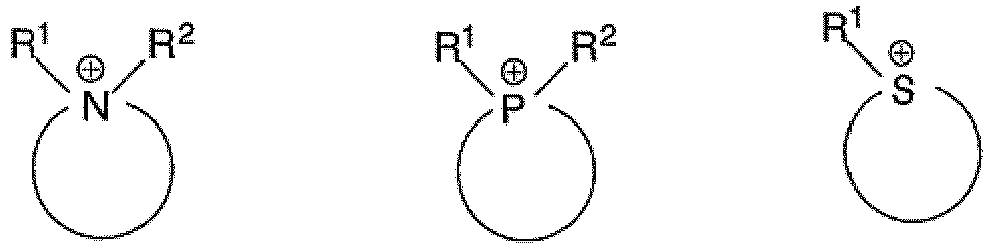

- On ne sortirait pas du cadre de la présente invention en utilisant un sel contenant 2 ou 3 sites ammonium, phosphonium ou sulfonium dans leur formule. Comme exemples de sels Y+A- on peut mentionner les chlorures et fluorures de tétraalkylammonium, les chlorures et fluorures de tétraalkylphosphonium, et chlorures et fluorures de trialkylsulfonium, les chlorures et fluorures d'alkylpyridinium, les chlorures, fluorures et bromures de dialkylimidazolium, et les chlorures et fluorures de trialkylimidazolium. Sont plus particulièrement appréciés le fluorure ou le chlorure de triméthylsulfonium, le chlorure ou le fluorure de N-éthyl-pyridinium, le chlorure ou le fluorure de N-butyl-pyridinium, le chlorure ou le fluorure de 1-éthyl-3-méthyl-imidazolium, et le chlorure ou fluorure de 1-butyl-3-méthyl-imidazolium.
- Les liquides ioniques selon l'invention peuvent être préparés de façon connue en soi en mélangeant de manière appropriée l'acide de Lewis halogéné ou oxyhalogéné et le sel organique Y+A- dans un rapport molaire qui peut aller de 0,5:1 à 3,5:1, de préférence de 1:1 à 2,5:1 et plus préférentiellement 1:1 à 2:1. Un rapport molaire strictement supérieur à 1:1 est particulièrement recommandé si l'on désire obtenir un liquide ionique acide.
- De préférence, le liquide ionique peut être à base d'antimoine. Par exemple, le liquide ionique peut être le produit de la réaction entre le pentachlorure d'antimoine avec le chlorure d'éthylméthylimidazolium, de sorte à obtenir le catalyseur emim+Sb2F11 -.
- Le mélange peut être réalisé dans un réacteur de type autoclave, éventuellement refroidi pour limiter l'exothermie de la réaction. On peut également contrôler cette exothermie en ajoutant progressivement l'un des réactifs à l'autre.
- La quantité molaire d'HF sur la quantité molaire dudit premier flux comprenant du 1,2,3,4-tetrachlorobutadiène obtenu à l'étape a) est comprise entre 2 et 50 et préférentiellement entre 10 et 30. La durée de la réaction nécessaire qui dépend de la quantité des réactifs mise en jeu au départ et des différents paramètres opératoires, peut être facilement connue expérimentalement.
- De préférence, l'étape b) de fluoration en phase liquide en présence de HF est effectuée à une pression de 5 à 25 barg.
- Le matériau du réacteur de fluoration doit permettre de travailler dans les conditions de pression et de température définies précédemment. Il doit également résister à la corrosion qu'engendre le fluorure d'hydrogène. Ainsi, l'acier inoxydable ou des alliages type MONEL, INCONEL ou HASTELLOY sont particulièrement indiqués.
- Selon un troisième mode de réalisation, l'étape b) de fluoration dudit premier flux comprenant du 1,2,3,4-tetrachlorobutadiène obtenu à l'étape a) peut être effectuée en présence d'un solvant polaire aprotique.
- Avantageusement, le solvant polaire aprotique est choisi parmi le groupe consistant en un éther, un amide, une amine, un sulfoxide, une cétone, un nitrile ou un ester.
- De préférence, le solvant organique polaire aprotique est choisi parmi le groupe consistant en 1,3-dioxane, 1,4-dioxane, 1,3,5-trioxane, tetrahydrofurane, 1,2-dimethoxyéthane, dimethylsulfoxyde, diéthylsulfoxyde, N-methylpyrrolidone, diméthylformamide, diméthylacétamide, acétate d'éthyle, acétone, propanone, 2-pentanone, butanone, n-butylacétate, triéthylamine, pyridine et acétonitrile.
- En particulier, le solvant organique polaire aprotique a un point d'ébullition supérieur à 100°C à pression atmosphérique. De préférence, le solvant organique polaire aprotique est 1,3-dioxane, 1,4-dioxane, 1,3,5-trioxane, N-methylpyrrolidone, diméthylformamide, diméthylacétamide, propanone, 2-pentanone, butanone, dimethylsulfoxyde, diéthylsulfoxyde.
- Dans ce troisième mode de réalisation, l'étape b) de fluoration est effectuée en présence d'un agent de fluoration de formule Ax+Fx dans laquelle A est un cation et F désigne un ion fluorure F-. De préférence, l'étape b) de fluoration est réalisée en présence d'un agent de fluoration de formule Ax+Fx dans laquelle A est H, Li, Na, K, Rb, Cs, Mg, Ca, Sr ou Ba ; et x est 1 ou 2. En particulier, l'étape b) de fluoration est réalisée en présence d'un agent de fluoration de formule Ax+Fx dans laquelle A est Li, Na, K, Mg ou Ca ; et x est 1 ou 2.
- De préférence, le ratio molaire entre l'agent de fluoration et ledit premier flux comprenant du 1,2,3,4-tetrachlorobutadiène est inférieur à 8,7, avantageusement inférieur à 8,4, de préférence inférieur à 7,8, en particulier inférieur à 7,5, plus particulièrement inférieur à 6,9, de manière privilégiée inférieur à 6,6.
- L'étape b) peut être effectuée pour une durée comprise entre 1 heure et 10 heures, avantageusement de 2 à 6 heures.
- Avantageusement, l'étape b) peut être effectuée au reflux du solvant.
- De préférence, l'étape b) est mise en œuvre, selon ce troisième mode de réalisation à une pression comprise 0 et 3 barg.
- Selon un mode de réalisation préféré, le second flux comprenant du 1,1,2,3,4,4-hexafluorobutane obtenu à l'étape b), selon l'un quelconque des modes de réalisation, peut être concentré et/ou distillé. Par exemple, le second flux comprenant du 1,1,2,3,4,4-hexafluorobutane peut être distillé à pression atmosphérique entre 63°C et 65°C.
- Selon l'étape c) du présent procédé, ledit second flux comprenant du 1,1,2,3,4,4-hexafluorobutane et obtenu à l'étape b) est soumis à une réaction de déhydrogénation.
- Selon un mode de réalisation préféré, l'étape c) est mise en œuvre par i) chloration dudit second flux comprenant du 1,1,2,3,4,4-hexafluorobutane puis ii) déchloration du produit obtenu en i) en présence d'un réactif métallique comprenant du zinc, le cuivre, le manganèse ou un mélange de ceux-ci, de préférence du zinc.
- De préférence, l'étape i) est réalisée en présence d'un excès de chlore. L'étape i) peut être mise en œuvre par un traitement thermique, avantageusement à une température supérieure à 80°C, de préférence à une température comprise entre 120°C et 150°C. Alternativement, l'étape i) peut être mise en œuvre par un traitement photochimique connu de l'homme du métier. Alternativement, l'étape i) peut être mise en œuvre en présence d'initiateur de radicaux tels que des peroxydes ou des composés du type azoïque, par exemple l'azoisobutyronitrile. Dans ce dernier cas, l'étape i) peut être mise en œuvre à une température comprise entre la température ambiante (par exemple 25°C) et 80°C.
- De préférence, le produit obtenu à l'étape i) est une composition comprenant le 1,2,3,4-tetrachloroperfluorobutane.
- De préférence, l'étape ii) est réalisée en présence d'un solvant aqueux et/ou alcoolique. Par exemple, l'étape ii) peut être réalisée en présence d'eau, d'isopropanol, de méthanol, d'éthanol ou de propanol ou un mélange de ceux-ci. En particulier, l'étape ii) peut être réalisée en présence d'eau, d'isopropanol ou un mélange de ceux-ci.
- De préférence, le troisième flux comprenant l'hexafluorobutadiène formé à l'étape c) est récupéré et soumis à une étape de distillation.
- On charge un réacteur en Inox de 500mm de long et de diamètre intérieur de 7,7mm avec un catalyseur à base de charbon actif imprégné par 8,4% de cuivre et 1,7% de palladium. La température du lit de catalyseur est portée à 270°C. Un flux d'hydrogène et d'hexachlorobutadiène est alors introduit dans le réacteur. Le débit d'hexachlorobutadiène et d'hydrogène sont respectivement de 0,022 moles/h et de 0,086 moles/h. Le temps de séjour est de 4,8 secondes. Le taux de transformation de l'hexachlorobutadiène est de 78% avec une sélectivité de 87% en 1,2,3,4-tetrachlorobutadiène. Le mélange réactionnel est récupéré par condensation et il est purifié par distillation sous vide (Point d'ébullition du 1,2,3,4-tetrachlorobutadiène = 188°C; point d'ébullition de l'hexachlorobutadiène = 210°C). Le rendement en 1,2,3,4-tetrachlorobutadiène après purification est de 60%.
- Dans un autoclave de 1l maintenu à 0°C, on introduit 100ml de 1,2,3,4-tétrachlorobutadiène dans 400ml de HF contenant 7ml de SbCl5. L'autoclave est muni d'une vanne de régulation de pression tarée à 20 bars. On porte peu à peu le mélange agité à 120°C. L'acide chlorhydrique produit lors de la réaction est éliminé de l'autoclave à l'aide de la vanne de régulation puis piégé selon les méthodes connues de l'homme du métier. Après deux heures à 120°C, le mélange réactionnel est refroidi et l'acide fluorhydrique en excès est éliminé par distillation. La phase organique restante est refroidie et décantée pour récupérer une composition comprenant du 1,1,2,3,4,4-hexafluorobutane. Cette dernière est distillée et on obtient le 1,1,2,3,4,4-hexafluorobutane (Point d'ébullition = 63-65°C) avec un rendement de 72%.
- Dans un réacteur tubulaire de diamètre 20mm, on introduit 5g de catalyseur Ni/Cr sur AlF3. La température du lit catalytique est portée à 360°C et un mélange de 0,28 g/h de 1,2,3,4-tétrachlorobutadiène et de 1,5 g/h de HF (soit un rapport molaire HF/1,2,3,4-tétrachlorobutadiène de 50) est mis en contact avec le catalyseur. En sortie de réacteur, l'acide fluorhydrique n'ayant pas réagi, soit 1,3 g/h, et les sous-produits de la réaction non totalement fluorés sont recyclés. Un mélange comprend de l'acide chlorhydrique et du 1,1,2,3,4,4-hexafluorobutane est obtenu. L'acide chlorhydrique et le 1,1,2,3,4,4-hexafluorobutane sont séparés pour aboutir à une composition de 1,2,3,4-tetrachlorobutadiène de grande pureté. Le rendement en 1,1,2,3,4,4-hexafluorobutane de 91% par rapport au 1,2,3,4-tétrachlorobutadiène introduit.
- Dans un réacteur en verre agité de 1 litre, thermostaté par une circulation d'un thermofluide dans une enveloppe extérieure, avec une canne d'introduction gaz, ici le chlore, et relié à un piège de gaz rempli d'eau sodée, on dissout 100g de 1,1,2,3,4,4-hexafluorobutane et 10g l'azoisobutyronitrile dans 700ml de chlorobenzène. On introduit à température ambiante une quantité de chlore correspondant à environ 30% de la stœchiométrie de la réaction soit 50g. On porte le mélange agité à 50°C ; une exothermie d'une dizaine de degrés apparait vers 45°C qui correspond à la décomposition de l'amorceur radicalaire, l'azoisobutyronitrile et à l'initiation de la chloration radicalaire. On introduit alors le chlore à un débit de 75 g/h en maintenant la température du milieu inférieure à 60°C. On arrête l'introduction de chlore lorsque 150g de chlore ont été introduits. On laisse réagir après la fin de l'introduction du chlore pendant au moins 1 heure, de préférence jusqu'à l'absence d'exothermie. Le mélange réactionnel est ensuite balayé par un flux d'azote durant 30 minutes puis récupéré, lavé à l'eau. On récupère la phase organique que l'on distille pour obtenir une composition comprenant du 1,2,3,4-tetrachloroperfluorobutane (Point d'ébullition = 63°C).
- Dans un réacteur agité surmonté d'un réfrigérant thermostaté relié à une bouteille en inox refroidie par de la carboglace, on introduit dans 800ml d'éthanol une quantité de zinc métallique légèrement surstœchiométrique soit ici 200g (1,55 moles de zinc). Le mélange est agité pour former une suspension de zinc et on introduit à température ambiante le 1,2,3,4-tétrachloroperfluorobutane. Le réfrigérant est maintenu à 0°C et ainsi seul l'hexafluorobutadiène traverse le réfrigérant. On récupère 72g d'hexafluorobutadiène soit un rendement de 72% par rapport au 1,1,2,3,4,4-hexafluorobutane. La pureté de l'hexafluorobutadiène est 98% en CPG.
Claims (13)
- Procédé de préparation de l'hexafluorobutadiène comprenant les étapes de :a) hydrodéchloration de l'hexachlorobutadiène pour former un premier flux comprenant du 1,2,3,4-tetrachlorobutadiène et optionnellement de l'hexachlorobutadiène n'ayant pas réagi,b) fluoration dudit premier flux comprenant du 1,2,3,4-tetrachlorobutadiène obtenu à l'étape a) pour former un second flux comprenant du 1,1,2,3,4,4-hexafluorobutane,c) déhydrogénation dudit second flux comprenant du 1,1,2,3,4,4-hexafluorobutane pour former un troisième flux comprenant de l'hexafluorobutadiène.
- Procédé selon la revendication précédente caractérisé en ce que l'étape b) de fluoration est réalisée en présence d'un agent de fluoration de formule Ax+Fx dans laquelle A est un cation et F désigne un ion fluorure F-.
- Procédé selon la revendication précédente caractérisé en ce que l'étape b) de fluoration est réalisée en présence d'un agent de fluoration de formule Ax+Fx dans laquelle A est H, Li, Na, K, Rb, Cs, Mg, Ca, Sr ou Ba ; et x est 1 ou 2.
- Procédé selon l'une quelconque des revendications précédentes caractérisé en ce que l'étape b) de fluoration est effectuée, en phase liquide, en présence d'un solvant polaire aprotique et d'un agent de fluoration de formule Ax+Fx dans laquelle A est Li, Na, K, Mg ou Ca ; et x est 1 ou 2 ; avantageusement le solvant polaire aprotique est choisi parmi le groupe consistant en un éther, un amide, une amine, un sulfoxyde, une cétone, un nitrile ou un ester.
- Procédé selon la revendication précédente caractérisé en ce que le solvant organique polaire aprotique a un point d'ébullition supérieur à 100°C à pression atmosphérique.
- Procédé selon l'une quelconque des revendications 1 à 3 caractérisé en ce que l'étape b) de fluoration est effectuée en phase gazeuse en présence d'un catalyseur et de HF.
- Procédé selon l'une quelconque des revendications 1 à 3 caractérisé en ce que l'étape b) de fluoration est effectuée en phase liquide en présence de HF, avantageusement en présence d'un catalyseur à base d'halogénures de métaux ou d'un liquide ionique.
- Procédé selon l'une quelconque des revendications précédentes caractérisé en ce que de l'acide chlorhydrique est également produit pendant l'étape de fluoration ; ledit second flux produit à l'étape b) comprenant du 1,1,2,3,4,4-hexafluorobutane, de l'acide chlorhydrique et éventuellement de l'agent de fluoration n'ayant pas réagi ; avantageusement le second flux obtenu à l'étape b) est séparé en un premier courant comprenant l'acide chlorhydrique et éventuellement l'agent de fluoration n'ayant pas réagi et en un second courant comprenant le 1,1,2,3,4,4-hexafluorobutane.
- Procédé selon l'une quelconque des revendications précédentes caractérisé en ce que l'hexafluorobutadiène formé à l'étape c) est récupéré et soumis à une étape de distillation.
- Procédé selon l'une quelconque des revendications précédentes caractérisé en ce que l'étape a) est mise en œuvre en présence d'hydrogène.
- Procédé selon l'une quelconque des revendications précédentes caractérisé en ce que l'étape a) est mise en œuvre en phase gazeuse à une température supérieure au point d'ébullition de l'hexachlorobutadiène.
- Procédé selon l'une quelconque des revendications précédentes caractérisé en ce que l'étape c) est mise en œuvre par i) chloration dudit second flux comprenant du 1,1,2,3,4,4-hexafluorobutane puis ii) déchloration du produit obtenu en i) en présence d'un réactif métallique comprenant du zinc.
- Procédé selon la revendication précédente caractérisé en ce que le produit obtenu en i) est le 1,2,3,4-tetrachloroperfluorobutane.
Applications Claiming Priority (2)
| Application Number | Priority Date | Filing Date | Title |
|---|---|---|---|
| FR1652921A FR3049599B1 (fr) | 2016-04-04 | 2016-04-04 | Procede de preparation de l'hexafluorobutadiene. |
| PCT/FR2017/050635 WO2017174889A1 (fr) | 2016-04-04 | 2017-03-20 | Procédé de préparation de l'hexafluorobutadiène |
Publications (2)
| Publication Number | Publication Date |
|---|---|
| EP3440040A1 EP3440040A1 (fr) | 2019-02-13 |
| EP3440040B1 true EP3440040B1 (fr) | 2020-01-08 |
Family
ID=56087395
Family Applications (1)
| Application Number | Title | Priority Date | Filing Date |
|---|---|---|---|
| EP17717778.9A Active EP3440040B1 (fr) | 2016-04-04 | 2017-03-20 | Procédé de préparation de l'hexafluorobutadiène |
Country Status (7)
| Country | Link |
|---|---|
| US (1) | US10336669B2 (fr) |
| EP (1) | EP3440040B1 (fr) |
| JP (1) | JP2019513721A (fr) |
| CN (1) | CN109071384A (fr) |
| ES (1) | ES2784527T3 (fr) |
| FR (1) | FR3049599B1 (fr) |
| WO (1) | WO2017174889A1 (fr) |
Families Citing this family (3)
| Publication number | Priority date | Publication date | Assignee | Title |
|---|---|---|---|---|
| CN111116302B (zh) * | 2019-12-30 | 2022-07-01 | 浙江巨化技术中心有限公司 | 一种卤代丁烯的合成方法 |
| WO2022249853A1 (fr) * | 2021-05-24 | 2022-12-01 | 昭和電工株式会社 | 1,2,3,4-tétrachloro-1,1,4-trifluorobutane ainsi que procédé de fabrication de celui-ci, et procédé de fabrication de 1,2,3,4-tétrachloro-1,1,2,3,4,4-hexafluorobutane |
| WO2022249852A1 (fr) * | 2021-05-24 | 2022-12-01 | 昭和電工株式会社 | 1,2,3,4-tétrachloro-1-fluorobutane ainsi que procédé de fabrication de celui-ci, et procédé de fabrication de 1,2,3,4-tétrachloro-1,1,2,3,4,4-hexafluorobutane |
Family Cites Families (8)
| Publication number | Priority date | Publication date | Assignee | Title |
|---|---|---|---|---|
| GB839756A (en) * | 1955-07-01 | 1960-06-29 | Robert Neville Haszeldine | Improvements in or relating to the preparation of 1,2,3,4-tetrahydroperfluorobutane and perfluorobutadiene |
| GB798407A (en) | 1956-11-27 | 1958-07-23 | Dow Chemical Co | Preparation of hexafluorobutadiene |
| US3287425A (en) | 1961-03-07 | 1966-11-22 | Du Pont | Fluorinated compounds and their preparation |
| AU5011493A (en) * | 1992-10-01 | 1994-04-26 | Dow Chemical Company, The | Processes for converting chlorinated alkane byproducts or waste products to useful, less chlorinated alkanes |
| CN101432253B (zh) * | 2006-04-28 | 2012-04-18 | 昭和电工株式会社 | 六氟-1,3-丁二烯的制造方法 |
| US9079818B2 (en) * | 2007-10-15 | 2015-07-14 | Honeywell International Inc. | Process for synthesis of fluorinated olefins |
| CN101648846B (zh) * | 2009-09-15 | 2012-12-26 | 浙江三美化工股份有限公司 | 液相-气相法合成1,1,1,2-四氟乙烷的生产工艺 |
| RU2571415C2 (ru) * | 2011-01-21 | 2015-12-20 | Аркема Франс | Каталитическое газофазное фторирование |
-
2016
- 2016-04-04 FR FR1652921A patent/FR3049599B1/fr not_active Expired - Fee Related
-
2017
- 2017-03-20 EP EP17717778.9A patent/EP3440040B1/fr active Active
- 2017-03-20 JP JP2018551930A patent/JP2019513721A/ja active Pending
- 2017-03-20 CN CN201780021528.9A patent/CN109071384A/zh active Pending
- 2017-03-20 WO PCT/FR2017/050635 patent/WO2017174889A1/fr not_active Ceased
- 2017-03-20 US US16/090,851 patent/US10336669B2/en not_active Expired - Fee Related
- 2017-03-20 ES ES17717778T patent/ES2784527T3/es active Active
Non-Patent Citations (1)
| Title |
|---|
| None * |
Also Published As
| Publication number | Publication date |
|---|---|
| WO2017174889A1 (fr) | 2017-10-12 |
| FR3049599A1 (fr) | 2017-10-06 |
| JP2019513721A (ja) | 2019-05-30 |
| US20190112244A1 (en) | 2019-04-18 |
| ES2784527T3 (es) | 2020-09-28 |
| FR3049599B1 (fr) | 2018-03-16 |
| CN109071384A (zh) | 2018-12-21 |
| EP3440040A1 (fr) | 2019-02-13 |
| US10336669B2 (en) | 2019-07-02 |
Similar Documents
| Publication | Publication Date | Title |
|---|---|---|
| FR2916755A1 (fr) | Procede de preparation d'(hydro)(chloro)(fluoro)olefines | |
| US10112879B2 (en) | Process to manufacture 2-chloro-1,1,1,2-tetrafluoropropane (HCFC-244bb) | |
| US9255044B2 (en) | Process for the manufacture of 2-chloro-1,1,1,2-tetrafluoropropane by liquid phase fluorination of 2-chloro-3,3,3-trifluoropropene | |
| JP2020023587A (ja) | 1−クロロ−2,3,3−トリフルオロプロペンの製造方法 | |
| CN105037080A (zh) | 延长氢氟化过程中的催化剂寿命的方法 | |
| US9701599B2 (en) | Process for producing 2,3,3,3-tetrafluoropropene | |
| CA2960177C (fr) | Synthese de chlorotrifluoroethylene au moyen de la deshydrochloration catalytique de 1,2-dichloro-1,1,2-trifluoroethane | |
| US9676688B2 (en) | Method for producing 1,1-dichloro-3,3,3-trifluoropropane | |
| KR20150125675A (ko) | Hcfc-244bb로의 hcfo-1233xf 불화수소화 동안 hfc-245cb 형성을 완화시키는 방법 | |
| FR2724167A1 (fr) | Procede pour l'hydrofluoration de chloro (fluoro) butane | |
| JP2014503496A (ja) | ペンタクロロプロパンの液相フッ素化による2−クロロ−3,3,3−トリフルオロプロペン(hcfo1233xf)の製造方法 | |
| EP3440040A1 (fr) | Procédé de préparation de l'hexafluorobutadiène | |
| EP3793967A1 (fr) | Procédé de production du 1-chloro-3,3,3-trifluoropropène | |
| CN1826304A (zh) | 制备氢氟烃的方法 | |
| JPH0769944A (ja) | 1−クロロ−1− フルオロエタン及び/又は1,1−ジフルオロエタンの製造方法 | |
| EP4107140A1 (fr) | Procede de production d'un compose iodofluoroalcane | |
| EP1673323B1 (fr) | Procede de fabrication du 1,1-difluoroethane et application a la fabrication du 1,1-difluoroethylene | |
| JP2017178897A (ja) | クロロプロパン類の製造方法 | |
| EP3630716A1 (fr) | Procede de preparation de composes fluoroorganiques | |
| EP3947328B1 (fr) | Procédé de purification du 1-chloro-3,3,3-trifluoropropène | |
| JP6360084B2 (ja) | 2−クロロ−3,3,3−トリフルオロプロペンの液相フッ素化で2−クロロ−1,1,1,2−テトラフルオロプロペンを製造する方法 | |
| FR3107271A1 (fr) | Procédé de production d’un composé iodofluoroalcane | |
| WO2017018090A1 (fr) | Procédé de production d'un chloroalcane d'ordre supérieur |
Legal Events
| Date | Code | Title | Description |
|---|---|---|---|
| STAA | Information on the status of an ep patent application or granted ep patent |
Free format text: STATUS: UNKNOWN |
|
| STAA | Information on the status of an ep patent application or granted ep patent |
Free format text: STATUS: THE INTERNATIONAL PUBLICATION HAS BEEN MADE |
|
| PUAI | Public reference made under article 153(3) epc to a published international application that has entered the european phase |
Free format text: ORIGINAL CODE: 0009012 |
|
| STAA | Information on the status of an ep patent application or granted ep patent |
Free format text: STATUS: REQUEST FOR EXAMINATION WAS MADE |
|
| 17P | Request for examination filed |
Effective date: 20181008 |
|
| AK | Designated contracting states |
Kind code of ref document: A1 Designated state(s): AL AT BE BG CH CY CZ DE DK EE ES FI FR GB GR HR HU IE IS IT LI LT LU LV MC MK MT NL NO PL PT RO RS SE SI SK SM TR |
|
| AX | Request for extension of the european patent |
Extension state: BA ME |
|
| DAV | Request for validation of the european patent (deleted) | ||
| DAX | Request for extension of the european patent (deleted) | ||
| GRAP | Despatch of communication of intention to grant a patent |
Free format text: ORIGINAL CODE: EPIDOSNIGR1 |
|
| STAA | Information on the status of an ep patent application or granted ep patent |
Free format text: STATUS: GRANT OF PATENT IS INTENDED |
|
| INTG | Intention to grant announced |
Effective date: 20191022 |
|
| GRAS | Grant fee paid |
Free format text: ORIGINAL CODE: EPIDOSNIGR3 |
|
| GRAA | (expected) grant |
Free format text: ORIGINAL CODE: 0009210 |
|
| STAA | Information on the status of an ep patent application or granted ep patent |
Free format text: STATUS: THE PATENT HAS BEEN GRANTED |
|
| AK | Designated contracting states |
Kind code of ref document: B1 Designated state(s): AL AT BE BG CH CY CZ DE DK EE ES FI FR GB GR HR HU IE IS IT LI LT LU LV MC MK MT NL NO PL PT RO RS SE SI SK SM TR |
|
| REG | Reference to a national code |
Ref country code: GB Ref legal event code: FG4D Free format text: NOT ENGLISH |
|
| REG | Reference to a national code |
Ref country code: CH Ref legal event code: EP |
|
| REG | Reference to a national code |
Ref country code: DE Ref legal event code: R096 Ref document number: 602017010724 Country of ref document: DE |
|
| REG | Reference to a national code |
Ref country code: IE Ref legal event code: FG4D Free format text: LANGUAGE OF EP DOCUMENT: FRENCH |
|
| REG | Reference to a national code |
Ref country code: AT Ref legal event code: REF Ref document number: 1222518 Country of ref document: AT Kind code of ref document: T Effective date: 20200215 |
|
| REG | Reference to a national code |
Ref country code: NL Ref legal event code: FP |
|
| REG | Reference to a national code |
Ref country code: CH Ref legal event code: NV Representative=s name: VALIPAT S.A. C/O BOVARD SA NEUCHATEL, CH |
|
| PGFP | Annual fee paid to national office [announced via postgrant information from national office to epo] |
Ref country code: IT Payment date: 20200331 Year of fee payment: 4 |
|
| REG | Reference to a national code |
Ref country code: LT Ref legal event code: MG4D |
|
| PG25 | Lapsed in a contracting state [announced via postgrant information from national office to epo] |
Ref country code: LT Free format text: LAPSE BECAUSE OF FAILURE TO SUBMIT A TRANSLATION OF THE DESCRIPTION OR TO PAY THE FEE WITHIN THE PRESCRIBED TIME-LIMIT Effective date: 20200108 Ref country code: NO Free format text: LAPSE BECAUSE OF FAILURE TO SUBMIT A TRANSLATION OF THE DESCRIPTION OR TO PAY THE FEE WITHIN THE PRESCRIBED TIME-LIMIT Effective date: 20200408 Ref country code: PT Free format text: LAPSE BECAUSE OF FAILURE TO SUBMIT A TRANSLATION OF THE DESCRIPTION OR TO PAY THE FEE WITHIN THE PRESCRIBED TIME-LIMIT Effective date: 20200531 Ref country code: FI Free format text: LAPSE BECAUSE OF FAILURE TO SUBMIT A TRANSLATION OF THE DESCRIPTION OR TO PAY THE FEE WITHIN THE PRESCRIBED TIME-LIMIT Effective date: 20200108 Ref country code: RS Free format text: LAPSE BECAUSE OF FAILURE TO SUBMIT A TRANSLATION OF THE DESCRIPTION OR TO PAY THE FEE WITHIN THE PRESCRIBED TIME-LIMIT Effective date: 20200108 |
|
| PGFP | Annual fee paid to national office [announced via postgrant information from national office to epo] |
Ref country code: CH Payment date: 20200420 Year of fee payment: 4 Ref country code: DE Payment date: 20200408 Year of fee payment: 4 Ref country code: ES Payment date: 20200428 Year of fee payment: 4 Ref country code: NL Payment date: 20200417 Year of fee payment: 4 Ref country code: FR Payment date: 20200414 Year of fee payment: 4 |
|
| PG25 | Lapsed in a contracting state [announced via postgrant information from national office to epo] |
Ref country code: IS Free format text: LAPSE BECAUSE OF FAILURE TO SUBMIT A TRANSLATION OF THE DESCRIPTION OR TO PAY THE FEE WITHIN THE PRESCRIBED TIME-LIMIT Effective date: 20200508 Ref country code: GR Free format text: LAPSE BECAUSE OF FAILURE TO SUBMIT A TRANSLATION OF THE DESCRIPTION OR TO PAY THE FEE WITHIN THE PRESCRIBED TIME-LIMIT Effective date: 20200409 Ref country code: HR Free format text: LAPSE BECAUSE OF FAILURE TO SUBMIT A TRANSLATION OF THE DESCRIPTION OR TO PAY THE FEE WITHIN THE PRESCRIBED TIME-LIMIT Effective date: 20200108 Ref country code: SE Free format text: LAPSE BECAUSE OF FAILURE TO SUBMIT A TRANSLATION OF THE DESCRIPTION OR TO PAY THE FEE WITHIN THE PRESCRIBED TIME-LIMIT Effective date: 20200108 Ref country code: LV Free format text: LAPSE BECAUSE OF FAILURE TO SUBMIT A TRANSLATION OF THE DESCRIPTION OR TO PAY THE FEE WITHIN THE PRESCRIBED TIME-LIMIT Effective date: 20200108 Ref country code: BG Free format text: LAPSE BECAUSE OF FAILURE TO SUBMIT A TRANSLATION OF THE DESCRIPTION OR TO PAY THE FEE WITHIN THE PRESCRIBED TIME-LIMIT Effective date: 20200408 |
|
| PGFP | Annual fee paid to national office [announced via postgrant information from national office to epo] |
Ref country code: BE Payment date: 20200416 Year of fee payment: 4 |
|
| REG | Reference to a national code |
Ref country code: ES Ref legal event code: FG2A Ref document number: 2784527 Country of ref document: ES Kind code of ref document: T3 Effective date: 20200928 |
|
| REG | Reference to a national code |
Ref country code: DE Ref legal event code: R097 Ref document number: 602017010724 Country of ref document: DE |
|
| PG25 | Lapsed in a contracting state [announced via postgrant information from national office to epo] |
Ref country code: DK Free format text: LAPSE BECAUSE OF FAILURE TO SUBMIT A TRANSLATION OF THE DESCRIPTION OR TO PAY THE FEE WITHIN THE PRESCRIBED TIME-LIMIT Effective date: 20200108 Ref country code: EE Free format text: LAPSE BECAUSE OF FAILURE TO SUBMIT A TRANSLATION OF THE DESCRIPTION OR TO PAY THE FEE WITHIN THE PRESCRIBED TIME-LIMIT Effective date: 20200108 Ref country code: SM Free format text: LAPSE BECAUSE OF FAILURE TO SUBMIT A TRANSLATION OF THE DESCRIPTION OR TO PAY THE FEE WITHIN THE PRESCRIBED TIME-LIMIT Effective date: 20200108 Ref country code: RO Free format text: LAPSE BECAUSE OF FAILURE TO SUBMIT A TRANSLATION OF THE DESCRIPTION OR TO PAY THE FEE WITHIN THE PRESCRIBED TIME-LIMIT Effective date: 20200108 Ref country code: CZ Free format text: LAPSE BECAUSE OF FAILURE TO SUBMIT A TRANSLATION OF THE DESCRIPTION OR TO PAY THE FEE WITHIN THE PRESCRIBED TIME-LIMIT Effective date: 20200108 Ref country code: MC Free format text: LAPSE BECAUSE OF FAILURE TO SUBMIT A TRANSLATION OF THE DESCRIPTION OR TO PAY THE FEE WITHIN THE PRESCRIBED TIME-LIMIT Effective date: 20200108 Ref country code: SK Free format text: LAPSE BECAUSE OF FAILURE TO SUBMIT A TRANSLATION OF THE DESCRIPTION OR TO PAY THE FEE WITHIN THE PRESCRIBED TIME-LIMIT Effective date: 20200108 |
|
| PLBE | No opposition filed within time limit |
Free format text: ORIGINAL CODE: 0009261 |
|
| STAA | Information on the status of an ep patent application or granted ep patent |
Free format text: STATUS: NO OPPOSITION FILED WITHIN TIME LIMIT |
|
| REG | Reference to a national code |
Ref country code: AT Ref legal event code: MK05 Ref document number: 1222518 Country of ref document: AT Kind code of ref document: T Effective date: 20200108 |
|
| 26N | No opposition filed |
Effective date: 20201009 |
|
| PG25 | Lapsed in a contracting state [announced via postgrant information from national office to epo] |
Ref country code: LU Free format text: LAPSE BECAUSE OF NON-PAYMENT OF DUE FEES Effective date: 20200320 |
|
| PG25 | Lapsed in a contracting state [announced via postgrant information from national office to epo] |
Ref country code: AT Free format text: LAPSE BECAUSE OF FAILURE TO SUBMIT A TRANSLATION OF THE DESCRIPTION OR TO PAY THE FEE WITHIN THE PRESCRIBED TIME-LIMIT Effective date: 20200108 Ref country code: IE Free format text: LAPSE BECAUSE OF NON-PAYMENT OF DUE FEES Effective date: 20200320 |
|
| PG25 | Lapsed in a contracting state [announced via postgrant information from national office to epo] |
Ref country code: PL Free format text: LAPSE BECAUSE OF FAILURE TO SUBMIT A TRANSLATION OF THE DESCRIPTION OR TO PAY THE FEE WITHIN THE PRESCRIBED TIME-LIMIT Effective date: 20200108 Ref country code: SI Free format text: LAPSE BECAUSE OF FAILURE TO SUBMIT A TRANSLATION OF THE DESCRIPTION OR TO PAY THE FEE WITHIN THE PRESCRIBED TIME-LIMIT Effective date: 20200108 |
|
| REG | Reference to a national code |
Ref country code: DE Ref legal event code: R119 Ref document number: 602017010724 Country of ref document: DE |
|
| REG | Reference to a national code |
Ref country code: CH Ref legal event code: PL |
|
| REG | Reference to a national code |
Ref country code: NL Ref legal event code: MM Effective date: 20210401 |
|
| GBPC | Gb: european patent ceased through non-payment of renewal fee |
Effective date: 20210320 |
|
| REG | Reference to a national code |
Ref country code: BE Ref legal event code: MM Effective date: 20210331 |
|
| PG25 | Lapsed in a contracting state [announced via postgrant information from national office to epo] |
Ref country code: GB Free format text: LAPSE BECAUSE OF NON-PAYMENT OF DUE FEES Effective date: 20210320 Ref country code: FR Free format text: LAPSE BECAUSE OF NON-PAYMENT OF DUE FEES Effective date: 20210331 Ref country code: NL Free format text: LAPSE BECAUSE OF NON-PAYMENT OF DUE FEES Effective date: 20210401 Ref country code: DE Free format text: LAPSE BECAUSE OF NON-PAYMENT OF DUE FEES Effective date: 20211001 Ref country code: CH Free format text: LAPSE BECAUSE OF NON-PAYMENT OF DUE FEES Effective date: 20210331 Ref country code: LI Free format text: LAPSE BECAUSE OF NON-PAYMENT OF DUE FEES Effective date: 20210331 |
|
| PG25 | Lapsed in a contracting state [announced via postgrant information from national office to epo] |
Ref country code: IT Free format text: LAPSE BECAUSE OF NON-PAYMENT OF DUE FEES Effective date: 20210320 |
|
| REG | Reference to a national code |
Ref country code: ES Ref legal event code: FD2A Effective date: 20220523 |
|
| PG25 | Lapsed in a contracting state [announced via postgrant information from national office to epo] |
Ref country code: TR Free format text: LAPSE BECAUSE OF FAILURE TO SUBMIT A TRANSLATION OF THE DESCRIPTION OR TO PAY THE FEE WITHIN THE PRESCRIBED TIME-LIMIT Effective date: 20200108 Ref country code: MT Free format text: LAPSE BECAUSE OF FAILURE TO SUBMIT A TRANSLATION OF THE DESCRIPTION OR TO PAY THE FEE WITHIN THE PRESCRIBED TIME-LIMIT Effective date: 20200108 Ref country code: CY Free format text: LAPSE BECAUSE OF FAILURE TO SUBMIT A TRANSLATION OF THE DESCRIPTION OR TO PAY THE FEE WITHIN THE PRESCRIBED TIME-LIMIT Effective date: 20200108 |
|
| PG25 | Lapsed in a contracting state [announced via postgrant information from national office to epo] |
Ref country code: MK Free format text: LAPSE BECAUSE OF FAILURE TO SUBMIT A TRANSLATION OF THE DESCRIPTION OR TO PAY THE FEE WITHIN THE PRESCRIBED TIME-LIMIT Effective date: 20200108 Ref country code: AL Free format text: LAPSE BECAUSE OF FAILURE TO SUBMIT A TRANSLATION OF THE DESCRIPTION OR TO PAY THE FEE WITHIN THE PRESCRIBED TIME-LIMIT Effective date: 20200108 |
|
| PG25 | Lapsed in a contracting state [announced via postgrant information from national office to epo] |
Ref country code: ES Free format text: LAPSE BECAUSE OF NON-PAYMENT OF DUE FEES Effective date: 20210321 Ref country code: BE Free format text: LAPSE BECAUSE OF NON-PAYMENT OF DUE FEES Effective date: 20210331 |