EP3440054B1 - Pyrrolderivate zur verwendung als mglur5-modulatoren - Google Patents
Pyrrolderivate zur verwendung als mglur5-modulatoren Download PDFInfo
- Publication number
- EP3440054B1 EP3440054B1 EP16897539.9A EP16897539A EP3440054B1 EP 3440054 B1 EP3440054 B1 EP 3440054B1 EP 16897539 A EP16897539 A EP 16897539A EP 3440054 B1 EP3440054 B1 EP 3440054B1
- Authority
- EP
- European Patent Office
- Prior art keywords
- alkyl
- aryl
- optionally substituted
- heterocycloalkyl
- cycloalkyl
- Prior art date
- Legal status (The legal status is an assumption and is not a legal conclusion. Google has not performed a legal analysis and makes no representation as to the accuracy of the status listed.)
- Not-in-force
Links
- 0 *c([n](*)c1ccccc11)c1C#I Chemical compound *c([n](*)c1ccccc11)c1C#I 0.000 description 10
- PBMFSQRYOILNGV-UHFFFAOYSA-N c1ccnnc1 Chemical compound c1ccnnc1 PBMFSQRYOILNGV-UHFFFAOYSA-N 0.000 description 2
- CZPWVGJYEJSRLH-UHFFFAOYSA-N c1cncnc1 Chemical compound c1cncnc1 CZPWVGJYEJSRLH-UHFFFAOYSA-N 0.000 description 2
- FYADHXFMURLYQI-UHFFFAOYSA-N c1cnncn1 Chemical compound c1cnncn1 FYADHXFMURLYQI-UHFFFAOYSA-N 0.000 description 2
- KYQCOXFCLRTKLS-UHFFFAOYSA-N c1nccnc1 Chemical compound c1nccnc1 KYQCOXFCLRTKLS-UHFFFAOYSA-N 0.000 description 2
- QCSNJBGSBSPIGR-UHFFFAOYSA-O CCC(C)C=CC(C)[NH+]1c2ccccc2C(C#Cc2ncccn2)=C=C1 Chemical compound CCC(C)C=CC(C)[NH+]1c2ccccc2C(C#Cc2ncccn2)=C=C1 QCSNJBGSBSPIGR-UHFFFAOYSA-O 0.000 description 1
- RQAXXQFWIDJSTM-UHFFFAOYSA-N c1ccc2N=[I]N=Cc2c1 Chemical compound c1ccc2N=[I]N=Cc2c1 RQAXXQFWIDJSTM-UHFFFAOYSA-N 0.000 description 1
Classifications
-
- C—CHEMISTRY; METALLURGY
- C07—ORGANIC CHEMISTRY
- C07D—HETEROCYCLIC COMPOUNDS
- C07D401/00—Heterocyclic compounds containing two or more hetero rings, having nitrogen atoms as the only ring hetero atoms, at least one ring being a six-membered ring with only one nitrogen atom
- C07D401/02—Heterocyclic compounds containing two or more hetero rings, having nitrogen atoms as the only ring hetero atoms, at least one ring being a six-membered ring with only one nitrogen atom containing two hetero rings
- C07D401/06—Heterocyclic compounds containing two or more hetero rings, having nitrogen atoms as the only ring hetero atoms, at least one ring being a six-membered ring with only one nitrogen atom containing two hetero rings linked by a carbon chain containing only aliphatic carbon atoms
-
- A—HUMAN NECESSITIES
- A61—MEDICAL OR VETERINARY SCIENCE; HYGIENE
- A61P—SPECIFIC THERAPEUTIC ACTIVITY OF CHEMICAL COMPOUNDS OR MEDICINAL PREPARATIONS
- A61P25/00—Drugs for disorders of the nervous system
-
- C—CHEMISTRY; METALLURGY
- C07—ORGANIC CHEMISTRY
- C07D—HETEROCYCLIC COMPOUNDS
- C07D207/00—Heterocyclic compounds containing five-membered rings not condensed with other rings, with one nitrogen atom as the only ring hetero atom
- C07D207/02—Heterocyclic compounds containing five-membered rings not condensed with other rings, with one nitrogen atom as the only ring hetero atom with only hydrogen or carbon atoms directly attached to the ring nitrogen atom
- C07D207/30—Heterocyclic compounds containing five-membered rings not condensed with other rings, with one nitrogen atom as the only ring hetero atom with only hydrogen or carbon atoms directly attached to the ring nitrogen atom having two double bonds between ring members or between ring members and non-ring members
- C07D207/32—Heterocyclic compounds containing five-membered rings not condensed with other rings, with one nitrogen atom as the only ring hetero atom with only hydrogen or carbon atoms directly attached to the ring nitrogen atom having two double bonds between ring members or between ring members and non-ring members with only hydrogen atoms, hydrocarbon or substituted hydrocarbon radicals, directly attached to ring carbon atoms
- C07D207/325—Heterocyclic compounds containing five-membered rings not condensed with other rings, with one nitrogen atom as the only ring hetero atom with only hydrogen or carbon atoms directly attached to the ring nitrogen atom having two double bonds between ring members or between ring members and non-ring members with only hydrogen atoms, hydrocarbon or substituted hydrocarbon radicals, directly attached to ring carbon atoms with substituted hydrocarbon radicals directly attached to the ring nitrogen atom
-
- C—CHEMISTRY; METALLURGY
- C07—ORGANIC CHEMISTRY
- C07D—HETEROCYCLIC COMPOUNDS
- C07D403/00—Heterocyclic compounds containing two or more hetero rings, having nitrogen atoms as the only ring hetero atoms, not provided for by group C07D401/00
- C07D403/02—Heterocyclic compounds containing two or more hetero rings, having nitrogen atoms as the only ring hetero atoms, not provided for by group C07D401/00 containing two hetero rings
- C07D403/06—Heterocyclic compounds containing two or more hetero rings, having nitrogen atoms as the only ring hetero atoms, not provided for by group C07D401/00 containing two hetero rings linked by a carbon chain containing only aliphatic carbon atoms
Definitions
- the present invention relates to compounds of general formula (I): or a pharmaceutically acceptable salt thereof, and to pharmaceutical compositions comprising said compounds or a pharmaceutically acceptable salt thereof, wherein the definitions of Ar 1 , Ar2 and P are as defined below.
- the compounds and compositions disclosed herein are mGlu5 receptor antagonists useful for the treatment or prevention of mGluR5 mediated disorders, such as acute and/or chronic neurological disorders, cognitive disorders and memory deficits, as well as acute and chronic pain.
- Glutamate is the most prominent neurotransmitter in the body, being present in over 50% of nervous tissue. Glutamate mediates its effects through two major groups of receptors: ionotropic and metabotropic. Ionotropic glutamate receptors are ion channel receptors which are often responsible for fast excitatory transmission. They are generally divided into N-methyl-D-aspartate (NMDA), ⁇ -amino-3-hydroxy-5-methyl-4-isoxazole propionic acid (AMPA) and kainite receptors. By contrast, metabotropic glutamate receptors (mGluRs) belong to the class C G-protein-coupled receptor (GPCR) protein family and are mainly involved in the modulation of fast excitatory transmission.
- GPCR G-protein-coupled receptor
- the Group I mGluRl and mGluR5 receptors couple to G-proteins of the Gq family, Gq and G11, and their activation leads to activation of phospholipase C, resulting in the hydrolysis of membrane phosphatidylinositol (4, 5)-bisphosphate to diacylglycerol, which subsequently activates protein kinase C, and inositol trisphosphate, which in turn activates the inositol trisphosphate receptor to promote the release of intracellular calcium.
- mGlu5 receptors are abundantly expressed in the striatum, cortex, hippocampus, caudate-putamen and nucleus accumbens; see for example: Shigemoto, R., Nomura, S., Hidemitsu, S., et al. Neuroscience Lett. 163, 53-57, 1993 .
- mGluR5 modulators have long been regarded as possessing therapeutic potential for a wide range of indications.
- mGlu5 receptor antagonists can be used for modulating the activity of the mGlu5 receptor and for use in the treatment or prevention of mGluR5 mediated disorders, such as acute and/or chronic neurological disorders, cognitive disorders and memory deficits, acute and chronic pain, protection against drug or disease induced liver damage or failure, urinary inconsistence.
- mGluR5 mediated disorders such as acute and/or chronic neurological disorders, cognitive disorders and memory deficits, acute and chronic pain, protection against drug or disease induced liver damage or failure, urinary inconsistence.
- diseases contemplated include cerebral ischemia, chronic neurodegeneration including Huntington's chorea, amyotrophic lateral sclerosis, Alzheimer's disease, Parkinson's disease, levodopa-induced dyskinesia in Parkinson's disease (PD-LID), psychiatric disorders, schizophrenia, mood disorders, emotion disorders, disorders of extrapyramidal motor function, obesity, disorders of pulmonary system and respiration, motor control and function, attention deficit disorders, concentration disorders, mental retardation (including mental retardation related to Fragile X syndrome), autism spectrum disorders (ASDs), pain disorders, neurodegenerative disorders, epilepsy, convulsive disorders, migraine, dyskinesia, eating disorders, vomiting, muscle spasms, urinary inconsistence, sleep disorders, sexual disorders, circadian disorders, drug withdrawal, drug addiction, compulsive disorders, anxiety, panic disorders, depression disorders, skin disorders, retinal ischemia, retinal degeneration, glaucoma, disorders associated with organ transplantation, asthma, ischemia and astrocytomas, diseases of
- WO 03/059904 discloses pyrrole compounds substituted directly, or by a bridge, with a heteroaryl moiety containing N adjacent to the point of connection of the heteroaryl, are mGluR5 modulators useful in the treatment of psychiatric and mood disorders such as, for example, schizophrenia, anxiety, depression, bipolar disorder and panic, as well as in the treatment of pain, circadian rhythm disorders, and other diseases.
- a pharmaceutical composition comprising a therapeutically effective amount of a compound according to formula I or a pharmaceutically acceptable salt thereof and a pharmaceutically acceptable carrier.
- alkyl refers to a branched or straight-chain monovalent saturated aliphatic hydrocarbon radical of one to twenty carbon atoms, preferably one to sixteen carbon atoms, more preferably one to ten carbon atoms.
- alkenyl refers to a straight-chain or branched hydrocarbon residue having an olefinic bond of two to twenty carbon atoms, preferably two to sixteen carbon atoms, more preferably two to ten carbon atoms.
- cycloalkyl refers to a monovalent mono- or polycarbocyclic radical of three to ten, preferably three to six carbon atoms. This term is further exemplified by radicals such as cyclopropyl, cyclobutyl, cyclopentyl, cyclohexyl, cycloheptyl, norbornyl, adamantyl, indanyl and the like.
- the "cycloalkyl” moieties can optionally be substituted with one, two, three or four substituents, with the understanding that said substituents are not, in turn, substituted further unless indicated otherwise in the Examples or claims below.
- cycloalkyl moieties include, but are not limited to, optionally substituted cyclopropyl, optionally substituted cyclobutyl, optionally substituted cyclopentyl, optionally substituted cyclopentenyl, optionally substituted cyclohexyl, optionally substituted cyclohexylene, optionally substituted cycloheptyl, and the like or those which are specifically exemplified herein.
- heterocycloalkyl denotes a mono- or polycyclic alkyl ring, wherein one, two or three of the carbon ring atoms is replaced by a heteroatom such as N, O or S.
- heterocycloalkyl groups include, but are not limited to, morpholinyl, thiomorpholinyl, piperazinyl, piperidinyl, pyrrolidinyl, tetrahydropyranyl, tetrahydrofuranyl, 1,3-dioxanyl and the like.
- heterocycloalkyl groups may be unsubstituted or substituted and attachment may be through their carbon frame or through their heteroatom(s) where appropriate, with the understanding that said substituents are not, in turn, substituted further unless indicated otherwise in the Examples or claims below.
- alkyl, lower alkyl and aryl groups may be substituted or unsubstituted. When substituted, there will generally be, for example, 1 to 4 substituents present, with the understanding that said substituents are not, in turn, substituted further unless indicated otherwise in the Examples or claims below. These substituents may optionally form a ring with the alkyl, lower alkyl or aryl group with which they are connected. Substituents may include, for example: carbon-containing groups such as alkyl, aryl, arylalkyl (e.g.
- cyano, cyanoalkyl nitro
- sulfur-containing groups such as thiols, thioethers, sulfoxides and sulfones (e.g. alkylthio, alkylsulfinyl, alkylsulfonyl, alkylthioalkyl, alkylsulfinylalkyl, alkylsulfonylalkyl, arylthio, arysulfinyl, arysulfonyl, arythioalkyl, arylsulfinylalkyl, arylsulfonylalkyl); and heterocyclic groups containing one or more heteroatoms, (e.g.
- heteroaryl refers to an aromatic mono- or polycyclic radical of 5 to 12 atoms having at least one aromatic ring containing one, two, or three ring heteroatoms selected from N, O, and S, with the remaining ring atoms being C.
- One or two ring carbon atoms of the heteroaryl group may be replaced with a carbonyl group.
- Examples of such groups include, but are not limited to, pyrimidinyl, pyridyl, indoyl, quinolinyl, pyridon-2-yl, isoquinolinyl, 5,6,7,8-tetrahydroquinolinyl, thienyl, furanyl, imidazolyl, pyrazolyl, thiazolyl, isothiazolyl, oxazolyl, oxadiazolyl, thiadiazolyl, pyrazolidinyl, pyrazinyl, pyridazinyl, thianaphthyl, benzofuranyl, isobenzofuranyl, oxyindolyl, isoindolyl, indazolyl, indolinyl, 7-azaindolyl, benzopyranyl, coumarinyl, isocoumarinyl, isoquinolinyl, naphthridinyl, cinnoliny
- heteroaryl group described above may be substituted independently with one, two, or three substituents, with the understanding that said substituents are not, in turn, substituted further unless indicated otherwise in the Examples or claims below. These substituents may optionally form a ring with the heteroaryl group to which they are connected.
- Substituents may include, for example: carbon-containing groups such as alkyl, aryl, arylalkyl (e.g. substituted and unsubstituted phenyl, substituted and unsubstituted benzyl); halogen atoms and halogen-containing groups such as haloalkyl (e.g. trifluoromethyl); oxygen-containing groups such as alcohols (e.g.
- nitrogen-containing groups such as amines (e.g. amino, mono- or di-alkylamino, aminoalkyl, mono- or di-alkylaminoalkyl), azides, nitriles (e.g. cyano, cyanoalkyl), nitro; sulfur-containing groups such as thiols, thioethers, sulfoxides and sulfones (e.g.
- alkoxy means alkyl-O-; and "alkanoyl” means alkyl-CO-.
- Alkoxy substituent groups or alkoxy-containing substituent groups may be substituted by, for example, one or more alkyl groups, with the understanding that said substituents are not, in turn, substituted further unless indicated otherwise in the Examples or claims below.
- halogen means a fluorine, chlorine, bromine or iodine radical, preferably a fluorine, chlorine or bromine radical, and more preferably a fluorine or chlorine radical.
- salts may be prepared from pharmaceutically acceptable non-toxic acids and bases including inorganic and organic acids and bases.
- acids include, for example, acetic, benzenesulfonic, benzoic, camphorsulfonic, citric, ethenesulfonic, dichloroacetic, formic, fumaric, gluconic, glutamic, hippuric, hydrobromic, hydrochloric, isethionic, lactic, maleic, malic, mandelic, methanesulfonic, mucic, nitric, oxalic, pamoic, pantothenic, phosphoric, succinic, sulfuric, tartaric, oxalic, p-toluenesulfonic and the like.
- Acceptable base salts include alkali metal (e.g. sodium, potassium), alkaline earth metal (e.g. calcium, magnesium) and aluminum salts.
- an effective amount of any one of the compounds of this invention or a combination of any of the compounds of this invention or a pharmaceutically acceptable salt thereof is administered via any of the usual and acceptable methods known in the art, either singly or in combination.
- the compounds or compositions can thus be administered orally (e.g., buccal cavity), sublingually, parenterally (e.g., intramuscularly, intravenously, or subcutaneously), rectally (e.g., by suppositories or washings), transdermally (e.g., skin electroporation) or by inhalation (e.g., by aerosol), and in the form or solid, liquid or gaseous dosages, including tablets and suspensions.
- buccal cavity e.g., buccal cavity
- parenterally e.g., intramuscularly, intravenously, or subcutaneously
- rectally e.g., by suppositories or washings
- transdermally e.g., skin electroporation
- the administration can be conducted in a single unit dosage form with continuous therapy or in a single dose therapy ad libitum.
- the therapeutic composition can also be in the form of an oil emulsion or dispersion in conjunction with a lipophilic salt such as pamoic acid, or in the form of a biodegradable sustained-release composition for subcutaneous or intramuscular administration.
- compositions hereof can be solids, liquids or gases.
- the compositions can take the form of tablets, pills, capsules, suppositories, powders, enterically coated or other protected formulations (e.g. binding on ionexchange resins or packaging in lipid-protein vesicles), sustained release formulations, solutions, suspensions, elixirs, aerosols, and the like.
- the carrier can be selected from the various oils including those of petroleum, animal, vegetable or synthetic origin, e.g., peanut oil, soybean oil, mineral oil, sesame oil, and the like.
- formulations for intravenous administration comprise sterile aqueous solutions or of the active ingredient(s) which are prepared by dissolving solid active ingredient(s) in water to produce an aqueous solution, and rendering the solution sterile.
- Suitable pharmaceutical excipients include starch, cellulose, talc, glucose, lactose, talc, gelatin, malt, rice, flour, chalk, silica, magnesium stearate, sodium stearate, glycerol monostearate, sodium chloride, dried skim milk, glycerol, propylene glycol, water, ethanol, and the like.
- the compositions may be subjected to conventional pharmaceutical additives such as preservatives, stabilizing agents, wetting or emulsifying agents, salts for adjusting osmotic pressure, buffers and the like.
- Suitable pharmaceutical carriers and their formulation are described in Remington's Pharmaceutical Sciences by E. W. Martin. Such compositions will, in any event, contain an effective amount of the active compound together with a suitable carrier so as to prepare the proper dosage form for proper administration to the recipient.
- the dose of a compound of the present invention depends on a number of factors, such as, for example, the manner of administration, the age and the body weight of the subject, and the condition of the subject to be treated, and ultimately will be decided by the attending physician or veterinarian.
- Such an amount of the active compound as determined by the attending physician or veterinarian is referred to herein, and in the claims, as a "therapeutically effective amount".
- the dose of a compound of the present invention is typically in the range of about 1 to about 1000 mg per day.
- the therapeutically effective amount is in an amount of from about 1 mg to about 500 mg per day.
- the compounds of general formula I in this invention may be derivatized at functional groups to provide derivatives which are capable of conversion back to the parent compound in vivo.
- Physiologically acceptable and metabolically labile derivatives, which are capable of producing the parent compounds of general formula I in vivo are also within the scope of this invention.
- the present compounds of formula I can be prepared by the methods described below, by the methods given in the schemes or in the examples. Appropriate reaction conditions for the individual reaction steps are known to a person skilled in the art.
- the reaction sequence is not limited to the one displayed in the schemes, however, depending on the starting materials and their respective reactivity, the sequence of reaction steps can be freely altered.
- Starting materials are either commercially available or can be prepared by methods analogous to the methods given below, by methods described in the examples, or by methods known in the art.
- the Fischer indole synthesis is a chemical reaction that produces the aromatic heterocycle indole from a (substituted) phenylhydrazine and an aldehyde or ketone under acidic conditions ( Fischer, E.; Jourdan, F.). Ueber die Hydrazine der Brenztrauben Anlagenre. Berichte der Deutschen Chemischenmaschine. 16 (2): 2241-2245,1883 ; Fischer, E.; Hess, O. Synthese von Indolderivaten. Berichte der Deutschen Chemischenmaschine. 17 (1): 559-568, 1884 ).
- aryl and heteroaryl carboxaldehydes may be converted to aryl or heteroaryl alkynes by treatment with C-silylated -diazophosphines under neutral conditions ( Ona, I., Xavier, B., Cazoria, A. M., et al., Journal of Organic Chemistry, 71, 5320,2006 ).
- aryl or heteroaryl aryl alkynes may also be prepared from aryl or heteroaryl compounds functionalized with groups capable of undergoing transition metal catalyzed cross-coupling reactions with alkynes.
- aryl or heteroaryl aryl alkynes may also be prepared from aryl or heteroaryl compounds functionalized with groups capable of undergoing transition metal catalyzed cross-coupling reactions with alkynes.
- Those skilled in the art will appreciate how to select the appropriate reaction partners.
- 3-alkynyl pyridine can be synthesized from either 3-bromopyridine or 3-trifluoromethanesulfonyl pyridine through reactions with suitably functionalized alkynes catalyzed by transition metals, followed by deprotection of terminal alkynes bearing a protecting group at the terminal position.
- Reaction of compound of formula 6 and aryl or heteroaryl alkyne 5 to form compound of formula 7 can be achieved by Sonogashira coupling just as described above.
- Compound of formula 7 may be treated with an acid, for example trifluoroacetic acid (TFA) in a suitable solvent, for example dichloromethane to effect the removal of protecting group 1,1-dimethylethoxycarbonyl (Boc), then followed by a conventional workup to get compound of formula 8.
- Iodides 2 can be achieved by nucleophilic substitution reaction, like combination of a solution of 1 to a iodination reagent, for example N-iodosuccinimide (NIS) in a suitable inert solvent, for example, acetone at appropriate temperature.
- NIS N-iodosuccinimide
- a suitable inert solvent for example, acetone
- Such reactions may be worked up using common procedures, for example, the reaction mixture was concentrated under vacuo and the residue was purified by silica gel chromatography, if necessary.
- Reaction of compound of formula 2 and ethynyltrimethylsilane 9 to form compound of formula 10 can be achieved by Sonogashira coupling of the alkyne 9 and halohydrocarbon 2 in a suitable inert solvent, for example CH 3 CN, by adding Pd(PPH 3 ) 2 Cl 2 , Et 3 N and CuI, then reaction at a medium temperature, for example 70°C, after reaction is completed and the newly formed compound of formula 10 can be isolated using conventional technics, for example the reaction mixture was filtered and concentrated then purified by chromatograph column.
- a suitable inert solvent for example CH 3 CN
- Compound of formula 10 may be treated with an aqueous base, for example potassium hydroxide or tetrabutylammonium fluoride (TBAF) in MeOH to effect the removal of protecting group trimethylsilyl (TMS) to afford compound of formula 11, which reacted with compound of formula 12 through Sonogashira coupling in a suitable inert solvent, for example CH 3 CN, by adding Pd(PPH 3 ) 2 Cl 2 , Et 3 N and CuI, then the reaction mixture was stirred at appropriate temperature, for example 90°C, after reaction is completed and the newly formed compound of formula 13 can be isolated using conventional technics, the mixture was filtered and concentrated by vacuo to give the crude product which was purified by silica gel chromatography. Just as described in Scheme 1, reaction of compounds of formula 13 and 3 to form the final product of formula I.
- an aqueous base for example potassium hydroxide or tetrabutylammonium fluoride (TBAF) in MeOH to effect the removal of protecting group trimethyl
- Example 7 is a Reference Example.
- HEK293 cells stably expressing recombinant rat mGluR5 were seeded in 384-well plates and dye loaded using Fluo-8. Cells were then washed to remove the un-incorporated dye.
- Antagonist evaluation was performed following a 15 min incubation of the test compound followed by the addition of submaximal concentration of glutamate.
- Intracellular calcium ([Ca 2+ ] i ) measurements were performed using a fluorometric imaging plate reader (FLIPR, Molecular Devices). The glutamate-evoked increase in [Ca 2+ ] i in the presence of the test compounds was compared to the response to glutamate alone (the positive control).
- Antagonist inhibition curves were fitted with a 4-parameter logistic equation giving IC 50 values, and Hill coefficients using an iterative nonlinear curve fitting algorithm.
- Example 7 is a Reference Example.
- Table 1 Example Compound Structure IC50 value (FLIPR assay) 1 1 C 2 2 C 3 3 C 4 4 C 5 5 C 6 6 C 7 7 C 8 8 C 9 9 C 10 10 A
- the radiolabeled allosteric antagonist [ 3 H]-2-Methyl-6-(phenylethynyl)pyridine was used to evaluate the ability of test compounds to interact with the MPEP site on mGluR5 as described in Rodriguez et al. [Mol Pharmacol 78:1105-1123, 2010 ].
- Membranes were prepared from HEK293 cells expressing rat mGluR5.
- Radioligand binding assays were performed in 96-well plates (Corning) containing binding buffer (15mM Tris pH 7.4, 120mM NaCl, 100mM KCl, 25mM MgCl 2 , 25 mM CaCl 2 ) with a final assay volume of 250 ⁇ L and 40 ⁇ g membranes/well.
Landscapes
- Chemical & Material Sciences (AREA)
- Organic Chemistry (AREA)
- Health & Medical Sciences (AREA)
- General Chemical & Material Sciences (AREA)
- Nuclear Medicine, Radiotherapy & Molecular Imaging (AREA)
- Neurosurgery (AREA)
- Biomedical Technology (AREA)
- Chemical Kinetics & Catalysis (AREA)
- Bioinformatics & Cheminformatics (AREA)
- Medicinal Chemistry (AREA)
- Neurology (AREA)
- Engineering & Computer Science (AREA)
- Pharmacology & Pharmacy (AREA)
- Life Sciences & Earth Sciences (AREA)
- Animal Behavior & Ethology (AREA)
- General Health & Medical Sciences (AREA)
- Public Health (AREA)
- Veterinary Medicine (AREA)
- Pharmaceuticals Containing Other Organic And Inorganic Compounds (AREA)
Claims (12)
- Verbindung von Formel I:
 Ar1 ein 5- bis 10-gliedriger mono- oder bicyclischer Heteroarylring ist, der 1 bis 3 Heteroatome enthält, die aus der aus N, O und S bestehenden Gruppe ausgewählt sind, wobei das 5- bis 10-gliedrige Ringsystem gegebenenfalls mit 1 bis 3 Substituenten substituiert ist, die unabhängig voneinander ausgewählt sind aus Alkyl, Halogen, -OH, -CN, Nitro, Alkoxy, -CF3, -O-CF3, -S(CH3), -O-Alkyl, -S-Alkyl, -S(O)-Alkyl, -S(O2)-Alkyl, -S(O2)-Aryl, -CH2-Aryl, Heteroaryl, Alkanoyl, -O-Aryl, -O-CH2-Aryl, -N(CH3)2, Cycloalkyl, Heterocycloalkyl, -C(O)-Cycloalkyl, -C(O)-Heterocycloalkyl, wobei die Substituenten zusammen einen gegebenenfalls substituierten 5- bis 7-gliedrigen kondensierten carbacyclischen oder heterocyclischen Ring bilden können,Ar2 ein 5- bis 10-gliedriger mono- oder bicyclischer Arylring ist, wobei das 5- bis 10-gliedrige Ringsystem gegebenenfalls mit 1 bis 3 Substituenten substituiert ist, die unabhängig voneinander ausgewählt sind aus Alkyl, -F, -Cl, -Br, -OH, -CN, Nitro, Alkoxy, -CF3, -OCF3, -S(CH3), -OCH3, -S-Alkyl, -S(O)-Alkyl, -S(O2)-Alkyl, -S(O2)-Aryl, -CH2-Aryl, Heteroaryl, Alkanoyl, -O-Aryl, -O-CH2-Aryl, -N(CH3)2, Cycloalkyl, Heterocycloalkyl, -C(O)-Cycloalkyl, -C(O)-Heterocycloalkyl oder substituiertes C1-9-Alkyl, wobei die Substituenten zusammen einen gegebenenfalls substituierten 5- bis 7-gliedrigen kondensierten carbacyclischen oder heterocyclischen Ring bilden können,P ein Heteroarylring ist, ausgewählt aus
 R1, R2 und R3 unabhängig voneinander ausgewählt sind aus -H, Halogen, -OH, -CN, Nitro, Alkyl, Alkoxy, -CF3, -OCF3, -CH2-Aryl, Phenyl, Heteroaryl, Alkanoyl, -O-Aryl, -O-CH2-Aryl, -N(CH3)2, -C(O)-Cycloalkyl, -C(O)-Heterocycloalkyl, -C(O)O-Alkyl, -C(O)O-Aryl, wobei die Substituenten zusammen einen gegebenenfalls substituierten 5- bis 7-gliedrigen kondensierten carbacyclischen oder heterocyclischen Ring bilden können.
 - Verbindung nach Anspruch 1 von Struktur Ia:
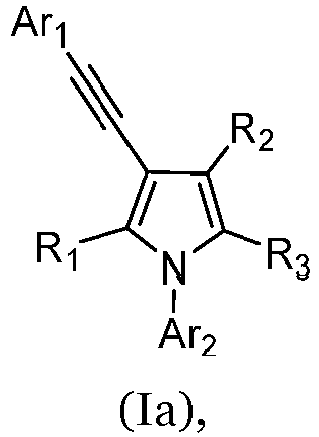
wobei:Ar1 ein 5- bis 10-gliedriger mono- oder bicyclischer Heteroarylring ist, der 1 bis 3 Heteroatome enthält, die aus der aus N, O und S bestehenden Gruppe ausgewählt sind, wobei das 5- bis 10-gliedrige Ringsystem gegebenenfalls mit 1 bis 3 Substituenten substituiert ist, die unabhängig voneinander ausgewählt sind aus Alkyl, -Halogen, -OH, -CN, Nitro, Alkoxy, -CF3, -O-CF3, -S(CH3), -O-Alkyl, -S-Alkyl, -S(O)-Alkyl, -S(O2)-Alkyl, -S(O2)-Aryl, -CH2-Aryl, Heteroaryl, Alkanoyl, -O-Aryl, -O-CH2-Aryl, -N(CH3)2, Cycloalkyl, Heterocycloalkyl, -C(O)-Cycloalkyl, -C(O)-Heterocycloalkyl, wobei die Substituenten zusammen einen gegebenenfalls substituierten 5- bis 7-gliedrigen kondensierten carbacyclischen oder heterocyclischen Ring bilden können,Ar2 ein 5- bis 10-gliedriger mono- oder bicyclischer Arylring ist, wobei das 5- bis 10-gliedrige Ringsystem gegebenenfalls mit 1 bis 3 Substituenten substituiert ist, die unabhängig voneinander ausgewählt sind aus Alkyl, Halogen, -OH, -CN, Nitro, Alkoxy, -CF3, -OCF3, -S(CH3), -OCH3, -S-Alkyl, -S(O)-Alkyl, -S(O2)-Alkyl, -S(O2)-Aryl, -CH2-Aryl, Heteroaryl, Alkanoyl, -O-Aryl, -O-CH2-Aryl, -N(CH3)2, Cycloalkyl, Heterocycloalkyl, -C(O)-Cycloalkyl, -C(O)-Heterocycloalkyl oder substituiertem C1-9-Alkyl, wobei die Substituenten zusammen einen gegebenenfalls substituierten 5- bis 7-gliedrigen kondensierten carbacyclischen oder heterocyclischen Ring bilden können,R1, R2 und R3 unabhängig voneinander ausgewählt sind aus -H, Halogen, -OH, -CN, Nitro, Alkyl, Alkoxy, -CF3, -OCF3, -CH2-Aryl, Phenyl, Heteroaryl, Alkanoyl, -O-Aryl, -O-CH2-Aryl, -N(CH3)2, -C(O)-Cycloalkyl, -C(O)-Heterocycloalkyl, -C(O)O-Alkyl, -C(O)O-Aryl, wobei die Substituenten zusammen einen gegebenenfalls substituierten 5- bis 7-gliedrigen kondensierten carbacyclischen oder heterocyclischen Ring bilden können. - Verbindung nach Anspruch 2, oder ein pharmazeutisch verträgliches Salz davon, wobei:Ar1 ein substituierter oder unsubstituierter Ring ist, ausgewählt aus der folgenden Liste:



 R4 -H oder C1-9-Alkyl ist,Ar2 ein 5- bis 10-gliedriger mono- oder bicyclischer Arylring ist, wobei das 5- bis 10-gliedrige Ringsystem gegebenenfalls mit 1 bis 3 Substituenten substituiert ist, die unabhängig voneinander ausgewählt sind aus Alkyl, Halogen, -OH, -CN, Nitro, Alkoxy, -CF3, -OCF3, -S(CH3), -OCH3, -S-Alkyl, -S(O)-Alkyl, -S(O2)-Alkyl, -S(O2)-Aryl, -CH2-Aryl, Heteroaryl, Alkanoyl, -O-Aryl, -O-CH2-Aryl, -N(CH3)2, Cycloalkyl, Heterocycloalkyl, -C(O)-Cycloalkyl, -C(O)-Heterocycloalkyl oder substituiertem C1-9-Alkyl, wobei die Substituenten zusammen einen gegebenenfalls substituierten 5- bis 7-gliedrigen kondensierten carbacyclischen oder heterocyclischen Ring bilden können,R1, R2 und R3 unabhängig voneinander ausgewählt sind aus -H, Halogen, -OH, -CN, Nitro, Alkyl, Alkoxy, -CF3, -OCF3, -CH2-Aryl, Phenyl, Heteroaryl, Alkanoyl, -O-Aryl, -O-CH2-Aryl, -N(CH3)2, -C(O)-Cycloalkyl, -C(O)-Heterocycloalkyl, -C(O)O-Alkyl, -C(O)O-Aryl, wobei die Substituenten zusammen einen gegebenenfalls substituierten 5- bis 7-gliedrigen kondensierten carbacyclischen oder heterocyclischen Ring bilden können.
 - Verbindung nach Anspruch 3, oder ein pharmazeutisch verträgliches Salz davon,
wobei:Ar1 2-Pyridinyl oder substituiertes 2-Pyridinyl ist,Ar2 gegebenenfalls mono- oder disubstituiertes mono- oder bicyclisches Aryl ist,R1, R2 und R3 unabhängig voneinander ausgewählt sind aus -H, Halogen, -OH, -CN, Nitro, Alkyl, Alkoxy, -CF3, -OCF3, -CH2-Aryl, Phenyl, Heteroaryl, Alkanoyl, -O-Aryl, -O-CH2-Aryl, -N(CH3)2, -C(O)-Cycloalkyl, -C(O)-Heterocycloalkyl, -C(O)O-Alkyl, -C(O)O-Aryl, wobei die Substituenten zusammen einen gegebenenfalls substituierten 5- bis 7-gliedrigen kondensierten carbacyclischen oder heterocyclischen Ring bilden können. - Verbindung nach Anspruch 3 oder ein pharmazeutisch verträgliches Salz davon,
wobei:Ar1 2-Pyridinyl, 4-Pyridinyl oder Pyrimidinyl ist,Ar2 ein 5- bis 10-gliedriges mono- oder bicyclisches Aryl ist, wobei das 5- bis 10-gliedrige Ringsystem gegebenenfalls mit 1 bis 3 Substituenten substituiert ist, die unabhängig voneinander ausgewählt sind aus -C1-C4-Alkyl, -F, -Cl, -Br, -OH, -CN, Nitro, -CF3, -OCF3, -O-C1-C4-Alkyl, -SCH3, -S(O)-CH3, -S(O2)-CH3, -CO2CH3 und Phenyl, wobei das C1-C4-Alkyl vorzugsweise Methyl, Ethyl, n-Propyl, iso-Propyl, n-Butyl, iso-Butyl, tert-Butyl ist, das -O-C1-C4-Alkyl vorzugsweise Methoxy, Ethoxy, n-Propoxy, iso-Propoxy, n-Butoxy, iso-Butoxy, tert-Butoxy ist, wobei das 5- bis 10-gliedrige Ringsystem vorzugsweise Phenyl ist,R1, R2 und R3 unabhängig voneinander ausgewählt sind aus -H, Halogen und -CH3. - Verbindung nach Anspruch 1, von Formel Ib,
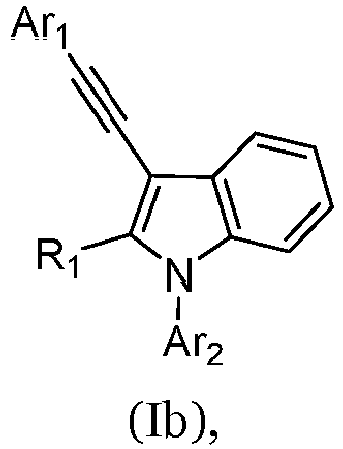 Ar1 ein unsubstituierter oder substituierter Ring ist, ausgewählt aus der folgenden Liste:




 R4 -H oder C1-9-Alkyl ist,Ar2 ein 5- bis 10-gliedriger mono- oder bicyclischer Arylring ist, wobei das 5- bis 10-gliedrige Ringsystem gegebenenfalls mit 1 bis 3 Substituenten substituiert ist, die unabhängig voneinander ausgewählt sind aus Alkyl, Halogen, -OH, -CN, Nitro, Alkoxy, -CF3, -OCF3, -S(CH3), -OCH3, -S-Alkyl, -S(O)-Alkyl, -S(O2)-Alkyl, -S(O2)-Aryl, -CH2-Aryl, Heteroaryl, Alkanoyl, -O-Aryl, -O-CH2-Aryl, -N(CH3)2, Cycloalkyl, Heterocycloalkyl, -C(O)-Cycloalkyl, -C(O)-Heterocycloalkyl oder substituiertem C1-9-Alkyl,R1 unabhängig ausgewählt ist aus -H, Halogen, -OH, -CN, Nitro, Alkyl, Alkoxy, -CF3, -OCF3, -CH2-Aryl, Phenyl, Heteroaryl, Alkanoyl, -O-Aryl, -O-CH2-Aryl, -N(CH3)2, -C(O)-Cycloalkyl, -C(O)-Heterocycloalkyl, -C(O)O-Alkyl, -C(O)O-Aryl.
 - Verbindung nach Anspruch 5 oder ein pharmazeutisch verträgliches Salz davon, wobei:Ar1 2-Pyridinyl oder substituiertes 2-Pyridinyl ist,Ar2 gegebenenfalls mono- oder disubstituiertes mono- oder bicyclisches Aryl ist,R1 H ist.
- Verbindung nach Anspruch 6, oder ein pharmazeutisch verträgliches Salz davon,
wobei:Ar1 2-Pyridinyl ist, das gegebenenfalls mit 1 oder 2 Substituenten substituiert ist, die unabhängig voneinander aus C1-C4-Alkyl ausgewählt sind, wobei C1-C4-Alkyl unter anderem Methyl, Ethyl, n-Propyl, iso-Propyl, n-Butyl, iso-Butyl, tert-Butyl umfasst,Ar2 ein 5- bis 10-gliedriger Mono- oder Bicyclus ist, wobei das 5- bis 10-gliedrige Ringsystem gegebenenfalls mit 1, 2 oder 3 Substituenten substituiert ist, die unabhängig voneinander ausgewählt sind aus -C1-C4-Alkyl, Halogen, -OH, -CN, Nitro, -CF3, -OCF3, -O-C1-C4-Alkyl, -SCH3, -S(O)-CH3, -S(O2)-CH3, -CO2CH3 und Phenyl, wobei das C1-C4-Alkyl vorzugsweise Methyl, Ethyl, n-Propyl, iso-Propyl, n-Butyl, iso-Butyl, tert-Butyl ist, das -O-C1-C4-Alkyl vorzugsweise Methoxy, Ethoxy, Propoxy, iso-Proxy, n-Butoxy, iso-Butoxy, tert-Butoxy ist,wobei das 5- bis 10-gliedrige Ringsystem vorzugsweise Phenyl ist,R1 H ist. - Verbindung nach Anspruch 1, oder ein pharmazeutisch verträgliches Salz davon,
wobei die Verbindung Folgendes ist:3-Iod-5-(3-(pyridin-2-ylethinyl)-1H-indol-1-yl)benzonitril,3-Fluor-5-(3-(pyridin-2-ylethinyl)-1H-indol-1-yl)benzonitril,1-(4-Fluorphenyl)-3-(pyridin-2-ylethinyl)-1H-indol,1-(4-Fluorphenyl)-3-(pyrimidin-2-ylethinyl)-1H-indol,3-Fluor-5-(3-fluor-4-(pyridin-2-ylethinyl)-1H-pyrrol-1-yl)benzonitril,3-Fluor-5-(3-(pyridin-2-ylethinyl)-1H-pyrrol-1-yl)benzonitril,2-((2,5-Dimethyl-1-(4-(trifluormethoxy)phenyl)-1H-pyrrol-3-yl)ethinyl)pyridin,2-((2,5-Dimethyl-1-(4-(trifluormethoxy)phenyl)-1H-pyrrol-3-yl)ethinyl)pyrimidin,4-((2,5-Dimethyl-1-(4-(trifluormethoxy)phenyl)-1H-pyrrol-3-yl)ethynly)pyridin. - Pharmazeutische Zusammensetzung, umfassend eine Verbindung nach einem der Ansprüche 1 bis 9 in Form einer freien Base oder eines pharmazeutisch verträglichen Salzes in Verbindung mit einem pharmazeutischen Träger oder Verdünnungsmittel.
- Verbindung nach einem der Ansprüche 1 bis 9 in Form einer freien Base oder eines pharmazeutisch verträglichen Salzes, oder eine pharmazeutische Zusammensetzung nach Anspruch 10 zur Verwendung bei der Vorbeugung, Behandlung oder Verzögerung des Fortschreitens von Störungen, die mit Unregelmäßigkeiten der glutamatergen Signalübertragung im Verdauungstrakt, den Harnwegen oder Störungen des zentralen Nervensystems verbunden sind, die zur Gänze oder zum Teil durch mGlu5-Rezeptoren vermittelt werden.
- Verbindung oder Zusammensetzung zur Verwendung nach Anspruch 11 zur Verwendung bei der Behandlung von Alzheimer-Krankheit, Parkinson-Krankheit, Levodopa-induzierter Dyskinesie bei Parkinson-Krankheit (PD-LID), Chorea Huntington, psychiatrischen Störungen, Schizophrenie, Stimmungsstörungen, Emotionsstörungen, Aufmerksamkeitsdefizitstörungen, Fragilem X-Syndrom, Autismus-Spektrum-Störungen (ASDs), gastroösophagealer Refluxkrankheit (GERD), Drogenabhängigkeit, Depressionsstörungen.
Applications Claiming Priority (1)
| Application Number | Priority Date | Filing Date | Title |
|---|---|---|---|
| PCT/CN2016/078548 WO2017173604A1 (en) | 2016-04-06 | 2016-04-06 | Pyrrole derivatives |
Publications (3)
| Publication Number | Publication Date |
|---|---|
| EP3440054A1 EP3440054A1 (de) | 2019-02-13 |
| EP3440054A4 EP3440054A4 (de) | 2019-10-09 |
| EP3440054B1 true EP3440054B1 (de) | 2021-12-01 |
Family
ID=60000825
Family Applications (1)
| Application Number | Title | Priority Date | Filing Date |
|---|---|---|---|
| EP16897539.9A Not-in-force EP3440054B1 (de) | 2016-04-06 | 2016-04-06 | Pyrrolderivate zur verwendung als mglur5-modulatoren |
Country Status (3)
| Country | Link |
|---|---|
| US (1) | US10669255B2 (de) |
| EP (1) | EP3440054B1 (de) |
| WO (1) | WO2017173604A1 (de) |
Families Citing this family (2)
| Publication number | Priority date | Publication date | Assignee | Title |
|---|---|---|---|---|
| CN113254586B (zh) * | 2021-05-31 | 2021-11-05 | 中国科学院深圳先进技术研究院 | 一种基于深度学习的无监督文本检索方法 |
| CN121085826B (zh) * | 2025-10-20 | 2026-03-24 | 杭州市第一人民医院(西湖大学附属杭州市第一人民医院) | 含3-炔基吡咯结构的化合物及应用 |
Family Cites Families (5)
| Publication number | Priority date | Publication date | Assignee | Title |
|---|---|---|---|---|
| MXPA03004862A (es) | 2000-12-04 | 2005-02-14 | Hoffmann La Roche | Derivados de feniletenilo o feniletinilo como antagonistas del receptor de glutamato. |
| CA2470519C (en) | 2001-12-21 | 2009-11-17 | Merck & Co., Inc. | Heteroaryl substituted pyrrole modulators of metabotropic glutamate receptor-5 |
| GB0503646D0 (en) | 2005-02-22 | 2005-03-30 | Novartis Ag | Organic compounds |
| EP2997030B1 (de) * | 2013-05-14 | 2017-08-09 | Nerviano Medical Sciences S.R.L. | Pyrrolo[2,3-d]pyrimidinderivate, verfahren zu ihrer herstellung und ihre verwendung als kinase-hemmer |
| CN105061286B (zh) | 2015-09-08 | 2017-11-24 | 上海蓝木化工有限公司 | 一种炔基取代吡咯类化合物的合成方法 |
-
2016
- 2016-04-06 US US16/091,781 patent/US10669255B2/en active Active
- 2016-04-06 WO PCT/CN2016/078548 patent/WO2017173604A1/en not_active Ceased
- 2016-04-06 EP EP16897539.9A patent/EP3440054B1/de not_active Not-in-force
Non-Patent Citations (1)
| Title |
|---|
| None * |
Also Published As
| Publication number | Publication date |
|---|---|
| US20190100506A1 (en) | 2019-04-04 |
| EP3440054A1 (de) | 2019-02-13 |
| US10669255B2 (en) | 2020-06-02 |
| EP3440054A4 (de) | 2019-10-09 |
| WO2017173604A1 (en) | 2017-10-12 |
Similar Documents
| Publication | Publication Date | Title |
|---|---|---|
| RU2625303C2 (ru) | Хинолины в качестве модуляторов fgfr киназы | |
| RU2629194C2 (ru) | Производные 1,5- и 1,7-нафтиридина, полезные при лечении заболеваний, опосредованных fgfr | |
| CN104703987B (zh) | 具有咪唑并吡嗪酮骨架的pde9抑制剂 | |
| CN106661000B (zh) | Egfr抑制剂及其制备和应用 | |
| RU2701517C2 (ru) | Производные хиназолинона, применимые в качестве модуляторов fgfr киназы | |
| EP2467378B1 (de) | Verbindungen mit xanthinoxidasehemmender wirkung, herstellungsverfahren dafür und pharmazeutische zusammensetzung damit | |
| CN101583598B (zh) | 具有IκB激酶β抑制活性的新型吲哚衍生物 | |
| JP2009527562A (ja) | ホスホジエステラーゼ10阻害剤としてのシンノリン誘導体 | |
| CN103370314A (zh) | 作为用于治疗癌症疾病的fgfr激酶抑制剂的取代苯并吡嗪衍生物 | |
| EP3371163B1 (de) | Pyrrolidinderivate | |
| CN116600808A (zh) | 一类作为kras突变体g12c抑制剂的四氢萘啶类衍生物、其制备方法及其应用 | |
| US10941132B2 (en) | Pyrazole derivatives | |
| CN105121424B (zh) | mGluR调节剂 | |
| EP3440054B1 (de) | Pyrrolderivate zur verwendung als mglur5-modulatoren | |
| WO2022148196A1 (zh) | 多激酶抑制剂及其用途 | |
| CN107849029A (zh) | 环丙烷衍生物及含有其的药物 | |
| HK1254456B (en) | Pyrrolidine derivatives |
Legal Events
| Date | Code | Title | Description |
|---|---|---|---|
| STAA | Information on the status of an ep patent application or granted ep patent |
Free format text: STATUS: THE INTERNATIONAL PUBLICATION HAS BEEN MADE |
|
| PUAI | Public reference made under article 153(3) epc to a published international application that has entered the european phase |
Free format text: ORIGINAL CODE: 0009012 |
|
| STAA | Information on the status of an ep patent application or granted ep patent |
Free format text: STATUS: REQUEST FOR EXAMINATION WAS MADE |
|
| 17P | Request for examination filed |
Effective date: 20180926 |
|
| AK | Designated contracting states |
Kind code of ref document: A1 Designated state(s): AL AT BE BG CH CY CZ DE DK EE ES FI FR GB GR HR HU IE IS IT LI LT LU LV MC MK MT NL NO PL PT RO RS SE SI SK SM TR |
|
| AX | Request for extension of the european patent |
Extension state: BA ME |
|
| DAV | Request for validation of the european patent (deleted) | ||
| DAX | Request for extension of the european patent (deleted) | ||
| A4 | Supplementary search report drawn up and despatched |
Effective date: 20190909 |
|
| RIC1 | Information provided on ipc code assigned before grant |
Ipc: A61K 31/40 20060101ALI20190903BHEP Ipc: C07D 209/04 20060101ALI20190903BHEP Ipc: A61P 25/00 20060101ALI20190903BHEP Ipc: C07D 403/06 20060101ALI20190903BHEP Ipc: C07D 207/32 20060101AFI20190903BHEP Ipc: A61K 31/404 20060101ALI20190903BHEP Ipc: C07D 401/06 20060101ALI20190903BHEP |
|
| STAA | Information on the status of an ep patent application or granted ep patent |
Free format text: STATUS: EXAMINATION IS IN PROGRESS |
|
| 17Q | First examination report despatched |
Effective date: 20200528 |
|
| GRAP | Despatch of communication of intention to grant a patent |
Free format text: ORIGINAL CODE: EPIDOSNIGR1 |
|
| STAA | Information on the status of an ep patent application or granted ep patent |
Free format text: STATUS: GRANT OF PATENT IS INTENDED |
|
| INTG | Intention to grant announced |
Effective date: 20210309 |
|
| GRAJ | Information related to disapproval of communication of intention to grant by the applicant or resumption of examination proceedings by the epo deleted |
Free format text: ORIGINAL CODE: EPIDOSDIGR1 |
|
| STAA | Information on the status of an ep patent application or granted ep patent |
Free format text: STATUS: EXAMINATION IS IN PROGRESS |
|
| GRAS | Grant fee paid |
Free format text: ORIGINAL CODE: EPIDOSNIGR3 |
|
| STAA | Information on the status of an ep patent application or granted ep patent |
Free format text: STATUS: GRANT OF PATENT IS INTENDED |
|
| GRAP | Despatch of communication of intention to grant a patent |
Free format text: ORIGINAL CODE: EPIDOSNIGR1 |
|
| INTC | Intention to grant announced (deleted) | ||
| INTG | Intention to grant announced |
Effective date: 20210716 |
|
| GRAA | (expected) grant |
Free format text: ORIGINAL CODE: 0009210 |
|
| STAA | Information on the status of an ep patent application or granted ep patent |
Free format text: STATUS: THE PATENT HAS BEEN GRANTED |
|
| AK | Designated contracting states |
Kind code of ref document: B1 Designated state(s): AL AT BE BG CH CY CZ DE DK EE ES FI FR GB GR HR HU IE IS IT LI LT LU LV MC MK MT NL NO PL PT RO RS SE SI SK SM TR |
|
| REG | Reference to a national code |
Ref country code: GB Ref legal event code: FG4D |
|
| REG | Reference to a national code |
Ref country code: AT Ref legal event code: REF Ref document number: 1451643 Country of ref document: AT Kind code of ref document: T Effective date: 20211215 Ref country code: CH Ref legal event code: EP |
|
| REG | Reference to a national code |
Ref country code: IE Ref legal event code: FG4D |
|
| REG | Reference to a national code |
Ref country code: DE Ref legal event code: R096 Ref document number: 602016067012 Country of ref document: DE |
|
| REG | Reference to a national code |
Ref country code: LT Ref legal event code: MG9D |
|
| REG | Reference to a national code |
Ref country code: NL Ref legal event code: MP Effective date: 20211201 |
|
| REG | Reference to a national code |
Ref country code: AT Ref legal event code: MK05 Ref document number: 1451643 Country of ref document: AT Kind code of ref document: T Effective date: 20211201 |
|
| PG25 | Lapsed in a contracting state [announced via postgrant information from national office to epo] |
Ref country code: RS Free format text: LAPSE BECAUSE OF FAILURE TO SUBMIT A TRANSLATION OF THE DESCRIPTION OR TO PAY THE FEE WITHIN THE PRESCRIBED TIME-LIMIT Effective date: 20211201 Ref country code: LT Free format text: LAPSE BECAUSE OF FAILURE TO SUBMIT A TRANSLATION OF THE DESCRIPTION OR TO PAY THE FEE WITHIN THE PRESCRIBED TIME-LIMIT Effective date: 20211201 Ref country code: FI Free format text: LAPSE BECAUSE OF FAILURE TO SUBMIT A TRANSLATION OF THE DESCRIPTION OR TO PAY THE FEE WITHIN THE PRESCRIBED TIME-LIMIT Effective date: 20211201 Ref country code: BG Free format text: LAPSE BECAUSE OF FAILURE TO SUBMIT A TRANSLATION OF THE DESCRIPTION OR TO PAY THE FEE WITHIN THE PRESCRIBED TIME-LIMIT Effective date: 20220301 Ref country code: AT Free format text: LAPSE BECAUSE OF FAILURE TO SUBMIT A TRANSLATION OF THE DESCRIPTION OR TO PAY THE FEE WITHIN THE PRESCRIBED TIME-LIMIT Effective date: 20211201 |
|
| PG25 | Lapsed in a contracting state [announced via postgrant information from national office to epo] |
Ref country code: SE Free format text: LAPSE BECAUSE OF FAILURE TO SUBMIT A TRANSLATION OF THE DESCRIPTION OR TO PAY THE FEE WITHIN THE PRESCRIBED TIME-LIMIT Effective date: 20211201 Ref country code: PL Free format text: LAPSE BECAUSE OF FAILURE TO SUBMIT A TRANSLATION OF THE DESCRIPTION OR TO PAY THE FEE WITHIN THE PRESCRIBED TIME-LIMIT Effective date: 20211201 Ref country code: NO Free format text: LAPSE BECAUSE OF FAILURE TO SUBMIT A TRANSLATION OF THE DESCRIPTION OR TO PAY THE FEE WITHIN THE PRESCRIBED TIME-LIMIT Effective date: 20220301 Ref country code: LV Free format text: LAPSE BECAUSE OF FAILURE TO SUBMIT A TRANSLATION OF THE DESCRIPTION OR TO PAY THE FEE WITHIN THE PRESCRIBED TIME-LIMIT Effective date: 20211201 Ref country code: HR Free format text: LAPSE BECAUSE OF FAILURE TO SUBMIT A TRANSLATION OF THE DESCRIPTION OR TO PAY THE FEE WITHIN THE PRESCRIBED TIME-LIMIT Effective date: 20211201 Ref country code: GR Free format text: LAPSE BECAUSE OF FAILURE TO SUBMIT A TRANSLATION OF THE DESCRIPTION OR TO PAY THE FEE WITHIN THE PRESCRIBED TIME-LIMIT Effective date: 20220302 Ref country code: ES Free format text: LAPSE BECAUSE OF FAILURE TO SUBMIT A TRANSLATION OF THE DESCRIPTION OR TO PAY THE FEE WITHIN THE PRESCRIBED TIME-LIMIT Effective date: 20211201 |
|
| PG25 | Lapsed in a contracting state [announced via postgrant information from national office to epo] |
Ref country code: NL Free format text: LAPSE BECAUSE OF FAILURE TO SUBMIT A TRANSLATION OF THE DESCRIPTION OR TO PAY THE FEE WITHIN THE PRESCRIBED TIME-LIMIT Effective date: 20211201 |
|
| PG25 | Lapsed in a contracting state [announced via postgrant information from national office to epo] |
Ref country code: SM Free format text: LAPSE BECAUSE OF FAILURE TO SUBMIT A TRANSLATION OF THE DESCRIPTION OR TO PAY THE FEE WITHIN THE PRESCRIBED TIME-LIMIT Effective date: 20211201 Ref country code: SK Free format text: LAPSE BECAUSE OF FAILURE TO SUBMIT A TRANSLATION OF THE DESCRIPTION OR TO PAY THE FEE WITHIN THE PRESCRIBED TIME-LIMIT Effective date: 20211201 Ref country code: RO Free format text: LAPSE BECAUSE OF FAILURE TO SUBMIT A TRANSLATION OF THE DESCRIPTION OR TO PAY THE FEE WITHIN THE PRESCRIBED TIME-LIMIT Effective date: 20211201 Ref country code: PT Free format text: LAPSE BECAUSE OF FAILURE TO SUBMIT A TRANSLATION OF THE DESCRIPTION OR TO PAY THE FEE WITHIN THE PRESCRIBED TIME-LIMIT Effective date: 20220401 Ref country code: EE Free format text: LAPSE BECAUSE OF FAILURE TO SUBMIT A TRANSLATION OF THE DESCRIPTION OR TO PAY THE FEE WITHIN THE PRESCRIBED TIME-LIMIT Effective date: 20211201 Ref country code: CZ Free format text: LAPSE BECAUSE OF FAILURE TO SUBMIT A TRANSLATION OF THE DESCRIPTION OR TO PAY THE FEE WITHIN THE PRESCRIBED TIME-LIMIT Effective date: 20211201 |
|
| REG | Reference to a national code |
Ref country code: DE Ref legal event code: R097 Ref document number: 602016067012 Country of ref document: DE |
|
| PG25 | Lapsed in a contracting state [announced via postgrant information from national office to epo] |
Ref country code: IS Free format text: LAPSE BECAUSE OF FAILURE TO SUBMIT A TRANSLATION OF THE DESCRIPTION OR TO PAY THE FEE WITHIN THE PRESCRIBED TIME-LIMIT Effective date: 20220401 |
|
| PLBE | No opposition filed within time limit |
Free format text: ORIGINAL CODE: 0009261 |
|
| STAA | Information on the status of an ep patent application or granted ep patent |
Free format text: STATUS: NO OPPOSITION FILED WITHIN TIME LIMIT |
|
| PG25 | Lapsed in a contracting state [announced via postgrant information from national office to epo] |
Ref country code: DK Free format text: LAPSE BECAUSE OF FAILURE TO SUBMIT A TRANSLATION OF THE DESCRIPTION OR TO PAY THE FEE WITHIN THE PRESCRIBED TIME-LIMIT Effective date: 20211201 Ref country code: AL Free format text: LAPSE BECAUSE OF FAILURE TO SUBMIT A TRANSLATION OF THE DESCRIPTION OR TO PAY THE FEE WITHIN THE PRESCRIBED TIME-LIMIT Effective date: 20211201 |
|
| 26N | No opposition filed |
Effective date: 20220902 |
|
| PG25 | Lapsed in a contracting state [announced via postgrant information from national office to epo] |
Ref country code: SI Free format text: LAPSE BECAUSE OF FAILURE TO SUBMIT A TRANSLATION OF THE DESCRIPTION OR TO PAY THE FEE WITHIN THE PRESCRIBED TIME-LIMIT Effective date: 20211201 |
|
| REG | Reference to a national code |
Ref country code: CH Ref legal event code: PL |
|
| REG | Reference to a national code |
Ref country code: BE Ref legal event code: MM Effective date: 20220430 |
|
| PG25 | Lapsed in a contracting state [announced via postgrant information from national office to epo] |
Ref country code: MC Free format text: LAPSE BECAUSE OF FAILURE TO SUBMIT A TRANSLATION OF THE DESCRIPTION OR TO PAY THE FEE WITHIN THE PRESCRIBED TIME-LIMIT Effective date: 20211201 Ref country code: LU Free format text: LAPSE BECAUSE OF NON-PAYMENT OF DUE FEES Effective date: 20220406 Ref country code: LI Free format text: LAPSE BECAUSE OF NON-PAYMENT OF DUE FEES Effective date: 20220430 Ref country code: CH Free format text: LAPSE BECAUSE OF NON-PAYMENT OF DUE FEES Effective date: 20220430 |
|
| PG25 | Lapsed in a contracting state [announced via postgrant information from national office to epo] |
Ref country code: BE Free format text: LAPSE BECAUSE OF NON-PAYMENT OF DUE FEES Effective date: 20220430 |
|
| PG25 | Lapsed in a contracting state [announced via postgrant information from national office to epo] |
Ref country code: IE Free format text: LAPSE BECAUSE OF NON-PAYMENT OF DUE FEES Effective date: 20220406 |
|
| PG25 | Lapsed in a contracting state [announced via postgrant information from national office to epo] |
Ref country code: IT Free format text: LAPSE BECAUSE OF FAILURE TO SUBMIT A TRANSLATION OF THE DESCRIPTION OR TO PAY THE FEE WITHIN THE PRESCRIBED TIME-LIMIT Effective date: 20211201 |
|
| PG25 | Lapsed in a contracting state [announced via postgrant information from national office to epo] |
Ref country code: HU Free format text: LAPSE BECAUSE OF FAILURE TO SUBMIT A TRANSLATION OF THE DESCRIPTION OR TO PAY THE FEE WITHIN THE PRESCRIBED TIME-LIMIT; INVALID AB INITIO Effective date: 20160406 |
|
| PG25 | Lapsed in a contracting state [announced via postgrant information from national office to epo] |
Ref country code: MK Free format text: LAPSE BECAUSE OF FAILURE TO SUBMIT A TRANSLATION OF THE DESCRIPTION OR TO PAY THE FEE WITHIN THE PRESCRIBED TIME-LIMIT Effective date: 20211201 Ref country code: CY Free format text: LAPSE BECAUSE OF FAILURE TO SUBMIT A TRANSLATION OF THE DESCRIPTION OR TO PAY THE FEE WITHIN THE PRESCRIBED TIME-LIMIT Effective date: 20211201 |
|
| PGFP | Annual fee paid to national office [announced via postgrant information from national office to epo] |
Ref country code: GB Payment date: 20240314 Year of fee payment: 9 |
|
| PGFP | Annual fee paid to national office [announced via postgrant information from national office to epo] |
Ref country code: FR Payment date: 20240321 Year of fee payment: 9 |
|
| PG25 | Lapsed in a contracting state [announced via postgrant information from national office to epo] |
Ref country code: TR Free format text: LAPSE BECAUSE OF FAILURE TO SUBMIT A TRANSLATION OF THE DESCRIPTION OR TO PAY THE FEE WITHIN THE PRESCRIBED TIME-LIMIT Effective date: 20211201 |
|
| PGFP | Annual fee paid to national office [announced via postgrant information from national office to epo] |
Ref country code: DE Payment date: 20240313 Year of fee payment: 9 |
|
| PG25 | Lapsed in a contracting state [announced via postgrant information from national office to epo] |
Ref country code: MT Free format text: LAPSE BECAUSE OF FAILURE TO SUBMIT A TRANSLATION OF THE DESCRIPTION OR TO PAY THE FEE WITHIN THE PRESCRIBED TIME-LIMIT Effective date: 20211201 |
|
| REG | Reference to a national code |
Ref country code: DE Ref legal event code: R119 Ref document number: 602016067012 Country of ref document: DE |
|
| GBPC | Gb: european patent ceased through non-payment of renewal fee |
Effective date: 20250406 |
|
| PG25 | Lapsed in a contracting state [announced via postgrant information from national office to epo] |
Ref country code: DE Free format text: LAPSE BECAUSE OF NON-PAYMENT OF DUE FEES Effective date: 20251104 |
|
| PG25 | Lapsed in a contracting state [announced via postgrant information from national office to epo] |
Ref country code: GB Free format text: LAPSE BECAUSE OF NON-PAYMENT OF DUE FEES Effective date: 20250406 |
|
| PG25 | Lapsed in a contracting state [announced via postgrant information from national office to epo] |
Ref country code: FR Free format text: LAPSE BECAUSE OF NON-PAYMENT OF DUE FEES Effective date: 20250430 |