EP3440940A1 - Machine de roulage de pâte - Google Patents
Machine de roulage de pâte Download PDFInfo
- Publication number
- EP3440940A1 EP3440940A1 EP17425089.4A EP17425089A EP3440940A1 EP 3440940 A1 EP3440940 A1 EP 3440940A1 EP 17425089 A EP17425089 A EP 17425089A EP 3440940 A1 EP3440940 A1 EP 3440940A1
- Authority
- EP
- European Patent Office
- Prior art keywords
- axis
- machine
- roll out
- fact
- dough
- Prior art date
- Legal status (The legal status is an assumption and is not a legal conclusion. Google has not performed a legal analysis and makes no representation as to the accuracy of the status listed.)
- Withdrawn
Links
- 238000005096 rolling process Methods 0.000 title claims abstract description 22
- 238000006073 displacement reaction Methods 0.000 claims description 12
- 238000013459 approach Methods 0.000 description 2
- 230000001788 irregular Effects 0.000 description 2
- 230000006835 compression Effects 0.000 description 1
- 238000007906 compression Methods 0.000 description 1
- 238000010411 cooking Methods 0.000 description 1
- 235000013312 flour Nutrition 0.000 description 1
- 235000013305 food Nutrition 0.000 description 1
- 238000003475 lamination Methods 0.000 description 1
- 230000002093 peripheral effect Effects 0.000 description 1
- 235000013550 pizza Nutrition 0.000 description 1
- 229920001296 polysiloxane Polymers 0.000 description 1
- 230000000284 resting effect Effects 0.000 description 1
Images


Classifications
-
- A—HUMAN NECESSITIES
- A21—BAKING; EDIBLE DOUGHS
- A21C—MACHINES OR EQUIPMENT FOR MAKING OR PROCESSING DOUGHS; HANDLING BAKED ARTICLES MADE FROM DOUGH
- A21C11/00—Other machines for forming the dough into its final shape before cooking or baking
- A21C11/004—Other machines for forming the dough into its final shape before cooking or baking forming the dough into a substantially disc-like shape with or without an outer rim, e.g. for making pie crusts, cake shells or pizza bases
- A21C11/008—Other machines for forming the dough into its final shape before cooking or baking forming the dough into a substantially disc-like shape with or without an outer rim, e.g. for making pie crusts, cake shells or pizza bases by press-rolling
Definitions
- the present invention relates to a machine for rolling out dough.
- Known type of machines used in the food industry for rolling out dough, and in particular for making pizzas and the like generally comprise a bearing frame, a supporting surface for a portion of dough to roll out, and means for rolling out dough arranged on top of the supporting surface, where one of the means for rolling out dough and the supporting surface is movable with respect to the other in the direction of mutual approaching/moving away to press the dough positioned between them.
- the portion of dough resting on the supporting surface is therefore pressed between the supporting surface and the roll out means, the latter being heated.
- Such pressing together with the heat emitted by the supporting surface and/or by the roll out means, causes a reduction in the thickness of the portion of dough and an increase in its diameter.
- the dough is not rolled out evenly and therefore has an irregular contour and a variable texture.
- the texture taken by the dough due to its pressure varies according to the conformation and shape of the dough portion to be rolled out positioned on the supporting surface.
- the dough portion to be rolled out is irregular and therefore has an uneven distribution of the material, due to pressure the dough thus rolled out will have variations in density locally which will inevitably affect the organoleptic properties of the finished product.
- the heat emitted by the supporting surface and/or by the roll out means results in a partial cooking of the dough, thereby jeopardizing the quality of the finished product.
- roller machine Another known type of machine for rolling out dough is the so-called "roller machine”.
- the roller machine rolls out the dough by lamination, i.e. by means of two opposing and counter-rotating rollers that achieve a decrease in dough thickness.
- the passage of the dough through the rollers does not allow for obtaining a substantially circular conformation, so further processing is required to give the dough the desired shape.
- the dough has to be manually rotated during its passage through the rollers so that the rolling out takes place in several directions.
- this step is very difficult and depends considerably, in any case, on the abilities of the operator in charge.
- Yet another type envisages the presence of a bearing frame, a supporting surface on which the dough to be rolled out is positioned, and roll out means for rolling out dough that are movable close to/away from the supporting surface.
- the roll out means comprise a plurality of rollers movable in rotation around respective axes and are movable integrally to one another around a vertical axis of rotation.
- the central portion of the dough undergoes a less intense pressure action than the peripheral portions and thus has different density and flatness from these.
- the main aim of the present invention is to provide a machine which allows obtaining even rolling out of dough in all its areas.
- one object of the present invention is to provide a machine which allows adjusting the pressure applied on the dough according to its thickness.
- Another object of the present invention is to provide a machine for rolling out dough which allows to overcome the aforementioned drawbacks of the prior art within the ambit of a simple, rational, easy, efficient to use and cost-effective solution.
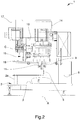
- reference numeral 1 globally indicates a machine for rolling out dough.
- the machine 1 comprises a bearing frame 2, at least one supporting surface 3 of at least one portion of dough P to be rolled out, dough roll out means 4 associated with the frame 2 and arranged on top of the supporting surface 3.
- the roll out means 4 are movable in translation along a direction of approaching/moving away from the supporting surface 3, identified in the figures with the double arrow 5, and are movable in rotation around a substantially vertical first axis A.
- the roll out means 4 comprise at least a first and a second roll out element, respectively 6 and 7, separate from one another and associated integrally in rotation around said first axis A.
- the first roll out element 6 is also movable in rotation around a substantially vertical second axis B and separate from the first axis A.
- the first and second roll out element 6 and 7 each performs a relevant first trajectory T' which is circular around the first axis A and the first roll out element 6 also runs a second trajectory T" which is circular around the second axis B.
- first trajectory T' defined by the first and second roll out element 6 and 7 in their rotation around the first axis A is substantially the same
- second trajectory T" defined by the first roll out element 6 in its rotation around the second axis B is contained within the first and tangent to it.
- the combined action of the first and second roll out element 6 and 7 thus allows rolling out the portion of dough P evenly.
- the second axis B is arranged on the opposite side to the second roll out element 7 with respect to a reference plane passing through the first axis.
- the first roll out element 6 extends through the aforementioned reference plane. More in detail, the first roll out element 6, during its rotation around the second axis B, passes through the first axis A, which then falls within the second trajectory T". This allows the processing and rolling out of the central portion of the dough, that is, of the portion positioned in the proximity of the first axis A.
- the first roll out element 6 is substantially cross-shaped. Alternative embodiments cannot however be ruled out wherein the first roll out element 6 has a different conformation.
- the machine 1 further comprises at least one non-stick element 8 of the flexible type, which is positioned in contact with the roll out elements 6 and 7 and is interposed between the roll out elements themselves and the supporting surface 3.
- the non-stick element 8 is adapted to contact the portion of dough P as a result of the roll out elements 6, 7 being approached to the supporting surface itself.
- the non-stick element 8 comprises a first flexible layer, positioned substantially in contact with the roll out elements 6 and 7, and a second layer, also flexible and of lower texture than the first layer, associated with the first layer and facing towards the supporting surface 3.
- the non-stick element 8, and in particular its second layer, is of the porous type, so as to also retain a certain amount of flour deposited onto it.
- the non-stick element 8 can, e.g., be made of silicone, although different embodiments cannot be ruled out which provide for the use of other types of material.
- the machine 1 comprises a supporting body 9, 10 of the roll out elements 6 and 7 which is movable along the direction of approaching/moving away from the supporting surface 3.
- the supporting body 9, 10 comprises a first body 9, which is associated movable in translation with the frame 2 along the direction 5, and a second body 10, which is integral in translation with the first body 9 approaching/moving away from the supporting surface 3 and which is movable in rotation with respect to the first body itself around the first axis A.
- the second body 10 supports the roll out elements 6 and 7, entraining them in rotation around the first axis A. Between the first and second body 9 and 10 is interposed at least a radial bearing 11.
- the first roll out element 6 is therefore associated movable in rotation with the second body 10 around the second axis B, while the second roll out element 7 is blocked in rotation with respect to the second body itself.
- the first body 9 comprises a first toothed wheel 12, which is therefore fixed
- the second roll out element 7 comprises a second toothed wheel 13 which engages with the first wheel 12 and which, due to the rotation of the first roll out element 6 around the first axis A causes the first roll out element itself to rotate around the second axis B.
- the machine 1 comprises first motor means 14, associated with the frame 2, adapted to operate in rotation the second body 10 around the first axis A.
- the machine 1 comprises movement means 15 for moving the supporting body 9,10, and in particular the first body 9, along the direction of approaching/moving away 5.
- the supporting body 9,10 has an idle position, which corresponds to the position at which it is located at the maximum distance from the supporting surface 3, and a final position, which corresponds to the position at which it is located at the minimum distance from the supporting surface 3.
- the movement means 15 comprise at least one cam element 16 connected to the frame 2, which is operable in rotation around a substantially horizontal third axis C and is adapted to interact with the first body 9 to displace it along the direction of approaching/moving away 5.
- the machine 1 comprises second motor means 17, associated with the frame 2, adapted to operate in rotation the cam element 16 around the third axis C.
- the cam element 16 interacts with the first body 9 by means of a ball-shaped element 18.
- the cam element 16 is also connected to the frame 2 by means of a supporting bracket 19.
- the cam element 16 is shaped so as to command a first and a second consecutive travel stroke of the supporting body 9,10 approaching the supporting surface 3, due to a first and second rotation respectively, around the third axis C.
- the amount of displacement of the supporting body 9,10, and particularly of the first body 9, during the first travel stroke is greater than the displacement during the second travel stroke, the rotation angle of the cam element 16 being equal.
- This displacement difference is related to the variation in the density of the portion of dough P during its processing. More particularly, during the first travel stroke, the portion of dough P, still having to be processed, has lower texture than the one it features when the supporting body 9,10 runs the second travel and therefore offers low resistance to displacement, thus allowing the supporting body itself to run for a greater stroke.
- the cam element 16 is shaped so as to command a forward travel and a return travel of the supporting body 9,10 at each rotation substantially equal to 180°.
- forward travel and “return travel” are meant the displacements of the supporting body 9,10, respectively approaching and moving away from the supporting surface 3, that is from the idle position to the final position and vice versa.
- elastic means 20 are provided which are associated with the frame 2 and are adapted to counteract the displacement of the supporting body 9,10 approaching the supporting surface 3.
- the frame 2 comprises a plurality of bearing posts 2a, with which the first body 9 is associated in a sliding manner, and on which are fitted the elastic means 20, of the type of springs, arranged below the first body itself.
- the elastic means 20 perform the function of keeping the first body 9, and more particularly the ball-shaped element 18, in contact with the cam element 16.
- the machine 1 also comprises adjusting means 21 for adjusting the position of the cam element 16 with respect to the supporting surface 3. Since the travel of the supporting body 9,10 remains the same regardless of the starting position of the cam element 16, by intervening on the adjusting means 21, the final position of the supporting body 9,10 is changed, i.e. the minimum distance of the roll out elements 6 and 7 from the supporting surface 3 and, consequently, the final thickness of the portion of dough P.
- the adjusting means 21, e.g. of the type of one or more adjusting screws, are adapted to vary the position of the bracket 19 with respect to the frame 2.
- the rotation of the cam element 16 causes the downward displacement of the first body 9, and consequently also of the second body 10. It follows therefore that the roll out means 4 exert a double action on the portion of dough P, i.e. a compression action due to the downward displacement of the first body 9, and a horizontal rolling out action due to the rotation of the second body 10 around the first axis A.
- the rotation of the second body 10 around the first axis A causes the first and second roll out elements 6 and 7 to rotate around such axis and the rotation at the same time of the first roll out element 6 around the second axis B.
- the first roll out element 6, due to its rotation around the second axis B, rolls out the portion of dough P on which it acts, by pushing it outwardly of the second trajectory T" and, therefore, inside the operating area of the second roll out element 7, thus completing the flattening action.
- the first roll out element 6, also covering the central portion of the first trajectory T', causes all the areas of the portion of dough P to be subjected to the same mechanical action, so as to obtain an even rolling of the portion of dough itself.
- the first body 9 runs a first travel stroke, due to which, starting from the idle position, it approaches the supporting surface 3 thus considerably reducing the thickness of the portion of dough P.
- this first travel stroke during which the second body 10 rotates around the first axis A so that the roll out elements 6, 7 perform the flattening action of the portion of dough P, the latter gradually increases its compactness, thus providing greater resistance against the further advancement of the first body 9.
- the second travel stroke performed by the latter due to the rotation of the cam element 16 has lower extension than the first stroke.
- the simultaneous rotation of the first roll out element around the first and second axis and of the second roll out element around the first axis allows rolling efficiently every dough area, including the one positioned at the first axis itself.
Landscapes
- Life Sciences & Earth Sciences (AREA)
- Engineering & Computer Science (AREA)
- Food Science & Technology (AREA)
- Manufacturing And Processing Devices For Dough (AREA)
Priority Applications (1)
| Application Number | Priority Date | Filing Date | Title |
|---|---|---|---|
| EP17425089.4A EP3440940A1 (fr) | 2017-08-11 | 2017-08-11 | Machine de roulage de pâte |
Applications Claiming Priority (1)
| Application Number | Priority Date | Filing Date | Title |
|---|---|---|---|
| EP17425089.4A EP3440940A1 (fr) | 2017-08-11 | 2017-08-11 | Machine de roulage de pâte |
Publications (1)
| Publication Number | Publication Date |
|---|---|
| EP3440940A1 true EP3440940A1 (fr) | 2019-02-13 |
Family
ID=60083907
Family Applications (1)
| Application Number | Title | Priority Date | Filing Date |
|---|---|---|---|
| EP17425089.4A Withdrawn EP3440940A1 (fr) | 2017-08-11 | 2017-08-11 | Machine de roulage de pâte |
Country Status (1)
| Country | Link |
|---|---|
| EP (1) | EP3440940A1 (fr) |
Cited By (1)
| Publication number | Priority date | Publication date | Assignee | Title |
|---|---|---|---|---|
| CN114600923A (zh) * | 2022-04-20 | 2022-06-10 | 大连石岛工业有限公司 | 一种基于plc控制的智能型仿手工擀制面皮机 |
Citations (6)
| Publication number | Priority date | Publication date | Assignee | Title |
|---|---|---|---|---|
| US4634365A (en) * | 1984-06-14 | 1987-01-06 | Pedro R. Triporo | Apparatus for making pizza |
| WO1996028979A1 (fr) * | 1995-03-20 | 1996-09-26 | Lauro Beltrami | Machine servant a aplatir de la pate a patisserie |
| EP1712133A2 (fr) * | 2005-04-11 | 2006-10-18 | COMAS S.p.A. | Dispositif pour façonner des bases de pâte, notamment pour tartes du type gâteau au fromage |
| WO2008142660A2 (fr) * | 2007-05-23 | 2008-11-27 | Iteca S.P.A. | Chaîne, procédé et poste de traitement pour former des disques de pâte tels que des bases de pizza ou analogues |
| WO2012146999A1 (fr) * | 2011-04-29 | 2012-11-01 | Sigma S.R.L. | Machine pour abaisser une pâte, en particulier pour préparer des pizzas |
| EP2962570A2 (fr) * | 2014-07-02 | 2016-01-06 | ITECA Impianti Tecnologici Alimentari Speciali S.P.A. | Disposif de façonnage d'éléments de pâte alimentaire en forme de disques |
-
2017
- 2017-08-11 EP EP17425089.4A patent/EP3440940A1/fr not_active Withdrawn
Patent Citations (6)
| Publication number | Priority date | Publication date | Assignee | Title |
|---|---|---|---|---|
| US4634365A (en) * | 1984-06-14 | 1987-01-06 | Pedro R. Triporo | Apparatus for making pizza |
| WO1996028979A1 (fr) * | 1995-03-20 | 1996-09-26 | Lauro Beltrami | Machine servant a aplatir de la pate a patisserie |
| EP1712133A2 (fr) * | 2005-04-11 | 2006-10-18 | COMAS S.p.A. | Dispositif pour façonner des bases de pâte, notamment pour tartes du type gâteau au fromage |
| WO2008142660A2 (fr) * | 2007-05-23 | 2008-11-27 | Iteca S.P.A. | Chaîne, procédé et poste de traitement pour former des disques de pâte tels que des bases de pizza ou analogues |
| WO2012146999A1 (fr) * | 2011-04-29 | 2012-11-01 | Sigma S.R.L. | Machine pour abaisser une pâte, en particulier pour préparer des pizzas |
| EP2962570A2 (fr) * | 2014-07-02 | 2016-01-06 | ITECA Impianti Tecnologici Alimentari Speciali S.P.A. | Disposif de façonnage d'éléments de pâte alimentaire en forme de disques |
Cited By (1)
| Publication number | Priority date | Publication date | Assignee | Title |
|---|---|---|---|---|
| CN114600923A (zh) * | 2022-04-20 | 2022-06-10 | 大连石岛工业有限公司 | 一种基于plc控制的智能型仿手工擀制面皮机 |
Similar Documents
| Publication | Publication Date | Title |
|---|---|---|
| JP5116025B2 (ja) | 食品生地延展成形装置および食品生地延展成形方法 | |
| US11896014B2 (en) | Method and apparatus for shaping pizza dough | |
| JP2547222B2 (ja) | 移動する帯状生産物を変形させずに処理するためのロール装置 | |
| EP3440940A1 (fr) | Machine de roulage de pâte | |
| CN112512323B (zh) | 改进的食物面团拉伸机及拉伸面团块的方法 | |
| EP2708130B1 (fr) | Appareil d'extrusion de pâte | |
| US1944112A (en) | Dough dividing and working machine | |
| EP2701519B1 (fr) | Machine pour abaisser une pâte, en particulier pour préparer des pizzas | |
| US6312749B1 (en) | Method and apparatus for producing a corrugated pasta sheet, facilitating adherence of sauce to surface | |
| JP4588565B2 (ja) | 食品生地を円板状に成形する方法および該方法で得られる円板状食品生地 | |
| US1206069A (en) | Candy-forming machine. | |
| EP4245146A1 (fr) | Dispositif pour former des fonds de pizza | |
| EP4245145B1 (fr) | Dispositif pour épandre des pâtes | |
| KR100433468B1 (ko) | 프레스 펀칭장치 | |
| CN223264542U (zh) | 一种滚花板调平组件 | |
| CN220675012U (zh) | 一种肉类食品加工滚揉机 | |
| US20030145742A1 (en) | Dough-flattening apparatus for the preparation of thin pizzas | |
| CN216533511U (zh) | 一种酥皮机用压合装置 | |
| US20060246170A1 (en) | Device for the forming of pastry bases, in particular for pies of cheesecake type | |
| CN209572994U (zh) | 一种全自动智能面条机加工机器人成型装置的传动机构 | |
| CN206184947U (zh) | 一种产品平整度调整机 | |
| ITMO20100351A1 (it) | Macchina per la stesura della pasta | |
| SU727271A1 (ru) | Станок дл формообразовани листовых деталей двойной кривизны | |
| HK40047683A (en) | Improved food dough-stretching machine and method for stretching a mass of dough | |
| JPS62641B2 (fr) |
Legal Events
| Date | Code | Title | Description |
|---|---|---|---|
| PUAI | Public reference made under article 153(3) epc to a published international application that has entered the european phase |
Free format text: ORIGINAL CODE: 0009012 |
|
| STAA | Information on the status of an ep patent application or granted ep patent |
Free format text: STATUS: THE APPLICATION HAS BEEN PUBLISHED |
|
| AK | Designated contracting states |
Kind code of ref document: A1 Designated state(s): AL AT BE BG CH CY CZ DE DK EE ES FI FR GB GR HR HU IE IS IT LI LT LU LV MC MK MT NL NO PL PT RO RS SE SI SK SM TR |
|
| AX | Request for extension of the european patent |
Extension state: BA ME |
|
| STAA | Information on the status of an ep patent application or granted ep patent |
Free format text: STATUS: THE APPLICATION IS DEEMED TO BE WITHDRAWN |
|
| 18D | Application deemed to be withdrawn |
Effective date: 20190814 |