EP3441815A1 - Brillen für gewichtsabnahme - Google Patents
Brillen für gewichtsabnahme Download PDFInfo
- Publication number
- EP3441815A1 EP3441815A1 EP17779250.4A EP17779250A EP3441815A1 EP 3441815 A1 EP3441815 A1 EP 3441815A1 EP 17779250 A EP17779250 A EP 17779250A EP 3441815 A1 EP3441815 A1 EP 3441815A1
- Authority
- EP
- European Patent Office
- Prior art keywords
- light
- wavelength
- translucent member
- eyeglasses
- transmission
- Prior art date
- Legal status (The legal status is an assumption and is not a legal conclusion. Google has not performed a legal analysis and makes no representation as to the accuracy of the status listed.)
- Withdrawn
Links
Images




Classifications
-
- G—PHYSICS
- G02—OPTICS
- G02C—SPECTACLES; SUNGLASSES OR GOGGLES INSOFAR AS THEY HAVE THE SAME FEATURES AS SPECTACLES; CONTACT LENSES
- G02C7/00—Optical parts
- G02C7/10—Filters, e.g. for facilitating adaptation of the eyes to the dark; Sunglasses
- G02C7/104—Filters, e.g. for facilitating adaptation of the eyes to the dark; Sunglasses having spectral characteristics for purposes other than sun-protection
-
- G—PHYSICS
- G02—OPTICS
- G02B—OPTICAL ELEMENTS, SYSTEMS OR APPARATUS
- G02B5/00—Optical elements other than lenses
- G02B5/20—Filters
-
- G—PHYSICS
- G02—OPTICS
- G02B—OPTICAL ELEMENTS, SYSTEMS OR APPARATUS
- G02B5/00—Optical elements other than lenses
- G02B5/20—Filters
- G02B5/22—Absorbing filters
-
- G—PHYSICS
- G02—OPTICS
- G02B—OPTICAL ELEMENTS, SYSTEMS OR APPARATUS
- G02B5/00—Optical elements other than lenses
- G02B5/20—Filters
- G02B5/26—Reflecting filters
-
- G—PHYSICS
- G02—OPTICS
- G02C—SPECTACLES; SUNGLASSES OR GOGGLES INSOFAR AS THEY HAVE THE SAME FEATURES AS SPECTACLES; CONTACT LENSES
- G02C1/00—Assemblies of lenses with bridges or browbars
- G02C1/06—Bridge or browbar secured to or integral with closed rigid rims for the lenses
-
- G—PHYSICS
- G02—OPTICS
- G02C—SPECTACLES; SUNGLASSES OR GOGGLES INSOFAR AS THEY HAVE THE SAME FEATURES AS SPECTACLES; CONTACT LENSES
- G02C7/00—Optical parts
- G02C7/10—Filters, e.g. for facilitating adaptation of the eyes to the dark; Sunglasses
-
- G—PHYSICS
- G02—OPTICS
- G02C—SPECTACLES; SUNGLASSES OR GOGGLES INSOFAR AS THEY HAVE THE SAME FEATURES AS SPECTACLES; CONTACT LENSES
- G02C7/00—Optical parts
- G02C7/16—Shades; shields; Obturators, e.g. with pinhole, with slot
Definitions
- the present invention relates to weight loss eyeglasses. More specifically, the present invention relates to a translucent member such as eyeglasses, a translucent sheet, or a translucent plate that produces an effect of lowering triglycerides, lowering blood glucose, increasing IRS-2, and the like related to metabolism.
- a translucent member such as eyeglasses, a translucent sheet, or a translucent plate that produces an effect of lowering triglycerides, lowering blood glucose, increasing IRS-2, and the like related to metabolism.
- Patent Document 1 describes matters related to blue light blocking eyeglasses.
- Patent Document 1 Japanese Laid-Open Patent Application No. 2014-95855
- An object of the present invention is to provide a translucent member such as weight loss eyeglasses. More specifically, an object of the present invention is to provide a translucent member such as eyeglasses, a translucent sheet, or a translucent plate that produces an effect of lowering triglycerides, lowering blood glucose, increasing IRS-2, and the like related to metabolism.
- the present inventors discovered that, when wearing eyeglasses for protecting the eyes from blue-light, ultraviolet rays, and the like at night, surprisingly a reduction in triglycerides, an increase in IRS-2, and the like occur.
- the present invention has been made based on these findings.
- the translucent member according to the present invention blocks or suppresses transmission of at least light that is received by the eye and has a wavelength of 460 nm. According to this invention, it was presumed that, because the at least light having a wavelength of 460 nm is blocked or the transmission thereof is suppressed, installing or wearing the translucent member particularly at night causes changes, such as a decrease in triglycerides, an increase in IRS-2, or the like in the blood, resulting in weight loss and slimming.
- the at least light having a wavelength of 460 nm is light having a wavelength of 440 to 500 nm, inclusive.
- the translucent member according to the present invention is preferably an eyeglass lens.
- the translucent member can be an eyeglass lens for nighttime use.
- the translucent member is a pair of eyeglasses comprising a lens that blocks or suppresses transmission of at least light having a wavelength of 460 nm, and a rim that blocks or suppresses transmission of at least light having a wavelength of 460 nm.
- the rim preferably comprises a projecting portion that decreases a gap between the rim and a face of an eyeglass wearer or eliminates the gap by coming into contact with the face. According to this invention, it is possible to keep the light from entering the eye from such a projecting portion.
- the translucent member is a transparent sheet, and blocks or suppresses transmission of at least light having a wavelength of 460 nm.
- a transparent sheet installed to a light source such as indoor lighting or a display and made to function particularly at night, changes such as a decrease in triglycerides, an increase in IRS-2, or the like in the blood occurred.
- the wavelength of the light blocked or for which transmission is suppressed may be wavelengths of only 460 nm and the vicinity thereof (for example, wavelengths of 440 to 500 nm), or may be wavelengths of 460 nm and the lower wavelength side of the vicinity thereof.
- the translucent member is capable of blocking or suppressing transmission of at least light having a wavelength of 460 nm and the vicinity thereof, the effect is obtained even when only light having a wavelength in the vicinity thereof is blocked or the transmission thereof is suppressed, and even when all light having wavelengths on the lower wavelength side of the vicinity thereof (including a visible light region and an ultraviolet light region) are blocked or the transmission thereof is suppressed.
- a translucent member such as eyeglasses or a translucent sheet that produces the effect of lowering triglycerides, increasing IRS-2, and the like.
- a translucent member according to the present invention is described below with reference to the drawings.
- the present invention is not limited to the embodiments and examples below, and various modifications can be made as long as the gist of the present application is included.
- the translucent member according to the present invention blocks or suppresses transmission of at least light that is received by the eye and has a wavelength of 460 nm.
- the translucent member include an eyeglass lens 2, eyeglasses 1 (including the lens 2 and a rim 3), a translucent sheet 11, and the like, as illustrated in Fig. 1 and Fig. 2 . It was presumed that, with the installing or wearing of the translucent member that blocks or suppresses transmission of at least light that is received by the eye and has a wavelength of 460 nm mainly indoors, particularly at night, changes such as a decrease in triglycerides, an increase in IRS-2, and the like in the blood occur, resulting in weight loss and slimming.
- the eyeglasses 1 and the translucent sheet 11 are described below in detail.
- the eyeglasses 1, as illustrated in Fig. 1 comprise the lens 2 (also referred to as the eyeglass lens 2) that blocks or suppresses transmission of at least light having a wavelength of 460 nm, and the rim 3 that blocks or suppresses transmission of at least light having a wavelength of 460 nm.
- the translucent member 1 may simply be the eyeglass lens 2, and members such as the rim 3 may not constitute the translucent member 1 according to the present invention, making it possible to obtain at least the effect of the present invention by even the eyeglass lens 2 alone.
- the at least light having a wavelength of 460 nm may be transmitted through the rim 3 and the like or enter the eye from gaps.
- An area of the eyeglasses 1 that blocks or suppresses transmission of at least light having the wavelength of 460 nm is preferably an area that can prevent the light (at least light of 460 nm) from entering the eye.
- examples include the lens 2, the rim 3 that retains the lens 2, a projecting portion 3a that is integrated with and projects from the rim 3, and the like. This projecting portion 3a decreases the gap between the rim 3 and the face of the eyeglass wearer, or eliminates the gap by coming into contact with the face, making it possible to prevent the above-described at least light having a wavelength of 460 nm from entering the eye.
- portions constituting the eyeglasses 1 include an armor 4, a hinge 5, a temple 6, a temple tip 7, and a bridge 8.
- the armor 4 and the hinge 5 where a gap readily occurs with the face of the eyeglass wearer may each have a shape that protrudes and increases in size so as to decrease the gap or come into contact with the face and eliminate the gap. This makes it possible to prevent the above-described at least light having a wavelength of 460 nm from entering the eye.
- the blocking or suppressing of transmission of at least light having a wavelength of 460 nm can be achieved by the special lens 2 and eyeglass components (such as the rim 3 and the projecting portion 3a) capable of blocking light having a wavelength including that wavelength region.
- the lens material may be glass or plastic.
- Such a lens 2 and eyeglass components can be achieved by combining known techniques that selectively impart the transmission of specific wavelengths and the blocking of light.
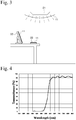
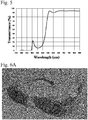
- the "at least light having the target wavelength of 460 nm" may be light blocked or for which transmission is suppressed in a wavelength region that includes a wavelength of 460 nm and the vicinity thereof (440 to 500 nm, for example) as shown by the measurement data in Fig. 4 . Further, as shown by the measurement data in Fig. 5 , light having a wavelength of 460 nm and the vicinity thereof (440 to 500 nm, for example) may be blocked or transmission thereof may be suppressed while simultaneously allowing the transmission of a part of wavelengths less than or equal to that region (400 to 440 nm, for example) to lighten the coloring of the translucent member.
- the translucent member is the lens 2 or the like capable of blocking or suppressing transmission of at least light having a wavelength of 460 nm
- the effect is obtained even when only light having a wavelength of 440 to 500 nm, for example, is blocked or transmission thereof is suppressed, and even when all light on the lower wavelength side of such wavelengths is blocked or transmission thereof is suppressed.
- light in the vicinity of 460 nm is light of 440 to 500 nm.
- the wavelength is a specific range centered around 460 nm, and preferably light is blocked or transmission is suppressed at 440 to 500 nm.
- the wavelength does not need to be strictly 440 to 500 nm and, for example, the lower limit may be 430 or 450 nm and the upper limit may be 510 or 490 nm.
- this means that the wavelength range is centered around 460 nm, and is specified so as to not be broad without limits and is not extended to a range that cannot sufficiently achieve the effect of the present invention.
- the wavelength may be about 440 to 520 nm.
- the problem of the coloring of the translucent member 1 such as the lens 2 is a matter of preference of the wearer, and is not substantially related to the effect obtained by the present invention.
- the color is lightened while minimally maintaining the effect of the present invention.
- the color becomes dark orange as shown in Fig. 6A , which may be considered not preferred depending on the wearer.
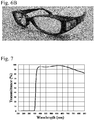
- the lens 2 or the like that suppresses the transmission of light of 440 to 500 nm but allows the transmission of a part of light of about 400 to 430 nm as shown in Fig. 5 , the color becomes quite light as shown in Fig. 6B , making it possible to obtain a color that does not result in a sense of discomfort.
- the transmittance at a peak appearing at about 400 to 430 nm is approximately 20%, which is effective from the viewpoint of coloring reduction compared to the transmittance (90% or greater) on the longer wavelength side of approximately 550 nm.
- reference sign A denotes a wavelength region in which light exceeding 500 nm is transmitted.
- Reference sign a denotes a lower limit wavelength of that transmitting region.
- Reference sign a' denotes a transmittance of the transmitting region.
- Reference sign B denotes a wavelength region where light is blocked or transmission is suppressed.
- Reference sign b denotes a transmittance of that region.
- Reference sign C denotes a wavelength region where light is transmitted.
- Reference sign c' denotes the transmittance of that region.
- Reference sign c denotes a boundary wavelength on the high wavelength side of the region B where light is blocked or transmission is suppressed.
- Reference sign d denotes a boundary wavelength on the low wavelength side of the region B where light is blocked or transmission is suppressed.
- Reference sign D denotes a wavelength region on the lower wavelength side of 400 nm where light is blocked or transmission is suppressed.
- Coloring can impart and improve transmittance on the low wavelength side.
- the degree of coloring is set low, preferably there is a transmitting portion of light in the wavelength range of 400 to 440 nm, as shown in Fig. 5 , for example.
- Transmittance in this case is preferably as high as possible since a higher transmittance results in a decrease in coloring.
- the transmittance of 550 nm or greater exceeds 90%, the maximum transmittance of light of the wavelength range of 400 to 440 nm is 20% or greater. With transmittance adjusted to such a level, the coloring of the translucent member 1 can be decreased as shown in Fig. 6B .
- the transmittance of the wavelength range of 400 to 440 nm may be 30% or greater or 40% or greater, for example. However, excluding cases where only a specific wavelength range (400 to 440 nm, for example) is a high rectangular shape, when the transmittance is too high, the base of the transmittance curve may raise the transmittance of 460 nm, which is the value for securing the effect of the present invention.
- the means for selectively adjusting the transmittance curve is not particularly limited, and known technical means such as multilayer film coating performed in the technical fields of glass and eyeglasses can be used. The above also applies to the translucent sheet 11 described later.
- the translucent sheet 11 is similar to the eyeglasses 1, and is a sheet that blocks or suppresses transmission of at least light having a wavelength of 460 nm, as illustrated in Fig. 2 and Fig. 3 . With such a translucent sheet 11 installed and made to function particularly at night, changes such as a decrease in triglycerides, an increase in IRS-2, and the like in the blood occurred.
- the translucent sheet 11, as illustrated in Fig. 3 may be installed on a front surface of an indoor lighting 21 or applied to a panel surface of a display 22 or a smartphone 23 so that light does not enter the eye.
- the translucent member (eyeglasses 1, translucent sheet 11) of the present invention it was possible to achieve a reduction in triglycerides, an increase in IRS-2, and the like by the wearing or installation thereof. Further, as confirmed in Experiment 2 and the like described later, it was found that a decrease in blood glucose and an improvement effect in insulin resistance were also obtained.
- FIG. 1 illustrates the shape of the eyeglasses
- Fig. 4 shows the transmittance curve of the lens
- Fig. 6A shows the eyeglasses in which the translucent member shown in Fig. 4 was used as the lens.
- the experiment target group included six persons (age: 22 to 55 years old, gender: 3 male, 3 female). Each person wore the eyeglasses from three to four hours before bedtime to bedtime, and not during the day. This continued for one month. Note that no other particular restrictions on alcohol consumption, napping, or the like were placed on the target group.
- the measured items included (1) a sleep study: Pittsburgh Sleep Quality Index (PSQI), actigraphy, and melatonin in urine, (2) blood test: AST (GOT), ALT (GPT), TG, HDL-cho, LDL-cho, glucose, HbA1c, C peptide, and insulin, and (3) body measurements: height, weight, girth, and blood pressure.
- PSQI Pittsburgh Sleep Quality Index
- actigraphy actigraphy
- melatonin in urine included
- blood test AST (GOT), ALT (GPT), TG, HDL-cho, LDL-cho, glucose, HbA1c, C peptide, and insulin
- body measurements height, weight, girth, and blood pressure.
- Fig. 9A shows the PSQI scores at the start of the experiment and one month later.
- the PSQI score indicates the quality of sleep, with a smaller value indicating better sleep.
- the average PSQI score at the start of the experiment was 5.5, and the score after one month improved to 3.8 (P value: less than 0.05, paired t-test).
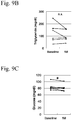
- triglyceride As for fat metabolism, a decrease in triglycerides (Triglyceride) was confirmed as shown in Fig. 9B . Specifically, a numerical improvement of approximately 20% on average was confirmed between the start and the end of the experiment. Particularly, a remarkable decrease was confirmed in two persons, including a decrease from 250 to 160, and a decrease from 150 to 80.
- Glucose blood glucose level
- a numerical improvement of approximately 10% on average was confirmed between the start and the end of the experiment.
- a remarkable decrease was confirmed in four persons, including a decrease from 107 to 101, a decrease from 85 to 78, and a decrease from 80 to 73.
- mice 6-week-old male C57BL/6J mice (Japan SLC, Inc.)
- the mice were raised for one week under 12 hours of light and 12 hours of darkness.
- the mice were exposed to weak light of 10 lux at Zeitgeber time (ZT) 14 for 30 minutes.
- White light emitting diode LEDs Toshiba Materials Co., Ltd.
- mice were kept under constant dark conditions.
- the mice were independently housed in cages provided with a running wheel.
- the animals were given a high fat diet (High Fat Diet 32, CLEA Japan, Inc.) and subsequently irradiated with a light pulse.
- Blood glucose levels were analyzed after 24 hours and after 48 hours of light pulses using a glucometer (Terumo Corporation). Samples of the liver were taken after 48 hours of light pulse.
- Figs. 10A and 10B each show a wheel running record of individual mice.
- Fig. 10A shows the record for a white light pulse
- Fig. 10B shows the record for a blue-cut light pulse.
- the wheel running activity of the mice was consistently maintained under a light-dark cycle of 12 hours of light followed by 12 hours of dark.
- the wheel running activity start time of the mice advanced by 15 minutes each day when the mice were not exposed to light during the light-dark cycle period (this is called the free-running rhythm of the mouse).
- the free-running rhythm of the mouse this is called the free-running rhythm of the mouse.
- deviation occurred in the activity start time as shown in Figs. 10A and 10B (this is referred to as a phase shift).
- Fig. 10A which includes a blue light portion
- Fig. 10B shows the light obtained by blocking the blue light in Fig. 10B
- Fig. 11 shows the phase shifts found from Figs. 10A and 10B and, from Fig. 11 , it was understood that the white light containing the blue light component had a larger phase shift rearward.
- Fig. 12 shows the phases of expression of per2, which is one type of clock gene, of a hypothalamic suprachiasmatic nucleus (SCN).
- SCN hypothalamic suprachiasmatic nucleus
- Fig. 13 shows the blood glucose levels at 24 hours and 48 hours after the mice were exposed to the same two types of light pulses as in the previous section after being given a high fat diet.
- Insulin suppresses glucose production in the liver, and is known to play a role in lowering blood glucose levels.
- the fat in the liver inhibits insulin signaling. This increases the production of glucose, and increases the blood glucose level as well.
- Glucose production in the liver involves IRS-1 and IRS-2, which are insulin receptor substrates (IRS).
Landscapes
- Physics & Mathematics (AREA)
- General Physics & Mathematics (AREA)
- Optics & Photonics (AREA)
- Health & Medical Sciences (AREA)
- Ophthalmology & Optometry (AREA)
- General Health & Medical Sciences (AREA)
- Spectroscopy & Molecular Physics (AREA)
- Optical Filters (AREA)
- Eyeglasses (AREA)
- Eye Examination Apparatus (AREA)
Applications Claiming Priority (2)
| Application Number | Priority Date | Filing Date | Title |
|---|---|---|---|
| JP2016077696 | 2016-04-07 | ||
| PCT/JP2017/014596 WO2017175873A1 (ja) | 2016-04-07 | 2017-04-07 | やせるめがね |
Publications (2)
| Publication Number | Publication Date |
|---|---|
| EP3441815A1 true EP3441815A1 (de) | 2019-02-13 |
| EP3441815A4 EP3441815A4 (de) | 2019-12-04 |
Family
ID=60000533
Family Applications (1)
| Application Number | Title | Priority Date | Filing Date |
|---|---|---|---|
| EP17779250.4A Withdrawn EP3441815A4 (de) | 2016-04-07 | 2017-04-07 | Brillen für gewichtsabnahme |
Country Status (5)
| Country | Link |
|---|---|
| US (1) | US20190121165A1 (de) |
| EP (1) | EP3441815A4 (de) |
| JP (1) | JP6635475B2 (de) |
| CN (1) | CN109073917A (de) |
| WO (1) | WO2017175873A1 (de) |
Families Citing this family (3)
| Publication number | Priority date | Publication date | Assignee | Title |
|---|---|---|---|---|
| JP7236874B2 (ja) * | 2019-02-12 | 2023-03-10 | 三菱電機ビルソリューションズ株式会社 | エレベーターのかごの照明装置の調光装置 |
| SE544316C2 (en) * | 2020-03-24 | 2022-04-05 | Ambicare Ab | Device for limiting visual impressions |
| KR20250089224A (ko) * | 2023-12-11 | 2025-06-18 | 주식회사 에덴룩스 | 멜라토닌 증진용 안경 |
Family Cites Families (22)
| Publication number | Priority date | Publication date | Assignee | Title |
|---|---|---|---|---|
| US4259406A (en) * | 1979-11-19 | 1981-03-31 | Corning Glass Works | Method for producing selectively tinted photochromic glass lens and products |
| JPH079482B2 (ja) * | 1985-09-26 | 1995-02-01 | ホ−ヤ株式会社 | 染色硬化表面層を有する合成樹脂レンズの製造法 |
| JPH0621903B2 (ja) * | 1986-04-01 | 1994-03-23 | ホ−ヤ株式会社 | レ−ザ保護眼鏡レンズ |
| US5177509A (en) * | 1987-02-26 | 1993-01-05 | Suntiger, Inc. | Ultraviolet radiation and blue light blocking polarizing lens |
| JPH04358116A (ja) * | 1991-06-04 | 1992-12-11 | Tokyo Keikaku:Kk | 防眩特性を有する眼鏡レンズ |
| US7520607B2 (en) * | 2002-08-28 | 2009-04-21 | Melcort Inc. | Device for the prevention of melationin suppression by light at night |
| JP3761032B2 (ja) * | 2004-03-31 | 2006-03-29 | 株式会社 メガネの平川 | 遮光用インナーフレーム付き眼鏡及びサングラス |
| JP4819460B2 (ja) * | 2005-09-28 | 2011-11-24 | 山本光学株式会社 | 光学物品 |
| WO2009013737A2 (en) * | 2007-07-20 | 2009-01-29 | Rappaport Family Institute For Research In The Medical Sciences | A method and a system for protection of retina from light- induced damage |
| EP2411862A4 (de) * | 2009-03-25 | 2014-07-16 | High Performance Optics Inc | Photochrome ophthalmische systeme zur selektiven filterung spezifischer blaulichtwellenlängen |
| JP2011100002A (ja) * | 2009-11-06 | 2011-05-19 | Ftf:Kk | ダイエット方法およびこれに用いられるダイエットメガネ |
| US8324808B2 (en) * | 2010-07-23 | 2012-12-04 | Biological Illumination, Llc | LED lamp for producing biologically-corrected light |
| JP5807237B2 (ja) * | 2010-09-17 | 2015-11-10 | 東海光学株式会社 | 遮光眼鏡 |
| EP2602653B1 (de) * | 2011-12-08 | 2020-09-16 | Essilor International | Methode zum Bestimmen der Konfiguration eines ophthalmischen Filters |
| ES2478693B1 (es) * | 2012-12-21 | 2015-04-29 | Universidad Complutense De Madrid | Elemento bloqueante de longitudes de onda corta en fuentes de iluminación de tipo led |
| US10627650B2 (en) * | 2013-09-10 | 2020-04-21 | Mitsui Chemicals, Inc. | Optical material and use thereof |
| US20150234207A1 (en) * | 2014-02-17 | 2015-08-20 | Daniel Koifman | Device and method for selective wavelength filtration and selective wavelength transmission for therapeutic effect |
| JP5685337B1 (ja) * | 2014-05-02 | 2015-03-18 | 山田医療照明株式会社 | 照明装置及び照明装置の製造方法 |
| WO2016014713A1 (en) * | 2014-07-22 | 2016-01-28 | University Of Utah Research Foundation | Methods, systems, and apparatus for reducing the frequency and/or severity of photophobic responses or for modulating circadian cycles |
| JP2016040579A (ja) * | 2014-08-12 | 2016-03-24 | 株式会社ジェイアイエヌ | アイウエア |
| CN204666964U (zh) * | 2015-05-14 | 2015-09-23 | 北京暴风魔镜科技有限公司 | 立体眼镜 |
| CN204925532U (zh) * | 2015-08-28 | 2015-12-30 | 深圳市好博瑞健康技术有限公司 | 一种护眼利眠健康眼镜 |
-
2017
- 2017-04-07 WO PCT/JP2017/014596 patent/WO2017175873A1/ja not_active Ceased
- 2017-04-07 EP EP17779250.4A patent/EP3441815A4/de not_active Withdrawn
- 2017-04-07 CN CN201780020640.0A patent/CN109073917A/zh active Pending
- 2017-04-07 US US16/090,986 patent/US20190121165A1/en not_active Abandoned
- 2017-04-07 JP JP2017522993A patent/JP6635475B2/ja active Active
Also Published As
| Publication number | Publication date |
|---|---|
| US20190121165A1 (en) | 2019-04-25 |
| JP6635475B2 (ja) | 2020-01-29 |
| WO2017175873A1 (ja) | 2017-10-12 |
| CN109073917A (zh) | 2018-12-21 |
| EP3441815A4 (de) | 2019-12-04 |
| JPWO2017175873A1 (ja) | 2018-10-25 |
Similar Documents
| Publication | Publication Date | Title |
|---|---|---|
| Vagge et al. | Blue light filtering ophthalmic lenses: A systematic review | |
| Swiatczak et al. | Myopia: why the retina stops inhibiting eye growth | |
| Behar-Cohen et al. | Ultraviolet damage to the eye revisited: eye-sun protection factor (E-SPF®), a new ultraviolet protection label for eyewear | |
| Alzahrani et al. | Modelling the effect of commercially available blue‐blocking lenses on visual and non‐visual functions | |
| Campbell et al. | Light as a modulator of non-image-forming brain functions—positive and negative impacts of increasing light availability | |
| Lucas | An epidemiological perspective of ultraviolet exposure—public health concerns | |
| Hammond et al. | The effects of blue light–filtering intraocular lenses on the protection and function of the visual system | |
| EP3382430B1 (de) | Optisches element | |
| Willmann | Ultraviolet keratitis: from the pathophysiological basis to prevention and clinical management | |
| EP3441815A1 (de) | Brillen für gewichtsabnahme | |
| Nandakumar et al. | Lipofuscin and the principles of fundus autofluorescence: a review | |
| Hammond Jr et al. | Contralateral comparison of blue-filtering and non-blue-filtering intraocular lenses: glare disability, heterochromatic contrast, and photostress recovery | |
| Katoh et al. | Cortical lens opacification in Iceland: Risk Factor Analysis–Reykjavik Eye Study | |
| Majdi et al. | The role of ultraviolet radiation in the ocular system of mammals | |
| Mainster et al. | Ultraviolet-B phototoxicity and hypothetical photomelanomagenesis: intraocular and crystalline lens photoprotection | |
| Renzi-Hammond et al. | The influence of HEV-filtering contact lenses on behavioral indices of glare | |
| Park et al. | The protective effect of brown-, gray-, and blue-tinted lenses against blue led light-induced cell death in A2E-laden human retinal pigment epithelial cells | |
| Kohnen et al. | Blue light filtration in intraocular lenses: effects on visual function and systemic health | |
| Ichikawa | Changes in blood pressure and sleep duration in patients with blue light-blocking/yellow-tinted intraocular lens (CHUKYO study) | |
| Khanal et al. | Childhood myopia part II: treatment mechanisms, emerging options, and considerations | |
| Swiatczak et al. | Pilot study: simulating myopic chromatic aberration on a computer screen induces progressive choroidal thickening in myopes | |
| Yu et al. | Selective blue-filtering spectacle lens protected primary porcine RPE cells against light emitting diode-induced cell damage | |
| Efron et al. | International rigid contact lens prescribing | |
| Okada et al. | The relationship between contact lens ultraviolet light transmittance and myopia progression: a large-scale retrospective cohort study | |
| Zheng et al. | Association between dietary consumption of vitamin B1 and advanced age-related macular degeneration: a cross-sectional observational study in NHANES 2005–2008 |
Legal Events
| Date | Code | Title | Description |
|---|---|---|---|
| STAA | Information on the status of an ep patent application or granted ep patent |
Free format text: STATUS: THE INTERNATIONAL PUBLICATION HAS BEEN MADE |
|
| PUAI | Public reference made under article 153(3) epc to a published international application that has entered the european phase |
Free format text: ORIGINAL CODE: 0009012 |
|
| STAA | Information on the status of an ep patent application or granted ep patent |
Free format text: STATUS: REQUEST FOR EXAMINATION WAS MADE |
|
| 17P | Request for examination filed |
Effective date: 20181107 |
|
| AK | Designated contracting states |
Kind code of ref document: A1 Designated state(s): AL AT BE BG CH CY CZ DE DK EE ES FI FR GB GR HR HU IE IS IT LI LT LU LV MC MK MT NL NO PL PT RO RS SE SI SK SM TR |
|
| AX | Request for extension of the european patent |
Extension state: BA ME |
|
| DAV | Request for validation of the european patent (deleted) | ||
| DAX | Request for extension of the european patent (deleted) | ||
| A4 | Supplementary search report drawn up and despatched |
Effective date: 20191031 |
|
| RIC1 | Information provided on ipc code assigned before grant |
Ipc: G02B 5/20 20060101ALI20191025BHEP Ipc: G02C 1/06 20060101ALI20191025BHEP Ipc: G02B 5/22 20060101ALI20191025BHEP Ipc: G02C 7/16 20060101ALI20191025BHEP Ipc: G02B 5/26 20060101ALI20191025BHEP Ipc: G02C 7/10 20060101AFI20191025BHEP |
|
| STAA | Information on the status of an ep patent application or granted ep patent |
Free format text: STATUS: THE APPLICATION HAS BEEN WITHDRAWN |
|
| 18W | Application withdrawn |
Effective date: 20200310 |