EP3441884A1 - Verfahren zur verwaltung eines übersetzungspuffers und mehrkernprozessor - Google Patents
Verfahren zur verwaltung eines übersetzungspuffers und mehrkernprozessor Download PDFInfo
- Publication number
- EP3441884A1 EP3441884A1 EP16900788.7A EP16900788A EP3441884A1 EP 3441884 A1 EP3441884 A1 EP 3441884A1 EP 16900788 A EP16900788 A EP 16900788A EP 3441884 A1 EP3441884 A1 EP 3441884A1
- Authority
- EP
- European Patent Office
- Prior art keywords
- core
- tlb
- entry
- idle
- target
- Prior art date
- Legal status (The legal status is an assumption and is not a legal conclusion. Google has not performed a legal analysis and makes no representation as to the accuracy of the status listed.)
- Granted
Links
Images





Classifications
-
- G—PHYSICS
- G06—COMPUTING OR CALCULATING; COUNTING
- G06F—ELECTRIC DIGITAL DATA PROCESSING
- G06F12/00—Accessing, addressing or allocating within memory systems or architectures
- G06F12/02—Addressing or allocation; Relocation
- G06F12/08—Addressing or allocation; Relocation in hierarchically structured memory systems, e.g. virtual memory systems
- G06F12/10—Address translation
- G06F12/1027—Address translation using associative or pseudo-associative address translation means, e.g. translation look-aside buffer [TLB]
-
- G—PHYSICS
- G06—COMPUTING OR CALCULATING; COUNTING
- G06F—ELECTRIC DIGITAL DATA PROCESSING
- G06F12/00—Accessing, addressing or allocating within memory systems or architectures
- G06F12/02—Addressing or allocation; Relocation
- G06F12/08—Addressing or allocation; Relocation in hierarchically structured memory systems, e.g. virtual memory systems
- G06F12/0802—Addressing of a memory level in which the access to the desired data or data block requires associative addressing means, e.g. caches
- G06F12/0806—Multiuser, multiprocessor or multiprocessing cache systems
-
- G—PHYSICS
- G06—COMPUTING OR CALCULATING; COUNTING
- G06F—ELECTRIC DIGITAL DATA PROCESSING
- G06F12/00—Accessing, addressing or allocating within memory systems or architectures
- G06F12/02—Addressing or allocation; Relocation
- G06F12/08—Addressing or allocation; Relocation in hierarchically structured memory systems, e.g. virtual memory systems
- G06F12/0802—Addressing of a memory level in which the access to the desired data or data block requires associative addressing means, e.g. caches
- G06F12/0806—Multiuser, multiprocessor or multiprocessing cache systems
- G06F12/0842—Multiuser, multiprocessor or multiprocessing cache systems for multiprocessing or multitasking
-
- G—PHYSICS
- G06—COMPUTING OR CALCULATING; COUNTING
- G06F—ELECTRIC DIGITAL DATA PROCESSING
- G06F12/00—Accessing, addressing or allocating within memory systems or architectures
- G06F12/02—Addressing or allocation; Relocation
- G06F12/08—Addressing or allocation; Relocation in hierarchically structured memory systems, e.g. virtual memory systems
- G06F12/10—Address translation
- G06F12/1009—Address translation using page tables, e.g. page table structures
-
- G—PHYSICS
- G06—COMPUTING OR CALCULATING; COUNTING
- G06F—ELECTRIC DIGITAL DATA PROCESSING
- G06F12/00—Accessing, addressing or allocating within memory systems or architectures
- G06F12/02—Addressing or allocation; Relocation
- G06F12/08—Addressing or allocation; Relocation in hierarchically structured memory systems, e.g. virtual memory systems
- G06F12/12—Replacement control
- G06F12/121—Replacement control using replacement algorithms
- G06F12/128—Replacement control using replacement algorithms adapted to multidimensional cache systems, e.g. set-associative, multicache, multiset or multilevel
-
- G—PHYSICS
- G06—COMPUTING OR CALCULATING; COUNTING
- G06F—ELECTRIC DIGITAL DATA PROCESSING
- G06F12/00—Accessing, addressing or allocating within memory systems or architectures
- G06F12/02—Addressing or allocation; Relocation
- G06F12/08—Addressing or allocation; Relocation in hierarchically structured memory systems, e.g. virtual memory systems
- G06F12/0802—Addressing of a memory level in which the access to the desired data or data block requires associative addressing means, e.g. caches
- G06F12/0806—Multiuser, multiprocessor or multiprocessing cache systems
- G06F12/0811—Multiuser, multiprocessor or multiprocessing cache systems with multilevel cache hierarchies
-
- G—PHYSICS
- G06—COMPUTING OR CALCULATING; COUNTING
- G06F—ELECTRIC DIGITAL DATA PROCESSING
- G06F2212/00—Indexing scheme relating to accessing, addressing or allocation within memory systems or architectures
- G06F2212/68—Details of translation look-aside buffer [TLB]
- G06F2212/684—TLB miss handling
Definitions
- the present invention relates to the field of information technologies, and more specifically, to a translation lookaside buffer (Translation Lookaside Buffer, TLB) management method and a multi-core processor.
- TLB Translation Lookaside Buffer
- a user program usually runs in a virtual address space.
- an operating system Operating System, OS
- a memory management unit Memory Management Unit, MMU
- a virtual address includes a virtual page number (Virtual Page Number, VPN) and an intra-page offset
- a physical address includes a physical frame number (Physical Frame Number, PFN) and an intra-page offset.
- VPN Virtual Page Number
- PFN Physical Frame Number
- each processor core hereinafter referred to as a core (Core)
- CMP Chip Multi-Processor
- TLB translation lookaside buffer
- a program working set in a system keeps increasing, that is, programs and to-be-processed data keep increasing.
- a storage space of a TLB in a core is limited.
- entries stored in the TLB in the existing cores cannot meet a use requirement.
- a currently required TLB translation entry is possibly missing in the TLB (that is, TLB Miss), or a TLB miss rate is increased. If the currently required TLB translation entry is missing, the core usually needs to obtain the TLB translation entry from the memory through processing of the operating system and accessing to the page table in the memory. This may lead to a relatively large delay and performance loss, thereby reducing program execution efficiency.
- Embodiments of the present invention provide a translation lookaside buffer processing method and a multi-core processor.
- the method can expand a TLB capacity of a core in a working state, thereby reducing a TLB miss rate and accelerate program execution.
- a translation lookaside buffer TLB management method is provided and is applied to a multi-core processor, where the multi-core processor includes a first core, the first core includes a TLB, and the method includes:
- the first core may obtain the first target TLB entry from another core of the multi-core processor.
- the first core may broadcast a TLB query request to other cores of a multi-core system, where the broadcast TLB query request carries a virtual address causing a miss, that is, a virtual address corresponding to the first target TLB entry.
- the other cores After receiving the broadcast address, the other cores search local TLBs for the virtual address. If a TLB of a processor core is hit, the first target TLB entry may be fed back to the first core.
- the first core can rapidly obtain the first target TLB entry from the another core, thereby avoiding that the first core sends a query request to an operating system to obtain the first target TLB entry from a memory. This can save time and improve application efficiency.
- the first core may also obtain the first target TLB entry from a page table of the memory.
- the first core sends the query request to the operating system, where the query request carries the virtual address causing the miss, and obtains the first target TLB entry from the page table of the memory after processing of the operating system. This is not limited in this embodiment of the present invention.
- the first core needs to replace a valid TLB entry with the first target TLB entry. In this case, the first core attempts to obtain more TLB resources to save the replaced TLB entry. Therefore, the first core needs to determine the second core from the idle cores.
- TLB miss Miss
- the first core attempts to obtain more TLB resources to save the replaced TLB entry. Therefore, the first core needs to determine the second core from the idle cores.
- the replaced TLB entry is stored by using a TLB resource in the idle core. This not only increases utilization of the TLB resource of the idle core, but also indirectly increases a capacity of the TLB of the first core, reduces a possibility of obtaining the target TLB entry by the first core from the memory, and accelerates program execution.
- a core included in the multi-core processor in this embodiment of the present invention may also be called a node.
- a node in this specification may be equivalent to a core in the multi-core processor.
- the first core replaces the first entry at a first entry position in the TLB of the first core with the first target TLB entry, and stores the first entry into the TLB of the second core.
- the first entry position may be any entry position in a TLB of a master core. This is not limited in this embodiment of the present invention.
- the first entry may be any TLB entry in the TLB of the first core.
- the first entry may be a first entry, a last entry, or an intermediate entry in the TLB of the first core. This is not limited in this embodiment of the present invention.
- the first core needs to store the first target TLB entry at the first entry position in the TLB of the first core, and store the first entry that is replaced from the first entry position into the TLB of the second core.
- the first core may be called a master core of the second core, and the second core may be called a slave core (or a spare core) of the first core.
- the master core (Master) writes a TLB entry into the TLB of the slave core (Slave). This process occurs when the TLB entry in the master is replaced. After the master obtains the first target TLB entry, because the TLB entry storage of the master core is full, the first target TLB entry needs to be filled to the first entry position. To be specific, the first entry at the first entry position is replaced with the first target TLB entry, and then the first entry is stored into the TLB of the slave core (Slave) (for example, the second core).
- the slave saves a write position.
- an alternate write mechanism may be used. That is, if a quantity of TLB entries of the slave core is N, writing starts sequentially from a first entry to an (N-1) th entry, that is, starts from 0 until the entry storage is full.
- a TLB processing method used when the entry storage of the slave core (for example, the second core) is full is described in detail in the following.
- the first target TLB entry is obtained to replace the first entry in the TLB of the first core, and the first entry is stored into the TLB of the second core, that is, the replaced entry is stored into the TLB of the second core. Therefore, in this embodiment of the present invention, a TLB resource of an idle core is used to expand a TLB capacity of a working core, thereby reducing a TLB miss rate and accelerating program execution.
- the working core namely the master core (Master) (for example, the first core)
- the working core does not need to obtain the entry again by using the operating system, but can obtain the entry by directly accessing the TLB of the slave. This greatly reduces a TLB refilling delay and accelerates program execution.
- an idle core can share a TLB resource of the idle core with only one working core for use, and the working core may obtain TLB resources of a plurality of idle cores to store TLB entries.
- the determining, by the first core, a second core from cores in an idle state in the multi-core processor includes:
- the replaced TLB entry is stored by using a TLB resource in the idle core. This not only increases utilization of the TLB resource of the idle core, but also indirectly increases a capacity of the TLB of the first core, reduces a possibility of obtaining the target TLB entry by the first core from the memory, and accelerates program execution.
- the selecting, by the first core based on the response message, a core from the cores in the idle state as the second core includes:
- the first core selects the idle core with the minimum overheads for communicating with the first core as the second core, and stores a replaced TLB entry into the second core, thereby reducing communication overheads to a greatest extent.
- the first core needs to query for an entry in the TLB of the second core, because the communication overheads are very low, the first core can quickly find the TLB entry, thereby improving program execution efficiency.
- selecting the second core based on the minimum overheads for communicating with the first core is a relatively ideal selection manner.
- the communication overheads need to be determined based on a congestion level of a network on chip NoC (Network on Chip) router in a multi-core processor chip, and a processor core is selected from idle cores as the second core based on the network congestion level.
- NoC Network on Chip
- the following implementations may be used.
- the selecting, from the idle-core list, an idle core with minimum overheads for communicating with the first core, as the second core includes:
- another manner may also be used to determine the core with the minimum communication overheads. This is not limited in this embodiment of the present invention.
- the first core (which may be called a requesting node herein) broadcasts a status query request (also called a TLB query request) to other cores (also called other nodes) in the multi-core processor, where the status query request is used to query whether each core is in an idle state.
- a status query request also called a TLB query request
- each core After receiving the status query request, each core sends a response message to the first core (the requesting node), where the response message is used to indicate whether the core is in the idle state.
- the first core obtains the idle-core list based on the response message. If the idle-core list is blank, TLB resource obtaining is terminated, and a missing TLB entry (that is, the first target TLB entry) of the first core is read from the memory in an existing manner.
- the first core selects, based on overheads for communicating with idle cores in the idle-core list, an idle core with the minimum communication overheads, and sends a TLB sharing request to the idle core. If the idle core has been shared by another node or the idle core switches to a working state in this case, the idle core sends a failure feedback to the requesting node, so that the idle core is deleted from the idle-node list. Then, the foregoing process is repeated. If the idle core is in the idle state in this case, the idle core is determined as the second core.
- the first core selects the idle core with the minimum overheads for communicating with the first core as the second core, and stores a replaced TLB entry into the second core, thereby reducing communication overheads to a greatest extent.
- the first core needs to query for an entry in the TLB of the second core, because the communication overheads are very low, the first core can quickly find the TLB entry, thereby improving program execution efficiency.
- the method further includes: recording an identifier of the second core in a TLB spare core list of the first core.
- the spare core list herein may also be called a slave core list.
- the second core becomes the slave core (Slave) (also called a spare core) of the first core.
- the slave core (the second core) writes an identifier (for example, a number) of the first core into a master core (Master) number register of the slave core.
- the first core becomes the master core (Master) of the second core, and adds an identifier (for example, a number) of the slave core (the second core) to the spare core list of the first core.
- the first core may read/write the TLB of the second core in the spare core list, thereby increasing the capacity of the TLB of the first core, reducing a TLB miss rate of the first core, and accelerating program execution.
- the method further includes:
- the first core stores the second entry at an original position of the second target TLB entry in the second core. That is, the first core exchanges storage positions of the second entry and the second target TLB entry.
- the master core reads a TLB entry from the slave core.
- the foregoing process occurs when a local TLB miss (Miss) occurs in the master (the first core), that is, the second target TLB entry does not exist in the local TLB.
- the master reads the TLB entry from the slave.
- the master sends a TLB read request to all slaves based on the spare core list (Slave List) (also called a slave core list).
- Slave List also called a slave core list.
- each slave queries a local TLB of the slave core. If the second target TLB is missed, a miss feedback is returned; if the second target TLB is hit, a hit feedback and content of a hit TLB entry are returned.
- the master After the master collects all feedbacks, if all the feedbacks are miss feedbacks, the master sends a TLB miss request to the operating system; if a TLB entry in the slave is hit, the master uses the hit TLB entry for refilling. If entry replacement occurs during a refilling process, a replaced entry is written into the hit slave core.
- a working core has permission to read/write a TLB of an idle core.
- Using a TLB resource in the idle core to save a replaced TLB entry not only increases utilization of the TLB resource of the idle core, but further increases the capacity of the TLB of the first core.
- the target entry may be read from the TLB of the slave core, thereby reducing a possibility of obtaining the target TLB entry by the first core from the memory, accelerating program execution, and improving program execution efficiency.
- the method further includes:
- the master core determines the third core from other idle cores in the multi-core processor to store the third entry that is in the TLB of the first core and that is replaced with the third target TLB entry.
- a new slave core is obtained to save the replaced TLB entry, further expanding the capacity of the first core.
- the first core queries for the replaced TLB entry again, the first core can directly read from the new slave core, and the first core does not need to obtain the TLB entry from the memory. Therefore, in this embodiment of the present invention, program execution can be accelerated and program execution efficiency can be improved.
- the method further includes: sending, by the first core, a TLB release instruction to a core recorded in the TLB spare core list, where the TLB release instruction is used to instruct the core recorded in the spare core list to terminate TLB sharing.
- the master when the master changes to the idle state, all obtained TLB resources are released.
- the master sends the TLB release request to all slaves based on the slave list, so that TLB resources of these idle cores can be used by another working core.
- the master and the slave After the master releases all the obtained TLB resources, the master and the slave both become idle cores, and can be used by another working core.
- the first core releases an obtained TLB resource of a slave core by sending a release instruction to all slave cores.
- the TLB resource of the slave core (the idle core) is released, avoiding resource waste.
- the released TLB resource of the slave core can be used by another working core, thereby increasing a capacity of the another working core and accelerating program execution of the working core.
- the slave core may or may not delete the TLB entry stored in the slave core. This is not limited in this embodiment of the present invention. For example, after sharing is terminated and the slave core serves as a slave core of another working core, all entries in the TLB may be deleted, so that the another core can store a replaced entry. For another example, after sharing is terminated and when the slave core is in the working state, a previously stored TLB entry may be reserved for searching and use by the slave core itself.
- the method further includes:
- the second core after the second core switches from the idle state to the working state, the second core sends the TLB sharing termination request to the first core, so that the first core releases the second core, and the second core can use the TLB resource of the second core.
- the second core may also become another master core and can use a TLB resource of another idle core.
- the method before the deleting, by the first core, the identifier of the second core from the TLB spare core list, the method further includes:
- the master core before the master core (for example, the first core) deletes the slave core (for example, the second core) from the spare core list, the master core obtains a new core (a new slave core) (for example, the fourth core) from the multi-core processor.
- a TLB of the new slave core is used to store all entries in the TLB of the deleted slave core (that is, the second core). In this way, if an entry in the second core needs to be queried in a subsequent query, the entry does not need to be obtained again by using the operating system, and the entry can be obtained by directly accessing the TLB of the slave core (the fourth core). This greatly reduces a TLB refilling delay and accelerates program execution.
- the first core obtains a new slave core (the fourth core) to save all entries in the TLB of the released second core. If the first core needs to query for an entry in the second core in a subsequent query, the first core does not need to re-obtain the entry from the memory by using the operating system. Instead, the first core can directly access the TLB of the slave core (the fourth core) to obtain the entry. This greatly reduces a TLB refilling delay and accelerates program execution.
- a multi-core processor can implement any one of the first aspect or the implementations of the first aspect.
- the multi-core processor includes a first core, and the first core includes a translation lookaside buffer TLB;
- the first target TLB entry is obtained to replace the first entry in the TLB of the first core, and the first entry is stored into the TLB of the second core, that is, the replaced entry is stored into the TLB of the second core. Therefore, in this embodiment of the present invention, a TLB resource of an idle core is used to expand a TLB capacity of a working core, thereby reducing a TLB miss rate and accelerating program execution.
- the working core namely the master core (Master) (for example, the first core)
- the working core does not need to obtain the entry again by using an operating system, but can obtain the entry by directly accessing the TLB of the slave. This greatly reduces a TLB refilling delay and accelerates program execution.
- an idle core can share a TLB resource of the idle core with only one working core for use, and the working core may obtain TLB resources of a plurality of idle cores to store TLB entries.
- the first core when obtaining the first target TLB entry, is specifically configured to:
- the first core may broadcast a TLB query request to other cores of the multi-core system, where the broadcast TLB query request carries a virtual address causing a miss, that is, a virtual address corresponding to the first target TLB entry.
- the other cores After receiving the broadcast address, the other cores search local TLBs for the virtual address. If a TLB of a processor core is hit, the first target TLB entry may be fed back to the first core.
- the first core can rapidly obtain the first target TLB entry from the another core, thereby avoiding that the first core sends a query request to the operating system to obtain the first target TLB entry from the memory. This can save time and improve application efficiency.
- the first core may also obtain the first target TLB entry from the page table of the memory.
- the first core sends the query request to the operating system, where the query request carries the virtual address causing the miss, and obtains the first target TLB entry from the page table of the memory after processing of the operating system. This is not limited in this embodiment of the present invention.
- the first core when determining a second core from cores in an idle state in the multi-core processor, is specifically configured to:
- the replaced TLB entry is stored by using a TLB resource in the idle core. This not only increases utilization of the TLB resource of the idle core, but also indirectly increases a capacity of the TLB of the first core, reduces a possibility of obtaining the target TLB entry by the first core from the memory, and accelerates program execution.
- the first core when selecting, based on the response message, a core from the cores in the idle state as the second core, is specifically configured to:
- the first core selects the idle core with the minimum overheads for communicating with the first core as the second core, and stores a replaced TLB entry into the second core, thereby reducing communication overheads to a greatest extent.
- the first core needs to query for an entry in the TLB of the second core, because the communication overheads are very low, the first core can quickly find the TLB entry, thereby improving program execution efficiency.
- the first core when selecting the idle core with the minimum overheads for communicating with the first core as the second core, is specifically configured to:
- the first core is further configured to record an identifier of the second core in a TLB spare core list of the first core.
- the first core may read/write the TLB of the second core in the spare core list, thereby increasing the capacity of the TLB of the first core, reducing a TLB miss rate of the first core, and accelerating program execution.
- the first core is further configured to:
- a working core has permission to read/write a TLB of an idle core.
- Using a TLB resource in the idle core to save a replaced TLB entry not only increases utilization of the TLB resource of the idle core, but further increases the capacity of the TLB of the first core.
- the target entry may be read from the TLB of the slave core, thereby reducing a possibility of obtaining the target TLB entry by the first core from the memory, accelerating program execution, and improving program execution efficiency.
- the first core is further configured to:
- a new slave core is obtained to save the replaced TLB entry, further expanding the capacity of the first core.
- the first core queries for the replaced TLB entry again, the first core can directly read from the new slave core, and the first core does not need to obtain the TLB entry from the memory. Therefore, in this embodiment of the present invention, program execution can be accelerated and program execution efficiency can be improved.
- the first core is further configured to: send a TLB release instruction to a core recorded in the TLB spare core list, where the TLB release instruction is used to instruct the core recorded in the spare core list to terminate TLB sharing.
- the first core releases an obtained TLB resource of a slave core by sending a release instruction to all slave cores.
- the TLB resource of the slave core (the idle core) is released, avoiding resource waste.
- the released TLB resource of the slave core can be used by another working core, thereby increasing a capacity of the another working core and accelerating program execution of the working core.
- the second core after the second core switches from the idle state to a working state, the second core is configured to send a TLB sharing termination request to the first core, where the TLB sharing termination request carries the identifier of the second core; and the first core is further configured to: receive the TLB sharing termination request, and delete the identifier of the second core from the TLB spare core list.
- the second core after the second core switches from the idle state to the working state, the second core sends the TLB sharing termination request to the first core, so that the first core releases the second core, and the second core can use the TLB resource of the second core.
- the second core may also become another master core and can use a TLB resource of another idle core.
- the first core is further configured to determine a fourth core from the cores in the idle state in the multi-core processor, where a TLB of the fourth core is used to store all entries in the TLB of the second core.
- the first core obtains a new slave core (the fourth core) to save all entries in the TLB of the released second core. If the first core needs to query for an entry in the second core in a subsequent query, the first core does not need to re-obtain the entry from the memory by using the operating system. Instead, the first core can directly access the TLB of the slave core (the fourth core) to obtain the entry. This greatly reduces a TLB refilling delay and accelerates program execution.
- the technical solutions of the present invention may be applied to a hardware device such as a CPU, a memory management unit (MMU, Memory Management Unit), and a memory, and the hardware device may run on an operating system that implements service processing by using a thread or a process (including a plurality of threads), such as the Linux system, the Unix system, the Windows system, the Android system, or the iOS system.
- a hardware device such as a CPU, a memory management unit (MMU, Memory Management Unit), and a memory
- MMU memory management unit
- Memory Management Unit a hardware device
- the hardware device may run on an operating system that implements service processing by using a thread or a process (including a plurality of threads), such as the Linux system, the Unix system, the Windows system, the Android system, or the iOS system.
- multi-core processor means a processor that includes a plurality of processor cores (Core), and may be specifically represented as a chip multi-processor, or a multiprocessor system-on-board.
- the chip multi-processor is a processor (Processor) in which a plurality of processor cores (Core) are interconnected and integrated on a chip (Chip) by using a network on chip (Network On Chip, NOC).
- the multiprocessor system-on-board is a processing system built by packaging (Package) each of a plurality of processor cores as a processor and integrating all processors on a circuit board.
- processor core also called a kernel or a core
- the processor core is made from monocrystalline silicon by using a specific production process, and performs all computations, command reception or command storage, and data processing for the CPU.
- a plurality of processor cores means that at least two processor cores are included, and the "a plurality of processor cores” covers an application scope of a multi-core (Multi-Core) and a many-core (Many Core) in the prior art.
- a TLB also known as a page table cache, stores some page table files, that is, entries for translating a virtual address to a physical address.
- the TLB may be used for interaction between a virtual address and a physical address, and provides a buffer for searching for the physical address, to effectively reduce time consumed for searching for the physical address by a core.
- a "master core (Master)” indicates a core that is in a working state and that can use a TLB resource of another idle core to manage a TLB entry.
- a “slave core (Slave)” indicates a core that is in an idle state and that can share a TLB resource of the slave core with the master core.
- TLB miss indicates that a TLB entry corresponding to an address translation request does not exist in a TLB of a core.
- TLB hit indicates that a TLB entry corresponding to an address translation request exists in a TLB of a core.
- TLB replace indicates that a TLB entry in the master core exchanges position with a TLB entry corresponding to an address translation request in the slave core. For example, as shown in FIG. 6 , a TLB entry corresponding to an address translation request in a slave core, namely, a "hit" TLB entry in a TLB of the slave core exchanges position with a "replace” TLB entry in a TLB of a master core.
- first, second, third, and fourth are only for distinguishing between cores, and should not constitute any limitation on the protection scope of the present invention.
- a first core may also be called a second core
- a second core may also be called a first core
- a fourth core and a second core or a third core may be a same core or different cores. This is not limited in the embodiments of the present invention.
- a TLB resource in an idle core is dynamically allocated to a working core (or a core in a working state or a working node) executing a task, to expand a TLB capacity of the working core, reduce TLB miss, and ultimately accelerate program execution.
- the working core may obtain TLB resources of one or more idle cores to meet a TLB access requirement of the working core.
- the working core that obtains the TLB resource is called a master core (Master), and the idle core that provides the TLB resource is called a slave core (Slave).
- Master master core
- slave core slave core
- a TLB entry frequently accessed is located in the master core
- a TLB entry infrequently accessed is located in the slave core.
- a “core” included in the multi-core processor may also be called a “node”, that is, the “node” in this specification may be equivalent to the "core” in the multi-core processor.
- the multi-core processor includes a plurality of cores, or in other words, the multi-core processor includes a plurality of nodes. This is not limited in the embodiments of the present invention.
- the multi-core processor may include at least two cores.
- the multi-core processor may include 2 cores, 4 cores, 8 cores, 16 cores, or 32 cores.
- the embodiments of the present invention are not limited thereto. The following describes a basic structure of a multi-core processor according to an embodiment of the present invention with reference to FIG. 1 .
- the multi-core processor shown in FIG. 1 includes 16 cores (Core): Core 0 to Core 15. Each core includes:
- the processing module of each core includes a TLB.
- the cores are connected to each other by using a network on chip and communicate with each other by using the network-on-chip interface. Communication between two horizontally or vertically adjacent cores by using a link between the two cores may be called a hop. For example, a communication path for communication between Core 1 and Core 3 requires at least two hops, that is, Core 1-Core 2-Core 3.
- FIG. 2 is a schematic flowchart of a TLB management method according to an embodiment of the present invention.
- the method shown in FIG. 2 may be performed by a first core.
- a method 200 shown in FIG. 2 is applied to a multi-core processor, where the multi-core processor includes a first core, and the first core includes a TLB.
- the first core may be any core of the multi-core processor.
- the first core may be any one of Core 0 to Core 15. This is not limited in this embodiment of the present invention.
- the method 200 shown in FIG. 2 includes the following steps.
- the first core receives a first address translation request, and queries the TLB of the first core based on the first address translation request.
- the first core queries whether there is a TLB entry corresponding to the first address translation request in the TLB of the first core.
- the first core When determining that a first target TLB entry corresponding to the first address translation request is missing in the TLB of the first core, the first core obtains the first target TLB entry.
- the first core may obtain the first target TLB entry from another core of the multi-core processor.
- the first core may broadcast a TLB query request to other cores of a multi-core system, where the broadcast TLB query request carries a virtual address causing a miss, that is, a virtual address corresponding to the first target TLB entry.
- the other cores After receiving the broadcast address, the other cores search local TLBs for the virtual address. If a TLB of a processor core is hit, the first target TLB entry may be fed back to the first core.
- the first core can rapidly obtain the first target TLB entry from the another core, thereby avoiding that the first core sends a query request to an operating system to obtain the first target TLB entry from a memory. This can save time and improve application efficiency.
- the first core may also obtain the first target TLB entry from a page table of the memory.
- the first core sends the query request to the operating system, where the query request carries the virtual address causing the miss, and obtains the first target TLB entry from the page table of the memory after processing of the operating system. This is not limited in this embodiment of the present invention.
- the first core determines a second core from cores in an idle state in the multi-core processor.
- the first core needs to replace a valid TLB entry with the first target TLB entry. In this case, the first core attempts to obtain more TLB resources to save the replaced TLB entry. Therefore, the first core needs to determine the second core from the idle cores.
- TLB miss Miss
- the first core attempts to obtain more TLB resources to save the replaced TLB entry. Therefore, the first core needs to determine the second core from the idle cores.
- the replaced TLB entry is stored by using a TLB resource in the idle core. This not only increases utilization of the TLB resource of the idle core, but also indirectly increases a capacity of the TLB of the first core, reduces a possibility of obtaining the target TLB entry by the first core from the memory, and accelerates program execution.
- that the first core determines a second core from cores in an idle state in the multi-core processor includes:
- the selecting, by the first core based on the response message, a core from the cores in the idle state as the second core includes:
- the first core selects the idle core with the minimum overheads for communicating with the first core as the second core, and stores a replaced TLB entry into the second core, thereby reducing communication overheads to a greatest extent.
- the first core needs to query for an entry in the TLB of the second core, because the communication overheads are very low, the first core can quickly find the TLB entry, thereby improving program execution efficiency.
- selecting the second core based on the minimum overheads for communicating with the first core is a relatively ideal selection manner.
- the communication overheads need to be determined based on a congestion level of a network on chip NoC (Network on Chip) router in a multi-core processor chip, and a processor core is selected from idle cores as the second core based on the network congestion level.
- NoC Network on Chip
- the following implementations may be used:
- another manner may also be used to determine the core with the minimum communication overheads. This is not limited in this embodiment of the present invention.
- the multi-core processor in FIG. 1 is used as an example.
- the first core is Core 5
- the idle cores included in the idle-core list are Core 7, Core 11 and Core 14.
- Minimum hops for communication between Core 5 and Core 7 are two hops, that is, a communication path is Core 5-Core 6-Core 7
- minimum hops for communication between Core 5 and Core 11 are three hops, for example, one of communication paths with the minimum hops is Core 5-Core 6-Core 7-Core 11
- minimum hops for communication between Core 5 and Core 14 are three hops, for example, one of communication paths with the minimum hops is Core 5-Core 9-Core 13-Core 14. Therefore, Core 5 selects Core 7 that has the minimum hops for communication with Core 5 as the second core.
- the first core (which may be called a requesting node herein) broadcasts a status query request (also called a TLB query request) to other cores (also called other nodes) in the multi-core processor, where the status query request is used to query whether each core is in an idle state.
- a status query request also called a TLB query request
- each core After receiving the status query request, each core sends a response message to the first core (the requesting node), where the response message is used to indicate whether the core is in the idle state.
- the first core obtains the idle-core list based on the response message. If the idle-core list is blank, TLB resource obtaining is terminated, and a missing TLB entry (that is, the first target TLB entry) of the first core is read from the memory in an existing manner.
- the first core selects, based on overheads for communicating with idle cores in the idle-core list, an idle core with the minimum communication overheads, and sends a TLB sharing request to the idle core. If the idle core has been shared by another node or the idle core switches to a working state in this case, the idle core sends a failure feedback to the requesting node, so that the idle core is deleted from the idle-node list. Then, the foregoing process is repeated. If the idle core is in the idle state in this case, the idle core is determined as the second core.
- the first core selects the idle core with the minimum overheads for communicating with the first core as the second core, and stores a replaced TLB entry into the second core, thereby reducing communication overheads to a greatest extent.
- the first core needs to query for an entry in the TLB of the second core, because the communication overheads are very low, the first core can quickly find the TLB entry, thereby improving program execution efficiency.
- the first core replaces a first entry in the TLB of the first core with the first target TLB entry, and stores the first entry into a TLB of the second core.
- the first core replaces the first entry at a first entry position in the TLB of the first core with the first target TLB entry, and stores the first entry into the TLB of the second core.
- the first entry position may be any entry position in a TLB of a master core. This is not limited in this embodiment of the present invention.
- the first entry may be any TLB entry in the TLB of the first core.
- the first entry may be a first entry, a last entry, or an intermediate entry in the TLB of the first core. This is not limited in this embodiment of the present invention.
- the first core needs to store the first target TLB entry at the first entry position in the TLB of the first core, and store the first entry that is replaced from the first entry position into the TLB of the second core.
- the first core may be called a master core of the second core, and the second core may be called a slave core (or a spare core) of the first core.
- the master core (Master) writes a TLB entry into the TLB of the slave core (Slave). This process occurs when the TLB entry in the master is replaced. As shown in FIG. 2 , after the master obtains the first target TLB entry, because the TLB entry storage of the master core is full, the first target TLB entry needs to be filled to the first entry position. To be specific, the first entry at the first entry position is replaced with the first target TLB entry, and then the first entry is stored into the TLB of the slave core (Slave) (for example, the second core).
- the slave saves a write position.
- an alternate write mechanism may be used. That is, if a quantity of TLB entries of the slave core is N, writing starts sequentially from a first entry to an (N-1) th entry, that is, starts from 0 until the entry storage is full.
- a TLB processing method used when the entry storage of the slave core (for example, the second core) is full is described in detail in the following.
- the first target TLB entry is obtained to replace the first entry in the TLB of the first core, and the first entry is stored into the TLB of the second core, that is, the replaced entry is stored into the TLB of the second core. Therefore, in this embodiment of the present invention, a TLB resource of an idle core is used to expand a TLB capacity of a working core, thereby reducing a TLB miss rate and accelerating program execution.
- the working core namely the master core (Master) (for example, the first core)
- the working core does not need to obtain the entry again by using the operating system, but can obtain the entry by directly accessing the TLB of the slave. This greatly reduces a TLB refilling delay and accelerates program execution.
- an idle core can share a TLB resource of the idle core with only one working core for use, and the working core may obtain TLB resources of a plurality of idle cores to store TLB entries.
- the method may further include: recording an identifier of the second core in a TLB spare core list of the first core.
- the spare core list herein may also be called a slave core list.
- the first core may read/write the TLB of the second core in the spare core list, thereby increasing the capacity of the TLB of the first core, reducing a TLB miss rate of the first core, and accelerating program execution.
- the second core After the first core determines the second core from the idle-core list, the second core becomes the slave core (Slave) (also called a spare core) of the first core.
- the slave core (the second core) writes an identifier (for example, a number) of the first core into a master core (Master) number register of the slave core.
- the first core becomes the master core (Master) of the second core, and adds an identifier (for example, a number) of the slave core (the second core) to the spare core list of the first core.
- identifiers of all slave cores may be recorded in the spare core list.
- all slaves of a current master may be recorded by using a vector.
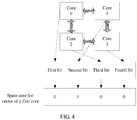
- a vector recorded in the spare core list may include four bits, and a first bit to a fourth bit respectively represent a first core to a fourth core, that is, Core 0 to Core 3.
- the first core may be Core 3 in FIG.
- a vector indicating the spare core list of the first core may be 0100, where 0 indicates that a core is not a slave core of the first core, and 1 indicates that a core is a slave core of the first core. Then it can be learned from the spare core list vector that a second core of the four cores is the slave core of the first core.
- the spare core list may be a 16-bit vector, and 16 bits from left to right represent Core 0 to Core 15, respectively. If the first core is Core 5, a spare core list vector of the first core may be, for example, 000000100000000. Because a 7 th bit is 1, a core corresponding to the 7 th bit, Core 6, is a slave core of Core 5.
- the master core After the master core obtains the address translation request, if a local TLB entry of the master core is missing, the master core reads a TLB entry from a slave core.
- the method may further include:
- the first core stores the second entry at an original position of the second target TLB entry in the second core. That is, the first core exchanges storage positions of the second entry and the second target TLB entry.
- the first core reads the second target entry in the TLB of the second core.
- the first core may send, to all the slave cores, a request for reading the second target entry.
- the second target entry may be located in a TLB of another slave core, and a corresponding process of entry reading and entry replacement is the same as that described above. Details are not described herein again.
- the foregoing process occurs when a local TLB miss (Miss) occurs in the master (the first core), that is, the second target TLB entry does not exist in the local TLB.
- the master reads the TLB entry from the slave. For example, as shown in FIG. 5 , the master sends a TLB read request to all slaves based on the spare core list (Slave List) (also called a slave core list). After receiving the TLB read request, each slave queries a local TLB of the slave core. If the second target TLB is missed, a miss feedback is returned; if the second target TLB is hit, a hit feedback and content of a hit TLB entry are returned.
- Slave List spare core list
- the master After the master collects all feedbacks, if the feedbacks are all miss feedbacks, the master sends a TLB query request to the operating system, to obtain the missing TLB entry from the memory; if a TLB entry in the slave is hit, the master uses the hit TLB entry for refilling. If entry replacement occurs during a refilling process, a replaced entry is written into the hit slave core.
- a working core has permission to read/write a TLB of an idle core.
- Using a TLB resource in the idle core to save a replaced TLB entry not only increases utilization of the TLB resource of the idle core, but further increases the capacity of the TLB of the first core.
- the target entry may be read from the TLB of the slave core, thereby reducing a possibility of obtaining the target TLB entry by the first core from the memory, accelerating program execution, and improving program execution efficiency.
- the slave saves a write position.
- an alternate write mechanism may be used. That is, if a quantity of TLB entries of the slave core (for example, the second core) is N, writing starts sequentially from a first entry, that is, from 0, to an (N-1) th entry.
- the slave core When a TLB entry is written into an (N-1) th position, that is, entry storage of the TLB of the slave core is full, it indicates that all entries stored in the TLB of the slave core are replaced entries of the master.
- the slave core may be called a full slave core (Full Slave).
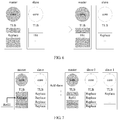
- the full slave is unable to save another replaced entry, and sends a write overflow request to the master. After receiving the request, the master records the full slave into a full slave list.
- the master when the master has an entry replaced, the master needs to obtain another slave core to store the replaced entry.
- the method may further include:
- a new slave core is obtained to save the replaced TLB entry, further expanding the capacity of the first core.
- the first core queries for the replaced TLB entry again, the first core can directly read from the new slave core, and the first core does not need to obtain the TLB entry from the memory. Therefore, in this embodiment of the present invention, program execution can be accelerated and program execution efficiency can be improved.
- the master core determines the third core from other idle cores in the multi-core processor to store the third entry that is in the TLB of the first core and that is replaced with the third target TLB entry.
- the master repeats a slave obtaining process described in the foregoing to obtain a new slave 1 (for example, the third core) in the figure, and writes the replaced entry (for example, the third entry) into the slave 1.
- a new slave 1 for example, the third core
- the foregoing describes a solution in which the master core determines the slave core and uses a resource of the slave core to store a TLB entry. After the master core switches from the working state to the idle state, because the master core does not need to use the TLB resource any longer, the master core needs to release the obtained resource of the slave core.
- the method further includes: sending, by the first core, a TLB release instruction to a core recorded in the TLB spare core list, where the TLB release instruction is used to instruct the core recorded in the spare core list to terminate TLB sharing.
- the master when the master changes to the idle state, all obtained TLB resources are released.
- the master sends the TLB release request to all slaves based on the slave list, so that TLB resources of these idle cores can be used by another working core. For example, as shown in FIG. 8 , after the master releases all obtained TLB resources, the master and the slaves all become idle cores, and can be used by another working core.
- the first core releases an obtained TLB resource of a slave core by sending a release instruction to all slave cores.
- the TLB resource of the slave core (the idle core) is released, avoiding resource waste.
- the released TLB resource of the slave core can be used by another working core, thereby increasing a capacity of the another working core and accelerating program execution of the working core.
- the slave core may or may not delete the TLB entry stored in the slave core. This is not limited in this embodiment of the present invention. For example, after sharing is terminated and the slave core serves as a slave core of another working core, all entries in the TLB may be deleted, so that the another core can store a replaced entry. For another example, after sharing is terminated and when the slave core is in the working state, a previously stored TLB entry may be reserved for searching and use by the slave core itself.
- the slave when the slave (for example, the second core) changes to an operating state, the slave sends a TLB sharing termination request to the master, and the master deletes the slave from the slave list after receiving the request. For example, as shown in FIG. 9 , after slave 1 changes to the operating state, the master core releases slave 1 and deletes slave 1 from the slave core list.
- the method further includes:
- the second core after the second core switches from the idle state to the working state, the second core sends the TLB sharing termination request to the first core, so that the first core releases the second core, and the second core can use the TLB resource of the second core.
- the second core may also become another master core and can use a TLB resource of another idle core.
- the method before the deleting, by the first core, the identifier of the second core from the TLB spare core list, the method further includes:
- the master core before the master core (for example, the first core) deletes the slave core (for example, the second core) from the spare core list, the master core obtains a new core (a new slave core) from the multi-core processor.
- a TLB of the new slave core is used to store all entries in the TLB of the deleted slave core (that is, the second core). In this way, if an entry in the second core needs to be queried in a subsequent query, the entry does not need to be obtained again by using the operating system, and the entry can be obtained by directly accessing the TLB of the slave core (the fourth core). This greatly reduces a TLB refilling delay and accelerates program execution.
- the master core releases slave 1 and deletes slave 1 from the slave core list.
- the master core determines a new slave core, for example, slave 2, stores all entries in a TLB of slave 1 into a TLB of slave 2, and records slave 2 into the slave core list.
- the first core obtains a new slave core (the fourth core) to save all entries in the TLB of the released second core. If the first core needs to query for an entry in the second core in a subsequent query, the first core does not need to re-obtain the entry from the memory by using the operating system. Instead, the first core can directly access the TLB of the slave core (the fourth core) to obtain the entry. This greatly reduces a TLB refilling delay and accelerates program execution.
- a flag register is configured for each core of the multi-core processor, where the flag register is used to record a status flag, a master core (Master) flag, and a slave core (Slave) flag of the core.
- the status flag is used to indicate an operating status and a sharing status of the core.
- the operating status includes an idle state or a working state.
- the sharing status includes a master core state, a slave core state, or a no-sharing state.
- the master core state indicates that the core is in the working state and uses a TLB resource of another idle core to manage a TLB entry, and the slave core state indicates that the core is in the idle state and shares a TLB resource with the master core.
- the master core flag is used to indicate an idle-core list, a slave core (Slave) list (also called a spare core list), and a full slave core (Full Slave) list when the core is the master core.
- the idle-core list is used to indicate a vector of all idle cores
- the slave core list is used to indicate a vector of all slave cores of the core
- the full slave core list is used to indicate a vector of all full slave cores of the core.
- the slave core flag is used to indicate a master core (Master) number and a write position of a replaced entry when the core is the slave core.
- the master core number includes an identifier of a unique master core of the core, and the write position of the replaced entry includes a write position of the replaced entry of the master core in the slave core.
- some registers need to be added to each node to save a flag, including the status flag, the master flag, and the slave flag. Because each node may become a master or a slave, the three flags are configured for each node. For example, see Table 1. Table 1 Description of flags in each node Type Name Bit Width Description Status flag Operating status 1 0: Idle node; 1: Working node Sharing status 2 00: No sharing; 01: Master; 10: Slave Master flag Idle-node list Quantity of nodes This flag records idle nodes in a system by using a vector. 0 indicates working, and 1 indicates idle.
- Slave list Quantity of nodes This flag records all slaves of a current master by using a vector. 0 indicates non-slave, and 1 indicates slave. Full slave list Quantity of nodes This flag records all full slaves of a current master by using a vector. 0 indicates non-full slave, and 1 indicates full slave. Slave flag Master number [log 2 (Quantity of nodes)] This flag records a unique master number corresponding to a slave. Write position ⁇ log 2 (Quantity of TLB entries) ⁇ This flag records a write position of a replaced entry of a master in a slave TLB.
- Operating status flag distinguishes between an idle node and a working node. Therefore, only a 1-bit register may be needed.
- Sharing status flag distinguishes between a master node, a slave node, and a no-sharing node. Therefore, a 2-bit register may be needed.
- Idle node/slave/full slave list A function of each list has been described in detail above.
- a vector is used for implementation, where a width of the vector is equal to a quantity of nodes in a system, and each bit (bit) of the vector corresponds to one node. For example, for a slave list, a bit 0 in the vector indicates that a corresponding node is not a slave, while a bit 1 indicates that a corresponding node is a slave.
- a slave can only have a unique master.
- a master number records a number of a master of the slave.
- the slave may inform the corresponding master based on the master number.
- a binary bit width of the master number may be ⁇ log 2 (Quantity of nodes)], that is, a minimal integer greater than or equal to log 2 (Quantity of nodes). For example, when a multi-core processor includes eight cores (eight nodes), it indicates that the master number needs ⁇ log 2 (8) ⁇ bits, that is, three bits. For another example, when a multi-core processor includes 12 cores (12 nodes), it indicates that the master number needs ⁇ log 2 (12) ⁇ bits, that is, 4 bits.
- Write position is maintained by a slave and indicates a write position of a replaced entry received from a master.
- a binary bit width of the write position may be ⁇ log 2 (Quantity of TLB entries)], that is, a minimal integer greater than or equal to log 2 (Quantity of TLB entries). For example, when there are 64 entries in a TBL of a slave, it indicates that the write position needs ⁇ log 2 (64) ⁇ bits, that is, 6 bits.
- setting of a flag enables a master core to read/write a TLB resource of a slave core, which expands a capacity of a TLB of the master core, and also reduces a possibility of obtaining the target TLB entry by the first core from the memory. This can accelerate program execution and improve program execution efficiency.
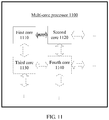
- FIG. 11 is a schematic block diagram of a multi-core processor 1100 according to an embodiment of the present invention.
- the multi-core processor 1100 includes a first core 1110 and a second core 1120.
- a third core 1130 may be further included.
- a fourth core 1140 may further be included.
- each core of the multi-core processor 1100 includes a processing module, a network-on-chip interface (Switch), and a caching module, where, for example, the caching module includes a level 1 cache (LI) and a level 2 cache (L2).
- the processing module of each core includes a TLB.
- the cores are connected to each other by using a network on chip and communicate with each other by using the network-on-chip interface.
- the multi-core processor 1100 in this embodiment of the present invention may further include more cores.
- the multi-core processor 1100 may include 8 cores, 10 cores, 16 cores, or 32 cores. This is not limited in this embodiment of the present invention.
- the first core may be any core of the multi-core processor.
- a 1 st core in FIG. 1 is used as the first core for description, but this embodiment of the present invention is not limited thereto.
- the second core may be any core, other than the first core, in the multi-core processor, that is, the second core may not be directly connected to the first core.
- FIG. 11 an example in which the second core is directly connected to the first core is used for description, but this embodiment of the present invention is not limited thereto.
- the third core and the fourth core in the following are directly connected to the first core or the second core, but this embodiment of the present invention is not limited thereto.
- the multi-core processor shown in FIG. 11 corresponds to the method embodiments in FIG. 1 to FIG. 10 .
- the multi-core processor 1100 in FIG. 11 can implement each procedure of the method provided in FIG. 1 to FIG. 10 . To avoid repetition, detailed descriptions are omitted properly in this embodiment of the present invention.
- the first core 1110 is configured to receive a first address translation request, and query a TLB of the first core based on the first address translation request; when determining that a first target TLB entry corresponding to the first address translation request is missing in the TLB of the first core, obtain the first target TLB entry; and when determining that entry storage in the TLB of the first core is full, determine a second core from cores in an idle state in the multi-core processor; and replace a first entry in the TLB of the first core with the first target TLB entry.
- the second core 1120 is configured to store the first entry into a TLB of the second core.
- the first core may be called a master core of the second core, and the second core may be called a slave core of the first core.
- the first target TLB entry is obtained to replace the first entry in the TLB of the first core, and the first entry is stored into the TLB of the second core, that is, the replaced entry is stored into the TLB of the second core. Therefore, in this embodiment of the present invention, a TLB resource of an idle core is used to expand a TLB capacity of a working core, thereby reducing a TLB miss rate and accelerating program execution.
- the working core namely the master core (Master) (for example, the first core)
- the working core does not need to obtain the entry again by using an operating system, but can obtain the entry by directly accessing the TLB of the slave. This greatly reduces a TLB refilling delay and accelerates program execution.
- an idle core can share a TLB resource of the idle core with only one working core for use, and the working core may obtain TLB resources of a plurality of idle cores to store TLB entries.
- the first core 1110 when obtaining the first target TLB entry, is specifically configured to:
- the first core may broadcast a TLB query request to other cores of the multi-core system, where the broadcast TLB query request carries a virtual address causing a miss, that is, a virtual address corresponding to the first target TLB entry.
- the other cores After receiving the broadcast address, the other cores search local TLBs for the virtual address. If a TLB of a processor core is hit, the first target TLB entry may be fed back to the first core.
- the first core can rapidly obtain the first target TLB entry from the another core, thereby avoiding that the first core sends a query request to the operating system to obtain the first target TLB entry from the memory. This can save time and improve application efficiency.
- the first core may also obtain the first target TLB entry from the page table of the memory.
- the first core sends the query request to the operating system, where the query request carries the virtual address causing the miss, and obtains the first target TLB entry from the page table of the memory after processing of the operating system. This is not limited in this embodiment of the present invention.
- the first core 1110 is specifically configured to:
- the replaced TLB entry is stored by using a TLB resource in the idle core. This not only increases utilization of the TLB resource of the idle core, but also indirectly increases a capacity of the TLB of the first core, reduces a possibility of obtaining the target TLB entry by the first core from the memory, and accelerates program execution.
- the first core 1110 is specifically configured to:
- the first core selects the idle core with the minimum overheads for communicating with the first core as the second core, and stores a replaced TLB entry into the second core, thereby reducing communication overheads to a greatest extent.
- the first core needs to query for an entry in the TLB of the second core, because the communication overheads are very low, the first core can quickly find the TLB entry, thereby improving program execution efficiency.
- the first core 1110 is specifically configured to:
- the first core 1110 is further configured to record an identifier of the second core into a TLB spare core list of the first core.
- the first core may read/write the TLB of the second core in the spare core list, thereby increasing the capacity of the TLB of the first core, reducing a TLB miss rate of the first core, and accelerating program execution.
- the first core 1110 is further configured to:
- a working core has permission to read/write a TLB of an idle core.
- Using a TLB resource in the idle core to save a replaced TLB entry not only increases utilization of the TLB resource of the idle core, but further increases the capacity of the TLB of the first core.
- the target entry may be read from the TLB of the slave core, thereby reducing a possibility of obtaining the target TLB entry by the first core from the memory, accelerating program execution, and improving program execution efficiency.
- the first core 1110 is further configured to:
- a new slave core is obtained to save the replaced TLB entry, further expanding the capacity of the first core.
- the first core queries for the replaced TLB entry again, the first core can directly read from the new slave core, and the first core does not need to obtain the TLB entry from the memory. Therefore, in this embodiment of the present invention, program execution can be accelerated and program execution efficiency can be improved.
- the first core is further configured to: send a TLB release instruction to a core recorded in the TLB spare core list, where the TLB release instruction is used to instruct the core recorded in the spare core list to terminate TLB sharing.
- the first core releases an obtained TLB resource of a slave core by sending a release instruction to all slave cores.
- the TLB resource of the slave core (the idle core) is released, avoiding resource waste.
- the released TLB resource of the slave core can be used by another working core, thereby increasing a capacity of the another working core and accelerating program execution of the working core.
- the second core is configured to send a TLB sharing termination request to the first core, where the TLB sharing termination request carries the identifier of the second core; and the first core is further configured to: receive the TLB sharing termination request, and delete the identifier of the second core from the TLB spare core list.
- the second core after the second core switches from the idle state to the working state, the second core sends the TLB sharing termination request to the first core, so that the first core releases the second core, and the second core can use the TLB resource of the second core.
- the second core may also become another master core and can use a TLB resource of another idle core.
- the first core is further configured to determine a fourth core 1140 from the cores in the idle state in the multi-core processor, where a TLB of the fourth core 1140 is used to store all entries in the TLB of the second core 1120.
- the first core obtains a new slave core (the fourth core) to save all entries in the TLB of the released second core. If the first core needs to query for an entry in the second core in a subsequent query, the first core does not need to re-obtain the entry from the memory by using the operating system. Instead, the first core can directly access the TLB of the slave core (the fourth core) to obtain the entry. This greatly reduces a TLB refilling delay and accelerates program execution.
- a flag register is configured for each core of the multi-core processor, where the flag register is used to record a status flag, a master core (Master) flag, and a slave core (Slave) flag of the core.
- the status flag is used to indicate an operating status and a sharing status of the core.
- the operating status includes an idle state or a working state.
- the sharing status includes a master core state, a slave core state, or a no-sharing state.
- the master core state indicates that the core is in the working state and uses a TLB resource of another idle core to manage a TLB entry, and the slave core state indicates that the core is in the idle state and shares a TLB resource with the master core.
- the master core flag is used to indicate an idle-core list, a slave core (Slave) list (also called a spare core list), and a full slave core (Full Slave) list when the core is the master core.
- the idle-core list is used to indicate a vector of all idle cores
- the slave core list is used to indicate a vector of all slave cores of the core
- the full slave core list is used to indicate a vector of all full slave cores of the core.
- the slave core flag is used to indicate a master core (Master) number and a write position of a replaced entry when the core is the slave core.
- the master core number includes an identifier of a unique master core of the core, and the write position of the replaced entry includes a write position of the replaced entry of the master core in the slave core.
- some registers need to be added to each node to save a flag, including the status flag, the master flag, and the slave flag. Because each node may become a master or a slave, the three flags are configured for each node, for example, as shown in the foregoing Table 1. Details are not described herein again.
- setting of a flag enables a master core to read/write a TLB resource of a slave core, which expands a capacity of a TLB of the master core, and also reduces a possibility of obtaining the target TLB entry by the first core from the memory. This can accelerate program execution and improve program execution efficiency.
- system and “network” may be used interchangeably in this specification.
- network may be used interchangeably in this specification.
- the term “and/or” in this specification describes only an association relationship for describing associated objects and represents that three relationships may exist. For example, A and/or B may represent the following three cases: Only A exists, both A and B exist, and only B exists.
- the character “/” in this specification generally indicates an “or” relationship between the associated objects.
- B corresponding to A indicates that B is associated with A, and B may be determined according to A.
- determining B according to A does not mean that B is determined according to A only; that is, B may also be determined according to A and/or other information.
- the disclosed system, apparatus, and method may be implemented in other manners.
- the described apparatus embodiment is merely an example.
- the unit division is merely logical function division and may be other division in actual implementation.
- a plurality of units or components may be combined or integrated into another system, or some features may be ignored or not performed.
- the displayed or discussed mutual couplings or direct couplings or communication connections may be implemented through some interfaces, indirect couplings or communication connections between the apparatuses or units, or electrical connections, mechanical connections, or connections in other forms.
- the units described as separate parts may or may not be physically separate, and parts displayed as units may or may not be physical units, may be located in one position, or may be distributed on a plurality of network units. A part or all of the units may be selected according to actual needs to achieve the objectives of the solutions of the embodiments of the present invention.
- functional units in the embodiments of the present invention may be integrated into one processing unit, or each of the units may exist alone physically, or two or more units are integrated into one unit.
- the integrated unit may be implemented in a form of hardware, or may be implemented in a form of a software functional unit.
- the present invention may be implemented by hardware, firmware or a combination thereof.
- the foregoing functions may be stored in a computer-readable medium or transmitted as one or more instructions or code in the computer-readable medium.
- the computer-readable medium includes a computer storage medium and a communications medium, where the communications medium includes any medium that enables a computer program to be transmitted from one place to another.
- the storage medium may be any available medium accessible to a computer.
- the computer-readable medium may include a RAM, a ROM, an EEPROM, a CD-ROM, or another optical disc storage or disk storage medium, or another magnetic storage device, or any other medium that can carry or store expected program code in a form of an instruction or a data structure and can be accessed by a computer.
- any connection may be appropriately defined as a computer-readable medium.
- a disk (Disk) and disc (disc) used by the present invention includes a compact disc (CD), a laser disc, an optical disc, a digital versatile disc (DVD), a floppy disk and a Blu-ray disc, where the disk generally copies data by a magnetic means, and the disc copies data optically by a laser means.
Landscapes
- Engineering & Computer Science (AREA)
- Theoretical Computer Science (AREA)
- Physics & Mathematics (AREA)
- General Engineering & Computer Science (AREA)
- General Physics & Mathematics (AREA)
- Memory System Of A Hierarchy Structure (AREA)
Applications Claiming Priority (1)
| Application Number | Priority Date | Filing Date | Title |
|---|---|---|---|
| PCT/CN2016/080867 WO2017190266A1 (zh) | 2016-05-03 | 2016-05-03 | 管理转址旁路缓存的方法和多核处理器 |
Publications (3)
| Publication Number | Publication Date |
|---|---|
| EP3441884A1 true EP3441884A1 (de) | 2019-02-13 |
| EP3441884A4 EP3441884A4 (de) | 2019-04-10 |
| EP3441884B1 EP3441884B1 (de) | 2021-09-01 |
Family
ID=60202654
Family Applications (1)
| Application Number | Title | Priority Date | Filing Date |
|---|---|---|---|
| EP16900788.7A Active EP3441884B1 (de) | 2016-05-03 | 2016-05-03 | Verfahren zur verwaltung eines übersetzungspuffers und mehrkernprozessor |
Country Status (4)
| Country | Link |
|---|---|
| US (1) | US10795826B2 (de) |
| EP (1) | EP3441884B1 (de) |
| CN (1) | CN108139966B (de) |
| WO (1) | WO2017190266A1 (de) |
Families Citing this family (12)
| Publication number | Priority date | Publication date | Assignee | Title |
|---|---|---|---|---|
| US11321240B2 (en) * | 2018-06-08 | 2022-05-03 | International Business Machines Corporation | MMIO addressing using a translation lookaside buffer |
| US10929302B2 (en) | 2018-06-08 | 2021-02-23 | International Business Machines Corporation | MMIO addressing using a translation table |
| US10740523B1 (en) * | 2018-07-12 | 2020-08-11 | Xilinx, Inc. | Systems and methods for providing defect recovery in an integrated circuit |
| CN111382115B (zh) * | 2018-12-28 | 2022-04-15 | 北京灵汐科技有限公司 | 一种用于片上网络的路径创建方法、装置及电子设备 |
| CN111124954B (zh) * | 2019-11-12 | 2023-02-24 | 上海高性能集成电路设计中心 | 一种两级转换旁路缓冲的管理装置及方法 |
| CN112147931B (zh) * | 2020-09-22 | 2022-06-24 | 哲库科技(北京)有限公司 | 一种信号处理器的控制方法、装置、设备以及存储介质 |
| CN112597075B (zh) * | 2020-12-28 | 2023-02-17 | 成都海光集成电路设计有限公司 | 用于路由器的缓存分配方法、片上网络及电子设备 |
| CN112965921B (zh) * | 2021-02-07 | 2024-04-02 | 中国人民解放军军事科学院国防科技创新研究院 | 一种多任务gpu中tlb管理方法及系统 |
| CN114579301B (zh) * | 2022-02-15 | 2025-10-14 | 无锡江南计算技术研究所 | 面向国产异构众核加速计算核心局部存储的管理方法 |
| CN114840445B (zh) * | 2022-03-02 | 2025-01-28 | 阿里巴巴(中国)有限公司 | 内存访问方法和装置 |
| CN115098410B (zh) * | 2022-06-24 | 2025-08-29 | 海光信息技术股份有限公司 | 处理器、用于处理器的数据处理方法及电子设备 |
| CN117472845B (zh) * | 2023-12-27 | 2024-03-19 | 南京翼辉信息技术有限公司 | 一种多核网络共享系统及其控制方法 |
Family Cites Families (42)
| Publication number | Priority date | Publication date | Assignee | Title |
|---|---|---|---|---|
| JPH07104842B2 (ja) * | 1989-03-03 | 1995-11-13 | 日本電気株式会社 | 外部記憶装置の割込み制御方式 |
| US6105113A (en) * | 1997-08-21 | 2000-08-15 | Silicon Graphics, Inc. | System and method for maintaining translation look-aside buffer (TLB) consistency |
| US6922755B1 (en) * | 2000-02-18 | 2005-07-26 | International Business Machines Corporation | Directory tree multinode computer system |
| US7149218B2 (en) * | 2001-12-05 | 2006-12-12 | International Business Machines Corporation | Cache line cut through of limited life data in a data processing system |
| US7076609B2 (en) * | 2002-09-20 | 2006-07-11 | Intel Corporation | Cache sharing for a chip multiprocessor or multiprocessing system |
| US20040117587A1 (en) | 2002-12-12 | 2004-06-17 | International Business Machines Corp. | Hardware managed virtual-to-physical address translation mechanism |
| US20050027960A1 (en) * | 2003-07-31 | 2005-02-03 | International Business Machines Corporation | Translation look-aside buffer sharing among logical partitions |
| US7996644B2 (en) | 2004-12-29 | 2011-08-09 | Intel Corporation | Fair sharing of a cache in a multi-core/multi-threaded processor by dynamically partitioning of the cache |
| US20070094450A1 (en) * | 2005-10-26 | 2007-04-26 | International Business Machines Corporation | Multi-level cache architecture having a selective victim cache |
| GB0603552D0 (en) * | 2006-02-22 | 2006-04-05 | Advanced Risc Mach Ltd | Cache management within a data processing apparatus |
| US8533395B2 (en) * | 2006-02-24 | 2013-09-10 | Micron Technology, Inc. | Moveable locked lines in a multi-level cache |
| US8180967B2 (en) * | 2006-03-30 | 2012-05-15 | Intel Corporation | Transactional memory virtualization |
| US7552288B2 (en) * | 2006-08-14 | 2009-06-23 | Intel Corporation | Selectively inclusive cache architecture |
| US7596662B2 (en) * | 2006-08-31 | 2009-09-29 | Intel Corporation | Selective storage of data in levels of a cache memory |
| US7774549B2 (en) * | 2006-10-11 | 2010-08-10 | Mips Technologies, Inc. | Horizontally-shared cache victims in multiple core processors |
| US8161242B2 (en) * | 2008-08-01 | 2012-04-17 | International Business Machines Corporation | Adaptive spill-receive mechanism for lateral caches |
| US8516221B2 (en) * | 2008-10-31 | 2013-08-20 | Hewlett-Packard Development Company, L.P. | On-the fly TLB coalescing |
| US20100146209A1 (en) * | 2008-12-05 | 2010-06-10 | Intellectual Ventures Management, Llc | Method and apparatus for combining independent data caches |
| US8364898B2 (en) * | 2009-01-23 | 2013-01-29 | International Business Machines Corporation | Optimizing a cache back invalidation policy |
| US8407421B2 (en) * | 2009-12-16 | 2013-03-26 | Intel Corporation | Cache spill management techniques using cache spill prediction |
| US8838935B2 (en) | 2010-09-24 | 2014-09-16 | Intel Corporation | Apparatus, method, and system for implementing micro page tables |
| US9405700B2 (en) * | 2010-11-04 | 2016-08-02 | Sonics, Inc. | Methods and apparatus for virtualization in an integrated circuit |
| US20120151232A1 (en) * | 2010-12-12 | 2012-06-14 | Fish Iii Russell Hamilton | CPU in Memory Cache Architecture |
| US8904068B2 (en) * | 2012-05-09 | 2014-12-02 | Nvidia Corporation | Virtual memory structure for coprocessors having memory allocation limitations |
| US9081706B2 (en) * | 2012-05-10 | 2015-07-14 | Oracle International Corporation | Using a shared last-level TLB to reduce address-translation latency |
| US9110718B2 (en) * | 2012-09-24 | 2015-08-18 | Oracle International Corporation | Supporting targeted stores in a shared-memory multiprocessor system |
| US10310973B2 (en) | 2012-10-25 | 2019-06-04 | Nvidia Corporation | Efficient memory virtualization in multi-threaded processing units |
| US9348752B1 (en) * | 2012-12-19 | 2016-05-24 | Amazon Technologies, Inc. | Cached data replication for cache recovery |
| US9372803B2 (en) * | 2012-12-20 | 2016-06-21 | Advanced Micro Devices, Inc. | Method and system for shutting down active core based caches |
| US9021207B2 (en) * | 2012-12-20 | 2015-04-28 | Advanced Micro Devices, Inc. | Management of cache size |
| US9418010B2 (en) * | 2013-04-17 | 2016-08-16 | Apple Inc. | Global maintenance command protocol in a cache coherent system |
| CN104346294B (zh) | 2013-07-31 | 2017-08-25 | 华为技术有限公司 | 基于多级缓存的数据读/写方法、装置和计算机系统 |
| US9710380B2 (en) * | 2013-08-29 | 2017-07-18 | Intel Corporation | Managing shared cache by multi-core processor |
| US9529730B2 (en) * | 2014-04-28 | 2016-12-27 | Apple Inc. | Methods for cache line eviction |
| CN105095094B (zh) * | 2014-05-06 | 2018-11-30 | 华为技术有限公司 | 内存管理方法和设备 |
| US20150378900A1 (en) * | 2014-06-27 | 2015-12-31 | International Business Machines Corporation | Co-processor memory accesses in a transactional memory |
| WO2016019566A1 (zh) * | 2014-08-08 | 2016-02-11 | 华为技术有限公司 | 内存管理方法、装置和系统、以及片上网络 |
| US9875186B2 (en) * | 2015-07-08 | 2018-01-23 | Futurewei Technologies, Inc. | System and method for data caching in processing nodes of a massively parallel processing (MPP) database system |
| US10453169B2 (en) * | 2016-03-28 | 2019-10-22 | Intel Corporation | Method and apparatus for multi format lossless compression |
| US20170300427A1 (en) * | 2016-04-18 | 2017-10-19 | Mediatek Inc. | Multi-processor system with cache sharing and associated cache sharing method |
| US10877886B2 (en) * | 2018-03-29 | 2020-12-29 | Intel Corporation | Storing cache lines in dedicated cache of an idle core |
| US20190041895A1 (en) * | 2018-04-12 | 2019-02-07 | Yingyu Miao | Single clock source for a multiple die package |
-
2016
- 2016-05-03 WO PCT/CN2016/080867 patent/WO2017190266A1/zh not_active Ceased
- 2016-05-03 CN CN201680057517.1A patent/CN108139966B/zh active Active
- 2016-05-03 EP EP16900788.7A patent/EP3441884B1/de active Active
-
2018
- 2018-11-02 US US16/178,676 patent/US10795826B2/en active Active
Also Published As
| Publication number | Publication date |
|---|---|
| US20190073315A1 (en) | 2019-03-07 |
| CN108139966B (zh) | 2020-12-22 |
| WO2017190266A1 (zh) | 2017-11-09 |
| CN108139966A (zh) | 2018-06-08 |
| EP3441884B1 (de) | 2021-09-01 |
| US10795826B2 (en) | 2020-10-06 |
| EP3441884A4 (de) | 2019-04-10 |
Similar Documents
| Publication | Publication Date | Title |
|---|---|---|
| US10795826B2 (en) | Translation lookaside buffer management method and multi-core processor | |
| US20190026225A1 (en) | Multiple chip multiprocessor cache coherence operation method and multiple chip multiprocessor | |
| CN112422615B (zh) | 一种通信的方法及装置 | |
| US20190347167A1 (en) | Primary Node-Standby Node Data Transmission Method, Control Node, and Database System | |
| CN105518631B (zh) | 内存管理方法、装置和系统、以及片上网络 | |
| US10868864B2 (en) | System and method for fault-tolerant remote direct memory access using single port host channel adapter hardware | |
| EP3249539B1 (de) | Verfahren und vorrichtung zum zugreifen auf ein datenbesucherverzeichnis in einem mehrkernsystem | |
| CN107992270B (zh) | 一种多控存储系统全局共享缓存的方法及装置 | |
| US11231964B2 (en) | Computing device shared resource lock allocation | |
| CN108134855B (zh) | Arp表管理方法、处理器核心、存储介质、电子设备 | |
| US20240205292A1 (en) | Data processing method and apparatus, computer device, and computer-readable storage medium | |
| CN107341114B (zh) | 一种目录管理的方法、节点控制器和系统 | |
| US11372759B2 (en) | Directory processing method and apparatus, and storage system | |
| WO2025118533A1 (zh) | 一种数据传输的方法和计算设备 | |
| CN117806526A (zh) | 数据迁移方法、装置、芯片以及计算机可读存储介质 | |
| CN110083548B (zh) | 数据处理方法及相关网元、设备、系统 | |
| WO2021238594A1 (zh) | 存储介质管理方法、装置、设备以及计算机可读存储介质 | |
| WO2024193272A1 (zh) | 一种数据共享方法、装置及设备 | |
| WO2024222015A1 (zh) | 数据处理系统和内存动态分配方法 | |
| EP4446904A1 (de) | Datensuchverfahren und -vorrichtung sowie netzwerkvorrichtung | |
| JP2024131398A (ja) | マルチコアシステムおよび読み出し方法 | |
| WO2024082702A1 (zh) | 数据处理方法、装置、芯片以及计算机可读存储介质 | |
| CN119669112A (zh) | 内存页表的缓存方法、装置、存储介质及计算机程序产品 | |
| WO2025140222A1 (zh) | 计算设备内组件间功能调用的方法、装置和设备 |
Legal Events
| Date | Code | Title | Description |
|---|---|---|---|
| STAA | Information on the status of an ep patent application or granted ep patent |
Free format text: STATUS: THE INTERNATIONAL PUBLICATION HAS BEEN MADE |
|
| PUAI | Public reference made under article 153(3) epc to a published international application that has entered the european phase |
Free format text: ORIGINAL CODE: 0009012 |
|
| STAA | Information on the status of an ep patent application or granted ep patent |
Free format text: STATUS: REQUEST FOR EXAMINATION WAS MADE |
|
| 17P | Request for examination filed |
Effective date: 20181107 |
|
| AK | Designated contracting states |
Kind code of ref document: A1 Designated state(s): AL AT BE BG CH CY CZ DE DK EE ES FI FR GB GR HR HU IE IS IT LI LT LU LV MC MK MT NL NO PL PT RO RS SE SI SK SM TR |
|
| AX | Request for extension of the european patent |
Extension state: BA ME |
|
| A4 | Supplementary search report drawn up and despatched |
Effective date: 20190308 |
|
| RIC1 | Information provided on ipc code assigned before grant |
Ipc: G06F 12/0806 20160101ALI20190304BHEP Ipc: G06F 12/128 20160101ALI20190304BHEP Ipc: G06F 12/00 20060101AFI20190304BHEP Ipc: G06F 12/1027 20160101ALI20190304BHEP |
|
| DAV | Request for validation of the european patent (deleted) | ||
| DAX | Request for extension of the european patent (deleted) | ||
| STAA | Information on the status of an ep patent application or granted ep patent |
Free format text: STATUS: EXAMINATION IS IN PROGRESS |
|
| 17Q | First examination report despatched |
Effective date: 20191011 |
|
| GRAP | Despatch of communication of intention to grant a patent |
Free format text: ORIGINAL CODE: EPIDOSNIGR1 |
|
| STAA | Information on the status of an ep patent application or granted ep patent |
Free format text: STATUS: GRANT OF PATENT IS INTENDED |
|
| INTG | Intention to grant announced |
Effective date: 20210329 |
|
| GRAS | Grant fee paid |
Free format text: ORIGINAL CODE: EPIDOSNIGR3 |
|
| GRAA | (expected) grant |
Free format text: ORIGINAL CODE: 0009210 |
|
| STAA | Information on the status of an ep patent application or granted ep patent |
Free format text: STATUS: THE PATENT HAS BEEN GRANTED |
|
| AK | Designated contracting states |
Kind code of ref document: B1 Designated state(s): AL AT BE BG CH CY CZ DE DK EE ES FI FR GB GR HR HU IE IS IT LI LT LU LV MC MK MT NL NO PL PT RO RS SE SI SK SM TR |
|
| REG | Reference to a national code |
Ref country code: GB Ref legal event code: FG4D |
|
| RIN1 | Information on inventor provided before grant (corrected) |
Inventor name: GU, XIONGLI Inventor name: CAI, WEIGUANG Inventor name: FANG, LEI |
|
| REG | Reference to a national code |
Ref country code: CH Ref legal event code: EP Ref country code: AT Ref legal event code: REF Ref document number: 1426945 Country of ref document: AT Kind code of ref document: T Effective date: 20210915 |
|
| REG | Reference to a national code |
Ref country code: DE Ref legal event code: R096 Ref document number: 602016063300 Country of ref document: DE |
|
| REG | Reference to a national code |
Ref country code: IE Ref legal event code: FG4D |
|
| REG | Reference to a national code |
Ref country code: LT Ref legal event code: MG9D |
|
| REG | Reference to a national code |
Ref country code: NL Ref legal event code: MP Effective date: 20210901 |
|
| PG25 | Lapsed in a contracting state [announced via postgrant information from national office to epo] |
Ref country code: SE Free format text: LAPSE BECAUSE OF FAILURE TO SUBMIT A TRANSLATION OF THE DESCRIPTION OR TO PAY THE FEE WITHIN THE PRESCRIBED TIME-LIMIT Effective date: 20210901 Ref country code: RS Free format text: LAPSE BECAUSE OF FAILURE TO SUBMIT A TRANSLATION OF THE DESCRIPTION OR TO PAY THE FEE WITHIN THE PRESCRIBED TIME-LIMIT Effective date: 20210901 Ref country code: NO Free format text: LAPSE BECAUSE OF FAILURE TO SUBMIT A TRANSLATION OF THE DESCRIPTION OR TO PAY THE FEE WITHIN THE PRESCRIBED TIME-LIMIT Effective date: 20211201 Ref country code: HR Free format text: LAPSE BECAUSE OF FAILURE TO SUBMIT A TRANSLATION OF THE DESCRIPTION OR TO PAY THE FEE WITHIN THE PRESCRIBED TIME-LIMIT Effective date: 20210901 Ref country code: ES Free format text: LAPSE BECAUSE OF FAILURE TO SUBMIT A TRANSLATION OF THE DESCRIPTION OR TO PAY THE FEE WITHIN THE PRESCRIBED TIME-LIMIT Effective date: 20210901 Ref country code: FI Free format text: LAPSE BECAUSE OF FAILURE TO SUBMIT A TRANSLATION OF THE DESCRIPTION OR TO PAY THE FEE WITHIN THE PRESCRIBED TIME-LIMIT Effective date: 20210901 Ref country code: LT Free format text: LAPSE BECAUSE OF FAILURE TO SUBMIT A TRANSLATION OF THE DESCRIPTION OR TO PAY THE FEE WITHIN THE PRESCRIBED TIME-LIMIT Effective date: 20210901 Ref country code: BG Free format text: LAPSE BECAUSE OF FAILURE TO SUBMIT A TRANSLATION OF THE DESCRIPTION OR TO PAY THE FEE WITHIN THE PRESCRIBED TIME-LIMIT Effective date: 20211201 |
|
| REG | Reference to a national code |
Ref country code: AT Ref legal event code: MK05 Ref document number: 1426945 Country of ref document: AT Kind code of ref document: T Effective date: 20210901 |
|
| PG25 | Lapsed in a contracting state [announced via postgrant information from national office to epo] |
Ref country code: PL Free format text: LAPSE BECAUSE OF FAILURE TO SUBMIT A TRANSLATION OF THE DESCRIPTION OR TO PAY THE FEE WITHIN THE PRESCRIBED TIME-LIMIT Effective date: 20210901 Ref country code: LV Free format text: LAPSE BECAUSE OF FAILURE TO SUBMIT A TRANSLATION OF THE DESCRIPTION OR TO PAY THE FEE WITHIN THE PRESCRIBED TIME-LIMIT Effective date: 20210901 Ref country code: GR Free format text: LAPSE BECAUSE OF FAILURE TO SUBMIT A TRANSLATION OF THE DESCRIPTION OR TO PAY THE FEE WITHIN THE PRESCRIBED TIME-LIMIT Effective date: 20211202 |
|
| PG25 | Lapsed in a contracting state [announced via postgrant information from national office to epo] |
Ref country code: AT Free format text: LAPSE BECAUSE OF FAILURE TO SUBMIT A TRANSLATION OF THE DESCRIPTION OR TO PAY THE FEE WITHIN THE PRESCRIBED TIME-LIMIT Effective date: 20210901 |
|
| PG25 | Lapsed in a contracting state [announced via postgrant information from national office to epo] |
Ref country code: IS Free format text: LAPSE BECAUSE OF FAILURE TO SUBMIT A TRANSLATION OF THE DESCRIPTION OR TO PAY THE FEE WITHIN THE PRESCRIBED TIME-LIMIT Effective date: 20220101 Ref country code: SM Free format text: LAPSE BECAUSE OF FAILURE TO SUBMIT A TRANSLATION OF THE DESCRIPTION OR TO PAY THE FEE WITHIN THE PRESCRIBED TIME-LIMIT Effective date: 20210901 Ref country code: SK Free format text: LAPSE BECAUSE OF FAILURE TO SUBMIT A TRANSLATION OF THE DESCRIPTION OR TO PAY THE FEE WITHIN THE PRESCRIBED TIME-LIMIT Effective date: 20210901 Ref country code: RO Free format text: LAPSE BECAUSE OF FAILURE TO SUBMIT A TRANSLATION OF THE DESCRIPTION OR TO PAY THE FEE WITHIN THE PRESCRIBED TIME-LIMIT Effective date: 20210901 Ref country code: PT Free format text: LAPSE BECAUSE OF FAILURE TO SUBMIT A TRANSLATION OF THE DESCRIPTION OR TO PAY THE FEE WITHIN THE PRESCRIBED TIME-LIMIT Effective date: 20220103 Ref country code: NL Free format text: LAPSE BECAUSE OF FAILURE TO SUBMIT A TRANSLATION OF THE DESCRIPTION OR TO PAY THE FEE WITHIN THE PRESCRIBED TIME-LIMIT Effective date: 20210901 Ref country code: EE Free format text: LAPSE BECAUSE OF FAILURE TO SUBMIT A TRANSLATION OF THE DESCRIPTION OR TO PAY THE FEE WITHIN THE PRESCRIBED TIME-LIMIT Effective date: 20210901 Ref country code: CZ Free format text: LAPSE BECAUSE OF FAILURE TO SUBMIT A TRANSLATION OF THE DESCRIPTION OR TO PAY THE FEE WITHIN THE PRESCRIBED TIME-LIMIT Effective date: 20210901 Ref country code: AL Free format text: LAPSE BECAUSE OF FAILURE TO SUBMIT A TRANSLATION OF THE DESCRIPTION OR TO PAY THE FEE WITHIN THE PRESCRIBED TIME-LIMIT Effective date: 20210901 |
|
| REG | Reference to a national code |
Ref country code: DE Ref legal event code: R097 Ref document number: 602016063300 Country of ref document: DE |
|
| PLBE | No opposition filed within time limit |
Free format text: ORIGINAL CODE: 0009261 |
|
| STAA | Information on the status of an ep patent application or granted ep patent |
Free format text: STATUS: NO OPPOSITION FILED WITHIN TIME LIMIT |
|
| PG25 | Lapsed in a contracting state [announced via postgrant information from national office to epo] |
Ref country code: IT Free format text: LAPSE BECAUSE OF FAILURE TO SUBMIT A TRANSLATION OF THE DESCRIPTION OR TO PAY THE FEE WITHIN THE PRESCRIBED TIME-LIMIT Effective date: 20210901 Ref country code: DK Free format text: LAPSE BECAUSE OF FAILURE TO SUBMIT A TRANSLATION OF THE DESCRIPTION OR TO PAY THE FEE WITHIN THE PRESCRIBED TIME-LIMIT Effective date: 20210901 |
|
| 26N | No opposition filed |
Effective date: 20220602 |
|
| PG25 | Lapsed in a contracting state [announced via postgrant information from national office to epo] |
Ref country code: SI Free format text: LAPSE BECAUSE OF FAILURE TO SUBMIT A TRANSLATION OF THE DESCRIPTION OR TO PAY THE FEE WITHIN THE PRESCRIBED TIME-LIMIT Effective date: 20210901 |
|
| REG | Reference to a national code |
Ref country code: CH Ref legal event code: PL |
|
| REG | Reference to a national code |
Ref country code: BE Ref legal event code: MM Effective date: 20220531 |
|
| PG25 | Lapsed in a contracting state [announced via postgrant information from national office to epo] |
Ref country code: MC Free format text: LAPSE BECAUSE OF FAILURE TO SUBMIT A TRANSLATION OF THE DESCRIPTION OR TO PAY THE FEE WITHIN THE PRESCRIBED TIME-LIMIT Effective date: 20210901 Ref country code: LU Free format text: LAPSE BECAUSE OF NON-PAYMENT OF DUE FEES Effective date: 20220503 Ref country code: LI Free format text: LAPSE BECAUSE OF NON-PAYMENT OF DUE FEES Effective date: 20220531 Ref country code: CH Free format text: LAPSE BECAUSE OF NON-PAYMENT OF DUE FEES Effective date: 20220531 |
|
| PG25 | Lapsed in a contracting state [announced via postgrant information from national office to epo] |
Ref country code: IE Free format text: LAPSE BECAUSE OF NON-PAYMENT OF DUE FEES Effective date: 20220503 |
|
| PG25 | Lapsed in a contracting state [announced via postgrant information from national office to epo] |
Ref country code: BE Free format text: LAPSE BECAUSE OF NON-PAYMENT OF DUE FEES Effective date: 20220531 |
|
| PG25 | Lapsed in a contracting state [announced via postgrant information from national office to epo] |
Ref country code: HU Free format text: LAPSE BECAUSE OF FAILURE TO SUBMIT A TRANSLATION OF THE DESCRIPTION OR TO PAY THE FEE WITHIN THE PRESCRIBED TIME-LIMIT; INVALID AB INITIO Effective date: 20160503 |
|
| PG25 | Lapsed in a contracting state [announced via postgrant information from national office to epo] |
Ref country code: MK Free format text: LAPSE BECAUSE OF FAILURE TO SUBMIT A TRANSLATION OF THE DESCRIPTION OR TO PAY THE FEE WITHIN THE PRESCRIBED TIME-LIMIT Effective date: 20210901 Ref country code: CY Free format text: LAPSE BECAUSE OF FAILURE TO SUBMIT A TRANSLATION OF THE DESCRIPTION OR TO PAY THE FEE WITHIN THE PRESCRIBED TIME-LIMIT Effective date: 20210901 |
|
| PG25 | Lapsed in a contracting state [announced via postgrant information from national office to epo] |
Ref country code: TR Free format text: LAPSE BECAUSE OF FAILURE TO SUBMIT A TRANSLATION OF THE DESCRIPTION OR TO PAY THE FEE WITHIN THE PRESCRIBED TIME-LIMIT Effective date: 20210901 |
|
| PG25 | Lapsed in a contracting state [announced via postgrant information from national office to epo] |
Ref country code: MT Free format text: LAPSE BECAUSE OF FAILURE TO SUBMIT A TRANSLATION OF THE DESCRIPTION OR TO PAY THE FEE WITHIN THE PRESCRIBED TIME-LIMIT Effective date: 20210901 |
|
| PGFP | Annual fee paid to national office [announced via postgrant information from national office to epo] |
Ref country code: DE Payment date: 20250402 Year of fee payment: 10 |
|
| PGFP | Annual fee paid to national office [announced via postgrant information from national office to epo] |
Ref country code: GB Payment date: 20250401 Year of fee payment: 10 |
|
| PGFP | Annual fee paid to national office [announced via postgrant information from national office to epo] |
Ref country code: FR Payment date: 20250401 Year of fee payment: 10 |