EP3441966A1 - System und verfahren zur ermittlung von audiocontext in augmented reality anwendungen - Google Patents
System und verfahren zur ermittlung von audiocontext in augmented reality anwendungen Download PDFInfo
- Publication number
- EP3441966A1 EP3441966A1 EP18196817.3A EP18196817A EP3441966A1 EP 3441966 A1 EP3441966 A1 EP 3441966A1 EP 18196817 A EP18196817 A EP 18196817A EP 3441966 A1 EP3441966 A1 EP 3441966A1
- Authority
- EP
- European Patent Office
- Prior art keywords
- audio
- reverberation time
- augmented
- audio signal
- reality
- Prior art date
- Legal status (The legal status is an assumption and is not a legal conclusion. Google has not performed a legal analysis and makes no representation as to the accuracy of the status listed.)
- Withdrawn
Links
Images



Classifications
-
- H—ELECTRICITY
- H04—ELECTRIC COMMUNICATION TECHNIQUE
- H04S—STEREOPHONIC SYSTEMS
- H04S7/00—Indicating arrangements; Control arrangements, e.g. balance control
- H04S7/30—Control circuits for electronic adaptation of the sound field
- H04S7/302—Electronic adaptation of stereophonic sound system to listener position or orientation
- H04S7/303—Tracking of listener position or orientation
- H04S7/304—For headphones
-
- A—HUMAN NECESSITIES
- A63—SPORTS; GAMES; AMUSEMENTS
- A63F—CARD, BOARD, OR ROULETTE GAMES; INDOOR GAMES USING SMALL MOVING PLAYING BODIES; VIDEO GAMES; GAMES NOT OTHERWISE PROVIDED FOR
- A63F13/00—Video games, i.e. games using an electronically generated display having two or more dimensions
- A63F13/50—Controlling the output signals based on the game progress
- A63F13/54—Controlling the output signals based on the game progress involving acoustic signals, e.g. for simulating revolutions per minute [RPM] dependent engine sounds in a driving game or reverberation against a virtual wall
-
- G—PHYSICS
- G10—MUSICAL INSTRUMENTS; ACOUSTICS
- G10L—SPEECH ANALYSIS TECHNIQUES OR SPEECH SYNTHESIS; SPEECH RECOGNITION; SPEECH OR VOICE PROCESSING TECHNIQUES; SPEECH OR AUDIO CODING OR DECODING
- G10L21/00—Speech or voice signal processing techniques to produce another audible or non-audible signal, e.g. visual or tactile, in order to modify its quality or its intelligibility
- G10L21/04—Time compression or expansion
- G10L21/043—Time compression or expansion by changing speed
-
- H—ELECTRICITY
- H04—ELECTRIC COMMUNICATION TECHNIQUE
- H04R—LOUDSPEAKERS, MICROPHONES, GRAMOPHONE PICK-UPS OR LIKE ACOUSTIC ELECTROMECHANICAL TRANSDUCERS; ELECTRIC HEARING AIDS; PUBLIC ADDRESS SYSTEMS
- H04R5/00—Stereophonic arrangements
- H04R5/033—Headphones for stereophonic communication
-
- H—ELECTRICITY
- H04—ELECTRIC COMMUNICATION TECHNIQUE
- H04S—STEREOPHONIC SYSTEMS
- H04S7/00—Indicating arrangements; Control arrangements, e.g. balance control
-
- H—ELECTRICITY
- H04—ELECTRIC COMMUNICATION TECHNIQUE
- H04S—STEREOPHONIC SYSTEMS
- H04S7/00—Indicating arrangements; Control arrangements, e.g. balance control
- H04S7/30—Control circuits for electronic adaptation of the sound field
-
- A—HUMAN NECESSITIES
- A63—SPORTS; GAMES; AMUSEMENTS
- A63F—CARD, BOARD, OR ROULETTE GAMES; INDOOR GAMES USING SMALL MOVING PLAYING BODIES; VIDEO GAMES; GAMES NOT OTHERWISE PROVIDED FOR
- A63F13/00—Video games, i.e. games using an electronically generated display having two or more dimensions
- A63F13/20—Input arrangements for video game devices
- A63F13/21—Input arrangements for video game devices characterised by their sensors, purposes or types
- A63F13/215—Input arrangements for video game devices characterised by their sensors, purposes or types comprising means for detecting acoustic signals, e.g. using a microphone
-
- A—HUMAN NECESSITIES
- A63—SPORTS; GAMES; AMUSEMENTS
- A63F—CARD, BOARD, OR ROULETTE GAMES; INDOOR GAMES USING SMALL MOVING PLAYING BODIES; VIDEO GAMES; GAMES NOT OTHERWISE PROVIDED FOR
- A63F2300/00—Features of games using an electronically generated display having two or more dimensions, e.g. on a television screen, showing representations related to the game
- A63F2300/60—Methods for processing data by generating or executing the game program
- A63F2300/6063—Methods for processing data by generating or executing the game program for sound processing
- A63F2300/6081—Methods for processing data by generating or executing the game program for sound processing generating an output signal, e.g. under timing constraints, for spatialization
-
- G—PHYSICS
- G10—MUSICAL INSTRUMENTS; ACOUSTICS
- G10L—SPEECH ANALYSIS TECHNIQUES OR SPEECH SYNTHESIS; SPEECH RECOGNITION; SPEECH OR VOICE PROCESSING TECHNIQUES; SPEECH OR AUDIO CODING OR DECODING
- G10L21/00—Speech or voice signal processing techniques to produce another audible or non-audible signal, e.g. visual or tactile, in order to modify its quality or its intelligibility
- G10L21/02—Speech enhancement, e.g. noise reduction or echo cancellation
- G10L21/0208—Noise filtering
- G10L21/0216—Noise filtering characterised by the method used for estimating noise
- G10L2021/02161—Number of inputs available containing the signal or the noise to be suppressed
- G10L2021/02166—Microphone arrays; Beamforming
-
- H—ELECTRICITY
- H04—ELECTRIC COMMUNICATION TECHNIQUE
- H04S—STEREOPHONIC SYSTEMS
- H04S2400/00—Details of stereophonic systems covered by H04S but not provided for in its groups
- H04S2400/01—Multi-channel, i.e. more than two input channels, sound reproduction with two speakers wherein the multi-channel information is substantially preserved
-
- H—ELECTRICITY
- H04—ELECTRIC COMMUNICATION TECHNIQUE
- H04S—STEREOPHONIC SYSTEMS
- H04S2400/00—Details of stereophonic systems covered by H04S but not provided for in its groups
- H04S2400/11—Positioning of individual sound objects, e.g. moving airplane, within a sound field
-
- H—ELECTRICITY
- H04—ELECTRIC COMMUNICATION TECHNIQUE
- H04S—STEREOPHONIC SYSTEMS
- H04S2420/00—Techniques used stereophonic systems covered by H04S but not provided for in its groups
- H04S2420/01—Enhancing the perception of the sound image or of the spatial distribution using head related transfer functions [HRTF's] or equivalents thereof, e.g. interaural time difference [ITD] or interaural level difference [ILD]
-
- H—ELECTRICITY
- H04—ELECTRIC COMMUNICATION TECHNIQUE
- H04S—STEREOPHONIC SYSTEMS
- H04S2420/00—Techniques used stereophonic systems covered by H04S but not provided for in its groups
- H04S2420/07—Synergistic effects of band splitting and sub-band processing
-
- H—ELECTRICITY
- H04—ELECTRIC COMMUNICATION TECHNIQUE
- H04S—STEREOPHONIC SYSTEMS
- H04S7/00—Indicating arrangements; Control arrangements, e.g. balance control
- H04S7/30—Control circuits for electronic adaptation of the sound field
- H04S7/305—Electronic adaptation of stereophonic audio signals to reverberation of the listening space
- H04S7/306—For headphones
Definitions
- This disclosure relates to audio applications for augmented-reality systems.
- Augmented-reality content needs to be aligned to the surrounding environment and context to seem natural to the user of the augmented-reality application.
- the content does not sound natural and does not provide natural user experience if the source reverberation is different from that of the audio scenery around the user, or if the content is rendered in the same relative directions as environmental sources. This is especially important in virtual-reality games and entertainment when audio tags are augmented in predetermined locations in the field or relative to the user.
- contextual analytics to obtain an accurate estimate of the given audio scenery including providing a reliable reverberation estimate. This is analogous to the desirability of having matching illumination and correct shadows for visual components that are rendered on an augmented-reality screen.
- Reverberation estimates are typically conducted by searching for decaying events within audio content.
- an estimator detects an impulse-like sound event, the decaying tail of which reveals the reverberation conditions of the given space.
- the estimator also detects signals that are slowly decaying by nature.
- the observed decay rate is a combination of the source-signal decay and the reverberation of the given space.
- the audio scenery is stationary-i.e., that the sound sources are not moving.
- a reverberation-estimation algorithm may detect the moving audio source as a decaying signal source, causing an error in the estimation result.
- Reverberation context can be detected only when there are active audio sources present. However, not all audio content is suitable to use for this analysis. Augmented-reality devices and game consoles can apply test signals for conducting the prevailing audio context analysis. However, many wearable devices do not have the capability to emit such a test signal, nor is such a test signal feasible in many situations.
- Reverberation of the environment and the room effect is typically estimated with an offline measurement setup.
- the basic approach is to have an artificial impulse-like sound source and an additional device for recording the impulse response.
- Reverberation estimation tools may use what is known in the art as maximum likelihood estimation (MLE).
- MLE maximum likelihood estimation
- the decay rate of the impulse is then applied to calculate the reverberation. This is a fairly reliable approach to determining the prevailing context. However, it is not real-time and cannot be used in augmented-reality services when the location of the user is not known beforehand.
- the reverberation estimation and room response of the given environment is conducted using test signals.
- the game devices or augmented-reality applications output a well-defined acoustic test signal, which could consist of white or pink noise, pseudorandom sequences or impulses, and the like.
- Microsoft's Kinect device can be configured to scan the room and estimate the room acoustics.
- the device or application is simultaneously playing back the test signal and recording the output with one or more microphones.
- knowing the input and output signals the device or application is able to determine the impulse response of the given space.
- Disclosed herein are systems and methods for determining audio context in augmented reality applications.
- One embodiment takes the form of a method that includes (i) sampling an audio signal from a plurality of microphones; (ii) determining a respective location of at least one audio source from the sampled audio signal; and (iii) rendering an augmented-reality audio signal having a virtual location separated from the at least one determined location by at least a threshold separation.
- the method is carried out by an augmented-reality headset.
- rendering includes applying a head-related transfer function filtering.
- the determined location is an angular position
- the threshold separation is a threshold angular distance; in at least one such embodiment, the threshold angular distance has a value selected from the group consisting of 5 degrees and 10 degrees.
- the at least one audio source includes multiple audio sources, and the virtual location is separated from each of the respective determined locations by at least the threshold separation.
- the method further includes distinguishing among the multiple audio sources based on one or more statistical properties selected from the group consisting of the range of harmonic frequencies, sound level, and coherence.
- each of the multiple audio sources contributes a respective audio component to the sampled audio signal
- the method further includes determining that each of the audio components has a respective coherence level that is above a predetermined coherence-level threshold.
- the method further includes identifying each of the multiple audio sources using a Gaussian mixture model.
- the method further includes identifying each of the multiple audio sources at least in part by determining a probability density function of direction of arrival data.
- the method further includes identifying each of the multiple audio sources at least in part by modeling a probability density function of direction of arrival data as a sum of probability distribution functions of the multiple audio sources.
- the sampled audio signal is not a test signal.
- the location determination is performed using binaural cue coding.
- the location determination is performed by analyzing a sub-band in the frequency domain.
- the location determination is performed using inter-channel time difference.
- One embodiment takes the form of an augmented-reality headset that includes (i) a plurality of microphones; (ii) at least one audio-output device; (iii) a processor; and (iv) data storage containing instructions executable by the processor for causing the augmented-reality headset to carry out a set of functions, the set of functions including (a) sampling an audio signal from the plurality of microphones; (b) determining a respective location of at least one audio source from the sampled audio signal; and (c) rendering, via the at least one audio-output device, an augmented-reality audio signal having a virtual location separated from the at least one determined location by at least a threshold separation.
- One embodiment takes the form of a method that includes (i) sampling at least one audio signal from a plurality of microphones; (ii) determining a reverberation time based on the sampled at least one audio signal; (iii) modifying an augmented-reality audio signal based at least in part on the determined reverberation time; and (iv) rendering the modified augmented-reality audio signal.
- the method is carried out by an augmented-reality headset.
- modifying the augmented-reality audio signal based at least in part on the determined reverberation time comprises applying to the augmented-reality audio signal a reverberation corresponding to the determined reverberation time.
- modifying the augmented-reality audio signal based at least in part on the determined reverberation time comprises applying to the augmented-reality audio signal a reverberation filter corresponding to the determined reverberation time.
- modifying the augmented-reality audio signal based at least in part on the determined reverberation time comprises slowing down the augmented-reality audio signal by an amount determined based at least in part on the determined reverberation time.
- Audio context analytics methods can be improved by combining numerous audio scene parameterizations associated with the point of interest.
- the direction of arrival of detected audio sources as well as coherence estimation reveal useful information about the environment and is used to provide contextual information.
- measurements associated with the movement of the sources may be used to further improve the analysis.
- audio context analysis may be performed without use of a test signal by listening to the environment and existing natural sounds.
- audio source direction of arrival estimation is conducted using a microphone array comprising at least two microphones.
- the output of the array is the summed signal of all microphones. Turning the array and detecting the direction that provides the highest amount of energy of the signal of interest is one method for estimating the direction of arrival.
- electronically steering of the array i.e. turning the array towards the point of interest may be implemented, instead of physically turning the device, by adjusting the microphone delay lines.
- the two-microphone array is aligned off the perpendicular axis of the microphones by delaying the other microphone input signal by a certain time delay before summing the signals. The time delay providing the maximum energy of the sum signal of interest together with the distance between the microphones may be used to derive the direction of arrival.
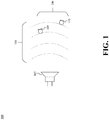
- FIG. 1 is a schematic illustration of a sound waveform arriving at a two-microphone array.
- FIG. 1 illustrates a situation 100 in which a microphone array 106 (including microphones 108 and 110) is physically turned slightly off a sound source 102 that is producing sound waves 104. As can be seen, the sound waves 104 arrive later at microphone 110 than they do at microphone 108. Now, to steer the microphone array 106 towards the actual sound source 102, the signal from microphone 110 may be delayed by a time unit corresponding to the difference in distance perpendicular to the sound source 102.
- the two-microphone array 106 could e.g. be a pair of microphones mounted on an augmented reality headset.
- a method to estimate the direction of arrival comprises detecting the level differences of microphone signals and applying corresponding stereo panning laws.
- FIG. 2 is a schematic illustration of sound waveforms experienced by a user. Indeed, FIG. 2 illustrates a situation 200 in which a listener 210 (shown from above and having a right ear 212 and a left ear 214) exposed to multiple sound sources 202 (emitting sound waves shown generally at 206) and 204 (emitting sound waves shown generally at 208).
- the ear-mounted microphones act as a sensor array that is able to distinguish the sources based on the time and level differences of incoming left and right hand side signals.
- the sound scene analysis may be conducted in the time-frequency domain by first decomposing the input signal with lapped transforms or filter banks. This enables sub-band processing of the signal.
- the inter-channel level cue can be applied.
- BCC binaural cue coding
- the input signal for a BCC parameterization may be two or more audio channels or sources.
- the input is first transformed into time-frequency domain using for example Fourier transform or QMF filterbank decomposition.
- the audio scene is then analysed in the transform domain and the corresponding parameterisation is extracted.
- ILD inter-channel level difference
- ITD time difference
- ICC inter-channel coherence
- ⁇ n arg max d ⁇ n k d
- ⁇ n ( k,d ) is the normalized correlation
- ⁇ n k d s n L k ⁇ d 1 T s n R k ⁇ d 2 s n L k ⁇ d 1 T s n L k ⁇ d 1 s n R k ⁇ d 2 T s n R k ⁇ d 2
- d 1 max 0
- ⁇ d d 2 max 0 d
- Equation (5) The normalized correlation of Equation (5) is the inter-channel coherence (ICC) parameter. It may be utilized for capturing the ambient components that are decorrelated with the "dry" sound components represented by phase and magnitude parameters in Equations (3) and (4).
- ICC inter-channel coherence
- BCC coefficients may be determined in DFT domain.
- STFT windowed Short Time Fourier Transform
- the sub-band signals above are converted to groups of transform coefficients.
- S n L and S n R are the spectral coefficient vectors of left and right (binaural) signal for sub-band n of the given analysis frame, respectively.
- ITD inter-channel phase difference
- the level and time/phase difference cues represent the dry surround sound components, i.e. they can be considered to model the sound source locations in space.
- ILD and ITD cues represent surround sound panning coefficients.
- the coherence cue is supposed to cover the relation between coherent and decorrelated sounds. That is, ICC represents the ambience of the environment. It relates directly to the correlation of input channels, and hence, gives a good indication about the environment around the listener. Therefore, the level of late reverberation of the sound sources e.g. due to the room effect, and the ambient sound distributed between the input channels may have a significant contribution to the spatial audio context for example on reverberation of the given space.
- the direction of arrival estimation above has been given for the detection of a single audio source. However, the same parameterisation could be used for multiple sources as well.
- Statistical analysis of the cues can be used to reveal that the audio scene may contain one or more sources. For example, the spatial audio cues could be clustered in arbitrary number of subsets using Gaussian Mixture Models (GMM) approach.
- GMM Gaussian Mixture Models
- the achieved direction of arrival cues can be classified within M Gaussian mixtures by determining the probability density function (PDF) of the direction of arrival data f X
- ⁇ i 1 M ⁇ i f X
- ⁇ i 1 M ⁇ i f X
- ⁇ i 1 M ⁇ i f X
- ⁇ i 1 ⁇ i 2 ⁇ e ⁇ ⁇ ⁇ ⁇ i 2 / 2 ⁇ i 2 , with mean ⁇ i , variance ⁇ 2 and direction of arrival cue ⁇ .
- PDF probability density function
- an expectation-maximisation (EM) algorithm could be used for estimation of the component weight, mean and variance parameters for each mixture in an iterative manner using the achieved data set.
- the system may be configured to determine the mean parameter for each Gaussian mixture since it gives the estimate of the direction of arrival of plurality of sound sources. Because the number of mixtures provided by the algorithm is most likely greater than the actual number of sound sources within the image, it may be beneficial to concentrate on the parameters having the greatest component weight and lowest variance since they indicate strong point-like sound sources. Mixtures having mean values close to each other could also be combined. For example, sources closer than 10-15 degrees could be combined as a single source.
- Source motion can be traced by observing the mean ⁇ i corresponding to the set of greatest component weights.
- Introduction of new sound sources can be determined when a new component weight (with a component mean parameter different from any previous parameter) exceeds a predetermined threshold.
- a component weight of a tracked sound source falls below a threshold, the source is most likely silent or has disappeared from the spatial audio image.
- Detecting the number of sound sources and their position relative to the user is important when rendering the augmented audio content. Additional information sources must not be placed in 3D space on top of or close to an existing sound source.
- Some embodiments may maintain a record of detected locations to keep track of sound sources as well as the number of sources. For example, when recording a conversation the speakers tend to take turns. That is, the estimation algorithm may be configured to remember the location of the previous speaker. One possibility is to label the sources based on the statistical properties such as range of the harmonic frequencies, sound level, coherence etc.
- a convenient approach for estimating the reverberation time in the given audio scene is to first construct a model for a signal decay representing the reverberant tail.
- the signal persists for a certain period of time that corresponds to the reverberation time.
- the reverberant tail may contain several reflections due to multiple scattering. Typically, the tail persists from tenths of a second to several seconds depending on acoustical properties of the given space.
- Reverberation time refers to a time during which the sound that was switched off decays by a desired amount.
- 60 dB may be used. Other values may also be used, depending on the environment and desired application. It should be noted, that in most cases, a continuous signal does not contain any complete event dropping by 60 dB. Only in scenarios where the user is, for example, clapping hands or otherwise artificially creating impulse-like sound events while recording the audio scenery, can a clean 60 dB decaying signal can be observed. Therefore, the estimation algorithm may be configured to identify the model parameters using signals with lower levels. In this case, even 20 dB decay is sufficient for finding the decaying signal model parameters.
- An efficient method for estimating the model parameter of Equation (12) is a maximum likelihood estimation (MLE) algorithm performed with overlapping N sample windows.
- the window size may be selected to prevent the estimation from failing if the decaying reverberant tail does not fit to the window and a non-decaying part is accidentally included.
- Equation (13) The time dependent decay factor a ( n ) in Equation (13) can be considered as a constant within the analysis window.
- Equation (14) The likelihood function of Equation (14) is solely defined by the decaying factor a and variance ⁇ . Taking the logarithm of Equation (14) a log-likelihood function is achieved.
- Equation (19) When the decay factor a is known, the variance can be solved for the given data set using the Equation (19). However, equation (18) can only be solved iteratively. The solution is to substitute Equation (19) into the log-likelihood function in Equation (15) and simply find the decaying factor that maximizes the likelihood.
- the maximum likelihood estimate algorithm described above could be performed with overlapping N sample windows.
- the window size may be selected such that the decaying reverberant tail fits to the window thereby preventing a non-decaying part from accidentally being included.
- the estimated set could be represented as a histogram.
- the audio signal may contain components that decay faster than the actual reverberation time. Therefore, one solution is to instead pick the estimate corresponding to the first dominant peak in the histogram.
- the estimation set can be improved using information about the prevailing audio context.
- the reverberation time estimation is a continuous process and produces an estimate in every analysis window, it happens that some of the estimates are determined for non-reverberant decaying tail including an active signal, silence, moving sources and coherent content.
- the real-time analysis algorithm applying overlapping windows produces reverberation estimates although the content does not have any reverberant components. That is, the estimates collected for the histogram-based selection algorithm may be misleading. Therefore, the estimation may be enhanced using information about the prevailing audio context.
- the reverberation context of the sound environment is typically fairly stable. That is, due to physical reasons, the reverberation of the environment around the user does not change suddenly. Therefore, the analysis can be conducted applying a number of reverberation estimates gained from overlapping windows over a fairly long time period. Some embodiments may buffer the estimates for several seconds since the analysis is trying to pinpoint a decaying tail in the recorded audio content that will provide the most reliable estimate. Most of the audio content is active sound or silence without decaying tails. Therefore, some embodiments may discard most of the estimates.
- the reverberation time estimates are refined by taking into account, for example, the input signal inter-channel coherence.
- the reverberation estimation algorithm monitors continually or periodically the inter-channel cue parameters of the audio image estimation. Even if the MLE algorithm provides a meaningful result, and a decaying signal event is detected, a high ICC parameter estimate may indicate that the given signal event is direct sound from a point-like source and cannot be a reverberant tail containing multiple scatterings of the sound.
- the coherence estimate can be conducted using conventional correlation methods by finding the maximum autocorrelation of the input signal. For example, an ICC or normalized correlation value above 0.6 indicates a highly correlated and periodic signal. Hence, reverberation time estimates corresponding to ICC (or autocorrelation) above a predetermined threshold can be safely discarded.
- the reverberation estimates may be discarded from the histogram-based analysis when the results from consecutive overlapping analysis windows contain one or more relatively large values.
- the MLE estimate calculated from active non-decaying signal is infinite. Therefore, for example a reverberation of 10 seconds is not meaningful.
- the analysis window may be considered non-reverberant and the reverberation estimates of the environment are not updated.
- Reverberant decaying tails caused by multiple scatterings could be caused by a point-like sound source, but the tail itself is ambient without clear direction of arrival cue. Therefore, the Gaussian mixtures of the detected sources are spreading in case of the reverberant tail. That is, a reliable estimate is achieved when the MLE estimate of the decaying cue is detected and the variances ⁇ 2 of Gaussian mixtures are increasing.
- the detection of moving sound sources is applied as a selection criterion.
- a moving sound may cause a decaying sound level tail when fading away from the observed audio image.
- a passing car creates a long decaying sound effect that may be mistaken as a reverberant tail.
- the fading sound may fit nicely into the MLE estimation and eventually produce a large peak in the histogram of all buffered estimates. Therefore, according to this embodiment, when a source moving faster than a predetermined angular velocity (first differential of the direction of arrival estimate of a tracked source) is above a predetermined threshold, the corresponding reverberation time estimates are not updated and buffered for the histogram based analysis.
- Moving sounds can also be identified with the Doppler effect.
- the frequency components of a known sound source is shifted to higher or lower frequencies depending whether the source is moving towards the listener or away from the listener, respectively. Frequency shift also reveals a passing sound source.
- the augmented reality concept with artificially added audio components may be improved by using the knowledge of the user's audio environment.
- a headset-based media rendering and augmented reality device such as a Google Glass type of headset, may have the microphones placed in earphones or a microphone array in the headset frame.
- the device may conduct the auditory context analysis described in the first embodiment.
- the device may analyse the audio image, determine the reverberation condition and refine the parameterization.
- the augmented content may be processed through a 3D localization scheme and a reverberation generation filter. This ensures that the augmented content sounds natural and it is experienced as natural sound belonging to the environment.
- the augmented sound is rendered in a certain predetermined direction relative to the user and environment.
- the existing sources in the environment are taken into account to avoid multiple sources in the same direction. This is done for example using Head Related Transfer Function (HRTF) filtering.
- HRTF Head Related Transfer Function
- the HRTF filter set corresponding to the direction of arrival is selected.
- each individual source signal is rendered separately with the HRTF set corresponding to the desired direction.
- the rendering could be done in sub-bands, and the dominant source, i.e. the loudest component, of each sub-band and time window is filtered with time-frequency component of corresponding HRTF filter pair.
- the augmentation may avoid the same locations.
- a coherent i.e. when the normalized coherence cue is greater than for example 0.5
- a stationary sound source is detected within the image
- the augmented source may be positioned or gracefully moved within a predetermined distance. For example, 5 to 10 degree clearance in the horizontal plane is beneficial for intelligibility and separation of sources.
- the source is non-coherent, i.e. scattered sound and moving within the image, there may not be any need to refine the location of the augmented sound.
- the audio augmentation application when the audio augmentation application is about to cancel one or more of the natural sound sources within the audio image around the user, accurate estimates of the location, reverberation and coherence of the source may be desired.
- the HRTF filter parameters are selected based on desired directions of the augmented sound. And finally a reverb generation is required with the contextual parameters achieved with this invention. There are several efficient methods to implement the artificial reverb.
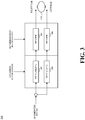
- FIG. 3 is a schematic block diagram illustrating augmentation of sound source as spatial audio for a headset-type of augmented-reality device, where the sound-processing chain includes 3D-rendering HRTF and reverberation filters.
- the augmented sound is passed through right-side and left-side HRTF filters 302 and 304, respectively, which also take as inputs location information, and then passed through right-side and left-side reverberation filters 306 and 308, respectively, which also take as inputs reverberation information in accordance with the present methods and systems.
- the output is then played respectively to the right and left ears of the depicted example user 310.
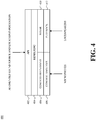
- FIG. 4 is a schematic block diagram illustrating an audio-enhancement software module 400.
- the module 400 includes a sub-module 408 for carrying out context analysis related to data gathered from microphones.
- the module 400 further includes a sub-module 406 that performs context refinement and interfaces between the sub-module 408 and a sub-module 404, which handles the rendering of the augmented-reality audio signals as described herein.
- the sub-module 404 interfaces between (a) an API 402 (described below) and (b)(1) the context-refinement sub-module 406 and a mixer sub-module 410.
- the mixer sub-module 410 interfaces between the rendering sub-module 410 and a playback sub-module 412, which provides audio output to loudspeakers.
- the context estimation could be applied for example for user indoor/outdoor classification.
- Reverberation in outdoor open spaces is typically zero since there are no scatterings and reflecting surfaces.
- An exception could be location between high-rise buildings on narrow streets.
- knowing that the user is outdoors does not ensure that reverberation cues are not needed in context analysis and audio augmentation.
- the various embodiments described herein relate to multi-source sensor signal capture in multi microphone and spatial audio capture, temporal and spatial audio scene estimation and context extraction applying audio parameterization.
- the methods described herein can be applied to ad-hoc sensor networks, real-time augmented reality services, devices and audio based user interfaces.
- Various embodiments provide a method for audio context estimation using binaural, stereo and multi-channel audio signals.
- the real-time estimation of the audio scene is conducted by estimating sound source locations, inter-channel coherence, discrete audio source motions and reverberation.
- the coherence cue may be used to distinguish reverberant tail of an audio event from a naturally decaying coherent and "dry" signal not affected by a reverberation.
- moving sound sources are excluded from the reverberation time estimation due to possible sound level fading effect caused by a sound source moving away from the observer. Having the capability to analyze spatial audio cues improves the overall context analysis reliability.
- the knowledge of overall auditory context around the user is useful for augmented reality concepts such as real time guidance and info services and for example pervasive games.
- the methods and devices described herein provide means for environment analysis regarding the reverberation, number of existing sound sources and their relative motion.
- Contextual audio environment estimation in some embodiments starts with parameterization of the audio image around the user, which may include:
- the parameterization may then be refined in some embodiments by using one or more of the following contextual knowledge and/or combining different modalities:
- the audio context analysis methods of this disclosure may be implemented in augmented reality devices or mobile phone audio enhancement modules.
- the algorithms described herein will handle the processing of the one or more microphone signals, context analysis 408 of the input and the rendering 404 of augmented content.
- the audio enhancement layer of this disclosure may include input connections for a plurality of microphones.
- the system may further contain an API 402 for the application developer and service provider to input augmented audio components and meta information about the desired locations.
- the enhancement layer conducts audio context analysis of the natural audio environment captured with microphones. This information is applied when the augmented content provided for example by the service provider or game application is rendered to the audio output.
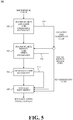
- FIG. 5 is a flow diagram illustrating steps performed in the context-estimation process. Indeed, FIG. 5 depicts a context analysis process 500 in detail according to some embodiments.
- the audio signals from two or more microphones are forwarded to sound source and coherence estimation tool in module 502.
- the corresponding cues are extracted to signal 510 for context refinement and for assisting the possible augmented audio source processing phase.
- the sound source motion estimation is conducted with the help of estimated location information in module 504.
- the output is the number of existing sources and their motion information in signal 512.
- the captured audio is forwarded further to reverberation estimation in module 506.
- the reverberation estimates are in signal 514.
- the context information is refined using all the estimated cues 510, 512, and 514 in module 508.
- the reverberation estimation is refined taking into account the location, coherence and motion information.
- modules that carry out (i.e., perform, execute, and the like) various functions that are described herein in connection with the respective modules.
- a module includes hardware (e.g., one or more processors, one or more microprocessors, one or more microcontrollers, one or more microchips, one or more application-specific integrated circuits (ASICs), one or more field programmable gate arrays (FPGAs), one or more memory devices) deemed suitable by those of skill in the relevant art for a given implementation.
- ASICs application-specific integrated circuits
- FPGAs field programmable gate arrays
- Each described module may also include instructions executable for carrying out the one or more functions described as being carried out by the respective module, and it is noted that those instructions could take the form of or include hardware (i.e., hardwired) instructions, firmware instructions, software instructions, and/or the like, and may be stored in any suitable non-transitory computer-readable medium or media, such as commonly referred to as RAM, ROM, etc.
- FIG. 6 is a flow diagram illustrating steps performed during audio augmentation using context information.
- FIG. 6 depicts an augmented audio source process 600 of some embodiments using the contextual information of the given space.
- the designed locations of the augmented sources are refined taking into account the estimated locations of the natural sources within the given space.
- the augmented source is designed to be in the same location or direction as a coherent, point-like natural source, the augmented source is moved away by a predefined number of degrees in module 602. This helps the user to separate the sources, and the intelligibility of the content is improved.
- both augmented and natural sources contain speech in, for example, a teleconference type of application scenario.
- the natural sound is non-coherent, e.g.
- the average normalized coherence cue value is below a threshold, such as e.g., 0.5, the augmented source is not moved even though it may locate in the same direction.
- HRTF processing may be applied to render the content in desired locations in module 604.
- the estimated reverberation cue is applied to all augmented content for generating natural sounding audio experience in module 606. Finally, all the augmented sources are mixed together in module 608 and played back in the augmented reality device.
- testing the application functionality in an audio enhancement software layer in mobile device or wearable augmented reality device is straightforward.
- the contextual cue refinement method of this disclosure is tested by running the content augmentation service in controlled audio environments such as a low-reverberating listening room or echoless chamber.
- the service API is fed with augmented audio content and the actual rendered content in the device loudspeakers or earpieces is recorded.
- FIG. 7 is a block diagram of a wireless transceiver user device that may be used in some embodiments.
- the systems and methods described herein may be implemented in a wireless transmit receive unit (WTRU), such as WTRU 702 illustrated in Fig. 7 .
- WTRU 702 wireless transmit receive unit
- the components of WTRU 702 may be implemented in an augmented-reality headset. As shown in FIG.
- the WTRU 702 may include a processor 718, a transceiver 720, a transmit/receive element 722, audio transducers 724 (preferably including at least two microphones and at least two speakers, which may be earphones), a keypad 726, a display/touchpad 728, a non-removable memory 730, a removable memory 732, a power source 734, a global positioning system (GPS) chipset 736, and other peripherals 738.
- GPS global positioning system
- the WTRU may communicate with nodes such as, but not limited to, a base transceiver station (BTS), a Node-B, a site controller, an access point (AP), a home node-B, an evolved node-B (eNodeB), a home evolved node-B (HeNB), a home evolved node-B gateway, and proxy nodes, among others.
- nodes such as, but not limited to, a base transceiver station (BTS), a Node-B, a site controller, an access point (AP), a home node-B, an evolved node-B (eNodeB), a home evolved node-B (HeNB), a home evolved node-B gateway, and proxy nodes, among others.
- the processor 718 may be a general purpose processor, a special purpose processor, a conventional processor, a digital signal processor (DSP), a plurality of microprocessors, one or more microprocessors in association with a DSP core, a controller, a microcontroller, Application Specific Integrated Circuits (ASICs), Field Programmable Gate Array (FPGAs) circuits, any other type of integrated circuit (IC), a state machine, and the like.
- the processor 718 may perform signal coding, data processing, power control, input/output processing, and/or any other functionality that enables the WTRU 702 to operate in a wireless environment.
- the processor 718 may be coupled to the transceiver 720, which may be coupled to the transmit/receive element 722. While FIG. 7 depicts the processor 718 and the transceiver 720 as separate components, it will be appreciated that the processor 718 and the transceiver 720 may be integrated together in an electronic package or chip.
- the transmit/receive element 722 may be configured to transmit signals to, or receive signals from, a node over the air interface 715.
- the transmit/receive element 722 may be an antenna configured to transmit and/or receive RF signals.
- the transmit/receive element 722 may be an emitter/detector configured to transmit and/or receive IR, UV, or visible-light signals, as examples.
- the transmit/receive element 722 may be configured to transmit and receive both RF and light signals. It will be appreciated that the transmit/receive element 722 may be configured to transmit and/or receive any combination of wireless signals.
- the WTRU 702 may include any number of transmit/receive elements 722. More specifically, the WTRU 702 may employ MIMO technology. Thus, in one embodiment, the WTRU 702 may include two or more transmit/receive elements 722 (e.g., multiple antennas) for transmitting and receiving wireless signals over the air interface 715.
- the WTRU 702 may include two or more transmit/receive elements 722 (e.g., multiple antennas) for transmitting and receiving wireless signals over the air interface 715.
- the transceiver 720 may be configured to modulate the signals that are to be transmitted by the transmit/receive element 722 and to demodulate the signals that are received by the transmit/receive element 722.
- the WTRU 702 may have multi-mode capabilities.
- the transceiver 720 may include multiple transceivers for enabling the WTRU 702 to communicate via multiple RATs, such as UTRA and IEEE 802.11, as examples.
- the processor 718 of the WTRU 102 may be coupled to, and may receive user input data from, the audio transducers 724, the keypad 726, and/or the display/touchpad 728 (e.g., a liquid crystal display (LCD) display unit or organic light-emitting diode (OLED) display unit).
- the processor 718 may also output user data to the speaker/microphone 724, the keypad 726, and/or the display/touchpad 728.
- the processor 718 may access information from, and store data in, any type of suitable memory, such as the non-removable memory 730 and/or the removable memory 732.
- the non-removable memory 730 may include random-access memory (RAM), read-only memory (ROM), a hard disk, or any other type of memory storage device.
- the removable memory 732 may include a subscriber identity module (SIM) card, a memory stick, a secure digital (SD) memory card, and the like.
- SIM subscriber identity module
- SD secure digital
- the processor 718 may access information from, and store data in, memory that is not physically located on the WTRU 702, such as on a server or a home computer (not shown).
- the processor 718 may receive power from the power source 734, and may be configured to distribute and/or control the power to the other components in the WTRU 702.
- the power source 734 may be any suitable device for powering the WTRU 702.
- the power source 734 may include one or more dry cell batteries (e.g., nickel-cadmium (NiCd), nickel-zinc (NiZn), nickel metal hydride (NiMH), lithium-ion (Li-ion), and the like), solar cells, fuel cells, and the like.
- the processor 718 may also be coupled to the GPS chipset 736, which may be configured to provide location information (e.g., longitude and latitude) regarding the current location of the WTRU 702.
- location information e.g., longitude and latitude
- the WTRU 702 may receive location information over the air interface 715 from a base station and/or determine its location based on the timing of the signals being received from two or more nearby base stations. It will be appreciated that the WTRU 702 may acquire location information by way of any suitable location-determination method while remaining consistent with an embodiment.
- the processor 718 may further be coupled to other peripherals 738, which may include one or more software and/or hardware modules that provide additional features, functionality and/or wired or wireless connectivity.
- the peripherals 738 may include an accelerometer, an e-compass, a satellite transceiver, a digital camera (for photographs or video), a universal serial bus (USB) port, a vibration device, a television transceiver, a hands-free headset, a Bluetooth® module, a frequency modulated (FM) radio unit, a digital music player, a media player, a video game player module, an Internet browser, and the like.
- the peripherals 738 may include an accelerometer, an e-compass, a satellite transceiver, a digital camera (for photographs or video), a universal serial bus (USB) port, a vibration device, a television transceiver, a hands-free headset, a Bluetooth® module, a frequency modulated (FM) radio unit, a digital music player, a media player, a video
- FIG. 8 is a flow diagram illustrating a first method, in accordance with at least one embodiment.
- the example method 800 is described herein by way of example as being carried out by an augmented-reality headset.
- the headset samples an audio signal from a plurality of microphones.
- the sampled audio signal is not a test signal.
- the headset determines a respective location of at least one audio source from the sampled audio signal.
- the location determination is performed using binaural cue coding.
- the location determination is performed by analyzing a sub-band in the frequency domain.
- the location determination is performed using inter-channel time difference.
- the headset renders an augmented-reality audio signal having a virtual location separated from the at least one determined location by at least a threshold separation.
- rendering includes applying a head-related transfer function filtering.
- the determined location is an angular position
- the threshold separation is a threshold angular distance; in at least one such embodiment, the threshold angular distance has a value selected from the group consisting of 5 degrees and 10 degrees.
- the at least one audio source includes multiple audio sources, and the virtual location is separated from each of the respective determined locations by at least the threshold separation.
- the method further includes distinguishing among the multiple audio sources based on one or more statistical properties selected from the group consisting of the range of harmonic frequencies, sound level, and coherence.
- each of the multiple audio sources contributes a respective audio component to the sampled audio signal
- the method further includes determining that each of the audio components has a respective coherence level that is above a predetermined coherence-level threshold.
- the method further includes identifying each of the multiple audio sources using a Gaussian mixture model. In at least one embodiment, the method further includes identifying each of the multiple audio sources at least in part by determining a probability density function of direction of arrival data. In at least one embodiment, the method further includes identifying each of the multiple audio sources at least in part by modeling a probability density function of direction of arrival data as a sum of probability distribution functions of the multiple audio sources.
- FIG. 9 is a flow diagram illustrating a second method, in accordance with at least one embodiment.
- the example method 900 of FIG. 9 is described herein by way of example as being carried out by an augmented-reality headset.
- the headset samples at least one audio signal from a plurality of microphones.
- the headset determines a reverberation time based on the sampled at least one audio signal.
- the headset modifies an augmented-reality audio signal based at least in part on the determined reverberation time.
- step 906 involves applying to the augmented-reality audio signal a reverberation corresponding to the determined reverberation time.
- step 906 involves applying to the augmented-reality audio signal a reverberation filter corresponding to the determined reverberation time.
- step 906 involves slowing down (i.e., increasing the playout time used for) the augmented-reality audio signal by an amount determined based at least in part on the determined reverberation time. Slowing down the audio signal may make the audio signal more readily understood by the user in an environment in which reverberation is significant.
- the headset renders the modified augmented-reality audio signal.
- One embodiment takes the form of a method of determining an audio context.
- the method includes (i) sampling an audio signal from a plurality of microphones; and (ii) determining a location of at least one audio source from the sampled audio signal.
- the method further includes rendering an augmented-reality audio signal having a virtual location separated from the location of the at least one audio source.
- the method further includes rendering an augmented-reality audio signal having a virtual location separated from the location of the at least one audio source, and rendering includes applying a head-related transfer function filtering.
- the method further includes rendering an augmented-reality audio signal having a virtual location with a separation of at least 5 degrees in the horizontal plane from the location of the audio source.
- the method further includes rendering an augmented-reality audio signal having a virtual location with a separation of at least 10 degrees in the horizontal plane from the location of the audio source.
- the method further includes (i) determining the location of a plurality of audio sources from the sampled audio signal and (ii) rendering an augmented-reality audio signal having a virtual location different from the locations of all of the plurality of audio sources.
- the method further includes (i) determining the location of a plurality of audio sources from the sampled audio signal, each of the audio sources contributing a respective audio component to the sampled audio signal; (ii) determining a coherence level of each of the respective audio components; (iii) identifying one or more coherent audio sources associated with a coherence level above a predetermined threshold; and (iv) rendering an augmented-reality audio signal at a virtual location different from the locations of the one or more coherent audio sources.
- the sampled audio signal is not a test signal.
- the location determination is performed using binaural cue coding.
- the location determination is performed by analyzing a sub-band in the frequency domain.
- the location determination is performed using inter-channel time difference.
- One embodiment takes the form of a method of determining an audio context.
- the method includes (i) sampling an audio signal from a plurality of microphones; (ii) identifying a plurality of audio sources, each source contributing a respective audio component to the sampled audio signal; and (iii) determining a location of at least one audio source from the sampled audio signal.
- the identification of audio sources is performed using a Gaussian mixture model.
- the identification of audio sources includes determining a probability density function of direction of arrival data.
- the method further includes tracking the plurality of audio sources.
- the identification of audio sources is performed by modeling a probability density function of direction of arrival data as a sum of probability distribution functions of the plurality of audio sources.
- the method further includes distinguishing different audio sources based on statistical properties selected from the group consisting of the range of harmonic frequencies, sound level, and coherence.
- One embodiment takes the form of a method of determining an audio context.
- the method includes (i) sampling an audio signal from a plurality of microphones; and (ii) determining a reverberation time based on the sampled audio signal.
- the sampled audio signal is not a test signal.
- the determination of reverberation time is performed using a plurality of overlapping sample windows.
- the determination of reverberation time is performed using maximum likelihood estimation.
- a plurality of audio signals are sampled, and the determination of the reverberation time includes: (i) determining an inter-channel coherence parameter for each of the plurality of sampled audio signals; and (ii) determining the reverberation time based only on signals having an inter-channel coherence parameter below a predetermined threshold.
- a plurality of audio signals are sampled, and the determination of the reverberation time includes: (i) for each of the plurality of sampled audio signals, determining a candidate reverberation time; and (ii) determining the reverberation time based only on signals having a candidate reverberation time below a predetermined threshold.
- the determination of the reverberation time includes: (i) identifying a plurality of audio sources from the sampled audio signal, each audio source contributing an associated audio component to the sampled audio signal; (ii) determining, from the associated audio component, an angular velocity of each of the plurality of audio sources; and (iii) determining the reverberation time based only on audio components associated with audio sources having an angular velocity below a threshold angular velocity.
- the determination of the reverberation time includes: (i) identifying a plurality of audio sources from the sampled audio signal, each audio source contributing an associated audio component to the sampled audio signal; (ii) using the Doppler effect to determine a radial velocity of each of the plurality of audio sources; and (iii) determining the reverberation time based only on audio components associated with audio sources having a radial velocity below a threshold radial velocity.
- the determination of the reverberation time includes: (i) identifying a plurality of audio sources from the sampled audio signal, each audio source contributing an associated audio component to the sampled audio signal; and (ii) determining the reverberation time based only on substantially stationary audio sources.
- the method further includes rendering an augmented-reality audio signal having a reverberation corresponding to the determined reverberation time.
- One embodiment takes the form of a method of determining an audio context.
- the method includes (i) sampling an audio signal from a plurality of microphones; (ii) identifying a plurality of audio sources from the sampled audio signal; (iii) identifying a component of the sampled audio signal attributable to a stationary audio source; and (iv) determining a reverberation time based at least in part on the component of the sampled audio signal attributable to the stationary audio source.
- the identification of a component attributable to a stationary audio source is performed using binaural cue coding.
- the identification of a component attributable to a stationary audio source is performed by analyzing a sub-band in the frequency domain.
- the identification of a component attributable to a stationary audio source is performed using inter-channel time difference.
- One embodiment takes the form of a system that includes (i) a plurality of microphones; (ii) a plurality of speakers; (iii) a processor; and (iv) a non-transitory computer-readable medium having instructions stored thereon, the instructions being operative, when executed by the processor, to (a) obtain a multi-channel audio sample from the plurality of microphones; (b) identify, from the multi-channel audio sample, a plurality of audio sources, each source contributing a respective audio component to the multi-channel audio sample; (c) determine a location of each of the audio sources; and (d) render an augmented-reality audio signal through the plurality of speakers.
- the instructions are further operative to render the augmented-reality audio signal at a virtual location different from the locations of the plurality of audio sources.
- the instructions are further operative to determine a reverberation time from the multi-channel audio sample.
- the instructions are further operative to (a) identify at least one stationary audio source from the plurality of audio sources; and (b) determine a reverberation time only from the audio components associated with the stationary audio sources.
- the speakers are earphones.
- the system is implemented in an augmented-reality headset.
- the instructions are operative to identify the plurality of audio sources using Gaussian mixture modelling.
- the instructions are further operative to (a) determine a candidate reverberation time for each of the audio components; and (b) base the reverberation time on the candidate reverberation times that are less than a predetermined threshold.
- the system is implemented in a mobile telephone.
- the instructions are further operative to (a) to determine a reverberation time from the multi-channel audio sample; (b) apply a reverberation filter using the determined reverberation time to an augmented-reality audio signal; and (c) render the filtered augmented-reality audio signal through the plurality of speakers.
- One embodiment takes the form of a method that includes (i) sampling a plurality of audio signals on at least two channels; (ii) determining an inter-channel coherence value for each of the audio signals; (iii) identifying at least one of the audio signals having an inter-channel coherence value below a predetermined threshold value; and (iv) determining a reverberation time from the at least one audio signal having an inter-channel coherence value below the predetermined threshold value.
- the method further includes generating an augmented-reality audio signal using the determined reverberation time.
- One embodiment takes the form of a method that includes (i) sampling a plurality of audio signals on at least two channels; (ii) determining a value representing source movement for each of the audio signals; (iii) identifying at least one of the audio signals having a source movement value below a predetermined threshold value; and (iv) determining a reverberation time from the at least one audio signal having a source movement value below the predetermined threshold value.
- the value representing source movement is an angular velocity.
- the value representing source movement is a value representing a Doppler shift.
- the method further includes generating an augmented-reality audio signal using the determined reverberation time.
- One embodiment takes the form of an augmented-reality audio system that generates information regarding the acoustic environment by sampling audio signals.
- the system identifies the location of one or more audio sources, with each source contributing an audio component to the sampled audio signals.
- the system determines a reverberation time for the acoustic environment using the audio components.
- the system may discard audio components from sources that are determined to be in motion, such as components with an angular velocity above a threshold or components having a Doppler shift above a threshold.
- the system may also discard audio components from sources having an inter-channel coherence above a threshold.
- the system renders sounds using the reverberation time at virtual locations that are separated from the locations of the audio sources.
- ROM read-only memory
- RAM random-access memory
- register cache memory
- semiconductor memory devices magnetic media such as internal hard disks and removable disks, magneto-optical media, and optical media such as CD-ROM disks, and digital versatile disks (DVDs).
- a processor in association with software may be used to implement a radio frequency transceiver for use in a WTRU, UE, terminal, base station, RNC, or any host computer.
Landscapes
- Engineering & Computer Science (AREA)
- Multimedia (AREA)
- Physics & Mathematics (AREA)
- Acoustics & Sound (AREA)
- Signal Processing (AREA)
- Human Computer Interaction (AREA)
- Computational Linguistics (AREA)
- Quality & Reliability (AREA)
- Health & Medical Sciences (AREA)
- Audiology, Speech & Language Pathology (AREA)
- Stereophonic System (AREA)
- Circuit For Audible Band Transducer (AREA)
Applications Claiming Priority (3)
| Application Number | Priority Date | Filing Date | Title |
|---|---|---|---|
| US201462028121P | 2014-07-23 | 2014-07-23 | |
| PCT/US2015/039763 WO2016014254A1 (en) | 2014-07-23 | 2015-07-09 | System and method for determining audio context in augmented-reality applications |
| EP15739473.5A EP3172730A1 (de) | 2014-07-23 | 2015-07-09 | System und verfahren zur bestimmung von audiokontext in anwendungen für erweiterte realität |
Related Parent Applications (1)
| Application Number | Title | Priority Date | Filing Date |
|---|---|---|---|
| EP15739473.5A Division EP3172730A1 (de) | 2014-07-23 | 2015-07-09 | System und verfahren zur bestimmung von audiokontext in anwendungen für erweiterte realität |
Publications (1)
| Publication Number | Publication Date |
|---|---|
| EP3441966A1 true EP3441966A1 (de) | 2019-02-13 |
Family
ID=53682881
Family Applications (2)
| Application Number | Title | Priority Date | Filing Date |
|---|---|---|---|
| EP18196817.3A Withdrawn EP3441966A1 (de) | 2014-07-23 | 2015-07-09 | System und verfahren zur ermittlung von audiocontext in augmented reality anwendungen |
| EP15739473.5A Withdrawn EP3172730A1 (de) | 2014-07-23 | 2015-07-09 | System und verfahren zur bestimmung von audiokontext in anwendungen für erweiterte realität |
Family Applications After (1)
| Application Number | Title | Priority Date | Filing Date |
|---|---|---|---|
| EP15739473.5A Withdrawn EP3172730A1 (de) | 2014-07-23 | 2015-07-09 | System und verfahren zur bestimmung von audiokontext in anwendungen für erweiterte realität |
Country Status (4)
| Country | Link |
|---|---|
| US (2) | US20170208415A1 (de) |
| EP (2) | EP3441966A1 (de) |
| CN (1) | CN106659936A (de) |
| WO (1) | WO2016014254A1 (de) |
Families Citing this family (54)
| Publication number | Priority date | Publication date | Assignee | Title |
|---|---|---|---|---|
| RU2678481C2 (ru) | 2013-11-05 | 2019-01-29 | Сони Корпорейшн | Устройство обработки информации, способ обработки информации и программа |
| WO2015166482A1 (en) | 2014-05-01 | 2015-11-05 | Bugatone Ltd. | Methods and devices for operating an audio processing integrated circuit to record an audio signal via a headphone port |
| CA2949610A1 (en) * | 2014-05-20 | 2015-11-26 | Bugatone Ltd. | Aural measurements from earphone output speakers |
| EP3197182B1 (de) * | 2014-08-13 | 2020-09-30 | Samsung Electronics Co., Ltd. | Verfahren und vorrichtung zur erzeugung und wiedergabe von audiosignalen |
| US10623828B2 (en) | 2015-08-26 | 2020-04-14 | Pcms Holdings, Inc. | Method and systems for generating and utilizing contextual watermarking |
| US20170177929A1 (en) * | 2015-12-21 | 2017-06-22 | Intel Corporation | Crowd gesture recognition |
| CN108605193B (zh) * | 2016-02-01 | 2021-03-16 | 索尼公司 | 声音输出设备、声音输出方法、计算机可读存储介质和声音系统 |
| CN105931648B (zh) * | 2016-06-24 | 2019-05-03 | 百度在线网络技术(北京)有限公司 | 音频信号解混响方法和装置 |
| US11195542B2 (en) | 2019-10-31 | 2021-12-07 | Ron Zass | Detecting repetitions in audio data |
| US20180018987A1 (en) * | 2016-07-16 | 2018-01-18 | Ron Zass | System and method for identifying language register |
| US12249342B2 (en) | 2016-07-16 | 2025-03-11 | Ron Zass | Visualizing auditory content for accessibility |
| CN107731238B (zh) * | 2016-08-10 | 2021-07-16 | 华为技术有限公司 | 多声道信号的编码方法和编码器 |
| EP3504523B1 (de) | 2016-08-29 | 2023-11-08 | Harman International Industries, Incorporated | Vorrichtung und verfahren zur erzeugung von virtuellen orten für einen hörraum |
| US9980078B2 (en) | 2016-10-14 | 2018-05-22 | Nokia Technologies Oy | Audio object modification in free-viewpoint rendering |
| US11096004B2 (en) | 2017-01-23 | 2021-08-17 | Nokia Technologies Oy | Spatial audio rendering point extension |
| WO2018152004A1 (en) * | 2017-02-15 | 2018-08-23 | Pcms Holdings, Inc. | Contextual filtering for immersive audio |
| US10531219B2 (en) | 2017-03-20 | 2020-01-07 | Nokia Technologies Oy | Smooth rendering of overlapping audio-object interactions |
| US11074036B2 (en) | 2017-05-05 | 2021-07-27 | Nokia Technologies Oy | Metadata-free audio-object interactions |
| US9843883B1 (en) * | 2017-05-12 | 2017-12-12 | QoSound, Inc. | Source independent sound field rotation for virtual and augmented reality applications |
| US10165386B2 (en) | 2017-05-16 | 2018-12-25 | Nokia Technologies Oy | VR audio superzoom |
| CN107281753B (zh) * | 2017-06-21 | 2020-10-23 | 网易(杭州)网络有限公司 | 场景音效混响控制方法及装置、存储介质及电子设备 |
| US20190090052A1 (en) * | 2017-09-20 | 2019-03-21 | Knowles Electronics, Llc | Cost effective microphone array design for spatial filtering |
| US11395087B2 (en) | 2017-09-29 | 2022-07-19 | Nokia Technologies Oy | Level-based audio-object interactions |
| IL297445B2 (en) | 2017-10-17 | 2024-03-01 | Magic Leap Inc | Mixed reality spatial audio |
| US10531222B2 (en) | 2017-10-18 | 2020-01-07 | Dolby Laboratories Licensing Corporation | Active acoustics control for near- and far-field sounds |
| WO2019133732A1 (en) * | 2017-12-28 | 2019-07-04 | Knowles Electronics, Llc | Content-based audio stream separation |
| WO2019133765A1 (en) * | 2017-12-28 | 2019-07-04 | Knowles Electronics, Llc | Direction of arrival estimation for multiple audio content streams |
| US11477510B2 (en) | 2018-02-15 | 2022-10-18 | Magic Leap, Inc. | Mixed reality virtual reverberation |
| US10542368B2 (en) | 2018-03-27 | 2020-01-21 | Nokia Technologies Oy | Audio content modification for playback audio |
| GB2572420A (en) * | 2018-03-29 | 2019-10-02 | Nokia Technologies Oy | Spatial sound rendering |
| JP7812195B2 (ja) | 2018-05-30 | 2026-02-09 | マジック リープ, インコーポレイテッド | フィルタパラメータに関するインデックススキーミング |
| CN116156411A (zh) * | 2018-06-18 | 2023-05-23 | 奇跃公司 | 用于交互式音频环境的空间音频 |
| GB2575511A (en) | 2018-07-13 | 2020-01-15 | Nokia Technologies Oy | Spatial audio Augmentation |
| GB2575509A (en) | 2018-07-13 | 2020-01-15 | Nokia Technologies Oy | Spatial audio capture, transmission and reproduction |
| CN113115175B (zh) * | 2018-09-25 | 2022-05-10 | Oppo广东移动通信有限公司 | 3d音效处理方法及相关产品 |
| CN109597481B (zh) * | 2018-11-16 | 2021-05-04 | Oppo广东移动通信有限公司 | Ar虚拟人物绘制方法、装置、移动终端及存储介质 |
| US10595149B1 (en) * | 2018-12-04 | 2020-03-17 | Facebook Technologies, Llc | Audio augmentation using environmental data |
| JP7631198B2 (ja) | 2018-12-24 | 2025-02-18 | ディーティーエス・インコーポレイテッド | 深層学習画像解析を用いた室内音響シミュレーション |
| US10897570B1 (en) | 2019-01-28 | 2021-01-19 | Facebook Technologies, Llc | Room acoustic matching using sensors on headset |
| EP3939035B1 (de) * | 2019-03-10 | 2026-07-01 | Kardome Technology Ltd. | Sprachverbesserung mittels clusterung von hinweisen |
| US10674307B1 (en) | 2019-03-27 | 2020-06-02 | Facebook Technologies, Llc | Determination of acoustic parameters for a headset using a mapping server |
| GB2582749A (en) | 2019-03-28 | 2020-10-07 | Nokia Technologies Oy | Determination of the significance of spatial audio parameters and associated encoding |
| CN110267166B (zh) * | 2019-07-16 | 2021-08-03 | 上海艺瓣文化传播有限公司 | 一种基于双耳效应的虚拟声场实时交互系统 |
| US11276215B1 (en) | 2019-08-28 | 2022-03-15 | Facebook Technologies, Llc | Spatial audio and avatar control using captured audio signals |
| JP7446420B2 (ja) | 2019-10-25 | 2024-03-08 | マジック リープ, インコーポレイテッド | 反響フィンガプリント推定 |
| US11217268B2 (en) * | 2019-11-06 | 2022-01-04 | Bose Corporation | Real-time augmented hearing platform |
| CN111770413B (zh) * | 2020-06-30 | 2021-08-27 | 浙江大华技术股份有限公司 | 一种多音源混音方法、装置及存储介质 |
| WO2022031418A1 (en) | 2020-07-31 | 2022-02-10 | Sterling Labs Llc. | Sound rendering for a shared point of view |
| CN117581297B (zh) * | 2021-07-02 | 2025-04-25 | 北京字跳网络技术有限公司 | 音频信号的渲染方法、装置和电子设备 |
| CN113889140B (zh) * | 2021-09-24 | 2025-07-22 | 北京有竹居网络技术有限公司 | 音频信号播放方法、装置和电子设备 |
| EP4415383A4 (de) * | 2021-10-06 | 2025-08-13 | Maxell Ltd | Vorrichtung zur wiedergabe von audio-augmented-reality-objekten und verfahren zur wiedergabe von audio-augmented-reality-objekten |
| GB2613558A (en) * | 2021-12-03 | 2023-06-14 | Nokia Technologies Oy | Adjustment of reverberator based on source directivity |
| CN115273431B (zh) * | 2022-09-26 | 2023-03-07 | 荣耀终端有限公司 | 设备的寻回方法、装置、存储介质和电子设备 |
| CN116684777A (zh) * | 2023-04-21 | 2023-09-01 | 阿里巴巴达摩院(杭州)科技有限公司 | 音频处理、模型训练方法、装置、设备及存储介质 |
Citations (3)
| Publication number | Priority date | Publication date | Assignee | Title |
|---|---|---|---|---|
| US20040196989A1 (en) * | 2003-04-04 | 2004-10-07 | Sol Friedman | Method and apparatus for expanding audio data |
| US20040213415A1 (en) * | 2003-04-28 | 2004-10-28 | Ratnam Rama | Determining reverberation time |
| EP2337375A1 (de) * | 2009-12-17 | 2011-06-22 | Nxp B.V. | Automatische Umgebungsakustikidentifikation |
Family Cites Families (10)
| Publication number | Priority date | Publication date | Assignee | Title |
|---|---|---|---|---|
| US7246058B2 (en) * | 2001-05-30 | 2007-07-17 | Aliph, Inc. | Detecting voiced and unvoiced speech using both acoustic and nonacoustic sensors |
| US7583805B2 (en) * | 2004-02-12 | 2009-09-01 | Agere Systems Inc. | Late reverberation-based synthesis of auditory scenes |
| EP1482763A3 (de) * | 2003-05-26 | 2008-08-13 | Matsushita Electric Industrial Co., Ltd. | Gerät zum Messen eines Schallfeldes |
| EP2030476B1 (de) * | 2006-06-01 | 2012-07-18 | Hear Ip Pty Ltd | Verfahren und system zur verbesserung der verständlichkeit von lauten |
| WO2012010929A1 (en) * | 2010-07-20 | 2012-01-26 | Nokia Corporation | A reverberation estimator |
| CN102013252A (zh) * | 2010-10-27 | 2011-04-13 | 华为终端有限公司 | 一种音效调节方法及声音播放装置 |
| US9794678B2 (en) * | 2011-05-13 | 2017-10-17 | Plantronics, Inc. | Psycho-acoustic noise suppression |
| US9955280B2 (en) * | 2012-04-19 | 2018-04-24 | Nokia Technologies Oy | Audio scene apparatus |
| US9386373B2 (en) * | 2012-07-03 | 2016-07-05 | Dts, Inc. | System and method for estimating a reverberation time |
| US9131295B2 (en) * | 2012-08-07 | 2015-09-08 | Microsoft Technology Licensing, Llc | Multi-microphone audio source separation based on combined statistical angle distributions |
-
2015
- 2015-07-09 EP EP18196817.3A patent/EP3441966A1/de not_active Withdrawn
- 2015-07-09 CN CN201580039587.XA patent/CN106659936A/zh active Pending
- 2015-07-09 US US15/327,314 patent/US20170208415A1/en not_active Abandoned
- 2015-07-09 WO PCT/US2015/039763 patent/WO2016014254A1/en not_active Ceased
- 2015-07-09 EP EP15739473.5A patent/EP3172730A1/de not_active Withdrawn
-
2018
- 2018-08-02 US US16/053,498 patent/US20180376273A1/en not_active Abandoned
Patent Citations (3)
| Publication number | Priority date | Publication date | Assignee | Title |
|---|---|---|---|---|
| US20040196989A1 (en) * | 2003-04-04 | 2004-10-07 | Sol Friedman | Method and apparatus for expanding audio data |
| US20040213415A1 (en) * | 2003-04-28 | 2004-10-28 | Ratnam Rama | Determining reverberation time |
| EP2337375A1 (de) * | 2009-12-17 | 2011-06-22 | Nxp B.V. | Automatische Umgebungsakustikidentifikation |
Non-Patent Citations (2)
| Title |
|---|
| JIMI Y C WEN ET AL: "Blind estimation of reverberation time based on the distribution of signal decay rates", ACOUSTICS, SPEECH AND SIGNAL PROCESSING, 2008. ICASSP 2008. IEEE INTERNATIONAL CONFERENCE ON, IEEE, PISCATAWAY, NJ, USA, 31 March 2008 (2008-03-31), pages 329 - 332, XP031250555, ISBN: 978-1-4244-1483-3 * |
| WESTERMANN ADAM ET AL: "Binaural dereverberation based on interaural coherence histograms", THE JOURNAL OF THE ACOUSTICAL SOCIETY OF AMERICA, AMERICAN INSTITUTE OF PHYSICS FOR THE ACOUSTICAL SOCIETY OF AMERICA, NEW YORK, NY, US, vol. 133, no. 5, 1 May 2013 (2013-05-01), pages 2767 - 2777, XP012173352, ISSN: 0001-4966, [retrieved on 20130506], DOI: 10.1121/1.4799007 * |
Also Published As
| Publication number | Publication date |
|---|---|
| US20180376273A1 (en) | 2018-12-27 |
| EP3172730A1 (de) | 2017-05-31 |
| WO2016014254A1 (en) | 2016-01-28 |
| CN106659936A (zh) | 2017-05-10 |
| US20170208415A1 (en) | 2017-07-20 |
Similar Documents
| Publication | Publication Date | Title |
|---|---|---|
| US20180376273A1 (en) | System and method for determining audio context in augmented-reality applications | |
| CN109644314B (zh) | 渲染声音程序的方法、音频回放系统和制造制品 | |
| US10645518B2 (en) | Distributed audio capture and mixing | |
| EP3520216B1 (de) | Verstärkungsregelung in räumlichen audiosystemen | |
| CN110677802B (zh) | 用于处理音频的方法和装置 | |
| KR102118411B1 (ko) | 원신호 분리 시스템 및 방법 | |
| US10455325B2 (en) | Direction of arrival estimation for multiple audio content streams | |
| US11388512B2 (en) | Positioning sound sources | |
| US20160187453A1 (en) | Method and device for a mobile terminal to locate a sound source | |
| GB2543276A (en) | Distributed audio capture and mixing | |
| JP2013148576A (ja) | 変調された背景音を利用して位置特定を行う携帯装置、コンピュータプログラム、および方法 | |
| CN103165136A (zh) | 音频处理方法及音频处理设备 | |
| Choi et al. | Robust time-delay estimation for acoustic indoor localization in reverberant environments | |
| Talagala et al. | Binaural sound source localization using the frequency diversity of the head-related transfer function | |
| GB2563670A (en) | Sound source distance estimation | |
| CN120052005A (zh) | 为被遮挡麦克风生成恢复的空间音频信号 | |
| CN110875056A (zh) | 语音转录设备、系统、方法、及电子设备 | |
| CN114255781A (zh) | 一种多通道音频信号获取方法、装置及系统 | |
| WO2021261385A1 (ja) | 音響再生装置、ノイズキャンセリングヘッドフォン装置、音響再生方法、音響処理プログラム | |
| Calamia et al. | Blind estimation of the direct-to-reverberant ratio using a beta distribution fit to binaural coherence | |
| Nguyen et al. | Selection of the closest sound source for robot auditory attention in multi-source scenarios | |
| Maazaoui et al. | Estimation of individualized HRTF in unsupervised conditions | |
| JP6650245B2 (ja) | インパルス応答生成装置及びプログラム | |
| Cano et al. | Selective hearing: A machine listening perspective | |
| CN115250646B (zh) | 一种辅助聆听方法及装置 |
Legal Events
| Date | Code | Title | Description |
|---|---|---|---|
| PUAI | Public reference made under article 153(3) epc to a published international application that has entered the european phase |
Free format text: ORIGINAL CODE: 0009012 |
|
| STAA | Information on the status of an ep patent application or granted ep patent |
Free format text: STATUS: REQUEST FOR EXAMINATION WAS MADE |
|
| 17P | Request for examination filed |
Effective date: 20180926 |
|
| AC | Divisional application: reference to earlier application |
Ref document number: 3172730 Country of ref document: EP Kind code of ref document: P |
|
| AK | Designated contracting states |
Kind code of ref document: A1 Designated state(s): AL AT BE BG CH CY CZ DE DK EE ES FI FR GB GR HR HU IE IS IT LI LT LU LV MC MK MT NL NO PL PT RO RS SE SI SK SM TR |
|
| STAA | Information on the status of an ep patent application or granted ep patent |
Free format text: STATUS: THE APPLICATION IS DEEMED TO BE WITHDRAWN |
|
| 18D | Application deemed to be withdrawn |
Effective date: 20190814 |