EP3441996A1 - PROCÉDÉ DE PRODUCTION D'UN NOYAU MAGNÉTIQUE EN FERRITE D'UN SYSTÈME Mn-Zn, ET NOYAU MAGNÉTIQUE EN FERRITE D'UN SYSTÈME Mn-Zn - Google Patents
PROCÉDÉ DE PRODUCTION D'UN NOYAU MAGNÉTIQUE EN FERRITE D'UN SYSTÈME Mn-Zn, ET NOYAU MAGNÉTIQUE EN FERRITE D'UN SYSTÈME Mn-Zn Download PDFInfo
- Publication number
- EP3441996A1 EP3441996A1 EP17770391.5A EP17770391A EP3441996A1 EP 3441996 A1 EP3441996 A1 EP 3441996A1 EP 17770391 A EP17770391 A EP 17770391A EP 3441996 A1 EP3441996 A1 EP 3441996A1
- Authority
- EP
- European Patent Office
- Prior art keywords
- calculated
- temperature
- mnzn ferrite
- mass
- parts
- Prior art date
- Legal status (The legal status is an assumption and is not a legal conclusion. Google has not performed a legal analysis and makes no representation as to the accuracy of the status listed.)
- Pending
Links
Images

Classifications
-
- C—CHEMISTRY; METALLURGY
- C04—CEMENTS; CONCRETE; ARTIFICIAL STONE; CERAMICS; REFRACTORIES
- C04B—LIME, MAGNESIA; SLAG; CEMENTS; COMPOSITIONS THEREOF, e.g. MORTARS, CONCRETE OR LIKE BUILDING MATERIALS; ARTIFICIAL STONE; CERAMICS; REFRACTORIES; TREATMENT OF NATURAL STONE
- C04B35/00—Shaped ceramic products characterised by their composition; Ceramics compositions; Processing powders of inorganic compounds preparatory to the manufacturing of ceramic products
- C04B35/01—Shaped ceramic products characterised by their composition; Ceramics compositions; Processing powders of inorganic compounds preparatory to the manufacturing of ceramic products based on oxide ceramics
- C04B35/26—Shaped ceramic products characterised by their composition; Ceramics compositions; Processing powders of inorganic compounds preparatory to the manufacturing of ceramic products based on oxide ceramics based on ferrites
- C04B35/2658—Other ferrites containing manganese or zinc, e.g. Mn-Zn ferrites
-
- H—ELECTRICITY
- H01—ELECTRIC ELEMENTS
- H01F—MAGNETS; INDUCTANCES; TRANSFORMERS; SELECTION OF MATERIALS FOR THEIR MAGNETIC PROPERTIES
- H01F1/00—Magnets or magnetic bodies characterised by the magnetic materials therefor; Selection of materials for their magnetic properties
- H01F1/01—Magnets or magnetic bodies characterised by the magnetic materials therefor; Selection of materials for their magnetic properties of inorganic materials
- H01F1/03—Magnets or magnetic bodies characterised by the magnetic materials therefor; Selection of materials for their magnetic properties of inorganic materials characterised by their coercivity
- H01F1/12—Magnets or magnetic bodies characterised by the magnetic materials therefor; Selection of materials for their magnetic properties of inorganic materials characterised by their coercivity of soft-magnetic materials
- H01F1/34—Magnets or magnetic bodies characterised by the magnetic materials therefor; Selection of materials for their magnetic properties of inorganic materials characterised by their coercivity of soft-magnetic materials non-metallic substances, e.g. ferrites
- H01F1/342—Oxides
- H01F1/344—Ferrites, e.g. having a cubic spinel structure (X2+O)(Y23+O3), e.g. magnetite Fe3O4
-
- C—CHEMISTRY; METALLURGY
- C01—INORGANIC CHEMISTRY
- C01G—COMPOUNDS CONTAINING METALS NOT COVERED BY SUBCLASSES C01D OR C01F
- C01G49/00—Compounds of iron
-
- C—CHEMISTRY; METALLURGY
- C04—CEMENTS; CONCRETE; ARTIFICIAL STONE; CERAMICS; REFRACTORIES
- C04B—LIME, MAGNESIA; SLAG; CEMENTS; COMPOSITIONS THEREOF, e.g. MORTARS, CONCRETE OR LIKE BUILDING MATERIALS; ARTIFICIAL STONE; CERAMICS; REFRACTORIES; TREATMENT OF NATURAL STONE
- C04B35/00—Shaped ceramic products characterised by their composition; Ceramics compositions; Processing powders of inorganic compounds preparatory to the manufacturing of ceramic products
- C04B35/01—Shaped ceramic products characterised by their composition; Ceramics compositions; Processing powders of inorganic compounds preparatory to the manufacturing of ceramic products based on oxide ceramics
- C04B35/26—Shaped ceramic products characterised by their composition; Ceramics compositions; Processing powders of inorganic compounds preparatory to the manufacturing of ceramic products based on oxide ceramics based on ferrites
- C04B35/2608—Compositions containing one or more ferrites of the group comprising manganese, zinc, nickel, copper or cobalt and one or more ferrites of the group comprising rare earth metals, alkali metals, alkaline earth metals or lead
-
- C—CHEMISTRY; METALLURGY
- C04—CEMENTS; CONCRETE; ARTIFICIAL STONE; CERAMICS; REFRACTORIES
- C04B—LIME, MAGNESIA; SLAG; CEMENTS; COMPOSITIONS THEREOF, e.g. MORTARS, CONCRETE OR LIKE BUILDING MATERIALS; ARTIFICIAL STONE; CERAMICS; REFRACTORIES; TREATMENT OF NATURAL STONE
- C04B35/00—Shaped ceramic products characterised by their composition; Ceramics compositions; Processing powders of inorganic compounds preparatory to the manufacturing of ceramic products
- C04B35/01—Shaped ceramic products characterised by their composition; Ceramics compositions; Processing powders of inorganic compounds preparatory to the manufacturing of ceramic products based on oxide ceramics
- C04B35/26—Shaped ceramic products characterised by their composition; Ceramics compositions; Processing powders of inorganic compounds preparatory to the manufacturing of ceramic products based on oxide ceramics based on ferrites
- C04B35/265—Compositions containing one or more ferrites of the group comprising manganese or zinc and one or more ferrites of the group comprising nickel, copper or cobalt
-
- C—CHEMISTRY; METALLURGY
- C04—CEMENTS; CONCRETE; ARTIFICIAL STONE; CERAMICS; REFRACTORIES
- C04B—LIME, MAGNESIA; SLAG; CEMENTS; COMPOSITIONS THEREOF, e.g. MORTARS, CONCRETE OR LIKE BUILDING MATERIALS; ARTIFICIAL STONE; CERAMICS; REFRACTORIES; TREATMENT OF NATURAL STONE
- C04B35/00—Shaped ceramic products characterised by their composition; Ceramics compositions; Processing powders of inorganic compounds preparatory to the manufacturing of ceramic products
- C04B35/622—Forming processes; Processing powders of inorganic compounds preparatory to the manufacturing of ceramic products
- C04B35/64—Burning or sintering processes
-
- H—ELECTRICITY
- H01—ELECTRIC ELEMENTS
- H01F—MAGNETS; INDUCTANCES; TRANSFORMERS; SELECTION OF MATERIALS FOR THEIR MAGNETIC PROPERTIES
- H01F1/00—Magnets or magnetic bodies characterised by the magnetic materials therefor; Selection of materials for their magnetic properties
- H01F1/01—Magnets or magnetic bodies characterised by the magnetic materials therefor; Selection of materials for their magnetic properties of inorganic materials
- H01F1/03—Magnets or magnetic bodies characterised by the magnetic materials therefor; Selection of materials for their magnetic properties of inorganic materials characterised by their coercivity
- H01F1/12—Magnets or magnetic bodies characterised by the magnetic materials therefor; Selection of materials for their magnetic properties of inorganic materials characterised by their coercivity of soft-magnetic materials
- H01F1/34—Magnets or magnetic bodies characterised by the magnetic materials therefor; Selection of materials for their magnetic properties of inorganic materials characterised by their coercivity of soft-magnetic materials non-metallic substances, e.g. ferrites
-
- H—ELECTRICITY
- H01—ELECTRIC ELEMENTS
- H01F—MAGNETS; INDUCTANCES; TRANSFORMERS; SELECTION OF MATERIALS FOR THEIR MAGNETIC PROPERTIES
- H01F27/00—Details of transformers or inductances, in general
- H01F27/24—Magnetic cores
- H01F27/255—Magnetic cores made from particles
-
- H—ELECTRICITY
- H01—ELECTRIC ELEMENTS
- H01F—MAGNETS; INDUCTANCES; TRANSFORMERS; SELECTION OF MATERIALS FOR THEIR MAGNETIC PROPERTIES
- H01F41/00—Apparatus or processes specially adapted for manufacturing or assembling magnets, inductances or transformers; Apparatus or processes specially adapted for manufacturing materials characterised by their magnetic properties
- H01F41/02—Apparatus or processes specially adapted for manufacturing or assembling magnets, inductances or transformers; Apparatus or processes specially adapted for manufacturing materials characterised by their magnetic properties for manufacturing cores, coils, or magnets
-
- H—ELECTRICITY
- H01—ELECTRIC ELEMENTS
- H01F—MAGNETS; INDUCTANCES; TRANSFORMERS; SELECTION OF MATERIALS FOR THEIR MAGNETIC PROPERTIES
- H01F41/00—Apparatus or processes specially adapted for manufacturing or assembling magnets, inductances or transformers; Apparatus or processes specially adapted for manufacturing materials characterised by their magnetic properties
- H01F41/02—Apparatus or processes specially adapted for manufacturing or assembling magnets, inductances or transformers; Apparatus or processes specially adapted for manufacturing materials characterised by their magnetic properties for manufacturing cores, coils, or magnets
- H01F41/0206—Manufacturing of magnetic cores by mechanical means
- H01F41/0246—Manufacturing of magnetic circuits by moulding or by pressing powder
-
- C—CHEMISTRY; METALLURGY
- C04—CEMENTS; CONCRETE; ARTIFICIAL STONE; CERAMICS; REFRACTORIES
- C04B—LIME, MAGNESIA; SLAG; CEMENTS; COMPOSITIONS THEREOF, e.g. MORTARS, CONCRETE OR LIKE BUILDING MATERIALS; ARTIFICIAL STONE; CERAMICS; REFRACTORIES; TREATMENT OF NATURAL STONE
- C04B2235/00—Aspects relating to ceramic starting mixtures or sintered ceramic products
- C04B2235/02—Composition of constituents of the starting material or of secondary phases of the final product
- C04B2235/30—Constituents and secondary phases not being of a fibrous nature
- C04B2235/32—Metal oxides, mixed metal oxides, or oxide-forming salts thereof, e.g. carbonates, nitrates, (oxy)hydroxides, chlorides
- C04B2235/3205—Alkaline earth oxides or oxide forming salts thereof, e.g. beryllium oxide
- C04B2235/3208—Calcium oxide or oxide-forming salts thereof, e.g. lime
-
- C—CHEMISTRY; METALLURGY
- C04—CEMENTS; CONCRETE; ARTIFICIAL STONE; CERAMICS; REFRACTORIES
- C04B—LIME, MAGNESIA; SLAG; CEMENTS; COMPOSITIONS THEREOF, e.g. MORTARS, CONCRETE OR LIKE BUILDING MATERIALS; ARTIFICIAL STONE; CERAMICS; REFRACTORIES; TREATMENT OF NATURAL STONE
- C04B2235/00—Aspects relating to ceramic starting mixtures or sintered ceramic products
- C04B2235/02—Composition of constituents of the starting material or of secondary phases of the final product
- C04B2235/30—Constituents and secondary phases not being of a fibrous nature
- C04B2235/32—Metal oxides, mixed metal oxides, or oxide-forming salts thereof, e.g. carbonates, nitrates, (oxy)hydroxides, chlorides
- C04B2235/3231—Refractory metal oxides, their mixed metal oxides, or oxide-forming salts thereof
- C04B2235/3239—Vanadium oxides, vanadates or oxide forming salts thereof, e.g. magnesium vanadate
-
- C—CHEMISTRY; METALLURGY
- C04—CEMENTS; CONCRETE; ARTIFICIAL STONE; CERAMICS; REFRACTORIES
- C04B—LIME, MAGNESIA; SLAG; CEMENTS; COMPOSITIONS THEREOF, e.g. MORTARS, CONCRETE OR LIKE BUILDING MATERIALS; ARTIFICIAL STONE; CERAMICS; REFRACTORIES; TREATMENT OF NATURAL STONE
- C04B2235/00—Aspects relating to ceramic starting mixtures or sintered ceramic products
- C04B2235/02—Composition of constituents of the starting material or of secondary phases of the final product
- C04B2235/30—Constituents and secondary phases not being of a fibrous nature
- C04B2235/32—Metal oxides, mixed metal oxides, or oxide-forming salts thereof, e.g. carbonates, nitrates, (oxy)hydroxides, chlorides
- C04B2235/3231—Refractory metal oxides, their mixed metal oxides, or oxide-forming salts thereof
- C04B2235/3251—Niobium oxides, niobates, tantalum oxides, tantalates, or oxide-forming salts thereof
-
- C—CHEMISTRY; METALLURGY
- C04—CEMENTS; CONCRETE; ARTIFICIAL STONE; CERAMICS; REFRACTORIES
- C04B—LIME, MAGNESIA; SLAG; CEMENTS; COMPOSITIONS THEREOF, e.g. MORTARS, CONCRETE OR LIKE BUILDING MATERIALS; ARTIFICIAL STONE; CERAMICS; REFRACTORIES; TREATMENT OF NATURAL STONE
- C04B2235/00—Aspects relating to ceramic starting mixtures or sintered ceramic products
- C04B2235/02—Composition of constituents of the starting material or of secondary phases of the final product
- C04B2235/30—Constituents and secondary phases not being of a fibrous nature
- C04B2235/32—Metal oxides, mixed metal oxides, or oxide-forming salts thereof, e.g. carbonates, nitrates, (oxy)hydroxides, chlorides
- C04B2235/3262—Manganese oxides, manganates, rhenium oxides or oxide-forming salts thereof, e.g. MnO
-
- C—CHEMISTRY; METALLURGY
- C04—CEMENTS; CONCRETE; ARTIFICIAL STONE; CERAMICS; REFRACTORIES
- C04B—LIME, MAGNESIA; SLAG; CEMENTS; COMPOSITIONS THEREOF, e.g. MORTARS, CONCRETE OR LIKE BUILDING MATERIALS; ARTIFICIAL STONE; CERAMICS; REFRACTORIES; TREATMENT OF NATURAL STONE
- C04B2235/00—Aspects relating to ceramic starting mixtures or sintered ceramic products
- C04B2235/02—Composition of constituents of the starting material or of secondary phases of the final product
- C04B2235/30—Constituents and secondary phases not being of a fibrous nature
- C04B2235/32—Metal oxides, mixed metal oxides, or oxide-forming salts thereof, e.g. carbonates, nitrates, (oxy)hydroxides, chlorides
- C04B2235/327—Iron group oxides, their mixed metal oxides, or oxide-forming salts thereof
- C04B2235/3272—Iron oxides or oxide forming salts thereof, e.g. hematite, magnetite
- C04B2235/3274—Ferrites
-
- C—CHEMISTRY; METALLURGY
- C04—CEMENTS; CONCRETE; ARTIFICIAL STONE; CERAMICS; REFRACTORIES
- C04B—LIME, MAGNESIA; SLAG; CEMENTS; COMPOSITIONS THEREOF, e.g. MORTARS, CONCRETE OR LIKE BUILDING MATERIALS; ARTIFICIAL STONE; CERAMICS; REFRACTORIES; TREATMENT OF NATURAL STONE
- C04B2235/00—Aspects relating to ceramic starting mixtures or sintered ceramic products
- C04B2235/02—Composition of constituents of the starting material or of secondary phases of the final product
- C04B2235/30—Constituents and secondary phases not being of a fibrous nature
- C04B2235/32—Metal oxides, mixed metal oxides, or oxide-forming salts thereof, e.g. carbonates, nitrates, (oxy)hydroxides, chlorides
- C04B2235/327—Iron group oxides, their mixed metal oxides, or oxide-forming salts thereof
- C04B2235/3275—Cobalt oxides, cobaltates or cobaltites or oxide forming salts thereof, e.g. bismuth cobaltate, zinc cobaltite
-
- C—CHEMISTRY; METALLURGY
- C04—CEMENTS; CONCRETE; ARTIFICIAL STONE; CERAMICS; REFRACTORIES
- C04B—LIME, MAGNESIA; SLAG; CEMENTS; COMPOSITIONS THEREOF, e.g. MORTARS, CONCRETE OR LIKE BUILDING MATERIALS; ARTIFICIAL STONE; CERAMICS; REFRACTORIES; TREATMENT OF NATURAL STONE
- C04B2235/00—Aspects relating to ceramic starting mixtures or sintered ceramic products
- C04B2235/02—Composition of constituents of the starting material or of secondary phases of the final product
- C04B2235/30—Constituents and secondary phases not being of a fibrous nature
- C04B2235/32—Metal oxides, mixed metal oxides, or oxide-forming salts thereof, e.g. carbonates, nitrates, (oxy)hydroxides, chlorides
- C04B2235/327—Iron group oxides, their mixed metal oxides, or oxide-forming salts thereof
- C04B2235/3275—Cobalt oxides, cobaltates or cobaltites or oxide forming salts thereof, e.g. bismuth cobaltate, zinc cobaltite
- C04B2235/3277—Co3O4
-
- C—CHEMISTRY; METALLURGY
- C04—CEMENTS; CONCRETE; ARTIFICIAL STONE; CERAMICS; REFRACTORIES
- C04B—LIME, MAGNESIA; SLAG; CEMENTS; COMPOSITIONS THEREOF, e.g. MORTARS, CONCRETE OR LIKE BUILDING MATERIALS; ARTIFICIAL STONE; CERAMICS; REFRACTORIES; TREATMENT OF NATURAL STONE
- C04B2235/00—Aspects relating to ceramic starting mixtures or sintered ceramic products
- C04B2235/02—Composition of constituents of the starting material or of secondary phases of the final product
- C04B2235/30—Constituents and secondary phases not being of a fibrous nature
- C04B2235/32—Metal oxides, mixed metal oxides, or oxide-forming salts thereof, e.g. carbonates, nitrates, (oxy)hydroxides, chlorides
- C04B2235/3284—Zinc oxides, zincates, cadmium oxides, cadmiates, mercury oxides, mercurates or oxide forming salts thereof
-
- C—CHEMISTRY; METALLURGY
- C04—CEMENTS; CONCRETE; ARTIFICIAL STONE; CERAMICS; REFRACTORIES
- C04B—LIME, MAGNESIA; SLAG; CEMENTS; COMPOSITIONS THEREOF, e.g. MORTARS, CONCRETE OR LIKE BUILDING MATERIALS; ARTIFICIAL STONE; CERAMICS; REFRACTORIES; TREATMENT OF NATURAL STONE
- C04B2235/00—Aspects relating to ceramic starting mixtures or sintered ceramic products
- C04B2235/02—Composition of constituents of the starting material or of secondary phases of the final product
- C04B2235/30—Constituents and secondary phases not being of a fibrous nature
- C04B2235/34—Non-metal oxides, non-metal mixed oxides, or salts thereof that form the non-metal oxides upon heating, e.g. carbonates, nitrates, (oxy)hydroxides, chlorides
- C04B2235/3418—Silicon oxide, silicic acids or oxide forming salts thereof, e.g. silica sol, fused silica, silica fume, cristobalite, quartz or flint
-
- C—CHEMISTRY; METALLURGY
- C04—CEMENTS; CONCRETE; ARTIFICIAL STONE; CERAMICS; REFRACTORIES
- C04B—LIME, MAGNESIA; SLAG; CEMENTS; COMPOSITIONS THEREOF, e.g. MORTARS, CONCRETE OR LIKE BUILDING MATERIALS; ARTIFICIAL STONE; CERAMICS; REFRACTORIES; TREATMENT OF NATURAL STONE
- C04B2235/00—Aspects relating to ceramic starting mixtures or sintered ceramic products
- C04B2235/02—Composition of constituents of the starting material or of secondary phases of the final product
- C04B2235/30—Constituents and secondary phases not being of a fibrous nature
- C04B2235/44—Metal salt constituents or additives chosen for the nature of the anions, e.g. hydrides or acetylacetonate
- C04B2235/442—Carbonates
-
- C—CHEMISTRY; METALLURGY
- C04—CEMENTS; CONCRETE; ARTIFICIAL STONE; CERAMICS; REFRACTORIES
- C04B—LIME, MAGNESIA; SLAG; CEMENTS; COMPOSITIONS THEREOF, e.g. MORTARS, CONCRETE OR LIKE BUILDING MATERIALS; ARTIFICIAL STONE; CERAMICS; REFRACTORIES; TREATMENT OF NATURAL STONE
- C04B2235/00—Aspects relating to ceramic starting mixtures or sintered ceramic products
- C04B2235/60—Aspects relating to the preparation, properties or mechanical treatment of green bodies or pre-forms
- C04B2235/602—Making the green bodies or pre-forms by moulding
-
- C—CHEMISTRY; METALLURGY
- C04—CEMENTS; CONCRETE; ARTIFICIAL STONE; CERAMICS; REFRACTORIES
- C04B—LIME, MAGNESIA; SLAG; CEMENTS; COMPOSITIONS THEREOF, e.g. MORTARS, CONCRETE OR LIKE BUILDING MATERIALS; ARTIFICIAL STONE; CERAMICS; REFRACTORIES; TREATMENT OF NATURAL STONE
- C04B2235/00—Aspects relating to ceramic starting mixtures or sintered ceramic products
- C04B2235/65—Aspects relating to heat treatments of ceramic bodies such as green ceramics or pre-sintered ceramics, e.g. burning, sintering or melting processes
- C04B2235/656—Aspects relating to heat treatments of ceramic bodies such as green ceramics or pre-sintered ceramics, e.g. burning, sintering or melting processes characterised by specific heating conditions during heat treatment
- C04B2235/6562—Heating rate
-
- C—CHEMISTRY; METALLURGY
- C04—CEMENTS; CONCRETE; ARTIFICIAL STONE; CERAMICS; REFRACTORIES
- C04B—LIME, MAGNESIA; SLAG; CEMENTS; COMPOSITIONS THEREOF, e.g. MORTARS, CONCRETE OR LIKE BUILDING MATERIALS; ARTIFICIAL STONE; CERAMICS; REFRACTORIES; TREATMENT OF NATURAL STONE
- C04B2235/00—Aspects relating to ceramic starting mixtures or sintered ceramic products
- C04B2235/65—Aspects relating to heat treatments of ceramic bodies such as green ceramics or pre-sintered ceramics, e.g. burning, sintering or melting processes
- C04B2235/656—Aspects relating to heat treatments of ceramic bodies such as green ceramics or pre-sintered ceramics, e.g. burning, sintering or melting processes characterised by specific heating conditions during heat treatment
- C04B2235/6565—Cooling rate
-
- C—CHEMISTRY; METALLURGY
- C04—CEMENTS; CONCRETE; ARTIFICIAL STONE; CERAMICS; REFRACTORIES
- C04B—LIME, MAGNESIA; SLAG; CEMENTS; COMPOSITIONS THEREOF, e.g. MORTARS, CONCRETE OR LIKE BUILDING MATERIALS; ARTIFICIAL STONE; CERAMICS; REFRACTORIES; TREATMENT OF NATURAL STONE
- C04B2235/00—Aspects relating to ceramic starting mixtures or sintered ceramic products
- C04B2235/65—Aspects relating to heat treatments of ceramic bodies such as green ceramics or pre-sintered ceramics, e.g. burning, sintering or melting processes
- C04B2235/656—Aspects relating to heat treatments of ceramic bodies such as green ceramics or pre-sintered ceramics, e.g. burning, sintering or melting processes characterised by specific heating conditions during heat treatment
- C04B2235/6567—Treatment time
-
- C—CHEMISTRY; METALLURGY
- C04—CEMENTS; CONCRETE; ARTIFICIAL STONE; CERAMICS; REFRACTORIES
- C04B—LIME, MAGNESIA; SLAG; CEMENTS; COMPOSITIONS THEREOF, e.g. MORTARS, CONCRETE OR LIKE BUILDING MATERIALS; ARTIFICIAL STONE; CERAMICS; REFRACTORIES; TREATMENT OF NATURAL STONE
- C04B2235/00—Aspects relating to ceramic starting mixtures or sintered ceramic products
- C04B2235/65—Aspects relating to heat treatments of ceramic bodies such as green ceramics or pre-sintered ceramics, e.g. burning, sintering or melting processes
- C04B2235/658—Atmosphere during thermal treatment
- C04B2235/6583—Oxygen containing atmosphere, e.g. with changing oxygen pressures
-
- C—CHEMISTRY; METALLURGY
- C04—CEMENTS; CONCRETE; ARTIFICIAL STONE; CERAMICS; REFRACTORIES
- C04B—LIME, MAGNESIA; SLAG; CEMENTS; COMPOSITIONS THEREOF, e.g. MORTARS, CONCRETE OR LIKE BUILDING MATERIALS; ARTIFICIAL STONE; CERAMICS; REFRACTORIES; TREATMENT OF NATURAL STONE
- C04B2235/00—Aspects relating to ceramic starting mixtures or sintered ceramic products
- C04B2235/70—Aspects relating to sintered or melt-casted ceramic products
- C04B2235/74—Physical characteristics
- C04B2235/78—Grain sizes and shapes, product microstructures, e.g. acicular grains, equiaxed grains, platelet-structures
- C04B2235/786—Micrometer sized grains, i.e. from 1 to 100 micron
-
- C—CHEMISTRY; METALLURGY
- C04—CEMENTS; CONCRETE; ARTIFICIAL STONE; CERAMICS; REFRACTORIES
- C04B—LIME, MAGNESIA; SLAG; CEMENTS; COMPOSITIONS THEREOF, e.g. MORTARS, CONCRETE OR LIKE BUILDING MATERIALS; ARTIFICIAL STONE; CERAMICS; REFRACTORIES; TREATMENT OF NATURAL STONE
- C04B2235/00—Aspects relating to ceramic starting mixtures or sintered ceramic products
- C04B2235/70—Aspects relating to sintered or melt-casted ceramic products
- C04B2235/96—Properties of ceramic products, e.g. mechanical properties such as strength, toughness, wear resistance
Definitions
- the present invention relates to a method for producing a MnZn ferrite core used in electronic devices, functional elements such as transformers, choke coils, etc., in switching power supplies, etc.
- Switching power supplies are used in power supply circuits in various electronic apparatuses needing power supply, in electric vehicles (EVs), hybrid electric vehicles (HEVs), mobile communications equipments (cell phones, smartphones, etc.), personal computers, servers, etc.
- EVs electric vehicles
- HEVs hybrid electric vehicles
- mobile communications equipments cell phones, smartphones, etc.
- personal computers servers, etc.
- Recent electronic apparatuses are increasingly required to be small and light in weight, consuming less electric power from the aspect of energy efficiency. Accordingly, large-scale integrated circuits (LSIs) such as digital signal processors (DSPs), micro-processing units (MPUs), etc., and functional elements used in electronic apparatuses are also required to be smaller and have higher performance and lower power consumption.
- LSIs large-scale integrated circuits
- DSPs digital signal processors
- MPUs micro-processing units
- functional elements used in electronic apparatuses are also required to be smaller and have higher performance and lower power consumption.
- DSPs digital signal processors
- MPUs micro-processing units
- recent higher integration of transistors by finer wiring in LSIs reduces the breakdown voltage of transistors and increases current consumption, resulting in increasingly lower operation voltage and larger current.
- Power supply circuits such as DC-DC converters for supplying power to LSIs should also be adapted to lower-voltage, higher- current operation of LSIs. For example, lowering the operation voltage of LSIs narrows a normally operable voltage range, resulting in fluctuated power supply voltage of LSIs due to the ripple of voltage from power supply circuits, so that the operation of LSIs becomes unstable. Accordingly, the switching frequencies of power supply circuits have been increased, for example, to 500 kHz or more.
- MnZn ferrite As a magnetic material.
- MnZn ferrite has larger initial permeability and saturation magnetic flux density than those of Ni ferrite, etc., and smaller core loss than those of magnetic cores of Fe-based amorphous alloys, Co-based amorphous alloys, pure iron, and magnetic metals such as Fe-Si, Fe-Ni, Fe-Si-Cr, and Fe-Si-Al. Small core loss is advantageous in suppressing the power consumption of power supply circuits.
- the core loss of MnZn ferrite has conventionally been reduced by various means from the aspects of crystal grains, composition, production method, etc. It is known that the core loss is effectively lowered in a high frequency range, by reducing the crystal grain sizes of MnZn ferrite, and insulating crystal grains with high-electric-resistance grain boundary phases containing Si and Ca.
- Patent Reference 1 JP 2007-112695 A discloses MnZn-ferrite, whose core loss in a high frequency range of 500 kHz or more is lowered by keeping a sintered body in a temperature range of 200-350°C for 0.3-12 hours, or by setting a cooling speed to 45°C/hour or less in a cooling process from a range of 240-350°C after sintering at a predetermined temperature.
- Patent Reference 1 The production method disclosed in Patent Reference 1 is an effective method for reducing core loss, but further decrease in core loss is required for MnZn ferrite in a wide temperature range. Accordingly, technologies for further reducing core loss are desired.
- an object of the present invention is to provide a method for producing a MnZn ferrite core, whose loss can be lowered, and a MnZn ferrite core.
- the method of the present invention for producing a MnZn ferrite core comprising 53-56% by mol of Fe (calculated as Fe 2 O 3 ), and 3-9% by mol of Zn (calculated as ZnO), the balance being Mn (calculated as MnO), as main components, and 0.05-0.4 parts by mass of Co (calculated as Co 3 O 4 ) as a sub-component per 100 parts by mass in total of the main components (calculated as the oxides), which is used at a frequency of 1 MHz or more and an exciting magnetic flux density of 75 mT or less; comprises a step of molding a raw material powder for the MnZn ferrite to obtain a green body; a step of sintering the green body and cooling it to a temperature of lower than 150°C to obtain a sintered body of MnZn ferrite; and a step of conducting a heat treatment comprising heating the sintered body of MnZn ferrite to a temperature meeting the following conditions:
- the sintering step preferably provides the sintered body of MnZn ferrite with core loss Pcv of less than 4000 kW/m 3 between 0°C and 120°C, at a frequency of 2 MHz and an exciting magnetic flux density of 50 mT.
- the heat treatment step preferably provides the sintered body of MnZn ferrite with core loss Pcv of less than 1500 kW/m 3 between 0°C and 120°C, at a frequency of 2 MHz and an exciting magnetic flux density of 50 mT.
- the MnZn ferrite preferably comprises 0.05-0.4 parts by mass of Co (calculated as Co 3 O 4 ), 0.003-0.015 parts by mass of Si (calculated as SiO 2 ), 0.06-0.3 parts by mass of Ca (calculated as CaCO 3 ), 0-0.1 parts by mass of V (calculated as V 2 O 5 ), and 0-0.3 parts by mass in total of Nb (calculated as Nb 2 O 5 ) and/or Ta (calculated as Ta 2 O 5 ) as sub-components, per 100 parts by mass in total of the main components (calculated as the oxides).
- the sintering step preferably comprises a temperature-elevating step, a high-temperature-keeping step, and a cooling step; the high-temperature-keeping step being conducted at a keeping temperature of higher than 1050°C and lower than 1150°C in an atmosphere having an oxygen concentration of 0.4-2% by volume; and the cooling step being conducted in an oxygen concentration in a range of 0.001-0.2% by volume from 900°C to 400°C, and at a cooling speed of 50°C/hour or more from (Tc + 70) °C to 100°C.
- the cooling speed from the keeping temperature to 100°C is preferably 50°C/hour or more.
- the MnZn ferrite core of the present invention preferably contains 0-0.05 parts by mass of V (calculated as V 2 O 5 ), 0.01-0.04 parts by mass of Nb (calculated as Nb 2 O 5 ), and 0-0.05 parts by mass of Ta (calculated as Ta 2 O 5 ).
- a MnZn ferrite core having lower loss and its production method are provided.
- the method of the present invention for producing a MnZn ferrite core comprises a step of molding a raw material powder for the MnZn ferrite to obtain a green body; a step of sintering the green body and cooling it to a temperature of lower than 150°C to obtain a sintered body of MnZn ferrite; and a heat treatment step comprising heating the sintered body of MnZn ferrite to a temperature meeting
- the MnZn ferrite produced by the method of the present invention may not have sufficiently low core loss at a frequency of less than 1 MHz.
- the percentage of hysteresis loss is high in the overall core loss, resulting in high core loss, and thus higher core loss in a high temperature range exceeding 100°C.
- a typical frequency is 1-5 MHz.
- An exciting magnetic flux density of more than 75 mT may provide large hysteresis loss, failing to sufficiently reduce the core loss.
- a typical exciting magnetic flux density is 25-75 mT.
- the MnZn ferrite preferably comprises Fe, Zn and Mn as main components, and at least Co as a sub-component; the main components comprising 53-56% by mol of Fe (calculated as Fe 2 O 3 ), and 3-9% by mol of Zn (calculated as ZnO), the balance being Mn (calculated as MnO); and the sub-components comprising 0.05-0.4 parts by mass of Co (calculated as Co 3 O 4 ) per 100 parts by mass in total of the main components (calculated as the oxides).
- the sub-components may further contain 0.003-0.015 parts by mass of Si (calculated as SiO 2 ), 0.06-0.3 parts by mass of Ca (calculated as CaCO 3 ), 0-0.1 parts by mass of V (calculated as V 2 O 5 ), and 0-0.3 parts by mass in total of Nb (calculated as Nb 2 O 5 ) and/or Ta (calculated as Ta 2 O 5 ), per 100 parts by mass in total of the main components (calculated as the oxides).
- Zn controls the frequency characteristics of permeability, having a particularly strong influence on the control of residual core loss due to magnetic wall resonance, etc.
- a smaller amount of Zn provides lower core loss in a higher frequency range.
- the Zn content in 3-9% by mol (calculated as ZnO), low loss can be obtained in a high frequency range of 1 MHz or more, particularly up to 3 MHz.
- the Zn content is more preferably 5-8% by mol (calculated as ZnO).
- the Curie temperature (Tc) calculated from the percentages by mol of Fe 2 O 3 and ZnO is in a practically acceptable temperature range of 250-330°C, when the Fe content and the Zn content are within the above ranges.
- the MnZn ferrite contains at least Co as a sub-component.
- Co 2+ controls the temperature providing the minimum core loss, as metal ions having a positive crystal magnetic anisotropy constant K1. Because Co 2+ has a larger crystal magnetic anisotropy constant K1 than that of Fe 2+ , it is an effective element for improving the temperature dependency of core loss. Too small an amount of Co 2+ less improves the temperature dependency, while too large an amount of Co 2+ extremely increases loss in a low temperature range, both practically undesirable.
- Co content is 0.05-0.4 parts by mass (calculated as Co 3 O 4 ) per 100 parts by mass in total of the main components (calculated as the oxides), Fe 2+ and Co 2+ ions are rearranged by the heat treatment to control induced magnetic anisotropy. As a result, core loss can be further reduced in a practical temperature range, improving the temperature dependency.
- the Co content is more preferably 0.1-0.3 parts by mass (calculated as Co 3 O 4 ).
- Ca and Si are preferably contained as sub-components. Si is segregated in grain boundaries to increase grain boundary resistance, thereby reducing eddy current loss, and thus reducing core loss in a high frequency range. If the amount of Si is too small, Si would not provide sufficient increase in grain boundary resistance. On the other hand, if the amount of Si is too large, Si would induce the excessive growth of crystal grains, resulting in larger core loss.
- Si content is 0.003-0.015 parts by mass (calculated as SiO 2 ) per 100 parts by mass in total of the main components (calculated as the oxides), sufficient grain boundary resistance for reducing eddy current loss can be secured, resulting in low loss in a high frequency range of 1 MHz or more.
- the Si content is more preferably 0.005-0.01 parts by mass (calculated as SiO 2 ).
- Ca is segregated in grain boundaries, increasing grain boundary resistance and reducing eddy current loss, thereby reducing core loss in a high frequency range. Too small an amount of Ca less increases grain boundary resistance, while too large an amount of Ca makes crystals larger, resulting in larger core loss.
- the Ca content is 0.06-0.3 parts by mass (calculated as CaCO 3 ) per 100 parts by mass in total of the main components (calculated as the oxides), sufficient grain boundary resistance for reducing eddy current loss can be secured, resulting in low loss in a high frequency range of 1 MHz or more.
- the Ca content is more preferably 0.06-0.2 parts by mass (calculated as CaCO 3 ).
- Nb and/or Ta suppress the growth of crystal grains, providing a uniform crystal structure, and reducing core loss.
- Nb and Ta prevent the melting point of the sintered body from being lowered by oxides of Fe, Ca and Si.
- Nb and Ta are segregated in crystal grains, resulting in higher core loss.
- the total amount of Nb (calculated as Nb 2 O 5 ) and Ta (calculated as Ta 2 O 5 ) is 0-0.3 parts by mass per 100 parts by mass in total of the main components (calculated as the oxides), sufficient grain boundary resistance for reducing eddy current loss can be secured, resulting in low loss in a high frequency range of 1 MHz or more.
- the Ta content (calculated as Ta 2 O 5 ) is preferably 0-0.1 parts by mass, more preferably 0-0.05 parts by mass.
- the Nb content (calculated as Nb 2 O 5 ) is preferably 0.05 parts or less by mass (not including 0), more preferably 0.01-0.04 parts by mass.
- the binder is an organic material substantially decomposed in the temperature-elevating step, but its carbon may remain after sintering depending on the conditions, likely deteriorating magnetic properties. Accordingly, the timing of switching to a low-oxygen-concentration atmosphere is desirably adjusted such that the binder is sufficiently decomposed.
- the MnZn ferrite core can be obtained by sintering a green body of MnZn ferrite raw material powder.
- the sintering comprises a temperature-elevating step, a high-temperature-keeping step, and a cooling step.
- the keeping temperature is preferably higher than 1050°C and lower than 1150°C, and the concentration of oxygen in the atmosphere is preferably 0.4-2% by volume.
- a cooling speed from at least (Tc + 70) °C to 100°C is preferably 50°C/hour or more, and a cooling speed from the keeping temperature to 100°C is preferably 50°C/hour or more.
- the concentration of oxygen in the atmosphere is preferably in a range of 0.4-2% by volume, at least at 900°C or higher.
- the keeping temperature in the high-temperature-keeping step is 1050°C or lower, a sufficient sintering density cannot be achieved, likely resulting in a structure containing many fine crystals and pores. Though sintering is accelerated at a keeping temperature of 1150°C or higher, relatively large crystal grains tend to be formed, resulting in increased eddy current loss. Thus, the core loss tends to be larger with the keeping temperature outside the above range in the high-temperature-keeping step. Excessive growth of crystals can be suppressed by lowering the keeping temperature to lower than 1150°C in the high-temperature-keeping step, thereby suppressing increase in eddy current loss.
- the keeping temperature in the high-temperature-keeping step is preferably 1060-1140°C, more preferably 1070-1130°C.
- the concentration of oxygen is preferably set depending on the keeping temperature; the higher the keeping temperature, the higher the concentration of oxygen. With the concentration of oxygen set depending on the keeping temperature, Ca is segregated in crystal grain boundaries to provide high grain boundary resistance, thereby reducing core loss.
- the concentration of oxygen in the atmosphere is lowered from the level in the high-temperature-keeping step to such a level as to avoid excessive oxidation and reduction.
- the oxygen concentration 0.001-0.2% by volume in the atmosphere in a temperature range from 900°C to 400°C
- the amount of Fe 2+ formed can be adjusted in a preferred range.
- a period between 900°C and 400°C until the atmosphere is adjusted to have a predetermined oxygen concentration in the cooling step subsequent to the high-temperature-keeping step is called "first cooling step.”
- the cooling speed in the first cooling step is not particularly restricted, as long as the temperature and the concentration of oxygen in a sintering furnace are in adjustable ranges, but it is preferably 50-300°C/hour.
- the cooling speed in the first cooling step is less than 50°C/hour, the sintering step needs a long time, resulting in a long residing time in the sintering furnace, undesirably leading to lower productivity and higher cost.
- the cooling speed is more than 300°C/hour, it may be difficult to keep the temperature and the concentration of oxygen uniform in the sintering furnace, though depending on the capacity of the sintering furnace.
- the unevenness of crystal grain sizes can be suppressed, and the amounts of Co 2+ and Fe 2+ ions can be controlled to proper levels, thereby reducing core loss.
- the cooling speed from (Tc + 70) °C to 100°C is preferably 50°C/hour to 300°C/hour, wherein Tc is a Curie temperature (°C) calculated from % by mol of iron oxide (Fe 2 O 3 ) and zinc oxide (ZnO), main components of the MnZn ferrite.
- the cooling speed from 400°C to 100°C is desirably 50°C/hour to 300°C/hour.
- a period of cooling at a predetermined cooling speed in a temperature range from (Tc + 70) °C to 100°C, inclusive of Tc is called "second cooling step.”
- the cooling speed of less than 50°C/hour in the second cooling step is not preferable, because of large influence of induced magnetic anisotropy due to Co 2+ and Fe 2+ , and high core loss at high temperatures.
- the cooling speed of more than 300°C/hour it may be difficult to control the temperature and the cooling speed in the sintering furnace, though depending on the sintering furnace.
- the atmosphere in the second cooling step may be an inert gas or air.
- the atmosphere having the oxygen concentration controlled in the first cooling step may not be changed, or may be changed to air or an inert gas in the course of the second cooling step.
- the cooling speed between (Tc + 70) °C and 100°C in the second cooling step is preferably controlled to 50°C/hour to 300°C/hour to exhibit small core loss in the above ranges of a frequency and an exciting magnetic flux density.
- the control of the cooling speed to 50°C/hour to 300°C/hour in the second cooling step makes it possible to obtain MnZn ferrite core having adjusted induced magnetic anisotropy and reduced residual loss and hysteresis loss, thereby exhibiting suppressed core loss in a desired exciting magnetic flux density and a wide temperature range.
- the sintered body of MnZn ferrite thus produced can have core loss Pcv of less than 4000 kW/m 3 between 0°C and 120°C, at a frequency of 2 MHz and an exciting magnetic flux density of 50 mT.
- the sintered body subjected to a heat treatment described later can have further reduced core loss.
- the sintered body of MnZn ferrite is heated to a temperature of 200°C or higher and between (Tc - 90) °C and (Tc + 100) °C, wherein Tc is the Curie temperature of the MnZn ferrite, namely a temperature meeting Condition 1 of 200°C or higher, and Condition 2 of (Tc - 90) °C to (Tc + 100) °C; kept at such a temperature for a predetermined period of time; and cooled from the keeping temperature at a speed of 50°C/hour or less.
- Tc is the Curie temperature of the MnZn ferrite, namely a temperature meeting Condition 1 of 200°C or higher, and Condition 2 of (Tc - 90) °C to (Tc + 100) °C
- the keeping temperature is lower than 200°C or lower than (Tc - 90) °C, it is difficult to obtain the effect of the present invention for reducing core loss.
- the keeping temperature is higher than (Tc + 100
- the heat treatment may be conducted in the air or in a reducing atmosphere.
- the heat treatment temperature is preferably 400°C or lower to prevent the deterioration of the magnetic properties of MnZn ferrite by oxidation.
- the cooling speed is as low as about 5°C/hour, the heat treatment temperature is preferably lower than 350°C.
- the upper limit of the heat treatment temperature is not limited by oxidation, but it is preferably 400°C or lower, as in the heat treatment in an oxidizing atmosphere, taking into account the effect of reducing core loss.
- the sintered body With a heat treatment conducted on the sintered body of MnZn ferrite under the above conditions, the sintered body can have core loss Pcv of less than 1500 kW/m 3 between 0°C and 120°C, at a frequency of 2 MHz and an exciting magnetic flux density of 50 mT.
- the temperature-elevating speed in the heat treatment is not particularly restricted, but may be typically 100°C/hour to 300°C/hour, taking into consideration the performance of the apparatus and strain due to thermal stress.
- the keeping time in the heat treatment is not particularly restricted, but may be a time period necessary for elevating the temperature of cores in the apparatus to a predetermined level, typically about 1 hour.
- the heat treatment of the present invention can be conducted in a heat treatment furnace such as an electric furnace, a constant-temperature chamber, etc.
- the resultant mixture was mixed with polyvinyl alcohol as a binder, granulated by a spray drier, and molded by pressing at 196 MPa to obtain a ring-shaped green body.
- the green body was sintered in an atmosphere-adjustable, electric furnace, to obtain a sintered body having an outer diameter of 14 mm, an inner diameter of 7 mm and a thickness of 5 mm.
- Table 1 Material Composition Main Components (% by mol) (1) Sub-Components (parts by mass) (2) Fe 2 O 3 ZnO MnO Co 3 O 4 CaCO 3 SiO 2 V 2 O 5 Ta 2 O 5 Nb 2 O 5 A 54.5 6.8 Bal. 0.19 0.12 0.005 0.02 0 0.03 B 54.5 6.8 Bal.
- the concentration of oxygen was gradually lowered in a range from 1000°C to 850°C, to 0.65% by volume at 1000°C, 0.05% by volume at 900°C, and 0.005% by volume at 850°C or lower.
- each core was taken out of the electric sintering furnace.
- the concentration of oxygen was measured by a zirconia-type oxygen analyzer, and the temperature was measured by a thermocouple attached to the sintering furnace.
- Each sintered body was evaluated with respect to core loss Pcv, saturation magnetic flux density Bs, initial permeability ⁇ i, average crystal grain size, and Curie temperature Tc, by the following methods.
- a sinusoidal, alternating magnetic field having a frequency of 2 MHz and an exciting magnetic flux density of 50 mT was applied to each core having a 3-turn primary winding and a 3-turn secondary winding, to measure its core loss Pcv every 20°C between 0°C and 120°C by a B-H analyzer (SY-8232 available from Iwatsu Electric Co., Ltd.).
- a temperature providing the minimum core loss Pcv between 0°C and 120°C was calculated from the measurement results by a least-squares method using a polynomial expression.
- a magnetic field of 1.2 kA/m was applied to each core having a 10-turn primary winding and a10-turn secondary winding, to measure its saturation magnetic flux density (Bs) at 20°C by a DC magnetization meter (SK-110 available from Metron Co. Ltd.).
- a magnetic field of 0.4 A/m was applied to each core having a 10-turn winding, to measure its initial permeability ⁇ i at 20°C and 100 kHz by HP-4284A available from Hewlett-Packard.
- a mirror-polished core was thermally etched at 950-1050°C for 1 hour in N2, and a photograph of its surface was taken by an optical or scanning electron microscope (2000 times), to calculate the average crystal grain size in a rectangular region of 60 ⁇ m x 40 ⁇ m of this photograph by a quadrature method (corresponding to JIS H0501-1986). When a sufficient number (300 or more) of particles could not be counted depending on crystal grain sizes, the region was properly expanded to observe 300 or more particles.
- the core loss Pcv, the temperature providing the minimum core loss Pcv, the saturation magnetic flux density Bs, the initial permeability ⁇ i, the average crystal grain size, and the Curie temperature Tc, which were measured above, are shown in Tables 2-1 and 2-2.
- Material Composition Core Loss (kW/m 3 ) at 2 MHz and 50 mT 0°C 20°C 40°C 60°C 80°C 100°C 120°C 1 A 1460 1310 1235 1245 1405 1735 2230 2 B 1430 1340 1330 1400 1610 2025 2590 3 C 1750 1690 1740 1870 2180 2750 3535 4 D 1835 1775 1825 1960 2330 3025 3990 5 E 1530 1375 1295 1305 1435 1700 2120 6 F 1505 1350 1270 1255 1420 1755 2275 Table 2-2 Sample No. Minimum-Core-Loss Temp.
- any sintered bodies exhibited core loss Pcv of less than 4000 kW/m 3 between 0°C and 120°C.
- the MnZn ferrite cores of Examples 7 and 8 were produced in the same manner as in Example 1, except for changing the cooling speed in the heat treatment to 10°C/hour and 20°C/hour, respectively.
- a MnZn ferrite core was produced from the sintered body of Sample 1 produced by using the material composition A shown in Table 1 in the same manner as in Example 1, except for changing the heat treatment conditions as described below. As shown in Table 3-1, the heat treatment was conducted by elevating the temperature from room temperature to 250°C over 1.5 hours, keeping that temperature for 21 hours, and cooling the sample by introducing air into the furnace from outside without using the above cooling step.
- the MnZn ferrite cores of Comparative Examples 2 and 3 were produced in the same manner as in Comparative Example 1, except for changing the keeping time in the heat treatment to 11 hours and 6 hours, respectively.
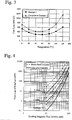
- the magnetic properties, etc. of the resultant cores are shown in Tables 3-2 and 3-3, and the temperature characteristics of core loss in Example 1 and Comparative Example 1 are shown in Fig. 3 .
- the magnetic properties, etc. were evaluated by the same methods as described above.
- the core loss change ratio by heat treatment was determined as described below at each temperature of 20°C, 60°C and 100°C.
- the effects of slow cooling after the heat treatment in Examples and Comparative Examples were compared between samples having the same sum of the keeping time and the cooling time, namely between Example 1 and Comparative Example 1, between Example 7 and Comparative Example 2, and between Example 8 and Comparative Example 3.
- the MnZn ferrite cores of Examples 1-6 obtained by the production method of the present invention exhibited low core loss in any compositions, indicating that they were low-loss MnZn ferrite cores in a wide temperature range.
- V, Ta and Nb are not indispensable as sub-components, but properly adding Nb or Ta and Nb further reduced core loss.
- a green body formed from the material composition A shown in Table 1 in the same manner as in Example 1 was sintered in an atmosphere-adjustable, electric sintering furnace, to obtain a sintered body having an outer diameter of 14 mm, an inner diameter of 7 mm and a thickness of 5 mm.
- the temperature conditions of the sintering step were the same as shown in Fig. 2 in the temperature elevation step, the high-temperature-keeping step and the first cooling step, but differed only in the second cooling step, in which cooling from 250°C to 150°C was conducted at a speed of 5°C/hour. After confirming that the temperature in the sintering furnace became lower than 150°C, the core was taken out of the electric sintering furnace and rapidly cooled.
- the MnZn ferrite cores of Examples 9-13 and Comparative Example 5 were produced in the same manner as in Example 1, except for changing the keeping temperature and the cooling speed in the heat treatment as shown in Table 5-1.
- the cooling of each sample was conducted to 150°C, and subsequently each sample was cooled by air introduced into the furnace from outside.
- Comparative Example 5 cooling was not conducted because the keeping temperature was 150°C, but the sample was cooled by air introduced into the furnace from outside 1 hour after passing the keeping time.
- Their magnetic properties, etc. were evaluated by the same methods as described above. The magnetic properties, etc. of the cores are shown in Tables 5-2 and 5-3. Table 5-1 No. Heat Treatment Conditions Keeping Temperature (°C) Keeping Time (hour) Cooling Speed (°C/hour) Com. Ex.
- Example 19 855 59 63 56
- Example 20 810 67 71 62
- Example 21 775 71 74
- Example 22 765 73 76
- Example 23 755 76 75 67
- the cooling speed of 50°C/hour or less in the heat treatment provided a remarkable effect of reducing core loss in the present invention, thereby providing a MnZn ferrite core with low loss in a wide temperature range.
- Example 1 The core losses before and after the heat treatment in Example 1 were measured at frequencies of 500 kHz, 1 MHz and 2 MHz and exciting magnetic flux densities of 10 mT to 100 mT, at 100°C. The results are shown in Fig. 4 . As is clear from Fig. 4 , the heat-treated MnZn ferrite core of Example 1 within the present invention exhibited low loss at an exciting magnetic flux density of 75 mT or less, at any frequency of 500 kHz, 1 MHz and 2 MHz.
- the core losses of the heat-treated MnZn ferrite cores of Examples 1-3 were measured at a frequency of 2 MHz and an exciting magnetic flux density of 50 mT, at 20°C, 60°C and 100°C, and separated to hysteresis losses, eddy current losses and residual losses.
- the frequency-depending core losses measured at frequencies of 50 kHz to 2 MHz were separated to each loss, and their proportions were determined. The results are shown in Table 8. Table 8 No. Temp.
- Examples 1 and 2 of the present invention containing Nb or Ta exhibited drastically improved hysteresis loss and residual loss, lower loss in a wide temperature range, at 100°C than Example 3 containing neither Nb nor Ta.
- This result is a novel discovery achieved by the present invention, indicating that in the heat treatment with slow cooling, the inclusion of Nb and Ta provides a MnZn ferrite core with further lower loss in a wide temperature range.
Landscapes
- Engineering & Computer Science (AREA)
- Chemical & Material Sciences (AREA)
- Power Engineering (AREA)
- Ceramic Engineering (AREA)
- Manufacturing & Machinery (AREA)
- Organic Chemistry (AREA)
- Materials Engineering (AREA)
- Structural Engineering (AREA)
- Dispersion Chemistry (AREA)
- Inorganic Chemistry (AREA)
- Soft Magnetic Materials (AREA)
- Magnetic Ceramics (AREA)
- Compounds Of Iron (AREA)
Applications Claiming Priority (2)
| Application Number | Priority Date | Filing Date | Title |
|---|---|---|---|
| JP2016061483 | 2016-03-25 | ||
| PCT/JP2017/011932 WO2017164351A1 (fr) | 2016-03-25 | 2017-03-24 | PROCÉDÉ DE PRODUCTION D'UN NOYAU MAGNÉTIQUE EN FERRITE D'UN SYSTÈME Mn-Zn, ET NOYAU MAGNÉTIQUE EN FERRITE D'UN SYSTÈME Mn-Zn |
Publications (2)
| Publication Number | Publication Date |
|---|---|
| EP3441996A1 true EP3441996A1 (fr) | 2019-02-13 |
| EP3441996A4 EP3441996A4 (fr) | 2019-08-14 |
Family
ID=59900551
Family Applications (1)
| Application Number | Title | Priority Date | Filing Date |
|---|---|---|---|
| EP17770391.5A Pending EP3441996A4 (fr) | 2016-03-25 | 2017-03-24 | PROCÉDÉ DE PRODUCTION D'UN NOYAU MAGNÉTIQUE EN FERRITE D'UN SYSTÈME Mn-Zn, ET NOYAU MAGNÉTIQUE EN FERRITE D'UN SYSTÈME Mn-Zn |
Country Status (6)
| Country | Link |
|---|---|
| US (1) | US10950375B2 (fr) |
| EP (1) | EP3441996A4 (fr) |
| JP (1) | JP6856064B2 (fr) |
| CN (1) | CN108885938B (fr) |
| TW (1) | TWI699789B (fr) |
| WO (1) | WO2017164351A1 (fr) |
Families Citing this family (22)
| Publication number | Priority date | Publication date | Assignee | Title |
|---|---|---|---|---|
| JP6962315B2 (ja) * | 2016-03-25 | 2021-11-05 | 日立金属株式会社 | MnZn系フェライトの製造方法及びMnZn系フェライト |
| CN109384463B (zh) * | 2018-12-30 | 2021-04-02 | 常熟浩博电子科技有限公司 | 高频高能效转换MnZn铁氧体及其制备方法 |
| JP7484086B2 (ja) * | 2019-05-15 | 2024-05-16 | 株式会社プロテリアル | MnZn系フェライト磁心の製造方法 |
| JP7247773B2 (ja) * | 2019-06-13 | 2023-03-29 | 株式会社プロテリアル | MnZn系フェライト粉の製造方法 |
| CN110824395B (zh) * | 2019-11-26 | 2022-08-26 | 上海宝钢磁业有限公司 | 基于居里温度和磁感应强度快速确定贫铁锰锌铁氧体成分的方法 |
| JP2021086990A (ja) * | 2019-11-29 | 2021-06-03 | 株式会社タムラ製作所 | リアクトル |
| CN111777419B (zh) * | 2020-05-29 | 2022-05-31 | 天长市烁源磁电有限公司 | 一种磁性铁氧体磁芯的烧结工艺 |
| CN111943658B (zh) * | 2020-06-30 | 2022-06-03 | 天通控股股份有限公司 | 一种宽温低损耗MnZn铁氧体材料及其制备方法 |
| CN111908926A (zh) * | 2020-09-14 | 2020-11-10 | 唐山霍尔磁电设备有限公司 | 一种高磁高性能铁氧体陶瓷软磁的智能加工设备及加工方法 |
| JP7606843B2 (ja) * | 2020-10-02 | 2024-12-26 | 株式会社トーキン | MnZn系フェライト、及びその製造方法 |
| JP7643857B2 (ja) * | 2020-10-20 | 2025-03-11 | 株式会社トーキン | MnZn系フェライト |
| CN112456994A (zh) * | 2020-11-27 | 2021-03-09 | 天通控股股份有限公司 | 一种低温烧结高频低损耗MnZn软磁铁氧体及其制备方法 |
| CN113820031B (zh) * | 2020-12-11 | 2024-07-19 | 中冶长天国际工程有限责任公司 | 一种用于铁矿石直接还原过程的在线测温方法 |
| CN113024235A (zh) * | 2021-02-02 | 2021-06-25 | 浙江国石磁业有限公司 | 一种变频宽温低损耗高磁通密度MnZn功率铁氧体及其制备方法 |
| CN113277840B (zh) * | 2021-05-10 | 2023-05-12 | 天通控股股份有限公司 | 一种高频高工作磁密低损耗锰锌铁氧体及其制备方法 |
| CN114195497A (zh) * | 2021-10-18 | 2022-03-18 | 江西瑞吉磁电子科技有限公司 | 一种高频、高居里温度磁芯材料及其制备方法 |
| CN114605142B (zh) * | 2022-03-28 | 2023-04-04 | 电子科技大学 | 一种ltcf变压器用复合铁氧体基板材料及其制备方法 |
| CN115010480A (zh) * | 2022-07-04 | 2022-09-06 | 娄底市玖鑫电子科技有限公司 | 一种锰锌铁氧体kah100材料制备方法 |
| CN115784731A (zh) * | 2022-11-22 | 2023-03-14 | 上海华源磁业股份有限公司 | 一种高阻抗软磁铁氧体磁芯制备方法 |
| CN121359224A (zh) | 2023-06-21 | 2026-01-16 | 株式会社博迈立铖 | MnZn系软磁铁氧体及其制造方法 |
| CN118073042A (zh) * | 2024-03-07 | 2024-05-24 | 南通冠优达磁业股份有限公司 | 一种充电桩用宽温高频低损耗软磁铁氧体材料的制备方法 |
| CN119638397A (zh) * | 2024-12-20 | 2025-03-18 | 浙江工业大学 | 一种高频低损耗锰锌铁氧体材料及其制备方法 |
Family Cites Families (10)
| Publication number | Priority date | Publication date | Assignee | Title |
|---|---|---|---|---|
| JP2002367822A (ja) | 2001-06-11 | 2002-12-20 | Nec Tokin Corp | 低損失酸化物磁性材料の製造方法 |
| DE10237717B4 (de) * | 2002-08-17 | 2012-12-13 | Robert Bosch Gmbh | Drahtloses Kommunikationssystem für wenigstens eine Steuereinheit in einem Fahrzeug |
| US7790053B2 (en) | 2004-11-19 | 2010-09-07 | Hitachi Metals, Ltd. | Loss-loss Mn-Zn ferrite and electronic part made thereof and switching power supply |
| JP2007070209A (ja) * | 2005-09-09 | 2007-03-22 | Tdk Corp | MnZn系フェライトの製造方法 |
| JP2007112695A (ja) | 2005-09-22 | 2007-05-10 | Tdk Corp | Mnフェライトの製造方法 |
| JP4879658B2 (ja) * | 2005-09-26 | 2012-02-22 | トヨタ自動車株式会社 | 微粒子担持カーボン粒子およびその製造方法ならびに燃料電池用電極 |
| JP5332254B2 (ja) * | 2008-03-25 | 2013-11-06 | Tdk株式会社 | フェライト焼結体 |
| CN103187136A (zh) * | 2013-03-11 | 2013-07-03 | 上海交通大学 | 一种铁基非晶软磁材料及其制备方法 |
| EP3187475B1 (fr) | 2014-08-29 | 2020-07-29 | Hitachi Metals, Ltd. | Ferrite mnzn et procédé pour la fabriquer |
| JP6720878B2 (ja) * | 2014-12-25 | 2020-07-08 | 日立金属株式会社 | MnZn系フェライトの製造方法及びMnZn系フェライト |
-
2017
- 2017-03-24 TW TW106109901A patent/TWI699789B/zh active
- 2017-03-24 JP JP2018507428A patent/JP6856064B2/ja active Active
- 2017-03-24 EP EP17770391.5A patent/EP3441996A4/fr active Pending
- 2017-03-24 CN CN201780019391.3A patent/CN108885938B/zh active Active
- 2017-03-24 WO PCT/JP2017/011932 patent/WO2017164351A1/fr not_active Ceased
- 2017-03-24 US US16/086,381 patent/US10950375B2/en active Active
Also Published As
| Publication number | Publication date |
|---|---|
| WO2017164351A1 (fr) | 2017-09-28 |
| US20190096554A1 (en) | 2019-03-28 |
| US10950375B2 (en) | 2021-03-16 |
| JPWO2017164351A1 (ja) | 2019-02-14 |
| CN108885938A (zh) | 2018-11-23 |
| TWI699789B (zh) | 2020-07-21 |
| TW201737269A (zh) | 2017-10-16 |
| JP6856064B2 (ja) | 2021-04-07 |
| EP3441996A4 (fr) | 2019-08-14 |
| CN108885938B (zh) | 2021-05-07 |
Similar Documents
| Publication | Publication Date | Title |
|---|---|---|
| EP3441996A1 (fr) | PROCÉDÉ DE PRODUCTION D'UN NOYAU MAGNÉTIQUE EN FERRITE D'UN SYSTÈME Mn-Zn, ET NOYAU MAGNÉTIQUE EN FERRITE D'UN SYSTÈME Mn-Zn | |
| EP3239114B1 (fr) | Procédé de production de ferrite à base de mnzn | |
| JP7513154B2 (ja) | MnZn系フェライト粉 | |
| US7790053B2 (en) | Loss-loss Mn-Zn ferrite and electronic part made thereof and switching power supply | |
| JP6962315B2 (ja) | MnZn系フェライトの製造方法及びMnZn系フェライト | |
| CN110494408B (zh) | MnZn系铁氧体烧结体 | |
| WO2016032001A1 (fr) | Ferrite mnzn et procédé pour la fabriquer | |
| EP3597617B1 (fr) | Corps fritté en ferrite à base de ni, composant de bobine et procédé de fabrication d'un corps fritté en ferrite à base de ni | |
| JP2023075218A (ja) | MnZn系フェライト粉 | |
| JP4031886B2 (ja) | Ni−Zn系フェライトの製造方法 | |
| EP4245738A1 (fr) | Ferrite de mnzn frittée et son procédé de production | |
| EP4734132A1 (fr) | Ferrite molle à base de mnzn et son procédé de production |
Legal Events
| Date | Code | Title | Description |
|---|---|---|---|
| STAA | Information on the status of an ep patent application or granted ep patent |
Free format text: STATUS: THE INTERNATIONAL PUBLICATION HAS BEEN MADE |
|
| PUAI | Public reference made under article 153(3) epc to a published international application that has entered the european phase |
Free format text: ORIGINAL CODE: 0009012 |
|
| STAA | Information on the status of an ep patent application or granted ep patent |
Free format text: STATUS: REQUEST FOR EXAMINATION WAS MADE |
|
| 17P | Request for examination filed |
Effective date: 20181024 |
|
| AK | Designated contracting states |
Kind code of ref document: A1 Designated state(s): AL AT BE BG CH CY CZ DE DK EE ES FI FR GB GR HR HU IE IS IT LI LT LU LV MC MK MT NL NO PL PT RO RS SE SI SK SM TR |
|
| AX | Request for extension of the european patent |
Extension state: BA ME |
|
| DAV | Request for validation of the european patent (deleted) | ||
| DAX | Request for extension of the european patent (deleted) | ||
| REG | Reference to a national code |
Ref country code: DE Ref legal event code: R079 Free format text: PREVIOUS MAIN CLASS: H01F0041020000 Ipc: C04B0035260000 |
|
| A4 | Supplementary search report drawn up and despatched |
Effective date: 20190715 |
|
| RIC1 | Information provided on ipc code assigned before grant |
Ipc: H01F 27/255 20060101ALI20190709BHEP Ipc: H01F 41/02 20060101ALI20190709BHEP Ipc: C01G 49/00 20060101ALI20190709BHEP Ipc: H01F 1/34 20060101ALI20190709BHEP Ipc: C04B 35/26 20060101AFI20190709BHEP |
|
| RAP3 | Party data changed (applicant data changed or rights of an application transferred) |
Owner name: PROTERIAL, LTD. |