EP3442254A1 - Bestimmungsverfahren, vorrichtung und system zum starten einer zellmessung und speichermedium - Google Patents
Bestimmungsverfahren, vorrichtung und system zum starten einer zellmessung und speichermedium Download PDFInfo
- Publication number
- EP3442254A1 EP3442254A1 EP16897768.4A EP16897768A EP3442254A1 EP 3442254 A1 EP3442254 A1 EP 3442254A1 EP 16897768 A EP16897768 A EP 16897768A EP 3442254 A1 EP3442254 A1 EP 3442254A1
- Authority
- EP
- European Patent Office
- Prior art keywords
- terminal
- type
- cell measurement
- starting
- cell
- Prior art date
- Legal status (The legal status is an assumption and is not a legal conclusion. Google has not performed a legal analysis and makes no representation as to the accuracy of the status listed.)
- Ceased
Links
Images



Classifications
-
- H—ELECTRICITY
- H04—ELECTRIC COMMUNICATION TECHNIQUE
- H04W—WIRELESS COMMUNICATION NETWORKS
- H04W24/00—Supervisory, monitoring or testing arrangements
- H04W24/08—Testing, supervising or monitoring using real traffic
-
- H—ELECTRICITY
- H04—ELECTRIC COMMUNICATION TECHNIQUE
- H04W—WIRELESS COMMUNICATION NETWORKS
- H04W36/00—Hand-off or reselection arrangements
- H04W36/0005—Control or signalling for completing the hand-off
- H04W36/0083—Determination of parameters used for hand-off, e.g. generation or modification of neighbour cell lists
- H04W36/0085—Hand-off measurements
- H04W36/0088—Scheduling hand-off measurements
-
- H—ELECTRICITY
- H04—ELECTRIC COMMUNICATION TECHNIQUE
- H04W—WIRELESS COMMUNICATION NETWORKS
- H04W36/00—Hand-off or reselection arrangements
- H04W36/24—Reselection being triggered by specific parameters
-
- H—ELECTRICITY
- H04—ELECTRIC COMMUNICATION TECHNIQUE
- H04W—WIRELESS COMMUNICATION NETWORKS
- H04W52/00—Power management, e.g. Transmission Power Control [TPC] or power classes
- H04W52/02—Power saving arrangements
- H04W52/0203—Power saving arrangements in the radio access network or backbone network of wireless communication networks
- H04W52/0206—Power saving arrangements in the radio access network or backbone network of wireless communication networks in access points, e.g. base stations
-
- H—ELECTRICITY
- H04—ELECTRIC COMMUNICATION TECHNIQUE
- H04W—WIRELESS COMMUNICATION NETWORKS
- H04W52/00—Power management, e.g. Transmission Power Control [TPC] or power classes
- H04W52/02—Power saving arrangements
- H04W52/0209—Power saving arrangements in terminal devices
-
- H—ELECTRICITY
- H04—ELECTRIC COMMUNICATION TECHNIQUE
- H04W—WIRELESS COMMUNICATION NETWORKS
- H04W52/00—Power management, e.g. Transmission Power Control [TPC] or power classes
- H04W52/02—Power saving arrangements
- H04W52/0209—Power saving arrangements in terminal devices
- H04W52/0225—Power saving arrangements in terminal devices using monitoring of external events, e.g. the presence of a signal
-
- H—ELECTRICITY
- H04—ELECTRIC COMMUNICATION TECHNIQUE
- H04W—WIRELESS COMMUNICATION NETWORKS
- H04W48/00—Access restriction; Network selection; Access point selection
- H04W48/16—Discovering, processing access restriction or access information
-
- H—ELECTRICITY
- H04—ELECTRIC COMMUNICATION TECHNIQUE
- H04W—WIRELESS COMMUNICATION NETWORKS
- H04W52/00—Power management, e.g. Transmission Power Control [TPC] or power classes
- H04W52/02—Power saving arrangements
- H04W52/0209—Power saving arrangements in terminal devices
- H04W52/0212—Power saving arrangements in terminal devices managed by the network, e.g. network or access point is leader and terminal is follower
-
- H—ELECTRICITY
- H04—ELECTRIC COMMUNICATION TECHNIQUE
- H04W—WIRELESS COMMUNICATION NETWORKS
- H04W52/00—Power management, e.g. Transmission Power Control [TPC] or power classes
- H04W52/02—Power saving arrangements
- H04W52/0209—Power saving arrangements in terminal devices
- H04W52/0225—Power saving arrangements in terminal devices using monitoring of external events, e.g. the presence of a signal
- H04W52/0245—Power saving arrangements in terminal devices using monitoring of external events, e.g. the presence of a signal according to signal strength
-
- H—ELECTRICITY
- H04—ELECTRIC COMMUNICATION TECHNIQUE
- H04W—WIRELESS COMMUNICATION NETWORKS
- H04W52/00—Power management, e.g. Transmission Power Control [TPC] or power classes
- H04W52/02—Power saving arrangements
- H04W52/0209—Power saving arrangements in terminal devices
- H04W52/0251—Power saving arrangements in terminal devices using monitoring of local events, e.g. events related to user activity
- H04W52/0254—Power saving arrangements in terminal devices using monitoring of local events, e.g. events related to user activity detecting a user operation or a tactile contact or a motion of the device
-
- H—ELECTRICITY
- H04—ELECTRIC COMMUNICATION TECHNIQUE
- H04W—WIRELESS COMMUNICATION NETWORKS
- H04W76/00—Connection management
- H04W76/20—Manipulation of established connections
- H04W76/27—Transitions between radio resource control [RRC] states
-
- Y—GENERAL TAGGING OF NEW TECHNOLOGICAL DEVELOPMENTS; GENERAL TAGGING OF CROSS-SECTIONAL TECHNOLOGIES SPANNING OVER SEVERAL SECTIONS OF THE IPC; TECHNICAL SUBJECTS COVERED BY FORMER USPC CROSS-REFERENCE ART COLLECTIONS [XRACs] AND DIGESTS
- Y02—TECHNOLOGIES OR APPLICATIONS FOR MITIGATION OR ADAPTATION AGAINST CLIMATE CHANGE
- Y02D—CLIMATE CHANGE MITIGATION TECHNOLOGIES IN INFORMATION AND COMMUNICATION TECHNOLOGIES [ICT], I.E. INFORMATION AND COMMUNICATION TECHNOLOGIES AIMING AT THE REDUCTION OF THEIR OWN ENERGY USE
- Y02D30/00—Reducing energy consumption in communication networks
- Y02D30/70—Reducing energy consumption in communication networks in wireless communication networks
Definitions
- the disclosure relates to the field of communications, and in particular to a determination method, apparatus and system for starting cell measurement, and a storage medium.
- the Narrow Band Internet of Things (NB-IOT) was established. Requirements of the NB-IOT for the power consumption are lower than the power consumption in 2G, and the standby time of a terminal module may be up to 10 years.
- UE User Equipment
- the measurement frequency is reduced as much as possible, and it is only necessary to periodically search for a cell with high-priority. If it is found that a certain cell with high-priority cannot meet a reselection condition, the measurement does not need to be continued.
- a number of different thresholds are defined in the standard to control cell reselection.
- the basic criteria are as follows.
- the UE In order to avoid the ping-pong effect, the UE is required to reside on a serving cell for more than 1 second for all reselections.
- a cell with high-priority must be reselected; for inter-frequency or heterogeneous system cells with high-priority, when the Srxlev of the cell exceeds a corresponding threshold (Threshx, high) for a period of time (Treselection), reselection can be performed.
- the best-sorted cell is reselected.
- the serving cell and the neighboring cell are rated according to a cell rating criterion (R criterion), the UE must reselect the best-rated cell.
- Rn an actual value of a Reference Signal Received Power (RSRP) of a neighboring cell measured by a UE - a serving cell reselection hysteresis
- Rs an actual value of a RSRP of a serving cell measured by a UE + a serving cell reselection hysteresis
- reselection For an inter-frequency or heterogeneous system cell with low-priority, when the Srxlev of the serving cell is lower than a corresponding threshold (Threshserving, low), and the Srxlev of the cell with low-priority exceeds a corresponding threshold (Threshx, low) for a period of time (Treselection), reselection can be performed.
- the disclosure provides a determination method, apparatus and system for starting cell measurement, and a storage medium, intended to at least solve the problem in the related art in which requirements of the NB-IOT for power consumption cannot be met by terminal measurement and reselection/handover solutions.
- a determination method for starting cell measurement includes that: after a terminal is registered with a network, the type of the terminal is judged according to identification information of the terminal, here, the type of the terminal includes a fixed terminal or a mobile terminal; and a trigger condition for starting the cell measurement is determined for the terminal according to the type.
- the identification information may include at least one of an International Mobile Subscriber Identification Number (IMSI) or a Mobile Subscriber Identification Number (MSIN).
- IMSI International Mobile Subscriber Identification Number
- MSIN Mobile Subscriber Identification Number
- a trigger condition for starting the cell measurement determined for the terminal according to the type may include: responsive to that the type is a fixed terminal, the trigger condition includes at least one of: a network parameter of a cell where the terminal is located is smaller than or equal to a first predetermined threshold or a network parameter of a neighboring cell of the terminal is greater than or equal to a second predetermined threshold; or a difference between the network parameter of the cell where the terminal is located and the network parameter of the neighboring cell of the terminal is smaller than or equal to a third predetermined threshold; and responsive to that the type is a mobile terminal, the trigger condition is that an area where the terminal enters is an area where the value of a signal receiving parameter is smaller than a fourth predetermined threshold.
- the method may further include that: responsive to that the type is a fixed terminal, before a trigger condition for starting the cell measurement is determined for the terminal according to the type, information of the signal receiving parameter actively reported by the terminal is received, and a network parameter of a cell where the terminal is located and/or a network parameter of a neighboring cell of the terminal are monitored.
- the method may further include that: responsive to that the type is a mobile terminal, before a trigger condition for starting the cell measurement is determined for the terminal according to the type, it is estimated whether the terminal needs to start the cell measurement according to at least one of a position of the area where the terminal is located or the pre-stored value range of a signal receiving parameter of the area.
- the method may further include that: before it is estimated whether the terminal needs to start the cell measurement according to at least one of the position of the area where the terminal is located or the pre-stored value range of the signal receiving parameter of the area, responsive to that the terminal enters a Radio Resource Control (RRC) connected state, a motion track of the terminal is monitored according to a tracking function of the terminal; and position information of the area where the terminal is located is determined according to the motion track.
- RRC Radio Resource Control
- the method may further include that: after a trigger condition for starting the cell measurement is determined for the terminal according to the type, responsive to that the trigger condition is met, an instruction is sent to the terminal for starting the cell measurement.
- the network parameter may include: a transmitting power.
- the signal receiving parameter may include at least one of an RSRP, a Reference Signal Received Quality (RSRQ), a Reference Signal Received Intensity (RSRI), or a Signal to Interference plus Noise Ratio (SINR).
- RSRP Reference Signal Received Quality
- RSRI Reference Signal Received Intensity
- SINR Signal to Interference plus Noise Ratio
- a determination method for starting cell measurement includes that: after a terminal is registered with a network, an instruction sent from a device at the network side and used for instructing the terminal to start the cell measurement is received, the instruction being an instruction triggered if the terminal meets a trigger condition for starting the cell measurement, the trigger condition for starting the cell measurement is determined by the device at the network side according to the type of the terminal, the type of the terminal being acquired by the device at the network side according to identification information of the terminal, and the type of the terminal includes a fixed terminal or a mobile terminal; and the cell measurement is started according to the instruction.
- the identification information includes at least one of an IMSI or an MSIN.
- the trigger condition for starting the cell measurement determined by the device at the network side according to the type of the terminal may include that: responsive to that the type is a fixed terminal, the trigger condition includes at least one of: a network parameter of a cell where the terminal is located is smaller than or equal to a first predetermined threshold, a network parameter of a neighboring cell of the terminal is greater than or equal to a second predetermined threshold; or a difference between the network parameter of the cell where the terminal is located and the network parameter of the neighboring cell of the terminal is smaller than or equal to a third predetermined threshold; and responsive to that the type is a mobile terminal, the trigger condition is that an area where the terminal enters is an area where a value of a signal receiving parameter is smaller than a fourth predetermined threshold.
- the network parameter may include a transmitting power.
- a determination apparatus for starting cell measurement includes: a judging module, configured to judge, after a terminal is registered with a network, the type of the terminal according to identification information of the terminal, here, the type of the terminal includes a fixed terminal or a mobile terminal; and a determining module, configured to determine a trigger condition for starting the cell measurement for the terminal according to the type.
- a determination apparatus for starting cell measurement includes: a receiving module, configured to receive, after a terminal is registered with a network, an instruction sent from a device at the network side and used for instructing the terminal to start the cell measurement, the instruction being an instruction triggered if the terminal meets a trigger condition for starting the cell measurement, the trigger condition for starting the cell measurement is determined by the device at the network side according to the type of the terminal, the type of the terminal being acquired by the device at the network side according to identification information of the terminal, and the type of the terminal includes a fixed terminal or a mobile terminal; and a starting module, configured to start the cell measurement according to the instruction.
- a determination system for starting cell measurement includes: a core network, a base station and a terminal, here, the terminal is located in a coverage area of the base station; the core network is configured to judge, after the terminal is registered with a network, the type of the terminal according to identification information of the terminal, and send the type to the base station; the base station is configured to receive the type sent from the core network, determine a trigger condition for starting the cell measurement for the terminal according to the type, and send an instruction for instructing the terminal to start the cell measurement to the terminal when determining that the terminal meets the trigger condition; and the terminal is configured to start, after receiving the instruction, the cell measurement.
- the embodiment of the disclosure further provides a computer storage medium.
- the computer storage medium stores a computer executable instruction.
- the computer executable instruction is used to implement the above determination method for starting cell measurement according to the embodiment of the disclosure.
- the type of a terminal is judged according to identification information of the terminal, and a trigger condition for starting cell measurement is determined according to the type of the terminal. That is, the different types of terminals correspond to different trigger conditions for starting the cell measurement, thus saving corresponding energy, better meeting requirements of the NB-IOT for power consumption, solving the problem in the related art in which requirements of the NB-IOT for power consumption cannot be met by terminal measurement and reselection/handover solutions, and saving energy while also improving the flexibility of the cell measurement.
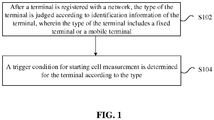
- FIG. 1 is a first flowchart of a determination method for starting cell measurement according to an embodiment of the disclosure. As shown in FIG. 1 , the flow includes the operations as follows.
- the type of the terminal is judged according to identification information of the terminal, here, the type of the terminal is a fixed terminal or a mobile terminal.
- a trigger condition for starting the cell measurement is determined for the terminal according to the type.
- the type of a terminal is judged according to identification information of the terminal, and a trigger condition for starting cell measurement is determined according to the type of the terminal. That is, the different types of terminals correspond to different trigger conditions for starting the cell measurement, thus saving corresponding energy, better meeting requirements of the NB-IOT for power consumption, solving the problem in the related art in which requirements of the NB-IOT for power consumption cannot be met by terminal measurement and reselection/handover solutions, and saving energy while also improving the flexibility of the cell measurement.
- the above terminal may be a terminal under the NB-IOT, but is not limited thereto; the above execution body may be a device at a network side such as a base station or a core network device, but is not limited thereto.
- the identification information may be at least one of an IMSI or an MSIN.
- the MSIN generally has 10 digits, and its structure is as follows: EF+M0M1M2M3+ABCD, where EF may be allocated by an operator; a corresponding relationship may exist between M0M1M2M3 and H0H1H2H3 in a Mobile Directory Number (MDN); ABCD, four digits, which may be randomly allocated.
- MDN Mobile Directory Number
- ABCD four digits, which may be randomly allocated.
- the identification information may be set in the following manner, but it is not limited to this.
- the 6 digits of EF and ABCD may be used to set a specific identifier for the NB-IOT.
- EF is 00 means NB-IOT UE
- D is 0 means a fixed UE
- the D is 1 means a mobile UE.
- the trigger condition may also be understood as a condition that the terminal has to perform measurement, reselection or handover. Therefore, operation S104 may be at least one of: when the type is a fixed terminal, the trigger condition includes at least one of: a network parameter of a cell where the terminal is located is smaller than or equal to a first predetermined threshold; a network parameter of a neighboring cell of the terminal is greater than or equal to a second predetermined threshold; or a difference between the network parameter of the cell where the terminal is located and the network parameter of the neighboring cell of the terminal is smaller than or equal to a third predetermined threshold; and when the type is a mobile terminal, the trigger condition is that an area where the terminal enters is an area where a received signal is smaller than a fourth predetermined threshold.
- the area where the value of the signal receiving parameter is smaller than the fourth predetermined threshold is an area where an access signal is poor.
- first predetermined threshold, the second predetermined threshold, the third predetermined threshold and the fourth predetermined threshold may be preset according to actual situations, but are not limited thereto.
- a terminal will start the cell measurement when the terminal has to perform measurement, reselection or handover. If the measurement, reselection or handover is not required to be performed, the terminal does not start the cell measurement. Compared with the related art in which the terminal continuously performs the cell measurement, energy is saved to a greater extent. For the NB-IOT, it can better meet the requirements of the NB-IOT for power consumption.
- the method may further include that: information of a signal receiving parameter actively reported by the terminal is received, and a network parameter of a cell where the terminal is located and/or a network parameter of a neighboring cell of the terminal are monitored.
- the signal receiving parameter may include, but is not limited to, at least one of an RSRP, an RSRQ, an RSRI, or an SINR.
- the network parameter may be a transmitting power, but is not limited thereto.
- the method may further include that: it is estimated whether the terminal needs to start the cell measurement according to a position of the area where the terminal is located and/or a pre-stored value range of the signal receiving parameter of the area.
- the pre-stored value range of the signal receiving parameter of the area may be obtained by the following manners.
- a signal receiving situation of each area in the cell e.g., RSRP, RSRQ, SINR, etc.
- the base station estimates the change range of the signal receiving parameter such as RSRP and RSRQ of the terminal in each area according to the signal receiving situation of each area in the cell (e.g., RSRP, RSRQ, SINR, etc.), and then the channel situation and the corresponding parameters of the area are stored in the base station.
- Which areas have strong signal reception and which areas have weak signal reception can be obtained by the sampling performed by multiple terminals, and the information is stored in the base station.
- the terminal does enter an area where the signal reception is weak (i.e., the area where the terminal is located is determined to be the area where the signal reception is weak). This can avoid the problem that a terminal consumes power by unnecessary measurement in some areas where the signal reception is good.
- the above estimation process is not limited to this.
- the terminal when the terminal is a mobile terminal, the terminal generally has a tracking function and the tracking function can be used to position the terminal. Therefore, the method may further include that: before it is estimated whether the terminal needs to start the cell measurement according to the position of an area where the terminal is located and/or the pre-stored value range of the signal receiving parameter of the area, when the terminal enters a RRC connected state, a motion track of the terminal is monitored according to a positioning function of the terminal; and position information of an area where the terminal is located is determined according to the motion track.
- the method may further include that: when the trigger condition is met, an instruction is sent to the terminal for starting the cell measurement. At the same time as or after the instruction is sent, a timer may be started. When the terminal completes the measurement and a measurement result meets a handover condition, the terminal is notified to perform the handover. If the handover condition is not met, the terminal is notified to stop the measurement if the timer expires.
- the instruction may be sent by paging information or dedicated signaling, but is not limited thereto.
- FIG. 2 is a second flowchart of a determination method for starting cell measurement according to an embodiment of the disclosure. As shown in FIG. 2 , the flow includes the operations as follows.
- an instruction sent from a device at a network side and used for instructing the terminal to start the cell measurement is received, here, the instruction is an instruction triggered if the terminal meets a trigger condition for starting the cell measurement, the trigger condition for starting the cell measurement is determined by the device at the network side according to the type of the terminal, the type of the terminal is acquired by the device at the network side according to identification information of the terminal, and the type of the terminal includes a fixed terminal or a mobile terminal.
- the cell measurement is started according to the instruction.
- the type of a terminal is judged according to identification information of the terminal, and a trigger condition for starting cell measurement is determined according to the type of the terminal. That is, the different types of terminals correspond to different trigger conditions for starting the cell measurement, thus saving corresponding energy, better meeting requirements of the NB-IOT for power consumption, solving the problem in the related art in which requirements of the NB-IOT for power consumption cannot be met by terminal measurement and reselection/handover solutions, and saving energy while also improving the flexibility of the cell measurement.
- the above terminal may be a terminal under the NB-IOT, but is not limited thereto; the above execution body may be a terminal.
- the identification information may be at least one of an IMSI or an MSIN.
- the MSIN generally has 10 digits, and its structure is as follows: EF+M0M1M2M3+ABCD, where EF may be allocated by an operator; a corresponding relationship may exist between M0M1M2M3 and H0H1H2H3 in an MDN; ABCD, four digits, which may be randomly allocated.
- the identification information may be set in the following manner, but it is not limited to this.
- the 6 digits of EF and ABCD may be used to set a specific identifier for the NB-IOT.
- EF is 00 means NB-IOT UE
- D is 0 means a fixed UE
- the D is 1 means a mobile UE.
- the trigger condition for starting the cell measurement by the device at the network side according to the type of the terminal may include that: when the type is a fixed terminal, the trigger condition is that a network parameter of a cell where the terminal is located is smaller than or equal to a first predetermined threshold or a network parameter of a neighboring cell of the terminal is greater than or equal to a second predetermined threshold; and when the type is a mobile terminal, the trigger condition is that an area where the terminal enters is an area where the value of a signal receiving parameter is smaller than a third predetermined threshold.
- the area where the value of the signal receiving parameter is smaller than the third predetermined threshold is an area where an access signal is poor.
- the network parameter may include a transmitting power.
- the terminal will start the cell measurement when the terminal has to perform measurement, reselection or handover. If the measurement, reselection or handover is not required to be performed, the terminal does not start the cell measurement. Compared with the related art in which the terminal continuously performs the cell measurement, energy is saved to a greater extent. For the NB-IOT, it can better meet the requirements of the NB-IOT for power consumption.
- the disclosure provides an optional determination method for starting cell measurement.
- the method includes that: when a terminal in an NB-IOT is registered with a network, a core network may determine whether the terminal is a fixed terminal or a mobile terminal according to identification information of UE such as an IMSI in a SIM card, and send the information to a base station where the terminal is located; and the base station performs measurement reselection/handover policy for the terminal according to the information.
- the geographical location where the smart water meter is located is fixed, the communication scenario is relatively simple, and the measurement and reselection/handover of networks are not required frequently.
- the core network determines whether the registered terminal is a fixed terminal or a mobile terminal according to its IMSI. Then, the core network sends the information to the base station where the terminal is located, and the base station determines different measurement and reselection/handover solutions according to the property of the terminal.
- a network side may perform monitoring and instruct a UE to perform passive cell measurement and reselection/handover, instead of performing active measurement and reselection/handover by the UE.
- a mobile terminal generally has a tracking function, such as a smart travel companion with NB-IOT (a device with tracking function for smart luggage) or a smart tracking on Bicycle (a device for tracking on bicycle).
- This function can be used (this function can only be used when the UE is in an RRC connected state), and when the device starts, a network state diagram of a cell where the device is located and a neighboring cell is downloaded, so the network instructs the UE to trigger and start the measurement when moving to some areas. If the UE moves to the neighboring cell, the above operations are repeatedly performed at the time of the handover. This avoids the UE from consuming power by making unnecessary measurements and reporting when the network is in good condition.
- the IMSI in the existing communication network is defined as follows.
- FIG. 3 is a structure schematic diagram of an IMSI according to an embodiment of the disclosure. As shown in FIG. 3 , the IMSI is composed of MCC+MNC+MSIN.
- MCC Mobile Country Code
- MNC Mobile Network Code
- PLMN Public Land Mobile Network
- MNC Public Land Mobile Network Controller
- MSIN used to identify mobile subscribers in a mobile communication network. There are 10 digits in total, and the structure is as follows. EF+M0M1M2M3+ABCD
- the EF is allocated by an operator; M0M1M2M3 and H0H1H2H3 in an MDN may have a corresponding relationship; ABCD, four digits, randomly allocated.
- EF may be allocated by an operator. ABCD are randomly allocated. Then these 6 digits may be used to set a specific identifier for the NB-IOT.
- EF is 00 means NB-IOT UE
- D is 0 means a fixed UE
- the D is 1 means a mobile UE.
- FIG. 4 is a schematic diagram of a process for starting cell measurement for a fixed terminal according to an embodiment of the disclosure. As shown in FIG. 4 , the process may include the operations as follows.
- a fixed UE A starts a device and accesses to a certain cell.
- operation S404 it is judged whether the network registration is completed, and if so, operation S406 is performed.
- a core network acquires an IMSI code of the UE A, and identifies the UE A as a fixed terminal according to the IMSI code of the UE A.
- the core network sends a message to a base station to which the UE A belongs, the message including information (fixed or mobile) in the base station that the UE A is a fixed terminal.
- the base station performs a corresponding measurement/reselection/handover policy according to the above information.
- the UE A starts the first measurement, and reports the channel quality, signal reception status (such as indicators of RSRP, RSRI, RSRQ, SINR, etc. which represent the channel status) to the base station.
- signal reception status such as indicators of RSRP, RSRI, RSRQ, SINR, etc. which represent the channel status
- the base station monitors the network condition of a cell where the UE A is located and a neighboring cell (such as a condition of transmitting power of the cell).
- the base station may perform estimation according to the network condition.
- operation S418 is performed, otherwise, operation S416 is performed.
- the base station sends an instruction (for UE in an idle state, the instruction is included in a paging message, and UE in a connected state, the instruction is sent through a dedicated signaling) to the UE A to instruct it to start measurement.
- a Timer A is started, and the time is set to be T1 (sufficient for the UE A to complete the measurement, reselection/handover).
- the UE A starts the measurement.
- operation S424 it is judged whether the measurement result meets the reselection/handover condition, if yes, operation S426 is performed; otherwise, operation S428 is performed.
- the UE A performs the reselection/handover.
- FIG. 5 is a schematic diagram of a process for starting cell measurement for a mobile terminal according to an embodiment of the disclosure. As shown in FIG. 5 , the starting flow includes the operations as follows.
- a signal receiving situation of each area in the cell can be obtained by for example placing multiple terminals in some typical areas of each cell to perform measurement, the base station can estimate change ranges of signal receiving parameters such as RSRP and RSRQ of the terminal in each area according to a signal receiving situation of each area in the cell (e.g., RSRP, RSRQ, SINR, etc.), and then the channel situation and the corresponding parameters of the area are stored in the base station.
- a UE B enters a connected state to start a positioning function.
- the base station monitors a motion track of the UE B (which may be positioned by a GPS).
- the base station estimates whether the UE B needs to start measurement, handover and the like by searching for the previously stored information such as RSRP and RSRQ according to the position of the area where the UE B is located , that is, the base station estimates whether the UE B needs to start the measurement, handover and the like according to the position of the area where the UE B is located and the previously stored value ranges of parameters such as RSRP, RSRQ and the like, thereby avoiding the process of power consumption of the UE B performing unnecessary measurement in some areas with good signal reception.
- the previously stored information such as RSRP and RSRQ
- operation S510 it is judged whether the UE B enters an area where the signal reception is poor; when the UE B enters the area where the signal reception is poor, the base station side estimates that the UE B has to perform the handover, operation S512 is performed, otherwise, operation S514 is performed.
- the base station sends signaling to the UE B to start measurement.
- the UE B starts a Timer B, and sets the time to be T2 (sufficient for the UE A to complete the measurement and handover).
- the UE starts measurement.
- operation S528 it is judged whether the measurement result meets the handover condition, if yes, operation S520 is performed; otherwise, operation S522 is performed.
- the UE B performs handover.
- operation S522 it is judged whether the timer expires; if yes, operation S524 is performed; otherwise, operation S516 is performed.
- the UE B stops the measurement.
- An NB-IOT Forest Monitor Terminal (F) is deployed somewhere in a forest to monitor natural disasters such as fires in forests or to determine behavior such as illegal logging.
- F NB-IOT Forest Monitor Terminal
- a small base station is added near a cell where F is located, and the signal receiving condition in the new-added neighboring cell will be better than that of the cell to which the F originally belongs, and F needs to perform reselection.
- the specific process is as follows. F is started and registered with a network. A core network judges that the terminal is a fixed terminal in the NB-IOT according to the IMSI of the terminal.
- the core network sends a message including the terminal attribute (either a fixed state or a mobile state) to a base station to which the terminal belongs.
- the base station performs a measurement, reselection/handover algorithm of the fixed terminal in the NB-IOT according to the above attributes.
- F starts measurement and feeds back channel measurement information (RSRP, RSRQ, SINR, etc.) to the base station, and then releases an RRC connection to enter an idle state.
- the base station monitors the network conditions of the cell where the terminal F is located and the neighboring cell (e.g., load (considered when the handover is performed), transmitting power status, etc.).
- the base station detects that a new station is added to the cell where the terminal F is located, and estimates RSRP and RSRQ values of the cell where the terminal F is located and the neighboring cell of the terminal F according to the situation of the signal received by F previously. If the estimated RSRP and RSRQ values of the neighboring cell are better than corresponding thresholds, the base station sends an instruction for staring measurement to the terminal F.
- the terminal F starts measurement and starts a Timer A, and sets the time to be T1 (sufficient for the terminal F to complete the measurement, reselection/handover), and if the measurement result meets the condition of performing the reselection/handover, the terminal F performs the reselection/handover. If the measurement result does not meet the condition of performing the reselection/handover, the terminal F stops the measurement when the Timer A expires.
- An NB-IOT mobile terminal bicycle recorder G is placed on a bicycle and used for tracking and recording the bicycle. After a terminal G is started, the bicycle starts to move, and when it is slowly driven to a certain cell, handover is needed to be performed.
- the specific process is as follows. in the initial stage of deploying a base station, the base station masters a channel situation of each area in the cell (e.g., RSRP, RSRQ, SINR, etc.) according to the measurement result obtained by NB-IOT terminals placed in some typical areas of each cell, and the channel situation and the corresponding area parameters are stored in the base station.
- the terminal G is started and registered with a network.
- a core network judges that the terminal G is a mobile terminal in the NB-IOT according to an IMSI of the terminal G.
- the core network sends a message including the terminal attribute (either a fixed state or a mobile state) to a base station to which the terminal belongs.
- the base station performs a measurement, reselection/handover algorithm of the mobile terminal in the NB-IOT according to the above attributes.
- the base station judges whether the terminal G needs to start the measurement, handover, etc. according to the monitored position of the bicycle and the previously stored signal receiving situation of each area in the cell.
- the bicycle slowly travels from a cell A to a cell B.
- the terminal G When the base station determines that the bicycle has reached an area where the signal reception is not good, the terminal G is triggered to start the measurement, and a Timer B is started and the time is set to be T2 (sufficient for the terminal G to complete the measurement and handover), and if the measurement result meets the handover condition, the handover is performed. If the measurement result does not meet the reselection/handover condition, the terminal G stops the measurement when the Timer B expires.
- the method according to the above embodiment may be implemented by means of software plus a necessary general hardware platform, and of course, may also be implemented through hardware, but in many cases, the former is a better implementation manner.
- the technical solution of the disclosure which is essential or contributes to the conventional art, may be embodied in the form of a software product stored in a storage medium (such as a ROM/RAM, a magnetic disk and an optical disc), including a number of instructions for causing a terminal device (which may be a mobile phone, a computer, a server, or a network device, etc.) to perform the methods described in various embodiments of the disclosure.
- a determination apparatus for starting cell measurement is also provided.
- the apparatus is used to implement the above embodiments and preferred implementation manners, and those have not been described will not be elaborated.
- the term "module” may implement a combination of software and/or hardware of a predetermined function.
- the apparatus described in the following embodiments is preferably implemented in software, hardware, or a combination of software and hardware, is also possible and contemplated.
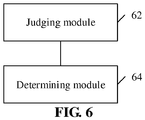
- FIG. 6 is a structure block diagram of a determination apparatus for starting cell measurement according to an embodiment of the disclosure. As shown in FIG. 6 , the apparatus includes a judging module 62 and a determining module 64.
- the judging module 62 is configured to judge, after a terminal is registered with a network, the type of the terminal according to identification information of the terminal, wherein the type of the terminal includes a fixed terminal or a mobile terminal.
- the determining module 64 is connected to the judging module 62 and is configured to determine, for the terminal, a trigger condition for starting the cell measurement according to the type.
- the type of a terminal is judged according to identification information of the terminal, and a trigger condition for starting cell measurement is determined according to the type of the terminal. That is, the different types of terminals correspond to different trigger conditions for starting the cell measurement, thus saving corresponding energy, better meeting requirements of The NB-IOT for power consumption, solving the problem in the related art in which requirements of The NB-IOT for power consumption cannot be met by terminal measurement and reselection/handover solutions, and saving energy while also improving the flexibility of cell measurement.
- the above terminal may be a terminal under the NB-IOT, but is not limited thereto.
- the above apparatus may be located on a device at the network side such as a base station or a core network device, but is not limited thereto.
- the identification information may be at least one of an IMSI or an MSIN.
- the MSIN generally has 10 digits, and its structure is as follows: EF+M0M1M2M3+ABCD, where EF may be allocated by an operator; a corresponding relationship may exist between M0M1M2M3 and H0H1H2H3 in an MDN; ABCD, four digits, which may be randomly allocated.
- the identification information may be set in the following manner, but it is not limited to this.
- the 6 digits of EF and ABCD may be used to set a specific identifier for the NB-IOT.
- EF is 00 means NB-IOT UE, where D is 0 means a fixed UE, and the D is 1 means a mobile UE.
- the trigger condition may also be understood as a condition that the terminal has to perform measurement, reselection or handover. Therefore, the corresponding relationship between the trigger condition and the terminal type may be presented as that: when the type is a fixed terminal, the trigger condition includes at least one of : a network parameter of a cell where the terminal is located is smaller than or equal to a first predetermined threshold, a network parameter of a neighboring cell of the terminal is greater than or equal to a second predetermined threshold; or a difference between the network parameter of the cell where the terminal is located and the network parameter of the neighboring cell of the terminal is smaller than or equal to a third predetermined threshold; and when the type is a mobile terminal, the trigger condition is that an area where the terminal enters is an area where a received signal is smaller than a fourth predetermined threshold.
- the area where the value of the signal receiving parameter is smaller than the fourth predetermined threshold is an area where an access signal is poor.
- the first predetermined threshold, the second predetermined threshold, the third predetermined threshold and the fourth predetermined threshold may be preset according to actual situations, but are not limited thereto.
- the terminal will start the cell measurement when the terminal has to perform the measurement, reselection or handover. If the measurement, reselection or handover is not required to be performed, the terminal does not start the cell measurement. Compared with the related art in which the terminal continuously performs the cell measurement, energy is saved to a greater extent. For the NB-IOT, it can better meet the requirements of the NB-IOT for power consumption.
- the apparatus may include: a receiving module, connected to the determining module 64, and configured to receive, when the type is a fixed terminal, information of a signal receiving parameter actively reported by the terminal, and monitor a network parameter of a cell where the terminal is located and/or a network parameter of a neighboring cell of the terminal.
- the signal receiving parameter may include, but is not limited to, at least one of an RSRP, an RSRQ, an RSRI, or an SINR.
- the network parameter may be a transmitting power, but is not limited thereto.
- the apparatus may further include: an estimating module, configured to estimate, when the type is a mobile terminal, whether the terminal needs to start the cell measurement according to the position of an area where the terminal is currently located and/or the value range of a signal receiving parameter of a pre-stored area.
- an estimating module configured to estimate, when the type is a mobile terminal, whether the terminal needs to start the cell measurement according to the position of an area where the terminal is currently located and/or the value range of a signal receiving parameter of a pre-stored area.
- the value range of the signal receiving parameter of the pre-stored area may be obtained by the following manners.
- a signal receiving situation of each area in the cell e.g., RSRP, RSRQ, SINR, etc.
- the base station estimates the change range of the signal receiving parameter such as RSRP and RSRQ of the terminal in each area according to the signal receiving situation of each area in the cell (e.g., RSRP, RSRQ, SINR, etc.), and then the channel situation and the corresponding parameters of the area are stored in the base station.
- Which areas have strong signal reception and which areas have weak signal reception can be obtained by the sampling performed by multiple terminals, and the information is stored in the base station.
- the estimating module estimates whether the terminal needs to start the cell measurement according to the position of an area where the terminal is located and the pre-stored value range of a signal receiving parameter of the area. First, according to the position of the area where the terminal is located, it is predicted whether the area is a pre-stored area where signal reception is weak. If the signal reception is weak, the value of the signal receiving parameter of the terminal in the area is compared with the pre-stored value range.
- the terminal needs to start the cell measurement, that is, the terminal does enter an area where the signal reception is weak (i.e., the area where the terminal is located is determined to be the area where the signal reception is weak). This can avoid the problem that a terminal consumes power by unnecessary measurement in some areas where signal reception is good.
- the above estimation process is not limited to this.
- the apparatus may further include: a positioning module, configured to monitor, when the terminal enters a RRC connected state, a motion track of the terminal according to a positioning function of the terminal, and determine position information of an area where the terminal is located according to the motion track.
- a positioning module configured to monitor, when the terminal enters a RRC connected state, a motion track of the terminal according to a positioning function of the terminal, and determine position information of an area where the terminal is located according to the motion track.
- the apparatus may further include a sending module, connected to the determining module 64, and configured to send, when the trigger condition is met, an instruction for starting the cell measurement to the terminal. It is to be noted that the apparatus may further include a timer, configured to determine measurement stopping time of the terminal when the measurement result does not meet the handover condition at the same time as or after the instruction is sent.
- the instruction may be sent from paging information or dedicated signaling, but is not limited thereto.
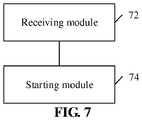
- FIG. 7 is a structure block diagram of a determination apparatus for starting cell measurement according to an embodiment of the disclosure. As shown in FIG. 7 , the apparatus may include a receiving module 72 and a starting module 74.
- the receiving module 72 is configured to receive, after a terminal is registered with a network, an instruction sent from a device at the network side and used for instructing the terminal to start the cell measurement, here, the instruction is an instruction triggered if the terminal meets a trigger condition for starting the cell measurement, the trigger condition for starting the cell measurement is determined by the device at the network side according to the type of the terminal, the type of the terminal is acquired by the device at the network side according to identification information of the terminal, and the type of the terminal include: a fixed terminal or a mobile terminal.
- the starting module 74 is connected to the receiving module 72 and is configured to start the cell measurement according to the instruction.
- the type of a terminal is judged according to identification information of the terminal, and a trigger condition for starting cell measurement is determined according to the type of the terminal. That is, the different types of terminals correspond to different trigger conditions for starting the cell measurement, thus saving corresponding energy, better meeting requirements of the NB-IOT for power consumption, solving the problem in the related art in which requirements of the NB-IOT for power consumption cannot be met by terminal measurement and reselection/handover solutions, and saving energy while also improving the flexibility of the cell measurement.
- the above terminal may be a terminal under the NB-IOT, but is not limited thereto; the above apparatus may be located in a terminal, but is not limited thereto.
- FIG. 8 is a structure block diagram of a determination system for starting cell measurement according to an embodiment of the disclosure.
- the apparatus may include: a core network 82, a base station 84 and a terminal 86, wherein the terminal 86 is located in a coverage area of the base station 84.
- the core network 82 is configured to judge, after the terminal 86 is registered with a network, the type of the terminal 86 according to identification information of the terminal 86, and send the type to the base station 84.
- the base station 84 is configured to receive the type sent from the core network 82, determine a trigger condition for starting the cell measurement for the terminal 86 according to the type, and send an instruction for instructing the terminal to start the cell measurement to the terminal 86 when determining that the terminal 86 meets the trigger condition.
- the terminal 86 is configured to start, after receiving the instruction, the cell measurement.
- the type of a terminal is judged according to identification information of the terminal, and a trigger condition for starting cell measurement is determined according to the type of the terminal. That is, the different types of terminals correspond to different trigger conditions for starting the cell measurement, thus saving corresponding energy, better meeting requirements of the NB-IOT for power consumption, solving the problem in the related art in which requirements of the NB-IOT for power consumption cannot be met by terminal measurement and reselection/handover solutions, and saving energy while also improving the flexibility of the cell measurement.
- each of the above modules may be implemented by software or hardware.
- the above may be implemented by, but not limited to, the following manners that the above modules are all located in the same processor; or, the above modules are located in multiple processors respectively.
- the judging module, the determining module, the estimating module, the sending module, the positioning module, and the starting module in the determination apparatus for starting cell measurement in the embodiment of the disclosure may be implemented by a processor, and may also be implemented by a specific logic circuit.
- the processor may be a Central Processing Unit (CPU), a Micro Processing Unit (MPU), a Digital Signal Processor (DSP), or a Field Programmable Gate Array (FPGA).
- the determination method for starting cell measurement is implemented in the form of a software function module, and is sold or used as a separate product, it may also be stored in a computer readable storage medium.
- the technical solution of the disclosure which is essential or contributes to the conventional art, may be embodied in the form of a software product stored in a storage medium, including a number of instructions for causing a terminal device (which may be a personal computer, a server, or a network device, etc.) to perform all or part of the methods described in various embodiments of the disclosure.
- the foregoing storage medium includes various media that can store program codes, such as a USB flash drive, a mobile hard disk, a Read Only Memory (ROM), a magnetic disk, or an optical disk.
- program codes such as a USB flash drive, a mobile hard disk, a Read Only Memory (ROM), a magnetic disk, or an optical disk.
- the embodiment of the disclosure further provides a computer storage medium.
- the computer storage medium stores a computer program.
- the computer program is used to perform the above determination method for starting cell measurement according to the embodiment of the disclosure.
- the storage medium may be configured to store a program code for performing the operations as follows.
- the type of the terminal is judged according to identification information of the terminal, wherein the type of the terminal includes a fixed terminal or a mobile terminal.
- a trigger condition for starting cell measurement is determined for the terminal according to the type.
- the above storage medium may include, but not limited to, various media that can store program codes such as a U disk, a ROM, a Random Access Memory (RAM), a mobile hard disk, a magnetic disk or an optical disk.
- program codes such as a U disk, a ROM, a Random Access Memory (RAM), a mobile hard disk, a magnetic disk or an optical disk.
- a specific example in the present embodiment may refer to the examples described in the above embodiments and alternative implementation manners, and details are not described herein in the present embodiment.
- modules or operations in the disclosure may be implemented by using a general calculation device, may be centralized on a single calculation device or may be distributed on a network composed of multiple calculation devices.
- they may be implemented by using executable program codes of the calculation devices.
- they may be stored in a storage device and executed by the calculation devices, the shown or described operations may be executed in a sequence different from this sequence under certain conditions, or they are manufactured into each integrated circuit module respectively, or multiple modules or operations therein are manufactured into a single integrated circuit module.
- the disclosure is not limited to the combination of any specific hardware and software.
Landscapes
- Engineering & Computer Science (AREA)
- Computer Networks & Wireless Communication (AREA)
- Signal Processing (AREA)
- Mobile Radio Communication Systems (AREA)
Applications Claiming Priority (2)
| Application Number | Priority Date | Filing Date | Title |
|---|---|---|---|
| CN201610210773.1A CN107277845B (zh) | 2016-04-06 | 2016-04-06 | 开启小区测量的确定方法、装置及系统 |
| PCT/CN2016/108728 WO2017173839A1 (zh) | 2016-04-06 | 2016-12-06 | 开启小区测量的确定方法、装置、系统及存储介质 |
Publications (2)
| Publication Number | Publication Date |
|---|---|
| EP3442254A1 true EP3442254A1 (de) | 2019-02-13 |
| EP3442254A4 EP3442254A4 (de) | 2019-05-08 |
Family
ID=60000791
Family Applications (1)
| Application Number | Title | Priority Date | Filing Date |
|---|---|---|---|
| EP16897768.4A Ceased EP3442254A4 (de) | 2016-04-06 | 2016-12-06 | Bestimmungsverfahren, vorrichtung und system zum starten einer zellmessung und speichermedium |
Country Status (3)
| Country | Link |
|---|---|
| EP (1) | EP3442254A4 (de) |
| CN (1) | CN107277845B (de) |
| WO (1) | WO2017173839A1 (de) |
Cited By (2)
| Publication number | Priority date | Publication date | Assignee | Title |
|---|---|---|---|---|
| US20230027243A1 (en) * | 2020-04-07 | 2023-01-26 | Guangdong Oppo Mobile Telecommunications Corp., Ltd. | Method for adjusting cell measurement, user equipment, and storage medium |
| US20240292353A1 (en) * | 2021-06-23 | 2024-08-29 | Sony Group Corporation | Electronic device and method for wireless communication systems, and storage media |
Families Citing this family (14)
| Publication number | Priority date | Publication date | Assignee | Title |
|---|---|---|---|---|
| BR112020016285A2 (pt) | 2018-02-12 | 2020-12-15 | Huawei Technologies Co., Ltd. | Método e aparelho de medição |
| CN108834124B (zh) * | 2018-07-04 | 2021-06-04 | 中国联合网络通信集团有限公司 | 2g物联网终端识别方法及系统 |
| CN111382755B (zh) * | 2018-12-27 | 2023-05-02 | 中国移动通信集团山西有限公司 | 一种基于adaboost加权和三阶聚类的共模天馈优化方法及系统 |
| CN114867072A (zh) | 2019-02-14 | 2022-08-05 | 华为技术有限公司 | 网络选择方法、网络设备以及终端设备 |
| CN112020107B (zh) * | 2019-05-29 | 2022-08-23 | 中国移动通信集团安徽有限公司 | 异频切换启测门限的优化方法、装置及计算设备 |
| EP4017113B1 (de) | 2019-08-29 | 2023-11-22 | Huawei Technologies Co., Ltd. | Kommunikationsverfahren und -vorrichtung |
| CN114424590B (zh) * | 2019-09-29 | 2024-10-18 | 华为技术有限公司 | 通信方法、设备及系统 |
| CN112738839B (zh) * | 2019-10-14 | 2022-07-29 | 中国移动通信集团山西有限公司 | NB-IoT网络容量的评估方法、装置、设备及存储介质 |
| CN112888045B (zh) * | 2019-11-30 | 2022-11-25 | 华为技术有限公司 | 小区测量的方法、测量装置、终端设备、芯片及存储介质 |
| CN113905396B (zh) * | 2021-09-10 | 2024-03-12 | 河南信安通信技术股份有限公司 | 一种lte主被动深度融合的手机信号测量设备及方法 |
| CN118104275A (zh) * | 2021-12-13 | 2024-05-28 | Oppo广东移动通信有限公司 | 信号测量方法、装置及存储介质 |
| CN116939755A (zh) * | 2022-04-12 | 2023-10-24 | 维沃移动通信有限公司 | 小区选择或小区重选方法、装置及通信设备 |
| CN116801364B (zh) * | 2023-08-22 | 2023-12-15 | Tcl通讯科技(成都)有限公司 | 小区测量方法、装置、存储介质及终端 |
| CN121942260A (zh) * | 2023-09-28 | 2026-04-28 | 中兴通讯股份有限公司 | 无线通信中用于跟踪和测量的信道状态信息参考信号的配置 |
Family Cites Families (8)
| Publication number | Priority date | Publication date | Assignee | Title |
|---|---|---|---|---|
| CN102137456A (zh) * | 2010-01-22 | 2011-07-27 | 中兴通讯股份有限公司 | 多天线终端的切换接入方法及系统 |
| CN102137383A (zh) * | 2010-01-22 | 2011-07-27 | 中兴通讯股份有限公司 | 获取mtc设备移动性相关信息及优化配置的方法和系统 |
| CN102244839B (zh) * | 2010-05-13 | 2016-02-10 | 中兴通讯股份有限公司 | 一种分组式mtc设备的识别方法和装置 |
| HK1213128A1 (zh) * | 2012-10-17 | 2016-06-24 | 美国博通公司 | 連接模式下的低功率通信 |
| CN103874174A (zh) * | 2012-12-18 | 2014-06-18 | 展讯通信(上海)有限公司 | 一种通过检测传感器来控制移动终端的方法 |
| CN103281737B (zh) * | 2013-06-17 | 2017-07-11 | 努比亚技术有限公司 | 一种移动终端小区切换的方法和移动终端 |
| EP3301995B1 (de) * | 2013-09-27 | 2019-08-21 | Sony Corporation | Kommunikationsvorrichtung und -verfahren |
| CN104811921B (zh) * | 2014-01-26 | 2019-02-26 | 电信科学技术研究院 | 信息通知、rrc连接释放控制方法及设备 |
-
2016
- 2016-04-06 CN CN201610210773.1A patent/CN107277845B/zh active Active
- 2016-12-06 WO PCT/CN2016/108728 patent/WO2017173839A1/zh not_active Ceased
- 2016-12-06 EP EP16897768.4A patent/EP3442254A4/de not_active Ceased
Cited By (3)
| Publication number | Priority date | Publication date | Assignee | Title |
|---|---|---|---|---|
| US20230027243A1 (en) * | 2020-04-07 | 2023-01-26 | Guangdong Oppo Mobile Telecommunications Corp., Ltd. | Method for adjusting cell measurement, user equipment, and storage medium |
| US12615562B2 (en) * | 2020-04-07 | 2026-04-28 | Guangdong Oppo Mobile Telecommunications Corp., Ltd. | Method for adjusting cell measurement, user equipment, and storage medium |
| US20240292353A1 (en) * | 2021-06-23 | 2024-08-29 | Sony Group Corporation | Electronic device and method for wireless communication systems, and storage media |
Also Published As
| Publication number | Publication date |
|---|---|
| CN107277845A (zh) | 2017-10-20 |
| WO2017173839A1 (zh) | 2017-10-12 |
| EP3442254A4 (de) | 2019-05-08 |
| CN107277845B (zh) | 2021-03-26 |
Similar Documents
| Publication | Publication Date | Title |
|---|---|---|
| EP3442254A1 (de) | Bestimmungsverfahren, vorrichtung und system zum starten einer zellmessung und speichermedium | |
| US8903383B2 (en) | Method in a device, and a wireless device | |
| CN103458462B (zh) | 一种小区选择方法和设备 | |
| CN105940744B (zh) | 在无线通信系统中由终端执行的d2d操作方法及使用该方法的终端 | |
| KR102144298B1 (ko) | 네트워크 검색 방법 및 단말 장치 | |
| US20180146410A1 (en) | Method and apparatus for reselecting cell in wireless communication system | |
| CN103067987B (zh) | 一种用户设备的位置区更新方法及装置 | |
| KR20150117658A (ko) | 무선 통신 시스템에서 mbms 정보 보고 방법 및 이를 지원하는 장치 | |
| KR20100139047A (ko) | 폐쇄된 가입자 그룹 셀들을 검색하기 위한 방법 및 장치 | |
| CN107770821A (zh) | 一种信号测量方法、相关设备及通信系统 | |
| US9942810B2 (en) | Connection setup for heterogeneous cellular communication networks | |
| WO2014098535A1 (ko) | 무선 통신 시스템에서 통신 방법 및 이를 지원하는 장치 | |
| US20240073761A1 (en) | Method for using slice information, and teminal | |
| WO2015167304A1 (ko) | 무선 통신 시스템에서 단말에 의해 수행되는 d2d(device-to-device) 동작 방법 및 상기 방법을 이용하는 단말 | |
| US9888415B1 (en) | Method and apparatus for cell reselection | |
| WO2016076676A1 (ko) | 무선 통신 시스템에서 단말에 의해 수행되는 d2d 관련 정보 보고 방법 및 상기 방법을 이용하는 단말 | |
| WO2016072797A2 (ko) | 무선 통신 시스템에서 단말에 의해 수행되는 d2d 발견 메시지 전송 방법 및 상기 방법을 이용하는 단말 | |
| EP3354075A1 (de) | Zellauswahl je nach überlastungsgrad | |
| EP2911450A1 (de) | Zellenneuauswahlverfahren und vorrichtung, basisstation | |
| CN112020899B (zh) | 网络接入方法及相关设备 | |
| WO2016072711A2 (ko) | 무선 통신 시스템에서 단말이 d2d(device-to-device) 동작을 위한 동기화 신호를 전송하는 방법 및 상기 방법을 이용하는 단말 | |
| KR101886546B1 (ko) | 무선 통신 시스템에서 단말에 의해 수행되는 d2d(device-to-device) 동작을 위한 셀 커버리지 판단 방법 및 상기 방법을 이용하는 단말 | |
| CN109286929B (zh) | 一种基于lte系统的移动终端imsi抓取和定位方法及其系统 | |
| US10924907B2 (en) | Apparatus of a user equipment adapted for receiving emergency notification information used in mobile communication and method for receiving emergency notification information | |
| US20150024759A1 (en) | Cell Selection Techniques for Femtocell Measurements |
Legal Events
| Date | Code | Title | Description |
|---|---|---|---|
| STAA | Information on the status of an ep patent application or granted ep patent |
Free format text: STATUS: THE INTERNATIONAL PUBLICATION HAS BEEN MADE |
|
| PUAI | Public reference made under article 153(3) epc to a published international application that has entered the european phase |
Free format text: ORIGINAL CODE: 0009012 |
|
| STAA | Information on the status of an ep patent application or granted ep patent |
Free format text: STATUS: REQUEST FOR EXAMINATION WAS MADE |
|
| 17P | Request for examination filed |
Effective date: 20181106 |
|
| AK | Designated contracting states |
Kind code of ref document: A1 Designated state(s): AL AT BE BG CH CY CZ DE DK EE ES FI FR GB GR HR HU IE IS IT LI LT LU LV MC MK MT NL NO PL PT RO RS SE SI SK SM TR |
|
| AX | Request for extension of the european patent |
Extension state: BA ME |
|
| A4 | Supplementary search report drawn up and despatched |
Effective date: 20190409 |
|
| RIC1 | Information provided on ipc code assigned before grant |
Ipc: H04W 36/00 20090101AFI20190403BHEP Ipc: H04W 52/02 20090101ALI20190403BHEP |
|
| DAV | Request for validation of the european patent (deleted) | ||
| DAX | Request for extension of the european patent (deleted) | ||
| STAA | Information on the status of an ep patent application or granted ep patent |
Free format text: STATUS: EXAMINATION IS IN PROGRESS |
|
| 17Q | First examination report despatched |
Effective date: 20200526 |
|
| REG | Reference to a national code |
Ref country code: DE Ref legal event code: R003 |
|
| STAA | Information on the status of an ep patent application or granted ep patent |
Free format text: STATUS: THE APPLICATION HAS BEEN REFUSED |
|
| 18R | Application refused |
Effective date: 20210719 |