EP3443162B1 - Feutre de presse et procédé pour sa fabrication - Google Patents
Feutre de presse et procédé pour sa fabrication Download PDFInfo
- Publication number
- EP3443162B1 EP3443162B1 EP17716864.8A EP17716864A EP3443162B1 EP 3443162 B1 EP3443162 B1 EP 3443162B1 EP 17716864 A EP17716864 A EP 17716864A EP 3443162 B1 EP3443162 B1 EP 3443162B1
- Authority
- EP
- European Patent Office
- Prior art keywords
- fabric
- layer
- polymer foam
- paper
- foam
- Prior art date
- Legal status (The legal status is an assumption and is not a legal conclusion. Google has not performed a legal analysis and makes no representation as to the accuracy of the status listed.)
- Active
Links
Images

Classifications
-
- D—TEXTILES; PAPER
- D21—PAPER-MAKING; PRODUCTION OF CELLULOSE
- D21F—PAPER-MAKING MACHINES; METHODS OF PRODUCING PAPER THEREON
- D21F7/00—Other details of machines for making continuous webs of paper
- D21F7/08—Felts
- D21F7/083—Multi-layer felts
-
- B—PERFORMING OPERATIONS; TRANSPORTING
- B32—LAYERED PRODUCTS
- B32B—LAYERED PRODUCTS, i.e. PRODUCTS BUILT-UP OF STRATA OF FLAT OR NON-FLAT, e.g. CELLULAR OR HONEYCOMB, FORM
- B32B5/00—Layered products characterised by the non- homogeneity or physical structure, i.e. comprising a fibrous, filamentary, particulate or foam layer; Layered products characterised by having a layer differing constitutionally or physically in different parts
- B32B5/18—Layered products characterised by the non- homogeneity or physical structure, i.e. comprising a fibrous, filamentary, particulate or foam layer; Layered products characterised by having a layer differing constitutionally or physically in different parts characterised by features of a layer of foamed material
-
- B—PERFORMING OPERATIONS; TRANSPORTING
- B32—LAYERED PRODUCTS
- B32B—LAYERED PRODUCTS, i.e. PRODUCTS BUILT-UP OF STRATA OF FLAT OR NON-FLAT, e.g. CELLULAR OR HONEYCOMB, FORM
- B32B5/00—Layered products characterised by the non- homogeneity or physical structure, i.e. comprising a fibrous, filamentary, particulate or foam layer; Layered products characterised by having a layer differing constitutionally or physically in different parts
- B32B5/22—Layered products characterised by the non- homogeneity or physical structure, i.e. comprising a fibrous, filamentary, particulate or foam layer; Layered products characterised by having a layer differing constitutionally or physically in different parts characterised by the presence of two or more layers which are next to each other and are fibrous, filamentary, formed of particles or foamed
- B32B5/24—Layered products characterised by the non- homogeneity or physical structure, i.e. comprising a fibrous, filamentary, particulate or foam layer; Layered products characterised by having a layer differing constitutionally or physically in different parts characterised by the presence of two or more layers which are next to each other and are fibrous, filamentary, formed of particles or foamed one layer being a fibrous or filamentary layer
- B32B5/245—Layered products characterised by the non- homogeneity or physical structure, i.e. comprising a fibrous, filamentary, particulate or foam layer; Layered products characterised by having a layer differing constitutionally or physically in different parts characterised by the presence of two or more layers which are next to each other and are fibrous, filamentary, formed of particles or foamed one layer being a fibrous or filamentary layer another layer next to it being a foam layer
-
- D—TEXTILES; PAPER
- D03—WEAVING
- D03D—WOVEN FABRICS; METHODS OF WEAVING; LOOMS
- D03D1/00—Woven fabrics designed to make specified articles
- D03D1/0094—Belts
-
- D—TEXTILES; PAPER
- D04—BRAIDING; LACE-MAKING; KNITTING; TRIMMINGS; NON-WOVEN FABRICS
- D04H—MAKING TEXTILE FABRICS, e.g. FROM FIBRES OR FILAMENTARY MATERIAL; FABRICS MADE BY SUCH PROCESSES OR APPARATUS, e.g. FELTS, NON-WOVEN FABRICS; COTTON-WOOL; WADDING ; NON-WOVEN FABRICS FROM STAPLE FIBRES, FILAMENTS OR YARNS, BONDED WITH AT LEAST ONE WEB-LIKE MATERIAL DURING THEIR CONSOLIDATION
- D04H1/00—Non-woven fabrics formed wholly or mainly of staple fibres or like relatively short fibres
- D04H1/40—Non-woven fabrics formed wholly or mainly of staple fibres or like relatively short fibres from fleeces or layers composed of fibres without existing or potential cohesive properties
- D04H1/44—Non-woven fabrics formed wholly or mainly of staple fibres or like relatively short fibres from fleeces or layers composed of fibres without existing or potential cohesive properties the fleeces or layers being consolidated by mechanical means, e.g. by rolling
- D04H1/46—Non-woven fabrics formed wholly or mainly of staple fibres or like relatively short fibres from fleeces or layers composed of fibres without existing or potential cohesive properties the fleeces or layers being consolidated by mechanical means, e.g. by rolling by needling or like operations to cause entanglement of fibres
- D04H1/48—Non-woven fabrics formed wholly or mainly of staple fibres or like relatively short fibres from fleeces or layers composed of fibres without existing or potential cohesive properties the fleeces or layers being consolidated by mechanical means, e.g. by rolling by needling or like operations to cause entanglement of fibres in combination with at least one other method of consolidation
- D04H1/485—Non-woven fabrics formed wholly or mainly of staple fibres or like relatively short fibres from fleeces or layers composed of fibres without existing or potential cohesive properties the fleeces or layers being consolidated by mechanical means, e.g. by rolling by needling or like operations to cause entanglement of fibres in combination with at least one other method of consolidation in combination with weld-bonding
-
- D—TEXTILES; PAPER
- D04—BRAIDING; LACE-MAKING; KNITTING; TRIMMINGS; NON-WOVEN FABRICS
- D04H—MAKING TEXTILE FABRICS, e.g. FROM FIBRES OR FILAMENTARY MATERIAL; FABRICS MADE BY SUCH PROCESSES OR APPARATUS, e.g. FELTS, NON-WOVEN FABRICS; COTTON-WOOL; WADDING ; NON-WOVEN FABRICS FROM STAPLE FIBRES, FILAMENTS OR YARNS, BONDED WITH AT LEAST ONE WEB-LIKE MATERIAL DURING THEIR CONSOLIDATION
- D04H1/00—Non-woven fabrics formed wholly or mainly of staple fibres or like relatively short fibres
- D04H1/40—Non-woven fabrics formed wholly or mainly of staple fibres or like relatively short fibres from fleeces or layers composed of fibres without existing or potential cohesive properties
- D04H1/44—Non-woven fabrics formed wholly or mainly of staple fibres or like relatively short fibres from fleeces or layers composed of fibres without existing or potential cohesive properties the fleeces or layers being consolidated by mechanical means, e.g. by rolling
- D04H1/46—Non-woven fabrics formed wholly or mainly of staple fibres or like relatively short fibres from fleeces or layers composed of fibres without existing or potential cohesive properties the fleeces or layers being consolidated by mechanical means, e.g. by rolling by needling or like operations to cause entanglement of fibres
- D04H1/498—Non-woven fabrics formed wholly or mainly of staple fibres or like relatively short fibres from fleeces or layers composed of fibres without existing or potential cohesive properties the fleeces or layers being consolidated by mechanical means, e.g. by rolling by needling or like operations to cause entanglement of fibres entanglement of layered webs
-
- D—TEXTILES; PAPER
- D21—PAPER-MAKING; PRODUCTION OF CELLULOSE
- D21F—PAPER-MAKING MACHINES; METHODS OF PRODUCING PAPER THEREON
- D21F1/00—Wet end of machines for making continuous webs of paper
- D21F1/0027—Screen-cloths
- D21F1/0036—Multi-layer screen-cloths
-
- D—TEXTILES; PAPER
- D10—INDEXING SCHEME ASSOCIATED WITH SUBLASSES OF SECTION D, RELATING TO TEXTILES
- D10B—INDEXING SCHEME ASSOCIATED WITH SUBLASSES OF SECTION D, RELATING TO TEXTILES
- D10B2331/00—Fibres made from polymers obtained otherwise than by reactions only involving carbon-to-carbon unsaturated bonds, e.g. polycondensation products
- D10B2331/02—Fibres made from polymers obtained otherwise than by reactions only involving carbon-to-carbon unsaturated bonds, e.g. polycondensation products polyamides
Definitions
- the present invention relates to a covering in the form of a press belt for a machine for producing or processing a paper web according to the preamble of claim 1, and a method for producing the covering.
- an aqueous fibrous suspension is usually initially dewatered in a so-called former on a forming fabric or between two forming fabrics, then further dewatered by pressing between two press felts and finally thermally dried.
- press felts are used almost exclusively for dewatering in the press, which comprise a woven basic structure to which one or more layers of nonwoven fibers are applied.
- the paper-contacting side of the press felt is made available by a fine non-woven fiber layer.
- Each of the WO 88/07929 A1 . DE 10 2006 055 828 A1 . EP 2 128 334 A1 and US 3 167 442 A discloses a press belt for a paper machine that has a base structure and a polymer foam layer, the polymer foam layer providing the paper side.
- the EP 1 688 536 A1 discloses a covering according to the preamble of claim 1.
- a covering in the form of a press belt for a machine for producing or processing a paper web is proposed, the covering having a paper side and a running side.
- the covering comprises a basic structure and at least one further structure.
- the at least one further structure comprises or comprises a layer of polymer foam, and this layer of polymer foam provides the paper side of the covering.
- Such a layer of polymer foam is permeable due to its pore structure, so that the water from the paper web can flow through it.
- the surface has no fibers or fiber segments that can be expressed in the paper surface.
- the paper-contacting side of the Layer made of polymer foam outside of a press nip has a smaller contact area with the paper web than press felts based on the usual staple fiber fleece layer.
- material portions that are below the uppermost pore layer can become contact points with the paper web.
- the contact area with the paper web can increase significantly and thus becomes often even larger than with conventional press felts with paper-contacting fleece layer
- the at least one layer of polymer foam has an anisotropic pore structure.
- an anisotropic structure With such an anisotropic structure, the shape of at least a large part (often more than 50%, or even more than 80%) of the individual pores deviates from the isotropic spherical shape.
- the pores have a greater extent in the machine direction of the covering and in the transverse direction of the covering than in the thickness direction.
- Such a pore structure can be achieved, for example, by compressing a foam layer with an isotropic pore structure.
- such an anisotropic pore structure allows water to be conducted quickly away from the paper web towards the basic structure. As a result, the foam layer usually provides less storage volume.
- the covering comprises at least one additional functional structure, which is arranged between the basic structure and the layer of polymer foam or on the side of the basic structure facing away from the paper.
- an additional functional structure can be, for example, a layer which comprises or consists of nonwoven fibers.
- the additional functional structure can also be other structures, such as a further foam layer, a film, a membrane or the like.
- several additional functional structures can also be provided, in particular several nonwoven fiber layers.
- At least one layer of polymer foam is provided on both sides of the basic structure, ie in the direction of the fibrous web and in the direction of the machine.
- one or more layers of polymer foam are provided only on one side of the basic structure, namely in the direction of the paper web.
- the layer of polymer foam is compressed in the thickness direction by more than 30%, preferably by more than 40%, particularly preferably by more than 50%, when the covering is subjected to a pressure of 3 MPa, compared to the initial thickness at a pressure loading of 0.1 MPa.
- the thickness measurement of a covering or the associated layer of polymer foam can be carried out under pressure, for example, in such a way that a sample is placed under the desired pressure in a computer tomograph or other suitable imaging analysis device. Using the images obtained in this way, the thickness of the individual components of the covering can be determined very precisely.
- Such a layer made of polymer foam can be advantageous for the use of the covering.
- the range from 3 MPa to 8 MPa represents the pressure range that is usually generated in a press nip. If such a covering is passed through a press nip together with a paper web placed thereon - and possibly a further covering as well - pressure is exerted there on the layer of polymer foam, whereby this layer is compressed accordingly in accordance with this advantageous embodiment.
- the 0.1 MPa specified should represent a typical base load that also acts on the fabric without the press nip acting, e.g. due to the weight of the wet paper web etc.
- the layer made of polymer foam is designed such that when the covering is subsequently relieved of pressure from 3 MPa (or 5MPa or 8 MPa) to 0.1 MPa, the layer made of polymer foam essentially expanded again to its original thickness.
- the combination of compression in a press nip and subsequent expansion after the press nip can cause the dry content of the material web to increase and the rewetting described at the beginning to be significantly reduced. Surprisingly, this effect could be observed in tests by the applicant.
- the foam layer in a press nip by compressing the foam layer in a press nip, the water can be removed more quickly due to the shortened drainage path.
- the expansion after the press nip changes the pore size and the pore volume of the foam layer. This makes it difficult for the water in the pores and the basic structure to penetrate back into the material web.
- the layer of polymer foam can consist of an elastomer, in particular a polyurethane, or can comprise this.
- a so-called flexible polyurethane foam and preferably a reticulated flexible polyurethane foam, can be used here.
- other materials for the layer of polymer foam such as e.g. a silicone, polyester, polyether etc.
- the layer of polymer foam can have a weight per unit area between 60 g / m 2 and 300 g / m 2 , up to 500 g / m 2 or more.
- the layer of polymer foam can have a bulk density between 100 kg / m 3 and 700 kg / m 3 .
- the basic structure of the covering can advantageously comprise or consist of a fabric, a scrim or a permeable film structure.
- a single-layer or multi-layer fabric can be used.
- the basic structure can advantageously have a permeability of more than 1.27 m 3 / m 2 * s (250 cfm), in particular more than 2.54 m 3 / m 2 * s (500 cfm). In principle, however, basic structures with a lower permeability can also be used.
- the covering has a permeability between 0.0508 m 3 / m 2 * s (10 cfm) and 1.27 m 3 / m 2 * s (250 cfm), in particular between 0.127 m 3 / m 2 * s (25 cfm) and 0.762 m 3 / m 2 * s (150 cfm).
- the basic structure as well as the entire covering are advantageously permeable to water and gas. To characterize the permeability, however, the determination of the permeability by means of air flow has become established.
- the unit cfm cubic foot per minute is a standard unit for assessing the permeability of clothing. 100 cfm corresponds to around 0.508 m 3 / m 2 * s.
- a covering according to the present invention is used as a press belt in the press section of a machine for producing a fibrous web - in particular a paper, cardboard, tissue or cellulose web.
- One or more fabrics according to the invention can be used in such a press section.
- the process step of compacting allows a multitude of properties of the layer made of polymer foam to be targeted in the production of the covering to adapt to the requirements placed on the covering in use.
- the compressibility or the compressive strength and / or the elasticity of the layer made of polymer foam can also be adapted by the compacting.
- Another effect that can be achieved by compacting is a further improvement in the surface properties of the paper-contacting side of the fabric. It can thus be achieved that the action of pressure and / or temperature causes the material of the foam layer to melt on the surface. As a result, touching foam elements or webs can be connected to one another in a materially integral manner. Surfaces created in this way can have increased mechanical stability or abrasion resistance.
- the compacted foams usually have a high permeability with little expansion in the thickness direction.
- the compacting can take place, for example, by pressing at an elevated temperature with subsequent cooling. Cooling can take place under The compaction pressure is maintained. In some cases, however, this can also be dispensed with entirely, or cooling can take place under reduced pressure ( ⁇ 90% of the compacting pressure, in particular ⁇ 75% of the compacting pressure).
- Suitable devices for realizing pressing can be so-called double belt presses, which often have heating and cooling zones.
- Favorable temperatures for compacting can differ in different applications and materials. In preferred applications, such as For flexible polyurethane foams, the required temperatures can range between 150 ° C and 200 ° C.
- a further advantageous possibility of compacting is to have the clothing run through a calender.
- the calender can have a roll nip, at least one roll being heated.
- the roller which comes into contact with the foam layer, is often heated.
- the additional functional structures can be a nonwoven fiber layer, a film, a membrane, another foam layer or the like.
- connection can be made by needling, gluing or welding, in particular laser transmission welding, as well as a combination of various suitable methods.
- the steps of the proposed method do not necessarily have to be carried out in a fixed order.
- the layer of polymer foam can be compacted before or after connecting the at least one further structure to the basic structure.
- Multiple compacting of the layer of polymer foam can also be provided.
- compacting can be carried out both before the connection and after the connection.
- Suitable, commercially available polymer foams such as e.g. Polyurethane flexible foams have thicknesses in the range from 2.5mm to 9mm, in particular between 3.5mm and 7mm. Such foams can be used from the starting material and then further compacted in the process according to the invention.
- the thickness of the layer of polymer foam after compacting is less than 30%, preferably less than 25%, particularly preferably less than 20% of the initial thickness of the foam layer.
- the layer of polymer foam is compacted after it has been attached to the base structure, it can happen that parts of the foam layer penetrate or are pressed into recesses in the supporting structure. This proportion is not used to determine the thickness of the foam layer.
- the polymer foam can have a pore density between 4 to 31.5 pores per centimeter (10 and 80 pores per inch (PPI)), preferably between 12 and 24 pores per centimeter (30 and 60 PPI), before the compacting.
- PPI pores per inch
- PPI is an international standard for the permeability of porous materials and describes a linear structure density.
- the polymer foam prior to compaction has a bulk density between 15 and 60 kg / m 3, preferably between 25 and 35 on per kg / m 3.
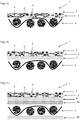
- Figures 1a, 1b, 1c and 2 show two versions of a covering according to the invention.
- the structure of a covering 1 in the form of a press belt is shown roughly schematically.
- the covering 1 comprises a fabric 3, which provides the basic structure 3.
- a layer of polymer foam 2 is attached to this basic structure 3.
- This layer of polymer foam 2 also provides the paper-contacting side of the covering 5.
- the pores 4 of the layer of polymer foam 2 are in the Figure 1 anisotropic covering shown. This can be realized, for example, in that a standard polymer foam, which usually has isotropic pores, has been compacted by means of a compacting step using pressure and / or temperature. In addition to the thickness of the foam layer 2, this also changes the shape of the pores 4. They are deformed in the thickness direction.
- a woven basic structure 3 is first made available. This can be woven from polyester filaments.
- a foam in the form of a reticulated flexible polyurethane foam is provided. In the example, this has a thickness of 4 mm and a pore density of 17.7 pores per centimeter (45 PPI).
- a suitable method for connecting the layers of polymer foam 2 to the basic structure 3 is laser transmission welding. In the example, an NIR line laser with a wavelength of 940 nm is used. This was pressed on with a joining pressure of approx. 20N / cm.
- Laser transmission welding when the polymer foam 2 absorbs all or part of the laser light (usually the absorption is> 70%), while the basic structure 3 is completely or largely transparent to the laser light.
- the laser light could first penetrate the base structure 3 and was then absorbed by the polymer foam. In this way, the heat required for welding was generated at the connection point between the basic structure 3 and the foam layer 2. This is a common principle in laser transmission welding.
- the laminate bonded in this way was then compacted at a temperature of approximately 190 ° under pressure.
- FIGS. 1b and 1c show a covering according to the invention, which in addition to the in Figure 1a described components still have one or more additional functional structures 6, 6a, 6b. These are designed as nonwoven layers, but other functional structures such as foils, membranes, foam layers or the like are also conceivable.
- the covering in Figure 1b has a nonwoven layer 6 which is arranged between the base structure 3 and the foam layer 2.
- the covering shown has three nonwoven layers 6, 6a, 6b, the individual nonwoven layers in this example being able to comprise fibers of different fineness.
- Example 1 a press felt with a fabric 3 and three layers of nonwoven fabric 6, 6a, 6b was first produced from a polyamide material. The nonwoven layers were connected to the fabric 3 by needling.
- This felt had a basis weight of 1100 g / m 2 and a permeability of approximately 0.319 m 3 / m 2 * s (62.8 CFM).
- An open-celled polyurethane (PU) soft foam was also used. This soft foam had a basis weight of 120 g / m 2 Thickness of 4mm and a pore density of 11.8 pores per centimeter (30 PPI).
- the PU soft foam was anthracite-colored in Example 1 and absorbing for the radiation of an NIR laser in the range of 940 nm.
- the foam layer was connected using NIR laser transmission welding.
- the laser was aimed at the running side of the belt.
- the polyamide material of the original felt was almost transparent to the laser light, but was absorbed by the foam layer at the interface with the nonwoven fiber layer with the development of heat.
- the material of at least one of the two layers in contact was melted as a result, which resulted in the layers being welded together.
- the welding process was supported by the fact that a certain joining pressure was still exerted on the sandwich by the felt and foam layer. This joining pressure was achieved by pressing the roller optics of the laser with a line width of 31 mm at 25 N onto the felt-foam sandwich, which was stored on a solid surface.
- the power of the laser in example 1 was 350 W.
- the foam layer was compacted. This compacting was carried out at a line load of 6 KN / m and a temperature of 195 ° C. These values can be selected differently depending on the application. A common temperature range for compacting is between 150 ° C and 210 ° C. The line load can also be selected higher or lower.
- the press tape obtained in this way from Example 1 had a basis weight of 1229 g / m 2 and a permeability of 0.324 m 3 / m 2 * s (63.7 CFM).
- the pores of the soft foam layer had an anisotropic structure due to the compacting.
- the foam layer was compressed by more than 30%.
- Figure 2 shows a schematic representation of a covering according to the invention, in which the basic structure 3a is provided by a permeable film structure 3a.
- the film structure 3a can be a single, act perforated film. Alternatively, such a film structure can itself be constructed from a laminate of different films.
- the connection of the foam layer 2 and the basic structure 3a can take place, for example, by welding or by gluing.
Landscapes
- Engineering & Computer Science (AREA)
- Textile Engineering (AREA)
- Mechanical Engineering (AREA)
- Paper (AREA)
Claims (14)
- Entoilage (1) sous la forme d'une bande de pressage pour une machine servant à la fabrication ou à la transformation d'une feuille continue de papier, l'entoilage (1) possédant un côté papier (5) et un côté défilement, comprenant une structure de base (3) et au moins une structure supplémentaire (2), l'au moins une structure supplémentaire (2) se composant d'une couche en mousse de polymère (2) ou comportant celle-ci, et cette couche en mousse de polymère (2) fournissant le côté papier (5) de l'entoilage (1), et lors d'une mise en charge de pression de l'entoilage (1) à 3 MPa, la couche en mousse de polymère (2) est comprimée dans le sens de l'épaisseur de plus de 30 %, de préférence de plus de 40 %, par rapport à l'épaisseur initiale avec une mise en charge de pression de 0,1 MPa, caractérisé en ce que l'entoilage (1) présente une perméabilité comprise entre 0,0508 m3/m2.s (10 cfm) et 1,27 m3/m2.s (250 cfm), notamment entre 0,127 m3/m2.s (25 cfm) et 0,762 m3/m2.s (150 cfm), et l'au moins une couche en mousse de polymère (2) présente une structure de pore anisotrope.
- Entoilage (1) selon la revendication 1, caractérisé en ce que l'entoilage (1) comporte au moins une structure fonctionnelle (6, 6a, 6b) supplémentaire qui est disposée entre la structure de base (3) et la couche en mousse de polymère (2) et/ou du côté de la structure de base (3) à l'opposé du papier, cette structure fonctionnelle (6, 6a, 6b) supplémentaire comprenant notamment des fibres d'étoffe ou en étant composée.
- Entoilage (1) selon l'une des revendications précédentes, caractérisé en ce que lors d'une mise en charge de pression de l'entoilage (1) à 3 MPa, la couche en mousse de polymère (2) est comprimée dans le sens de l'épaisseur de plus de 50 % par rapport à l'épaisseur initiale avec une mise en charge de pression de 0,1 MPa.
- Entoilage (1) selon l'une des revendications précédentes, caractérisé en ce que lors d'un soulagement de pression subséquent de l'entoilage (1) de 3 MPa à 0,1 MPa, la couche en mousse de polymère (2) s'expanse de nouveau sensiblement à son épaisseur initiale.
- Entoilage (1) selon l'une des revendications précédentes, caractérisé en ce que la couche en mousse de polymère (2) se compose d'une mousse tendre de polyuréthane réticulée ou comporte celle-ci.
- Entoilage (1) selon l'une des revendications précédentes, caractérisé en ce que la couche en mousse de polymère (2) possède une densité brute comprise entre 100 kg/m3 et 700 kg/m3.
- Entoilage (1) selon l'une des revendications précédentes, caractérisé en ce que la structure de base (2) comprend un tissu, une natte ou une structure de film perméable ou en est composée.
- Entoilage (1) selon l'une des revendications précédentes, caractérisé en ce qu'au moins une couche en mousse de polymère (2) se trouve à chaque fois des deux côtés de la structure de base (3), c'est-à-dire en direction de la feuille continue de matière fibreuse et en direction de la machine.
- Procédé de fabrication d'un entoilage (1) selon l'une des revendications 1 à 8, comprenant les étapes suivantes :a) fourniture d'une structure de base (3),b) fourniture d'au moins une structure supplémentaire (2) ,c) assemblage de l'au moins une structure supplémentaire (2) avec la structure de base (3), la structure supplémentaire (2) se composant d'une couche en mousse de polymère (2) ou comportant celle-ci et celle-ci mettant à disposition le côté (5) en contact avec le papier de l'entoilage (1), et le procédé comprenant en plus l'étape suivante :d) compactage de la couche en mousse de polymère (2) sous l'influence de la pression et/ou de la température.
- Procédé selon la revendication 9, caractérisé en ce que le procédé comprend en plus l'étape suivante :b1) fourniture d'une structure fonctionnelle (6, 6a, 6b) supplémentaire et disposition de cette structure fonctionnelle (6, 6a, 6b) supplémentaire entre la structure de base (3) et la couche en mousse de polymère (2) et/ou du côté de la structure de base (3) à l'opposé du papier.
- Procédé selon la revendication 10, caractérisé en ce que la structure fonctionnelle (6, 6a, 6b) supplémentaire comprend des fibres d'étoffe ou en est composée.
- Procédé selon l'une des revendications 9 à 11, caractérisé en ce que le compactage de la couche en mousse de polymère (2) est effectué avant et/ou après l'assemblage de la couche en mousse de polymère (2) avec la structure de base (3).
- Procédé selon l'une des revendications 9 à 12, caractérisé en ce que l'épaisseur de la couche en mousse de polymère (2) après le compactage est inférieure à 30 %, de préférence inférieure à 25 %, notamment de préférence inférieure à 20 % de l'épaisseur initiale.
- Utilisation d'un entoilage (1) selon l'une des revendications 1 à 8 en tant que bande de pressage (1) dans la partie de pressage d'une machine servant à la fabrication d'une feuille continue de papier.
Applications Claiming Priority (2)
| Application Number | Priority Date | Filing Date | Title |
|---|---|---|---|
| DE102016206384.7A DE102016206384B4 (de) | 2016-04-15 | 2016-04-15 | Bespannung und Verfahren zum Herstellen einer Bespannung |
| PCT/EP2017/058501 WO2017178405A1 (fr) | 2016-04-15 | 2017-04-10 | Habillage et son procédé de fabrication |
Publications (2)
| Publication Number | Publication Date |
|---|---|
| EP3443162A1 EP3443162A1 (fr) | 2019-02-20 |
| EP3443162B1 true EP3443162B1 (fr) | 2020-02-26 |
Family
ID=58536979
Family Applications (1)
| Application Number | Title | Priority Date | Filing Date |
|---|---|---|---|
| EP17716864.8A Active EP3443162B1 (fr) | 2016-04-15 | 2017-04-10 | Feutre de presse et procédé pour sa fabrication |
Country Status (5)
| Country | Link |
|---|---|
| US (1) | US10844540B2 (fr) |
| EP (1) | EP3443162B1 (fr) |
| CN (1) | CN108884637B (fr) |
| DE (1) | DE102016206384B4 (fr) |
| WO (1) | WO2017178405A1 (fr) |
Families Citing this family (4)
| Publication number | Priority date | Publication date | Assignee | Title |
|---|---|---|---|---|
| DE102019111441A1 (de) * | 2019-05-03 | 2020-11-05 | Voith Patent Gmbh | Bespannung und Verwendung in einer Tissuemaschine |
| WO2020224835A1 (fr) * | 2019-05-03 | 2020-11-12 | Voith Patent Gmbh | Feutre piqué et utilisation de feutre piqué dans une machine à papier à usage sanitaire et domestique |
| US20220275580A1 (en) * | 2019-07-15 | 2022-09-01 | Voith Patent Gmbh | Paper machine clothing and method |
| CN115176055A (zh) * | 2020-02-27 | 2022-10-11 | 福伊特专利有限公司 | 造纸机网毯 |
Family Cites Families (18)
| Publication number | Priority date | Publication date | Assignee | Title |
|---|---|---|---|---|
| US3175025A (en) * | 1963-04-05 | 1965-03-23 | Chemotronics International Inc | Process for bonding and/or reticulation |
| US3617442A (en) * | 1968-09-30 | 1971-11-02 | Alfred A Hurschman | Paper-making means and method |
| US4271222A (en) * | 1980-02-04 | 1981-06-02 | Albany International Corp. | Papermakers felt and method of manufacture |
| US4369081A (en) * | 1981-08-31 | 1983-01-18 | Albany International Corp. | Method of securing a foam layer to a belt |
| JPS61252389A (ja) * | 1985-04-25 | 1986-11-10 | 市川毛織株式会社 | 抄紙用加圧ベルト |
| US4851281A (en) * | 1987-04-14 | 1989-07-25 | Huyck Corporation | Papermakers' felt having compressible elastomer elements and methods of producing same |
| US5232768A (en) * | 1988-06-09 | 1993-08-03 | Nordiskafilt Ab | Wet press fabric to be used in papermaking machine |
| US4830905A (en) * | 1988-08-22 | 1989-05-16 | Appleton Mills | Papermaker's felt incorporating a closed cell polymeric foam layer |
| US4931010A (en) * | 1988-10-31 | 1990-06-05 | Albany International Corp. | Fabrics having hydrophilic and hydrophobic foams |
| US5118557A (en) * | 1988-10-31 | 1992-06-02 | Albany International Corp. | Foam coating of press fabrics to achieve a controlled void volume |
| US7156956B2 (en) * | 2003-08-11 | 2007-01-02 | Albany International Corp. | Paper industry process belt with a surface structure composed of a porous membrane |
| JP2006214058A (ja) | 2005-02-07 | 2006-08-17 | Ichikawa Co Ltd | 抄紙搬送フェルトおよび該抄紙搬送フェルトを備えた抄紙機のプレス装置 |
| DE102006055828A1 (de) | 2006-11-27 | 2008-05-29 | Voith Patent Gmbh | Band für eine Maschine zur Herstellung von Bahnmaterial, insbesondere Papier oder Karton |
| US20080216980A1 (en) * | 2007-03-08 | 2008-09-11 | Johan Malmqvist | Paper machine belt with water impermeable base layer and porous surface |
| EP2072668A1 (fr) | 2007-12-21 | 2009-06-24 | Voith Patent GmbH | Bande pour une machine destinée à la fabrication de matériaux en bande et procédé de fabrication d'une telle bande |
| DE102008001854A1 (de) | 2008-05-19 | 2009-11-26 | Voith Patent Gmbh | Pressfilz |
| DE102014220828B4 (de) * | 2014-10-15 | 2019-05-23 | Voith Patent Gmbh | Funktionales Band, Verfahren zu seiner Herstellung und seine Verwendung |
| US9982388B2 (en) * | 2015-08-13 | 2018-05-29 | Voith Patent Gmbh | Fabric for a machine to produce a fiber web and method of producing a fiber web |
-
2016
- 2016-04-15 DE DE102016206384.7A patent/DE102016206384B4/de active Active
-
2017
- 2017-04-10 CN CN201780022606.7A patent/CN108884637B/zh active Active
- 2017-04-10 EP EP17716864.8A patent/EP3443162B1/fr active Active
- 2017-04-10 US US16/093,728 patent/US10844540B2/en active Active
- 2017-04-10 WO PCT/EP2017/058501 patent/WO2017178405A1/fr not_active Ceased
Non-Patent Citations (1)
| Title |
|---|
| None * |
Also Published As
| Publication number | Publication date |
|---|---|
| CN108884637B (zh) | 2021-06-04 |
| DE102016206384A1 (de) | 2017-10-19 |
| WO2017178405A1 (fr) | 2017-10-19 |
| EP3443162A1 (fr) | 2019-02-20 |
| CN108884637A (zh) | 2018-11-23 |
| US20190136452A1 (en) | 2019-05-09 |
| US10844540B2 (en) | 2020-11-24 |
| DE102016206384B4 (de) | 2026-04-23 |
Similar Documents
| Publication | Publication Date | Title |
|---|---|---|
| DE69709115T2 (de) | Verwendung eines filzes mit einer membran in einer yankee-papiermaschine | |
| EP1925727B1 (fr) | Machine pour la fabrication du papier tissu | |
| EP3443162B1 (fr) | Feutre de presse et procédé pour sa fabrication | |
| EP2462279B1 (fr) | Combinaison d'un feutre de presse avec un revêtement de cylindre compresseur et/ou un revêtement de cylindre aspirant pour une machine à papier | |
| EP3443161B1 (fr) | Procédé et bande de formation pour produire une bande de matière fibreuse | |
| DE202008007008U1 (de) | Saugfähige Faserstoffbahn | |
| EP2788547B1 (fr) | Toile de presse pour une machine pour la fabrication de papier mousseline et une machine pour la fabrication de papier mousseline | |
| EP2072675A2 (fr) | Bande pour une machine destinée à la fabrication de matériau en bande | |
| EP3207177A1 (fr) | Habillage et procédé de production d'un habillage | |
| EP2072668A1 (fr) | Bande pour une machine destinée à la fabrication de matériaux en bande et procédé de fabrication d'une telle bande | |
| DE102007055801A1 (de) | Band für eine Maschine zur Herstellung von Bahnmaterial und Verfahren zur Herstellung eines derartigen Bands | |
| DE69902958T2 (de) | Mehrschichtiges poröses Gewebe | |
| EP3443160B1 (fr) | Toile de formation et son procédé de fabrication | |
| EP2072669B1 (fr) | Bande pour une machine destinée à la fabrication de matériaux en bande et procédé de fabrication d'une telle bande | |
| DE102020121627A1 (de) | Pressfilz | |
| DE102021117647A1 (de) | Verfahren und Maschine zur Herstellung einer Faserstoffbahn | |
| EP2072670A1 (fr) | Bande pour une machine destinée à la fabrication de matériaux en bande et procédé de fabrication d'une telle bande | |
| DE102015215556A1 (de) | Pressband und Verfahren zur Herstellung eines Pressbands | |
| WO2007033878A2 (fr) | Bande de transfert | |
| DE102008040307A1 (de) | Band für eine Maschine zur Herstellung von Bahnmaterial | |
| WO2009019060A1 (fr) | Feutre comprimé | |
| DE102022103119A1 (de) | Walze, Bezug und Herstellungsverfahren | |
| DE102005021480A1 (de) | PMC mit splittbaren Fasern | |
| DE102005038534A1 (de) | PMC mit splittbaren Fasern |
Legal Events
| Date | Code | Title | Description |
|---|---|---|---|
| STAA | Information on the status of an ep patent application or granted ep patent |
Free format text: STATUS: UNKNOWN |
|
| STAA | Information on the status of an ep patent application or granted ep patent |
Free format text: STATUS: THE INTERNATIONAL PUBLICATION HAS BEEN MADE |
|
| PUAI | Public reference made under article 153(3) epc to a published international application that has entered the european phase |
Free format text: ORIGINAL CODE: 0009012 |
|
| STAA | Information on the status of an ep patent application or granted ep patent |
Free format text: STATUS: REQUEST FOR EXAMINATION WAS MADE |
|
| 17P | Request for examination filed |
Effective date: 20181115 |
|
| AK | Designated contracting states |
Kind code of ref document: A1 Designated state(s): AL AT BE BG CH CY CZ DE DK EE ES FI FR GB GR HR HU IE IS IT LI LT LU LV MC MK MT NL NO PL PT RO RS SE SI SK SM TR |
|
| AX | Request for extension of the european patent |
Extension state: BA ME |
|
| DAV | Request for validation of the european patent (deleted) | ||
| DAX | Request for extension of the european patent (deleted) | ||
| GRAP | Despatch of communication of intention to grant a patent |
Free format text: ORIGINAL CODE: EPIDOSNIGR1 |
|
| STAA | Information on the status of an ep patent application or granted ep patent |
Free format text: STATUS: GRANT OF PATENT IS INTENDED |
|
| INTG | Intention to grant announced |
Effective date: 20190829 |
|
| RAP1 | Party data changed (applicant data changed or rights of an application transferred) |
Owner name: VOITH PATENT GMBH |
|
| GRAS | Grant fee paid |
Free format text: ORIGINAL CODE: EPIDOSNIGR3 |
|
| GRAJ | Information related to disapproval of communication of intention to grant by the applicant or resumption of examination proceedings by the epo deleted |
Free format text: ORIGINAL CODE: EPIDOSDIGR1 |
|
| GRAL | Information related to payment of fee for publishing/printing deleted |
Free format text: ORIGINAL CODE: EPIDOSDIGR3 |
|
| STAA | Information on the status of an ep patent application or granted ep patent |
Free format text: STATUS: REQUEST FOR EXAMINATION WAS MADE |
|
| GRAR | Information related to intention to grant a patent recorded |
Free format text: ORIGINAL CODE: EPIDOSNIGR71 |
|
| STAA | Information on the status of an ep patent application or granted ep patent |
Free format text: STATUS: GRANT OF PATENT IS INTENDED |
|
| INTC | Intention to grant announced (deleted) | ||
| GRAA | (expected) grant |
Free format text: ORIGINAL CODE: 0009210 |
|
| STAA | Information on the status of an ep patent application or granted ep patent |
Free format text: STATUS: THE PATENT HAS BEEN GRANTED |
|
| INTG | Intention to grant announced |
Effective date: 20200114 |
|
| AK | Designated contracting states |
Kind code of ref document: B1 Designated state(s): AL AT BE BG CH CY CZ DE DK EE ES FI FR GB GR HR HU IE IS IT LI LT LU LV MC MK MT NL NO PL PT RO RS SE SI SK SM TR |
|
| REG | Reference to a national code |
Ref country code: GB Ref legal event code: FG4D Free format text: NOT ENGLISH |
|
| REG | Reference to a national code |
Ref country code: CH Ref legal event code: EP |
|
| REG | Reference to a national code |
Ref country code: DE Ref legal event code: R096 Ref document number: 502017003994 Country of ref document: DE |
|
| REG | Reference to a national code |
Ref country code: AT Ref legal event code: REF Ref document number: 1237756 Country of ref document: AT Kind code of ref document: T Effective date: 20200315 |
|
| REG | Reference to a national code |
Ref country code: IE Ref legal event code: FG4D Free format text: LANGUAGE OF EP DOCUMENT: GERMAN |
|
| REG | Reference to a national code |
Ref country code: FI Ref legal event code: FGE |
|
| REG | Reference to a national code |
Ref country code: SE Ref legal event code: TRGR |
|
| PG25 | Lapsed in a contracting state [announced via postgrant information from national office to epo] |
Ref country code: RS Free format text: LAPSE BECAUSE OF FAILURE TO SUBMIT A TRANSLATION OF THE DESCRIPTION OR TO PAY THE FEE WITHIN THE PRESCRIBED TIME-LIMIT Effective date: 20200226 Ref country code: NO Free format text: LAPSE BECAUSE OF FAILURE TO SUBMIT A TRANSLATION OF THE DESCRIPTION OR TO PAY THE FEE WITHIN THE PRESCRIBED TIME-LIMIT Effective date: 20200526 |
|
| REG | Reference to a national code |
Ref country code: NL Ref legal event code: MP Effective date: 20200226 |
|
| REG | Reference to a national code |
Ref country code: LT Ref legal event code: MG4D |
|
| PG25 | Lapsed in a contracting state [announced via postgrant information from national office to epo] |
Ref country code: LV Free format text: LAPSE BECAUSE OF FAILURE TO SUBMIT A TRANSLATION OF THE DESCRIPTION OR TO PAY THE FEE WITHIN THE PRESCRIBED TIME-LIMIT Effective date: 20200226 Ref country code: GR Free format text: LAPSE BECAUSE OF FAILURE TO SUBMIT A TRANSLATION OF THE DESCRIPTION OR TO PAY THE FEE WITHIN THE PRESCRIBED TIME-LIMIT Effective date: 20200527 Ref country code: HR Free format text: LAPSE BECAUSE OF FAILURE TO SUBMIT A TRANSLATION OF THE DESCRIPTION OR TO PAY THE FEE WITHIN THE PRESCRIBED TIME-LIMIT Effective date: 20200226 Ref country code: IS Free format text: LAPSE BECAUSE OF FAILURE TO SUBMIT A TRANSLATION OF THE DESCRIPTION OR TO PAY THE FEE WITHIN THE PRESCRIBED TIME-LIMIT Effective date: 20200626 Ref country code: BG Free format text: LAPSE BECAUSE OF FAILURE TO SUBMIT A TRANSLATION OF THE DESCRIPTION OR TO PAY THE FEE WITHIN THE PRESCRIBED TIME-LIMIT Effective date: 20200526 |
|
| PG25 | Lapsed in a contracting state [announced via postgrant information from national office to epo] |
Ref country code: NL Free format text: LAPSE BECAUSE OF FAILURE TO SUBMIT A TRANSLATION OF THE DESCRIPTION OR TO PAY THE FEE WITHIN THE PRESCRIBED TIME-LIMIT Effective date: 20200226 |
|
| PG25 | Lapsed in a contracting state [announced via postgrant information from national office to epo] |
Ref country code: RO Free format text: LAPSE BECAUSE OF FAILURE TO SUBMIT A TRANSLATION OF THE DESCRIPTION OR TO PAY THE FEE WITHIN THE PRESCRIBED TIME-LIMIT Effective date: 20200226 Ref country code: SK Free format text: LAPSE BECAUSE OF FAILURE TO SUBMIT A TRANSLATION OF THE DESCRIPTION OR TO PAY THE FEE WITHIN THE PRESCRIBED TIME-LIMIT Effective date: 20200226 Ref country code: CZ Free format text: LAPSE BECAUSE OF FAILURE TO SUBMIT A TRANSLATION OF THE DESCRIPTION OR TO PAY THE FEE WITHIN THE PRESCRIBED TIME-LIMIT Effective date: 20200226 Ref country code: LT Free format text: LAPSE BECAUSE OF FAILURE TO SUBMIT A TRANSLATION OF THE DESCRIPTION OR TO PAY THE FEE WITHIN THE PRESCRIBED TIME-LIMIT Effective date: 20200226 Ref country code: ES Free format text: LAPSE BECAUSE OF FAILURE TO SUBMIT A TRANSLATION OF THE DESCRIPTION OR TO PAY THE FEE WITHIN THE PRESCRIBED TIME-LIMIT Effective date: 20200226 Ref country code: PT Free format text: LAPSE BECAUSE OF FAILURE TO SUBMIT A TRANSLATION OF THE DESCRIPTION OR TO PAY THE FEE WITHIN THE PRESCRIBED TIME-LIMIT Effective date: 20200719 Ref country code: DK Free format text: LAPSE BECAUSE OF FAILURE TO SUBMIT A TRANSLATION OF THE DESCRIPTION OR TO PAY THE FEE WITHIN THE PRESCRIBED TIME-LIMIT Effective date: 20200226 Ref country code: EE Free format text: LAPSE BECAUSE OF FAILURE TO SUBMIT A TRANSLATION OF THE DESCRIPTION OR TO PAY THE FEE WITHIN THE PRESCRIBED TIME-LIMIT Effective date: 20200226 Ref country code: SM Free format text: LAPSE BECAUSE OF FAILURE TO SUBMIT A TRANSLATION OF THE DESCRIPTION OR TO PAY THE FEE WITHIN THE PRESCRIBED TIME-LIMIT Effective date: 20200226 |
|
| REG | Reference to a national code |
Ref country code: DE Ref legal event code: R097 Ref document number: 502017003994 Country of ref document: DE |
|
| PG25 | Lapsed in a contracting state [announced via postgrant information from national office to epo] |
Ref country code: MC Free format text: LAPSE BECAUSE OF FAILURE TO SUBMIT A TRANSLATION OF THE DESCRIPTION OR TO PAY THE FEE WITHIN THE PRESCRIBED TIME-LIMIT Effective date: 20200226 |
|
| REG | Reference to a national code |
Ref country code: CH Ref legal event code: PL |
|
| PLBE | No opposition filed within time limit |
Free format text: ORIGINAL CODE: 0009261 |
|
| STAA | Information on the status of an ep patent application or granted ep patent |
Free format text: STATUS: NO OPPOSITION FILED WITHIN TIME LIMIT |
|
| PG25 | Lapsed in a contracting state [announced via postgrant information from national office to epo] |
Ref country code: LU Free format text: LAPSE BECAUSE OF NON-PAYMENT OF DUE FEES Effective date: 20200410 Ref country code: FR Free format text: LAPSE BECAUSE OF NON-PAYMENT OF DUE FEES Effective date: 20200426 Ref country code: IT Free format text: LAPSE BECAUSE OF FAILURE TO SUBMIT A TRANSLATION OF THE DESCRIPTION OR TO PAY THE FEE WITHIN THE PRESCRIBED TIME-LIMIT Effective date: 20200226 Ref country code: CH Free format text: LAPSE BECAUSE OF NON-PAYMENT OF DUE FEES Effective date: 20200430 Ref country code: LI Free format text: LAPSE BECAUSE OF NON-PAYMENT OF DUE FEES Effective date: 20200430 |
|
| 26N | No opposition filed |
Effective date: 20201127 |
|
| REG | Reference to a national code |
Ref country code: BE Ref legal event code: MM Effective date: 20200430 |
|
| PG25 | Lapsed in a contracting state [announced via postgrant information from national office to epo] |
Ref country code: BE Free format text: LAPSE BECAUSE OF NON-PAYMENT OF DUE FEES Effective date: 20200430 Ref country code: PL Free format text: LAPSE BECAUSE OF FAILURE TO SUBMIT A TRANSLATION OF THE DESCRIPTION OR TO PAY THE FEE WITHIN THE PRESCRIBED TIME-LIMIT Effective date: 20200226 Ref country code: SI Free format text: LAPSE BECAUSE OF FAILURE TO SUBMIT A TRANSLATION OF THE DESCRIPTION OR TO PAY THE FEE WITHIN THE PRESCRIBED TIME-LIMIT Effective date: 20200226 |
|
| PG25 | Lapsed in a contracting state [announced via postgrant information from national office to epo] |
Ref country code: IE Free format text: LAPSE BECAUSE OF NON-PAYMENT OF DUE FEES Effective date: 20200410 |
|
| PG25 | Lapsed in a contracting state [announced via postgrant information from national office to epo] |
Ref country code: TR Free format text: LAPSE BECAUSE OF FAILURE TO SUBMIT A TRANSLATION OF THE DESCRIPTION OR TO PAY THE FEE WITHIN THE PRESCRIBED TIME-LIMIT Effective date: 20200226 Ref country code: MT Free format text: LAPSE BECAUSE OF FAILURE TO SUBMIT A TRANSLATION OF THE DESCRIPTION OR TO PAY THE FEE WITHIN THE PRESCRIBED TIME-LIMIT Effective date: 20200226 Ref country code: CY Free format text: LAPSE BECAUSE OF FAILURE TO SUBMIT A TRANSLATION OF THE DESCRIPTION OR TO PAY THE FEE WITHIN THE PRESCRIBED TIME-LIMIT Effective date: 20200226 |
|
| PG25 | Lapsed in a contracting state [announced via postgrant information from national office to epo] |
Ref country code: MK Free format text: LAPSE BECAUSE OF FAILURE TO SUBMIT A TRANSLATION OF THE DESCRIPTION OR TO PAY THE FEE WITHIN THE PRESCRIBED TIME-LIMIT Effective date: 20200226 Ref country code: AL Free format text: LAPSE BECAUSE OF FAILURE TO SUBMIT A TRANSLATION OF THE DESCRIPTION OR TO PAY THE FEE WITHIN THE PRESCRIBED TIME-LIMIT Effective date: 20200226 |
|
| PGFP | Annual fee paid to national office [announced via postgrant information from national office to epo] |
Ref country code: FI Payment date: 20250424 Year of fee payment: 9 |
|
| PGFP | Annual fee paid to national office [announced via postgrant information from national office to epo] |
Ref country code: DE Payment date: 20250422 Year of fee payment: 9 |
|
| PGFP | Annual fee paid to national office [announced via postgrant information from national office to epo] |
Ref country code: GB Payment date: 20250423 Year of fee payment: 9 |
|
| PGFP | Annual fee paid to national office [announced via postgrant information from national office to epo] |
Ref country code: AT Payment date: 20250423 Year of fee payment: 9 |
|
| PGFP | Annual fee paid to national office [announced via postgrant information from national office to epo] |
Ref country code: SE Payment date: 20250429 Year of fee payment: 9 |