EP3443338B1 - Procédés de détection d'énantiomères d'échantillon à l'aide d'une spectrométrie de mobilité différentielle - Google Patents
Procédés de détection d'énantiomères d'échantillon à l'aide d'une spectrométrie de mobilité différentielle Download PDFInfo
- Publication number
- EP3443338B1 EP3443338B1 EP17782030.5A EP17782030A EP3443338B1 EP 3443338 B1 EP3443338 B1 EP 3443338B1 EP 17782030 A EP17782030 A EP 17782030A EP 3443338 B1 EP3443338 B1 EP 3443338B1
- Authority
- EP
- European Patent Office
- Prior art keywords
- diastereomers
- sample
- enantiomers
- ionized
- reagent
- Prior art date
- Legal status (The legal status is an assumption and is not a legal conclusion. Google has not performed a legal analysis and makes no representation as to the accuracy of the status listed.)
- Active
Links
Images





Classifications
-
- G—PHYSICS
- G01—MEASURING; TESTING
- G01N—INVESTIGATING OR ANALYSING MATERIALS BY DETERMINING THEIR CHEMICAL OR PHYSICAL PROPERTIES
- G01N27/00—Investigating or analysing materials by the use of electric, electrochemical, or magnetic means
- G01N27/62—Investigating or analysing materials by the use of electric, electrochemical, or magnetic means by investigating the ionisation of gases, e.g. aerosols; by investigating electric discharges, e.g. emission of cathode
- G01N27/622—Ion mobility spectrometry
- G01N27/624—Differential mobility spectrometry [DMS]; Field asymmetric-waveform ion mobility spectrometry [FAIMS]
-
- C—CHEMISTRY; METALLURGY
- C07—ORGANIC CHEMISTRY
- C07B—GENERAL METHODS OF ORGANIC CHEMISTRY; APPARATUS THEREFOR
- C07B63/00—Purification; Separation; Stabilisation; Use of additives
-
- G—PHYSICS
- G01—MEASURING; TESTING
- G01N—INVESTIGATING OR ANALYSING MATERIALS BY DETERMINING THEIR CHEMICAL OR PHYSICAL PROPERTIES
- G01N27/00—Investigating or analysing materials by the use of electric, electrochemical, or magnetic means
- G01N27/62—Investigating or analysing materials by the use of electric, electrochemical, or magnetic means by investigating the ionisation of gases, e.g. aerosols; by investigating electric discharges, e.g. emission of cathode
- G01N27/622—Ion mobility spectrometry
- G01N27/623—Ion mobility spectrometry combined with mass spectrometry
-
- H—ELECTRICITY
- H01—ELECTRIC ELEMENTS
- H01J—ELECTRIC DISCHARGE TUBES OR DISCHARGE LAMPS
- H01J49/00—Particle spectrometers or separator tubes
- H01J49/02—Details
- H01J49/04—Arrangements for introducing or extracting samples to be analysed, e.g. vacuum locks; Arrangements for external adjustment of electron- or ion-optical components
-
- H—ELECTRICITY
- H01—ELECTRIC ELEMENTS
- H01J—ELECTRIC DISCHARGE TUBES OR DISCHARGE LAMPS
- H01J49/00—Particle spectrometers or separator tubes
- H01J49/02—Details
- H01J49/10—Ion sources; Ion guns
Definitions
- the present teachings generally relate to methods and systems utilizing differential mobility spectrometry (DMS) to identify, quantify, separate, and/or detect individual enantiomers.
- DMS differential mobility spectrometry
- the methods can comprise reacting enantiomers of an enantiomeric isomeric pair to form a pair of diastereomers (each of which corresponds to one of the enantiomers covalently bound to a reagent) and separating the diastereomers via DMS.
- the reagent itself comprises an enantiomerically-pure species (e.g., the enantiomeric excess of one enantiomer is greater than 90%, greater than 95%, greater than 98%, or substantially 100% of the chiral stereoisomers in the reagent).
- certain embodiments relate to a method of analyzing a sample containing or suspected of containing at least one enantiomer of an enantiomeric isomer pair, the method comprising: transporting one or more diastereomers each of which is derived from a single enantiomer of the enantiomeric pair through a differential spectrometer to effect separation of the one or more diastereomers.
- the one or more diastereomers can comprise a first diastereomer corresponding to a first enantiomer of the enantiomeric isomer pair and a second diastereomer corresponding to a second enantiomer of the enantiomeric pair, the method further comprising determining the relative abundance in the sample of the first enantiomer and the second enantiomer based on the relative abundance of the diastereomers following differential mobility separation.
- certain embodiments relate to a method of analyzing a sample containing or suspected of containing at least one enantiomer of an enantiomeric isomer pair, the method comprising: reacting each enantiomer (if present within the sample) of an enantiomeric isomer pair with a derivatizing reagent so as to form diastereomers corresponding to each enantiomer of the enantiomeric pair; ionizing said diastereomers so as to form ionized diastereomers; and transporting said ionized diastereomers through a differential mobility spectrometer to effect separation of said ionized diastereomers corresponding to each enantiomer of the enantiomeric pair.
- the differential mobility spectrometer can comprise a High-Field Asymmetric Waveform Ion Mobility Spectrometer (FAIMS).
- FIMS High-Field Asymmetric Waveform Ion Mobility Spectrometer
- a compensation voltage and a separation voltage can be applied to the differential mobility spectrometer while the ionized diastereomers are being transported therethrough such that one of the ionized diastereomers is selectively or preferentially transmitted from the differential mobility spectrometer based on its mobility characteristics therewithin.
- the method can further comprise scanning the compensation voltage while maintaining the separation voltage at a fixed value.
- the method can include adjusting at least one of the compensation voltage and the separation voltage after a first duration so as to transmit the other of said ionized diastereomers selectively for a second duration.
- the method can comprise detecting the ionized diastereomers transported from the differential mobility spectrometer at a first combination of compensation voltage and separation voltage and at a second combination of compensation voltage and separation voltage applied to the differential mobility spectrometer, wherein the first combination is configured to optimize transmission of the ionized diastereomer corresponding to a first enantiomer of the enantiomeric pair and the second combination is configured to optimize transmission of the ionized diastereomer corresponding to a second enantiomer of the enantiomeric pair.
- the differential mobility spectrometer can be operated in a variety of manners so as to effect the separation of the ionized diastereomers.
- the method can further comprise adding a chemical modifier to a drift gas for transporting said ionized diastereomers through the differential mobility spectrometer.
- the chemical modifier can be selected from the group consisting of water, methanol, isopropanol, acetonitrile, and acetone, all by way of non-limiting example.
- the method can include modulating a throttle gas flow rate to modulate a drift time of the one or more ionized diastereomers in the differential mobility spectrometer.
- the derivatizing reagents can comprise a variety of compounds in accordance with various aspects of the present teachings, but are generally configured to be reacted with the enantiomers in the sample so as to form a diastereomer corresponding to each enantiomer of the enantiomeric pair.
- the reagent can be an enantiomerically-pure compound having at least one chiral center.
- the reagent can be an acyl halide or a carboxylic acid.
- Exemplary examples of enantiomerically-pure acyl halides include S-(-)-N-(trifluoroacetyl)prolyl chloride, R-(+)-N-(trifluoroacetyl)propyl chloride, (S)-(+)- ⁇ -Methoxy- ⁇ -(trifluoromethyl)phenylacetyl chloride, (R)-(-)- ⁇ -Methoxy- ⁇ -(trifluoromethyl)phenylacetyl chloride, 1R,4R-camphanic chloride, 1R,4S-camphanic chloride, 1S,4R-camphanic chloride, and 1S,4S-camphanic chloride.
- the derivatizing reagent can comprise a molecule containing one or more chiral centers.
- the derivatizing reagent can comprise a molecule containing a single chiral center or two chiral centers.
- the derivatizing reagent can be reacted with the sample enantiomers in a variety of manners so as to form the diastereomers in accordance with various aspects of the present teachings.
- the enantiomers can contain a functional group that comprises at least one of a hydroxyl group and a primary amine, and the step of reacting enantiomers with the derivatizing reagent can comprise covalently bonding one or more of said groups to said derivatizing reagent.
- the methods can comprise reacting the enantiomers of an enantiomeric isomeric pair to form a pair of diastereomers and separating the diastereomers via DMS based on the diastereomers' different mobility characteristics.
- the diastereomers can be formed by covalently binding the enantiomers with a reagent, which itself can comprise an enantiomer in a enantiomerically-pure form (e.g., one enantiomer of an enantiomeric pair comprises greater than 90%, greater than 95%, greater than 98%, or substantially all of the total quantity of the enantiomers of the enantiomeric pair in the reagent).
- a reagent which itself can comprise an enantiomer in a enantiomerically-pure form (e.g., one enantiomer of an enantiomeric pair comprises greater than 90%, greater than 95%, greater than 98%, or substantially all of the total quantity of the enantiomers of the enantiomeric pair in the reagent).
- an exemplary method 100 for identifying and/or quantifying the enantiomers within a sample is depicted in accordance with various aspects of the present teachings.
- a sample containing or suspected of containing one or both enantiomers of an enantiomeric pair can be reacted with a derivatizing reagent so as to form diastereomers, each of which can correspond to one of the enantiomers (if present) covalently bound to the derivatizing reagent.
- the enantiomers can be present in a variety of samples, including, for example, a biological sample.
- Biological samples can comprise any bodily fluid, such as an intracellular fluid, an extracellular fluid, urine, blood, CSF (cerebrospinal fluid), saliva, bile, amniotic fluid, lymph, etc.
- the sample can also comprise, for example, a crude sample or a purified sample, and it will be appreciated that one or more additional steps of sample processing can be performed before and/or after step 102, for example, so as to remove contaminants or otherwise purify the enantiomers within a sample and/or the diastereomeric reaction products.
- any of gas chromatography, liquid chromatography, or capillary electrophoresis can be used to purify the sample prior to step 102 and/or to purify the reaction products prior to further processing as discussed below.
- warfarin an anticoagulant that can be used for the prevention of thrombosis
- warfarin is a chiral compound comprising the enantiomers R-warfarin and S-warfarin, as shown below.
- Each enantiomer of this enantiomeric pair is metabolized in the body by different pathways, with the S-warfarin enantiomer exhibiting higher potency than the R-warfarin in producing an anticoagulant response.
- Amphetamine is another example of a chiral compound comprising an enantiomeric pair of R-amphetamine enantiomer (also known as levoamphetamine) and S-amphetamine enantiomer (also known as dextroamphetamine), which can exhibit pharmacological properties and different half-lives in the body.
- R-amphetamine enantiomer also known as levoamphetamine
- S-amphetamine enantiomer also known as dextroamphetamine
- Methamphetamine is another example of a chiral compound comprising an enantiomeric pair of S-methamphetamine enantiomer and R-methamphetamine enantiomer, the former of which is a psychoactive street drug and the latter of which is a nasal decongestant.
- the enantiomers of the enantiomeric isomer pair exhibit one or more functional groups that can be replaced in its reaction with the derivatizing reagent.
- the enantiomers can comprise one or more functional groups (e.g., electron donating group and/or electron withdrawing group), such as hydroxyl groups and/or primary amine groups, disposed at different locations of a compound.
- enantiomerically-pure refers to a derivatizing reagent in which a single stereoisomer of the chiral stereoisomeric forms of the derivatizing reagent comprises greater than 90% (e.g., greater than 95%, greater than 98%, or substantially 100%) of the total quantity of the chiral stereoisomers in the reagent.
- the derivatizing reagent in the case of a derivatizing reagent exhibiting a single chiral center (and thus two enantiomeric forms), is "enantiomerically pure" if one enantiomer comprises greater than 90%, greater than 95%, greater than 98%, or substantially 100% of the total quantity of the enantiomers of the enantiomeric pair in the reagent.
- the derivatizing reagent is "enantiomerically pure” if one enantiomer comprises greater than 90%, greater than 95%, greater than 98%, or substantially 100% of the total quantity of the chiral stereoisomers (i.e., of all of the enantiomeric and diastereomeric forms of the molecule) in the reagent.
- the reaction of the sample enantiomers occurs in a defined chiral environment so as to provide reaction products substantially consisting of only two diastereomers, each of which corresponds to one of the enantiomers of the enantiomeric isomer pair in the sample bound to the same enantiomeric form of the reagent.
- the derivatizing reagent can include one or more functional groups (e.g., electron donating group and/or electron withdrawing group), such as hydroxyl groups and/or primary amine groups, that can react with one of the enantiomers of the enantiomeric isomer pair.
- the derivatizing reagent can comprise one or more functional groups (e.g., an acyl halide functional group) that is configured to react rapidly, reproducibly, and symmetrically with a hydroxyl or amine group of each enantiomer of the enantiomeric isomer pair.
- one or more functional groups e.g., an acyl halide functional group
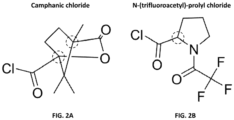
- some exemplary derivatizing reagents comprise camphanic chloride; N-(trifluoroacetyl)prolyl chloride; BOC-L-cysteine; N ⁇ -(2,4-Dinitro-5-fluorophenyl)-L-valinamide; N-Isobutyryl-L-cysteine; N ⁇ -(2,4-Dinitro-5-fluorophenyl)-L-alaninamide; 2,3,4,6-Tetra-O-acetyl- ⁇ -D-glucopyranosyl isothiocyanate; 2,3,4-Tri-O-acetyl- ⁇ -D-arabinopyranosyl isothiocyanate; (1R,4aS,10aR)-7-Isopropyl-1-isothiocyanato-1,4a-dimethyl-1,2,3,4,4a,9,10,10a-octahydrophenanthrene; N-(7
- camphanic chloride FIG. 2A
- N-(trifluoroacetyl)prolyl chloride and FIG. 2B each of which is commercially available in enantiomerically-pure form.
- these exemplary derivatizing reagents comprise at least one chiral center (two in the case of camphanic chloride).
- camphanic chloride can exhibit four stereoisomers: 1R,4R-camphanic chloride, 1R,4S-camphanic chloride, 1S,4R-camphanic chloride, and 1S,4S-camphanic chloride. It will be appreciated by a person skilled in the art that of these four chiral forms of camphanic chloride, 1R,4R-camphanic chloride and 1 S,4S-camphanic chloride represent one enantiomeric pair while 1R,4S-camphanic chloride and 1S,4R-camphanic chloride represent a second enantiomeric pair.
- 1R,4R-camphanic chloride and 1R,4S-camphanic chloride are considered diastereomers relative to one another due to the common R-configuration about one of the chiral centers (i.e., 1R).
- 1R,4R-camphanic chloride and 1S,4R-camphanic chloride are considered diastereomers relative to one another due to the common R-configuration about one of the chiral centers (i.e., 4R).
- N-(trifluoroacetyl)prolyl chloride is an enantiomer that exhibits two stereoisomeric forms due its single chiral centers: S-(-)-N-(trifluoroacetyl)prolyl chloride and its enantiomer R-(-)-N-(trifluoroacetyl)propyl chloride.
- the derivatizing reagent will be considered enantiomerically-pure within the meaning of the present teachings if one enantiomer comprises greater than 90% of the total quantity of S-(-)-N-(trifluoroacetyl)prolyl chloride and its enantiomer R-(-)-N-(trifluoroacetyl)propyl chloride.
- each of these exemplary derivatizing reagents includes an acyl halide group that can react with the enantiomers as described below with respect to FIGS. 3-5
- enantiomerically-pure derivatizing reagents comprising other functional groups such as amines and alcohols can be used in accordance with various aspects of the present teachings to react with the sample enantiomers, all by way of non-limiting example.
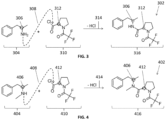
- an exemplary reaction scheme 302 is depicted for reacting the enantiomers R/S-amphetamine 304 with enantiomerically-pure S-(-)-N-(trifluoroacetyl)prolyl chloride 310.
- the hydroxyl group of the amphetamine 304 (which exhibits one chiral center and is present in both enantiomeric forms R-amphetamine and S-amphetamine) reacts 308 with the carbon from the acyl halide group of the S-(-)-N-(trifluoroacetyl)prolyl chloride enantiomer (exhibiting one chiral centers 312).
- N-(trifluoroacetyl)prolyl amphetamine 316 exhibits two chiral centers (306 and 312) and would be present in two diastereomeric forms (S,S-(trifluoroacetyl)prolyl amphetamine and R,S-(trifluoroacetyl)prolyl amphetamine). It will be noted that the products 316 are considered diastereomers relative to one another because they exhibit a common S configuration about one of the chiral centers.
- an exemplary reaction scheme 402 is depicted for reacting the enantiomers R/S-methamphetamine 404 with enantiomerically-pure S-(-)-N-(trifluoroacetyl)prolyl chloride 410.
- the amine group of the methamphetamine 404 (which exhibits one chiral center and is present in enantiomeric forms R-methamphetamine and S-methamphetamine) reacts 408 with the carbon from the acyl halide group of the (trifluoroacetyl)prolyl chloride enantiomer 410 (exhibiting one chiral center 412).
- N-(trifluoroacetyl)prolyl methamphetamine 416 exhibits two chiral centers (406 and 412) and would be present in two diastereomeric forms (S,S)-N-(trifluoroacetyl)prolyl methamphetamine and (R,S)-N-(trifluoroacetyl)prolyl methamphetamine). It will be noted that the products 416 are considered diastereomers relative to one another because they exhibit a common S configuration about one of the two chiral centers.
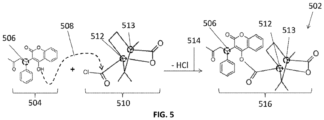
- an exemplary reaction scheme 502 is depicted for reacting the sample enantiomers R/S-warfarin 504 with enantiomerically-pure 1S,4R-camphanic chloride 510.
- the hydroxyl group of the warfarin 504 (which exhibits one chiral center and is present in both enantiomeric forms R-warfarin and S-warfarin) reacts 508 with the carbon from the acyl halide group of the 1S-4R-camphanic chloride enantiomer 510 (exhibiting two chiral centers 512, 513).
- camphanyl warfarin 516 exhibits three chiral centers (506, 512, and 513) and would be present in two diastereomeric forms (R,S,R-camphanyl warfarin and S,S,R-camphanyl warfarin). It will be noted that the products 516 are considered diastereomers relative to one another because they exhibit a common S,R configuration respectively about two of the chiral centers.
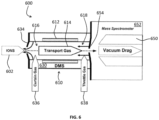
- the reaction products can then be ionized (e.g., via an ion source) as shown in step 104 and subjected to DMS so as to separate the ionized diastereomers based on their differential mobilities.
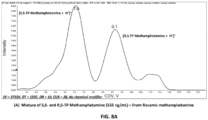
- FIGS. 8B and 8C depict the mass spectra of FIGS. 8B and 8C , which depict the m/z ratios of the fragmentation products of the ions transmitted by the DMS at the CoVs of +9.1 V ( FIG. 8B ) and +7.0 V ( FIG. 8C ) and generated by the 5500 QTRAP ® MS system operated in EPI mode.
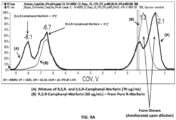
- FIGS. 9A-C exemplary data are depicted demonstrating the separation of the enantiomeric forms of warfarin using DMS.
- warfarin represents a chiral compound having two enantiomeric forms: R- and S-warfarin.
- DMS methods and systems are generally unable to resolve these enantiomers such that the individual enantiomers can be confirmed and/or quantified, methods and systems in accordance with various aspects of the present teachings can allow for this determination by reacting a sample containing the enantiomers of R- and S-warfarin with a enantiomerically-pure 1S,4R-camphanic chloride, as discussed above with reference to FIG. 5 .
- sample A the warfarin comprised a racemic mixture of R- and S-warfarin, each of which is reacted with 1S,4R-camphanic chloride so as to generate a sample containing 70 ⁇ g/mL of two diastereomeric forms: R,S,R-camphanyl warfarin and S,S,R-camphanyl warfarin.
- sample B the warfarin comprised a pure R-warfarin such that the reaction resulted in a single diastereomeric form in the sample at 50 ⁇ g/mL: R,S,R-camphanyl warfarin.
- the ionogram of FIG. 9A was generated by operating the differential mobility spectrometer (SelexION TM , SCIEX, Concord, ON) with an SV of 4000V, DT of 150°C, DR of 16 psi (Curve A) and 20 psi (Curve B), CUR of 10 psi containing 1.5% (v/v) isopropanol, as the CoV applied to the DMS was scanned from about -10V to about +4V DC.
- the DMS was mounted on a 5500 QTRAP ® system (SCIEX), with the total ion intensity (y-axis) reflecting the count of ions transmitted by the DMS at each CoV.
- the curve for sample A containing the two diastereomers of camphanyl warfarin exhibits CoV peaks at -8.1 V and -6.7 V.
- the curve for sample B containing only one of the diastereomers of sample A i.e., R,S,R-camphanyl warfarin
- FIGS. 9B and 9C depict the mass spectra of FIGS. 9B and 9C , which depict the m/z ratios of the fragmentation products of the ions transmitted by the DMS at CoVs of - 6.7 V ( FIG. 9B ) and -8.1 V ( FIG. 9C ) and generated by the 5500 QTRAP ® MS system operated in EPI mode.
Landscapes
- Chemical & Material Sciences (AREA)
- Physics & Mathematics (AREA)
- Spectroscopy & Molecular Physics (AREA)
- Analytical Chemistry (AREA)
- Health & Medical Sciences (AREA)
- Life Sciences & Earth Sciences (AREA)
- General Health & Medical Sciences (AREA)
- Electrochemistry (AREA)
- Chemical Kinetics & Catalysis (AREA)
- Biochemistry (AREA)
- General Physics & Mathematics (AREA)
- Immunology (AREA)
- Pathology (AREA)
- Organic Chemistry (AREA)
- Molecular Biology (AREA)
- Engineering & Computer Science (AREA)
- Plasma & Fusion (AREA)
- Other Investigation Or Analysis Of Materials By Electrical Means (AREA)
Claims (15)
- Procédé d'analyse d'échantillon contenant ou susceptible de contenir au moins un énantiomère d'une paire d'isomères énantiomères, comprenant :a. la mise en réaction, s'il est présent, de chaque énantiomère d'une paire d'isomères énantiomères avec un réactif de dérivatisation de manière à former une paire de diastéréomères dont chacun correspond à l'un des énantiomères de la paire d'énantiomères lié par covalence au réactif de dérivatisation ;b. l'ionisation desdits diastéréomères de manière à former des diastéréomères ionisés ; etc. le transport desdits diastéréomères ionisés à travers un spectromètre de mobilité différentielle pour effectuer une séparation desdits diastéréomères ionisés correspondant à chaque énantiomère de la paire d'énantiomères.
- Procédé selon la revendication 1, dans lequel ledit réactif est un composé énantiomériquement pur présentant au moins un centre chiral.
- Procédé selon la revendication 2, dans lequel ledit réactif est un halogénure d'acyle.
- Procédé selon la revendication 3, dans lequel ledit réactif est un de chlorure de S-(-)-N-(trifluoroacétyl)prolyle et de chlorure de R-(-)-N-(trifluoroacétyl)-propyle.
- Procédé selon la revendication 2, dans lequel ledit réactif est un de chlorure 1R,4R-camphanique, de chlorure 1R,4S-camphanique, de chlorure 1S,4R-camphanique, et de chlorure 1S,4S-camphanique.
- Procédé selon la revendication 2, dans lequel ledit réactif présente seulement un centre chiral.
- Procédé selon la revendication 2, dans lequel ledit réactif présente deux centres chiraux.
- Procédé selon la revendication 1, dans lequel lesdits énantiomères comprennent au moins un d'un groupe hydroxyle et d'une amine primaire, et facultativement
dans lequel ladite étape de mise en réaction d'énantiomères comprend la liaison par covalence d'un ou de plusieurs dudit groupe hydroxyle et amine primaire audit réactif de dérivatisation. - Procédé selon la revendication 1, dans lequel une tension de compensation et une tension de séparation sont appliquées au spectromètre de mobilité différentielle de manière à transmettre sélectivement un desdits diastéréomères ionisés.
- Procédé selon la revendication 9, comprenant en outre le balayage de la tension de compensation tout en maintenant la tension de séparation.
- Procédé selon la revendication 9, comprenant en outre l'ajustement d'au moins une de la tension de compensation et de la tension de séparation après une première durée de manière à transmettre sélectivement l'autre desdits diastéréomères ionisés pendant une seconde durée.
- Procédé selon la revendication 1, comprenant en outre l'ajout d'un modificateur chimique à un gaz de dérive pour transporter lesdits diastéréomères ionisés à travers le spectromètre de mobilité différentielle, et facultativement
dans lequel le modificateur chimique est sélectionné dans le groupe consistant en eau, méthanol, isopropanol, acétonitrile et acétone. - Procédé selon la revendication 1, comprenant en outre la détection des diastéréomères ionisés transportés à partir du spectromètre de mobilité différentielle à une première combinaison de tension de compensation et de tension de séparation et à une seconde combinaison de tension de compensation et de tension de séparation appliquées au spectromètre de mobilité différentielle, dans lequel la première combinaison est configurée pour optimiser la transmission du diastéréomère ionisé correspondant à un premier énantiomère de la paire d'énantiomères et la seconde combinaison est configurée pour optimiser la transmission du diastéréomère ionisé correspondant à un second énantiomère de la paire d'énantiomères.
- Procédé selon la revendication 13, comprenant en outre la détermination de l'abondance relative dans l'échantillon des premier et second énantiomères de la paire d'énantiomères.
- Procédé selon la revendication 1, dans lequel le spectromètre de mobilité différentielle comprend une spectrométrie de mobilité ionique à forme d'onde asymétrique en champ intense (FAIMS).
Applications Claiming Priority (2)
| Application Number | Priority Date | Filing Date | Title |
|---|---|---|---|
| US201662323191P | 2016-04-15 | 2016-04-15 | |
| PCT/IB2017/052117 WO2017178988A1 (fr) | 2016-04-15 | 2017-04-12 | Procédés de détection d'énantiomères d'échantillon à l'aide d'une spectrométrie de mobilité différentielle |
Publications (3)
| Publication Number | Publication Date |
|---|---|
| EP3443338A1 EP3443338A1 (fr) | 2019-02-20 |
| EP3443338A4 EP3443338A4 (fr) | 2019-12-18 |
| EP3443338B1 true EP3443338B1 (fr) | 2025-07-09 |
Family
ID=60042384
Family Applications (1)
| Application Number | Title | Priority Date | Filing Date |
|---|---|---|---|
| EP17782030.5A Active EP3443338B1 (fr) | 2016-04-15 | 2017-04-12 | Procédés de détection d'énantiomères d'échantillon à l'aide d'une spectrométrie de mobilité différentielle |
Country Status (4)
| Country | Link |
|---|---|
| US (1) | US11215583B2 (fr) |
| EP (1) | EP3443338B1 (fr) |
| JP (1) | JP7174631B2 (fr) |
| WO (1) | WO2017178988A1 (fr) |
Families Citing this family (7)
| Publication number | Priority date | Publication date | Assignee | Title |
|---|---|---|---|---|
| JP6879120B2 (ja) * | 2017-08-23 | 2021-06-02 | 株式会社島津製作所 | 光学異性体の分析方法及びイオン移動度分析装置 |
| US10663428B2 (en) | 2018-06-29 | 2020-05-26 | Thermo Finnigan Llc | Systems and methods for ion separation using IMS-MS with multiple ion exits |
| US10663430B2 (en) | 2018-08-08 | 2020-05-26 | Thermo Finnigan Llc | Quantitation throughput enhancement by differential mobility based pre-separation |
| CN112146967A (zh) * | 2019-06-28 | 2020-12-29 | Fei 公司 | 用于制备和递送用于带电粒子分析的生物样品的系统和方法 |
| EP4244611A1 (fr) * | 2020-11-11 | 2023-09-20 | DH Technologies Development Pte. Ltd. | Procédé de détection de stéroïdes isomériques à l'aide d'une spectrométrie de mobilité différentielle |
| CN113341054A (zh) * | 2021-04-13 | 2021-09-03 | 河北科技大学 | 一种1-nea对映异构体过量率的测定方法 |
| GB202203746D0 (en) * | 2022-03-17 | 2022-05-04 | Micromass Ltd | Method of determining the enantiomeric purity of an analyte |
Family Cites Families (9)
| Publication number | Priority date | Publication date | Assignee | Title |
|---|---|---|---|---|
| US6461858B1 (en) * | 1998-01-26 | 2002-10-08 | Pharm-Eco Laboratories, Inc. | Enzyme activated supports for enantiomeric separations |
| EP1750119A1 (fr) * | 2005-08-05 | 2007-02-07 | Institut Catala D'Investigacio Quimica | Nouveaux réactifs chiraux pour la détermination d'excès énantiomérique |
| US8884221B2 (en) * | 2006-01-05 | 2014-11-11 | Excellims Corporation | High performance ion mobility spectrometer apparatus and methods |
| US8563322B2 (en) | 2006-04-20 | 2013-10-22 | Axel Mie | Method for separation of molecules |
| US20110045598A1 (en) | 2007-10-17 | 2011-02-24 | Baylor University | Methods for determining enantiomeric purity with improved chiral selectors |
| DE102008013500A1 (de) * | 2008-03-10 | 2009-09-17 | Evonik Degussa Gmbh | Neue chirale Selektoren und stationäre Phasen zur Trennung von Enantiomerengemischen |
| WO2013103841A1 (fr) | 2012-01-05 | 2013-07-11 | Clinical Reference Laboratory, Inc. | Procédés de détermination chirale quantitative de d- et l-énantiomères d'amphétamine et de méthamphétamine |
| EP3152185B1 (fr) | 2014-06-04 | 2023-10-04 | Roche Diagnostics GmbH | Procédé et utilization du sel pour séparer des epimers par spectrométrie de mobilité ionique |
| WO2016030860A1 (fr) * | 2014-08-29 | 2016-03-03 | Dh Technologies Development Pte. Ltd. | Procédés de détection dans un spectromètre à mobilité différentielle au moyen d'un complexe peptide-métal |
-
2017
- 2017-04-12 WO PCT/IB2017/052117 patent/WO2017178988A1/fr not_active Ceased
- 2017-04-12 EP EP17782030.5A patent/EP3443338B1/fr active Active
- 2017-04-12 JP JP2018553967A patent/JP7174631B2/ja active Active
- 2017-04-12 US US16/093,681 patent/US11215583B2/en active Active
Also Published As
| Publication number | Publication date |
|---|---|
| US11215583B2 (en) | 2022-01-04 |
| JP7174631B2 (ja) | 2022-11-17 |
| JP2019511726A (ja) | 2019-04-25 |
| EP3443338A4 (fr) | 2019-12-18 |
| EP3443338A1 (fr) | 2019-02-20 |
| WO2017178988A1 (fr) | 2017-10-19 |
| US20190137447A1 (en) | 2019-05-09 |
Similar Documents
| Publication | Publication Date | Title |
|---|---|---|
| EP3443338B1 (fr) | Procédés de détection d'énantiomères d'échantillon à l'aide d'une spectrométrie de mobilité différentielle | |
| US20070023631A1 (en) | Parallel sample handling for high-throughput mass spectrometric analysis | |
| Choi et al. | Fragmentation patterns of protonated amino acids formed by atmospheric pressure chemical ionization | |
| US10001456B2 (en) | Methods for detection in differential mobility spectrometer using a peptide metal complex | |
| EP2850424B1 (fr) | Procédés pour la détection sélective d'acides biologiquement pertinents | |
| US20150260684A1 (en) | Method and apparatus for ion mobility spectrometry | |
| Luosujärvi et al. | Gas chromatography/mass spectrometry of polychlorinated biphenyls using atmospheric pressure chemical ionization and atmospheric pressure photoionization microchips | |
| US12313589B2 (en) | Liquid chromatography-mass spectrometry (LC-MS) methods for analyzing ampholyte lot variation | |
| EP2939014B1 (fr) | Procédé d'analyse de lipides isomères | |
| de Person et al. | Analysis of native amino acids by liquid chromatography/electrospray ionization mass spectrometry: comparative study between two sources and interfaces | |
| US9164060B2 (en) | Reducing interferences in isobaric tag-based quantification | |
| US11085925B2 (en) | Isomeric reagent tags for differential mobility spectrometry | |
| Galceran et al. | High-performance liquid chromatography—mass spectrometry (pneumatically assisted electrospray) of hydroxy polycyclic aromatic hydrocarbons | |
| US20240003846A1 (en) | Methods For Detection Of Isomeric Steroids Using Differential Mobility Spectrometry | |
| KR20190050432A (ko) | 수소/중수소 교환 질량 분석법 | |
| Moini | Capillary electrophoresis-electrospray ionization mass spectrometry of amino acids, peptides, and proteins | |
| Brown | Advancing Analytical Strategies for Stereoisomer Separation and Glycan Characterization: A HILIC-IM-MS Approach | |
| Raju et al. | Diastereomeric differentiation of norbornene amino acid peptides by electrospray ionization tandem mass spectrometry | |
| Belov et al. | New Developments in LC-MS and Other Hyphenated Techniques |
Legal Events
| Date | Code | Title | Description |
|---|---|---|---|
| STAA | Information on the status of an ep patent application or granted ep patent |
Free format text: STATUS: THE INTERNATIONAL PUBLICATION HAS BEEN MADE |
|
| PUAI | Public reference made under article 153(3) epc to a published international application that has entered the european phase |
Free format text: ORIGINAL CODE: 0009012 |
|
| STAA | Information on the status of an ep patent application or granted ep patent |
Free format text: STATUS: REQUEST FOR EXAMINATION WAS MADE |
|
| 17P | Request for examination filed |
Effective date: 20181109 |
|
| AK | Designated contracting states |
Kind code of ref document: A1 Designated state(s): AL AT BE BG CH CY CZ DE DK EE ES FI FR GB GR HR HU IE IS IT LI LT LU LV MC MK MT NL NO PL PT RO RS SE SI SK SM TR |
|
| AX | Request for extension of the european patent |
Extension state: BA ME |
|
| DAV | Request for validation of the european patent (deleted) | ||
| DAX | Request for extension of the european patent (deleted) | ||
| A4 | Supplementary search report drawn up and despatched |
Effective date: 20191115 |
|
| RIC1 | Information provided on ipc code assigned before grant |
Ipc: G01N 27/62 20060101AFI20191111BHEP |
|
| STAA | Information on the status of an ep patent application or granted ep patent |
Free format text: STATUS: EXAMINATION IS IN PROGRESS |
|
| 17Q | First examination report despatched |
Effective date: 20210305 |
|
| P01 | Opt-out of the competence of the unified patent court (upc) registered |
Effective date: 20230601 |
|
| GRAP | Despatch of communication of intention to grant a patent |
Free format text: ORIGINAL CODE: EPIDOSNIGR1 |
|
| STAA | Information on the status of an ep patent application or granted ep patent |
Free format text: STATUS: GRANT OF PATENT IS INTENDED |
|
| INTG | Intention to grant announced |
Effective date: 20250131 |
|
| GRAS | Grant fee paid |
Free format text: ORIGINAL CODE: EPIDOSNIGR3 |
|
| GRAA | (expected) grant |
Free format text: ORIGINAL CODE: 0009210 |
|
| STAA | Information on the status of an ep patent application or granted ep patent |
Free format text: STATUS: THE PATENT HAS BEEN GRANTED |
|
| AK | Designated contracting states |
Kind code of ref document: B1 Designated state(s): AL AT BE BG CH CY CZ DE DK EE ES FI FR GB GR HR HU IE IS IT LI LT LU LV MC MK MT NL NO PL PT RO RS SE SI SK SM TR |
|
| REG | Reference to a national code |
Ref country code: GB Ref legal event code: FG4D |
|
| REG | Reference to a national code |
Ref country code: CH Ref legal event code: EP |
|
| REG | Reference to a national code |
Ref country code: DE Ref legal event code: R096 Ref document number: 602017090464 Country of ref document: DE |
|
| REG | Reference to a national code |
Ref country code: IE Ref legal event code: FG4D |
|
| REG | Reference to a national code |
Ref country code: NL Ref legal event code: MP Effective date: 20250709 |
|
| PG25 | Lapsed in a contracting state [announced via postgrant information from national office to epo] |
Ref country code: PT Free format text: LAPSE BECAUSE OF FAILURE TO SUBMIT A TRANSLATION OF THE DESCRIPTION OR TO PAY THE FEE WITHIN THE PRESCRIBED TIME-LIMIT Effective date: 20251110 |
|
| PG25 | Lapsed in a contracting state [announced via postgrant information from national office to epo] |
Ref country code: NL Free format text: LAPSE BECAUSE OF FAILURE TO SUBMIT A TRANSLATION OF THE DESCRIPTION OR TO PAY THE FEE WITHIN THE PRESCRIBED TIME-LIMIT Effective date: 20250709 |
|
| REG | Reference to a national code |
Ref country code: AT Ref legal event code: MK05 Ref document number: 1812228 Country of ref document: AT Kind code of ref document: T Effective date: 20250709 |
|
| PG25 | Lapsed in a contracting state [announced via postgrant information from national office to epo] |
Ref country code: IS Free format text: LAPSE BECAUSE OF FAILURE TO SUBMIT A TRANSLATION OF THE DESCRIPTION OR TO PAY THE FEE WITHIN THE PRESCRIBED TIME-LIMIT Effective date: 20251109 |
|
| PG25 | Lapsed in a contracting state [announced via postgrant information from national office to epo] |
Ref country code: NO Free format text: LAPSE BECAUSE OF FAILURE TO SUBMIT A TRANSLATION OF THE DESCRIPTION OR TO PAY THE FEE WITHIN THE PRESCRIBED TIME-LIMIT Effective date: 20251009 |
|
| REG | Reference to a national code |
Ref country code: LT Ref legal event code: MG9D |
|
| PG25 | Lapsed in a contracting state [announced via postgrant information from national office to epo] |
Ref country code: AT Free format text: LAPSE BECAUSE OF FAILURE TO SUBMIT A TRANSLATION OF THE DESCRIPTION OR TO PAY THE FEE WITHIN THE PRESCRIBED TIME-LIMIT Effective date: 20250709 |
|
| PG25 | Lapsed in a contracting state [announced via postgrant information from national office to epo] |
Ref country code: FI Free format text: LAPSE BECAUSE OF FAILURE TO SUBMIT A TRANSLATION OF THE DESCRIPTION OR TO PAY THE FEE WITHIN THE PRESCRIBED TIME-LIMIT Effective date: 20250709 |
|
| PG25 | Lapsed in a contracting state [announced via postgrant information from national office to epo] |
Ref country code: HR Free format text: LAPSE BECAUSE OF FAILURE TO SUBMIT A TRANSLATION OF THE DESCRIPTION OR TO PAY THE FEE WITHIN THE PRESCRIBED TIME-LIMIT Effective date: 20250709 |
|
| PG25 | Lapsed in a contracting state [announced via postgrant information from national office to epo] |
Ref country code: GR Free format text: LAPSE BECAUSE OF FAILURE TO SUBMIT A TRANSLATION OF THE DESCRIPTION OR TO PAY THE FEE WITHIN THE PRESCRIBED TIME-LIMIT Effective date: 20251010 |
|
| PG25 | Lapsed in a contracting state [announced via postgrant information from national office to epo] |
Ref country code: SE Free format text: LAPSE BECAUSE OF FAILURE TO SUBMIT A TRANSLATION OF THE DESCRIPTION OR TO PAY THE FEE WITHIN THE PRESCRIBED TIME-LIMIT Effective date: 20250709 |
|
| PG25 | Lapsed in a contracting state [announced via postgrant information from national office to epo] |
Ref country code: LV Free format text: LAPSE BECAUSE OF FAILURE TO SUBMIT A TRANSLATION OF THE DESCRIPTION OR TO PAY THE FEE WITHIN THE PRESCRIBED TIME-LIMIT Effective date: 20250709 |
|
| PG25 | Lapsed in a contracting state [announced via postgrant information from national office to epo] |
Ref country code: BG Free format text: LAPSE BECAUSE OF FAILURE TO SUBMIT A TRANSLATION OF THE DESCRIPTION OR TO PAY THE FEE WITHIN THE PRESCRIBED TIME-LIMIT Effective date: 20250709 Ref country code: PL Free format text: LAPSE BECAUSE OF FAILURE TO SUBMIT A TRANSLATION OF THE DESCRIPTION OR TO PAY THE FEE WITHIN THE PRESCRIBED TIME-LIMIT Effective date: 20250709 |
|
| PG25 | Lapsed in a contracting state [announced via postgrant information from national office to epo] |
Ref country code: RS Free format text: LAPSE BECAUSE OF FAILURE TO SUBMIT A TRANSLATION OF THE DESCRIPTION OR TO PAY THE FEE WITHIN THE PRESCRIBED TIME-LIMIT Effective date: 20251009 |
|
| PG25 | Lapsed in a contracting state [announced via postgrant information from national office to epo] |
Ref country code: ES Free format text: LAPSE BECAUSE OF FAILURE TO SUBMIT A TRANSLATION OF THE DESCRIPTION OR TO PAY THE FEE WITHIN THE PRESCRIBED TIME-LIMIT Effective date: 20250709 |
|
| PG25 | Lapsed in a contracting state [announced via postgrant information from national office to epo] |
Ref country code: SM Free format text: LAPSE BECAUSE OF FAILURE TO SUBMIT A TRANSLATION OF THE DESCRIPTION OR TO PAY THE FEE WITHIN THE PRESCRIBED TIME-LIMIT Effective date: 20250709 |
|
| PGFP | Annual fee paid to national office [announced via postgrant information from national office to epo] |
Ref country code: GB Payment date: 20260226 Year of fee payment: 10 |
|
| PG25 | Lapsed in a contracting state [announced via postgrant information from national office to epo] |
Ref country code: DK Free format text: LAPSE BECAUSE OF FAILURE TO SUBMIT A TRANSLATION OF THE DESCRIPTION OR TO PAY THE FEE WITHIN THE PRESCRIBED TIME-LIMIT Effective date: 20250709 |
|
| PG25 | Lapsed in a contracting state [announced via postgrant information from national office to epo] |
Ref country code: IT Free format text: LAPSE BECAUSE OF FAILURE TO SUBMIT A TRANSLATION OF THE DESCRIPTION OR TO PAY THE FEE WITHIN THE PRESCRIBED TIME-LIMIT Effective date: 20250709 |
|
| PG25 | Lapsed in a contracting state [announced via postgrant information from national office to epo] |
Ref country code: CZ Free format text: LAPSE BECAUSE OF FAILURE TO SUBMIT A TRANSLATION OF THE DESCRIPTION OR TO PAY THE FEE WITHIN THE PRESCRIBED TIME-LIMIT Effective date: 20250709 |
|
| PG25 | Lapsed in a contracting state [announced via postgrant information from national office to epo] |
Ref country code: SK Free format text: LAPSE BECAUSE OF FAILURE TO SUBMIT A TRANSLATION OF THE DESCRIPTION OR TO PAY THE FEE WITHIN THE PRESCRIBED TIME-LIMIT Effective date: 20250709 Ref country code: EE Free format text: LAPSE BECAUSE OF FAILURE TO SUBMIT A TRANSLATION OF THE DESCRIPTION OR TO PAY THE FEE WITHIN THE PRESCRIBED TIME-LIMIT Effective date: 20250709 |