EP3443387B1 - Photocapteurs agencés sur une surface d'un scintillateur - Google Patents
Photocapteurs agencés sur une surface d'un scintillateur Download PDFInfo
- Publication number
- EP3443387B1 EP3443387B1 EP17783315.9A EP17783315A EP3443387B1 EP 3443387 B1 EP3443387 B1 EP 3443387B1 EP 17783315 A EP17783315 A EP 17783315A EP 3443387 B1 EP3443387 B1 EP 3443387B1
- Authority
- EP
- European Patent Office
- Prior art keywords
- scintillator
- photosensor
- radiation detector
- discrete
- disposed
- Prior art date
- Legal status (The legal status is an assumption and is not a legal conclusion. Google has not performed a legal analysis and makes no representation as to the accuracy of the status listed.)
- Active
Links
Images



Classifications
-
- G—PHYSICS
- G01—MEASURING; TESTING
- G01T—MEASUREMENT OF NUCLEAR OR X-RADIATION
- G01T1/00—Measuring X-radiation, gamma radiation, corpuscular radiation, or cosmic radiation
- G01T1/16—Measuring radiation intensity
- G01T1/20—Measuring radiation intensity with scintillation detectors
- G01T1/2018—Scintillation-photodiode combinations
- G01T1/20185—Coupling means between the photodiode and the scintillator, e.g. optical couplings using adhesives with wavelength-shifting fibres
-
- G—PHYSICS
- G01—MEASURING; TESTING
- G01T—MEASUREMENT OF NUCLEAR OR X-RADIATION
- G01T1/00—Measuring X-radiation, gamma radiation, corpuscular radiation, or cosmic radiation
- G01T1/16—Measuring radiation intensity
- G01T1/20—Measuring radiation intensity with scintillation detectors
- G01T1/2002—Optical details, e.g. reflecting or diffusing layers
-
- G—PHYSICS
- G01—MEASURING; TESTING
- G01T—MEASUREMENT OF NUCLEAR OR X-RADIATION
- G01T1/00—Measuring X-radiation, gamma radiation, corpuscular radiation, or cosmic radiation
- G01T1/16—Measuring radiation intensity
- G01T1/20—Measuring radiation intensity with scintillation detectors
- G01T1/2018—Scintillation-photodiode combinations
- G01T1/20184—Detector read-out circuitry, e.g. for clearing of traps, compensating for traps or compensating for direct hits
-
- G—PHYSICS
- G01—MEASURING; TESTING
- G01T—MEASUREMENT OF NUCLEAR OR X-RADIATION
- G01T1/00—Measuring X-radiation, gamma radiation, corpuscular radiation, or cosmic radiation
- G01T1/16—Measuring radiation intensity
- G01T1/20—Measuring radiation intensity with scintillation detectors
- G01T1/2018—Scintillation-photodiode combinations
- G01T1/20186—Position of the photodiode with respect to the incoming radiation, e.g. in the front of, below or sideways the scintillator
-
- G—PHYSICS
- G01—MEASURING; TESTING
- G01T—MEASUREMENT OF NUCLEAR OR X-RADIATION
- G01T1/00—Measuring X-radiation, gamma radiation, corpuscular radiation, or cosmic radiation
- G01T1/16—Measuring radiation intensity
- G01T1/20—Measuring radiation intensity with scintillation detectors
- G01T1/2018—Scintillation-photodiode combinations
- G01T1/20187—Position of the scintillator with respect to the photodiode, e.g. photodiode surrounding the crystal, the crystal surrounding the photodiode, shape or size of the scintillator
Definitions
- the present disclosure is directed to the arrangement of photosensors on a scintillator and methods of using such scintillators and photosensors in a radiation detector.
- Scintillator-based detectors are used in a variety of applications, including research in nuclear physics, oil exploration, field spectroscopy, container and baggage scanning, and medical diagnostics.
- a scintillator material of the scintillator-based detector When a scintillator material of the scintillator-based detector is exposed to ionizing radiation, the scintillator material captures energy of incoming radiation and scintillates, emitting the captured energy in the form of photons.
- a photosensor of the scintillator-based detector detects the emitted photons. Radiation detection apparatuses can analyze pulses for many different reasons. Continued improvements are desired.
- the patent publication JP5150219 B2 discloses a scintillator crystal coupled to a segmented photodiode.
- the term "energy resolution” (also referred to as PHR for pulse height resolution) refers to a parameter measured by recording a spectrum representing the activity of a source as a function of energy, this spectrum describing the full width at half maximum ("FWHM") of a peak which divided by the energy (abscissa of the peak maximum), multiplied by 100%, gives the PHR as a percentage-the lower the PHR, the better the spectral resolution.
- FWHM full width at half maximum
- the terms “comprises,” “comprising,” “includes,” “including,” “has,” “having,” or any other variation thereof, are intended to cover a non-exclusive inclusion.
- a process, method, article, or apparatus that comprises a list of features is not necessarily limited only to those features but may include other features not expressly listed or inherent to such process, method, article, or apparatus.
- “or” refers to an inclusive-or and not to an exclusive-or. For example, a condition A or B is satisfied by any one of the following: A is true (or present) and B is false (or not present), A is false (or not present) and B is true (or present), and both A and B are true (or present).
- the inventors have developed an arrangement of a photosensor applied to a scintillator to improve light collection efficiency and energy resolution.
- a photosensor such as a semiconductor-based photosensor, can be very small and can be read out individually in an array.
- a photosensor can be arranged in various patterns on a surface of a scintillator without covering the entire area of the surface.
- the arrangement of a photosensor on a scintillator surface can include placing a photosensor at each corner or along the peripheral edge of a scintillator surface, instead of at the center of the scintillator surface. Additionally, the aspect ratio of the scintillator can be selected to improve energy resolution.
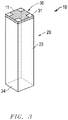
- a radiation detector 10 can include a scintillator 20 and a photosensor system 30 disposed on a scintillator surface 22.
- the photosensor system 30 is placed only on the scintillator surface 22.
- a photosensor can also be disposed on a side surface 23 of the scintillator 20.
- the photosensor 30 does not cover the entire area of the scintillator surface 22.
- the photosensor system 30 can occupy a cumulative area of at most 80%, or at most 60%, or at most 40%, or at most 30%, or at most 25% of the surface area of the scintillator surface 22.
- the photosensor system 30 can occupy a cumulative area of at least 1%, or at least 5%, or at least 10%, or at least 15%, or at least 20% of a total area of scintillator surface 22.
- the photosensor system 30 can occupy a cumulative area within a range of any of the above minimum and maximum values, such as 1 to 80%, or 10 to 40% of the total area of the scintillator surface.
- a total coverage of 15 to 30%, or even 20 to 25% can achieve approximately the same energy resolution as 100% coverage for a NaI(T1) scintillator.
- the photosensor system 30 does not occupy any area within a distance of the center point of the scintillator surface 22 that is 10% of the distance from the center point of the scintillator surface 22 to the nearest peripheral edge of the scintillator surface 22.
- the cumulative area can represent a total area occupied by the photosensor system or a total active area of the photosensor system.
- the photosensor system 30 can include a discrete photosensor 31 or a plurality of discrete photosensor 31 each arranged individually on the surface 22.
- the discrete photosensor 31 can include a solid state photosensor, such as a semiconductor-based photosensor.
- the semiconductor-based photosensor can include, for example, at least one of Si, SiC, GaN, InP, CdTe, or any combination thereof.
- the discrete photosensor 31 can include a silicon-based photosensor.
- an optical window 11 can be disposed between the scintillator 20 and the photosensor 31.
- the optical window 11 can be transmissive to scintillation light given off by the scintillator 20.
- the optical window 11 can include a polymer film, a mineral glass, a sapphire, an aluminum oxynitride, a spinel, or any combination thereof.
- the optical window 11 can include an ultra thin mineral glass having a thickness of no greater than 300 microns.
- a layer of optical coupling material can be disposed on the photosensor 31, the scintillator 20, the optical window 11 if present, or any combination thereof.
- the optical coupling material can include a grease, a resin, an adhesive, or any combination thereof, disposed between the scintillator 20 and the photosensor 31.
- the optical coupling material can also be transmissive to scintillation light given off by the scintillator 20.
- photosensor system 30 can include a discrete photosensor 31 disposed at a corner of scintillator surface 22.
- the photosensor system 30 includes a discrete photosensor disposed at each corner, in a corner configuration.
- the photosensor system 30 includes a discrete photosensor 31 disposed at each corner and along each peripheral edge of the scintillator surface 22, in an edge configuration.
- the edge configuration can include a single discrete photosensor 31 spanning each peripheral edge or a plurality of discrete photosensors arranged side-by-side to span each peripheral edge.
- FIGs. 1 to 5 illustrate the discrete photosensors 31 having a rectangular or square shape.
- the discrete photosensors 31 can have alternative shapes that generally fit in the area near the corner or along the peripheral edges of scintillator surface 22.
- the discrete photosensors 31 can have a triangular shape such that a corner of the triangular shape is disposed on a corner of scintillator surface 22.
- the photosensor system 30 can include a discrete photosensor 31 arranged such that a peripheral edge of the discrete photosensor 31 is flush with the nearest peripheral edge of the scintillator surface 22. While it may be advantageous to have the peripheral edge of the discrete photosensor 31 as close to the nearest peripheral edge of the scintillator surface 22 as possible, achieving flush edges may not be possible in a particular application. In another embodiment, a discrete photosensor 31 can be arranged such that a peripheral edge of the discrete photosensor 31 is spaced apart from the nearest peripheral edge of the scintillator surface 22.
- the shortest distance from the peripheral edge of the discrete photosensor 31 to the nearest peripheral edge of the scintillator surface 22 is at most 3 mm, or at most 2 mm, or at most 1 mm. If not flush, the shortest distance from the peripheral edge of the discrete photosensor 31 to the nearest peripheral edge of the scintillator surface 22 may be at least 1 micron.
- the shortest distance from the peripheral edge of the discrete photosensor 31 to the nearest peripheral edge of the scintillator surface 22 can be at most 10%, or at most 8%, or at most 6%, or at most 4%, or at most 2% of the shortest distance from the nearest peripheral edge of the scintillator surface 22 to the center point of the scintillator surface 22. If not flush, the shortest distance from the peripheral edge of the discrete photosensor 31 to the nearest peripheral edge of the scintillator surface 22 may be at least 0.1% of the shortest distance from the nearest peripheral edge of the scintillator surface 22 to the center point of the scintillator 20.
- the scintillator surface 22 can have a polygonal shape, an arcuate shape, an irregular shape, or the like.
- the scintillator surface 22 has a polygonal shape having a plurality of corners, such as at least 3 corners, or at least 4 corners.
- the polygonal shape has at most 10 corners, or at most 9 corners, or at most 8 corners.
- the polygonal shape includes a rectangular shape and, in the embodiment illustrated in FIGs. 1 and 2 , the scintillator surface 22 has a square shape.
- the scintillator surface 22 has an oval shape or a circle shape.
- the scintillator surface 22 can have an area of at least 500 mm 2 , or at least 700 mm 2 , or at least 900 mm 2 . In an embodiment, surface 22 can have an area of at most 40000 mm 2 , or at most 30000 mm 2 , or at most 20000 mm 2 . For example, surface 22 can have an area in a range of any of the above minimum and maximum values, such as 500 to 40000 mm 2 , or 700 to 30000 mm 2 , or 900 to 20000 mm 2 .
- the scintillator surface 22 can have an average width W S calculated by taking an average of the shortest distance from the center point of the scintillator surface 22 to each peripheral edge of the scintillator surface 22.
- the average width W S is calculated by taking an average of the diameter along the major axis and the diameter along the minor axis.
- the scintillator surface 22 has an average width W S of at least 10 mm, or at least 15 mm, or at least 20 mm.
- surface 22 has an average width W S of at most 600 mm, or at most 500 mm, or at most 400 mm.
- surface 22 can have an average width W S in a range of any of the above minimum or maximum values, such as 15 to 600 mm, or 20 to 500, or 20 to 400 mm.
- the photosensor system 30 can be disposed on more than one surface of the scintillator 20. In an embodiment the photosensor system 30 can be disposed on opposing scintillator surfaces, each having discrete photosensors 31 disposed thereon. In the embodiment illustrated in FIG. 2 , the discrete photosensors 31 are only disposed on opposing scintillator surfaces 22 and 24.
- the scintillator surface 24, and a discrete photosensor 31 disposed on the scintillator surface 24, can have one or more of the features described above with respect to the scintillator surface 22, and a discrete photosensor 31 disposed on the scintillator surface 22.
- the size and shape of scintillator surfaces 22 and 24 can be the same or different.
- the shape of the scintillator surfaces 22 and 24 can be the same while the sizes of surfaces 22 and 24 are different, such as a frustum of a cone or pyramid.
- the arrangement of the discrete photosensors 31 on the scintillator surfaces 22 and 24 can be the same or different.
- the scintillator 20 can have a length L measured from the scintillator surface 22 to the scintillator surface 24.
- the length L is greater than or equal to the average width W S of the scintillator surface 22.
- the length L can be at least 10 mm, or at least 20 mm, or at least 30 mm.
- the length L can be at most 5000 mm, or at most 4000 mm, or at most 3000 mm.
- the length L can be in a range of any of the above minimum and maximum values, such as 10 to 5000 mm, or 20 to 4000 mm, or 30 to 3000 mm.
- the scintillator can have a length L within the values discussed above, after reading this specification, a person of ordinary skill in the art will understand how the photosensor system 30 discussed herein could be applied to the surface of a scintillator having a length L that is less than or greater than the values discussed above.
- the scintillator 20 can be a cube having the dimensions of at least 25 mm ⁇ 25 mm ⁇ 25 mm or at least 50 mm ⁇ 50 mm ⁇ 50 mm. In an embodiment, scintillator 20 can be a cuboid having the dimensions of at least 25 mm ⁇ 25 mm ⁇ 50 mm; or at least 50 mm ⁇ 50 mm ⁇ 100 mm; or at least 50 mm ⁇ 100 mm ⁇ 400 mm; or at least 100 mm ⁇ 100 mm ⁇ 400 mm.
- the scintillator 20 can be a cylinder having a diameter of at least 25 mm, or at least 50 mm, or at least 75 mm, or at least 100 mm, or at least 125 mm, and a length of at least 25 mm, or at least 50 mm, or at least 75 mm, or at least 100 mm, or at least 125 mm.
- the length L of the cylinder is the same as the average width W S of the scintillator surface 22 of the cylinder.
- the length L of the cylinder is greater than the diameter of the scintillator surface 22 of the cylinder, even at least twice the diameter of the cylinder.
- the aspect ratio of the scintillator 20 is equal to the length L of the scintillator 20 divided by the average width W S of the scintillator surface 22.
- the energy resolution decreases, which is desired, as the aspect ratio of the scintillator 20 increases from about 1.
- the aspect ratio of the scintillator 20 is at least 1, or at least 1.2, or at least 1.4, or at least 1.6, or at least 1.8.
- the aspect ratio is too high, the energy resolution can begin to increase, which is undesired.
- the aspect ratio of the scintillator 20 may be at most 7, or at most 6.5, or at most 6, or at most 5.5.
- the aspect ratio of the scintillator 20 can be within a range of any of the above minimum and maximum values, such as 1.2 to 7, or 1.4 to 6.5, or 1.6 to 6, or 1.8 to 5.5.
- a radiation detector including a scintillator having an aspect ratio within the above ranges can show a decrease in energy resolution as compared to radiation detectors including scintillators having an aspect ratio outside of these ranges.
- scintillator 20 can have an aspect ratio of 1 to 7; for an energy resolution of at most 6.65%, scintillator 20 can have an aspect ratio of 1.4 to 6.2; and for an energy resolution of at most 6.55, scintillator 20 can have an aspect ratio of 2 to 5.5.
- scintillator 20 can include a scintillator material that is particularly suited for a particular application, so long as a photosensor 30 can be disposed on scintillator 20.
- the scintillator material is an inorganic scintillator material.
- the inorganic scintillator material can include a sodium iodide, a cesium iodide, a bismuth germinate, a lanthanum bromide, a cerium bromide, a lanthanum chloride, a lutetium oxyorthosilicate, a lutetium yttrium oxyorthosilicate, a cesium lithium lanthanum bromide, a cesium lithium lanthanum bromo-chloride, a cesium lithium yttrium chloride, or any combination thereof.
- the scintillator is an organic scintillator material.
- the organic scintillator material can include a plastic scintillator, an anthracene, a stilbene, or any combination thereof.
- the scintillator 20 can be a monolithic scintillator.
- an advantage of the radiation detector described herein includes achieving improved performance while the photosensor cumulatively occupies less than the full area of the surface of the scintillator.
- the radiation detector 10 can have an improved single-end light collection efficiency and dual-end light collection efficiency.
- single-end at least when used with respect to performance parameters of the radiation detector 10 refers to a measurement taken from a single end surface of the scintillator
- dual-end at least when used with respect to performance parameters of the radiation detector, refers to a measurement taken from a two opposing end surfaces of the scintillator.
- the radiation detector 10 can further include an analyzer device electrically coupled to the photosensors 30, as illustrated in FIG. 7 .
- the analyzer device 262 can include hardware and can be at least partly implemented in software, firmware, or a combination thereof.
- the hardware can include a plurality of circuits within an fieldprogrammable gate array (FPGA), an application-specific integrated circuit (ASIC), another integrated circuit or on a printed circuit board, or another suitable device, or any combination thereof.
- the analyzer device 262 can also include a buffer to temporarily store data before the data are analyzed, written to storage, read, transmitted to another component or device, another suitable action is performed on the data, or any combination thereof.
- the analyzer device 262 can include an amplifier 422 coupled to the photosensor system 30, such that an electronic pulse from the photosensor system 30 can be amplified before analysis.
- the amplifier 422 can be coupled to an analog-to-digital converter (ADC) 424 that can digitize the electronic pulse.
- ADC analog-to-digital converter
- the ADC 424 can be coupled to a pulse shape discrimination (PSD) module 442.
- the PSD module 442 can include a FPGA or an ASIC.
- the PSD module 442 can include circuits to analyze the shape of the electronic pulse and determine whether the electronic pulse corresponds to a neutron or gamma radiation.
- the PSD module 442 can use the electronic pulse, information derived from the electronic pulse, and temperature from the temperature sensor with a look-up table to determine whether the electronic pulse corresponds to a neutron or gamma radiation.
- the look-up table can be part of the FPGA or ASIC or may be in another device, such as an integrated circuit, a disk drive, or a suitable persistent memory device.
- the analyzer device 262 can further comprise a neutron counter 462 and a gamma radiation counter 464. If the PSD module 442 determines that an electronic pulse corresponds to a neutron, the PSD module 442 increments the neutron counter 462. If the PSD module 442 determines that an electronic pulse corresponds to gamma radiation, the PSD module 442 increments the gamma radiation counter 464. While FIG. 6 illustrates a dual mode radiation detector, in other embodiments the radiation detector could be single mode radiation detector and the analyzer could include only one of the neutron counter 462 or the gamma radiation counter 464, or may the radiation detector may be used to identify a particular material based on the pulse energy.
- any of the scintillators as previously described can be used in a variety of applications.
- Exemplary applications include radiation detectors for security applications, oil well-logging detectors, gamma ray spectroscopy, isotope identification, Single Positron Emission Computer Tomography (SPECT) or Positron Emission Tomography (PET) analysis, and x-ray imaging.
- the radiation detectors for security applications can include a portal monitor radiation detector, a handheld radiation detector, and a personal radiation detector.
- the simulation was based on cuboidal NaI scintillators having the dimensions of 4 inches (about 10.2 cm) ⁇ 4 inches (about 10.2 cm) ⁇ 16 inches (about 40.6 cm) and plurality of discrete photosensors placed on one or opposing surfaces of the cuboidal NaI scintillators in a corner configuration (see FIG. 4 ), an edge configuration (see FIG. 5 ), and a center configuration (see FIG. 6 ).
- the detector performance improvement was quantified by the width of an Impulse Response Function (IRF).
- IRF Impulse Response Function
- the "impulse” is a collection of pulses in a simulation that generate the same number of photons within the scintillator. In other words, a group of light pulses is generated with an energy resolution of 0%.
- the amount of light collected by the photosensors from each pulse will vary due to variance in absorption and extinction that the geometry will impose on the random photon paths.
- the energy resolution starts out at 0%, the variation in light collection from different parts of the scintillator will worsen the energy resolution. This worsening is captured in the IRF, which has a non-zero FWHM.
- Detector performance is improved when the IRF FWHM is narrow.
- the single-end configurations and R Transfer results are provided in Table 1 and the dual-end configurations and R Transfer results are listed in Table 2.
- SiPM refers to a silicon photomultiplier having an active area of 6 ⁇ 6 mm 2
- PMT refers to a 3.5 inch photomultiplier tube.
- the center configuration appears to the least favorable of the three configurations.
- the R Transfer decreases when the photosensors are in a corner configuration and even more when the photosensors are in an edge configuration, indicating that the photons can be better detected at the corners and the edges of the surface of the scintillator, rather than at the center.
- the cumulative surface area covered in percent of total surface area and pulse height for each cube NaI(T1) scintillator are provided in the graph of FIG. 8 and the cumulative surface area covered in percent of total surface area and energy resolution for each scintillator are illustrated in the graph of FIG. 9 .
- the graph of FIG. 8 indicates that, for a given amount of surface coverage, the amount of light collected (proportional to Pulse Height) was greater when the SiPMs were in a corner configuration vis-à-vis a center configuration.
- the graph of FIG. 9 indicates that the energy resolution is also better when the SiPMs were in a corner configuration vis-à-vis a center configuration.
- the simulation was based on cuboidal NaI scintillators having different aspect ratios but each having a volume of about 6.5 cm 2 .
- a plurality of silicon photomultipliers (SiPM) each having an active area of 6 ⁇ 6 mm 2 were placed on one of the end surfaces of the cuboidal scintillator in a corner configuration (see FIG. 4 ).
- the active area of each photosensor was 6 ⁇ 6 mm 2 .
- the detector performance was quantified using R Transfer as described in Example 1.
- FIGs. 10 and 11 include plots of various performance parameters versus aspect ratio.
- the light collection efficiency (%) is on the left axis and represented by the line including circles
- R Transfer (%) is on the right axis and represented by the line including squares, each measured as the aspect ratio on the horizontal axis increases from left to right.
- Light collection efficiency refers to the fraction of photons that reach a photosensor and is proportional to pulse height.
- the PHR at 662 keV (%) is on the left axis and is measured as the aspect ratio on the horizontal axis increases from left to right.
- Light collection efficiency improves as the percentage increases, whereas geometrical nonuniformity and energy resolution improve as the percentage decreases.
- performance increases as the aspect ratio approaches 4, such as in a range of from 1 to 7, or even 1.5 to 6.
Landscapes
- Spectroscopy & Molecular Physics (AREA)
- Health & Medical Sciences (AREA)
- Life Sciences & Earth Sciences (AREA)
- General Physics & Mathematics (AREA)
- High Energy & Nuclear Physics (AREA)
- Molecular Biology (AREA)
- Physics & Mathematics (AREA)
- Chemical & Material Sciences (AREA)
- Crystallography & Structural Chemistry (AREA)
- Measurement Of Radiation (AREA)
- Nuclear Medicine (AREA)
- Analysing Materials By The Use Of Radiation (AREA)
- Apparatus For Radiation Diagnosis (AREA)
Claims (13)
- Détecteur de rayonnement (10) comprenant :un scintillateur (20) ayant une première surface (22) ; etun système de photocapteur (30) comprenant un photocapteur discret (31) disposé sur la première surface (22) de sorte qu'une distance la plus courte entre un bord périphérique du photocapteur discret (31) et un bord périphérique le plus proche de la première surface (22) soit au plus 10 % d'une distance la plus courte entre le bord périphérique le plus proche de la première surface (22) et un point central de la première surface (22),dans lequel une fenêtre optique (11) est disposée entre le scintillateur (20) et le système de photocapteur (30) ;et au moins l'un des éléments suivants :le système de photocapteur (30) occupe une zone cumulée d'au plus 80 % d'une zone de surface de la première surface (22) etle système de photocapteur (30) n'occupe aucune zone à une distance du point central de la première surface (22) qui est de 10 % de la distance entre le point central de la première surface (22) et le bord périphérique le plus proche de la première surface (22),caractérisé en ce que le scintillateur (20) a un rapport d'aspect de 1,4 à 6,2, le rapport d'aspect étant égal à la longueur L du scintillateur (20) divisée par la largeur moyenne WS de la première surface (22)
- Détecteur de rayonnement (10) selon la revendication 1, dans lequel la distance la plus courte entre le bord périphérique du photocapteur discret (31) et le bord périphérique le plus proche de la première surface (22) est d'au plus 8 %, d'au plus 6 % ou d'au plus 4 % ou d'au plus 2 % de la distance la plus courte entre le bord périphérique le plus proche de la première surface (22) et le point central de la première surface (22).
- Détecteur de rayonnement (10) selon l'une quelconque des revendications précédentes, dans lequel la distance la plus courte entre le bord périphérique du photocapteur discret (31) et le bord périphérique le plus proche de la première surface (22) est d'au plus 3 mm ou d'au plus 2 mm ou d'au plus 1 mm.
- Détecteur de rayonnement (10) selon l'une quelconque des revendications précédentes, dans lequel le scintillateur (20) est un scintillateur polyédrique.
- Détecteur de rayonnement (10) selon l'une quelconque des revendications précédentes, dans lequel la première surface (22) a un coin et le photocapteur discret (31) est disposé au niveau du coin de la première surface (22).
- Détecteur de rayonnement (10) selon l'une quelconque des revendications précédentes, dans lequel le système de photocapteur (30) comprend une pluralité de photocapteurs discrets (31) disposés sur la première surface (22).
- Détecteur de rayonnement (10) selon la revendication 6, dans lequel la première surface (22) a une pluralité de coins et de bords périphériques reliant les coins et la pluralité de photocapteurs discrets (31) sont uniquement disposés au niveau des coins de la première surface (22).
- Détecteur de rayonnement (10) selon la revendication 6, dans lequel la première surface (22) a une pluralité de coins et de bords périphériques reliant les coins et la pluralité de photocapteurs discrets (31) sont disposés à chacun des coins et le long des bords périphériques de la première surface (22).
- Détecteur de rayonnement (10) selon l'une quelconque des revendications précédentes, dans lequel :le scintillateur (20) a une seconde surface (24) opposée à la première surface (22) ;le système de photocapteur (30) comprend une première pluralité de photocapteurs discrets (31) disposés sur la première surface (22) et une seconde pluralité de photocapteurs discrets (31) disposés sur la seconde surface (24) ; etla première et la seconde pluralité de photocapteurs discrets (31) sont disposées sur les première et seconde surfaces (22, 24), respectivement, dans le même agencement.
- Détecteur de rayonnement (10) selon l'une quelconque des revendications précédentes, dans lequel une zone active totale des photocapteurs discrets (31) disposés sur la seconde surface (24) est d'au plus 80 % ou d'au plus 60 % ou d'au plus 40 % ou d'au plus 30 % ou d'au plus 25 % de la zone de surface de la seconde surface (24).
- Détecteur de rayonnement (10) selon l'une quelconque des revendications précédentes, dans lequel le scintillateur (20) a un rapport d'aspect de 2 à 5,5.
- Détecteur de rayonnement (10) selon l'une quelconque des revendications précédentes, dans lequel le scintillateur (20) a un rapport d'aspect dans une plage de 1,6 à 6 ou de 1,8 à 5,5.
- Appareil de détection de rayonnement comprenant :le détecteur de rayonnement (10) selon l'une quelconque des revendications précédentes etun dispositif analyseur (262) couplé électriquement au photocapteur (30),dans lequel l'appareil de détection de rayonnement inclut l'un d'un appareil de détection de sécurité, d'un appareil de détection de diagraphie de puits, d'un appareil de spectroscopie à rayons gamma, d'un appareil d'identification d'isotopes, d'un appareil d'analyse par tomographie par ordinateur à émission unique de positrons (SPECT). d'un appareil d'analyse par tomographie à émission de positrons (TEP) et d'un appareil d'imagerie par rayons X.
Priority Applications (1)
| Application Number | Priority Date | Filing Date | Title |
|---|---|---|---|
| EP22174855.1A EP4080249B1 (fr) | 2016-04-15 | 2017-04-14 | Photocapteurs agencés sur une surface d'un scintillateur |
Applications Claiming Priority (3)
| Application Number | Priority Date | Filing Date | Title |
|---|---|---|---|
| US201662323315P | 2016-04-15 | 2016-04-15 | |
| US201662398074P | 2016-09-22 | 2016-09-22 | |
| PCT/US2017/027769 WO2017181112A2 (fr) | 2016-04-15 | 2017-04-14 | Photocapteurs agencés sur une surface d'un scintillateur |
Related Child Applications (1)
| Application Number | Title | Priority Date | Filing Date |
|---|---|---|---|
| EP22174855.1A Division EP4080249B1 (fr) | 2016-04-15 | 2017-04-14 | Photocapteurs agencés sur une surface d'un scintillateur |
Publications (3)
| Publication Number | Publication Date |
|---|---|
| EP3443387A2 EP3443387A2 (fr) | 2019-02-20 |
| EP3443387A4 EP3443387A4 (fr) | 2019-12-18 |
| EP3443387B1 true EP3443387B1 (fr) | 2022-06-01 |
Family
ID=60041980
Family Applications (2)
| Application Number | Title | Priority Date | Filing Date |
|---|---|---|---|
| EP22174855.1A Active EP4080249B1 (fr) | 2016-04-15 | 2017-04-14 | Photocapteurs agencés sur une surface d'un scintillateur |
| EP17783315.9A Active EP3443387B1 (fr) | 2016-04-15 | 2017-04-14 | Photocapteurs agencés sur une surface d'un scintillateur |
Family Applications Before (1)
| Application Number | Title | Priority Date | Filing Date |
|---|---|---|---|
| EP22174855.1A Active EP4080249B1 (fr) | 2016-04-15 | 2017-04-14 | Photocapteurs agencés sur une surface d'un scintillateur |
Country Status (5)
| Country | Link |
|---|---|
| US (2) | US9952336B2 (fr) |
| EP (2) | EP4080249B1 (fr) |
| JP (2) | JP6775033B2 (fr) |
| CN (1) | CN109073764B (fr) |
| WO (1) | WO2017181112A2 (fr) |
Families Citing this family (10)
| Publication number | Priority date | Publication date | Assignee | Title |
|---|---|---|---|---|
| FR3072783B1 (fr) * | 2017-10-24 | 2020-11-20 | Commissariat Energie Atomique | Systeme de detection de rayonnement ionisant et procede de detection associe |
| JP7176206B2 (ja) * | 2018-03-14 | 2022-11-22 | 富士電機株式会社 | 炭化珪素半導体装置および炭化珪素半導体回路装置 |
| JP2020041944A (ja) * | 2018-09-12 | 2020-03-19 | 株式会社東芝 | 放射線検出器 |
| WO2020208203A1 (fr) * | 2019-04-12 | 2020-10-15 | Arktis Radiation Detectors Ltd. | Détecteur de rayonnement de panneau |
| IT201900010638A1 (it) * | 2019-07-02 | 2021-01-02 | St Microelectronics Srl | Rilevatore di radiazione a scintillatore e dosimetro corrispondente |
| CA3184909A1 (fr) * | 2020-07-14 | 2022-01-20 | Massimo Morichi | Systeme et procede d'identification de menaces nucleaires |
| JP7835736B2 (ja) | 2020-09-02 | 2026-03-25 | ザ・リサーチ・ファウンデーション・フォー・ザ・ステイト・ユニヴァーシティ・オブ・ニューヨーク | テーパ付きシンチレータ結晶モジュールおよびそれを使用する方法 |
| CN116649990B (zh) * | 2022-02-21 | 2025-12-12 | 上海联影医疗科技股份有限公司 | 一种探测器系统及成像设备 |
| US12013503B2 (en) * | 2022-10-07 | 2024-06-18 | Cintilight, Llc | Lateral crystal photodiode readouts and switched diode networks for processing nuclear events |
| US12449554B2 (en) | 2023-10-05 | 2025-10-21 | Cintilight, Llc | Scintillator detectors and methods for positron emission tomography |
Family Cites Families (51)
| Publication number | Priority date | Publication date | Assignee | Title |
|---|---|---|---|---|
| DE10054678A1 (de) * | 2000-11-03 | 2002-05-16 | Siemens Ag | Verfahren zur Herstellung eines ein- oder mehrdimensionalen Detektorarrays |
| US6979826B2 (en) * | 2002-07-29 | 2005-12-27 | Ge Medical Systems Global Technology Company Llc | Scintillator geometry for enhanced radiation detection and reduced error sensitivity |
| US7573035B2 (en) * | 2004-10-29 | 2009-08-11 | Koninklijke Philips Electronics N.V. | GOS ceramic scintillating fiber optics x-ray imaging plate for use in medical DF and RF imaging and in CT |
| JP4534006B2 (ja) * | 2005-09-28 | 2010-09-01 | 独立行政法人放射線医学総合研究所 | 放射線位置検出方法及び装置 |
| US7301153B2 (en) * | 2006-03-23 | 2007-11-27 | Siemens Medical Solutions Usa, Inc. | Photo sensor panel for high resolution PET |
| US7692156B1 (en) * | 2006-08-23 | 2010-04-06 | Radiation Monitoring Devices, Inc. | Beam-oriented pixellated scintillators for radiation imaging |
| US8586933B2 (en) | 2007-04-25 | 2013-11-19 | Koninklijke Philips N.V. | Radiation detector having a split laminate optical coupling |
| CN101796428B (zh) * | 2007-09-07 | 2013-08-07 | 圣戈本陶瓷及塑料股份有限公司 | 减小了边缘效应的检测器 |
| JP5150219B2 (ja) * | 2007-11-14 | 2013-02-20 | 浜松ホトニクス株式会社 | 放射線位置検出器 |
| EP2344906A2 (fr) * | 2008-10-07 | 2011-07-20 | Koninklijke Philips Electronics N.V. | Boîtier pour cristal à scintillation hygroscopique pour imagerie nucléaire |
| WO2010078034A2 (fr) * | 2008-12-17 | 2010-07-08 | Saint-Gobain Ceramics & Plastics, Inc. | Procédé et appareil de réseau de scintillation |
| US8481952B2 (en) * | 2008-12-23 | 2013-07-09 | Saint-Gobain Ceramics & Plastics, Inc. | Scintillation separator |
| US8481948B2 (en) | 2009-03-25 | 2013-07-09 | Koninklijke Philips Electronics N.V. | Method to optimize the light extraction from scintillator crystals in a solid-state detector |
| GB2483400B (en) | 2009-05-21 | 2014-01-08 | Schlumberger Holdings | High strength optical window for radiation detectors |
| US20110042571A1 (en) * | 2009-08-24 | 2011-02-24 | Saint-Gobain Ceramics & Plastics, Inc. | Scintillation Detector Assembly |
| CN102655813B (zh) | 2009-10-27 | 2015-08-12 | 华盛顿大学商业中心 | 用于辐射检测器晶体的光学界面图案形成 |
| US8324583B2 (en) * | 2009-11-12 | 2012-12-04 | Saint-Gobain Ceramics & Plastics, Inc. | Scintillation pixel design and method of operation |
| JP5630756B2 (ja) * | 2010-03-29 | 2014-11-26 | 独立行政法人放射線医学総合研究所 | 3次元放射線位置検出器、及び、その検出位置特定方法 |
| WO2012004703A2 (fr) * | 2010-07-06 | 2012-01-12 | Koninklijke Philips Electronics N.V. | Procédé de production d'un réseau de scintillateurs à espaceurs à base d'argent (ag) |
| CN103069301B (zh) * | 2010-08-30 | 2016-04-27 | 圣戈本陶瓷及塑料股份有限公司 | 包括闪烁体元件阵列的辐射检测系统及其形成方法 |
| WO2012066469A1 (fr) * | 2010-11-18 | 2012-05-24 | Koninklijke Philips Electronics N.V. | Système tep/tdm à détecteur unique |
| US9535169B2 (en) * | 2011-01-04 | 2017-01-03 | Hamamatsu Photonics K.K. | Radiation detector |
| US8993971B2 (en) * | 2011-06-15 | 2015-03-31 | The Board Of Trustees Of The Leland Stanford Junior University | High resolution positron emission tomography |
| US9194959B2 (en) | 2011-07-06 | 2015-11-24 | Siemens Medical Solutions Usa, Inc. | Positron emission tomography detector based on monolithic scintillator crystal |
| US9435898B2 (en) * | 2011-11-17 | 2016-09-06 | The Board Of Trustees Of The Leland Stanford Junior University | Dedicated cardiac PET |
| US9075151B2 (en) * | 2011-12-22 | 2015-07-07 | General Electric Company | Detector array and method of manufacturing the same |
| US9164181B2 (en) * | 2011-12-30 | 2015-10-20 | Saint-Gobain Ceramics & Plastics, Inc. | Scintillation crystals having features on a side, radiation detection apparatuses including such scintillation crystals, and processes of forming the same |
| WO2014099086A2 (fr) * | 2012-09-27 | 2014-06-26 | Saint-Gobain Ceramics & Plastics, Inc. | Réseau de scintillateur, scintillateur, appareil de détection de rayonnement comprenant le réseau de scintillateur ou le scintillateur et ses procédés de fabrication |
| EP2912491B1 (fr) * | 2012-10-26 | 2019-04-10 | Molecubes | Étalonnage de détecteurs à base de cristal monolithiques |
| EP2922067B1 (fr) * | 2012-11-16 | 2018-08-15 | Toray Industries, Inc. | Panneau de scintillateur |
| CN103837881B (zh) * | 2012-11-20 | 2016-06-29 | 李洪弟 | 正电子发射断层成像的检测器模组及其制造方法 |
| ES2727282T3 (es) | 2012-12-21 | 2019-10-15 | General Equipment For Medical Imaging S A Oncovision | Detector de centelleo de rayos gama que conserva la distribución original de la luz de centelleo |
| US9304211B2 (en) * | 2013-01-18 | 2016-04-05 | University Of Manitoba | Scintillation detector with active light guide |
| US10101470B2 (en) * | 2013-09-18 | 2018-10-16 | Koninklijke Philips N.V. | Laser etched scintillation crystals for increased performance |
| WO2015052977A1 (fr) * | 2013-10-07 | 2015-04-16 | 株式会社島津製作所 | Détecteur de rayonnement et procédé de fabrication dudit détecteur de rayonnement |
| EP3111251B1 (fr) * | 2014-02-26 | 2024-04-03 | Luxium Solutions, LLC | Réseau de scintillateurs et procédés de formation d'un réseau de scintillateurs et d'un détecteur de rayonnement |
| US20170014943A1 (en) * | 2014-02-28 | 2017-01-19 | The General Hospital Corporation | System and method for processing radiation detectors using laser beams |
| US10527740B2 (en) * | 2014-04-03 | 2020-01-07 | Siemens Medical Solutions Usa, Inc. | Silicon photomultiplier based TOF-PET detector |
| JP6545565B2 (ja) * | 2014-08-25 | 2019-07-17 | キヤノンメディカルシステムズ株式会社 | 検出器、核医学イメージング装置、pet−ct装置及びpet−mri装置 |
| US9804277B2 (en) * | 2015-01-30 | 2017-10-31 | Hamamatsu Photonics K.K. | Radiation detector |
| US9903960B1 (en) * | 2015-03-17 | 2018-02-27 | Koninklijke Philips N.V. | Scintillation event position determination in a radiation particle detector |
| US11254867B1 (en) * | 2015-04-06 | 2022-02-22 | Radiation Monitoring Devices, Inc. | Thallium-based scintillator materials |
| US9696439B2 (en) * | 2015-08-10 | 2017-07-04 | Shanghai United Imaging Healthcare Co., Ltd. | Apparatus and method for PET detector |
| US20170184728A1 (en) * | 2015-12-29 | 2017-06-29 | General Electric Company | Scintillator configurations and methods for fabricating the same |
| US10497741B2 (en) * | 2016-01-05 | 2019-12-03 | Board Of Regents, The University Of Texas System | Apparatus and methods for optical emission detection |
| WO2019041172A1 (fr) * | 2017-08-30 | 2019-03-07 | Shenzhen United Imaging Healthcare Co., Ltd. | Système, procédé et module de détecteur pour imagerie tep |
| JP6995666B2 (ja) * | 2018-03-01 | 2022-01-14 | キヤノン株式会社 | 放射線撮像装置及び放射線撮像システム |
| WO2020005761A1 (fr) * | 2018-06-29 | 2020-01-02 | Saint-Gobain Ceramics & Plastics, Inc. | Matériau luminescent comprenant des pièges à trous et à électrons et appareil comprenant un tel matériau |
| AU2019374164B2 (en) * | 2018-11-09 | 2025-08-14 | Western Sydney University | "a chromatography component" |
| US11264422B2 (en) * | 2019-08-30 | 2022-03-01 | LightSpin Technologies Inc. | Scalable position-sensitive photodetector device |
| FI3825736T3 (fi) * | 2019-11-22 | 2025-10-02 | Hellma Mat Gmbh | Yksi- ja kaksisuuntaisia comptonin sirontaprosesseja käyttävä kuvantamisilmaisinjärjestelmä gammasäteilyyn |
-
2017
- 2017-04-14 WO PCT/US2017/027769 patent/WO2017181112A2/fr not_active Ceased
- 2017-04-14 JP JP2018554402A patent/JP6775033B2/ja active Active
- 2017-04-14 US US15/488,274 patent/US9952336B2/en not_active Ceased
- 2017-04-14 CN CN201780023751.7A patent/CN109073764B/zh active Active
- 2017-04-14 EP EP22174855.1A patent/EP4080249B1/fr active Active
- 2017-04-14 EP EP17783315.9A patent/EP3443387B1/fr active Active
-
2020
- 2020-04-23 US US16/856,401 patent/USRE49174E1/en active Active
- 2020-10-05 JP JP2020168629A patent/JP7018106B2/ja active Active
Also Published As
| Publication number | Publication date |
|---|---|
| WO2017181112A2 (fr) | 2017-10-19 |
| JP6775033B2 (ja) | 2020-10-28 |
| JP2021012206A (ja) | 2021-02-04 |
| JP2019514008A (ja) | 2019-05-30 |
| WO2017181112A3 (fr) | 2017-11-30 |
| EP4080249B1 (fr) | 2025-01-01 |
| EP3443387A4 (fr) | 2019-12-18 |
| CN109073764B (zh) | 2022-08-16 |
| EP4080249A1 (fr) | 2022-10-26 |
| JP7018106B2 (ja) | 2022-02-09 |
| USRE49174E1 (en) | 2022-08-16 |
| EP3443387A2 (fr) | 2019-02-20 |
| CN109073764A (zh) | 2018-12-21 |
| US20170329024A1 (en) | 2017-11-16 |
| US9952336B2 (en) | 2018-04-24 |
Similar Documents
| Publication | Publication Date | Title |
|---|---|---|
| USRE49174E1 (en) | Photosensors arranged on a surface of a scintillator | |
| US10281594B2 (en) | Gamma-ray Compton TOF camera system | |
| CN102227649B (zh) | 闪烁阵列方法以及器具 | |
| US7601963B2 (en) | High-resolution depth-of-interaction PET detector | |
| US8481952B2 (en) | Scintillation separator | |
| Jeong et al. | Development of hand-held coded-aperture gamma ray imaging system based on GAGG (Ce) scintillator coupled with SiPM array | |
| US11726216B2 (en) | Radiation detection apparatus having a reflector | |
| US8692205B2 (en) | Combined method for detecting and positioning high energy radiation | |
| US20170212251A1 (en) | Multiple spatial resolution scintillation detectors | |
| US20130193331A1 (en) | Scintillation pixel array with reduced cross talk | |
| WO2012152587A2 (fr) | Détecteur gamma basé sur des photodiodes à avalanche polarisées en mode geiger | |
| US11686864B2 (en) | Scintillator array with high detective quantum efficiency | |
| EP3236290A1 (fr) | Cristal de scintillation combiné, détecteur de scintillation combiné et dispositif de détection de rayonnement | |
| Sosa et al. | Energy resolution experiments of conical organic scintillators and a comparison with Geant4 simulations | |
| US20170293038A1 (en) | Compact radiation detector | |
| US9395451B2 (en) | Apparatus including a light emitting device, a layer having a positive refractive index, and a layer having a negative refractive index | |
| Ruch et al. | Comparison between silicon photomultipliers and photomultiplier tubes for pulse shape discrimination with stilbene | |
| Joung et al. | Investigation on a bar detector with 3D position decoding scheme | |
| WO2018213076A1 (fr) | Système de fixation d'un dispositif scintillateur, scintillateur associé et procédé associé |
Legal Events
| Date | Code | Title | Description |
|---|---|---|---|
| STAA | Information on the status of an ep patent application or granted ep patent |
Free format text: STATUS: THE INTERNATIONAL PUBLICATION HAS BEEN MADE |
|
| PUAI | Public reference made under article 153(3) epc to a published international application that has entered the european phase |
Free format text: ORIGINAL CODE: 0009012 |
|
| STAA | Information on the status of an ep patent application or granted ep patent |
Free format text: STATUS: REQUEST FOR EXAMINATION WAS MADE |
|
| 17P | Request for examination filed |
Effective date: 20181113 |
|
| AK | Designated contracting states |
Kind code of ref document: A2 Designated state(s): AL AT BE BG CH CY CZ DE DK EE ES FI FR GB GR HR HU IE IS IT LI LT LU LV MC MK MT NL NO PL PT RO RS SE SI SK SM TR |
|
| AX | Request for extension of the european patent |
Extension state: BA ME |
|
| DAV | Request for validation of the european patent (deleted) | ||
| DAX | Request for extension of the european patent (deleted) | ||
| A4 | Supplementary search report drawn up and despatched |
Effective date: 20191120 |
|
| RIC1 | Information provided on ipc code assigned before grant |
Ipc: G01T 1/20 20060101AFI20191114BHEP |
|
| REG | Reference to a national code |
Ref country code: DE Ref legal event code: R079 Ref document number: 602017058055 Country of ref document: DE Free format text: PREVIOUS MAIN CLASS: G01T0001100000 Ipc: G01T0001200000 |
|
| GRAP | Despatch of communication of intention to grant a patent |
Free format text: ORIGINAL CODE: EPIDOSNIGR1 |
|
| STAA | Information on the status of an ep patent application or granted ep patent |
Free format text: STATUS: GRANT OF PATENT IS INTENDED |
|
| RIC1 | Information provided on ipc code assigned before grant |
Ipc: G01T 1/20 20060101AFI20210527BHEP |
|
| INTG | Intention to grant announced |
Effective date: 20210616 |
|
| GRAJ | Information related to disapproval of communication of intention to grant by the applicant or resumption of examination proceedings by the epo deleted |
Free format text: ORIGINAL CODE: EPIDOSDIGR1 |
|
| STAA | Information on the status of an ep patent application or granted ep patent |
Free format text: STATUS: REQUEST FOR EXAMINATION WAS MADE |
|
| INTC | Intention to grant announced (deleted) | ||
| GRAP | Despatch of communication of intention to grant a patent |
Free format text: ORIGINAL CODE: EPIDOSNIGR1 |
|
| STAA | Information on the status of an ep patent application or granted ep patent |
Free format text: STATUS: GRANT OF PATENT IS INTENDED |
|
| INTG | Intention to grant announced |
Effective date: 20211126 |
|
| GRAS | Grant fee paid |
Free format text: ORIGINAL CODE: EPIDOSNIGR3 |
|
| GRAA | (expected) grant |
Free format text: ORIGINAL CODE: 0009210 |
|
| STAA | Information on the status of an ep patent application or granted ep patent |
Free format text: STATUS: THE PATENT HAS BEEN GRANTED |
|
| AK | Designated contracting states |
Kind code of ref document: B1 Designated state(s): AL AT BE BG CH CY CZ DE DK EE ES FI FR GB GR HR HU IE IS IT LI LT LU LV MC MK MT NL NO PL PT RO RS SE SI SK SM TR |
|
| REG | Reference to a national code |
Ref country code: GB Ref legal event code: FG4D |
|
| REG | Reference to a national code |
Ref country code: AT Ref legal event code: REF Ref document number: 1495770 Country of ref document: AT Kind code of ref document: T Effective date: 20220615 Ref country code: CH Ref legal event code: EP |
|
| REG | Reference to a national code |
Ref country code: IE Ref legal event code: FG4D |
|
| REG | Reference to a national code |
Ref country code: DE Ref legal event code: R096 Ref document number: 602017058055 Country of ref document: DE |
|
| REG | Reference to a national code |
Ref country code: NL Ref legal event code: FP |
|
| REG | Reference to a national code |
Ref country code: LT Ref legal event code: MG9D |
|
| PG25 | Lapsed in a contracting state [announced via postgrant information from national office to epo] |
Ref country code: SE Free format text: LAPSE BECAUSE OF FAILURE TO SUBMIT A TRANSLATION OF THE DESCRIPTION OR TO PAY THE FEE WITHIN THE PRESCRIBED TIME-LIMIT Effective date: 20220601 Ref country code: NO Free format text: LAPSE BECAUSE OF FAILURE TO SUBMIT A TRANSLATION OF THE DESCRIPTION OR TO PAY THE FEE WITHIN THE PRESCRIBED TIME-LIMIT Effective date: 20220901 Ref country code: LT Free format text: LAPSE BECAUSE OF FAILURE TO SUBMIT A TRANSLATION OF THE DESCRIPTION OR TO PAY THE FEE WITHIN THE PRESCRIBED TIME-LIMIT Effective date: 20220601 Ref country code: HR Free format text: LAPSE BECAUSE OF FAILURE TO SUBMIT A TRANSLATION OF THE DESCRIPTION OR TO PAY THE FEE WITHIN THE PRESCRIBED TIME-LIMIT Effective date: 20220601 Ref country code: GR Free format text: LAPSE BECAUSE OF FAILURE TO SUBMIT A TRANSLATION OF THE DESCRIPTION OR TO PAY THE FEE WITHIN THE PRESCRIBED TIME-LIMIT Effective date: 20220902 Ref country code: FI Free format text: LAPSE BECAUSE OF FAILURE TO SUBMIT A TRANSLATION OF THE DESCRIPTION OR TO PAY THE FEE WITHIN THE PRESCRIBED TIME-LIMIT Effective date: 20220601 Ref country code: ES Free format text: LAPSE BECAUSE OF FAILURE TO SUBMIT A TRANSLATION OF THE DESCRIPTION OR TO PAY THE FEE WITHIN THE PRESCRIBED TIME-LIMIT Effective date: 20220601 Ref country code: BG Free format text: LAPSE BECAUSE OF FAILURE TO SUBMIT A TRANSLATION OF THE DESCRIPTION OR TO PAY THE FEE WITHIN THE PRESCRIBED TIME-LIMIT Effective date: 20220901 |
|
| REG | Reference to a national code |
Ref country code: AT Ref legal event code: MK05 Ref document number: 1495770 Country of ref document: AT Kind code of ref document: T Effective date: 20220601 |
|
| PG25 | Lapsed in a contracting state [announced via postgrant information from national office to epo] |
Ref country code: RS Free format text: LAPSE BECAUSE OF FAILURE TO SUBMIT A TRANSLATION OF THE DESCRIPTION OR TO PAY THE FEE WITHIN THE PRESCRIBED TIME-LIMIT Effective date: 20220601 Ref country code: PL Free format text: LAPSE BECAUSE OF FAILURE TO SUBMIT A TRANSLATION OF THE DESCRIPTION OR TO PAY THE FEE WITHIN THE PRESCRIBED TIME-LIMIT Effective date: 20220601 Ref country code: LV Free format text: LAPSE BECAUSE OF FAILURE TO SUBMIT A TRANSLATION OF THE DESCRIPTION OR TO PAY THE FEE WITHIN THE PRESCRIBED TIME-LIMIT Effective date: 20220601 |
|
| PG25 | Lapsed in a contracting state [announced via postgrant information from national office to epo] |
Ref country code: SM Free format text: LAPSE BECAUSE OF FAILURE TO SUBMIT A TRANSLATION OF THE DESCRIPTION OR TO PAY THE FEE WITHIN THE PRESCRIBED TIME-LIMIT Effective date: 20220601 Ref country code: SK Free format text: LAPSE BECAUSE OF FAILURE TO SUBMIT A TRANSLATION OF THE DESCRIPTION OR TO PAY THE FEE WITHIN THE PRESCRIBED TIME-LIMIT Effective date: 20220601 Ref country code: RO Free format text: LAPSE BECAUSE OF FAILURE TO SUBMIT A TRANSLATION OF THE DESCRIPTION OR TO PAY THE FEE WITHIN THE PRESCRIBED TIME-LIMIT Effective date: 20220601 Ref country code: PT Free format text: LAPSE BECAUSE OF FAILURE TO SUBMIT A TRANSLATION OF THE DESCRIPTION OR TO PAY THE FEE WITHIN THE PRESCRIBED TIME-LIMIT Effective date: 20221003 Ref country code: EE Free format text: LAPSE BECAUSE OF FAILURE TO SUBMIT A TRANSLATION OF THE DESCRIPTION OR TO PAY THE FEE WITHIN THE PRESCRIBED TIME-LIMIT Effective date: 20220601 Ref country code: CZ Free format text: LAPSE BECAUSE OF FAILURE TO SUBMIT A TRANSLATION OF THE DESCRIPTION OR TO PAY THE FEE WITHIN THE PRESCRIBED TIME-LIMIT Effective date: 20220601 Ref country code: AT Free format text: LAPSE BECAUSE OF FAILURE TO SUBMIT A TRANSLATION OF THE DESCRIPTION OR TO PAY THE FEE WITHIN THE PRESCRIBED TIME-LIMIT Effective date: 20220601 |
|
| PG25 | Lapsed in a contracting state [announced via postgrant information from national office to epo] |
Ref country code: IS Free format text: LAPSE BECAUSE OF FAILURE TO SUBMIT A TRANSLATION OF THE DESCRIPTION OR TO PAY THE FEE WITHIN THE PRESCRIBED TIME-LIMIT Effective date: 20221001 |
|
| REG | Reference to a national code |
Ref country code: DE Ref legal event code: R097 Ref document number: 602017058055 Country of ref document: DE |
|
| PG25 | Lapsed in a contracting state [announced via postgrant information from national office to epo] |
Ref country code: AL Free format text: LAPSE BECAUSE OF FAILURE TO SUBMIT A TRANSLATION OF THE DESCRIPTION OR TO PAY THE FEE WITHIN THE PRESCRIBED TIME-LIMIT Effective date: 20220601 |
|
| PLBE | No opposition filed within time limit |
Free format text: ORIGINAL CODE: 0009261 |
|
| STAA | Information on the status of an ep patent application or granted ep patent |
Free format text: STATUS: NO OPPOSITION FILED WITHIN TIME LIMIT |
|
| PG25 | Lapsed in a contracting state [announced via postgrant information from national office to epo] |
Ref country code: DK Free format text: LAPSE BECAUSE OF FAILURE TO SUBMIT A TRANSLATION OF THE DESCRIPTION OR TO PAY THE FEE WITHIN THE PRESCRIBED TIME-LIMIT Effective date: 20220601 |
|
| 26N | No opposition filed |
Effective date: 20230302 |
|
| PG25 | Lapsed in a contracting state [announced via postgrant information from national office to epo] |
Ref country code: SI Free format text: LAPSE BECAUSE OF FAILURE TO SUBMIT A TRANSLATION OF THE DESCRIPTION OR TO PAY THE FEE WITHIN THE PRESCRIBED TIME-LIMIT Effective date: 20220601 |
|
| REG | Reference to a national code |
Ref country code: GB Ref legal event code: 732E Free format text: REGISTERED BETWEEN 20230504 AND 20230510 |
|
| REG | Reference to a national code |
Ref country code: DE Ref legal event code: R119 Ref document number: 602017058055 Country of ref document: DE |
|
| REG | Reference to a national code |
Ref country code: CH Ref legal event code: PL |
|
| PG25 | Lapsed in a contracting state [announced via postgrant information from national office to epo] |
Ref country code: LU Free format text: LAPSE BECAUSE OF NON-PAYMENT OF DUE FEES Effective date: 20230414 |
|
| REG | Reference to a national code |
Ref country code: BE Ref legal event code: MM Effective date: 20230430 |
|
| PG25 | Lapsed in a contracting state [announced via postgrant information from national office to epo] |
Ref country code: MC Free format text: LAPSE BECAUSE OF FAILURE TO SUBMIT A TRANSLATION OF THE DESCRIPTION OR TO PAY THE FEE WITHIN THE PRESCRIBED TIME-LIMIT Effective date: 20220601 |
|
| PG25 | Lapsed in a contracting state [announced via postgrant information from national office to epo] |
Ref country code: MC Free format text: LAPSE BECAUSE OF FAILURE TO SUBMIT A TRANSLATION OF THE DESCRIPTION OR TO PAY THE FEE WITHIN THE PRESCRIBED TIME-LIMIT Effective date: 20220601 Ref country code: LI Free format text: LAPSE BECAUSE OF NON-PAYMENT OF DUE FEES Effective date: 20230430 Ref country code: IT Free format text: LAPSE BECAUSE OF FAILURE TO SUBMIT A TRANSLATION OF THE DESCRIPTION OR TO PAY THE FEE WITHIN THE PRESCRIBED TIME-LIMIT Effective date: 20220601 Ref country code: DE Free format text: LAPSE BECAUSE OF NON-PAYMENT OF DUE FEES Effective date: 20231103 Ref country code: CH Free format text: LAPSE BECAUSE OF NON-PAYMENT OF DUE FEES Effective date: 20230430 |
|
| REG | Reference to a national code |
Ref country code: IE Ref legal event code: MM4A |
|
| PG25 | Lapsed in a contracting state [announced via postgrant information from national office to epo] |
Ref country code: BE Free format text: LAPSE BECAUSE OF NON-PAYMENT OF DUE FEES Effective date: 20230430 |
|
| PG25 | Lapsed in a contracting state [announced via postgrant information from national office to epo] |
Ref country code: IE Free format text: LAPSE BECAUSE OF NON-PAYMENT OF DUE FEES Effective date: 20230414 |
|
| PG25 | Lapsed in a contracting state [announced via postgrant information from national office to epo] |
Ref country code: IE Free format text: LAPSE BECAUSE OF NON-PAYMENT OF DUE FEES Effective date: 20230414 |
|
| PG25 | Lapsed in a contracting state [announced via postgrant information from national office to epo] |
Ref country code: BG Free format text: LAPSE BECAUSE OF FAILURE TO SUBMIT A TRANSLATION OF THE DESCRIPTION OR TO PAY THE FEE WITHIN THE PRESCRIBED TIME-LIMIT Effective date: 20220601 |
|
| REG | Reference to a national code |
Ref country code: NL Ref legal event code: PD Owner name: LUXIUM SOLUTIONS, LLC; US Free format text: DETAILS ASSIGNMENT: CHANGE OF OWNER(S), ASSIGNMENT; FORMER OWNER NAME: SAINT-GOBAIN CERAMICS & PLASTICS, INC. Effective date: 20241113 |
|
| PG25 | Lapsed in a contracting state [announced via postgrant information from national office to epo] |
Ref country code: BG Free format text: LAPSE BECAUSE OF FAILURE TO SUBMIT A TRANSLATION OF THE DESCRIPTION OR TO PAY THE FEE WITHIN THE PRESCRIBED TIME-LIMIT Effective date: 20220601 |
|
| PGFP | Annual fee paid to national office [announced via postgrant information from national office to epo] |
Ref country code: NL Payment date: 20250427 Year of fee payment: 9 |
|
| PGFP | Annual fee paid to national office [announced via postgrant information from national office to epo] |
Ref country code: GB Payment date: 20250428 Year of fee payment: 9 |
|
| PGFP | Annual fee paid to national office [announced via postgrant information from national office to epo] |
Ref country code: FR Payment date: 20250425 Year of fee payment: 9 |
|
| PG25 | Lapsed in a contracting state [announced via postgrant information from national office to epo] |
Ref country code: CY Free format text: LAPSE BECAUSE OF FAILURE TO SUBMIT A TRANSLATION OF THE DESCRIPTION OR TO PAY THE FEE WITHIN THE PRESCRIBED TIME-LIMIT; INVALID AB INITIO Effective date: 20170414 |
|
| PG25 | Lapsed in a contracting state [announced via postgrant information from national office to epo] |
Ref country code: HU Free format text: LAPSE BECAUSE OF FAILURE TO SUBMIT A TRANSLATION OF THE DESCRIPTION OR TO PAY THE FEE WITHIN THE PRESCRIBED TIME-LIMIT; INVALID AB INITIO Effective date: 20170414 |
|
| PG25 | Lapsed in a contracting state [announced via postgrant information from national office to epo] |
Ref country code: TR Free format text: LAPSE BECAUSE OF FAILURE TO SUBMIT A TRANSLATION OF THE DESCRIPTION OR TO PAY THE FEE WITHIN THE PRESCRIBED TIME-LIMIT Effective date: 20220601 |